Chap 17. Teams and Teamwork môn Principle of Management | Trường Đại học Quốc tế, Đại học Quốc gia Thành phố Hồ Chí Minh
Synergy (sức mạnh tổng hợp) - is the creation of a whole greater than the sum of its individual parts. Tài liệu giúp bạn tham khảo, ôn tập và đạt kết quả cao. Mời đọc đón xem!
Môn: Principles of Management 187 tài liệu
Trường: Trường Đại học Quốc tế, Đại học Quốc gia Thành phố Hồ Chí Minh 1.5 K tài liệu
Tác giả:













Preview text:
Chap 17. Teams and Teamwork 1. Teams in Organizations
A team is a collection of people who regularly interact to pursue common goals.
Teamwork is the process of people actively working together to accomplish common goals.
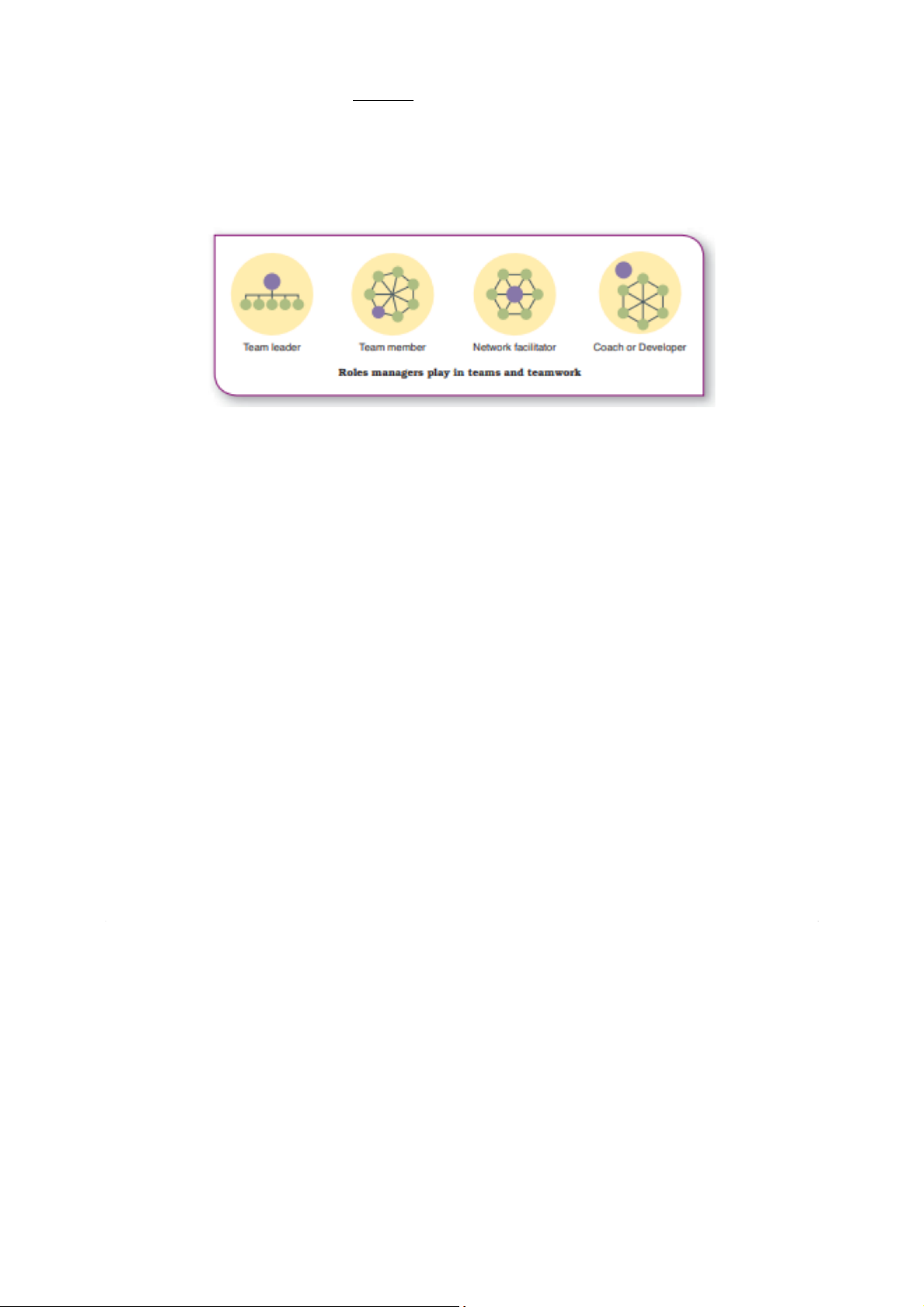
=> Managers must be prepared to perform at least four important teamwork roles.
A team leader - serves as the appointed head of a team or work unit.
A team member - serves as a helpful contributing part of a project team.
A network facilitator - serves as the peer leader and networking hub for a special task force.
A coach or developer - serves as a team’s advisor on ways to improve processes and performance. - Teamwork pros
+ Synergy (sức mạnh tổng hợp) - is the creation of a whole greater than the sum of its individual parts.
Synergy pools individual talents and eff orts to create extraordinary results through collective action. + The Many Benefits of Teams
Performance gains through synergy
More resources for problem solving
Improved creativity and innovation
Improved quality of decision making
Greater member commitment to tasks
Increased motivation of members
Increased need satisfaction of members - Teamwork cons
+ Social loafing is the tendency of some people to avoid responsibility by “freeriding” in groups. Lười biếng xã hội
là hiệu ứng tâm lý miêu tả xu hướng một người bỏ ít công
sức hơn khi làm việc nhóm. Dù tất cả thành viên đang chung sức cho cùng
một mục đích, mỗi cá nhân lại đóng góp ít hơn so với khả năng thật sự mà
họ có thể khi thực hiện chúng một mình.
there are things a leader or concerned team members can do in such cases.
The possibilities include making individual contributions more visible,
rewarding individuals for their contributions, making task assignments more
interesting, and keeping group size small so that free-riders are more subject
to peer pressure and leader evaluation. - Meetings, meetings, meetings
1. People arrive late, leave early, and don’t take things seriously.
2. The meeting is too long, sometimes twice as long as necessary.
3. People don’t stay on topic; they digress and are easily distracted.
4. The discussion lacks candor; people are unwilling to tell the truth.
5. The right information isn’t available, so decisions are postponed.
6. Nothing happens when the meeting is over; no one puts decisions into action.
7. Things never get better; the same mistakes are made meeting after meeting.
- Organizations as Networks of Teams
+ A formal group is a team offi cially recognized and supported by the organization.
VD: departments (e.g., market research department), units (e.g., audit unit), teams
(e.g., customer service team), or divisions (e.g., office products division)
+ An informal group is unoffi cial and emerges from relationships and shared interests among members.
2. Trends in the Use of Teams
- Committees, project teams, and task forces
+ A committee is designated to work on a special task on a continuing basis. => A
committee brings people together outside of their daily job assignments to work in
a small team for a specific purpose.
+ A project team or task force is convened for a specific purpose and disbands
when its task is completed. => Project teams or task forces bring people together to
work on common problems, but on a temporary rather than permanent basis. - Cross-Functional Teams
+ A cross-functional team operates with members who come from different
functional units of an organization
+ The functional chimneys problem is a lack of communication across functions.
These teams help reduce the functional chimneys problem by eliminating
“walls” that may otherwise limit communication and cooperation among
people from diff erent departments and functions. - Self-Managing Teams
Members of a self-managing work team have the authority to make decisions about
how they share and complete their work.
these teams operate with a high degree of task interdependence, authority to
make many decisions about how they work, and collective responsibility for results.
The “self-management” responsibilities include planning and scheduling
work, training members in various tasks, distributing tasks, meeting
performance goals, ensuring high quality, and solving day-to-day operating problems - Virtual team
Members of a virtual team or distributed team work together and solve problems
through computer-based interactions. + Potential advantages:
Virtual teams can save time and travel expenses when members work in different locations
To be easily expanded to include more members as needed, and the
discussions and shared information can be archived for later access.
Virtual teams are usually quite efficient because members are less prone to
stray off task and get sidetracked by interpersonal difficulties. + Potential disadvantages:
The lack of face-to-face interaction in virtual teams creates potential disadvantages.
It limits the role of emotions and nonverbal cues in communication and
allows relationships to stay depersonalized - Team building
Team building is a sequence of activities to analyze a team and make changes to improve its performance.
The process begins with awareness that a problem may exist or may develop
within the team. Members then work together to gather data and fully understand
the problem, make plans to correct it, implement the plans, and evaluate results.
This whole process is repeated as diffi culties or new problems are discovered
=> Team building engages team members in a process of assessment and action
planning to improve teamwork and future performance. 3. How Teams Work
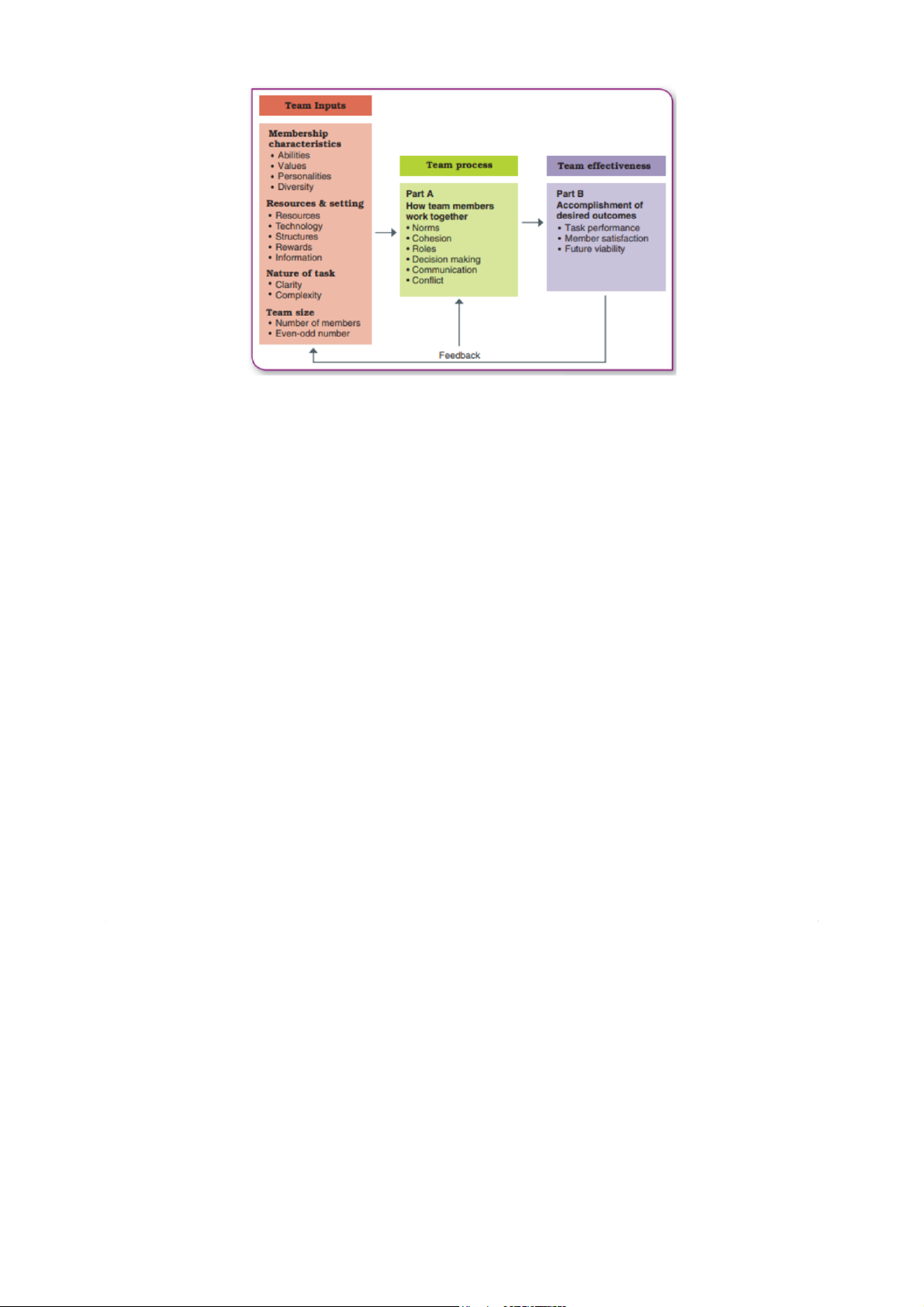
An effective team achieves high levels of task performance, membership
satisfaction, and future viability. - Team Inputs
Important team inputs include the organizational setting, nature of the task, size,
and membership characteristics. + Membership Characteristics
Team diversity is the differences in values, personalities, experiences,
demographics, and cultures among the membership.
As team diversity increases, so does the complexity of interpersonal
relationships among members. But the potential complications of
membership diversity also come with special performance opportunities.
When heterogeneous teams are well managed, the variety of ideas,
perspectives, and experiences within them can become valuable problem solving and performance assets + Resources and Setting
Teams function best when members have good information, material resources,
technology, organization structures, and rewards, physical work space.
Th s makes it easy for project teams to convene and disband as needed, and
for people to meet and communicate during the ebb and flow of daily work + Nature of the Task
The nature of the task not only sets standards for the talents needed by team
members, it also affects how they work together. Clearly defined tasks are easier to
deal with. Complex tasks ask a lot more of members in things like information sharing and coordinated action + Team Size
Team size affects how members work together, handle disagreements, and make
decisions. The number of potential interactions increases geometrically as teams
grow larger. This creates communication problems and congestion. - Stages of Team Development
Team process is the way team members work together to accomplish tasks.
A team matures through various stages of development, including forming,
storming, norming, performing, and adjourning. + Forming Stage + Storming Stage + Norming Stage + Performing Stage + Adjourning Stage - Norms and Cohesiveness
A norm is a behavior, rule, or standard expected to be followed by team members. + Managing Team Norms
Team leaders should help and encourage members to develop positive norms. + Managing Team Cohesiveness
Cohesiveness is the degree to which members are attracted to and motivated to remain part of a team.
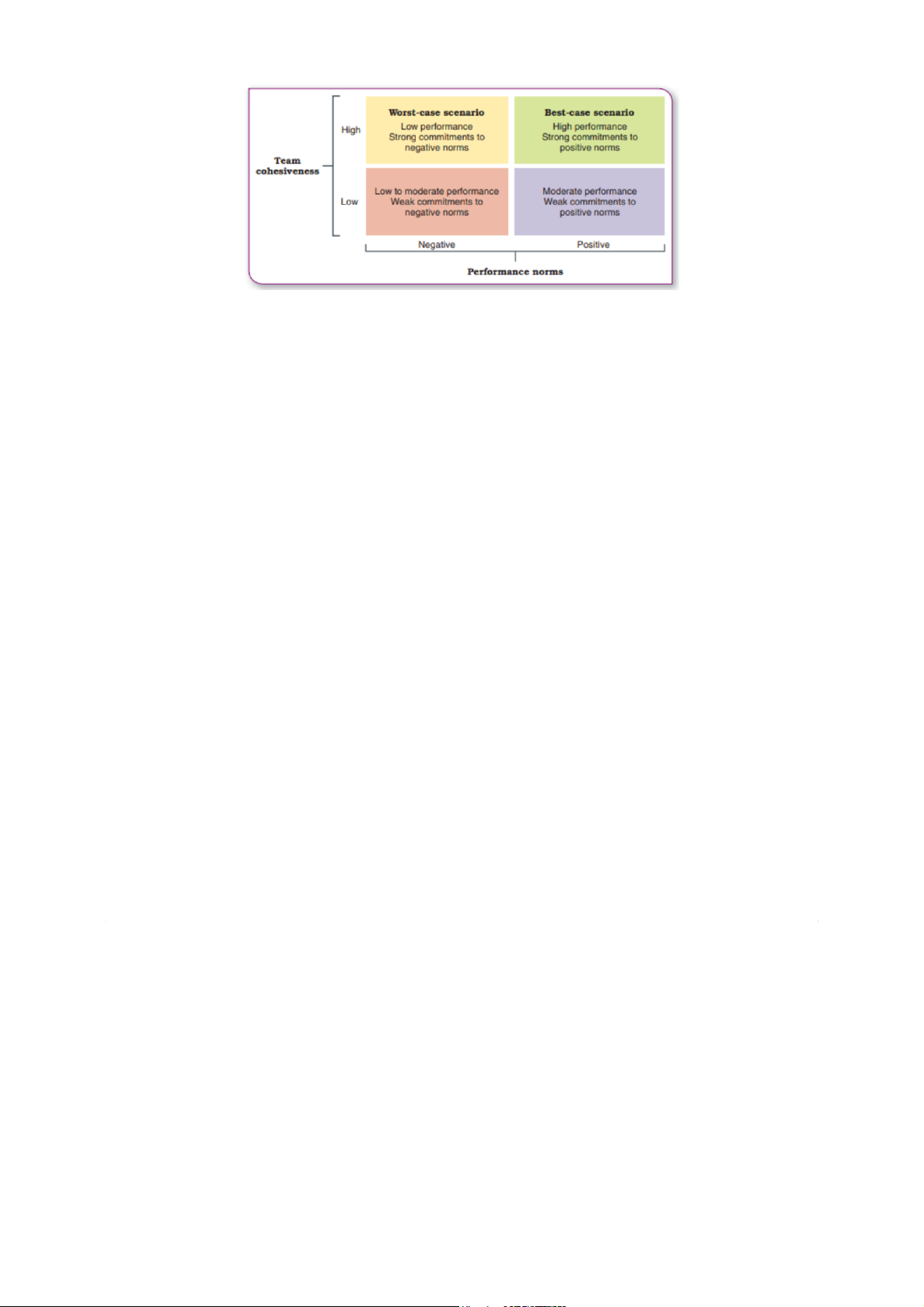
Team members vary in adherence to group norms. Conformity to norms is largely
determined by the strength of team cohesiveness, the degree to which members are
attracted to and motivated to remain part of a team
The “best-case” scenario is a team with high cohesiveness and a high
performance norm. Strong conformity to norms by members of this team has
a benefi cial effect on team performance.
The “worst-case” scenario of high cohesiveness and a low performance
norm. Members of this team conform to the low performance norm and restrict their work efforts - Task and Maintenance Roles
+ A task activity is an action taken by a team member that directly contributes to
the group’s performance purpose.
Leading through task activities involves making an effort to define and solve
problems and to advance work toward performance results. Without the
relevant task activities such as initiating agendas, sharing information, and
others, teams will have difficulty accomplishing their objectives.
+ A maintenance activity is an action taken by a team member that supports the emotional life of the group.
Leading through maintenance activities, by contrast, helps strengthen the
team as a social system. When maintenance activities such as gatekeeping,
encouraging others, and reducing tensions are performed well, good
interpersonal relationships are achieved and the ability of the team to stay
together over the longer term is ensured.
+ Distributed leadership is when all members of a team contribute helpful task and maintenance behaviors.
+ Disruptive activities are self-serving behaviors that interfere with team eff ectiveness.
Both team task and maintenance activities stand in distinct contrast to the disruptive activities - Communication Networks
A decentralized communication network allows all members to communicate directly with one another.
In a centralized communication network, communication fl ows only between
individual members and a hub, or center point.
In a restricted communication network, subgroups have limited communication with one another
The best teams use each of these communication networks, but they use
them in the right ways and at the right times. Centralized communication
networks seem to work better on simple tasks. Their decentralized
communication networks support the more intense interactions and
information sharing required to perform complicated tasks.
Effective teams make use of alternative communication structures, such as
the centralized and decentralized networks, to best complete tasks.
4. Decision Making in Teams
Decision making is the process of making choices among alternative possible courses of action. - Ways Teams Make Decisions
Teams can make decisions by lack of response, authority rule, minority rule,
majority rule, consensus, and unanimity
+ In decision by lack of response, one idea after another is suggested without any
discussion taking place. When the team fi nally accepts an idea, all others have
been bypassed by simple lack of response rather than by critical evaluation.
+ In decision by authority rule, the leader, manager, committee head, or some other
authority fi gure makes a decision for the team. Th is can be done with or without
discussion and is very time-effi cient. Whether the decision is a good one or a bad
one, however, depends on whether the authority fi gure has the necessary
information and expertise, and on how well this approach is accepted by other team members
+ In decision by minority rule, two or three people are able to dominate or
“railroad” the team into making a decision that they prefer. Th is is often done by
providing a suggestion and then forcing quick agreement by challenging the team
with such statements as “Does anyone object? No? Well let’s go ahead, then.”
+ One of the most common things teams do, especially when signs of disagreement
arise, is to take a vote and arrive at a decision by majority rule.
+ Teams are often encouraged to achieve decision by consensus. Th is is where full
discussion leads to one alternative being favored by most members, and the other
members agree to support it. When a consensus is reached, even those who may
have opposed the decision know that their views have been heard by everyone involved
+ A decision by unanimity may be the ideal state of aff airs. “Unanimity” means
that all team members agree on the course of action to be taken. This is a logically
perfect method, but it is also extremely diffi cult to achieve in actual practice. One
of the reasons that teams sometimes turn to authority decisions, majority voting, or
even minority decisions, is the diffi culty of managing the team process to achieve consensus or unanimity
- Advantages and Disadvantages of Team Decisions
=> Although group decisions often make more information available for problem
solving and generate more understanding and commitment, they are slower than
individual decisions and may involve social pressures to conform.
- Groupthink (tư duy tập thể)
Groupthink is a tendency for highly cohesive teams to lose their evaluative capabilities.
- Creativity in Team Decision Making
=> Techniques for improving creativity in teams include brainstorming and the nominal group technique
+ Brainstorming engages group members in an open, spontaneous discussion of problems and ideas.
+ The nominal group technique structures interaction among team members discussing problems and ideas.
Chap 18. Communication and Collaboration
1. The Communication Process
Communication is the process of sending and receiving symbols with meanings attached. - Effective Communication
In effective communication the intended meaning is fully understood by the
receiver. => Effective communication occurs when the sender and the receiver of a
message both interpret it in the same way.
- Efficient communication occurs at minimum cost. => Efficient communication
occurs when the message is sent at low cost for the sender
- Persuasion and Credibility in Communication
+ Persuasive communication presents a message in a manner that causes the other
person to support it. => Persuasive communication results in the recipient acting as
intended by the sender; credibility earned by expertise and good relationships is
essential to persuasive communication.
+ Credible communication earns trust, respect, and integrity in the eyes of others -Communication Barriers
Noise is anything that interferes with the effectiveness of communication; common
examples are poor utilization of channels, poor written or oral expression, physical
distractions, and status effects
- Cross-Cultural Communication
Communicating across cultures requires lots of sensitivity, awareness, and an
ability to quickly learn the rights and wrongs
Ethnocentrism is a major enemy of effective cross-cultural communication. This is
the tendency to consider one’s culture superior to any and all others. And, it hurts
communication in at least three major ways. First, it may cause someone to not
listen well to what others have to say. Second, it may cause someone to address or
speak with others in ways that alienate them. Third, it may lead to the use of
inappropriate stereotypes when dealing with persons from other cultures
=> Greater cross-cultural awareness and sensitivity are important if we are to
overcome the negative influences of ethnocentrism on communication.
2. Improving Collaboration Th rough Communication - Transparency and Openness
+ Communication transparency involves openly sharing honest and complete
information about the organization and workplace affairs. => A lack of
communication transparency is evident when managers try to hide information and
restrict the access of organizational members to it.
Transparency in the sense that information conveyed to others is honest,
credible, and fully disclosed is an important way to improve communication in the workplace.
+ Open book management is where managers provide employees with essential fi
nancial information about their companies.
- Use of Electronic Media
Electronic grapevines use electronic media to pass messages and information
among members of social networks.
=> Proper choice of channels and use of information technology can improve
communication in organizations. - Active Listening
Active listening is the process of taking action to help someone say exactly what
he or she really means.30 It involves being sincere and trying to fi nd out the full
meaning of what is being said. It also involves being disciplined in controlling
emotions and withholding premature evaluations or interpretations. => Active
listening, through refl ecting back and paraphrasing, can help overcome barriers and improve communication. - Constructive Feedback
Feedback is the process of telling someone else how you feel about something that
person did or said. It occurs in the normal give-and- take of working relationships,
and it occurs more formally during scheduled performance reviews. => Feedback
is most useful and constructive, rather than harmful, when it offers real benefi t to
the receiver and doesn’t just satisfy some personal need of the sender
=> MBWA— “managing by wandering around”
Interactive management through MBWA, such as structured meetings, use of
electronic media, and advisory councils can improve upward communication. - Space Design
Proxemics is the study of how we use space.And, space counts in communication.
The distance between people conveys varying intentions in terms of intimacy,
openness, and status in interpersonal communications.
Office architecture and space designs can be used to improve
communication in organizations. 3. Managing Conflict
Conflict is a disagreement over issues of substance and/or an emotional antagonism.
Substantive conflict involves disagreements over goals, resources, rewards,
policies, procedures, and job assignments.
Emotional conflict results from feelings of anger, distrust, dislike, fear, and
resentment, as well as from personality clashes.
-Functional and Dysfunctional Conflict
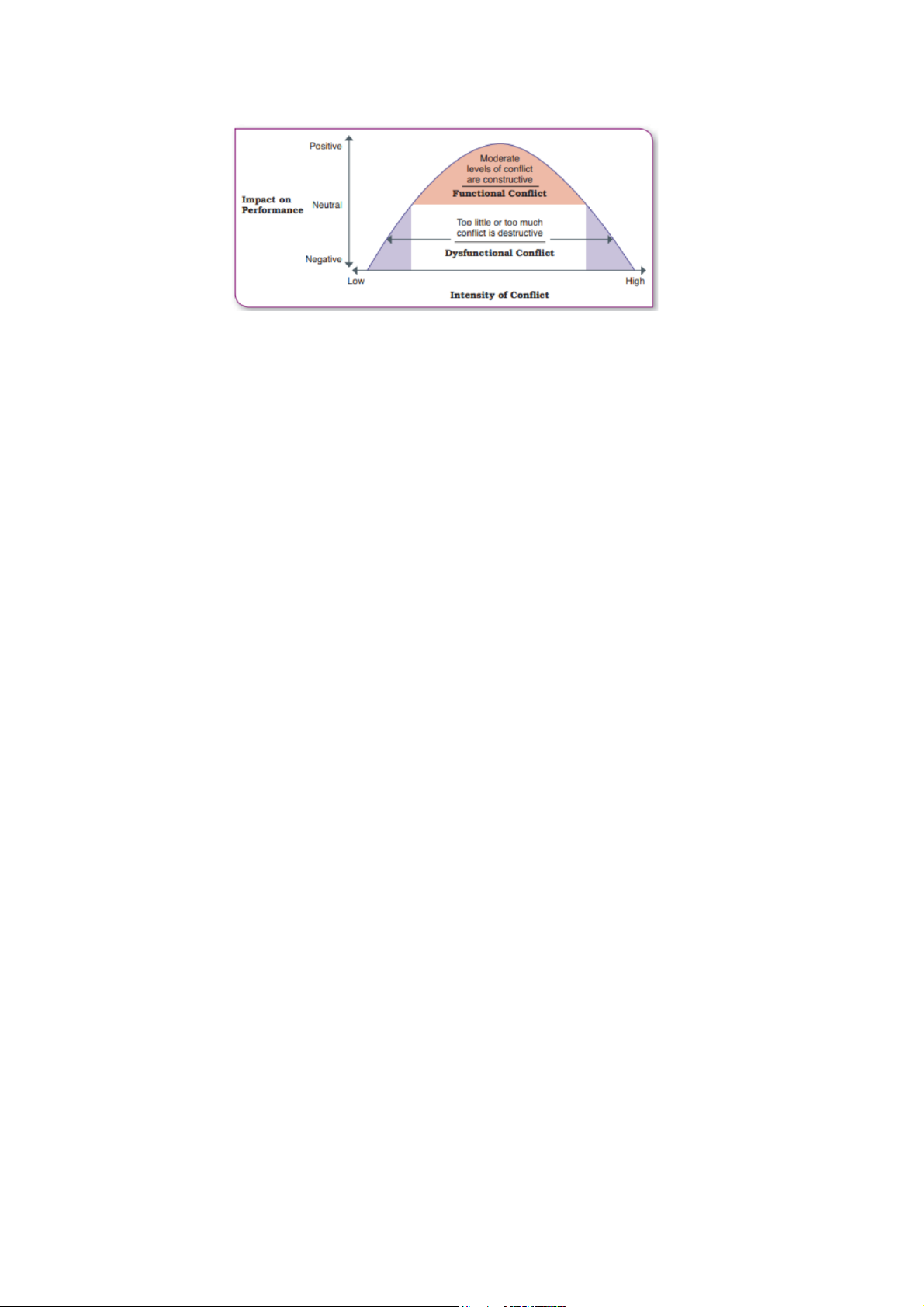
+ Functional conflict is constructive and helps task performance.
This functional conflict, or constructive conflict, moves people toward
greater work eff orts, cooperation, and creativity. It helps teams achieve their
goals and avoid making poor decisions because of groupthink.
+ Dysfunctional conflict is destructive and hurts task performance.
Dysfunctional conflict, or destructive conflict, harms performance,
relationships, and even individual well-being. It occurs when there is too
much or too little conflict in the situation. Too much conflict is distracting
and overwhelming. Too little conflict promotes groupthink, complacency,
and the loss of a high-performance edge.
Moderate levels of conflict are functional for performance and creativity; too
little or too much conflict becomes dysfunctional. -Causes of Conflict
Role ambiguities in the form of unclear job expectations and other task
uncertainties increase the likelihood for people to work at cross-purposes.
Resource scarcities cause conflict when people have to share or compete for them
Task interdependencies breed conflict when people depend on others to
perform well in order to perform well themselves.
Competing objectives are also opportunities for conflict. When goals are
poorly set or reward systems are poorly designed, individuals and groups
may come into confl ict by working to one another’s disadvantage.
Structural differentiation breeds conflict. Differences in organization
structures and in the characteristics of the people staffing them may foster
confl ict because of incompatible approaches toward work
Unresolved prior conflicts tend to erupt in later confl icts. Unless a conflict
is fully resolved, it may remain latent only to emerge again in the future. - Conflict Resolution
Conflict resolution is the removal of the substantial and emotional reasons for a
conflict. True conflict resolution eliminates the underlying causes of conflict and
reduces the potential for similar conflicts in the future
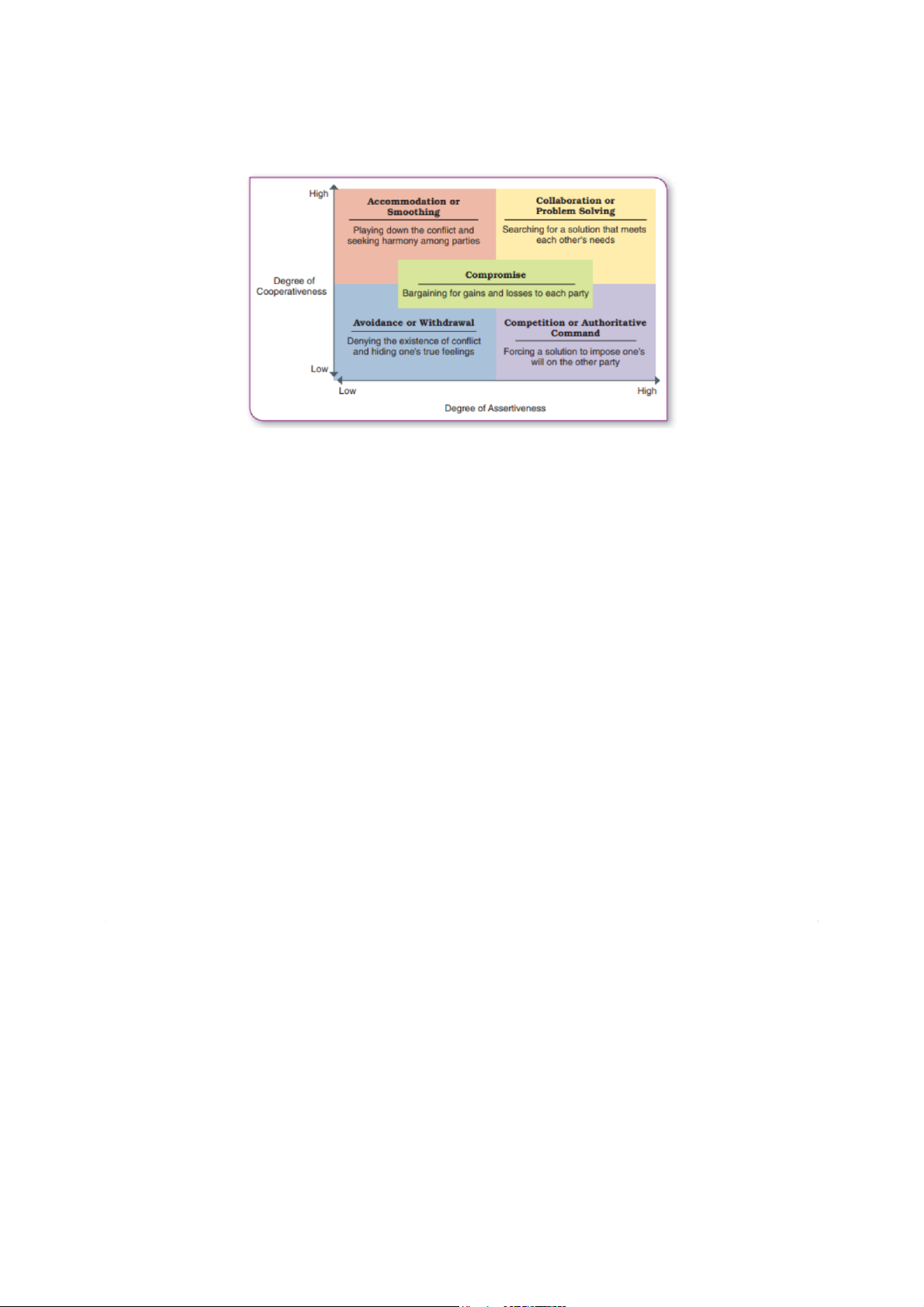
True conflict resolution involves problem solving through a win–win collaborative approach. -Conflict Management Styles
+ Cooperativeness is the desire to satisfy another party’s needs and concerns.
+ Assertiveness is the desire to satisfy one’s own needs and concerns.
Avoidance, or withdrawal, pretends that a conflict doesn’t really exist.
Accommodation, or smoothing, plays down differences and highlights
similarities to reduce conflict.
Competition, or authoritative command, uses force, superior skill, or
domination to “win” a conflict.
Compromise occurs when each party to the conflict gives up something of value to the other.
Collaboration, or problem solving, involves working through conflict
differences and solving problems so everyone wins
- Structural Approaches to Conflict Management
=> Conflict may be managed through structural approaches that involve changing
people, goals, resources, or work arrangements. 4. Managing Negotiation
Negotiation is the process of making joint decisions when the parties involved have diff erent preferences.
- Negotiation Goals and Approaches
+ Substance goals in negotiation are concerned with outcomes.
+ Relationship goals in negotiation are concerned with the ways people work together.
Substance goals concerned with outcomes and relationship goals concerned
with processes are both important in successful negotiation.
Effective negotiation occurs when issues of substance are resolved and working
relationships among the negotiating parties are maintained or even improved. - Gaining Agreements
+ Distributive negotiation focuses on win–lose claims made by each party for certain preferred outcomes.
+ Principled negotiation or integrative negotiation uses a “win–win” orientation to
reach solutions acceptable to each party.
Distributive negotiation emphasizes win–lose outcomes; integrative
negotiation emphasizes win–win outcomes - Negotiation Pitfalls
=> Common negotiation pitfalls include the myth of the fixed pie, overconfidence,
too much telling and too little hearing, and ethical misconduct.
Myth of the “fixed pie”: This involves acting on the distributive win–lose
assumption that in order for you to gain the other person must give
something up. This fails to recognize the integrative assumption that the
“pie” can sometimes be expanded or utilized to everyone’s advantage
Nonrational escalation of conflict: The negotiator gets locked into previously
stated “demands” and allows personal needs for “ego” and “saving face” to
inflate the perceived importance of satisfying them.
Overconfidence and ignoring the other’s needs: The negotiator becomes
overconfident, believes his or her position is the only correct one, and fails
to consider the needs of the other party
Too much “telling” and too little “hearing.” The “telling” error occurs when
parties to a negotiation don’t really make themselves understood to each
other. The “hearing” error occurs when they fail to listen well enough to
understand what each other is saying
Premature cultural comfort: This occurs when a negotiator is too quick to
assume that he or she understands the intentions, positions, and meanings of
a negotiator from a different culture
Trap of ethical misconduct: The motivation to negotiate unethically
sometimes arises from pure greed and undue emphasis on the profi t motive.
Th is may be experienced as a desire to “get just a bit more” or to “get as
much as you can” from a negotiation. The motivation to behave unethically
may also result from a sense of competition. This is a desire to “win” a
negotiation just for the sake of winning it, or because of the misguided belief
that someone else must “lose” in order for you to gain.
- Third-Party Dispute Resolution
=> Mediation and arbitration are structured approaches to third-party dispute resolution.
In mediation a neutral party tries to help conflicting parties improve
communication to resolve their dispute.
In arbitration a neutral third party issues a binding decision to resolve a dispute.
+ Some organizations provide for a process called alternative dispute resolution.
This approach utilizes mediation or arbitration, but does so only after direct
attempts to negotiate agreements between the conflicting parties have failed. An
ombudsperson, a designated neutral third party who listens to complaints and
disputes, often plays a key role in this process
Tài liệu liên quan:
-
Leadership Styles Preferred by Generation Z môn Principle of Management | Trường Đại học Quốc tế, Đại học Quốc gia Thành phố Hồ Chí Minh
3 2 -

Chapter 7 Blowing the Whistl môn Principle of Management | Trường Đại học Quốc tế, Đại học Quốc gia Thành phố Hồ Chí Minh
3 2 -
Chapter 11 - Organizational Structures and Their Impacts on Leadership môn Principle of Management | Trường Đại học Quốc tế, Đại học Quốc gia Thành phố Hồ Chí Minh
3 2 -
Lecture 2: Relational Model and Algebra môn Principle of Management | Trường Đại học Quốc tế, Đại học Quốc gia Thành phố Hồ Chí Minh
3 2 -
Lecture 6: ER –Relational Translation môn Principle of Management | Trường Đại học Quốc tế, Đại học Quốc gia Thành phố Hồ Chí Minh
3 2