Chap 2: Values, Attitudes, Emotions and Cultures: The manager as a person môn Principle of Management | Trường Đại học Quốc tế, Đại học Quốc gia Thành phố Hồ Chí Minh
Describe the various personality traits that affect how managers think, feel, and behave. Tài liệu giúp bạn tham khảo, ôn tập và đạt kết quả cao. Mời đọc đón xem!
Môn: Principles of Management 187 tài liệu
Trường: Trường Đại học Quốc tế, Đại học Quốc gia Thành phố Hồ Chí Minh 1.5 K tài liệu
Tác giả:



















Preview text:
CHAPTER 2 VALUES, ATTITUDES, EMOTIONS, AND CULTURE: THE MANAGER AS A PERSON
©McGraw-Hill Education. All rights reserved. Authorized only for instructor use in the classroom. No reproduction or further distribution permitted without the prior written consent of McGraw-Hill Education. Learning Objectives
2-1. Describe the various personality traits that affect
how managers think, feel, and behave.
2-2. Explain what values and attitudes are, and
describe their impact on managerial action.
2-3. Appreciate how moods and emotions influence
all members of an organization.
2-4. Describe the nature of emotional intelligence and its role in management.
2-5. Define organizational culture, and explain how
managers both create and are influenced by organizational culture. ©McGraw-Hill Education.
Enduring Characteristics: Personality Traits Personality Traits
Enduring tendencies to feel, think, and act in certain ways
Managers’ personalities influence their behavior
and approach to managing people and resources. ©McGraw-Hill Education. Managers and Traits
No single trait is right or wrong for being an effective manager.
Effectiveness is determined by a complex
interaction between the characteristics of
managers and the nature of the job and
organization in which they are working. ©McGraw-Hill Education. TOPICS FOR DISCUSSION (1 of 3)
Discuss why managers with different types of
personalities can be equally effective and successful. [LO 2-1] ©McGraw-Hill Education.
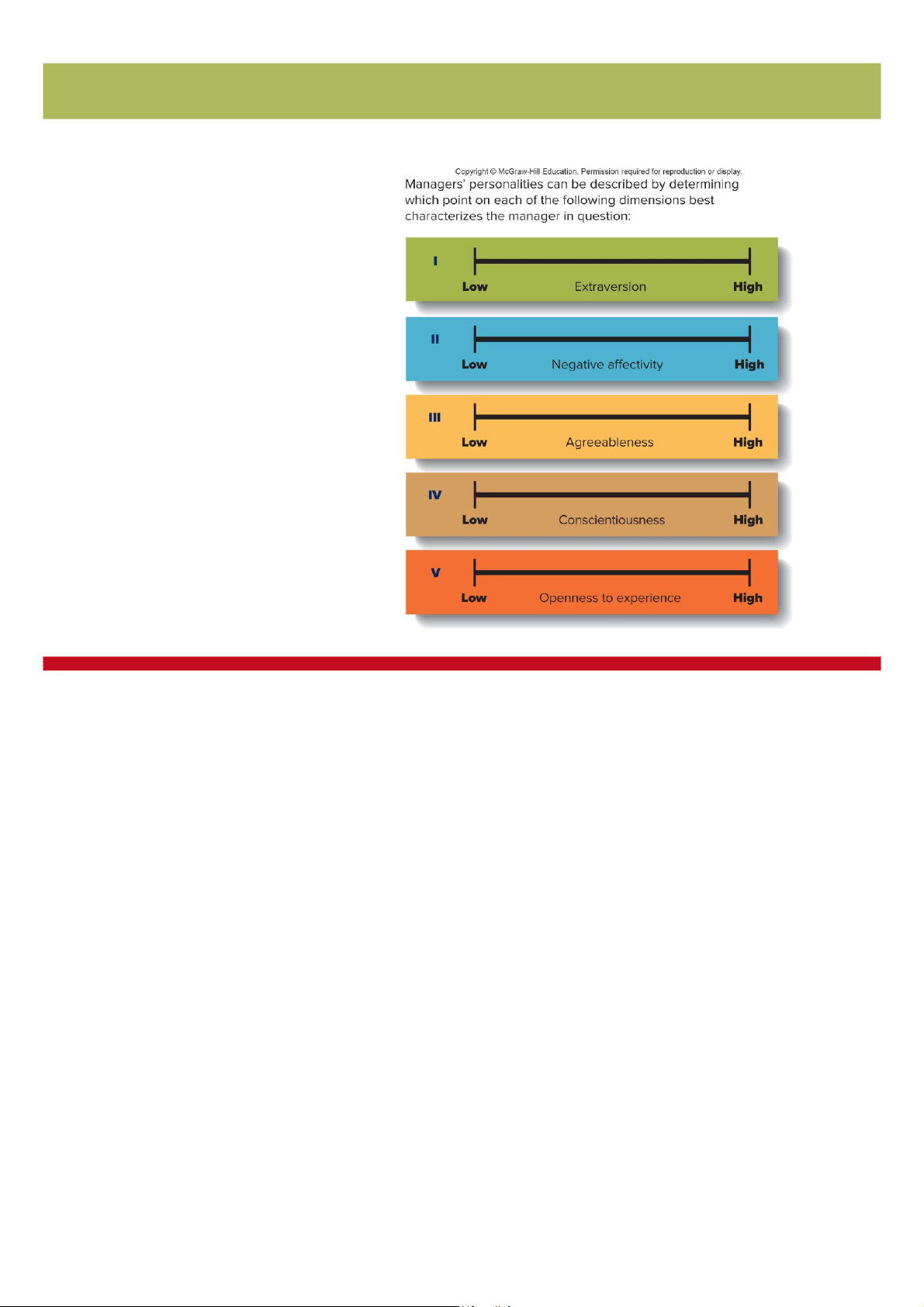
Big Five Personality Traits (1 of 6) Figure 2.1 Managers’ personalities can be described by determining which point on each of these dimensions best characterizes the manager in question. ©McGraw-Hill Education.
Big Five Personality Traits (2 of 6) Extraversion High Tendency to •Sociable experience positive emotions •Affectionate and moods and •Outgoing feel good about oneself and the •friendly rest of the world Low •Less inclined toward social interaction •Less positive outlook ©McGraw-Hill Education.
Big Five Personality Traits (3 of 6) Negative affectivity High Tendency to •Feel angry experience negative •Dissatisfied emotions and moods, feel distressed, and be Low critical of oneself and •Less pessimistic and others •Less critical of themselves ©McGraw-Hill Education.
Big Five Personality Traits (4 of 6) Agreeableness High Tendency to get along •Likable well with others •Affectionate •Care about others Low •Distrustful •Unsympathetic •Uncooperative •Antagonistic ©McGraw-Hill Education.
Big Five Personality Traits (5 of 6) Conscientiousness High Tendency to be careful, •Organized scrupulous, and •Self-disciplined persevering Low •Lack of direction and self-discipline ©McGraw-Hill Education.
Big Five Personality Traits (6 of 6) Openness to High Experience Innovative in decision Tendency to be original, making have broad interests, be open to a wide range of Low stimuli, be daring, and Less prone to take risks take risks ©McGraw-Hill Education. Measures of Extraversion, Agreeableness, Conscientiousness, and Openness to Experience Figure 2.2
Jump to Appendix 1 for long description. ©McGraw-Hill Education.
Source: L. R. Goldberg, Oregon Research Institute, http://ipip.ori.org/ipip/. Reprinted with permission.
Other Personality Traits (1 of 6) Internal Locus of Control
•Tendency to locate responsibility for one’s fate within oneself
•Own actions and behaviors are major and decisive determinants of job outcomes ©McGraw-Hill Education.
Other Personality Traits (2 of 6) External Locus of Control
Tendency to locate responsibility for one’s own fate
in outside forces and to believe that one’s own
behavior has little impact on outcomes ©McGraw-Hill Education.
Other Personality Traits (3 of 6) Self-Esteem High The degree to which Competent and capable people feel good about Low themselves and their capabilities Poor opinions of themselves and abilities ©McGraw-Hill Education.
Other Personality Traits (4 of 6) Need for Achievement
The extent to which an individual has a strong desire
to perform challenging tasks well and to meet
personal standards for excellence ©McGraw-Hill Education.
Other Personality Traits (5 of 6) Need for Affiliation
The extent to which an individual is concerned
about establishing and maintaining good
interpersonal relations, being liked, and having other people get along ©McGraw-Hill Education.
Other Personality Traits (6 of 6) Need for Power
The extent to which an individual desires to control or influence others ©McGraw-Hill Education.
Values, Attitudes, and Moods and Emotions Values
What managers try to achieve through work and how they think they should behave Attitudes
Managers’ thoughts and feelings about their specific jobs and organizations Moods and Emotions
How managers actually feel when they are managing ©McGraw-Hill Education. Values (1 of 2) Terminal Values Instrumental Values A lifelong goal or A mode of conduct that objective that an an individual seeks to individual seeks to follow achieve ©McGraw-Hill Education.
Tài liệu liên quan:
-
Leadership Styles Preferred by Generation Z môn Principle of Management | Trường Đại học Quốc tế, Đại học Quốc gia Thành phố Hồ Chí Minh
3 2 -

Chapter 7 Blowing the Whistl môn Principle of Management | Trường Đại học Quốc tế, Đại học Quốc gia Thành phố Hồ Chí Minh
3 2 -
Chapter 11 - Organizational Structures and Their Impacts on Leadership môn Principle of Management | Trường Đại học Quốc tế, Đại học Quốc gia Thành phố Hồ Chí Minh
3 2 -
Lecture 2: Relational Model and Algebra môn Principle of Management | Trường Đại học Quốc tế, Đại học Quốc gia Thành phố Hồ Chí Minh
3 2 -
Lecture 6: ER –Relational Translation môn Principle of Management | Trường Đại học Quốc tế, Đại học Quốc gia Thành phố Hồ Chí Minh
3 2