Chapter 10: Acquisition and disposition of Property, Plant, and Equipment môn Kinh tế tài chính | Đại học Kinh tế Thành phố Hồ Chí Minh
Chapter 10: Acquisition and disposition of Property, Plant, and Equipment môn Kinh tế tài chính | Đại học Kinh tế Thành phố Hồ Chí Minh. Tài liệu được sưu tầm giúp bạn tham khảo, ôn tập và đạt kết quả cao. Mời bạn đọc đón xem.
Môn: kinh tế tài chính ( UEH ) 59 tài liệu
Trường: Đại học Kinh tế Thành phố Hồ Chí Minh 3.1 K tài liệu
Tác giả:
















Preview text:
CHAPTER 10
Acquisition and Disposition of Property, Plant, and Equipment LEARNING OBJECTIVES
After studying this chapter, you should be able to:
1. Identify property, plant, and equipment and its related costs.
2. Discuss the accounting problems associated with the capitalization of borrowing costs.
3. Explain accounting issues related to acquiring and valuing plant assets.
4. Describe the accounting treatment for costs subsequent to acquisition.
5. Describe the accounting treatment for the disposal of property, plant, and equipment.
This chapter also includes numerous conceptual discussions that are
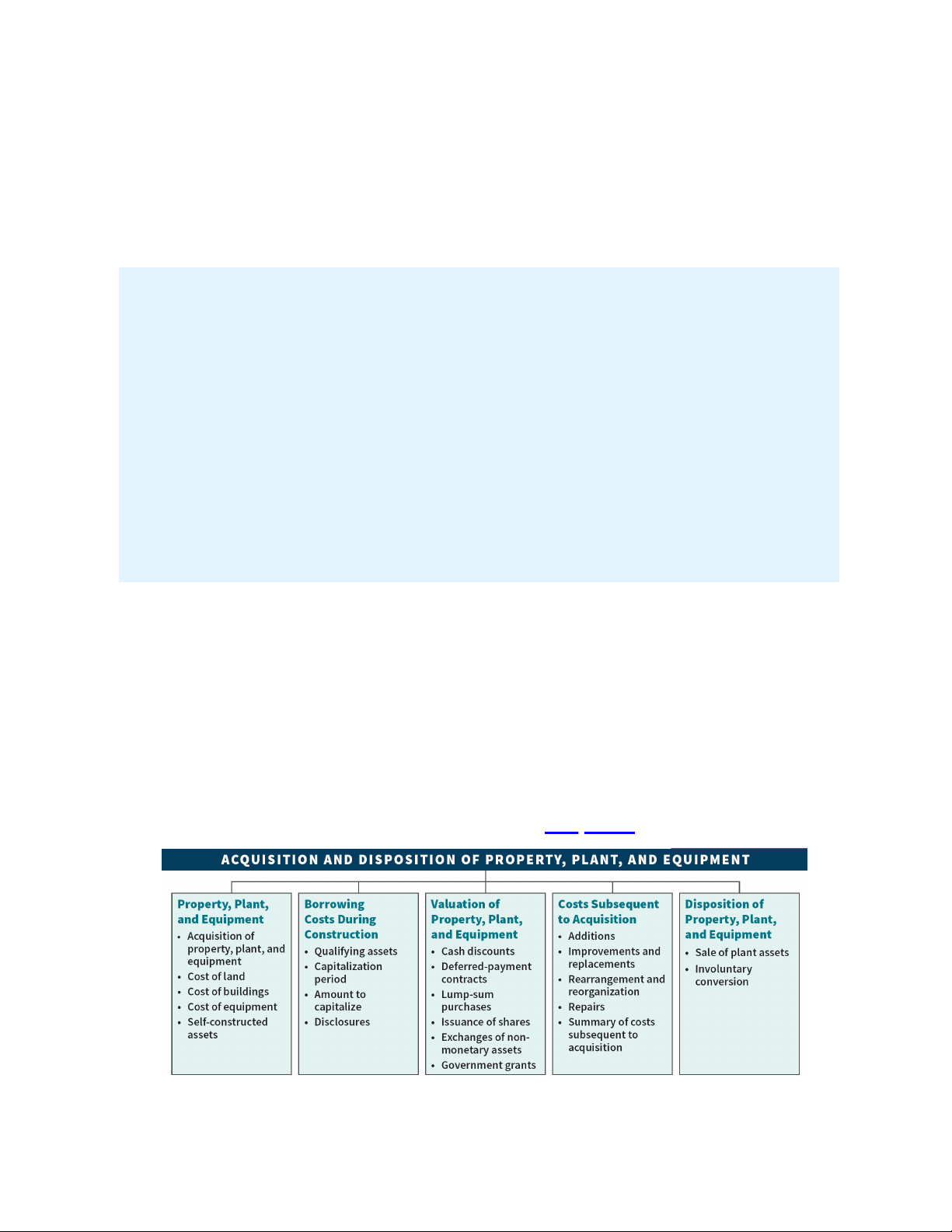
integral to the topics presented here. PREVIEW OF CHAPTER 10
As we indicate in the following opening story, market watchers monitor
carefully capital expenditures on property, plant, and equipment. In this
chapter, we discuss the proper accounting for the acquisition, use, and
disposition of property, plant, and equipment. The content and organization of
the chapter are as follows. (Note that Global Accounting Insights related to
property, plant, and equipment is presented in Chapter 11.) Watch Your Spending
Investments in long-lived assets, such as property, plant, and equipment, are
important elements in many companies’ statements of financial position. Along
with research and development, these investments are the driving force for many
companies in generating cash flows. Property, plant, and equipment information
reported on a company’s statement of financial position directly affects such items
as total assets, depreciation expense, cash flows, and net income. As a result,
companies are careful regarding their spending level for capital expenditures (capex).
Determining the proper level of capital expenditures in many companies is
challenging. Expenditures that are too much or too little run the risk of decreasing
cash flows, losing competitive position, and diminishing pricing power. The
recession in Europe, the financial crisis in 2008 and its lingering effects, and
China’s reduced level of spending are now slowing down the growth in capital
expenditures. Western Europe, Latin America, and the Asian-Pacific countries are
all showing signs of capital expenditure fatigue. The adjacent graph shows that
global capital expenditures are highly variable and tend to follow the trends in revenue and EBITDA growth.
Even in good times, the issues related to capital expenditures are complex. The
following areas and subsequent questions have led to many sleepless nights for company managers:
1. Spending volume—how much should be spent?
2. Capital allocation—what should it be spent on?
3. Project execution—how does spending transform into real returns?
Answers to these questions are not easy, and failure to answer them correctly can
lead to loss of profitability. It also follows that these issues are of extreme interest
to users of financial statements. As mentioned previously, too much or too little
capital spending by companies can lead to decreased cash flows, loss of competitive
position, and diminished pricing power. Relationships between capital-
expenditures-to-sales and capital-expenditures-to-depreciation, as well as free cash
flow, provide insight into the underlying financial flexibility of a company. Review and Practice
Go to the Review and Practice section at the end of the chapter for a
targeted summary review and practice problem with solution. Multiple-choice
questions with annotated solutions, as well as additional exercises and practice
problem with solutions, are also available online.
Property, Plant, and Equipment LEARNING OBJECTIVE 1
Identify property, plant, and equipment and its related costs.
Companies like Hon Hai Precision (TWN), Tata Steel (IND), and Royal Dutch
Shell (GBR and NLD) use assets of a durable nature. Such assets are called
property, plant, and equipment. Other terms commonly used are plant assets
and fixed assets. We use these terms interchangeably. Property, plant, and
equipment is defined as tangible assets that are held for use in production or
supply of goods and services, for rentals to others, or for administrative purposes;
they are expected to be used during more than one period. [1] (See the
Authoritative Literature References section near the end of the chapter.) Property,
plant, and equipment therefore includes land, building structures (offices,
factories, warehouses), and equipment (machinery, furniture, tools). The major
characteristics of property, plant, and equipment are as follows.
1. They are acquired for use in operations and not for resale. Only assets
used in normal business operations are classified as property, plant, and
equipment. For example, an idle building is more appropriately classified
separately as an investment. Property, plant, and equipment held for possible
price appreciation are classified as investments. In addition, property, plant,
and equipment held for sale or disposal are separately classified and reported
on the statement of financial position. Land developers or subdividers classify land as inventory.
2. They are long-term in nature and usually depreciated. Property, plant,
and equipment yield services over a number of years. Companies allocate the
cost of the investment in these assets to future periods through periodic
depreciation charges. The exception is land, which is depreciated only if a
material decrease in value occurs, such as a loss in fertility of agricultural land
because of poor crop rotation, drought, or soil erosion.
3. They possess physical substance. Property, plant, and equipment are
tangible assets characterized by physical existence or substance. This
differentiates them from intangible assets, such as patents or copyrights.
Unlike raw material, however, property, plant, and equipment do not
physically become part of a product held for resale.
Acquisition of Property, Plant, and Equipment
Most companies use historical cost as the basis for valuing property, plant, and
equipment (see Underlying Concepts). Historical cost measures the cash or
cash equivalent price of obtaining the asset and bringing it to the location and
condition necessary for its intended use. Underlying Concepts
Fair value is relevant to inventory but less so for property, plant, and
equipment which, consistent with the going concern assumption, are held for
use in the business, not for sale like inventory.
Companies recognize property, plant, and equipment when the cost of the asset can
be measured reliably and it is probable that the company will obtain future
economic benefits. [2] For example, when Starbucks (USA) purchases coffee
makers for its operations, these costs are reported as assets because they can be
reliably measured and benefit future periods. However, when Starbucks makes
ordinary repairs to its coffee machines, it expenses these costs because the primary
period benefited is only the current period.
In general, companies report the following costs as part of property, plant, and equipment. [3]1
1. Purchase price, including import duties and non-refundable purchase taxes,
less trade discounts and rebates. For example, British Airways (GBR)
indicates that aircraft are stated at the fair value of the consideration given
after offsetting manufacturing credits.
2. Costs attributable to bringing the asset to the location and condition necessary
for it to be used in a manner intended by the company. For example, when
Skanska AB (SWE) purchases heavy machinery from Caterpillar (USA), it
capitalizes the costs of purchase, including delivery costs.2
Companies value property, plant, and equipment in subsequent periods using
either the cost method or fair value (revaluation) method. Companies can apply the
cost or fair value method to all the items of property, plant, and equipment or to a
single class or classes of property, plant, and equipment. For example, a company
may value land (one class of asset) after acquisition using the revaluation
accounting method and, at the same time, value buildings and equipment (other classes of assets) at cost.
Most companies use the cost method—it is less expensive to use because the cost
of an appraiser is not needed. In addition, the revaluation (fair value) method
generally leads to higher asset values, which means that companies report higher
depreciation expense and lower net income. This chapter discusses the cost
method; we illustrate the (fair value) revaluation method in Chapter 11. Cost of Land
All expenditures made to acquire land and ready it for use are considered part of
the land cost. Thus, when Auchan (FRA) or ÆON (JPN) purchases land on which
to build a new store, land costs typically include (1) the purchase price; (2) closing
costs, such as title to the land, attorney’s fees, and recording fees; (3) costs incurred
in getting the land in condition for its intended use, such as grading, filling,
draining, and clearing; (4) assumption of any liens, mortgages, or encumbrances on
the property; and (5) any additional land improvements that have an indefinite life.
For example, when ÆON purchases land for the purpose of constructing a building,
it considers all costs incurred up to the excavation for the new building as land
costs. Removal of old buildings—clearing, grading, and filling—is a land
cost because these activities are necessary to get the land in condition for
its intended purpose. ÆON treats any proceeds from getting the land ready for
its intended use, such as salvage receipts on the demolition of an old building or
the sale of cleared timber, as reductions in the price of the land.
In some cases, when ÆON purchases land, it may assume certain obligations on
the land, such as back taxes or liens. In such situations, the cost of the land is the
cash paid for it, plus the encumbrances. In other words, if the purchase price of the
land is ¥50,000,000 cash but ÆON assumes accrued property taxes of ¥5,000,000
and liens of ¥10,000,000, its land cost is ¥65,000,000.
ÆON also might incur special assessments for local improvements, such as
pavements, street lights, sewers, and drainage systems. It should charge these costs
to the Land account because they are relatively permanent in nature. That is, after
installation, they are maintained by the local government. In addition, ÆON should
charge any permanent improvements it makes, such as landscaping, to the Land
account. It records separately any improvements with limited lives, such as
private driveways, walks, fences, and parking lots, to the Land Improvements
account. These costs are depreciated over their estimated lives.
Generally, land is part of property, plant, and equipment. However, if the
major purpose of acquiring and holding land is speculative, a company more
appropriately classifies the land as an investment. If a real estate concern holds
the land for resale, it should classify the land as inventory.
In cases where land is held as an investment, what accounting treatment should be
given for taxes, insurance, and other direct costs incurred while holding the land?
Many believe these costs should be capitalized. The reason: They are not generating
revenue from the investment at this time. Companies generally use this approach
except when the asset is currently producing revenue (such as rental property). Cost of Buildings
The cost of buildings should include all expenditures related directly to their
acquisition or construction. These costs include (1) materials, labor, and overhead
costs incurred during construction, and (2) professional fees and building permits.
Generally, companies contract others to construct their buildings. Companies
consider all costs incurred, from excavation to completion, as part of the building costs.
But how should companies account for an old building that is on the site of a newly
proposed building? Is the cost of removal of the old building a cost of the land or a
cost of the new building? Recall that if a company purchases land with an old
building on it, then the cost of demolition less its residual value is a cost
of getting the land ready for its intended use and relates to the land
rather than to the new building. In other words, all costs of getting an asset
ready for its intended use are costs of that asset.
It follows that any costs that are not directly attributable to getting the building
ready for its intended use should not be capitalized. For example, start-up costs,
such as promotional costs related to the building’s opening or operating losses
incurred initially due to low sales, should not be capitalized. Also, general
administrative expenses (such as the cost of the finance department) should not be
allocated to the cost of the building. Cost of Equipment
The term “equipment” in accounting includes delivery equipment, office
equipment, machinery, furniture and fixtures, furnishings, factory equipment, and
similar fixed assets. The cost of such assets includes the purchase price, freight and
handling charges incurred, insurance on the equipment while in transit, cost of
special foundations if required, assembling and installation costs, and costs of
conducting trial runs. Costs thus include all expenditures incurred in acquiring the
equipment and preparing it for use. Self-Constructed Assets
Occasionally, companies construct their own assets. Determining the cost of such
machinery and other fixed assets can be a problem. Without a purchase price or
contract price, the company must allocate costs and expenses to arrive at the cost of
the self-constructed asset. Materials and direct labor used in construction pose
no problem. A company can trace these costs directly to work and material orders
related to the fixed assets constructed.
However, the assignment of indirect costs of manufacturing creates special
problems. These indirect costs, called overhead or burden, include power, heat,
light, insurance, property taxes on factory buildings and equipment, factory
supervisory labor, depreciation of fixed assets, and supplies.
Companies can handle overhead in one of two ways:
1. Assign no fixed overhead to the cost of the constructed asset. The
major argument for this treatment is that overhead is generally fixed in nature.
As a result, this approach assumes that the company will have the same costs
regardless of whether or not it constructs the asset. Therefore, to charge a
portion of the overhead costs to the equipment will normally reduce current
expenses and consequently overstate income of the current period. However,
the company would assign to the cost of the constructed asset variable
overhead costs that increase as a result of the construction.
2. Assign a portion of all overhead to the construction process. This
approach, called a full-costing approach, assumes that costs attach to all
products and assets manufactured or constructed. Under this approach, a
company assigns a portion of all overhead to the construction process, as it
would to normal production. Advocates say that failure to allocate overhead
costs understates the initial cost of the asset and results in an inaccurate future allocation.
Companies should assign to the asset a pro rata portion of the fixed overhead to
determine its cost. Companies use this treatment extensively because many believe
that it results in a better matching of costs with revenues. Abnormal amounts of
wasted material, labor, or other resources should not be added to the cost of the asset. [4]
If the allocated overhead results in recording construction costs in excess of the
costs that an outside independent producer would charge, the company should
record the excess overhead as a period loss rather than capitalize it. This avoids
capitalizing the asset at more than its fair value. Under no circumstances should a
company record a “profit on self-construction.”
Borrowing Costs During Construction LEARNING OBJECTIVE 2
Discuss the accounting problems associated with the capitalization of borrowing costs.
The proper accounting for borrowing costs3 has been a long-standing
controversy. Three approaches have been suggested to account for the interest
incurred in financing the construction of property, plant, and equipment:
1. Capitalize no borrowing costs during construction. Under this
approach, interest is considered a cost of financing and not a cost of
construction. Some contend that if a company had used equity financing rather
than debt, it would not incur this cost. The major argument against this
approach is that the use of cash, whatever its source, has an associated implicit
interest cost, which should not be ignored.
2. Charge construction with all borrowing costs of funds employed,
whether identifiable or not. This method maintains that the cost of
construction should include the cost of financing, whether by cash, debt, or
equity. Its advocates say that all costs necessary to get an asset ready for its
intended use, including borrowing costs, are part of the asset’s cost. Interest,
whether actual or imputed, is a cost, just as are labor and materials. A major
criticism of this approach is that imputing the cost of equity capital is
subjective and outside the framework of an historical cost system.
3. Capitalize only the actual borrowing costs incurred during
construction. This approach agrees in part with the logic of the second
approach—that interest is just as much a cost as are labor and materials. But,
this approach capitalizes only borrowing costs incurred through debt financing.
(That is, it does not try to determine the cost of equity financing.) Under this
approach, a company that uses debt financing will have an asset of higher cost
than a company that uses equity financing. Some consider this approach
unsatisfactory because they believe the cost of an asset should be the same
whether it is financed with cash, debt, or equity.
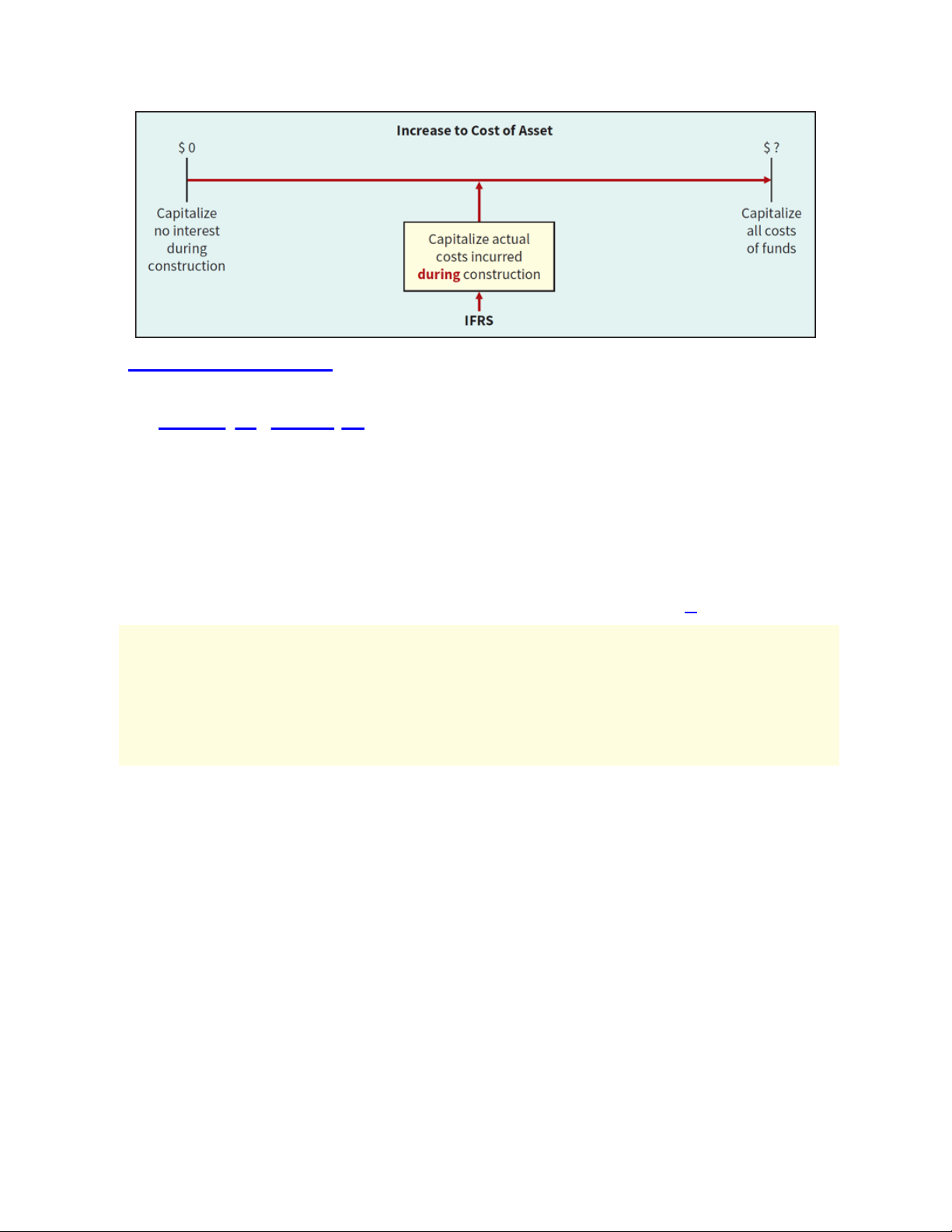
Illustration 10.1 shows how a company might add borrowing costs (if any) to the
cost of the asset under the three capitalization approaches.
ILLUSTRATION 10.1 Capitalization of Borrowing Costs
IFRS requires the third approach—capitalizing actual interest (with modifications)
(see Underlying Concepts). This method follows the concept that the historical
cost of acquiring an asset includes all costs (including borrowing costs) incurred to
bring the asset to the condition and location necessary for its intended use. The
rationale for this approach is that during construction, the asset is not generating
revenues. Therefore, a company should defer (capitalize) borrowing costs. Once
construction is complete, a company can utilize the asset in its operations. At this
point, the company should report borrowing as an expense in the determination of
net income. It follows that the company should expense any borrowing cost
incurred in purchasing an asset that is ready for its intended use. [6] Underlying Concepts
The objective of capitalizing borrowing costs is to obtain a measure of
acquisition cost that reflects a company’s total investment in the asset and to
charge that cost to future periods benefitted.
To implement the capitalization approach for borrowing costs, companies consider three items: 1. Qualifying assets. 2. Capitalization period. 3. Amount to capitalize. Qualifying Assets
To qualify for the capitalization of borrowing costs, assets must require
a substantial period of time to get them ready for their intended use or
sale. A company capitalizes borrowing costs starting at the beginning of the
capitalization period (described in the next section). Capitalization continues until
the company substantially readies the asset for its intended use.
Assets that qualify for borrowing cost capitalization include assets under
construction for a company’s own use (including buildings, plants, and large
machinery) and assets intended for sale or lease that require a substantial period of
time to produce (e.g., ships or real estate developments).4
Examples of assets that do not qualify for interest capitalization are (1) assets that
are in use or ready for their intended use, and (2) inventories that are produced over a short period of time. Capitalization Period
The capitalization period is the period of time during which a company
capitalizes borrowing costs. It begins with the presence of three conditions:
1. Expenditures for the asset are being incurred.
2. Activities that are necessary to get the asset ready for its intended use or sale are in progress.
3. Borrowing cost is being incurred.
Capitalization continues as long as these three conditions are present. The
capitalization period ends when the asset is substantially complete and ready for its intended use. Amount to Capitalize
The amount of borrowing cost to be capitalized varies depending on whether there
is specific debt that has been incurred to fund the project or whether the project
is being funded from the general debt obligations of the company.
When the project is funded by specific debt, the amount capitalized is the actual
borrowing costs incurred during the capitalization period offset by any investment
income on temporary investments of funds made available from the borrowings. To
illustrate the issues related to the capitalization of borrowing costs funded by
specific debt, assume that on November 1, 2021, Shalla Company contracted Pfeifer
Construction Co. to construct a building for $1,400,000 on land costing $100,000
(purchased from the contractor and included in the first payment). Shalla made the
following payments to the construction company during 2022. January 1 March 1 May 1 December 31 Total
$210,000 $300,000 $540,000 $450,000 $1,500,000
Pfeifer Construction completed the building, ready for occupancy, on December 31,
2022. Shalla had a 15 percent, three-year, $1,500,000, note to finance purchase of
land and construction of the building, dated December 31, 2021, with interest
payable annually on December 31. During 2021, a portion of the proceeds from the
borrowing that had not yet been expended in the project were invested and earned $60,000 in interest income.
The project began on January 1 and was completed on December 31, so the
capitalization period was the full year of 2022. The amount of borrowing costs to be
capitalized for 2022 would be computed as shown in Illustration 10.2.
Borrowing costs ($1,500,000 × .15) $225,000 Investment income 60,000
Borrowing costs to be capitalized $165,000
ILLUSTRATION 10.2 Total Borrowing Costs
Shalla would make the following entries during the year. January 1 Land 100,000
Buildings (or Construction in Process) 110,000 Cash 210,000 March 1 Buildings 300,000 Cash 300,000 May 1 Buildings 540,000 Cash 540,000 December 31 Buildings 450,000 Cash 450,000
Buildings (Capitalized Borrowing Cost) 225,000 Cash 225,000 Cash 60,000
Buildings (Capitalized Borrowing Cost) 60,000
When the project is funded by general debt, some additional calculations and steps
are included in the process. To illustrate, assume the same facts as the previous
illustration, but, instead of any specific debt, the project is funded by the general
debt of the company. Assume that Shalla had the following two debt obligations outstanding during 2022:
1. 10 percent, $1,000,000, 5-year note payable, dated December 31, 2018, with
interest payable annually on December 31.
2. 12 percent, $1,500,000, 10-year bonds issued December 31, 2017, with interest
payable annually on December 31.
When a project is funded by general debt, the company will need to determine the
average carrying amount of the project during the period. This can be computed
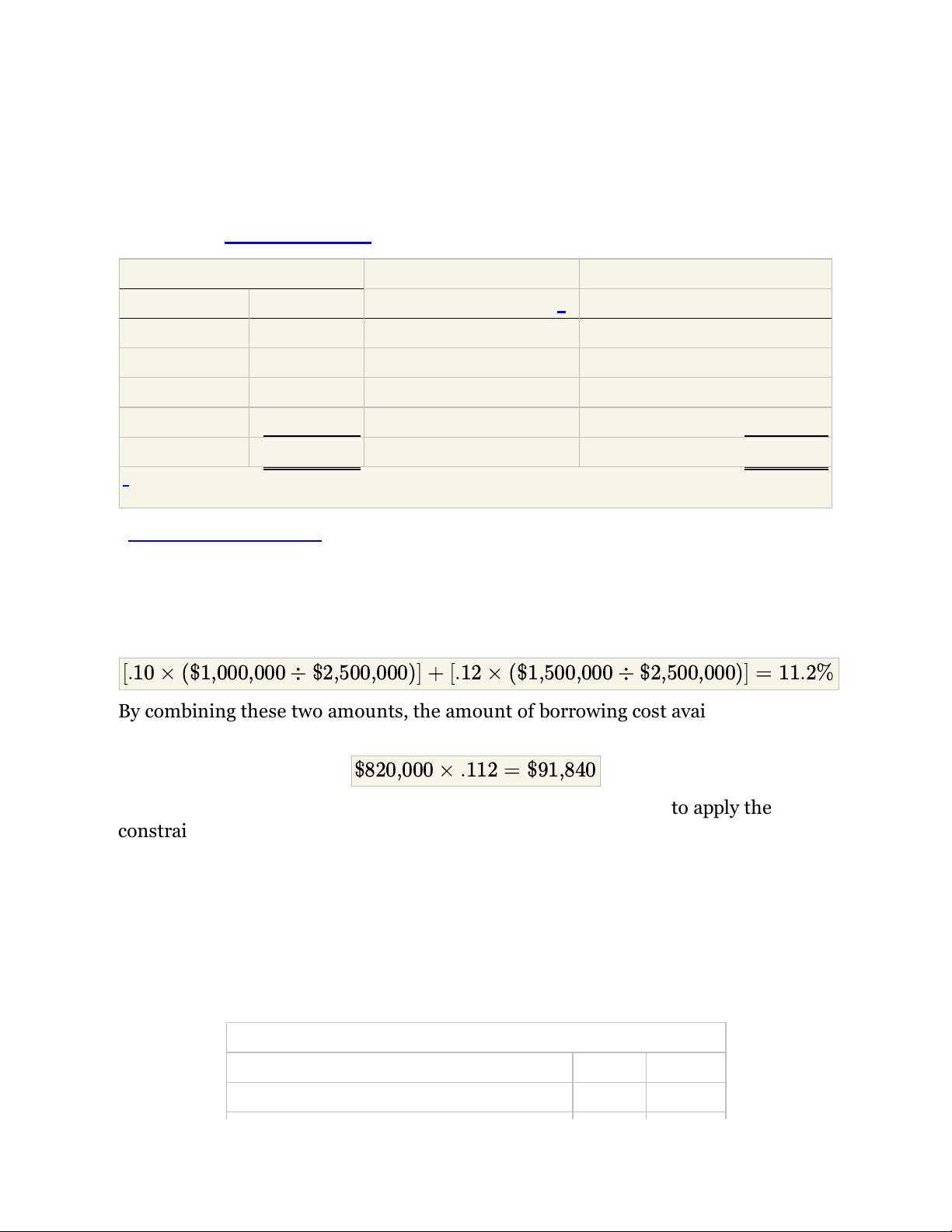
as shown in Illustration 10.3. Expenditures Date Amount Capitalization Period* Average Carrying Amount January 1 $ 210,000 12/12 $210,000 March 1 300,000 10/12 250,000 May 1 540,000 8/12 360,000 December 31 450,000 0/12 0 Totals $1,500,000 $820,000
* The capitalization period is the number of months between when the expenditure is made and the end of the
year or the end of the project, whichever occurs first.
ILLUSTRATION 10.3 Average Carrying Amount Calculations
The second amount that is needed when borrowing costs from general debt are
being used, and there is more than one general debt obligation, is the weighted-
average borrowing cost. This amount is called the capitalization rate and is computed as follows.
[.10 × ($1,000,000 ÷ $2,500,000)] + [.12 × ($1,500,000 ÷ $2,500,000)] = 11.2%
By combining these two amounts, the amount of borrowing cost available for
capitalization is now computed. $820,000 × .112 = $91,840
The final step when the borrowing cost of general debt is used is to apply the
constraint that the amount capitalized cannot exceed the actual
borrowing costs incurred during the period. In 2022, total borrowing costs
were $280,000 [($1,000,000 × .10) + ($1,500,000 × .12)]. The amount capitalized
will be lower of actual, or the amount computed by multiplying the average
carrying amount by the capitalization rate. In this case, Shalla will capitalize $91,840.
All of the other entries presented above would be the same except for the interest
entries on December 31, which would be as follows. December 31
Buildings (Capitalized Borrowing Cost) 91,840
Interest Expense ($280,000 − $91,840) 188,160 Cash 280,000
The final possibility is that the project is funded by a blend of specific debt and
general debt. To illustrate this case, assume that Shalla has the following debt outstanding during 2022. Specific Construction Debt
1. 15 percent, $750,000, 3-year note to finance purchase of land and construction
of the building, dated December 31, 2021, with interest payable annually on
December 31. Idle funds from this borrowing were invested during early 2022
and earned $40,000 in investment income. Other Debt
2. 10 percent, $500,000, 5-year note payable, dated December 31, 2018, with
interest payable annually on December 31.
3. 12 percent, $1,500,000, 10-year bonds issued December 31, 2017, with interest
payable annually on December 31.
In this case, the expenditures are first allocated to the specific debt to the extent
possible. Then, the remainder of the expenditures are allocated to the general debt,
as shown in Illustration 10.4. Amount Amount Allocated to Allocated to Average Specific General Capitalization Carrying Date Expenditure Borrowings Borrowings Period Amount January 1 $ 210,000 $210,000 $ 0 March 1 300,000 300,000 0 May 1 540,000 240,000 300,000 8/12 $200,000 December 450,000 0 450,000 0/12 0 31 Totals $1,500,000 $750,000 $750,000 $200,000
ILLUSTRATION 10.4 Allocation of Expenditures
The borrowing costs of the specific debt for this project is $72,500 based on the
borrowing costs of $112,500 ($1,500,000 × .15) less the investment income of $40,000.
The capitalization rate on the general debt is 11.5 percent {[(.10 × $500,000 ÷
$2,000,000)] + [.12 × ($1,500,000 ÷ $2,000,000)]}. This results in a potential
amount of borrowing costs to be capitalized of $23,000 ($200,000 × .115). Since
this amount is lower than the actual borrowing costs of the general debt of
$230,000 [($500,000 × .10) + ($1,500,000 × .12)], $23,000 will be capitalized
from the general borrowings. The total amount to be capitalized is shown in Illustration 10.5.
Interest costs from specific debt $112,500
Investment income from specific debt funds (40,000)
Interest costs from general debt 23,000
Total borrowing costs capitalized for 2022 $ 95,500
ILLUSTRATION 10.5 Summary of Borrowing Costs
At December 31, the following entry would be made: December 31
Buildings (Capitalized Borrowing Cost) ($112,500 + $23,000) 135,500
Interest Expense ($230,000 − $23,000) 207,000 Cash ($112,500 + $230,000) 342,500 Cash 40,000
Buildings (Capitalized Borrowing Cost) 40,000 Disclosures
For each period, an entity will disclose both the amount of borrowing costs
capitalized during the period and the capitalization rate used to determine the
amount of borrowing costs eligible for capitalization. Illustration 10.6 provides
an example from the financial statements of Royal Dutch Shell (GBR and NLD). Royal Dutch Shell 6 INTEREST EXPENSE ($ million) 2018 2017 2016
Interest incurred and similar charges $3,550 $3,448 $2,732 Less: interest capitalized (876) (622) (725)
Other net losses on fair value hedges of debt 169 114 4 Accretion expense 902 1,102 1,192 Total $3,745 $4,042 $3,303
The rate applied in determining the amount of interest capitalized in 2018 was 4% (2017: 3%; 2016: 3%).
ILLUSTRATION 10.6 Borrowing Costs Disclosure
Valuation of Property, Plant, and Equipment LEARNING OBJECTIVE 3
Explain accounting issues related to acquiring and valuing plant assets.
As with other assets, companies should record property, plant, and
equipment at the fair value of what they give up or at the fair value of the
asset received, whichever is more clearly evident. However, the process of
asset acquisition sometimes obscures fair value. For example, if a company buys
land and buildings together for one price, how does it determine separate values for
the land and buildings? We examine these types of accounting problems in the following sections. Cash Discounts
When a company purchases plant assets subject to cash discounts for prompt
payment, how should it report the discount? If it takes the discount, the company
should consider the discount as a reduction in the purchase price of the asset. But
should the company reduce the asset cost even if it does not take the discount?
Two points of view exist on this question. One approach considers the discount—
whether taken or not—as a reduction in the cost of the asset. The rationale for this
approach is that the real cost of the asset is the cash or cash equivalent price of the
asset. In addition, some argue that the terms of cash discounts are so attractive that
failure to take them indicates management error or inefficiency.
With respect to the second approach, its proponents argue that failure to take the
discount should not always be considered a loss. The terms may be unfavorable, or
it might not be prudent for the company to take the discount. At present,
companies use both methods, though most prefer the former method. (For
homework purposes, treat the discount, whether taken or not, as a reduction in the cost of the asset.)
Deferred-Payment Contracts
Companies frequently purchase plant assets on long-term credit contracts, using
notes, mortgages, bonds, or equipment obligations. To properly reflect cost,
companies account for assets purchased on long-term credit contracts at
the present value of the consideration exchanged between the
contracting parties at the date of the transaction.
For example, Greathouse Company purchases an asset today in exchange for a
$10,000 zero-interest-bearing note payable four years from now. The company
would not record the asset at $10,000. Instead, the present value of the $10,000
note establishes the exchange price of the transaction (the purchase price of the
asset). Assuming an appropriate interest rate of 9 percent at which to discount this
single payment of $10,000 due four years from now, Greathouse records this asset
at $7,084.30 ($10,000 × .70843). [See Table 6.2 for the present value of a single
sum, PV = $10,000 (PVF4,9%).]
When no interest rate is stated or if the specified rate is unreasonable, the company
imputes an appropriate interest rate. The objective is to approximate the interest
rate that the buyer and seller would negotiate at arm’s length in a similar
borrowing transaction. In imputing an interest rate, companies consider such
factors as the borrower’s credit rating, the amount and maturity date of the note,
and prevailing interest rates. The company uses the cash exchange price of
the asset acquired (if determinable) as the basis for recording the asset
and measuring the interest element.
To illustrate, Sutter AG purchases a specially built robot spray painter for its
production line. The company issues a €100,000, five-year, zero-interest-bearing
note to Wrigley Robotics for the new equipment. The prevailing market rate of
interest for obligations of this nature is 10 percent. Sutter is to pay off the note in
five €20,000 installments, made at the end of each year. Sutter cannot readily
determine the fair value of this specially built robot. Therefore, Sutter
approximates the robot’s value by establishing the fair value (present value) of the
note. Entries for the date of purchase and dates of payments, plus computation of
the present value of the note, are as follows. Date of Purchase Equipment 75,816* Notes Payable 75,816
*Present value of note = €20,000 (PVF-OA5,10%)
= €20,000 (3.79079); Table 6.4 = €75,816 End of First Year Interest Expense 7,582 Notes Payable 12,418 Cash 20,000
Interest expense in the first year under the effective-interest approach is €7,582
(€75,816 × .10). The entry at the end of the second year to record interest and
principal payment is as follows. End of Second Year Interest Expense 6,340 Notes Payable 13,660 Cash 20,000
Interest expense in the second year under the effective-interest approach is €6,340
[(€75,816 − €12,418) × .10].
If Sutter did not impute an interest rate for the deferred-payment contract, it would
record the asset at an amount greater than its fair value. In addition, Sutter would
understate interest expense in the income statement for all periods involved. Lump-Sum Purchases
A common challenge in valuing fixed assets arises when a company purchases a
group of assets at a single lump-sum price. When this occurs, the company
allocates the total cost among the various assets on the basis of their relative fair
values. The assumption is that costs will vary in direct proportion to fair value. This
is the same principle that companies apply to allocate a lump-sum cost among different inventory items.
To determine fair value, a company should use valuation techniques that are
appropriate in the circumstances. In some cases, a single valuation technique will
be appropriate. In other cases, multiple valuation approaches might have to be used.5
To illustrate, Norduct Homes, Inc. decides to purchase several assets of a small
heating concern, Comfort Heating, for $80,000. Comfort Heating is in the process
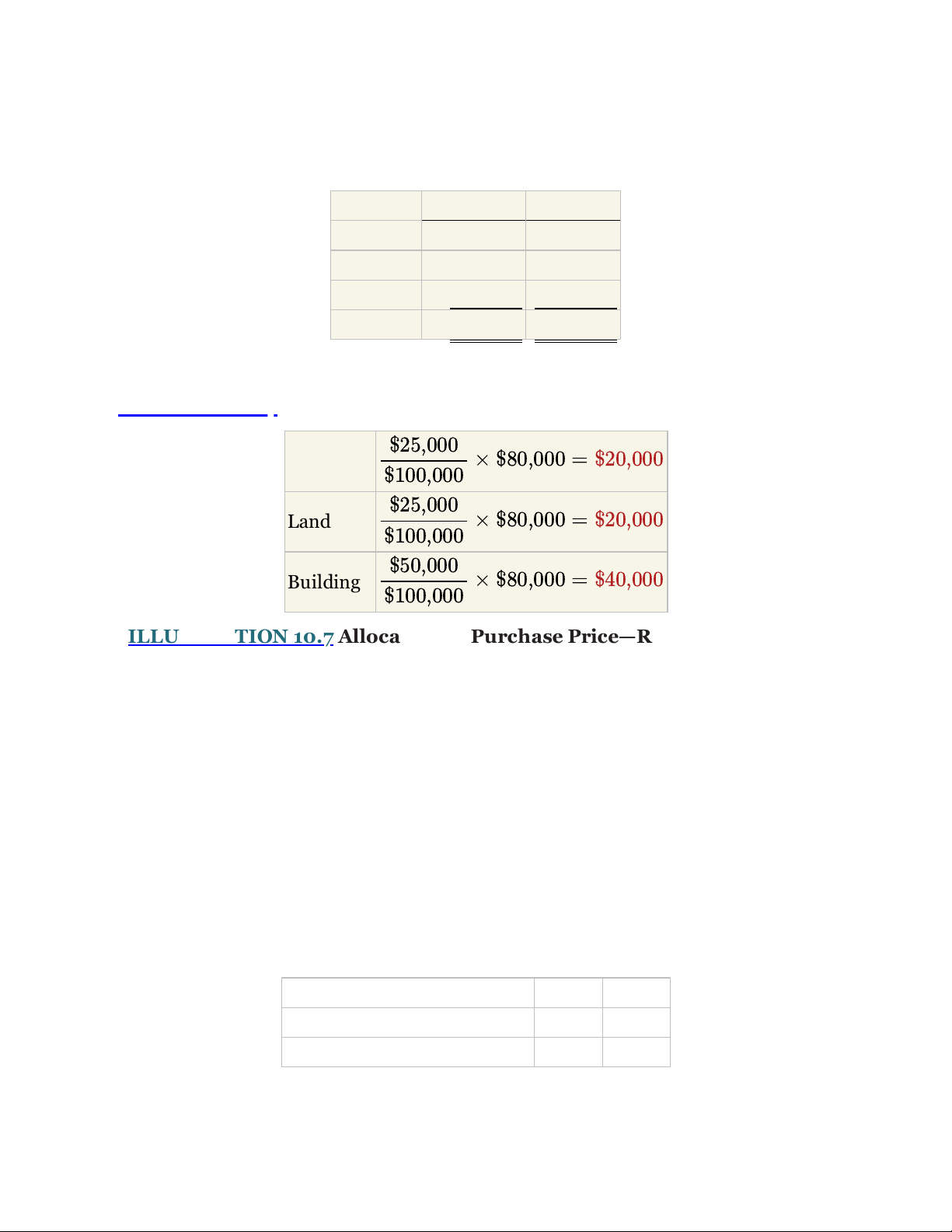
of liquidation. Its assets sold are as follows. Book Value Fair Value Inventory $30,000 $ 25,000 Land 20,000 25,000 Building 35,000 50,000 $85,000 $100,000
Norduct Homes allocates the $80,000 purchase price on the basis of the relative
fair values (assuming specific identification of costs is impracticable), shown in Illustration 10.7. $25,000 Inventory × $80,000 = $20,000 $100,000 $25,000 Land × $80,000 = $20,000 $100,000 $50,000 Building × $80,000 = $40,000 $100,000
ILLUSTRATION 10.7 Allocation of Purchase Price—Relative Fair Value Basis Issuance of Shares
When companies acquire property by issuing securities, such as ordinary shares,
the par or stated value of such shares fails to properly measure the property cost. If
trading of the shares is active, the market price of the shares issued is a fair
indication of the cost of the property acquired. The shares are a good
measure of the current cash equivalent price.
For example, Upgrade Living Co. decides to purchase some adjacent land for
expansion of its carpeting and cabinet operation. In lieu of paying cash for the land,
the company issues to Deedland Company 5,000 ordinary shares (par value $10)
that have a market price of $12 per share. Upgrade Living Co. records the following entry. Land (5,000 × $12) 60,000 Share Capital—Ordinary 50,000 Share Premium—Ordinary 10,000
If the company cannot determine the fair value of the ordinary shares exchanged
(based on a market price), it may estimate the fair value of the property. It then
uses the value of the property as the basis for recording the asset and issuance of the ordinary shares.
Exchanges of Non-Monetary Assets
The proper accounting for exchanges of non-monetary assets, such as property,
plant, and equipment, is controversial.6 Some argue that companies should account
for these types of exchanges based on the fair value of the asset given up or the fair
value of the asset received, with a gain or loss recognized. Others believe that they
should account for exchanges based on the recorded amount (book value) of the
asset given up, with no gain or loss recognized. Still others favor an approach that
recognizes losses in all cases but defers gains in special situations.
Ordinarily, companies account for the exchange of non-monetary assets on the
basis of the fair value of the asset given up or the fair value of the asset
received, whichever is clearly more evident. [7] Thus, companies should
recognize immediately any gains or losses on the exchange. The rationale for
immediate recognition is that most transactions have commercial substance,
and therefore gains and losses should be recognized.
Meaning of Commercial Substance
As indicated above, fair value is the basis for measuring an asset acquired in a non-
monetary exchange if the transaction has commercial substance. An exchange has
commercial substance if the future cash flows change as a result of the
transaction. That is, if the two parties’ economic positions change, the transaction has commercial substance.
For example, Andrew Co. exchanges some of its equipment for land held by
Roddick Inc. It is likely that the timing and amount of the cash flows arising for the
land will differ significantly from the cash flows arising from the equipment. As a
result, both Andrew Co. and Roddick Inc. are in different economic positions.
Therefore, the exchange has commercial substance, and the companies recognize a gain or loss on the exchange.
What if companies exchange similar assets, such as one truck for another truck?
Even in an exchange of similar assets, a change in the economic position of the
company can result. For example, let’s say the useful life of the truck received is
significantly longer than that of the truck given up. The cash flows for the trucks
can differ significantly. As a result, the transaction has commercial substance, and
the company should use fair value as a basis for measuring the asset received in the exchange.
However, it is possible to exchange similar assets but not have a significant
difference in cash flows. That is, the company is in the same economic position as
before the exchange. In that case, the company generally defers gains and losses on the exchange.
As we will see in the following examples, use of fair value generally results in
recognizing a gain or loss at the time of the exchange. Consequently, companies
must determine if the transaction has commercial substance. To make this
determination, they must carefully evaluate the cash flow characteristics of the assets exchanged.7
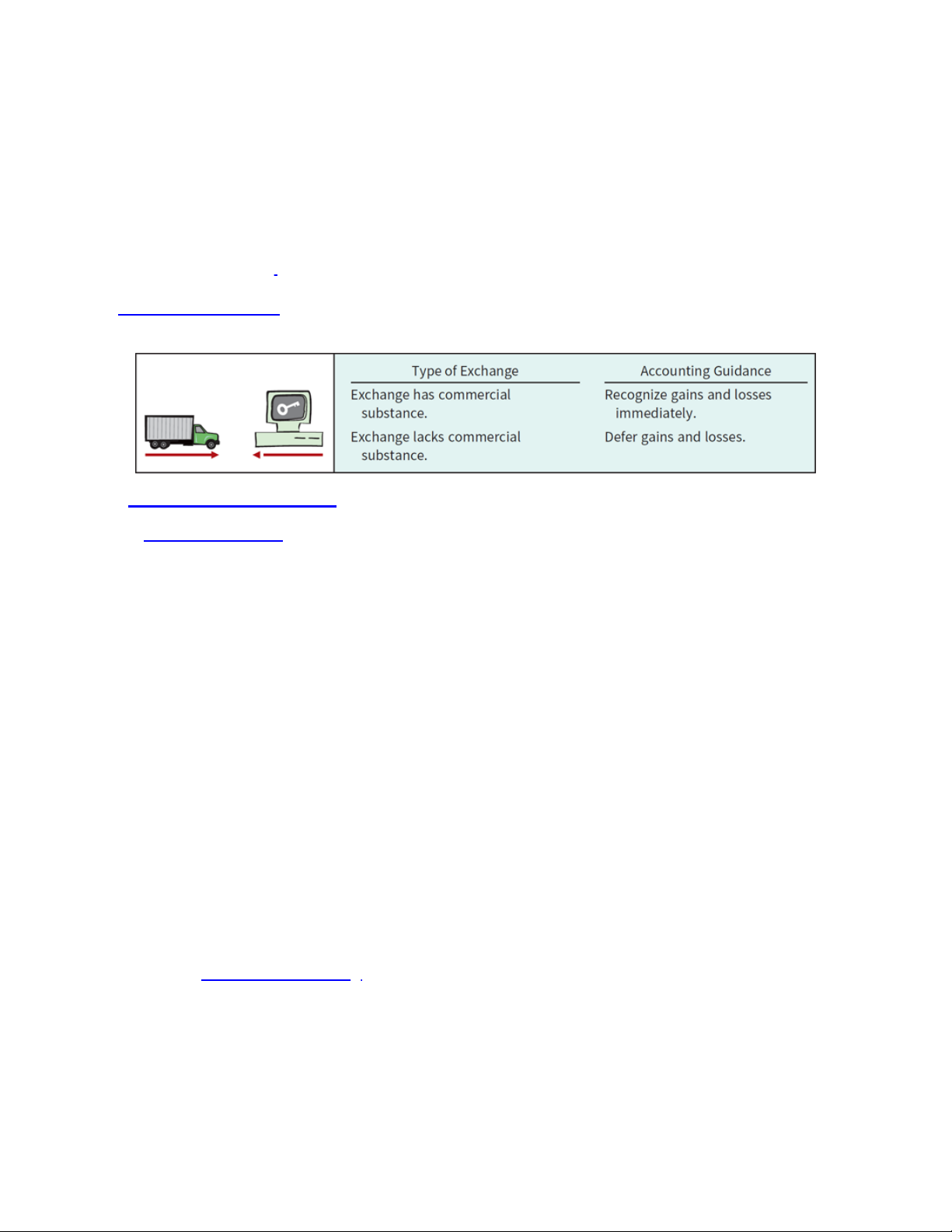
Illustration 10.8 summarizes asset exchange situations and the related accounting.
ILLUSTRATION 10.8 Accounting for Exchanges
As Illustration 10.8 indicates, the accounting for gains and losses depends on
whether the exchange has commercial substance. If the exchange has commercial
substance, the company recognizes the gains and losses immediately. However, if
the exchange lacks commercial substance, it defers recognition of gains and losses.
To illustrate the accounting for these different types of transactions, we examine
various loss and gain exchange situations.
Exchanges—Loss Situation (Has Commercial Substance)
When a company exchanges non-monetary assets and a loss results, the company
recognizes the loss if the exchange has commercial substance. The rationale:
Companies should not value assets at more than their cash equivalent price. If the
loss were deferred, assets would be overstated.
For example, Information Processing SA trades its used machine for a new model
at Jerrod Business Solutions NV. The exchange has commercial substance. The
used machine has a book value of €8,000 (original cost €12,000 less €4,000
accumulated depreciation) and a fair value of €6,000. The new model lists for
€16,000. Jerrod gives Information Processing a trade-in allowance of €9,000 for
the used machine. Information Processing computes the cost of the new asset as
shown in Illustration 10.9.
Tài liệu liên quan:
-
Bộ đề trắc nghiệm kinh tế tài chính | Đại học Kinh tế Thành phố Hồ Chí Minh
30 15 -

Bài tập chương 3,4,5 - môn kinh tế tài chính
218 109 -

Tiểu luận các nhân tố tác động đến dự trữ ngoại hối của các nước phát triển
295 148 -
Tài liệu suy thoái kinh tế, suy thoái tài chính | Môn kinh tế tài chính
290 145