Chapter 17 - Teams and Teamwork in Organizations môn Principle of Management | Trường Đại học Quốc tế, Đại học Quốc gia Thành phố Hồ Chí Minh
Example: A product development team might include a designer, an engineer, and a marketing expert—all working together to launch a new product. Tài liệu giúp bạn tham khảo, ôn tập và đạt kết quả cao. Mời đọc đón xem!
Môn: Principles of Management 187 tài liệu
Trường: Trường Đại học Quốc tế, Đại học Quốc gia Thành phố Hồ Chí Minh 1.5 K tài liệu
Tác giả:















Preview text:
Chap 17
1. Teams in Organizations -
Team: A small group of people with complementary skills who interact
and work with one another to achieve shared goals -
Teamwork: The process of people actively working together to accomplish common goals 👥 What is a Team?
A team is a small group of people who bring different skills to the table and
work closely together to reach a shared goal.
Example: A product development team might include a designer, an
engineer, and a marketing expert—all working together to launch a new product. 🤝 What is Teamwork?
Teamwork is the process of people working actively and cooperatively to achieve team goals.
Example: In a hospital, doctors, nurses, and support staff must coordinate
care to help patients recover. -
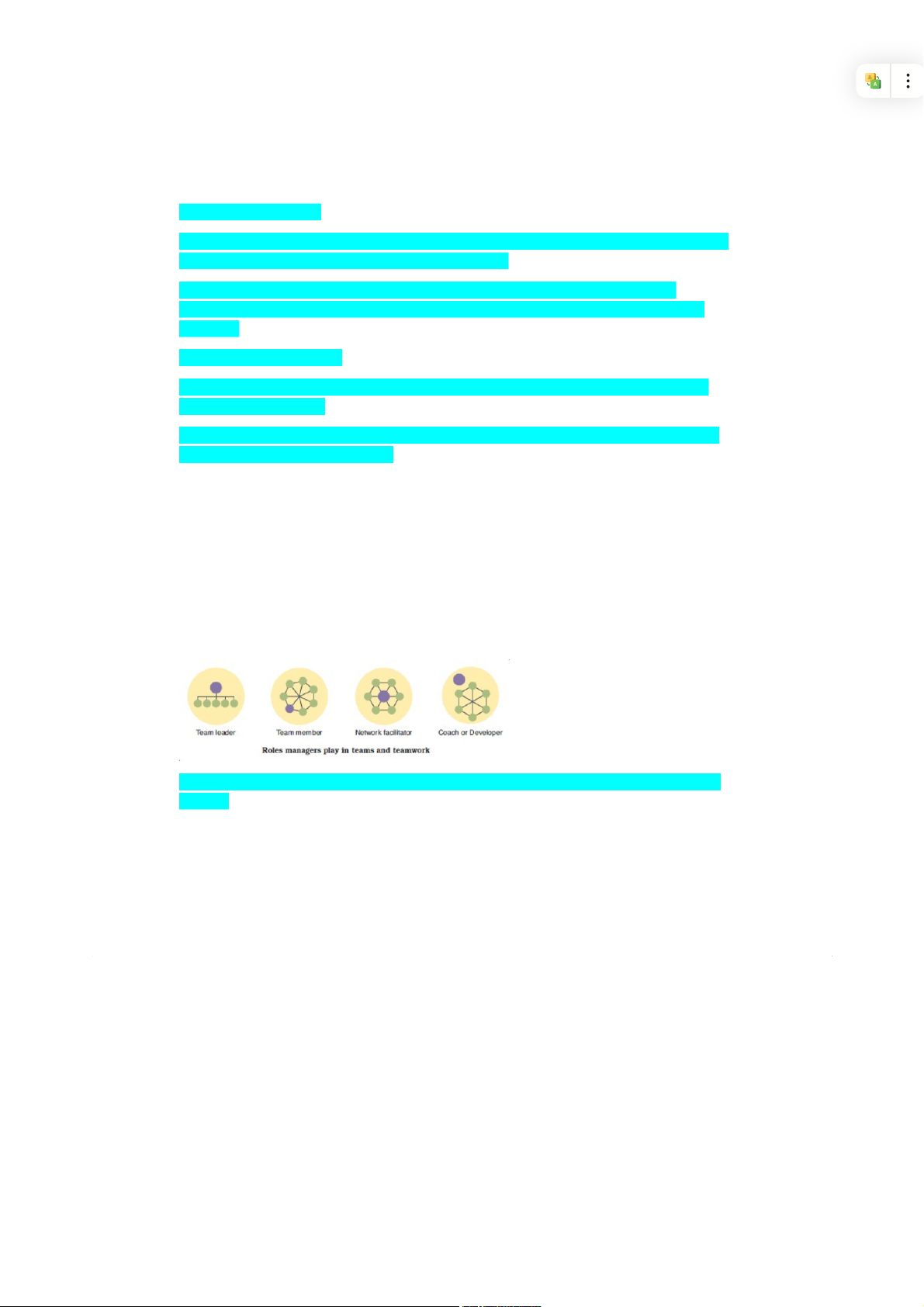
Team and teamwork roles for managers:
Team leader— serving as the appointed head of a team or work unit.
Network facilitator — serving as a peer leader and network hub for a special task force.
Team members serve as helpful contributing members of a project team.
Coach or team developer — serving as a team’s advisor on ways to improve processes and performance.
Managers or leaders in organizations can play different roles in supporting teams: Chap 17 Role Description Example
A project manager in charge of Team Leader
Heads the team and guides meeting deadlines and their work assigning tasks Connects people and
A senior employee who helps Network
resources, especially in cross- different departments Facilitator functional teams collaborate
A software developer writing
Team Member Actively contributes as a code as part of an app participant development team
Advises and supports the
A consultant helping a sales Coach/Team team in improving
team streamline its client Developer performance outreach process - Synergy
The creation of a whole that is greater than the sum of its individual parts.
A team uses its membership resources to the fullest and thereby achieves
through collective action far more than could be achieved otherwise.
Synergy means the team accomplishes more together than each member
could on their own. The team's output is greater than the sum of individual efforts.
Example: In a relay race, each runner’s speed matters, but smooth baton
passing and team coordination are what win the race.
✅ Why synergy is important:
Encourages creativity through collaboration
Combines different strengths
Builds better problem-solving skills
Achieves results faster and more efÏciently Chap 17 -
Common problems in teams: Personality conflicts; Individual
differences in work styles; Ambiguous agendas; Ill-defined problems;
Social loafing tendency of some people to avoid responsibility by “free riding” in groups.
Common Problems in Teams
Even good teams face challenges. Some of the common problems include:
1. Personality Conflicts – Team members may not get along due to
different temperaments or values.
Example: One person is very direct, while another is sensitive—this can lead to tension.
2. Different Work Styles – People approach tasks in their own way (some
fast and loose, others slow and detailed).
Example: A team member who wants to “just get it done” might clash with
someone who prefers planning everything first.
3. Ambiguous Agendas – Goals or roles are unclear.
Example: No one knows who is responsible for presenting during the team meeting.
4. Ill-Defined Problems – The team doesn’t fully understand the problem
they’re supposed to solve.
Example: A team is told to "increase engagement" but isn’t given data or
direction on what that really means. Chap 17
5. Social Loafing – When some people don’t pull their weight and let
others do all the work ("free riders").
Example: In a group project, one member stops contributing because they
know others will cover for them. -
Formal groups: OfÏcially recognized and supported by the organization;
Specifically created to perform essential tasks; Managers and leaders
serve “linking pin” roles. -
Informal groups: Not recognized on organization charts; Not ofÏcially
created for an organizational purpose; Emerge as part of the informal
structure and from natural or spontaneous relationships among people;
Include interest, friendship, and support groups; Can have positive
performance impact; Can help satisfy social needs.
Formal vs. Informal Groups in Organizations ✅ Formal Groups
Definition: OfÏcial teams created by the organization to complete tasks.
Structure: Have clearly defined roles, goals, and often a supervisor or manager.
Purpose: To perform specific functions that contribute to the organization’s success.
Example: A finance department team or a safety committee at a construction company.
Manager’s Role: Managers often serve as "linking pins" — connecting their
team to other teams or higher leadership. 🤝 Informal Groups Chap 17
Definition: Naturally formed groups based on relationships, not on ofÏcial roles or tasks.
Not shown on org charts and not ofÏcially created by management.
Types: Friendship groups, lunch groups, interest-based groups (e.g., a cycling club at work).
Example: Coworkers who regularly eat lunch together and chat about life outside work. Benefits:
Boosts morale and sense of belonging
Helps with communication and informal knowledge sharing
Can support team members emotionally
Caution: If informal groups become negative or resistant to change, they can harm productivity. 1. Teamwork pros 2. Teamwork cons
3. Meetings, meetings, meetings
4. Organizations as networks of teams
2. Trends in the Use of Teams
1. Committees, project teams, and task forces -
Committees: People outside their daily job assignments work together
in a small team for a specific purpose; Task agenda is narrow, focused, and ongoing Committees
Definition: Ongoing teams made up of people from different
departments, working together outside of their normal duties.
Purpose: Handle specific, often long-term or recurring issues.
Example: A workplace health and safety committee that meets monthly to review safety protocols. -
Projects teams or task forces: People from various parts of an
organization work together on common problems, but on a temporary Chap 17
basis; OfÏcial tasks are very specific, and time defined; Disbands after task is completed.
🔹 Project Teams / Task Forces
Definition: Temporary teams formed to solve specific problems or complete specific tasks.
Members: Come from different departments or roles.
End Result: Disband after the job is done.
Example: A new product launch team with members from marketing, design,
and sales, disbanding after launch.
2. Cross-functional teams -
Members come from different functional units of an organization. -
Teams are created to knock down “walls” separating departments. -
Functional chimneys problem – a lack of communication across functions
Definition: Teams that include people from different departments (e.g.,
marketing, finance, operations).
Purpose: Encourage collaboration across traditional departmental boundaries.
Why they matter: Break down silos, solve problems more creatively, and
make better decisions by combining diverse expertise.
Problem they help solve:
oFunctional chimneys problem – when departments don't share
information or work well together.
Example: A customer experience improvement team including staff from IT,
customer service, and logistics working together. 3. Self-managed teams
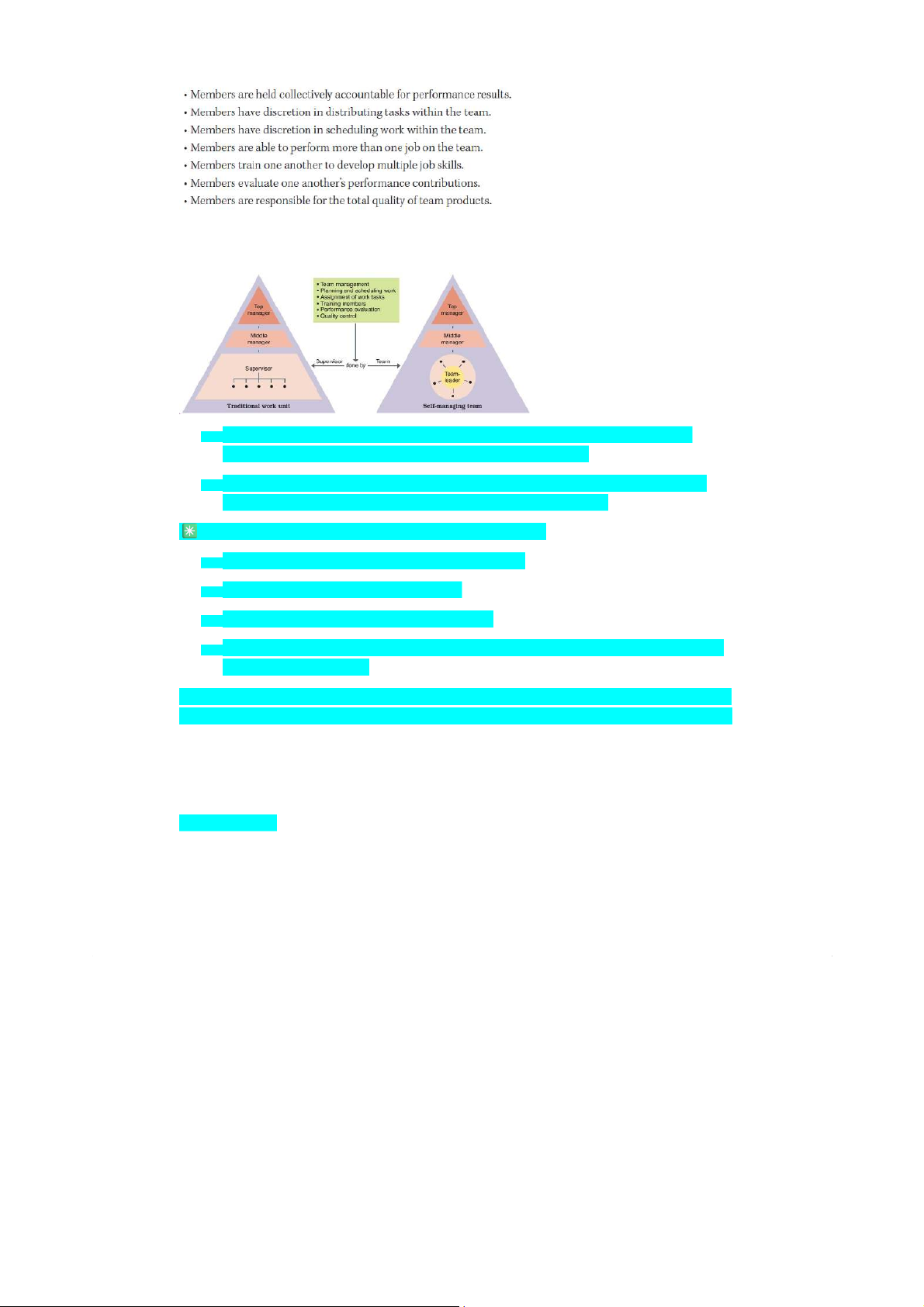
-Have the authority to make decisions about how they share and complete their work. -
Key feature is multitasking with an emphasis on participation. -
Characteristics of self-managing teams: Chap 17
Figure 17.1 Organizational and management implications of self-managing work teams
Definition: Teams that have decision-making power and manage
themselves without needing constant supervision.
Key Feature: Team members multitask and share responsibility for
planning, scheduling, and evaluating their own work.
✳ Characteristics of Self-Managed Teams include:
Shared leadership among team members
Joint accountability for outcomes
High participation in decision-making
Team members handle tasks like setting goals, assigning duties, and monitoring progress
Example: At a manufacturing plant, a self-managed assembly team decides
who does what tasks, rotates roles, and handles quality control themselves.
4. Virtual (distributed) teams -
Teams of people who work together and solve problems through largely
computer-mediated rather than face-to-face interactions. 🔹 Definition: Chap 17
A virtual team is a group of people who work together primarily through
digital communication tools—like email, video calls, shared documents—
rather than meeting in person.
🔹 Examples of Virtual Teams:
A marketing team with members in different countries collaborating through Zoom and Slack.
A software development team working remotely via GitHub and Trello.
Potential advantages of virtual Potential problems of virtual teams: teams: Savings in time and travel
DifÏculty in establishing good expenses working relationships
Minimization or elimination of Depersonalization of working interpersonal difÏculties relationships Ease of expansion
Hard to build strong working
Saves time and travel costs
relationships due to lack of in- (no need for flights or daily person contact. commutes).
Depersonalization—teammates
Reduces interpersonal conflict may feel disconnected or
(less chance for face-to-face isolated. clashes).
Communication challenges—
Easier to expand (can include delays, misunderstandings, or members from anywhere lack of tone/context. globally).
G u id elin e s fo r m a na g in g v irtu a l te am s:
S e le c t te a m m e m b er s h ig h in in itia tiv e a n d c a p a b le o f s elf-sta rtin g .
S e le ct m e m be rs w h o w ill jo in a n d e n g a ge th e te a m w ith p o sitiv e a ttitu d e s.
S e le ct m e m be rs k n o w n fo r w o rkin g h a rd to m e e t te am g o a ls.
B e g in w ith s oc ia l m e s sa g in g th a t a llo w s m e m b e rs to e xc h an g e info rm a tio n
a b o ut e a ch o th er to p e rs on aliz e th e p ro ce ss .
A s sig n cle a r g o a ls a n d ro les so th a t m e m b e rs ca n fo cu s w h ile w o rk in g -
a lo n e a n d a ls o k n ow w h at o th e rs a re d o in g . 5. Team building -
Activities that analyze teams and make changes to improve performance.
-May include meetings, games and outdoor activities. Chap 17 Definition:
Team building involves planned activities designed to improve how well a
team functions—how they communicate, collaborate, and solve problems. 🔹 Methods:
Workshops or strategy sessions Games and simulations
Outdoor activities like team retreats or obstacle courses
Example: A company holds a weekend retreat with problem-solving games
to help team members improve trust and coordination.
🔸 Purpose of Team Building:
Strengthen trust and communication
Clarify team roles and goals
Improve problem-solving and collaboration
Boost morale and team spirit 3. How Teams Work -
Effective Teams: Perform tasks; Satisfy members; Remain viable for the future.
Figure 17.2 An open-systems model of team effectiveness Chap 17
🔹 Effective Teams Have Three Main Goals:
1. Perform Tasks: Get their work done well.
2. Satisfy Members: Make team members feel valued and happy.
3. Remain Viable: Stay strong and able to work together in the future. -
Team effectiveness may be summarized as :Quality of inputs+ Pr ocess gains – Process losses= T eam effectiveness
🔹 Team Effectiveness Formula:
Team Effectiveness = Quality of Inputs + Process Gains – Process Losses
Quality of Inputs: What the team starts with—skills, resources, member traits.
Process Gains: Positive things the team achieves by working together
(e.g., better ideas, motivation).
Process Losses: Problems or inefÏciencies (e.g., poor communication, conflict). - Team diversity:
A variety of values, personalities, experiences, demographics, and cultures among members
Greater variety of available ideas, perspectives, and experiences
As team diversity increases, the complexity of interpersonal relationships also increases. Team Diversity Chap 17
Means having members with different values, personalities,
experiences, backgrounds, and cultures.
Diversity brings a wider range of ideas and perspectives.
But, it can also make team relationships more complex and require
better communication skills. 1. Team inputs -
Team input factors that influence group processes in the pursuit of team effectiveness: Resources and setting Nature of the task Team size Membership characteristics 1. Team Inputs
These are factors that influence how well the team works:
Resources and setting: Tools, budget, physical environment.
Nature of the task: How difÏcult or complex the job is.
Team size: How many members are in the team.
Membership characteristics: Skills, attitudes, personalities of team members.
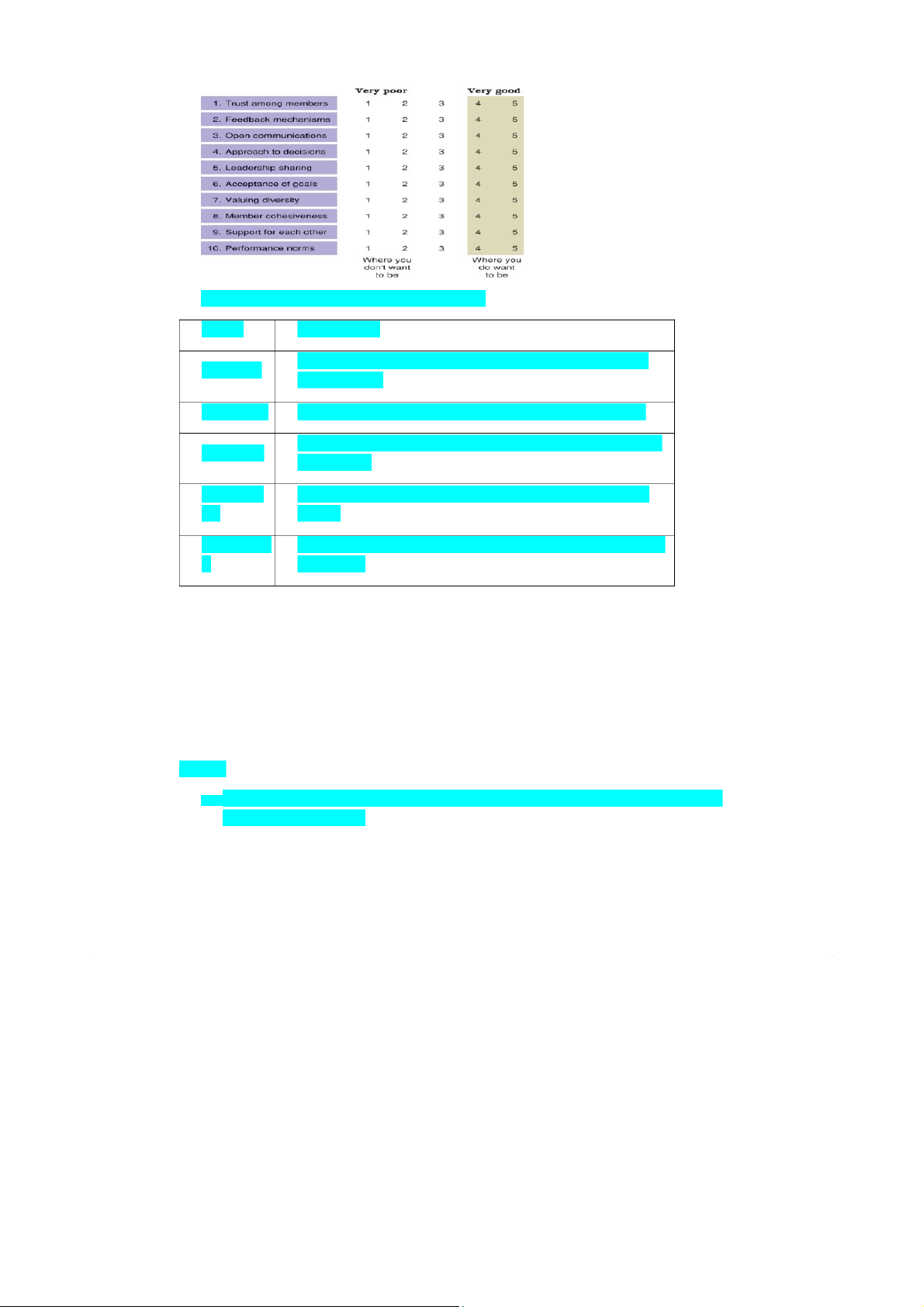
2. Stages of team development -
Forming: initial orientation and interpersonal testing -
Storming: conflict over tasks and ways of working as a team -
Norming: consolidation around task and operating agendas -
Performing: teamwork and focused task performance -
Adjourning: task accomplishment and eventual disengagement
Figure 17.3 Criteria for assessing the maturity of a team. Chap 17
Teams usually develop in these stages: Stage Description
Forming Team members get to know each other and test boundaries. Storming
Conflicts arise about tasks and team processes.
Norming The team settles into agreed ways of working and sets roles. Performi
The team works efÏciently together, focusing on ng tasks. Adjournin
Team finishes the task and members disengage or g move on.
3. Norms and cohesiveness - Norms
Behavior expected of team members.
Rules or standards that guide behavior. May result in team sanctions. Norms
Norms are the unwritten rules or expected behaviors that guide how team members act. Chap 17
They tell members what is acceptable or unacceptable behavior within the team.
If someone breaks these norms, the team might apply sanctions (like
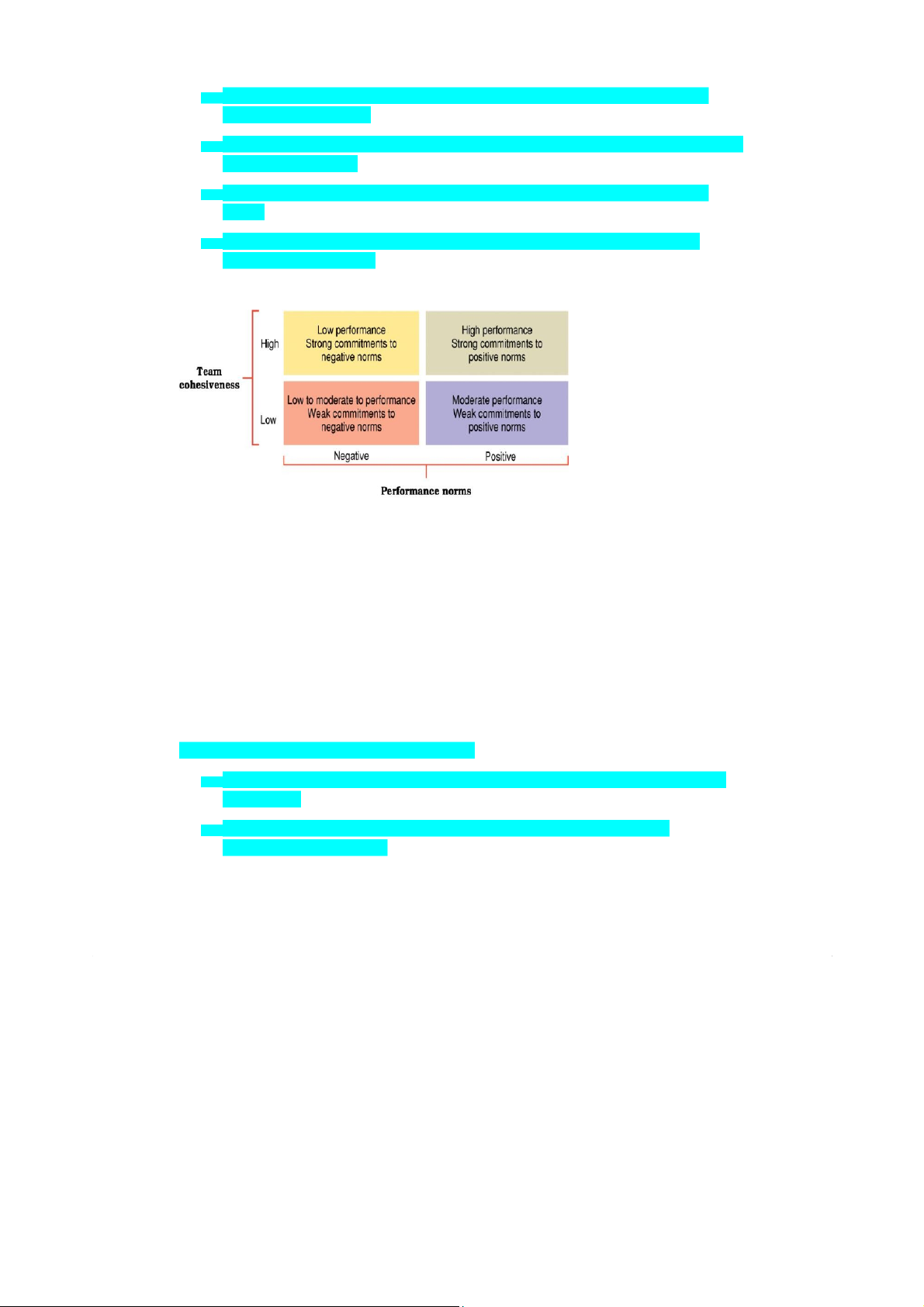
criticism or exclusion) to encourage conformity. - Cohesiveness
The degree that members are attracted to and motivated to remain part of the team. Desire to conform to norms. Cohesiveness
Cohesiveness is how strongly team members feel connected to each
other and want to stay part of the team.
High cohesiveness means members are motivated to stick together and work well.
It also increases the desire to follow the team norms. -
Guidelines for building positive norms: Act as a positive role model
Reinforce the desired behaviors with rewards
Control results by performance reviews and regular feedback
Orient and train new members to adopt desired behaviors
Recruit and select new members who exhibit desired behaviors
Hold regular meetings to discuss progress and ways of improving
Use team decision-making methods to reach agreement
Guidelines for Building Positive Norms
Be a positive role model: Show the behavior you want to see.
Reward desired behaviors: Encourage good behavior by recognizing or rewarding it.
Use performance reviews and feedback: Regularly assess and give feedback on behavior. Chap 17
Train and orient new members: Help new team members learn the expected behaviors.
Recruit members who fit the norms: Select people who naturally match the team’s values.
Hold regular meetings: Discuss progress and ways to improve as a team.
Use team decision-making: Involve everyone in decisions to build agreement on norms
Figure 17.4 How cohesiveness and norms influence team performance. -
Guidelines for increasing team cohesion:
Build agreement on team goals.
Increase membership homogeneity.
Increase interaction among members. Decrease team size.
Introducing competition with other teams
Reward team rather than individual results.
Provide physical isolation from other teams.
Guidelines for Increasing Team Cohesion
Build agreement on goals: Make sure everyone agrees on the team’s objectives.
Increase similarity among members: Having similar values or backgrounds can help. Chap 17
Encourage interaction: More time spent together builds stronger bonds.
Keep team size manageable: Smaller teams usually have better cohesion.
Introduce competition with other teams: Healthy competition can boost unity.
Reward team results: Focus on group achievements, not just individual ones.
Physically separate teams: Giving teams their own space helps them bond.
4. Task and maintenance roles - Task activities
Actions by team members that contribute directly to team’s performance purpose.
Include: Initiating; Information sharing; Summarizing; Elaborating; Opinion giving Task Activities
These are the actions team members take that directly help the team get its work done. Examples include:
oInitiating: Starting discussions or suggesting ideas.
oInformation sharing: Providing facts or data.
oSummarizing: Recapping what’s been said.
oElaborating: Adding more details or explanations.
oOpinion giving: Sharing personal views or judgments. - Maintenance activities
Supporting the emotional life of a team as an ongoing social system
Include: Gatekeeping; Encouraging; Following; Harmonizing; Reducing tension Maintenance Activities Chap 17
These focus on supporting the team’s social and emotional well-being. Examples include:
oGatekeeping: Making sure everyone gets a chance to speak.
oEncouraging: Offering support and praise.
oFollowing: Listening and showing acceptance of others’ ideas.
oHarmonizing: Reducing conflict and promoting peace.
oReducing tension: Helping the team relax or lighten up. -
Distributed leadership roles …
Make every member responsible for recognizing when task and/or
maintenance activities are needed and taking actions to provide them.
Leading through task activities focuses on solving problems and achieving performance results.
Leading through maintenance activities helps strengthen and perpetuate the team as a social system. Disruptive Activities
These are negative behaviors that hurt team effectiveness, such as:
oBeing aggressive or hostile. oBlocking ideas.
oOversharing personal problems (self-confessing).
oConstantly seeking sympathy or recognition.
oCompeting in unproductive ways.
oWithdrawing from participation.
oHorsing around or acting unseriously.
17.5 Distributed leadership helps teams meet task and maintenance needs. Chap 17 -
Disruptive activities that detract from team effectiveness: Being
aggressive; Blocking; Self-confessing; Seeking sympathy; Competing;
Withdrawal; Horsing around; Seeking recognition
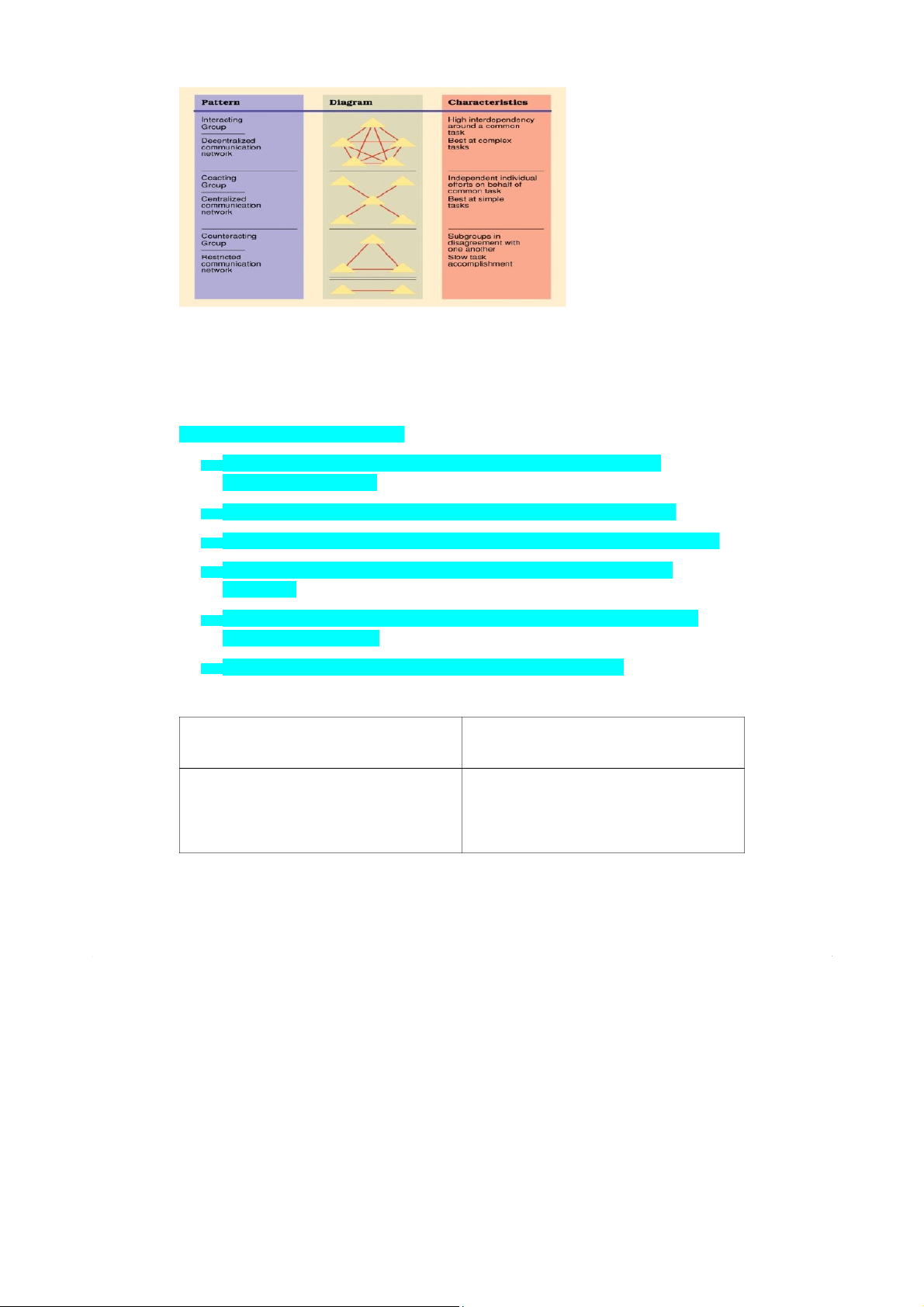
5. Communication networks -
Decentralized: All members communicate directly with one another -
Centralized: Activities are coordinated and results pooled by central point of control -
Restricted: Polarized subgroups contest to one another; Subgroups
may engage in antagonistic relations Decentralized Network
Everyone in the team communicates directly with everyone else.
Encourages open discussion and shared information. Centralized Network
Communication flows through a central person or point.
This person coordinates activities and gathers results. Restricted Network
Team splits into subgroups that mainly communicate within themselves.
These subgroups may compete or have conflicts with each other.
Figure 17.6 Interaction patterns and communication networks in teams Chap 17
4. Decision Making in Teams
1. Ways teams make decisions.
Methods of team decision making: Lack of response; Authority rule; Minority
rule; Majority rule; Consensus; Unanimity.
1. Ways Teams Make Decisions
Lack of response: No real decision is made; the team avoids addressing the issue.
Authority rule: A leader or manager makes the decision alone.
Minority rule: A small subgroup within the team makes the decision.
Majority rule: The decision is made based on the vote of most members.
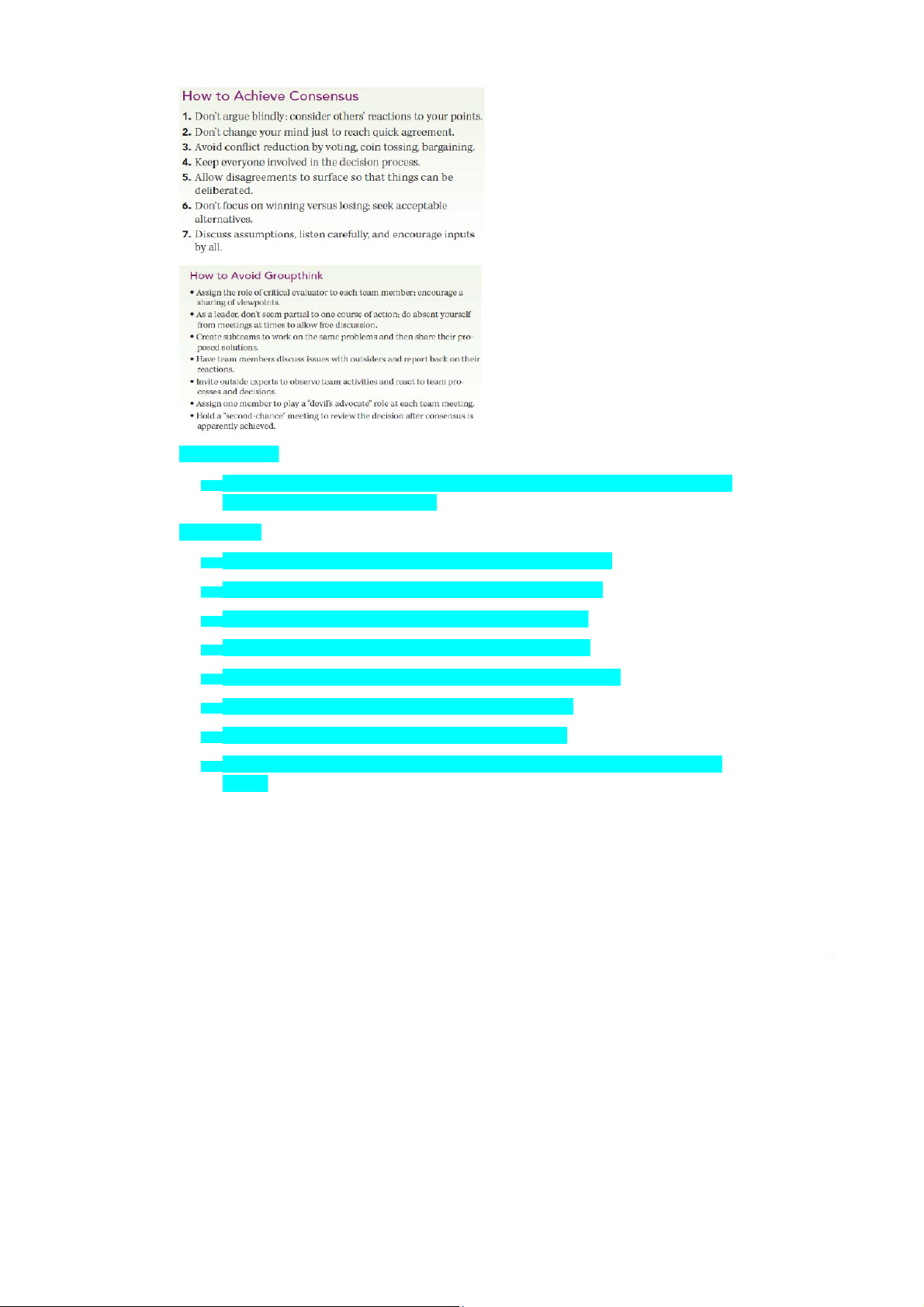
Consensus: The whole team discusses until they reach a decision everyone can accept.
Unanimity: Every member fully agrees on the decision.
2. Advantages and disadvantages of team decisions Advantages of team decision
Disadvantages of team decision making: making:
Greater amounts of information, Social pressure to conform knowledge, and expertise Individual or minority group Expands number of action domination alternatives considered Time requirements Increases understanding and Chap 17 acceptance
Increases commitment to follow through
2. Advantages and Disadvantages of Team Decisions Advantages:
Brings more information, knowledge, and expertise together.
Allows consideration of a wider range of possible actions.
Helps team members understand the decision better.
Increases commitment to implementing the decision. Disadvantages:
Social pressure may push members to conform, even if they disagree.
Some individuals or small groups might dominate the decision process.
Decision-making can take more time compared to individual decisions. 3. Groupthink - Symptoms of groupthink:
Illusions of group invulnerability
Rationalizing unpleasant and disconfirming data
Belief in inherent group morality
Negative stereotypes of competitors Pressure to conform. Self-censorship of members Illusions of unanimity Mind guarding Chap 17 3. Groupthink
Groupthink happens when the desire for harmony and conformity in a
team leads to poor decisions. Symptoms:
Illusion that the group is invulnerable and cannot fail.
Ignoring or rationalizing away opposing information.
Belief that the group’s decisions are morally right.
Negative stereotyping of outsiders or competitors.
Pressure on members to conform to the group’s ideas.
Members censor their own doubts or objections.
Illusion that everyone agrees (false unanimity).
“Mind guarding” – some members protect the group from dissenting views.
4. Creativity in team decision making. - Brainstorming
Tài liệu liên quan:
-
Leadership Styles Preferred by Generation Z môn Principle of Management | Trường Đại học Quốc tế, Đại học Quốc gia Thành phố Hồ Chí Minh
1 1 -
Chapter 7 Blowing the Whistl môn Principle of Management | Trường Đại học Quốc tế, Đại học Quốc gia Thành phố Hồ Chí Minh
2 1 -
Chapter 11 - Organizational Structures and Their Impacts on Leadership môn Principle of Management | Trường Đại học Quốc tế, Đại học Quốc gia Thành phố Hồ Chí Minh
3 2 -
Lecture 2: Relational Model and Algebra môn Principle of Management | Trường Đại học Quốc tế, Đại học Quốc gia Thành phố Hồ Chí Minh
1 1 -
Lecture 6: ER –Relational Translation môn Principle of Management | Trường Đại học Quốc tế, Đại học Quốc gia Thành phố Hồ Chí Minh
2 1