Chapter 5 Global Management AND Cultural Diversity môn Principle of Management | Trường Đại học Quốc tế, Đại học Quốc gia Thành phố Hồ Chí Minh
Globalizationisthegrowinginterdependenceamongelementsofthe global economy. Tài liệu giúp bạn tham khảo, ôn tập và đạt kết quả cao. Mời đọc đón xem!
Môn: Principles of Management 187 tài liệu
Trường: Trường Đại học Quốc tế, Đại học Quốc gia Thành phố Hồ Chí Minh 1.5 K tài liệu
Tác giả:


















Preview text:
Trần Bảo Tuấn - BABAIU20169
Ngô Trần Cẩm Tú - BABAIU20165
Nguyễn Minh Long - BABAIU20072 CHAPTER 5:
GLOBAL MANAGEMENT AND CULTURAL DIVERSITY
-Globalization is the growing interdependence among elements of the global economy.
-Global management involves managing business and organizations
with interests in more than one country.
- A truly global manager is culturally aware and informed on international affairs. I. Why do companies go global?
-An international business conducts for-profit transactions of goods
and services across national boundaries.
- Common reasons for doing international business:
●Profits—Gain profits through expanded operations.
●Customers—Enter new markets to gain new customers.
●Suppliers—Get access to materials, products, and services.
●Labor—Get access to lower-cost talented workers.
●Capital—Tap a larger pool of financial resources.
●Risk—Spread assets among multiple countries
Trần Bảo Tuấn - BABAIU20169
Ngô Trần Cẩm Tú - BABAIU20165
Nguyễn Minh Long - BABAIU20072 II. How to go global? 2.1) Market entry strategies
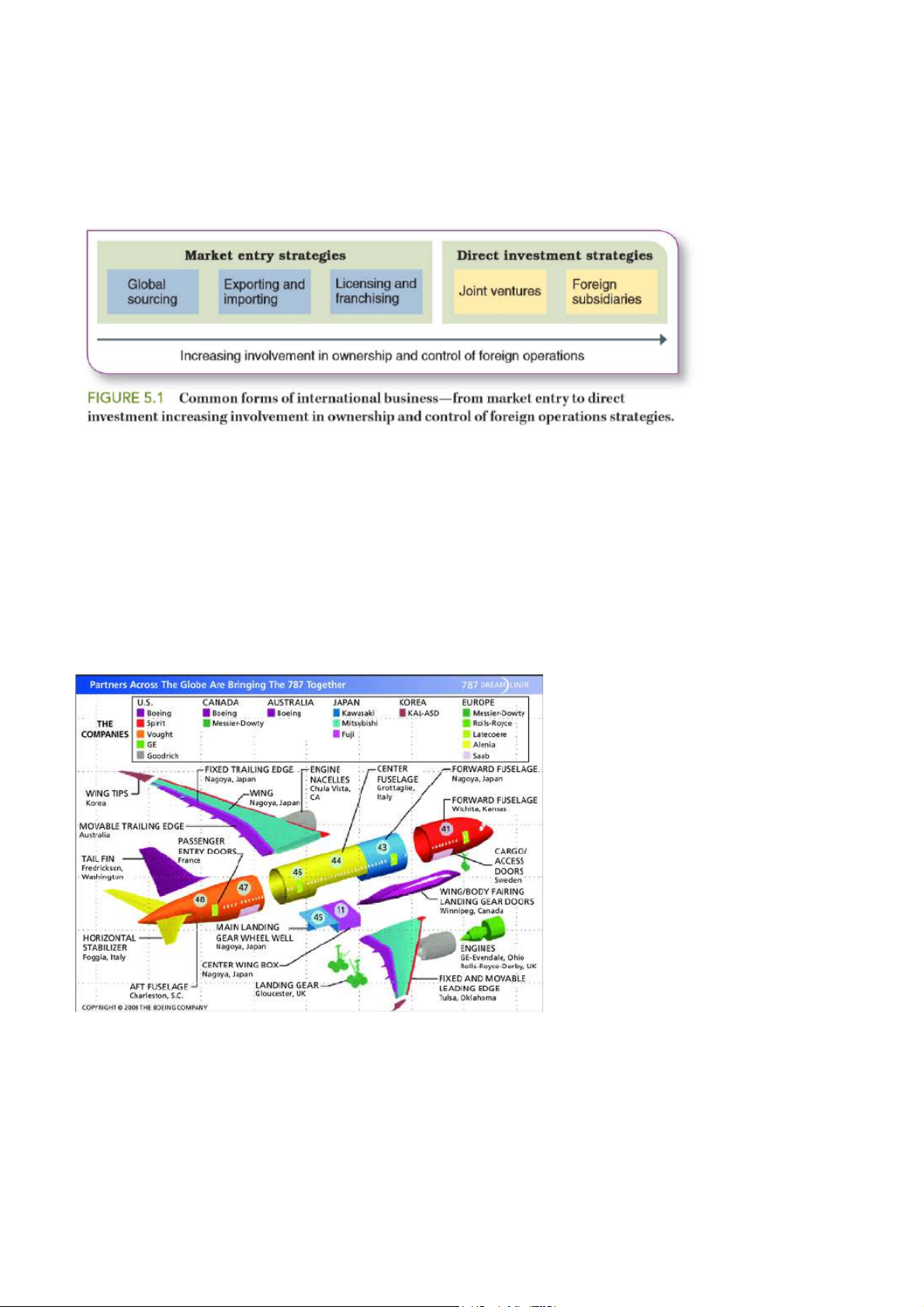
-Global sourcing: the process of purchasing materials, manufacturing
components, or locating business services around the world.
—> Example: The Boeing Company, VinFast -Exporting and importing:
+Exporting (Xuất Khẩu) : selling locally made products in foreign markets. →Example: VN exports rice
+Importing (Nhập Khẩu): buying foreign-made products and
selling them in domestic markets.
→Example: Many technological devices (phone, laptops and so on) sold in VN are imported
Trần Bảo Tuấn - BABAIU20169
Ngô Trần Cẩm Tú - BABAIU20165
Nguyễn Minh Long - BABAIU20072
-Licensing agreement (Cấp phép): a local firm pays a fee to a foreign
firm for rights to make or sell its products.
→Example:Coca-Cola licenses bottlers (wholesalers) in various
world markets that buy Coca-Cola syrup concentrate and then
bottle and sell the finished product to retailers locally.
-Franchising( Nhượng quyền kinh doanh) is a form of licensing in
which the foreign firm buys the rights to use another’s name and
operating methods in its home country.
→Example: McDonald’s, Wendy’s, and Subway sell facility
designs, equipment, product ingredients and recipes, and
management systems to foreign investors, while retaining certain
brand, product and operating controls.
2.2) Direct investment strategy
-Joint venture (công ty liên doanh): This is a co-ownership arrangement
in which the foreign and local partners agree to pool resources, share
risks, and jointly operate the new business. (2 hoặc nhiều công ty cùng
thành lập ra một doanh nghiệp mới)
→Example: Caradigm venture between Microso Corporation
and General Electric (GE) in 2011. The Caradigm project was
launched to integrate a Microso healthcare intelligence product
with various GE health-related technologies.
Trần Bảo Tuấn - BABAIU20169
Ngô Trần Cẩm Tú - BABAIU20165
Nguyễn Minh Long - BABAIU20072
-A global strategic alliance (liên minh chiến lược): is a partnership in
which foreign and domestic firms share resources and knowledge for
mutual gains. (2 hoặc nhiều công ty cùng thống nhất để share kiến thức, nguồn lực cho nhau)
→Example: In 2012, Red Bull partnered with GoPro to support a
record-breaking skydive from a balloon. Red Bull sponsored the
dive, and the skydiver wore a GoPro camera to capture it. The two
brands later formed a long-term strategic alliance for Red Bull
extreme sports events, such as the Red Bull Rampage. Only GoPro
cameras are used to capture an athlete’s point-of-view shots at these events.
-A foreign subsidiary is a local operation completely owned by a foreign
firm. (Thành lập công ty con tại địa phương/quốc gia dưới tên của công ty mẹ: Ví dụ: Intel Việt Nam)
→Example: Unilever, Toyota, Intel lập công ty con tại VN III. Global business environment - Legal and political systems:
Trần Bảo Tuấn - BABAIU20169
Ngô Trần Cẩm Tú - BABAIU20165
Nguyễn Minh Long - BABAIU20072
●Differing laws and practices regarding: business ownership,
foreign currency exchange, protection of intellectual property rights ●Counterfeit merchandise
●Political risk – potential loss in value of a foreign investment due
to instability and political changes in the host country
●Political risk analysis – forecast political disruptions that threaten
the value of a foreign investment
- Trade agreements and trade barriers:
●World Trade Organization member nations agree to negotiate
and resolve disputes about tariffs and trade restrictions.
●Most favored nation status gives a trading partner the most
favorable treatment for imports and exports.
●Tariffs are taxes governments levy on imports from abroad.
Nontariff barriers to trade discourage imports in nontax ways
such as quotas and government import restrictions.
●Protectionism is a call for tariffs and favorable treatments to
protect domestic firms from foreign competition.
→One goal of most tariffs and protectionism is to protect local firms from foreign
competition and save jobs for local workers.
→Different countries may have agreements that facilitate the business or they have
regulations that oppose or limit the success of a business
Trần Bảo Tuấn - BABAIU20169
Ngô Trần Cẩm Tú - BABAIU20165
Nguyễn Minh Long - BABAIU20072 IV. Culture and Global diversity
- Culture (Văn hóa): is a shared set of beliefs, values, and patterns of behavior common to a group of people.
- Culture shock (Shock Văn hóa): is the confusion and discomfort a person
experiences when in an unfamiliar culture.
- Ethnocentrism (Chủ nghĩa dân tộc): is the tendency to consider one’s culture superior to others.
- Cultural intelligence (Trí thông minh văn hóa) is the ability to accept and adapt to new cultures.
4.1) Silent languages of culture - Context:
+Low-context cultures emphasize communication via spoken or written
words. (Văn hóa chủ yếu sử dụng từ ngữ hoặc văn nói)
+High-context cultures rely on nonverbal and situational cues as well as
on spoken or written words in communication. (Văn hóa khi giao tiếp sử
dụng các yếu tố ngoại cảnh như giọng điệu, hành vi, cử chỉ,...) - Time:
+In monochronic cultures people tend to do one thing at a time. → It is
common in the United States to schedule meetings with specific people
and focus on a specific agenda for an allotted time. And if someone is
Trần Bảo Tuấn - BABAIU20169
Ngô Trần Cẩm Tú - BABAIU20165
Nguyễn Minh Long - BABAIU20072
late or brings an uninvited guest, we tend not to like it. (Làm từng việc, không nên giao cùng 1 lúc)
+In polychronic cultures time is used to accomplish many different
things at once. They o en try to work on many different things at once,
perhaps not in any particular order, and give in to distractions and
interruptions. (Có thể làm 1 lúc rất nhiều việc) - Space:
+Proxemics is how people use space to communicate.
Example 1:Americans tend to like and value their own space, perhaps as
much space as they can get —> they like big office, big cars, big homes, and big yards
Example 2: Vietnamese also value certain distance between people when talking or communicating 4.2) Tight and Loose Cultures
- In a tight culture, such as ones found in Korea, Japan, or Malaysia, social
norms are strong and clear. People know the prevailing norms and let them
guide their behavior. → The goal in tight cultures is to fit in with society’s
expectations and not stand out.
- Ăn coi nồi ngồi coi hướng, thường tìm thấy văn hóa collectivism (văn hóa tập thể)
-In a loose culture, such as ones found in Australia, Brazil, or Hungary, social
norms are mixed and less clear cut. People may be more or less concerned
Trần Bảo Tuấn - BABAIU20169
Ngô Trần Cẩm Tú - BABAIU20165
Nguyễn Minh Long - BABAIU20072
with them, and conformity will vary a good deal → It is quite acceptable for
individuals in loose cultures to show unique identities and express themselves independent from the masses.
- Có thể nhuộm tóc , trong văn hóa cá nhân (individualism)
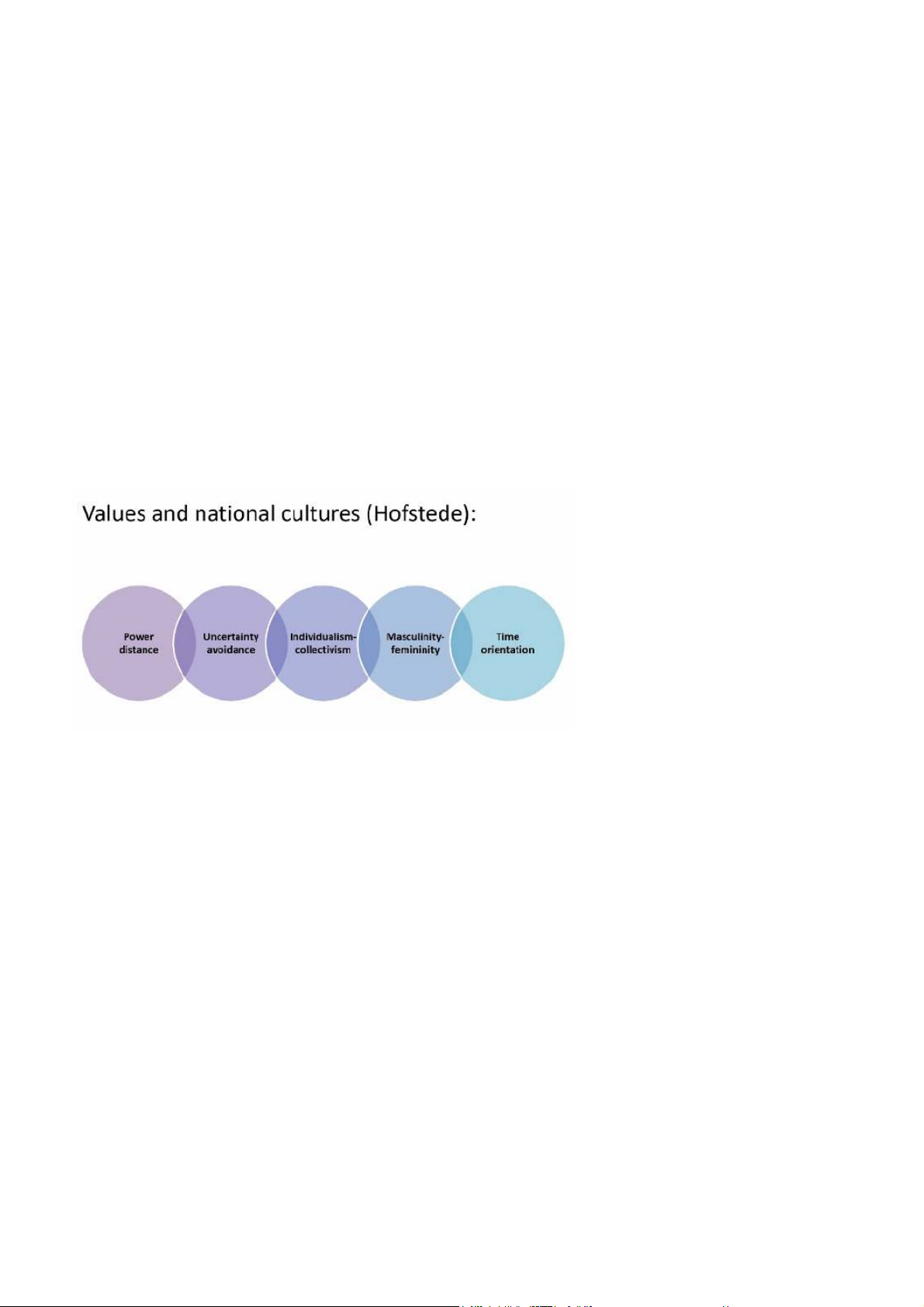
4.3) Values and national cultures
- Power distance is the degree to which a society accepts unequal distribution
of power. (Công ty Châu Á thường high power distance, châu Âu thì low power distance hơn)
- Individualism (Chủ nghĩa cá nhân) – Collectivism (chủ nghĩa tập thể) is the
degree to which a society emphasizes individuals and their self-interests.
- Uncertainty avoidance is the degree to which a society tolerates risk and uncertainty.
+ High uncertainty avoidance: Vietnamese ko thích risk taking + Low uncertainty avoidance:
- Masculinity–femininity is the degree to which a society values assertiveness and materialism.
Trần Bảo Tuấn - BABAIU20169
Ngô Trần Cẩm Tú - BABAIU20165
Nguyễn Minh Long - BABAIU20072
+Masculinity culture: In a masculine culture, men are expected to be
assertive, competitive, and focused on material success. Nếu nữ mà làm
manager thì gặp rất nhiều khó khăn vì không được tin tưởng
- Time orientation is the degree to which a society emphasizes short-term or long-term goals.
+Short-term thinking: phải có result immediately → American
tendencies toward impatience and desire for quick, even instantaneous,
gratifications show short-term thinking. (những người này thường suy
nghĩ phải có chi tiết, kết quả rõ ràng của từng giai đoạn, không phải
người ta không nghĩ đến long-term, mà người ta suy nghĩ từng step giai
đoạn ngắn để đạt được mục tiêu)
(Nếu làm việc với thể loại người này thì should báo cáo rất rõ ràng, kết
quả chi tiết, từng giai đoạn, cụ thể, ví dụ kế hoạch năm nhất sẽ thu về 10
tỷ, năm 2 thu về 20 tỷ,..)
+Long-term thinking: think general result with long-term impact
(Không cần nghe kết quả 1 năm 2 năm, mà chỉ quan trọng đến ảnh hưởng chung nhất
Tài liệu liên quan:
-
Leadership Styles Preferred by Generation Z môn Principle of Management | Trường Đại học Quốc tế, Đại học Quốc gia Thành phố Hồ Chí Minh
3 2 -
Chapter 7 Blowing the Whistl môn Principle of Management | Trường Đại học Quốc tế, Đại học Quốc gia Thành phố Hồ Chí Minh
3 2 -
Chapter 11 - Organizational Structures and Their Impacts on Leadership môn Principle of Management | Trường Đại học Quốc tế, Đại học Quốc gia Thành phố Hồ Chí Minh
3 2 -
Lecture 2: Relational Model and Algebra môn Principle of Management | Trường Đại học Quốc tế, Đại học Quốc gia Thành phố Hồ Chí Minh
3 2 -
Lecture 6: ER –Relational Translation môn Principle of Management | Trường Đại học Quốc tế, Đại học Quốc gia Thành phố Hồ Chí Minh
3 2