Consumer Intentions for Green Freight Transportation in Hanoi môn Thống kê trong kinh tế và kinh doanh | Trường Đại học Kinh Tế Quốc Dân
This article develops the extended Theory of Planned Behavior(TPB) to investigate the factors influencing purchase intention and the willingness to pay a premium for green-shipped consumer products(GSCPs. Tài liệu giúp bạn tham khảo, ôn tập và đạt kết quả cao. Mời đọc đón xem!
Môn: Thống kê trong kinh tế và kinh doanh 1.3 K tài liệu
Trường: Trường Đại học Kinh Tế Quốc Dân 8.2 K tài liệu
Tác giả:








Preview text:
Available online at www.sciencedirect.com ScienceDirect
Transportation Research Procedia 85 (2025) 52–59
Sustainable Development and Climate Change Adaptation in Transportation (SDCAT 2023)
Consumer intention and willingness to pay a premium for green
freight transportation: a case study in Hanoi, Vietnam
Tran Thi Lan Huonga, Nguyen Thi Hong Maia, Nguyen Hoang Maia, Nguyen Thi Nhua,*
aFaculty of Transport Economics, University of Transport and Communications, 03 Cau Giay street, Lang Thuong ward, Dong Da district, Ha Noi, 100000, Vietnam Abstract
This article develops the extended Theory of Planned Behavior (TPB) to investigate the factors influencing purchase intention and
the willingness to pay a premium for green-shipped consumer products (GSCPs) among end consumers. Empirical research
conducted with 459 consumers in Hanoi, Vietnam, demonstrates that attitudes, perceived behavioral control, and perceived values
related to green freight positively impact end consumer’s behavioral intentions. In contrast, subjective norms exhibit no significant
influence. Furthermore, there is a positive correlation between behavioral intentions and the final consumer's willingness to pay
for GSCPs. These research findings offer valuable insights for transportation service providers and policymakers in their endeavors
to promote environmentally sustainable transportation solutions.
© 2024 The Authors. Published by ELSEVIER B.V.
This is an open access article under the CC BY-NC-ND license (https://creativecommons.org/licenses/by-nc-nd/4.0)
Peer-review under responsibility of the scientific committee of the Sustainable Development and Climate Change Adaption in Transportation
Keywords: Theory of Planned Behavior, Green freight transportation, Willingness to pay a premium, Intention. 1. Introduction
The transportation sector, recognized for its detrimental impact on the environment and human health, emitted a
staggering 8 billion tons of CO2 into the atmosphere in 2008. Even in the face of global slowdown in transportation
activities in 2021 due to the Covid-19 pandemic, emissions from this sector remained alarmingly high at 7.6 billion
tons of CO2 (Statista webpage, n.d.). These emissions carry significant economic burdens associated with pollution
and greenhouse gas (GHG) emissions (Callahan and Mankin, 2022). Shockingly, it has been reported that in 2021,
approximately 7 million individuals worldwide lost their lives due to air pollution, including 4.2 million deaths
* Corresponding author. Tel.: +84977064589.
E-mail address: nhunguyen@utc.edu.vn
2352-1465 © 2024 The Authors. Published by ELSEVIER B.V.
This is an open access article under the CC BY-NC-ND license (https://creativecommons.org/licenses/by-nc-nd/4.0)
Peer-review under responsibility of the scientific committee of the Sustainable Development and Climate Change Adaption in Transportation 10.1016/j.trpro.2025.03.133
Tran Thi Lan Huong et al. / Transportation Research Procedia 85 (2025) 52–59 53
attributed to outdoor air pollution (Roser, 2023). This urgent issue has placed immense pressure on urban authorities,
nations, and consumers, compelling transportation authorities to proactively enhance the sustainability of transport operations.
A range of environmentally-friendly initiatives have been introduced in the freight transport sector to mitigate CO2
emissions and improve environmental conditions. These include the adoption of electric freight vehicles (EEA, 2023),
traffic reorganization, and transport route design (Davis and Figliozzi, 2013; Demir et al., 2014), as well as restrictions
on the spatial and temporal operations of goods transport vehicles within urban areas (Quak, 2008). Nonetheless, it is
worth noting that the incorporation of green technologies is often associated with increased upfront costs, which in
turn lead to elevated transportation expenses. Therefore, it is pivotal to assess consumer acceptance and their
willingness to pay for these green services to ensure the successful implementation of such initiatives (Fries et al.,
2010). Understanding consumer behavior, acceptance, and willingness to pay serves as a cornerstone upon which
transport operators can base their investments in green initiatives. Lee (2009) has underscored the lack of research and
market information as a significant impediment for international green marketers seeking to introduce eco-friendly
products in emerging Asian markets (Lee, n.d.).
While research on sustainable green freight transportation (GFT) development is not novel, the majority of these
studies have primarily concentrated on the supply side of transportation services, with little attention given to the
preferences and acceptance of the service demand side, specifically, the end consumers. This paper fills this gap by
investigating the relationship between the psychological and environmental awareness of end consumers and their
inclination to use and pay for GSCPs. We conducted a survey among consumers in Hanoi, Vietnam, to address the
prevailing research questions: (1) To what extent do consumers endorse GSCPs? and (2), if they endorse them, are
they willing to pay a premium for GSCPs? The outcomes of our research serve as the foundation for policymakers
seeking to implement policies shaping green transportation in Vietnam.
The remainder of this article is structured as follows: Section 2 outlines the Research Framework and Research
Methods, with research findings presented in Section 3. Section 4 delves into the Discussion and Conclusions, and
finally, Section 5 expresses our gratitude.
2. Research framework and research methods 2.1. Model design
Research on consumer acceptance of green products and services has predominantly focused on developed
countries and employs established models such as the Technology Acceptance Model (TAM), the Theory of Planned
Behavior (TPB), and the Unified Theory of Acceptance and Use of Technology (UTAUT). Among these, the TPB
Model is widely recognized as a valuable framework for comprehending human behavior across various domains,
particularly in the field of environmental psychology. Extending beyond the original TPB, other studies have
endeavored to enhance the explanatory power of these models by exploring the impact of emotions, environmental
awareness, environmental beliefs, values, norms, and willingness to pay (Ateş, 2021; Schniederjans and Starkey, 2014;
Trivedi et al., 2015; Yadav and Pathak, 2017), in elucidating consumer acceptance of GSCPs.
Summarizing the existing literature on the intention and the willingness to pay more for GSCPs, our study utilizes
the TPB model while introducing two additional variables: the perceived value of green transportation services and
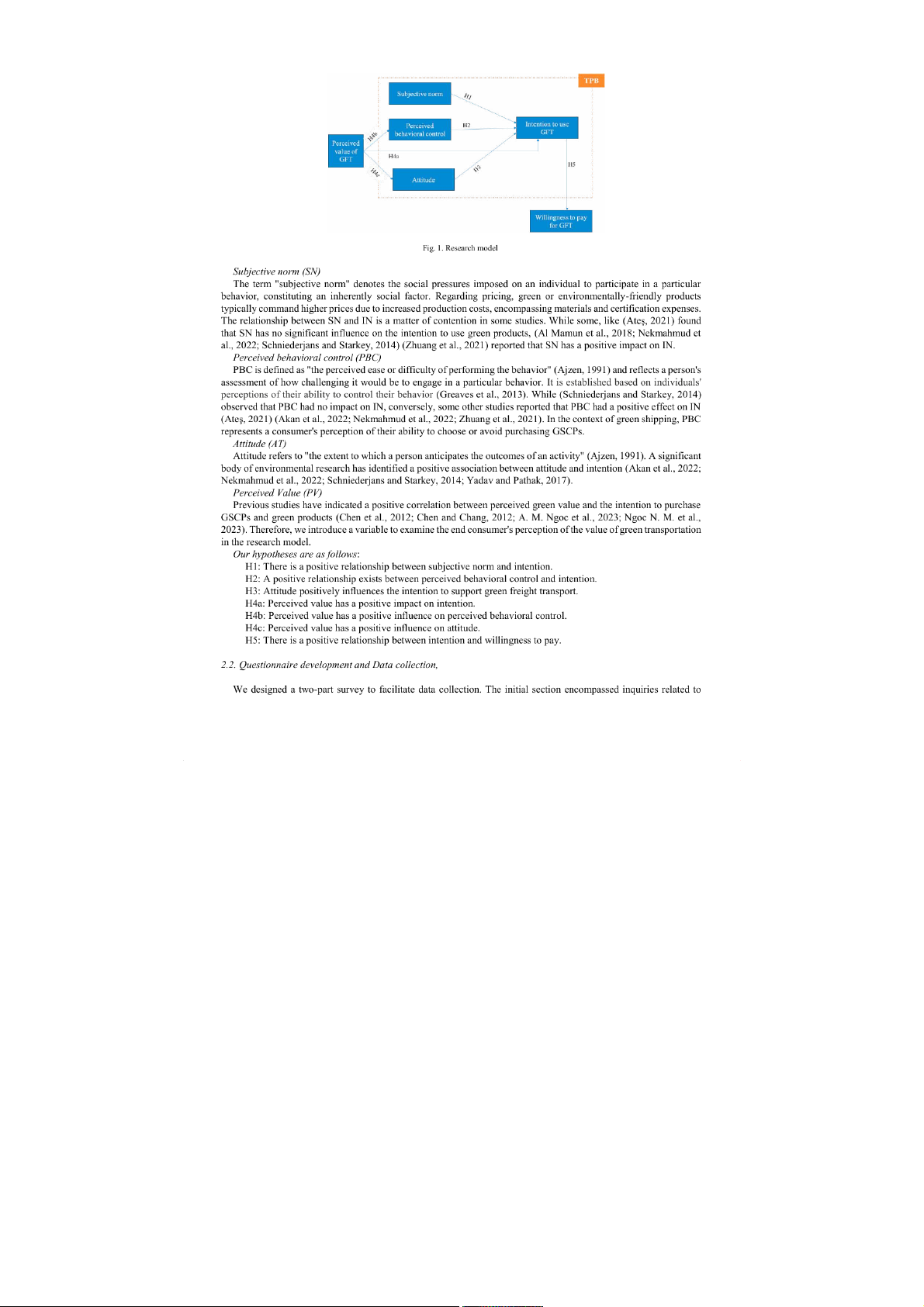
the willingness to pay a premium for GSCPs. Figure 1 illustrates our research model.
Willingness to Pay a Premium (WPP)
Price is consistently recognized as one of the most critical factors influencing consumers' decision-making
processes. Understanding consumers' willingness to pay a premium for socially-responsible products is crucial for
organizations, as pricing is a significant barrier to green consumption (Gleim et al., 2013). The willingness to pay a
premium price for GSCPs can be considered a form of pro-environmental behavior (Ajzen, 1991). Intention (IN)
Intention to purchase represents a consumer's subjective likelihood of acquiring a product (Fishbein and Ajzen,
1975). There are contrary findings on the relationship between IN and WTP. For example, Yadav and Pathak (2017)
found no direct correlation between WTP and IN, but others investigated a favorable association between IN and WTP ((Akan et al., 2022).
54 Tran Thi Lan Huong et al. / Transportation Research Procedia 85 (2025) 52–59
Tran Thi Lan Huong et al. / Transportation Research Procedia 85 (2025) 52–59 55
demographics, while the subsequent part comprised a series of questions intended to illuminate the independent
variables incorporated in our hypothetical research model. These variables were evaluated through diverse scales and
components (refer to Table 2). Each item on the scale was assessed using a five-point Likert scale, where respondents
could choose from a range of options from 1 ("strongly disagree") to 5 ("strongly agree").
The official survey was carried out between September 8, 2023, and September 27, 2023, utilizing a combination
of online and in-person methods. We received a total of 523 responses, but following the exclusion of invalid
submissions, such as those with missing information or identical answers for all questions, we obtained 459 valid
responses (361 online responses, 98 in-person responses), representing an 87.7% response rate. The demographic
composition of the respondents is mentioned in Table 1.
Table 1. Demographic profile of respondents Demographics Frequency Percent (%) Age Under 18 years 9 2 18 –under 25 years 172 37,5 25 - under 35 years 126 27,5 35- under 45 years 129 28,1 45- under 55 years 21 4,6 55 years and over 2 0.4 Gender Male 226 49.2 Female 232 50.5 Income Under 3 million VND per month 121 26.4
More than 3 million to 5 million VND per month 82 17.9
More than 5 million to 10 million VND per month 73 15.9
More than 10 million to 15 million VND per month 102 22.2
More than 15 million to 20 million VND per month 27 5.9 Over 20 million VND per month 54 11.8 Means of Walking or Biking 20 4.4 transport used Bus 102 22.2
Electric Bicycle/Electric Scooter 112 24.4 Electric Personal Cars 4 0.9 Gasoline-Powered Motorcycles 166 36,2
Gasoline/Diesel-Powered Personal Cars 49 10.7 Other 6 1.3
Table 1 reveals that a significant portion of the survey respondents fall within the 18 to 45 age range, a demographic
segment often more receptive to change. The gender distribution among the interviewees is nearly equal. Notably, the
largest group of respondents reported an income of less than 3 million VND, accounting for over 26% of the total. The
second-largest income group was those earning between 3 to 15 million VND, representing 22.2% of the total. Given
Hanoi's reliance on motorbikes, it is unsurprising that 136 out of 459 respondents mentioned using personal gasoline-
powered motorbikes. Additionally, a substantial number of respondents reported using motorbikes or electric bicycles,
with 112 out of 459 respondents falling into this category. Furthermore, the utilization of buses as a mode of
transportation is also relatively high, with 102 respondents indicating its use.
2.3. Analysis Procedures
This study utilizes Structural Equation Modeling (SEM) to investigate the causal relationships among various
constructs. Confirmatory Factor Analysis (CFA) is employed in the measurement model of our study to define latent
constructs from observed variables, while path analysis is utilized within the structural model to explore causal
relationships among these latent constructs. This analysis aims to reveal the interrelationships and interdependencies
among the latent variables, offering insights into the underlying causal mechanisms (Kline R.B, 2015). There are 6
measurement models in our study (refer to Figure 1). SPSS 20 and AMOS 21 software are utilized for data analysis
56 Tran Thi Lan Huong et al. / Transportation Research Procedia 85 (2025) 52–59
procedures. The result of factor analysis shows that all normalized factor loadings of items surpass 0.70 to guarantee
satisfactory validity (Fornell and Larcker, 1981). In the next step, the structural model was analyzed using AMOS 21
software. To evaluate the accuracy of the model, the following indices were considered: Chi-square ratio and degrees
of freedom (χ2/df) must be below 3.0 (Hu and Bentler, 1999). Furthermore, Goodness of Fit (GFI), Comparative Fit
Index (CFI), and Tucker-Lewis Index (TLI) values greater than 0.9 and Root Mean Square Error of Approximation
(RMSEA) less than 0.08 (Hair et al., 2010). 3. Results
3.1. Reliability and Validity of the Measurement Model,
Table 2 presents the results, showing that all items exhibit normalized factor loadings greater than 0.7, which
signifies strong convergence. The AVE values range from 0.748 to 0.873, surpassing the conve ntional threshold of
0.50. Furthermore, both the CR and Cronbach's alpha coefficients surpass the acceptable threshold of 0.7 (Fornell and
Larcker, 1981). These results confirm the suitability of the research model.
Table 2. The results of the measurement model: reliability and validity Constructs Measurement items Symbol Factor Loading AVE CR Cronbach's Attitude (AT) (Al
I find buying GSCPs to be a great idea. AT1 0.882 0.778 0.933 0.933 Mamun et al., 2018;
Buying GSCPs is essential to me. AT2 0.878 Ateş, 2021; Schniederjans and
To me, GSCPs is a step forward. AT3 0.859 Starkey, 2014)
Buying GSCPs holds value for me. AT4 0.909 Perceived Value (PV)
I believe GFT is beneficial for reducing dust PV1 0.834 0.748 0.922 0.922 (Caspersen et al., 2022; pollution. Mahmoud et al., 2022;
GFT contributes to reducing CO2 emissions, PV2 0.862 A. M. Ngoc et al., 2023) in my opinion.
For me, GFT helps conserve a significant PV3 0.864 amount of energy.
To me, GFT contributes to improving the PV4 0.898
living environment and human health. Perceived behavioral
Buying GSCPs is completely up to my PBC1 0.876 0.761 0.922 0.922 control (PBC) (Ateş, personal opinion 2021; Schniederjans
My decision to buy GSCPs was easy PBC2 0.849 and Starkey, 2014)
I have complete control over my GSCPs PBC3 0.867 purchasing behavior
For me, buying GSCPs is very convenient PBC4 0.867 Subjective norm (SN)
My friends support me in buying GSCPs. SN1 0.886 0.816 0.93 0.928 (Al Mamun et al., 2018;
My colleagues believe I should buy GSCPs. SN2 0.916 Ateş, 2021; Schniederjans and
My family is supportive of my decision to SN3 0.908 Starkey, 2014) buy GSCPs. Intention (IN) I intend to buy GSCPs. IN1 0.874 0.800 0.889 0.894 (Schniederjans and I will try to buy GSCPs IN2 0.914 Starkey, 2014; Yadav and Pathak, 2017) Willingness to Pay
I am willing to pay more to purchase GSCPs. WPP1 0.908 0.873 0.928 0.932 Premium (WPP) (Schniederjans and
Even if GSCPs have a higher selling price, I Starkey, 2014; Yadav will still purchase them. WPP2 0.960 and Pathak, 2017)
The results from Table 3 indicate that the square root of the average variance extracted (AVE) for each latent
construct exceeded the inter-construct correlation values of the same construct and other measured constructs,
indicating satisfactory discriminant validity.
The mean of each construct reflects participants' perceptions concerning the six constructs under study. The
participants showed the highest level of Intention (Mean = 4.21), followed by Perceived Value of GFT and Attitude
(Mean = 4.04), Perceived behavioral control (Mean = 3.7), Subjective Norm (Mean = 3.5), and finally Willingness to
Tran Thi Lan Huong et al. / Transportation Research Procedia 85 (2025) 52–59 57
Pay a Premium (Mean = 2.87). These findings demonstrate a positive disposition among end consumers toward green
transportation. It is evident that they are deeply aware of the positive values of green transportation, resulting in a
robust endorsement of eco-friendly modes for the distribution of consumer goods. Nonetheless, when questioned about
their willingness to bear additional costs for green transportation, the level of agreement appears to be relatively low,
with substantial differences in responses.
Table 3. Discriminant Validity Analysis Mean SD AT PBC SN PV IN WPP AT 4.04 0.8 0.88 PBC 3.7 0.8 .384** 0.87 SN 3.5 0.83 .429** .403** 0.90 PV 4.04 0.78 .541** .442** .440** 0.86 IN 4.21 0.80 .533** .406** .366** .485** 0.89 WPP 2.87 1.32 .362** .220** .229** .331** .254** 0.93
Note: Significant at: **p < 0.01. The diagonal (bold) elements represent the square roots of AVEs, while the off-diagonal elements represent the
correlations among constructs.
AT: Attitude; PBC: Perceived behavioral control; SN: Subjective norm; PV: Perceived Value; IN: Intention; WPP: Willingness to Pay a Premium.
3.2 The structural model
The analysis of the structural model and hypothesis testing was conducted using AMOS software. Figure 2 and
Table 4 present the results of the structural model. The criteria to evaluate the model's suitability are completely within
the allowed threshold (χ2/df = 2.775 < 3.0; GFI = 0.918 > 0.9; TLI = 0.958 > 0.9; CFI = 0.964 > 0.9; RMSEA = 0.062
< 0.08), proving that the research model is appropriate.
With the exception of hypothesis H1, all other hypotheses are empirically supported. These outcomes elucidate that
the inclination of consumers to procure consumer goods delivered through green transportation services depends on
their attitudes towards eco-friendly transportation products, their perceived control over purchasing decisions, and
their awareness of environmental benefits associated with green freight transport. Furthermore, the intentions of end
consumers exhibit a positive influence on their propensity to incur additional expenditures for green transportation.
Table 4. Structural Model Analysis Results Hypothesis Path coefficient p-value Results (p<0.1) H1: SN IN 0.05 0.188 No H2: PBC IN 0.16 0.000 Yes H3: AT IN 0.34 0.000 Yes H4a: PV IN 0.22 0.000 Yes
AT: Attitude; PBC: Perceived behavioral control; SN: Subjective norm; PV: Perceived Value; IN: Intention; WPP: Willingness to Pay a Premium. 4. Discussion
Our research model is designed to examine the influence of intention on the willingness to purchase GSCPs within
the Vietnamese context. Furthermore, we aim to explore the factors motivating consumers to buy GSCPs,
encompassing consumer attitudes, perceived behavioral control, subjective norms, and perceptions of the
environmental benefits of green freight transportation. In line with the Theory of Planned Behavior, our findings
indicate that both consumer AT and PBC exhibit positive correlations with consumers' intention to buy GSCPs.
Notably, consumer attitudes exhibit a particularly robust connection with intention, consistent with numerous prior
studies concerning the association between consumer attitudes and purchase intention such as (Akan et al., 2022;
Schniederjans and Starkey, 2014; Yadav and Pathak, 2017; Zhuang et al., 2021). Therefore, we recommend that
organizations direct their efforts toward promoting the adoption of eco-friendly transportation and emphasizing the
positive environmental effects of green freight transportation.
58 Tran Thi Lan Huong et al. / Transportation Research Procedia 85 (2025) 52–59
In contrast to Schniederjans and Starkey's study, we found a slight positive relationship between Perceived
Behavioral Control (PBC) and Intention (IN), whereas Subjective Norm (SN) showed no association with IN, aligning
with the findings of a previous study (Ateş, 2021; Nekmahmud et al., 2022; Zhuang et al., 2021). Both PBC and SN
received average scores at an intermediate level, showing relatively high convergence (SD = 0.8). This might be
attributed to the relatively recent introduction of "green transportation" in the Vietnamese market, where not everyone
possesses a comprehensive understanding of it. Consequently, consumers may place more confidence in their
individual purchasing decisions than in the influence of external factors. Alternatively, they may have other
considerations, such as price and delivery time when deciding to buy GSCPs.
Perceived value (PV) was introduced as an additional variable to the TPB model, revealing a positive relationship
with IN. Furthermore, PV not only has a direct impact on IN but also influences IN through Attitude (AT) and PBC,
showing a strong correlation. This highlights that greater awareness of the benefits of green freight will enhance
consumers' attitudes towards GSCP and streamline their decision-making process when choosing GSCP. Therefore,
we recommend that green marketers and policymakers prioritize making green products easily accessible to consumers
through effective pricing strategies and communication of the environmental benefits of green freight for individuals.
Finally, although the path analysis results indicate that those who support purchasing green transport goods
influence their willingness to pay more, the analysis results in Table 3 indicate that IN has a mean of 4.27 with an SD
of 0.76, while Willingness to Pay a Premium (WPP) has a mean of 2.87 and an SD of 1.32. This suggests that
consumers strongly support the idea of environmentally-friendly transportation services but may be less inclined to
pay extra for GSCPs. In other words, individuals in a developing country may be highly price-sensitive when it comes
to goods and services (Yadav and Pathak, 2017). According to (Huong et al., 2020), 22.09% of consumers in Hanoi
expressed a high interest in the pricing of last-mile delivery services, and these pricing considerations can significantly
impact consumer purchasing decisions. Therefore, policymakers and freight transport operators need to develop
suitable green solutions that align with various stages and consumer willingness to pay.
In order to implement environmentally friendly measures without increasing transportation costs, we propose that
the government should consider financial support policies for transportation operators, such as reducing taxes, fees,
and providing subsidies. Additionally, preferential loans for green transportation businesses could be introduced.
Simultaneously, active promotion and advertising of the benefits, values, and image of green freight transport are
necessary to capture consumer attention and enhance their willingness to support and pay more in the future. 5. Conclusions
In summary, environmental pollution in the transportation sector remains a global concern, with road freight
transport, as confirmed by (McKinnon, 2018), being one of the most challenging sectors to decarbonize. Furthermore,
Fries has noted that green transportation can be relatively expensive (Fries et al., 2010), potentially increasing the
selling price of consumer goods. Therefore, shippers and transporters must consider consumers' acceptance and their
willingness to pay more before deciding on a mode of transportation or adopting green measures. The TPB theoretical
model has proven to be a valuable tool for understanding consumers' intentions to purchase GSCPs.
Beyond the documented findings, this study recognizes several limitations that should be taken into account in
future research. Firstly, the study does not consider the influence of demographic variables on the intention and
willingness to pay for purchasing GSCPs. Secondly, the measurement of consumer purchasing behavior of GSCPs
relies on self-reported data rather than actual observed behavior. Lastly, the study focuses on green products in a
general sense; however, it is essential to recognize that consumers' behavioral intentions to purchase GSCPs may vary
across different product categories. Acknowledgments
This research is funded by the University of Transport and Communications (UTC) under grant number T2024-KT- 004TD. References
Ajzen, I., 1991. The theory of planned behavior. Organ. Behav. Hum. Decis. Process., Theories of Cognitive Self-Regulation 50, 179–211.
Tran Thi Lan Huong et al. / Transportation Research Procedia 85 (2025) 52–59 59
https://doi.org/10.1016/0749-5978(91)90020-T.
Akan, Ş., Özdemir, E., Bakır, M., 2022. Purchase Intention Toward Green Airlines and Willingness to Pay More: Extending the Theory of Planned
Behavior, in: Kiracı, K., Çalıyurt, K.T. (Eds.), Corporate Governance, Sustainability, and Information Systems in the Aviation Sector, Volume
I, Accounting, Finance, Sustainability, Governance & Fraud: Theory and Application. Springer Nature, Singapore, pp. 123–143.
https://doi.org/10.1007/978-981-16-9276-5_7.
Al Mamun, A., Fazal, S.A., Ahmad, G.B., Yaacob, M.R.B., Mohamad, M.R., 2018. Willingness to Pay for Environmentally Friendly Products
among Low-Income Households along Coastal Peninsular Malaysia. Sustainability 10, 1316. https://doi.org/10.3390/su10051316.
Ateş, H., 2021. Understanding Students’ and Science Educators’ Eco-Labeled Food Purchase Behaviors: Extension of Theory of Planned Behavior
with Self-Identity, Personal Norm, Willingness to Pay, and Eco-Label Knowledge. Ecol. Food Nutr. 60, 454–472.
https://doi.org/10.1080/03670244.2020.1865339.
Callahan, C.W., Mankin, J.S., 2022. National attribution of historical climate damages. Clim. Change 172, 40. https://doi.org/10.1007/s10584-022- 03387-y.
Caspersen, E., Navrud, S., Bengtsson, J., 2022. Act locally? Are female online shoppers willing to pay to reduce the carbon footprint of last mile
deliveries? Int. J. Sustain. Transp. 16, 1144–1158. https://doi.org/10.1080/15568318.2021.1975326.
Chen, Y., Chang, C., 2012. Enhance green purchase intentions: The roles of green perceived value, green perceived risk, and green trust. Manag.
Decis. 50, 502–520. https://doi.org/10.1108/00251741211216250.
Demir, E., Bektaş, T., Laporte, G., 2014. A review of recent research on green road freight transportation. Eur. J. Oper. Res. 237, 775–793.
https://doi.org/10.1016/j.ejor.2013.12.033.
EEA, 2023. Electric vehicles. https://www.eea.europa.eu/en/topics/in-depth/electric-vehicles (accessed 6 September 2023).
Fishbein, M., Ajzen, I., 1975. Belief, Attitude, Intention, and Behavior: An Introduction to Theory and Research, 1st ed. Addison-Wesley, Canada.
Fornell, C., Larcker, D.F., 1981. Evaluating Structural Equation Models with Unobservable Variables and Measurement Error. J. Mark. Res. 18,
39–50. https://doi.org/10.2307/3151312.
Fries, N., de Jong, G.C., Patterson, Z., Weidmann, U., 2010. Shipper Willingness to Pay to Increase Environmental Performance in Freight
Transportation. Transp. Res. Rec. 2168, 33–42. https://doi.org/10.3141/2168-05.
Gleim, M.R., Smith, J.S., Andrews, D., Cronin Jr., J.J., 2013. Against the green: A multi-method examination of the barriers to green consumption.
J. Retail. 89, 44–61. https://doi.org/10.1016/j.jretai.2012.10.001.
Greaves, M., Zibarras, L.D., Stride, C., 2013. Using the theory of planned behavior to explore environmental behavioral intentions in the workplace.
J. Environ. Psychol. 34, 109–120. https://doi.org/10.1016/j.jenvp.2013.02.003.
Hair, J.F., Black, W.C., Babin, B.J., 2010. Multivariate Data Analysis: A Global Perspective, 7th ed. Pearson Education, America.
Hu, L., Bentler, P.M., 1999. Cutoff criteria for fit indexes in covariance structure analysis: Conventional criteria versus new alternatives: Structural
Equation Modeling: A Multidisciplinary Journal: Vol 6, https://doi.org/10.1080/10705519909540118.
Huong G.H., Viet D.B., Van H.N.T., 2020. Evaluation of last mile delivery service in Vietnam from end users’ viewpoints. TCSJ. 71, 726–736.
https://doi.org/10.25073/tcsj.71.6.8.
Kline R.B, 2015. Principles and Practice of Structural Equation Modeling, Fifth Edition. Guilford Press, New York.
Lee, K., n.d. Gender differences in Hong Kong adolescent consumers’ green purchasing behavior. Journal of Consumer Marketing. 26, 87-96.
https://doi.org/10.1108/07363760910940456.
Mahmoud, M.A., Tsetse, E.K.K., Tulasi, E.E., Muddey, D.K., 2022. Green Packaging, Environmental Awareness, Willingness to Pay and
Consumers’ Purchase Decisions. Sustainability 14, 16091. https://doi.org/10.3390/su142316091.
McKinnon, A., 2018. Decarbonizing Logistics: Distributing Goods in a Low Carbon World. Kogan Page Publishers.
Nekmahmud, Md., Naz, F., Ramkissoon, H., Fekete-Farkas, M., 2022. Transforming consumers’ intention to purchase green products: Role of
social media. Technol. Forecast. Soc. Change 185, 122067. https://doi.org/10.1016/j.techfore.2022.122067.
Ngoc, A.M., Nishiuchi, H., Nhu, N.T., 2023. Determinants of carriers’ intentions to use electric cargo vehicles in last-mile delivery by extending
the technology acceptance model: a case study of Vietnam. Int. J. Logist. Manag. 34, 210–235. https://doi.org/10.1108/IJLM-12-2021-0566.
Ngoc N.M., Phuong H.L.H., Manh N.D., Duong K.A., Tung T.T., Hao H.V., Hieu N.M., 2023. Exploring continuance intention to use electric
motorcycles among students in Hanoi using expectation confirmation theory. TCSJ 74, 58–71. https://doi.org/10.47869/tcsj.74.1.6.
Quak, H.J., 2008. Sustainability of urban freight transport: retail distribution and local regulations in cities, TRAIL thesis series. Netherlands TRAIL
Research School, Delft, The Netherlands.
Roser, M., 2023. Data Review: How many people die from air pollution? Our World Data. https://ourworldindata.org/data-review-air-pollution-
deaths (accessed 11 October 2023).
Schniederjans, D.G., Starkey, C.M., 2014. Intention and willingness to pay for green freight transportation: An empirical examination. Transp. Res.
Part Transp. Environ. 31, 116–125. https://doi.org/10.1016/j.trd.2014.05.024.
Statista webpage, ., n.d. Global CO2 emissions by sector 2021 | Statista. https://www.statista.com/statistics/276480/world-carbon-dioxide-
emissions-by-sector/ (accessed 27 August 2023).
Yadav, R., Pathak, G.S., 2017. Determinants of Consumers’ Green Purchase Behavior in a Developing Nation: Applying and Extending the Theory
of Planned Behavior. Ecol. Econ. 134, 114–122. https://doi.org/10.1016/j.ecolecon.2016.12.019.
Zhuang, W., Luo, X., Riaz, M.U., 2021. On the Factors Influencing Green Purchase Intention: A Meta-Analysis Approach. Front. Psychol. 12.
https://doi.org/10.3389/fpsyg.2021.644020.
Tài liệu liên quan:
-
Ôn tập nhóm Bài Tập Hồi Quy | Thống kê trong kinh tế và kinh doanh | Trường Đại học Kinh tế Quốc dân
15 8 -
Thống Kê Xuất Nhập Khẩu và Giá Trị Hàng Hóa | Thống kê trong kinh tế và kinh doanh | Trường Đại học Kinh tế Quốc dân
17 9 -
Bài Tập Thống Kê Kinh Doanh | Thống kê trong kinh tế và kinh doanh | Trường Đại học Kinh tế Quốc dân
15 8 -
Bài tập Phân tích sự sụp đổ của Thomas Cook trong ngành du lịch | Thống kê trong kinh tế và kinh doanh | Trường Đại học Kinh tế Quốc dân
15 8 -
Thực Hành C1: Phân Tích Dữ Liệu Bất Động Sản Trên SPSS | Thống kê trong kinh tế và kinh doanh | Trường Đại học Kinh tế Quốc dân
12 6