Environmental Sustainability in a Cashless Society - Addendum | Microeconomics | Trường Đại học Quốc tế, Đại học Quốc gia Thành phố Hồ Chí Minh
The Institute and Faculty of Actuaries (IFoA) is the UK’s chartered professional body dedicated to educating, developing and regulating actuaries based both in the UK and internationally. The Institute promotes and supports a wide range of research and knowledge exchange activities with members, external stakeholders and international research communities. Tài liệu được sưu tầm và soạn thảo dưới dạng file PDF để gửi tới các bạn cùng tham khảo, ôn tập đầy đủ kiến thức, chuẩn bị cho các buổi học thật tốt. Mời bạn đọc đón xem!
Môn: Microeconomics 245 tài liệu
Trường: Trường Đại học Quốc tế, Đại học Quốc gia Thành phố Hồ Chí Minh 1.5 K tài liệu
Tác giả:




Preview text:
An Addendum to A Cashless Society- Benefits,
Risks and Issues (2018 Addendum) Issue 21- Environmental sustainability of a cashless society By S. Rochemont October 2018
A Cashless Society- Benefits, Risks and Issues (Interim Paper) Addendum Contents Table of Contents
Reading pre-requisites!.......................................................................................................................!5!
Background!..........................................................................................................................................!6!
Key takeaways!....................................................................................................................................!7!
Keywords!.............................................................................................................................................!8!
Correspondence details!.....................................................................................................................!9!
Introduction to Addendum!................................................................................................................!10!
Section 1: The environmental cost of cash!...................................................................................!11!
1.1 The UK: Raw materials and impact of ATMs!.....................................................................!11!
1.2 The Netherlands: Debit cards vs. Cash!..............................................................................!14!
1.3 Switzerland: Supply chain impacts!......................................................................................!14!
Section 2: Environmental costs of a cashless economy!.............................................................!18!
2.1 Debit cards!..............................................................................................................................!18!
2.2 Smartphones!...........................................................................................................................!18!
2.3 The impact of Distributed Ledger Technology!...................................................................!19!
2.4 QR codes as a means of payment!......................................................................................!20!
2.4.1 Background of QR codes!...............................................................................................!21!
2.4.2 QR code payments!.........................................................................................................!21!
2.4.3 Sustainability of QR code payments!............................................................................!22!
2.4.4 Additional benefits of QR code payments!...................................................................!23!
2.4.5 Market potential!...............................................................................................................!24!
Section 3: Synergies between a cashless society and a circular economy!.............................!25!
3.1 Linear vs circular economy concepts!..................................................................................!25!
3.2 A circular economy vs a cashless society?!........................................................................!25!
3.3 The circular economy advantage!.........................................................................................!26!
Section 4: Drivers and policies for a cashless economy!.............................................................!27!
4.1 Role of the banking sector!....................................................................................................!27!
4.2 Shifts in development and tax models!................................................................................!27!
Conclusion!.........................................................................................................................................!29!
References and Bibliography!..........................................................................................................!30! ! Non-Business ! Figures
Figure!1!Influence!of!variation!in!ATM!energy!consumption!in!the!UK!(Ref!3)!...................................!13!
Figure!2!Switzerland!life!span!of!the!banknotes!(Ref!6)!......................................................................!15!
Figure!3!Switzerland!Process!chart!of!the!bank!note!life!cycle!(Ref!6)!................................................!15!
Figure!4!Switzerland!Yearly!environmental!pollution!(Ref!6)!..............................................................!16!
Figure!5!Switzerland!contribution!to!greenhouse!effect!(Ref!6)!.........................................................!16!
Figure!6!Switzerland!contribution!to!acidification!(Ref!6)!...................................................................!16!
Figure!7!Switzerland!contribution!to!the!summer!smog!(Ref!6)!.........................................................!17!
Figure!8!Netherlands!schematic!view!of!the!debit!card!payment!system!(Ref!5)!...............................!18!
Figure!9!Energy!consumption!and!scaling!issues!(Ref!9)!.....................................................................!20!
Figure!10!Means!of!payment!and!underlying!infrastructure:!Environmental!footprint!......................!20!
Figure!11!Sample!QR!content!for!money!transfers!in!the!SEPA!area!(Ref!21)!.....................................!21!
Figure!12!QR!code!payment!scanning!models![Ref!22]!.......................................................................!23! ! Non-Business ! Reading pre-requisites
This paper supplements the “Cashless Society- Benefits Risks and Issues (Interim Paper)”, and
additional papers published by the cashless society working party on the Institute and Faculty of
Actuaries (IFoA) website in December 2017. Resource URLs: -
Interim paper: https://www.actuaries.org.uk/documents/cashless-society-benefits-risks-and- issues! -
Cashless Society Working party: https://www.actuaries.org.uk/practice-areas/finance-and-
investment/finance-and-investment-research-working-parties/cashless-society-working-party! ! Non-Business ! Background
The Institute and Faculty of Actuaries (IFoA) is the UK’s chartered professional body dedicated to
educating, developing and regulating actuaries based both in the UK and internationally. The Institute
promotes and supports a wide range of research and knowledge exchange activities with members,
external stakeholders and international research communities.
A volunteer working party published an interim report in December 2017, sponsored by the Finance &
Investment board at the IFoA, focusing on the “Cashless Society- Benefits Risks and Issues”. It
concluded: “A cashless society and its underpinning digital economy should open opportunities for
most stakeholders in many economies, including the financially excluded. Yet the topic is divisive due
to clashing stakeholder interests that lead this group to raise the importance of addressing substantial
risks and issues for successful transition.”
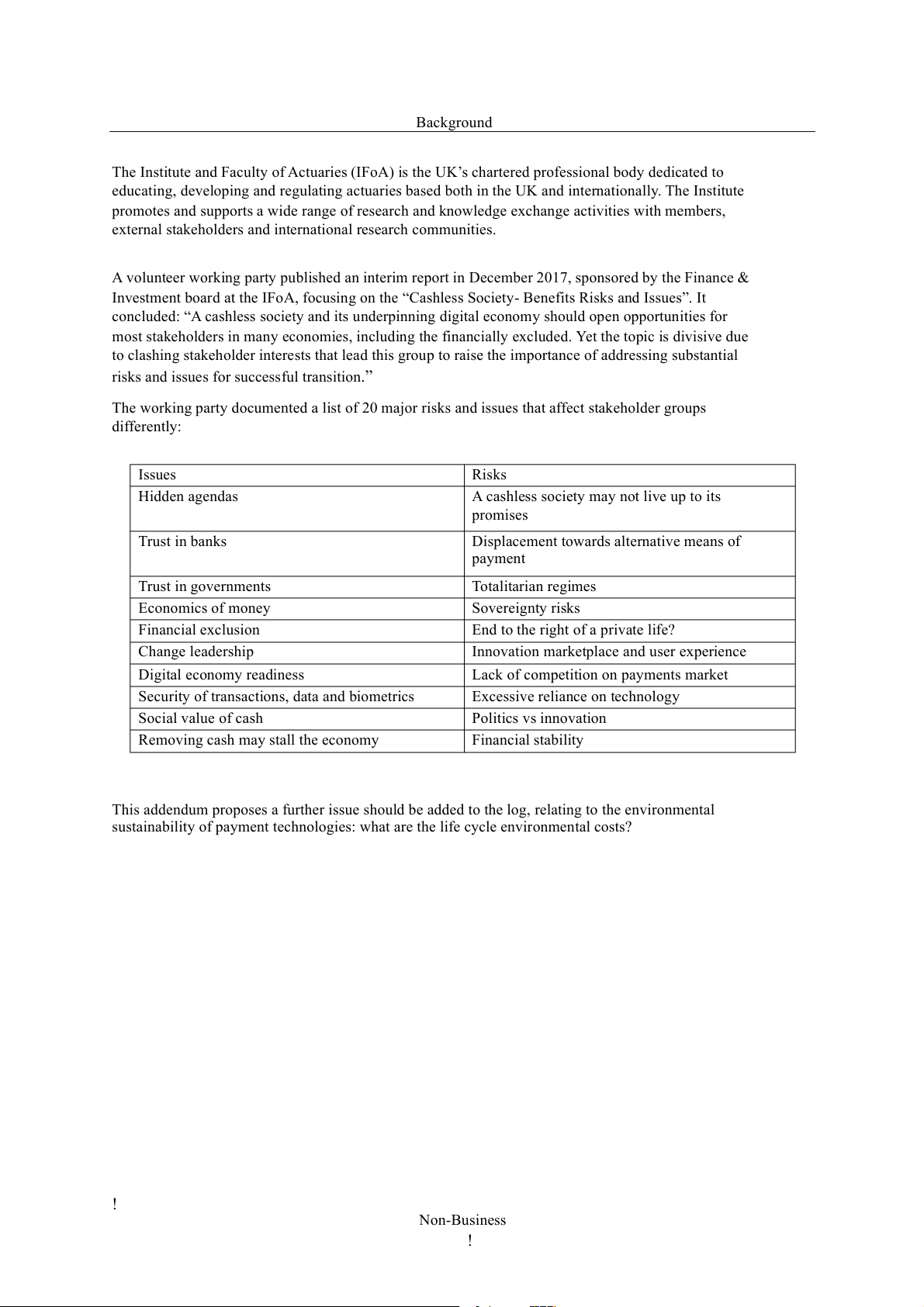
The working party documented a list of 20 major risks and issues that affect stakeholder groups differently: Issues Risks Hidden agendas
A cashless society may not live up to its promises Trust in banks
Displacement towards alternative means of payment Trust in governments Totalitarian regimes Economics of money Sovereignty risks Financial exclusion
End to the right of a private life? Change leadership
Innovation marketplace and user experience Digital economy readiness
Lack of competition on payments market
Security of transactions, data and biometrics
Excessive reliance on technology Social value of cash Politics vs innovation
Removing cash may stall the economy Financial stability
This addendum proposes a further issue should be added to the log, relating to the environmental
sustainability of payment technologies: what are the life cycle environmental costs? ! Non-Business ! Key takeaways !
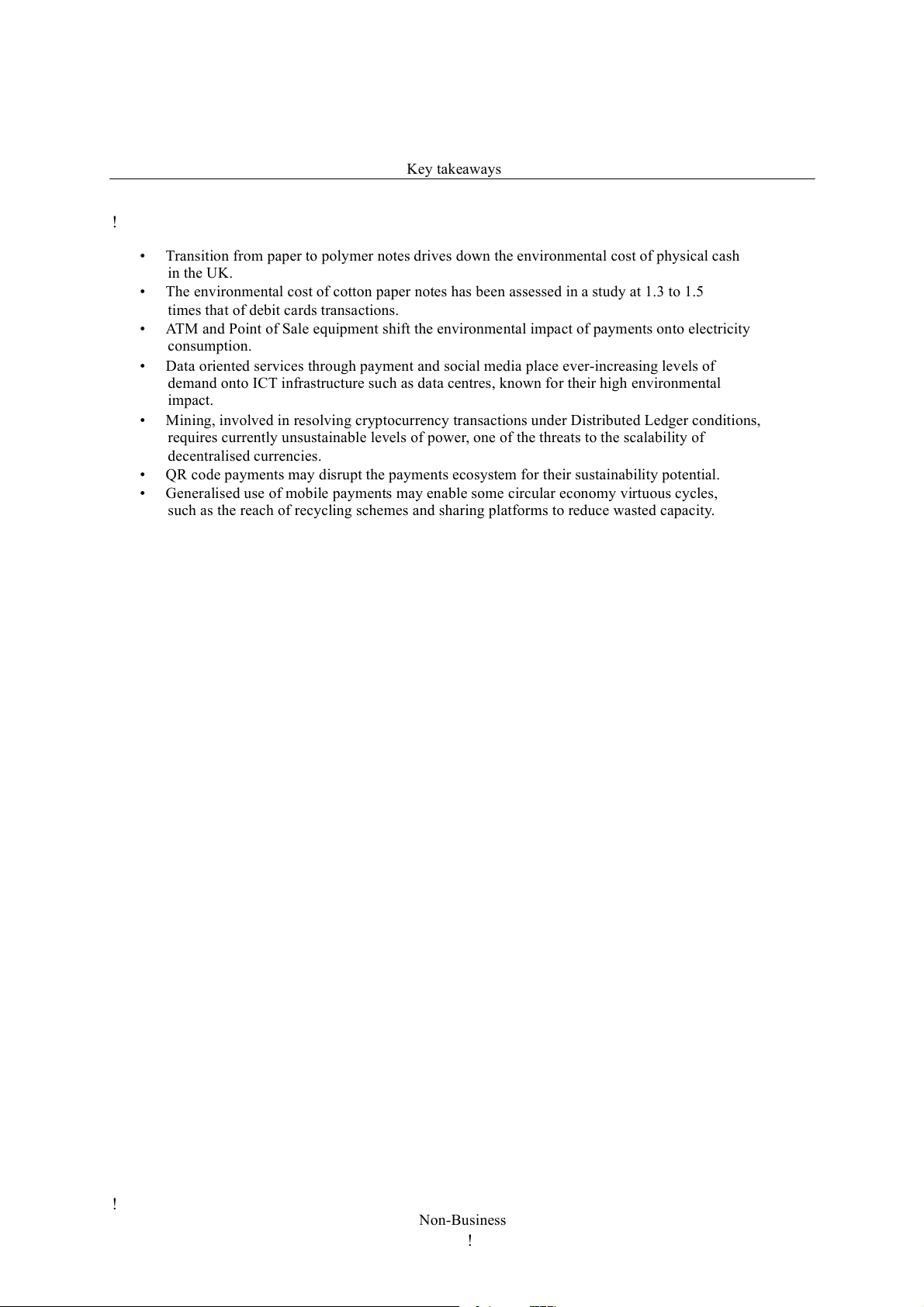
• Transition from paper to polymer notes drives down the environmental cost of physical cash in the UK.
• The environmental cost of cotton paper notes has been assessed in a study at 1.3 to 1.5
times that of debit cards transactions.
• ATM and Point of Sale equipment shift the environmental impact of payments onto electricity consumption.
• Data oriented services through payment and social media place ever-increasing levels of
demand onto ICT infrastructure such as data centres, known for their high environmental impact.
• Mining, involved in resolving cryptocurrency transactions under Distributed Ledger conditions,
requires currently unsustainable levels of power, one of the threats to the scalability of decentralised currencies.
• QR code payments may disrupt the payments ecosystem for their sustainability potential.
• Generalised use of mobile payments may enable some circular economy virtuous cycles,
such as the reach of recycling schemes and sharing platforms to reduce wasted capacity. ! Non-Business ! Keywords !
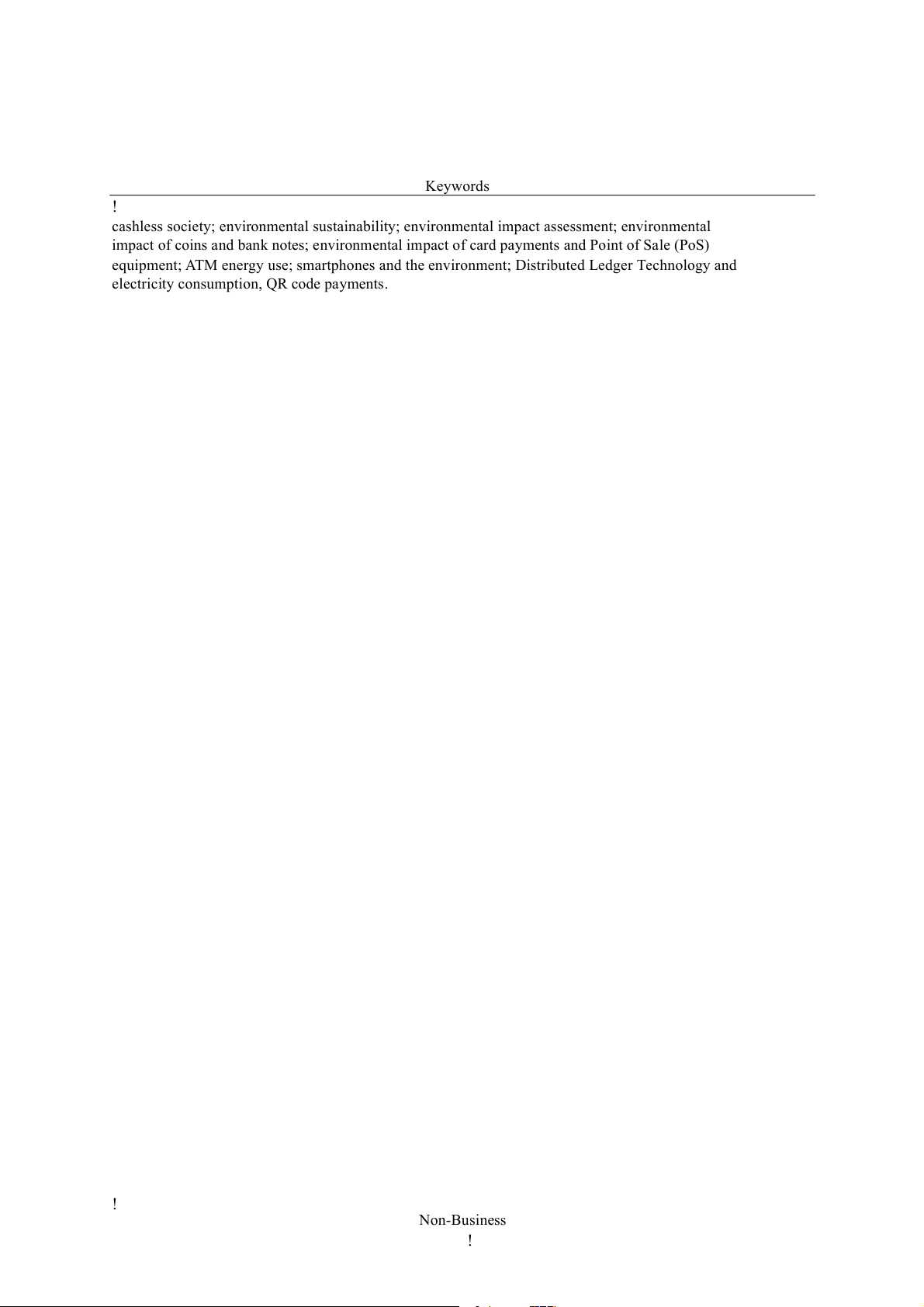
cashless society; environmental sustainability; environmental impact assessment; environmental
impact of coins and bank notes; environmental impact of card payments and Point of Sale (PoS)
equipment; ATM energy use; smartphones and the environment; Distributed Ledger Technology and
electricity consumption, QR code payments. ! Non-Business ! Correspondence details Ian Collier
17, Northwick Circle, Kenton, Harrow, Middlesex, HA3 0EJ ian.collier@btinternet.com ! Non-Business !
Cashless Society – Benefits, Risks and Issues (Interim Paper) Introduction to Addendum
The interim paper “ A Cashless Society: Benefits, Risks and Issues” assessed a number of key
economic aspects with a view to balance the arguments, and documented a log of 20 risks and issues.
Now in its second phase of research, the Working Party is exploring further implications of a cashless
society. This paper focuses on the environmental perspectives of a cashless society, and proposes to
add a new issue to the register.
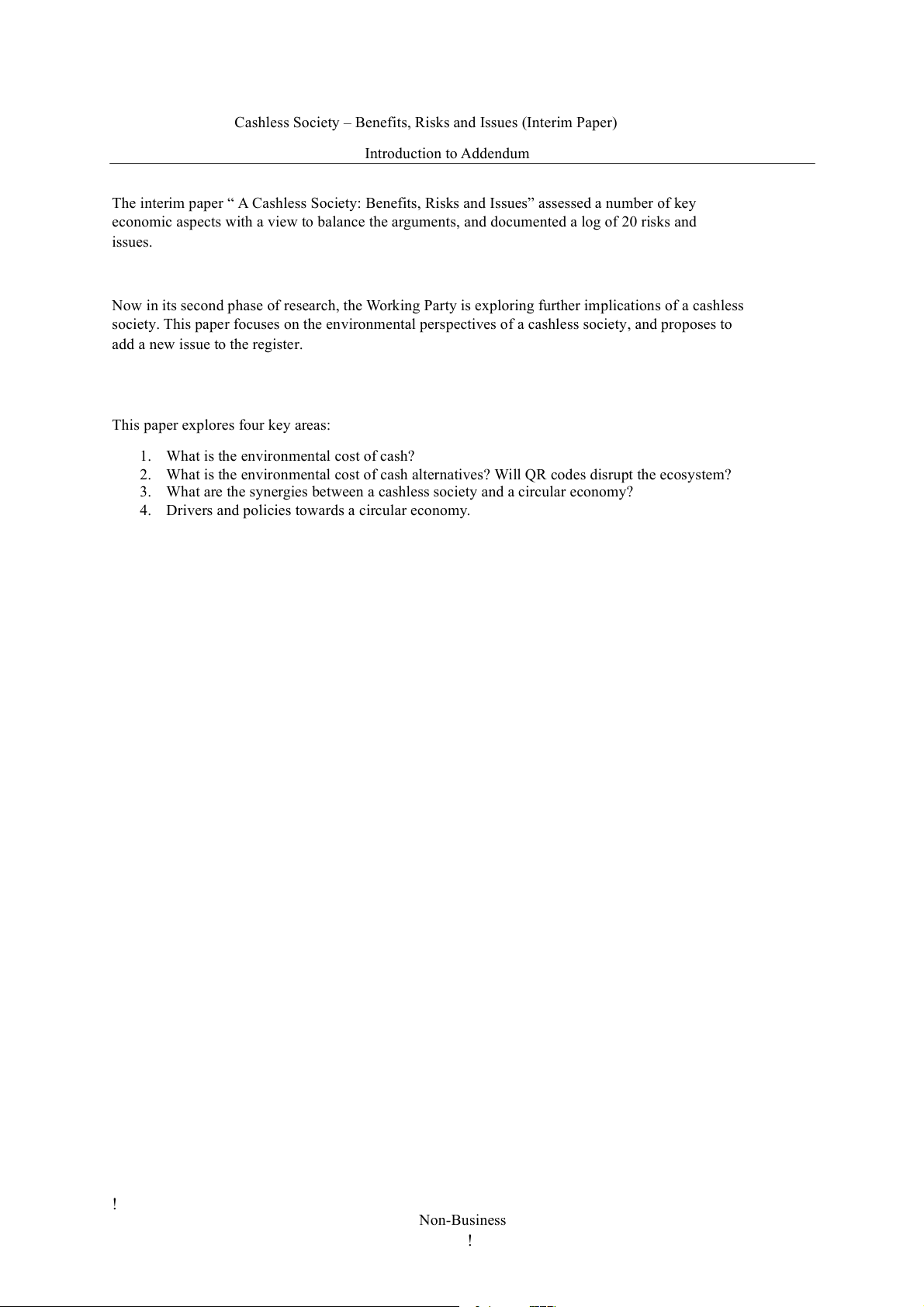
This paper explores four key areas:
1. What is the environmental cost of cash?
2. What is the environmental cost of cash alternatives? Will QR codes disrupt the ecosystem?
3. What are the synergies between a cashless society and a circular economy?
4. Drivers and policies towards a circular economy. ! Non-Business !
Section 1: The environmental cost of cash
Cash is currently key to the economy: as a resource, it keeps circulating until physically destroyed, by
regulation, wear and tear, accidental damage or loss. Minters keep improving materials for durability.
The interim paper (1) assessed the cash management activities cost as a % of GDP, generally
around 0.5 to 1% of GDP in most developed economies, rising to 2% for Japan and 3.2% in India.
This section focuses on three key life cycle assessments that highlight different perspectives, yet are
likely relevant across these countries.
1.1 The UK: Raw materials and impact of ATMs !
UK coinage is made of a copper-nickel alloy and is recyclable (2). Bank notes have also evolved,
mainly for security reasons, i.e. anti counterfeiting measures, and durability. The polymer notes
launched in 2016 in the UK, last longer, so are more environmentally friendly than the older bank notes (3).
1.1.1 Significant issues for £5, £10 and £20 notes:
The Bank of England Lifecycle Assessment (3) summarises the key issues for the main notes in use in the UK:
“The results for most indicators are dominated by impacts associated with electricity
generation required to operate ATMs. These are the same for both paper and polymer bank
notes and have the effect of reducing the relative differences between the substrates that
arise due to variations in production and end of life impacts. This effect is most marked for the
£10 and £20 denominations where, respectively, 91% and 90% notes are sent to ATMs after
sorting. For £5 notes the influence is slightly smaller as only 64% of these notes are
distributed to ATMs. The UK grid mix is changing rapidly and is expected to become
significantly less carbon intensive in future. Some forecasts estimate reductions of around
60% by 2030 compared to 1990 levels [Power Perspectives 2012, European Commission
2011]. Even if such large reductions are not realised it seems inevitable that there will be
significant decarbonisation of the UK grid in the coming years. As such, the contribution of
ATMs to the total life cycle impact is expected to reduce significantly in coming years and will
make the impact of other life cycle stages more noticeable in contrast.”
1.1.2 Effects of raw material production:!
For paper notes (3), raw material production has a significant contribution to:
• Global warming potential from biogenic sources, resulting in a credit due to carbon dioxide
being removed from the atmosphere during plant growth than is returned at end of life
(although, when considering fossil and biogenic GHG sources combined, this stage is not a significant contributor);
• Eco-toxicity potential due to the use of pesticides during cotton cultivation;
• Freshwater consumption due to the use of irrigation water during cotton cultivation;
• Renewable primary energy due to the energy embodied within the cotton; and for £5 notes,
where the influence of ATMs is not as dominant as for £10 and £20 denominations, other life
cycle stages gain more significance. ! Non-Business !
In addition to the indicators listed above, raw material production is also a significant contributor to
acidification potential and eutrophication potential:
• The papermaking process is seen to have a significant contribution to eutrophication
potential, global warming potential, photochemical ozone creation potential, human toxicity
(cancer) potential, and non-renewable primary energy.
• For £5 polymer notes, substrate production has a significant contribution to the total life cycle impacts for:
o Acidification potential and global warming potential from fossil sources due to
emissions associated with combustion of fossil energy sources.
o Global warming potential from biogenic sources but in contrast to the paper notes,
this results in positive net GHG emissions.
o Photochemical ozone creation potential due to VOC emissions during this opacification process.
o Impacts relating to other life cycle stages such as printing, transport and end of life,
are relatively small in comparison. 1.1.3 Energy impact of ATMs: !
(3) “Energy consumption by ATMs is seen to be a dominant contributor to many
environmental indicators assessed in this study. The default electricity consumption data
used in this study is based on “typical” through the wall and lobby style ATMs with what are
considered to be reasonable usage scenarios for the number of notes vended in a single
transaction, and the number of transactions per day. However, ATMs come in many different
styles with differing energy consumption and differing cash carrying capacity. Furthermore
ATMs in different locations will see different patterns of usage. Hence, there is a significant
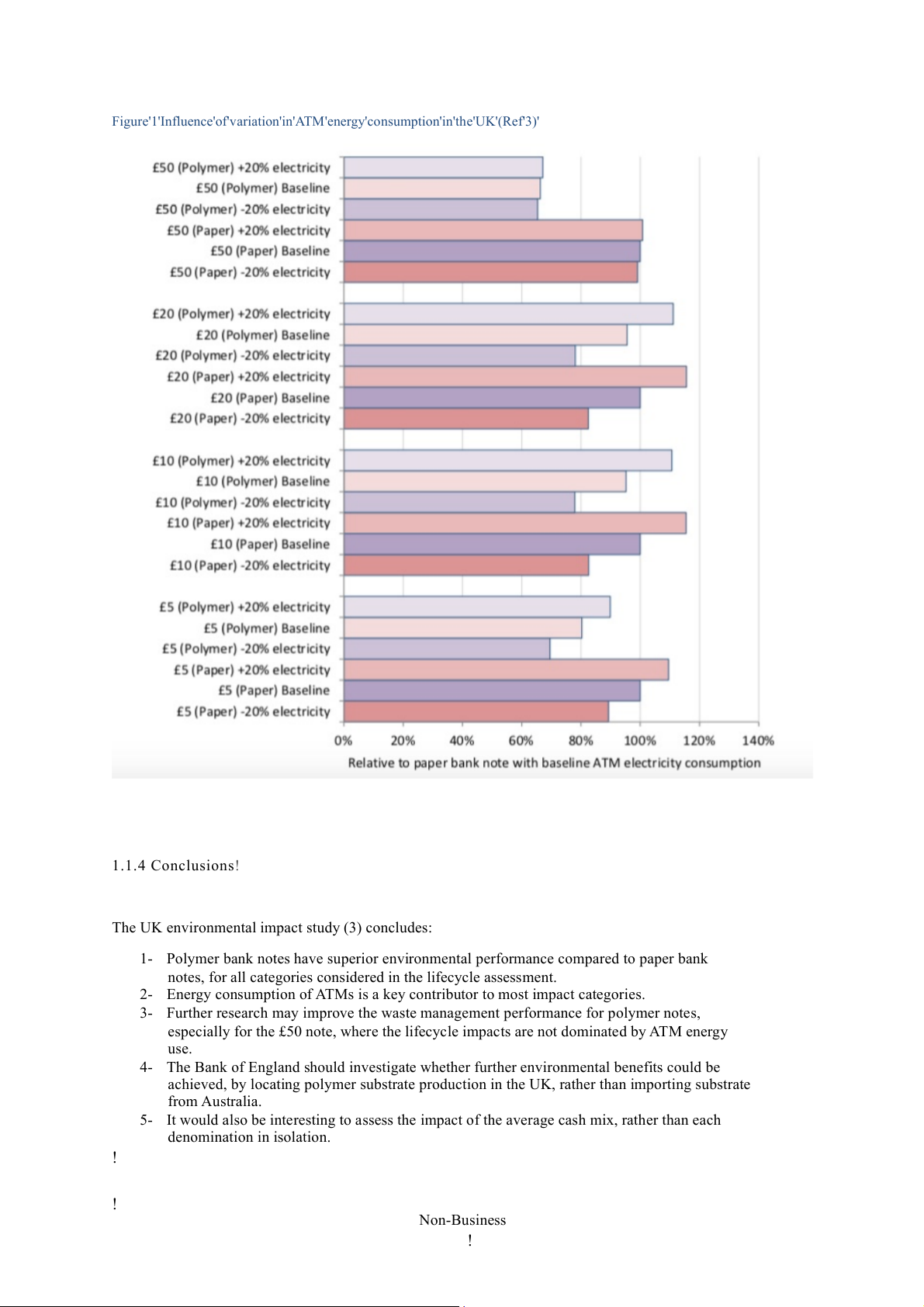
uncertainty in the electricity data for ATMs used in the default scenario. Figure 1 shows the
influence on the results of a change in ATM electricity demand of ±20%.
It is immediately clear that the results for the £10 and £20 notes are very sensitive to changes
in ATM energy consumption. For these denominations, a 20% change in ATM electricity
demand corresponds to an 18% change in overall GHG emissions. This is as expected given
the dominance of ATM impacts seen in the main results. The effect is less marked for the £5
note due to lower number that are sent to ATMs after sorting but still results in a noticeable
13% change in overall life cycle impact. In contrast, the results for the £50 note show very
little sensitivity to variations in ATM electricity demand as only 1% of these notes are sent to ATMs after sorting.“ ! ! Non-Business !
Figure'1'Influence'of'variation'in'ATM'energy'consumption'in'the'UK'(Ref'3)' 1.1.4 Conclusions!
The UK environmental impact study (3) concludes:
1- Polymer bank notes have superior environmental performance compared to paper bank
notes, for all categories considered in the lifecycle assessment.
2- Energy consumption of ATMs is a key contributor to most impact categories.
3- Further research may improve the waste management performance for polymer notes,
especially for the £50 note, where the lifecycle impacts are not dominated by ATM energy use.
4- The Bank of England should investigate whether further environmental benefits could be
achieved, by locating polymer substrate production in the UK, rather than importing substrate from Australia.
5- It would also be interesting to assess the impact of the average cash mix, rather than each denomination in isolation. ! ! Non-Business !
The total removal of cash would eradicate the environmental cost of cash. Does this suggest a less
cash economy would reduce the environmental impact accordingly? It may do so, if the number of
ATMs decreases, leading to lower storage and processing costs. Alternatively, leveraging spare ATM
capacity for additional uses may be a way to increase ATM productivity, hence reducing their relative impact.! !
1.2 The Netherlands: Debit cards vs. Cash
The ECB assessed the environmental impact of cash payments in 2003: “As euro banknotes are
designed to be used on a daily basis, their environmental impact was compared with the impact
caused by other everyday activities. The assessment concluded that the total environmental impact
caused by the 3 billion euro banknotes produced in 2003 was equivalent to the environmental impact
of each European citizen driving a car for one kilometre or leaving a 60W bulb switched on for 12 hours.” (4)
The DeNederlanscheBank assessed the environmental cost of cash and concluded (5), with many limitations/ caveats:
“[…]Hanegraaf (2017) and Larcin (2017) analyse the environmental impact of an average
cash payment in the Netherlands in 2015. It turns out that the total environmental impact of
an average cash payments amounts 700 µPt [as global eco-index] and has a GWP [Global
Warming Potential] of 5.0 gram CO2-equivalents. These results indicate that the total
environmental impact of a cash payment is 1.5 times higher and that its GWP is 1.3 times
higher than of a debit card payment. The relatively higher impact of cash on the environment
as a whole rather than on climate stems, among others, from the fact that the metal depletion
for coin production affects the environment, but does not affect climate. The somewhat higher
environmental impact of cash payments on the environment as a whole and on climate
compared to debit card payments suggests that the substitution of cash by debit card
payments, which takes place in many countries, may enhance the sustainability of the POS payment system.”
1.3 Switzerland: Supply chain impacts
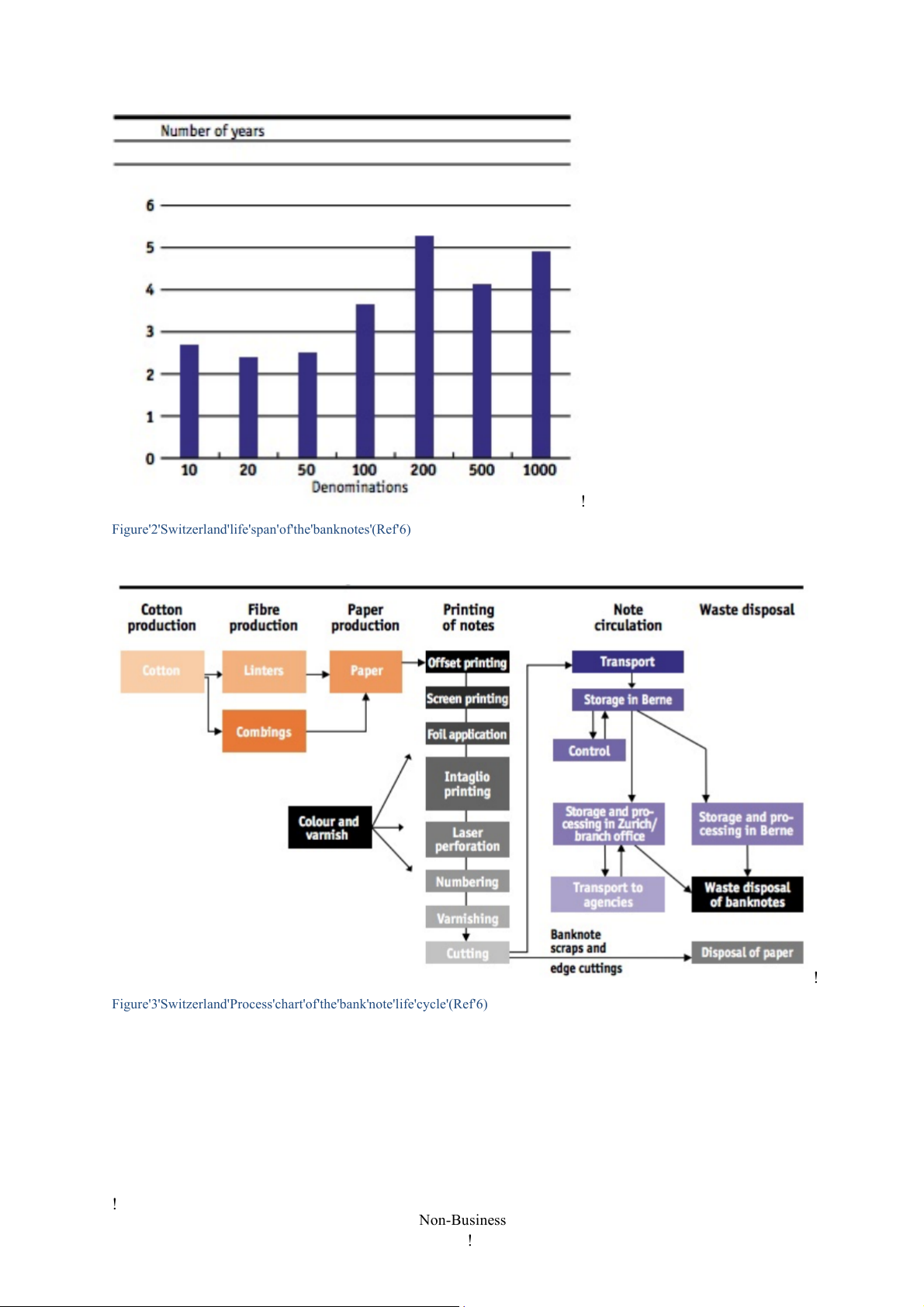
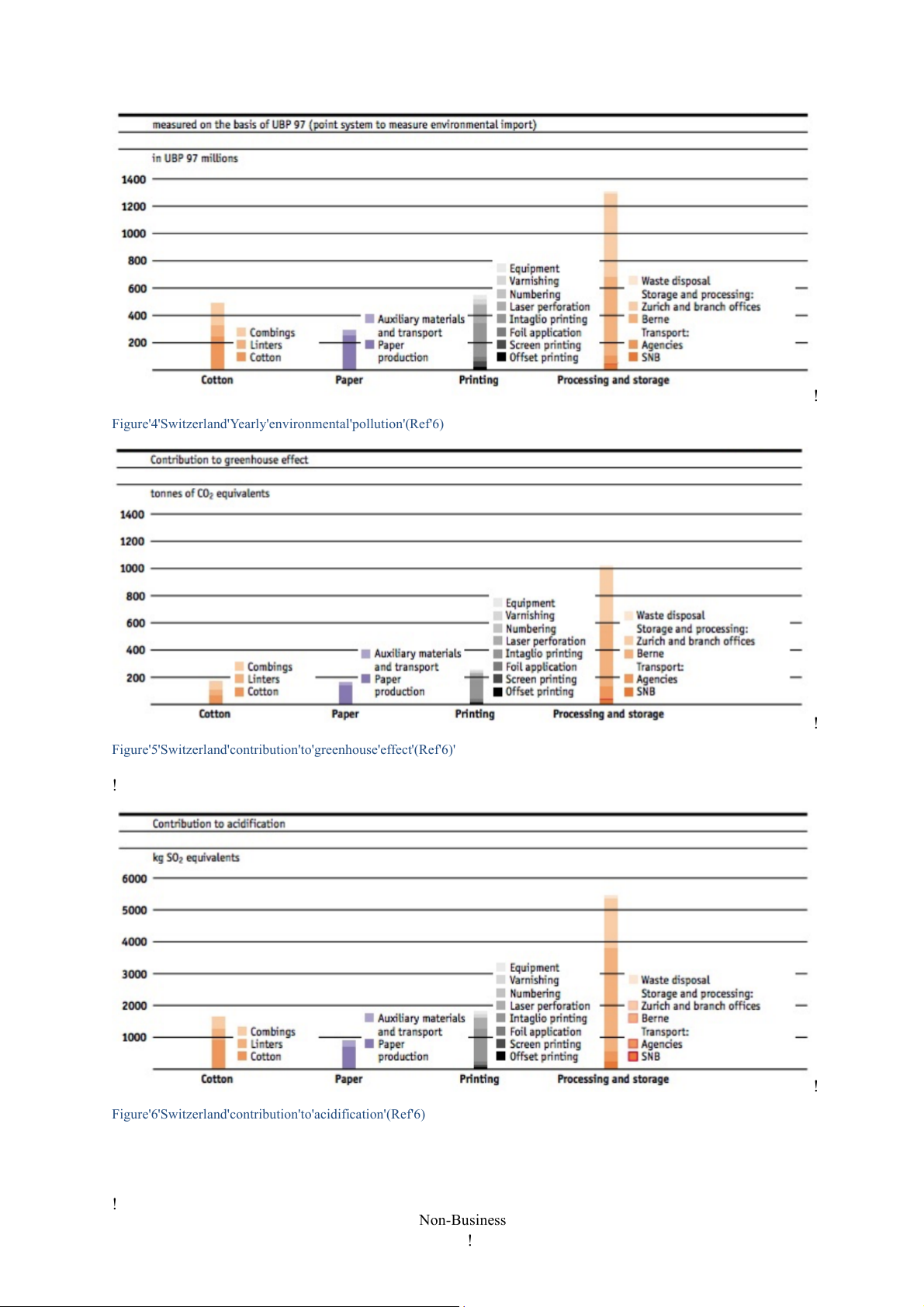
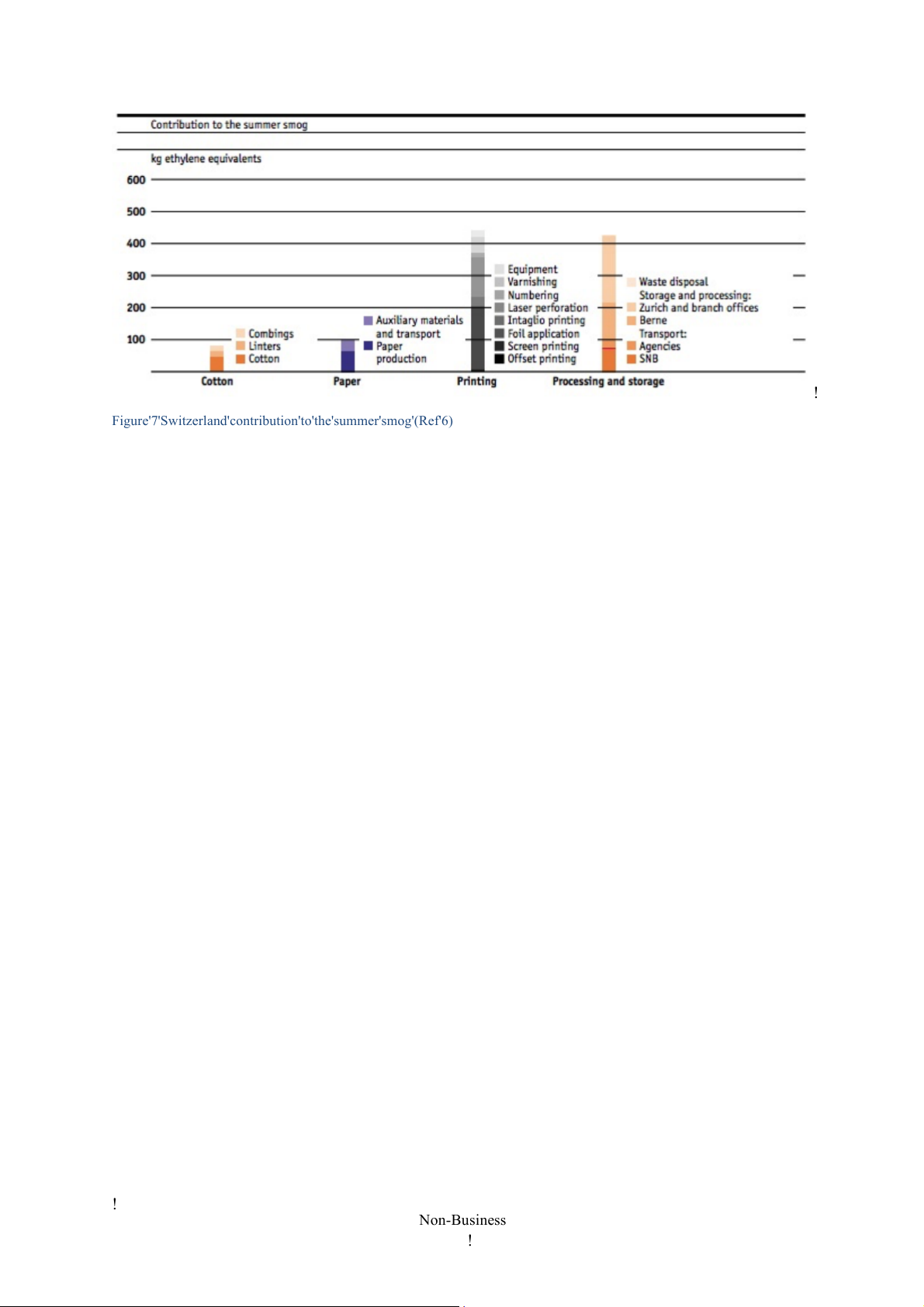
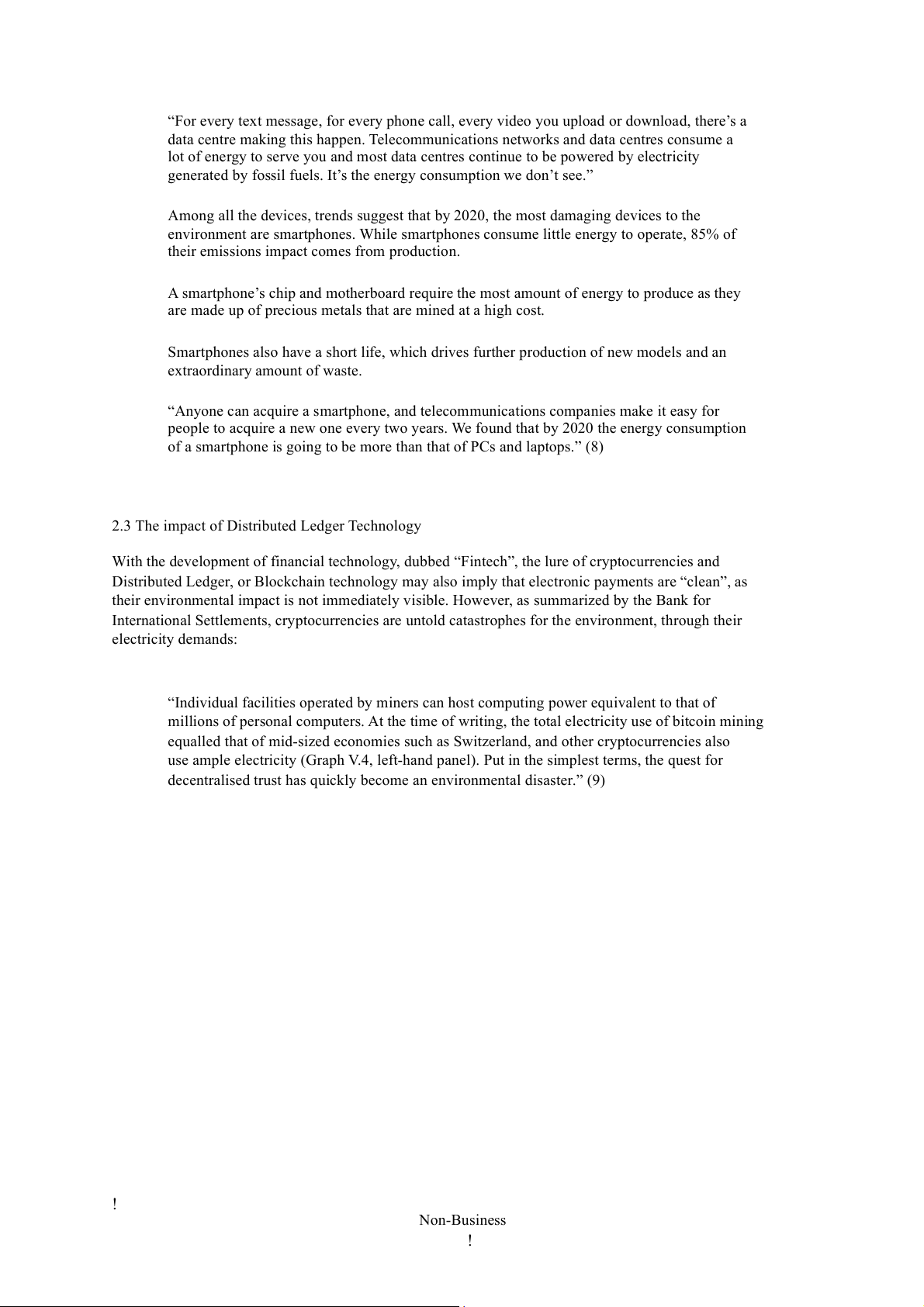
The Swiss National Bank banknote lifecycle assessment undertaken in 2000 (6) provides us with
extensive insights on the production process and environmental impacts of their banknote assets, as
per their eighth banknote series. We reproduce some key charts of the paper below for awareness of
the Swiss banknote lifecycle, their lifespan, as well as their environmental measures. ! Non-Business ! !
Figure'2'Switzerland'life'span'of'the'banknotes'(Ref'6) !
Figure'3'Switzerland'Process'chart'of'the'bank'note'life'cycle'(Ref'6) ! Non-Business ! !
Figure'4'Switzerland'Yearly'environmental'pollution'(Ref'6) !
Figure'5'Switzerland'contribution'to'greenhouse'effect'(Ref'6)' ! !
Figure'6'Switzerland'contribution'to'acidification'(Ref'6) ! Non-Business ! !
Figure'7'Switzerland'contribution'to'the'summer'smog'(Ref'6) ! Non-Business !
Section 2: Environmental costs of a cashless economy
It seems natural to hypothesise that cashless payments are greener, based on the premise that
stopping the use of physical cash would save on the environmental cost of cash as detailed in the
earlier section. The DeNederlanscheBank study (7) suggests debit cards carry a lower environmental
footprint, with potential for further improvements. ! !
Figure'8'Netherlands'schematic'view'of'the'debit'card'payment'system'(Ref'5)' 2.1 Debit cards
The key study (5) provides insights on the environmental impacts of debit card payments in the Netherlands. Their results:
“One Dutch debit card transaction in 2015 is estimated to have an absolute environmental
impact of 470 µPt [as global eco-index]. Within the process chain of a debit card transaction,
the relative environmental impact of payment terminals is dominant, contributing 75% of the
total impact. Terminal materials (37%) and terminal energy use (27%) are the largest
contributors to this share, while the remaining impact comprises datacentre (11%) and debit
card (15%) subsystems. For datacentres, this impact mainly stems from their energy use.
Finally, scenario analyses show that a significant decrease (44%) in the environmental impact
of the entire debit card payment system could be achieved by stimulating the use of
renewable energy in payment terminals and datacentres, reducing the standby time of
payment terminals, and by increasing the lifetimes of debit cards.” 2.2 Smartphones!
However, we must consider the broader context of the reliance on underlying payments infrastructure,
with the associated network and other technology services required for data processing (7) such as
data centres and their associated electricity costs, the environmental impact of smartphone production: (8)
“We found that the ICT [Information and Communications Technology] industry as a whole
was growing but it was incremental. “Today it sits at about 1.5%. If trends continue, ICT will
account for as much as 14% for the total global footprint by 2040, or about half of the entire
transportation sector worldwide.” ! Non-Business !
“For every text message, for every phone call, every video you upload or download, there’s a
data centre making this happen. Telecommunications networks and data centres consume a
lot of energy to serve you and most data centres continue to be powered by electricity
generated by fossil fuels. It’s the energy consumption we don’t see.”
Among all the devices, trends suggest that by 2020, the most damaging devices to the
environment are smartphones. While smartphones consume little energy to operate, 85% of
their emissions impact comes from production.
A smartphone’s chip and motherboard require the most amount of energy to produce as they
are made up of precious metals that are mined at a high cost.
Smartphones also have a short life, which drives further production of new models and an
extraordinary amount of waste.
“Anyone can acquire a smartphone, and telecommunications companies make it easy for
people to acquire a new one every two years. We found that by 2020 the energy consumption
of a smartphone is going to be more than that of PCs and laptops.” (8)
2.3 The impact of Distributed Ledger Technology
With the development of financial technology, dubbed “Fintech”, the lure of cryptocurrencies and
Distributed Ledger, or Blockchain technology may also imply that electronic payments are “clean”, as
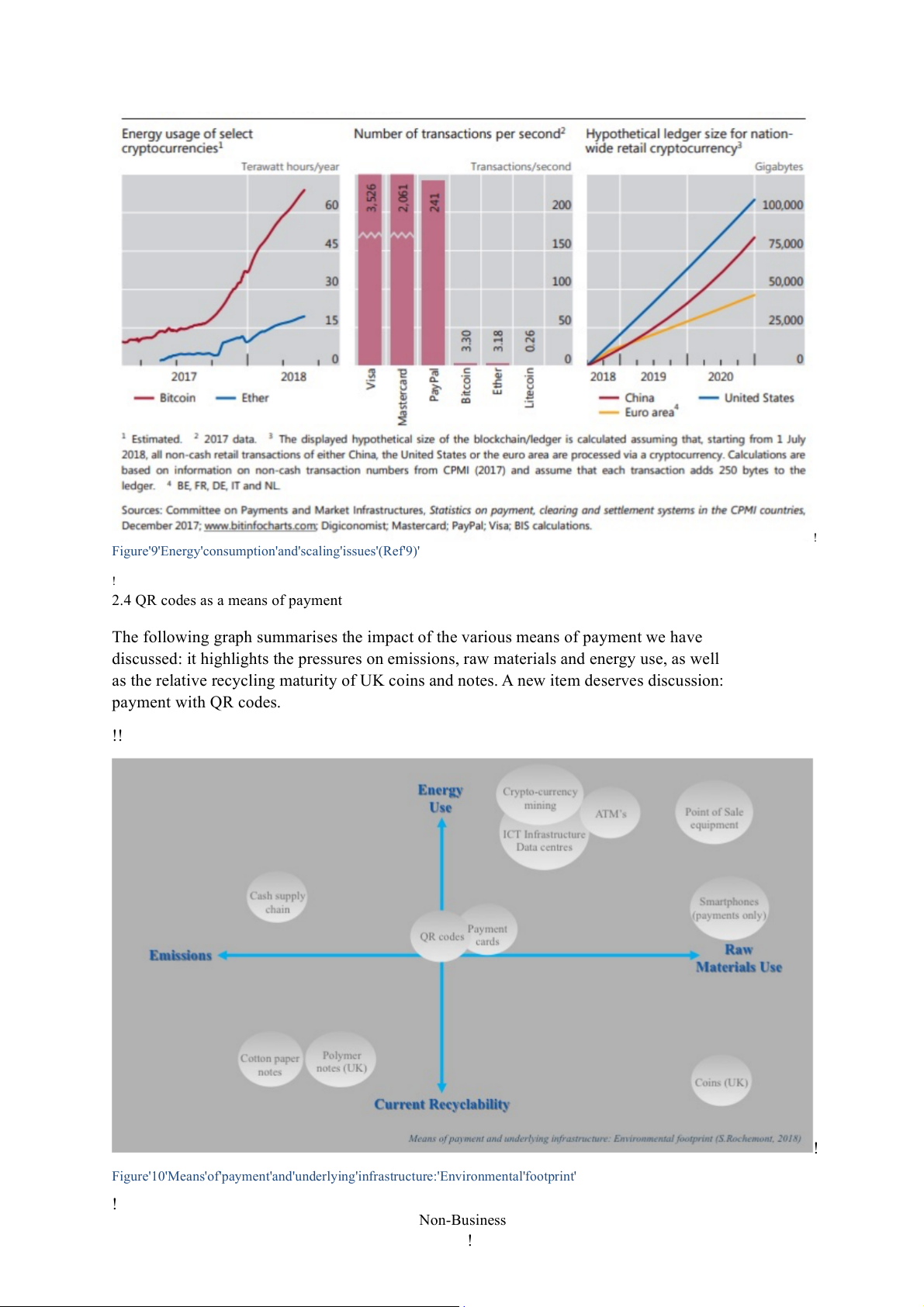
their environmental impact is not immediately visible. However, as summarized by the Bank for
International Settlements, cryptocurrencies are untold catastrophes for the environment, through their electricity demands:
“Individual facilities operated by miners can host computing power equivalent to that of
millions of personal computers. At the time of writing, the total electricity use of bitcoin mining
equalled that of mid-sized economies such as Switzerland, and other cryptocurrencies also
use ample electricity (Graph V.4, left-hand panel). Put in the simplest terms, the quest for
decentralised trust has quickly become an environmental disaster.” (9) ! Non-Business ! !
Figure'9'Energy'consumption'and'scaling'issues'(Ref'9)' !
2.4 QR codes as a means of payment
The following graph summarises the impact of the various means of payment we have
discussed: it highlights the pressures on emissions, raw materials and energy use, as well
as the relative recycling maturity of UK coins and notes. A new item deserves discussion: payment with QR codes. !! !
Figure'10'Means'of'payment'and'underlying'infrastructure:'Environmental'footprint' ! Non-Business !
Tài liệu liên quan:
-
Elasticity Problems and Solutions: Practice Exercises | Microeconomics | Trường Đại học Quốc tế, Đại học Quốc gia Thành phố Hồ Chí Minh
5 3 -
Supply and Demand - ôn tập: Market Equilibrium Effects Analysis | Microeconomics | Trường Đại học Quốc tế, Đại học Quốc gia Thành phố Hồ Chí Minh
3 2 -
Monopoly & Monopolistic Competition | Microeconomics | Trường Đại học Quốc tế, Đại học Quốc gia Thành phố Hồ Chí Minh
4 2 -
Systematic Review of Social Media Marketing in Luxury Brands | Microeconomics | Trường Đại học Quốc tế, Đại học Quốc gia Thành phố Hồ Chí Minh
4 2 -
Seminar-5: Economics | Microeconomics | Trường Đại học Quốc tế, Đại học Quốc gia Thành phố Hồ Chí Minh
4 2