Exchange Rates, Interest Rates, and Interest Parity | Tài chính quốc tế | Trường Học Viện nông nghiệp Việt Nam
The interest rate parity explains the relationship between returns to bond investments between two countries. Interest rate parity results from profit-seeking arbitrage activity, specifically covered interest rate arbitrage. Let us go through an example of how covered interest arbitrage works. For expositional purposes i$ = interest rate in the United States i£ = interest rate in the United Kingdom F = forward exchange rate (dollars per pound) E = spot exchange rate (dollars per pound). Tài liệu được sưu tầm và soạn thảo dưới dạng file PDF để gửi tới các bạn cùng tham khảo, ôn tập đầy đủ kiến thức, chuẩn bị cho các buổi học thật tốt. Mời bạn đọc đón xem!
Môn: Tài chính quốc tế (hvnn) 130 tài liệu
Trường: Học viện Nông nghiệp Việt Nam 2.4 K tài liệu
Tác giả:


Preview text:
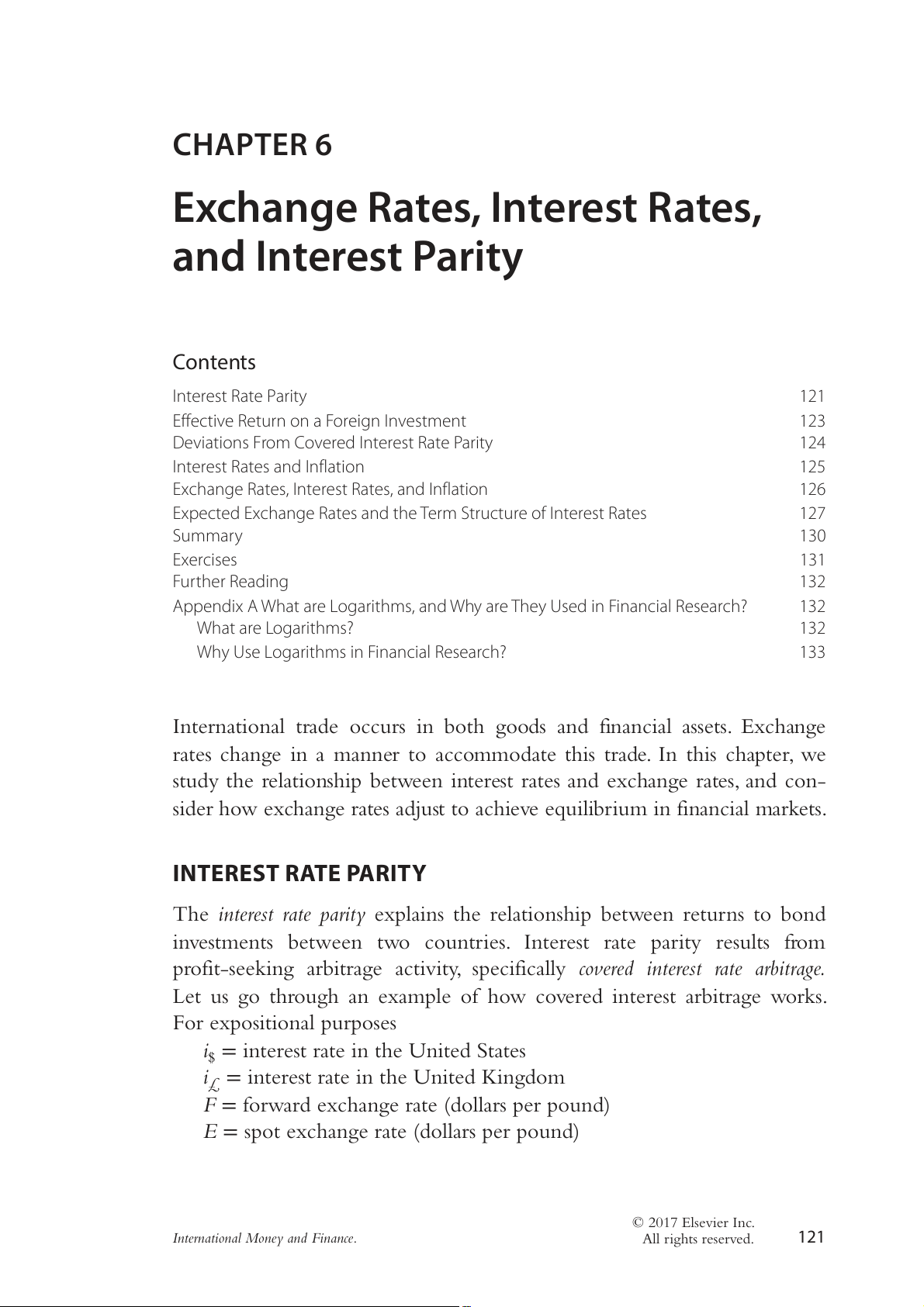
CHAPTER 6
Exchange Rates, Interest Rates, and Interest Parity Contents Interest Rate Parity 121
Effective Return on a Foreign Investment 123
Deviations From Covered Interest Rate Parity 124 Interest Rates and Inflation 125
Exchange Rates, Interest Rates, and Inflation 126
Expected Exchange Rates and the Term Structure of Interest Rates 127 Summary 130 Exercises 131 Further Reading 132
Appendix A What are Logarithms, and Why are They Used in Financial Research? 132 What are Logarithms? 132
Why Use Logarithms in Financial Research? 133
International trade occurs in both goods and financial assets. Exchange
rates change in a manner to accommodate this trade. In this chapter, we
study the relationship between interest rates and exchange rates, and con-
sider how exchange rates adjust to achieve equilibrium in financial markets. INTEREST RATE PARITY
The interest rate parity explains the relationship between returns to bond
investments between two countries. Interest rate parity results from
profit-seeking arbitrage activity, specifically covered interest rate arbitrage.
Let us go through an example of how covered interest arbitrage works. For expositional purposes
i$ = interest rate in the United States
i£ = interest rate in the United Kingdom
F = forward exchange rate (dollars per pound)
E = spot exchange rate (dollars per pound) © 201 7 Elsevier Inc.
International Money and Finance. All rights reserved. 121 122
International Money and Finance
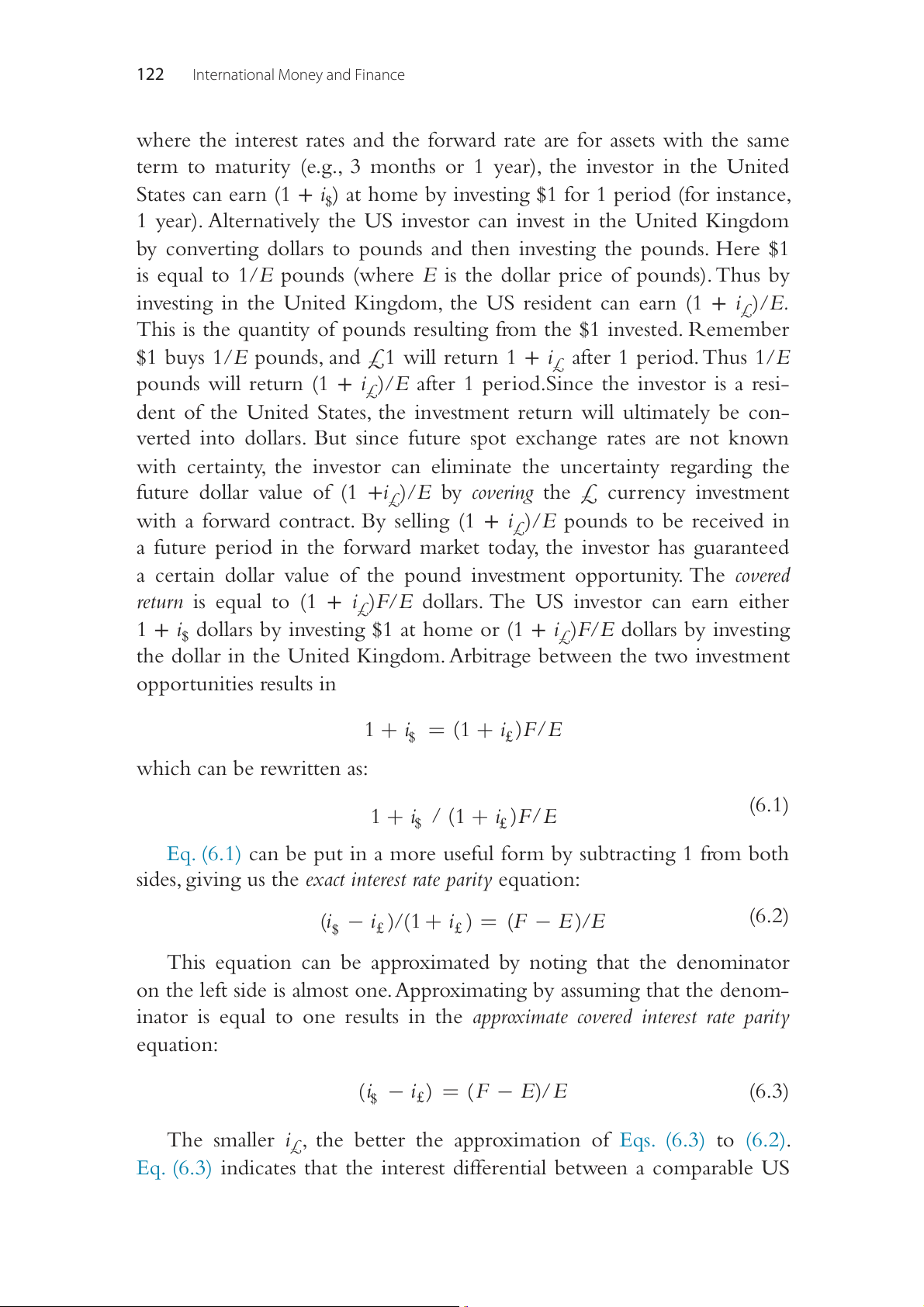
where the interest rates and the forward rate are for assets with the same
term to maturity (e.g., 3 months or 1 year), the investor in the United
States can earn (1 + i ) at home by investing $1 for 1 period (for instance, $
1 year). Alternatively the US investor can invest in the United Kingdom
by converting dollars to pounds and then investing the pounds. Here $1 is equal to 1/ E pounds (where
E is the dollar price of pounds). Thus by
investing in the United Kingdom, the US resident can earn (1 + i£)/E.
This is the quantity of pounds resulting from the $1 invested. Remember $1 buys 1/
E pounds, and £1 will return 1 + i after 1 period. Thus 1/ £ E
pounds will return (1 + i
after 1 period.Since the investor is a resi- £)/E
dent of the United States, the investment return will ultimately be con-
verted into dollars. But since future spot exchange rates are not known
with certainty, the investor can eliminate the uncertainty regarding the
future dollar value of (1 +i£)/E by covering the £ currency investment
with a forward contract. By selling (1 + i pounds to be received in £)/E
a future period in the forward market today, the investor has guaranteed
a certain dollar value of the pound investment opportunity. The covered
return is equal to (1 + i F E
£) / dollars. The US investor can earn either
1 + i$ dollars by investing $1 at home or (1 + i F E dollars by investing £) /
the dollar in the United Kingdom. Arbitrage between the two investment opportunities results in
1 + i = (1 + i£ )F/E $ which can be rewritten as: 1 + i / (1 (6.1)
+ i£ )F/E $
Eq. (6.1) can be put in a more useful form by subtracting 1 from both
sides, giving us the exact interest rate parity equation: (i − i (6.2) £ )/(1 + i£ )
= (F − E )/E $
This equation can be approximated by noting that the denominator
on the left side is almost one. Approximating by assuming that the denom-
inator is equal to one results in the approximate covered interest rate parity equation:
(i − i£) = (F − E)/E $ (6.3)
The smaller i , the better the approximation of £ Eqs. (6.3) to (6.2).
Eq. (6.3) indicates that the interest differential between a comparable US
Exchange Rates, Interest Rates, and Interest Parity 123
and UK investment is equal to the forward premium or discount on the
pound. (We must remember that, since interest rates are quoted at annual
rates or percent per annum, the forward premiums or discounts must also
be quoted at annual rates.) Now let us consider an example. Ignoring bid-
ask spreads, we observe the following Eurocurrency market interest rates: Euro $: 15% Euro £: 10%
The exchange rate is quoted as the dollar price of pounds and is cur-
rently E = 2.00. Given the previous information, what do you expect the 12-month forward rate to be?
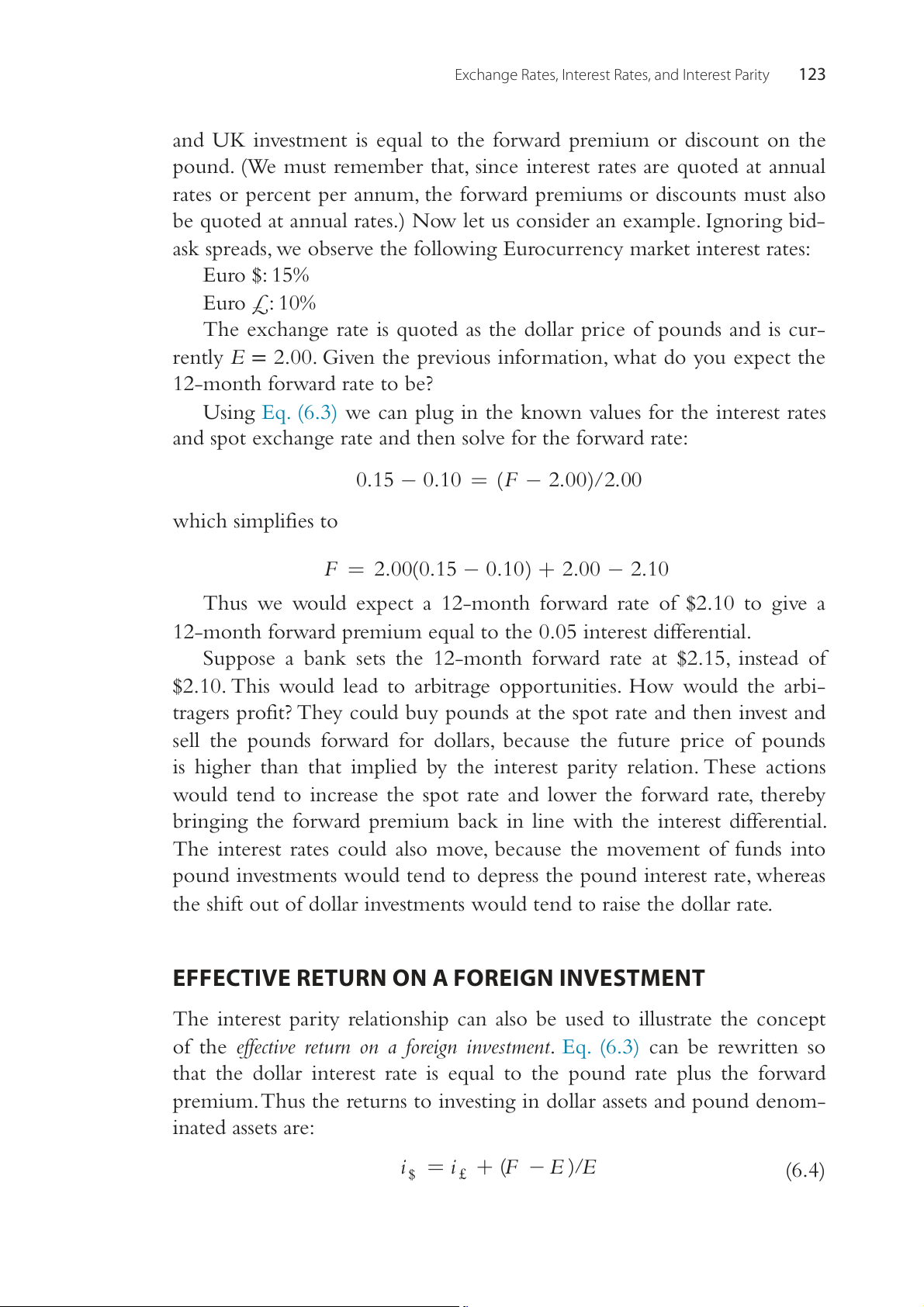
Using Eq. (6.3) we can plug in the known values for the interest rates
and spot exchange rate and then solve for the forward rate: 0.15 − 0 1 . 0 = (F − 2.00)/2.00 which simplifies to F = 2.00(0.15 − 0 1 . 0) + 2 0 . 0 − 2.10
Thus we would expect a 12-month forward rate of $2.10 to give a
12-month forward premium equal to the 0.05 interest differential.
Suppose a bank sets the 12-month forward rate at $2.15, instead of
$2.10. This would lead to arbitrage opportunities. How would the arbi-
tragers profit? They could buy pounds at the spot rate and then invest and
sell the pounds forward for dollars, because the future price of pounds
is higher than that implied by the interest parity relation. These actions
would tend to increase the spot rate and lower the forward rate, thereby
bringing the forward premium back in line with the interest differential.
The interest rates could also move, because the movement of funds into
pound investments would tend to depress the pound interest rate, whereas
the shift out of dollar investments would tend to raise the dollar rate.
EFFECTIVE RETURN ON A FOREIGN INVESTMENT
The interest parity relationship can also be used to illustrate the concept
of the effective return on a foreign investment. Eq. (6.3) can be rewritten so
that the dollar interest rate is equal to the pound rate plus the forward
premium. Thus the returns to investing in dollar assets and pound denom- inated assets are: i = i + F £ ( − E ) E / $ (6.4) 124
International Money and Finance
Covered interest parity ensures that Eq. (6.4) will hold. Note that the
interest rate on the bond i is not the relevant return measure by itself, £
since this is the return in pounds. Instead the effective return to a UK
investment is composed of an interest rate return and an exchange rate
return. But suppose we do not use the forward market, yet we are US
residents who buy UK bonds. Even in this case the effective return would
be composed of two parts. The first part would be the interest rate return
and the second would be the expected change in the exchange rate, as
we now need to take into account the expected spot rate in the future. In
other words, the return on a UK investment, plus the expected change in
the value of UK currency, is our expected return on a pound investment.
If the forward exchange rate is equal to the expected future spot rate, then
the forward premium is also the expected change in the exchange rate.
DEVIATIONS FROM COVERED INTEREST RATE PARITY
Even though foreign exchange traders quote forward rates based on inter-
est differentials and current spot rates so that the forward rate will yield
a forward premium equal to the interest differential, we may ask: How
well does interest rate parity hold in the real world? Since deviations from
interest rate parity would seem to present profitable arbitrage opportuni-
ties, we would expect profit-seeking arbitragers to eliminate any devia-
tions. Still, careful studies of the data indicate that small deviations from
interest rate parity do occur. There are several reasons why interest rate
parity may not hold exactly, and yet we can earn no arbitrage profits from
the situation. The most obvious reason is the transactions cost between
markets. Because buying and selling foreign exchange and international
securities involves a cost for each transaction, there may exist deviations
from interest rate parity that are equal to, or smaller than, these transaction
costs. In this case, speculators cannot profit from the deviations, since the
price of buying and selling in the market would wipe out any apparent
gain. Studies indicate that for comparable financial assets that differ only in
terms of currency of denomination (e.g., dollar- and pound-denominated
Eurodeposits in a German bank), 100% of the deviations from interest rate
parity can be accounted for by transaction costs.
Besides transaction costs, there are other reasons why interest rate par-
ity may not hold perfectly. One other reason, for small deviations from
interest rate parity, is the potential difference in taxation of interest earn-
ings and foreign exchange rate earnings. If these are differently taxed in a
Exchange Rates, Interest Rates, and Interest Parity 125
country then the effective return Eq. (6.4) might not hold since one side
involves only interest earnings and the other interest earnings and foreign
exchange earnings. Thus it may be misleading to simply consider pretax
effective returns to decide if profitable arbitrage is possible.
Two more reasons for why interest rate parity might not hold per-
fectly are government controls and political risk. If government controls
on financial capital flows exist, then an effective barrier between national
markets is in place. If an individual cannot freely buy or sell the cur-
rency or securities of a country, then the free market forces that work in
response to effective return differentials will not function. Indeed, even the
threat of controls could affect the interest rate parity condition. Political
risk is often mentioned in conjunction with government controls. The
interest rate parity condition is not directly affected by political risk, such
as a regime change. Instead it is the threat of the new regime imposing
capital controls that affects the interest rate parity condition. We should
note, however, that the external or Eurocurrency market often serves as
a means of avoiding political risk, since an individual can borrow and
lend foreign currencies outside the home country of each currency. For
instance, the Eurodollar market provides a market for US dollar loans
and deposits in major financial centers outside the United States, thereby
avoiding any risk associated with US government actions.
INTEREST RATES AND INFLATION
To better understand the relationship between interest rates and exchange
rates, we now consider how inflation can be related to both. To link
exchange rates, interest rates, and inflation, we must first understand the
role of inflation in interest rate determination. Economists distinguish
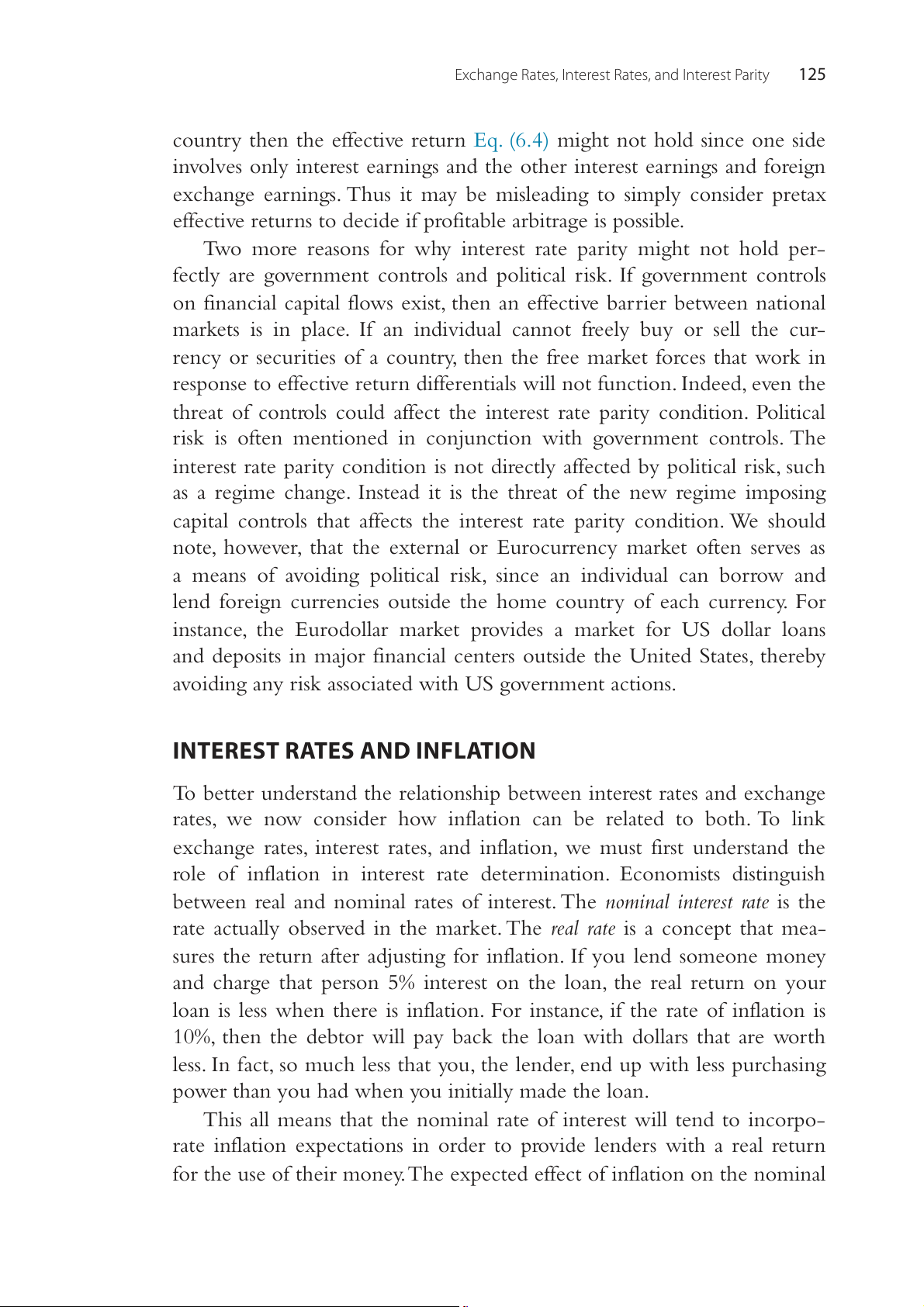
between real and nominal rates of interest. The nominal interest rate is the
rate actually observed in the market. The real rate is a concept that mea-
sures the return after adjusting for inflation. If you lend someone money
and charge that person 5% interest on the loan, the real return on your
loan is less when there is inflation. For instance, if the rate of inflation is
10%, then the debtor will pay back the loan with dollars that are worth
less. In fact, so much less that you, the lender, end up with less purchasing
power than you had when you initially made the loan.
This all means that the nominal rate of interest will tend to incorpo-
rate inflation expectations in order to provide lenders with a real return
for the use of their money. The expected effect of inflation on the nominal 126
International Money and Finance
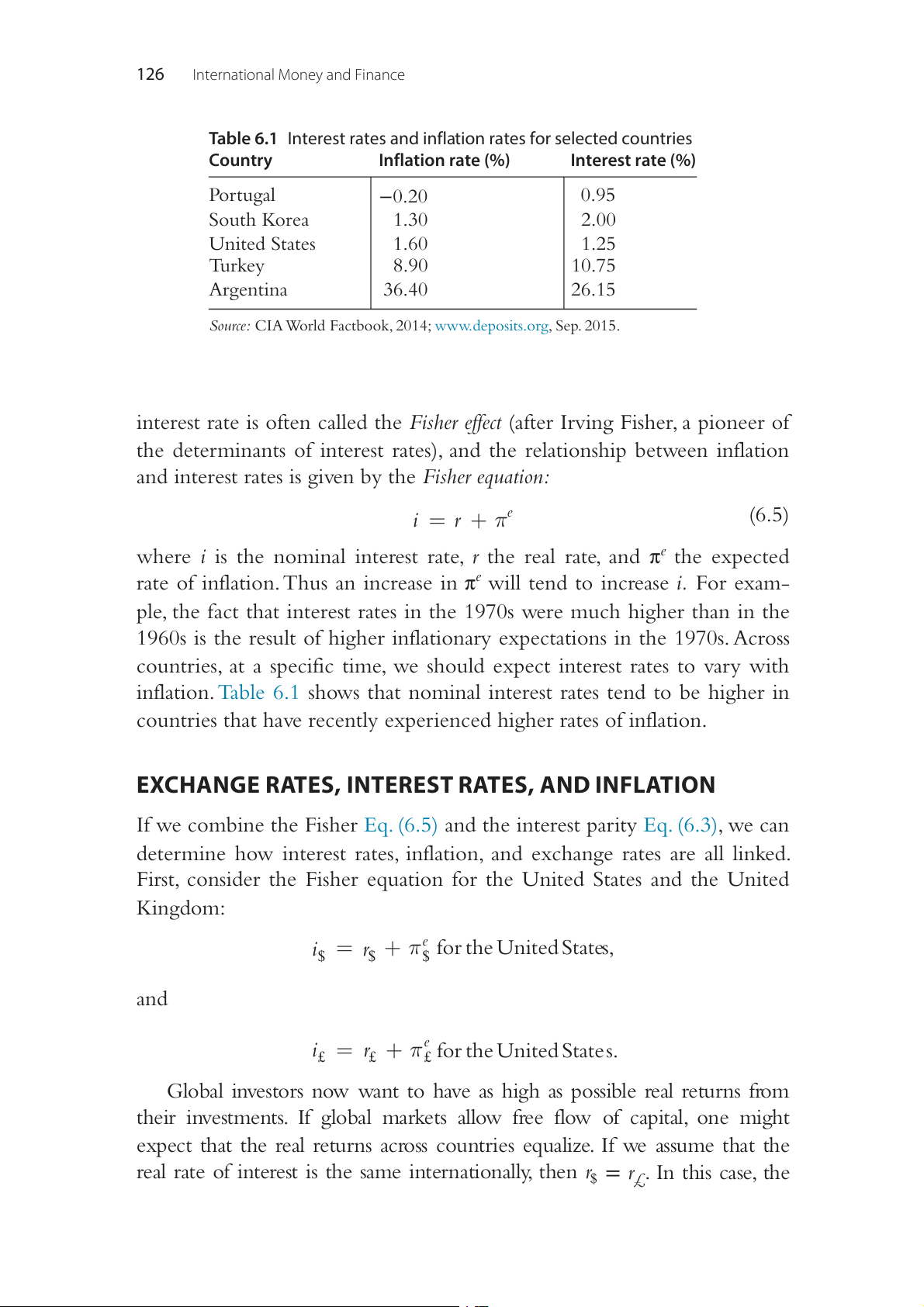
Table 6.1 Interest rates and inflation rates for selected countries Country Inflation rate (%) Interest rate (%) Portugal −0.20 0.95 South Korea 1.30 2.00 United States 1.60 1.25 Turkey 8.90 10.75 Argentina 36.40 26.15
Source: CIA World Factbook, 2014; www.deposits.org, Sep. 2015.
interest rate is often called the Fisher effect (after Irving Fisher, a pioneer of
the determinants of interest rates), and the relationship between inflation
and interest rates is given by the Fisher equation: i r e = + (6.5) π
where i is the nominal interest rate, r the real rate, and πe the expected
rate of inflation. Thus an increase in πe will tend to increase i. For exam-
ple, the fact that interest rates in the 1970s were much higher than in the
1960s is the result of higher inflationary expectations in the 1970s. Across
countries, at a specific time, we should expect interest rates to vary with
inflation. Table 6.1 shows that nominal interest rates tend to be higher in
countries that have recently experienced higher rates of inflation.
EXCHANGE RATES, INTEREST RATES, AND INFLATION
If we combine the Fisher Eq. (6.5) and the interest parity Eq. (6.3), we can
determine how interest rates, inflation, and exchange rates are all linked.
First, consider the Fisher equation for the United States and the United Kingdom: i = r e + π for the United States, $ $ $ and i = r e £
£ + π£ for the United State s.
Global investors now want to have as high as possible real returns from
their investments. If global markets allow free flow of capital, one might
expect that the real returns across countries equalize. If we assume that the
real rate of interest is the same internationally, then r$ = r£. In this case, the
Exchange Rates, Interest Rates, and Interest Parity 127
nominal interest rates, i$ and i£, differ solely by expected inflation, so we can write i − i e e $ £ = π $ − π (6.6) £
The interest parity condition of Eq. (6.3) indicates that the interest dif-
ferential is also equal to the forward premium, or e e i − i = π − π = F ( − S E $ £ $ £ )/ (6.7)
Eq. (6.7) summarizes the link among interest, inflation, and exchange rates.
In the real world the interrelationships summarized by Eq. (6.7) are
determined simultaneously, because interest rates, inflation expectations,
and exchange rates are jointly affected by new events and information. For
instance, suppose we begin from a situation of equilibrium, where interest
parity holds. Suddenly there is a change in US policy that leads to expecta-
tions of a higher US inflation rate. The increase in expected inflation will
cause dollar interest rates to rise. At the same time exchange rates will adjust
to maintain interest parity. If the expected future spot rate is changed, we
would expect F to carry much of the adjustment burden. If the expected
future spot rate is unchanged, the current spot rate would tend to carry the
bulk of the adjustment burden. Finally if central bank intervention is peg-
ging exchange rates at fixed levels by buying and selling to maintain the
fixed rate, the domestic and foreign currency interest rates will have to
adjust to parity levels. The fundamental point is that the initial US pol-
icy change led to changes in inflationary expectations, interest rates, and
exchange rates simultaneously, since they all adjust to new equilibrium levels.
EXPECTED EXCHANGE RATES AND THE TERM STRUCTURE OF INTEREST RATES
There is no such thing as the interest rate for a country. Interest rates
within a country vary for different investment opportunities and for dif-
ferent maturity dates on similar investment opportunities. The structure of
interest rates existing on investment opportunities over time is known as
the term structure of interest rates. For instance in the bond market we will
observe 3-month, 6-month, 1-year, 3-year, and even longer-term bonds. If
the interest rates rise with the term to maturity, then we observe a rising
term structure. If the interest rates are the same regardless of term, then
the term structure will be flat. We describe the term structure of interest 128
International Money and Finance
rates by describing the slope of a line connecting the various points in
time at which we observe interest rates.
There are several competing theories that explain the term structure of
interest rates. We will discuss three theories:
1. Expectations: This theory suggests that the long-term interest rate tends
to be equal to an average of short-term rates expected over the long-
term holding period. In other words an investor could buy a long-
term bond or a series of short-term bonds, so the expected return
from the long-term bond will tend to be equal to the return generated
from holding the series of short-term bonds.
2. Liquidity premium: Underlying this theory is the idea that long-term
bonds incorporate a risk premium since risk-averse investors would pre-
fer to lend short term. The premium on long-term bonds would tend to
result in interest rates rising with the holding period of the bond.
3. Preferred habitat: This approach contends that the bond markets are seg-
mented by maturities. In other words there is a separate market for
short- and long-term bonds, and the interest rates are determined by
supply and demand in each market. If the markets are segmented then
the returns in the long-term bond market can be very different from the short-term bond market.
Although we could use these theories to explain the term structure of
interest rates in any one currency, in international finance we use the term
structures for different currencies to infer expected exchange rate changes.
For instance if we compared Euro–dollar and Euro–euro deposit rates for
different maturities, like 1-month and 3-month deposits, the difference
between the two term structures should reflect expected exchange rate
changes, as long as the expected future spot rate is equal to the forward
rate. Of course, if there are capital controls, then the various national mar-
kets become isolated and there would not be any particular relationship
between international interest rates.
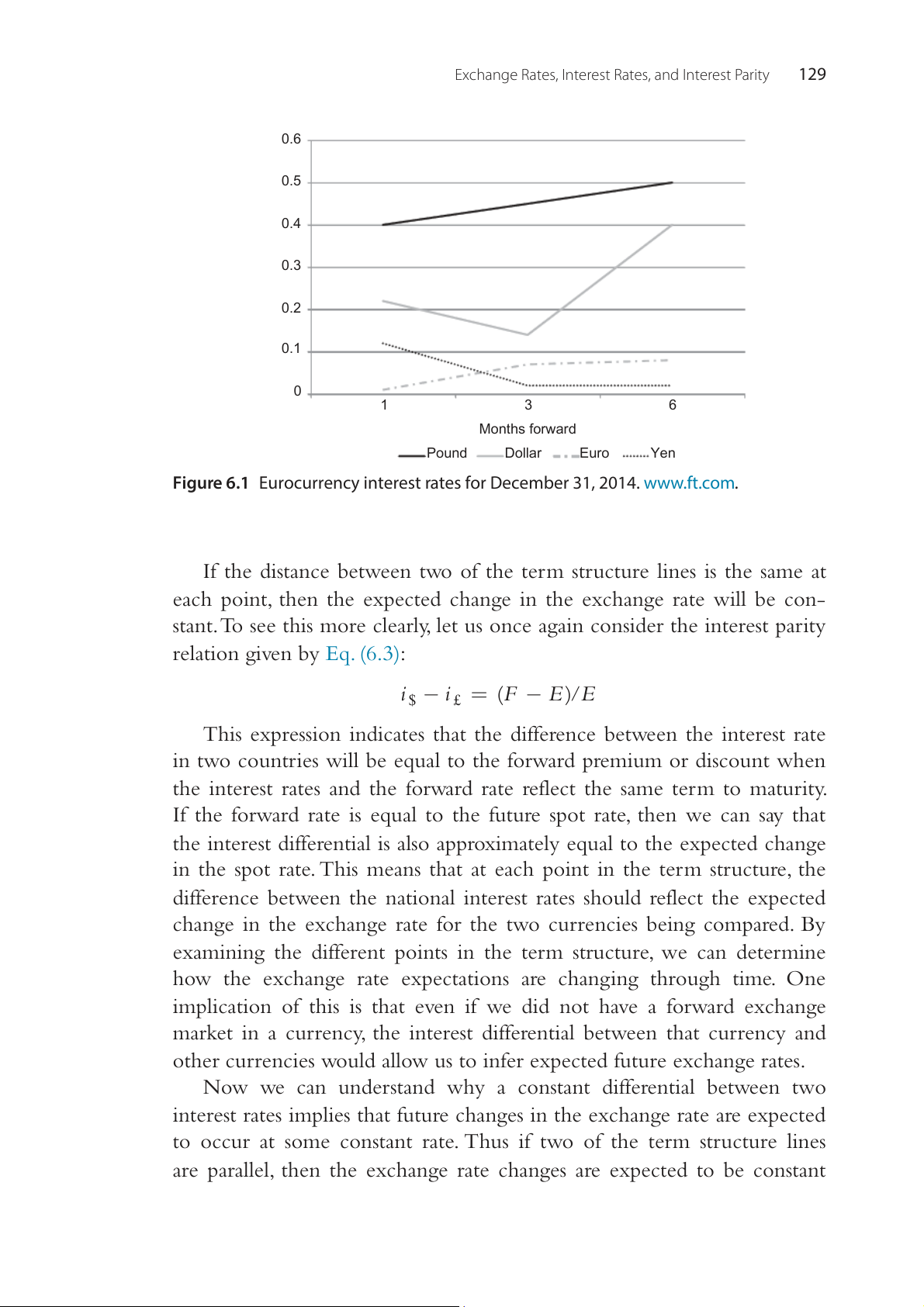
Fig. 6.1 plots the Eurocurrency deposit rates at a particular time for
1- to 6-month terms. We know from the interest rate parity condition that
when one country has higher interest rates than another, the high-inter-
est-rate currency is expected to depreciate relative to the low-interest-rate
currency. The only way an interest rate can be above another one is if the
high-interest-rate currency is expected to depreciate; thus, the effective
rate, i + (F − E)/E (as shown in Eq. (6.4), with the forward rate used as a
predictor of the future spot rate), is lower than the observed rate, i, because
of the expected depreciation of the currency (F < ) E .
Exchange Rates, Interest Rates, and Interest Parity 129 0.6 0.5 0.4 te ra st 0.3 re te In 0.2 0.1 0 1 3 6 Months forward Pound Dollar Euro Yen
Figure 6.1 Eurocurrency interest rates for December 31, 2014. www.ft.com.
If the distance between two of the term structure lines is the same at
each point, then the expected change in the exchange rate will be con-
stant. To see this more clearly, let us once again consider the interest parity relation given by Eq. (6.3): i − i = F ( − E E $ £ )/
This expression indicates that the difference between the interest rate
in two countries will be equal to the forward premium or discount when
the interest rates and the forward rate reflect the same term to maturity.
If the forward rate is equal to the future spot rate, then we can say that
the interest differential is also approximately equal to the expected change
in the spot rate. This means that at each point in the term structure, the
difference between the national interest rates should reflect the expected
change in the exchange rate for the two currencies being compared. By
examining the different points in the term structure, we can determine
how the exchange rate expectations are changing through time. One
implication of this is that even if we did not have a forward exchange
market in a currency, the interest differential between that currency and
other currencies would allow us to infer expected future exchange rates.
Now we can understand why a constant differential between two
interest rates implies that future changes in the exchange rate are expected
to occur at some constant rate. Thus if two of the term structure lines
are parallel, then the exchange rate changes are expected to be constant 130
International Money and Finance
(the currencies will appreciate or depreciate against each other at a con-
stant rate). On the other hand, if two term structure lines are diverging, or
moving farther apart from one another, then the high-interest-rate cur-
rency is expected to depreciate at an increasing rate over time. For term
structure lines that are converging, or moving closer together, the high-
interest-rate currency is expected to depreciate at a declining rate relative
to the low-interest-rate currency.
To illustrate the exchange rate–term structure relationship, let us look
at Fig. 6.1. In Fig. 6.1 the term structure line for the yen lies below that
of the dollar. We should then expect the Japanese yen to appreciate against
the US dollar and the yen should sell at a forward premium against the
dollar. With regard to the slopes of the curves, the term structure line for
Japan and the United States are diverging over time. The divergence of the
US line from the Japanese line suggests that the yen is expected to appre-
ciate against the dollar at a faster rate over time.
Looking at the other currencies in Fig. 6.1 we can see differences in
the expected changes in the exchange rates. The term structure line for
the pound lies above that of the dollar so we should expect the pound to
depreciate in value against the dollar and sell at a forward discount against
the dollar. The fact that the term structure of the euro lies below both the
pound and dollar indicates that the euro is expected to appreciate against
both of those currencies in the table. A particularly interesting case is the
term structure for the euro and the yen, because these intersect. The yen
is expected to depreciate or sell at a forward discount against the euro at
1-month maturity, but at the 3-month and 6-month maturities the yen
sells at forward premium against the euro. SUMMARY
1. The interest parity relationship indicates that the interest rate differen-
tial between investments in two currencies will equal to the forward
premium or discount between the currencies.
2. The international investment is covered when investors use the for-
ward contracts to cover or hedge themselves from risk of the
unknown future spot exchange rates.
3. A currency is at a forward premium (discount) by as much as
its interest rate is lower (higher) than the interest rate in the other country.
4. Covered interest parity links together four rates, which are the cur-
rent spot exchange rate, the current forward exchange rate, and the
Exchange Rates, Interest Rates, and Interest Parity 131
current interest rates in two countries. If one of these rates change,
at least one of the others must also change to maintain the covered interest parity.
5. Covered interest arbitrage ensures interest parity.
6. Deviations from interest rate parity could be the result of transaction
costs, differential taxation, government controls, or political risk.
7. The real interest rate is equal to the nominal interest rate minus the expected rate of inflation.
8. If real interest rates are equal in two countries, then the interest rate
differential will equal to expected inflation rate differential, which
in turn will equal to the forward premium or discount between two currencies.
9. The term structure of interest rates is the relationship between inter-
est rates on various bonds with different terms to maturity.
10. Differences between the term structure of interest rates in two coun-
tries will reflect the expected exchange rate changes. EXERCISES
1. Suppose you want to infer expected future exchange rates in a less
developed country that has free-market-determined interest rates but
does not have a forward exchange market. Is there any other way of
inferring expected future exchange rates? Under what assumptions?
2. a. Show that there is a direct relationship between the forward
premium and the “real” interest rate differential between two currencies.
b. Under what conditions will the forward premium equal the
expected “inflation” differential between two currencies?
3. Give four reasons why, when interest parity does not hold exactly, we
are unable to take advantage of arbitrage to earn profits.
4. Suppose the 1-year interest rate on British pounds is 11%, the dollar
interest rate is 6%, and the current $/£ spot rate is $1.80.
a. What do you expect the spot rate to be in 1 year?
b. Why can we not observe the expected future spot rate?
5. Assume that the 1-year interest rate in the United States is 2% and the
1-year interest rate in Sweden is 4%. Is there a premium or discount on the Swedish krona?
6. If two countries had identical term structures of interest rates,
what is the expected future exchange rate change between the two currencies? 132
International Money and Finance FURTHER READING
Choudhry, B., Titman, S., 2001. Why real interest rates, cost of capital and price/earnings
ratios vary across countries. J. Int. Money Financ., 165–190. April.
Lothian, J.R., Wu, L., 2011. Uncovered interest rate parity over the last two centuries. J. Int.
Money Financ. 30 (3), 448–473.
McKinnon, R.I., 1979. Money in International Exchange. Oxford, New York.
Pigott, C., 1993–1994. International interest rate convergence: a survey of the issues and
evidence. Fed. Res. Bank N.Y. Q. Rev. Winter 18 (4), 24–38.
Solnik, B., 1978. International parity conditions and exchange risk. J. Bank Financ. 2, 281–293.
Throop, A.W., 1994. Linkages of national interest rates. FRBSF Wkly. Lett. 94, September 1–4.
Wainwright, K., Chiang, A.C., 2004. Fundamental Methods Mathematical Economics. McGraw-Hill, New York.
APPENDIX A WHAT ARE LOGARITHMS, AND WHY
ARE THEY USED IN FINANCIAL RESEARCH?
Although this is not a course in mathematics, there are certain techniques that
are so prevalent in modern financial research that not to use them would be a
disservice to the student. Logarithms are a prime example. The most impor-
tant reason for the use of logarithms is that they show the “true” percentage
distance. In addition, they facilitate calculations in financial relationships. What are Logarithms?
Logarithms are a way of transforming numbers to simplify mathematical anal-
ysis of a problem. One way to view a logarithm as the power to which some
base must be raised to give a certain number. For example, we all know that
the square of 10 is 100, or 102 = 100. Therefore if 10 is our base, we know
that 10 must be raised to the second power to equal 100. We could then say
that the logarithm of 100 to the base 10 is 2. This is written as log = 10 100 2
What then is the log of 1000? Of course, log 1000 3, because 10 10 = 10 10 10 103 × × = = 1000.
In general any number greater than 1 could serve as the base by which
we could write all positive numbers. Picking any arbitrary number desig-
nated as a, where a is greater than 1, we could write any positive number b as log b = c a
where c is the power to which a must be raised to equal b.
Exchange Rates, Interest Rates, and Interest Parity 133
Rather than pick any arbitrary number for our base a, there is a particu-
lar number that arises naturally in economic phenomena. This number is
approximately 2.71828, and it is called e. The value of e arises in the contin-
uous compounding of interest. Specifically, e = limn
(1 + 1/n)n, where n →∞
is the number of times interest is compounded per year. The value of some
principal amount, P, in 1 year, compounded continuously at r percent inter-
est, is V = Per. If r = 100%, then the amount of principal and interest after
1 year is V = Pe. Since e comes naturally out of continuous compounding,
we refer to e as the base of the natural logarithms. Financial researchers utilize
logarithms to the base e. Rather than write the log of some number b as
logeb = c, it is common to express log as ln, so that we write e ln b = c
In all uses of logarithms in this text, we assume log b is actually ln b or
the natural logarithm; it is for convenience that we drop the e subscript
and simply write log b rather than log . eb
Why Use Logarithms in Financial Research?
If the lesson so far has seemed rather esoteric and unrelated to your inter- ests, here is the payoff.
A useful feature of logarithms is that the change in the logarithm of
some variable is commonly used to measure the percentage change in the
variable (the measure is precise for compound changes and approximate
for simple rates of change). If we want to calculate the percentage change
in the yen/$ exchange rate (E) between today (period t) and yesterday
(period t − 1), we could calculate (E − E E . Alternatively we could t t−1)/ t−1 calculate ln E ln . t − Et−1
For example, let us assume that the E 80 for the yen/$ in the t−1 = past value and E
125 for the yen/$ in the current period. What is the t =
percentage change in the value of the yen? If we use the formula (Et − E E
t−1)/ t−1 then the percentage change is 56.25%, but if we use the ln Et −
ln Et−1 = 44.63%. The two values are near each other, but not quite the
same. Now assume that the exchange rate was quoted in inverse form
instead as $/yen. The rates become E 0.0125 for the yen/$ and t−1 =
Et = 0.008. Note that these are identical to the rates quoted above. What
is the percentage change in the value of the yen? If we use the formula (E )/ t − Et − −1
Et−1 then the percentage change is 36%, but if we use the
ln Et − ln Et−1 = −44.63%. So when we use natural logarithms the per-
centage distance becomes identical no matter how currencies are quoted. 134
International Money and Finance
The fact that percentage distances are the same, whatever the base
period value, is a very convenient feature of logarithms. In the Covered
Interest Rate Parity concept, we need to be able to move back and forth
in currencies, and using natural logarithms we know that this will equal
the interest rate differentials.
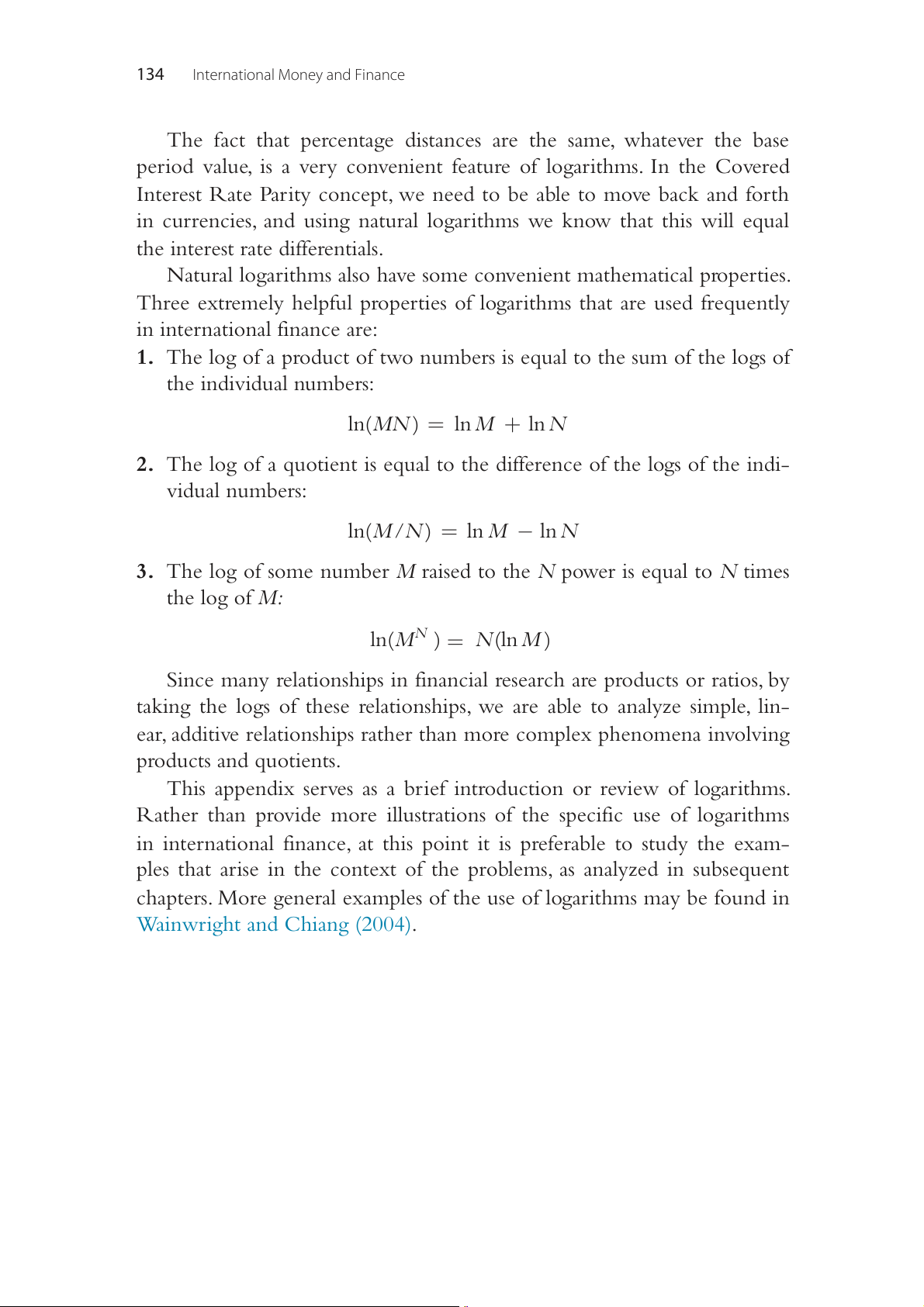
Natural logarithms also have some convenient mathematical properties.
Three extremely helpful properties of logarithms that are used frequently in international finance are:
1. The log of a product of two numbers is equal to the sum of the logs of the individual numbers:
ln(MN ) = ln M + ln N
2. The log of a quotient is equal to the difference of the logs of the indi- vidual numbers:
ln(M /N ) = ln M − ln N
3. The log of some number M raised to the N power is equal to N times the log of M: ln(MN ) N = (ln M )
Since many relationships in financial research are products or ratios, by
taking the logs of these relationships, we are able to analyze simple, lin-
ear, additive relationships rather than more complex phenomena involving products and quotients.
This appendix serves as a brief introduction or review of logarithms.
Rather than provide more illustrations of the specific use of logarithms
in international finance, at this point it is preferable to study the exam-
ples that arise in the context of the problems, as analyzed in subsequent
chapters. More general examples of the use of logarithms may be found in Wainwright and Chiang (2004).
Tài liệu liên quan:
-

Hoạt động Tài chính của Doanh nghiệp Đa Quốc Gia (DN) - Chương 6 | Tài chính quốc tế | Trường Học Viện nông nghiệp Việt Nam
19 10 -

Hệ Thống Tiền Tệ Quốc Tế: Khái Niệm và Các Chế Độ Tỷ Giá | Tài chính quốc tế | Trường Học Viện nông nghiệp Việt Nam
24 12 -

Bài giảng Chương 1: Các Quan Hệ Cân Bằng Quốc Tế và LOP | Tài chính quốc tế | Trường Học Viện nông nghiệp Việt Nam
21 11 -

Cách Tính Lạm Phát và CPI: So Sánh Việt Nam và Mỹ | Tài chính quốc tế | Trường Học Viện nông nghiệp Việt Nam
23 12 -

Detailed Report and Analysis on Submission Trends | Tài chính quốc tế | Trường Học Viện nông nghiệp Việt Nam
23 12