Extensions and Challenges to the Monetary Approach in International | Tài chính quốc tế | Trường Học Viện nông nghiệp Việt Nam
This chapter considers some of the extensions and challenges to the monetary approach of exchange rate (MAER) determination. The MAER model emphasizes financial asset markets. Rather than the traditional view of exchange rates adjusting to equilibrate international trade in goods, the exchange rate is viewed as adjusting to equilibrate international trade in financial assets. In the MAER model changes to money demand and money supply cause adjustments to goods prices and the exchange rate. Since goods prices adjust slowly relative to financial asset prices, and financial assets are traded continuously each business day, the shift in emphasis from goods markets to asset markets has important implications. Tài liệu được sưu tầm và soạn thảo dưới dạng file PDF để gửi tới các bạn cùng tham khảo, ôn tập đầy đủ kiến thức, chuẩn bị cho các buổi học thật tốt. Mời bạn đọc đón xem!
Môn: Tài chính quốc tế (hvnn) 130 tài liệu
Trường: Học viện Nông nghiệp Việt Nam 2.4 K tài liệu
Tác giả:


Preview text:
CHAPTER 15
Extensions and Challenges to the Monetary Approach Contents The Role of News 292 The PB Approach 293 The Trade Balance Approach 294 The Overshooting Approach 297
The Currency Substitution Approach 299
Recent Innovations to Open-Economy Macroeconomics 301 Summary 303 Exercises 304 Further Reading 305
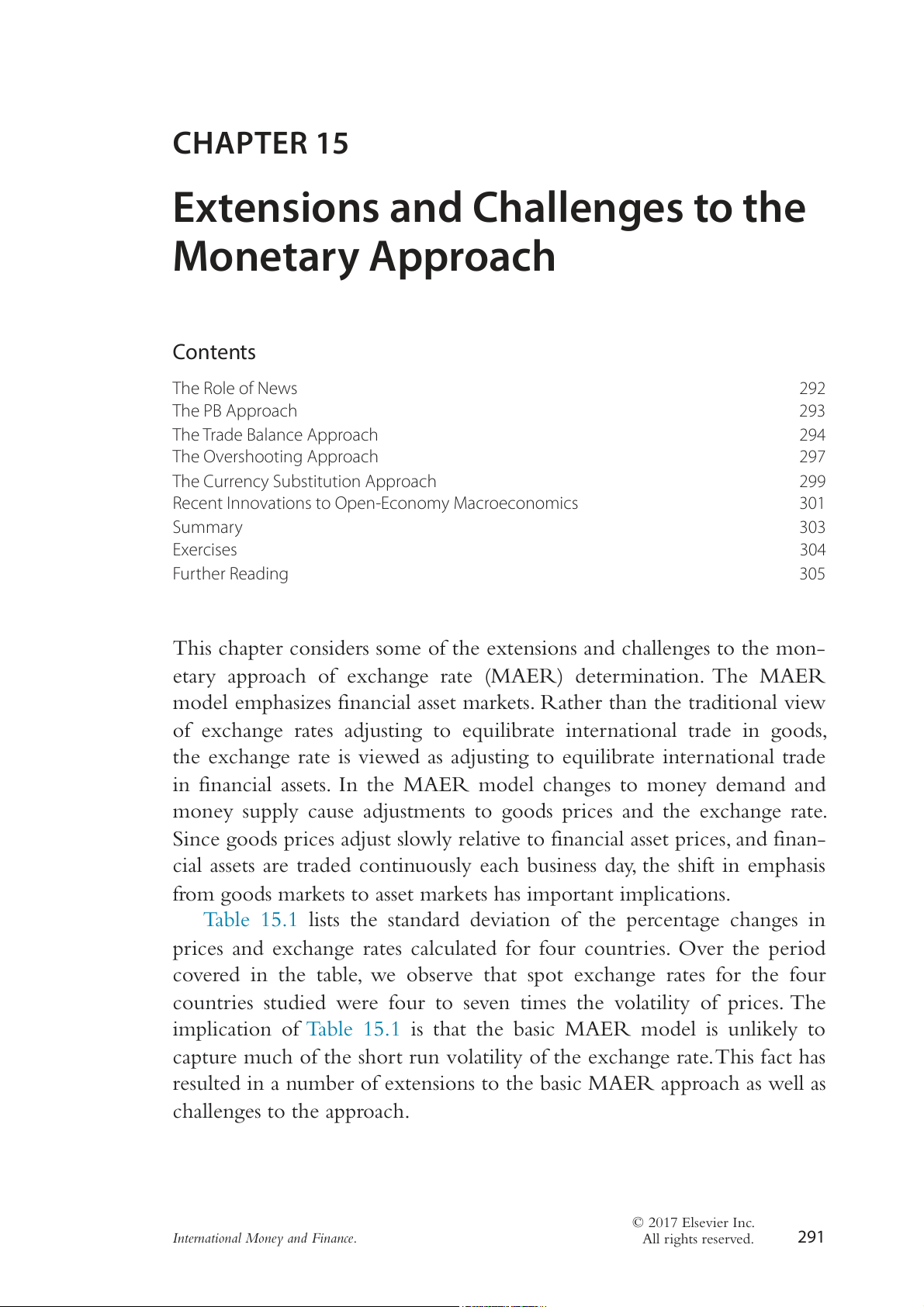
This chapter considers some of the extensions and challenges to the mon-
etary approach of exchange rate (MAER) determination. The MAER
model emphasizes financial asset markets. Rather than the traditional view
of exchange rates adjusting to equilibrate international trade in goods,
the exchange rate is viewed as adjusting to equilibrate international trade
in financial assets. In the MAER model changes to money demand and
money supply cause adjustments to goods prices and the exchange rate.
Since goods prices adjust slowly relative to financial asset prices, and finan-
cial assets are traded continuously each business day, the shift in emphasis
from goods markets to asset markets has important implications.
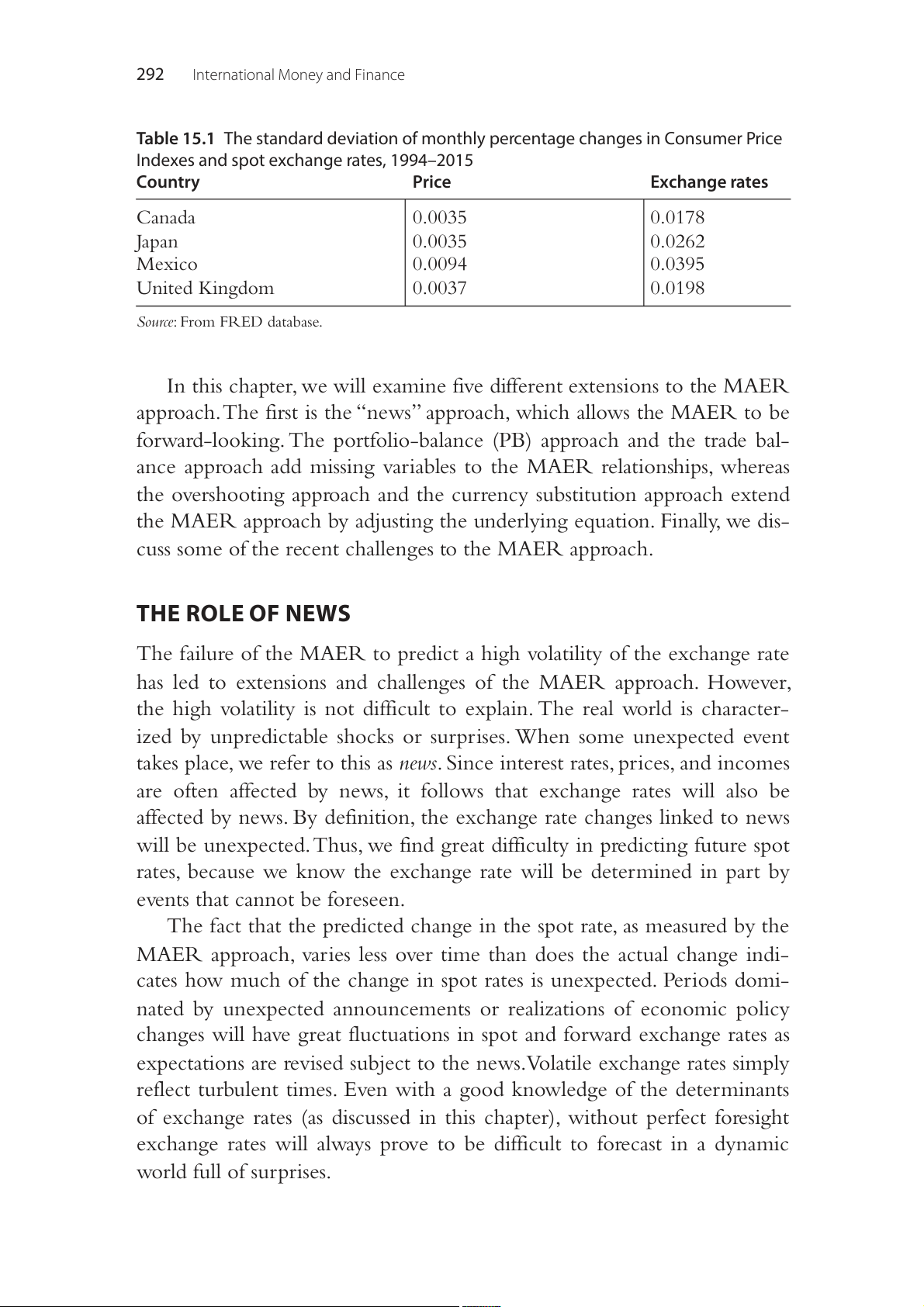
Table 15.1 lists the standard deviation of the percentage changes in
prices and exchange rates calculated for four countries. Over the period
covered in the table, we observe that spot exchange rates for the four
countries studied were four to seven times the volatility of prices. The
implication of Table 15.1 is that the basic MAER model is unlikely to
capture much of the short run volatility of the exchange rate. This fact has
resulted in a number of extensions to the basic MAER approach as well as challenges to the approach. © 201 7 Elsevier Inc.
International Money and Finance. All rights reserved. 291 292
International Money and Finance
Table 15.1 The standard deviation of monthly percentage changes in Consumer Price
Indexes and spot exchange rates, 1994–2015 Country Price Exchange rates Canada 0.0035 0.0178 Japan 0.0035 0.0262 Mexico 0.0094 0.0395 United Kingdom 0.0037 0.0198
Source: From FRED database.
In this chapter, we will examine five different extensions to the MAER
approach. The first is the “news” approach, which allows the MAER to be
forward-looking. The portfolio-balance (PB) approach and the trade bal-
ance approach add missing variables to the MAER relationships, whereas
the overshooting approach and the currency substitution approach extend
the MAER approach by adjusting the underlying equation. Finally, we dis-
cuss some of the recent challenges to the MAER approach. THE ROLE OF NEWS
The failure of the MAER to predict a high volatility of the exchange rate
has led to extensions and challenges of the MAER approach. However,
the high volatility is not difficult to explain. The real world is character-
ized by unpredictable shocks or surprises. When some unexpected event
takes place, we refer to this as news. Since interest rates, prices, and incomes
are often affected by news, it follows that exchange rates will also be
affected by news. By definition, the exchange rate changes linked to news
will be unexpected. Thus, we find great difficulty in predicting future spot
rates, because we know the exchange rate will be determined in part by
events that cannot be foreseen.
The fact that the predicted change in the spot rate, as measured by the
MAER approach, varies less over time than does the actual change indi-
cates how much of the change in spot rates is unexpected. Periods domi-
nated by unexpected announcements or realizations of economic policy
changes will have great fluctuations in spot and forward exchange rates as
expectations are revised subject to the news. Volatile exchange rates simply
reflect turbulent times. Even with a good knowledge of the determinants
of exchange rates (as discussed in this chapter), without perfect foresight
exchange rates will always prove to be difficult to forecast in a dynamic world full of surprises.
Extensions and Challenges to the Monetary Approach 293
The fact that the expected volatility of the exchange rate using the
monetary model is less than the actual volatility has led to many exten-
sions of the monetary approach. We discuss these extensions in the rest of the chapter. THE PB APPROACH
If domestic and foreign bonds are perfect substitutes, then the basic
monetary approach, presented in the last chapter, is a useful descrip-
tion of exchange rate determination. However, if domestic and foreign
bonds are not perfect substitutes then the MAER has to be modified.
The PB approach assumes that assets are imperfect substitutes interna-
tionally because investors perceive foreign exchange risk to be attached
to foreign-currency-denominated bonds. As the supply of domestic bonds
rises relative to foreign bonds, there will be an increased risk premium on
the domestic bonds that will cause the domestic currency to depreciate
in the spot market. If the spot exchange rate depreciates today, and if the
expected future spot rate is unchanged, the expected rate of appreciation over the future will increase.
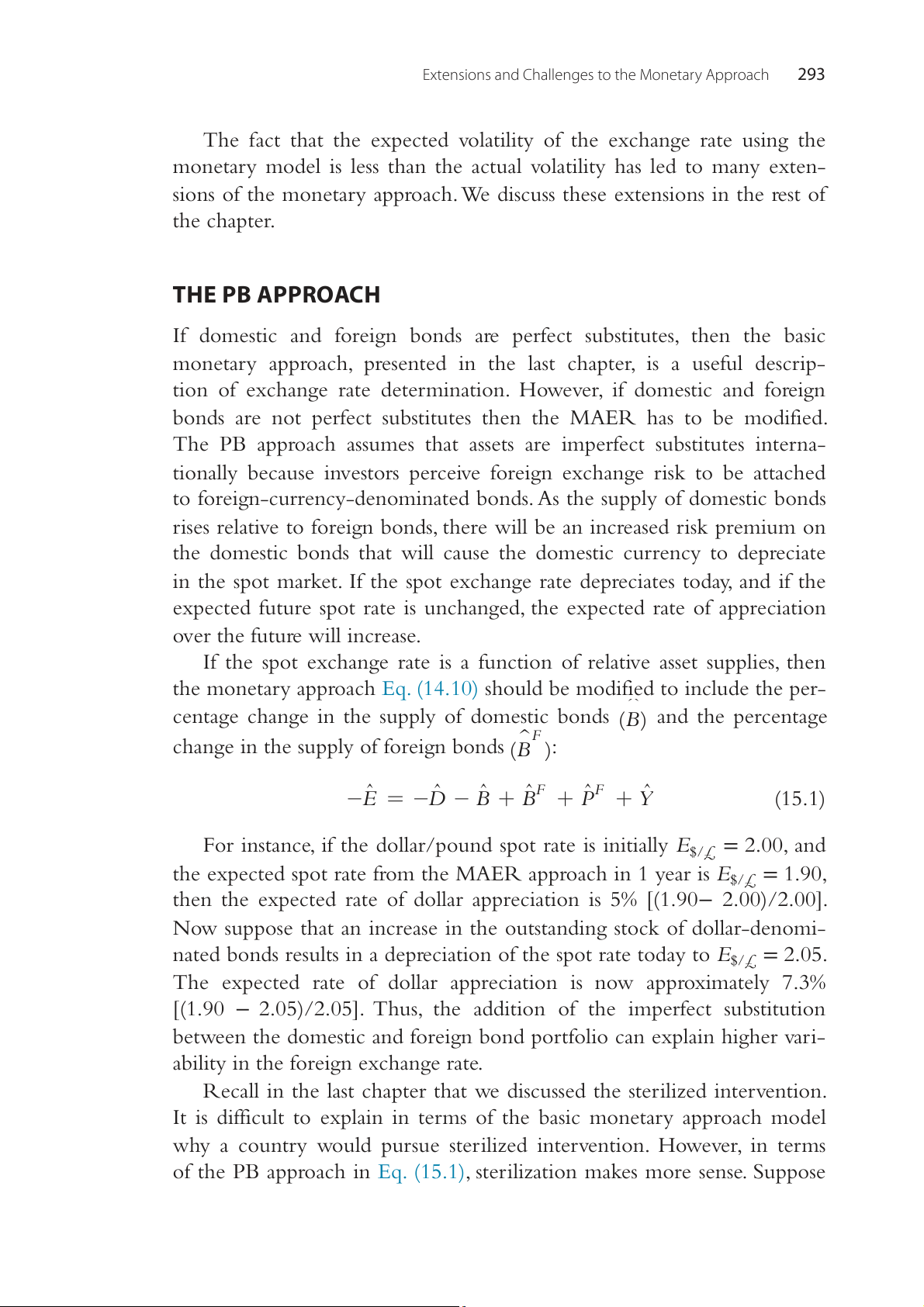
If the spot exchange rate is a function of relative asset supplies, then
the monetary approach Eq. (14.10) should be modified to include the per-
centage change in the supply of domestic bonds (B) and the percentage F
change in the supply of foreign bonds (B ): F F − ˆ E = − ˆ D − ˆ B + ˆ B + ˆ P + ˆ Y (15.1)
For instance, if the dollar/pound spot rate is initially E 2.00, and $/£ =
the expected spot rate from the MAER approach in 1 year is E$/£ = 1.90,
then the expected rate of dollar appreciation is 5% [(1.90− 2.00)/2.00].
Now suppose that an increase in the outstanding stock of dollar-denomi-
nated bonds results in a depreciation of the spot rate today to E$/£ = 2.05.
The expected rate of dollar appreciation is now approximately 7.3%
[(1.90 − 2.05)/2.05]. Thus, the addition of the imperfect substitution
between the domestic and foreign bond portfolio can explain higher vari-
ability in the foreign exchange rate.
Recall in the last chapter that we discussed the sterilized intervention.
It is difficult to explain in terms of the basic monetary approach model
why a country would pursue sterilized intervention. However, in terms
of the PB approach in Eq. (15.1), sterilization makes more sense. Suppose 294
International Money and Finance
the Japanese yen is appreciating against the dollar, and the Bank of Japan
decides to intervene in the foreign exchange market to increase the value
of the dollar and stop the yen appreciation. The Bank of Japan increases
domestic credit in order to purchase US dollar-denominated bonds. This
should cause the yen to depreciate. This effect is reinforced by the open
market sale of yen securities by the Bank of Japan. Thus, the yen can
depreciate even with a sterilized intervention.
This broader PB view might be expected to explain exchange rate
changes better than the simple MAER equation. However, the empirical
evidence is not at all clear on this matter.
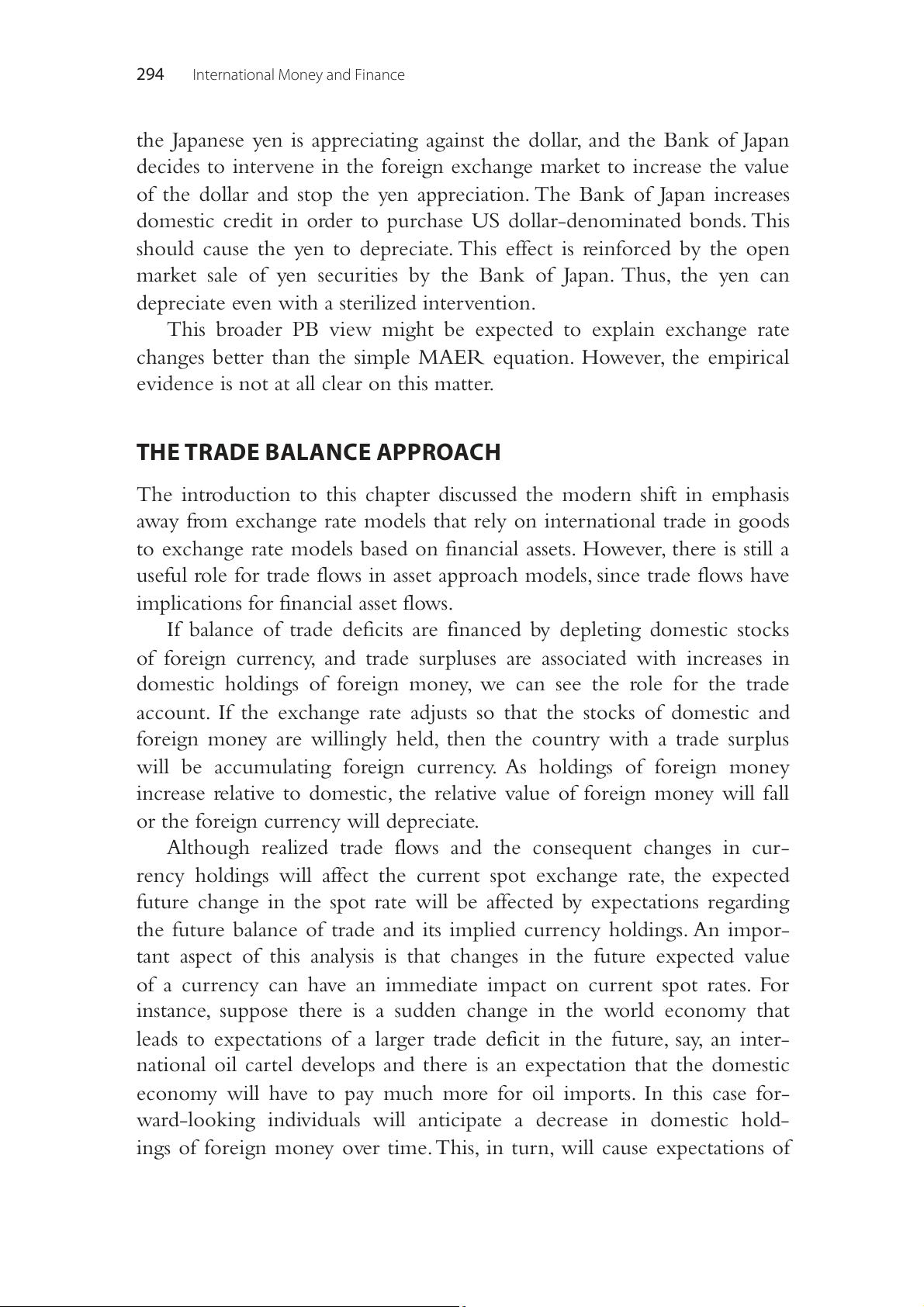
THE TRADE BALANCE APPROACH
The introduction to this chapter discussed the modern shift in emphasis
away from exchange rate models that rely on international trade in goods
to exchange rate models based on financial assets. However, there is still a
useful role for trade flows in asset approach models, since trade flows have
implications for financial asset flows.
If balance of trade deficits are financed by depleting domestic stocks
of foreign currency, and trade surpluses are associated with increases in
domestic holdings of foreign money, we can see the role for the trade
account. If the exchange rate adjusts so that the stocks of domestic and
foreign money are willingly held, then the country with a trade surplus
will be accumulating foreign currency. As holdings of foreign money
increase relative to domestic, the relative value of foreign money will fall
or the foreign currency will depreciate.
Although realized trade flows and the consequent changes in cur-
rency holdings will affect the current spot exchange rate, the expected
future change in the spot rate will be affected by expectations regarding
the future balance of trade and its implied currency holdings. An impor-
tant aspect of this analysis is that changes in the future expected value
of a currency can have an immediate impact on current spot rates. For
instance, suppose there is a sudden change in the world economy that
leads to expectations of a larger trade deficit in the future, say, an inter-
national oil cartel develops and there is an expectation that the domestic
economy will have to pay much more for oil imports. In this case for-
ward-looking individuals will anticipate a decrease in domestic hold-
ings of foreign money over time. This, in turn, will cause expectations of
Extensions and Challenges to the Monetary Approach 295
a higher rate of appreciation in the value of foreign currency, or a faster
expected depreciation of the domestic currency. This higher expected rate
of depreciation of the domestic currency leads to an immediate attempt
by individuals and firms to shift from domestic into foreign money.
Because, at this moment, the total stocks of foreign and domestic money
are constant, the attempt to exchange domestic for foreign money will
cause an immediate appreciation of the foreign currency to maintain
equilibrium, and so the existing supplies of domestic and foreign money are willingly held.
We note that current spot exchange rates are affected by changes in
expectations concerning future trade flows, as well as by current interna-
tional trade flows. As is often the case in economic phenomena, the short
run effect of some new event determining the balance of trade can dif-
fer from the long-run result. Suppose the long-run equilibrium under
floating exchange rates is balanced trade, where exports equal imports.
If we are initially in equilibrium and then experience a disturbance like
an oil cartel formation, in the short run we expect large balance of trade
deficits, but in the long run, as all prices and quantities adjust to the situ-
ation, we return to the long-run equilibrium of balanced trade. The new
long-run equilibrium exchange rate will be higher than the old rate, since,
as a result of the period of the trade deficit, foreigners will have larger
stocks of domestic currency while domestic residents hold less foreign
currency. The exchange rate need not move to the new equilibrium
immediately. In the short run during which trade deficits are experienced,
the exchange rate will tend to be below the new equilibrium rate. Thus,
as the outflow of money from the domestic economy proceeds with the
deficits, there is a steady depreciation of the domestic currency to main-
tain the short-run equilibrium where quantities of monies demanded and supplied are equal.
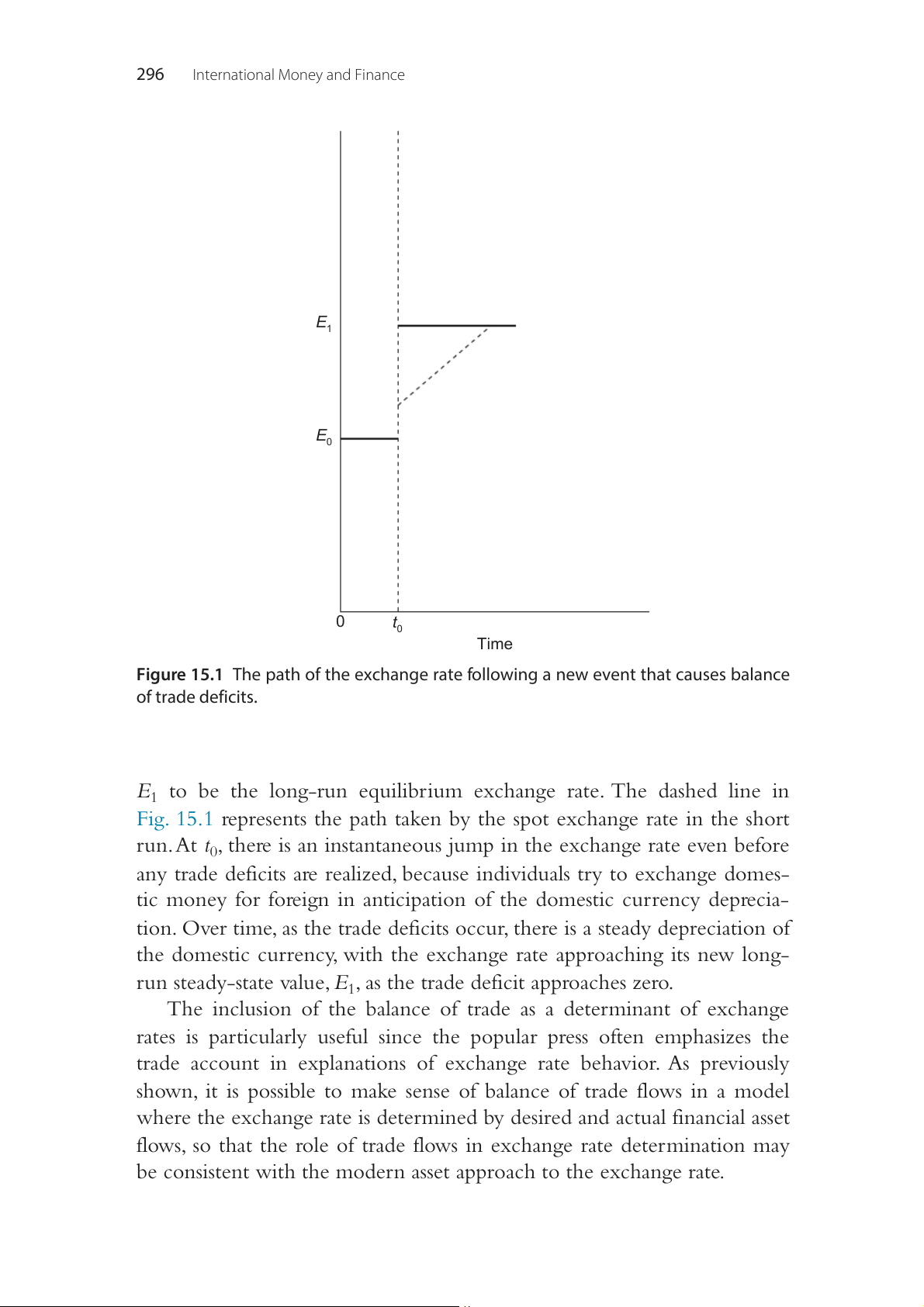
Fig. 15.1 illustrates the effects just discussed. Some unexpected event
occurs at time t that causes a balance of trade deficit. The initial exchange 0
rate is E . With the deficit, and the consequent outflow of money from 0
home to abroad, the domestic currency will depreciate. Eventually, as
prices and quantities adjust to the changes in the structure of trade, a new
long-run equilibrium is reached at E , where the trade balance is restored. 1
This move to the new long-run exchange rate, E , does not have to come 1
instantaneously, because the deficit will persist for some time. However,
the forward rate could jump to E at time as the market now expects 1 t0 296
International Money and Finance te ra E e 1 g n a xch t e o p S E0 0 t0 Time
Figure 15.1 The path of the exchange rate following a new event that causes balance of trade deficits.
E1 to be the long-run equilibrium exchange rate. The dashed line in
Fig. 15.1 represents the path taken by the spot exchange rate in the short
run. At t0, there is an instantaneous jump in the exchange rate even before
any trade deficits are realized, because individuals try to exchange domes-
tic money for foreign in anticipation of the domestic currency deprecia-
tion. Over time, as the trade deficits occur, there is a steady depreciation of
the domestic currency, with the exchange rate approaching its new long-
run steady-state value, E , as the trade deficit approaches zero. 1
The inclusion of the balance of trade as a determinant of exchange
rates is particularly useful since the popular press often emphasizes the
trade account in explanations of exchange rate behavior. As previously
shown, it is possible to make sense of balance of trade flows in a model
where the exchange rate is determined by desired and actual financial asset
flows, so that the role of trade flows in exchange rate determination may
be consistent with the modern asset approach to the exchange rate.
Extensions and Challenges to the Monetary Approach 297
THE OVERSHOOTING APPROACH
Fig. 15.1 indicates that with news regarding a higher trade deficit for the
domestic country, the spot exchange rate will jump immediately above
E0 and will then rise steadily until the new long-run equilibrium, E1,
is reached. It is possible that the exchange rate may not always move in
such an orderly fashion to the new long-run equilibrium following a disturbance.
We know that purchasing power parity does not hold well under flex-
ible exchange rates. Exchange rates exhibit much more volatile behavior
than do prices. We might expect that in the short run, following some dis-
turbance to equilibrium, prices will adjust slowly to the new equilibrium
level, whereas exchange rates and interest rates adjust quickly. Dornbusch
(1976) shows that the different speed of adjustment to equilibrium allows
for some interesting behavior regarding exchange rates and prices.
At times it appears that spot exchange rates move too much, given
some economic disturbance. Moreover, we have observed instances when
country A has a higher inflation rate than country B, yet A’s currency
appreciates relative to B’s. Such anomalies can be explained in the context
of an “overshooting” exchange rate model. We assume that financial mar-
kets adjust instantaneously to an exogenous shock, whereas goods markets
adjust slowly over time. With this setting, we analyze what happens when
country A increases its money supply.
For equilibrium in the money market, money demand must equal
money supply. Thus, if the money supply increases, something must
happen to increase money demand. We assume money demand depends
on income and the interest rate, so we can write a money demand func- tion like M d aY bi = + (15.2)
where Md is the real stock of money demanded (the nominal stock of
money divided by the price level), Y is income, and i is the interest rate.
Money demand is positively related to income, so a exceeds zero. As Y
increases, people tend to demand more of everything, including money.
Since the interest rate is the opportunity cost of holding money, there is
an inverse relationship between money demand and i, or b is negative. It
is commonly believed that in the short run following an increase in the
money supply, both income and the price level are relatively constant. As a
result, interest rates must drop to equate money demand to money supply. 298
International Money and Finance
The interest rate parity relation for countries A and B may be written as i = i + F ( − E ) E A B / (15.3)
Thus, if i falls, for a given foreign interest rate , the expected change A iB
in the currency value, (F − E)/ ,
E must be negative. However, when the
money supply in country A increases, we expect that eventually prices
there will rise, since we have more A currency chasing the limited quan-
tity of goods available for purchase. This higher future price in A will
imply a higher future exchange rate to achieve purchasing power parity: E = P P / A B
Since PA is expected to rise over time, given PB, E will also rise. This
higher expected future spot rate will be reflected in a higher forward rate
now. But if F rises, while at the same time (F E)/ –
E falls to maintain inter-
est rate parity, E will have to increase more than F. Then, once prices start
rising, real money balances fall and the domestic interest rate rises. Over
time, as the interest rate increases,
E will fall to maintain interest rate par-
ity. Therefore, the initial rise in
E will be in excess of the long-run , E or E
will overshoot its long-run value.
If the discussion seems overwhelming at this point, the reader will be
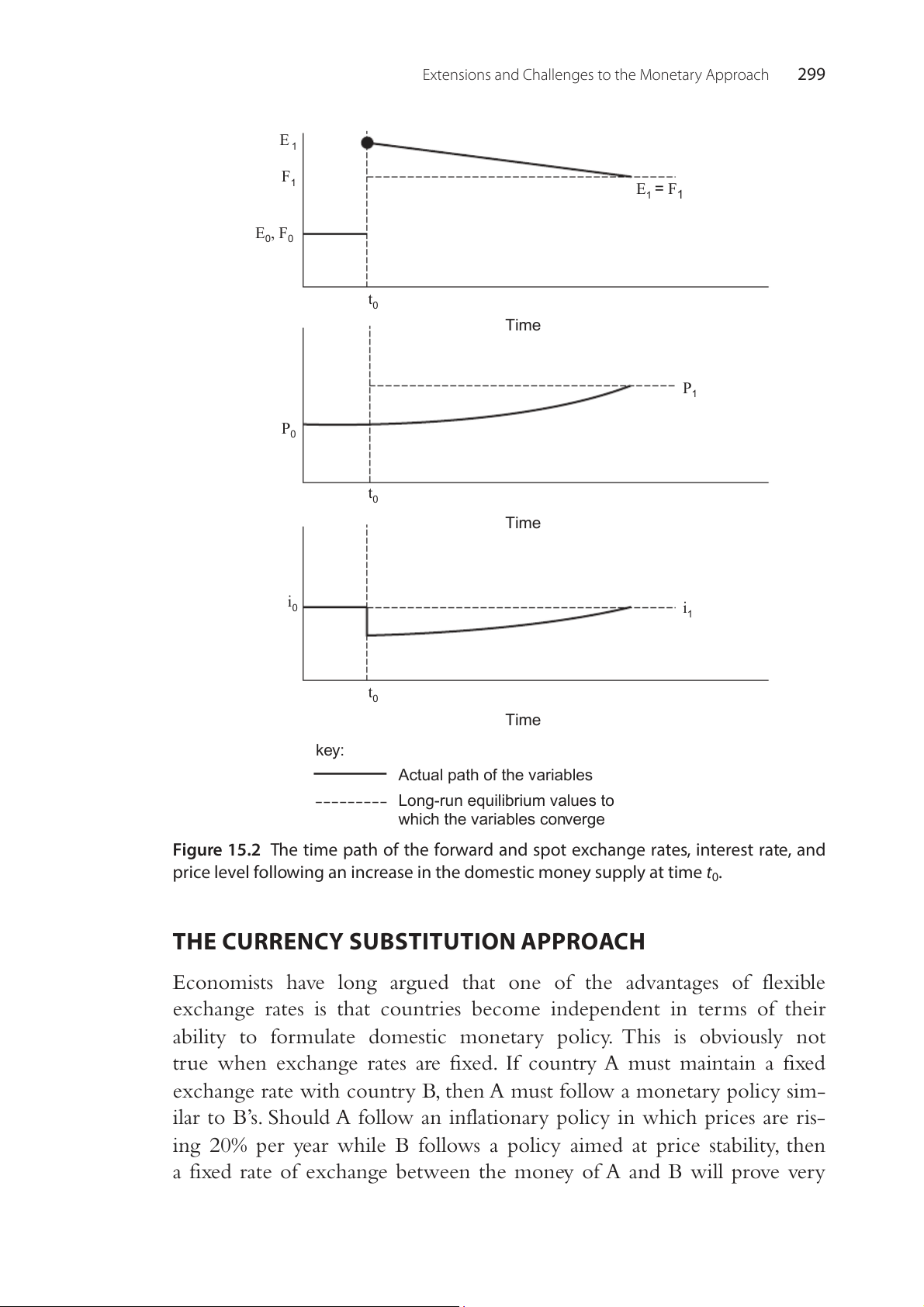
relieved to know that a concise summary can be given graphically. Fig.
15.2 summarizes the discussion thus far. The initial equilibrium is given by
E0, F0, P0, and i . When the money supply increases at time , the domes- 0 t0
tic interest rate falls, and the spot and forward exchange rates increase
while the price level remains fixed. The eventual equilibrium price and
exchange rate will rise in proportion to the increase in the money supply.
Although the forward rate will move immediately to its new equilibrium,
F1, the spot rate will increase above the eventual equilibrium, E , because 1
of the need to maintain interest parity (remember i has fallen in the short
run). Over time, as prices start rising, the interest rate increases and the
exchange rate converges to the new equilibrium, E . 1
As a result of the overshooting E, we observe a period where country
A has rising prices relative to the fixed price of country B, yet A’s currency
appreciates along the solid line converging to E1. We might explain this
period as one in which prices increase, lowering real money balances and
raising interest rates. Country A experiences capital inflows in response to
the higher interest rates, so that A’s currency appreciates steadily at the same
rate as the interest rate increase in order to maintain interest rate parity.
Extensions and Challenges to the Monetary Approach 299 E 1 te F ra 1 e E = F 1 1 g n a E , F xch 0 0 E t0 Time l ve P le 1 rice P P 0 t0 Time te ra st i0 i re 1 te In t0 Time key: Actual path of the variables
Long-run equilibrium values to which the variables converge
Figure 15.2 The time path of the forward and spot exchange rates, interest rate, and
price level following an increase in the domestic money supply at time t0.
THE CURRENCY SUBSTITUTION APPROACH
Economists have long argued that one of the advantages of flexible
exchange rates is that countries become independent in terms of their
ability to formulate domestic monetary policy. This is obviously not
true when exchange rates are fixed. If country A must maintain a fixed
exchange rate with country B, then A must follow a monetary policy sim-
ilar to B’s. Should A follow an inflationary policy in which prices are ris-
ing 20% per year while B follows a policy aimed at price stability, then
a fixed rate of exchange between the money of A and B will prove very 300
International Money and Finance
difficult to maintain. Yet with flexible exchange rates, A and B can each
choose any monetary policy they like, and the exchange rate will simply
change over time to adjust for the inflation differentials.
This independence of domestic policy under flexible exchange rates
may be reduced if there is an international demand for monies. Suppose
country B residents desire to hold currency A to use for future transac-
tions or simply to hold as part of their investment portfolio. As demand
for money shifts between currencies A and B, the exchange rate will shift
as well. In a region with substitutable currencies, shifts in money demand
between currencies will add an additional element of exchange rate variability.
With fixed exchange rates, central banks make currencies perfect sub-
stitutes on the supply side. They alter the supplies of currency to main-
tain the exchange rate peg. The issue of currency substitution deals with
the substitutability among currencies on the demand side of the market. If
currencies were perfect substitutes to money demanders, then all curren-
cies would have to have the same inflation rates, or demand for the high-
inflation currency would fall to zero (since the inflation rate determines
the loss of purchasing power of a money). Perfectly substitutable monies
indicate that demanders are indifferent between the use of one currency
and another. If the cost of holding currency A rises relative to the cost
of holding B, say because of a higher inflation rate for currency A, then
demand will shift away from A to B, when A and B are substitutes. This
would cause the A currency to depreciate even more than was initially
called for by the inflation differential between A and B.
For instance, suppose Canada has a 10% annual inflation rate while
the United States has a 5% rate. With no currency substitution, we would
expect the US dollar to appreciate against the Canadian dollar on pur-
chasing power parity grounds. Now suppose that Canadian citizens hold
stocks of US dollar currency, and these US dollars are good substitutes
for Canadian dollars. The higher inflation rate on the Canadian dollar
means that stocks of Canadian dollars held will lose value more rapidly
than US dollars, so there is an increased demand for US dollar currency.
This attempt to exchange Canadian dollar currency for US dollars results
in a further depreciation of the Canadian dollar. Such shifts in demand
between currencies can result in volatile exchange rates and can be very
unsettling to central banks desiring exchange rate stability.
Although central banks may attempt to follow independent monetary
policies, they will not be able to do so with high currency substitution.
Extensions and Challenges to the Monetary Approach 301
Money demanders will adjust their portfolio holdings away from high-
inflation currencies to low-inflation currencies. This currency substitution
leads to more volatile exchange rates, since not only does the exchange
rate adjust to compensate for the original inflation differential, but it also
adjusts as currency portfolios are altered. Therefore, one implication of a
high degree of currency substitution is a need for international coordi-
nation of monetary policy. If money demanders substitute between cur-
rencies to force each currency to follow a similar inflation rate, then the
supposed independence of monetary policy under flexible exchange rates is largely illusory.
We should expect currency substitution to be most important in
a regional setting where there is a relatively high degree of mobility of
resources between countries. For instance, the use of the euro by coun-
tries in Western Europe may be evidence of a high degree of currency
substitution that once existed among the former European currencies.
Alternatively, there is evidence of a high degree of currency substitu-
tion existing between the US dollar and Latin American currencies. In
many Latin American countries, dollars serve as an important substitute
currency, both as a store of value (the dollar being more stable than the
typical Latin American currency) and as a medium of exchange used for
transactions. This latter effect is particularly pronounced in border areas.
Aside from regional settings, it is not clear that currency substitution
should be a potentially important source of exchange rate variability. At
this point it is probably safe to treat currency substitution as a potentially
important source of exchange rate variability, but one that may not be rel- evant to all country pairs.
RECENT INNOVATIONS TO OPEN-ECONOMY MACROECONOMICS
The recent advances in open-economy macroeconomics come in two
general types. The first assumes that the economy responds quickly so that
an equilibrium is reached quickly, whereas the other type of models have
some short-run restriction to prevent an equilibrium in the short run.
The so-called equilibrium approach to exchange rates assumes that
prices, interest rates, and exchange rates are always at their market clear-
ing equilibrium levels. In this approach, changes in exchange rates occur
because of changes in tastes or technology and are part of the adjustment
to a shock to the world economy. For instance, suppose an improvement 302
International Money and Finance
in technology in Switzerland increases Swiss output, and at the higher
level of productivity the price of Swiss goods relative to other countries’
goods falls through a depreciation of the franc. The lower relative price of
Swiss output is associated with rising Swiss exports. In this scenario, the
franc did not depreciate in order to make Swiss goods more competitive
on world markets; instead it depreciated because the higher level of Swiss
productivity made the relative price of Swiss goods fall.
According to the equilibrium approach, changes in exchange rates are
caused by changes in tastes or technology, so the franc depreciation did
not cause the increase in Swiss exports and output but instead was a result
of these changes. Similarly, if tastes had changed so that Swiss goods were
now more favored by consumers, this would increase the relative price
of Swiss goods and would be associated with a franc appreciation. In this
view of the world, exchange rate changes can never be viewed as good or
bad—they simply occur in response to some other event and are part of
the adjustment to a new equilibrium.
Another recent approach to explaining exchange rates assumes that in
the long run the equilibrium approach is reached, but in the short run
restrictions to price movements result in temporary disequilibria that
result in large exchange rate variability. Essentially these models combine
elements of the IS-LM-BP framework from Chapter 13, The IS-LM-BP
Approach with the monetary approach. While these new models are too
complex to be covered in detail here, we should realize where economic
thought is moving and the implications of this new thinking. The New
International Macroeconomics carefully considers the details of the economy
to the level of individual firms and households and how their actions
aggregate to macroeconomic phenomena.
The IS-LM-BP model focused on one country and abstracted from
the rest of the world, which is in the background. The New International
Macroeconomics typically examines two countries (you might think of
one as the rest of the world) and the determination of key macroeco-
nomic variables like incomes, prices, and the exchange rate. The pre-
dictions of this type of model would include the following effects of a
surprising increase in the domestic money supply: consumer spending
increases at home and abroad; domestic income increases by more than
foreign income; the domestic currency depreciates and purchasing power
parity is maintained continuously.
The IS-LM-BP model was developed holding the price level con-
stant. In many New International Macroeconomic models the price level
Extensions and Challenges to the Monetary Approach 303
is held fixed for a short run and then allowed to change in the long run
as in the monetary approach. So the short-run fixed price is like the old
model, but the long run allows for a dynamic adjustment of prices over
time that is missing from the static models of the IS-LM-BP type. In
many New International Macroeconomic models, if prices were perfectly
flexible, then money supply shocks would have no effects on real vari-
ables like income or consumption due to the assumption of purchasing
power parity. In this case, prices would change in proportion to changes
in the money supply and the exchange rate would change to leave rela-
tive prices at home and abroad unchanged (the “law of one price”) so that
there is no inducement for changes in consumption or production. So the
assumption of “sticky prices” is important to generate changes in spending and output.
Since there is much evidence against the law of one price, some
research has focused on a modified version of a New International
Macroeconomic model that allows for pricing to market. This occurs when
local currency pricing reflects local market conditions in each country and
allows for price discrimination across countries. In this case, purchasing
power parity does not hold and so changes in the money supply of one
country may result in bigger exchange rate changes due to the relative
lack of responsiveness of price levels across countries. This is an important
change since we observe real-world exchange rates having much greater
volatility than relative prices across countries. SUMMARY
1. The monetary approach to the exchange rate does not predict the
high volatility of exchange rates.
2. Five approaches trying to explain excessive exchange rate variation
are: (i) the news approach, (ii) the PB approach, (iii) the trade balance
approach, (iv) the overshooting approach, and (v) the currency substi- tution approach.
3. The volatility of exchange rate is affected by news—unforeseeable
events or shocks. News about future policies immediately affects the exchange rate.
4. The PB approach extends the MAER by including the relative
supply of domestic bonds to foreign bonds into the analysis of the
exchange rate determination. The domestic and foreign assets are
imperfect substitutes (there is a risk premium to holding foreign assets). 304
International Money and Finance
The changes in the demand and supply of domestic and foreign bond
markets will lead to exchange rate movements.
5. Sterilized intervention that leaves money supply unchanged can affect
exchange rates through PB channel of shifting relative bond supplies.
6. In the trade balance approach, the future expected value of a cur-
rency can have an immediate impact on current spot rates. Any
news that changes the expectations about the future directions of
the balance of trade will affect the expected value of the future spot
exchange rates and hence will affect the current spot rates.
7. The overshooting approach assumes the perfect capital mobility such
that financial markets adjust immediately, but the good market adjusts
slowly to shocks. As a result, when the money supply increases, the
domestic currency depreciates more than the necessary long-run
level because of the overreaction from financial markets in the short
run. As time passes, the goods prices will rise in proportion to the
increase in money supply. The exchange rate will return to its long- run level.
8. The independence of domestic monetary policy under flexible
exchange rates may be reduced if there is currency substitution.
9. If people are willing to substitute between the domestic currency
and other currencies, then demand for the domestic currency might
be affected by money supply changes. As a result, substitutability
between currencies constrains monetary policy action and increases exchange rate volatility.
10. Currency substitution is important in a regional setting and it may
require international coordination of monetary policy.
11. The recent trends in the open economy macroeconomics focus on
two modeling types: (i) the general equilibrium approach—prices,
interest rates, and exchange rates adjust instantaneously to restore an
equilibrium; and (ii) the IS-LM-BP framework—which describes the
sluggishness of adjustments toward the equilibrium in the short run
causing temporary disequilibrium and exchange rate variability. EXERCISES
1. In each of the five approaches, list the underlying assumptions (e.g.,
what is assumed in terms of speed of adjustment in goods markets
and financial markets, expectations, asset substitutability, and currency substitutability).
Extensions and Challenges to the Monetary Approach 305
2. Suppose that a central bank buys bonds on the open market and uses
money to pay for them, thereby increasing the supply of money and
decreasing the supply of bonds. Use the PB approach to explain what
would happen to (i) domestic interest rate, (ii) demand for foreign
bonds, (iii) foreign interest rate, and (iv) the spot exchange rate.
3. Explain why a high currency substitution would cause the US dollar
exchange rate to depreciate more than the expected level when the
Fed increases money supply in the United States.
4. Suppose that the Fed unexpectedly decreases the money supply in
the United States. Use the overshooting approach to explain how the
spot exchange rate, forward rate, domestic interest rate, and the domes-
tic price level would change in response to the policy change. Draw
graphs to illustrate the time paths of the adjustments.
5. Assume that a country increases its domestic money supply. If the
“overshooting” theory is correct, how could a central bank prevent the
exchange rate from depreciating too much in the short run?
6. Suppose the United States discovers a new technology that will
improve its exports. Therefore, there are rumors that this technology
will bring the US trade balance from trade deficits to expected long-
term surpluses. What would happen to the exchange rate value of the
US dollar from this news? Do you anticipate any difference in the dol-
lar values between short run and long run? FURTHER READING
Aivazian, V.A., Callen, J.L., Krinsky, I., Kwan, C.C.Y., 1986. International exchange risk and
asset substitutability. J. Int. Money Financ. December.
Baillie, R.T., Osterberg, W.P., 1997. Why do central banks intervene? J. Int. Money Financ. December.
Chari, V., Kehoe, P.J., McGrattan, E.R., 2002. Can sticky price models generate volatile and
persistent exchange rates? Rev. Econ. Stud. 69 (3), 533–563.
Dominguez, K., 1998. Central bank intervention and exchange rate volatility. J. Int. Money Financ. February.
Dornbusch, R., 1976. Expectations and exchange rate dynamics. J. Pol. Econ. 84 (6), 1161–1176.
Ize, A., Yeyati, E.L., 2003. Financial dollarization. J. Int. Econ. 59, 323–347.
Lane, P.R., 2001. The new open economy macroeconomics: a survey J. Int. Econ. August.
Levin, J.H., 1986. Trade flow lags, monetary and fiscal policy, and exchange rate overshoot-
ing. J. Int. Money Financ. December.
Moura, G., 2011. Testing the equilibrium exchange rate model. Appl. Math. Sci. 5 (20), 981–993.
Sarno, L., Taylor, M.P., 2002. New Developments in Exchange Rate Economics. Elgar, Cheltenham. 306
International Money and Finance
Solow, R.M., Touffut, J. (Eds.), 2012. What’s Right with Macroeconomics? Elgar, Cheltenham.
Steinsson, J., 2008. The dynamic behavior of the real exchange rate in sticky price models.
Am. Econ. Rev. 98 (1), 519–533.
Stockman, A.C., 1987. The equilibrium approach to exchange rates. Fed. Reserve. Bank of Richmond Econ. Rev. April.
Taylor, M., 1995. The economics of exchange rates J. Econ. Lit. March.
Tài liệu liên quan:
-

Hoạt động Tài chính của Doanh nghiệp Đa Quốc Gia (DN) - Chương 6 | Tài chính quốc tế | Trường Học Viện nông nghiệp Việt Nam
19 10 -

Hệ Thống Tiền Tệ Quốc Tế: Khái Niệm và Các Chế Độ Tỷ Giá | Tài chính quốc tế | Trường Học Viện nông nghiệp Việt Nam
24 12 -

Bài giảng Chương 1: Các Quan Hệ Cân Bằng Quốc Tế và LOP | Tài chính quốc tế | Trường Học Viện nông nghiệp Việt Nam
21 11 -

Cách Tính Lạm Phát và CPI: So Sánh Việt Nam và Mỹ | Tài chính quốc tế | Trường Học Viện nông nghiệp Việt Nam
23 12 -

Detailed Report and Analysis on Submission Trends | Tài chính quốc tế | Trường Học Viện nông nghiệp Việt Nam
23 12