Financial Management of the Multinational Firm (2017) | Tài chính quốc tế | Trường Học Viện nông nghiệp Việt Nam
Any business firm must evaluate its operations periodically to better allocate resources and increase income.The financial management of a multinational firm involves exercising control over foreign operations. The responsible individuals at the parent office or headquarters review financial reports from foreign subsidiaries with a view toward modifying operations and assessing the performance of foreign managers. Tài liệu được sưu tầm và soạn thảo dưới dạng file PDF để gửi tới các bạn cùng tham khảo, ôn tập đầy đủ kiến thức, chuẩn bị cho các buổi học thật tốt. Mời bạn đọc đón xem!
Môn: Tài chính quốc tế (hvnn) 130 tài liệu
Trường: Học viện Nông nghiệp Việt Nam 2.4 K tài liệu
Tác giả:


Preview text:
CHAPTER 9 Financial Management of the Multinational Firm Contents Financial Control 173 Cash Management 175 Letters of Credit 178 An Example of Trade Financing 180 Intrafirm Transfers 182 Capital Budgeting 184 Summary 187 Exercises 188 Further Reading 188 Appendix A Present Value 189
Since multinational firms are involved in payables and receivables denom-
inated in different currencies, product shipments across national borders,
and subsidiaries operating in different political jurisdictions, they face
a different set of problems than firms with a purely domestic operation.
The corporate treasurer and other financial decision makers of the multi-
national firms operate in a cosmopolitan setting that offers profit and loss
opportunities never considered by the executives of purely domestic firms.
This chapter looks at the unique attributes of financial management in
the multinational firm. The basic issues—control, cash management, trade
credit, intrafirm transfers, and capital budgeting—face all firms. The prob-
lems particular to the internationally oriented firm are the ones addressed. FINANCIAL CONTROL
Any business firm must evaluate its operations periodically to better allo-
cate resources and increase income. The financial management of a mul-
tinational firm involves exercising control over foreign operations. The
responsible individuals at the parent office or headquarters review financial
reports from foreign subsidiaries with a view toward modifying operations
and assessing the performance of foreign managers. Copyright © 201 7 Elsevier Inc.
International Money and Finance. All rights reserved. 173 174
International Money and Finance
Typical control systems are based on setting standards with regard to
sales, profits, inventory, or other specific variables and then examining
financial statements and reports to evaluate the achievement of such goals.
There is no “correct” system of control. Methods vary across industries
and even across firms in a single industry. All methods have the common
goal of providing management with a means of monitoring the perfor-
mance of the firm’s operations, new strategies, and goals as conditions
change. However, establishing a useful control system is more difficult for
a multinational firm than for a purely domestic firm. For instance, should
foreign subsidiary profits be measured and evaluated in foreign currency
or in the domestic currency of the parent firm? The answer to this ques-
tion depends on whether foreign managers are to be held responsible for
currency translation gains or losses.
If top management wants foreign managers to be involved in currency
management and international financing issues, then the domestic cur-
rency of the parent would be a reasonable choice. On the other hand, if
top management wants foreign managers to concern themselves with pro-
duction operations and behave as other managers in companies in the for-
eign country would, then the foreign currency would be the appropriate currency for evaluation.
Some multinational firms prefer a decentralized management struc-
ture in which each subsidiary has a great deal of autonomy and makes
most financing and production decisions subject only to general parent
company guidelines. In this management setting, the foreign manager may
be expected to operate and think as the stockholders of the parent firm
would want, so the foreign manager makes decisions aimed at increasing
the parent’s domestic currency value of the subsidiary. The control mecha-
nism in such firms is to evaluate foreign managers based on their ability to increase that value.
Other firms prefer more centralized management in which financial
managers at the parent make most of the decisions. They choose to move
funds among divisions based on a system-wide view rather than what is
best for a single subsidiary. A highly centralized system would have foreign
managers evaluated on their ability to meet goals established by the parent
for key variables like sales or labor costs. The parent-firm managers assume
responsibility for maximizing the value of the firm, with foreign manag-
ers basically responding to directives from the top. We then see that the
appropriate control system is largely determined by the management style of the parent.
Financial Management of the Multinational Firm 175
Considering the discussion to this point, it is clear that managers at
foreign subsidiaries should be evaluated only on the basis of things they
control. Foreign managers often may be asked by the parent to follow
policies and relations with other subsidiaries of the firm that the man-
agers would never follow if they sought solely to maximize their subsid-
iary’s profit. Actions of the parent that lower a subsidiary’s profit should
not result in a negative view of the foreign manager. In addition, other
actions beyond the foreign manager’s control—changing tax laws, foreign
exchange controls, or inflation rates—could result in reducing foreign
profits through no fault of the foreign manager. The message to par-
ent company managers is to place blame fairly where the blame lies. In
a dynamic world, corporate fortunes may rise and fall because of events
entirely beyond any manager’s control. CASH MANAGEMENT
Cash management involves using the firm’s cash as efficiently as possible.
Given the daily uncertainties of business, firms must maintain some liquid
resources. Liquid assets are those that are readily spent. Cash is the most liquid
asset. But since cash (and the traditional checking account) earns no interest,
the firm has a strong incentive to minimize its holdings of cash. There are
highly liquid short-term securities that serve as good substitutes for actual
cash balances and yet pay interest. The corporate treasurer is concerned with
maintaining the correct level of liquidity at the minimum possible cost.
The multinational treasurer faces the challenge of managing liquid
assets denominated in different currencies. The challenge is compounded
by the fact that subsidiaries operate in foreign countries where financial
market regulations and institutions differ.
When a subsidiary receives a payment and the funds are not needed
immediately by this subsidiary, the managers at the parent headquar-
ters must decide what to do with the funds. For instance, suppose a US
multinational’s Mexican subsidiary receives 500 million pesos. Should the
pesos be converted to dollars and invested in the United States, or placed
in Mexican peso investments, or converted into any other currency in the
world? The answer depends on the current needs of the firm as well as the
current regulations in Mexico. If Mexico has strict foreign exchange con-
trols in place, the 500 million pesos will have to be kept in Mexico and
invested there until a future time when the Mexican subsidiary will need them to make a payment. 176
International Money and Finance
Even without legal restrictions on foreign exchange movements, we
might invest the pesos in Mexico for 30 days if the subsidiary faces a large
payment in 30 days. This assumes that there is no need for the funds in
another area of the firm, and that the return on the Mexican investment is
comparable to what we could earn in another country on a similar invest-
ment (which interest rate parity would suggest). By leaving the funds
in pesos, we do not incur any transaction costs for converting pesos to
another currency now and then going back to pesos in 30 days. In any
case, we would never let the funds sit idly in the bank for 30 days.
There are times when the political or economic situation in a country
is so unstable that we keep only the minimum possible level of assets in
that country. Even when we will need pesos in 30 days for the Mexican
subsidiary’s payable, if there exists a significant threat that the government
could confiscate or freeze bank deposits or other financial assets, we would
incur the transaction costs of currency conversion to avoid the political
risk associated with leaving the money in Mexico.
Multinational cash management involves centralized management.
Subsidiaries and liquid assets may be spread around the world, but they are
managed from the home office of the parent firm. Through such central-
ized coordination, the overall cash needs of the firm are lower. This occurs
because all subsidiaries do not have the same pattern of cash flows. For
instance, one subsidiary may receive a dollar payment and finds itself with
surplus cash, while another subsidiary faces a dollar payment and must
obtain dollars. If each subsidiary operated independently, there would be
more cash held in the family of multinational foreign units than if the par-
ent headquarters directed the surplus funds of one subsidiary to the sub- sidiary facing the payable.
Centralization of cash management allows the parent to offset subsid-
iary payables and receivables in a process called netting. Netting involves
the consolidation of payables and receivables for one currency so that only
the difference between them must be bought or sold. For example, sup-
pose Oklahoma Instruments in the United States sells C$2 million worth
of car phones to its Canadian sales subsidiary and buys C$3 million worth
of computer frames from its Canadian manufacturing subsidiary. If the
payable and receivable both are due on the same day, then the C$2 mil-
lion receivable can be used to fund the C$3 million payable, and only C$1
million must be bought in the foreign exchange market. Rather than buy
C$3 million to settle the payable and sell the C$2 million to convert the
receivable into dollars, incurring transaction costs twice on the full C$5
million, the firm has one foreign exchange transaction for C$1 million.
Financial Management of the Multinational Firm 177
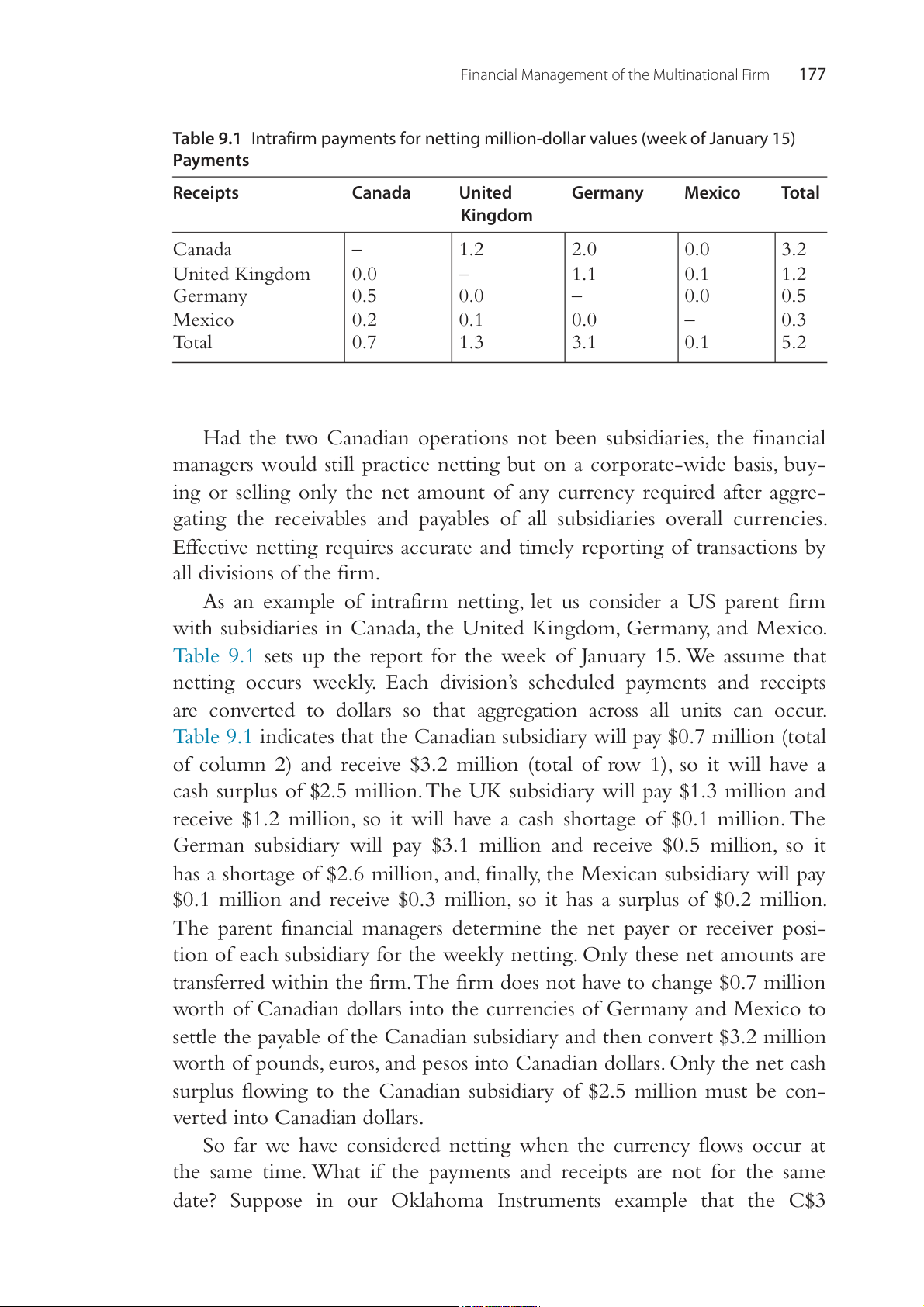
Table 9.1 Intrafirm payments for netting million-dollar values (week of January 15) Payments Receipts Canada United Germany Mexico Total Kingdom Canada – 1.2 2.0 0.0 3.2 United Kingdom 0.0 – 1.1 0.1 1.2 Germany 0.5 0.0 – 0.0 0.5 Mexico 0.2 0.1 0.0 – 0.3 Total 0.7 1.3 3.1 0.1 5.2
Had the two Canadian operations not been subsidiaries, the financial
managers would still practice netting but on a corporate-wide basis, buy-
ing or selling only the net amount of any currency required after aggre-
gating the receivables and payables of all subsidiaries overall currencies.
Effective netting requires accurate and timely reporting of transactions by all divisions of the firm.
As an example of intrafirm netting, let us consider a US parent firm
with subsidiaries in Canada, the United Kingdom, Germany, and Mexico.
Table 9.1 sets up the report for the week of January 15. We assume that
netting occurs weekly. Each division’s scheduled payments and receipts
are converted to dollars so that aggregation across all units can occur.
Table 9.1 indicates that the Canadian subsidiary will pay $0.7 million (total
of column 2) and receive $3.2 million (total of row 1), so it will have a
cash surplus of $2.5 million. The UK subsidiary will pay $1.3 million and
receive $1.2 million, so it will have a cash shortage of $0.1 million. The
German subsidiary will pay $3.1 million and receive $0.5 million, so it
has a shortage of $2.6 million, and, finally, the Mexican subsidiary will pay
$0.1 million and receive $0.3 million, so it has a surplus of $0.2 million.
The parent financial managers determine the net payer or receiver posi-
tion of each subsidiary for the weekly netting. Only these net amounts are
transferred within the firm. The firm does not have to change $0.7 million
worth of Canadian dollars into the currencies of Germany and Mexico to
settle the payable of the Canadian subsidiary and then convert $3.2 million
worth of pounds, euros, and pesos into Canadian dollars. Only the net cash
surplus flowing to the Canadian subsidiary of $2.5 million must be con- verted into Canadian dollars.
So far we have considered netting when the currency flows occur at
the same time. What if the payments and receipts are not for the same
date? Suppose in our Oklahoma Instruments example that the C$3 178
International Money and Finance
million payable is due on October 1, and the C$2 million receivable is due
September 1. Netting could still occur by leading or lagging currency flows.
The sales subsidiary could lag its C$2 million payment by 1 month, or the
C$3 million could lead 1 month and be paid on September 1. Leads and
lags increase the flexibility of parent financial managers, but require excel-
lent information flows between all divisions and headquarters. LETTERS OF CREDIT
Once a company decides to export a good, they want to make sure that a
payment will be made by the importer of the good. Because it is difficult
to enforce contracts across countries, an intermediary is often necessary to
enforce the contract. A letter of credit (LOC) is a written instrument issued
by a bank at the request of an importer that obligates the bank to pay a
specific amount of money to an exporter. The time at which payment is
due is specified, along with conditions regarding necessary documents to be
presented by the exporter prior to payment. The LOC may stipulate that a
bill of lading be presented that evidences no damaged goods. A bill of lading
is a detailed list of the content that is shipped, and can be used to identify
missing or damaged items. Perhaps some minimal level of damage (like 2%
of the boxes or crates) is stipulated. In any case such conditions in an LOC
allow the importer to retain some quality control prior to payment.
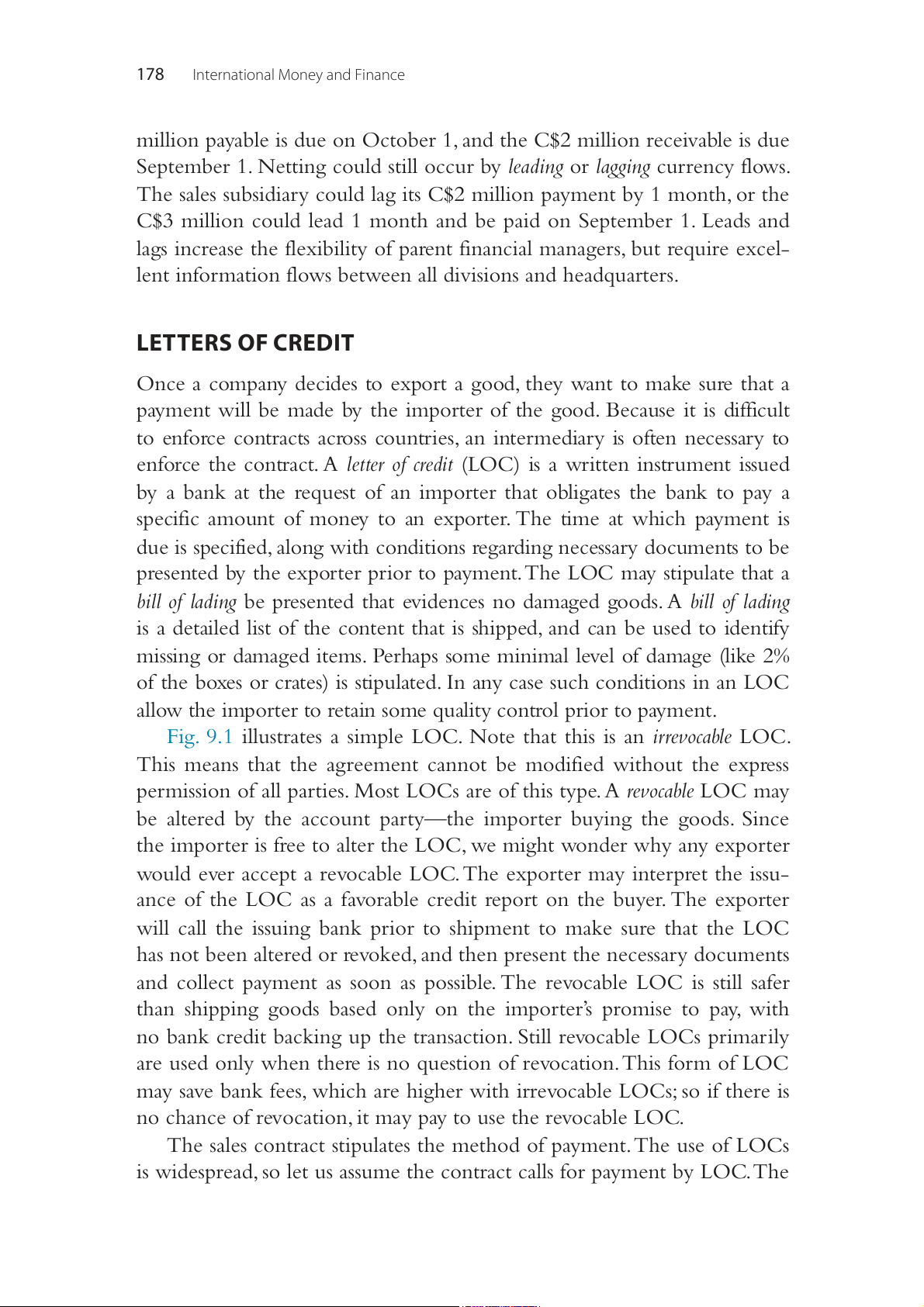
Fig. 9.1 illustrates a simple LOC. Note that this is an irrevocable LOC.
This means that the agreement cannot be modified without the express
permission of all parties. Most LOCs are of this type. A revocable LOC may
be altered by the account party—the importer buying the goods. Since
the importer is free to alter the LOC, we might wonder why any exporter
would ever accept a revocable LOC. The exporter may interpret the issu-
ance of the LOC as a favorable credit report on the buyer. The exporter
will call the issuing bank prior to shipment to make sure that the LOC
has not been altered or revoked, and then present the necessary documents
and collect payment as soon as possible. The revocable LOC is still safer
than shipping goods based only on the importer’s promise to pay, with
no bank credit backing up the transaction. Still revocable LOCs primarily
are used only when there is no question of revocation. This form of LOC
may save bank fees, which are higher with irrevocable LOCs; so if there is
no chance of revocation, it may pay to use the revocable LOC.
The sales contract stipulates the method of payment. The use of LOCs
is widespread, so let us assume the contract calls for payment by LOC. The
Financial Management of the Multinational Firm 179
[Bank letterhead (Name & Address of Importer’s Bank)] LETTER OF CREDIT NO. ACCOUNT PARTY DATE: (Buyer’s Name & Address) BENEFICIARY
(Seller’s Name & Address)
TO: (Seller’s Bank & Address)
WE HAVE OPENED AN IRREVOCABLE LETTER OF CREDIT IN FAVOR OF: (Seller’s Name) FOR THE AMOUNT OF: $
(Dollar amount is written in words here)
AVAILABLE WITH US AGAINST THE FOLLOWING DOCUMENTS:
(Required documents are listed here)
TRANSSHIPMENTS: (Permitted or not)
PARTIAL SHIPMENTS: (Permitted or not)
THIS CREDIT IS VALID UNTIL (Date) FOR PRESENTATION OF DOCUMENTS TO US.
DOCUMENTS ARE TO BE PRESENTED WITHIN (Number) DAYS AFTER DATE OF ISSUANCE OF BILLS OF LADING.
PLEASE ADVISE THE BENEFICIARY OF YOUR CONFIRMATION.
THIS CREDIT IS SUBJECT TO THE UNIFORM CUSTOMS AND PRACTICE FOR
DOCUMENTARY CREDITS. INTERNATIONAL CHAMBER OF COMMERCE PUBLICATION NO. 500.
THIS CREDIT IS IRREVOCABLE AND WE HEREBY ENGAGE WITH THE DRAWERS THAT
DRAWINGS IN ACCORD WITH THE TERMS OF THIS CREDIT WILL BE DULY HONORED BY US. Yours truly, (Signature) International Department
Figure 9.1 Letter of credit (LOC).
importer must then apply for an LOC from a bank. The importer requests
that the LOC stipulate no payment until appropriate documents are pre-
sented by the exporter to the bank. These document stipulations cannot
violate the sales contract since the bank is at risk to ensure that the docu-
ments are in order at the time of payment. 180
International Money and Finance
If the bank considers the importer an acceptable credit risk, the LOC
is issued and sent to the exporter. The exporter then examines the LOC
to ensure that it conforms to the sales contract. If it does not, then modi-
fications must be made before the goods are shipped. Once the exporter
fulfills all obligations in delivering the goods, the documentary proof is
presented to the bank for examination. If the documents conform to the
LOC, payment is made, with the bank collecting from the importer and then paying the exporter.
If the importer does not pay the bank, the bank is still obligated to
pay the exporter. The exporter is then satisfied, and any problems must be
settled between the importer and the bank. Banks may or may not require
that the underlying goods serve as collateral for the LOC. If the bank does
require an interest in the goods, then the bill of lading is consigned to the
bank. With an unsecured LOC, the bank assumes the credit risk of a buyer
default. With a secured LOC, the bank assumes the risk of changes in the
value of the goods and the cost of disposal. Even if the importer is a sound
credit risk, the bank assumes the risk that it misses a document discrep-
ancy and that the importer refuses to pay as a result.
What are the risks for the buyer and seller? The exporter faces the risk
of shipping goods without being able to meetall terms listed in the LOC.
If the goods are shipped and a document discrepancy exists, then the seller
will not be paid. The buyer risks fraud from the seller. The goods may not
meet the specifications ordered, but the seller fraudulently prepares docu-
ments stating otherwise. The bank is not responsible for such fraudulent
documents, so the risk is the buyer’s.
Banks charge a flat fee for issuing and amending LOCs. A percentage
of the amount paid is also charged at the time payment is made. These
charges generally apply to the importer, unless the parties agree otherwise.
AN EXAMPLE OF TRADE FINANCING
Let us consider an example that applies some of the issues covered so far.
Suppose a US firm, New York Wine Importers, wants to import wine
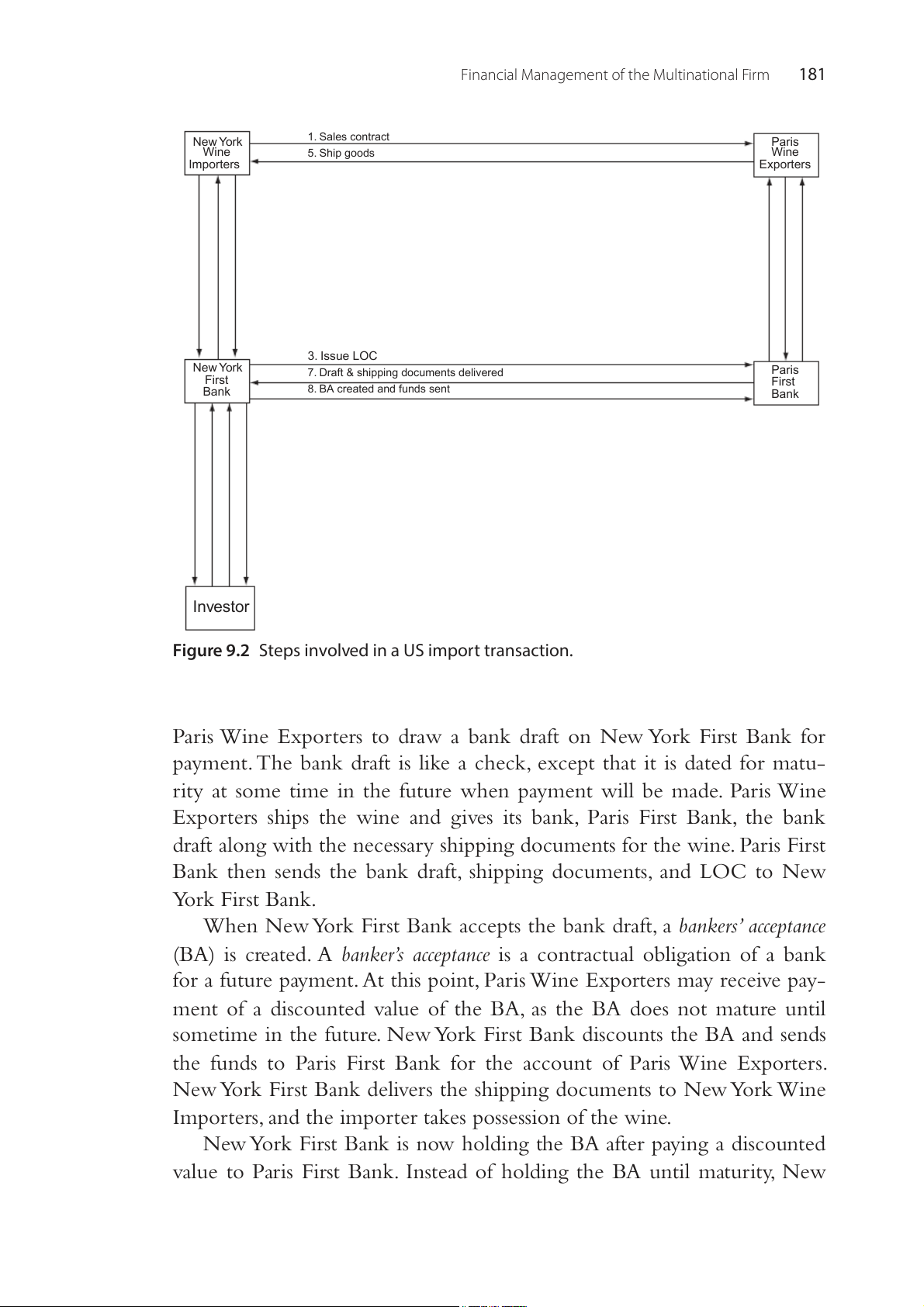
from a French firm, Paris Wine Exporters. Fig. 9.2 illustrates the steps
involved in the transaction. First, the importer and exporter must agree on
the basics of the transaction. The sales contract will stipulate the amount
and kind of wine, price, shipping date, and payment method.
Following the sales contract, the importer requests a LOC from its
bank, New York First Bank. The bank issues an LOC that authorizes
Financial Management of the Multinational Firm 181 New York 1. Sales contract Paris Wine 5. Ship goods Wine Importers Exporters d re e ts n liv e e m d cu ts o n d e rity g m tu in a p C cu ip o e O d t m C sh d O a r L g a id ft & fo in r L t m p a fo ra n ly ip p d e p h A ly k p p n . S . B p a aym . A 0 4 2 1 1 . A . B . P 4 6 9 3. Issue LOC New York
7. Draft & shipping documents delivered Paris First First 8. BA created and funds sent Bank Bank rity tu a t m a d te n t t ld n se n e re e so p A aym A aym . B . P . B . P 1 2 3 5 1 1 1 1 Investor
Figure 9.2 Steps involved in a US import transaction.
Paris Wine Exporters to draw a bank draft on New York First Bank for
payment. The bank draft is like a check, except that it is dated for matu-
rity at some time in the future when payment will be made. Paris Wine
Exporters ships the wine and gives its bank, Paris First Bank, the bank
draft along with the necessary shipping documents for the wine. Paris First
Bank then sends the bank draft, shipping documents, and LOC to New York First Bank.
When New York First Bank accepts the bank draft, a bankers’ acceptance
(BA) is created. A banker’s acceptance is a contractual obligation of a bank
for a future payment. At this point, Paris Wine Exporters may receive pay-
ment of a discounted value of the BA, as the BA does not mature until
sometime in the future. New York First Bank discounts the BA and sends
the funds to Paris First Bank for the account of Paris Wine Exporters.
New York First Bank delivers the shipping documents to New York Wine
Importers, and the importer takes possession of the wine.
New York First Bank is now holding the BA after paying a discounted
value to Paris First Bank. Instead of holding the BA until maturity, New 182
International Money and Finance
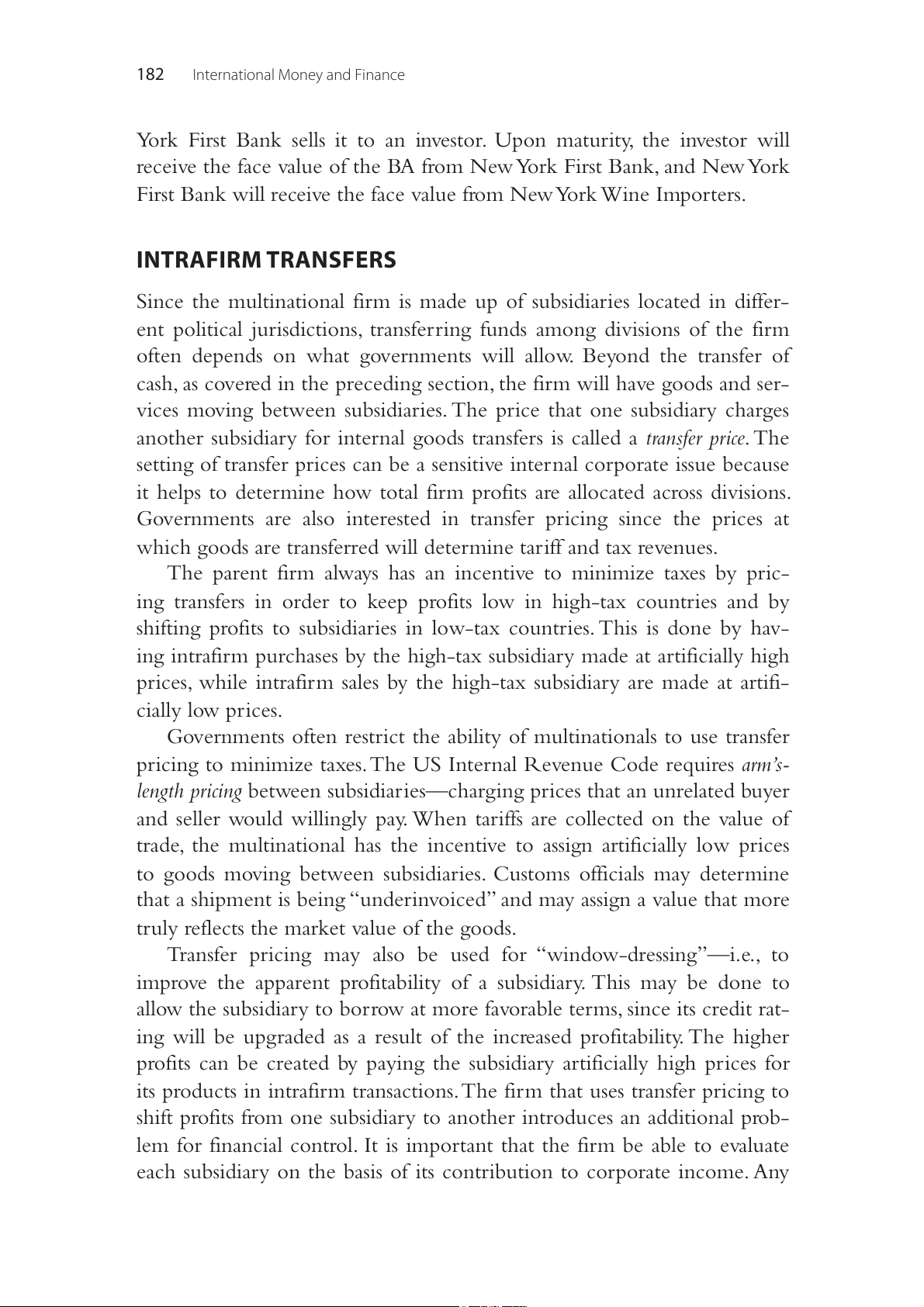
York First Bank sells it to an investor. Upon maturity, the investor will
receive the face value of the BA from New York First Bank, and New York
First Bank will receive the face value from New York Wine Importers. INTRAFIRM TRANSFERS
Since the multinational firm is made up of subsidiaries located in differ-
ent political jurisdictions, transferring funds among divisions of the firm
often depends on what governments will allow. Beyond the transfer of
cash, as covered in the preceding section, the firm will have goods and ser-
vices moving between subsidiaries. The price that one subsidiary charges
another subsidiary for internal goods transfers is called a transfer price. The
setting of transfer prices can be a sensitive internal corporate issue because
it helps to determine how total firm profits are allocated across divisions.
Governments are also interested in transfer pricing since the prices at
which goods are transferred will determine tariff and tax revenues.
The parent firm always has an incentive to minimize taxes by pric-
ing transfers in order to keep profits low in high-tax countries and by
shifting profits to subsidiaries in low-tax countries. This is done by hav-
ing intrafirm purchases by the high-tax subsidiary made at artificially high
prices, while intrafirm sales by the high-tax subsidiary are made at artifi- cially low prices.
Governments often restrict the ability of multinationals to use transfer
pricing to minimize taxes. The US Internal Revenue Code requires arm’s-
length pricing between subsidiaries—charging prices that an unrelated buyer
and seller would willingly pay. When tariffs are collected on the value of
trade, the multinational has the incentive to assign artificially low prices
to goods moving between subsidiaries. Customs officials may determine
that a shipment is being “underinvoiced” and may assign a value that more
truly reflects the market value of the goods.
Transfer pricing may also be used for “window-dressing”—i.e., to
improve the apparent profitability of a subsidiary. This may be done to
allow the subsidiary to borrow at more favorable terms, since its credit rat-
ing will be upgraded as a result of the increased profitability. The higher
profits can be created by paying the subsidiary artificially high prices for
its products in intrafirm transactions. The firm that uses transfer pricing to
shift profits from one subsidiary to another introduces an additional prob-
lem for financial control. It is important that the firm be able to evaluate
each subsidiary on the basis of its contribution to corporate income. Any
Financial Management of the Multinational Firm 183
Table 9.2 Transfer pricing example
Waikiki Shirt Co. makes T-shirts in low-tax country L (with a 20% tax rate) and ships
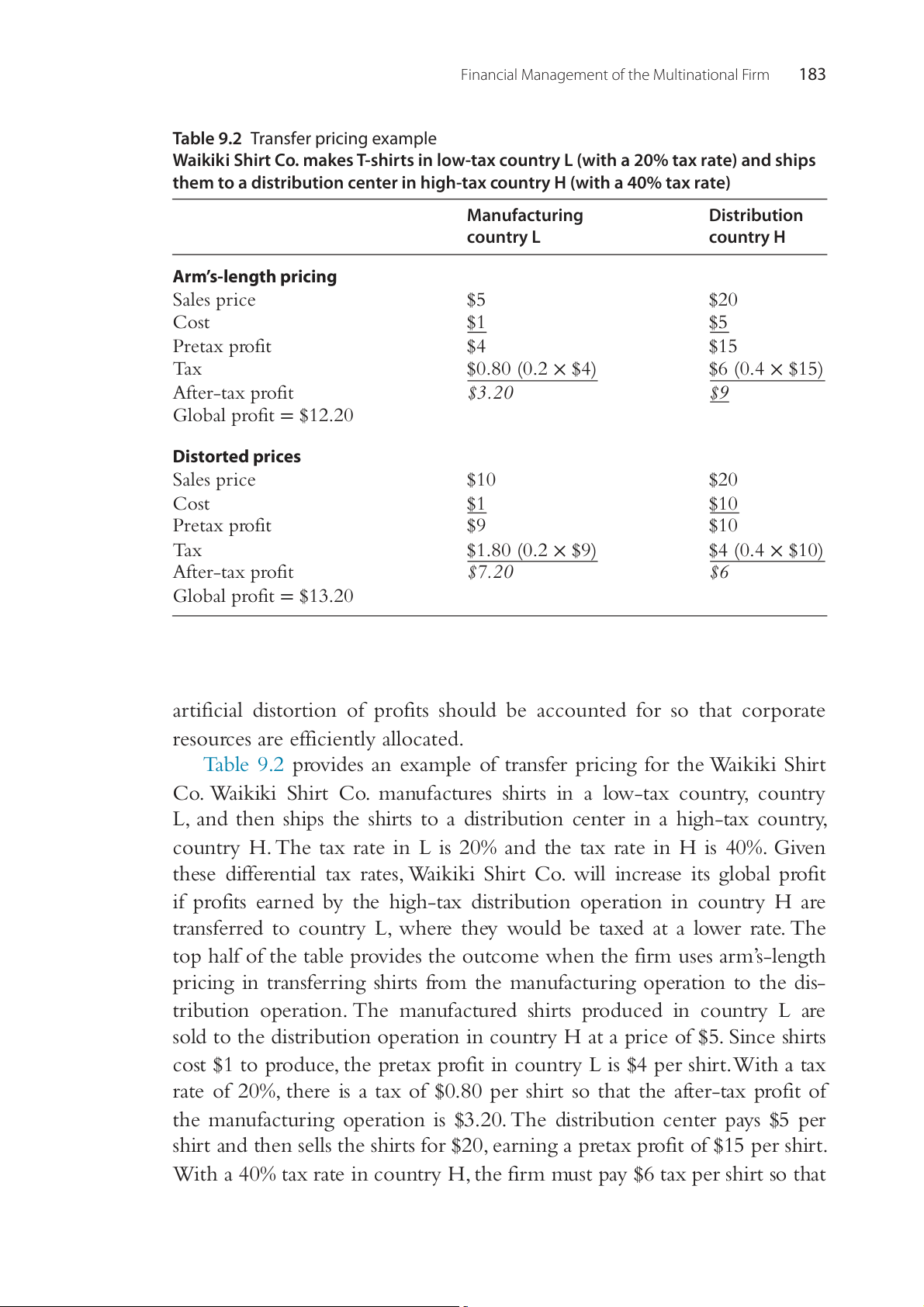
them to a distribution center in high-tax country H (with a 40% tax rate) Manufacturing Distribution country L country H Arm’s-length pricing Sales price $5 $20 Cost $1 $5 Pretax profit $4 $15 Tax $0.80 (0.2 × $4) $6 (0.4 × $15) After-tax profit $3.20 $9 Global profit = $12.20 Distorted prices Sales price $10 $20 Cost $1 $10 Pretax profit $9 $10 Tax $1.80 (0.2 × $9) $4 (0.4 × $10) After-tax profit $7.20 $6 Global profit = $13.20
artificial distortion of profits should be accounted for so that corporate
resources are efficiently allocated.
Table 9.2 provides an example of transfer pricing for the Waikiki Shirt
Co. Waikiki Shirt Co. manufactures shirts in a low-tax country, country
L, and then ships the shirts to a distribution center in a high-tax country,
country H. The tax rate in L is 20% and the tax rate in H is 40%. Given
these differential tax rates, Waikiki Shirt Co. will increase its global profit
if profits earned by the high-tax distribution operation in country H are
transferred to country L, where they would be taxed at a lower rate. The
top half of the table provides the outcome when the firm uses arm’s-length
pricing in transferring shirts from the manufacturing operation to the dis-
tribution operation. The manufactured shirts produced in country L are
sold to the distribution operation in country H at a price of $5. Since shirts
cost $1 to produce, the pretax profit in country L is $4 per shirt. With a tax
rate of 20%, there is a tax of $0.80 per shirt so that the after-tax profit of
the manufacturing operation is $3.20. The distribution center pays $5 per
shirt and then sells the shirts for $20, earning a pretax profit of $15 per shirt.
With a 40% tax rate in country H, the firm must pay $6 tax per shirt so that 184
International Money and Finance
the after-tax profit is $9 per shirt. By summing the after-tax profit earned in
countries L and H, the firm earns a global profit of $12.20 per shirt.
Now suppose the firm uses distorted transfer pricing to lower the
global tax liability and increase the global profit. This involves having the
manufacturing operation in the low-tax country L charge a price above
the arm’s-length (true market) value for the shirts it sells to the distribu-
tion operation in the high-tax country H. The bottom half of Table 9.2
illustrates how this might work. Now the manufacturing operation sells
the shirts to the distribution operation for $10 per shirt. The cost of pro-
duction is still the same $1 so the pretax profit is $9 per shirt. A 20% tax
rate means that a tax of $1.80 per shirt must be paid, and the after-tax
profit is $7.20 per shirt. The distribution operation now pays $10 for the
shirt and still sells it for $20, so the pretax profit is $10. At 40%, the tax is
$4 per shirt, and the after-tax profit is $6. Summing the after-tax profit of
the operations in country L and country H, we find that the global profit is $13.20 per shirt.
The firm is able to increase the profit per shirt by $1 through the
transfer pricing distortion of the value of the shirt transferred from coun-
try L to country H. In this manner, firms can increase profits by shifting
profits from high-tax to low-tax countries. Of course, the tax authori-
ties in country H would not permit such an overstatement of the transfer
value of the shirt (and consequent underpayment of taxes in country H), if
they could determine the true arm’s-length shirt value. For this reason, tax
authorities frequently ask multinational firms to justify the prices they use for internal transfers. CAPITAL BUDGETING
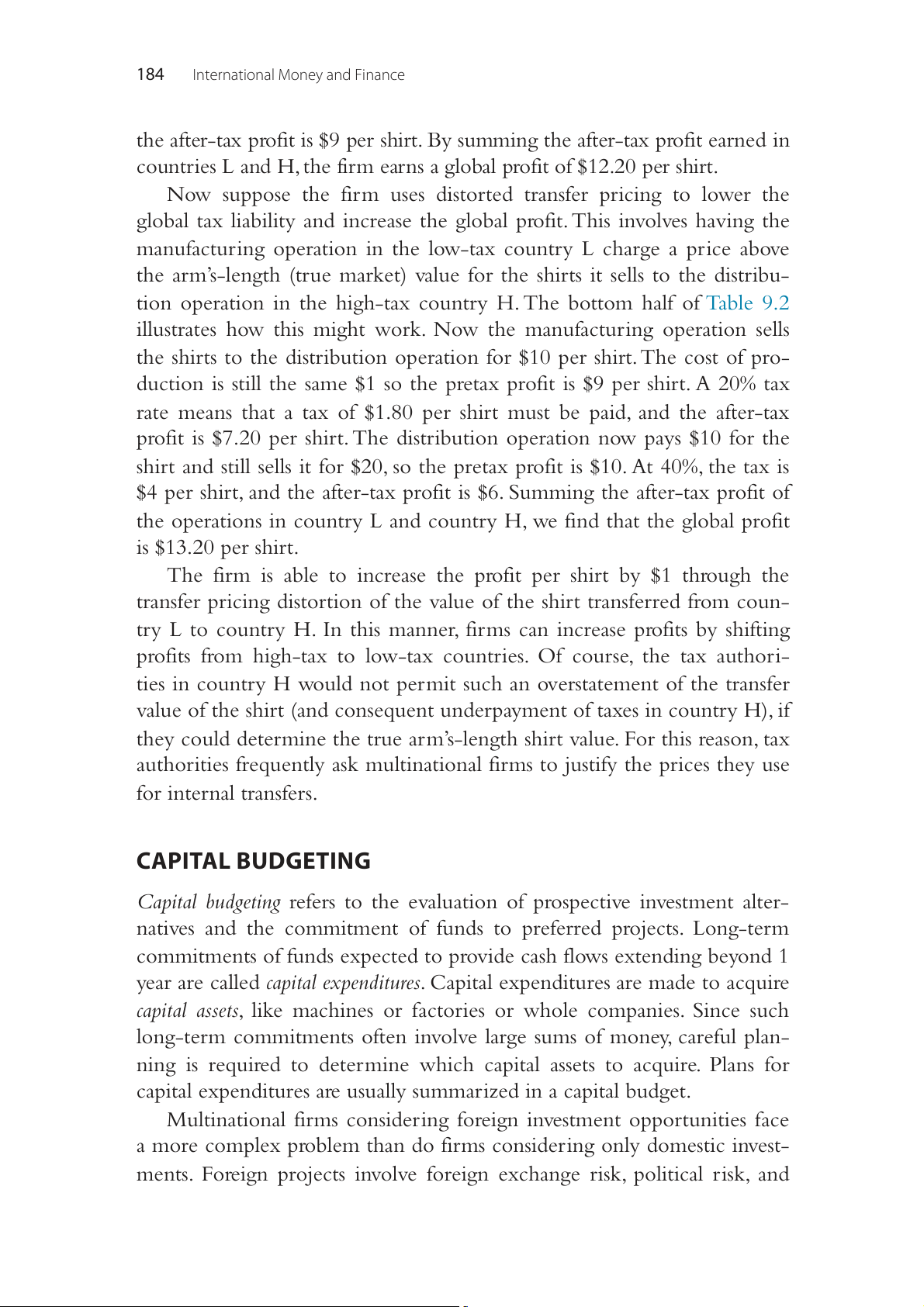
Capital budgeting refers to the evaluation of prospective investment alter-
natives and the commitment of funds to preferred projects. Long-term
commitments of funds expected to provide cash flows extending beyond 1
year are called capital expenditures. Capital expenditures are made to acquire
capital assets, like machines or factories or whole companies. Since such
long-term commitments often involve large sums of money, careful plan-
ning is required to determine which capital assets to acquire. Plans for
capital expenditures are usually summarized in a capital budget.
Multinational firms considering foreign investment opportunities face
a more complex problem than do firms considering only domestic invest-
ments. Foreign projects involve foreign exchange risk, political risk, and
Financial Management of the Multinational Firm 185
foreign tax regulations. Comparing projects in different countries requires
a consideration of how all factors will change over countries.
There are several alternative approaches to capital budgeting. A useful
approach for multinational firms is the adjusted present value approach.
We work with present value because the value of a dollar to be received
today is worth more than a dollar to be received in the future, say 1 year
from now. As a result we must discount future cash flows to reflect the
fact that the value today will fall depending on how long it takes before
the cash flows are realized. The Appendix A to this chapter reviews present
value calculations for readers unfamiliar with the concept.
For multinational firms, the adjusted present value approach is presented
here as an appropriate tool for capital budgeting decisions. The adjusted pres-
ent value (APV) measures total present value as the sum of the present values
of the basic cash flows estimated to result from the investment (operations
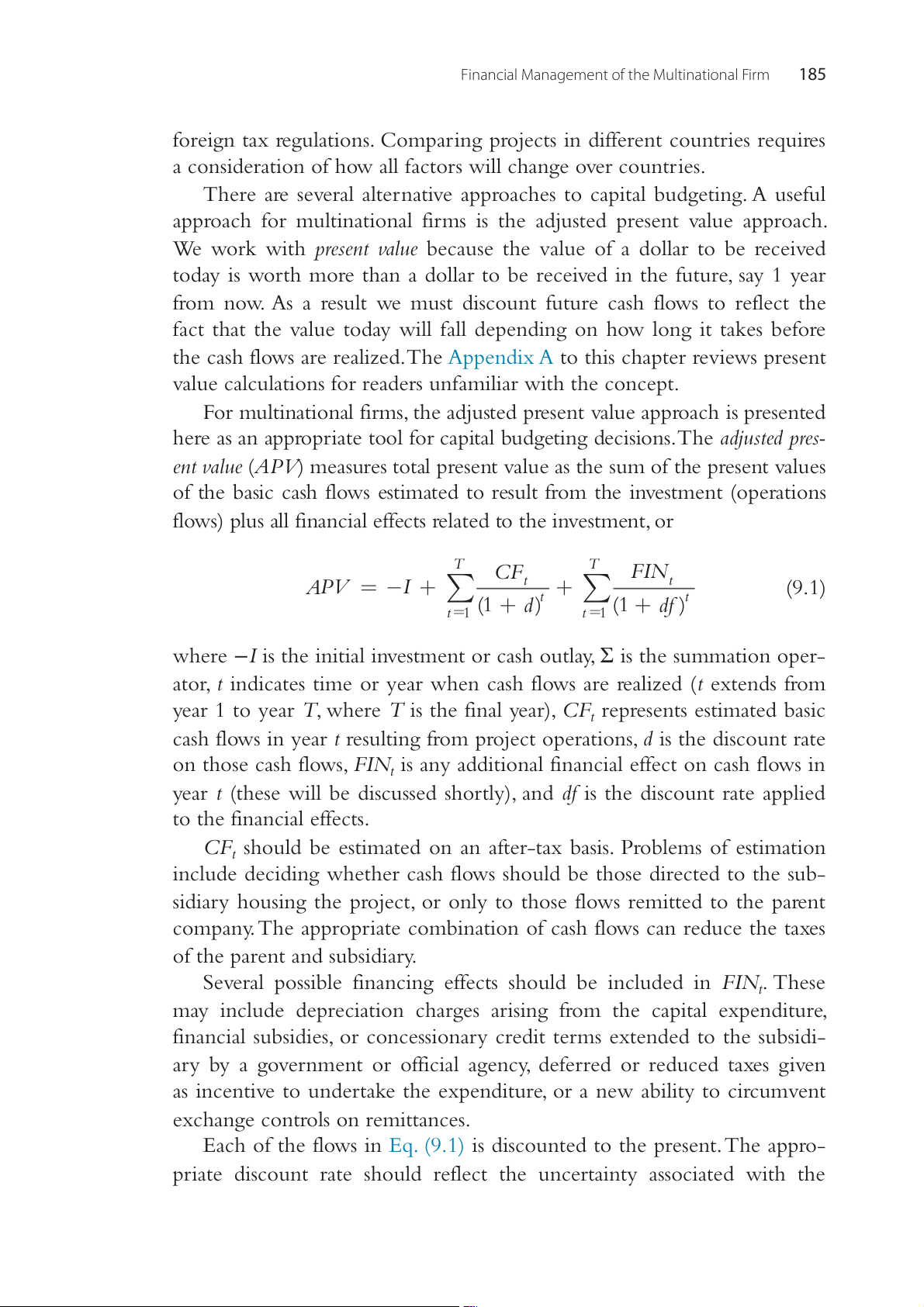
flows) plus all financial effects related to the investment, or T CF T FIN APV = I t t − + + ∑ ∑ (9.1) t t (1 + d) (1 + =1 = df ) t t 1
where −I is the initial investment or cash outlay, Σ is the summation oper-
ator, t indicates time or year when cash flows are realized (t extends from
year 1 to year T, where T is the final year), CF represents estimated basic t
cash flows in year t resulting from project operations, d is the discount rate
on those cash flows, FIN is any additional financial effect on cash flows in t
year t (these will be discussed shortly), and df is the discount rate applied to the financial effects.
CFt should be estimated on an after-tax basis. Problems of estimation
include deciding whether cash flows should be those directed to the sub-
sidiary housing the project, or only to those flows remitted to the parent
company. The appropriate combination of cash flows can reduce the taxes of the parent and subsidiary.
Several possible financing effects should be included in FINt. These
may include depreciation charges arising from the capital expenditure,
financial subsidies, or concessionary credit terms extended to the subsidi-
ary by a government or official agency, deferred or reduced taxes given
as incentive to undertake the expenditure, or a new ability to circumvent
exchange controls on remittances.
Each of the flows in Eq. (9.1) is discounted to the present. The appro-
priate discount rate should reflect the uncertainty associated with the 186
International Money and Finance
flow. CFt is not known with certainty and could fluctuate over the life
of the project. Furthermore the nominal cash flows from operations will
change over time as inflation changes. The discount rate, d, could be equal
to the risk-free rate plus a risk premium that reflects the systematic risk of
the project. The financial terms in FIN are likely to be fixed in nominal t
terms over time. In this case current market interest rates may be accept-
able as discount rates, df.
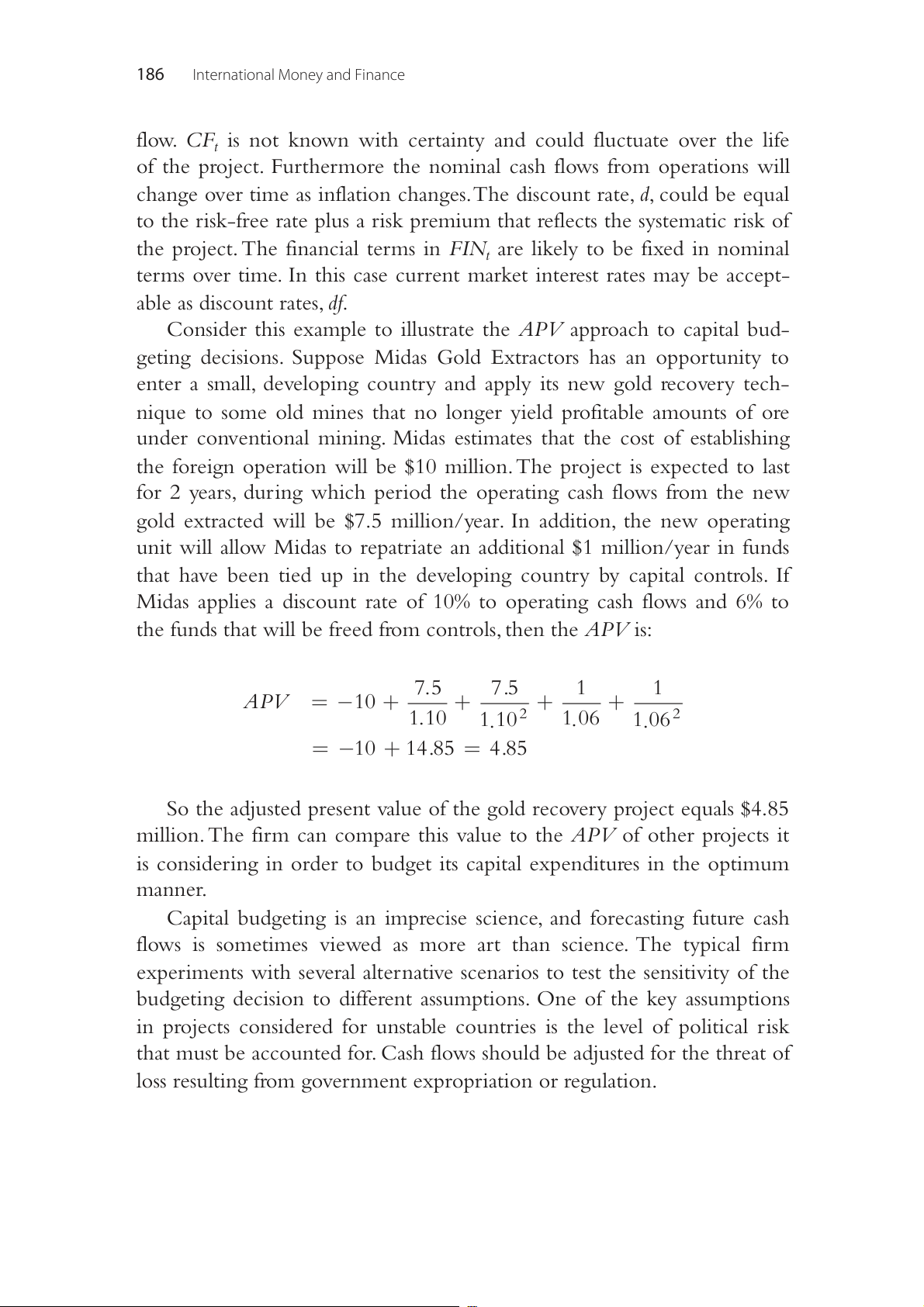
Consider this example to illustrate the APV approach to capital bud-
geting decisions. Suppose Midas Gold Extractors has an opportunity to
enter a small, developing country and apply its new gold recovery tech-
nique to some old mines that no longer yield profitable amounts of ore
under conventional mining. Midas estimates that the cost of establishing
the foreign operation will be $10 million. The project is expected to last
for 2 years, during which period the operating cash flows from the new
gold extracted will be $7.5 million/year. In addition, the new operating
unit will allow Midas to repatriate an additional $1 million/year in funds
that have been tied up in the developing country by capital controls. If
Midas applies a discount rate of 10% to operating cash flows and 6% to
the funds that will be freed from controls, then the APV is: 7.5 7 5 . 1 1 APV = −10 + + + + 1.10 1.102 1.06 1.062 = −10 + 14 8 . 5 = 4 8 . 5
So the adjusted present value of the gold recovery project equals $4.85
million. The firm can compare this value to the APV of other projects it
is considering in order to budget its capital expenditures in the optimum manner.
Capital budgeting is an imprecise science, and forecasting future cash
flows is sometimes viewed as more art than science. The typical firm
experiments with several alternative scenarios to test the sensitivity of the
budgeting decision to different assumptions. One of the key assumptions
in projects considered for unstable countries is the level of political risk
that must be accounted for. Cash flows should be adjusted for the threat of
loss resulting from government expropriation or regulation.
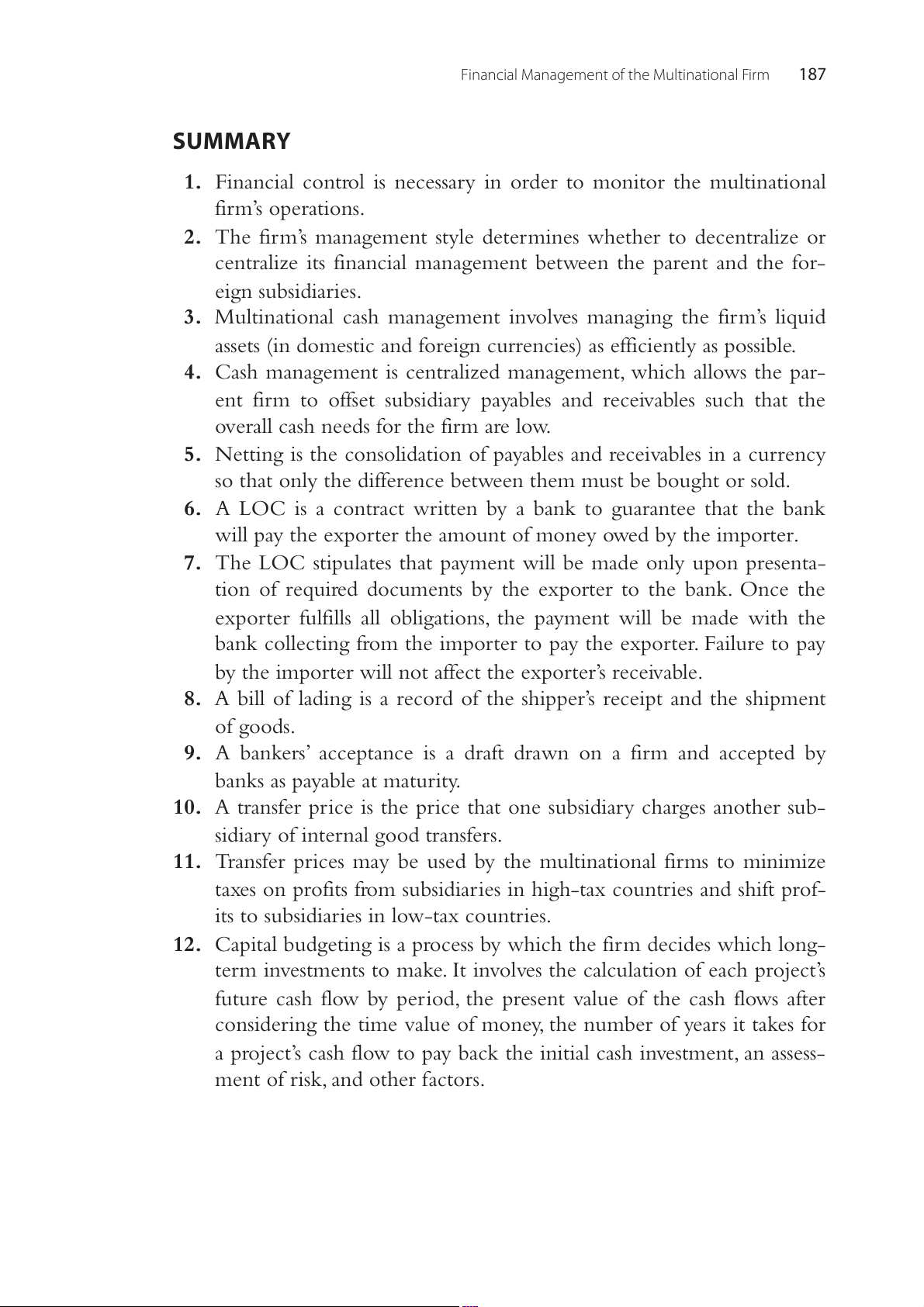
Financial Management of the Multinational Firm 187 SUMMARY
1. Financial control is necessary in order to monitor the multinational firm’s operations.
2. The firm’s management style determines whether to decentralize or
centralize its financial management between the parent and the for- eign subsidiaries.
3. Multinational cash management involves managing the firm’s liquid
assets (in domestic and foreign currencies) as efficiently as possible.
4. Cash management is centralized management, which allows the par-
ent firm to offset subsidiary payables and receivables such that the
overall cash needs for the firm are low.
5. Netting is the consolidation of payables and receivables in a currency
so that only the difference between them must be bought or sold.
6. A LOC is a contract written by a bank to guarantee that the bank
will pay the exporter the amount of money owed by the importer.
7. The LOC stipulates that payment will be made only upon presenta-
tion of required documents by the exporter to the bank. Once the
exporter fulfills all obligations, the payment will be made with the
bank collecting from the importer to pay the exporter. Failure to pay
by the importer will not affect the exporter’s receivable.
8. A bill of lading is a record of the shipper’s receipt and the shipment of goods.
9. A bankers’ acceptance is a draft drawn on a firm and accepted by banks as payable at maturity.
10. A transfer price is the price that one subsidiary charges another sub-
sidiary of internal good transfers.
11. Transfer prices may be used by the multinational firms to minimize
taxes on profits from subsidiaries in high-tax countries and shift prof-
its to subsidiaries in low-tax countries.
12. Capital budgeting is a process by which the firm decides which long-
term investments to make. It involves the calculation of each project’s
future cash flow by period, the present value of the cash flows after
considering the time value of money, the number of years it takes for
a project’s cash flow to pay back the initial cash investment, an assess-
ment of risk, and other factors. 188
International Money and Finance
13. The adjusted present value is the sum of the project’s initial invest-
ment cost, the present values of cash flows, and all financial effects related to the investment. EXERCISES
1. Suppose that the Japanese firm Sanpo will receive $1.5 million from its
US sales subsidiary on June 3. Moreover, on June 3 a US bank is due
$2.3 million from Sanpo as repayment of a loan. Explain how netting
by Sanpo would apply to this example, and what the advantages are?
2. What could be done if Question 1 is modified so that Sanpo owes the
$2.3 million on June 13, but the $1.5 million receivable is still sched- uled for June 3?
3. Give an example of how transfer pricing can be used to
a. shift profits to a low-tax subsidiary in Ireland?
b. reduce the tariff on a shipment of computer parts from a subsidiary
in Taiwan to a subsidiary in Brazil?
c. increase profits in a French subsidiary that will soon be applying for a loan?
4. What is arm’s-length pricing?
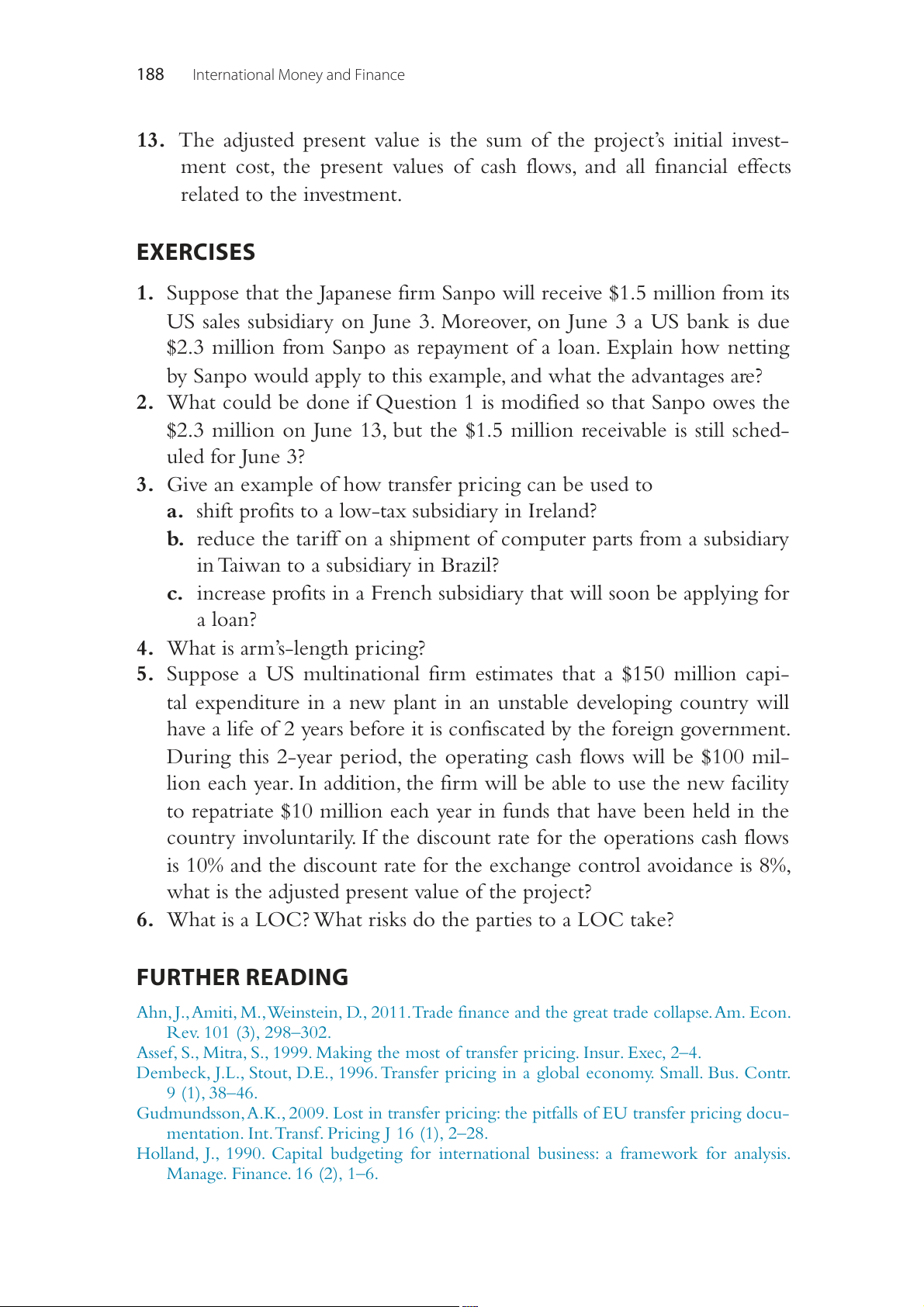
5. Suppose a US multinational firm estimates that a $150 million capi-
tal expenditure in a new plant in an unstable developing country will
have a life of 2 years before it is confiscated by the foreign government.
During this 2-year period, the operating cash flows will be $100 mil-
lion each year. In addition, the firm will be able to use the new facility
to repatriate $10 million each year in funds that have been held in the
country involuntarily. If the discount rate for the operations cash flows
is 10% and the discount rate for the exchange control avoidance is 8%,
what is the adjusted present value of the project?
6. What is a LOC? What risks do the parties to a LOC take? FURTHER READING
Ahn, J., Amiti, M., Weinstein, D., 2011. Trade finance and the great trade collapse. Am. Econ. Rev. 101 (3), 298–302.
Assef, S., Mitra, S., 1999. Making the most of transfer pricing. Insur. Exec, 2–4.
Dembeck, J.L., Stout, D.E., 1996. Transfer pricing in a global economy. Small. Bus. Contr. 9 (1), 38–46.
Gudmundsson, A.K., 2009. Lost in transfer pricing: the pitfalls of EU transfer pricing docu-
mentation. Int. Transf. Pricing J 16 (1), 2–28.
Holland, J., 1990. Capital budgeting for international business: a framework for analysis.
Manage. Finance. 16 (2), 1–6.
Financial Management of the Multinational Firm 189
Lessard, D.R., 1985. Evaluating foreign projects: an adjusted present value approach. In:
Lessard, D.R. (Ed.), International Financial Management, Wiley, New York.
Mitchell, P., 1997. Alternative financing techniques in trade with Sub-Saharan Africa. Bus. Am. 118 (2), 29.
Venedikian, H.M., Warfield, G.A., 1996. Export-Import Finance. Wiley, New York.
APPENDIX A PRESENT VALUE
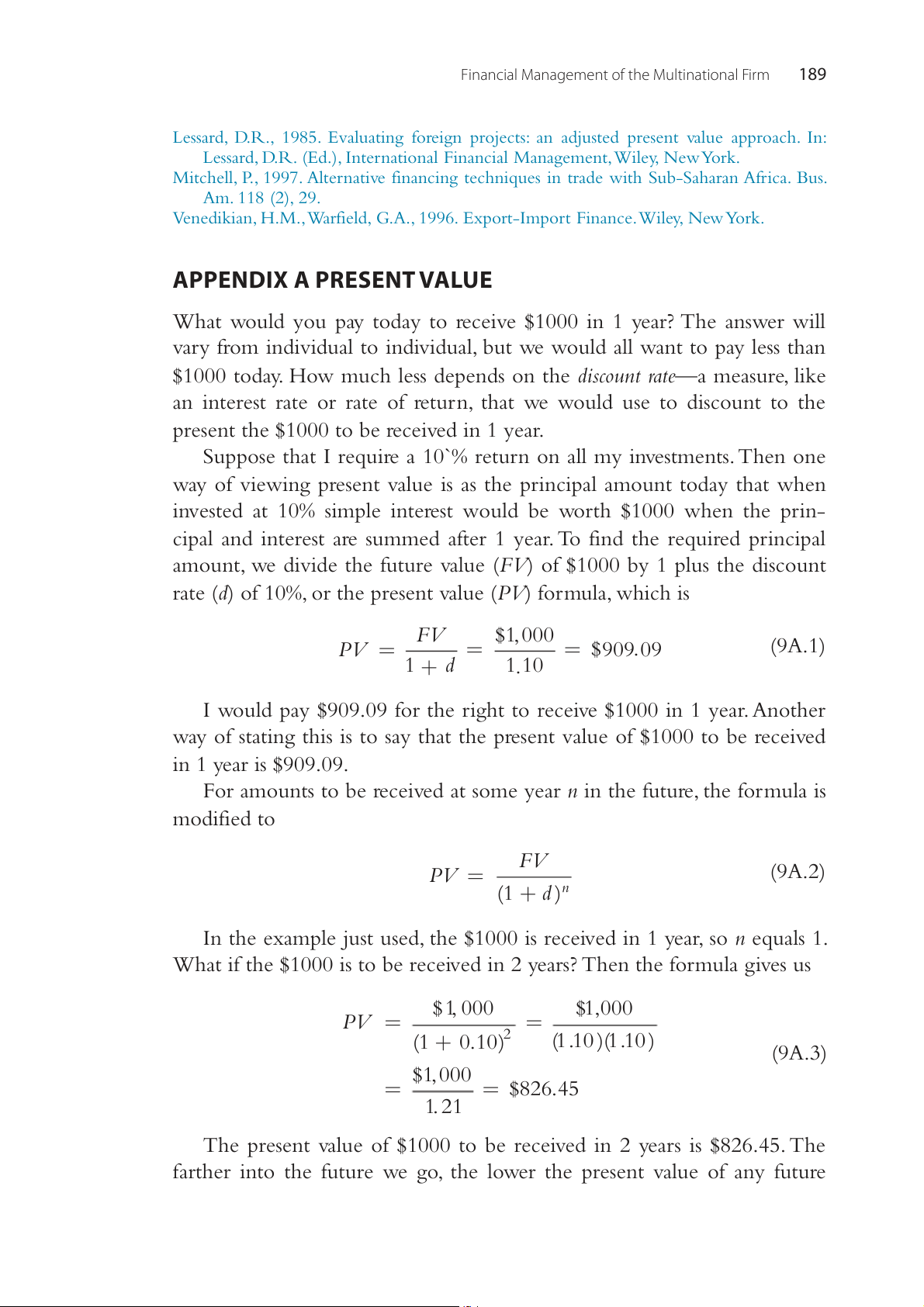
What would you pay today to receive $1000 in 1 year? The answer will
vary from individual to individual, but we would all want to pay less than
$1000 today. How much less depends on the discount rate—a measure, like
an interest rate or rate of return, that we would use to discount to the
present the $1000 to be received in 1 year.
Suppose that I require a 10`% return on all my investments. Then one
way of viewing present value is as the principal amount today that when
invested at 10% simple interest would be worth $1000 when the prin-
cipal and interest are summed after 1 year. To find the required principal
amount, we divide the future value (FV) of $1000 by 1 plus the discount
rate (d) of 10%, or the present value (PV) formula, which is FV 1 $ ,000 PV = = = $909.09 (9A.1) 1 + d 1 .10
I would pay $909.09 for the right to receive $1000 in 1 year. Another
way of stating this is to say that the present value of $1000 to be received in 1 year is $909.09.
For amounts to be received at some year n in the future, the formula is modified to FV PV = (9A.2) (1 + d n )
In the example just used, the $1000 is received in 1 year, so n equals 1.
What if the $1000 is to be received in 2 years? Then the formula gives us $ , 1 000 $ , 1 000 PV = = (1 + . 0 10)2 (1 .10 )(1.10 ) (9A.3) $ , 1 000 = = $82 . 6 45 . 1 21
The present value of $1000 to be received in 2 years is $826.45. The
farther into the future we go, the lower the present value of any future 190
International Money and Finance
value. Furthermore the higher the discount rate, the lower the present
value of any future value to be received.
If a capital outlay will generate a stream of earnings to be received
over many years, we simply sum the present value of each individual year
to obtain the present value of the future cash flows associated with the
expenditure. Then we subtract the initial investment or cash outflow to
find the present value of the project. If Σ is the summation operator and t
denotes time (like years), then the present value of an investment of I dol-
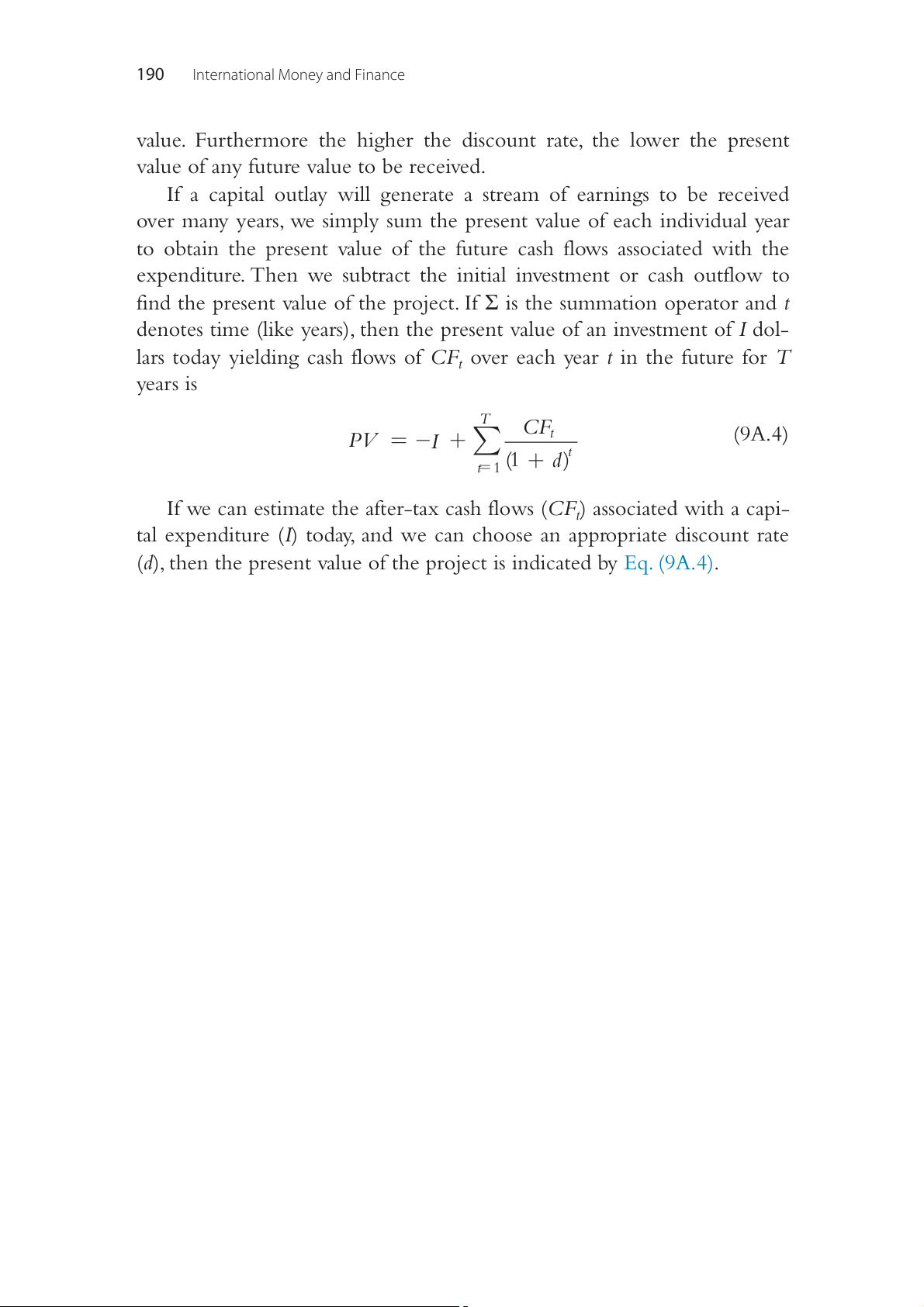
lars today yielding cash flows of CF over each year in the future for t t T years is T CF PV = I t − + ∑ (9A.4) t (1 + = d) t 1
If we can estimate the after-tax cash flows (CF ) associated with a capi- t
tal expenditure (I) today, and we can choose an appropriate discount rate
(d), then the present value of the project is indicated by Eq. (9A.4).
Tài liệu liên quan:
-

Hoạt động Tài chính của Doanh nghiệp Đa Quốc Gia (DN) - Chương 6 | Tài chính quốc tế | Trường Học Viện nông nghiệp Việt Nam
19 10 -
Hệ Thống Tiền Tệ Quốc Tế: Khái Niệm và Các Chế Độ Tỷ Giá | Tài chính quốc tế | Trường Học Viện nông nghiệp Việt Nam
24 12 -

Bài giảng Chương 1: Các Quan Hệ Cân Bằng Quốc Tế và LOP | Tài chính quốc tế | Trường Học Viện nông nghiệp Việt Nam
21 11 -

Cách Tính Lạm Phát và CPI: So Sánh Việt Nam và Mỹ | Tài chính quốc tế | Trường Học Viện nông nghiệp Việt Nam
23 12 -

Detailed Report and Analysis on Submission Trends | Tài chính quốc tế | Trường Học Viện nông nghiệp Việt Nam
23 12