Foreign Exchange Risk and Forecasting | Tài chính quốc tế | Trường Học Viện nông nghiệp Việt Nam
International business involves foreign exchange risk since the value of transactions in different currencies will be sensitive to exchange rate changes. Although it is possible to manage a firm ’ s foreign-currencydenominated assets and liabilities to avoid exposure to exchange rate changes, the benefit involved is not always worth the effort. Tài liệu được sưu tầm và soạn thảo dưới dạng file PDF để gửi tới các bạn cùng tham khảo, ôn tập đầy đủ kiến thức, chuẩn bị cho các buổi học thật tốt. Mời bạn đọc đón xem!
Môn: Tài chính quốc tế (hvnn) 130 tài liệu
Trường: Học viện Nông nghiệp Việt Nam 2.4 K tài liệu
Tác giả:


Preview text:
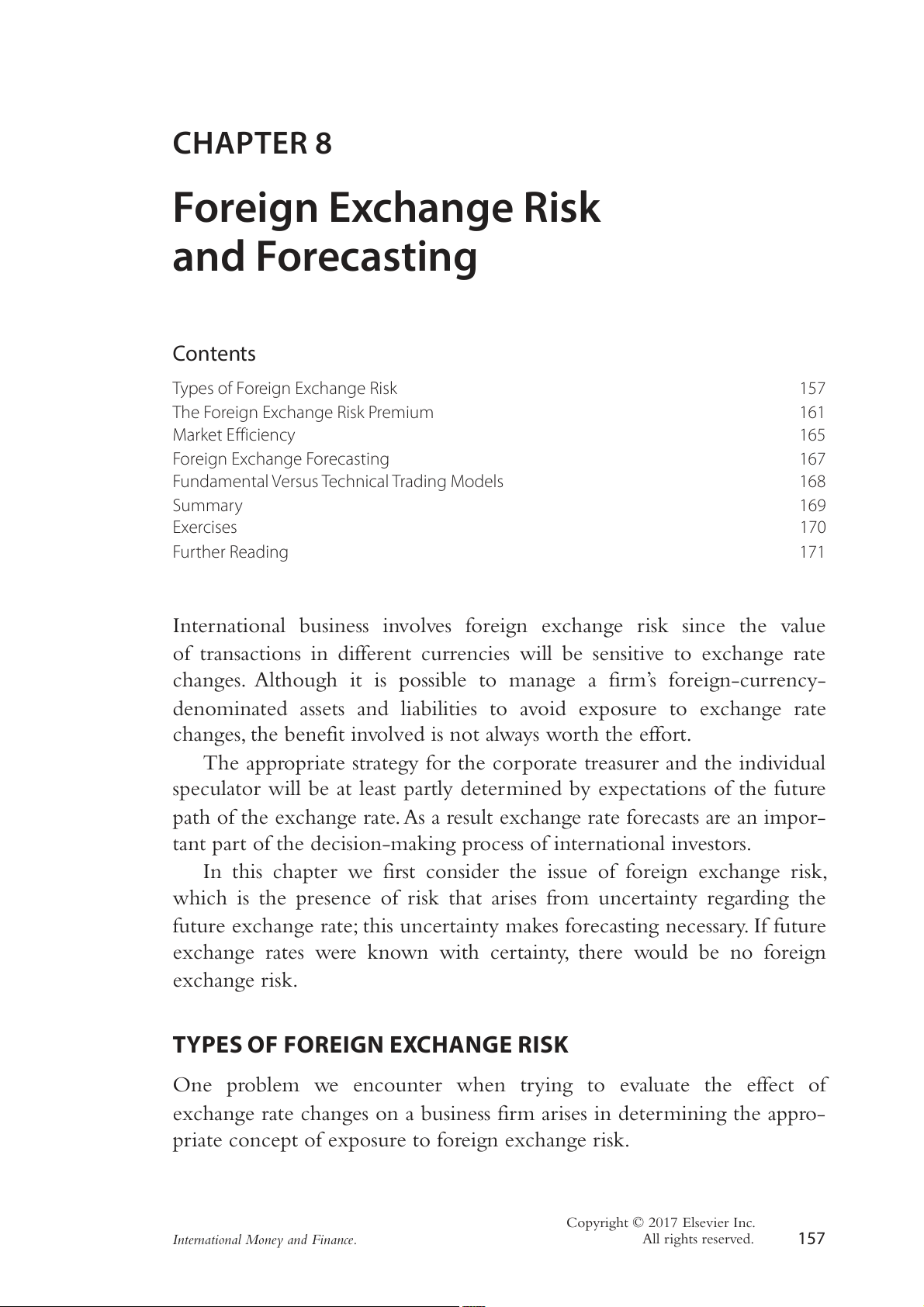
CHAPTER 8 Foreign Exchange Risk and Forecasting Contents
Types of Foreign Exchange Risk 157
The Foreign Exchange Risk Premium 161 Market Efficiency 165 Foreign Exchange Forecasting 167
Fundamental Versus Technical Trading Models 168 Summary 169 Exercises 170 Further Reading 171
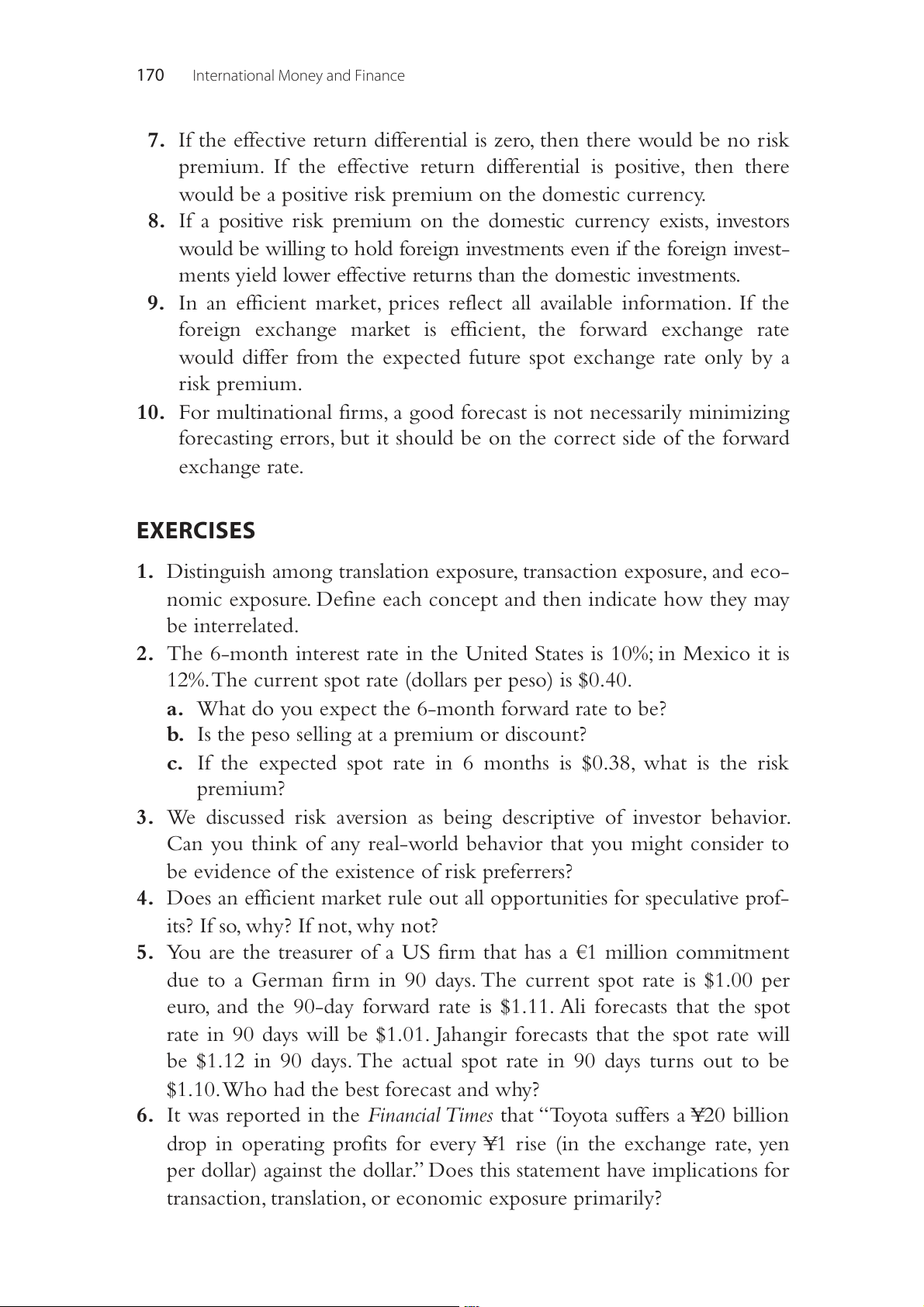
International business involves foreign exchange risk since the value
of transactions in different currencies will be sensitive to exchange rate
changes. Although it is possible to manage a firm’s foreign-currency-
denominated assets and liabilities to avoid exposure to exchange rate
changes, the benefit involved is not always worth the effort.
The appropriate strategy for the corporate treasurer and the individual
speculator will be at least partly determined by expectations of the future
path of the exchange rate. As a result exchange rate forecasts are an impor-
tant part of the decision-making process of international investors.
In this chapter we first consider the issue of foreign exchange risk,
which is the presence of risk that arises from uncertainty regarding the
future exchange rate; this uncertainty makes forecasting necessary. If future
exchange rates were known with certainty, there would be no foreign exchange risk.
TYPES OF FOREIGN EXCHANGE RISK
One problem we encounter when trying to evaluate the effect of
exchange rate changes on a business firm arises in determining the appro-
priate concept of exposure to foreign exchange risk.
Copyright © 2017 Elsevier Inc.
International Money and Finance. All rights reserved. 157 158
International Money and Finance
We can identify three principal concepts of exchange risk exposure:
1. Translation exposure: This is also known as accounting exposure. It is the
difference between foreign-currency-denominated assets and foreign-
currency-denominated liabilities.
2. Transaction exposure: This is an exposure resulting from the uncertain
domestic currency value of a foreign-currency-denominated transac-
tion to be completed at some future date.
3. Economic exposure: This is an exposure of the firm’s value to changes in
exchange rates. If the value of the firm is measured as the present value
of future after-tax cash flows, then economic exposure is concerned
with the sensitivity of the real domestic currency value of long-term
cash flows to exchange rate changes.
Economic exposure is the most important to the firm. Rather than
worry about how accountants will report the value of our international
operations (translation exposure), it is far more important to the firm (and
to rational investors) to focus on the purchasing power of long-run cash
flows insofar as these determine the real value of the firm.
Let us consider an example of a hypothetical firm’s situation to illus-
trate the differences among the alternative exposure concepts. Suppose we
have the balance sheet of XYZ-France, a foreign subsidiary of the par-
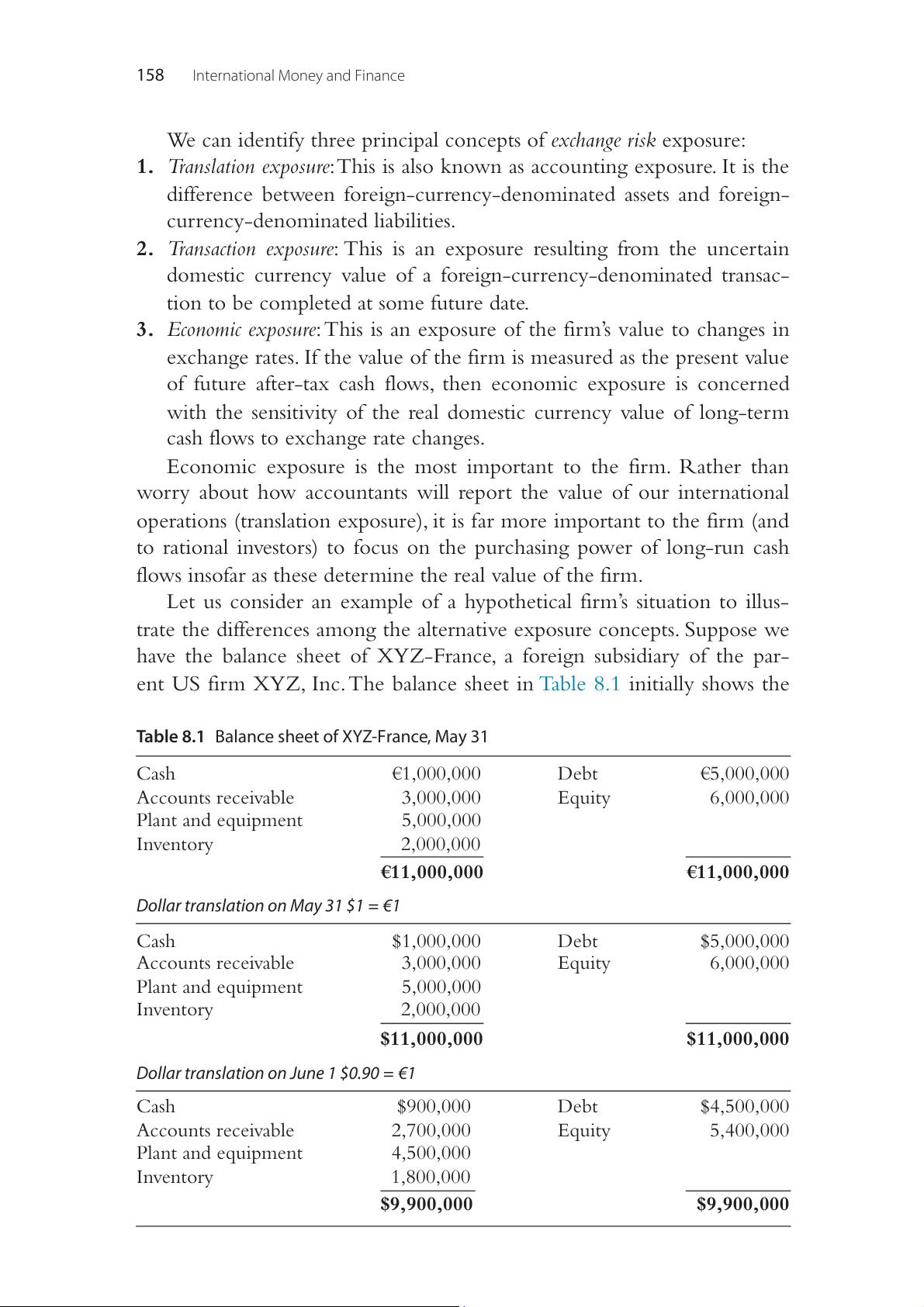
ent US firm XYZ, Inc. The balance sheet in Table 8.1 initially shows the
Table 8.1 Balance sheet of XYZ-France, May 31 Cash €1,000,000 Debt €5,000,000 Accounts receivable 3,000,000 Equity 6,000,000 Plant and equipment 5,000,000 Inventory 2,000,000 €11,000,000 €11,000,000
Dollar translation on May 31 $1 = €1 Cash $1,000,000 Debt $5,000,000 Accounts receivable 3,000,000 Equity 6,000,000 Plant and equipment 5,000,000 Inventory 2,000,000 $11,000,000 $11,000,000
Dollar translation on June 1 $0.90 = €1 Cash $900,000 Debt $4,500,000 Accounts receivable 2,700,000 Equity 5,400,000 Plant and equipment 4,500,000 Inventory 1,800,000 $9,900,000 $9,900,000
Foreign Exchange Risk and Forecasting 159
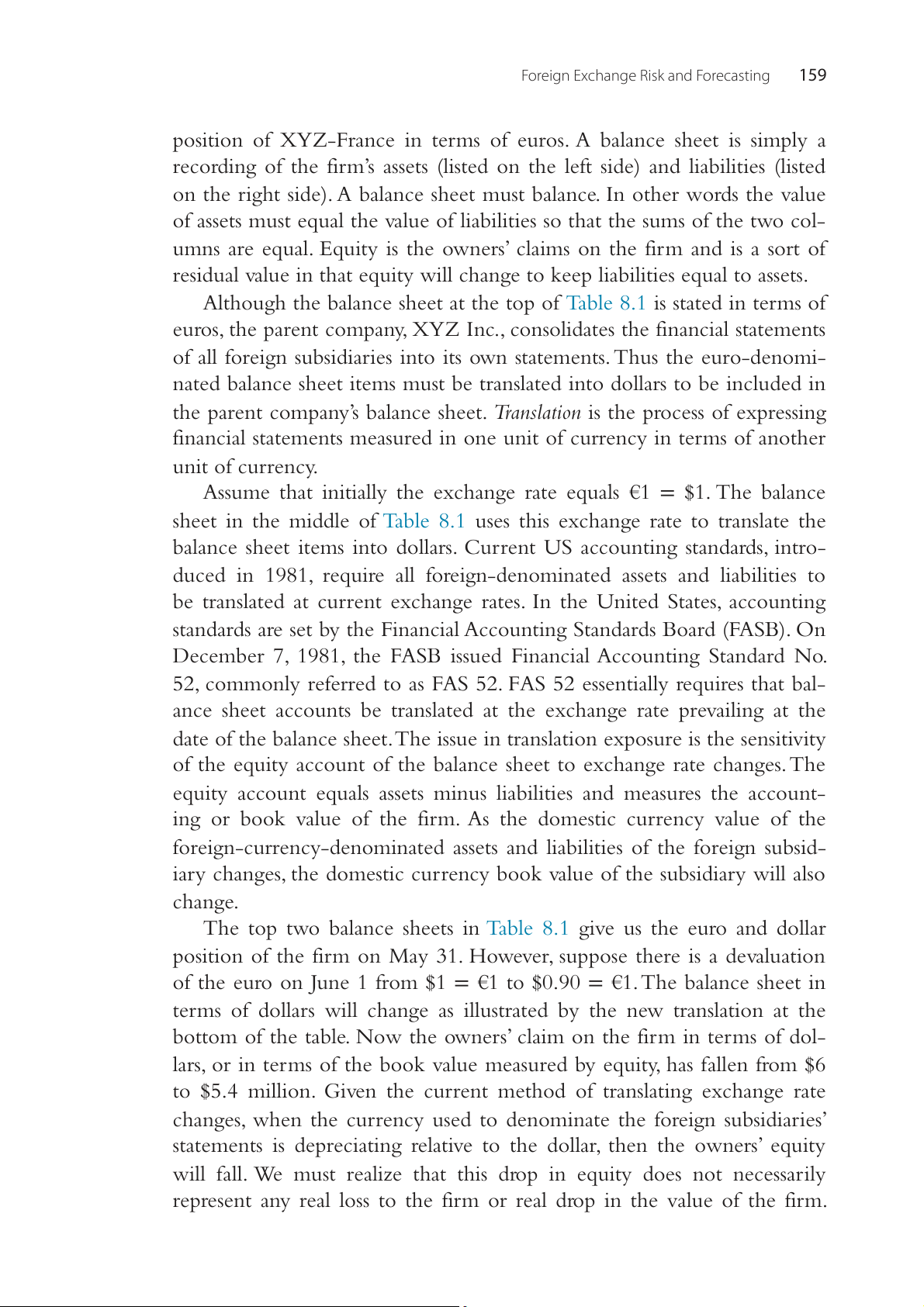
position of XYZ-France in terms of euros. A balance sheet is simply a
recording of the firm’s assets (listed on the left side) and liabilities (listed
on the right side). A balance sheet must balance. In other words the value
of assets must equal the value of liabilities so that the sums of the two col-
umns are equal. Equity is the owners’ claims on the firm and is a sort of
residual value in that equity will change to keep liabilities equal to assets.
Although the balance sheet at the top of Table 8.1 is stated in terms of
euros, the parent company, XYZ Inc., consolidates the financial statements
of all foreign subsidiaries into its own statements. Thus the euro-denomi-
nated balance sheet items must be translated into dollars to be included in
the parent company’s balance sheet. Translation is the process of expressing
financial statements measured in one unit of currency in terms of another unit of currency.
Assume that initially the exchange rate equals €1 = $1. The balance
sheet in the middle of Table 8.1 uses this exchange rate to translate the
balance sheet items into dollars. Current US accounting standards, intro-
duced in 1981, require all foreign-denominated assets and liabilities to
be translated at current exchange rates. In the United States, accounting
standards are set by the Financial Accounting Standards Board (FASB). On
December 7, 1981, the FASB issued Financial Accounting Standard No.
52, commonly referred to as FAS 52. FAS 52 essentially requires that bal-
ance sheet accounts be translated at the exchange rate prevailing at the
date of the balance sheet. The issue in translation exposure is the sensitivity
of the equity account of the balance sheet to exchange rate changes. The
equity account equals assets minus liabilities and measures the account-
ing or book value of the firm. As the domestic currency value of the
foreign-currency-denominated assets and liabilities of the foreign subsid-
iary changes, the domestic currency book value of the subsidiary will also change.
The top two balance sheets in Table 8.1 give us the euro and dollar
position of the firm on May 31. However, suppose there is a devaluation
of the euro on June 1 from $1 = €1 to $0.90 = €1. The balance sheet in
terms of dollars will change as illustrated by the new translation at the
bottom of the table. Now the owners’ claim on the firm in terms of dol-
lars, or in terms of the book value measured by equity, has fallen from $6
to $5.4 million. Given the current method of translating exchange rate
changes, when the currency used to denominate the foreign subsidiaries’
statements is depreciating relative to the dollar, then the owners’ equity
will fall. We must realize that this drop in equity does not necessarily
represent any real loss to the firm or real drop in the value of the firm. 160
International Money and Finance
The euro position of the firm is unchanged; only the dollar value to the
US parent is altered by the exchange rate change.
Since the balance sheet translation of foreign assets and liabilities does
not by itself indicate anything about the real economic exposure of the
firm, we must look beyond the balance sheet and the translation expo-
sure. Transaction exposure can be viewed as a kind of economic exposure,
since the profitability of future transactions is susceptible to exchange rate
change, and these changes can have a big effect on future cash flows—as
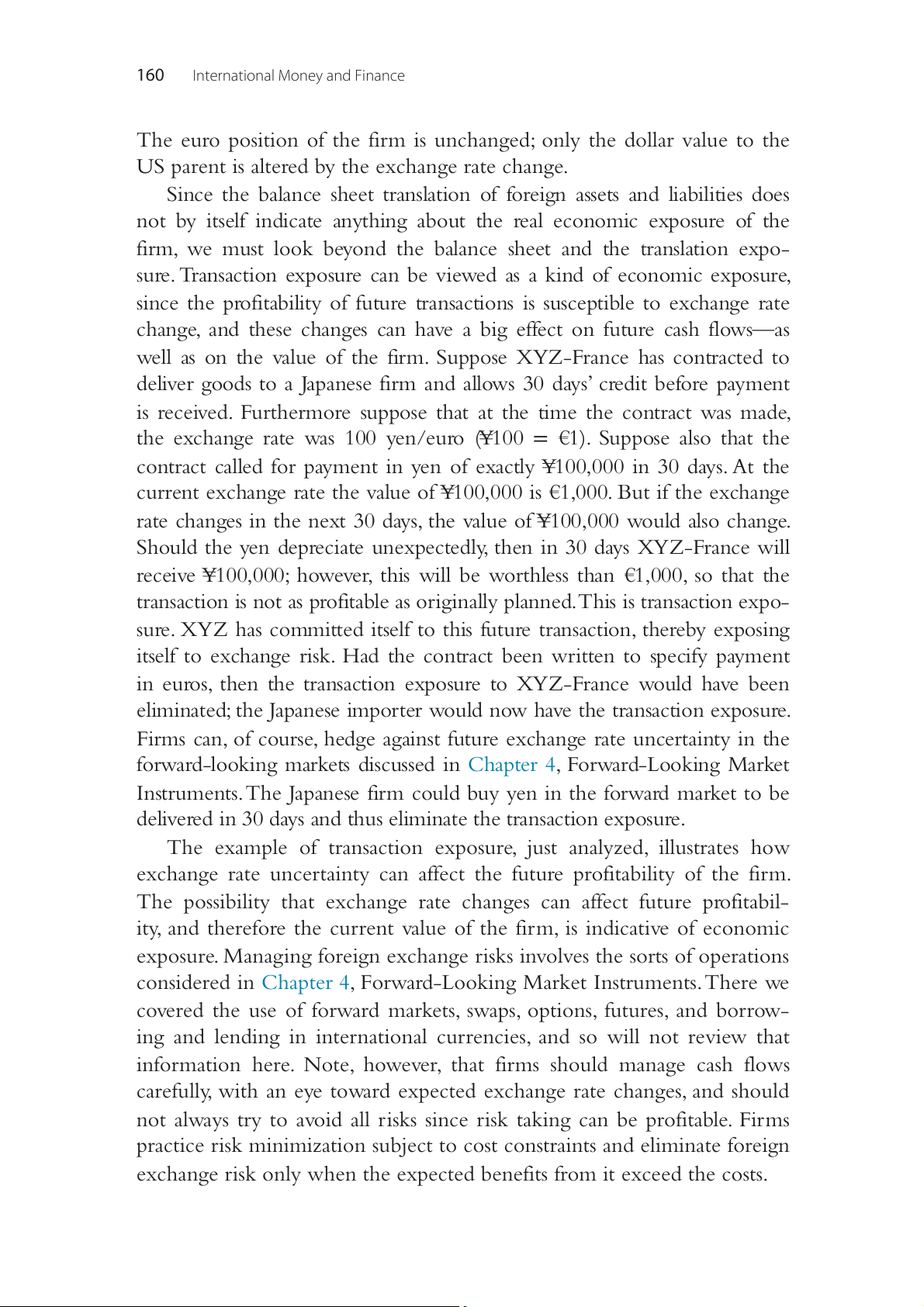
well as on the value of the firm. Suppose XYZ-France has contracted to
deliver goods to a Japanese firm and allows 30 days’ credit before payment
is received. Furthermore suppose that at the time the contract was made,
the exchange rate was 100 yen/euro (¥100 = €1). Suppose also that the
contract called for payment in yen of exactly ¥100,000 in 30 days. At the
current exchange rate the value of ¥100,000 is €1,000. But if the exchange
rate changes in the next 30 days, the value of ¥100,000 would also change.
Should the yen depreciate unexpectedly, then in 30 days XYZ-France will
receive ¥100,000; however, this will be worthless than €1,000, so that the
transaction is not as profitable as originally planned. This is transaction expo-
sure. XYZ has committed itself to this future transaction, thereby exposing
itself to exchange risk. Had the contract been written to specify payment
in euros, then the transaction exposure to XYZ-France would have been
eliminated; the Japanese importer would now have the transaction exposure.
Firms can, of course, hedge against future exchange rate uncertainty in the
forward-looking markets discussed in Chapter4, Forward-Looking Market
Instruments. The Japanese firm could buy yen in the forward market to be
delivered in 30 days and thus eliminate the transaction exposure.
The example of transaction exposure, just analyzed, illustrates how
exchange rate uncertainty can affect the future profitability of the firm.
The possibility that exchange rate changes can affect future profitabil-
ity, and therefore the current value of the firm, is indicative of economic
exposure. Managing foreign exchange risks involves the sorts of operations
considered in Chapter4, Forward-Looking Market Instruments. There we
covered the use of forward markets, swaps, options, futures, and borrow-
ing and lending in international currencies, and so will not review that
information here. Note, however, that firms should manage cash flows
carefully, with an eye toward expected exchange rate changes, and should
not always try to avoid all risks since risk taking can be profitable. Firms
practice risk minimization subject to cost constraints and eliminate foreign
exchange risk only when the expected benefits from it exceed the costs.
Foreign Exchange Risk and Forecasting 161
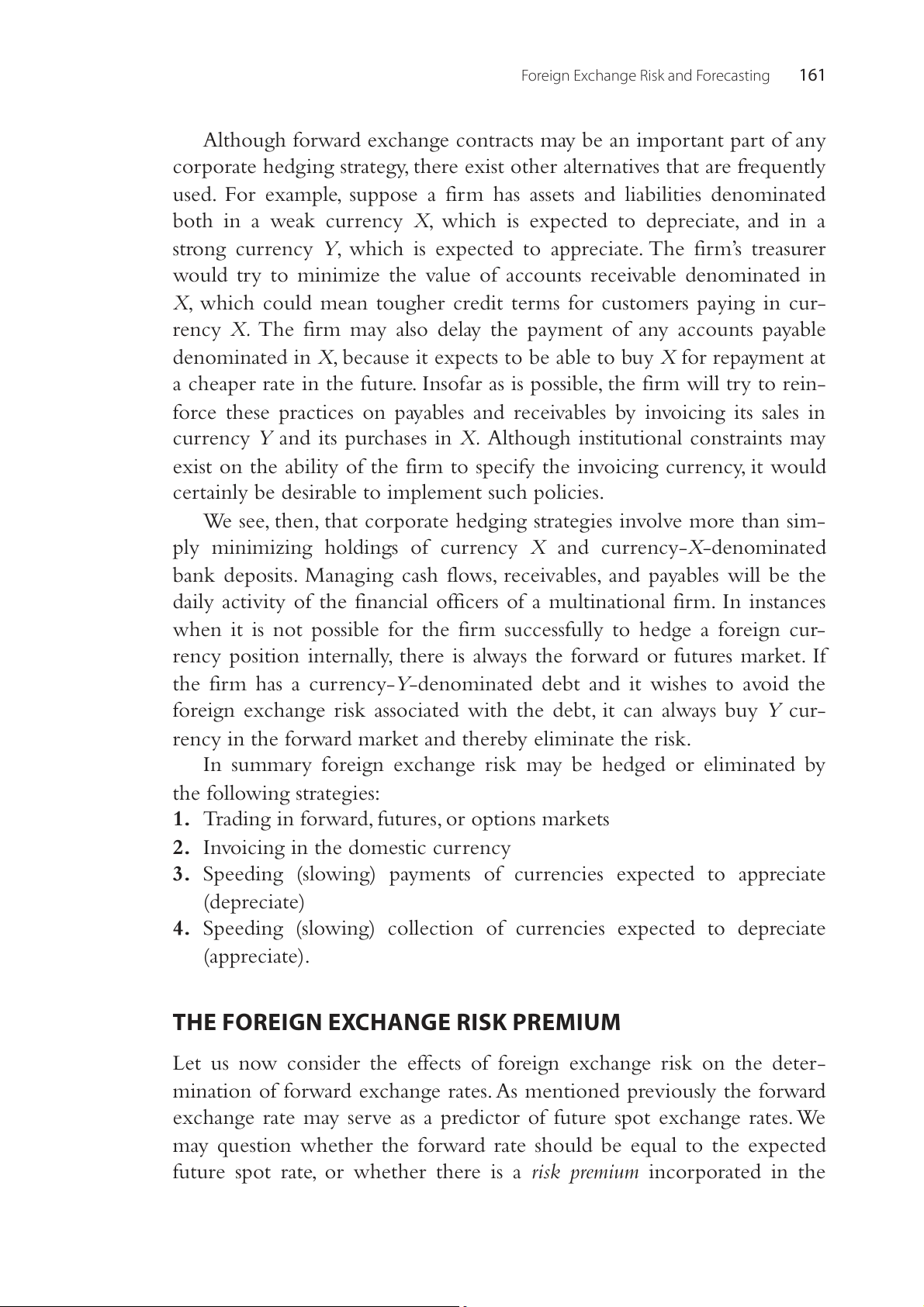
Although forward exchange contracts may be an important part of any
corporate hedging strategy, there exist other alternatives that are frequently
used. For example, suppose a firm has assets and liabilities denominated
both in a weak currency X, which is expected to depreciate, and in a
strong currency Y, which is expected to appreciate. The firm’s treasurer
would try to minimize the value of accounts receivable denominated in
X, which could mean tougher credit terms for customers paying in cur-
rency X. The firm may also delay the payment of any accounts payable
denominated in X, because it expects to be able to buy X for repayment at
a cheaper rate in the future. Insofar as is possible, the firm will try to rein-
force these practices on payables and receivables by invoicing its sales in
currency Y and its purchases in X. Although institutional constraints may
exist on the ability of the firm to specify the invoicing currency, it would
certainly be desirable to implement such policies.
We see, then, that corporate hedging strategies involve more than sim-
ply minimizing holdings of currency X and currency-X-denominated
bank deposits. Managing cash flows, receivables, and payables will be the
daily activity of the financial officers of a multinational firm. In instances
when it is not possible for the firm successfully to hedge a foreign cur-
rency position internally, there is always the forward or futures market. If the firm has a currency- -
Y denominated debt and it wishes to avoid the
foreign exchange risk associated with the debt, it can always buy Y cur-
rency in the forward market and thereby eliminate the risk.
In summary foreign exchange risk may be hedged or eliminated by the following strategies:
1. Trading in forward, futures, or options markets
2. Invoicing in the domestic currency
3. Speeding (slowing) payments of currencies expected to appreciate (depreciate)
4. Speeding (slowing) collection of currencies expected to depreciate (appreciate).
THE FOREIGN EXCHANGE RISK PREMIUM
Let us now consider the effects of foreign exchange risk on the deter-
mination of forward exchange rates. As mentioned previously the forward
exchange rate may serve as a predictor of future spot exchange rates. We
may question whether the forward rate should be equal to the expected
future spot rate, or whether there is a risk premium incorporated in the 162
International Money and Finance
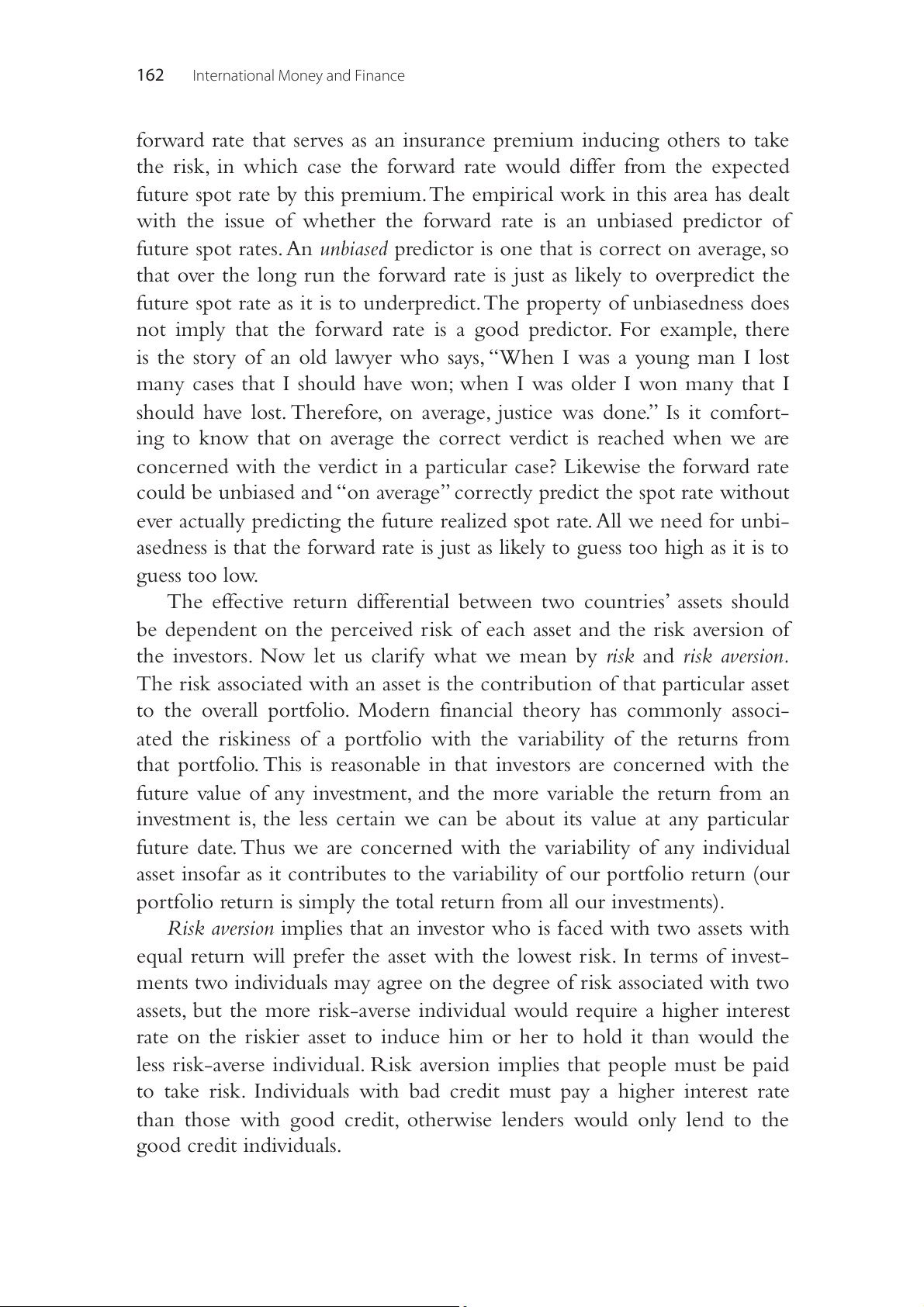
forward rate that serves as an insurance premium inducing others to take
the risk, in which case the forward rate would differ from the expected
future spot rate by this premium. The empirical work in this area has dealt
with the issue of whether the forward rate is an unbiased predictor of
future spot rates. An unbiased predictor is one that is correct on average, so
that over the long run the forward rate is just as likely to overpredict the
future spot rate as it is to underpredict. The property of unbiasedness does
not imply that the forward rate is a good predictor. For example, there
is the story of an old lawyer who says, “When I was a young man I lost
many cases that I should have won; when I was older I won many that I
should have lost. Therefore, on average, justice was done.” Is it comfort-
ing to know that on average the correct verdict is reached when we are
concerned with the verdict in a particular case? Likewise the forward rate
could be unbiased and “on average” correctly predict the spot rate without
ever actually predicting the future realized spot rate. All we need for unbi-
asedness is that the forward rate is just as likely to guess too high as it is to guess too low.
The effective return differential between two countries’ assets should
be dependent on the perceived risk of each asset and the risk aversion of
the investors. Now let us clarify what we mean by risk and risk aversion.
The risk associated with an asset is the contribution of that particular asset
to the overall portfolio. Modern financial theory has commonly associ-
ated the riskiness of a portfolio with the variability of the returns from
that portfolio. This is reasonable in that investors are concerned with the
future value of any investment, and the more variable the return from an
investment is, the less certain we can be about its value at any particular
future date. Thus we are concerned with the variability of any individual
asset insofar as it contributes to the variability of our portfolio return (our
portfolio return is simply the total return from all our investments).
Risk aversion implies that an investor who is faced with two assets with
equal return will prefer the asset with the lowest risk. In terms of invest-
ments two individuals may agree on the degree of risk associated with two
assets, but the more risk-averse individual would require a higher interest
rate on the riskier asset to induce him or her to hold it than would the
less risk-averse individual. Risk aversion implies that people must be paid
to take risk. Individuals with bad credit must pay a higher interest rate
than those with good credit, otherwise lenders would only lend to the good credit individuals.
Foreign Exchange Risk and Forecasting 163
FAQ: Are Entrepreneurs Risk Lovers?
It is a common perception that entrepreneurs love to take risks, and are a “spe-
cial breed” of business people. That seems to contradict the idea in economics
that people are risk averse. In an article in The New Yorker, Malcolm Gladwell
discusses this by examining the behavior of some famous successful entrepre-
neurs.1 After studying the behavior of entrepreneurs such as Ted Turner and
John Paulson, he concludes that entrepreneurs are in fact very risk averse. They
spend a lot of time to make sure that their risk is minimal in their investments,
or spend large amounts on research to make sure that the expected return is
sufficient. John Paulson, e.g., did a lot of research on the housing market in the
United States in the mid-2000s, deciding that the housing bubble must burst. By
buying Credit Default Swaps that gave him a short position, he benefited a great
deal from the downturn. In fact in 2007 alone he had profits of $15 billion. So
entrepreneurs are just like other people, trying to minimize their risk exposure
and only investing where the expected payoff is large enough to cover the risk of the investment.
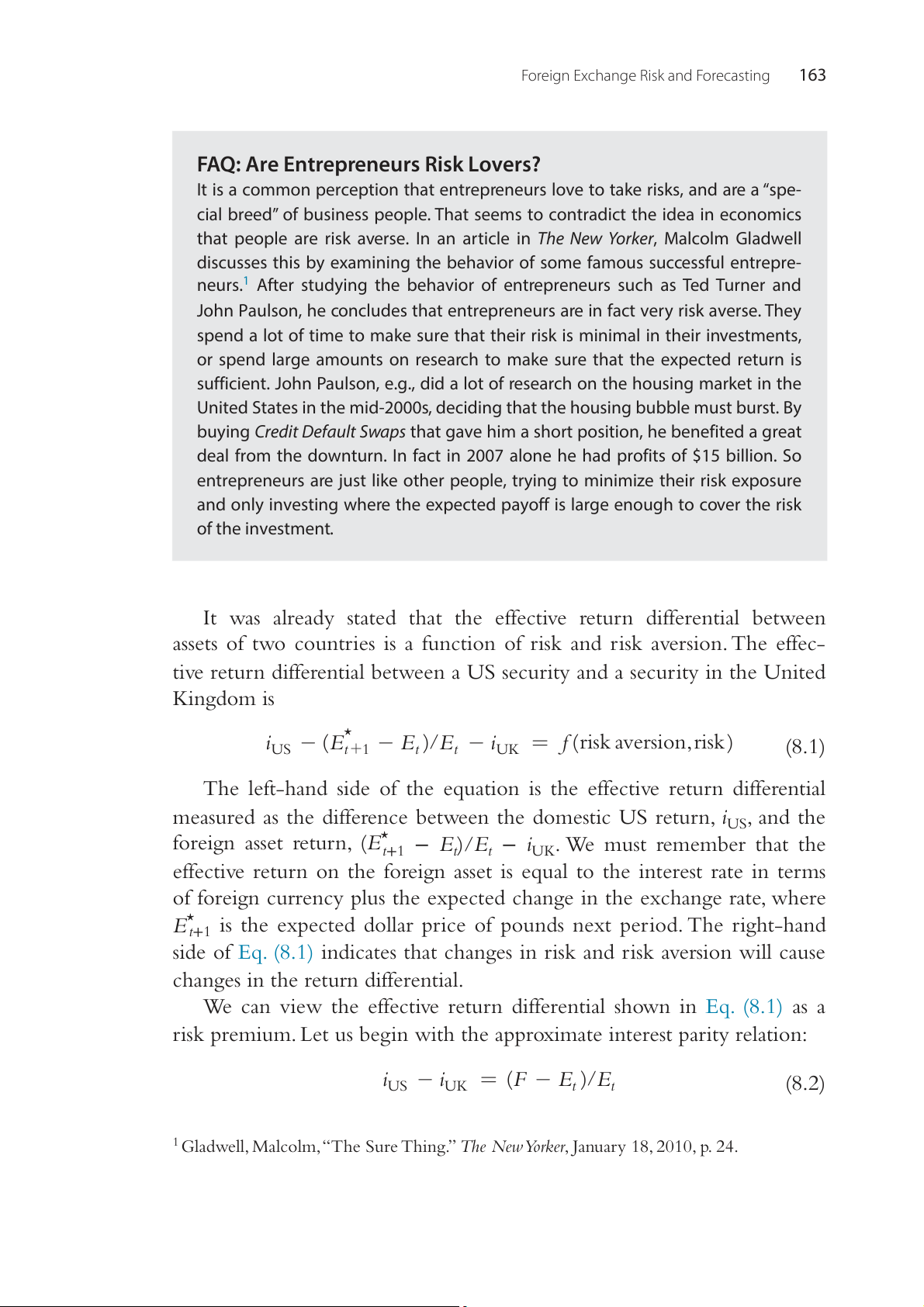
It was already stated that the effective return differential between
assets of two countries is a function of risk and risk aversion. The effec-
tive return differential between a US security and a security in the United Kingdom is * i − (E
− E )/E − i = ( , ) + f risk aversion risk US t 1 t t UK (8.1)
The left-hand side of the equation is the effective return differential
measured as the difference between the domestic US return, i , and the US
foreign asset return, (E*t )/E − i +1 − Et t UK. We must remember that the
effective return on the foreign asset is equal to the interest rate in terms
of foreign currency plus the expected change in the exchange rate, where
E*t+1 is the expected dollar price of pounds next period. The right-hand
side of Eq. (8.1) indicates that changes in risk and risk aversion will cause
changes in the return differential.
We can view the effective return differential shown in Eq. (8.1) as a
risk premium. Let us begin with the approximate interest parity relation: i − i = (
F − E ) E / US UK t t (8.2)
1 Gladwell, Malcolm, “The Sure Thing.” The New Yorker, January 18, 2010, p. 24. 164
International Money and Finance
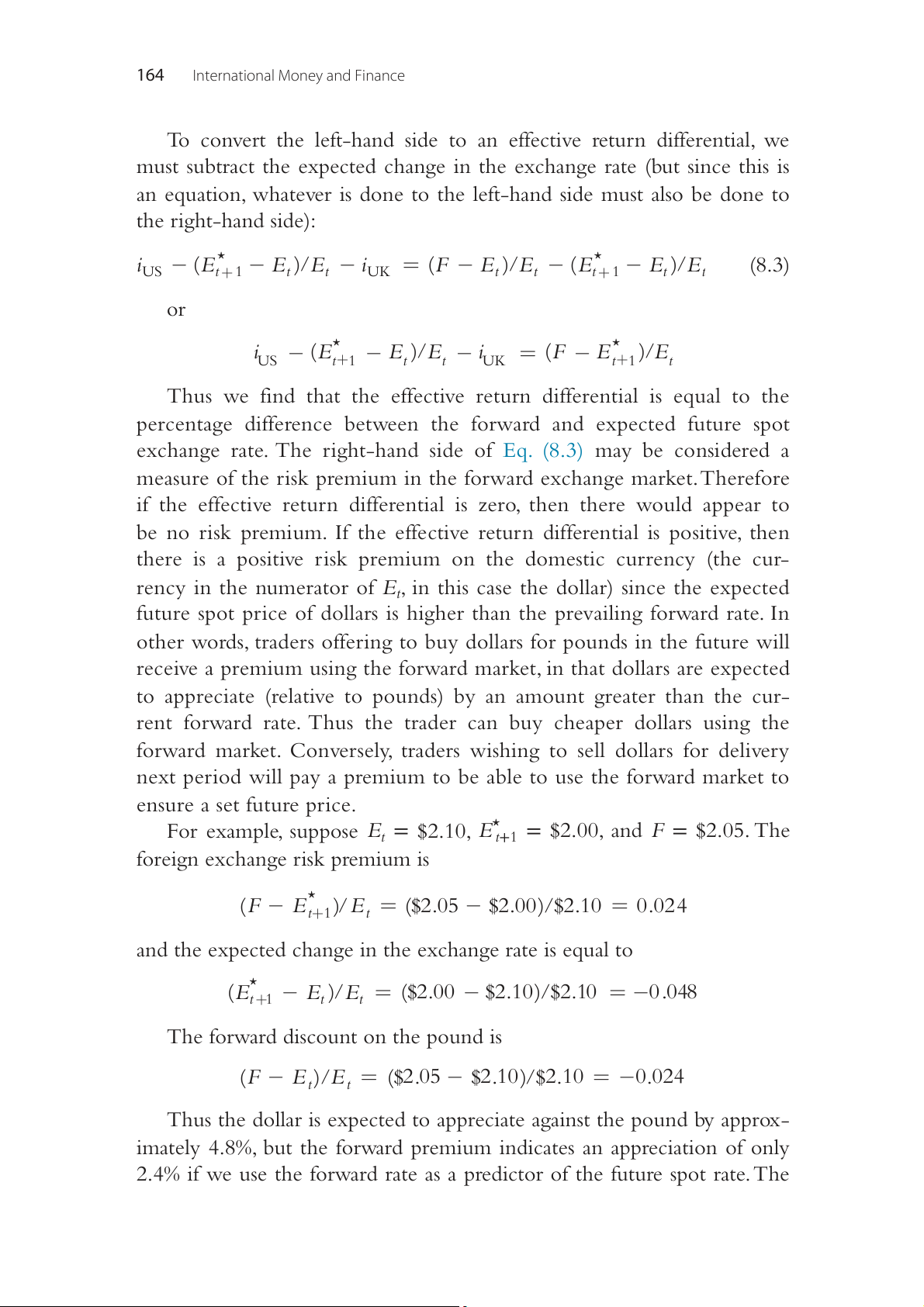
To convert the left-hand side to an effective return differential, we
must subtract the expected change in the exchange rate (but since this is
an equation, whatever is done to the left-hand side must also be done to the right-hand side): i − ( E * − )/ ( )/ ( * )/ (8.3) + E E − i = F − E E − E − 1 + E E US t t t UK t t t 1 t t or * * i − (E − )/ ( )/ + E E − i = F − E + E US t 1 t t UK t 1 t
Thus we find that the effective return differential is equal to the
percentage difference between the forward and expected future spot
exchange rate. The right-hand side of Eq. (8.3) may be considered a
measure of the risk premium in the forward exchange market. Therefore
if the effective return differential is zero, then there would appear to
be no risk premium. If the effective return differential is positive, then
there is a positive risk premium on the domestic currency (the cur-
rency in the numerator of E , in this case the dollar) since the expected t
future spot price of dollars is higher than the prevailing forward rate. In
other words, traders offering to buy dollars for pounds in the future will
receive a premium using the forward market, in that dollars are expected
to appreciate (relative to pounds) by an amount greater than the cur-
rent forward rate. Thus the trader can buy cheaper dollars using the
forward market. Conversely, traders wishing to sell dollars for delivery
next period will pay a premium to be able to use the forward market to ensure a set future price.
For example, suppose Et = $2.10, E*t+1 = $2.00, and F = $2.05. The
foreign exchange risk premium is * (F − E )/ 2 05 2 00 2 10 0 024 + E = ($ . − $ . )/$ . = . t 1 t
and the expected change in the exchange rate is equal to * (E − = 2 00 − 2 10 2 10 = −0 048 + E )/E ($ . $ . )/$ . . t 1 t t
The forward discount on the pound is
(F − E )/E = ($2.05 − $2.10)/$2.10 = −0.024 t t
Thus the dollar is expected to appreciate against the pound by approx-
imately 4.8%, but the forward premium indicates an appreciation of only
2.4% if we use the forward rate as a predictor of the future spot rate. The
Foreign Exchange Risk and Forecasting 165
discrepancy results from the presence of a risk premium that makes the
forward rate a biased predictor of the future spot rate. Specifically the for-
ward rate overpredicts the future dollar price of pounds in order to allow the risk premium.
Given the positive risk premium on the dollar, the expected effective
return from holding a UK bond will be less than the domestic return to
US residents holding US bonds. To continue with the previous example,
let us suppose that the UK interest rate is 0.124, whereas the US rate is
0.100. Then the interest rate differential is i − i = −0.024 US UK
The expected return from holding a UK bond is * i + E ( − )/ 0.124 . 0 048 . 0 076 + E E = − = UK t 1 t t
The return from the US bond is 0.10, which exceeds the expected
effective return on the foreign bond; yet this can be an equilibrium solu-
tion given the risk premium. Investors are willing to hold UK invest-
ments yielding a lower expected return than comparable US investments
because there is a positive risk premium on the dollar. Thus the higher
dollar return is necessary to induce investors to hold the riskier dollar- denominated investments. MARKET EFFICIENCY
Although the previous example had a nonzero effective return differ-
ential, it might still be an efficient market. A market is said to be efficient
if prices reflect all available information. In the foreign exchange mar-
ket, this means that spot and forward exchange rates will quickly adjust
to any new information. For instance, an unexpected change in US eco-
nomic policy that informed observers feel will be inflationary (like an
unexpected increase in money supply growth) will lead to an immediate
depreciation of the dollar. If markets were inefficient, then prices would
not adjust quickly to the new information, and it would be possible for a
well-informed investor to make profits consistently from foreign exchange
trading that would otherwise be excessive relative to the risk undertaken.
With efficient markets, the forward rate would differ from the
expected future spot rate only by a risk premium. If this were not the
case, and the forward rate exceeded the expected future spot rate plus a 166
International Money and Finance
risk premium, an investor could realize certain profits by selling forward
currency now, because she or he would be able to buy the currency at
a lower price in the future than the forward rate at which the currency
will be sold. Although profits can most certainly be earned from foreign
exchange speculation in the real world, it is also true that there are no
sure profits. The real world is characterized by uncertainty regarding the
future spot rate, since the future cannot be foreseen. Yet forward exchange
rates adjust to the changing economic picture according to revisions of
what the future spot rate is likely to be (as well as to changes in the risk
attached to the currencies involved). It is this ongoing process of price
adjustments in response to new information in the efficient market that
rules out any certain profits from speculation. Of course, the fact that the
future will bring unexpected events ensures that profits and losses will
result from foreign exchange speculation. If an astute investor possessed
an ability to forecast exchange rates better than the rest of the market, the
profits resulting would be enormous. Foreign exchange forecasting will be discussed in the next section.
Many studies have tested the efficiency of the foreign exchange mar-
ket. The fact that they have often reached different conclusions regarding
the efficiency of the market emphasizes the difficulty involved in using
statistics in the social sciences. Such studies have usually investigated
whether the forward rate contains all the relevant information regarding
the expected future spot rate. They test whether the forward rate alone
predicts the future spot rate well or whether additional data will aid in
the prediction. If further information adds nothing beyond that already
embodied in the forward rate, the market is said to be efficient. On the
other hand, if some data are found that would permit a speculator con-
sistently to predict the future spot rate better than can be done using the
forward rate (including a risk premium), then this speculator would earn
a consistent profit from foreign exchange speculation, and one could con-
clude that the market is not efficient.
It must be recognized that such tests have their weaknesses. Although
a statistical analysis must make use of past data, speculators must actually
predict the future. The fact that a researcher could find a forecasting rule
that would beat the forward rate in predicting past spot rates is not par-
ticularly useful for current speculation and does not rule out market effi-
ciency. The key point is that such a rule was not known during the time
the data were actually being generated. So if a researcher in 2017 claims
to have found a way to predict the spot rates observed in 2015 better
Foreign Exchange Risk and Forecasting 167
than the 2015 forward rates, this does not mean that the foreign exchange
market in 2015 was necessarily inefficient. Speculators in 2015 did not
have the forecasting rule developed in 2017, and thus could not have used
such information to outguess the 2015 forward rates consistently.
FOREIGN EXCHANGE FORECASTING
Since future exchange rates are uncertain, participants in international
financial markets can never know for sure what the spot rate will be 1
month or 1 year ahead. As a result forecasts must be made. If we could
forecast more accurately than the rest of the market, the potential profits
would be enormous. An immediate question is: What makes a good fore-
cast? In other words how should we judge a forecast of the future spot rate?
We can certainly raise objections to rating forecasts on the basis of
simple forecast errors. Even though, other things being equal, we should
prefer a smaller forecast error to a larger one, in practice other things are
not equal. To be successful, a forecast should be on the “correct side” of
the forward rate. The “correct side” means that the forecast makes the
market participant choose correctly whether to use the forward market or
not. For instance consider the following example: Current spot rate: ¥120 = $1
Current 12-month forward rate: ¥115 = $1 Mr. A forecasts: ¥106 = $1 Ms. B forecasts: ¥116 = $1
Future spot rate realized in 12 months: ¥113 = $1
A Japanese firm has a $1 million receipt due in 12 months and uses
the forecasts to help decide whether to cover the dollar receivable with
a forward contract or wait and sell the dollars in the spot market in 12
months. In terms of forecast errors, Mr. A’s prediction of ¥106 = $1 yields
an error of −6.2% ((106 − 113)/113) against a realized future spot rate of
¥113. Ms. B’s prediction of ¥116 = $1 is much closer to the realized spot
rate, with an error of only 2.6% ((116 − 113)/113). While Ms. B’s forecast
is closer to the rate eventually realized, this is not the important feature of
a good forecast, in this case. Ms. B forecasts a future spot rate in excess of
the forward rate, so if it followed her prediction, the Japanese firm would
wait and sell the dollars in the spot market in 12 months (or would take a
long position in dollars). Unfortunately since the future spot rate ¥113 = $1
is less than the current forward rate at which the dollars could be sold 168
International Money and Finance
(¥115 = $1), the firm would receive ¥113 million rather than ¥115 mil- lion for the $1 million.
Following Mr. A’s forecast of a future spot rate below the forward rate,
the Japanese firm would sell dollars in the forward market (or take a short
position in dollars). The firm would then sell dollars at the current forward
rate of ¥115 per dollar rather than wait and receive only ¥113 per dollar
in the spot market in the future. The forward contract yields ¥2 million
more than the uncovered position. The important lesson is that a forecast
should be on the correct side of the forward rate; otherwise, a small fore-
casting error is not useful. Corporate treasurers or individual speculators
want a forecast that will give them the direction the future spot rate will
take relative to the forward rate.
If the foreign exchange market is efficient so that prices reflect all avail-
able information, then we may wonder why anyone would pay for fore-
casts. There is some evidence that advisory services have been able to “beat
the forward rate” at certain times. If such services could consistently offer
forecasts that are better than the forward rate, what can we conclude about
market efficiency? Evidence that some advisory services can consistently
beat the forward rate is not necessarily evidence of a lack of market effi-
ciency. If the difference between the forward rate and the forecast represents
transaction costs, then there is no abnormal return from using the forecast.
Moreover, if the difference is the result of a risk premium, then any returns
earned from the forecasts would be a normal compensation for risk bear-
ing. Finally we must realize that the services are rarely free. Although the
economics departments of larger banks sometimes provide free forecasts to
corporate customers, professional advisory services charge anywhere from
several hundred to many thousands of dollars per year for advice. If the
potential profits from speculation are reflected in the price of the service,
then once again we cannot earn abnormal profits from the forecasts.
FUNDAMENTAL VERSUS TECHNICAL TRADING MODELS
Exchange rate forecasters typically use two types of models: technical or
fundamental. A fundamental model forecasts exchange rates based on vari-
ables that are believed to be important determinants of exchange rates. As
we shall learn later in the text, fundamentals-based models of exchange
rates view as important things like government monetary and fiscal policy,
international trade flows, and political uncertainty. An expected change
Foreign Exchange Risk and Forecasting 169
in some fundamental variable leads to a current change in the forecast.
A technical trading model uses the past history of exchange rates to predict
future movements. Technical traders are sometimes called chartists because
they use charts or diagrams depicting the time path of an exchange rate
to infer changing trends. Finance scholars typically have taken a dim view
of technical analysis, since the ability to predict future price movements
by looking only at the past would bring the concept of efficient mar-
kets into question. However, recent research has led to a more support-
ive view of technical analysis by some scholars and the method is widely
popular among foreign exchange market participants. Surveys indicate that
nearly 90% of foreign exchange dealers use some sort of technical analysis
to form their expectations of exchange rates. However, the same surveys
suggest that technical models are seen as particularly useful for short-term
forecasting, while fundamentals are seen as more important for predicting long-run changes.
Although the returns to a superior forecaster would be considerable,
there is no evidence to suggest that abnormally large profits have been
produced by following the advice of professional advisory services. But
then if you ever developed a method that consistently outperformed other
speculators, would you tell anyone else? SUMMARY
1. Foreign exchange risk includes translation exposure, transaction
exposure, and economic exposure.
2. Foreign exchange risk could be minimized by trading in forward-
looking market instruments, invoicing prices in domestic currency,
speeding payments of currencies expected to appreciate, and speeding
collections of currencies expected to depreciate.
3. The foreign exchange risk premium is the difference between the
forward exchange rate and the expected future spot exchange rate.
4. A risk-averse investor will prefer an investment with a lower risk
when he/she faces two investments of similar expected returns.
5. The difference between the return on a domestic asset and the effec-
tive return on a foreign asset depends on the risk of the assets and the degree of risk aversion.
6. The effective return differential is equal to the risk premium in the forward exchange market. 170
International Money and Finance
7. If the effective return differential is zero, then there would be no risk
premium. If the effective return differential is positive, then there
would be a positive risk premium on the domestic currency.
8. If a positive risk premium on the domestic currency exists, investors
would be willing to hold foreign investments even if the foreign invest-
ments yield lower effective returns than the domestic investments.
9. In an efficient market, prices reflect all available information. If the
foreign exchange market is efficient, the forward exchange rate
would differ from the expected future spot exchange rate only by a risk premium.
10. For multinational firms, a good forecast is not necessarily minimizing
forecasting errors, but it should be on the correct side of the forward exchange rate. EXERCISES
1. Distinguish among translation exposure, transaction exposure, and eco-
nomic exposure. Define each concept and then indicate how they may be interrelated.
2. The 6-month interest rate in the United States is 10%; in Mexico it is
12%. The current spot rate (dollars per peso) is $0.40.
a. What do you expect the 6-month forward rate to be?
b. Is the peso selling at a premium or discount?
c. If the expected spot rate in 6 months is $0.38, what is the risk premium?
3. We discussed risk aversion as being descriptive of investor behavior.
Can you think of any real-world behavior that you might consider to
be evidence of the existence of risk preferrers?
4. Does an efficient market rule out all opportunities for speculative prof-
its? If so, why? If not, why not?
5. You are the treasurer of a US firm that has a €1 million commitment
due to a German firm in 90 days. The current spot rate is $1.00 per
euro, and the 90-day forward rate is $1.11. Ali forecasts that the spot
rate in 90 days will be $1.01. Jahangir forecasts that the spot rate will
be $1.12 in 90 days. The actual spot rate in 90 days turns out to be
$1.10. Who had the best forecast and why?
6. It was reported in the Financial Times that “Toyota suffers a ¥20 billion
drop in operating profits for every ¥1 rise (in the exchange rate, yen
per dollar) against the dollar.” Does this statement have implications for
transaction, translation, or economic exposure primarily?
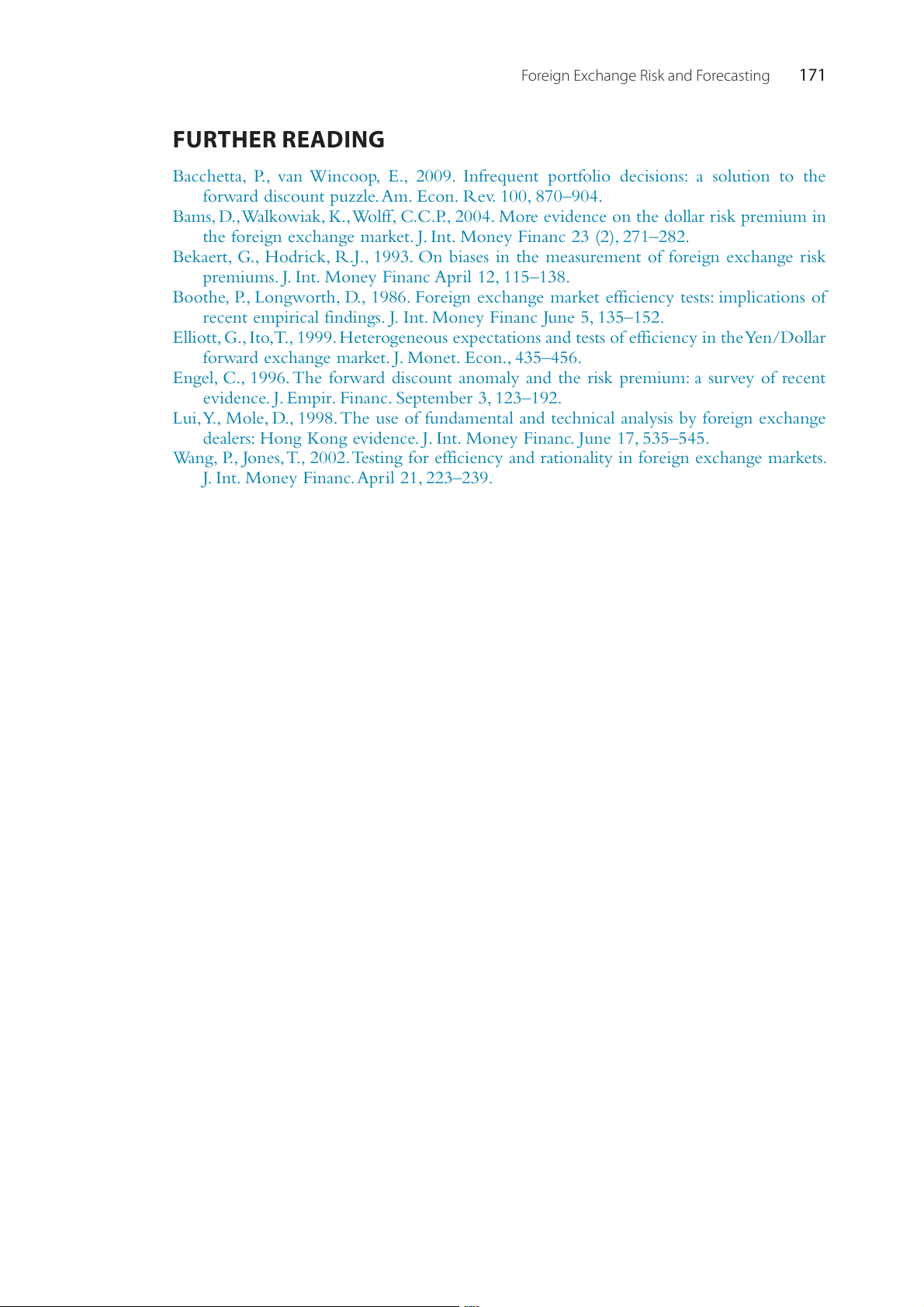
Foreign Exchange Risk and Forecasting 171 FURTHER READING
Bacchetta, P., van Wincoop, E., 2009. Infrequent portfolio decisions: a solution to the
forward discount puzzle. Am. Econ. Rev. 100, 870–904.
Bams, D., Walkowiak, K., Wolff, C.C.P., 2004. More evidence on the dollar risk premium in
the foreign exchange market. J. Int. Money Financ 23 (2), 271–282.
Bekaert, G., Hodrick, R.J., 1993. On biases in the measurement of foreign exchange risk
premiums. J. Int. Money Financ April 12, 115–138.
Boothe, P., Longworth, D., 1986. Foreign exchange market efficiency tests: implications of
recent empirical findings. J. Int. Money Financ June 5, 135–152.
Elliott, G., Ito, T., 1999. Heterogeneous expectations and tests of efficiency in the Yen/Dollar
forward exchange market. J. Monet. Econ., 435–456.
Engel, C., 1996. The forward discount anomaly and the risk premium: a survey of recent
evidence. J. Empir. Financ. September 3, 123–192.
Lui, Y., Mole, D., 1998. The use of fundamental and technical analysis by foreign exchange
dealers: Hong Kong evidence. J. Int. Money Financ. June 17, 535–545.
Wang, P., Jones, T., 2002. Testing for efficiency and rationality in foreign exchange markets.
J. Int. Money Financ. April 21, 223–239.
Tài liệu liên quan:
-

Hoạt động Tài chính của Doanh nghiệp Đa Quốc Gia (DN) - Chương 6 | Tài chính quốc tế | Trường Học Viện nông nghiệp Việt Nam
19 10 -
Hệ Thống Tiền Tệ Quốc Tế: Khái Niệm và Các Chế Độ Tỷ Giá | Tài chính quốc tế | Trường Học Viện nông nghiệp Việt Nam
24 12 -

Bài giảng Chương 1: Các Quan Hệ Cân Bằng Quốc Tế và LOP | Tài chính quốc tế | Trường Học Viện nông nghiệp Việt Nam
21 11 -

Cách Tính Lạm Phát và CPI: So Sánh Việt Nam và Mỹ | Tài chính quốc tế | Trường Học Viện nông nghiệp Việt Nam
23 12 -

Detailed Report and Analysis on Submission Trends | Tài chính quốc tế | Trường Học Viện nông nghiệp Việt Nam
23 12