Foreign Trade MCQ môn Kinh tế vi mô | Trường Đại học Kinh Tế Quốc Dân
A tariff is a tax placed on a. exported goods that lowers the domestic price below the world price. b. exported goods that keeps the domestic price the same as the worl price . Tài liệu giúp bạn tham khảo, ôn tập và đạt kết quả cao. Mời đọc đón xem!
Môn: Kinh tế vi mô ( NEU ) 762 tài liệu
Trường: Trường Đại học Kinh Tế Quốc Dân 7.5 K tài liệu
Tác giả:




Preview text:
FOREIGN TRADE 1. A tariff is a tax placed on
a. exported goods that lowers the domestic price below the world price.
b. exported goods that keeps the domestic price the same as the world price.
c. imported goods that lowers the domestic price below the world price.
d. imported goods that raises the domestic price above the world price.
2. When goods that are produced in the United States are sold to China, the goods are
a. exported by the United States and imported by China.
b. imported by the United States and exported by China.
c. exported by the United States and exported by China.
d. imported by the United States and imported by China.
3. When Ford and General Motors import automobile parts from
Mexico at prices below those they must pay in the United States,
a. workers who assemble Ford and General Motors vehicles become worse off.
b. United States consumers, taken as a group, become worse off.
c. Mexican consumers, taken as a group, become worse off.
d. American companies that manufacture automobile parts become worse off.
4. Countries usually impose restrictions on free foreign trade to protect a. foreign producers. b. foreign consumers. c. domestic producers. d. domestic consumers.
5. For any country, if the world price of computers is higher than
the domestic price of computers, that country should
a. export computers, since that country has a comparative advantage in computers.
b. import computers, since that country has a comparative advantage in computers.
c. not trade computers, since that country cannot gain from trade.
d. not trade, since they already produce computers cheaper than other countries.
6. A country has a comparative advantage in a product if the world price is
a. lower than its domestic price.
b. higher than its domestic price.
c. equal to its domestic price.
d. None of the above are correct.
7. If the United States exports cars to France and imports cheese from Switzerland,
a. the United States has a comparative advantage in producing cars, and Switzerland has a
comparative advantage in producing cheese.
b. the United States has a comparative advantage in producing cheese, and Switzerland has a
comparative advantage in producing cars.
c. the United States and France would both be better off if they each produced cars and cheese.
d. Comparative advantage cannot be determined without knowing absolute prices.
8. When a country allows trade and becomes an exporter of a good domestic producers
a. gain and domestic consumers lose.
b. lose and domestic consumers gain.
c. and domestic consumers both gain.
d. and domestic consumers both lose.
9. When a country allows trade and becomes an importer of a good,
a. everyone in the country benefits.
b. the gains of the winners exceed the losses of the losers.
c. the losses of the losers exceed the gains of the winners.
d. everyone in the country loses.
10. The world price of yo-yo’s is $4.00 each. The pre-trade
price of yo-yo’s in Taiwan is $3.50 each. If Taiwan allows
trade in yo-yo’s we know that Taiwan will
a. import yo-yo’s and the price in Taiwan will be $4.00 each.
b. import yo-yo’s and the price in Taiwan will be $3.50 each.
c. export yo-yo’s and the price in Taiwan will be $4.00 each.
d. export yo-yo’s and the price in Taiwan will be $3.50 each.
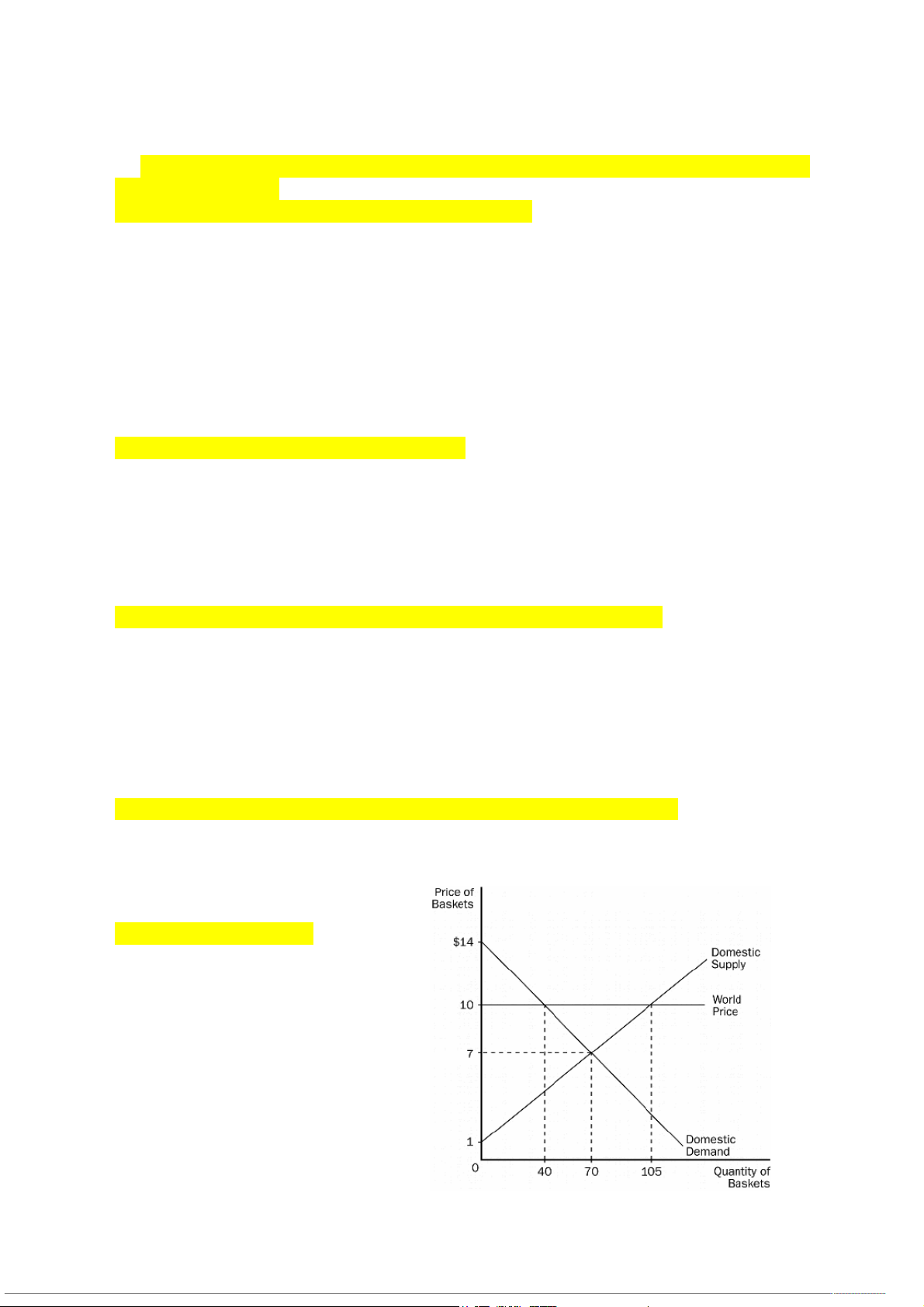
11. According to the graph, with free trade, this countrywould a. import 70 baskets. b. export 65 baskets. c. export 35 baskets. d. import 40 baskets.
12. According to the graph for this country, at the world price,
a. the domestic quantity demanded is greater
than the domestic quantity supplied.
b. the domestic quantity demanded is less than the domestic quantity supplied.
c. the domestic quantity demanded equals the domestic quantity supplied.
d. this country should raise the domestic price of baskets.
13. According to the graph, the increase in
total surplus resulting from trade is
a. $60. Since producer surplus increases by
$180 and consumer surplus falls by $240.
b. $60. Since consumer surplus increases by
$180 and producer surplus falls by $240.
c. $75. Since producer surplus increases by
$240 and consumer surplus falls by $165.
d. $75. Since consumer surplus increases by
$240 and producer surplus falls by $165
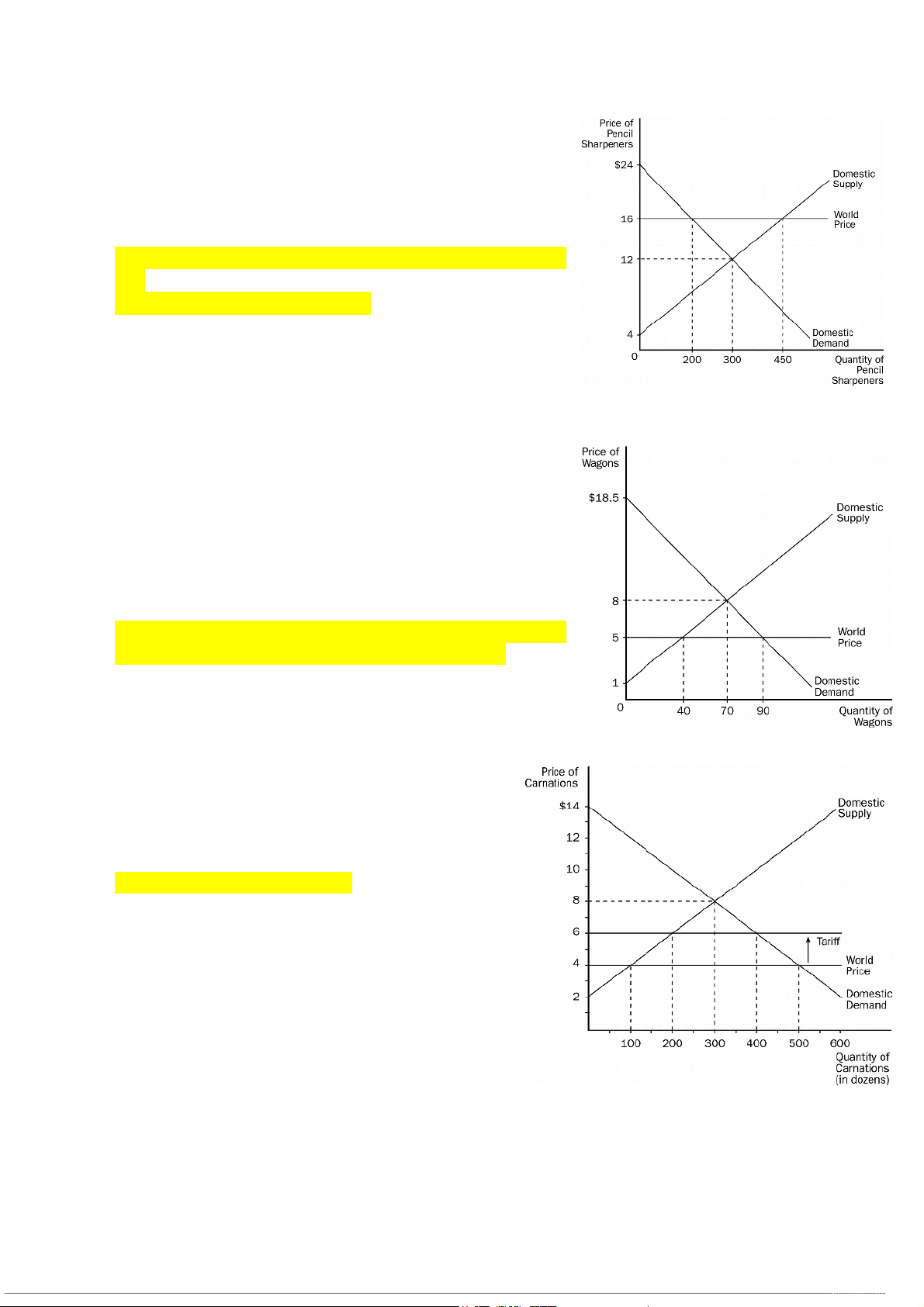
14. According to the graph, before
the tariff is imposed, this country will a. import 200 carnations. b. import 400 carnations. c. export 200 carnations. d. export 400 carnations.
15. The before-trade price of fish in Greece is $3.00 per pound.
The world price of fish is $5.00 perpound. Greece is a price-taker
in the fish market. If Greece allows trade in fish Greece will become an
a. importer of fish and the price of fish in Greece will be $3.00.
b. importer of fish and the price of fish in Greece will be $5.00.
c. exporter of fish and the price of fish in Greece will be $3.00.
d. exporter of fish and the price of fish in Greece will be $5.00.
Tài liệu liên quan:
-
TOPIC: COSMETICS môn Kinh tế vi mô | Trường Đại học Kinh tế Quốc dân
1 1 -

Sách Bài Tập Vi Mô - Hướng Dẫn và Lời Giải Chi Tiết
11 6 -

Nguyên lý chiến lược kinh doanh - Bài giảng môn Kinh tế vi mô | Trường Đại học Kinh Tế Quốc Dân
12 6 -

Chương 7 các kỹ thuật lựa chọn chiến lược - Bài giảng môn Kinh tế vi mô | Trường Đại học Kinh Tế Quốc Dân
12 6 -
Tổng hợp câu hỏi trắc nghiệm theo chương ôn tập môn Kinh tế vi mô | Trường Đại học Kinh Tế Quốc Dân
17 9