GIÁO TRÌNH LÝ THUYẾT DỊCH
Giáo trình lý thuyết dịch.Tài liệu được tổng hợp và sưu tầm gồm 115 trang. Mời các bạn tham khảo
Môn: Lý thuyết dịch 19 tài liệu
Trường: Trường Đại học Ngoại ngữ, Đại học Đà Nẵng 292 tài liệu
Tác giả:


















Preview text:
3 MỤC LỤC Trang LỜI NÓI ĐẦU 5
Unit 1. TRANSLATION AND TRANSLATION THEORY 6
1.1. Definition of translation and translation theory 6 1.2. Translation history 9
1.3. The dynamics of translation 9 1.4. Translation and culture 11
1.5. Pre-translation considerations 22 1.6. Questions for discussion 39
Unit 2. TRANSLATION PROCESS AND METHOD 40 2.1. Translation process 40
2.2. The approach to translation 41 2.3. The unit of translation 42 2.4. Translation methods 42 2.5. Questions for discussion 46
Unit 3. TRANSLATION EQUIVALENCE AND TRANSLATION 47 LOSS 3.1. Translation equivalence 47 3.2. The equivalent effect 57 3.3. Translation loss 59 3.4. Questions for discussion 60
Unit 4. GRAMMATICAL SKEWING AND TRANSLATION 61 SHIFTS 4.1. Grammatical skewing 61 4.2. Translation shifts 68 4.3. Questions for discussion 69
Unit 5. STRATEGIES FOR TRANSLATORS 70 5.1. About language 70
5.2. Strategies for translators 71 5.3. Questions for discussion 81
Unit 6. TRANSLATION EVALUATION 82
6.1. Why evaluate the translation? 82 4
6.2. Who evaluates the translation? 83 6.3. Translation criteria 83
6.4. Ways of evaluating translation 86 6.5. Questions for discussion 90 91
Unit 7. INTERPRETATION AND INTERPRETING IN SPECIALIZED AREAS 7.1. What is interpreting? 91 7.2. Modes of interpreting 91 7.3. Interpreting process 95
7.4. Attributes for interpreting 95
7.5. Interpreting in specialized areas 102
7.6. Codes of ethics for liaison interpreters 113 7.7. Questions for discussion 114 TÀI LIỆU THAM KHẢO 116 5 LỜI NÓI ĐẦU
Lý thuyết dịch là một môn học trong chương trình đào tạo đại học ngoại
ngữ chuyên ngành ngôn ngữ Anh tại Học viện Khoa học Quân sự. Đây là một
môn học khó yêu cầu người học phải nắm được một lượng kiến thức lớn về lý
thuyết. Nhằm đáp ứng yêu cầu giảng dạy, năm 2002, Khoa tiếng Anh đã biên
soạn cuốn Giáo trình Lý thuyết dịch để phục vụ cho việc giảng dạy môn học này.
Tuy nhiên, do thời gian biên soạn đã khá lâu nên nhiều nội dung đã không còn
phù hợp với kiến thức hiện nay. Bên cạnh đó, cuốn giáo trình biên soạn năm 2002
chưa đề cập đến quá trình dịch các chuyên ngành, đặc biệt là dịch tiếng Anh quân
sự. Được sự chấp nhận của Thủ trưởng Học viện, chúng tôi đã lựa chọn và biên
soạn một cuốn giáo trình Lý thuyết dịch mới với mục đích cung cấp một cái nhìn
hệ thống hơn và bám sát với điều kiện thực tế hơn phục vụ cho việc giảng dạy
môn Lý thuyết dịch tại Khoa Tiếng Anh, Học viện Khoa học Quân sự.
Giáo trình Lý thuyết dịch gồm 7 bài, giới thiệu về các vấn đề cơ bản nhất
trong lý thuyết dịch. Bài 1 giới thiệu các vấn đề chung của dịch thuật và lý thuyết
dịch. Bài 2 giới thiệu về quá trình dịch (translation process) và các phương pháp
dịch (translation methods) phổ biến. Bài 3 giới thiệu về tương đương
(equivalence) và mất nghĩa (loss) trong khi dịch. Bài 4 giới thiệu về các vấn đề
bất tương xứng trên phương diện ngữ pháp (grammatical skewing) và chuyển dịch
(translation shift). Bài 5 đề xuất một số chiến lược dịch (translation strategies) cho
người dịch. Bài 6 giới thiệu những nội dung về đánh giá bản dịch. Bài 7 giới thiệu
về hoạt động phiên dịch và phiên dịch trong các lĩnh vực chuyên ngành.
Giáo trình này được sử dụng cho các đối tượng đào tạo đại học ngoại ngữ
cấp Phân đội, đại học ngoại ngữ Dân sự và văn bằng 2. Mỗi bài sẽ được dạy trong
4 tiết. Tuy nhiên, ở một số bài, tuỳ theo yêu cầu của từng đối tượng đào tạo và
thời gian dành cho môn học, giáo viên cần lựa chọn những phần trọng tâm ở từng
bài để giảng dạy. Đối với những phần còn lại, người học tự nghiên cứu ở nhà để
nắm vững những vấn đề liên quan. Do lý thuyết dịch là một môn khó, bao hàm
nhiều quan điểm khác nhau nên chúng tôi rất mong nhận được ý kiến đóng góp
của các đồng nghiệp và các chuyên gia để giáo trình được hoàn thiện hơn. Các tác giả 6 Unit 1
TRANSLATION AND TRANSLATION THEORY
1.1. Definition of translation and translation theory
1.1.1. What is translation?
There has been a plethora of definitions which Nida (1964, pp.161-164) has
elaborately surveyed. He rightly elucidates: Definitions of proper translating are
almost as numerous and varied as the persons who have undertaken to discuss the subject.
This diversity is in a sense quite understandable; for there are vast
differences in the materials translated, in the purpose of the publication, and in the
needs of the prospective audience. Nevertheless, a definition which is not
confined to the mere transference of meaning is furnished by Nida and Taber
(1964, p.12) who postulate translation consists in reproducing in the receptor
language the closest natural equivalent of the source language message, first in
terms of meaning and secondly in terms of style.
Bell (1991, pp.5-6) seems to have pursued the same line of emphasis on
meaning and style in his translation of translation “Translation is the expression
in another language (or the target language) of what has been expressed in
another, source language, preserving semantic and stylistic equivalences”.
The above definitions also stress the significance of ‘equivalence’
which underlies the following definitions given by Catford (1965, p.20):
“Translation is the replacement of a text in one language by a replacement
of an equivalent text in a second language” and “Translation is the
replacement of textual material in one language (SL) by equivalent textual
material in another language (TL)”.
On the other hand, functionalists view translation differently: Translation
is the production of a functional target text maintaining a relationship with a
given source text that is specified according to the intended or demanded
function of the target text (Nord, in Shutttle Worth and Cowie, (1997, p.182).
Nord, however, distinguishes between two senses of translation: wide and
narrow. Translation is, in a narrow sense, any translational action where a
source text is transferred into a target culture and language.
According to the form and presentation of the target text we distinguish
between oral translation (‘interpreting’) and written translation (‘translation’ in
the narrow sense) (Nord, 2001, p.141). Widening the above definitions, Sager
(1989, p.293) maintains that translation should reflect the environment in which
the professional translation activity takes place: Translation is an extremely
motivated industrial activity, supported by information technology, which is
diversified in response to the particular needs of this form of communication. In a
similar vein, Koller (1989, p.196) describes translation as a ‘text processing 7
activity and simultaneously highlights the significance of ‘equivalence’:
Translation can be understood as the result of a text-processing activity, by means
of which a source-language text is transposed into a target-language text. Between
the resulting text in L2 (the target-language text) and the source text L1 (the
source language text) there exists a relationship which can be designated as
translational, or equivalence relation.
Amongst the above definitions, Nida and Taber's (1964) may serve as a
basis for our concept of translation as a TL product which is as semantically
accurate, grammatically correct, stylistically effective and textually coherent as
the SL text. In other words, the translator's main attention should not be focused
only on the accurate semantic transference of SL message into the TL, but also on
the appropriate syntax and diction in the TL, which are explicitly the translator's
(not the source author's) domain of activity which displays his true competence.
Indeed, according to Wilss (2001, p.95), "the notion of translation competence,"
"is aptly assessed in transfer situations that require at least some degree of
adaptation to new and challenging textual demands." He describes such situations
as "accommodatory situations" which need "structural adjustment" (ibid) and
generally textual manipulation. In point of fact, the competent translator performs
multiple tasks with inevitable intricacies of performance. His approach to
translating expressive, emotive or expository texts in particular is deemed to be
creativity-oriented, that is, hermeneutic/manipulation rather than routine-oriented.
In short, translation is concerned with the written word. Hence, the
translators render written texts from one language into another. Translators are
required to undertake assignments, which range from simple items, such as birth
certificates and driving licenses, to more complex written material, such as
articles in specialized professional journals, business contracts and legal documents. 8
1.1.2. What is translation theory?
Translation theory, in a narrow sense, is concerned with the translation
method appropriately used for a certain type of text, and it is therefore dependent
on a functional theory of language. However, in a wider sense, translation theory
is the body of knowledge that we have about translating, extending from general
principles to guidelines, suggestions and hints.
Since the mid 1980s there have been some major translation theories in the world.
- Linguistic Theory of Translation by Catford (1965), Nida (1975) focuses
on finding the equivalence (of meaning, grammar, content...)
- Functionalist Theories of Translation (German school) by Reiss (2000),
Neubart (1985) do not pay attention to source texts. Their main aim is what we do with translation.
- Translation as Cultural Events Theory by Hormer (1975) sets up an
integrated approach to translation.
- Manipulation School of Translation by Bassnett (1980) points out the power of translation.
- Deconstructionist Theories by Gentzler (1993) (USA) forget source texts
and regard translation as the second original.
- Culture and Context Theories by Newmark (1984) focus on culture and
context during the translation process. As this is the most suitable for
undergraduate students, the theory, which is introduced below, is based on Newmark's.
Translation theory, in a narrow sense, is concerned with the translation
method appropriately used for a certain type of text, and it is therefore dependent
on a functional theory of language. However, in a wider sense, translation theory
is the body of knowledge that we have about translating, extending from general
principles to guidelines, suggestions and hints.
What translation theory does is, first, to identify and define a translation
problem (no problem - no translation theory!); second, to indicate all the factors
that have to be taken into account in solving the problem; third, to list all the
possible translation procedures; finally, to recommend the most suitable
translation procedure, plus the appropriate translation.
Translation theory’s main concern is to determine appropriate translation
methods for the widest possible range of texts or text-categories. Further, it
provides a framework of principles, restricted rules and hints for translating
texts and criticizing translations, a background for problem-solving.
1.2. Translation history 9
Translation has always been done by somebody for somebody. The first
trace of translation dates from 3000 B.C, during the Egyptian Old Kingdom,
the area of the First Cataract, Elephantine, where inscriptions in two languages
have been found. It became a significant factor in the West in 300 BC Luther's
Bible translation in 1522 laid the foundations of modern German. In the 19th
century translation was mainly a one-way means of communication between
prominent men of letters and, to a lesser degree, philosophers and scientists
and their educated readers abroad, whilst trade was conducted in the language
of the dominant nation, and diplomacy, previously in Latin, was in French.
The 20th century has been called the “age of translation” to which one
may add “and interpreting”. International agreements between states, between
state, public and private organizations are now translated for all interested
parties, whether or not the signatories understand each other's language. The
setting up of a new international body, the constitution of an independent state,
the formation of a multinational company, gives translation enhanced
importance. The exponential increase in technology (patents, specifications,
documentation), the attempt to bring it to developing countries, the
simultaneous publication of the same book in various languages, the increase in
world communication, has correspondingly increased requirements. That the
very survival of such bodies as the United Nations is crucially dependent on
interpreting and translation can be taken as a good example of the importance
of translation and interpreting.
1.3. The dynamics of translation
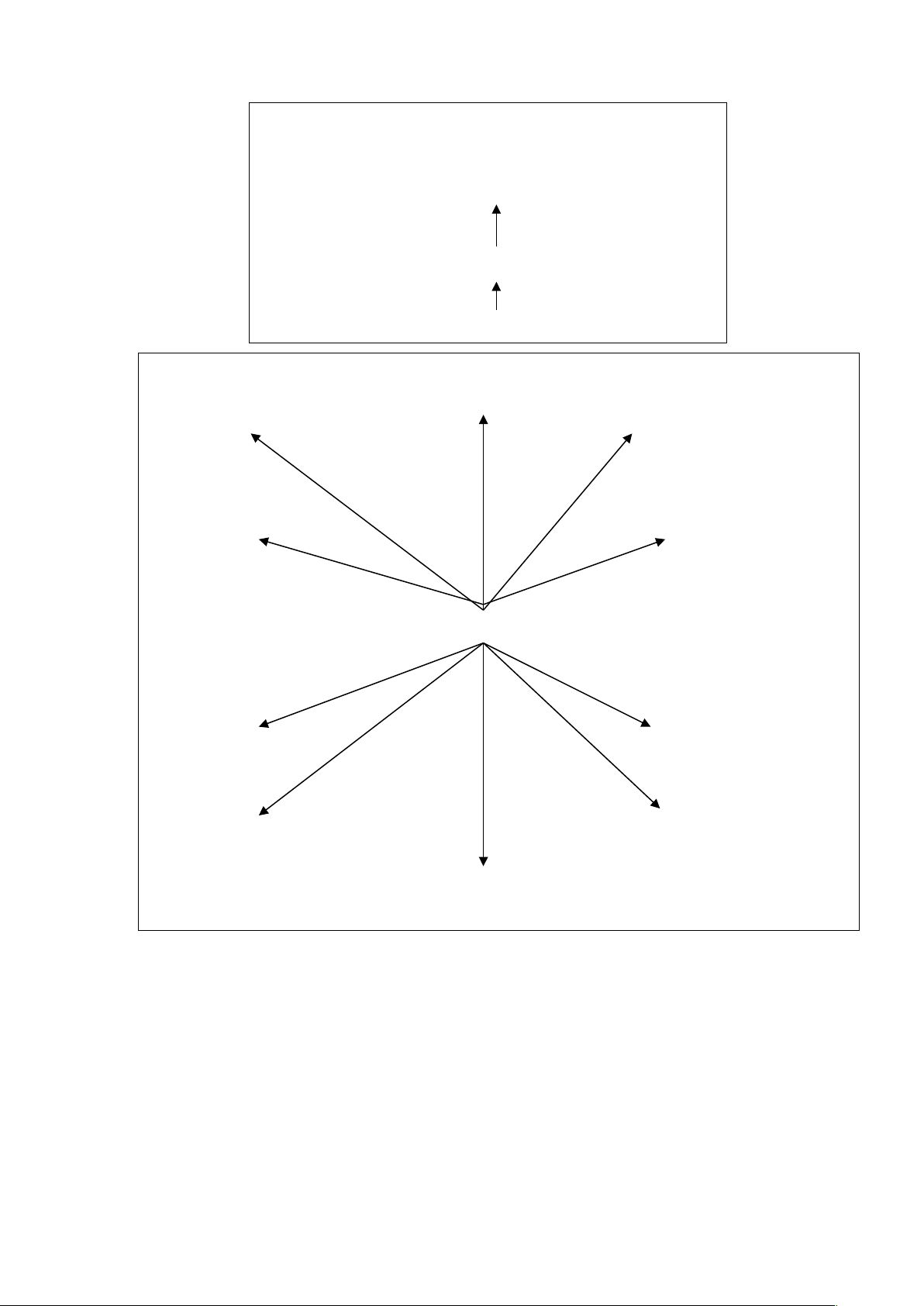
According to Newmark (1988), there are some participants/actors in the translation process: 10 L1 C1 L1 C1 L1 C1 L2 C2
Author Reader Translator Reader L2 C2 Translation Initiator Translation Commissioner
9. The truth (the facts of the matter) 1. SL writer 5. TL readership 2. SL norms 6. TL norms TEXT 3. SL culture 7. TL culture 4. SL setting 8. TL setting and tradition and tradition 10. Translator
Figure 1.2. Newmark’s participants/actors in the translation process
A text is pulled in ten different directions, as follows:
(1) The individual style or idiolect of the source language (SL) author when
should it be preserved, normalized?
(2) The conventional grammatical and lexical usage for this type of text,
depending on the topic and situation.
(3) Content items referring specifically to the SL, or the third language
(i.e. not source language or target language (TL) cultures. 11
(4) The typical format of a text in a book, periodical, newspaper etc, as in
influenced by tradition at the time.
(5) The expectations of the putative readership, bearing in mind their
estimated knowledge of the topic and the style of language they use, expressed in
terms of the largest common factor, since one should not translate down (or up) to the readership.
(6), (7), (8). As for (2),(3) and (4) respectively, but related to the TL.
(9) What is being described or reported, ascertained or verified (the
referential truth). Where are possible independently of the SL text and the
expectations of the readership.
(10) The views and perfidies of the translator, which may be personal and
subjective, or may be social and cultural, involving the translator’s “group
loyalty factor”, which may reflect the national, political, ethnic, religious, social
class, sex etc, assumptions of the translator.
1.4. Translation and culture
Language and culture may thus be seen as being closely related and both
aspects must be considered for translation. When considering the translation of
cultural words and notions, Newmark proposes two opposing methods:
transference and componential analysis (Newmark, 1988, p.96). As Newmark
mentions, transference gives "local colour," keeping cultural names and concepts.
1.4.1. Definition of culture
Culture here is defined as the way of life and its manifestations that are
peculiar to a community that uses a particular language as its means of
expression. There is a clear distinction between ‘cultural’, ‘universal’ and
‘personal’ language. ‘Die’, ‘live’, ‘star’, ‘swim’, ‘mirror’ and ‘table’ are
universals – usually there is no translation problem there. ‘Monsoon’, ‘steppe’,
‘dacha’, ‘tagliatelle’ are cultural words – there will be a translation problem
unless there is cultural overlap between the source and the target language (and its
readership). Universal words such as ‘breakfast’, ‘embrace’, ‘pile’ often cover the
universal function, but not the cultural description of the referent. And if one
expresses himself in a personal way – ‘you’re weaving (creating conversation) as
usual’, his “underlife” (personal qualities and private life) is evident in that
poem’, ‘he’s a monologer’ (never finishes the sentence) – he uses personal, not
immediately social language, what is often called idiolect, and there is normally a translation problem.
All these are broad and fuzzy distinctions. You can have several cultures
(and sub-cultures) within one language. When a speech community focuses its
attention on a particular topic (this is usually called ‘cultural focus), it spawns a
plethora of words to designate its special language or terminology – the English
on sport, notably the crazy cricket words (‘a maiden over’, ‘silly mid-on’, 12
‘howzzat’), the French on wine and cheeses, the Germans on sausages, Spaniards
on bull-fighting, Arabs on camels, Eskimos on snow, the Vietnamese on bamboo
and bamboo products. Frequently where there is cultural focus, there is a
translation problem due to the cultural ‘gap’ or ‘distance’ between the source and the target languages.
It should be noted that language is not regarded as a component or feature
of culture. If it were so, translation would be impossible. Language does however
contain all kinds of cultural deposits, in the grammar (genders of inanimate
nouns), forms of address (like chú bác, cậu mợ, cô dì) as well as the lexis (the sun
sets) which are not taken account of universals either in consciousness of
translation. The more specific a language becomes for natural phenomena (e.g.
flora and fauna) the more it becomes embedded in cultural features, and therefore creates translation problems.
Most ‘cultural’ words are easy to detect, since they are associated with a
particular language and cannot be literally translated, but many cultural customs
are described in ordinary language (‘topping out a building’, ‘time, gentlemen,
please’, ‘mud in your eyes’), where literal translation would distort the meaning
and a translation may include an appropriate descriptive functional equivalent.
Cultural objects may be referred to by a relatively culture-free generic term or
classifier (e.g. tea) plus the various additions in different cultures.
1.4.2. Cultural categories
A few general considerations govern the translation of all cultural words.
First, your ultimate consideration should be recognition of the cultural
achievements referred to in the SL text, and respect for all foreign countries and their cultures.
Two translation procedures which are at opposite ends of the scale are
normally available; transference, which, usually in literary texts, offers local
colour and atmosphere, and in specialist texts enables the readership (some of
whom may be more or less familiar with the SL) to identify the referent –
particularly a name or a concept – in other texts (or conversations) without
difficulty. However, transference, though it is brief and concise, blocks
comprehension, it emphasizes the culture and excludes the message, does not
communicate; some would say it is not a translation procedure at all. At the other
end, there is componential analysis, the most accurate translation procedure,
which excludes the culture and highlights the message. Componential analysis is
based on a component common to the SL and the TL, say in the case of dacha,
‘house’ to which you add extra contextual distinguishing components (for the
wealthy’, ‘summer residence’). Inevitably, a componential analysis is not as
economical and has not the pragmatic impact of the original. Lastly, the translator
of a cultural word, which is always less context-bound than ordinary language,
has to bear in mind both the motivation and the cultural specialist (in relation to
the text’s topic) and linguistic level of the readership. 13
The first part of this chapter brings together, under a single heading, a
number of issues directly connected with the fact that translating involves not just
two languages, but a transfer from one culture to another. The second part looks at
two related translation techniques necessitated by the transfer from one cultural
mode of expression to another: compromise and compensation a) Ecology
This category consists of words that designate the ecological features of a
country, particularly in terms of flora, fauna, winds, plains, hills. The typical
words of this group are loch, dune, snowdrop, honeysuckle, lim, sến, trung du, đồng chiêm trũng …
Geographical features can be normally distinguished from other cultural
terms in that they are usually value-free, politically and commercially. All these
words would normally transferred, with the addition of a brief culture-free third
term where necessary in the text.
b) Material culture (artefacts)
Material culture concerns with the physical aspects of the culture including
food, clothes, houses, towns, transport and communication: . - Food
Food is for many the most sensitive and important expression of national
culture: sake, nem, tương, nước mắm, sushi, pho, etc; food terms are subject to the
widest variety of translation procedures. Various settings: menus – straight,
multilingual, glossed; cookbooks, food guides; tourist brochures; journalism
increasingly contain foreign food terms. - Clothes
National costumes when distinctive are not translated, e.g., sari, kimono, áo
dài, kilt, kimono, Saree, Hanbok and jeans (which is an internationalism, and an
American symbol like ‘coke’)
Clothes as cultural terms may be sufficiently explained for TL general
readers if the generic noun or classifier is added: e.g., ‘shintigin trousers’ or
‘basque skirt, Kufi or kufi cap or Kente cloth’, if the particular is of no interest,
the generic word can simply replace it. However, it has to be borne in mind that
the function of the generic clothes is approximately constant, indicating the part
of the body that is covered, but the description varies depending on climate and material used. - Houses and towns
Many language communities have a typical house which for general
purposes remains untranslated: ‘palazzo (large house); chalet, bungalow, nhà sàn,
nhà rông, Treetops, Oaklands’. - Transport 14
Transport is dominated by American and the car. American English has 26
words for the car. Now, the names of planes and cars are often near-
internationalisms for educated readerships: ‘747’, ‘727’, ‘DC-10’, ‘jumbo jet’,
‘Mini’, ‘Ford’, ‘BMW’, ‘Volvo’. In this case, the generic word should be added to
make it clear for the general readership. In other cases, words remain
untranslated: ‘cyclo, xích lô, double-decker bus, or xe ôm’
c) Social culture – work and leisure
The obvious cultural words that denote leisure activities in Europe are the
national games with their lexical sets: cricket, bull-fighting, hockey. To these
must be added the largely non-team games: tennis, snooker, squash, badminton,
fives, and a large number of card games, the gambling games and their lexical sets being French in casinos.
1.4.3. Organizations, customs, activities, procedures, concepts
a) Political and administrative
The political and social life of a country is reflected in its institutional
terms. Where the title of a head of state (President’, ‘Prime Minister’, ‘King’) or
the name of a parliament (‘Quốc hội’, Camera dei Deputati) are ‘transparent’, that
is, made up of ‘international’ or easy translated morphemes, they are through-
translated (‘National Assembly’, ‘Chamber of Deputies’). Where the name of a
parliament is not ‘readily’ translatable (Bundestag (Germany); Gosudarstvennaja
Duma (Russia), Congress, Senate, it can be transferred or translated by using a
generic term and the country’s name (Quốc hội Đức, Đu-ma quốc gia Nga, Quốc
hội Mỹ, Thượng viện). A government inner circle is usually designated as a
‘cabinet’ or a ‘council of ministers’ and may be informally be referred to by the
name of the capital city. Some ministries and other political institutions and
parties may also be referred to by their familiar alternative terms, i.e., the name of
the building – Elysée, ‘Pentagon’, ‘White House’, ‘Westminster’ – or the streets where they are housed.
Names of ministries are usually literally translated, provided they are
appropriately descriptive. Therefore ‘Treasury’ becomes ‘Bộ tài chính’; ‘Home
office’, ‘Ministry of the Interior’ – Bộ Nội vụ; ‘attorney-general’, ‘chief justice’ -
Bộ trưởng Bộ tư pháp, or the appropriate cultural equivalent; ‘Defence Ministry’,
‘Ministry of National Defence’.
Where a public body or organization has an ‘opaque’ name, say, Maison de
la Culture, ‘British Council’, ‘National Trust, ‘Arts Council’, ‘Privy Council’ –
the translator has first to establish whether there is a recognized translation and
secondly whether it will be understood by the readership and is appropriate in the
setting; if not, in a formal informative text, the name should be transferred, and a
functional, culture-free equivalent given (Maison de la Culture, ‘cung văn hoá’);
such equivalent may have to extend over a word group: ‘National Trust’, tổ chức
bảo tồn tượng đài và công viên quốc gia của Anh; in some cases, a cultural 15
equivalent may be adequate; ‘British Council’, Alliance francaise, Goethe-
Institut, but a literal translation is not enough; Hội đồng Anh, and in this case, the
functional equivalent is preferable, e.g. ‘tổ chức của nhà nước chịu trách nhiệm
truyền bá tiếng Anh và văn hoá Anh ở nước ngoài’ b) Religious
In religious language, the proselytizing activities of Christianity,
particularly the Catholic Church and the Baptists, are reflected in manifold
translation. The language of the other world religions tends to be transferred when
it becomes of TL interest, the commonest words being naturalized. c) Artistic terms
The translation of artistic terms referring to movements, processes and
organizations generally depends on the putative knowledge of the readership. For
educated readers, ‘opaque’ names such as ‘the Leipzig Gewandhaus’ and ‘the
Amsterdam Concertgebouw’ are transferred, transparent names (‘the Berlin’, ‘the
Vienna’, ‘the London’ philharmonic orchestras, etc.) are translated. Names of
buildings, museums, theatres, opera houses, are likely to be transferred as well as
translated, since they form part of street plans and addresses. Many terms in art
and music remain Italian, but French in ballet (e.g. fouetté, pas de deux). Art
nouveau in English and French becomes Jugendstil in German and stile liberty in
Italian. The Bauhaus and Neue Sachlichkeit (sometimes ‘New Objectivity’), being
opaque, are transferred but the various –isms are neutralized, even though
‘Fauvism’ is opaque. Such terms tend to transference when they are regarded as
faits de civilisation, i.e. cultural features, and to naturalization if their universality is accepted. d) Gestures and habits
For ‘gestures and habits’ there is a distinction between description and
function which can be made where necessary in ambiguous cases: thus, if people
smile a little when someone dies, do a slow hand-clap to express warm
appreciation, spit as a blessing, nod to dissent or shake their head to assent, kiss
their finger tips to greet or to praise, give a thumps-up to signal OK, all of which
occur in some cultures and not in others.
1.4.4. Cultural transposition
We shall use the general term cultural transposition as a cover-term for the
various degrees of departure from literal translation that one may resort to in the
process of transferring the contents of a ST into the context of a target culture.
That is to say, the various kinds of cultural transposition we are about to discuss
are all alternatives to a maximally SL-biased literal translation. Any degree of
cultural transposition involves the choice of features indigenous to the TL and the
target culture in preference to features with their roots in the source culture. The
result is to minimize ‘foreign’ (that is, SL-specific) features in the TT, thereby to
some extent ‘naturalizing’ it into the TL and its cultural setting. 16
Although placing the emphasis on culture, meaningful to initiated
readers, he claims this method may cause problems for the general readership
and limit the comprehension of certain aspects. The importance of the
translation process in communication leads Newmark to propose componential
analysis which he describes as being "the most accurate translation procedure,
which excludes the culture and highlights the message" (Newmark, 1988,
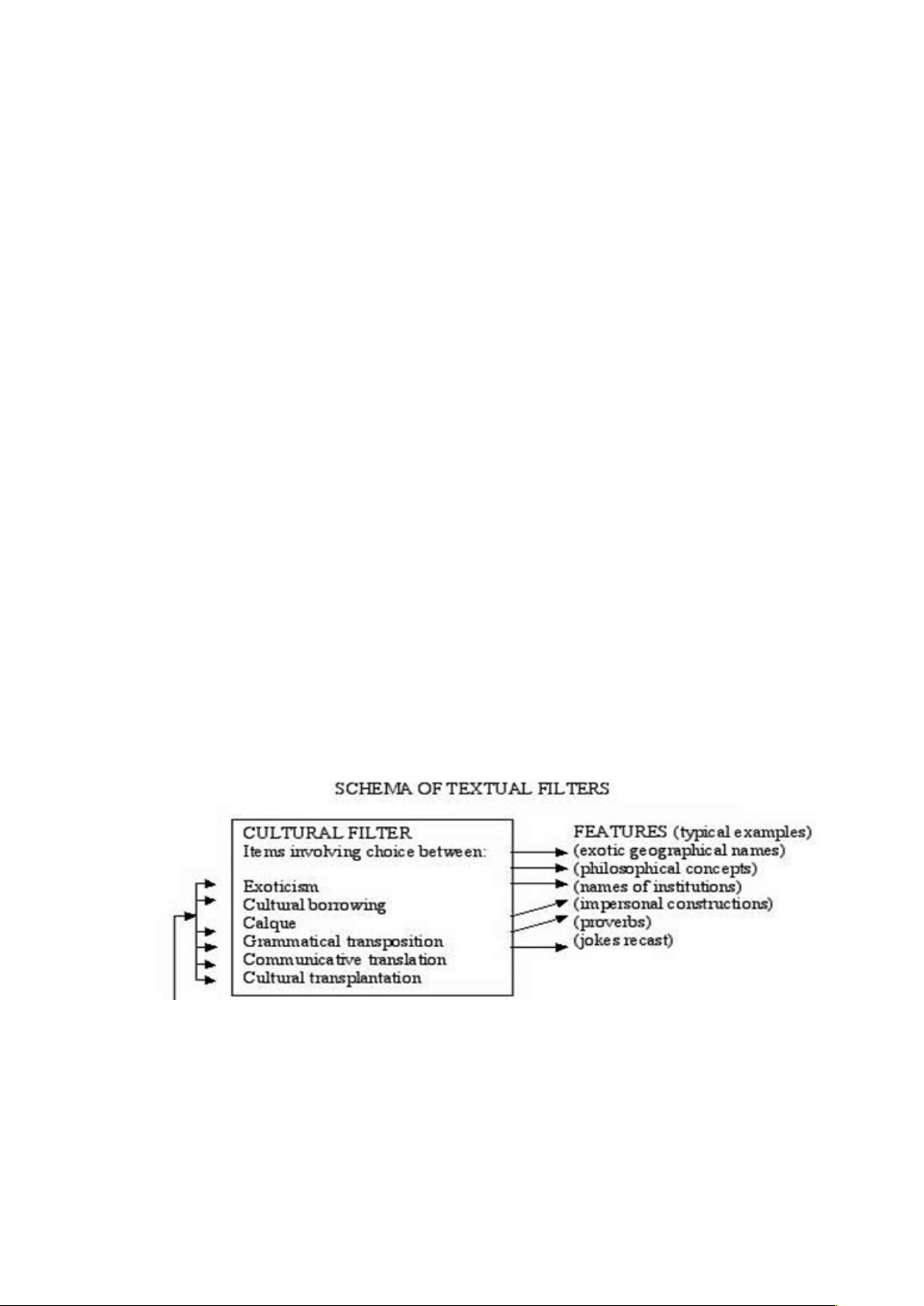
p.96). The various degrees of cultural transposition can be visualized as points
along a scale between the extremes of exoticism and cultural transplantation
proposed by Hervey et al (1996, p.28), visualised as follows: SL Bias TL Bias
_________________________________________________ Exoticism Cultural Calque Communicative Cultural borrowing translation transplantation
Figure 1.4.4. Hervey’s cultural transplantation
Some of the most straightforward examples of the basic issues in cultural
transposition are offered by place-names and proper names. Translating names is
not usually a major concern, but a brief look at the question provides a simple
introduction to what is often complex problem. a) Translating names
In translating a name there are, in principle, at least two alternatives. Either
the name can be taken over unchanged from the ST to the TT, or it can be adapted
to the phonic/graphic conventions of the TL. The first alternative is tantamount to
literal translation, and involves no cultural transposition. It is a form of
‘exoticism’. It may be impracticable if, as with Russian names, it creates
problems of pronounceability and comprehension in an oral TT, or problems of
spelling and memorization in a written one. The second alternative,
transliteration, is less extreme: conversional conventions are used to alter the
phonic/graphic shape of a ST name so that it comes more into line with TL
patterns of pronunciation and spelling. Transliteration is the standard way of
coping with, for example, Chinese names in English texts.
How a name is transliterated may be entirely up to the translator, if there is
no established precedent for transcribing the name in question, or it may require
following a standard transliteration created by early translators. Standard
transliteration varies, of course, from language to language. Examples are
common in the translation of place-names: Mat-xcơ-va/ Moscow/Moscou. b) Exoticism
In general, the extreme options in signaling cultural foreignness in a TT fall into
a category of exoticism. A TT translated in an exotic manner is one which constantly
resorts to linguistic and cultural features imported from the ST into the TT with 17
minimal adaptation, and which, thereby, constantly signals the exotic source culture
and its cultural strangeness. Of course, this may be one of the TT’s chief attractions, as
with some translations of Icelandic sagas or Arabic poetry that deliberately trade on
exoticism. However, such a TT has an impact on TL audience which the ST could
never have had on a SL audience, for whom the text has no features of an alien
culture: Xì-tốp, ma ket ting, mit tinh, etc. c) Cultural transplantation
At the opposite end of the scale from exoticism is cultural transplantation,
whose extreme forms are hardly translations at all, but more like adaptations – the
wholesale transplanting of the entire setting of the ST, resulting in the text being
completely rewritten in an indigenous target culture setting. Cultural
transplantation sometimes can produce successful texts, but it is not normal translation practice.
By and large, normal translation practice avoids both wholesale exoticism
and wholesale cultural transplantation. In attempting to avoid the two extremes,
the translator may have to consider the alternatives lying between them on the
scale given above: Khúc chiết, thanh niên, etc. d) Cultural borrowing
The first alternative is to transfer a ST expression verbatim into the TT.
This is termed Cultural borrowing. The translators will resort to it when it proves
impossible to find a suitable TL expression of indigenous origins for translating
the SL expression. A vital for cultural borrowing is that the textual context of the
TT should make the meaning of the borrowed expression clear. Cultural
borrowing will be most frequent in texts on history or social or political matters,
where the simplest solution is to give a definition of terms, and then to use the SL word in the TT.
Of course cultural borrowing only presents translators with an open and
free choice in cases where previous translation practice has not already set up a
precedent for the verbatim borrowing of the ST expression. The Saussurean
linguistic term ‘langue’ and ‘parole’ are good examples of this issue. The option
of translating ‘langue’ and ‘parole’ as ‘language’ and ‘speaking’ does exist, but
the fact that English texts frequently resort to the borrowed terms ‘langue’ and
‘parole’ in the precise linguistic sense prejudices the issue in favour of borrowing.
Furthermore, where terms with SL origins have already passed into the TL
without significant change of meaning, thus constituting standard conventional
equivalents of the original SL terms borrowed, the translator may not be faced
with a significant decision at all: Lão Phật gia, Mama Chuê, etc. e) Communicative translation
In contrast with cultural borrowing, the translator may opt for
communicative translation. This is often mandatory for culturally conventional
formulae where a literal rendering would be inappropriate. 18
For example, many proverbs, idioms and clichés have readily identifiable
communicative equivalents in the TL. Only special contextual reasons can justify
opting against a standard communicative translation in such cases. Otherwise the
result is likely to be ludicrous translation. The translator has virtually no freedom of
choice in rendering stock institutionalized phrases such as ‘Beware of the
dogs(Fierce Dog)/ Nhà có chó dữ’, ‘Carry coal to Newcastle/ Chở củi về rừng,
Keep off the grass/ Không dẫm lên cỏ!, Tổng quản, Chuột túi, etc.’ The very fact
that the ST uses a set phrase or idiom usually part and parcel of its stylistic effect,
and if the TT does not use corresponding TL set phrases or idioms this stylistic effect will be lost. f) Calque
“The morning guest never stays long” is an instance of calque, an
expression that consists of TL words and respects TL syntax, but is unidiomatic in
the TL because it is modelled on the structure of a SL expression. In essence,
then, calque is a form of literal translation. A bad calque imitates ST structure to
the point of being ungrammatical in the TL; a good calque manages to
compromise between imitating a ST structure and not offending against the grammar of the TL.
Calquing may also be called a form of cultural borrowing, although, instead
of verbatim borrowing of expressions, only the model of SL grammatical
structures is borrowed. For example, if ST ‘cherchez la femme’ in a detective
story is rendered in the TT ‘look for the woman’ would be calque. Like cultural
borrowing proper, and for similar reasons, translation by creating calques does
occur in practice. Furthermore, as also happens with cultural borrowing proper,
some originally calqued expressions become standard TL cultural equivalents of their SL origins.
Clearly, there are certain dangers in using calque as a translation device.
The major one is that the meaning of calques phrases may not be clear in the TT.
In the worst cases, calques are not even recognizable for what they are, but are
merely puzzling to the reader or listener. This is why in our Hungarian example,
we suggested using a device like ‘you know the saying’ to signal the calquing
process. But, of course, it is not sufficient for the TT to make it clear that a
particular phrase is an intentional calque. The meaning of the calqued phrase must
also be transparent in the TT context. The most successful calques need no
explanation; less successful ones may need to be explained, perhaps in a footnote or a glossary.
Like all forms of cultural borrowing, calque exhibits a certain degree of
exoticism, bringing into the TT the cultural foreignness and strangeness of the
source culture: ‘As ancient as the sun/Xưa như quả đất, as alike as 2 peas in the
pot/Giống nhau như hai giọt nước, It never rains but pours/Phúc bất trùng lai
hoạ vô đơn chí, and The early bird catches the worms/Trâu chậm uống nước
đục, etc.’ Consequently, it should generally be avoided in texts where exoticism is 19
inappropriate, such as in instruction manual, whose prime function is to give clear
and explicit information. In any text, one should also definitely avoid
unintentional calquing resulting from too slavish a simulation of the grammatical structures of the ST.
In brief summary of the discussion so far, where standard communicative
equivalents exist for a ST expression, the translator should give these first
preferences, unless there are particular reasons for not doing so. Where standard
communicative equivalents are lacking, and also a particular ST concept is alien to
the target culture, preference should be given to cultural borrowing, unless there are particular reasons against it. 1.
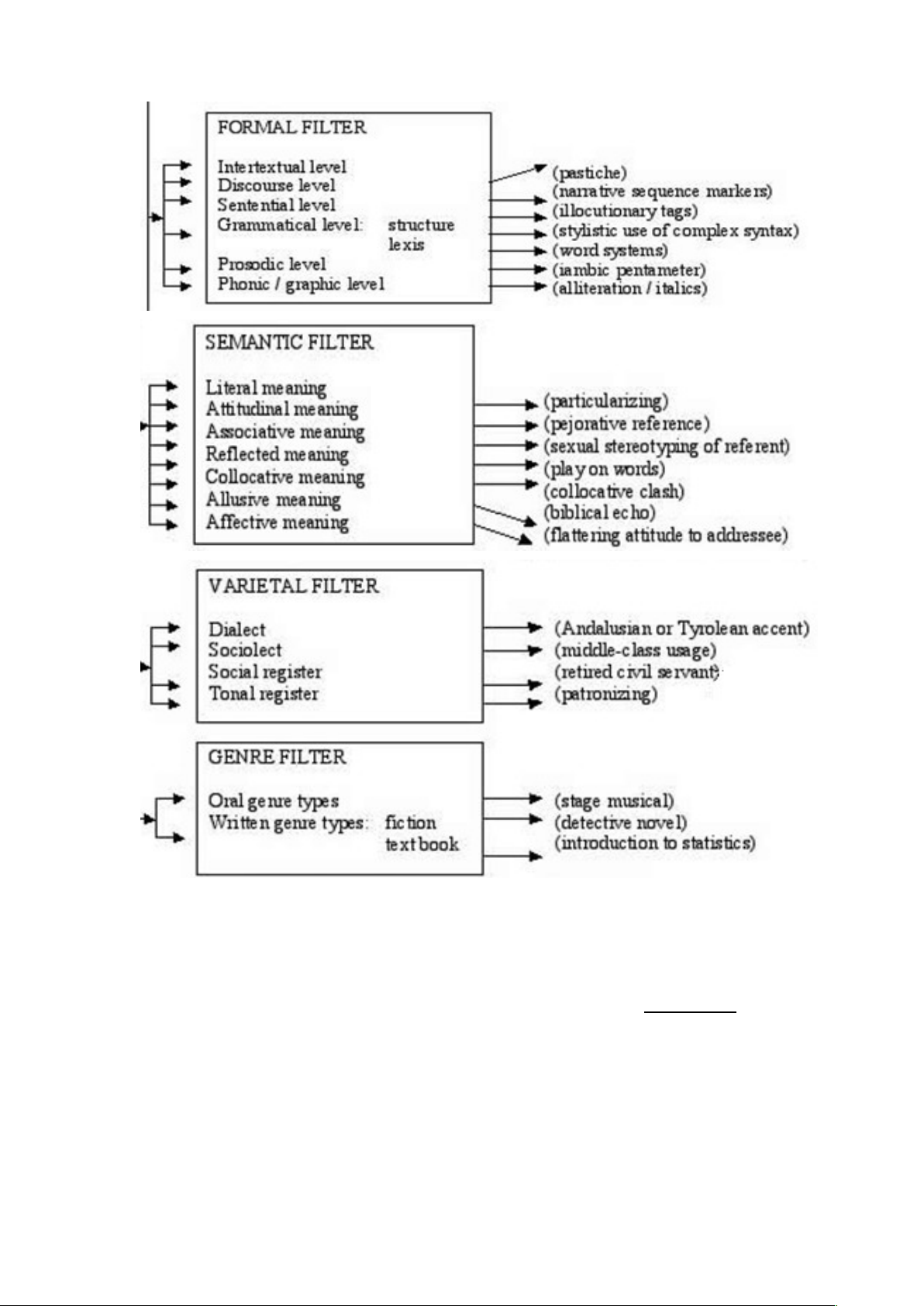
1.4.5. Schema of textual filters
Translation is a kind of activity which inevitably involves at least two
languages and two cultural traditions (Toury, 1978, p.200). As this statement
implies, translators are permanently faced with the problem of how to treat the
cultural aspects implicit in a source text (ST) and of finding the most appropriate
technique of successfully conveying these aspects in the target language (TL).
These problems may vary in scope depending on the cultural and linguistic gap
between the two (or more) languages concerned (Nida, 1964, p.30).
The cultural implications for translation may take several forms ranging
from lexical content and syntax to ideologies and ways of life in a given culture.
The translator also has to decide on the importance given to certain cultural
aspects and to what extent it is necessary or desirable to translate them into the
TL. The aims of the ST will also have implications for translation as well as the
intended readership for both the ST and the target text (TT) by looking at the
following schema by Hervey, Higgins and Haywood (1996, p.216). TE XT 20
Figure 1.4.5. Schema of textual filters
1.5. Pre-translation considerations 1.5.1. Reading the text
The translator starts the first stage of the translation process, the understanding stage.
The purpose is to extract all content and expressive value to then
reformulate them in the target language. Capturing and understanding the text
does not end the communication process opened by the author. Instead it restarts
it and the reader/translator becomes a spokesperson for the author of the original text. 21
At the same time, the reader/translator becomes the author of a text in
another language. The translator is also an unusual reader in the sense that he or
she has to read in a language other than their native one.
In each of the first two stages, understanding and re-expression, the
translator must have a linguistic competency that is optimal in both languages
and, of equal importance, a broad wealth of knowledge. The translator must work
hard on being the best reader of the text. On the first reading, the translator
familiarizes him or herself with the text in its setting. Textual problems (related to
lexical elements or unfamiliar concepts) require a specific solution. Extra-textual
problems (related to the desired motive and function of the translation) influence
on the translation strategy adopted in consideration of the text in its totality. An
intense reading is the basis of a syntactic, semantic, and pragmatic analysis of the text.
1.5.2. The intention of the text
The understanding of a text naturally involves a search for the intention of
the text. By intention we mean the point of view of the text. Different texts may
describe a particular incident differently using the same facts and figures. But the
type of language used in the text, the ways of describing, and the style, etc.
display the intention of a text. They represent writer's attitude to the subject
matter. A translator must ascertain the intention of the text and has to represent it
in his translation. If a piece is redundant and confusing he can simplify, rearrange,
clarify, and detail the text maintaining the tone and point of view displayed in the original.
In principle translator's intention is identical to that of the author of the SL
text. But there may be certain instances where a translator may differ. Take for
example a case of translation of advertisements where the translators need not
always match the intention of the copy-writer. If a translator is translating such a
text to persuade TL consumers to buy a certain product then he may have to
change the style and the way of presentation in his translation. However such
instances are rare and mostly translators are expected to follow the original closely.
In literary translations, this subjective element plays a major role.
Though in principle translation theorists agree that translator should not impose
his intentions on a text or misrepresent a text, it is very difficult to judge it for
a literary text throws itself open for many kinds of readings. The notions of
authority and original become problematic as far as the literary texts are
concerned. Secondly, the politics of translation may also force a translator to
make some deliberate interventions in a particular cultural setting while
translating a text. However, sine Newmark does not concerned with such
dimensions of a literary translation these questions do not bother him.
Any translation is ultimately meant for a readership. Therefore, it is important
to characterize the readership of the translation in terms of expert or layman, 22
informed or ignorant, age or young, etc. the likely setting of a text is that by which
we indicate where the translation would be published? This is another point to be
considered by the translator. Keeping nature of the readership and setting of
translation in view, a translator has to design his translation and its style of
presentation according to the requirements of his readership. 1.5.3. Text styles
Text categories and text types can be made either on the basis of subject
matter, focus or on consideration of the function of language in a given text.
Newmark and others distinguishes text-types on the basis of language functions.
The linguist, Halliday, distinguished three linguistically relevant language
functions: 'ideational' the 'interpersonal' and the 'textual', Karl Bühler
characterized language functions as 'representational', 'expressive' and 'conative'.
Famous linguist and translation theorist Roman Jackobson later modified these
three functions of language proposed by Bühler: "…. The main three functions of
language are the 'expressive' (the subjective 'I' form), the descriptive or
'informative' (the 'it' form) and the 'vocative' or directive or persuasive (the 'you'
form) and the minor functions being the 'phatic', the 'metalingual' and the
'aesthetic' as cited in Newmark (1988, p.21).
It is important to notice that the tripartite division is an attempt to generalize
language functions and these generalizations "directed towards sociological or
psychological inquiries" rather than linguistic. Moreover, in many texts all the three
functions may be found. Hence, the text-categories based on these generalizations
are helpful only to the extent of understanding the main focus of a particular text
which will, in turn, help translators to choose an appropriate translation method.
The following are the text categories. a) The 'expressive'
Speaker's mind is central to this function of language. Experiences of an
author, his / her knowledge about the world, his / her feelings etc. are identified
by others as true or false when they are expressed. But the expression here has
nothing to do with such identification. An author or a speaker filled with intense
feeling would express his/her feelings irrespective of any response. The feeling is
important in such texts. The following are the expressive text types:
(1) Serious imaginative literature: Poetry, short-stories, novels, plays etc.
(2) Authoritative statements: This kind of texts have the personal 'stamp' of
their authors, and show certain originally as far as the quality of writing is
concerned. Authority of their authors derives from their status and quality of
writing. Political statements, speeches, documents, legal documents, academic
works, etc. constitute this text-type.
Tài liệu liên quan:
-
Ufls-flte final exam notes on translation theory | Theory of translation | Trường Đại học Ngoại ngữ, Đại học Đà Nẵng
48 24 -
GIÁO TRÌNH LÝ THUYẾT DỊCH
44 22 -
Ôn tập Lý thuyết dịch | Trường Đại học Ngoại ngữ, Đại học Đà Nẵng
1.6 K 789 -
Tóm tắt môn Lý thuyết dịch | Trường Đại học Ngoại ngữ, Đại học Đà Nẵng
0.9 K 473