Ufls-flte final exam notes on translation theory | Theory of translation | Trường Đại học Ngoại ngữ, Đại học Đà Nẵng
Translation is a phenomenon that has a huge effect on everyday life. This can range from the translation of a key international treaty to the following multilingual poster that welcomes customers to a holiday resort or to any tourist destination in your home country. Tài liệu được sưu tầm và soạn thảo dưới dạng file PDF để gửi tới các bạn cùng tham khảo, ôn tập đầy đủ kiến thức, chuẩn bị cho các buổi học thật tốt. Mời bạn đọc đón xem!
Môn: Lý thuyết dịch 19 tài liệu
Trường: Trường Đại học Ngoại ngữ, Đại học Đà Nẵng 292 tài liệu
Tác giả:







Preview text:
WHAT IS TRANSLATION? INTRODUCING TRANSLATION
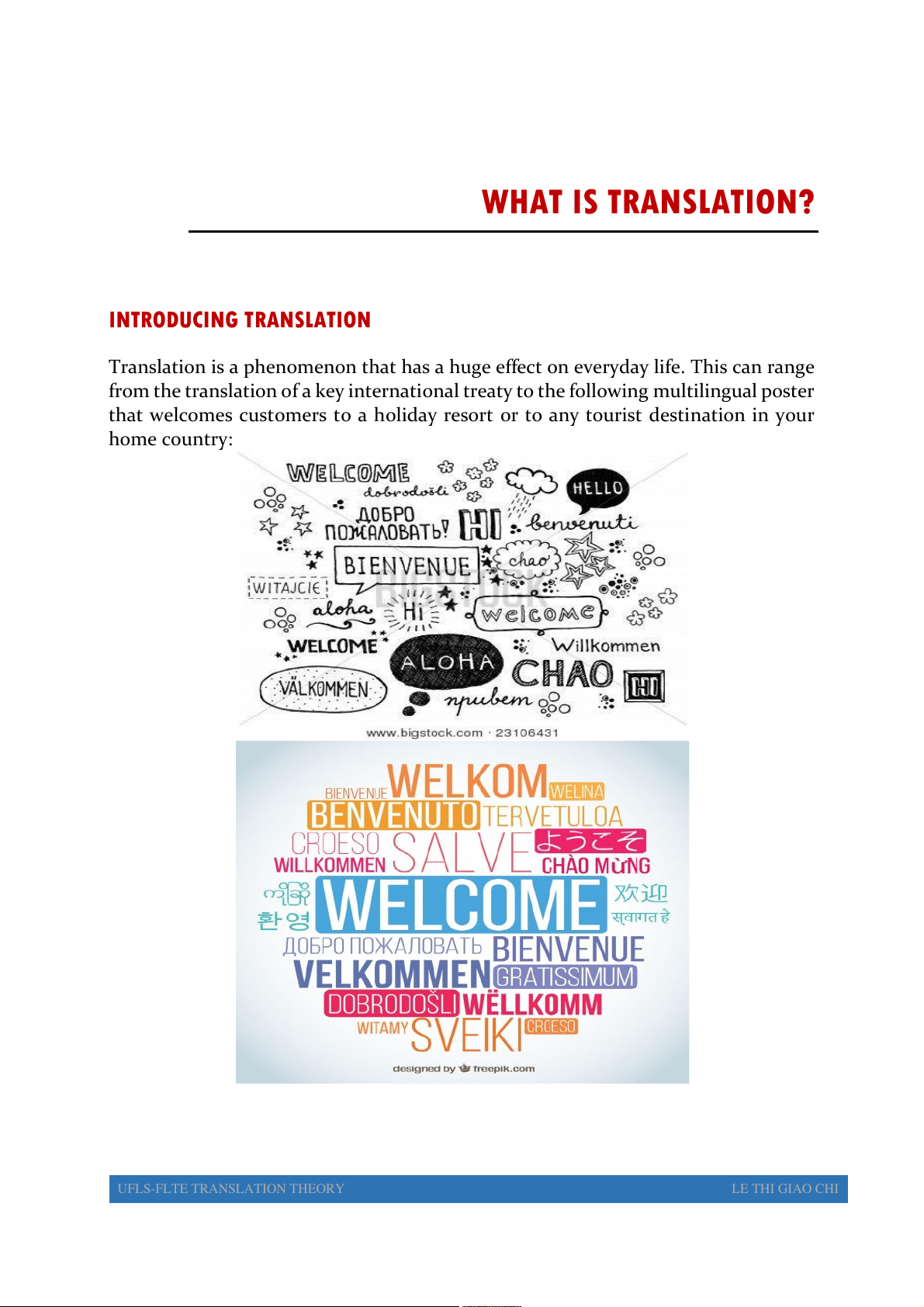
Translation is a phenomenon that has a huge effect on everyday life. This can range
from the translation of a key international treaty to the following multilingual poster
that welcomes customers to a holiday resort or to any tourist destination in your home country: UFLS-FLTE TRANSLATION THEORY LE THI GIAO CHI
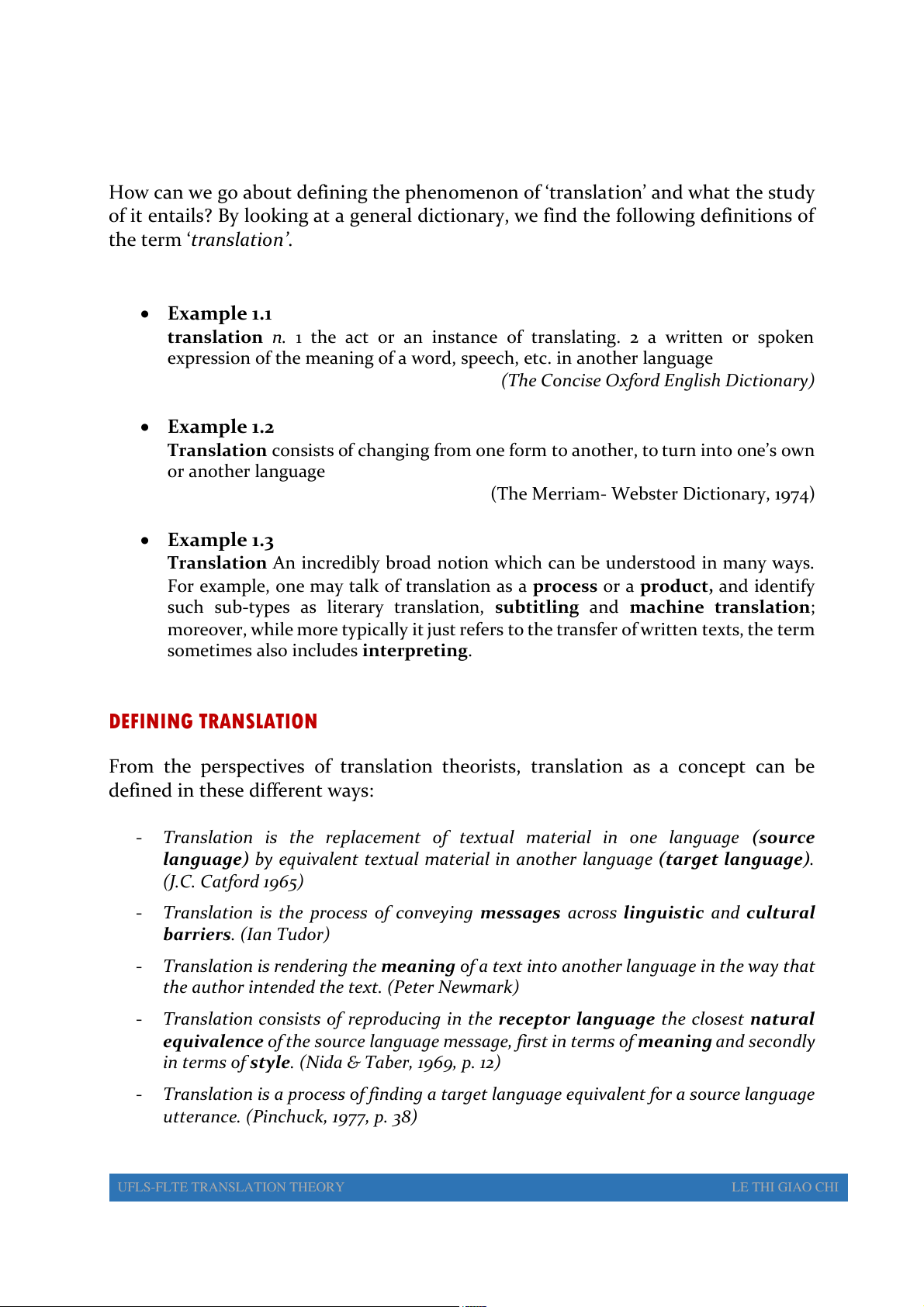
How can we go about defining the phenomenon of ‘translation’ and what the study
of it entails? By looking at a general dictionary, we find the following definitions of the term ‘translation’. • Example 1.1
translation n. 1 the act or an instance of translating. 2 a written or spoken
expression of the meaning of a word, speech, etc. in another language
(The Concise Oxford English Dictionary) • Example 1.2
Translation consists of changing from one form to another, to turn into one’s own or another language
(The Merriam- Webster Dictionary, 1974) • Example 1.3
Translation An incredibly broad notion which can be understood in many ways.
For example, one may talk of translation as a process or a product, and identify
such sub-types as literary translation, subtitling and machine ; translation
moreover, while more typically it just refers to the transfer of written texts, the term
sometimes also includes interpreting. DEFINING TRANSLATION
From the perspectives of translation theorists, translation as a concept can be
defined in these different ways:
- Translation is the replacement of textual material in one language (source
language) by equivalent textual material in another language (target language). (J.C. Catford 1965)
- Translation is the process of conveying messages across linguistic and cultural
barriers. (Ian Tudor)
- Translation is rendering the of meaning
a text into another language in the way that
the author intended the text. (Peter Newmark)
- Translation consists of reproducing in the receptor
language the closest natural
equivalence of the source language message, first in terms of meaning and secondly
in terms of style. (Nida & Taber, 1969, p. 12)
- Translation is a process of finding a target language equivalent for a source language
utterance. (Pinchuck, 1977, p. 38) UFLS-FLTE TRANSLATION THEORY LE THI GIAO CHI
As can be implied in the definitions above, translation is basically a change of form
(which is usually referred to as the actual words, phrases, clauses, sentences,
paragraphs etc., which are spoken or written). However, we can see that meaning
captures the essence of the text and only by having a meaningful translation, we can
transfer the essence of a text.
‘Each language carries with it its own meaning since message is property of a language’ (J.C. Catford)
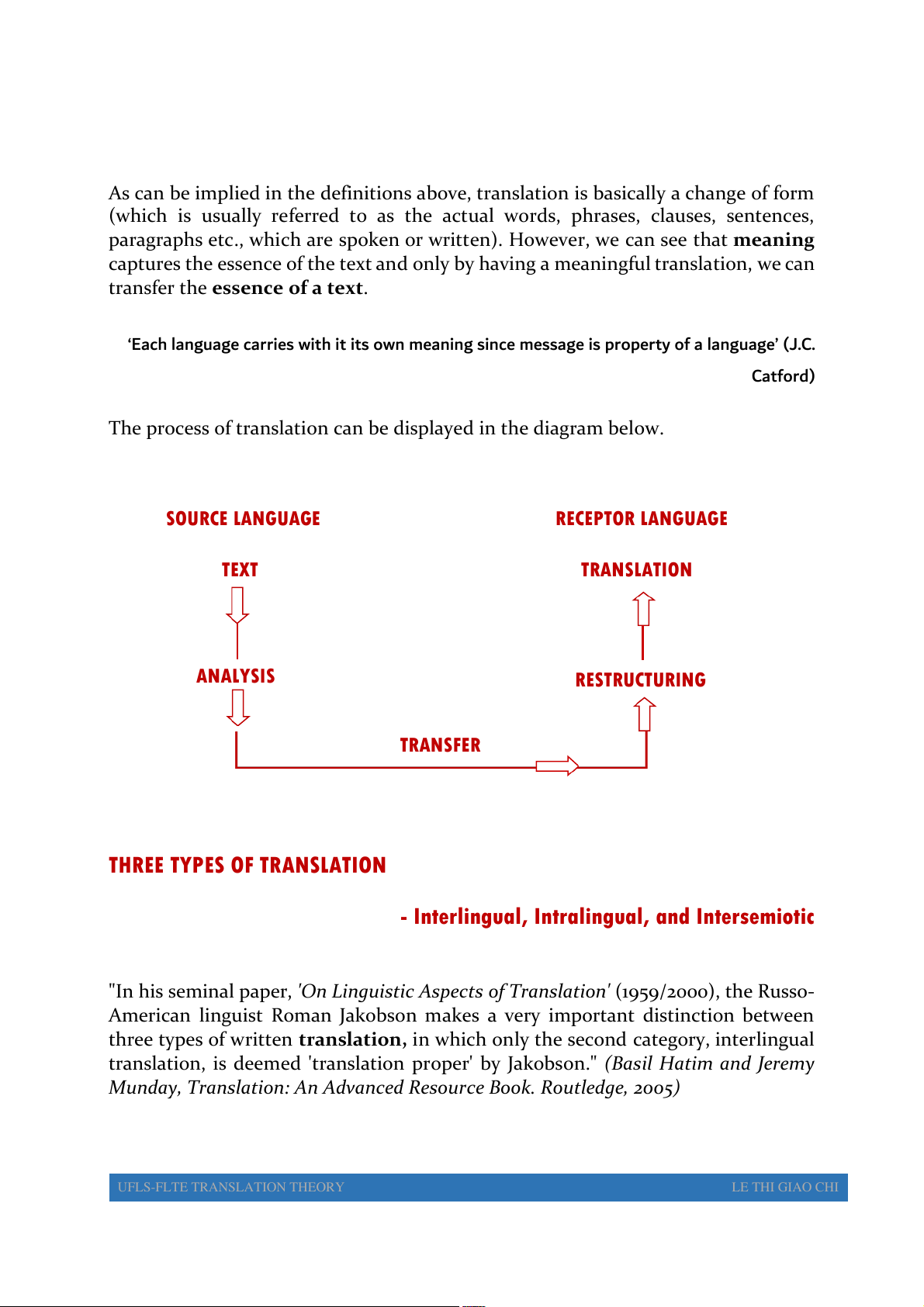
The process of translation can be displayed in the diagram below. SOURCE LANGUAGE RECEPTOR LANGUAGE TEXT TRANSLATION ANALYSIS RESTRUCTURING TRANSFER THREE TYPES OF TRANSLATION
- Interlingual, Intralingual, and Intersemiotic
"In his seminal paper, 'On Linguistic Aspects of Translation' (1959/2000), the Russo-
American linguist Roman Jakobson makes a very important distinction between
three types of written translation, in which only the second category, interlingual
translation, is deemed 'translation proper' by Jakobson." (Basil Hatim and Jeremy
Munday, Translation: An Advanced Resource Book. Routledge, 2005) UFLS-FLTE TRANSLATION THEORY LE THI GIAO CHI
Intralingual translation – translation within the same language, which
can involve rewording or paraphrase
Interlingual translation – translation from one language to another
Intersemiotic translation – translation of the verbal sign by a non-
verbal sign, e.g. music or image, or braille.
THE DYNAMICS OF TRANSLATION (Peter Newmark)
There are different elements involved in the process of translation. Hence, any
attempt to understand the meaning of a text requires in-depth knowledge of the
dynamics of translation presented by Peter Newmark as follows.
The truth (facts of the matter) TL readership SL writer SL norms TL norms TEXT SL culture TL culture SL setting TL setting Translator UFLS-FLTE TRANSLATION THEORY LE THI GIAO CHI
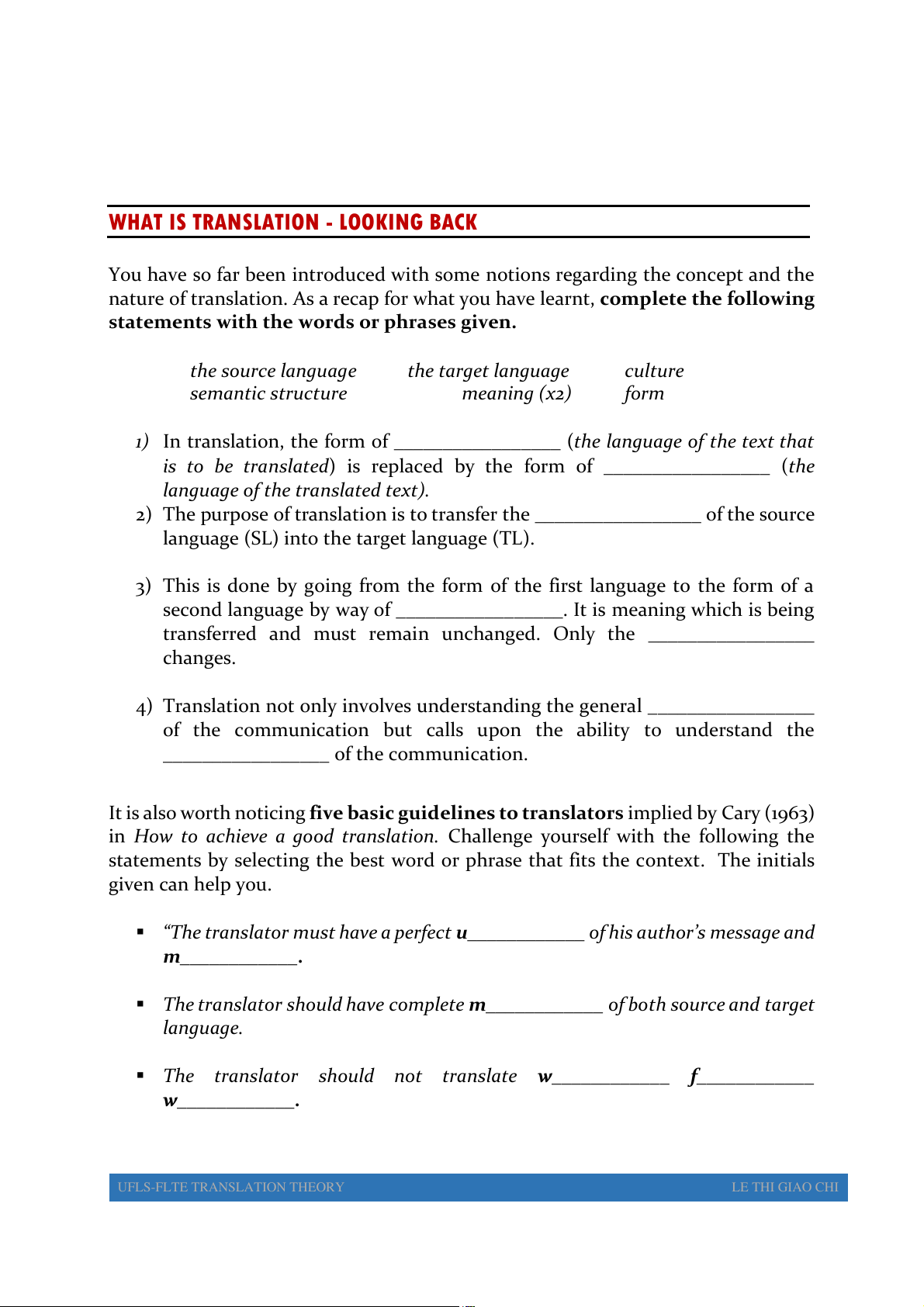
WHAT IS TRANSLATION - LOOKING BACK
You have so far been introduced with some notions regarding the concept and the
nature of translation. As a recap for what you have learnt, complete the following
statements with the words or phrases given. the source language the target language culture semantic structure meaning (x2) form
1) In translation, the form of _________________ (the language of the text that
is to be translated) is replaced by the form of _________________ (the
language of the translated text).
2) The purpose of translation is to transfer the _________________ of the source
language (SL) into the target language (TL).
3) This is done by going from the form of the first language to the form of a
second language by way of _________________. It is meaning which is being
transferred and must remain unchanged. Only the _________________ changes.
4) Translation not only involves understanding the general _________________
of the communication but calls upon the ability to understand the
_________________ of the communication.
It is also worth noticing five basic guidelines to translators implied by Cary (1963)
in How to achieve a good translation. Challenge yourself with the following the
statements by selecting the best word or phrase that fits the context. The initials given can help you.
▪ “The translator must have a perfect u____________ of his author’s message and m____________.
▪ The translator should have complete m____________ of both source and target language.
▪ The translator should not translate w____________ f____________ w____________. UFLS-FLTE TRANSLATION THEORY LE THI GIAO CHI
▪ The translator should beware of Latinisms and use i____________ l____________.
▪ The translator should strive after a smooth, and elegant, unpretentious and
even s____________.
Besides the five basic guidelines to translators, the three “laws of translation”
formulated by Tytler (1978) in Essay on the Principles of Translation can give further
insight into the nature of translation:
▪ The translation should give a complete transcript of the ideas of the original work.
▪ The style and manner of writing should be of the same character with that of the original.
▪ The translation should have all the ease of the original composition.
Give the Vietnamese translation to these laws.
▪ The translation should give a complete transcript of the ideas of the original work.
………………………………………………………………………………………………………………………
▪ The style and manner of writing should be of the same character with that of the original.
………………………………………………………………………………………………………………………
▪ The translation should have all the ease of the original composition.
………………………………………………………………………………………………………………………
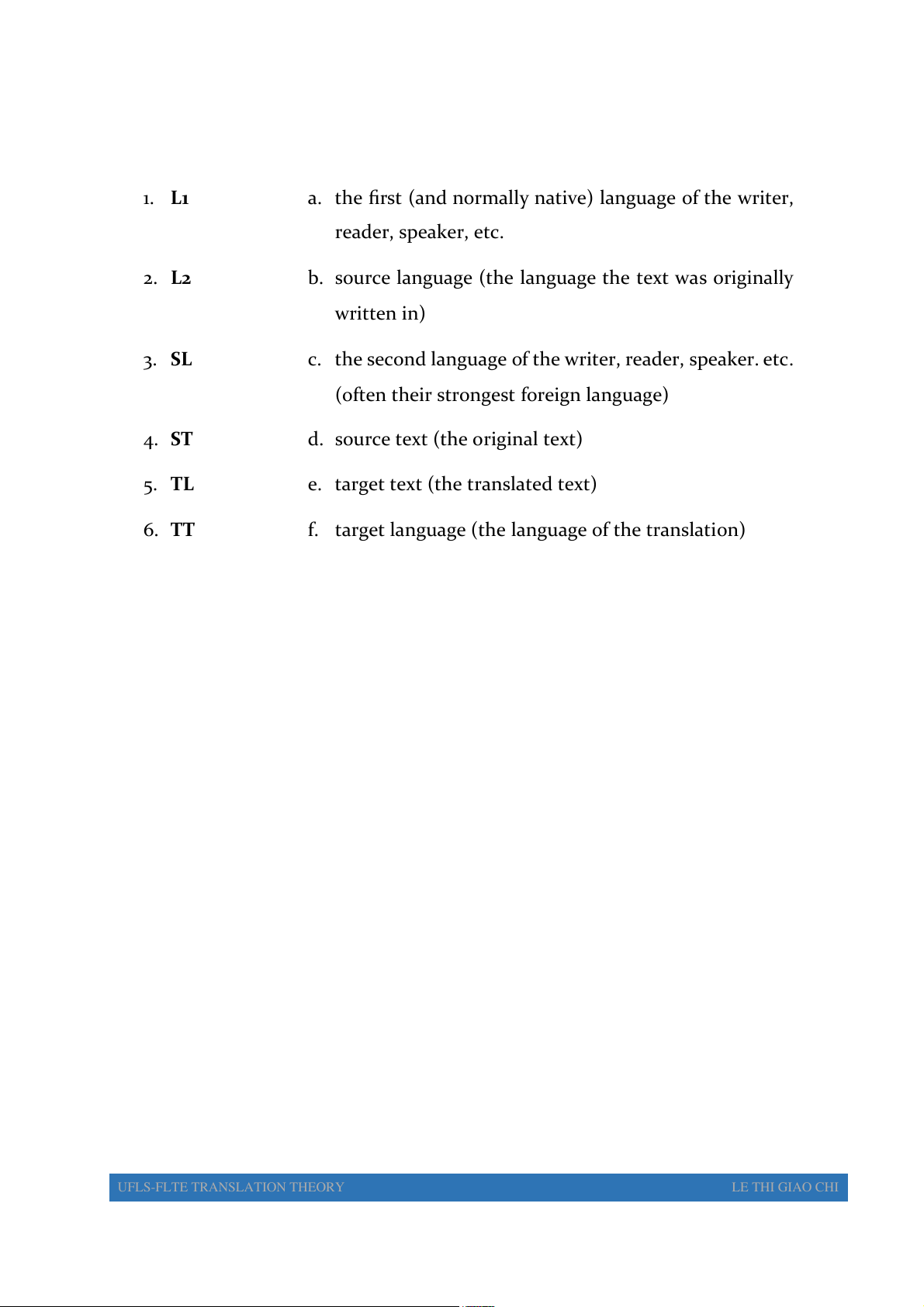
Below is a list of standard abbreviations that can be found in most of the
sections throughout any book or reference of translation theory.
Do you know what each of the following abbreviations stands for? Match the
abbreviations with their description. UFLS-FLTE TRANSLATION THEORY LE THI GIAO CHI 1. L1
a. the first (and normally native) language of the writer, reader, speaker, etc. 2. L2
b. source language (the language the text was originally written in) 3. SL
c. the second language of the writer, reader, speaker. etc.
(often their strongest foreign language) 4. ST
d. source text (the original text) 5. TL
e. target text (the translated text) 6. TT
f. target language (the language of the translation) UFLS-FLTE TRANSLATION THEORY LE THI GIAO CHI
TRANSLATION AND INTERPRETATION
The field of translation and interpretation is especially demanding because of the
variety of complex tasks that are involved in terms of:
1. general knowledge.
2. cultural knowledge.
3. specific translative / interpretive skills.
All these tasks are in addition to proficiency in the language to be used, which is
clearly a prerequisite for study in translation and interpretation.
In the first instance, translation and interpretation involve an enormous amount of
knowledge in a variety of areas.
“A good translator/interpreter has to be a veritable mine of information no matter
what subject he is dealing with. If you are interpreting a lecture on genetics and
you don’t know what a chromosome is, you are in deep trouble! Or, if you have to
translate a paper on the effects of increased taxation on aggregate demand, you
are up the proverbial creek without a paddle if you have never had a course in
economics. Besides, vocabulary is not enough - in order to make any sense out of
a text or a speech, you have to understand what the author is really saying.
Translation and interpretation involve ideas, not words. ”
For this reason, the course of translation and interpretation will need to involve
studies of subject areas such as international economics, political science and
international studies which are frequently called upon for translation.
“Becoming an accomplished translator or interpreter means you will have to
be constantly expanding your awareness of the world around you.”
Before we can translate or interpret a message, we must understand the total
meaning of the message within its own cultural context. UFLS TRANSLATION THEORY LE THI GIAO CHI
“You must first understand the ideas behind the words and, going one step
further, you should have clear knowledge of the culture which formulated those
ideas. This step is usually the most exciting. A growing awareness of different
life styles brings home the idea that rendering accurate translations is really
not that simple. Not only must you lend a sympathetic ear to two separate
cultures, you must also enjoy working with words. And, one of the main
purposes of the institute’s course in Translation Theory is to make you aware
of the possible meanings of a word in different contexts. We study the semantic
and morphological aspects of communication in an attempt to better
understand language usage.”
For example, translator and interpreter will need to study how words
communicate, what “bias words” are, i.e. words that communicate positive
meanings and negative meanings, such as “underdeveloped country” vs.
“backward country” vs. “developing country”.
As well as understanding the meanings of the words, we will need to understand
the meaning conveyed through the style. Is it formal? informal? personal?
impersonal? Is the author or speaker humorous? serious? sarcastic? emphatic? Is his expression subtle? overt?
The hardest part is yet to come in bridging the conceptual gap between two
cultures when we try to convey the total massage by way of the concepts and
symbols (i.e. thoughts and words) of a different language. Cultural sensitivity and
creativity will be called upon maintaining the style of the total communication.
Different languages often communicate similar meanings via different number of
words, different kinds of words, different intonation and pitch, different gestures. If
we translate/interpret literally, our version may result in a loss of the message.
In addition to a wealth of general knowledge in relevant subject - areas, the ability
to switch cultural contexts and to solve problems of inter - cultural
communication, translation and interpretation are specific and complex skills which
require the development of particular psycholinguistic strategies.
While some of these strategies overlap, others differ according to the type of
translation or interpretation involved. It will be important to distinguish between
translation and interpretation, and to be able to identify the particular strategies involved. UFLS TRANSLATION THEORY LE THI GIAO CHI
WHAT ARE THE DIFFERENCES BETWEEN
TRANSLATION AND INTERPRETATION?
“Most people think that translation and interpretation are the same thing
and that the mere knowledge of a language implies the ability to go from
one language to another. Translation implies carefully analyzing the
message given within the context of a particular linguistic code and
transferring this message into another written linguistic code.
Interpretation, on the other hand, means doing the same but orally and simultaneously.”
In general, messages to be translated are written and translated version are also
written. Messages to be interpreted are generally transmitted orally and the
interpretations are rendered orally. This difference in the vehicle of original
message transmission implicates a difference in the time that will be available for
comprehending the original message and the time available for rendering the
message into another language. The time factor in turn affects the different skills
and strategies that will be called upon.
There are four basic types of translation and interpretation:
1. Prepared translation 2. Sight translation
3. Consecutive interpretation
4. Simultaneous interpretation UFLS TRANSLATION THEORY LE THI GIAO CHI TRANSLATION
As discussed in the first section, translation involves more than a word-for-word
version of a text in another language. As well as problems of word meaning, word
order, sentences structure and style across cultures, there is the problem of
understanding the varied subject areas involved in the messages to be translated.
“A good way to close this knowledge gap is to study the specific meaning of a word
within a given context. The purpose of our classes in terminology is learning ways
by which we can improve our supply of terms by establishing word systems
according to alphabetical order, idea order, and idiomatic usage.”
Students are discouraged from translating too literally; the key is to translate
approximately, while conveying the meaning in the originating culture’s terms. A
study of advertisements affords good practice in becoming aware of the cultural
aspects. As well as conveying the meaning in the originating culture’s terms the
translator / interpreter must also be aware of the culture of the audience. Prepared Translation
Prepared translations are prepared outside of class and constructively criticized by both students and teachers. Sight Translation
The major difference between sight translation and prepared translation is speed of response.
“It might interest you to note that there is a no man’s land between translation
and interpretation. This we call sight translation. Though you usually do not
have time to read the complete text before you start, slowly but surely, you
learn to read ahead while translating. The reason both translators and
interpreters learn this is that translators have to do a lot of sight translation in
their professional life, and interpreters not only use it, but the techniques UFLS TRANSLATION THEORY LE THI GIAO CHI
learned also provide excellent preparation for what awaits them in simultaneous.”
Practise sight translation with a partner.
We all want success. We want to be successful and feel successful. We chase
money, fame, power, education, relationships and a thousand other things
without ever stopping to ask one essential question: What, actually, is success?
Few people pause to consider what it truly means to achieve success in their
own lives. As Jim Rohn said, “If you don’t design your own life plan, chances
are you’ll fall into someone else’s plan. And guess what they have planned for you? Not much.” INTERPRETATION
Some basic strategies underlying development of interpretive skills may have
eluded us amidst the haste to introduce courses in interpretation and translation,
and our failure to distinguish one from the other.
The particular skills involved are distinct from and in addition to the skill of code
switching required in the translation and interpretation of one language into
another. For example, special skills involve listening, memory, note - taking,
summarizing and paraphrasing. It is important to underscore the point that a
considerable amount of work is done to develop these underlying processes. Before
students actually practice interpreting from one language to another, these
prerequisite skills are practiced and mastered within the dominant language, i.e.
English. Therefore, the introductory courses on interpretation are in English. Consecutive Interpretation UFLS TRANSLATION THEORY LE THI GIAO CHI
“(Consecutive interpretation) is the process of listening to a speech or lecture
in one language and then at a certain moment, transcribing and summarizing
it orally, in another language. The time lapse between the speech and your
interpretation varies.”
The training for developing the skills of consecutive interpretation includes:
1. Learning to repeat what a speaker has said, first in one’s dominant language;
2. Memory training, e.g. practice in increasing retention of clusters of words and numbers;
3. Learning to take accurate notes;
4. Learning to summarize;
5. Learning to paraphrase;
6. Learning to simplify;
7. Learning to clarify;
8. Learning to express with confidence and naturalness. Simultaneous Interpretation
“By now you must be wondering what simultaneous is. Picture yourself in a
‘2x4’ booth, a pair of headphones on, and without prior notice, a voice
comes through. Immediately you have to simultaneously render what is
said into another language. Sounds impossible, doesn’t it? As a matter of
fact, the first time you try it, your natural impulse may be to tear off the
headsets and walk out. However, in no time at all, the process somehow UFLS TRANSLATION THEORY LE THI GIAO CHI
becomes automatic, you pick up momentum, and your interpretation takes
on a smoother quality. Believe it or not, it is fascinating, and, also very rewarding.” Simultaneous interpretation involves the immediate, simultaneous
interpretation of what is being said. The training for developing this skill
includes all the aforementioned strategies, and specifically calls upon the ability
to paraphrase. If a specific word is not known, another must instantly be supplied.
Hence, training includes (i) a study of synonyms; (ii) exercises in paraphrasing; (iii)
exercises which expose the student to different voices, accents, and speeds. OVERVIEW
In summary, it becomes increasingly clear that translation and interpretation
are complex skills. It would be folly to assume that proficiency in the language to
be used is a sufficient qualification; indeed, proficiency is only a prerequisite for initial training.
While translation and interpretation share many underlying processes, they also
require highly specialized and disciplined training, particular to each.
Because of the specialized and comprehensive skills required in translation and
interpretation, mastery of the underlying processes in one own language is
essential before translating or interpreting into a different language.
As well as specialized skills, both translation and interpretation upon vast
areas of general knowledge and the ability to switch language codes. In
addition to solving the problems of structural differences, code switching becomes
particularly complex in identifying the varied meanings of words in different
contexts, understanding the variety of ways in which cultural meanings are
conveyed, and in bridging the gap between conceptual differences across cultures.
Complete solutions to problems of translation and interpretation are not available
in books. Solutions require individual perseverance as divergent thinking as well as
a joint effort among all concerned.
(Adapted from Gail Robinson Dept. of Education, Sydney, 1977) UFLS TRANSLATION THEORY LE THI GIAO CHI
TRANSLATION AND INTERPRETATION - LOOKING BACK
Translation and Interpretation
Fill in the spaces with Interpretation, Translation, Linguistic code, Orally, Simultaneously, Written.
________________ implies carefully analyzing the message given within the
context of a particular ________________ and transferring this message into
another ________________ linguistic code. ________________, on the other hand,
means doing the same but ________________ and ________________.
Types of Translation and Interpretation
Match the four types in column A with the descriptions in column B. A B
1. Prepared translation
a. includes an immediate, oral rendition based on a written text. 2. Sight translation
b. is the process of listening to a speech or lecture
in one language and at a certain moment,
transcribing and summarizing it orally, in
another language. The time lapse between the
speech and your interpretation varies. 3. Consecutive
c. involves the preparation of a translation interpretation
outside of class and it is then constructively
criticized by both students and teacher. 4. Simultaneous d. involves the immediate, simultaneous interpretation
interpretation of what is being said into another language. Co C m o p m a p r a e r e y o y ur u r a n a s n w s e w r e r w it i h t h a a p a p r a t r n t e n r e . r Fi F r i s r t s , t , p r p a r c a t c i t se s e t r t a r n a s n l s a l t a i t ng n g t h t e h e t e t x e t x . t WHAT SUCCESS ISN’T
Before we can pursue success, we need to understand what
success isn’t. If you spend just a few minutes on social media, you’ll
realize how many people hold a very narrow definition of success.
They think it’s about building wealth, having the perfect
relationship, or launching a billion-dollar business. And a lot of
times, they attach famous people to their image of success.
None of these things or people is wrong but being like them
doesn’t necessarily make you successful. Many people have fought
and struggled to the top only to feel miserable and burned out
once they get there. They’re unhappy because they pursued the
wrong definition of success - one that didn’t match their values.
Throughout childhood and early adulthood, we learn various ideas
of success from our parents, teachers and friends. Everyone has
their own agenda and idea of who and what we should be.
Although it’s OK to value the opinions and hopes of others, we
shouldn’t necessarily adopt them as our own. No one can impose
their version of success on us. No one can tell us what it means to live the good life.
It’s easy to assume that success means obtaining a specific object,
such as a job or social status, and to believe that if we get that
thing, we’ll be successful. But some of the greatest successes
resulted from the worst failures. Winston Churchill said, “Success is
not final, failure is not fatal. It is the courage to continue that counts.”
(Adapted from https://alexjasin.com/success-really-mean/#gs.02f3u5) Th T e h n e , n , p r p a r c a t c i t se s e s i s g i h g t h t t r t a r n a s n l s a l ti t o i n o n w i w t i h t h a a p a p r a t r ne n r e . r . LANGUAGE AND CULTURE
Language is a set of verbal symbols that are primarily auditory, but secondarily written,
now in more than 2,200 different languages with more than 400 orthographic systems for computer adaptation.
Language also constitutes the most distinctive feature of a culture, which may be
described in a simplistic manner as the totality of the beliefs and practices of a society.
And although a language may be regarded as a relatively small part of a culture, it is
indispensable for both the functioning and the perpetuation of the culture.
Accordingly, competent translators are always aware that ultimately words only
have meaning in terms of the corresponding culture. But while a language can usually
be acquired within a period of ten years, it takes a lifetime to understand and become an integral part of a culture.
Because culture gives birth to language, translation and culture are intimately
connected. Meanings in both source and target languages are profoundly affected by their
cultural context, especially in business translation. A phrase that appears easy to translate
may actually contain cultural subtleties that, unless they are accounted for, can bring just
the opposite meaning than is intended. So, translation without deep cultural context can
be dangerous, especially when meanings are critical.
Translation and Culture: Literal and Contextual Meaning
For every translated sentence, the translator must be able to decide on the importance
of its cultural context, what the phrase really means, not necessarily what it literally
means, and convey that meaning in a way which makes sense not only in the target
language but also in the context of the target culture.
There are many institutions and practices that exist in one culture and don’t exist in other
cultures. Deeply held belief systems, even commitments to truth vary from culture to
culture. Each of these unique culturally based psychological entities is associated with
words that have meaning in one language that is distinct to that language and not
duplicated in other languages. How would those unique features of culture be translated?
Only someone steeped in the cultures of both source language and target language can
hope to make an interpretation. UFLS TRANSLATION THEORY LE THI GIAO CHI
Taboos and Value Differences
Deeply held taboos in one culture can be completely neutral in another culture.
Translation must be sensitive to the moral, spiritual values associations of the
words and symbols in the language to find meaning equivalents.
The values dimension is where some of the worst translation confounding takes place.
Mistranslation Example 1
When President Carter went to Poland in 1977, the State Department
hired a Russian interpreter who was not used to translating into Polish.
Through that interpreter, Carter ended up saying things in Polish like
“when I abandoned the United States” instead of “when I left the United
States”; and saying things like “your lusts for the future” instead of “your
desires for the future.” The mistakes became a media field day much to
the embarrassment of the President.
Mistranslation Example 2
When Nikita Khrushchev at the United Nations uttered the famous
phrase “we will bury you” it was a culturally insensitive mistranslation
from the Russian which really meant “we will outlast you.” The
mistranslation was widely interpreted as a threat of attack.
There are many examples like that which point to the necessity for cultural sensitivity in
translation. Mistakes have led to expensive product re-branding, tumbling stock process,
and a vision of horns on Moses’ head.
Culture gives language different contexts
The same words passed from one culture to another obtain slightly or radically different
meanings. Sometimes those meaning differences represent slight or intense value
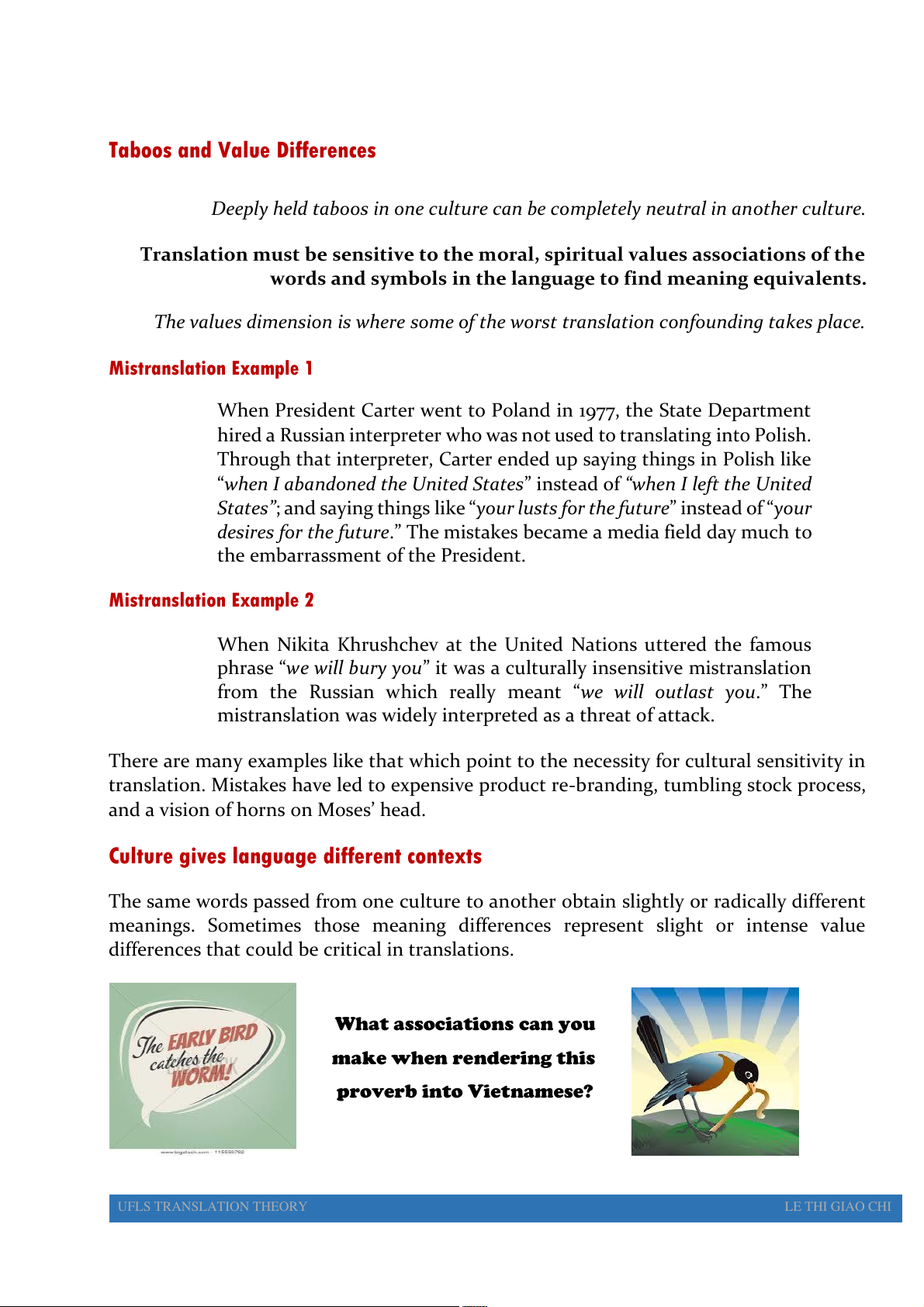
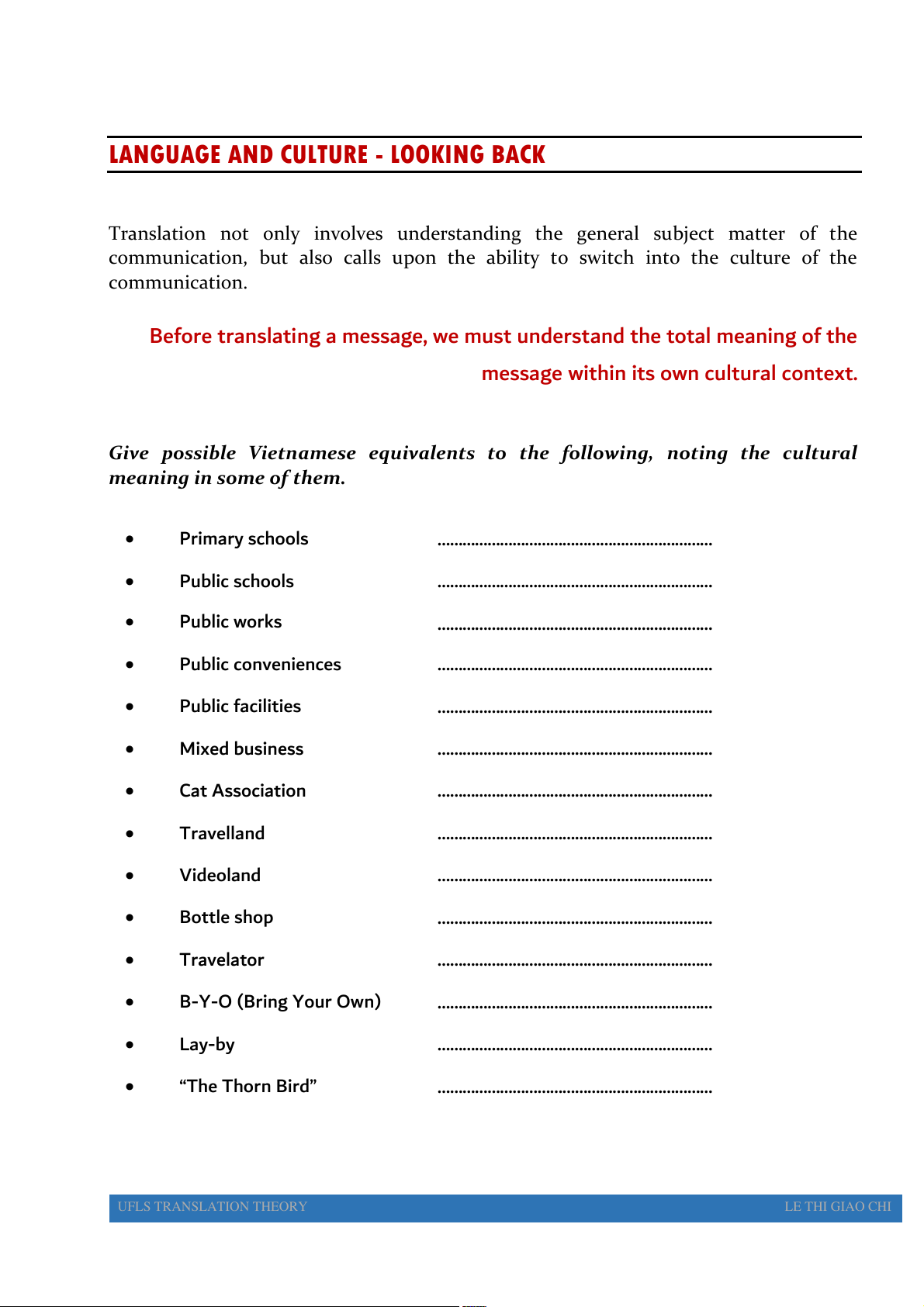
differences that could be critical in translations. What associations can you make when rendering this proverb into Vietnamese? UFLS TRANSLATION THEORY LE THI GIAO CHI
LANGUAGE AND CULTURE - LOOKING BACK
Translation not only involves understanding the general subject matter of the
communication, but also calls upon the ability to switch into the culture of the communication.
Before translating a message, we must understand the total meaning of the
message within its own cultural context.
Give possible Vietnamese equivalents to the following, noting the cultural
meaning in some of them. • Primary schools
………………………………………………………… • Public schools
………………………………………………………… • Public works
………………………………………………………… • Public conveniences
………………………………………………………… • Public facilities
………………………………………………………… • Mixed business
………………………………………………………… • Cat Association
………………………………………………………… • Travelland
………………………………………………………… • Videoland
………………………………………………………… • Bottle shop
………………………………………………………… • Travelator
………………………………………………………… • B-Y-O (Bring Your Own)
………………………………………………………… • Lay-by
………………………………………………………… • “The Thorn Bird”
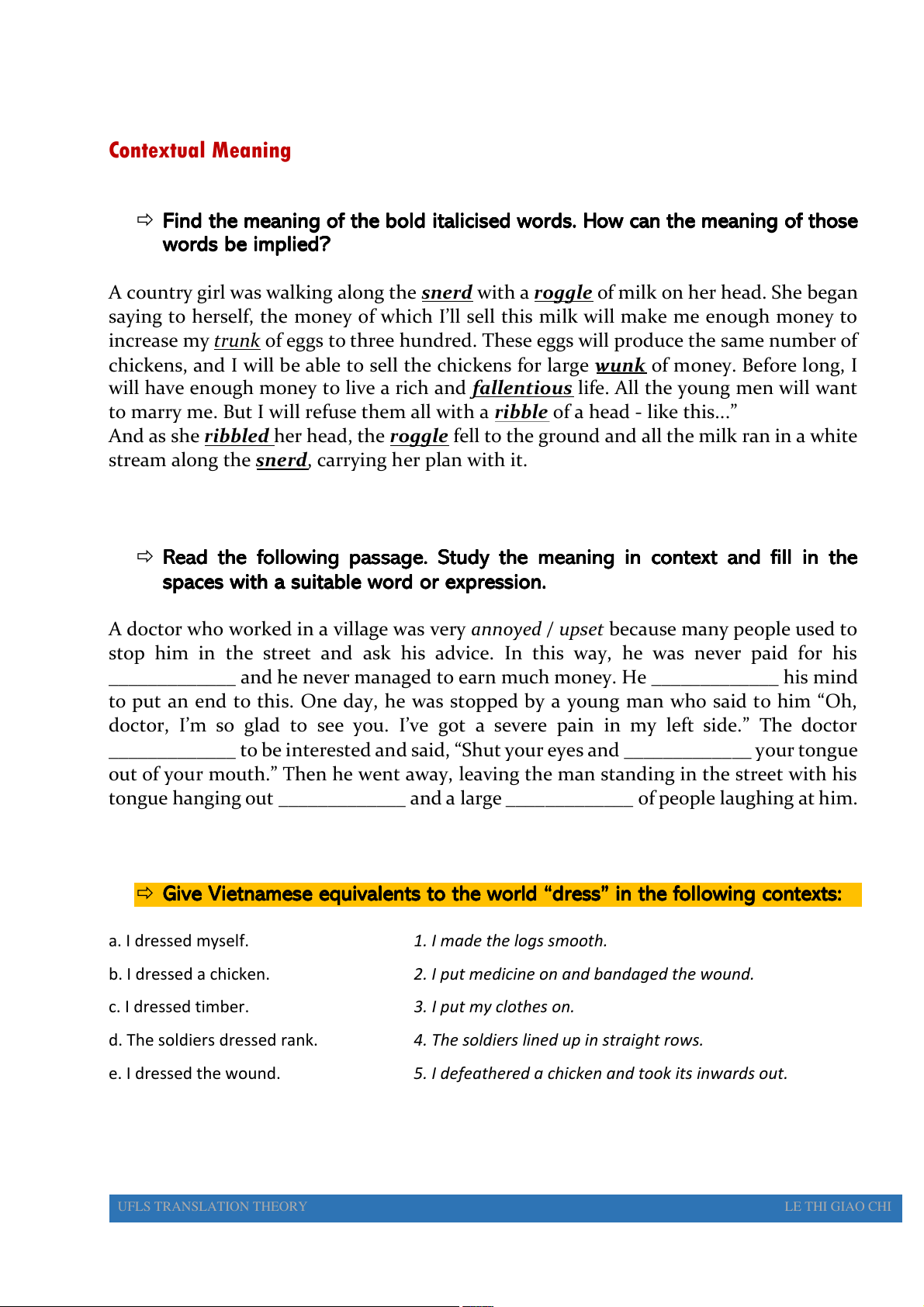
………………………………………………………… UFLS TRANSLATION THEORY LE THI GIAO CHI Contextual Meaning Fi F n i d n d t h t e h e me m a e n a i n n i g n g of t o h f t e h e bo b l o d l d i t i a t l a i l c i i c s i e s d e d wo w r o d r s d . s . H ow o w c a c n a n th t e h e me m a e n a i n n i g n g o f o f th t o h s o e s e wo w r o d r s d s b e b e i m i p m l p i l e i d e ? d ?
A country girl was walking along the snerd with a roggle of milk on her head. She began
saying to herself, the money of which I’ll sell this milk will make me enough money to
increase my trunk of eggs to three hundred. These eggs will produce the same number of
chickens, and I will be able to sell the chickens for large wunk of money. Before long, I
will have enough money to live a rich and fallentious life. All the young men will want
to marry me. But I will refuse them all with a ribble of a head - like this...”
And as she ribbled her head, the roggle fell to the ground and all the milk ran in a white
stream along the snerd, carrying her plan with it. Re R a e d a d th t e h fol fo l l o l w o i w n i g n pa p s a sa s g a e g . e . St S u t d u y d y th t e h e me m a e n a i n n i g n g in i n co c n o t n e t x e t x t an a d n d fill fill in i n th t e h e sp s a p c a e c s e s w i w t i h t h a a s u s i u t i a t b a le l e w o w r o d r d o r o r e x e p x r p e r s e s s i s o i n o . n .
A doctor who worked in a village was very annoyed / upset because many people used to
stop him in the street and ask his advice. In this way, he was never paid for his
_____________ and he never managed to earn much money. He _____________ his mind
to put an end to this. One day, he was stopped by a young man who said to him “Oh,
doctor, I’m so glad to see you. I’ve got a severe pain in my left side.” The doctor
_____________ to be interested and said, “Shut your eyes and _____________ your tongue
out of your mouth.” Then he went away, leaving the man standing in the street with his
tongue hanging out _____________ and a large _____________ of people laughing at him. Gi G v i e v e V i V e i t e n t a n m a e m s e e s e e q e ui u v i a v l a e l n e t n s t s t o t o t h t e h e w o w r o l r d d “ d “ r d e r s e s s ” s ” i n i n t h t e h e fo l fo llo l w o i w n i g n g c o c n o te t x e t x s t : s a. I dressed myself.
1. I made the logs smooth. b. I dressed a chicken.
2. I put medicine on and bandaged the wound. c. I dressed timber.
3. I put my clothes on. d. The soldiers dressed rank.
4. The soldiers lined up in straight rows. e. I dressed the wound.
5. I defeathered a chicken and took its inwards out. UFLS TRANSLATION THEORY LE THI GIAO CHI