Impact of online flow on brand experience and loyalty môn Nghiên cứu khoa học | Trường Đại học Kinh tế, Đại học Quốc gia Hà Nội
Impact of online flow on brand experience and loyalty môn Nghiên cứu khoa học | Trường Đại học Kinh tế, Đại học Quốc gia Hà Nội. Tài liệu được sưu tầm giúp bạn tham khảo, ôn tập và đạt kết quả cao. Mời bạn đọc đón xem.
Môn: Nghiên cứu khoa học (UEB) 5 tài liệu
Trường: Trường Đại học Kinh tế, Đại học Quốc gia Hà Nội 491 tài liệu
Tác giả:














Preview text:
Shim et al.: Impact of Online Flow on Brand Experience and Loyalty
IMPACT OF ONLINE FLOW ON BRAND EXPERIENCE AND LOYALTY Soo In Shim
Chonbuk National University, Department of Fashion Design
567, Baekje-daero, Deokjin-gu, Jeonju-si, Jeollabuk-do, 561-756, South Korea sooinshim@jbnu.ac.kr Sandra Forsythe
Auburn University, Department of Consumer and Design Sciences
308 Spidle Hall, Auburn, Alabama, 36849, USA forsysa@auburn.edu Wi-Suk Kwon
Auburn University, Department of Consumer and Design Sciences
308 Spidle Hall, Auburn, Alabama, 36849, USA kwonwis@auburn.edu ABSTRACT
This study examined the relationships between consumers’ skill, perceived challenge, online flow, brand
experience, and brand loyalty in the context of online shopping on an apparel brand’s website. Data were collected
using an online survey with a national sample of 400 female adults (age 20-34). Respondents were asked to perform
an online browsing task on an existing brand’s website randomly assigned to them and answer questions about the
task. The results from structural equation modeling analysis show that more skillful consumers are more likely to
reach a state of online flow on a brand’s website, and the relationship between skill and online flow was moderated
by the level of challenge felt by consumers about the given task. Further, online flow positively influenced sensory
and affective brand experiences, which in turn led to brand loyalty. Theoretical and managerial implications of the
findings are discussed along with limitations and recommendations.
Keywords: Online; Flow; Brand; Experience; Loyalty 1. Introduction
Many firms have tried to foster brand loyalty. Because brand loyalty results from a close relationship between a
brand and its customers, it can offer a robust customer base – a strong competitive advantage [Meyer & Schwager
2007; Pine & Gilmore 1998]. Strong brand loyalty is reflected by customers’ emotional attachment to a brand and
their patronage behavior toward the brand [Chaudhuri & Holbrook 2001]. As one way to build strong brand loyalty,
it has been emphasized that firms need to convey positive brand experiences to consumers [Mascarenhas et al. 2006;
Nysveen et al. 2013]. Considering that brand experience is comprised of consumers’ synthesized perceptions of all
points of contact with a brand [Morgan-Thomas & Veloutsou 2013], a brand’s website is regarded as a crucial
channel for conveying brand experience because consumers can freely explore the brand’s online offerings through
richer and more interactive ways than through other channels [Berthon et al. 1996; Keller 2010; Müller et al. 2008; Pine & Gilmore 1998].
Consumers’ interaction with brand-related stimuli on the website has not been sufficiently investigated in regard
to accumulated consumer experience with a brand. Prior studies focusing on the experience of online flow -- a state
of optimal, outstanding, memorable, extraordinary, totally absorbing, or engaging online experience -- have
demonstrated the positive effect of online flow on online learning [e.g., Hoffman & Novak 1996; Skadberg &
Kimmel 2004] and on online shopping [e.g., Hausman & Siekpe 2009; Hsu et al. 2012; Rose et al. 2012]. Given that
online flow can be defined as a consumer’s complete absorption in an online activity such as online shopping [van
Noort et al. 2012], the momentary, fragmentary experience of enjoyment in online shopping is likely to create an
overall positive perception of the website where the shopping activity happened. However, there are no published
studies verifying the benefits of online flow in enhancing consumers’ overall brand experience, and thereby, their
brand loyalty. To fill this gap in the literature, the present study proposes that online flow, experienced on a brand’s
website, positively influences brand experience and leads to enhanced brand loyalty. Page 56
Journal of Electronic Commerce Research, VOL 16, NO 1, 2015
In addition to examining the influence of online flow on brand experience and brand loyalty, it is necessary to
know how consumers reach a state of online flow when visiting a brand’s website. Consumers’ flow experience is
known to result from their expectation of control over web navigation [Chen et al. 1999; Dailey 2004; Hoffman &
Novak 1996; Novak et al. 2000]. Flow theory postulates that consumers can reach flow only when they have
sufficient skill to complete a task that is manageably challenging [Csikszentmihalyi 1991; Csikszentmihalyi 1997].
For a given online task, skill is a user’s ability to accomplish the task, while challenge is the amount of effort
required to accomplish the task. Prior studies have focused on skill and challenge only in terms of online
navigational tasks [e.g., Chen et al. 1999; Dailey 2004; Hoffman & Novak 1996; Novak et al. 2000; Richard &
Chandra 2005], which may be insufficient for investigating actual online shopping. Moreover, depending on the
product category for the online shopping task, category-specific skill and challenge may influence the level of flow a
consumer reaches during online shopping. For example, consumers shopping for fashion products online are likely
to need an expert knowledge of recent fashion trends as well as navigation skills using a browser in order to undergo
a flow experience. For this reason, the range of skill and challenge need to be extended in consideration of a specific
context of online shopping (e.g., what kind of products consumers are looking for).
The purpose of this study is to examine the relationships between skill, challenge, online flow, brand
experience, and brand loyalty in the context of online shopping on an apparel brand’s website. The specific
objectives are to examine (1) an interaction between skill and challenge that leads to online flow on a brand’s
website; (2) the relationship between the online flow experienced on a brand’s website and consumers’ brand
experience; (3) the relationship between consumers’ brand experience and their brand loyalty; and (4) the mediating
role of brand experience on the relationship between online flow and brand loyalty. It is notable that the present
study examines the role of skill and challenge in flow experience in the context of online apparel shopping.
Specifically, this study explores perceived challenges relevant to online browsing tasks on an apparel brand’s
website and the various skill dimensions (e.g., online shopping skill, clothing shopping skill, and general shopping
skill) necessary to complete these tasks as potential antecedents of reaching an online flow experience on the apparel
brand’s website. Apparel brand websites are appropriate to this study because they provide ample opportunity for
visitors to be actively involved in processing the abundant and dynamic information available, such as size, color,
design, price, and materials. Because the ability to convey full information on dominate product attributes (e.g.,
touch and feel information) for experience goods such as apparel products are limited on websites [Song & Kim
2012], apparel brand websites have used various visual and textual stimuli to help consumers evoke mental images
of product use [Schlosser et al. 2003]. These stimuli are likely to engage consumers in performing the browsing tasks used in the study. 2. Theoretical Framework 2.1.
Effects of Skill and Challenge on Online Flow
Flow is defined as “the state in which people are so involved in an activity that nothing else seems to matter”
and represents the highest possible quality of experience [Csikszentmihalyi 1991]. Online flow is the flow state
specific to online environments, conceptualized as a multidimensional construct embracing various dimensions,
such as focused concentration on a task, a sense of being in control, autotelic experience (also referred to as intrinsic
reward or enjoyment), a sense of time distortion, and telepresence [Guo & Poole 2009; Hoffman & Novak 2009].
According to flow theory, flow is determined by two factors: skill and challenge. Flow occurs only when a
formidable challenge is manageable by a person’s skills; that is, the levels of both skill and challenge are high. Thus,
online flow is determined by the level of a user’s navigational skill and the level of challenge of an online search
task [Hoffman & Novak 1996; Novak et al. 2000].
In the context of shopping on a brand’s website, online flow can be regarded as the extent to which a consumer
is engaged in interaction with brand-related stimuli on a brand’s website while performing an online shopping task.
Skill in this context may be defined as the extent to which a consumer is equipped with all the abilities needed to
shop on the brand’s website. In the case of apparel brand websites, consumers’ online shopping skill, encompassing
online navigational skill, general shopping skill, and apparel specific shopping skill, is likely to influence their
online flow positively. Challenge in online shopping can be regarded as the level of mental discomfort provoked by
the required effort to reach a purchase decision on a brand’s website. In addition to navigational challenge related to
the website design, shopping challenge related to characteristics of the merchandise such as quality, size, price, and
variety needs to be considered to conceptualize challenge in online shopping.
As suggested in the flow theory, people are most likely to reach flow only when both skill and challenge are
high [Csikszentmihalyi 1991; Csikszentmihalyi 1997], as it is the interaction between high levels of skill and
challenge that leads to online flow. If consumers have a high level of skill, they may not be challenged and fail to
reach online flow; if consumers without a high level of skill perceive a high level of challenge, they may feel Page 57
Shim et al.: Impact of Online Flow on Brand Experience and Loyalty
overwhelmed by their lack of skills to overcome the challenge. Thus, neither skill nor challenge contributes to flow
in a linear manner; the level of challenge must be paired with the appropriate level of skill [Richard et al. 2010]. In
the context of online shopping as well, online flow is likely to be determined by the interaction between skill and
challenge. Thus, the effect of skill on online flow is expected to be moderated by the level of challenge. Based on
this rationale, the two following hypotheses are proposed.
H1. The higher the online shopping skill, the greater the online flow.
H2. Challenge moderates the relationship between skill and online flow such that the relationship between skill
and online flow is stronger when challenge is perceived to be high (vs. low). 2.2.
Effects of Online Flow on Brand Experience
The term “brand experience” is defined as cumulative consumer experiences with brand-related stimuli that are
part of a brand’s design and identity, packaging, communications, and environments [Brakus et al. 2009], implying
that consumer perceptions of brand experience can be influenced by marketing communications such as website
content and marketing environments such as website design. As a brand’s website is typically both a marketing
communication and a sales channel, the variety of stimuli on a website can provoke positive (or negative)
interactions between a consumer and the brand’s website, contributing to the consumer’s overall brand experience.
If the interaction on the brand’s website is characterized as outstanding, memorable, extraordinary, or optimal, the
state of online flow is likely to have occurred; this flow experience is expected to have enhanced the consumer’s
overall brand experience. Schembri [2009] suggests that experiential meaning of a brand is formed from a
customer’s specific individual experiences, supporting the notion that an episode of online flow on the brand’s
website may positively influence a consumer’s overall brand experience.
More specifically, the online flow experienced while visiting a website is expected to enhance the four
dimensions of brand experience (i.e., sensory, affective, behavioral, and intellectual) suggested by Brakus et al.
[2009]. Sensory, affective, and intellectual brand experiences are subjective, internal responses, representing the
sensations, feelings, and cognitions, a consumer has toward stimuli related to the brand. On the other hand,
behavioral brand experience refers to consumers’ responses to a brand that are observed through their physical
behavior toward specific brand-related stimuli (e.g., consumers work out more energetically wearing Nike workout
clothes). Given that online flow entails subjective internal responses as well as behavioral responses [Hoffman &
Novak 1996; Hoffman & Novak 2009], online flow is probably related to all the sensory, affective, behavioral, and
intellectual dimensions of brand experience. For example, consumers experiencing online flow on a brand’s website
are awake and focused (i.e., concentration dimension), so their visual and auditory senses are highly activated,
which may lead to increasing sensory brand experience. This hyper-focused state on a brand’s website may also
facilitate consumers’ brain activity, which is likely to enhance their intellectual brand experience. Similarly,
shopping enjoyment on a brand’s website (i.e., autotelic experience dimension of online flow) may cause increased
affective brand experience. Moreover, behavioral brand experience can be enhanced through a feeling of being in
other real-life situations where a brand product is being used (i.e., telepresence dimension of online flow) because
consumers are likely to be exposed to various stimuli calling for the brand-like action (e.g., brand mission) on the
brand’s website. Thus, the following hypothesis is proposed.
H3. The greater the online flow on a brand’s website, the more positive the (a) sensory, (b) affective, (c)
behavioral, and (d) intellectual brand experiences. 2.3.
Effects of Brand Experience on Brand Loyalty
Brand loyalty is thought to result from the search and attribute evaluation process that leads to beliefs of brand
superiority as well as repeat purchase [Holland & Baker 2001; van den Brink et al. 2006]. This study posits that
brand loyalty includes consumers’ belief that a brand is preferable to others and their subsequent intention to engage
in loyal behaviors such as recommending the brand to others and repeatedly purchasing the brand.
The relationship between brand experience and brand loyalty has been suggested in prior studies [Biedenbach &
Marell 2010; Brakus et al. 2009; Mascarenhas et al. 2006; Meyer & Schwager 2007] because brand loyalty is often
built on the basis of long-term and close relationships between a customer and a brand. Some studies show empirical
evidence that a positive brand experience can significantly increase brand loyalty [Biedenbach & Marell 2010;
Morgan-Thomas & Veloutsou 2013]. Lin and Kuo [2013] demonstrate that consumers’ loyalty intention is
influenced by their experiences formed during their most recent shopping, implying that positive brand experience
could be key to strong brand loyalty.
Since brand experience has been conceptualized as a multidimensional construct consisting of the sensory,
affective, behavioral, and intellectual dimensions [Brakus et al. 2009], the positive relationship between brand
experience and brand loyalty needs to be verified more specifically. Nysveen et al. [2013] have considered the
multidimensional construct of brand experience in verifying the effects of brand experience dimensions on brand
loyalty. The authors have found that only relational dimension of brand experience has a significant, direct effect on Page 58
Journal of Electronic Commerce Research, VOL 16, NO 1, 2015
brand loyalty whereas the other dimensions, including the sensory, affective, behavioral, and intellectual dimensions,
do not. Given that Nysveen et al.’s [2013] study focuses on a service brand context, their findings may be less
applicable to other contexts such as shopping a product on an apparel brand’s website. But more importantly, their
findings support the notion that the effect of brand experience on brand loyalty can differ depending on brand
experience dimensions. Considering that consumer experience with apparel product brands can be well applied to
the dimensionality of brand experience suggested by Brakus et al. [2009], we predict that all types of brand
experience are likely to influence brand loyalty, as reflected in the following hypothesis.
H4. The more positive the (a) sensory, (b) affective, (c) behavioral, and (d) intellectual brand experiences on a
brand’s website, the greater the brand loyalty. 2.4.
Mediating Effects of Brand Experience on the Relationship between Online Flow and Brand Loyalty
Literature has suggested the plausible, positive effect of online flow on brand loyalty [Brodie et al. 2013; Cha
2011; Gabisch & Gwebu 2011; Mu & Galletta 2007; Nambisan & Watt 2011; Siekpe 2005]. Because interactive
experience within a brand’s website engages the consumer with the brand and thereby enhances consumer loyalty
[Brodie et al. 2013], online flow can also enhance brand loyalty given that online flow is an interactive experience of
the highest quality [Csikszentmihalyi 1991]. Furthermore, Siekpe [2005] has demonstrated that flow experiences on
websites could result in repeat visits. Despite the potential effect of online flow on brand loyalty, no published study
has empirically examined this relationship, perhaps because it takes time to become loyal to a specific brand. Online
flow is thought to be a situational experience at a specific moment [Chen et al. 1999]. Accumulating online flow
experiences on a brand’s website can lead to brand loyalty, established by providing positive experiences with a
brand over time [van den Brink et al. 2006]. However, given that online flow may influence overall brand
experience (as predicted in H3), which in turn may lead to brand loyalty (as predicted in H4), it is plausible that the
effect of online flow on brand loyalty suggested in the prior studies is mediated by enhanced brand experience.
Thus, the following hypothesis is proposed.
H5. (a) Sensory, (b) affective, (c) behavioral, and (d) intellectual brand experience mediates the relationship
between online flow and brand loyalty.
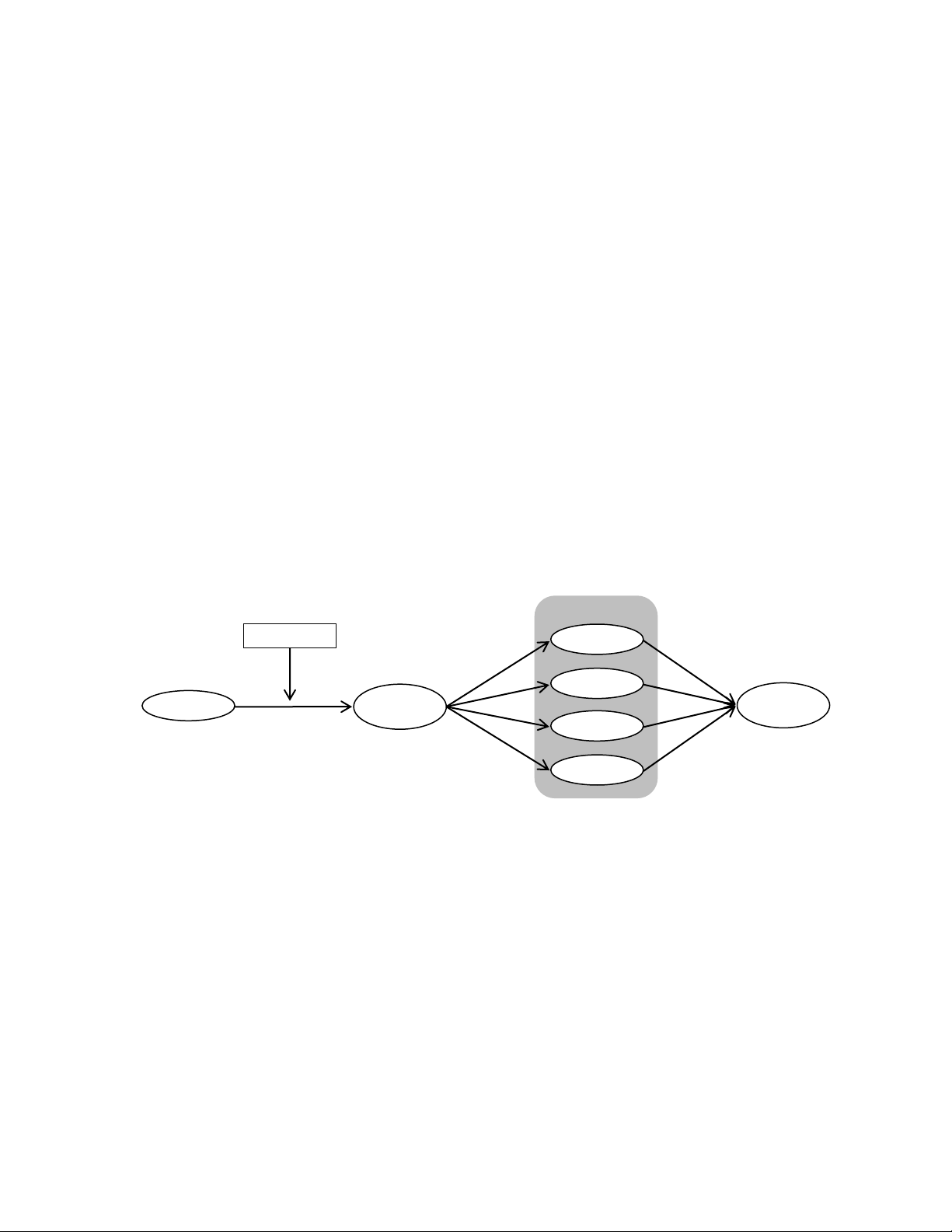
The research model portraying all the hypothesized relationships in the present study is shown in Figure 1. Brand Experience Challenge Sensory H3(a) H4(a) H2 H3(b) Affective H4(b) Brand Skills Online Flow Loyalty H1 Behavioral H3(c) H4(c) H3(d) Intellectual H4(d)
Note. H5 (i.e., mediating relationship) is not noted separately in this Figure. Figure 1. Research Model 3. Methods
This study employed an online survey including an online browsing task and a questionnaire for a large sample
size necessary to alleviate concern over sampling errors [Jackson et al. 2013] that could hinder the validity and
reliability of newly developed items used in this study. Moreover, a large sample is necessary to test the hypotheses
in a single framework by using structural equation modeling (SEM), which is one of major contributions of this
study. In order to evoke perceived challenge and create an environment to facilitate reaching the state of flow,
participants were asked to perform a task of browsing an apparel brand’s website and answer questions related to the
task at hand, rather than simply answering questions based on their memories about a recent online flow experience.
The data were collected through the Internet to allow online flow to be measured immediately after the respondents completed the browsing task. 3.1. Instruments 3.1.1. Online Browsing Task
The online browsing task required each respondent to select a shirt or top she would like to wear from the
apparel brand website randomly assigned from eight well-known existing apparel brands’ websites. Well-known Page 59
Shim et al.: Impact of Online Flow on Brand Experience and Loyalty
existing brands were more suitable to the context of this study than new or lesser known brands because brand
loyalty may be built through repetitive experiences with a brand. To select the brands used in the online browsing
task, first, a panel of three experts in the apparel merchandising field examined vertically-integrated apparel brands
targeting female consumers (e.g., Victoria Secret) listed in trade publications [Internet Retailer 2010; WWD 2008]
in terms of their retail format and target market. Then, content analysis of the brands’ websites was conducted to
identify whether they have sufficient selections of merchandise to choose from and whether their price ranges fit the
task requirement. Based on the shirt/top merchandise assortment of the brands’ websites, 10 brands’ websites were
selected and subjected to a pilot test with a convenience sample of 150 female college students. Two of the brands’
websites were eliminated because no pilot test respondents had shopped on these websites for an apparel product.
Thus, the remaining eight brands’ websites were retained to be used for the browsing task in the main study.
The instructions for the browsing task were described to generate varying levels of perceived challenge among
respondents. Respondents were asked to browse the assigned brand website to select a shirt or top by simultaneously
judging several product characteristics including quality, style, color, fit, coordination with existing wardrobe, and
price, which is often a challenge that creates difficulties in apparel shopping [Claxton & Ritchie 1979]. Specifically,
the browsing task instruction stated that the shirt/top selected must be made by the given brand, be a style and color
that suits the respondent, reflect good quality materials and workmanship, fit the respondent well, go well with other
apparel items the respondent already has, and be priced under $50. The level of challenge from this task perceived
by the aforementioned pilot test sample was widely distributed from 1 to 6.25 (M = 3.5, SD = 1.16) on a 7-point Likert scale.
Unlike experimental research, survey research presents difficulties in controlling respondents, which could
prevent us from confirming whether respondents actually conducted the task. To ensure respondents’ participation in
the task, respondents were subsequently asked to describe the shirt/top they selected during the task (e.g., product
name, color, size, price, etc.). The responses without the information about the shirt/top selected were excluded from
the data used for further analysis. 3.1.2. Measurements
When consumers shop and order through the Internet, their skills to buy a product online could be affected by
multiple factors, such as factors related to online only and factors related to shopping in general [Zhou et al. 2007].
Accordingly, a 15-item scale (see Table 1) was developed by the researchers to assess respondents’ skills in various
areas, including e-commerce skill, clothing shopping skill, general shopping skill, and web navigation skill, relevant
to online apparel shopping based on literature [Novak et al. 2000; Reece & Kinnear 1986]. Challenge was measured
by four items adapted from Novak et al.’s [2000] navigational challenge items to reflect the challenge posed by the
online browsing task assigned in this study (see Table 1). In order to include all the dimensions of online flow
proposed in the original literature [Hoffman & Novak 1996] and subsequently develop a more comprehensive
measure of online flow, 36 online-flow items were culled and adapted from various existing online flow scales
which tend to focus on selective dimensions of online flow [Guo & Poole 2009; Jackson & Marsh 1996; Klein 2003;
Novak et al. 2000; Webster et al. 1993] (see Table 2). Brand experience was measured by a 12-item scale adapted
from Brakus et al. [2009] (see Table 3). Seven brand loyalty items (see Table 3) were developed by the researchers
to measure favorable beliefs and behavioral intentions toward the brand based on the concept of brand loyalty,
defined as a customer’s belief in the priority of a brand over other rival brands and their subsequent behavioral
intentions to repurchase, revisit, and recommend the brand, and pay a price premium for the brand [Oliver 1999; van
den Brink et al. 2006]. Many existing measurement scales of brand loyalty [van den Brink et al. 2006], brand beliefs
[Uwaifo 2008], brand image [Grewal et al. 2003], and behavioral intention [Veletsianos & Miller 2008] were
referenced to generate a comprehensive list of loyalty items. Finally, demographic characteristics of respondents
were measured through questions asking their age, marital state, educational state, ethnicity, and annual household
income. For all measures, 7-point Likert scales (1 = Strongely Disagree, 7 = Strongly Agree) were used. 3.2.
Sampling and Data Collection Procedure
A national sample of 815 female consumers in the United States, who were between 20 and 34 years old and
had shopped online, participated in the survey. The sample was randomly selected from members of an online
consumer panel of a market research firm and was recruited via email. Participants first completed the skill measure
on the online questionnaire, and then visited the apparel brand website randomly assigned to them to conduct the Page 60
Journal of Electronic Commerce Research, VOL 16, NO 1, 2015
Table 1: Exploratory and Confirmatory Factor Analysis Results for Skill and Perceived Challenge Factor Loading Variable Dimension Item EFAa CFAb Skill Online Shopping Skill
I am skilled in using the web. .782 .904 (AVE = .743,
I have good web search techniques. .753 .955 Cronbach’s α = .901)
I know how to find what I am looking for on the web. .748 .941
I easily complete the purchase process on a shopping website. .672 .598 Clothing Shopping Skill
I can judge whether a clothing product has high quality. .786 .745 (AVE = .627,
I can judge whether a clothing product fits me well. .779 .891 Cronbach’s α = .866)
I am usually aware of how trendy a clothing product is. .718 .667
When I shop for clothing, I can choose the right style and color for me. .621 .846 General Shopping Skill
I usually know what to buy when I shop for something. .805 .766 (AVE = .616,
I easily narrow down product choices. .785 .850 Cronbach’s α = .822)
It is easy for me to find the right product that I am looking for in a store. .759 .733 Eliminated items
It is hard for me to compare product choices to decide what to buy. R
I know somewhat less than most users about using the web. R - -
I often have difficulties in shopping online. R
I have no trouble in buying something online.
Challenge (Cronbach’s α = .806)
This task challenged me to perform to the best of my ability. .822
I found that this task stretched my capabilities to my limit. .820 N/A
This task was challenging to me. .806
This task provided a good test of my skills in online shopping. .684
a n = 191, except challenge for which n = 400 b n = 209 R Reverse-coded items.
online browsing task. After completing the browsing task, participants returned to the online questionnaire, entered
information about the product they chose during the task, and completed the remaining measures including
challenge perceived during the task, online flow, brand experience, brand loyalty, and demographic characteristics.
The market research firm provided respondents with a small incentive for participation. In addition to the small
incentive, all respondents had a chance to enter a random drawing to receive the product they selected for the task.
This drawing was intended to better engage respondents in the browsing task and actively sustain cognitive
processing [Mollen & Wilson 2010]. By providing an opportunity to gain the product selected, respondents could
regard the browsing task as a shopping event similar to real shopping situations, rather than a mock activity for a survey.
Among the 815 responses, 58 responses were eliminated from the data because they included invalid data or did not
provide information about the product they chose from the online browsing task. The remaining data were not
evenly distributed across the eight brands. In order to avoid an unwanted effect resulting from an idiosyncrasy of a
particular brand more highly represented in the data, we randomly selected about 50 responses from each brand
based on the sample size of the least represented brand. The final sample used for data analysis consisted of 400
women age 20 to 34 (M = 27.8, SD = 3.92).
Educational experience of the respondents varied substantially; the largest group had some college or technical
school (44.8%), followed by those with a 4-year college degree (22.6%), a high school degree (18.8%), and others
(13.8%). A majority of the respondents were non-Hispanic White (63.8%), followed by non-Hispanic Black
(12.8%), Hispanic (7.2%), and Asian (7.2%). The sample characteristics were generally consistent with the U.S.
national female population with ages of 20-35 years as reported by the U.S. Census Bureau [U.S. Census Bureau
2009a; U.S. Census Bureau 2009b; U.S. Census Bureau 2010a; U.S. Census Bureau 2010b]. Page 61
Shim et al.: Impact of Online Flow on Brand Experience and Loyalty
Table 2: Exploratory and Confirmatory Factor Analysis Results for Online Flow Factor Loading Dimension Item EFAa CFAb Telepresence
During this task, my body was in the room, but my mind was inside the world created .869 .894 (AVE = .674, by the computer.
Cronbach’s α = .939) I felt I was more in the web world than the real world around me when I was doing the .865 .872 task.
When I completed this task, I felt like I came back to the real world after a journey. .845 .872
I forgot about my immediate surroundings when I was doing the task. .824 .887
During this task, I felt I was in the world the website created. .792 .877
During this task, I forgot I was in the middle of a survey. .759 .740
The website seemed to me somewhere I visited rather than something I saw. .708 .807
I lost track of time while doing this task. .616 .562 Autotelic Experience This task was interesting. .771 .853 (AVE = .697,
I really enjoyed doing this task. .748 .880
Cronbach’s α = .948) I loved the feeling of completing this task. .748 .824
I found this task experience rewarding. .742 .838 This task was fun for me. .728 .883
The experience of doing this task left me feeling great. .720 .794
This task stimulated my curiosity. .693 .831 This task made me curious. .685 .768 Control
I felt calm because I understood the process to complete this task. .860 .863 (AVE = .582,
I clearly knew the right things to do to complete this task. .843 .759
Cronbach’s α = .901) I felt calm because I was sure about what to do to accomplish this task. .841 .859
I felt clear about what to do to accomplish this task. .839 .795
During this task, I made the correct movements without thinking. .760 .634
During this task, I felt in control. .688 .736
I reacted to the website automatically during this task. .626 .661 Eliminated items
During this task, I made an effort to keep my mind on the task. R
I was concerned about how well I was completing this task. R
I was worried about how I was performing during this task. R
I was self-conscious during this task. R
This task stimulated my imagination.
During this task, my attention was focused entirely on what I was doing.
I was completely focused on this task at hand. - -
During this task, time appeared to go by very quickly.
During this task, I did things spontaneously and automatically without having to think.
Things just seemed to be happening automatically during this task. Time flew during this task.
I had total concentration to complete this task. This task bored me. R a n = 191 b n = 209 R Reverse-coded items. Page 62
Journal of Electronic Commerce Research, VOL 16, NO 1, 2015
Table 3: Exploratory and Confirmatory Factor Analysis Results for Brand Experience and Brand Loyalty Factor Loading Variable Dimension Item EFAa CFAb Brand Sensory Experience
This brand makes a strong visual impression. .740 .780 Experience (AVE = .683,
I find this brand interesting in product displays, product texture, .761 .783 Cronbach’s α = .869)
background music and/or use of fragrance.
This brand appeals to my senses of hearing, sight, touch, and/or smell. .823 .910 Affective Experience
This brand induces my feelings and sentiments. .893 .932 (AVE = .789,
I have strong emotions for this brand. .900 .827 Cronbach’s α = .916) This brand provokes emotions. .900 .902 Behavioral Experience
I behave in a certain way when I wear this brand’s clothes. .871 .891 (AVE = .824,
I act differently when I use this brand. .868 .910 Cronbach’s α = .934)
This brand results in a certain behavior. .904 .922 Intellectual Experience
I engage in a lot of thinking when I encounter this brand. .852 .901 (AVE = .824, This brand makes me think. .850 .937 Cronbach’s α = .933)
This brand stimulates my thinking and problem solving. .875 .884 Brand (AVE = .720,
I will buy this brand next time. .929 .860 Loyalty Cronbach’s α = .951)
I will think of this brand over other brands. .928 .894
I will pay a lot of attention to this brand over other brands. .918 .886
I will revisit this brand next time. .899 .826
I will consider this brand my first choice. .892 .871
I will recommend this brand to other people. .878 .796
I will pay more in order to buy this brand. .833 .799 a n = 191 b n = 209 4. Results 4.1.
Measurement Validity and Reliability
The reliability and validity of the measures for skill, perceived challenge, online flow, brand experience, and
brand loyalty were assessed before testing the hypotheses. For the four-item challenge scale, exploratory factor
analysis (EFA) was conducted on the entire data set (n = 400) employing the procedure of principal component
analysis with Varimax rotation. The EFA results assured the unidimensionality of the scale. The Cronbach’s α for
the four challenge items was .806, indicating good internal consistency [Cronbach & Shavelson 2004].
For the other measurements, the data were randomly split into two sets so that one set (n = 191) was used for
EFA and the other set (n = 209) for confirmatory factor analysis (CFA). Results of independent samples t-test
confirmed the non-difference in respondents’ age (t = -.375, df = 396, p = .708) as well as the measurements of skill,
online flow, brand experience, and brand loyalty (all ps > .05) between the EFA and CFA data sets. EFA using
principal component analysis with Varimax rotation, analyzed by SPSS 19.0, was used to reduce items and identify
factors with clear structure meaning. Then, CFA employing the maximum likelihood estimation procedure was
conducted using AMOS 8.0 to confirm the factor structures resulting from the EFA and further refinement of the
measurement models, if needed.
Based on results from the EFA and CFA, a three-factor model including 11 items was finalized as the
measurement model for skill (see Table 1). The finalized CFA model fit was good (χ2 = 53.362, df = 41, p < .01; CFI
= .992, TLI = .989; RMSEA = .038). The three skill factors were labeled online shopping skill, clothing skill, and
general shopping skill. Further, the online flow measurement model finalized through the EFA and CFA was
comprised of 23 items classified into three factors; telepresence, autotelic experience, and control (see Table 2). The
final CFA model fit was acceptable (χ2 = 467.646, df = 227, p < .001; CFI = .939, TLI = .932, RMSEA = .071).
Telepresence indicates cognitive immersion in the online browsing task, autotelic experience denotes intrinsic
rewards from the browsing task (e.g., enjoyable and exploratory experiences on performing the task), and control
refers to perceived sense of control over the browsing task. Next, a four-factor, 12-item measurement model was
finalized for brand experience through the EFA and CFA (CFA model fit: χ2 = 123.342, df = 48, p < .001; CFI =
.972, TLI = .962; and RMSEA = .087) (see Table 3). The four factors were labeled as sensory, affective, behavioral,
and intellectual experiences, following the original classifications suggested by Brakus et al. [2009]. Finally, as Page 63
Shim et al.: Impact of Online Flow on Brand Experience and Loyalty
shown in Table 3, the EFA and CFA resulted in a single-factor, seven-item model for brand loyalty with an
acceptable model fit from the CFA (χ2 = 14.347, df = 8, p < .01; CFI = .995, TLI = .988, RMSEA = .062).
The finalized measurement models were further tested for their construct validity, including convergent and
discriminant validity [Hair et al. 2009]. The average variance extracted (AVE) for all factors exceeded .50, thereby
demonstrating convergent validity [Fornell & Larcker 1981]. No factor correlation confidence intervals (i.e., plus
and minus two standard errors around the factor correlation coefficients) contained 1.0, thereby indicating
discriminant validity [Anderson & Gerbing 1988]. Further, through a series of chi-square difference tests,
unconstrained models (i.e., the finalized CFA models) showed a significantly better fit over all the constrained
models with a factor correlation coefficient of 1.0, reaffirming the discriminant validity of all scale factors
[Anderson & Gerbing 1988]. Finally, Cronbach’s αs of all scale factors exceeded .70, indicating the internal
consistency of the scales [Cronbach & Shavelson 2004]. 4.2. Hypothesis Testing
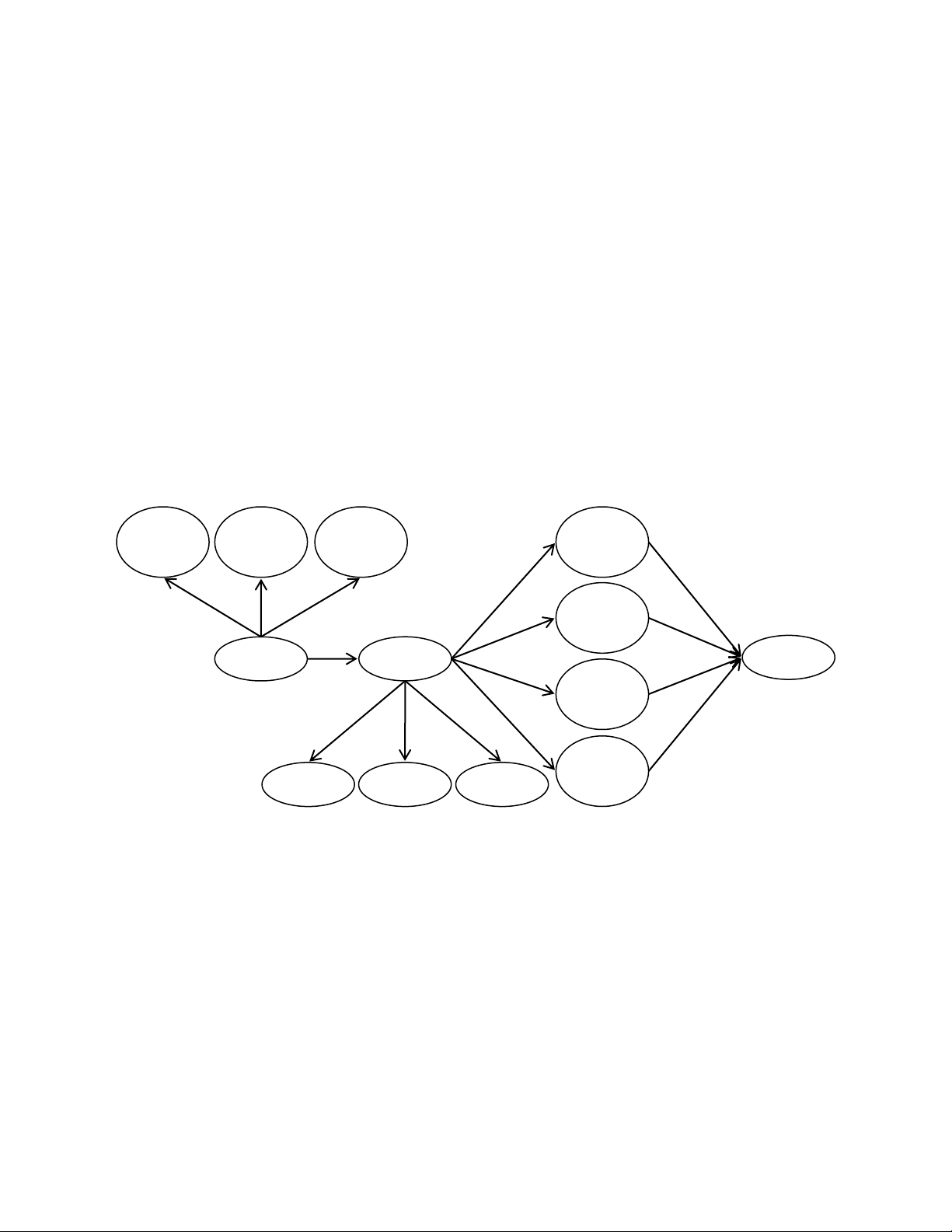
All hypothesized direct relationships (i.e., H1, H3a-d, and H4a-d) were tested through a single-group SEM with
maximum likelihood estimation using AMOS. The SEM results (see Figure 2) demonstrated an acceptable fit (χ2 =
3317.640, df = 1409, p < .001; CFI = .905, TLI = .900, RMSEA = .058). The standardized regression coefficients
indicated that skill positively influenced online flow (γ = .303, p < .001), supporting H1. The positive influences of
online flow on sensory (β = .860, p < .001), affective (β = .991, p < .001), behavioral (β = .932, p < .001), and
intellectual (β = .928, p < .001) brand experiences also were significant, supporting H3a-d. Moreover, sensory (β =
.266, p < .01) and affective (β = .857, p < .001) brand experiences had a positive influence on brand loyalty, thereby
supporting H4a and H4b. The influences of behavioral (β = -.178, p = .162) and intellectual (β = -.169, p = .185)
brand experiences on brand loyalty were not significant, thereby failing to support H4c and H4d. Online Clothing General Sensory Shopping Shopping Shopping Brand .860*** .266** Skill Skill Skill Experience .701*** .892*** .722*** Affective .991*** Brand .857*** Experience .303*** Skills Online Brand Flow .932*** -.178 Loyalty Behavioral Brand .928*** Experience -.169 .600*** .540*** .202*** Intellectual Brand Tele- Autotelic Control Experience presence Experience
χ2 = 3317.640, df = 1409, p < .001, CFI = .905, TLI = .900, and RMSEA = .058 ** *** p < .01, p < .001
Figure 2: Structural equation model and standardized coefficients for testing H1, H3a-d, and H4a-d (n = 400).
H2, predicting that the relationship between skill and online flow would vary between the high and low
challenge groups, was tested using multiple-group CFA. Respondents were categorized into high and low challenge
groups using a median split based on the average of the four challenge items. Then, as shown in Figure 3, a CFA
model was created with two latent variables (i.e., skill and online flow) using second-order factor structures whereas
each of the latent variables was indicated by their factors which were then indicated by their measurement items; the
three second-order skill factors are online, clothing, and general shopping skills, whereas the three second-order
online flow factors are telepresence, autotelic experience, and control. The multiple-group CFA results (χ2 = 2261.9,
df = 1174, p < .001; CFI = .901, TLI = .894, RMSEA = .048) show the correlation between skill and online flow
was higher for the high-challenge group (ρ = .806, p < .001) than for the low-challenge group (ρ = .393, p < .001).
To determine whether this correlation difference between the two challenge groups was statistically significant, a
chi-square difference test was run between this model and another multiple-group CFA model with a constraint that
the skill-online flow factor correlation coefficient was equal between the high- and low-challenge groups. Results Page 64
Journal of Electronic Commerce Research, VOL 16, NO 1, 2015
from the chi-square difference test (Δχ2 = 13.680, Δdf = 1, p < .001) show that the unconstrained model had a
significantly better fit than the constrained model, indicating that the skill-online flow correlation significantly
differs between the high- and low-challenge groups, thereby supporting H2. Online Tele- shopping presence .821*** .372*** skill .806*** Clothing .887*** Skills Online .865*** Autotelic shopping Flow experience skill .694*** .925*** General Control shopping skill (a) High challenge Online Tele- shopping presence .796*** .504*** skill .393*** Clothing .710*** Skills Online .998*** Autotelic shopping Flow experience skill .733*** .586*** General Control shopping skill (b) Low challenge
χ2 = 2261.9, df = 1174, p < .001, CFI = .901, TLI = .894, and RMSEA = .048 *** p < .001
Figure 3: Structural equation model for testing H2 (n = 400)
To further examine H2, a multivariate analysis of variance (MANOVA), followed by ANOVAs, was conducted
on SPSS, with skill (the high vs. low skill groups based on a median split of the composite score of skill items) and
challenge (the high vs. low perceived challenge groups) as the fixed factors and the composite scores of each of the
three online flow dimensions as the dependent variables. MANOVA results show a significant skill × challenge
interaction effect (Wilks' λ = .971, F3, 394 = 3.905, p < .01) as well as significant main effects of skill (Wilks' λ =
.782, F3, 394 = 36.550, p < .001) and challenge (Wilks' λ = .831, F3, 394 = 26.685, p < .001). As shown in Table 4,
results from follow-up ANOVAs revealed that the skill × challenge interaction effect was significant for autotelic
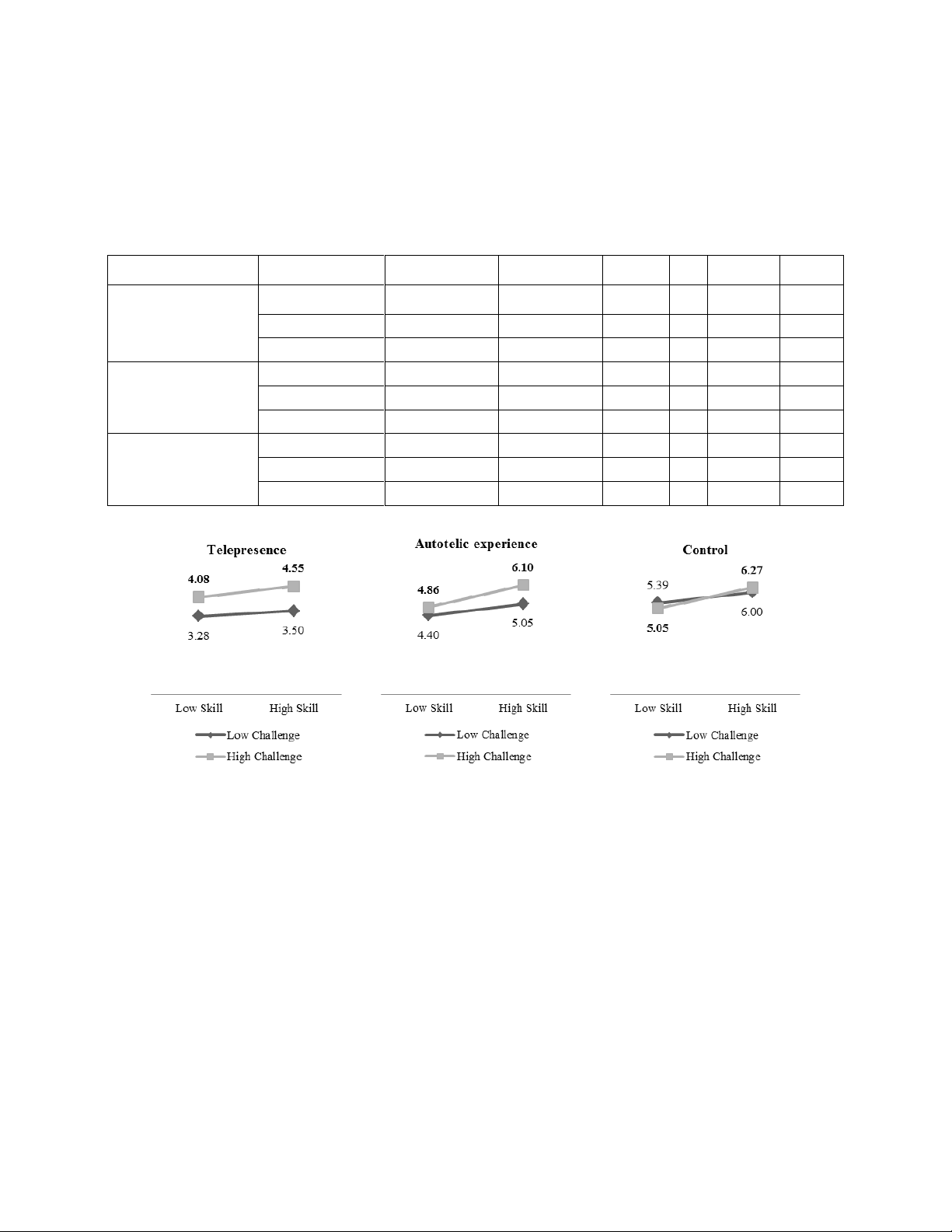
experience (F1, 396 = 7.165, p < .01) and control (F1, 396 = 10.572, p < .01). Figure 4 describes that the difference in
autotelic experience between the low and high skill groups was greater for the high challenge group (Mlow-skilled =
4.86, Mhigh-skilled = 6.10) than for the low challenge group (Mlow-skilled = 4.40, Mhigh-skilled = 5.05). In addition, there was
a greater difference in control between the low and high skill groups for the high challenge group (Mlow-skilled = 5.05,
Mhigh-skilled = 6.27) than for the low challenge group (Mlow-skilled = 5.39, Mhigh-skilled = 6.00). However, the skill ×
challenge interaction effect for telepresence was not significant (F1, 396 = 1.469, p = .384), indicating that the effect
of skill on telepresence was not different between the high- and low-challenge groups.
Finally, with regard to H5, because the direct effects of behavioral and intellectual brand experiences on brand
loyalty were not significant as reported earlier in relation to H4c and H4d; H5c and H5d, predicting the mediation of
these two brand experience dimensions for the relationship between online flow and brand loyalty, were not
supported. H5a and H5b, predicting the mediating role of sensory and affective brand experiences for the
relationship between online flow and brand loyalty, was tested by running two additional SEM models. The first
model was created by eliminating behavioral and intellectual brand experiences from the original SEM model shown
in Figure 2 because the direct effects of the two brand experience dimensions on brand loyalty were not significant
as mentioned above. The second model was created by adding the direct regression path from online flow to brand
loyalty to the first model. In the first model, the effects of online flow on sensory (β = .935, p < .001) and affective
(β = .853, p < .001) brand experiences as well as the effects of sensory (β = .408, p < .001) and affective (β = .416, p Page 65
Shim et al.: Impact of Online Flow on Brand Experience and Loyalty
< .001) brand experiences on brand loyalty were significant. In the second model, the direct effect of online flow on
brand loyalty (β = .923, p < .05) and the effects of online flow on sensory (β = .931, p < .001) and affective (β =
.858, p < .001) brand experiences were significant, whereas the effects of sensory (β = -.274, p = .329) and affective
(β = .178, p = .142) brand experiences on brand loyalty became non-significant. These results indicate that online
flow directly influences brand loyalty, rather than having an indirect influence mediated by brand experience,
thereby rejecting H5a and H5b.
Table 4: ANOVA Results for Testing H2 Dependent Variable Effect Sum of Square Mean Square F df Error df p Telepresence Skill 11.868 11.868 6.138 1 396 .014 Challenge 85.071 85.071 44.001 1 396 < .001 Skill × Challenge 1.469 1.469 .760 1 396 .384 Autotelic experience Skill 88.776 88.776 70.987 1 396 < .001 Challenge 56.904 56.904 45.502 1 396 < .001 Skill × Challenge 8.961 8.961 7.165 1 396 .008 Control Skill 83.553 83.553 95.384 1 396 < .001 Challenge .148 .148 .169 1 396 .681 Skill × Challenge 9.260 9.260 10.572 1 396 .001
Figure 4: Mean scores of online flow dimensions depending on skill and challenge levels 5. Discussion
In the context of shopping for an apparel product on a brand’s website, this study demonstrates that the positive
effect of consumers’ skill on online flow is strengthened more by a high level of perceived challenge than a low
level of perceived challenge. Online flow positively influences the sensory and affective aspects of brand experience,
which in turn lead to enhanced brand loyalty. In addition to these relationships, this study also finds the direct,
positive effect of online flow on brand loyalty. The contribution of these findings is discussed from both theoretical and practical perspectives. 5.1. Theoretical implications
First, this study contributes to a better understanding of how brand experience and brand loyalty could be
established through consumers’ experiences on the brand’s website, by illuminating the mechanism explaining the
relationships among online flow, brand experience, and brand loyalty. Prior studies have proposed these
relationships in fragments, but none has simultaneously investigated these variables in a single framework by using
structural equation modeling. The present study verifies that experiencing the state of flow on a brand’s website can
result in enhanced sensory and affective brand experiences, which leads to enhanced brand loyalty. The findings of
this study point to online flow as important antecedents of brand experience and brand loyalty by explaining that
online flow stimulates consumers’ five senses and provokes their emotions related to a brand, and these enhanced
sensory and affective brand experiences lead consumers to believe the priority of the brand over other rival brands Page 66
Journal of Electronic Commerce Research, VOL 16, NO 1, 2015
and subsequently repeat positive behaviors for the brand (e.g., repurchase, revisit, recommendation to other
consumers, payment of a price premium). In particular, the positive relationships between online flow and brand
experience, demonstrated in this study, have not been clearly verified before. Thus, e-commerce research should
focus on the significance of an intense, positive experience on a brand’s website because the online experience can
continuously generate positive effects on consumers’ overall perception toward the brand.
Second, the present study demonstrates that online flow has direct, positive effects on brand loyalty as well as
on brand experience, extending the findings of prior studies [Brodie et al. 2013; Hausman & Siekpe 2009]. This
study hypothesizes a mediating effect of brand experience on the relationship between online flow and brand loyalty,
but the mediating effect is only partial, providing empirical evidence for the notion that consumers engaged in
interactive web-based experiences with a brand exhibit enhanced consumer loyalty [Brodie et al. 2013]. In this
study, even though online flow occurs during a specific moment (Chen et al., 1999), it directly influences brand
loyalty rather than being mediated by perception of overall brand experience, suggesting a potentially lasting impact
of online flow that leads to brand loyalty. Thus, online flow research should further clarify the mechanism by which
an instant consumer experience such as online flow can cause a persistent consumer response such as loyalty.
Third, this study sheds light on the relationships between different dimensions of brand experience and brand
loyalty, which has not been studied in the context of online apparel shopping before. Rather than focusing on a
specific dimension of brand experience [e.g., Nambisan & Watt 2011; Wang et al. 2010] or overall brand experience
[e.g., Biedenbach & Marell 2010; Brakus et al. 2009], this study uses the construct of brand experience consisting of
the four dimensions (i.e., sensory, affective, behavioral, and intellectual dimensions) suggested by Brakus et al.’s
[2009] in order to identify which dimension can be influential in enhancing brand loyalty in the context of apparel
product brands. Although Nysveen et al. [2013] has tested the relationship between each of the experience
dimensions and other brand-related constructs including brand loyalty, their study was based on the context of
service brands, which potentially could generate different results from the assessment of product brands [O'Cass &
Grace 2004]. In particular, Nysveen et al. [2013] demonstrate that the only experience dimension directly
influencing brand loyalty was found to be relational experience, which was added in consideration of the nature of
service branding. Unlike the results of Nysveen et al.’s [2013] study, this study reveals the significant influences of
sensory and affective brand experiences on brand loyalty, which implies that appealing to aesthetic senses and
emotions related to a brand can strengthen brand loyalty. Given that the context of the present study was apparel
brands’ websites, the significant effects of the sensory and affective brand experiences on brand loyalty may be
attributed to the uniqueness of the product category. When shopping for apparel products, consumers are likely to
engage in sensory experiences to clarify how the product looks or fits on them [Song & Kim 2012]. Affective
experiences such as enjoyment resulting from trying on various apparel products in a store or using a virtual try-on
technology on a commercial website are also closely related to the nature of apparel products [Lee et al. 2010].
Fourth, the present study contributes to the literature by using a comprehensive scale to measure skill in
applying flow theory to the context of online apparel shopping. Most prior studies of online flow have tended to
operationalize skill and challenge specific to online navigational tasks [e.g., Hoffman & Novak 1996; Novak et al.
2000; Richard & Chandra 2005], limiting their applicability to actual (or simulated) online shopping contexts. This
study adopts a broader conceptualization of skill and develops a measure of various dimensions of skills relevant to
online shopping tasks for the chosen product category (apparel) beyond the navigational skills applicable to general
web environments. The significant main effect of skill, conceptualized in three dimensions (i.e., online shopping
skill, clothing shopping skill, and general shopping skill), on online flow in this study illuminates that diverse skill
dimensions beyond the navigational skill can be predictors of online flow.
Fifth, this study makes a contribution to the flow literature by clarifying the significant moderating effect of
challenge for the relationship between skill and online flow. Prior studies have suggested that online flow is
determined by the matched high skill and high challenge [Novak et al. 2000; Skadberg & Kimmel 2004], but their
findings usually show only the positive direct effects of skill and challenge on online flow instead of the effect of
matched skill and challenge. This study empirically shows that the effect of skill on online flow is greater among the
high-challenge group than among the low-challenge group, demonstrating that consumers are more likely to reach
flow when they have sufficient skills to complete a task as well as the task is manageably challenging
[Csikszentmihalyi 1991; Csikszentmihalyi 1997]. Although high challenge may hinder consumers from being
confident of task achievement, high challenge involves them to a great extent in browsing a brand’s website
[Richard & Chandra 2005]. High skill superseding the difficulty of a task is likely to result in a less intense flow
state [Smith & Sivakumar 2004], further emphasizing the significance of the matched high skill and challenge in online shopping. Page 67
Shim et al.: Impact of Online Flow on Brand Experience and Loyalty 5.2. Managerial implications
This study draws managerial attention to the potential of a brand’s website in achieving their marketing goal of
enhancing brand loyalty. This study shows that online flow on a brand’s website enhances sensory and affective
brand experiences as well as brand loyalty. A brand’s website is crucial in conveying brand experience because
consumers can actively interact with the brand’s offerings on its website. Findings of this study confirm that
marketers can build brand loyalty through a brand’s website by stimulating consumers’ sensations and feelings.
Consumer experiences on an apparel brand’s physical store can be enhanced through a chance to explore the entire
store and inspect products, which stimulates a consumer’s senses with colorful displays, ambient music, and texture
inspections by touching [Siekpe 2005]. Likewise, a brand’s website can enhance consumer experiences by
stimulating visual and auditory senses with the combination of website design elements. Considering that each
consumer has a different learning style among visual, auditory, read/write, and kinesthetic learning styles [Hossain
et al. 2009], customization features of a brand’s website (e.g., text-oriented website, visually attractive website,
animated website) are likely to improve brand experience and brand loyalty. Moreover, marketers may try to
strategically allocate marketing campaigns using aesthetic and emotional appeals to a brand’s website so that the
campaign massages are more likely to reach consumers and contribute to the formation of positive brand experience.
Because a well-organized layout and differential design of a website can help visitors to perceive visual aesthetics of
the website [Wang et al. 2010] and to enrich consumers’ affective experiences by evoking pleasure [Nambisan &
Watt 2011], marketers need to be concerned with great harmony of website design elements and marketing campaign messages.
This study also demonstrates that consumers need to not only have high skill but also perceive that the shopping
task is sufficiently challenging in order to reach an intense flow state on a brand’s website. This finding indicates
that marketers need to challenge their brand’s website visitors through the website design and web marketing
strategies to encourage consumers’ engagement. For example, marketers could design their brand’s website like a
game continually offering certain tasks and awards related to visitors’ shopping behavior; visitors might need to post
about personal comparison between the brand’s new products and their existing wardrobe (i.e., a task), in order to
receive 30% off coupon code applicable to purchase the new products (i.e., an award). Such a campaign could
challenge website visitors, enhancing the likelihood they will reach the state of online flow. However, not all
challenges would be accepted favorably by consumers, and the same challenge may be viewed with varying levels
of favorability depending on the consumer characteristics such as skill levels. Therefore, recognizing the conditions
under which target consumers are most likely to reach online flow is a crucial step to promote their loyalty toward a brand’s website. 5.3.
Limitations and recommendations
Findings of this study need to be interpreted with caution in light of the methodological limitation. Due to the
nature of the online survey method, the researchers were not able to control the environment in which respondents
performed the given browsing task on a brand’s website and answered the measurement items. Since respondents
answered the questionnaire at different times and places using computers that varied in Internet connection speed
and screen resolution, uncontrollable method variances are likely. Future research employing laboratory
experimental research designs, which allow researchers to identify computer specifications, manage the conditions
of computers, and instruct about each step of task procedure, may help to control the environment in which data are
collected and thus enhance the internal validity of the findings. Another limitation of this study can be considered as
the limited ability to generalize findings to other contexts, given that the context of this study is specific to apparel
shopping on a brand’s website. Based on the findings of this study, the intellectual and behavioral dimensions of
brand experience are not significantly associated with both online flow and brand loyalty, but the statistical
significance may be verified in different contexts. For example, intellectual brand experience may play an important
role in establishing brand loyalty in the context of electronic devices, such as smartphones, tablets, and computers,
because these kinds of products are likely to facilitate consumers’ information processing. Future research could
improve the applicability of the findings to broader contexts by examining the hypotheses using different products,
shopping tasks, and/or stimulus websites. Further, the relationship between online flow and brand experience can be
investigated more carefully and closely in future research. The pure effect of online flow on brand experience is
worth verifying for confirmation of the strategic importance of a brand’s website. By controlling variables
representing previous brand knowledge in an experimental setting, researchers could refine how much online flow
contribute to enhanced brand experience compared to the contribution resulting from previous brand knowledge.
Finally, this study used a unidimensional challenge measure, which was efficient in identifying the moderating
effect of challenge for the relationship between skill and flow. However, further research is recommended to
incorporate diverse dimensions of challenge that capture various conditions where challenge is generated. In doing Page 68
Journal of Electronic Commerce Research, VOL 16, NO 1, 2015
so, more specific insight might be obtained as to the kinds of challenges that are favorable versus unfavorable to
consumers’ online flow experience. REFERENCES
Anderson, J.C. and D.W. Gerbing, "Structural Equation Modeling in Practice: A Review and Recommended Two-
Step Approach," Psychological Bulletin, Vol. 103, No. 3: 411-423, 1988.
Berthon, P., L.F. Pitt, and R.T. Watson, "The World Wide Web as an Advertising Medium: Toward an
Understanding of Conversion Efficiency," Journal of Advertising Research, Vol. 36, No. 1: 43-54, 1996.
Biedenbach, G. and A. Marell, "The Impact of Customer Experience on Brand Equity in a Business-to-Business
Services Setting," Journal of Brand Management, Vol. 17, No. 6: 446-458, 2010.
Brakus, J.J., B.H. Schmitt, and L. Zarantonello, "Brand Experience: What Is It? How Is It Measured? Does It Affect
Loyalty?," Journal of Marketing, Vol. 73, No. 3: 52-68, 2009.
Brodie, R.J., A. Ilic, B. Juric, and L. Hollebeek, "Consumer Engagement in a Virtual Brand Community: An
Exploratory Analysis," Journal of Business Research, Vol. 66, No. 1: 105-114, 2013.
Cha, J., "Exploring the Internet as a Unique Shopping Channel to Sell Both Real and Virtual Items: A Comparison
of Factors Affecting Purchase Intention and Consumer Characteristics," Journal of Electronic Commerce
Research, Vol. 12, No. 2: 115-132, 2011.
Chaudhuri, A. and M.B. Holbrook, "The Chain of Effects from Brand Trust and Brand Affect to Brand
Performance: The Role of Brand Loyalty," Journal of Marketing, Vol. 65, No. 2: 81-93, 2001.
Chen, H., R.T. Wigand, and M.S. Nilan, "Optimal Experience of Web Activities," Computers in Human Behavior,
Vol. 15, No. 5: 585-608, 1999.
Claxton, J.D. and J.R.B. Ritchie, "Consumer Prepurchase Shopping Problems: A Focus on the Retailing
Component," Journal of Retailing, Vol. 55, No. 3: 24-43, 1979.
Cronbach, L.J. and R.J. Shavelson, "My Current Thoughts on Coefficient Alpha and Successor Procedures,"
Educational and Psychological Measurement, Vol. 64, No. 3: 391-418, 2004.
Csikszentmihalyi, M., Flow: The Psychology of Optimal Experience, New York: Harper Perennial, 1991.
Csikszentmihalyi, M., Finding Flow: The Psychology of Engagement with Everyday Life, New York: Basic Books, 1997.
Dailey, L., "Navigational Web Atmospherics: Explaining the Influence of Restrictive Navigation Cues," Journal of
Business Research, Vol. 57, No. 7: 795-803, 2004.
Fornell, C. and D.F. Larcker, "Evaluating Structural Equation Models with Unobservable Variables and
Measurement Error," Journal of Marketing Research, Vol. 18, No. 1: 39-50, 1981.
Gabisch, J.A. and K.L. Gwebu, "Impact of Virtual Brand Experience on Purchase Intentions: The Role of
Multichannel Congruence," Journal of Electronic Commerce Research, Vol. 12, No. 4: 302-319, 2011.
Grewal, D., J. Baker, M. Levy, and G.B. Voss, "The Effects of Wait Expectations and Store Atmosphere
Evaluations on Patronage Intentions in Service-Intensive Retail Stores," Journal of Retailing, Vol. 79: 259-268, 2003.
Guo, Y.M. and M.S. Poole, "Antecedents of Flow in Online Shopping: A Test of Alternative Models," Information
Systems Journal, Vol. 19, No. 4: 369-390, 2009.
Hair, J.F., W.C. Black, B.J. Babin, and R.E. Anderson, Multivariate Data Analysis, (7th ed.), NJ, Upper Saddle River: Prentice Hall, 2009.
Hausman, A.V. and J.S. Siekpe, "The Effect of Web Interface Features on Consumer Online Purchase Intentions,"
Journal of Business Research, Vol. 62, No. 1: 5-13, 2009.
Hoffman, D.L. and T.P. Novak, "Marketing in Hypermedia Computer-Mediated Environments: Conceptual
Foundations," Journal of Marketing, Vol. 60, No. 3: 50-68, 1996.
Hoffman, D.L. and T.P. Novak, "Flow Online: Lessons Learned and Future Prospects," Journal of Interactive
Marketing, Vol. 23, No. 1: 23-34, 2009.
Holland, J. and S.M. Baker, "Customer Participation in Creating Site Brand Loyalty," Journal of Interactive
Marketing, Vol. 15, No. 4: 34-45, 2001.
Hossain, M.M., A.B.M. Abdullah, V.R. Prybutok, and M. Talukder, "The Impact of Learning Style on Web Shopper
Electronic Catalog Feature Preference," Journal of Electronic Commerce Research, Vol. 10, No. 1: 1-12, 2009.
Hsu, C.-L., K.-C. Chang, and M.-C. Chen, “Flow Experience and Internet Shopping Behavior: Investigating the
Moderating Effect of Consumer Characteristics,” Systems Research and Behavioral Science, Vol. 29, No. 3: 317-332, 2012.
Internet Retailer, I., "The Top 500 List," Retrieved October 11, 2010, from
http://www.internetretailer.com/top500/list/, 2010. Page 69
Shim et al.: Impact of Online Flow on Brand Experience and Loyalty
Jackson, S.A. and H.W. Marsh, "Development and Validation of a Scale to Measure Optimal Experience: The Flow
State Scale," Journal of Sport & Exercise Psychology, Vol. 18: 17-35, 1996.
Jackson, D. L., J. Voth, and M. P. Frey, “A Note on Sample Size and Solution Propriety for Confirmatory Factor
Analytic Models,” Structural Equation Modeling: A Multidisciplinary Journal, Vol. 20, No. 1: 86-97, 2013.
Keller, K.L., "Brand Equity Management in a Multichannel, Multimedia Retail Environment," Journal of Interactive
Marketing, Vol. 24, No. 2: 58-70, 2010.
Klein, L.R., "Creating Virtual Product Experiences: The Role of Telepresence," Journal of Interactive Marketing, Vol. 17, No. 1: 41-55, 2003.
Lee, H.-H., J. Kim, and A.M. Fiore, "Affective and Cognitive Online Shopping Experience: Effects of Image
Interactivity Technology and Experimenting with Appearance," Clothing and Textiles Research Journal, Vol. 28, No. 2: 140-154, 2010.
Lin, C.-H. and B.Z.-L. Kuo, "Escalation of Loyalty and the Decreasing Impact of Perceived Value and Satisfaction
over Time," Journal of Electronic Commerce Research, Vol. 14, No. 4: 348-362, 2013.
Müller, B., L. Florès, M. Agrebi, and J.-L. Chandon, "The Branding Impact of Brand Websites: Do Newsletters and
Consumer Magazines Have a Moderating Role?," Journal of Advertising Research, Vol. 48, No. 3: 465-472, 2008.
Mascarenhas, O.A., R. Kesavan, and M. Bernacchi, "Lasting Customer Loyalty: A Total Customer Experience
Approach," Journal of Consumer Marketing, Vol. 23, No. 7: 397-405, 2006.
Meyer, C. and A. Schwager, "Understanding Customer Experience," Harvard Business Review, Vol. 85, No. 2: 116- 126, 2007.
Mollen, A. and H. Wilson, "Engagement, Telepresence and Interactivity in Online Consumer Experience:
Reconciling Scholastic and Managerial Perspectives," Journal of Business Research, Vol. 63, No. 9-10: 919- 925, 2010.
Morgan-Thomas, A. and C. Veloutsou, "Beyond Technology Acceptance: Brand Relationships and Online Brand
Experience," Journal of Business Research, Vol. 66, No. 1: 21-27, 2013.
Mu, E. and D.F. Galletta, "The Effects of the Meaningfulness of Salient Brand and Product-Related Text and
Graphcis on Web Site Recognition," Journal of Electronic Commerce Research, Vol. 8, No. 2: 115-127, 2007.
Nambisan, P. and J.H. Watt, "Managing Customer Experiences in Online Product Communities," Journal of
Business Research, Vol. 64, No. 8: 889-895, 2011.
Novak, T.P., D.L. Hoffman, and Y.-F. Yung, "Measuring the Customer Experience in Online Environments: A
Structural Modeling Approach," Marketing Science, Vol. 19, No. 1: 22, 2000.
Nysveen, H., P.E. Pedersen, and S. Skard, "Brand Experiences in Service Organizations: Exploring the Individual
Effects of Brand Experience Dimensions," Journal of Brand Management, Vol. 20, No. 5: 404-423, 2013.
O'Cass, A. and D. Grace, "Exploring Consumer Experiences with a Service Brand," Journal of Product & Brand
Management, Vol. 13, No. 4: 257-268, 2004.
Oliver, R.L., "Whence Consumer Loyalty?," Journal of Marketing, Vol. 63, No. 4: 33-44, 1999.
Pine, B.J., II and J.H. Gilmore, "Welcome to the Experience Economy," Harvard Business Review, Vol. 76, No. 4: 97-105, 1998.
Reece, B.B. and T.C. Kinnear, "Indices of Consumer Socialization for Retailing Research," Journal of Retailing,
Vol. 62, No. 3: 267-280, 1986.
Richard, M.-O. and R. Chandra, "A Model of Consumer Web Navigational Behavior: Conceptual Development and
Application," Journal of Business Research, Vol. 58, No. 8: 1019-1029, 2005.
Richard, M.-O., J.-C. Chebat, Z. Yang, and S. Putrevu, “A Proposed Model of Online Consumer Behavior:
Assessing the Role of Gender,” Journal of Business Research, Vol. 63, No. 9–10: 926-934, 2010.
Rose, S., M. Clark, P. Samouel, and N. Hair, “Online Customer Experience in E-retailing: An Empirical Model of
Antecedents and Outcomes,” Journal of Retailing, Vol. 88, No. 2: 308-322, 2012.
Schembri, S., "Reframing Brand Experience: The Experiential Meaning of Harley–Davidson," Journal of Business
Research, Vol. 62, No. 12: 1299-1310, 2009.
Schlosser, A.E., D.G. Mick, and J. Deighton, "Experiencing Products in the Virtual World: The Role of Goal and
Imagery in Influencing Attitudes Versus Purchase Intentions," Journal of Consumer Research, Vol. 30, No. 2: 184-198, 2003.
Siekpe, J.S., "An Examination of the Multidimensionality of Flow Construct in a Computer-Mediated
Environment," Journal of Electronic Commerce Research, Vol. 6, No. 1: 31, 2005.
Skadberg, Y.X. and J.R. Kimmel, "Visitors' Flow Experience While Browsing a Web Site: Its Measurement,
Contributing Factors and Consequences," Computers in Human Behavior, Vol. 20, No. 3: 403-422, 2004. Page 70
Journal of Electronic Commerce Research, VOL 16, NO 1, 2015
Smith, D.N. and K. Sivakumar, "Flow and Internet Shopping Behavior: A Conceptual Model and Research
Propositions," Journal of Business Research, Vol. 57, No. 10: 1199-1208, 2004.
Song, S.S. and M. Kim, "Does More Mean Better? An Examination of Visual Product Presentation in E-Retailing,"
Journal of Electronic Commerce Research, Vol. 13, No. 4: 345-355, 2012.
U. S. Census Bureau, "Annual Estimates of the Resident Population by Sex, Race, and Hispanic Origin for the
United States: April 1, 2000 to July 1, 2009 (Nc-Est2009-03)," Retrieved December 17, 2011, from
http://www.census.gov/popest/data/national/asrh/2009/index.html, 2009a.
U. S. Census Bureau, "Annual Estimates of the Resident Population for the United States, Regions, States, and
Puerto Rico: April 1, 2000 to July 1, 2009 (Nst-Est2009-01)," Retrieved December 17, 2011, from
http://www.census.gov/popest/data/national/totals/2009/index.html, 2009b.
U. S. Census Bureau, "Educational Attainment of the Population 18 Years and over, by Age, Sex, Race, and
Hispanic Origin: 2010," Retrieved December 17, 2011, from
http://www.census.gov/hhes/socdemo/education/data/cps/2010/tables.html, 2010a.
U. S. Census Bureau, "Income Distribution to $250,000 or More for Households: 2010," Retrieved December 17,
2011, from http://www.census.gov/hhes/www/cpstables/032011/hhinc/new06_000.htm, 2010b.
Uwaifo, S.O., "Computer Anxiety as Predictor of Librarians' Perceived Ease of Use of Automated Library Systems
in Nigerian University Libraries," African Journal of Library, Archives, & Information Science, Vol. 18, No. 2: 147-155, 2008.
van den Brink, D., G. Odekerken-Schröder, and P. Pauwels, "The Effect of Strategic and Tactical Cause-Related
Marketing on Consumers' Brand Loyalty," Journal of Consumer Marketing, Vol. 23, No. 1: 15-25, 2006.
van Noort, G., H. A. M. Voorveld, and E. A. van Reijmersdal, “Interactivity in Brand Web Sites: Cognitive,
Affective, and Behavioral Responses Explained by Consumers' Online Flow Experience,” Journal of
Interactive Marketing, Vol. 26, No. 4: 223-234, 2012.
Veletsianos, G. and C. Miller, "Conversing with Pedagogical Agents: A Phenomenological Exploration of
Interacting with Digital Entities," British Journal of Educational Technology, Vol. 39, No. 6: 969-986, 2008.
Wang, Y.J., M.D. Hernandez, and M.S. Minor, "Web Aesthetics Effects on Perceived Online Service Quality and
Satisfaction in an E-Tail Environment: The Moderating Role of Purchase Task," Journal of Business Research,
Vol. 63, No. 9–10: 935-942, 2010.
Webster, J., L.K. Trevino, and L. Ryan, "The Dimensionality and Correlates of Flow in Human-Computer
Interactions," Computers in Human Behavior, Vol. 9, No. 4: 411-426, 1993.
WWD, "The Top 10: WWD," Women's Wear Daily: 46, 2008.
Zhou, L., L. Dai, and D. Zhang, "Online Shopping Acceptance Model - a Critical Survey of Consumer Factors in
Online Shopping," Journal of Electronic Commerce Research, Vol. 8, No. 1: 41-42,44-62, 2007. Page 71
Tài liệu liên quan:
-
Mousetrap Cars Guide for Engineering Students - Tài liệu Nghiên cứu khoa học | Trường Đại học Kinh tế, Đại học Quốc gia Hà Nội
35 18 -
The effects of perceived relevance of travel blogs’ content on the behavioral intention to visit a tourist destination môn Nghiên cứu khoa học | Trường Đại học Kinh tế, Đại học Quốc gia Hà Nội
31 16 -
BAB 11 Ekuitas - Nghiên cứu khoa học | Trường Đại học Kinh tế, Đại học Quốc gia Hà Nội
201 101 -
Nghiên cứu các yếu tố ảnh hưởng đến xuất khẩu cà phê của Việt Nam sang Mỹ giai đoạn 2002 - 2020 | Bài tiểu luận học phần Nghiên cứu khoa học | Trường Đại học Kinh tế, Đại học Quốc gia Hà Nội
849 425