The effects of perceived relevance of travel blogs’ content on the behavioral intention to visit a tourist destination môn Nghiên cứu khoa học | Trường Đại học Kinh tế, Đại học Quốc gia Hà Nội
The effects of perceived relevance of travel blogs’ content on the behavioral intention to visit a tourist destination môn Nghiên cứu khoa học | Trường Đại học Kinh tế, Đại học Quốc gia Hà Nội. Tài liệu được sưu tầm giúp bạn tham khảo, ôn tập và đạt kết quả cao. Mời bạn đọc đón xem.
Môn: Nghiên cứu khoa học (UEB) 5 tài liệu
Trường: Trường Đại học Kinh tế, Đại học Quốc gia Hà Nội 491 tài liệu
Tác giả:













Preview text:
Computers in Human Behavior 30 (2014) 787–799
Contents lists available at SciVerse ScienceDirect Computers in Human Behavior
j o u r n a l h o m e p a g e : w w w . e l s e v i e r . c o m / l o c a t e / c o m p h u m b e h
The effects of perceived relevance of travel blogs’ content on the
behavioral intention to visit a tourist destination
Yu-Chen Chen ⇑, Rong-An Shang, Ming-Jin Li
Department of Business Administration, Soochow University, 56, Sec. 1, Kuei-Yang St., Taipei City 100, Taiwan, ROC a r t i c l e i n f o a b s t r a c t Article history:
The tourism industry is characterized by ever-increasing competition, causing destinations to seek new Available online 4 June 2013
methods to attract tourists. Traditionally, a decision to visit a destination is interpreted, in part, as a
rational calculation of the costs/benefits of a set of alternative destinations, which were derived from Keywords:
external information sources, including e-WOM (word-of-mouth) or travelers’ blogs. There are numerous
Travelers’ information search
travel blogs available for people to share and learn about travel experiences. Evidence shows, however, Blog
that not every blog exerts the same degree of influence on tourists. Therefore, which characteristics of Behavioral intention
these travel blogs attract tourists’ attention and influence their decisions, becomes an interesting Information relevance
research question. Based on the concept of information relevance, a model is proposed for interrelating Perceived enjoyment Interesting content
various attributes specific to blog’s content and perceived enjoyment, an intrinsic motivation of informa-
tion systems usage, to mitigate the above-mentioned gap. Results show that novelty, understandability,
and interest of blogs’ content affect behavioral intention through blog usage enjoyment. Finally, theoret-
ical and practical implications are proposed.
Ó 2013 Elsevier Ltd. All rights reserved. 1. Introduction
using these forms of inter-personal influence media, companies
in this industry can create a competitive advantage (Litvin et al.,
Tourism is a popular activity in modern life and has contributed 2008; Singh et al., 2008).
significantly to economic development for decades. However, com-
Weblogs are now widely available; therefore, it is not surprising
petition in almost every sector of this industry has intensified dur-
that the quantity of available e-WOM has increased (Xiang & Gret-
ing recent years (Horng, Liu, Chou, & Tsai, 2012; Litvin, Goldsmith,
zel, 2010) to an extent where information overload has become a
& Pan, 2008); tourism service providers are now finding it difficult
pressing issue (Chen, Shang, & Kao, 2009; Frías, Rodriquez, & Cas-
to acquire and keep customers (Echtner & Ritchie, 1991; Ho, 2007).
taneda, 2008; Grant et al., 2008; Park & Lee, 2008). Empirical evi-
Therefore, methods of attracting tourists to a destination are
dence, however, indicates that people may not consult numerous
receiving greater attention from researchers, policy makers, and
blogs for advice; the degree of inter-personal influence varies from
marketers. Before choosing a destination, tourists may search for
blog to blog (Zafiropoulos, 2012). Determining which characteris-
information to support their decision-making (Fodness & Murry,
tics of these travel blogs attract tourists’ attention and influence
1997; Grant, Clarke, & Kyriazis, 2008; Vogt & Fesenmaier, 1998).
their travel decisions now becomes an interesting question. The
By understanding the relationships between various information
concept of information relevance (Xu & Chen, 2006) is adapted to
sources’ characteristics and destination choice, tourism managers
describe these blog characteristics and a research model is created
can improve their marketing efforts. to answer this question.
Recently, personal blogs have become an important source for
The effects of various information sources, including e-traveling
acquiring travel information (Lin & Huang, 2006; Litvin et al.,
service providers, have been examined extensively in recent liter-
2008; Scott, 2001; Singh, Veron-Jackson, & Cullinane, 2008; Yoo
ature (Frías et al., 2008). The effects of information from travelers’
& Gretzel, 2012). With personal blogs, many tourists can share
blogs, however, have received relatively little attention (Jeong &
their travel experiences with others and potential tourists can
Jang, 2011; Vermeulen & Seegers, 2009; Yoo & Gretzel, 2012);
search for and respond to others’ experiences. Therefore, a blog
studies investigating the effects of information relevance in the
can be seen as an asynchronous and many-to-many channel for
context of information overload are particularly scant. The purpose
conveying travel-related electronic word-of-mouth (e-WOM). By
of this study, therefore, is twofold. The first is to further our under-
standing of tourists’ information search and destination choice
behavior by including perceived relevance of travel blogs into the
⇑ Corresponding author. Tel.: +886 2 23111531x3450 (O), +886 2 28325260 (H).
traditional paradigm of tourism decision-making. The second is
E-mail address: cyc@scu.edu.tw (Y.-C. Chen).
0747-5632/$ - see front matter Ó 2013 Elsevier Ltd. All rights reserved.
http://dx.doi.org/10.1016/j.chb.2013.05.019 788
Y.-C. Chen et al. / Computers in Human Behavior 30 (2014) 787–799
to construct and test a model regarding the formation of behavioral
Individuals can now use blogs to conveniently describe and share
intention to visit a destination, revealing how travel blogs may
their personal subjective experiences or opinions with friends, or
influence a tourist’s future behavioral intention.
even strangers. People can write about their destination images
and provide others with functional cues, such as better hotels or
essential attractions, and can even use photos or films to illustrate 2. Literature review
the places they have been. Prospective tourists can search blogs for
subjective travel experiences or respond to others’ experiences
2.1. Destination choice and travelers’ information searches
(Yoo & Gretzel, 2012). In this regard, a blog can be seen as a social
medium that carries user generated content for WOM distribution
With highly involved products and services like travel, tourists
(Xiang & Gretzel, 2010), and blog posts may represent a type of
are likely to spend a significant amount of time searching informa-
written WOM (Hennig-Thurau, Gwinner, Walsh, & Gremler,
tion before their trip (Fodness & Murry, 1997; Vogt & Fesenmaier,
2004). In short, a blog can be viewed as a many-to-many and asyn-
1998). Tourists may rely on external information when choosing a
chronous platform that provides a personal, interactive process for
destination and making onsite decisions, such as accommodations,
communication and e-WOM exchange (Litvin et al., 2008) and pro-
transportation, attractions, and even shopping (Fodness & Murry,
duces interpersonal influences (Sigala, 2012; Yoo & Gretzel, 2012).
1998; Hyde, 2008). An information search is defined as an ex-
pressed need in response to internal and external contingencies
2.3. External factors: information attributes
to consult various amounts and types of information sources prior
to a purchase decision to facilitate trip planning (Fodness & Murry,
2.3.1. Value of external information 1997; Hyde, 2008).
Information search can be viewed as a goal-oriented activity
In the past, travelers mainly found tourism information from
aimed at reaching valuable outcomes (Vogt & Fesenmaier, 1998).
commercial sources in order to form a destination image (Beerli
Consumers gain value from processing retrieved information in or-
& Martin, 2004). Destination image affects the perceived quality
der to reach a better decision (Grant et al., 2008). Consumer value
of, satisfaction with, behavioral intention towards, and willingness
comes primarily from the information medium’s characteristics
to choose that destination (Bigné, Sánchez, & Sánchez, 2001). Des-
such as availability of information (Frías et al., 2008). Information
tinations with positive images have a higher probability of being
source characteristics that have been studied include, but are not
included and chosen in the decision-making process (Baloglu &
limited to: (1) type and amount of external stimuli (information
McCleary, 1999; Bigné et al., 2001; Echtner & Ritchie, 1991).
sources), such as movies, guidebooks, magazines, and the Internet
A destination image is defined as a mental portrayal of the vir-
(Fodness & Murry, 1998; Frías et al., 2008; Gartner, 1993); (2) qual-
tual experience, or what the experience might look like in a future
ity and quantity of the information (Burgess, 1978; Grant et al.,
trip (Govers, Go, & Kumar, 2007). It is composed of a set of beliefs,
2008); and (3) content and format of the information (Grant
ideas, and impressions about that destination (Baloglu & McCleary, et al., 2008; Mercille, 2005).
1999). Destination images, however, seem to develop over time
Travel blogs represent one of the recent media for personal pub-
from not only commercial sources, but also social stimuli, such
lication and interpersonal communication. Based on blogs’ owner-
as friends’ and relatives’ recommendations or word-of-mouth
ship including individual, business and government, a typology of
(Fodness & Murry, 1997). A handful of impressions are selected
travel blog was developed (Schmallegger & Carson, 2008); each
and elaborated in the individual’s mind to form the mental con-
type of travel blog has specific content, target audience and mode struct (Reynolds, 1965).
of communication. Among which, personal journal blog is the only
Information can also be used to minimize the perceptions of
one that possess almost user generated content. Other types
risk and uncertainty involved with certain destinations (Beerli &
including corporate blog and government blog may be created
Martin, 2004; Money & Crotts, 2003). Tourism is an experience
in-house or by external professional bloggers, and is more or less
product characterized by intangibility and uncertainty, both at
commercial, factual or political oriented. Therefore, travel blogs
the time of purchase and consumption. Therefore, higher risk is in-
other than personal journal blog will be excluded from this study.
volved when selecting a destination. High perceived risk may lead
Among various blogs, personal journal type of blog accounts for
consumers to rely on a certain mode of communication, such as
70% of all blogs, and is almost single authored (Herring, Scheidt,
personal sources or WOM (Jeong & Jang, 2011). Positive WOM
Bonus, & Wright, 2004). Hence, an author’s characteristics, such
was found to increase purchase intention by creating a favorable
as gender, age, personality, motivation, involvement, credibility,
brand image and reducing risk perception (Jeong & Jang, 2011).
identity and anonymity, self disclosiveness, self-expression, ability
etc., may have tremendous impacts on his/her production and/or
2.2. Travelers’ blogs as the e-WOM platform
readers’ perceptions of the blog’s content. For example, Armstrong
and McAdams (2009) found that male authors were deemed more
Weblog (blog) is one of the latest and most quickly expanding
credible than female authors. These factors, however, have re-
forms of media for Internet communication and publication (Scott,
ceived relatively ample attention from literature (e.g., Armstrong
2001; Singh et al., 2008). It differs from other types of web pages in
& McAdams, 2009; Chesney & Su, 2010; Hollenbaugh, 2010; Hsu
both format and content. Tourists tend to store their travel experi-
& Tsou, 2011; Lin & Huang, 2006; Litvin et al., 2008; Para-López,
ences or destination images in story form (Govers et al., 2007),
Gutiérrez-Taño, Díaz-Armas, & Bulchand-Gidumal, 2012).
leading to blogs that normally consist of dated entries in a ‘‘story
Information quality and quantity are two information attributes
telling’’ format (Blood, 2004). Many blogs also allow readers to post
that influence the information processing strategies deployed by
comments to individual entries, much as they would in a thread on
consumers (Grant et al., 2008), and may impact the relationship
a discussion forum. The blog format, then, lends itself smoothly for
between information source and destination image (Frías et al.,
use in various collaborative tasks, such as experience sharing.
2008). Travel product selection requires more abundant, higher
Advancement of media technologies has also allowed bloggers to
quality information since the tourism product is complex and dif-
include multimedia materials like photos, films and audio in their
ficult to evaluate (Grant et al., 2008; Zafiropoulos, 2012). The roles blogs.
these two information attributes play deserve further investiga-
Blog writing is characterized by a strong sense of the blogger’s
tion; however, this issue has attracted relatively little attention
personality and point of view (Dave, 2003; Hollenbaugh, 2010).
in the tourism field (Frías et al., 2008).
Y.-C. Chen et al. / Computers in Human Behavior 30 (2014) 787–799 789 2.3.2. Information quality
tion, thus making information being reciprocated back and forth
Information quality in a travel decision situation can be defined
among various actors to pass along to more audiences; an obliga-
as the usefulness of available information about travel product
tory relationship among people may therefore be established to
attributes in helping tourists evaluate the product. It is one of
ensure social mobility of travel experiences (Vogt & Fesenmaier,
the primary factors affecting information systems (IS) success
1998). Advancement of social media functionality enabled even
and user satisfaction (DeLone & McLean, 2003). Individuals use
wider social networking and interactions, allowing collaboration
information output from an IS to make decisions. Then, they eval-
to easily take place among individuals, which make the trip plan-
uate the value of the IS, and determine information quality based
ning from a solitarian to a social collaborative process (Sigala,
on the perceived value. Thus, measures of information quality, 2012).
such as accuracy, currency, completeness, credibility, timeliness,
Many social values, like intimate interaction, physical support
relevance, richness, and consistency (Chen, 2010; Ho, 2007; Shang,
and guidance, feedback to travel plan etc., and emotional values
Chen, & Chen, in press; Zheng, Zhao, & Stylianou, in press), are al-
like playfulness, enjoyment etc., can be earned during this process ways perceptual.
(Sigala, 2010). These values become antecedents of the motivation
Most previous works related to information quality were con-
to keep surfing and accessing the content of social media (Para-
ducted in the context of goal oriented decision making, such as
López et al., 2012). Travelers may finally accomplish trip planning
financial investment (Shang et al., in press), tax filing (Chen,
via searching, selecting, communicating, sharing or adapting expe-
2010), purchase of search goods (Grant et al., 2008), and informa-
riences to co-create with others a collective intelligence about the
tion sharing in a virtual community (Zheng et al., in press). Tourists
trip (Sigala, 2012); however, during this process, they may encoun-
may gain value of objective or factual information, like accommo-
ter discrepancies within retrieved experiences, and can subjec-
dation prices and availability, from obtaining optimal decision
tively decide whether or not to incorporate these experiences
quality (Grant et al., 2008). In this regard, tourists may be deemed
into their mental portrayal when evaluating the affective, hedonic,
as rational decision makers, and the selection of a destination may
or emotional value of a destination.
be viewed, in part, as a rational calculation and comparison of the
Watts et al. (2009) also argued that there are dimensions of
costs/benefits from a set of alternatives (Vogt & Fesenmaier, 1998).
quality that cannot be objectively measured and tend to vary with
In such a context, imperfect information may harm decision
the usage context. They referred to this as contextual quality, since
outcomes. For example, an itinerary may not be optimal if the tour-
its evaluation is subject to contextual factors, such as personal
ist received incorrect or obsolete information regarding uncontrol-
preferences or decision characteristics. Recently, some researchers
lable factors, such as air schedules and air ticket fares. As a result of
have begun to explore the effects of different kinds of contextual
social media content produced by strangers, some researchers ar-
quality. Shang et al. (in press) identified social comparison and
gue that information quality has become an issue in decision-mak-
found that people may use information posted in virtual communi-
ing. This can be exemplified by the difficulty encountered in the
ties to compare their social status with others. Watts et al. (2009)
evaluation of information sources credibility (Armstrong & McAd-
proposed that relevance is one of the most salient contextual qual-
ams, 2009; Chesney & Su, 2010; McKnight & Kacmar, 2006) which
ities. Levels of relevance generally depend on the decision it is
plays a role in impacting decision quality (McKnight & Kacmar,
being applied to (Watts et al., 2009); for example, travel experi-
2006; Shang et al., in press; Zheng et al., in press).
ences to destination ‘‘A’’ may be highly relevant to one who is plan-
Information quality measures the semantic success of the infor-
ning to visit this destination.
mation in conveying the intended meaning. Hence, the selection of
To conclude, from a user’s point of view, perceptions of infor-
dimensions and measures of information quality are contingent on
mation quality in the context of experience consumption should
the objectives and context of the decisions (DeLone & McLean,
be interpreted differently than in the context of search goods.
2003). For example, Chen (2010) excluded relevance and reliability
Many traditional measures of information quality may not relate
from their study regarding taxpayers’ satisfaction with the tax-fil-
to or be useful in evaluating the value of subjective information.
ing system, since government information is assumed to be reli-
Researchers should identify the contextual quality that best suits
able and highly relevant to users’ information needs and decision their studies.
tasks. Nevertheless, the measurement of objective information
quality dimensions (e.g., accuracy and completeness) is often 2.3.3. Information quantity
intrinsic to the information itself, regardless of the context in
The negative effects of information quantity on image forma-
which it is applied (Watts, Shankaranarayanan, & Even, 2009). In
tion were stressed and explored by Frías et al. (2008). Ironically,
other words, contextual factors may not influence the semantic
one important benefit of the Internet is access to abundant dy-
meaning of objective information.
namic information to support consumer decision making (Xiang
Grant et al. (2008), however, stressed that objective information
& Gretzel, 2010). The interactive nature of the web environment al-
quality may play a more important role in the purchase of search
lows for deep, nonlinear searches initiated and controlled by cus-
goods. When purchasing an experience like travel, a decision-ma-
tomers. Consumers are increasingly exposed to online advice,
ker may gain more values from subjective information that con-
desired or not (Hennig-Thurau et al., 2004; Yoo & Gretzel, 2012).
tains copious personal experiences and personal interpretations
Websites with user generated content, such as blogs, have gained
(Yoo & Gretzel, 2012). This is evident from a recent study that
considerable popularity in travelers’ Internet usage (Xiang & Gret-
showed in 5 of 7 geographical regions, subjective information from
zel, 2010) and made a huge impact on tourists’ decisions (Verme-
interpersonal communications exerted more influence on the deci-
ulen & Seegers, 2009; Yoo & Gretzel, 2012). With the advancement
sion to visit Hong King for the first time (Doong, Wang, & Law,
of Internet technologies, e-WOM via blogs spread much more
2008). It is also found that social media use may have significant
widely and rapidly than traditional face-to-face WOM (Litvin
impacts on travelers’ decision behavior and outcomes (Yoo & Gret-
et al., 2008). Information overload hence resulted (Grant et al., zel, 2012).
2008; Xiang & Gretzel, 2010) and became a pressing issue and a
Since destination image is described as a mental portrayal of a
problem in consumer information processing (Chen et al., 2009;
virtual or imaginary experience of a future trip, its creation in-
Grant et al., 2008; Park & Lee, 2008). This, in turn, produced ad-
volves a social and emotional process of selecting and processing
verse effects on one’s destination selection (Frías et al., 2008).
experiences shared by others (Govers et al., 2007). During this pro-
To overcome this problem, internal filtering mechanisms, like
cess, people may interact socially with others to exchange informa-
knowledge and experience, are used to solicit information irrele- 790
Y.-C. Chen et al. / Computers in Human Behavior 30 (2014) 787–799
vant to decision information needs (Chen et al., 2009). A recent
his/her attention on the discrepancy, and create exploratory
study deployed social network analysis technique to analyze data
behavior (Joelle & Dirk, 2001). As a result, the social process of
from 1305 wine blogs and found that the degree of inter-personal
selecting and sharing experiences is activated.
influence varied from blog to blog. Only a small portion of the blogs
Due to anonymity, active bloggers are, at most, ‘‘familiar strang-
had a significant impact on consumers; 32% of them had no impact
ers’’ to those who read their blogs frequently. The question of why
at all (Zafiropoulos, 2012). This finding suggests that consumers
people seek strangers for advice has just begun to attract research
may consult only a few blogs for wine products or wine tours,
attention (Weiss, Lurie, & Maccinis, 2008), and deserves further
and may be using some sort of strategy to focus on useful informa-
investigation. Reliability of information has been frequently men-
tion. Then, exactly which characteristics of travel blogs will attract
tioned as an answer (Hirsh, 1999; Warnick, 2004; Weiss et al.,
tourists’ attention and influence their travel decisions? The answer
2008). Reliability of content can be viewed as the whole credibility
to this question may lie in the concept of information relevance
of a document, and is defined as the degree that the content of a
(Xu & Chen, 2006), which illustrates the degree of relevance be-
retrieved document is perceived to be true, accurate, or believable
tween a blog’s content and one’s mental constructs of a destination
(Xu & Chen, 2006). Xu and Chen (2006) followed previous works and trip expectations.
(Hirsh, 1999; Warnick, 2004) to conceptualize information reliabil-
ity as a concept including two dimensions of content and source 2.3.4. Information relevance credibility.
Since the 1970s, information relevance has been used as a crite-
Content credibility differs from source credibility. Traditional
rion for judging whether or not the information retrieved is related
literature in information quality stressed the role of source credi-
to information needs. Since information search for decision making
bility as the primary factor judging information reliability (War-
can serve and satisfy users’ utilitarian purposes, it can be objec-
nick, 2004). Since trip panning may involve a social and
tively measured from utilitarian orientation. In this regard, it is a
collaborative process, a document, after its creation, is often bor-
multidimensional cognitive concept whose meaning is largely
rowed, revised and parasitic on other hyperlinked text. Hence, so-
dependent on the perception of the usefulness, value or utility of
cial media content is not static; rather, it is like an organism whose
a document to the problem or task at hand (Xu & Chen, 2006).
proliferation or adaptation is partially dependent on the pattern of
However, emotional or social values can also be derived from infor-
social interactions. Hence, website content would be experienced
mation search for trip planning (Sigala, 2012); hence, hedonic im-
and evaluated subjectively by the involved travelers (Warnick,
pacts such as enjoyment from reading document can be another
2004). Reliability, therefore, is most importantly determined by
aspect for the judgment of relevance (Xu & Chen, 2006).
document content; however, ‘‘source status, by influencing percep-
Destination image can be seen as an imagined and anticipated
tions of source credibility, competence, or trustworthiness, can
vision of future tourism consumption. Though exposed to some
provide message recipients with a simple rule as to whether or
external inputs when building this vision, people always retain
not to agree with the message’’ (Petty, Priester, & Wegender,
the impressions that are relevant to them (Vogt & Fesenmaier,
1994, p. 103). Therefore, source credibility can be thought of as
1998). Xu and Chen (2006) proposed criteria that users employ
an external cue of content credibility (Bateman, 1998; Hirsh,
in making relevance judgments: topicality, novelty, reliability,
1999). Yet, Chesney and Su (2010) found that a blog’s source cred-
and understandability. The meanings of these concepts will be
ibility would not change even if the blogger’s personal identity was
introduced and elaborated below.
revealed. They also found that presentation skills impact a blog-
Topicality has been identified as the first and most basic condi-
ger’s credibility; factors affecting content credibility may vary
tion for relevance. If the user believes that the information re-
depending on readers’ personal characteristics, such as gender
trieved is about the topic area of interest, or that the connection (Chesney & Su, 2010).
between the information’s ‘‘aboutness’’ and one’s information
Xu and Chen (2006) define understandability of content as the
needs is high, it is topically relevant. Since information in travelers’
extent to which a user perceives a retrieved document’s informa-
blogs is likely to be grouped by specific destinations, a blog’s con-
tion to be easy to read and understand. The use of jargon or tech-
tent is not only created by travelers, but also informed by relevant
nical language reduces the message’s clarity and leads to a
experiences (Xiang & Gretzel, 2010; Zafiropoulos, 2012). Therefore,
significantly lower evaluation of the message (Dwyer, 1999). For
it is very likely related to the targeted destination, and topicality
example, in a client-professional exchange of information, the
can be assumed while searching travelers’ blogs. As a result, this
use of hard-to-understand language may negatively affect the
construct is not included in the theoretical model.
acceptance of the professional’s advice (Elsbach & Elofson, 2000).
Novelty of content refers to the degree to which the information
Both experts and non-experts are sensitive to the use of jargon in
within a traveler’s blog is perceived to be new. Novelty plays an
documents (Brown, Braskamp, & Newman, 1978). Background
important role in tourist decision-making (Crompton, 1979; Jang
knowledge, however, is not the only factor that affects understand-
& Feng, 2007) and acts in opposition to familiarity; it is often de-
ability (Xu & Chen, 2006); other factors, such as presentation and
fined as the degree of contrast between the present perception
writing skills or inclusion of examples and graphics, can all affect
and past experience of a destination (Pearson, 1970). Crompton
understandability (Bateman, 1998). An article describing a trip
(1979) referred to novelty as a new experience; therefore, a novel
experience would be easier to understand if multimedia materials
trip is characterized by new and unfamiliar experiences that differ
like photos and films were provided. Vivid, involved, and affective
from prior life experiences (Faison, 1977).
psychological states occur more easily while surfing blogs with
A person with a higher level of product familiarity may possess
these types of articles (Govers et al., 2007; Hoffman & Novak,
more comprehensive product knowledge or experiences. While
1996). In contrast, blogs lacking understandability may create
surfing travel blogs to select a destination, s/he may encounter less
knowledge uncertainty about available product features, which
unknown or unexpected product features, and may consult more
may adversely affect the information search (Vogt & Fesenmaier,
internal knowledge or experiences, creating less need for external 1998).
information (Vogt & Fesenmaier, 1998). Conversely, a novel expe-
rience with a specific destination may represent unexpected prod- 2.3.5. Interesting content
uct/service attributes, surprising the consumer. The degree of
Interesting content may be another noteworthy informational
surprise depends on the difference between the new and prior
characteristic that helps readers judge information relevance
experiences. Strong surprise may encourage an individual to focus
(Hirsh, 1999). It can be defined as the appealing effect of an activity
Y.-C. Chen et al. / Computers in Human Behavior 30 (2014) 787–799 791
on an individual emerged from person-activity interaction leading
Given that travel is an experience consuming activity, anticipat-
to a positive psychological state and sense of delight (Chen, Darst,
ing pleasure experiences from information retrieved should be a
& Pangrazi, 1999). It hence refers to the degree of fascination and
prerequisite for a destination to be chosen. Viewing trip planning
attraction one feels about from reading the blog’s content; it is
process as activities for seeking emotional value (Sigala, 2012), he-
the perceived fun, pleasure, and amusement one gains from blog-
donic impact such as enjoyment from reading blogs may as well be
ging. Surfing travel blogs can be regarded as an activity where
treated as the ‘‘usefulness’ of the blog’s content in producing hedo-
one learns of others’ experiences. Interest derived from person-
nic impact to the readers (Para-López et al., 2012; Xu & Chen,
activity interaction, such as blogging, has long been a motivational
2006)’’. Unfortunately, Xu and Chen (2006) focused only on utili-
factor for learning (Chen et al., 1999). It is a contextual quality
tarian aspect of relevance. Whether or not relevance judgment is
characterized by personal subjectivity, since one’s awareness of
still effective in hedonic view remains unknown. This study, hence,
an activity’s specific features determine the degree of interest
decided to focus on intrinsic motivational factor like enjoyment in
(Chen et al., 1999). Due to the nature of blogs, this concept, though choosing a destination.
rarely investigated in the traditional stream of tourism studies,
Intrinsic motivations for information search have long been dis-
may be an important informational attribute in destination choice.
cussed by scholars in the marketing field. Just as some lurkers may
A traveler, after experiencing a destination, forms a post-visit
search for information without specific consumption needs, consum-
image that is more realistic, complex, and probably substantially
ers frequently conduct on-going searches for product information,
different from the pre-visit image (Baloglu & McCleary, 1999; Beer-
such as reading an automobile magazine or browsing in an antiques
li & Martin, 2004). Every tourist has his or her own exclusive fan-
shop (Vogt & Fesenmaier, 1998). There may be other shopping moti-
tasies, perspectives, and approaches regarding a trip and gains
vators besides making good purchase decisions, and consumers may
unique insights to form a distinctive image. These images are not
enjoy the act of shopping itself. Recreational or hedonic motives have
presented in people’s blogs in a commercial style. Instead, travelers
been found to be significant antecedents for on-going information
write articles, arrange text, photos, and/or films in a very personal,
searches (Para-López et al., 2012; Sigala, 2010).
skillful, and innovative style. Thus, the content of travel blogs can
Recreational use, manifested as non-directed search behavior,
be very fascinating and attractive to readers.
can be an important intrinsic motivator for consumers to browse
Interest, however, depends on one’s preferences (Chen et al.,
a medium (Hoffman & Novak, 1996). According to flow theory,
1999). A tourist searching for escape and calm might perceive
while navigating a website, goal-directed and experiential activi-
experiences of exciting activities as uninteresting. An interesting
ties compete for the user’s attention. Extrinsic motivation applies
activity is usually seen as new, complex, dynamic, and challenging;
to goal-directed behavior that achieves a valuable outcome; intrin-
this can motivate people to try new things and explore complex
sic motivations apply to experiential or recreational behavior. Both
ideas. Therefore, interest leads to exploratory behavior, such as
extrinsic motivators, such as a directed search for utilitarian bene-
reading about strangers’ travel experiences (Kashdan & Silvia,
fits, and intrinsic motivators, such as a non-directed search for he-
2009). Reading an interesting blog may be enough to draw the
donic value, cause the users to focus their attention on the blog’s
reader’s attention to the content (Hoffman & Novak, 1996), and
content. This state of focused attention may lead to a flow experi-
make the social process of image creation through blog surfing
ence, in which a user’s self-awareness disappears, the navigation
inherently enjoyable (Govers et al., 2007). Therefore, one can argue
process itself becomes intrinsically enjoyable, and results in a
that reading interesting travel blogs can motivate people to learn
pleasing state of mind. Consumers in a flow state are more likely
about others’ experiences and influence their perceptions of inher-
to remember their perceptions; this increased learning should ent enjoyment.
have some impacts on one’s decisions (Hoffman & Novak, 1996).
Teo, Lim, and Lai (1999) defined intrinsic motivation as ‘‘the
performance of an activity for no apparent reinforcement other
2.4. Inherent enjoyment: intrinsic motivation of blog usage
than the process of performing the activity per se.’’ People may
use web-based systems simply because they truly enjoy it. Per-
Since trip planning can serve tourists’ utilitarian purposes,
ceived enjoyment from a particular medium may explain the
much of the prior research in this area naturally focused more on
acceptance of new technologies, like blogs. Recent studies have
the objective utility of information such as usefulness or utility
shown that interactions between humans and websites are intrin-
of the blog as an extrinsic motivational factor in choosing a desti-
sically enjoyable or interesting (Ahn et al., 2007; Moon & Kim,
nation (e.g., Armstrong & McAdams, 2009; Bernardo, Marimon, &
2001); additionally, a high level of perceived enjoyment positively
del Mar Alonso-Almeida, 2012; Ho, 2007; Hsu & Tsou, 2011;
influences the attitude and intention to use a website more exten-
McKnight & Kacmar, 2006). Some authors, however, called for
sively (Heijden, 2003; Lin, Wu, & Tsai, 2005; Teo et al., 1999). It has
the necessity to pay more attention to the emotional or hedonic as-
also been found that the use of user-generated social media, such
pects of consumption (Armstrong & McAdams, 2009; Bernardo
as blogs, may be stimulated by intrinsic joy or derived enjoyment
et al., 2012; Sigala, 2012). The hedonic perspective seizes one’s
(Hsu & Lin, 2008; Para-López et al., 2012). Focused attention on a
emotions during decision-making and product consumption
travel blog’s content may communicate expectation of experiences
stages. It views consumers not just as rational problem solvers,
of visiting a destination more intensively. Hence, inherent enjoy-
but also as pleasure seekers looking for activities that elicit positive
ment might create imagination of a pleasant trip.
emotions (Vogt & Fesenmaier, 1998).
In order to form a destination image, a person must accumulate,
In this regard, searching for information may also be seen as a
memorize, process, and summarize relevant information. With
leisure activity, done for entertainment and pleasure. Positive
blogs, people can access a greater amount of travel experiences.
emotional responses, including enjoyment, excitement, happiness,
Expectations for the experience, along with pleasure and/or enjoy-
gratification, and enthusiasm, are brought on by such activities
ment anticipating the destination and future trip, are produced
(Vogt & Fesenmaier, 1998). High levels of information quality were
during the process. These expectations may stimulate the reader’s
also found to provide enhanced enjoyment (Ahn, Ryu, & Han,
sense of enjoyment during blog usage. The more favorable one’s
2007). Hence, destination image is built not only from the informa-
attitude is towards blogging, the more time one is likely to spend
tion pushed by mass media, but also from an inherently enjoyable
surfing for information. People may be more persistent and be ex-
social process of collecting, selecting, and sharing others’ experi-
posed to more information, thereby forming a positive destination
ences (Govers et al., 2007; Reynolds, 1965).
image and a greater desire to visit the destination. 792
Y.-C. Chen et al. / Computers in Human Behavior 30 (2014) 787–799 3. Methods
the image formation process will continue. Empirical evidence
showed that perceived information credibility positively influences 3.1. Research framework
the willingness to follow a website’s advice (Shang et al., in press),
even an unfamiliar website (McKnight & Kacmar, 2006). Hsu and
Many information quality variables have been identified in pre-
Tsou (2011) also found that blog content credibility directly im-
vious literature. Some of them, from tourists’ perspectives, may re-
pacted readers’ blogging experiences. Hence, the following hypoth-
flect the subjective experiences of travel blogs (Grant et al., 2008). esis is offered:
Based on the literature reviewed, information relevance is pro-
posed as the criterion for the interpretation, solicitation, and selec-
H2. Perceived reliability of content positively influences blog
tion of blogs’ content. Normally, irrelevant information is useless usage enjoyment.
for trip planning; tourists may apply this criterion to focus on lim-
A destination image can only be created if bloggers’ experiences
ited, useful blog content in order to reduce the amount of informa-
are understandable. Difficult-to-understand information often
tion (Frías et al., 2008; Xu & Chen, 2006; Zafiropoulos, 2012). Based
leads to uncertainty and ambiguity for the tourists, and may ulti-
on the above concepts, a conceptual model was derived and is pre-
mately result in time spent thinking about the blogger’s story.
sented in Fig. 1 to answer the following questions: How do travel
Users can waste time and effort reading travel experiences lacking
blogs impact behavior intention to visit a destination and what
understandability and be distracted by the ambiguity and uncer-
characteristics of travel blogs accomplish this?
tainty (Zheng et al., in press). Hence, a travel blog lacking under-
In many cases, novelty-seeking is an important motivator for
standability may cause users to reject the blogger’s opinions, and
numerous pleasure travelers (Jang & Feng, 2007). If the content
perhaps reject the overall blog (Elsbach & Elofson, 2000; Xu &
of a travel blog are perceived to be familiar, readers may not pro-
Chen, 2006). The more understandable a blog is, the more likely
duce cognitive change (Xu & Chen, 2006); these readers may not
the enjoyable image formation process will continue. Therefore,
find novel sources of pleasure and feel bored (Jang & Feng, 2007),
the following hypothesis is offered:
leading them to stop reading that blog. Conversely, if an individual
planning a trip perceives the virtual experience to be new, s/he
H3. Understandability of content positively influences blog usage
may start the enjoyable social process of image creation, and begin enjoyment.
to incorporate this experience into his/her own image (Govers
While surfing and interacting with travel blogs, there are
et al., 2007; Grant et al., 2008). Positive feelings and affective psy-
numerous opportunities to discover interesting experiences; addi-
chological states would follow. Therefore, the following hypothesis
tionally, uninteresting experiences may be regarded as irrelevant is offered:
and filtered out (Hirsh, 1999). Since interest encourages explor-
atory behavior (Kashdan & Silvia, 2009), if the experiences in a blog
H1. Perceived novelty of content positively influences blog usage
are perceived to be interesting, people may spend more time read- enjoyment.
ing it (Kashdan & Silvia, 2009). The process of image building is
The evaluation of blog content reliability is largely dependent
more likely to endure for a longer period of time and people might
on the perceptions of content and source credibility (Xu & Chen,
feel enjoyment regarding their blog usage (Govers et al., 2007).
2006). Most bloggers publish anonymously; therefore, source cred-
Therefore, the following hypothesis is offered:
ibility could affect whether a reader accepts the blog’s recommen-
dations. Yet, blog source credibility does not change when the
H4. Interest in the content positively influences blog usage
blogger’s personal identity is revealed (Chesney & Su, 2010). There- enjoyment.
fore, content credibility becomes the primary concern. The evalua-
While navigating a blog or social media website, people may
tion of credibility often depends on the user’s experiences and
engage in not only goal-oriented activities, but also recreational
personal preferences (Chesney & Su, 2010; Warnick, 2004; Watts
behaviors (Grant et al., 2008; Vogt & Fesenmaier, 1998). Individu-
et al., 2009). The tourists must believe that the travel experience
als who experience immediate enjoyment from reading travelers’
is credible; otherwise, they will not continue reading the blog
blogs and perceive any involving activity as inherently enjoyable,
and will not act on its advices (McKnight & Kacmar, 2006). If read-
are more likely to surf these blogs extensively (Hsu & Lin, 2008)
ers perceive the travel experience as true, accurate, and believable,
and focus their attention on the blogs (Hoffman & Novak, 1996).
they may agree with it (Petty et al., 1994) and may pay more atten-
Then, an individual may be immersed in abundant information
tion to it (Shang et al., in press); this increases the possibility that
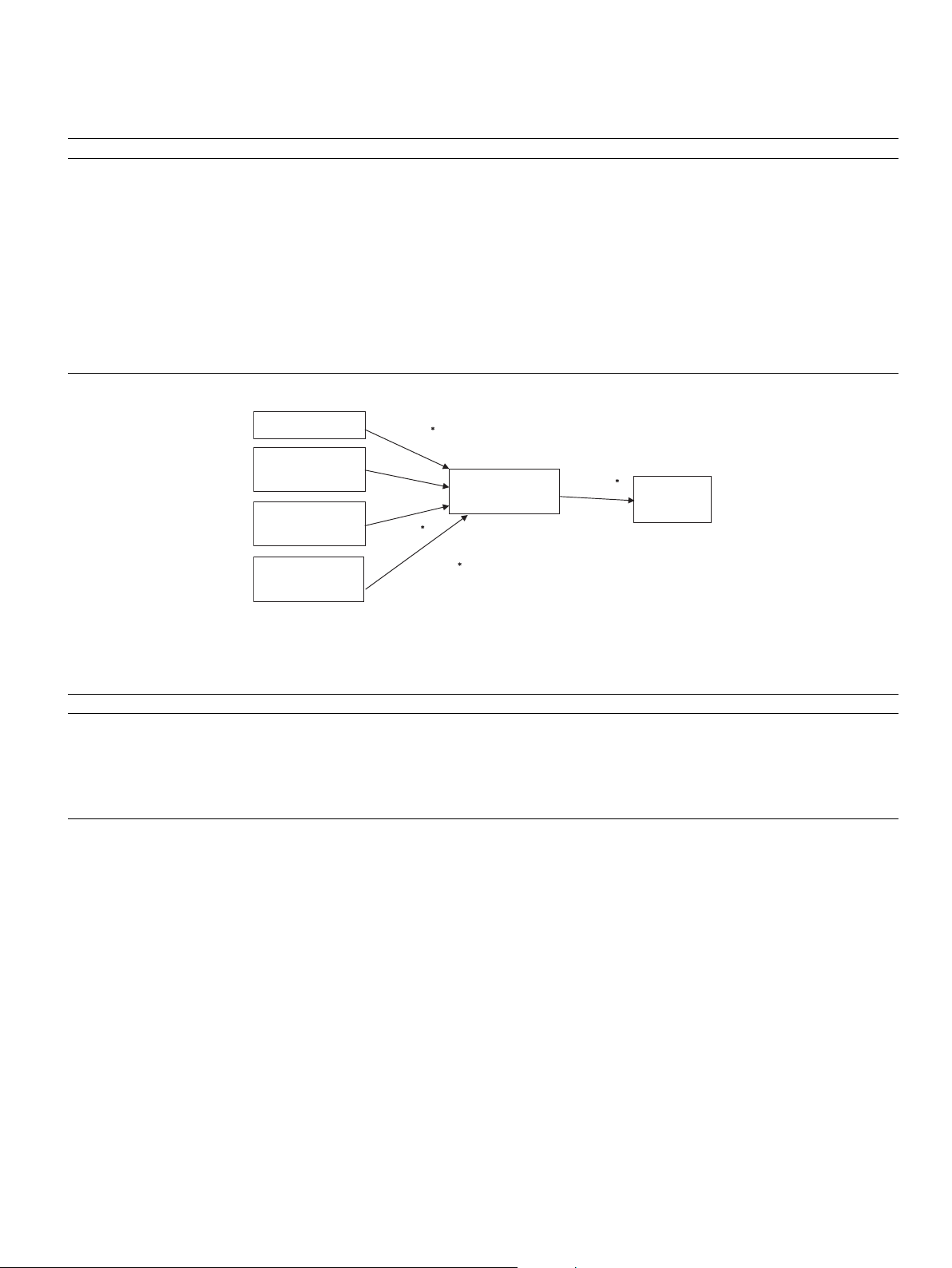
and learn extensively (Hoffman & Novak, 1996). This may lead to Novelty H1 Reliability H2 H5
Perceived Enjoyment of blog Intention to H3 usage visit Understandability H4 Interestingness Fig. 1. Research framework.
Y.-C. Chen et al. / Computers in Human Behavior 30 (2014) 787–799 793
the creation of a destination image that is an integral and influen-
Blog usage enjoyment is defined as ‘‘the degree of perceived
tial part of the traveler’s decision process (Beerli & Martin, 2004;
enjoyment while using a blog.’’ Venkatesh and Davis (2000) de-
Bigné et al., 2001; Echtner & Ritchie, 1991). Hence, the hypothesis
signed a three item (enjoyable, pleasant, and fun) scale to measure below is proposed.
enjoyment. It can also be viewed as the degree of playfulness expe-
rienced while using the information system (Moon & Kim, 2001).
H5. Blog usage enjoyment positively influences the behavioral
Another three item scale was designed by Moon and Kim (2001)
intention to visit a destination.
to measure enjoyment (enjoyment, fun, happy) and was later
adapted by Ahn et al. (2007). Both scales have been frequently used
by later researches. We combined and adapted their scales to fit 3.2. Measures the context of this study.
Finally, the behavioral intention to visit a destination is defined
To ensure content validity, the items selected for the constructs
as ‘‘the willingness to visit the destination mentioned in the blog.’’
(shown in the Appendix) were primarily revised from prior studies.
A four item scale was designed by Vijayasarathy (2002) to measure
All constructs, except for the subjects’ demographic variables, were
consumers’ intentions to purchase products from e-retailers with
measured on a five-point Likert-type scale. Table 1 summarizes the
good reliability and validity. Two items from Vijayasarathy
operational definition and sources of the variables’ measurement
(2002) were employed to measure this variable. The item ‘‘I intend items in this study.
to collect data about the product’’ was dropped because this study
Novelty of content is defined as ‘‘information in the blog about
investigated subjects’ responses after data have already been col-
the destination that is new to the user.’’ Xu and Chen (2006) devel-
lected. Since the probability of a tourist visiting the same destina-
oped a generic measurement scale for information relevance that
tion many times in the near future is quite low, the item ‘‘I plan to
could be used here. However, items for measuring novelty (amount
shop for more products’’ was also deleted.
of new and unique information, and similarity to previous knowl-
Two stages of pretests were used to develop the instruments.
edge) were outside of the tourism context, and might be difficult
First, ten subjects were asked to examine the meanings and correct
for tourists to reply to, since they were designed for generic con-
the wordings of the items. Then, we invited 50 subjects that had
texts. Hence, a nine item novelty-seeking scale developed by Jang
frequently visited travel blogs to fill out an online questionnaire
and Feng (2007) was condensed into three items: (1) new culture
and discussed their answers with them via MSN (Microsoft Mes-
and lifestyles, such as cuisine, crafts and handiworks, different cul-
senger). SPSS 11.0 was used to analyze the factor structure of prin-
tures, interesting people, people from unique ethnic and native
cipal components of variables. Items from Xu and Chen (2006),
groups; (2) curiosity, such as new knowledge, a variety of things
including Q1_1, Q1_2, and Q1_3 were excluded because they were
to do, and a place that one can talk about when home; and (3) dis-
not loaded in predicted factors. Therefore, the novelty measure-
covering a new place for traveling. A six-items scale was developed
ment items in the final questionnaire came mainly from Jang &
from Xu and Chen (2006) and Jang and Feng (2007). Feng, (2007).
Understandability of content is defined as ‘‘the degree to which
the user perceives the blog’s content about the destination as easy
to read and understand.’’ Reliability of content is defined as ‘‘the
3.3. Subjects and data collection
degree to which the blog’s content about the destination is per-
ceived to be true, accurate, or believable.’’ Measurement scales
The questionnaire was designed for an individual who has
for these two variables were adapted from Xu and Chen (2006).
lurked on travel blogs. Since the locations described in the blogs
Interestingness of content is defined as ‘‘the degree to which an
differ, we asked informants to recall the most impressive blog to
individual perceives the blog information as interesting to him/
answer the questionnaire. To prevent a situation where the subject
her.’’ No existing scales for blog content interestingness were
already intended to visit a specific destination and then searched
found in the extant literature. Chen et al. (1999) developed a 4-
blogs only to help plan the itinerary, this study restricted the sub-
items scale to measure interestingness of Physical education.
jects to those who were intending to take a trip and were consid-
Among them, two items measure the overall impression of level
ering destionations based on blogs’ content. Potential informants
of interestingness; and the other items measure the degree of
were made aware of this requirement and only suitable subjects
sense of delight. Rossiter (2002), however, stressed that a single-
were invited to participate. One last question was added, which
item measure could be good enough, or even better than multi-
asked why they lurked on this travel blog. Replies other than ‘‘I
items measure in conditions that: (1) nearly everyone describes
am intending to go on a trip,’’ such as enjoyment only, killing time,
the object to be evaluated, that is travelers’ blog, identically and
or gaining knowledge to make the plan, were excluded from fur-
(2) subjects have unanimous agreement as to what the concept
ther study. Different sources were used to invite suitable subjects.
is, and understand that there is only one holistic characteristics
An MSN friends list was used to inquire about our friends’ experi-
being referred to when the attribute of the construct is posed. This
ences with travel blogs. If any of them had experience, s/he was
study therefore designed an item to measure readers’ overall
asked to fill out an online questionnaire. Also, an invitation to
impression of degree of interestingness.
the online survey was posted on some well known travel blogs Table 1
Operational definition and measurement. Variable Operational definition Measurement Novelty of content
The blog’s content about the destination is new to the user
Xu and Chen (2006), Jang and Feng (2007) Understandability of
The blog’s content about the destination is perceived by the user as easy to read and understand Xu and Chen (2006) content Reliability of content
The degree to which the blog’s content about the destination is perceived to be true, accurate, or Xu and Chen (2006) believable Interestingness of content
The degree to which the blog’s content is perceived to be interesting Developed by this study Blog usage enjoyment
The degree to which lurking on the blog is perceived to be inherently enjoyable Ahn et al. (2007) Intention
The willingness to visit the destination mentioned in the blog Vijayasarathy (2002) 794
Y.-C. Chen et al. / Computers in Human Behavior 30 (2014) 787–799
in Taiwan, along with PTT, the biggest billboard in Taiwan. Addi-
CFI = 0.97; IFI = 0.97; SRMR = 0.049; RMSEA = 0.067). The results
tionally, we invited students at our university to fill out a paper
of CFA are shown in Table 3. All item loadings were significant
questionnaire. The survey lasted for 2 weeks. Two hundred and fif-
and larger than 0.5. The average variance extracted (AVE) of most
teen responses were obtained in this period (44 from travel blogs
constructs were larger than 0.5, except for that of novelty, which
and PTT, 87 from MSN friends, and 84 from the university). Of
was 0.472. To improve the AVE of novelty, Q1_6 was deleted. Final-
the 215 samples, 179 responses were valid. Deletion criteria de-
ly, all AVEs were larger than the square roots of correlations be-
pended on the answers that were missed or if respondents chose
tween variables, providing evidence of discriminate validity for more than one item. the measurements. 4. Data analysis 4.3. Hypotheses testing
4.1. Sample characteristics, descriptive statistics, and correlations
Partial Least Squares (PLS) is a commonly used statistical anal-
ysis method for latent variables. PLS can be used to confirm the
A total of 179 samples were collected. About 70% of our sample
validity of an instrument’s constructs and assess the structural
was going on a trip in the near future, and more than 60% accessed
relationship among constructs (Chin, 1998; Gefen, Straub, & Boud-
blogs for travel knowledge. The samples collected were suitable for
reau, 2000). It is able to model latent constructs even under condi-
further analysis because most of them could relate to the question-
tions of non-normality and small- to medium-size samples (Chin & naire items.
Newsted, 1996), making it appropriate to use for comprehensively
Since a profile of the blogger population is lacking and unclear,
testing the proposed model. Consistent with the distribution-free,
this study is unable to compare the demographics of general blog-
predictive approach of PLS (Wold, 1985), the structural model
gers and the sample. However, empirical evidence may show that
was evaluated using the R-square for the dependent constructs
our sample could be, more or less, representative of bloggers in
and the size, along with the t-statistics and significance level of
Taiwan. About 72.1% (n = 129) of the sample were female; about
the structural path coefficients. The t-statistics were estimated
85% of the sample ranged from 20 to 30 years old and were mostly
using the bootstrap re-sampling procedure (500 re-samples).
students. This is in accordance with InsightXplorer (2007), which
We used structural equation modeling procedures imple-
reported that blog users were generally less than 29 years old
mented in smart PLS to test the hypotheses. Results of the hypoth-
(70.3%), and MIC (2006), which reported that more than 60% of
eses testing, shown in Fig. 2 and summarized in Table 4, show that
respondents were female. Pi and Ye (2007) also found that 64.5%
the independent variables explain 31.7% of the variance in the blog
of their sample was female; and about 71.2% of the respondents
usage enjoyment construct. All the t-statistics of every variable are
were between 20 and 29 years old. Shiau and Kuo (2010) also
significant, except for the path between reliability and enjoyment
found about 84% of their sample ranged between 20 and 30 years
of blog usage. Therefore, H1, H3, and H4 were supported, but not
old; 59% were female; 65% were students. These demographics
H2. Blog usage enjoyment explains 11.1% of the variance in behav-
from different sources generally match those in this study.
ior intention. The t-statistic (4.586) is significant, which tends to
Table 2 reports variable means, standard deviation, and the support H5.
Pearson correlations. No two variables are correlated above 0.70,
a threshold for the multicollinearity problem (Hair, Anderson, Ta-
5. Discussions and managerial implications
tham, & Black, 1995). An examination of the correlations shows ini-
tial support for all of this study’s hypotheses. The variables’ mean
Due to intensified competition, tourism destinations are looking
scores are all above 4.0, except for reliability of content (3.78). This
for ways to attract tourists. Weblog represents a new information
may be because 70% of the sample was going on a trip very soon,
source that provides user-generated content, producing a higher
and 60% was blogging for information. Most of the sample might,
level of inter-personal influence on behavior intention. A model
before replying to this survey, already have good perceptions of
based on information relevance, a measure of subjective quality,
the blogs’ content and have a higher propensity for taking a trip.
was built and tested to explain why and how some blogs have a
greater impact than others on travelers’ intentions to visit a 4.2. Measurement model destination.
Some primary findings have contributed to our knowledge
This study conducted confirmatory factor analysis to test the
regarding the behavior intention to visit a tourist destination. First
reliability and validity of the measurement model. The goodness-
of all, the behavioral intention to visit a destination may be af-
of-fit indices indicate a moderate fit between the measurement
fected by relevant information. Criteria used for such judgment in-
model and the data (Chi-square = 144.61, p = 0.00, df = 80; Chi-
clude novelty, understandability, and interest (H1, H3, and H4). It
square/df = 1.8; GFI = 0.9; AGFI = 0.85; NFI = 0.93; NNFI = 0.95;
is noteworthy that novelty exerts a more powerful influence than Table 2
Descriptive statistics and Pearson correlations. Variables Mean SD Int Enj Nov Und Rel Inter Int 4.0 0.663 1 Enj 4.03 0.555 0.330** 1 Nov 4.12 0.50 0.406** 0.459* 1 Und 4.03 0.47 0.247** 0.350* 0.289** 1 Rel 3.78 0.52 0.172** 0.278* 0.339** 0.357** 1 Inter 4.07 0.54 0.015 0.350* 0.144 0.211** 0.243** 1
Note: n = 179; Two-tailed tests of significance were used.
Abbreviation: Int – Behavioral intention; Enj – Enjoyment; Nov – Novelty; Und – Understandability; Rel – Reliability; Inter – Interestingness. * p < 0.05. ** p < 0.01.
Y.-C. Chen et al. / Computers in Human Behavior 30 (2014) 787–799 795 Table 3 Summary of the results of CFA. Constructs Indicators Loading Cronbach’s alpha t-Value Average variance extracted Novelty Q1_4 0.77 0.719 7.00 0.472 Q1_5 0.73 9.90 Q1_6 0.54 10.44 Reliability Q1_7 0.68 0.822 9.65 0.62 Q1_8 0.79 11.45 Q1_9 0.88 13.19 Understandability Q1_10 0.81 0.751 11.07 0.53 Q1_11 0.77 10.41 Q1_12 0.58 7.57 Enjoyment Q1_14 0.77 0.872 11.68 0.63 Q1_15 0.85 13.37 Q1_16 0.83 12.86 Q1_17 0.73 10.78 Intention Q2_1 0.87 0.821 10.79 0.71 Q2_2 0.81 10.11 Novelty of content ( 0.306(6.144 (H1) Reliability of content Blog usage 0.333(4.586 ) 0.027(0.524)(H2) Intention to enjoyment (H5) visit Understandability
0.177(3.175 ) (H3) of content
0.289(4.068 ) (H4) Interestingness of content
Fig. 2. Results of hypotheses analysis. Table 4
Results of the structural model and hypotheses testing. Path coefficient t-Value Support
Effect on blog usage enjoyment (R2 = 0.317)
H1. Novelty ? blog usage enjoyment 0.306 6.164* Yes
H2. Reliability ? blog usage enjoyment 0.027 0.524 No
H3. Understandability ? blog usage enjoyment 0.177 3.175* Yes
H4. Interestingness of content ? blog usage enjoyment 0.289 4.068* Yes
Effect on intention (R2 = 0.111)
H5. blog usage enjoyment ? intention 0.333 4.586* Yes
* T-statistics significant at 1.64 (p 6 0.05).
the other two variables. However, some studies have contradicto-
However, the measurement scale of this variable is still imma-
rily found that familiarity, not novelty, positively impact interest
ture. Following the ‘‘Cronbach a-LISREL’’ approach, interestingness
and likelihood of visiting a destination, along with perceived qual-
was originally operationalized as a four reflective items to measure
ity of the trip (Horng et al., 2012; Maestro, Gallego, & Requezo,
the perception of interestingness and sense of delight (Chen et al.,
2007; Milman & Pizam, 1995). This discrepancy may arise from
1999). This study, instead, followed Rossiter (2002) to focus on
the different travel style preferences of tourists that value familiar-
content validity requirement and designed a single-item measure.
ity and those that are seeking novelty (Basala & Klenosky, 2001).
It seems that the results of hypotheses testing support Rossiter’s
Future studies may further explore the effects of travel style pref-
(2002) idea. However, PLS algorithm sets the latent variable oper-
erence on the relationship between novelty and destination choice.
ationalized as a single item equal to this item. Hence, it is question-
Secondly, interesting content is a new concept that reflects the
able whether the variable is really latent (Henseler & Fassott,
information attribute of relevance, and may deserve further inves-
2010). In addition, PLS estimates tend to be true value when the
tigation in tourism research (H4). The effects of information rele-
number of sample and items increase indefinitely (Wold, 1985).
vance were originally examined from utilitarian aspect where
A single item measure, therefore, could make the results of hypoth-
jobs or work needed to be done (Xu & Chen, 2006). This finding
esis testing unreliable. A covariance based SEM technique, allows
indicates that, in the context of experiential consumption, interest
researchers to separate the relationships between constructs from
should be considered as a component of relevance. In addition,
their measurement errors, which favors the situation where the
there is a necessity for identifying more hedonic dimensions of
reliability of measure is less optimal (Chin, 1998). Unfortunately,
information relevance. These issues represent some valuable
there is still no precise way to estimate the measurement error
opportunities for future researches.
of a single-item measure (Kline, 2011). A multi-items measure 796
Y.-C. Chen et al. / Computers in Human Behavior 30 (2014) 787–799
may resolve the above problems at the costs of adding unrelated
tion. Kaplan and Haenlein (2011) claimed, therefore, that the
items, or deleting related items (Rossiter, 2002). The sense of de-
first rule of blogging is to provide relevant information to target
light from interesting activities should be a complex concept
customers. In this regard, this study has already found that no-
involving various affections like fun, excitement etc. Chen et al.’
vel, reliable, and interesting information regarding a destination,
(1999) original scale measured the perception of fun only, which
such as ‘‘I left my heart in the Aegean Sea’’ (Lin & Huang, 2006),
may deteriorate the content validity. In addition, whether these
can convince tourists to visit a destination. This provides mar-
items are reflective is still questionable. For example, reading arti-
keting personnel and policy makers a new approach for promot-
cles about restaurant experiences may make people feel pleasure, ing tourist destinations.
but not necessarily feel exciting; instead, reading articles about
These findings lead to some practical tactics. Business should
adventure experiences may make people feel arousal and exciting.
provide support to and help travelers build their blogs, creating a
Researchers are encouraged to determine the nature of these
non-conventional, high-speed communication medium where
items, and refine this measure by using more suitable items to im-
people can exchange their travel experiences. Customers’ experi-
prove factorial analysis and reliability, and content validity
ences can be collected, and their requirements and complaints concurrently.
can also be managed via this platform (Kaplan & Haenlein, 2011).
Thirdly, researchers are encouraged to pay more attention to
Also, companies can set up their own blogs to promote destina-
the effects of intrinsic motivation, perceived enjoyment in par-
tions, giving them closer contact with their target customers so
ticular (H5). In previous literature, media conveying travel infor-
they can act quickly (e.g., sales promotions) and get their feedback
mation, including motion pictures, magazines, advertisements,
(Kaplan & Haenlein, 2011). Additionally, travelers can be invited to
guidebooks, and Internet agents (Gartner, 1993, Frías et al.,
write about and share their destination images with other people.
2008), are all one-to-many mediums that lack interactivity in
For example, in 2009, the Taiwanese government invited and sub-
the information seeking task. Due to the interactivity between
sidized young people around the world to take a trip to Taiwan, on
information providers and seekers, the structural characteristics
the condition that they would publish articles and images regard-
of social media or blogs differ greatly from traditional media
ing their experiences in Taiwan on their blogs. Singh et al. (2008)
(Govers et al., 2007). The image creation process may also have
referred to these types of travelers as thought leaders and urged
recreational purposes, which may produce emotional responses
managers to maintain these people’s blogs in order to provide cur-
from the user (Govers et al., 2007; Vogt & Fesenmaier, 1998).
rent information, novel experiences, and deeper insights. Finally,
Future research may consider the effects of other emotional re-
marketers have traditionally tried to integrate the customer into
sponses, such as curiosity, excitement or arousal, derived from
their decision-making process. Customers are an important source
surfing blogs (Kashdan & Silvia, 2009; Vogt & Fesenmaier,
of knowledge and can be a co-producer of products/services. Com- 1998).
panies can design an evaluation judgment scale and ask customers
Unexpectedly, reliability of content did not have any effect
to read and evaluate various blogs. Issues relevant to customers’
on blog usage enjoyment (H2 was rejected). There are some
needs could be identified easily and quickly (Kaplan & Haenlein,
explanations for this result. First of all, travelers’ reviews were 2011).
often perceived to be more reliable than information given by
tourism service providers (Vermeulen and Seegers, 2009). Sec-
ondly, reliability is, in part, determined by source credibility
6. Conclusions and future researches
(Xu & Chen, 2006). Whether or not an information source is
reliable involves a very complex judgment wherein the blogger’s
Due to the nature of the Internet in general, and blogs in partic-
current and past behaviors, relative to other information provid-
ular, abundant information may become a problem in information
ers, influence people’s perceptions (Weiss et al., 2008). Empirical
search; and the subjective information attributes of blog content
evidence has indicated that presentation of personal identifica-
may exert considerable influences on destination selection. Find-
tion information may have no impact on source credibility;
ings of this study suggest that tourists may only consult blogs that
the rationale behind this finding is still unclear (Chesney &
are subjectively perceived to be relevant to their information needs
Su, 2010). Thirdly, judgments of credibility might depend on so-
and concentrate on this limited information to build a destination
cial and normative factors associated with the nature of the
image. During this image formation process, a perception of enjoy-
Internet environment, as well as values and priorities related
ment may be produced to impact one’s intention. From the find-
to community values and the context of a website (Warnick,
ings and the above discussions, some theoretical implications can
2004). Fourthly, aesthetic value can be gained from blogs by be derived.
stimulating thinking, through imagining and envisioning a desti-
Interactivity and inter-personal influences have a great im-
nation that is real and obtainable; it is also accomplished
pact on blog or social media content. In addition, the widespread
through fantasizing, the act of producing a multisensory image
usage of multimedia technologies may further change the struc-
not drawn from personal experience (Vogt & Fesenmaier,
tural characteristics and information attributes of these new
1998). One can enjoy and dream about a trip, even if some facts
kinds of information sources, to the point where huge differ-
are missing or vague. Finally, Watts et al. (2009) deemed cred-
ences may exist between these new media formats and tradi-
ibility as a subjective and contextual quality of information, tional sources, even face-to-face WOM. In the field of
where many factors may impact its evaluation. For example,
information systems, the effects of various measures of objective
since tourism is a high risk product, risk-adverse tourists may
information quality on intrinsic motivations and behavioral
need to experience the destination themselves before reliability
intentions have been investigated for decades. Do these objective
can be judged. Current researches, however, have assumed the
quality measures still play a role in the image creation process?
objective role of this variable and designed measurement scales
Except for relevance, are there any other subjective information
accordingly (e.g., Shang et al., in press). Therefore, the measure-
quality variables that deserve attention from tourism studies?
ment scales for this variable may not reflect its subjective
What are the effects of these subjective quality measures, other nature.
than relevance? These questions have received relatively little
The findings from this study indicate that blog can be used as attention.
an important tool for tourism marketing (Lin & Huang, 2006).
Therefore, researchers are first encouraged to further explore
Tourists are unlikely to build images using irrelevant informa-
the role of subjective information quality in tourism. For exam-
Y.-C. Chen et al. / Computers in Human Behavior 30 (2014) 787–799 797
ple, it would be interesting to know whether the content of tra-
The effect of consistency on tourism decisions, however, is yet to
vel blogs and responses to this content have become a source of be explored.
social comparison. How will social comparisons influence desti-
More importantly, there are some occasions such as family or
nation decisions (Shang et al., in press)? Though researchers
classmates trip that people travel in groups. In such context, pre-
have noticed and stressed the importance of subjective quality
trip planning involves a social process among all actors partici-
in experiential and hedonic consumption, like traveling (e.g.,
pating group decision making and collaboration requiring many
Vogt & Fesenmaier, 1998), many recent researches still empha-
people to contribute and share individual intelligence, and co-
sized objective, context-free quality variables (e.g., Hsu & Tsou,
agree on the travel plan. Blogging in this sense can be inter-
2011). Subjective quality has received relatively little attention,
preted as a process of creating collective intelligence by writing,
especially in the online context (Bernardo et al., 2012). Though
uploading, sharing and consolidating individual experiences
some studies are taking place, it is still in the early stages of
(Sigala, 2012). However, various members may be conflict with development.
each other on many issues like goals of the trip, budget con-
Researchers are also encouraged to reconceptualize traditional
straints, preferences, etc. Then, how can a group reach a decision
information quality variables to decide whether they are purely
effectively and efficiently while surfing social media for advice?
utilitarian or not. Watts et al. (2009) maintained that some quality
How does the structural nature of this social community affect
variables, relevance and credibility in particular, are subjective in
tourism decisions, with issues like dynamics within social
nature. This study found support for the effects of relevance on
groups, consensus building processes, and roles of opinion leader
destination decisions. Credibility, however, is most controversial
(Richins & Root-Shaffer, 1998)? How can collaborative and group
since it is traditionally, and still is treated as an objective quality
decision technologies help making decisions? These issues re-
(Ho, 2007; Shang et al., in press; Zheng et al., in press). The natures
ceive relatively little attention from extant literature. Sigala’s
of other variables can also be re-examined and conflicts should be
(2012) pioneering work showed that users of geocollaborative resolved.
portal, a group decision tool integrated with web 2.0 technolo-
Recent studies related to subjective quality were unfortunately
gies, gave a greater importance to the impact of this tool on
fragmental; each identified their own, unique subjective quality
group decision process rather than the outcomes. Effects of
measures to serve and satisfy their researches’ purposes and con-
many contextual factors such as users’ profiles, group size, type
texts. For example, Bernardo et al. (2012) defined hedonic quality,
of trip etc., however, remains for further investigations.
as distinguished from pure utilitarian quality, for many businesses,
In addition, pre-trip information search is a process composed
including travel agents. Shang et al. (in press) explored the impacts
of both rational calculation and pleasure seeking activities. Due
of social comparison quality on investment decisions. Similarities
to the very nature of this study, only an intrinsic motivational var-
and differences may be found among these studies; however, a
iable was incorporated into the theoretical model. Yet, a pleasur-
consensus regarding the structure and dimensions of subjective
able trip without economic value may still not be an idea
quality is yet to be achieved. Further research is needed to identify
alternative for tourists. Therefore, extrinsic motivational factors
more subjective quality variables in different contexts of hedonic
such as usefulness of blog’s content can be further incorporated
consumption and develop a common dimensionality structure of
into the theoretical model in future studies.
subjective quality. Some claim that the theoretical and operational
Some limitations should be mentioned. First of all, readers
challenges of incorporating contextual usage into quality assess-
should be cautious in interpreting the results since the sampling
ment must be resolved before advancements can occur (Watts
procedure was not random. While a convenient sampling meth-
et al., 2009). In this regard, Watts et al. advised researchers to ac-
od was used, self-selection could be a threat to validity. Compar-
count for the characteristics of the decision-makers and the deci-
ison with sample demographics from other related studies in sions at hand.
Taiwan proved that they were similar; therefore, the threat to
Another major issue that requires further investigation is
external validity may be decreased to a certain extent. However,
information overload encountered when surfing social media
the sample may still suffer from cultural or geographical limita-
during image creation (Frías et al., 2008; Grant et al., 2008). Frías
tions, since there is no way to accurately compare the bloggers
et al. (2008) found that destination image worsened when tour-
in Taiwan with other countries/areas due to the fact that the
ists faced with more information, but this effect was moderated
demographic of bloggers keep changing (Armstrong & McAdams,
by message involvement and Internet experience. Future re- 2009).
searches can borrow other factors that alleviate the information
Furthermore, the sample size was small, meaning the results
burden from the information overload paradigm, such as desti-
may not be as stable and reliable. However, PLS, the statistical tool
nation involvement and travel experiences (Chen et al., 2009;
used in this study, is most suitable for testing hypotheses with
Frías et al., 2008; Park & Lee, 2008). This will lead to further
small sample. Therefore, the above problems may not be too seri-
understanding of the causes and effects of information quantity
ous. Finally, this study asked informants to recall an impressive on tourism decisions.
blog as the basis for filling out the questionnaire. This study, how-
Furthermore, besides traditional informational characteristics,
ever, cannot be completely sure whether the blog led to the inten-
such as availability and currency, structural characteristics of so-
tion to visit a destination or vice versa. To prevent this problem, we
cial media not considered in this study, such as inter-personal
restricted the subjects’ qualifications and added a question regard-
influence and interactivity, should be taken into account. For
ing the purpose of lurking on this blog, which was used to exclude
example, links to other blogs or content feedback raise the ques- unsuitable subjects.
tion of severe content inconsistency (Shang et al., in press). Tour-
ists can access many different travelers’ experiences with only a Acknowledgements
few clicks. How do information conflicts and contradictions among
different blogs impact tourist decisions? How do readers consoli-
This research is supported by National Science Council, Taiwan,
date different experiences and form their own unique image?
under Grant Number NSC 99-2410-H-031 -031 -MY2. The authors
Shang et al. (in press) measured perceptions of consistency and
are grateful to the anonymous reviewers of this paper for their very
found that this variable positively impacts investment decision
helpful and thoughtful comments and guidance in revising and
usefulness, but not satisfaction about the investment decision. editing this paper. 798
Y.-C. Chen et al. / Computers in Human Behavior 30 (2014) 787–799 Appendix A.
Blood, R. (2004). How blogging software reshapes the online community: [1].
Communications of the ACM, 47(12), 53.
Brown, R. D., Braskamp, L. A., & Newman, D. L. (1978). Evaluator credibility and Novelty of
acceptance as a function of report styles: Do jargon and data make a difference?
Evaluation Quarterly, 2(2), 331–341. content
Burgess, J. A. (1978). Image and identity. Occasional papers in geography (Vol. 23). Q1_1
There was a substantial amount of new
University of Hull Publications. information in this blog
Chen, C. W. (2010). Impact of quality antecedents on taxpayer satisfaction with Q1_2
I knew little about the destination described in
online tax-filing systems—An empirical study. Information & Management, 47, 308–315.
the blog before I came across this blog
Chen, A., Darst, P. W., & Pangrazi, R. P. (1999). What constitutes situational interest? Q1_3
This blog has a substantial amount of unique
Validating a construct in physical education. Measurement in Physical Education
information that I have not come across before
and Exercise Science, 3(3), 157–180.
Chen, Y. C., Shang, R. A., & Kao, C. Y. (2009). The effects of information overload on Q1_4
Through this blog, I discovered a new
consumers’ subjective state towards buying decision in the internet shopping destination
environment. Electronic Commerce Research and Applications, 8(1), 48–58. Q1_5
Through this blog, I learned about the
Chesney, T., & Su, Daniel K. S. (2010). The impact of anonymity on weblog
credibility. International Journal of Human Computer Studies, 68, 710–718.
destination’s culture and way of life
Chin, W. W. (1998). Issues and opinion on structural equation modeling. MIS Q1_6
Through this blog, I satisfied my curiosity Quarterly, 22(1), 7–16. regarding this destination
Chin, W. W., & Newsted, P. R. (1996). Structural equation modeling analysis with
small samples: Using partial least squares. In R. H. Hoyly (Ed.), Statistical Reliability of content
strategies for small-sample research. Thousand Oaks, CA: Sage.
Crompton, J. L. (1979). Motivation for pleasure vacation. Journal of Leisure Research, Q1_7
I think the content of this blog is accurate 6, 408–424. Q1_8
I think the content of this blog is consistent
Dave, W. (2003). What makes a weBlog a weBlog? with facts
whatmakesaweblogaweblog.html> Accessed 15.02.06.
DeLone, W. H., & McLean, E. R. (2003). The DeLone and McLean model of Q1_9
I think the content of this blog is reliable
information systems success: A 10-year update. Journal of Management
Information Systems, 19(4), 9–30. Understandability of content
Doong, H. S., Wang, H. C., & Law, R. (2008). An initial investigation of the effect of Q1_10
The information in this blog was easy for me to
advertisement and word-of-month: First-time visitors to Hong Kong. Journal of understand
Air Transport Management, 14, 159–161.
Dwyer, J. (1999). Communication in business: Strategies and skills. Sydney: Prentice Q1_11
I was able to follow this blog’s content with Hall. little effort
Echtner, C., & Ritchie, J. (1991). The meaning and measurement of destination Q1_12
Readers like me should find this blog easy to
image. The Journal of Tourism Studies, 2(2), 2–12. read
Elsbach, K. D., & Elofson, G. (2000). How the packaging of decision explanations
affects perceptions of trustworthiness. Academy of Management Journal, 43(1), Interestingness of content 83–89.
Faison, E. (1977). The neglected variety drive: A useful concept for consumer Q1_13
I think the content of this blog is interesting
behavior. Journal of Consumer Research, 4, 172–175.
Fodness, D., & Murry, B. (1997). Tourist information search. Annals of Tourism Blog usage enjoyment Research, 24(3), 503–523. Q1_14
Using this blog provides me with enjoyment
Fodness, D., & Murry, B. (1998). A typology of tourist information search strategies. Q1_15
Using this blog makes me feel relaxed and
Journal of Travel Research, 37, 108–119.
Frías, D. M., Rodriquez, M. A., & Castaneda, J. A. (2008). Internet vs. travel agencies pleasant
on pre-visit destination image formation: An information processing view. Q1_16
Using this blog makes me feel happy
Tourism Management, 29(1), 163–179. Q1_17 Using this blog is fun
Gartner, W. C. (1993). Image formation process. Journal of Travel and Tourism Marketing, 2(2/3), 191–215.
Behavioral intention to visit a destination
Gefen, D., Straub, D. W., & Boudreau, M. C. (2000). Structural equation modeling and
regression: Guidelines for research practice. Communications of the Association Q2_1
If I get the chance to travel, I intend to visit the
for Information Systems, 4(7), 1–79.
destination mentioned in this blog
Govers, R., Go, F. M., & Kumar, K. (2007). Virtual destination image: A new Q2_2
When I go on a trip, the probability that I visit
measurement approach. Annals of Tourism Research, 34(4), 977–997.
Grant, R., Clarke, R. J., & Kyriazis, E. (2008). A review of factors affecting online
the destination mentioned in this blog is high
consumer search behaviour from an information value perspective. Journal of
Marketing Management, 23(5–6), 519–533.
Hair, J. F., Anderson, R. E., Tatham, R. L., & Black, W. C. (1995). Multivariate data
analysis with readings (4th ed.). New York: Macmillan.
Heijden, H. (2003). Factors influencing the usage of websites: The case of generic
portal in the Netherlands. Information & Management, 40(6), 541–549. References
Hennig-Thurau, T., Gwinner, K. P., Walsh, G., & Gremler, D. D. (2004). Electronic
word-of-mouth via consumer-opinion platforms: What motivates consumers to
articulate themselves on the internet? Journal of Interactive Marketing, 18(1),
Ahn, T., Ryu, S., & Han, I. (2007). The impact of web quality and playfulness on user 38–52.
acceptance of online retailing. Information & Management, 44(3), 263–275.
Henseler, J., & Fassott, G. (2010). Testing moderating effects in PLS path models: An
Armstrong, C. L., & McAdams, M. J. (2009). Blogs of information: How gender cues
illustration of available procedures. In W. W. Chin, V. E. Vinzi, H. Wang, & J.
and individual motivations influence perceptions of credibility. Journal of
Henseler (Eds.), Handbook of partial least squares: Concept, methods and
Computer-Mediated Communication., 14, 435–456.
applications (pp. 713–735). Berlin: Springer-Verlag.
Baloglu, S., & McCleary, K. W. (1999). A model of destination image formation.
Herring, S. C., Scheidt, L. A., Bonus, S., & Wright, E. (2004). Bridging the gap: A genre
Annals of Tourism Research, 26(1), 868–897.
analysis of weblogs. In Proceedings of the 37th Hawai’i international conference on
Basala, S. L., & Klenosky, D. B. (2001). Travel style preferences for visiting a novel
system sciences (HICSS-37). Los Alamitos: IEEE Computer Society Press.
destination: A conjoint investigation across the novelty-familiarity continuum.
Hirsh, S. G. (1999). Children’s relevance criteria and information seeking on
Journal of Travel Research, 40, 172–182.
electronic resources. Journal of the American Society for Information Science,
Bateman, J. (1998). Changes in relevance criteria: A longitudinal study. In 50(14), 1265–1283.
Proceedings of the 61st annual meeting of the american society for information
Ho, C. I. (2007). The development of an e-travel service quality scale. Tourism
science (Vol. 35, pp. 23–32).
Management, 28(6), 1434–1449.
Beerli, A., & Martin, J. D. (2004). Factors influencing destination image. Annals of
Hoffman, D. L., & Novak, T. P. (1996). Marketing in hypermdia computer-mediated
Tourism Research, 31(3), 657–681.
environments: Conceptual foundations. Journal of Marketing, 60(3), 50–68.
Bernardo, M., Marimon, F., & del Mar Alonso-Almeida, M. (2012). Functional quality
Hollenbaugh, E. E. (2010). Personal journal bloggers: Profiles of disclosiveness.
and hedonic quality: A study of the dimensions of e-service quality in online
Computers in Human Behavior, 26, 1657–1666.
travel agencies. Information & Management, 49, 342–347.
Horng, J. S., Liu, C. H., Chou, H. Y., & Tsai, C. Y. (2012). Understanding the impact of
Bigné, J. E., Sánchez, M. I., & Sánchez, J. (2001). Tourism image, evaluation variables
culinary brand equity and destination familiarity on travel intention. Tourism
and after purchase behavior: Inter-relationships. Tourism Management, 22(6), Management, 33, 815–824. 607–616.
Y.-C. Chen et al. / Computers in Human Behavior 30 (2014) 787–799 799
Hsu, C. L., & Lin, Judy C. C. (2008). Acceptance of blog usage: The roles of technology
Pi, S. H., & Ye, L. J. (2007). The factors affect customer retention of blog: A
acceptance, social influence and knowledge sharing motivation. Information &
perspective of switching cost. Journal of e-Business, 9(4), 925–944 (in Chinese). Management, 45, 65–74.
Reynolds, W. H. (1965). The role of the consumer in image building. California
Hsu, H. Y., & Tsou, H. T. (2011). Understanding customer experiences in online blog
Management Review, 7(3), 69–76.
environments. International Journal of Information Management, 31, 510–523.
Richins, M. L., & Root-Shaffer, T. (1998). The role of involvement and opinion
Hyde, K. F. (2008). Information processing and touring planning theory. Annals of
leadership in consumer word-of-mouth: An implicit model made explicit.
Tourism Research, 35(3), 712–731.
Advertising Consumer Research, 15, 32–36.
InsightXplorer (2007). Survey of the satisfaction and selection of blog platform for
Rossiter, J. R. (2002). The C-OAR-SE procedure for scale development in marketing. building blog (in Chinese).
International Journal of Research in Marketing, 19, 305–335.
self_blog200710.html> (Accessed 15.02.06).
Schmallegger, D., & Carson, D. (2008). Blogs in tourism: Changing approaches to
Jang, S. C., & Feng, R. (2007). Temporal destination revisit intention: The effects of
information exchange. Journal of Vacation Marketing, 14(2), 99–110.
novelty seeking and satisfaction. Tourism Management, 28, 580–590.
Scott, P. (2001). Logging: Creating instant content for the web. Jeong, E. H., & Jang, S. C. (2011). Restaurant experiences triggering positive
library.usask.ca/~scottp/i12001/definitions.html> (Retrieved 25.01.04).
electronic word-of-mouth (eWOM) motivations. International Journal of
Shang, R. A., Chen, Y. C., & Chen, C. J. (in press). Social and objective value of
Hospitality Management, 30(2), 356–366.
information in virtual investment communities. Online Information Review.
Joelle, V., & Dirk, S. (2001). The role of surprise in satisfaction judgment. Journal of
Shiau, W. L., & Kuo, T. Y. (2010). An empirical study of bloggers’ continuous usage of
Consumer Satisfaction, Dissatisfaction and Complaining Behavior, 14, 27–46.
blogs: Prospects from an integrated model of ECT, TAM and personal factors.
Kaplan, A. M., & Haenlein, M. (2011). The early bird catches the news: Nine things
Journal of e-Business, 12(2), 221–250 (in Chinese).
you should know about micro-blogging. Business Horizons, 54, 105–113.
Sigala, M. (2010). Measuring customer value in online collaborative trip planning
Kashdan, T. B., & Silvia, P. (2009). Curiosity and interest: The benefits of thriving on
process. Marketing Intelligence and Planning, 21(8), 418–443.
novelty and challenge. In S. J. Lopez (Ed.), Handbook of positive psychology (2nd
Sigala, M. (2012). The impact of geocollaborative portals on group decision making
ed., pp. 367–375). Oxford, UK: Oxford University Press.
for trip planning. European Journal of Information Systems, 21(4), 404–426.
Kline, Rex. B. (2011). Principles and practice of structural equation modeling (3rd ed.).
Singh, T., Veron-Jackson, L., & Cullinane, J. (2008). Blogging: A new play in your New York, NY: Guilford Press.
marketing game plan. Business Horizons, 51, 281–292.
Lin, Y. S., & Huang, J. Y. (2006). Internet blogs as a tourism marketing medium: A
Teo, T. S. H., Lim, V. K. G., & Lai, R. Y. C. (1999). Intrinsic and extrinsic motivation in
case study. Journal of Business Research, 59(10–11), 1201–1205.
internet usage. Omega: International Journal of Management Science, 27(1),
Lin, C. S., Wu, S., & Tsai, R. J. (2005). Integrating perceived playfulness into 25–37.
expectation–confirmation model for web portal context. Information and
Venkatesh, V., & Davis, F. D. (2000). A theoretical extension of the technology Management, 42(5), 683–693.
acceptance model: Four longitudinal field studies. Management Science, 46,
Litvin, S. W., Goldsmith, R. E., & Pan, B. (2008). Electronic word-of mouth in 186–204.
hospitality and tourism management. Tourism Management, 29(3), 458–468.
Vermeulen, I. E., & Seegers, D. (2009). Tried and tested: The impact of online hotel
Maestro, R. M. H., Gallego, P. A. M., & Requezo, L. S. (2007). The moderating role of
reviews on consumer consideration. Tourism Management, 30, 123–127.
familiarity in rural tourism in Spain. Tourism Management, 28, 951–964.
Vijayasarathy, L. R. (2002). Product characteristics and internet shopping intention.
McKnight, H., & Kacmar, C. (2006). Factors of information credibility for an internet
Internet Research, 12(5), 411–426.
advice site. In Proceedings of the 39th Hawaii international conference on system
Vogt, C. A., & Fesenmaier, D. R. (1998). Expanding the functional information search sciences.
model. Annals of Tourism Research, 25(3), 551–578.
Mercille, J. (2005). Media effects on image. The case of Tibet. Annals of Tourism
Warnick, B. (2004). Online ethos: Source credibility in an authorless environment. Research, 32, 1039–1055.
American Behavioral Scientist, 48(2), 256–265.
MIC (2006). An analysis of Internet users’ behavior in Taiwan (in Chinese) Watts, S., Shankaranarayanan, G., & Even, A. (2009). Data quality assessment in
www.itis.org.tw/reporter/ViewHTML/att/repocontent.jhtm> Accessed in 2007.
context: A cognitive perspective. Decision Support Systems, 48, 202–211.
Milman, A., & Pizam, A. (1995). The role of awareness and familiarity with a
Weiss, A. M., Lurie, N. H., & Maccinis, D. J. (2008), XLV, 425–436.
destination: The central Florida case. Journal of Travel Research, 33, 21–27.
Wold, H. (1985). Systems analysis by partial least squares. In P. Nijkamp, L. Leitner,
Money, R. B., & Crotts, J. C. (2003). The effect of uncertainty avoidance on
& N. Wrigley (Eds.), Marketing the unmeasurable. Dordrecht: Marius Nijhoff.
information search, planning, and purchases of international travel vacations.
Xiang, Z., & Gretzel, U. (2010). Role of social media in online travel information
Tourism Management, 24(2), 191–202.
search. Tourism Management, 31(2), 179–188.
Moon, J., & Kim, Y. (2001). Extending the TAM for a World-Wide-Web context.
Xu, Y., & Chen, Z. (2006). Relevance judgment: What do information users consider
Information & Management, 38(4), 217–230.
beyond topicality? Journal of the American Society for Information Science and
Para-López, E., Gutiérrez-Taño, D., Díaz-Armas, R. J., & Bulchand-Gidumal, J. (2012). Technology, 57(7), 961–973.
Travelers 2.0: Motivations, opportunity and ability to use social media. In M.
Yoo, K. H., & Gretzel, U. (2012). Use and creation of social media by travelers. In M.
Sigala, E. Christou, & U. Gretzel (Eds.), Social media in travel and hospitality:
Sigala, E. Christou, & U. Gretzel (Eds.), Social media in travel and hospitality:
Theory, practice and cases. Burlinton, VT: Ashgate Publishing Company.
Theory, practice and cases. Burlinton, VT: Ashgate Publishing Company.
Park, D. H., & Lee, J. (2008). EWOM overload and its effect on consumer behavioral
Zafiropoulos, K. (2012). Wine blog influence and blog community’s connectivity: A
intention depending on consumer involvement. Electronic Commerce Research
social network analysis. European Journal of Tourism, Hospitality and Recreation,
and Applications, 7(4), 386–398. 3(1), 135–156.
Pearson, P. H. (1970). Relationship between global and specified measures of
Zheng, Y. M., Zhao, K. & Stylianou, A. (in press). The impacts of information quality
novelty seeking. Journal of Consulting and Clinical Psychology, 34, 199–204.
and system quality on users’ continuance intention in information-exchange
Petty, R., Priester, J., & Wegender, D. (1994). Cognitive processes in attitude change.
virtual communities: An empirical investigation. Decision Support Systems.
In R. Wyer & T. Srull (Eds.), Handbook of social cognition (pp. 69–142). Hillsdale, NJ: Erlbaum.
Tài liệu liên quan:
-
Mousetrap Cars Guide for Engineering Students - Tài liệu Nghiên cứu khoa học | Trường Đại học Kinh tế, Đại học Quốc gia Hà Nội
35 18 -
Impact of online flow on brand experience and loyalty môn Nghiên cứu khoa học | Trường Đại học Kinh tế, Đại học Quốc gia Hà Nội
35 18 -
BAB 11 Ekuitas - Nghiên cứu khoa học | Trường Đại học Kinh tế, Đại học Quốc gia Hà Nội
201 101 -

Nghiên cứu các yếu tố ảnh hưởng đến xuất khẩu cà phê của Việt Nam sang Mỹ giai đoạn 2002 - 2020 | Bài tiểu luận học phần Nghiên cứu khoa học | Trường Đại học Kinh tế, Đại học Quốc gia Hà Nội
849 425