International Lending and Financial Crises Analysis | Tài chính quốc tế | Trường Học Viện nông nghiệp Việt Nam
In many ways, international lending is similar to domestic lending. Lenders care about the risk of default and the expected return from mak- ing loans whether they are lending across town or across international borders. In this chapter, we will continue our discussion of capital flows, by looking at international lending. In addition, the chapter will examine the problems that borrowing countries may experience. Tài liệu được sưu tầm và soạn thảo dưới dạng file PDF để gửi tới các bạn cùng tham khảo, ôn tập đầy đủ kiến thức, chuẩn bị cho các buổi học thật tốt. Mời bạn đọc đón xem!
Môn: Tài chính quốc tế (hvnn) 130 tài liệu
Trường: Học viện Nông nghiệp Việt Nam 2.4 K tài liệu
Tác giả:


Preview text:
CHAPTER 11
International Lending and Crises Contents International Lending 211 Causes of Financial Crises 212
International Lending and the Great Recession 215
International Lending and the Greek Debt Crisis 219 IMF Conditionality 222 The Role of Corruption 225 Country Risk Analysis 226 Summary 229 Exercises 229 Further Reading 230
In many ways, international lending is similar to domestic lending.
Lenders care about the risk of default and the expected return from mak-
ing loans whether they are lending across town or across international
borders. In this chapter, we will continue our discussion of capital flows,
by looking at international lending. In addition, the chapter will examine
the problems that borrowing countries may experience. INTERNATIONAL LENDING
International lending has had recurrent horror stories where regional
financial crises have imposed large losses on lenders. In the 1980s, there
was a Latin American debt crisis in which many countries were unable to
service the international debts they had accumulated. Table 11.1 illustrates
the commitment of US banks to lending in each of the crisis areas. The
table indicates that the situation from the perspective of US banks was
much more dire in the 1982 Latin American crisis than in the more recent
cases. The 1980 debtor nations owed so much money to international
banks that a default would have wiped out the biggest banks in the world.
As a result, debts were rescheduled rather than allowed to default. A debt
rescheduling postpones the repayment of interest and principal so that
banks can claim the loan as being owed in the future rather than in default © 201 7 Elsevier Inc.
International Money and Finance. All rights reserved. 211 212
International Money and Finance
Table 11.1 US bank loans in financial crisis
countries as a percentage of US bank capital Latin America in 1982 Argentina 12% Brazil 26% Chile 9% Mexico 37% Mexico in 1994 11% Asia in 1997 Indonesia 2% Korea 3% Thailand 1%
Source: From Kamin, S., 1998. The Asian financial crisis
in historical perspective: a review of selected statistics.
Working Paper, Board of Governors of the Federal Reserve System.
now. This way, banks do not have to write off the debt as a loss—which
would have threatened the existence of many large banks due to the large
size of the loans relative to the capitalization of the bank. For instance, the
Mexican debt to US banks in 1982 was equal to 37% of US bank capital.
Banks simply could not afford to write off bad debt of this magnitude as
loss. By rescheduling the debt, banks would avoid this alternative.
In contrast to the heavy exposure of international banks to Latin
American borrowers in 1982, the Asian financial crisis of 1997 involved
a much more manageable debt position for US banks. Many international
investors lost money in the Asian crisis, but the crisis did not threaten the
stability of the world banking system to the extent the 1980s crisis did.
However, the debtor countries required international assistance to recover
from the crisis in all recent crisis situations. This recovery involves new
loans from governments, banks, and the International Monetary Fund
(IMF). Later in this chapter, we consider the role of the IMF in more
detail. First, it is useful to think about what causes financial crises.
CAUSES OF FINANCIAL CRISES
The causes of the recent Asian financial crisis are still being debated. Yet, it
is safe to say that certain elements are essential in any explanation, includ-
ing external shocks, domestic macroeconomic policy, and domestic finan-
cial system flaws. Let us consider each of these in turn.
International Lending and Crises 213
1. External shocks. Following years of rapid growth, the East Asian econo-
mies faced a series of external shocks in the mid-1990s that may have
contributed to the crisis. The Chinese renminbi and the Japanese
yen were both devalued, making other Asian economies with fixed
exchange rates less competitive relative to China and Japan. Because
electronics manufacturing is an important export industry in East Asia,
another factor contributing to a drop in exports and national income
was the sharp drop in semiconductor prices. As exports and incomes
fell, loan repayment became more difficult and property values started
to fall. Since real property is used as collateral in many bank loans, the
drop in property values made many loans of questionable value so that
the banking systems were facing many defaults.
2. Domestic macroeconomic policy. The most obvious element of macroeco-
nomic policy in most crisis countries was the use of fixed exchange
rates. Fixed exchange rates encouraged international capital flows into
the countries, and many debts incurred in foreign currencies were
not hedged because of the lack of exchange rate volatility. Once pres-
sures for devaluation began, countries defended the pegged exchange
rate by central bank intervention—buying domestic currency with
dollars. Because each country has a finite supply of dollars, countries
also raised interest rates to increase the attractiveness of investments
denominated in domestic currency. Finally, some countries resorted
to capital controls, restricting foreigners access to domestic currency
to restrict speculation against the domestic currency. For instance, if
investors wanted to speculate against the Thai baht, they could bor-
row baht and exchange them for dollars, betting that the baht would
fall in value against the dollar. This increased selling pressure on the
baht could be reduced by capital controls limiting foreigners’ ability to
borrow baht. However, ultimately the pressure to devalue is too great,
as even domestic residents are speculating against the domestic cur-
rency and the fixed exchange rate is abandoned. This occurs with great
cost to the domestic financial market. Because international debts were
denominated in foreign currency and most were unhedged because
of the prior fixed exchange rate, the domestic currency burden of the
debt was increased in proportion to the size of the devaluation. To aid
in the repayment of the debt, countries turn to other governments and the IMF for aid.
3. Domestic financial system flaws. The countries experiencing the Asian
crisis were characterized by banking systems in which loans were not 214
International Money and Finance
always made on the basis of prudent business decisions. Political and
social connections were often more important than expected return
and collateral when applying for a loan. As a result, many bad loans
were extended. During the boom times of the early to mid-1990s,
the rapid growth of the economy covered such losses. However,
once the growth started to falter, the bad loans started to adversely
affect the financial health of the banking system. A related issue is
that banks and other lenders expected the government to bail them
out if they ran into serious financial difficulties. This situation of
implicit government loan guarantees created a moral hazard situation.
A moral hazard exists when one does not have to bear the full cost of
bad decisions. If institutions or individuals taking the risk are assured
of not being held liable for losses, then it creates excessive risk taking.
So if banks believe that the government will cover any significant
losses from loans to political cronies that are not repaid, they will be
more likely to extend such loans.
Considerable resources have been devoted to understanding the nature
and causes of financial crises in hopes of avoiding future crises and fore-
casting those crises that do occur. Forecasting is always difficult in eco-
nomics, and it is safe to say that there will always be surprises that no
economic forecaster foresees. Yet there are certain variables that are so
obviously related to past crises that they may serve as warning indicators
of potential future crises. The list includes the following:
1. Fixed exchange rates. Countries involved in recent crises, includ-
ing Mexico in 1993–94, the Southeast Asian countries in 1997, and
Argentina in 2002, all utilized fixed exchange rates prior to the onset
of the crisis. Generally, macroeconomic policies were inconsistent
with the maintenance of the fixed exchange rate. When large devalu-
ations ultimately occurred, domestic residents holding unhedged loans
denominated in foreign currency suffered huge losses.
2. Falling international reserves. The maintenance of fixed exchange rates
may be no problem. One way to detect whether the exchange rate is
no longer an equilibrium rate is to monitor the international reserve
holdings of the country (largely the foreign currency held by the cen-
tral bank and treasury). If the stock of international reserves is falling
steadily over time, that is a good indicator that the fixed exchange rate
regime is under pressure and there is likely to be a devaluation.
3. Lack of transparency. Many crisis countries suffer from a lack of transpar-
ency in governmental activities and in public disclosures of business
International Lending and Crises 215
conditions. Investors need to know the financial situation of firms in
order to make informed investment decisions. If accounting rules allow
firms to hide the financial impact of actions that would harm investors,
then investors may not be able to adequately judge when the risk of
investing in a firm rises. In such cases, a financial crisis may appear as a
surprise to all but the “insiders” in a troubled firm. Similarly, if the gov-
ernment does not disclose its international reserve position in a timely
and informative manner, investors may be caught by surprise when a
devaluation occurs. The lack of good information on government and
business activities serves as a warning sign of potential future problems.
This short list of warning signs provides an indication of the sorts of
variables an international investor must consider when evaluating the risks
of investing in a foreign country. Once a country finds itself with severe
international debt repayment problems, it has to seek additional financing.
Because international banks are not willing to commit new money where
prospects for repayment are slim, the IMF becomes an important source
of funding. Before we examine the role of the IMF, we will examine the
recent financial crisis in the United States and the debt crisis in Greece.
INTERNATIONAL LENDING AND THE GREAT RECESSION
The recent financial crisis shares some similarities with past crises, but is also
different in some ways. The recent crisis, starting in the end of 2007, has been
called the Great Recession, because of its sharp effect on output across the
world. Economists are still debating the causes of the crisis, but some general
observations can be made. The Great Recession was caused by an overexpan-
sion of credit and a lack of transparency into the riskiness of the investments.
This is similar to the Asian financial crisis. However, the transmission effect
of the crisis was a bit different for the Great Recession than the Asian finan-
cial crisis. The effects of the US housing crisis were transmitted throughout
the international financial world from a highly interconnected global finan-
cial market. Specifically, the sharp increase in securitization during the begin-
ning of the 2000s integrated financial markets across the world and led to an
unexpected systemic risk. Systemic risk is the possibility that an event, such as a
failure of a single firm, could have a serious effect on the entire economy.
The beginning of the crisis occurred in the housing sectors in five
states in the United States, namely: Arizona, California, Florida, Nevada,
and Virginia. The housing market crash in these five states caused finan-
cial markets across the world to momentarily break down. How could 216
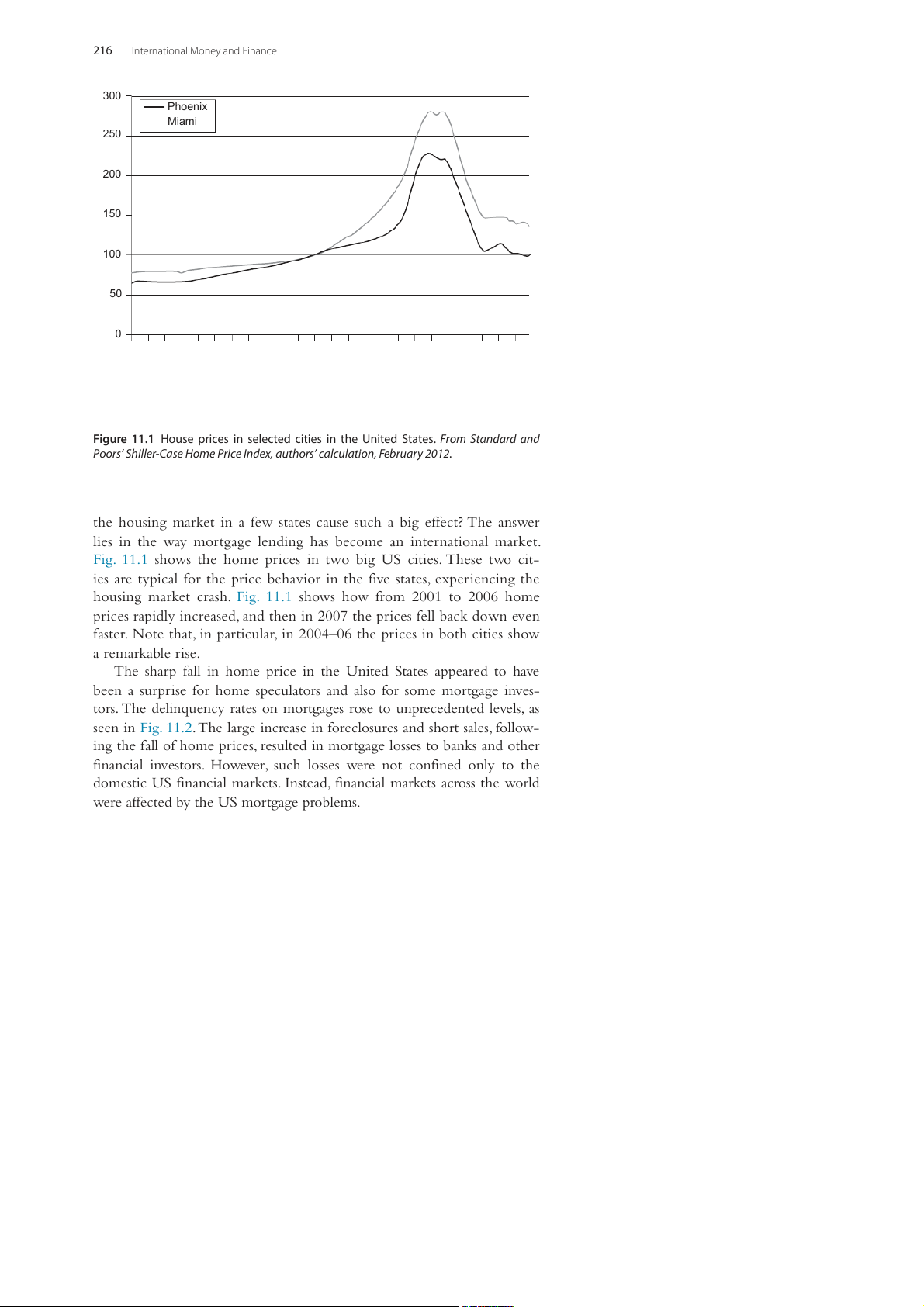
International Money and Finance 300 Phoenix Miami 250 200 150 100 50 0 0 0 2 3 4 5 6 7 8 9 0 1 1 3 4 5 6 7 8 9 0 1 9 1 2 9 9 9 9 9 9 9 9 9 0 0 0 0 0 0 0 0 0 0 1 1 9 9 0 9 9 9 9 9 9 9 9 9 0 0 0 0 0 0 0 0 0 0 0 0 1 9 1 0 1 2 2 2 2 2 r 1 1 1 1 r 2 2 2 2 ry r 1 r 1 r 1 r 2 r 2 e st ly e y ril 1 ry ry r 2 e st ly e y ril 2 ry a e e e e e b u n a p rch a a e b u n a p rch a u b b b b b o g Ju M a u b o g Ju M a n m m Ju A Ju A ct m u ru m ru M m m b n ct u M b Ja ce ve te A e ce ve te A e e o O p Ja O F e o p F D N e e S D N S
Figure 11.1 House prices in selected cities in the United States. From Standard and
Poors’ Shiller-Case Home Price Index, authors’ calculation, February 2012.
the housing market in a few states cause such a big effect? The answer
lies in the way mortgage lending has become an international market.
Fig. 11.1 shows the home prices in two big US cities. These two cit-
ies are typical for the price behavior in the five states, experiencing the
housing market crash. Fig. 11.1 shows how from 2001 to 2006 home
prices rapidly increased, and then in 2007 the prices fell back down even
faster. Note that, in particular, in 2004–06 the prices in both cities show a remarkable rise.
The sharp fall in home price in the United States appeared to have
been a surprise for home speculators and also for some mortgage inves-
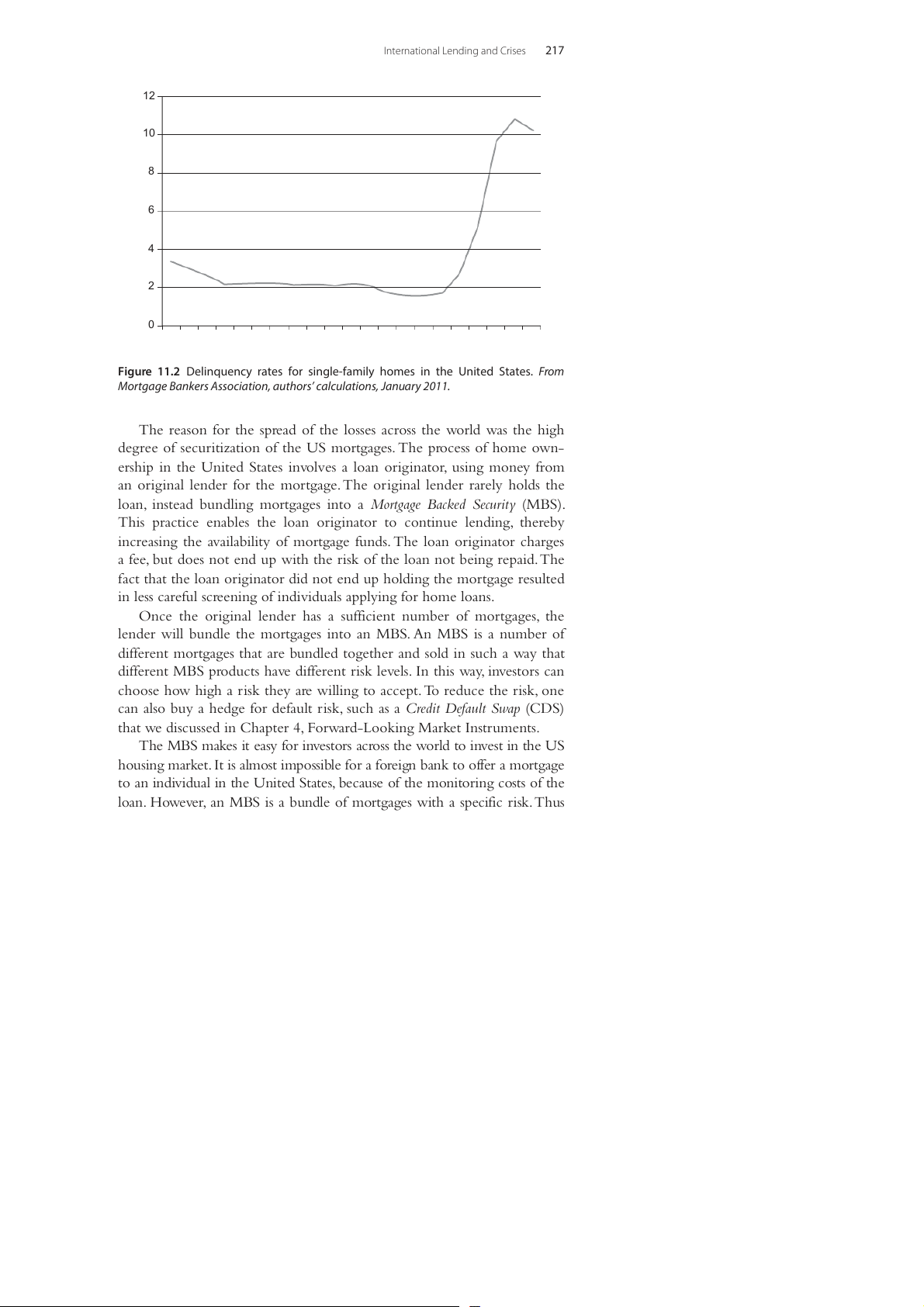
tors. The delinquency rates on mortgages rose to unprecedented levels, as
seen in Fig. 11.2. The large increase in foreclosures and short sales, follow-
ing the fall of home prices, resulted in mortgage losses to banks and other
financial investors. However, such losses were not confined only to the
domestic US financial markets. Instead, financial markets across the world
were affected by the US mortgage problems.
International Lending and Crises 217 12 10 8 6 4 2 0 1 2 3 4 5 6 7 8 9 0 1 2 3 4 5 6 7 8 9 0 1 9 9 9 9 9 9 9 9 9 0 0 0 0 0 0 0 0 0 0 1 1 9 9 9 9 9 9 9 9 9 0 0 0 0 0 0 0 0 0 0 0 0 1 1 1 1 1 1 1 1 1 2 2 2 2 2 2 2 2 2 2 2 2
Figure 11.2 Delinquency rates for single-family homes in the United States. From
Mortgage Bankers Association, authors’ calculations, January 2011.
The reason for the spread of the losses across the world was the high
degree of securitization of the US mortgages. The process of home own-
ership in the United States involves a loan originator, using money from
an original lender for the mortgage. The original lender rarely holds the
loan, instead bundling mortgages into a Mortgage Backed Security (MBS).
This practice enables the loan originator to continue lending, thereby
increasing the availability of mortgage funds. The loan originator charges
a fee, but does not end up with the risk of the loan not being repaid. The
fact that the loan originator did not end up holding the mortgage resulted
in less careful screening of individuals applying for home loans.
Once the original lender has a sufficient number of mortgages, the
lender will bundle the mortgages into an MBS. An MBS is a number of
different mortgages that are bundled together and sold in such a way that
different MBS products have different risk levels. In this way, investors can
choose how high a risk they are willing to accept. To reduce the risk, one
can also buy a hedge for default risk, such as a Credit Default Swap (CDS)
that we discussed in Chapter4, Forward-Looking Market Instruments.
The MBS makes it easy for investors across the world to invest in the US
housing market. It is almost impossible for a foreign bank to offer a mortgage
to an individual in the United States, because of the monitoring costs of the
loan. However, an MBS is a bundle of mortgages with a specific risk. Thus 218
International Money and Finance
international investors do not need to worry about what the MBS contains.
This made international investment in MBSs particularly attractive. In addi-
tion, the MBS could be hedged using the CDS market, which made the
international investors feel protected. Therefore, loans to individuals that are
seen as risky (subprime or nonprime loans) increased with the introduction
of the MBS market. According to DiMartino and Duca (2007) nonprime
loans increased from 9% of new mortgages in 2001 to 40% in 2006.
The MBS and CDS markets grew sharply in 2004–07. The CDS mar-
ket was $6.4 trillion in 2004 and grew to $57.9 trillion in 2007. However,
the protection had one flaw: There still was a counterparty risk. A counter-
party risk is the risk that a firm that is part of the hedge defaults. Thus,
one can set up a perfect hedge against default risk of the MBS, but if
one firm that sold you the CDS defaults then your investment is sud-
denly unhedged. Once your portfolio is unhedged, your chance of default
increases. Thus, one firm defaulting can have a spreading effect across
financial institutions and individuals across the globe. In general, this sys-
temic risk seems to have been unanticipated by the financial market.
In March 2008, the first major problem appeared with Bear Stearns,
an investment bank in the United States, nearing bankruptcy. Bear Stearns
was highly interconnected with both domestic and international financial
markets through MBSs and CDSs. To forestall the systemic risk possibility,
the Federal Reserve and Treasury decided to intervene. However, when
Lehman Brothers ran into the same type of problem in October 2008, it
was allowed to go into bankruptcy. At the time of its bankruptcy, Lehman
had close to a million CDS contracts, with hundreds of firms all over the
world. Therefore the ripple effects from Lehman Brothers default were felt
throughout the world with the cost of risk hedges increasing sharply and
many banks and financial firms edging closer to bankruptcy. In the United
States, Countrywide (the largest US mortgage lender) failed and Fannie
Mae and Freddie Mac (the largest backers of mortgages in the United
States) were taken over by the government. In addition, the world’s larg-
est insurance company, AIG, became virtually bankrupt in October 2008,
primarily due to CDS problems. In the rest of the world, major financial
companies defaulted or were taken over by the government. For example,
in the United Kingdom Northern Rock and Bradford & Bingley were
taken over by the UK government, while in Iceland the whole banking
system defaulted pushing the entire country into default in October 2008.
The reason for the multitude of bankruptcies across the world was the
high levels of leverage for many financial institutions. Financial institutions
International Lending and Crises 219
need to have equity to back up the loans they make. The more equity they
have, the lower the leverage level. Let us assume that you have $1, and lend
it to Sam for 10% interest. You now will receive an interest payment of
10 cents when the loan matures. In this example the leverage level is one,
because your equity (the cash you invested in the company) is equal to
your assets (the loan you made). Now assume that you want to lend $10
more to Joe. You are out of cash to lend Joe so you borrow money from
Roger (at 5%) to lend to Joe (at 10%). You now have $1 in equity plus $10
in liabilities (to Roger) and assets of $11. Your leverage level is now 11 to
1. Note that the higher the leverage level, the higher your profit will be,
unless someone defaults. If Joe defaults on his loan then you do not have
any equity to pay back your loan, and consequently have to go bankrupt.
The higher the leverage level is, the higher the risk that you will become bankrupt from a bad loan.
Traditional banks have to hold liquid capital to back up their asset
portfolios. The riskier the assets are, the higher the capital that is required
to hold. To prevent bank insolvency, the Bank for International Settlements,
located in Switzerland, sets the international rules for capitalization of
banks. The most recent framework is called the Basel III rules. In addition
to the Basel III regulation, the Federal Reserve sets additional rules for
US banks. In contrast, investment banks and hedge funds have fewer rules.
Thus, they may have higher leverage levels than traditional banks. At the
start of the Great Recession, many investment banks had leverage ratios of
30 to 1, meaning that 30 dollars of assets had only 1 dollar of equity. Even
a small reduction in the value of the assets wiped out the equity, making
the financial institution insolvent.
INTERNATIONAL LENDING AND THE GREEK DEBT CRISIS
The Greek debt crisis of 2010 followed the Great Recession and was
related to the response of the financial industries to the financial crisis.
Greece has struggled with fiscal deficits for a long time and succeeded
in reducing the fiscal deficit far enough to join the Eurozone in 2001.
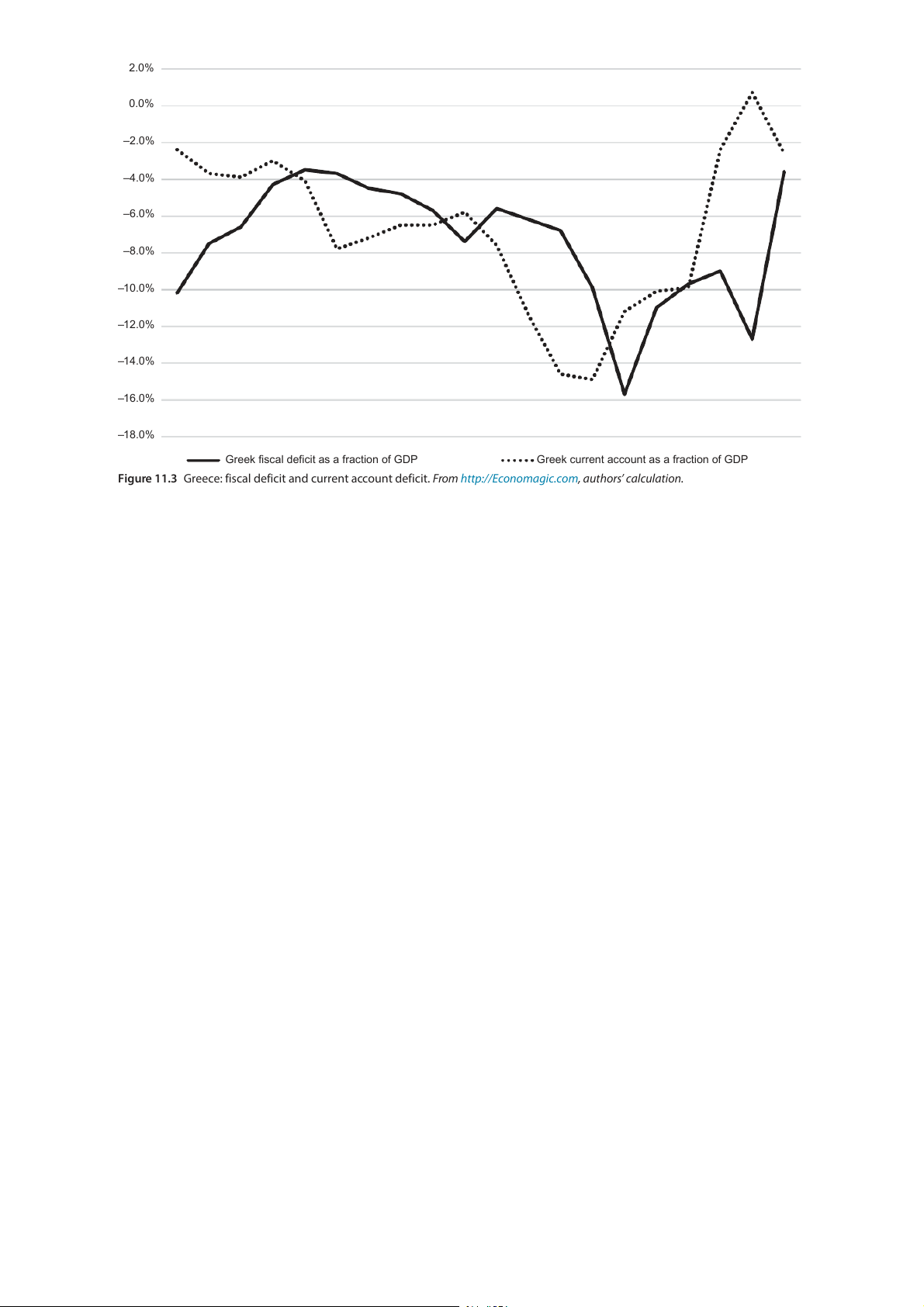
Fig.11.3 shows the fiscal deficit shrinking from more than 10% of GDP
in 1995 to slightly less than 4% in 2001. However, the fiscal deficits grew
worse again in the 2000s. Gradually the fiscal deficit returned to the 10%
mark in 2008 and bottomed out at 16% in 2009!
In addition to the fiscal deficit, Fig. 11.3 also shows the current
account deficit. In the 2000s the fiscal deficit and the current account 2.0% 0.0% 1 1 1 1 1 2 2 2 2 2 2 2 2 2 2 2 2 2 2 2 9 9 9 9 9 0 0 0 0 0 0 0 0 0 0 0 0 0 0 0 9 9 9 9 9 0 0 0 0 0 0 0 0 0 0 1 1 1 1 1 5 6 7 8 9 0 1 2 3 4 5 6 7 8 9 0 1 2 3 4 –2.0% –4.0% –6.0% –8.0% –10.0% –12.0% –14.0% –16.0% –18.0%
Greek fiscal deficit as a fraction of GDP
Greek current account as a fraction of GDP
Figure 11.3 Greece: fiscal deficit and current account deficit. From http://Economagic.com, authors’ calculation.
International Lending and Crises 221
deficits both increase rapidly. This implies that the cause of the current
account deficit was foreign capital flows financing the fiscal deficit. In
Chapter 3, The Balance of Payments, we discussed such a situation as a
case of “twin deficits.” Government borrowing pressured up interest rates
and attracted financial investment from Germany and other countries. The
use of foreign funds to finance the government borrowing made it easier
for Greek people to continue consuming, because they did not have to
buy government debt themselves. In addition, the foreign financial flows
meant that the Greek government was not pressured to reduce govern-
ment spending or raise taxes to eliminate the fiscal deficit.
The convenient position of using foreign financial flows to pay for
the fiscal deficit came to an end after the Great Recession. When the
US financial crisis spread through the world in 2008, financial firms
became cautious about taking on risk, following the default of several
major financial firms. The lack of risk appetite led to a sharp increase in
the cost of hedging risk. This affected firms, municipalities, states, and
countries that had high indebtedness. Among the countries affected was
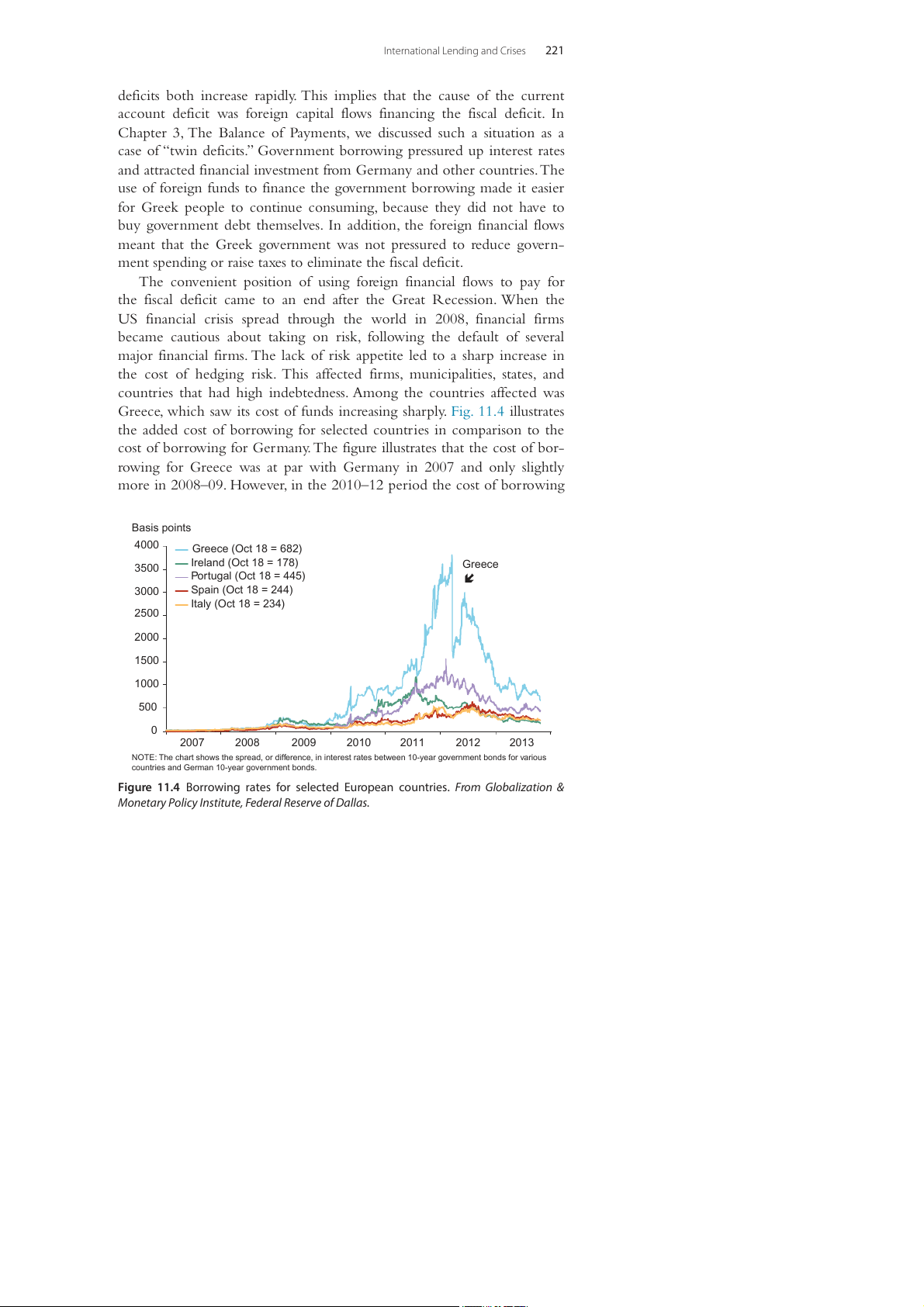
Greece, which saw its cost of funds increasing sharply. Fig. 11.4 illustrates
the added cost of borrowing for selected countries in comparison to the
cost of borrowing for Germany. The figure illustrates that the cost of bor-
rowing for Greece was at par with Germany in 2007 and only slightly
more in 2008–09. However, in the 2010–12 period the cost of borrowing Basis points 4000 Greece (Oct 18 = 682) Ireland (Oct 18 = 178) Greece 3500 Portugal (Oct 18 = 445) 3000 Spain (Oct 18 = 244) Italy (Oct 18 = 234) 2500 2000 1500 1000 500 0 2007 2008 2009 2010 2011 2012 2013
NOTE: The chart shows the spread, or difference, in interest rates between 10-year government bonds for various
countries and German 10-year government bonds.
Figure 11.4 Borrowing rates for selected European countries. From Globalization &
Monetary Policy Institute, Federal Reserve of Dallas. 222
International Money and Finance
skyrocketed for Greece. At one point Greece had to pay over 3500 basis
points (35 percentage points) more than Germany! The tremendously
high borrowing costs meant that the Greek government had to increase
its borrowing just to finance the cost of borrowing. Clearly this was not
a sustainable position. In May 2010 Greece had no choice but to ask the
IMF for assistance. In the next section, we look at how the role of the
IMF has changed from supervising the Bretton Woods system to a lender of last resort. IMF CONDITIONALITY
The IMF has been an important source of loans for debtor nations expe-
riencing repayment problems. The importance of an IMF loan is more
than simply having the IMF “bail out” commercial bank and government
creditors. The IMF requires borrowers to adjust their economic policies
to reduce balance of payments deficits and improve the chance for debt
repayment. Such IMF-required adjustment programs are known as IMF conditionality.
Part of the process of developing a loan package includes a visit to the
borrowing country by an IMF mission. The mission comprises economists
who review the causes of the country’s economic problems and recom-
mend solutions. Through negotiation with the borrower, a program of
conditions attached to the loan is agreed upon. The conditions usually
involve targets for macroeconomic variables, such as money supply growth
or the government deficit. The loan is disbursed at intervals, with a pos-
sible cutoff of new disbursements if the conditions have not been met.
The importance of IMF conditionality to creditors can now be under-
stood. Loans to sovereign governments involve risk management from
the lenders’ point of view just as loans to private entities do. Although
countries cannot go out of business, they can have revolutions or political
upheavals leading to a repudiation of the debts incurred by the previous
regime. Even without such drastic political change, countries may not be
able or willing to service their debt due to adverse economic conditions.
International lending adds a new dimension to risk since there is neither
an international court of law to enforce contracts nor any loan collateral
aside from assets that the borrowing country may have in the lending
country. The IMF serves as an overseer that can offer debtors new loans
if they agree to conditions. Sovereign governments may be offended if a
foreign creditor government or commercial bank suggests changes in the
International Lending and Crises 223
debtor’s domestic policy, but the IMF is a multinational organization of
over 180 countries. The members of the IMF mission to the debtor nation
will be of many different nationalities, and their advice will be nonpoliti-
cal. However, the IMF is still criticized at times as being dominated by the
interests of the advanced industrial countries. In terms of voting power, this is true.
Votes in the IMF determine policy, and voting power is determined
by a country’s quota. The quota is the financial contribution of a coun-
try to the IMF and it entitles membership. Each country receives 250
votes, plus one additional vote for each SDR100,000 of its quota. (At
least 75% of the quota may be contributed in domestic currency, with less
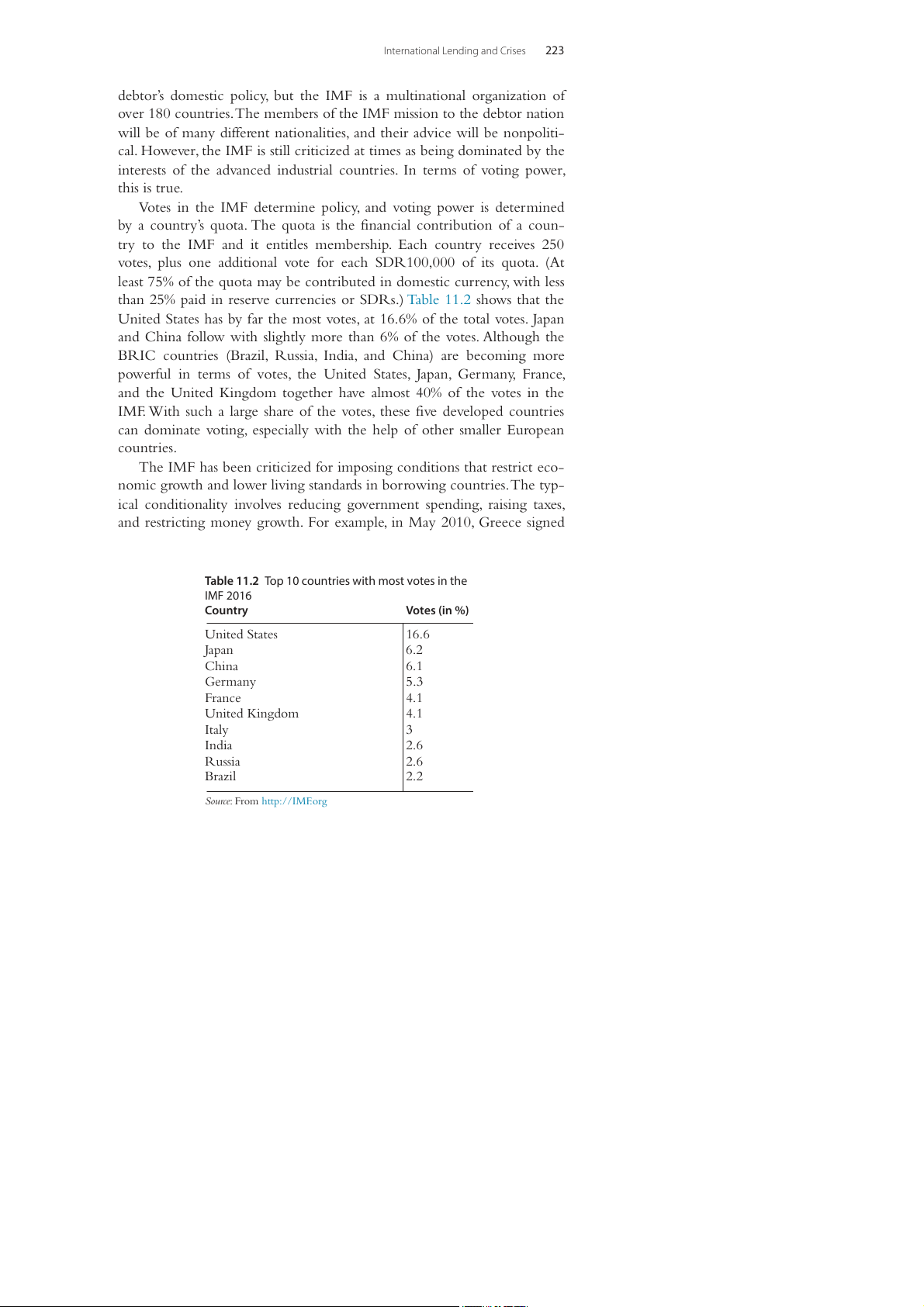
than 25% paid in reserve currencies or SDRs.) Table 11.2 shows that the
United States has by far the most votes, at 16.6% of the total votes. Japan
and China follow with slightly more than 6% of the votes. Although the
BRIC countries (Brazil, Russia, India, and China) are becoming more
powerful in terms of votes, the United States, Japan, Germany, France,
and the United Kingdom together have almost 40% of the votes in the
IMF. With such a large share of the votes, these five developed countries
can dominate voting, especially with the help of other smaller European countries.
The IMF has been criticized for imposing conditions that restrict eco-
nomic growth and lower living standards in borrowing countries. The typ-
ical conditionality involves reducing government spending, raising taxes,
and restricting money growth. For example, in May 2010, Greece signed
Table 11.2 Top 10 countries with most votes in the IMF 2016 Country Votes (in %) United States 16.6 Japan 6.2 China 6.1 Germany 5.3 France 4.1 United Kingdom 4.1 Italy 3 India 2.6 Russia 2.6 Brazil 2.2
Source: From http://IMF.org 224
International Money and Finance
a €30 billion loan agreement with the IMF. In addition, the European
Union agreed to provide funds making the total financing package reach
€110 billion. At the heart of the agreement Greece would impose fiscal
discipline that would reduce the budget deficit from its 15.4% level in
2009, to well below 3% of GDP by 2014. To accomplish this the Greek
authorities committed to reduce government spending and increase
taxes. Note that in this case monetary growth was not an issue as Greece
belonged to the Eurozone and cannot adjust monetary growth.
In the original statement by the IMF and Greek authorities, it is rec-
ognized that the austerity package could lead to short-run output contrac-
tion. However, the view was that the structural reforms and fiscal discipline
would improve the competitiveness and long-run recovery of the econ-
omy. Such policies may be interpreted as austerity imposed by the IMF, but
the austerity is intended for the borrowing government in order to permit
the productive private sector to play a larger role in the economy.
The view of the IMF is that adjustment programs are unavoidable in
debtor countries facing repayment difficulties. However, the short-run con-
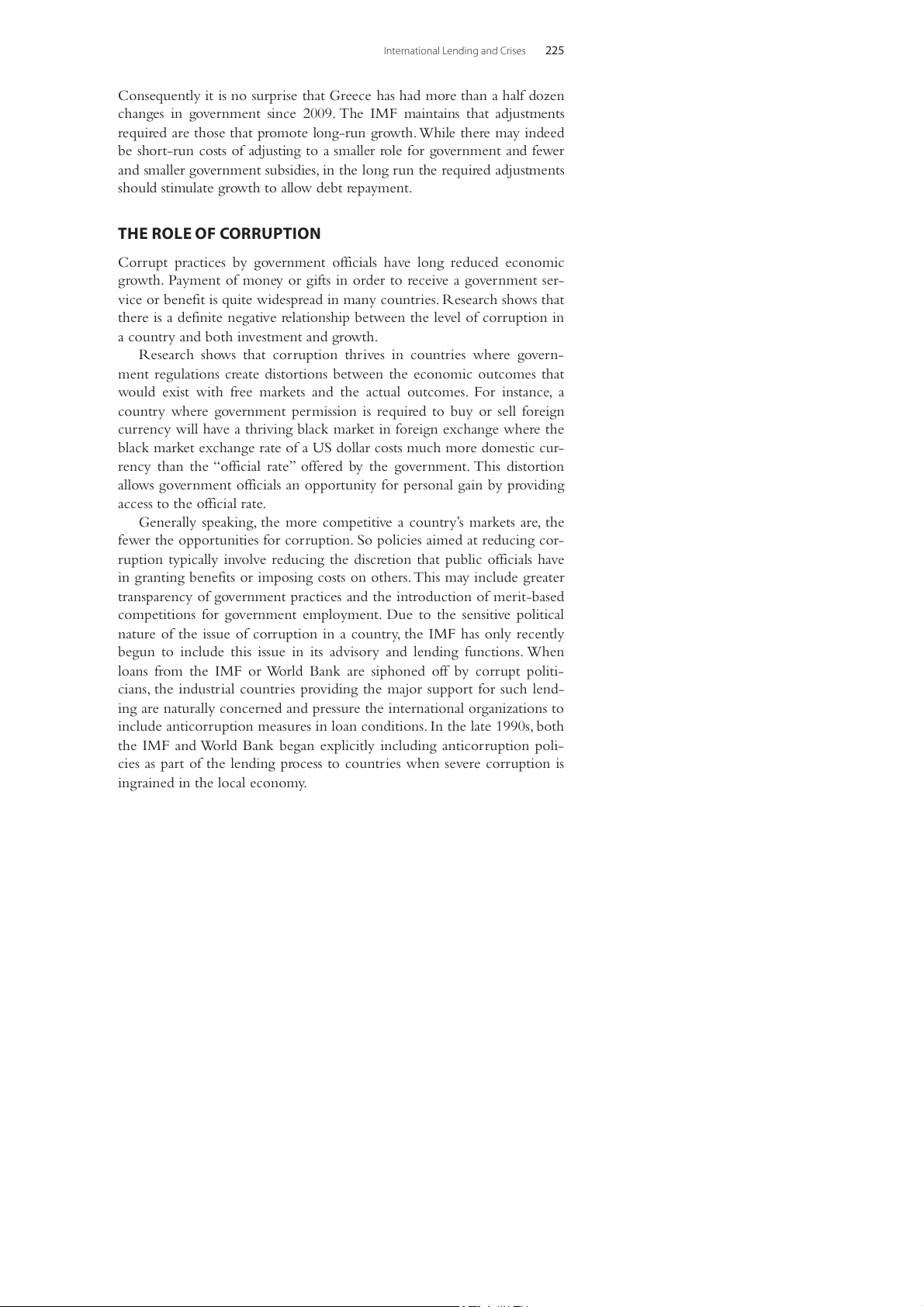
traction can be quite burdensome. In Greece, for example, the unemploy-
ment rate increased substantially. Fig. 11.5 shows the Greek unemployment
rate. From a usual unemployment at or below 10% the unemployment sky-
rocketed to over 25% in a 5-year period. With one in four unemployed it
leaves citizens with much time to be upset about the current conditions. Greek Unemployment Rate 30.0% 25.0% 20.0% 15.0% 10.0% 5.0% 0.0% 1 1 1 1 1 2 2 2 2 2 2 2 2 9 9 9 9 9 0 0 0 0 0 0 0 0 9 9 9 9 9 0 0 0 0 0 1 1 1 0 2 4 6 8 0 2 4 6 8 0 2 4
Figure 11.5 Unemployment in Greece. From http://Economagic.com
International Lending and Crises 225
Consequently it is no surprise that Greece has had more than a half dozen
changes in government since 2009. The IMF maintains that adjustments
required are those that promote long-run growth. While there may indeed
be short-run costs of adjusting to a smaller role for government and fewer
and smaller government subsidies, in the long run the required adjustments
should stimulate growth to allow debt repayment. THE ROLE OF CORRUPTION
Corrupt practices by government officials have long reduced economic
growth. Payment of money or gifts in order to receive a government ser-
vice or benefit is quite widespread in many countries. Research shows that
there is a definite negative relationship between the level of corruption in
a country and both investment and growth.
Research shows that corruption thrives in countries where govern-
ment regulations create distortions between the economic outcomes that
would exist with free markets and the actual outcomes. For instance, a
country where government permission is required to buy or sell foreign
currency will have a thriving black market in foreign exchange where the
black market exchange rate of a US dollar costs much more domestic cur-
rency than the “official rate” offered by the government. This distortion
allows government officials an opportunity for personal gain by providing access to the official rate.
Generally speaking, the more competitive a country’s markets are, the
fewer the opportunities for corruption. So policies aimed at reducing cor-
ruption typically involve reducing the discretion that public officials have
in granting benefits or imposing costs on others. This may include greater
transparency of government practices and the introduction of merit-based
competitions for government employment. Due to the sensitive political
nature of the issue of corruption in a country, the IMF has only recently
begun to include this issue in its advisory and lending functions. When
loans from the IMF or World Bank are siphoned off by corrupt politi-
cians, the industrial countries providing the major support for such lend-
ing are naturally concerned and pressure the international organizations to
include anticorruption measures in loan conditions. In the late 1990s, both
the IMF and World Bank began explicitly including anticorruption poli-
cies as part of the lending process to countries when severe corruption is
ingrained in the local economy. 226
International Money and Finance COUNTRY RISK ANALYSIS
International financial activity involves risks that are missing in domestic
transactions. There are no international courts to enforce contracts and a
bank cannot repossess a nation’s collateral, because typically no collateral
is pledged. Problem loans to sovereign governments have received most of
the publicity, but it is important to realize that loans to private firms can
also become nonperforming because of capital controls or exchange rate
policies. In this regard, even operating subsidiary units in foreign countries
may not be able to transfer funds to the parent multinational firm, if for-
eign exchange controls block the transfer of funds.
It is important for commercial banks and multinational firms to be
able to assess the risks involved in international deals. Country risk analysis
has become an important part of international business. Country risk
analysis refers to the evaluation of the overall political and financial situa-
tion in a country and the extent to which these conditions may affect the
country’s ability to repay its debts. In determining the degree of risk asso-
ciated with a particular country, we should consider both qualitative and
quantitative factors. The qualitative factors include the political stability of
the country. Certain key features may indicate political uncertainty:
1. Splits between different language, ethnic, and religious groups that
threaten to undermine stability.
2. Extreme nationalism and aversion to foreigners that may lead to pref-
erential treatment of local interests and nationalization of foreign holdings.
3. Unfavorable social conditions, including extremes of wealth.
4. Conflicts in society evidenced by frequency of demonstrations, vio- lence, and guerrilla war.
5. The strength and organization of radical groups.
Besides the qualitative or political factors, we also want to consider the
financial factors that allow an evaluation of a country’s ability to repay its
debts. Country risk analysts examine factors such as these:
1. External debt. Specifically, this is the debt owed to foreigners as a fraction
of GDP or foreign exchange earnings. If a country’s debts appear to be
relatively large, then the country may have future repayment problems.
2. International reserve holdings. These reserves indicate the ability of a
country to meet its short-term international trade needs should its
export earnings fall. The ratio of international reserves to imports is
used to rank countries according to their liquidity.
International Lending and Crises 227
3. Exports. Exports are looked at in terms of the foreign exchange earned
as well as the diversity of the products exported. Countries that depend
largely on one or two products to earn foreign exchange may be more
susceptible to wide swings in export earnings than countries with a
diversified group of export products.
4. Economic growth. Measured by the growth of real GDP or real per cap-
ita GDP, economic growth may serve as an indicator of general eco-
nomic conditions within a country.
Although no method of assessing country risk is foolproof, by evaluat-
ing and comparing countries on the basis of some structured approach,
international lenders have a base on which they can build subjective eval-
uations of whether to extend credit to a particular country.
Recognizing the desire of investors to have reliable information about
country risk, BlackRock Investment Institute launched a new ranking of
country risk in 2011. This ranking ranks countries according to the likeli-
hood of debt default, devaluation of the currency or above-trend deflation.
Foreign investors would not only be concerned about a country default-
ing on the debt, but would also be concerned about a sharp loss of the
foreign currency value by a high inflation or devaluation of the currency.
There are four components to BlackRock’s country risk analysis:
1. Fiscal Space, with a 40% weight, examines several macroeconomic fac-
tors that could lead to a debt path that is unsustainable.
2. External Finance Position, with a 20% weight, examines the vulnerability
of a country to external shocks.
3. Financial Sector Health, with a 10% weight, measures the risk exposure
that the private sector banks impose on the country’s financial health.
4. Willingness to Pay, with a 30% weight, measures how a country’s insti-
tutions can handle debt payment.
The first three components deal with a country’s ability to pay,
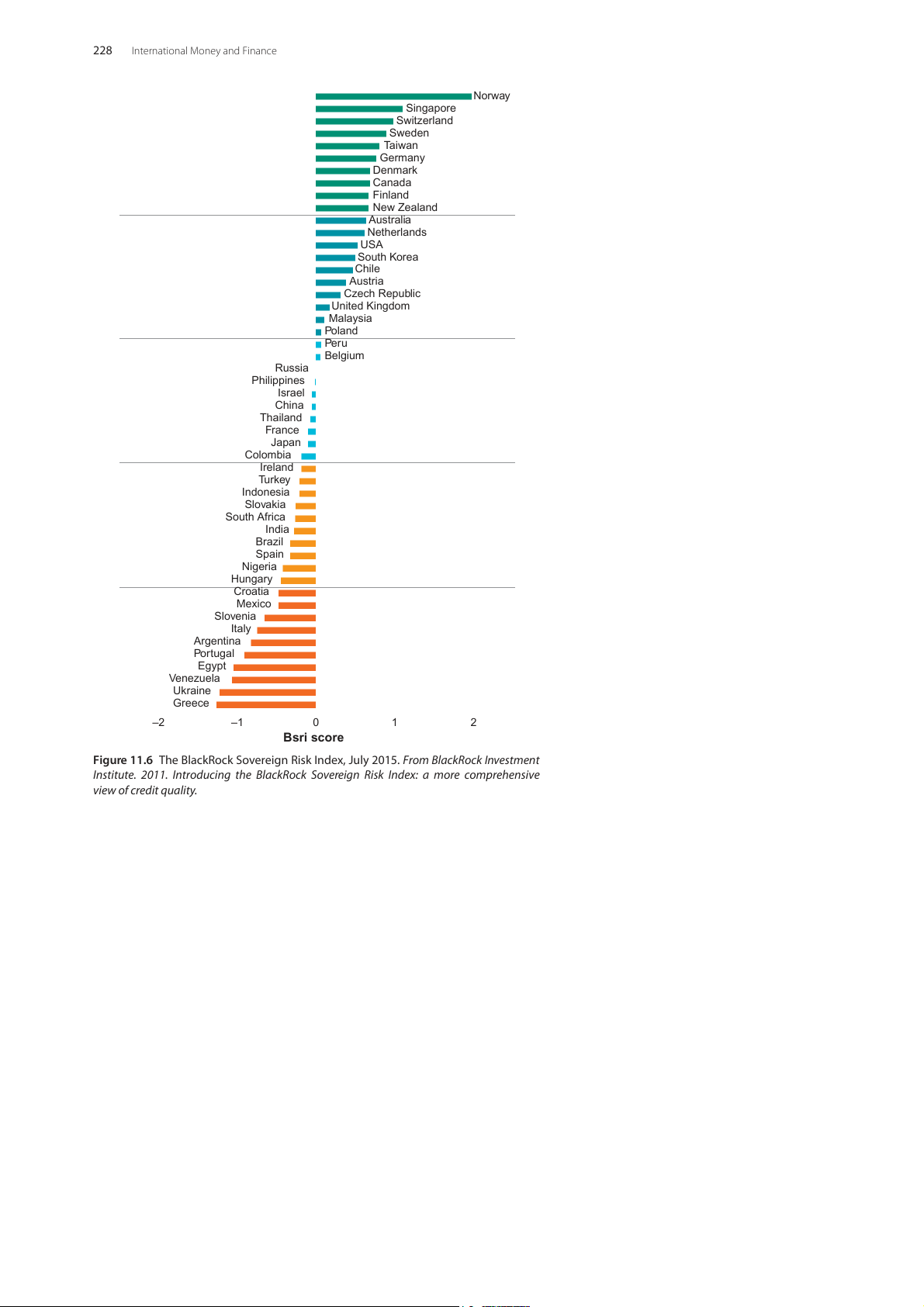
whereas the last one deals with the willingness to pay. Fig. 11.6 shows the
results of the July 2015 ranking of country risk.
The Scandinavian countries are ranked very high in the index.
Norway leads the index, with Sweden, Finland, and Denmark also in the
top 10. Norway has extremely low levels of debt and has strong institu-
tions backing the country. On the other extreme are countries with large
levels of debt or high political instability. The Euro debt crisis still remains
a problem resulting in Greece, Portugal, Croatia, Slovenia, and Italy rank-
ing among the lowest 10 countries. Others among the bottom 10 coun-
tries are having political instability, such as Ukraine, Venezuela, and Egypt. 228
International Money and Finance Norway Singapore Switzerland Sweden Taiwan Germany Denmark Canada Finland New Zealand Australia Netherlands USA South Korea Chile Austria Czech Republic United Kingdom Malaysia Poland Peru Belgium Russia Philippines Israel China Thailand France Japan Colombia Ireland Turkey Indonesia Slovakia South Africa India Brazil Spain Nigeria Hungary Croatia Mexico Slovenia Italy Argentina Portugal Egypt Venezuela Ukraine Greece –2 –1 0 1 2 Bsri score
Figure 11.6 The BlackRock Sovereign Risk Index, July 2015. From BlackRock Investment
Institute. 2011. Introducing the BlackRock Sovereign Risk Index: a more comprehensive view of credit quality.
International Lending and Crises 229
The United States ranks 13th, close to the top among the second tier
of countries in the risk index. Note also that the differences are small
between the score that United States has and the scores of the five coun-
tries ahead, implying that from the view of riskiness, the top 20 countries
in the ranking have a relatively low riskiness. SUMMARY
1. The Latin American debt crisis in the 1980s had threatened the sol-
vency of large banks and creditors, so debts were rescheduled to post-
pone the repayments rather than allowed for default.
2. The causes of the Asian financial crisis of 1997 were external shocks,
weak macroeconomic fundamentals, and domestic financial system flaws.
3. A fixed exchange rate system, a decline in foreign reserves, and a lack
of transparency in governmental activities could serve as warning indi-
cators of potential financial crisis.
4. The Great Recession of 2008–09 in the United States spread to global
financial markets because foreign investors had invested in MBSs backed by US mortgages.
5. Since the risk of MBS could be hedged by using CDS market, many
investors felt protected and highly leveraged their investments. This
practice led to bankruptcies of several giant investment banks.
6. When a country seeks financial assistance from IMF to overcome its
problem, the government is subject to a set of agreed macroeconomic
policy changes and structural reforms, known as the IMF conditional-
ity, to ensure ability to repay the loan.
7. The IMF has included a clause of anticorruption into its lending process.
8. Country risk analysis is the evaluation of a country’s overall political
and financial situations that may influence the country’s ability to repay its loans.
9. Country risk analysis is based on structural modeling of variables such
as the amount of external debt to GDP, international reserve holdings,
the volume of exports, and the pace of economic growth. EXERCISES
1. Why would a debtor nation prefer to borrow from a bank rather than
the IMF, other things being equal? Can “other things” ever be equal
between commercial bank and IMF loans? 230
International Money and Finance
2. Pick three developing countries and create a country risk index for
them. Rank them ordinally in terms of factors that you can observe
(like exports, GDP growth, reserves, etc.) by looking at International
Financial Statistics published by the IMF. Based on your evaluation,
which country appears to be the best credit risk? How does your rank-
ing compare to that found in the most recent BlackRock Investment survey?
3. How did each of the following contribute to the Asian financial crisis
of the late 1990s: external shocks, domestic macroeconomic policy, and
domestic financial system flaws?
4. Explain how the fixed exchange rate arrangement could lead to a financial crisis.
5. Imagine yourself in a job interview for a position with a large inter-
national bank. The interviewer mentions that, recently, the bank has
experienced some problem loans to foreign governments. The inter-
viewer asks you what factors you think the bank should consider when
evaluating a loan proposal involving a foreign governmental agency. How do you respond?
6. Explain what a highly leveraged investment practice is. How does it relate to financial crisis? FURTHER READING
Bird, G., Hussain, M., Joyce, J.P., 2004. Many happy returns? Recidivism and the IMF. J. Int.
Money Financ. 23 (1), 231–251.
BlackRock Investment Institute, 2011. Introducing the BlackRock Sovereign Risk Index:
A more Comprehensive View of Credit Quality. BlackRock Investment Institute, New York.
Brealey, R.A., Kaplanis, E., 2004. The impact of IMF programs on asset values. J. Int. Money Financ. 23 (2), 143–304.
Bullard, J., Neely, C.J., Wheelock, D.C., 2009. Systemic risk and the financial crisis: a primer.
Fed. Reserve Bank St. Louis Rev 91, 403–417.
DiMartino, D., Duca, J.V., 2007. The rise and fall of subprime mortgages. Fed. Reserve Bank
of Dallas Econ. Lett. 2 (11), 1–8.
Schadler, S., Bennett, A., Carkovic, M., Dicks-Mireaux, L., Mecagni, M., Morsink, J.H.J.,
Savastano, M.A., 1995. IMF Conditionality: Experience under Stand-By and Extended
Arrangements. World Bank, Washigton, DC, International Monetary Fund Occasional Paper, No. 128.
Somerville, R.A., Taffler, R.J., 1995. Banker judgment versus formal forecasting models: the
case of country risk assessment. J. Bank Financ. 19 (2), 281–297.
Stulz, R.M., 2010. Credit default swaps and the credit crisis. J. Econ. Perspect. 24 (1), 73–92.
Tài liệu liên quan:
-

Hoạt động Tài chính của Doanh nghiệp Đa Quốc Gia (DN) - Chương 6 | Tài chính quốc tế | Trường Học Viện nông nghiệp Việt Nam
19 10 -
Hệ Thống Tiền Tệ Quốc Tế: Khái Niệm và Các Chế Độ Tỷ Giá | Tài chính quốc tế | Trường Học Viện nông nghiệp Việt Nam
24 12 -

Bài giảng Chương 1: Các Quan Hệ Cân Bằng Quốc Tế và LOP | Tài chính quốc tế | Trường Học Viện nông nghiệp Việt Nam
21 11 -
Cách Tính Lạm Phát và CPI: So Sánh Việt Nam và Mỹ | Tài chính quốc tế | Trường Học Viện nông nghiệp Việt Nam
23 12 -

Detailed Report and Analysis on Submission Trends | Tài chính quốc tế | Trường Học Viện nông nghiệp Việt Nam
23 12