Lecture 6: economic growth môn Kinh tế vi mô | Trường Đại học Kinh Tế Quốc Dân
The determinants of economic growth and the standard of living inthe long run .Tài liệu giúp bạn tham khảo, ôn tập và đạt kết quả cao. Mời đọc đón xem!
Môn: Kinh tế vi mô ( NEU ) 762 tài liệu
Trường: Trường Đại học Kinh Tế Quốc Dân 7.6 K tài liệu
Tác giả:






Preview text:
Lecture 6: economic growth Solow model Endogenous growth Policies to promote growth. 1. The Solow Model
*The determinants of economic growth and the standard of living in the long run.
1. K is no longer fixed: (vốn tư bản: nhà xưởng, trang thiết bị…) Investment K grow. Depreciation K shrink. 2. L is no longer fixed: Population growth L grow.
3. The consumption function is simple. 4. No G or T
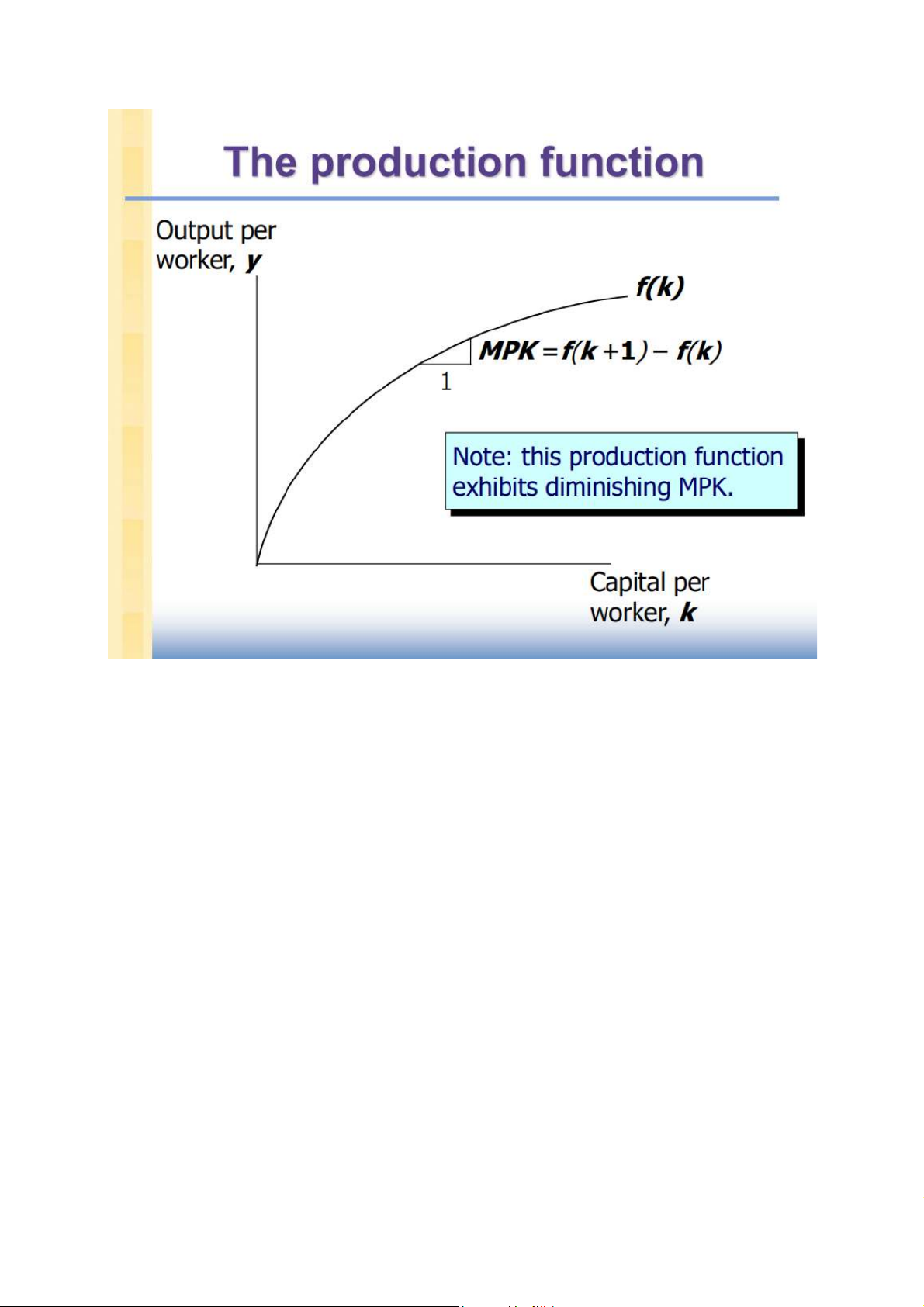
( only to simplify presentation; we can still do fiscal policy assessments) *The production function:
In aggregate terms: Y = F (K, L ) Define: y = Y/L = output per worker k = K/L = capital per worker
Assume constant returns to scale:
zY = F (zK, zL ) for any z > 0 Pick z = 1/L. Then Y/L = F (K/L , 1) y = F (k, 1) y = f(k) where f(k) = F (k, 1) *The national income identity Y = C + I (remember, no G ) In “per worker” terms: y = c + i where c = C/L and i = I/L *The Consumption function
s = the saving rate, ( tỉ lệ tiết kiệm)
the franction of income that is saved (tỉ lệ tiết kiệm trên thu nhập) ( s là biến ngoại sinh)
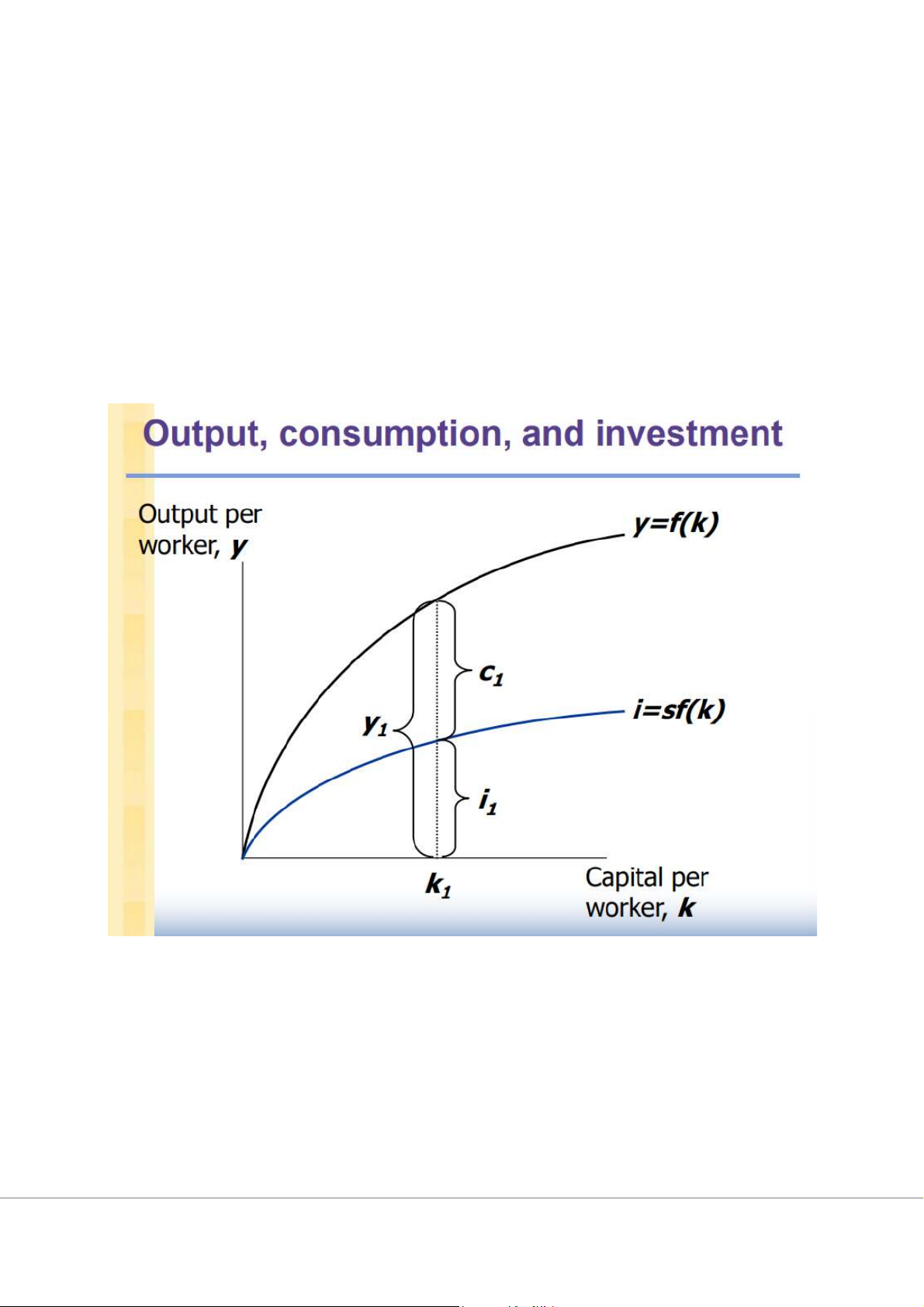
Consumption function: c = (1–s)y (per worker) *Saving and investment saving (per worker) = sy
National income identity is y = c + i
Rearrange to get: i = y – c = sy (investment = saving) Using the results above, i = sy = sf(k) *Depreciation
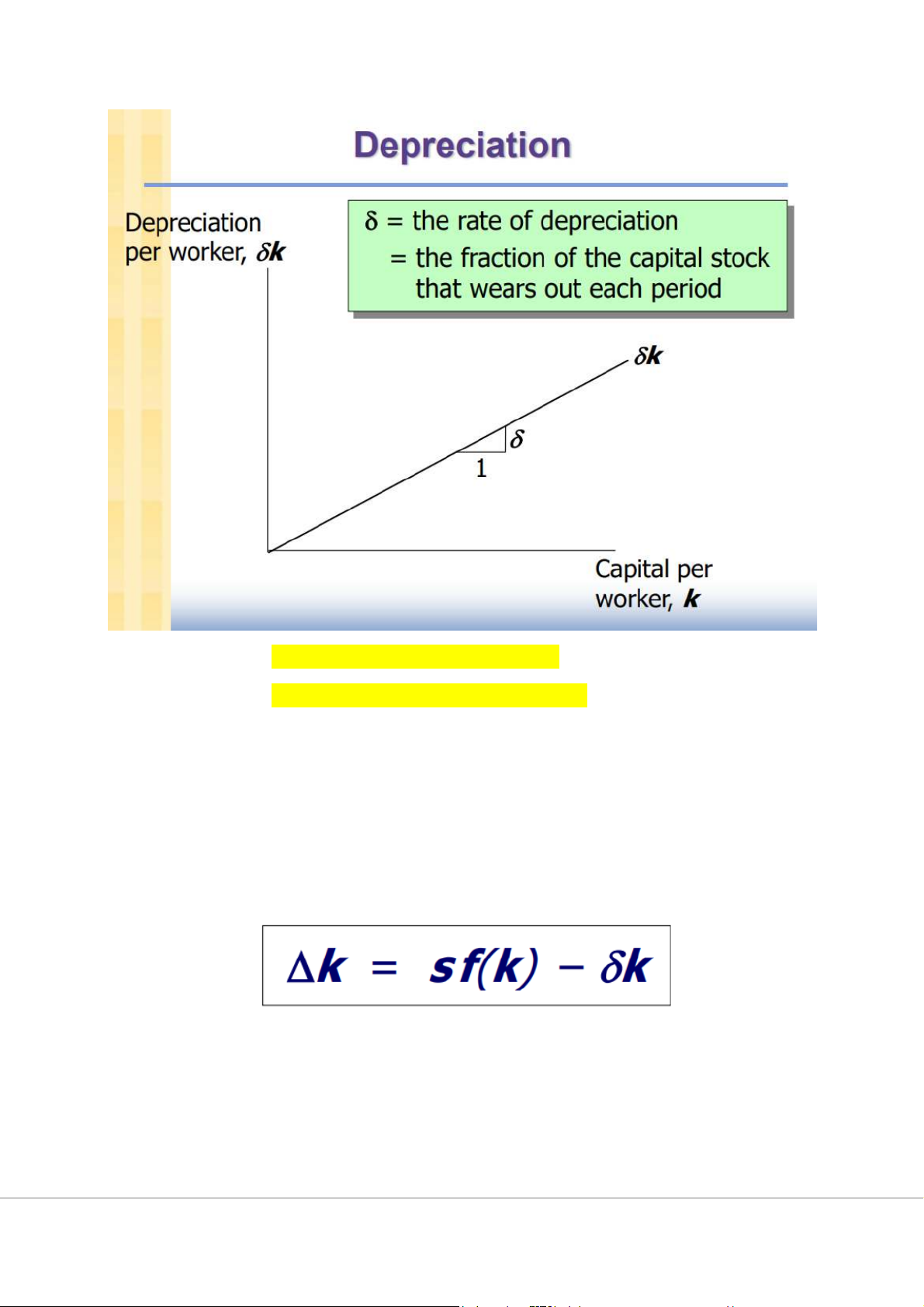
= the rate of depreciation = the fraction of the capital stock that wears out each period. (tỷ lệ khấu hao)
Đầu tư làm tăng tính lũy tư bản
Khấu hao làm giảm tích lũy tư bản
Change in capital stock = investment – depreciation k = i – k
Since i = sf(k) , this becomes: k = s f(k) – k
Determines behavior of all of the other endogenous variables because they all depend on k. E.g., income per person: y = f(k)
consump. per person: c = (1–s)f(k)
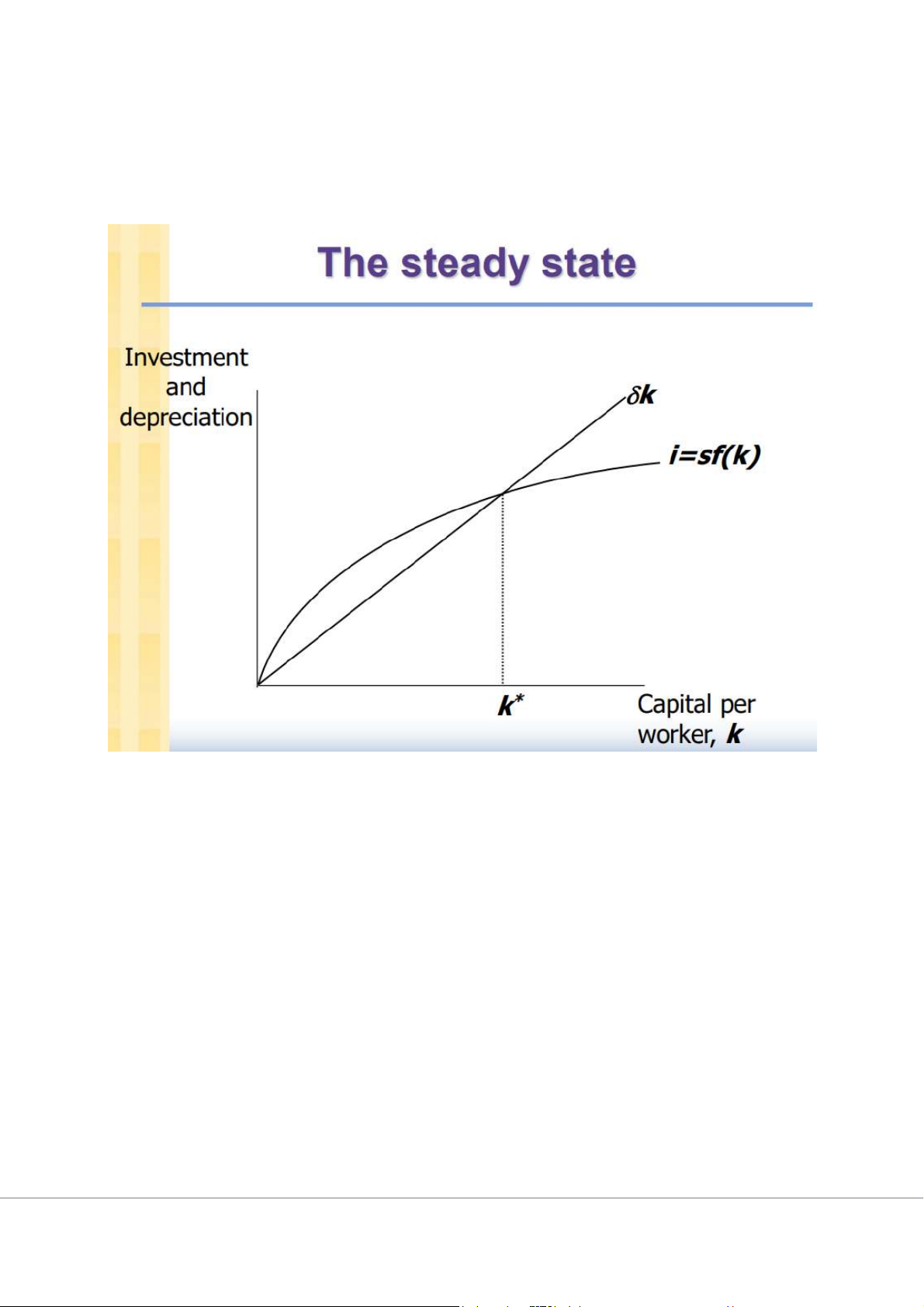
*The steady state ( Khi nền KT ở trạng thái dừng)
If investment is just enough to cover depreciation [sf(k) = k ],
then capital per worker will remain constant: k = 0.
This constant value, denoted , is called k*
the steady state capital stock.
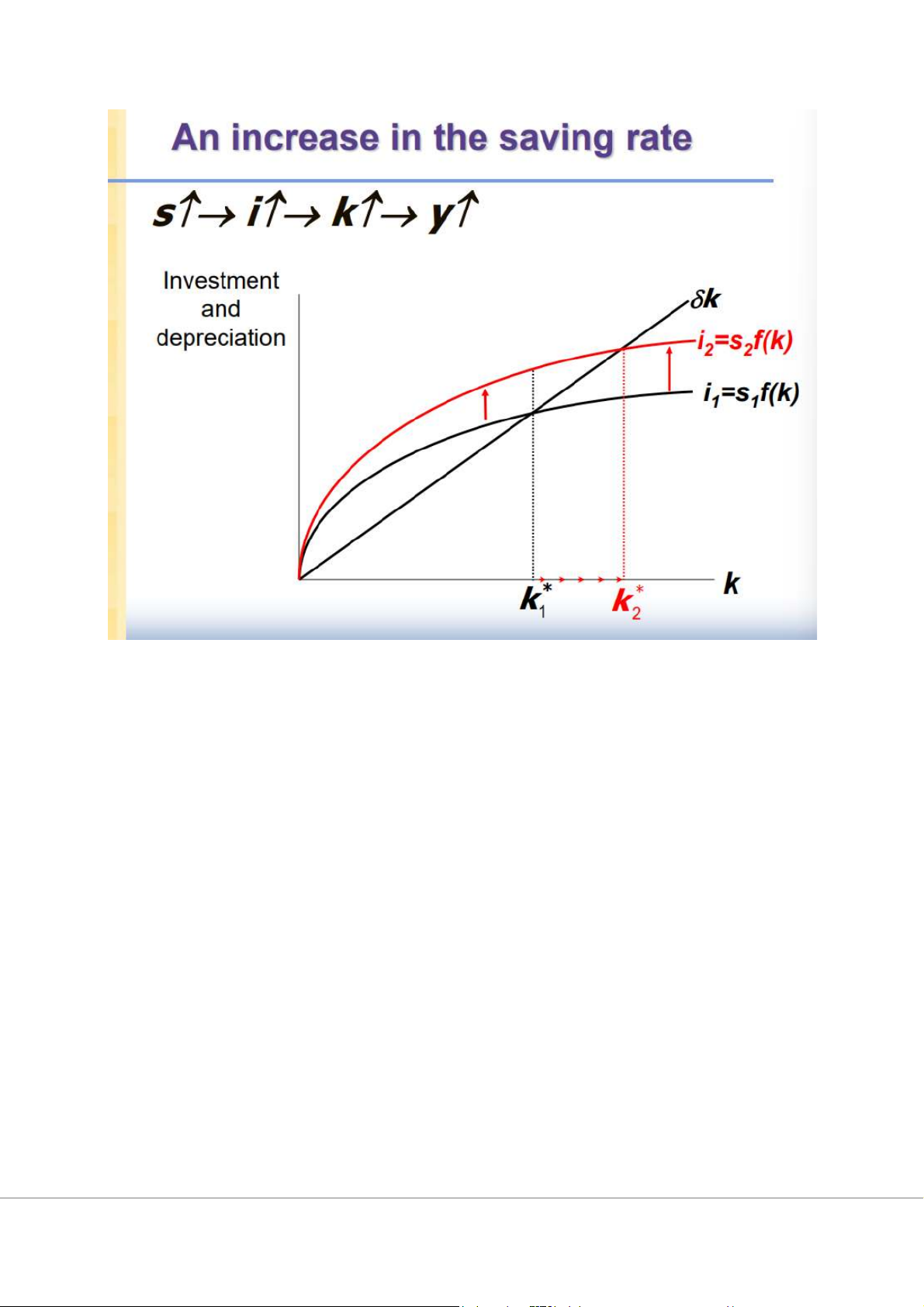
As long as k < k*, investment will exceed depreciation, and will continue to k grow toward . k*
Việc tăng tỉ lệ tiết kiệm chỉ dẫn tới tang trưởng kinh tế nhanh hơn trong ngắn
hạn trước khi nền KT đạt trạng thái dừng ( the steady state).
• Nếu một nền kinh tế duy trì một tỉ lệ tiết kiệm cao thì sẽ duy trì được mức sản
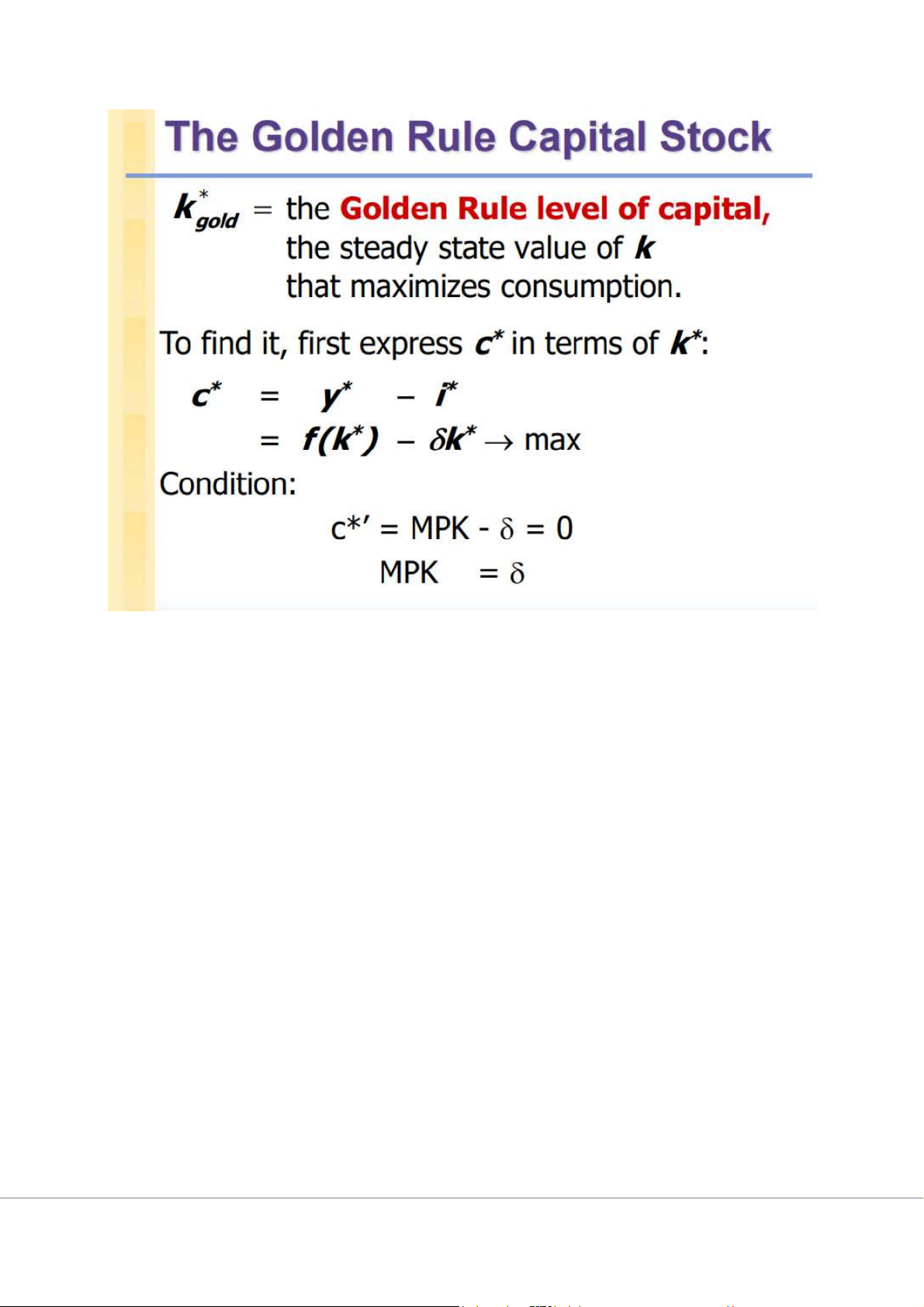
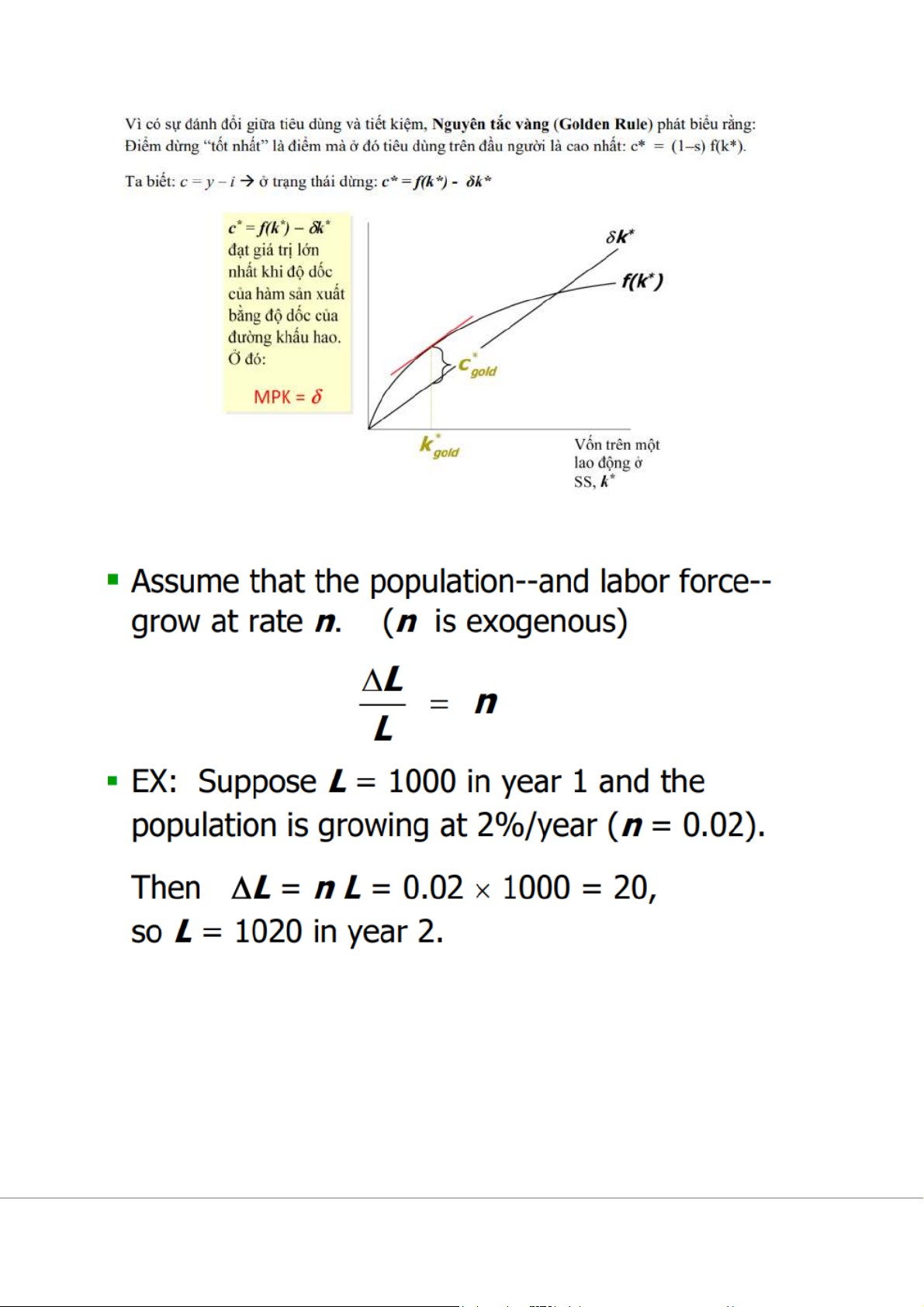
lượng cao nhưng không duy trì được tốc độ tăng trưởng cao. The golden Rule: Introduction c* = f(k *) k *
is biggest where the slope of the production func. equals the slope of the depreciation line: MPK = *Population Growth:
Break-even investment ( mức đầu tư hòa vốn):
Tốc độ tăng lao động cao hơn sẽ cho nền kinh tế đạt trạng thái dừng sớm hơn,
nghĩa là ở mức k* thấp hơn. Và vì y = f(k), khi k* thấp hơn sẽ dẫn tới y* thấp hơn.
Như vậy, mô hình Solow dự đoán rằng những nước có tăng trưởng dân số cao hơn
sẽ có mức vốn và thu nhập trên lao động thấp hơn trong dài hạn. Tech progess in solow model
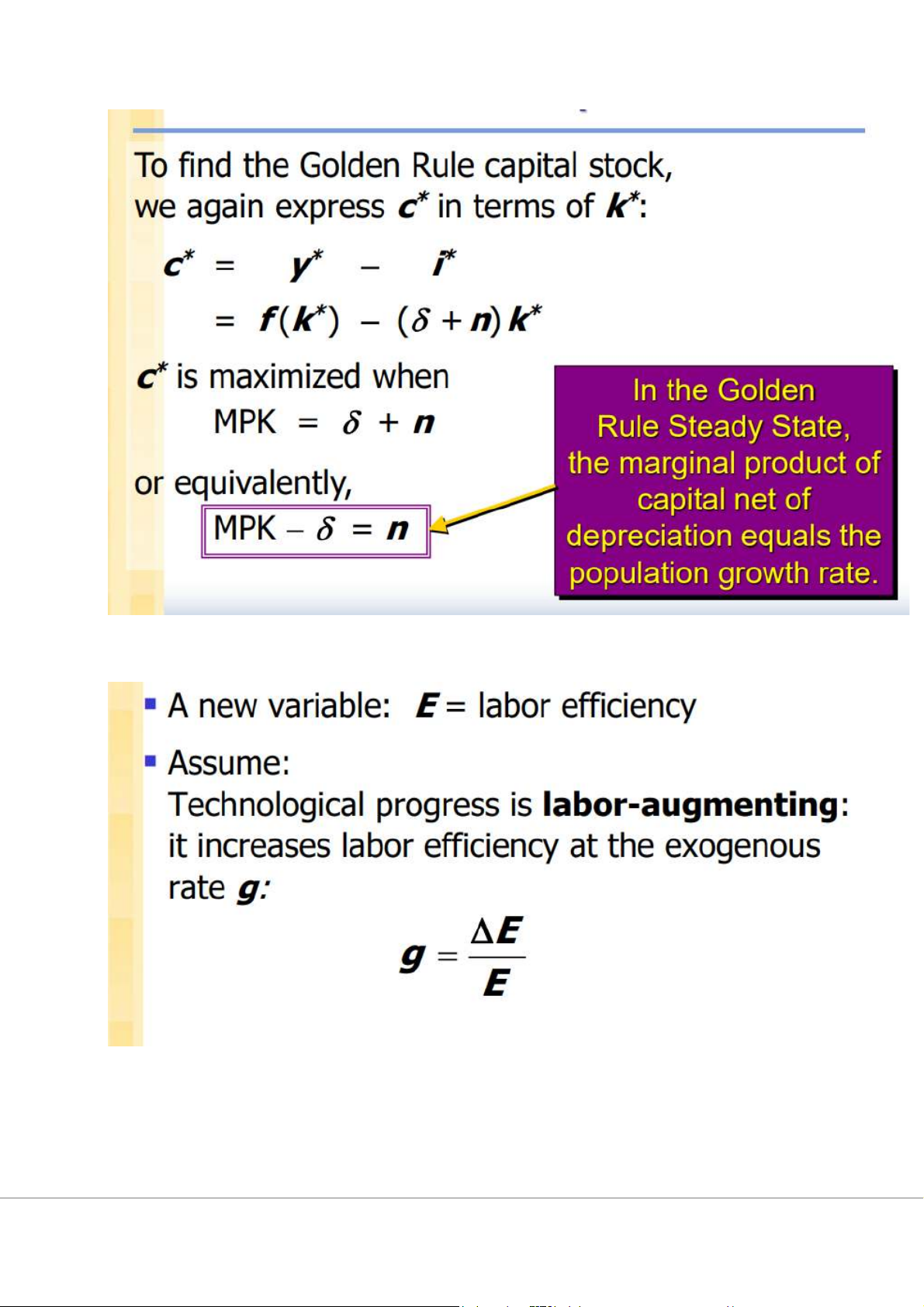
We now write the production function as:
where L E = the number of effective workers. 2. Endogenous Model * A two-sector model Two sectors:
• manufacturing firms produce goods
• research universities produce knowledge that
increases labor efficiency in manufacturing
u = fraction of labor in research (u is exogenous)
Mfg prod func: Y = F [K, (1-u)EL] Res prod func: E = g(u)E Cap accumulation: K = sY K
In the steady state, mfg output per worker and the standard of living grow at rate E/E = g(u). Key variables:
s: affects the level of income, but not its growth rate (same as in Solow model)
u: affects level and growth rate of income 3. Policies to promote growth
3.1. Evaluating the rate of saving
Use the Golden Rule to determine whether our saving rate and capital stock are too high, too low, or about right
3.2. Policies to increase the saving rate
Reduce the government budget deficit (or increase the budget surplus)
Increase incentives for private saving.
3.3. Allocating the economy’s investment Three categories to invest: • private capital stock • public infrastructure
• human capital: the knowledge and
skills that workers acquire through education.
3.4 Encouraging technological progress
Patent laws: encourage innovation by granting temporary monopolies to inventors of new products Tax incentives for R&D
Grants to fund basic research at universities
Industrial policy: encourage specific industries that are key for rapid tech. progress
Tài liệu liên quan:
-
TOPIC: COSMETICS môn Kinh tế vi mô | Trường Đại học Kinh tế Quốc dân
6 3 -

Sách Bài Tập Vi Mô - Hướng Dẫn và Lời Giải Chi Tiết
17 9 -

Nguyên lý chiến lược kinh doanh - Bài giảng môn Kinh tế vi mô | Trường Đại học Kinh Tế Quốc Dân
13 7 -

Chương 7 các kỹ thuật lựa chọn chiến lược - Bài giảng môn Kinh tế vi mô | Trường Đại học Kinh Tế Quốc Dân
14 7 -

Tổng hợp câu hỏi trắc nghiệm theo chương ôn tập môn Kinh tế vi mô | Trường Đại học Kinh Tế Quốc Dân
18 9