Market Instruments: Forward Rates, Swaps, Futures, and Options | Tài chính quốc tế | Trường Học Viện nông nghiệp Việt Nam
In Chapter 1,The Foreign Exchange Market, we considered the problem of a US importer buying Swiss watches. Since the exporter requires pay- ment in Swiss francs, the transaction requires an exchange of US dollars for francs. In the discussion in Chapter 1,The Foreign Exchange Market, it was assumed that the payment was done immediately, thus the chap- ter discussed the spot market—exchanging dollars for francs today at the current spot exchange rate. In the real world payments are not immediate. Instead the purchaser is usually granted 30, 60, or 90 days to pay for the purchase. Tài liệu được sưu tầm và soạn thảo dưới dạng file PDF để gửi tới các bạn cùng tham khảo, ôn tập đầy đủ kiến thức, chuẩn bị cho các buổi học thật tốt. Mời bạn đọc đón xem!
Môn: Tài chính quốc tế (hvnn) 130 tài liệu
Trường: Học viện Nông nghiệp Việt Nam 2.4 K tài liệu
Tác giả:


Preview text:
CHAPTER 4 Forward-Looking Market Instruments Contents Forward Rates 89 Swaps 90 Futures 94 Options 97
Other Forward-Looking Instruments 100 Summary 101 Exercises 102 Further Reading 103
In Chapter1, The Foreign Exchange Market, we considered the problem
of a US importer buying Swiss watches. Since the exporter requires pay-
ment in Swiss francs, the transaction requires an exchange of US dollars
for francs. In the discussion in Chapter1, The Foreign Exchange Market,
it was assumed that the payment was done immediately, thus the chap-
ter discussed the spot market—exchanging dollars for francs today at the
current spot exchange rate. In the real world payments are not immedi-
ate. Instead the purchaser is usually granted 30, 60, or 90 days to pay for
the purchase. Thus, the transaction requires the purchaser and the seller to
try to predict the future foreign currency value. This chapter deals with
instruments that help cover the risk of a foreign currency value becoming
too high when the importer has a foreign currency liability, or too low
when the exporter has a foreign currency receivable.
Suppose we return to the example of the US watch importer. Earlier,
the importer purchased francs in the spot market to settle a contract
payable now. Yet much international trade is contracted in advance
of delivery and payment. It would not be unusual for the importer
to place an order for Swiss watches for delivery at a future date. For
instance, suppose the order calls for delivery of the goods and payment
of the invoice in 3 months. Specifically, let’s say that the order is for CHF100,000. © 201 7 Elsevier Inc.
International Money and Finance. All rights reserved. 87 88
International Money and Finance
What options does the importer have with respect to payment? One
option is to wait 3 months and then buy the francs. A disadvantage of this
strategy is that the exchange rate could change over the next 3 months
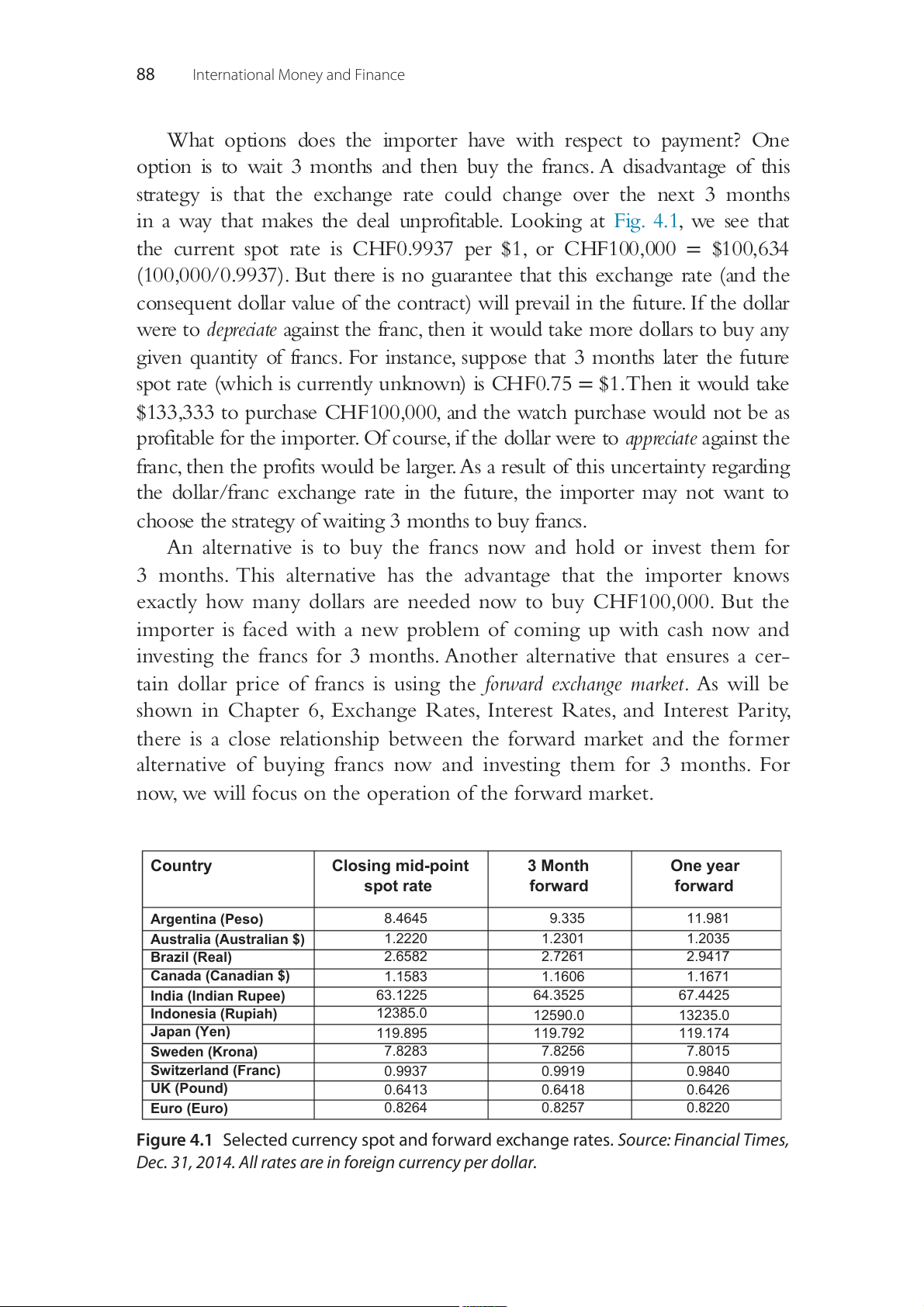
in a way that makes the deal unprofitable. Looking at Fig. 4.1, we see that
the current spot rate is CHF0.9937 per $1, or CHF100,000 = $100,634
(100,000/0.9937). But there is no guarantee that this exchange rate (and the
consequent dol ar value of the contract) will prevail in the future. If the dollar
were to depreciate against the franc, then it would take more dol ars to buy any
given quantity of francs. For instance, suppose that 3 months later the future
spot rate (which is currently unknown) is CHF0.75 = $1. Then it would take
$133,333 to purchase CHF100,000, and the watch purchase would not be as
profitable for the importer. Of course, if the dollar were to appreciate against the
franc, then the profits would be larger. As a result of this uncertainty regarding
the dollar/franc exchange rate in the future, the importer may not want to
choose the strategy of waiting 3 months to buy francs.
An alternative is to buy the francs now and hold or invest them for
3 months. This alternative has the advantage that the importer knows
exactly how many dollars are needed now to buy CHF100,000. But the
importer is faced with a new problem of coming up with cash now and
investing the francs for 3 months. Another alternative that ensures a cer-
tain dollar price of francs is using the forward exchange market. As will be
shown in Chapter 6, Exchange Rates, Interest Rates, and Interest Parity,
there is a close relationship between the forward market and the former
alternative of buying francs now and investing them for 3 months. For
now, we will focus on the operation of the forward market. Country Closing mid-point 3 Month One year spot rate forward forward Argentina (Peso) 8.4645 9.335 11.981
Australia (Australian $) 1.2220 1.2301 1.2035 Brazil (Real) 2.6582 2.7261 2.9417 Canada (Canadian $) 1.1583 1.1606 1.1671 India (Indian Rupee) 63.1225 64.3525 67.4425 Indonesia (Rupiah) 12385.0 12590.0 13235.0 Japan (Yen) 119.895 119.792 119.174 Sweden (Krona) 7.8283 7.8256 7.8015 Switzerland (Franc) 0.9937 0.9919 0.9840 UK (Pound) 0.6413 0.6418 0.6426 Euro (Euro) 0.8264 0.8257 0.8220
Figure 4.1 Selected currency spot and forward exchange rates. Source: Financial Times,
Dec. 31, 2014. All rates are in foreign currency per dollar.
Forward-Looking Market Instruments 89 FORWARD RATES
The forward exchange market refers to buying and selling currencies to
be delivered at a future date. Fig. 4.1 includes forward exchange rates for
the major traded currencies, including the Swiss franc. Most countries
in the world have forward markets and maturities and amounts are set
in each transaction. Thus, this figure only represents a small selection of
the available quotes. Note in the figure that the 3-month or 90-day for-
ward rate on the Swiss franc is CHF0.9919 = $1. Note that Fig. 4.1 also
shows 1-year forwards. Often 1-month and 6-month forward rates are also
quoted, as these are also commonly traded maturities.
The advantage of the forward market is that we have established a set
exchange rate between the dollar and the franc and do not have to buy
the francs until they are needed in 90 days. This may be preferred to the
option of buying francs now and investing them for 3 months, because it
is neither necessary to part with any funds now nor to have knowledge of
investment opportunities in francs. (However, the selling bank may require
that the importer hold “compensating balances” or “margin” until the
90-day period is up—that is, leave funds in an account at the bank, allow-
ing the bank to use the money until the forward date.) With a forward
rate of $1.00817 = CHF1 (1/0.9919), CHF100,000 will sell for $100,817.
The importer now knows with certainty how many dollars the watches
will cost in 90 days. In addition, note that the importer only pays a small
amount above the spot exchange rate for this forward contract. Instead of
paying $100,634 for 100,000 Swiss franc in the spot market, the importer
can pay an additional $183 for a contract that delivers the CHF100,000 in 90 days.
If the forward exchange price of a currency exceeds the current spot
price, that currency is said to be selling at a forward premium. A currency is
selling at a forward discount when the forward rate is less than the current
spot rate. The forward rates in Fig. 4.1 indicate that the British pound is
selling at a discount against the dollar, but the Japanese yen is selling at a
premium. A forward premium or discount is expressed in annualized per-
cent terms to make it comparable to interest rates. In the above case of the
Swiss franc, the franc has a forward premium of 0.725 percent. To com-
pute this we find the expected percent change [(F S ]*100 and then t- )/ t St
multiply it by 4 to annualize the results. Note that the result will indicate
a negative result, but that refers to the dollar, because the exchange rates
in Table 4.1 are in terms of foreign currency per dollar. Thus there is a 90
International Money and Finance
discount of 0.725 percent on the dollar and a premium of 0.725 percent
on the Swiss franc. The implications of a currency selling at a discount or
premium will be explored in coming chapters. In the event that the spot
and forward rates are equal, the currency is said to be flat. SWAPS
A foreign exchange swap is an arrangement where there is a simultane-
ous exchange of two currencies on a specific date at a rate agreed at the
time of the contract, and a reverse exchange of the same two currencies
at a date further in the future at a rate agreed at the time of the con-
tract. Swaps are an efficient way to meet the firm’s need for foreign cur-
rencies because they combine two separate transactions into one, thus
cutting transactions costs in half. The firm avoids any foreign exchange
risk by matching the liability created by borrowing foreign currencies
with the asset created by lending domestic currency, both to be repaid
at the known future exchange rate. This is known as hedging the foreign exchange risk.
For example, suppose Citibank wants pounds now, and wants to hold
the pounds for 3 months. Instead of borrowing the pounds, Citibank
could enter into a swap agreement wherein they trade dollars for pounds
now and pounds for dollars in 3 months. The terms of the arrangement
are obviously closely related to conditions in the forward market, since the
swap rates will be determined by the discounts or premiums in the for- ward exchange market.
Suppose Citibank wants pounds for 3 months and works a swap with
HSBC. Citibank will trade dollars to HSBC and in return will receive
pounds. In 3 months the trade is reversed. Citibank will payout pounds
to HSBC and receive dollars (of course, there is nothing special about the
3-month period used here—swaps could be for any period). Suppose the
spot rate is $/£ = $2.00 and the 3-month forward rate is $/£ = $2.10, so
that there is a $0.10 premium on the pound. These premiums or discounts
are actually quoted in basis points when serving as swap rates (a basis point
is 1/100%, or 0.0001). Thus the $0.10 premium converts into a swap rate
of 1000 points, which is all the swap participants are interested in; they do
not care about the actual spot or forward rate since only the difference
between them matters for a swap.
Swap rates are usefully converted into percent per annum terms to
make them comparable to other borrowing and lending rates (remember
a swap is the same as borrowing one currency while lending another
Forward-Looking Market Instruments 91
currency for the duration of the swap period). The swap rate of 1000
points or 0.1000 was for a 3-month period. To convert this into annual
terms, we find the percentage return for the swap period and then mul-
tiply this by the reciprocal of the fraction of the year for which the swap
exists. The percentage return for the swap period is equal to the
Premium(discount)/spot rate = 0.10/$2.00 = 0.05
The fraction of a year for which the swap exists is
3 months/12 months ⇒ 1/4 of the year
And the reciprocal of the fraction is 1/ 1 ( 4 / ) = 4
Thus, the percent per annum premium (discount) or swap rate is
Annualized percentage swap rate = 0.05 × 4 = 20%
This swap, then, yields a return of 20% per annum, which can be com-
pared to the other opportunities open to the bank.
An alternative swap agreement is a currency swap. A currency swap is
a contract in which two counterparties exchange streams of interest
payments in different currencies for an agreed period of time and then
exchange principal amounts in the respective currencies at an agreed
exchange rate at maturity. Currency swaps allow firms to obtain long-
term foreign currency financing at lower cost than they can by bor-
rowing directly. Suppose a Canadian firm wants to receive Japanese yen
today with repayment in 5 years. If the Canadian firm is not well known
to Japanese banks, the firm will pay a higher interest rate than firms that
actively participate in Japanese financial markets. The Canadian firm may
approach a bank to arrange a currency swap that will reduce its borrowing
costs. The bank will find a Japanese firm desiring Canadian dollars. The
Canadian firm is able to borrow Canadian dollars more cheaply than the
Japanese firm, and the Japanese firm is able to borrow yen more cheaply
than the Canadian firm. The intermediary bank will arrange for each firm
to borrow its domestic currency and then swap the domestic currency for
the desired foreign currency. The interest rates paid on the two currencies
will reflect the forward premium in existence at the time the swap is exe-
cuted. When the swap agreement matures, the original principal amounts
are traded back to the source firms. Both firms benefit by having access to
foreign funds at a lower cost than they could obtain directly. 92
International Money and Finance
FAQ: What Is a Credit Default Swap?
It is difficult to keep up with all the terminology, but the financial crisis in
2008–2009 highlighted hedging instruments that were not well known to the
public. Credit Default Swaps (CDS) had become a huge international market in
the 2000s. A CDS is a type of insurance scheme that protects the buyer from a
default in the payments. The buyer of the CDS pays a fee to the seller during the
term of the CDS. The seller of the CDS will then receive a fee for taking on the
risk of a default of the payments by the party that is making a payment.
For example, assume that a Japanese company has borrowed money by
issuing a bond and has agreed to pay a periodic amount twice a year to the
bond holders (the lenders). A bond holder may then purchase a CDS to cover
the risk of the Japanese firm defaulting on their payments. The bond holder
buys such a CDS from a financial institution like AIG. Note that the bond holder
(lender) now has hedged the default risk of the Japanese firm, but still has a risk
that the seller of the CDS, in this case AIG, defaults and does not honor their
commitment to pay off in the case of default. This was not seen as an issue until
the financial crisis showed that the sellers of CDSs were vulnerable. AIG adopts
the risk that the Japanese firm will continue to make its payments. As long
as the Japanese borrower makes payments on time, AIG just collects the ‘pre-
mium’ or price of the CDS from the bond holder and incurs no costs to payout
since there is no default. In the financial crisis, ‘counterparty risk’ became a very
important issue as some of the largest financial institutions in the world were in
danger of defaulting on obligations such as credit default swaps since the prob-
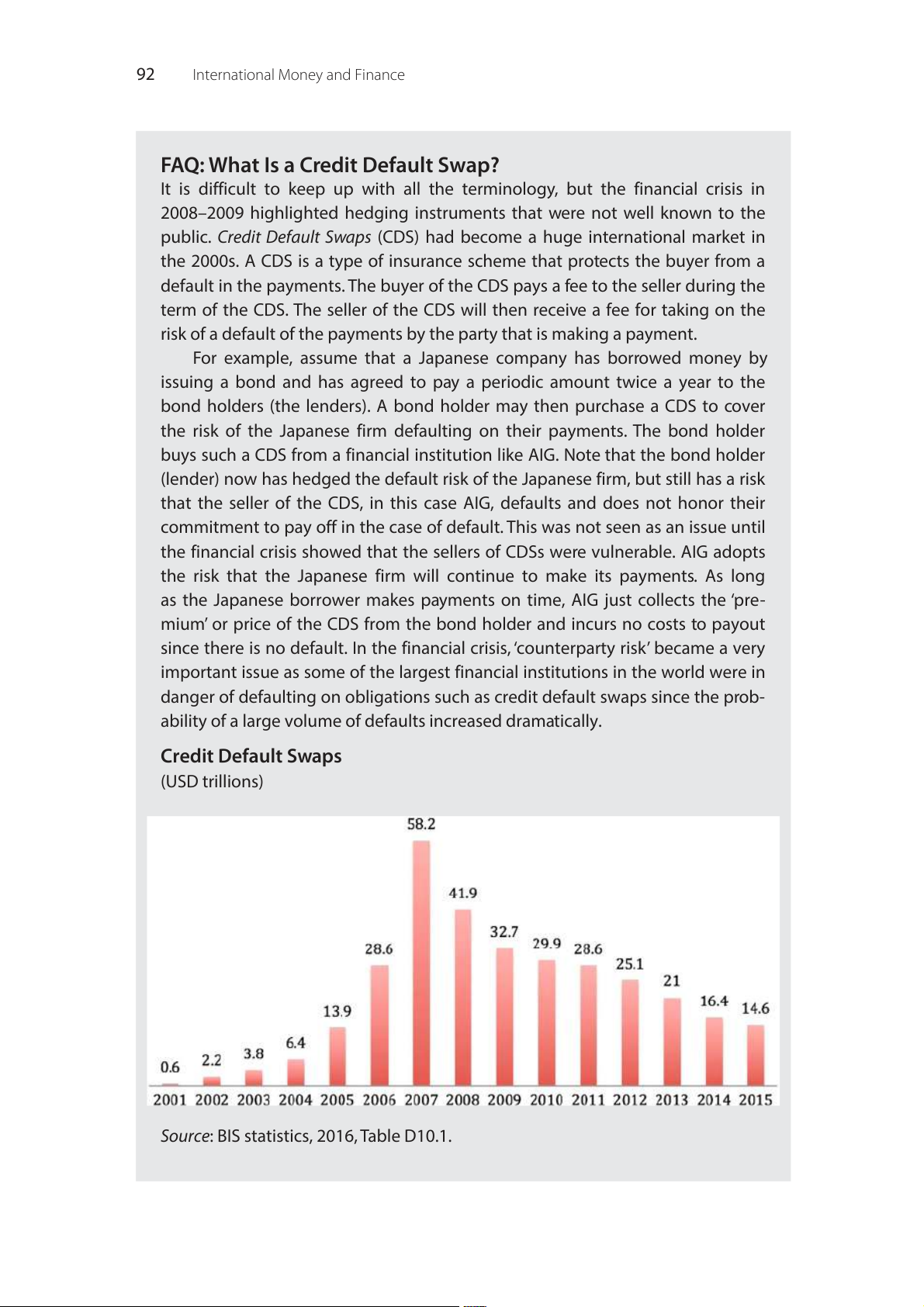
ability of a large volume of defaults increased dramatically. Credit Default Swaps (USD trillions)
Source: BIS statistics, 2016, Table D10.1.
Forward-Looking Market Instruments 93
As can be seen in the figure above the CDS market had grown tremen-
dously in the beginning of the 2000s peaking before the great recession. In
2007, 58.2 trillion outstanding CDS existed, as compared to 2.2 trillion 5 years
earlier. After the Great Recession the CDS market has slowed down, but it still
plays an important role in prudent risk management of financial obligations.
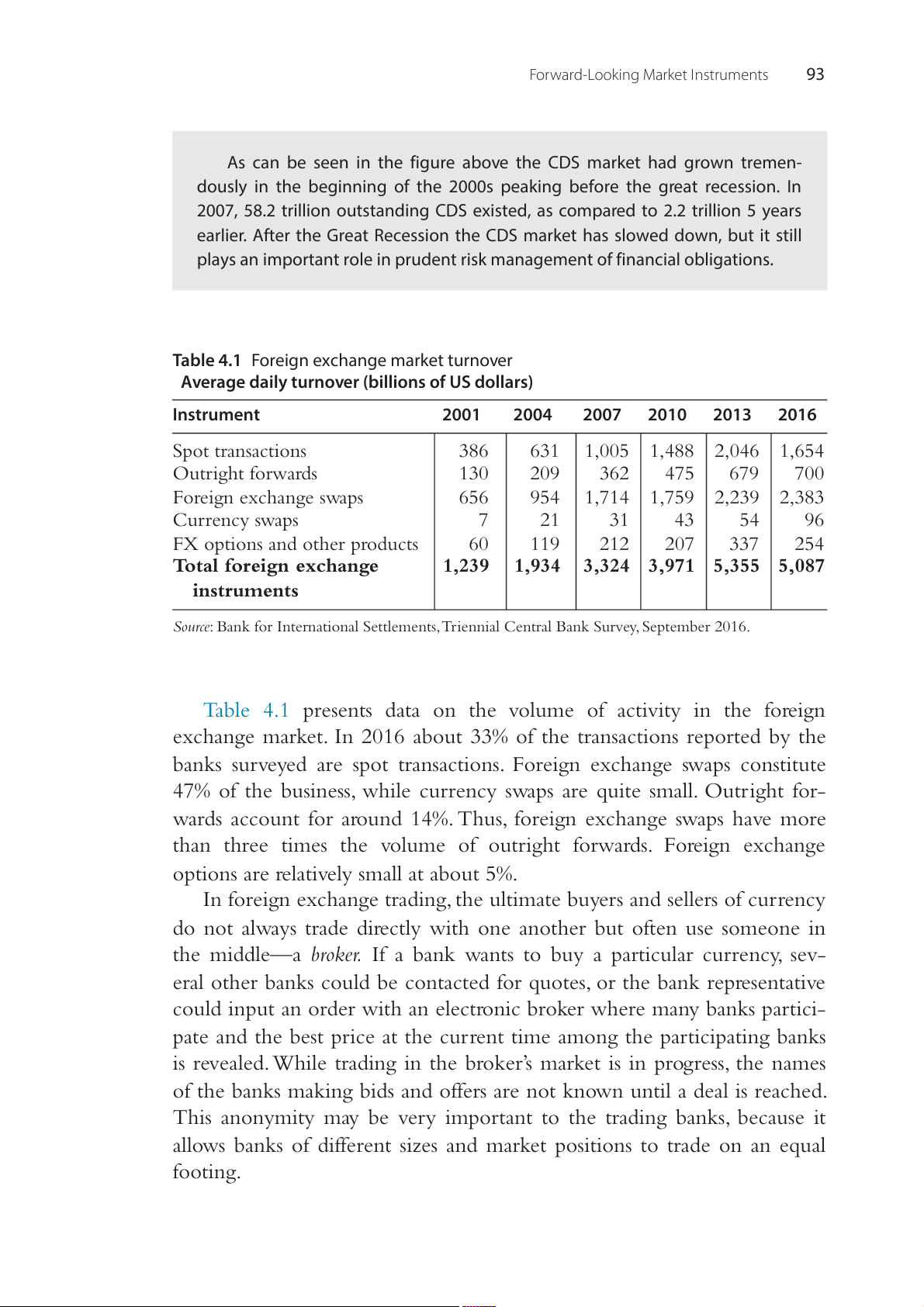
Table 4.1 Foreign exchange market turnover
Average daily turnover (billions of US dollars) Instrument 2001 2004 2007 2010 2013 2016 Spot transactions 386 631 1,005 1,488 2,046 1,654 Outright forwards 130 209 362 475 679 700 Foreign exchange swaps 656 954 1,714 1,759 2,239 2,383 Currency swaps 7 21 31 43 54 96 FX options and other products 60 119 212 207 337 254 Total foreign exchange 1,239 1,934 3,324 3,971 5,355 5,087 instruments
Source: Bank for International Settlements, Triennial Central Bank Survey, September 2016.
Table 4.1 presents data on the volume of activity in the foreign
exchange market. In 2016 about 33% of the transactions reported by the
banks surveyed are spot transactions. Foreign exchange swaps constitute
47% of the business, while currency swaps are quite small. Outright for-
wards account for around 14%. Thus, foreign exchange swaps have more
than three times the volume of outright forwards. Foreign exchange
options are relatively small at about 5%.
In foreign exchange trading, the ultimate buyers and sellers of currency
do not always trade directly with one another but often use someone in
the middle—a broker. If a bank wants to buy a particular currency, sev-
eral other banks could be contacted for quotes, or the bank representative
could input an order with an electronic broker where many banks partici-
pate and the best price at the current time among the participating banks
is revealed. While trading in the broker’s market is in progress, the names
of the banks making bids and offers are not known until a deal is reached.
This anonymity may be very important to the trading banks, because it
allows banks of different sizes and market positions to trade on an equal footing. 94
International Money and Finance
In the electronic brokers market, computer programs take offers to buy
and sell from different agents and match them. In addition to the elec-
tronic brokers, there are electronic dealing systems. Rather than talking
directly over the telephone dealer-to-dealer, computer networks allow
for trades to be executed electronically. The use of electronic broker sys-
tems varies greatly across countries. Approximately 54% of trading in
the United States goes through such networks, compared to 66% in the
United Kingdom and 48% in Japan. FUTURES
The foreign exchange market we have discussed (spot, forward, and swap
transactions) is a global market. Commercial banks, business firms, and gov-
ernments in various locations buy and sell foreign exchange using telephone
and computer systems with no centralized geographical market location.
However, additional institutions exist that have not yet been covered, one
of which is the foreign exchange futures market. The futures market is a
market where foreign currencies may be bought and sold for delivery at a
future date. The futures market differs from the forward market in that only
a few currencies are traded; moreover, trading occurs in standardized con-
tracts and in a specific geographic location. Note that futures contracts are
traded on organized exchanges, such as the International Monetary Market
(IMM) of the Chicago Mercantile Exchange (CME), which is the larg-
est currency futures market. An exchange facilitates buying and selling and
guarantees that all commitments are honored. CME futures are traded on
the British pound, Canadian dollar, Japanese yen, Swiss franc, Australian dol-
lar, Mexican peso, and euro. The contracts involve a specific amount of cur-
rency to be delivered at specific maturity dates. Contracts mature on the
third Wednesday of March, June, September, and December. In the for-
ward market, contracts are typically 30, 90, or 180 days long, but can be
for any term agreed by the parties, and are maturing every day of the year.
Forward market contracts are written for any amount agreed upon by the
parties involved. In the CME futures market the contracts are written for
fixed amounts: GBP62,500, CAD100,000, JPY12,500,000, CHF125,000, MXN500,000, and EUR125,000.
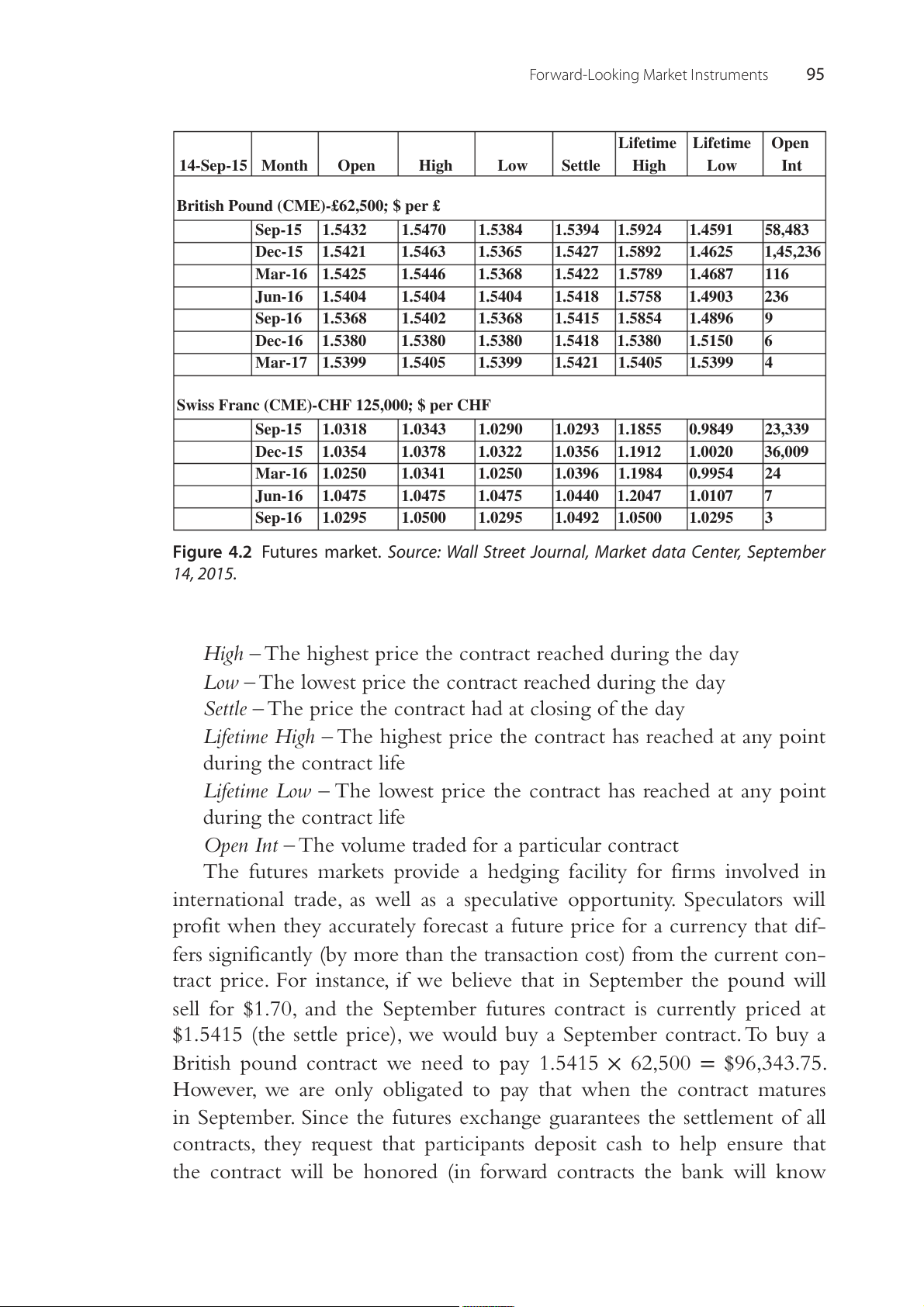
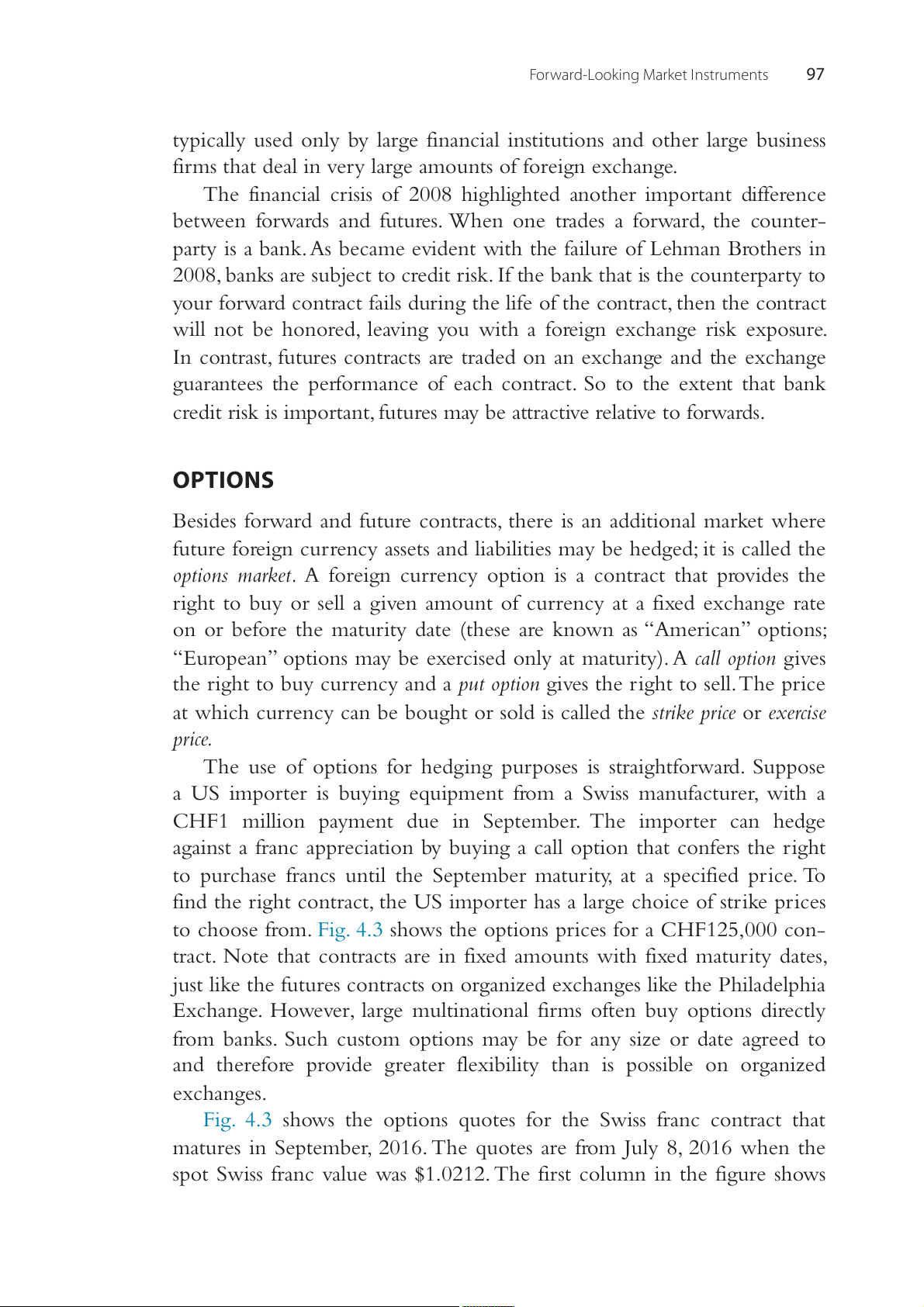
The futures table shows the dollar prices quoted for each unit of the
contract. In Fig. 4.2 the columns for each contract are:
Month – Month that the contract matures
Open – The price that contract had at the beginning of the trading day
Forward-Looking Market Instruments 95 Lifetime Lifetime Open 14-Sep-15 Month Open High Low Settle High Low Int
British Pound (CME)-£62,500; $ per £ Sep-15 1.5432 1.5470 1.5384 1.5394 1.5924 1.4591 58,483 Dec-15 1.5421 1.5463 1.5365 1.5427 1.5892 1.4625 1,45,236 Mar-16 1.5425 1.5446 1.5368 1.5422 1.5789 1.4687 116 Jun-16 1.5404 1.5404 1.5404 1.5418 1.5758 1.4903 236 Sep-16 1.5368 1.5402 1.5368 1.5415 1.5854 1.4896 9 Dec-16 1.5380 1.5380 1.5380 1.5418 1.5380 1.5150 6 Mar-17 1.5399 1.5405 1.5399 1.5421 1.5405 1.5399 4
Swiss Franc (CME)-CHF 125,000; $ per CHF Sep-15 1.0318 1.0343 1.0290 1.0293 1.1855 0.9849 23,339 Dec-15 1.0354 1.0378 1.0322 1.0356 1.1912 1.0020 36,009 Mar-16 1.0250 1.0341 1.0250 1.0396 1.1984 0.9954 24 Jun-16 1.0475 1.0475 1.0475 1.0440 1.2047 1.0107 7 Sep-16 1.0295 1.0500 1.0295 1.0492 1.0500 1.0295 3
Figure 4.2 Futures market. Source: Wall Street Journal, Market data Center, September 14, 2015.
High – The highest price the contract reached during the day
Low – The lowest price the contract reached during the day
Settle – The price the contract had at closing of the day
Lifetime High – The highest price the contract has reached at any point during the contract life
Lifetime Low – The lowest price the contract has reached at any point during the contract life
Open Int – The volume traded for a particular contract
The futures markets provide a hedging facility for firms involved in
international trade, as well as a speculative opportunity. Speculators will
profit when they accurately forecast a future price for a currency that dif-
fers significantly (by more than the transaction cost) from the current con-
tract price. For instance, if we believe that in September the pound will
sell for $1.70, and the September futures contract is currently priced at
$1.5415 (the settle price), we would buy a September contract. To buy a
British pound contract we need to pay 1.5415 × = 62,500 $96,343.75.
However, we are only obligated to pay that when the contract matures
in September. Since the futures exchange guarantees the settlement of all
contracts, they request that participants deposit cash to help ensure that
the contract will be honored (in forward contracts the bank will know 96
International Money and Finance
the participants and might not require any security). For example, the
exchange might ask for 10% of the contract value, or $9634.38 as a secu-
rity or margin. The margin is a cushion for potential losses that you may
incur on the contract, to make sure you will honor your contract.
Each day the futures market will quote the September contract that
we now own, until the maturity date, so the value of the contract changes
on a daily basis. At maturity each pound will cost $1.5415, but the con-
tract does not have to be kept until maturity. For example, assume that
the price of the pound contract goes to $1.65 in August. We can now sell
our contract for $1.65 × 62,500 = $103,125 for a profit of $6,781.25 (less
transactions costs), or we can wait and hope that the September rate will
be even more favorable. Note also that the security deposit is returned to
us if we sell the contract. In contrast, a fall in the value of the pound in
August will hurt our financial position. If the pound falls to $1.50 then
our pound position is only worth $93,750. If we still believe that the
pound price will go up in September then it makes sense to wait and hold
onto the contract. In cases when the negative position becomes serious,
the seller might be worried that we will not be able to honor the position
in September. Therefore, they might ask for more security, for example
an extra $2,593.75 to make the total margin $12,228.13. This is called a margin call.
As the preceding examples show, a futures contract may not be held
to maturity by the initial purchaser. Only the last holder of the contract
has to take delivery of the foreign exchange. Thus, the futures market can
be used to hedge risk, but can also be used by speculators. The speculators
can take ownership of a fairly large contract with a small initial invest-
ment. Thus, speculators can be highly leveraged and have futures con-
tracts worth lots more than the net worth of the individual. This is how
Nick Leeson caused Barings Bank to collapse. In a 3-month period Nick
bought 20,000 futures contracts worth about 180,000 pounds each. He
was speculating that the contracts would increase in value, but instead
the contracts lost almost $1 billion (see www.nickleeson.com, for more details.).
In comparing the types of participants in the futures market and
forward markets, we have already concluded that futures markets can be
used for speculation as well as hedging. In addition, the futures contracts
are for smaller amounts of currency than are forward contracts, and there-
fore serve as a useful hedging vehicle for relatively small firms. Forward
contracts are within the realm of wholesale banking activity and are
Forward-Looking Market Instruments 97
typically used only by large financial institutions and other large business
firms that deal in very large amounts of foreign exchange.
The financial crisis of 2008 highlighted another important difference
between forwards and futures. When one trades a forward, the counter-
party is a bank. As became evident with the failure of Lehman Brothers in
2008, banks are subject to credit risk. If the bank that is the counterparty to
your forward contract fails during the life of the contract, then the contract
will not be honored, leaving you with a foreign exchange risk exposure.
In contrast, futures contracts are traded on an exchange and the exchange
guarantees the performance of each contract. So to the extent that bank
credit risk is important, futures may be attractive relative to forwards. OPTIONS
Besides forward and future contracts, there is an additional market where
future foreign currency assets and liabilities may be hedged; it is called the
options market. A foreign currency option is a contract that provides the
right to buy or sell a given amount of currency at a fixed exchange rate
on or before the maturity date (these are known as “American” options;
“European” options may be exercised only at maturity). A call option gives
the right to buy currency and a put option gives the right to sell. The price
at which currency can be bought or sold is called the strike price or exercise price.
The use of options for hedging purposes is straightforward. Suppose
a US importer is buying equipment from a Swiss manufacturer, with a
CHF1 million payment due in September. The importer can hedge
against a franc appreciation by buying a call option that confers the right
to purchase francs until the September maturity, at a specified price. To
find the right contract, the US importer has a large choice of strike prices
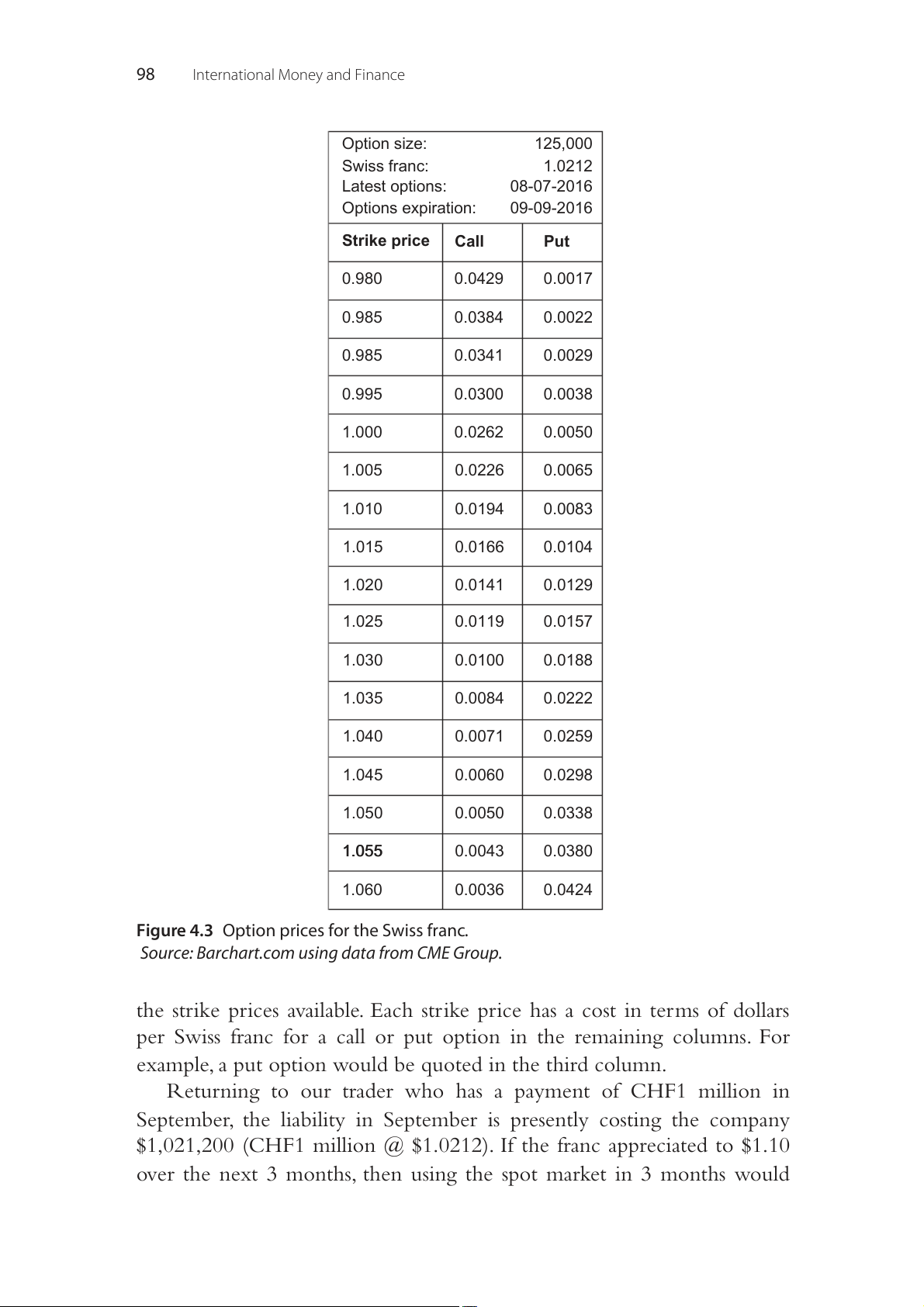
to choose from. Fig. 4.3 shows the options prices for a CHF125,000 con-
tract. Note that contracts are in fixed amounts with fixed maturity dates,
just like the futures contracts on organized exchanges like the Philadelphia
Exchange. However, large multinational firms often buy options directly
from banks. Such custom options may be for any size or date agreed to
and therefore provide greater flexibility than is possible on organized exchanges.
Fig. 4.3 shows the options quotes for the Swiss franc contract that
matures in September, 2016. The quotes are from July 8, 2016 when the
spot Swiss franc value was $1.0212. The first column in the figure shows 98
International Money and Finance Option size: 125,000 Swiss franc: 1.0212 Latest options: 08-07-2016 Options expiration: 09-09-2016 Strike price Call Put 0.980 0.0429 0.0017 0.985 0.0384 0.0022 0.985 0.0341 0.0029 0.995 0.0300 0.0038 1.000 0.0262 0.0050 1.005 0.0226 0.0065 1.010 0.0194 0.0083 1.015 0.0166 0.0104 1.020 0.0141 0.0129 1.025 0.0119 0.0157 1.030 0.0100 0.0188 1.035 0.0084 0.0222 1.040 0.0071 0.0259 1.045 0.0060 0.0298 1.050 0.0050 0.0338 1.055 0.0043 0.0380 1.060 0.0036 0.0424
Figure 4.3 Option prices for the Swiss franc.
Source: Barchart.com using data from CME Group.
the strike prices available. Each strike price has a cost in terms of dollars
per Swiss franc for a call or put option in the remaining columns. For
example, a put option would be quoted in the third column.
Returning to our trader who has a payment of CHF1 million in
September, the liability in September is presently costing the company
$1,021,200 (CHF1 million @ $1.0212). If the franc appreciated to $1.10
over the next 3 months, then using the spot market in 3 months would
Forward-Looking Market Instruments 99
change the value of the imports to $1,100,000 (CHF1,000,000 × $1.1), an
increase in the cost of the imports of $78,800. A call option will provide
insurance against such change. But there are many options to choose from.
If we are only interested in a substantial increase in the value of the Swiss
franc, we should choose a higher strike price because it is cheaper. If we
cannot tolerate much movement at all, we would pick a lower strike price,
but be willing to pay a higher upfront cost. For example, if we choose
to protect ourselves against a substantial movement in the Swiss franc we
might choose 1.060 as a strike price. This strike price would give us the
right to buy Swiss francs at $1.06. It will cost us $0.0036 per Swiss franc.
Thus, the CHF125,000 contract would cost us $450 (0.0036 ×125,000).
However, we need eight contracts to cover our liability so the total cost
for the option cover is $3,600.
With the options contract, we can now avoid any increase in the
cost of the currency above 1.06, and at the same time take advantage of
any reduction in the cost of the Swiss franc. For example, if the Swiss
franc next month falls in value to $1.00, we can let the option expire
and buy Swiss francs on the spot market at a cost of $1,000,000, a
savings of $21,200 from our initial liability. But having the option not
to exercise the trade comes at a cost. Even if we do not exercise the
option contract, we still have to pay the full amount of the option pre- mium of $3,600.
An option is said to be in the money when the strike price is less than
the current spot rate for a call option, or greater than the current spot rate
for a put option. Returning to our example of the US importer buying
CHF1 million of equipment to be paid for in September, the current spot
rate is $1.0212 per CHF. If the importer buys a September call option
with a strike price of 1.010, then this contract can already be exercised
to buy cheap currency. By exercising the option the importer can already
buy Swiss francs at $1.01, and could then turn around and sell them on
the spot market for $1.0212. This type of contract is “in the money” and
would cost more than a contract that is not “in the money.” Similarly a
strike price that is above the current spot rate would be “in the money” for a put option.
If we knew with certainty what the future exchange rate would be,
there would be no market for options, futures, or forward contracts. In
an uncertain world, risk-averse traders willingly pay to avoid the poten-
tial loss associated with adverse movements in exchange rates. An advan-
tage of options over futures or forwards is greater flexibility. A futures or 100
International Money and Finance
forward contract is an obligation to buy or sell at a set exchange rate. An
option offers the right to buy or sell if desired in the future and is not an obligation.
OTHER FORWARD-LOOKING INSTRUMENTS
The growth of options contracts since the early 1980s has stimulated the
development of new products and techniques for managing foreign
exchange assets and liabilities. One recent development combines the fea-
tures of a forward contract and an option contract. Terms such as break for-
ward, participating forward, or FOX (forward with option exit) refer to forward
contracts with an option to break out of the contract at a future date. In this
case, the forward exchange rate price includes an option premium for the
right to break the forward contract. The incentive for such a contract comes
from the desire of customers to have the insurance provided by a forward
contract when the exchange rate moves against them and yet not lose the
potential for profit available with favorable exchange rate movements.
One might first wonder whether a break-forward hedge could not be
achieved more simply by using a straight option contract. There are several
attractive features of the break-forward contract that do not exist with an
option. For one thing, an option requires an upfront premium payment.
The corporate treasurer may not have a budget for option premiums or
may not have management approval for using options. The break forward
hides the option premium in the forward rate. Since the price at which
the forward contract is broken is fixed in advance, the break forward may
be treated as a simple forward contract for tax and accounting purposes,
whether the contract is broken or not.
One of the more difficult problems in hedging foreign exchange risk
arises in bidding on contracts. The bidder submits a proposal to perform
some task for the firm or government agency that will award a contract
to the successful bidder. Since there may be many other bidders, the
bidding firms face the foreign exchange risk associated with the con-
tract only if they are, in fact, awarded the contract. Suppose a particular
bidder assesses that it has only a 20% chance of winning the contract.
Should that bidder buy a forward contract or option today to hedge the
foreign exchange risk it faces in the event it is the successful bidder?
If substantial foreign exchange risk is involved for the successful bidder,
then not only the bidders but also the contract awarder face a dilemma.
Forward-Looking Market Instruments 101
The bids will not be as competitive in light of the outstanding foreign
exchange risk as they would be if the exchange rate uncertainty were hedged.
One approach to this problem is the Scout contract. Midland Bank
developed the Scout (share currency option under tender) as an option
that is sold to the contract awarder, who then sells it to the successful bid-
der. The awarding agency now receives more competitive, and perhaps a
greater number of, bids because the bidders now know that the foreign exchange hedge is arranged.
Over time, we should expect a proliferation of new financial mar-
ket products aimed at dealing with future transactions involving foreign
exchange. If there is a corporate interest in customizing an option or a
forward arrangement to a specific type of transaction, an innovative bank
will step in and offer a product. The small sample of new products dis-
cussed in this section is intended to suggest the practical use of these financial innovations. SUMMARY
1. Many international transactions involve future delivery of goods and
payments, subjecting traders to uncertainty about future exchange rate
fluctuations at the time of delivery. Therefore, several forward-looking
market instruments exist to reduce traders’ currency risk.
2. The forward exchange market is composed of commercial banks buy-
ing and selling foreign currencies to be delivered at a future date.
3. When the forward price of a currency is greater than (less than) the
spot price, the currency is said to sell at a forward premium (discount).
When the forward price is equal to the spot price, a currency is sold at a forward flat.
4. The advantage of the forward exchange market is that a specified
exchange rate between currencies has been established and no buying/
selling of the currency is needed until a specified date in the future.
5. The forward exchange swap is a combination of spot and forward
transactions of the same amount of the currency delivered in two dif-
ferent dates. The two steps are executed in one single step.
6. The currency swap is a contract between two parties to exchange
the principal and interest payments of a loan in one currency to the
equivalent term of loan in another currency. Both parties benefit from 102
International Money and Finance
having access to a long-term foreign currency financing at a lower cost
than they could obtain directly.
7. Foreign currency futures are standardized contracts traded on estab-
lished exchanges for delivery of currencies at a specified future date.
8. The futures market differs from the forward market in that only a
few currencies are traded; each currency has a standardized contract
of a fixed amount and predetermined dates; and contracts are traded
only in a specific location. The participants in the futures marketalso
include speculators, since the future contracts can be bought and sold before the contracts mature.
9. Foreign currency options are contracts that give the buyer the right
to buy (call option) or sell (put option) currencies at a specified price
within a specific period of time. The strike price is the price at which
the owner of the contract has the right to transact. EXERCISES
1. Use Fig. 4.1 to determine whether each of the currencies listed here is
selling at a 3-month forward premium or discount against the dollar: a. Pound b. Swiss franc c. Yen d. Canadian dollar
2. Calculate the per annum premium (discount) of a 3-month forward
contract on Canadian dollars based on the information in Fig. 4.1.
3. List at least three ways in which a futures contract differs from a forward contract.
4. Assume US corporation XYZ needs to arrange to have £10,000 in 90
days. Discuss the alternatives available to the corporation in meeting
this obligation. What factors are important in determining which strat- egy is best?
5. Suppose you are the treasurer of a large US multinational firm that
wants to hedge the foreign exchange risk associated with a payable
of 1,000,000 UK pound due in 90 days. How many futures contracts would cover your risk?
6. Suppose you are the treasurer of a US multinational firm that wants
to hedge the foreign exchange risk associated with your firm’s sale of
equipment to a Swiss firm worth CHF1,000,000. The receivable is due
in 6 months. You want to ensure that Swiss francs are worth at least
Forward-Looking Market Instruments 103
$0.90 when the francs are received so you want a strike price of $0.90.
How many options contracts do you need to hedge this risk? Do you
want a call or put on Swiss francs? What has to happen to the spot rate
in 6 months for you to let the option expire? FURTHER READING
Baba, N., Packer, F., Nagano, T., 2008. The spillover of money market turbulence to FX swap
and cross-country swap market. BIS Q. Rev., 73–86.
Broll, U., Zilcha, I., 1992. Exchange rate uncertainty, futures markets and the multinational firm Eur. Econ. Rev.
Géczy, C., Minton, B.A., Schrand, C., 1997. Why firms use currency derivatives. J. Finance, 1323–1354.
Lien, D., Wang, K.P., 2004. Optimal bidding and hedging in international markets. J. Int. Money Finance 23, 785–787.
Mengle, D., 2007. Credit derivatives: an overview. Fed. Rev. Bank Atlanta Econ. Rev., 1–24. Fourth Quarter.
Tài liệu liên quan:
-

Hoạt động Tài chính của Doanh nghiệp Đa Quốc Gia (DN) - Chương 6 | Tài chính quốc tế | Trường Học Viện nông nghiệp Việt Nam
19 10 -
Hệ Thống Tiền Tệ Quốc Tế: Khái Niệm và Các Chế Độ Tỷ Giá | Tài chính quốc tế | Trường Học Viện nông nghiệp Việt Nam
24 12 -

Bài giảng Chương 1: Các Quan Hệ Cân Bằng Quốc Tế và LOP | Tài chính quốc tế | Trường Học Viện nông nghiệp Việt Nam
21 11 -
Cách Tính Lạm Phát và CPI: So Sánh Việt Nam và Mỹ | Tài chính quốc tế | Trường Học Viện nông nghiệp Việt Nam
23 12 -
Detailed Report and Analysis on Submission Trends | Tài chính quốc tế | Trường Học Viện nông nghiệp Việt Nam
23 12