Market Strategy Homework 4: Tactics for Eco-Friendly Products | Lập kế hoạch kinh doanh | Trường Đại học Kiến trúc Đà Nẵng
Briefly review your overall marketing strategy. The main marketing strategy of a consumer goods company could be a market penetration strategy. Since the company’s products are consumer goods, the marketing strategy should be long-term, covering all customer segments, and educating customers to make it easier for them to accept new products. Tài liệu được sưu tầm và soạn thảo dưới dạng file PDF để gửi tới các bạn cùng tham khảo, ôn tập đầy đủ kiến thức, chuẩn bị cho các buổi học thật tốt. Mời bạn đọc đón xem!
Môn: Lập kế hoạch kinh doanh ( KTD) 66 tài liệu
Trường: Trường Đại học Kiến trúc Đà Nẵng 322 tài liệu
Tác giả:





Preview text:
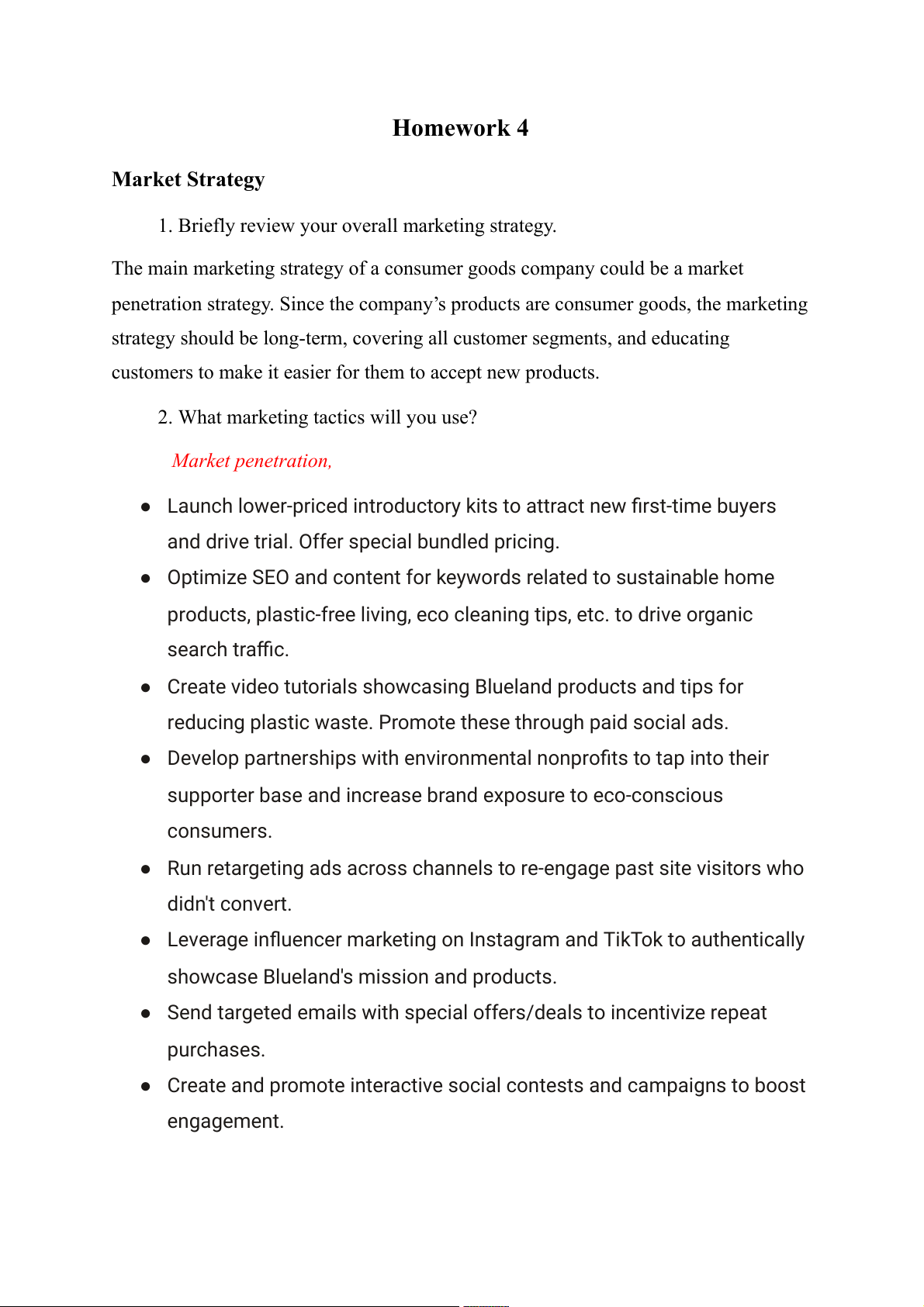
Homework 4 Market Strategy
1. Briefly review your overall marketing strategy.
The main marketing strategy of a consumer goods company could be a market
penetration strategy. Since the company’s products are consumer goods, the marketing
strategy should be long-term, covering all customer segments, and educating
customers to make it easier for them to accept new products.
2. What marketing tactics will you use? Market penetration,
● Launch lower-priced introductory kits to attract new first-time buyers
and drive trial. Offer special bundled pricing.
● Optimize SEO and content for keywords related to sustainable home
products, plastic-free living, eco cleaning tips, etc. to drive organic search traffic.
● Create video tutorials showcasing Blueland products and tips for
reducing plastic waste. Promote these through paid social ads.
● Develop partnerships with environmental nonprofits to tap into their
supporter base and increase brand exposure to eco-conscious consumers.
● Run retargeting ads across channels to re-engage past site visitors who didn't convert.
● Leverage influencer marketing on Instagram and TikTok to authentically
showcase Blueland's mission and products.
● Send targeted emails with special offers/deals to incentivize repeat purchases.
● Create and promote interactive social contests and campaigns to boost engagement.
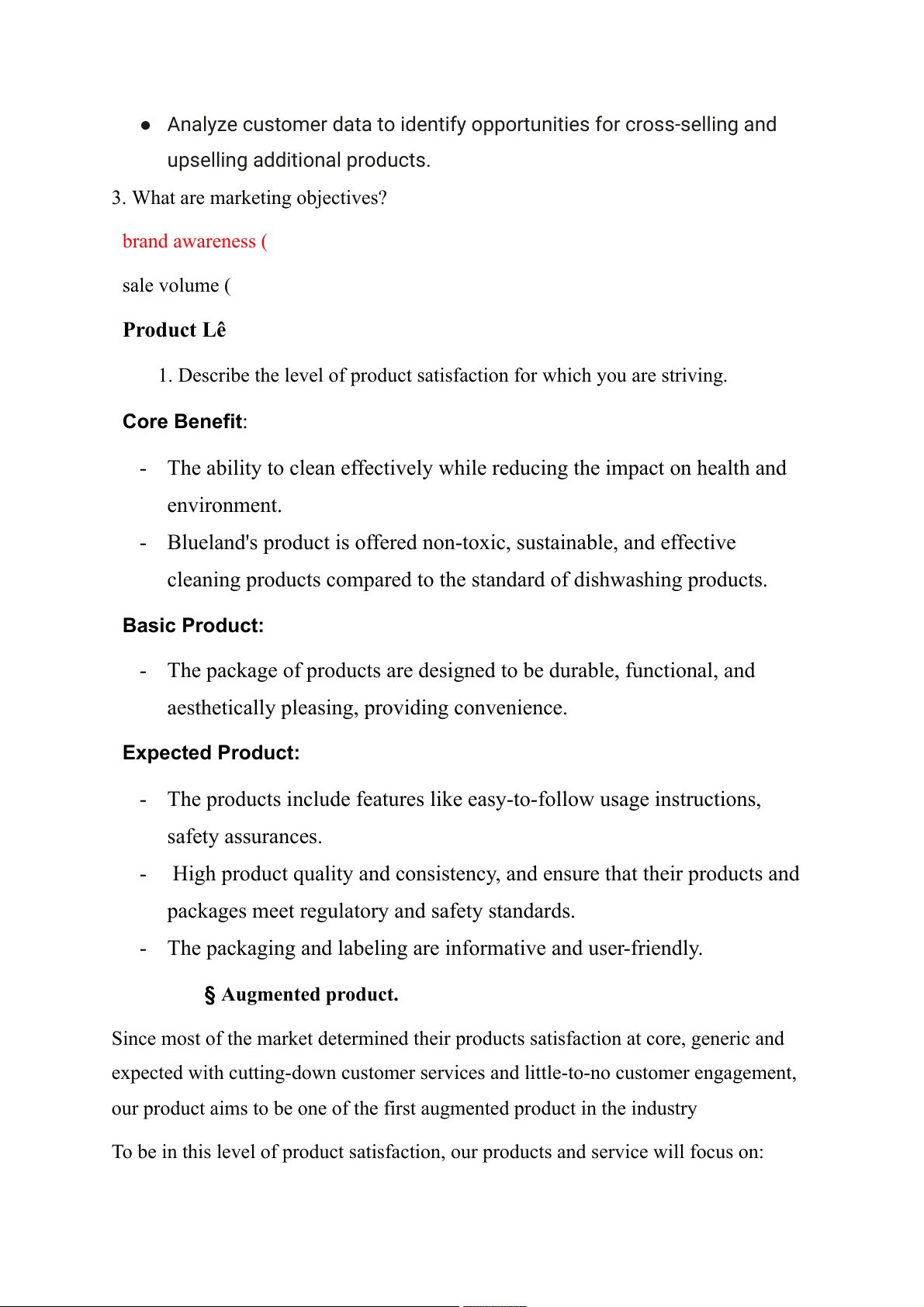
● Analyze customer data to identify opportunities for cross-selling and upselling additional products.
3. What are marketing objectives? brand awareness ( sale volume ( Product Lê
1. Describe the level of product satisfaction for which you are striving. Core Benefit: -
The ability to clean effectively while reducing the impact on health and environment. -
Blueland's product is offered non-toxic, sustainable, and effective
cleaning products compared to the standard of dishwashing products. Basic Product: -
The package of products are designed to be durable, functional, and
aesthetically pleasing, providing convenience. Expected Product: -
The products include features like easy-to-follow usage instructions, safety assurances. -
High product quality and consistency, and ensure that their products and
packages meet regulatory and safety standards. -
The packaging and labeling are informative and user-friendly. § Augmented product.
Since most of the market determined their products satisfaction at core, generic and
expected with cutting-down customer services and little-to-no customer engagement,
our product aims to be one of the first augmented product in the industry
To be in this level of product satisfaction, our products and service will focus on: -
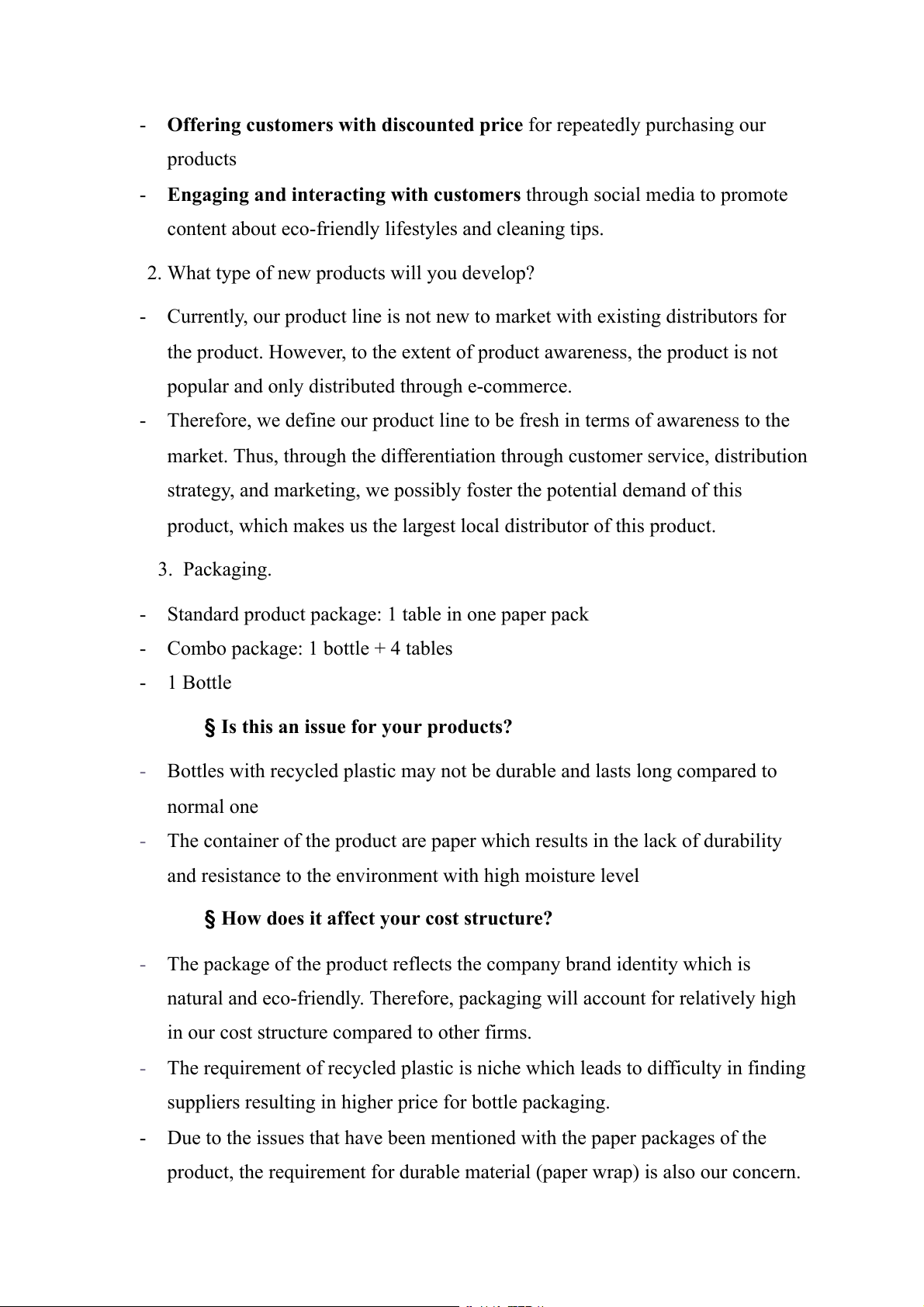
Offering customers with discounted price for repeatedly purchasing our products -
Engaging and interacting with customers through social media to promote
content about eco-friendly lifestyles and cleaning tips.
2. What type of new products will you develop? -
Currently, our product line is not new to market with existing distributors for
the product. However, to the extent of product awareness, the product is not
popular and only distributed through e-commerce. -
Therefore, we define our product line to be fresh in terms of awareness to the
market. Thus, through the differentiation through customer service, distribution
strategy, and marketing, we possibly foster the potential demand of this
product, which makes us the largest local distributor of this product. 3. Packaging. -
Standard product package: 1 table in one paper pack -
Combo package: 1 bottle + 4 tables - 1 Bottle
§ Is this an issue for your products? -
Bottles with recycled plastic may not be durable and lasts long compared to normal one -
The container of the product are paper which results in the lack of durability
and resistance to the environment with high moisture level
§ How does it affect your cost structure? -
The package of the product reflects the company brand identity which is
natural and eco-friendly. Therefore, packaging will account for relatively high
in our cost structure compared to other firms. -
The requirement of recycled plastic is niche which leads to difficulty in finding
suppliers resulting in higher price for bottle packaging. -
Due to the issues that have been mentioned with the paper packages of the
product, the requirement for durable material (paper wrap) is also our concern.
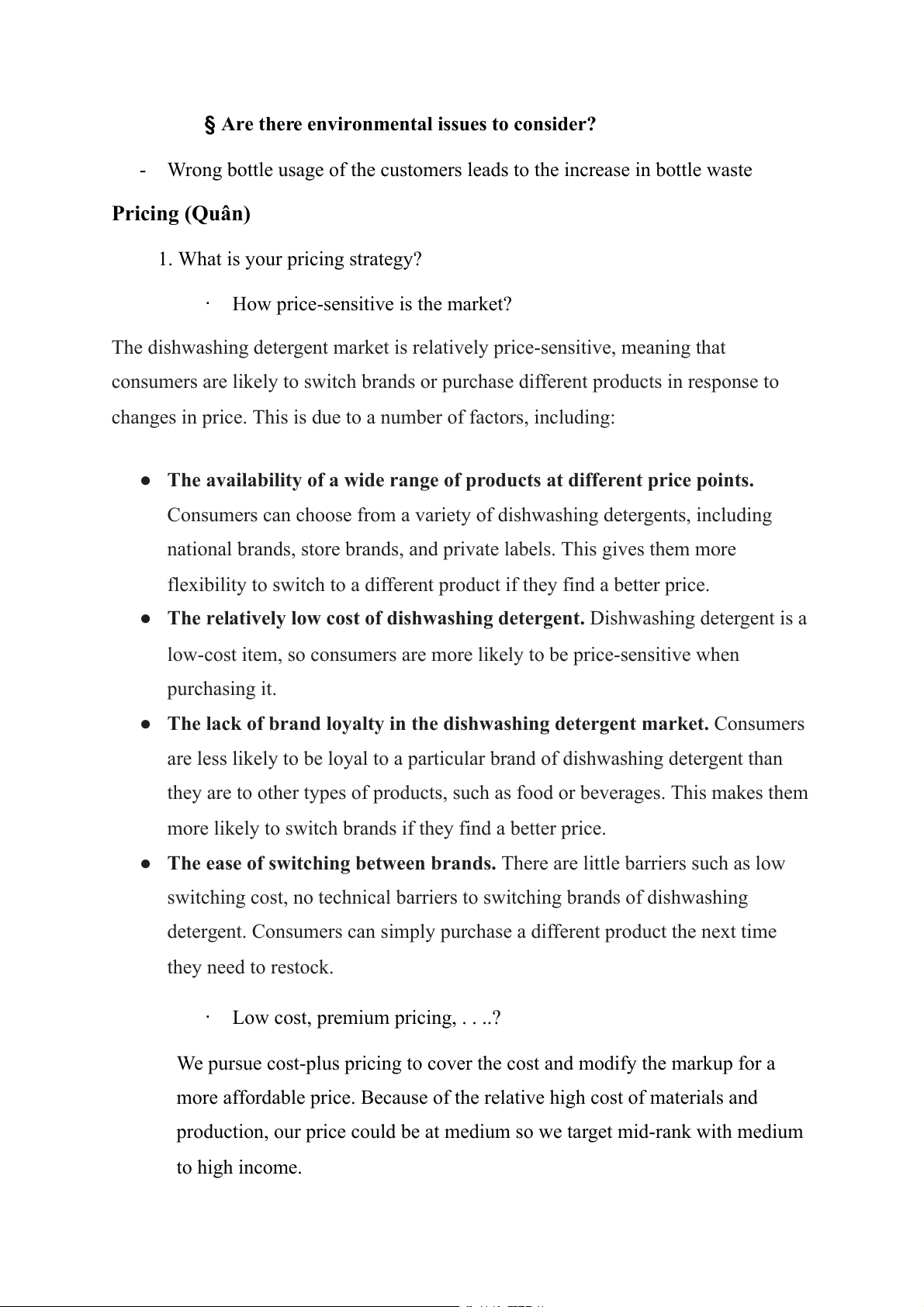
§ Are there environmental issues to consider? -
Wrong bottle usage of the customers leads to the increase in bottle waste Pricing (Quân)
1. What is your pricing strategy? ·
How price-sensitive is the market?
The dishwashing detergent market is relatively price-sensitive, meaning that
consumers are likely to switch brands or purchase different products in response to
changes in price. This is due to a number of factors, including:
● The availability of a wide range of products at different price points.
Consumers can choose from a variety of dishwashing detergents, including
national brands, store brands, and private labels. This gives them more
flexibility to switch to a different product if they find a better price.
● The relatively low cost of dishwashing detergent. Dishwashing detergent is a
low-cost item, so consumers are more likely to be price-sensitive when purchasing it.
● The lack of brand loyalty in the dishwashing detergent market. Consumers
are less likely to be loyal to a particular brand of dishwashing detergent than
they are to other types of products, such as food or beverages. This makes them
more likely to switch brands if they find a better price.
● The ease of switching between brands. There are little barriers such as low
switching cost, no technical barriers to switching brands of dishwashing
detergent. Consumers can simply purchase a different product the next time they need to restock. ·
Low cost, premium pricing, . . ..?
We pursue cost-plus pricing to cover the cost and modify the markup for a
more affordable price. Because of the relative high cost of materials and
production, our price could be at medium so we target mid-rank with medium to high income. · Why this strategy?
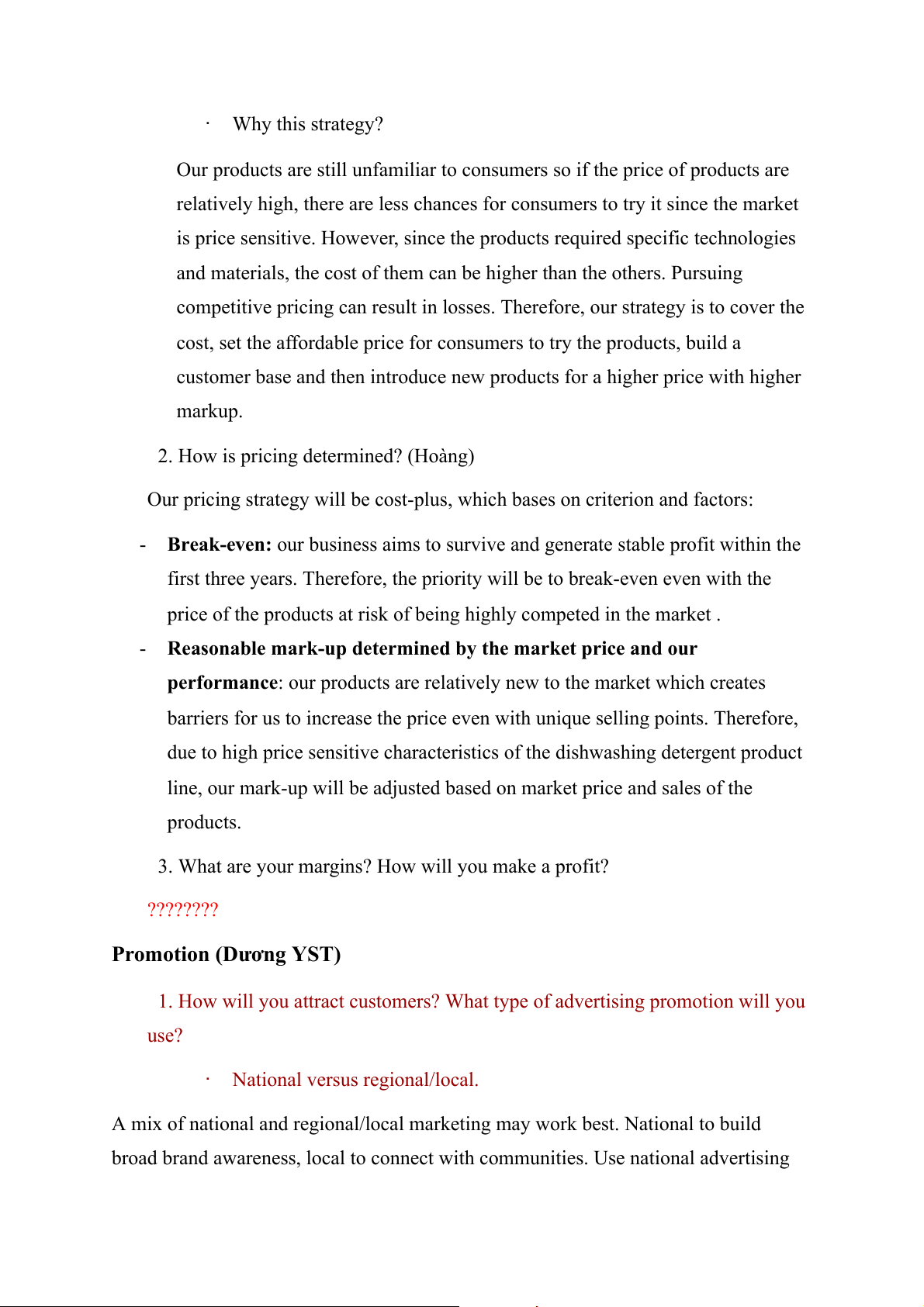
Our products are still unfamiliar to consumers so if the price of products are
relatively high, there are less chances for consumers to try it since the market
is price sensitive. However, since the products required specific technologies
and materials, the cost of them can be higher than the others. Pursuing
competitive pricing can result in losses. Therefore, our strategy is to cover the
cost, set the affordable price for consumers to try the products, build a
customer base and then introduce new products for a higher price with higher markup.
2. How is pricing determined? (Hoàng)
Our pricing strategy will be cost-plus, which bases on criterion and factors: -
Break-even: our business aims to survive and generate stable profit within the
first three years. Therefore, the priority will be to break-even even with the
price of the products at risk of being highly competed in the market . -
Reasonable mark-up determined by the market price and our
performance: our products are relatively new to the market which creates
barriers for us to increase the price even with unique selling points. Therefore,
due to high price sensitive characteristics of the dishwashing detergent product
line, our mark-up will be adjusted based on market price and sales of the products.
3. What are your margins? How will you make a profit? ???????? Promotion (Dương YST)
1. How will you attract customers? What type of advertising promotion will you use? ·
National versus regional/local.
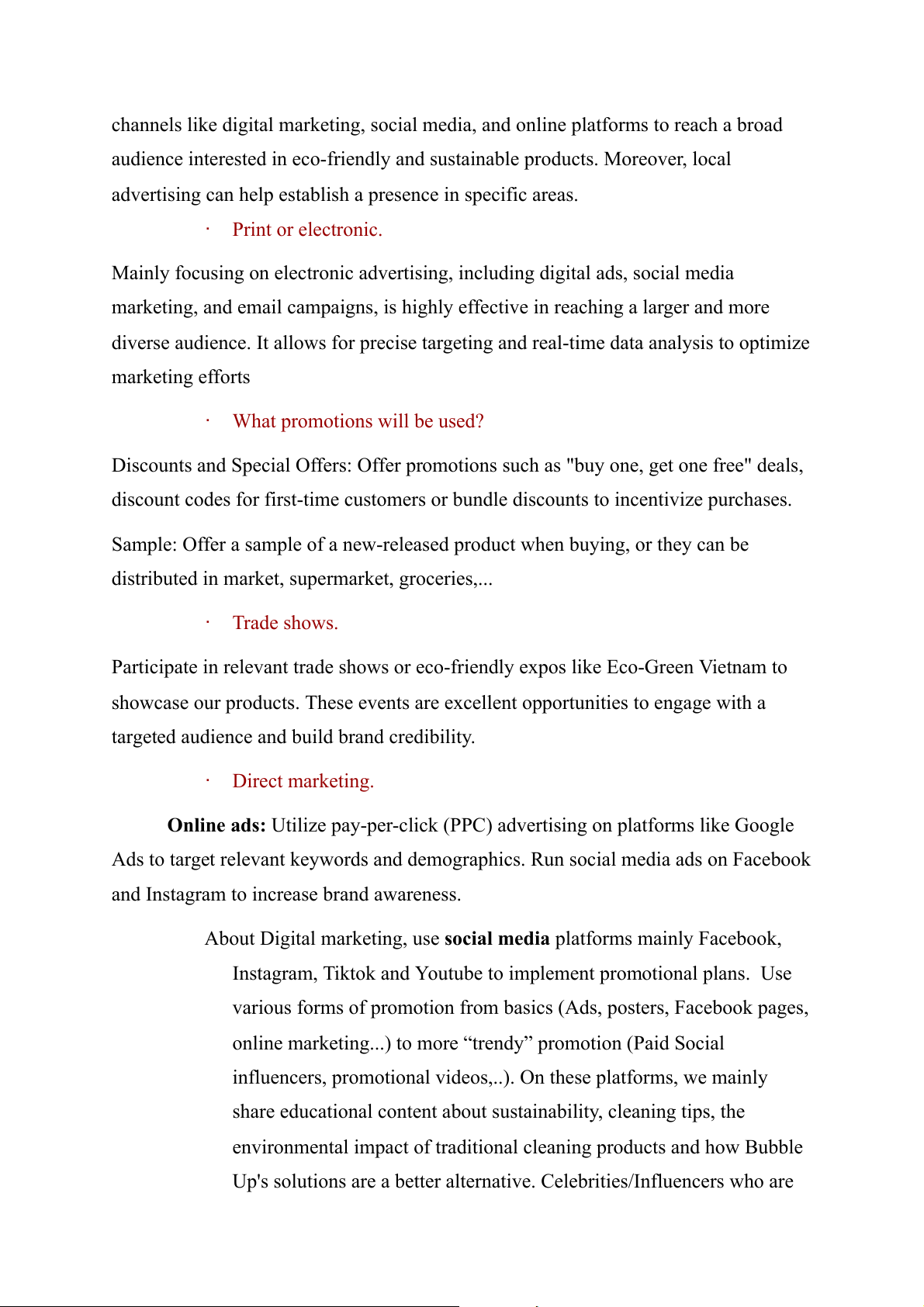
A mix of national and regional/local marketing may work best. National to build
broad brand awareness, local to connect with communities. Use national advertising
channels like digital marketing, social media, and online platforms to reach a broad
audience interested in eco-friendly and sustainable products. Moreover, local
advertising can help establish a presence in specific areas. · Print or electronic.
Mainly focusing on electronic advertising, including digital ads, social media
marketing, and email campaigns, is highly effective in reaching a larger and more
diverse audience. It allows for precise targeting and real-time data analysis to optimize marketing efforts · What promotions will be used?
Discounts and Special Offers: Offer promotions such as "buy one, get one free" deals,
discount codes for first-time customers or bundle discounts to incentivize purchases.
Sample: Offer a sample of a new-released product when buying, or they can be
distributed in market, supermarket, groceries,... · Trade shows.
Participate in relevant trade shows or eco-friendly expos like Eco-Green Vietnam to
showcase our products. These events are excellent opportunities to engage with a
targeted audience and build brand credibility. · Direct marketing.
Online ads: Utilize pay-per-click (PPC) advertising on platforms like Google
Ads to target relevant keywords and demographics. Run social media ads on Facebook
and Instagram to increase brand awareness.
About Digital marketing, use social media platforms mainly Facebook,
Instagram, Tiktok and Youtube to implement promotional plans. Use
various forms of promotion from basics (Ads, posters, Facebook pages,
online marketing...) to more “trendy” promotion (Paid Social
influencers, promotional videos,..). On these platforms, we mainly
share educational content about sustainability, cleaning tips, the
environmental impact of traditional cleaning products and how Bubble
Up's solutions are a better alternative. Celebrities/Influencers who are
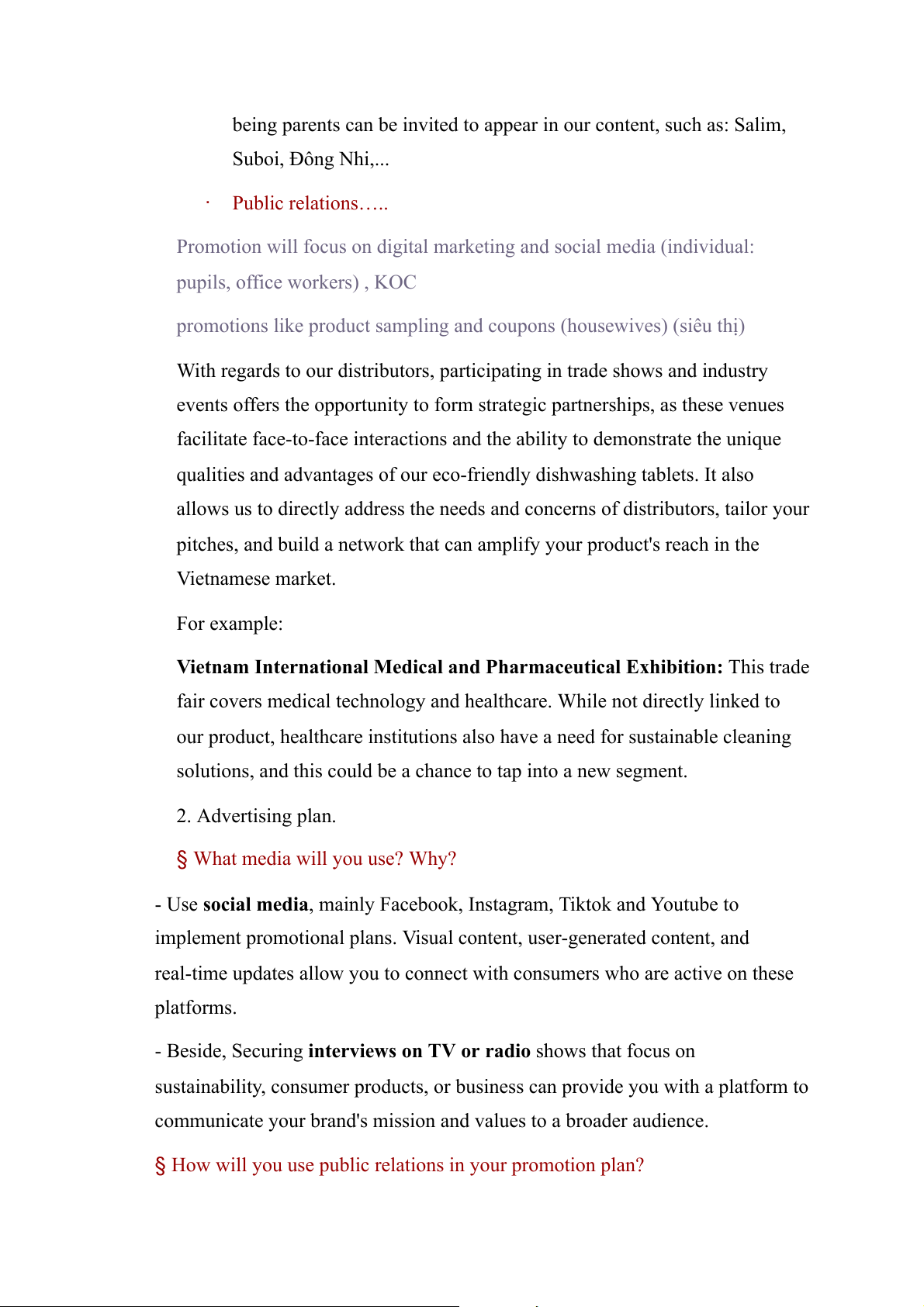
being parents can be invited to appear in our content, such as: Salim, Suboi, Đông Nhi,... · Public relations…..
Promotion will focus on digital marketing and social media (individual: pupils, office workers) , KOC
promotions like product sampling and coupons (housewives) (siêu thị)
With regards to our distributors, participating in trade shows and industry
events offers the opportunity to form strategic partnerships, as these venues
facilitate face-to-face interactions and the ability to demonstrate the unique
qualities and advantages of our eco-friendly dishwashing tablets. It also
allows us to directly address the needs and concerns of distributors, tailor your
pitches, and build a network that can amplify your product's reach in the Vietnamese market. For example:
Vietnam International Medical and Pharmaceutical Exhibition: This trade
fair covers medical technology and healthcare. While not directly linked to
our product, healthcare institutions also have a need for sustainable cleaning
solutions, and this could be a chance to tap into a new segment. 2. Advertising plan.
§ What media will you use? Why?
- Use social media, mainly Facebook, Instagram, Tiktok and Youtube to
implement promotional plans. Visual content, user-generated content, and
real-time updates allow you to connect with consumers who are active on these platforms.
- Beside, Securing interviews on TV or radio shows that focus on
sustainability, consumer products, or business can provide you with a platform to
communicate your brand's mission and values to a broader audience.
§ How will you use public relations in your promotion plan?
A lot of sales promotions -> collaborate with Shopee to take a portion of its sold
product on Shopee’s super sales day to donate to local charities to help with
climate change and local pollution. -> The price of these products will be lower
than usual to attract more customers. -> also spread brand awareness and good
PR (public relations) strategy.
§ Scheduling plans. (chép slide) 3. Budget. (Hoàng)
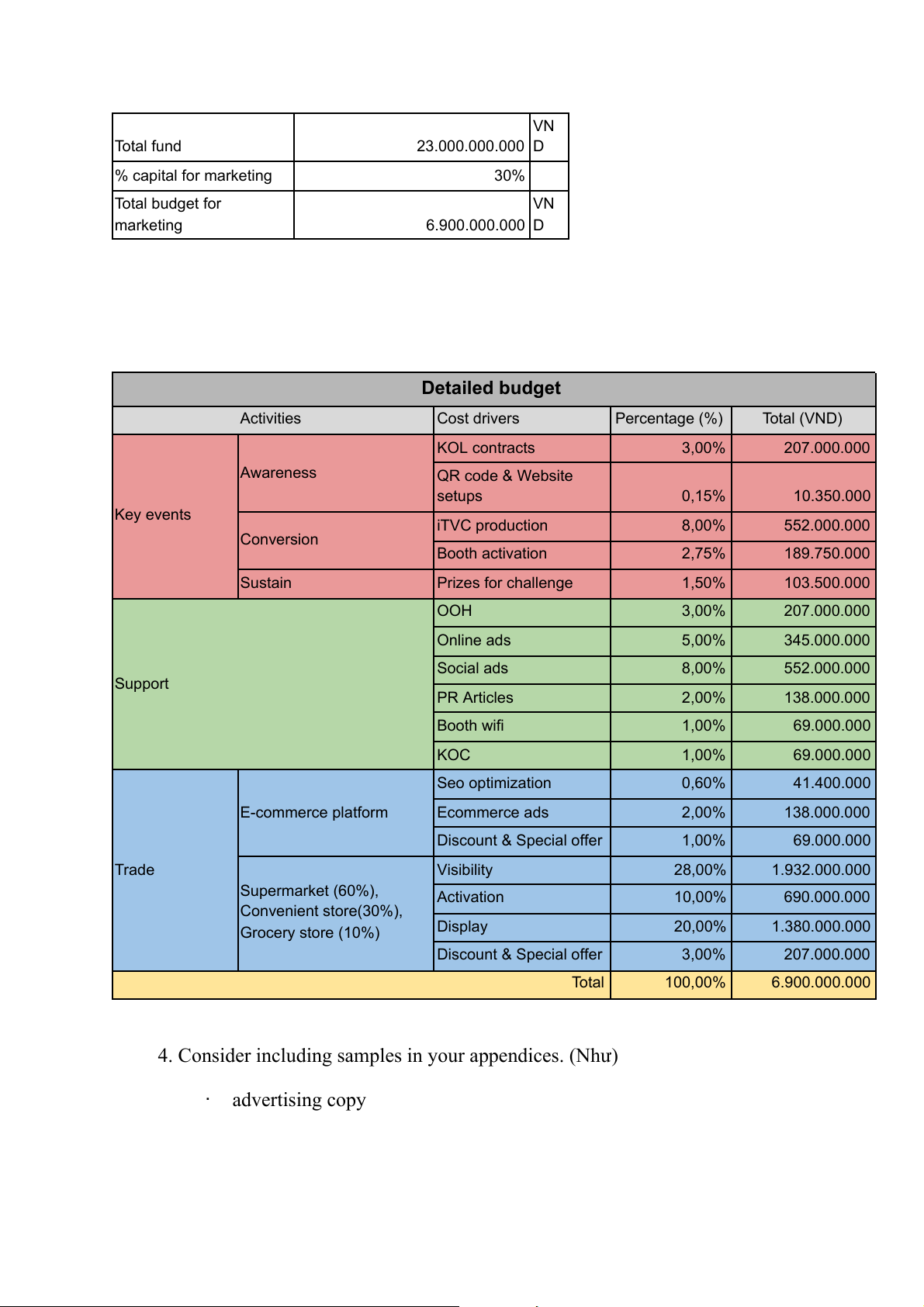
§ What percentage of sales will you spend on promotion?
We will spend 30% of our operating. This is reasonable because Bubble Up is a
new product in the market, and it's common for companies to allocate a higher
percentage of sales to promotions to build brand awareness and establish a customer base.
§ What budgeting method will you use? Why?
We plan to firstly use activity-based method then from the second year, we might
use incremental budgeting. However, if there is any uncertainty, we will apply zero-based method.
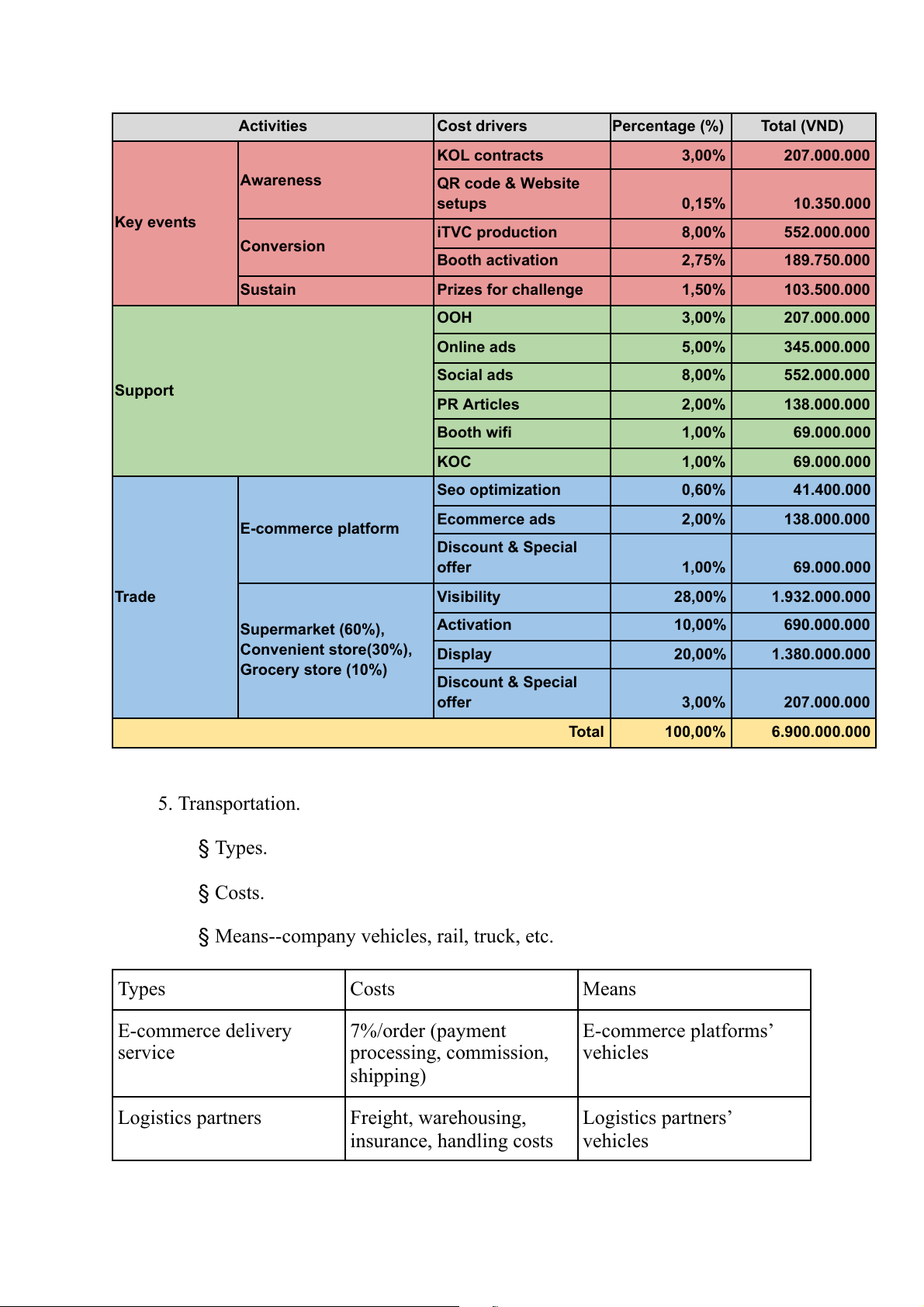
§ Refer to the detailed budget in your appendices. (Quân?) Unit VN Total fund 23.000.000.000 D % capital for marketing 30% Total budget for VN marketing 6.900.000.000 D Detailed budget Activities Cost drivers Percentage (%) Total (VND) KOL contracts 3,00% 207.000.000 Awareness QR code & Website setups 0,15% 10.350.000 Key events iTVC production 8,00% 552.000.000 Conversion Booth activation 2,75% 189.750.000 Sustain Prizes for challenge 1,50% 103.500.000 OOH 3,00% 207.000.000 Online ads 5,00% 345.000.000 Social ads 8,00% 552.000.000 Support PR Articles 2,00% 138.000.000 Booth wifi 1,00% 69.000.000 KOC 1,00% 69.000.000 Seo optimization 0,60% 41.400.000 E-commerce platform Ecommerce ads 2,00% 138.000.000 Discount & Special offer 1,00% 69.000.000 Trade Visibility 28,00% 1.932.000.000 Supermarket (60%), Activation 10,00% 690.000.000 Convenient store(30%), Grocery store (10%) Display 20,00% 1.380.000.000 Discount & Special offer 3,00% 207.000.000 Total 100,00% 6.900.000.000
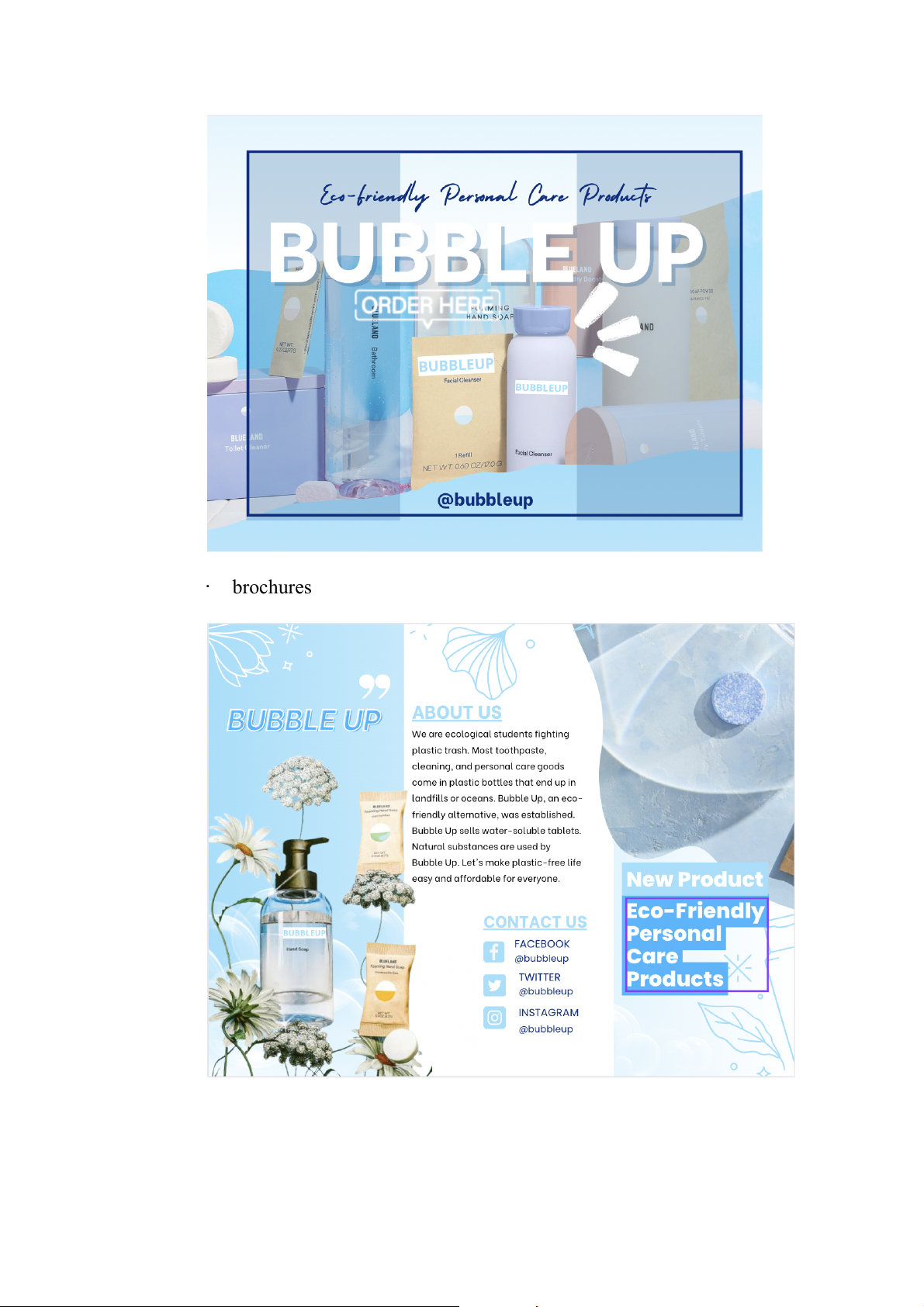
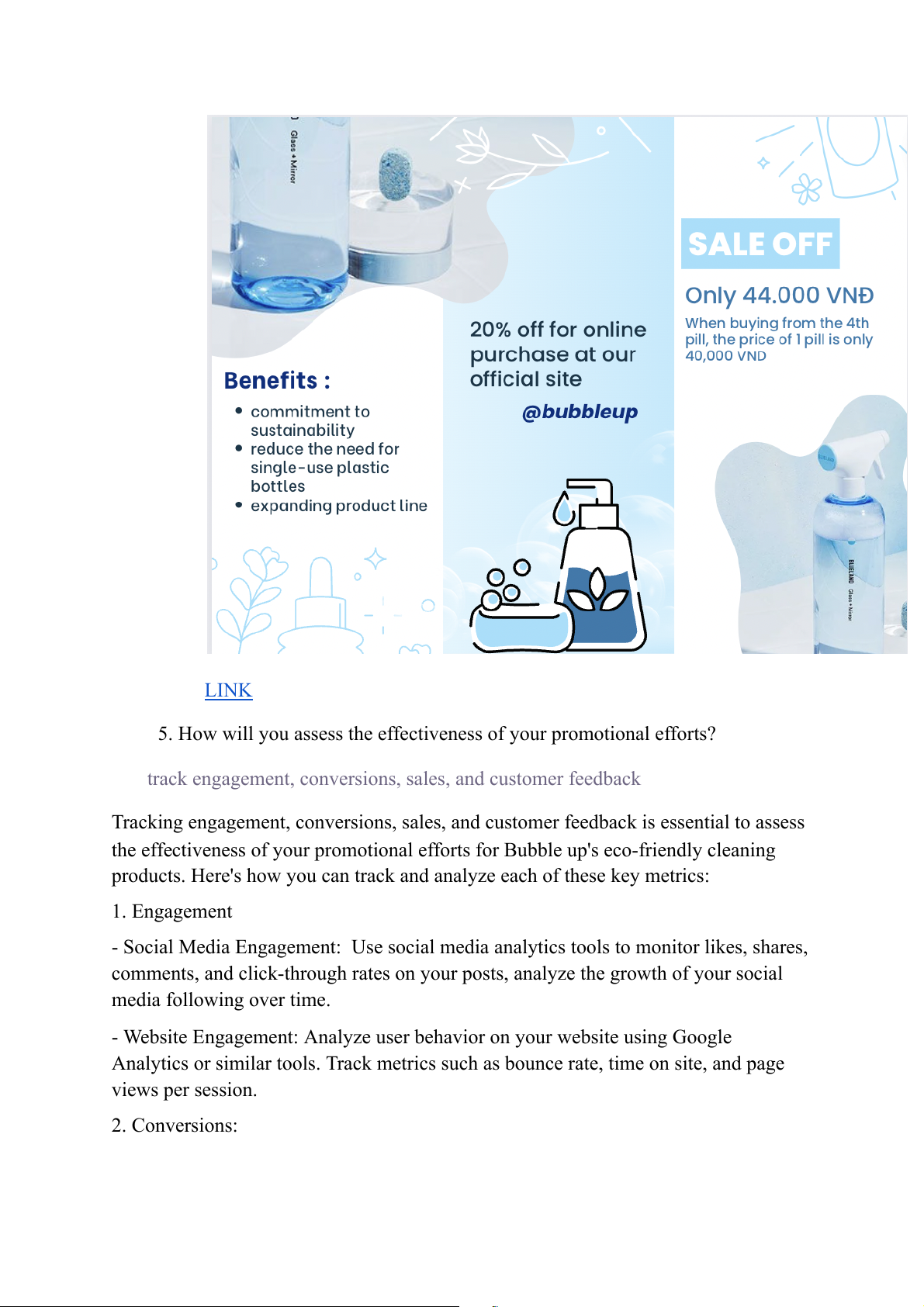
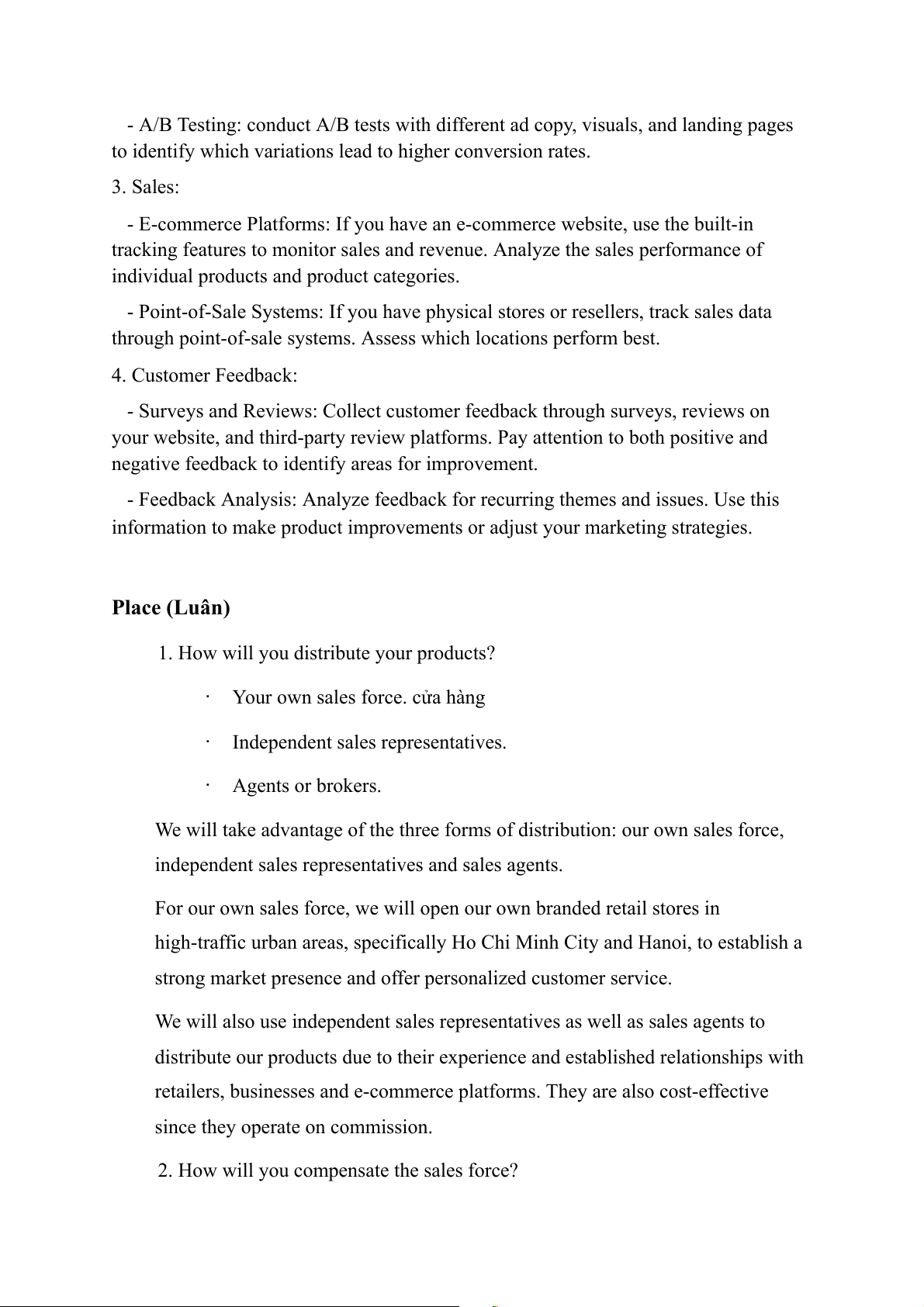
4. Consider including samples in your appendices. (Như) · advertising copy · brochures LINK
5. How will you assess the effectiveness of your promotional efforts?
track engagement, conversions, sales, and customer feedback
Tracking engagement, conversions, sales, and customer feedback is essential to assess
the effectiveness of your promotional efforts for Bubble up's eco-friendly cleaning
products. Here's how you can track and analyze each of these key metrics: 1. Engagement
- Social Media Engagement: Use social media analytics tools to monitor likes, shares,
comments, and click-through rates on your posts, analyze the growth of your social media following over time.
- Website Engagement: Analyze user behavior on your website using Google
Analytics or similar tools. Track metrics such as bounce rate, time on site, and page views per session. 2. Conversions:
- A/B Testing: conduct A/B tests with different ad copy, visuals, and landing pages
to identify which variations lead to higher conversion rates. 3. Sales:
- E-commerce Platforms: If you have an e-commerce website, use the built-in
tracking features to monitor sales and revenue. Analyze the sales performance of
individual products and product categories.
- Point-of-Sale Systems: If you have physical stores or resellers, track sales data
through point-of-sale systems. Assess which locations perform best. 4. Customer Feedback:
- Surveys and Reviews: Collect customer feedback through surveys, reviews on
your website, and third-party review platforms. Pay attention to both positive and
negative feedback to identify areas for improvement.
- Feedback Analysis: Analyze feedback for recurring themes and issues. Use this
information to make product improvements or adjust your marketing strategies. Place (Luân)
1. How will you distribute your products? ·
Your own sales force. cửa hàng ·
Independent sales representatives. · Agents or brokers.
We will take advantage of the three forms of distribution: our own sales force,
independent sales representatives and sales agents.
For our own sales force, we will open our own branded retail stores in
high-traffic urban areas, specifically Ho Chi Minh City and Hanoi, to establish a
strong market presence and offer personalized customer service.
We will also use independent sales representatives as well as sales agents to
distribute our products due to their experience and established relationships with
retailers, businesses and e-commerce platforms. They are also cost-effective
since they operate on commission.
2. How will you compensate the sales force?
Our own sales force will receive salary and performance bonuses, and
independent sales representatives as well as sales agents will receive commission and performance bonuses. Salary: 7,000,000 VND/month
Commission: Earn 10% of the sales they generate.
Performance Bonuses: Additional compensation of 5% (on salary for our own
sales force, and on commission for independent sales representatives and sales agents).
3. How will you structure the sales force, their territories, the product lines, etc.?
Our own sales force will manage one Bubble Up-branded retail store in Hanoi, and one in Ho Chi Minh City.
Independent sales representatives are assigned for supermarket, grocery store
and business distribution. They are usually better for supermarkets where
building a direct relationship is crucial. They can negotiate shelf space, manage
in-store promotions, and ensure that the products are well-represented. For local
grocery stores, independent representatives can provide a personalized approach,
which is valuable for establishing strong relationships and understanding local
market needs. With regards to businesses in hospitality or restaurant fields, they
are believed to have a strong network, specialized knowledge as well as a
committed presence to align with our brand and effectively engage with our customers.
Sales agents are assigned for e-commerce platforms and convenience stores.
Sales agents can be effective for e-commerce platforms because they might have
better knowledge of digital sales environments and can manage relationships
with online retailers or platforms. They can also handle convenience stores
efficiently due to the typically lower individual sales volume per store. They can
also be adept at managing several small accounts and ensuring compliance with local demands. 4. Sales plan.
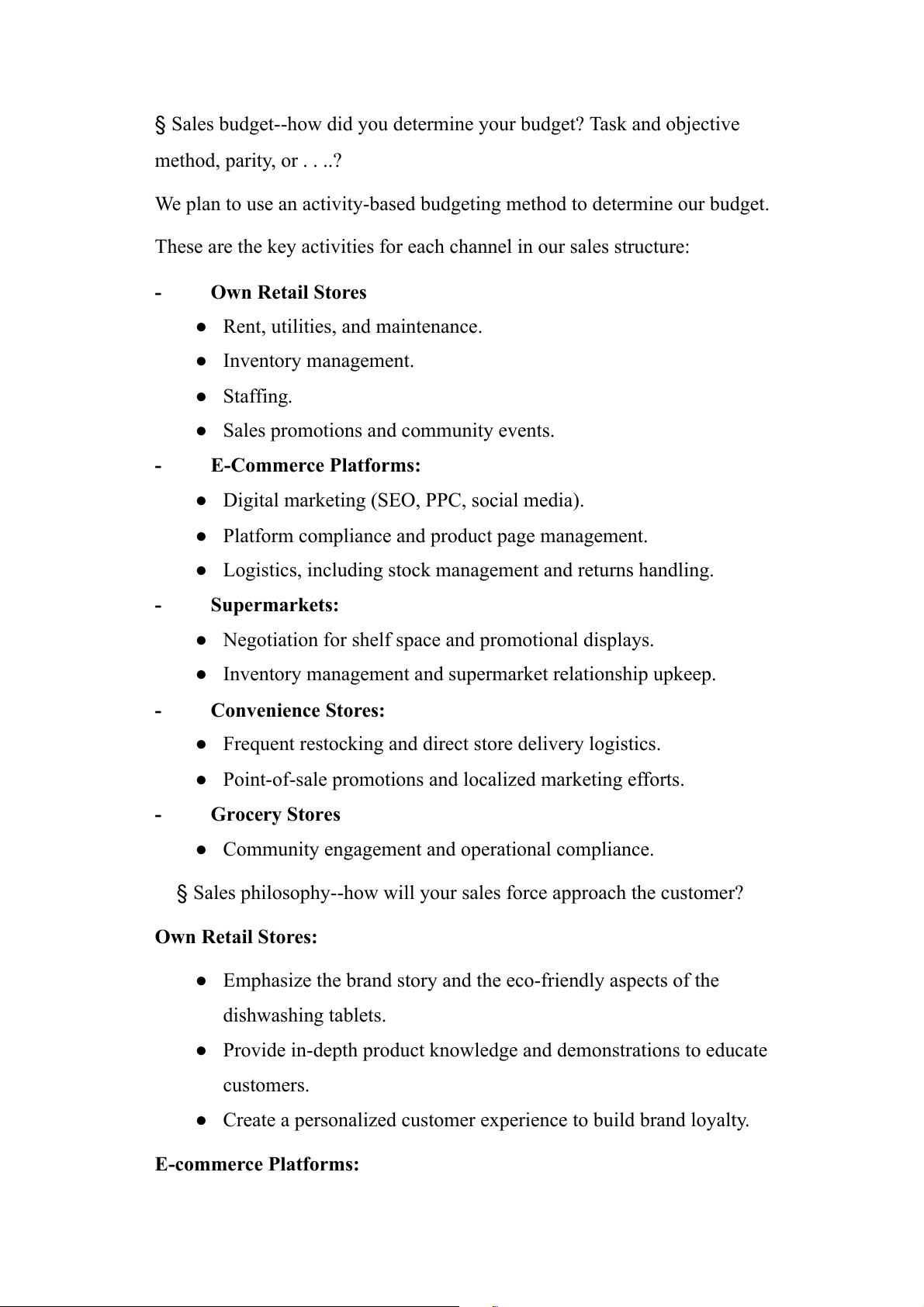
§ Sales budget--how did you determine your budget? Task and objective method, parity, or . . ..?
We plan to use an activity-based budgeting method to determine our budget.
These are the key activities for each channel in our sales structure: - Own Retail Stores
● Rent, utilities, and maintenance. ● Inventory management. ● Staffing.
● Sales promotions and community events. - E-Commerce Platforms:
● Digital marketing (SEO, PPC, social media).
● Platform compliance and product page management.
● Logistics, including stock management and returns handling. - Supermarkets:
● Negotiation for shelf space and promotional displays.
● Inventory management and supermarket relationship upkeep. - Convenience Stores:
● Frequent restocking and direct store delivery logistics.
● Point-of-sale promotions and localized marketing efforts. - Grocery Stores
● Community engagement and operational compliance.
§ Sales philosophy--how will your sales force approach the customer? Own Retail Stores:
● Emphasize the brand story and the eco-friendly aspects of the dishwashing tablets.
● Provide in-depth product knowledge and demonstrations to educate customers.
● Create a personalized customer experience to build brand loyalty. E-commerce Platforms:
● Focus on digital marketing strategies that highlight the sustainable aspects of the product.
● Use SEO to improve visibility in searches related to eco-friendly products.
● Offer competitive pricing, bundle deals, and subscriptions for repeat purchases. Supermarkets:
● Negotiate for shelf placement that aligns with eco-friendly or organic products.
● Engage in in-store promotions and demonstrations to educate customers.
● Work with supermarket chains for circulars, flyers, and eco-focused events. Convenience Stores:
● Emphasize quick, easy, and accessible eco-friendly solutions.
● Ensure the product packaging stands out for impulse buys.
● Offer smaller or trial-sized packages to encourage first-time purchases. Grocery Stores:
● Build personal relationships with store owners for better product
placement and joint promotions.
● Offer store owners exclusive discounts, competitive prices and ensure them a reliable supply.
§ Refer to the detailed budget in your appendices. (Quan) Unit VN Total fund 23.000.000.000 D % capital for marketing 30% Total budget for VN marketing 6.900.000.000 D Detailed budget Activities Cost drivers Percentage (%) Total (VND) KOL contracts 3,00% 207.000.000 Awareness QR code & Website setups 0,15% 10.350.000 Key events iTVC production 8,00% 552.000.000 Conversion Booth activation 2,75% 189.750.000 Sustain Prizes for challenge 1,50% 103.500.000 OOH 3,00% 207.000.000 Online ads 5,00% 345.000.000 Social ads 8,00% 552.000.000 Support PR Articles 2,00% 138.000.000 Booth wifi 1,00% 69.000.000 KOC 1,00% 69.000.000 Seo optimization 0,60% 41.400.000 Ecommerce ads 2,00% 138.000.000 E-commerce platform Discount & Special offer 1,00% 69.000.000 Trade Visibility 28,00% 1.932.000.000 Supermarket (60%), Activation 10,00% 690.000.000 Convenient store(30%), Display 20,00% 1.380.000.000 Grocery store (10%) Discount & Special offer 3,00% 207.000.000 Total 100,00% 6.900.000.000 5. Transportation. § Types. § Costs.
§ Means--company vehicles, rail, truck, etc. Types Costs Means E-commerce delivery 7%/order (payment E-commerce platforms’ service processing, commission, vehicles shipping) Logistics partners Freight, warehousing, Logistics partners’ insurance, handling costs vehicles Service Policies (Nhung)
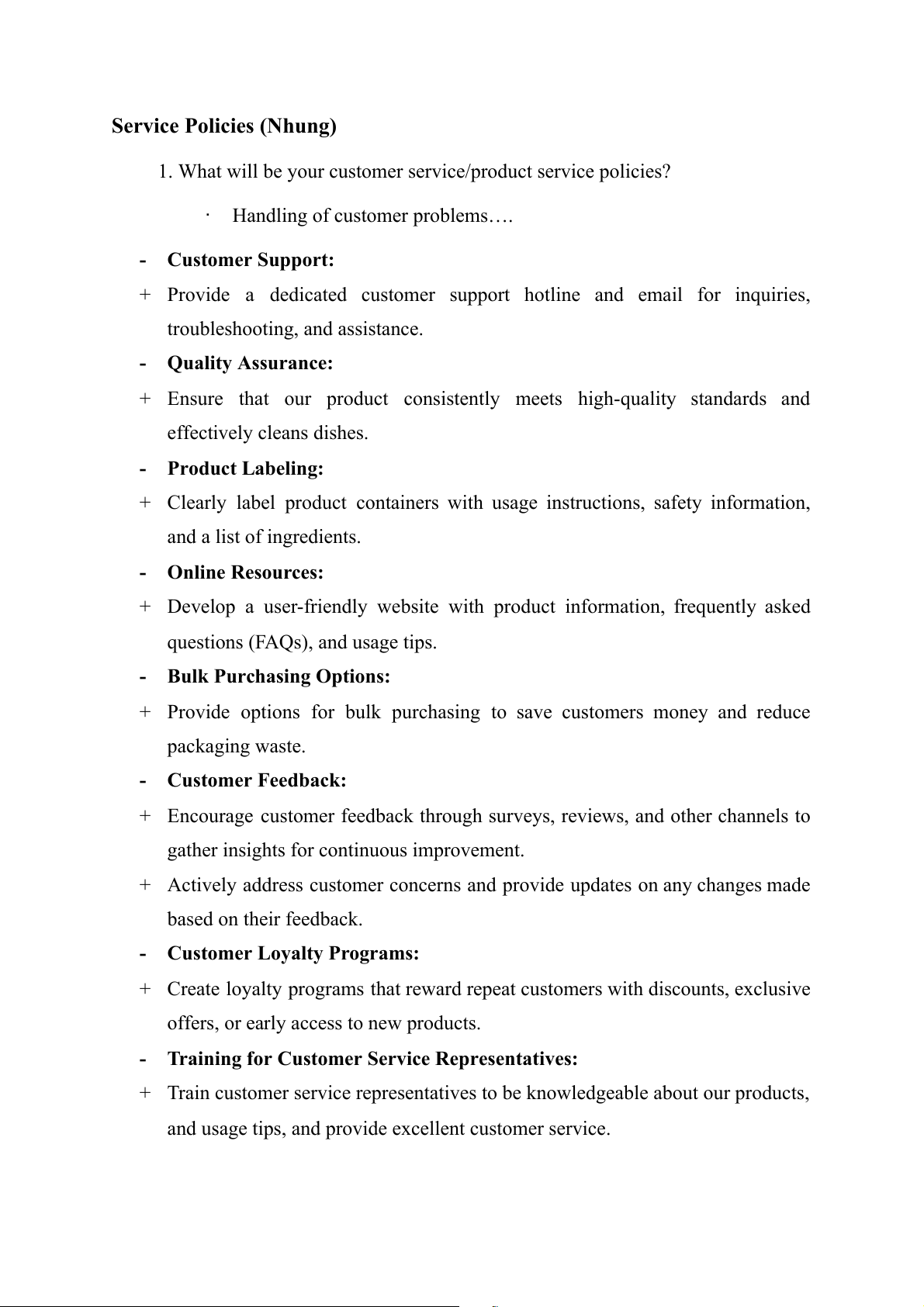
1. What will be your customer service/product service policies? ·
Handling of customer problems…. - Customer Support:
+ Provide a dedicated customer support hotline and email for inquiries,
troubleshooting, and assistance. - Quality Assurance:
+ Ensure that our product consistently meets high-quality standards and effectively cleans dishes. - Product Labeling:
+ Clearly label product containers with usage instructions, safety information, and a list of ingredients. - Online Resources:
+ Develop a user-friendly website with product information, frequently asked
questions (FAQs), and usage tips. - Bulk Purchasing Options:
+ Provide options for bulk purchasing to save customers money and reduce packaging waste. - Customer Feedback:
+ Encourage customer feedback through surveys, reviews, and other channels to
gather insights for continuous improvement.
+ Actively address customer concerns and provide updates on any changes made based on their feedback. - Customer Loyalty Programs:
+ Create loyalty programs that reward repeat customers with discounts, exclusive
offers, or early access to new products. -
Training for Customer Service Representatives:
+ Train customer service representatives to be knowledgeable about our products,
and usage tips, and provide excellent customer service.
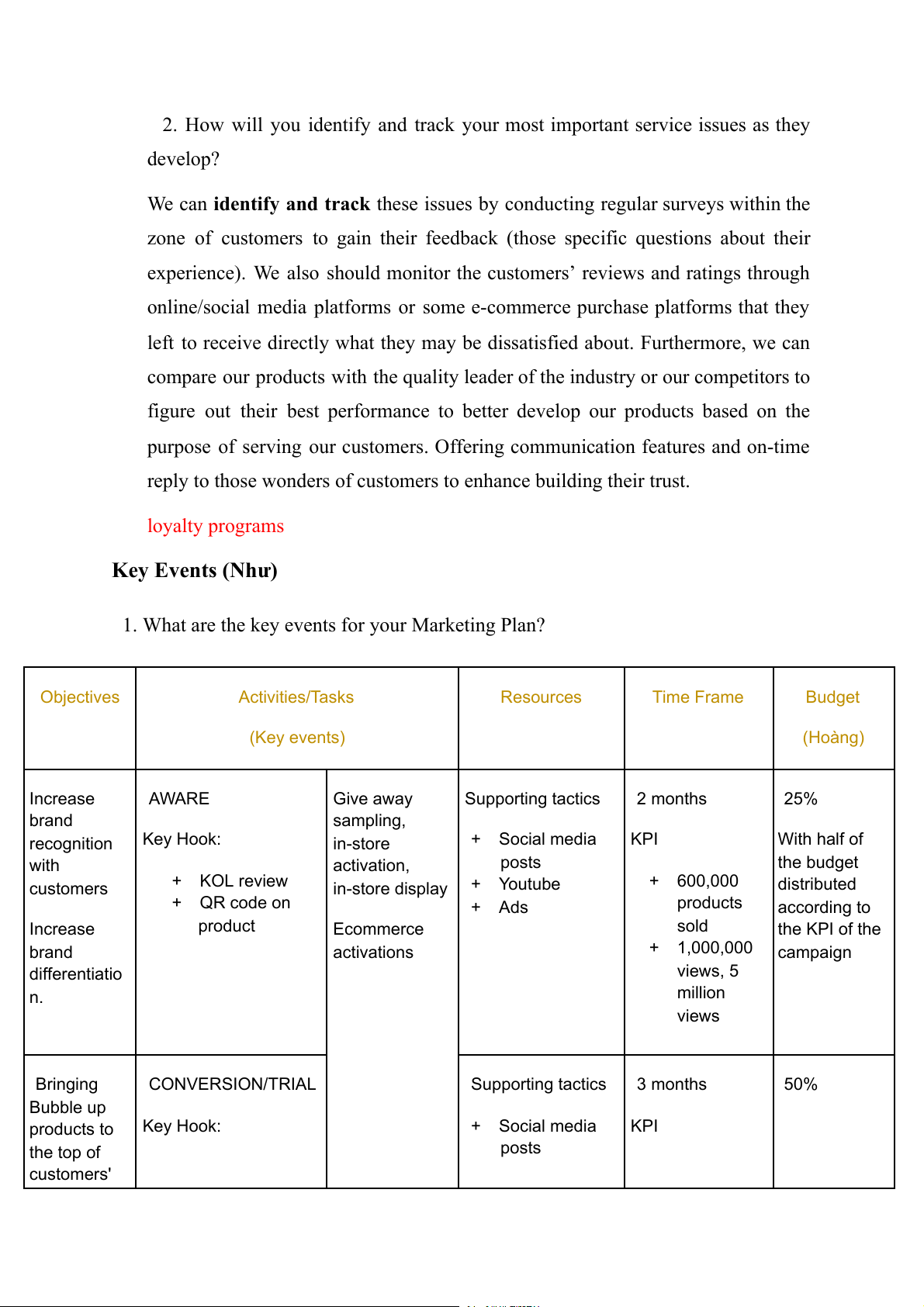
2. How will you identify and track your most important service issues as they develop?
We can identify and track these issues by conducting regular surveys within the
zone of customers to gain their feedback (those specific questions about their
experience). We also should monitor the customers’ reviews and ratings through
online/social media platforms or some e-commerce purchase platforms that they
left to receive directly what they may be dissatisfied about. Furthermore, we can
compare our products with the quality leader of the industry or our competitors to
figure out their best performance to better develop our products based on the
purpose of serving our customers. Offering communication features and on-time
reply to those wonders of customers to enhance building their trust. loyalty programs Key Events (Như)
1. What are the key events for your Marketing Plan? Objectives Activities/Tasks Resources Time Frame Budget (Key events) (Hoàng) Increase AWARE Give away Supporting tactics 2 months 25% brand sampling, recognition Key Hook: in-store + Social media KPI With half of with activation, posts the budget customers + KOL review in-store display + Youtube + 600,000 distributed + QR code on + Ads products according to Increase product Ecommerce sold the KPI of the brand activations + 1,000,000 campaign differentiatio views, 5 n. million views Bringing CONVERSION/TRIAL Supporting tactics 3 months 50% Bubble up products to Key Hook: + Social media KPI the top of posts customers' minds, + iTVC series + PR articles + 1,000,000 increasing “Clean up OOH KOCs products trials. with Bubble + Booth Wifi sold up - mood up, Marketing Ads 3,000,000 Increase house clean" visits awareness + Booth 500,000 of the role of activation followers providing energy in specific situations such as loss of concentratio n when balancing personal and external work. Maintain SUSTAIN + Social 1 month 25% purchasing media posts actions and Key Hook: + PR articles KPI convert into + KOCs loyal + Tiktok + Capcut + 450,000 customers. challenge + Youtube products + hashtag sold #Bubble up + 1,000,000 approaches + 100,000 followers
2. Time/Event Chart (you can include a chart or time line in your appendices
and simply reference the key events in the body of the plan)
Tài liệu liên quan:
-
Analysis of Industry and Market Trends | Lập kế hoạch kinh doanh | Trường Đại học Kiến trúc Đà Nẵng
16 8 -
Kế hoạch tổ chức workshop định hướng nghề nghiệp” | Lập kế hoạch kinh doanh | Trường Đại học Kiến trúc Đà Nẵng
13 7 -
Kế hoạch sản xuất và vận hành sản phẩm Bath Bomb | Lập kế hoạch kinh doanh | Trường Đại học Kiến trúc Đà Nẵng
14 7 -
So Sánh Kế Hoạch Kinh Doanh - Nhóm Handmade | Lập kế hoạch kinh doanh | Trường Đại học Kiến trúc Đà Nẵng
15 8 -
Phân tích Doanh nghiệp - Thiết kế và Đánh giá Sản phẩm Mới | Lập kế hoạch kinh doanh | Trường Đại học Kiến trúc Đà Nẵng
15 8