Midterm Solutions for Chapter 3: Adjusting Accounts | Nguyên lý kế | Trường Đại học Ngoại thương
1. (a) Under the time period assumption, an accountant is required to determine the relevance of each business transaction to specific accounting periods. (b) An accounting time period of one year in length is referred to as a fiscal year. A fiscal year that extends from January 1 to December 31 is referred to as a calendar year. Accounting periods of less than one year are called interim periods. LO: 3.1 Difficulty: Easy BLOOMCODE: Comprehension AACSB: Reflective thinking. Tài liệu được sưu tầm và soạn thảo dưới dạng file PDF để gửi tới các bạn cùng tham khảo, ôn tập đầy đủ kiến thức, chuẩn bị cho các buổi học thật tốt. Mời bạn đọc đón xem!
Môn: Nguyên lý kế toán (KETH201) 12 tài liệu
Trường: Trường Đại học Ngoại Thương 1.1 K tài liệu
Tác giả:







Preview text:
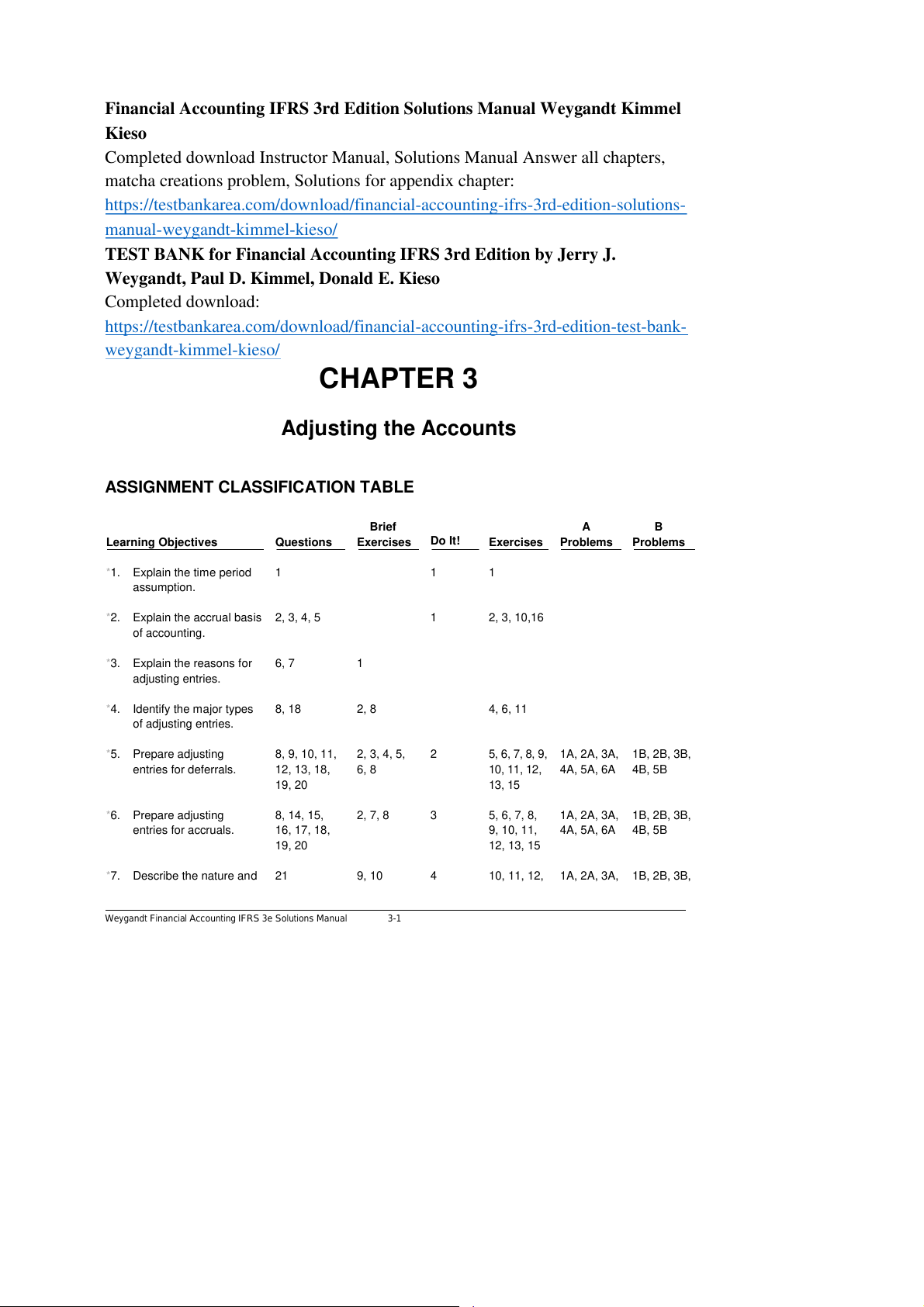
Financial Accounting IFRS 3rd Edition Solutions Manual Weygandt Kimmel Kieso
Completed download Instructor Manual, Solutions Manual Answer all chapters,
matcha creations problem, Solutions for appendix chapter:
https://testbankarea.com/download/financial-accounting-ifrs-3rd-edition-solutions- manual-weygandt-kimmel-kieso/
TEST BANK for Financial Accounting IFRS 3rd Edition by Jerry J.
Weygandt, Paul D. Kimmel, Donald E. Kieso Completed download:
https://testbankarea.com/download/financial-accounting-ifrs-3rd-edition-test-bank- weygandt-kimmel-kieso/ CHAPTER 3 Adjusting the Accounts
ASSIGNMENT CLASSIFICATION TABLE Brief A B Learning Objectives Questions Exercises Do It! Exercises Problems Problems *1. Explain the time period 1 1 1 assumption.
*2. Explain the accrual basis 2, 3, 4, 5 1 2, 3, 10,16 of accounting.
*3. Explain the reasons for 6, 7 1 adjusting entries.
*4. Identify the major types 8, 18 2, 8 4, 6, 11 of adjusting entries. *5. Prepare adjusting 8, 9, 10, 11, 2, 3, 4, 5, 2
5, 6, 7, 8, 9, 1A, 2A, 3A, 1B, 2B, 3B, entries for deferrals. 12, 13, 18, 6, 8 10, 11, 12, 4A, 5A, 6A 4B, 5B 19, 20 13, 15 *6. Prepare adjusting 8, 14, 15, 2, 7, 8 3
5, 6, 7, 8, 1A, 2A, 3A, 1B, 2B, 3B, entries for accruals. 16, 17, 18, 9, 10, 11, 4A, 5A, 6A 4B, 5B 19, 20 12, 13, 15
*7. Describe the nature and 21 9, 10 4
10, 11, 12, 1A, 2A, 3A, 1B, 2B, 3B,
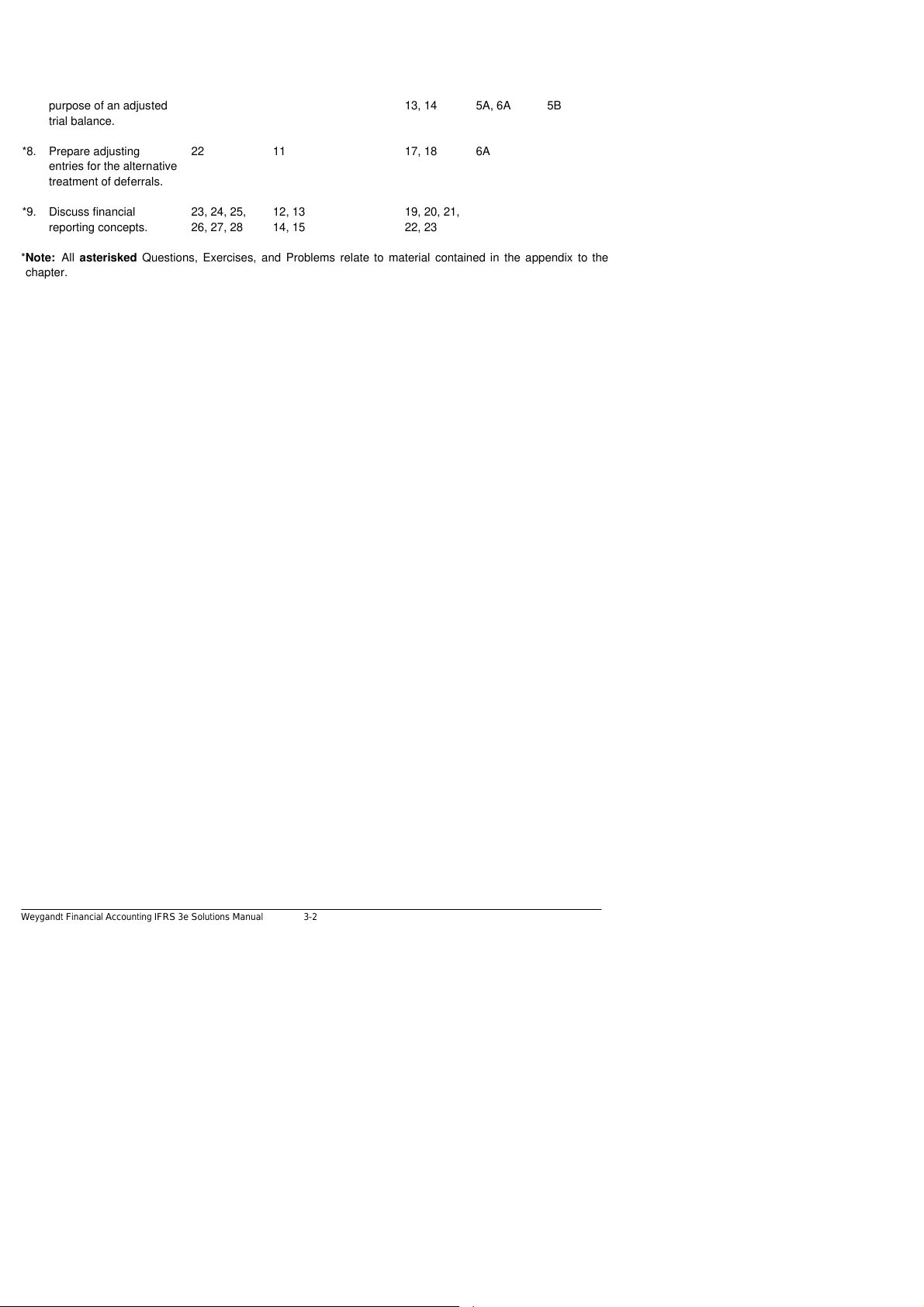
Weygandt Financial Accounting IFRS 3e Solutions Manual 3-1 purpose of an adjusted 13, 14 5A, 6A 5B trial balance. *8. Prepare adjusting 22 11 17, 18 6A entries for the alternative treatment of deferrals. *9. Discuss financial 23, 24, 25, 12, 13 19, 20, 21, reporting concepts. 26, 27, 28 14, 15 22, 23
*Note: Al asterisked Questions, Exercises, and Problems relate to material contained in the appendix to the chapter.
Weygandt Financial Accounting IFRS 3e Solutions Manual 3-2
ASSIGNMENT CHARACTERISTICS TABLE Problem Difficulty Time Number Description Level Allotted (min.)
1A Prepare adjusting entries, post to ledger accounts, Simple 40–50
and prepare an adjusted trial balance.
2A Prepare adjusting entries, post, and prepare adjusted Simple 50–60
trial balance and financial statements.
3A Prepare adjusting entries and financial statements. Moderate 40–50 4A Prepare adjusting entries. Moderate 30–40
5A Journalize transactions and fol ow through accounting Moderate 60–70
cycle to preparation of financial statements.
*6A* Prepare adjusting entries, adjusted trial balance, Moderate 40–50
and financial statements using appendix.
1B Prepare adjusting entries, post to ledger accounts, Simple 40–50
and prepare an adjusted trial balance.
2B Prepare adjusting entries, post, and prepare adjusted Simple 50–60
trial balance and financial statements.
3B Prepare adjusting entries and financial statements. Moderate 40–50 4B Prepare adjusting entries. Moderate 30–40
5B Journalize transactions and fol ow through accounting Moderate 60–70
cycle to preparation of financial statements.
Weygandt Financial Accounting IFRS 3e Solutions Manual 3-3
WEYGANDT FINANCIAL ACCOUNTING, IFRS EDITION, 3e CHAPTER 3 ADJUSTING THE ACCOUNTS Number LO BT Difficulty Time (min.) BE1 3 C Simple 4–6 BE2 4–6 AN Moderate 6–8 BE3 5 AN Simple 3–5 BE4 5 AN Simple 3–5 BE5 5 AN Simple 2–4 BE6 5 AN Simple 2–4 BE7 6 AN Simple 4–6 BE8 4–6 AN Simple 5–7 BE9 7 AP Simple 4–6 BE10 7 AP Simple 2–4 BE11* 8 AN Moderate 3–5 BE12* 9 K Simple 3–5 BE13* 9 K Simple 2–4 BE14* 9 K Simple 2–4 BE15* 9 K Simple 1–2 DI1 1, 2 K Simple 2–4 DI2 5 AN Simple 6–8 DI3 6 AN Simple 4–6 DI4 7 AN Moderate 20–30 EX1 1 C Simple 3–5 EX2 2 E Moderate 10–15 EX3 2 AP Simple 6–8 EX4 4 AN Simple 5–6 EX5 5, 6 AN Moderate 10–15 EX6 4–6 AN Moderate 10–12 EX7 5, 6 AN Moderate 8–10 EX8 5, 6 AN Moderate 8–10 EX9 5, 6 AN Simple 8–10 EX10 2, 5–7 AN Moderate 8–10 EX11 4–7 AN Moderate 12–15 EX12 5–7 AN Moderate 8–10
Weygandt Financial Accounting IFRS 3e Solutions Manual 3-4
ADJUSTING THE ACCOUNTS (Continued) Number LO BT Difficulty Time (min.) EX13 5–7 AN Simple 8–10 EX14 7 AP Simple 12–15 EX15 5, 6 AN, S Moderate 8–10 EX16 2 AN Moderate 8–10 EX17* 8 AN Moderate 6–8 EX18* 8 AN Moderate 10–12 EX19* 9 K Simple 3–5 EX20* 9 C Simple 3–5 EX21* 9 K Simple 6–8 EX22* 9 E Simple 10–20 EX23* 9 E Simple 10–20 P1A 5–7 AN Simple 40–50 P2A 5–7 AN Simple 50–60 P3A 5–7 AN Moderate 40–50 P4A 5, 6 AN Moderate 30–40 P5A 5–7 AN Moderate 60–70 P6A 5–8 AN Moderate 40–50 P1B 5–7 AN Simple 40–50 P2B 5–7 AN Simple 50–60 P3B 5–7 AN Moderate 40–50 P4B 5, 6 AN Moderate 30–40 P5B 5–7 AN Moderate 60–70 BYP1 5, 6 AN Simple 10–15 BYP2 — AN Simple 10–15 BYP3 2–7 S Moderate 15–20 BYP4 3–6 C Simple 10–15 BYP5 3–6 E Moderate 10–15
Weygandt Financial Accounting IFRS 3e Solutions Manual 3-5
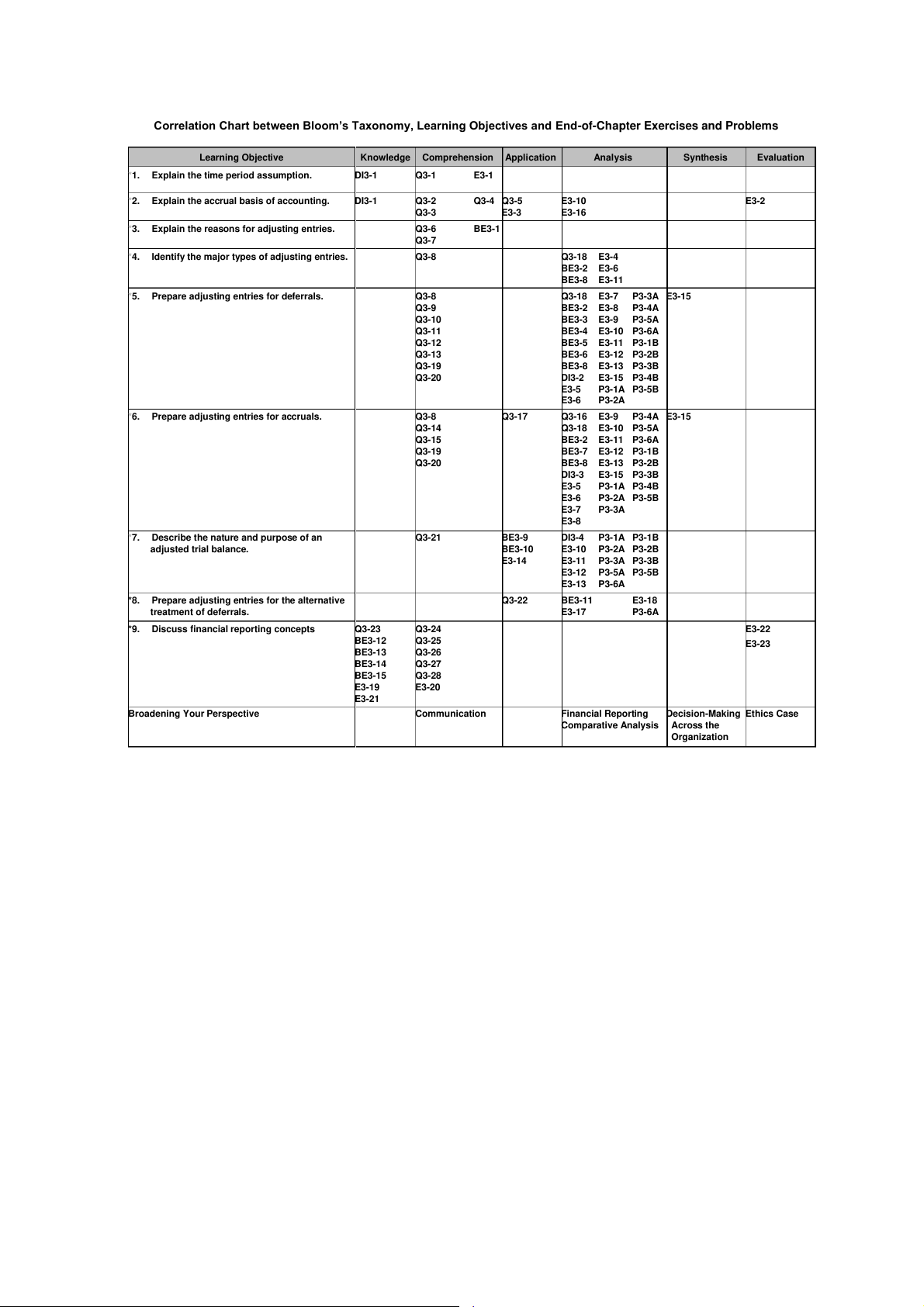
Correlation Chart between Bloom’s Taxonomy, Learning Objectives and End-of-Chapter Exercises and Problems Learning Objective
Knowledge Comprehension Application Analysis Synthesis Evaluation B LOOM
*1. Explain the time period assumption. DI3-1 Q3-1 E3-1
*2. Explain the accrual basis of accounting. DI3-1 Q3-2 Q3-4 Q3-5 E3-10 E3-2 Q3-3 E3-3 E3-16 ’S
*3. Explain the reasons for adjusting entries. Q3-6 BE3-1 Q3-7 T A
*4. Identify the major types of adjusting entries. Q3-8 Q3-18 E3-4 XON BE3-2 E3-6 BE3-8 E3-11
*5. Prepare adjusting entries for deferrals. Q3-8 Q3-18 E3-7 P3-3A E3-15 O Q3-9 BE3-2 E3-8 P3-4A M Q3-10 BE3-3 E3-9 P3-5A Y Q3-11 BE3-4 E3-10 P3-6A T Q3-12 BE3-5 E3-11 P3-1B A Q3-13 BE3-6 E3-12 P3-2B B Q3-19 BE3-8 E3-13 P3-3B L Q3-20 DI3-2 E3-15 P3-4B E E3-5 P3-1A P3-5B E3-6 P3-2A
*6. Prepare adjusting entries for accruals. Q3-8 Q3-17 Q3-16 E3-9 P3-4A E3-15 Q3-14 Q3-18 E3-10 P3-5A Q3-15 BE3-2 E3-11 P3-6A Q3-19 BE3-7 E3-12 P3-1B Q3-20 BE3-8 E3-13 P3-2B DI3-3 E3-15 P3-3B E3-5 P3-1A P3-4B E3-6 P3-2A P3-5B E3-7 P3-3A E3-8
*7. Describe the nature and purpose of an Q3-21 BE3-9 DI3-4 P3-1A P3-1B
adjusted trial balance. BE3-10 E3-10 P3-2A P3-2B E3-14 E3-11 P3-3A P3-3B E3-12 P3-5A P3-5B E3-13 P3-6A
*8. Prepare adjusting entries for the alternative Q3-22 BE3-11 E3-18
treatment of deferrals. E3-17 P3-6A
*9. Discuss financial reporting concepts Q3-23 Q3-24 E3-22 BE3-12 Q3-25 E3-23 BE3-13 Q3-26 BE3-14 Q3-27 BE3-15 Q3-28 E3-19 E3-20 E3-21
Broadening Your Perspective Communication Financial Reporting
Decision-Making Ethics Case
Comparative Analysis Across the Organization ANSWERS TO QUESTIONS
1. (a) Under the time period assumption, an accountant is required to determine the relevance of
each business transaction to specific accounting periods.
(b) An accounting time period of one year in length is referred to as a fiscal year. A fiscal year
that extends from January 1 to December 31 is referred to as a calendar year. Accounting
periods of less than one year are cal ed interim periods. LO: 3.1 Difficulty: Easy BLOOMCODE: Comprehension AACSB: Reflective thinking
2. The two principles that relate to adjusting the accounts are:
The revenue recognition principle, which states that revenue should be recognized in the accounting
period in which the performance obligation is satisfied.
The expense recognition principle, which states that efforts (expenses) should be matched with accomplishments (revenues). LO: 3.2 Difficulty: Easy BLOOMCODE: Comprehension AACSB: Reflective thinking
3. The law firm should recognize the revenue in April. When a company agrees to perform a service
for a customer it has a performance obligation. The revenue recognition principle states that
revenue should be recognized in the accounting period in which the performance obligation is
satisfied which is April in this case. LO: 3.2 Difficulty: Easy BLOOMCODE: Comprehension AACSB: Reflective thinking
4. Information presented on an accrual basis is more useful than on a cash basis because it reveals
relationships that are likely to be important in predicting future results. To il ustrate, under accrual
accounting, revenues are recognized when earned so they can be related to the economic
environment in which they occur. Trends in revenues are thus more meaningful. LO: 3.2 Difficulty: Easy BLOOMCODE: Comprehension AACSB: Reflective thinking
5. Expenses of £4,700 should be deducted from the revenues in April. Under the expense
recognition principle efforts (expenses) should be matched with accomplishments (revenues). LO: 3.1 Difficulty: Easy BLOOMCODE: Application AACSB: Reflective thinking
Weygandt Financial Accounting IFRS 3e Solutions Manual 3-7
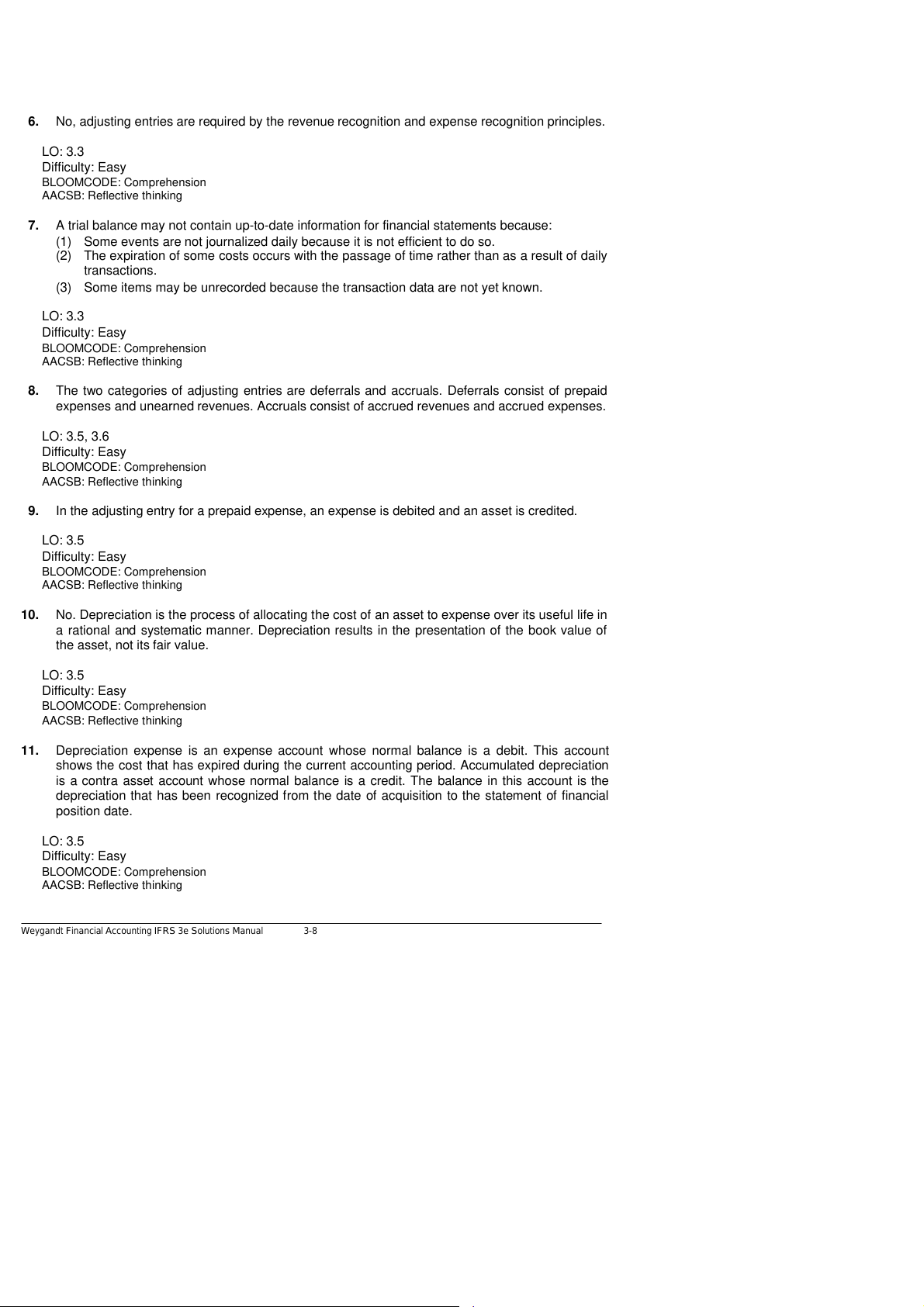
6. No, adjusting entries are required by the revenue recognition and expense recognition principles. LO: 3.3 Difficulty: Easy BLOOMCODE: Comprehension AACSB: Reflective thinking
7. A trial balance may not contain up-to-date information for financial statements because:
(1) Some events are not journalized daily because it is not efficient to do so.
(2) The expiration of some costs occurs with the passage of time rather than as a result of daily transactions.
(3) Some items may be unrecorded because the transaction data are not yet known. LO: 3.3 Difficulty: Easy BLOOMCODE: Comprehension AACSB: Reflective thinking
8. The two categories of adjusting entries are deferrals and accruals. Deferrals consist of prepaid
expenses and unearned revenues. Accruals consist of accrued revenues and accrued expenses. LO: 3.5, 3.6 Difficulty: Easy BLOOMCODE: Comprehension AACSB: Reflective thinking
9. In the adjusting entry for a prepaid expense, an expense is debited and an asset is credited. LO: 3.5 Difficulty: Easy BLOOMCODE: Comprehension AACSB: Reflective thinking
10. No. Depreciation is the process of al ocating the cost of an asset to expense over its useful life in
a rational and systematic manner. Depreciation results in the presentation of the book value of
the asset, not its fair value. LO: 3.5 Difficulty: Easy BLOOMCODE: Comprehension AACSB: Reflective thinking
11. Depreciation expense is an expense account whose normal balance is a debit. This account
shows the cost that has expired during the current accounting period. Accumulated depreciation
is a contra asset account whose normal balance is a credit. The balance in this account is the
depreciation that has been recognized from the date of acquisition to the statement of financial position date. LO: 3.5 Difficulty: Easy BLOOMCODE: Comprehension AACSB: Reflective thinking
Weygandt Financial Accounting IFRS 3e Solutions Manual 3-8
Questions Chapter 3 (Continued)
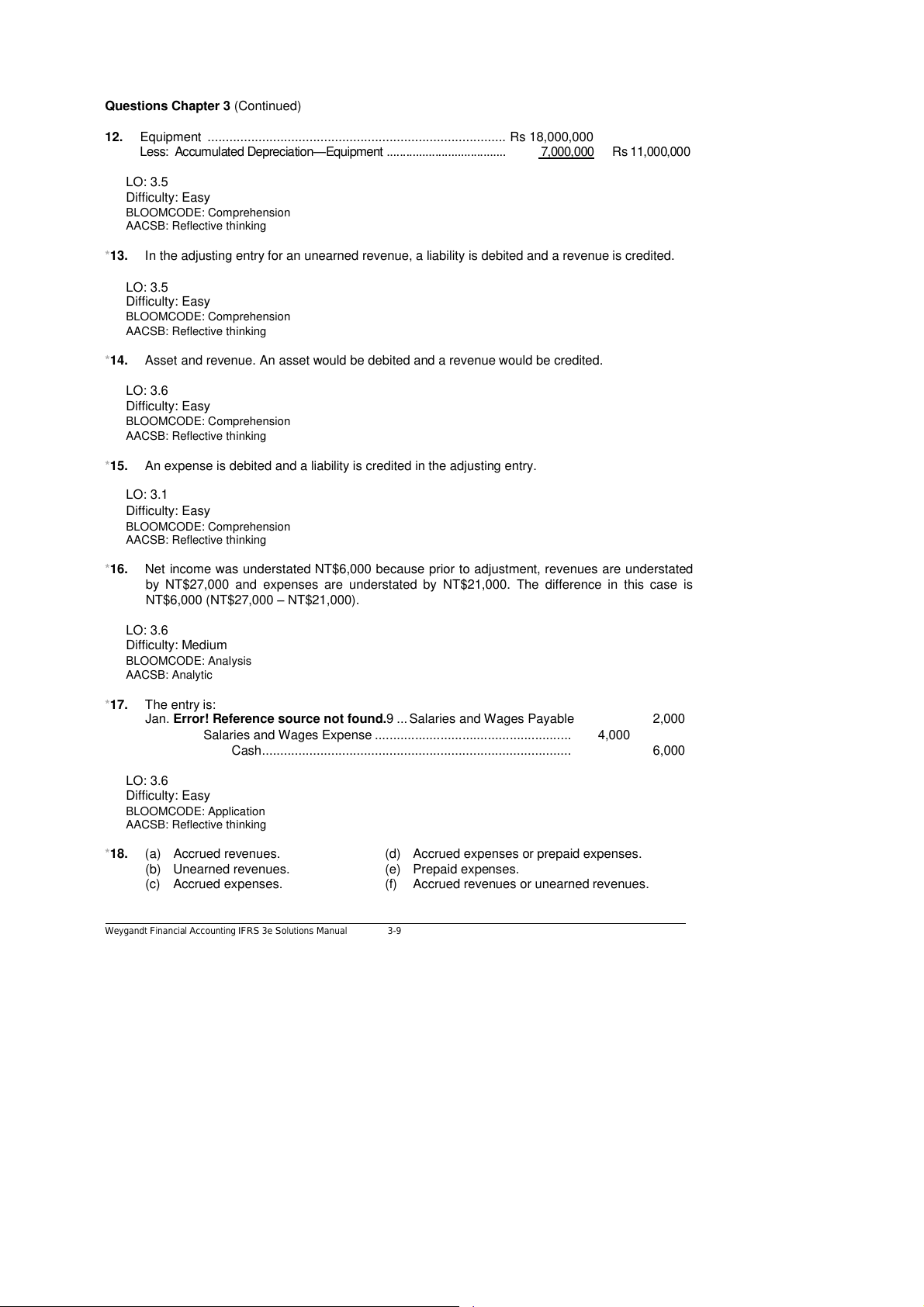
12. Equipment .................................................................................. Rs 18,000,000
Less: Accumulated Depreciation—Equipment . . . . . . . .. . . . . .. . . . . . 7,000,000 Rs 11,000,000 LO: 3.5 Difficulty: Easy BLOOMCODE: Comprehension AACSB: Reflective thinking
*13. In the adjusting entry for an unearned revenue, a liability is debited and a revenue is credited. LO: 3.5 Difficulty: Easy BLOOMCODE: Comprehension AACSB: Reflective thinking
*14. Asset and revenue. An asset would be debited and a revenue would be credited. LO: 3.6 Difficulty: Easy BLOOMCODE: Comprehension AACSB: Reflective thinking
*15. An expense is debited and a liability is credited in the adjusting entry. LO: 3.1 Difficulty: Easy BLOOMCODE: Comprehension AACSB: Reflective thinking
*16. Net income was understated NT$6,000 because prior to adjustment, revenues are understated
by NT$27,000 and expenses are understated by NT$21,000. The difference in this case is
NT$6,000 (NT$27,000 – NT$21,000). LO: 3.6 Difficulty: Medium BLOOMCODE: Analysis AACSB: Analytic *17. The entry is:
Jan. Error! Reference source not found.9 ... Salaries and Wages Payable 2,000
Salaries and Wages Expense ...................................................... 4,000
Cash ..................................................................................... 6,000 LO: 3.6 Difficulty: Easy BLOOMCODE: Application AACSB: Reflective thinking
*18. (a) Accrued revenues.
(d) Accrued expenses or prepaid expenses. (b) Unearned revenues. (e) Prepaid expenses. (c) Accrued expenses.
(f) Accrued revenues or unearned revenues.
Weygandt Financial Accounting IFRS 3e Solutions Manual 3-9 LO: 3.6 Difficulty: Medium BLOOMCODE: Analysis AACSB: Analytic
*19. (a) Salaries and Wages Payable. (d) Supplies Expense. (b) Accumulated Depreciation. (e) Service Revenue. (c) Interest Expense. (f) Service Revenue. LO: 3.5, 3.6 Difficulty: Easy BLOOMCODE: Comprehension AACSB: Reflective thinking
*20. Disagree. An adjusting entry affects only one statement of financial position account and one income statement account. LO: 3.5, 3.6 Difficulty: Easy BLOOMCODE: Comprehension AACSB: Reflective thinking
*21. Financial statements can be prepared from an adjusted trial balance because the balances of
al accounts have been adjusted to show the effects of al financial events that have occurred during the accounting period. LO: 3.7 Difficulty: Easy BLOOMCODE: Comprehension AACSB: Reflective thinking
*22. For Supplies Expense (prepaid expense): expenses are overstated and assets are understated. The adjusting entry is:
Assets (Supplies) ...................................................................................... XX
Expenses (Supplies Expense) ............................................................ XX
For Rent Revenue (unearned revenues): revenues are overstated and liabilities are understated. The adjusting entry is:
Revenues (Rent Revenue) ....................................................................... XX
Liabilities (Unearned Rent Revenue) .................................................. XX LO: 3.8 Difficulty: Medium BLOOMCODE: Application AACSB: Reflective thinking
*23. (a) The primary objective of financial reporting is to provide financial information that is useful to
investors and creditors for making decisions about providing capital.
(b) The fundamental qualitative characteristics are relevance and faithful representation. The
enhancing qualities are comparabiIity, verifiability, timeliness, and understandability. LO: 3.9 Difficulty: Easy BLOOMCODE: Knowledge
Weygandt Financial Accounting IFRS 3e Solutions Manual 3-10 AACSB: Reflective thinking
Weygandt Financial Accounting IFRS 3e Solutions Manual 3-11
Questions Chapter 3 (Continued)
*24. Gross is correct. Consistency means using the same accounting principles and accounting
methods from period to period within a company. Without consistency in the application of
accounting principles, it is difficult to determine whether a company is better off, worse off, or the same from period to period. LO: 3.9 Difficulty: Easy BLOOMCODE: Comprehension AACSB: Reflective thinking
*25. Comparability results when different companies use the same accounting principles.
Consistency means using the same accounting principles and methods from year to year within the same company. LO: 3.9 Difficulty: Easy BLOOMCODE: Comprehension AACSB: Reflective thinking
*26. The constraint is the cost constraint. The cost constraint al ows accounting standard setters to
weigh the cost that companies wil incur to provide information against the benefit that financial
statement users wil gain from having the information available. LO: 3.9 Difficulty: Easy BLOOMCODE: Comprehension AACSB: Reflective thinking
*27. Accounting relies primarily on two measurement principles. Fair value is sometimes used when
market price information is readily available. However, in many situations reliable market price
information is not available. In these instances, accounting relies on cost as its basis. LO: 3.9 Difficulty: Easy BLOOMCODE: Comprehension AACSB: Reflective thinking
*28. The economic entity assumption states that every economic entity can be separately identified
and accounted for. This assumption requires that the activities of the entity be kept separate and
distinct from (1) the activities of its owners (the shareholders) and (2) al other economic entities.
A shareholder of a company charging personal living costs as expenses of the company is an
example of a violation of the economic entity assumption. LO: 3.9 Difficulty: Easy BLOOMCODE: Comprehension AACSB: Reflective thinking
Weygandt Financial Accounting IFRS 3e Solutions Manual 3-12
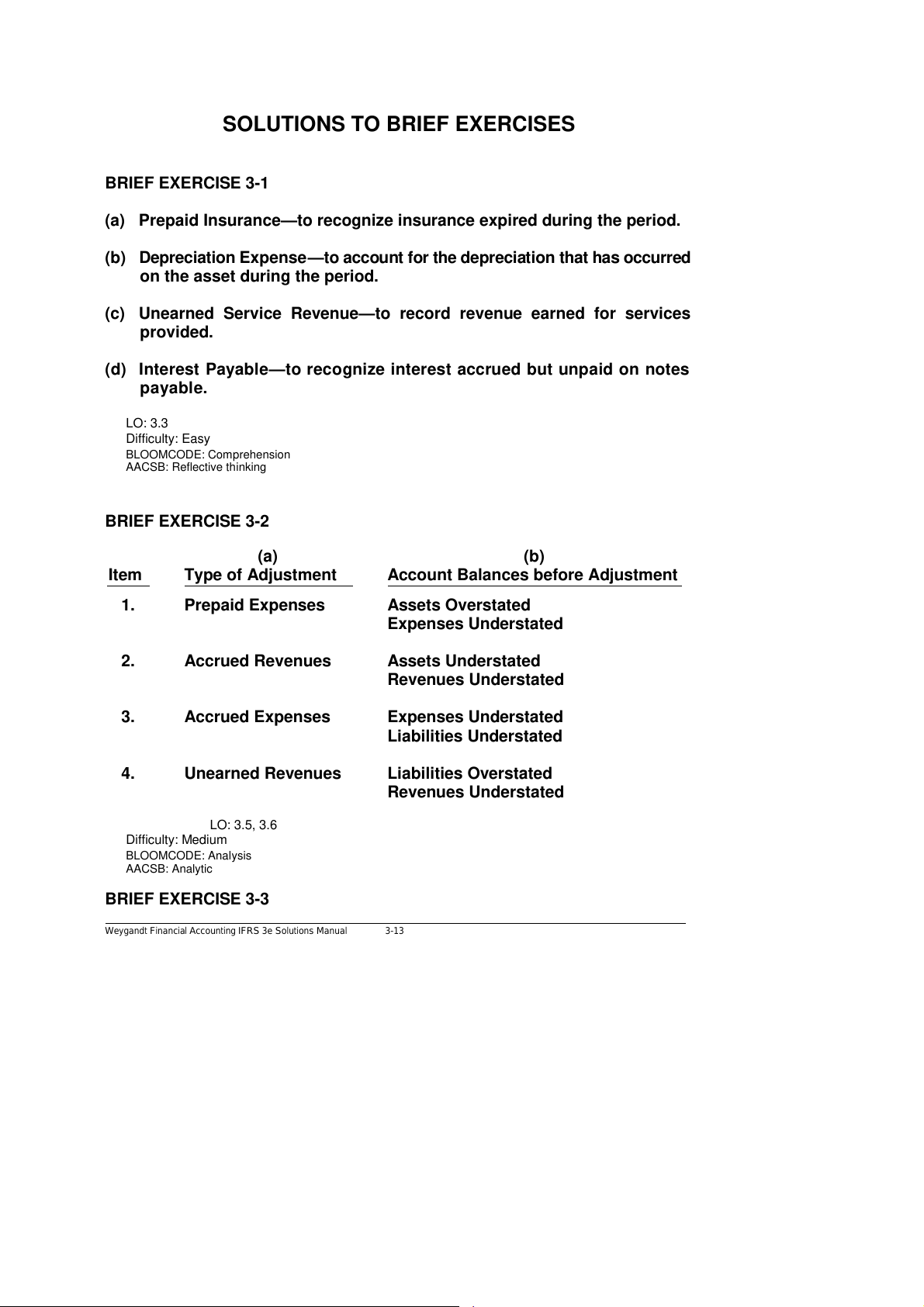
SOLUTIONS TO BRIEF EXERCISES BRIEF EXERCISE 3-1
(a) Prepaid Insurance—to recognize insurance expired during the period.
(b) Depreciation Expense—to account for the depreciation that has occurred
on the asset during the period.
(c) Unearned Service Revenue—to record revenue earned for services provided.
(d) Interest Payable—to recognize interest accrued but unpaid on notes payable. LO: 3.3 Difficulty: Easy BLOOMCODE: Comprehension AACSB: Reflective thinking BRIEF EXERCISE 3-2 (a) (b) Item Type of Adjustment
Account Balances before Adjustment 1. Prepaid Expenses Assets Overstated Expenses Understated 2. Accrued Revenues Assets Understated Revenues Understated 3. Accrued Expenses Expenses Understated
Liabilities Understated 4. Unearned Revenues Liabilities Overstated Revenues Understated LO: 3.5, 3.6 Difficulty: Medium BLOOMCODE: Analysis AACSB: Analytic BRIEF EXERCISE 3-3
Weygandt Financial Accounting IFRS 3e Solutions Manual 3-13
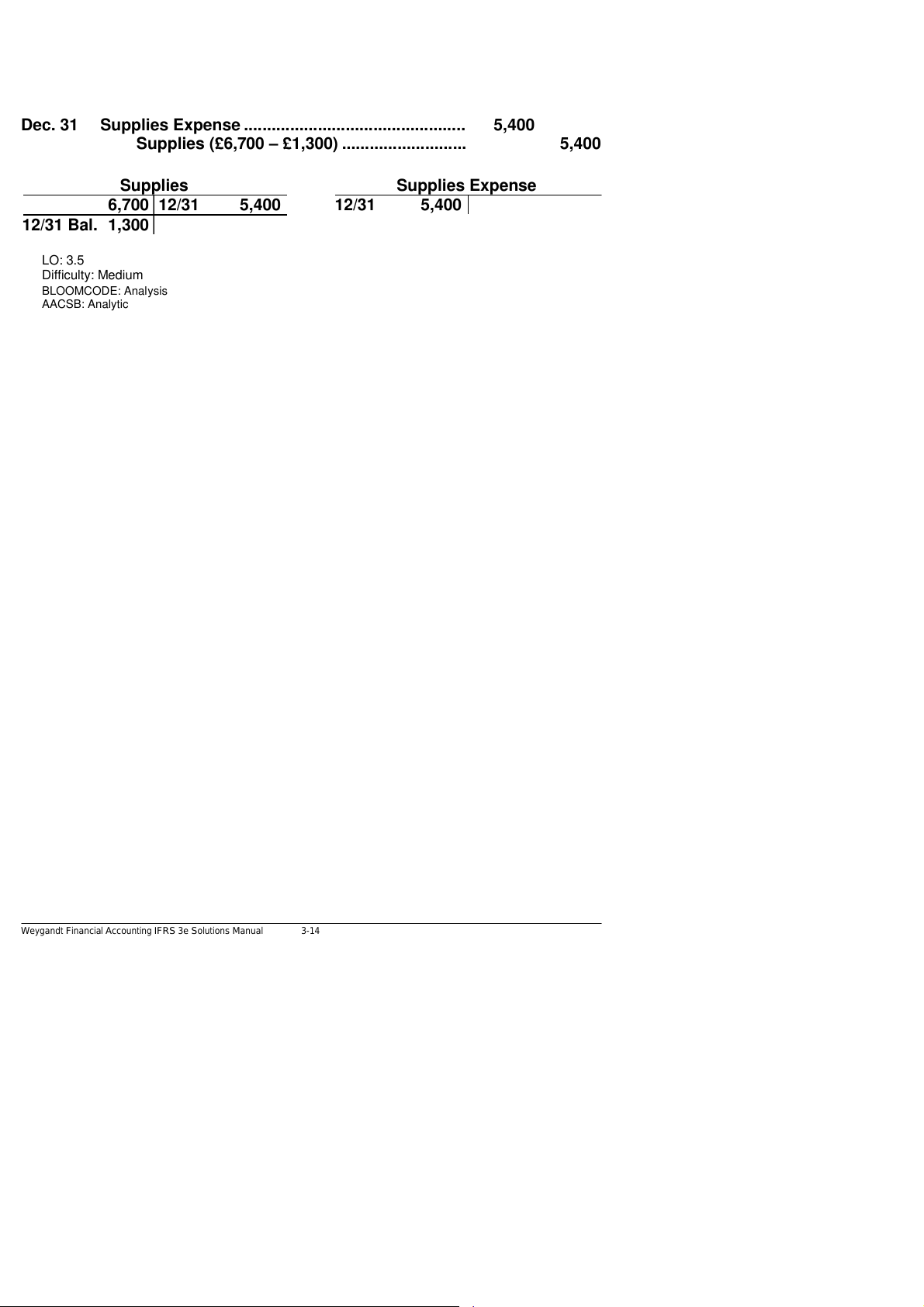
Dec. 31 Supplies Expense ................................................ 5,400
Supplies (£6,700 – £1,300) ........................... 5,400 Supplies Supplies Expense 6,700 12/31 5,400 12/31 5,400 12/31 Bal. 1,300 LO: 3.5 Difficulty: Medium BLOOMCODE: Analysis AACSB: Analytic
Weygandt Financial Accounting IFRS 3e Solutions Manual 3-14 BRIEF EXERCISE 3-4
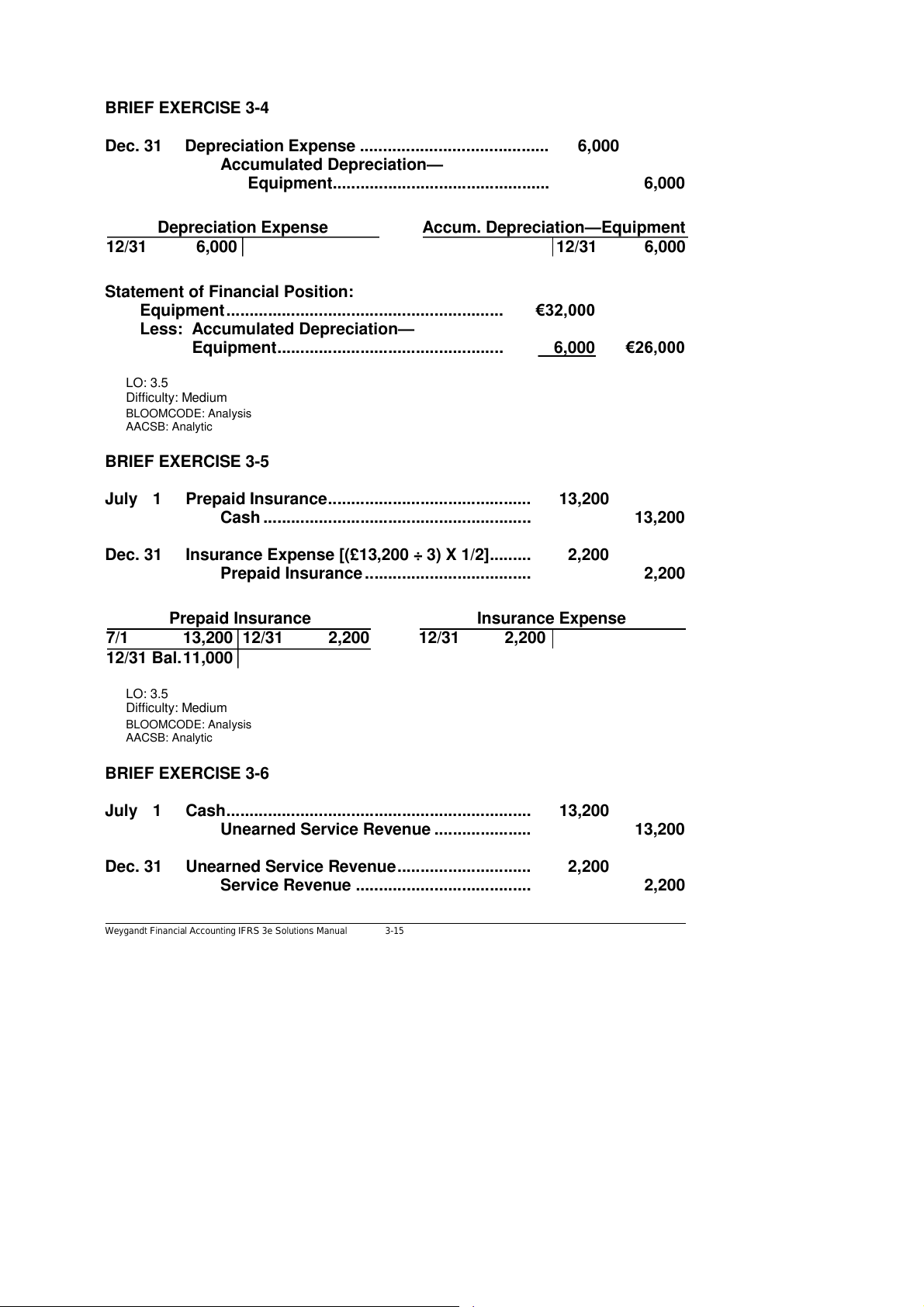
Dec. 31 Depreciation Expense ......................................... 6,000
Accumulated Depreciation—
Equipment ............................................... 6,000 Depreciation Expense
Accum. Depreciation—Equipment 12/31 6,000 12/31 6,000
Statement of Financial Position:
Equipment ............................................................ €32,000
Less: Accumulated Depreciation—
Equipment ................................................. 6,000 €26,000 LO: 3.5 Difficulty: Medium BLOOMCODE: Analysis AACSB: Analytic BRIEF EXERCISE 3-5
July 1 Prepaid Insurance ............................................ 13,200
Cash .......................................................... 13,200
Dec. 31 Insurance Expense [(£13,200 ÷ 3) X 1/2] ......... 2,200
Prepaid Insurance .................................... 2,200 Prepaid Insurance Insurance Expense 7/1 13,200 12/31 2,200 12/31 2,200 12/31 Bal. 11,000 LO: 3.5 Difficulty: Medium BLOOMCODE: Analysis AACSB: Analytic BRIEF EXERCISE 3-6
July 1 Cash .................................................................. 13,200
Unearned Service Revenue ..................... 13,200
Dec. 31 Unearned Service Revenue ............................. 2,200
Service Revenue ...................................... 2,200
Weygandt Financial Accounting IFRS 3e Solutions Manual 3-15
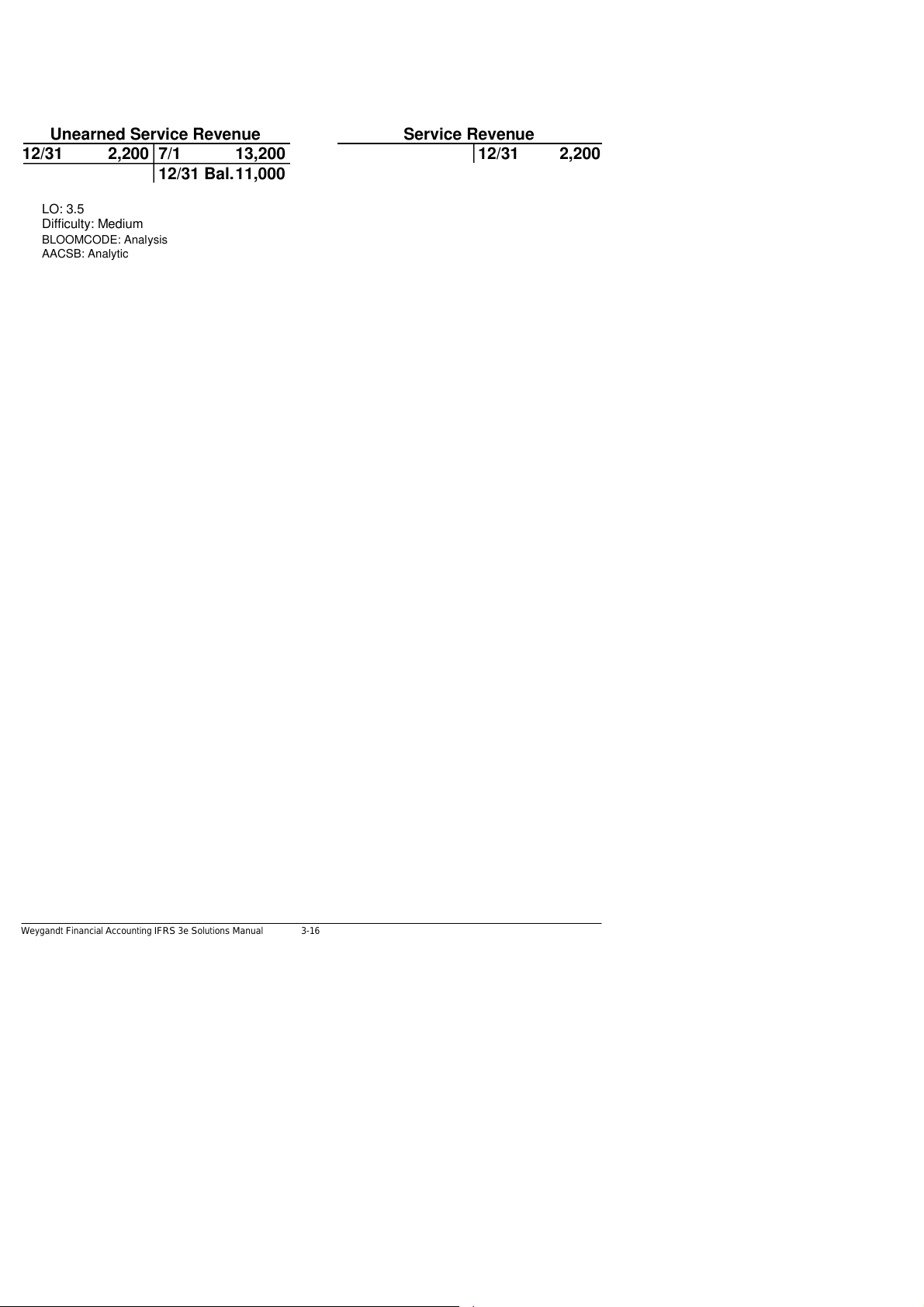
Unearned Service Revenue Service Revenue 12/31 2,200 7/1 13,200 12/31 2,200 12/31 Bal. 11,000 LO: 3.5 Difficulty: Medium BLOOMCODE: Analysis AACSB: Analytic
Weygandt Financial Accounting IFRS 3e Solutions Manual 3-16 BRIEF EXERCISE 3-7
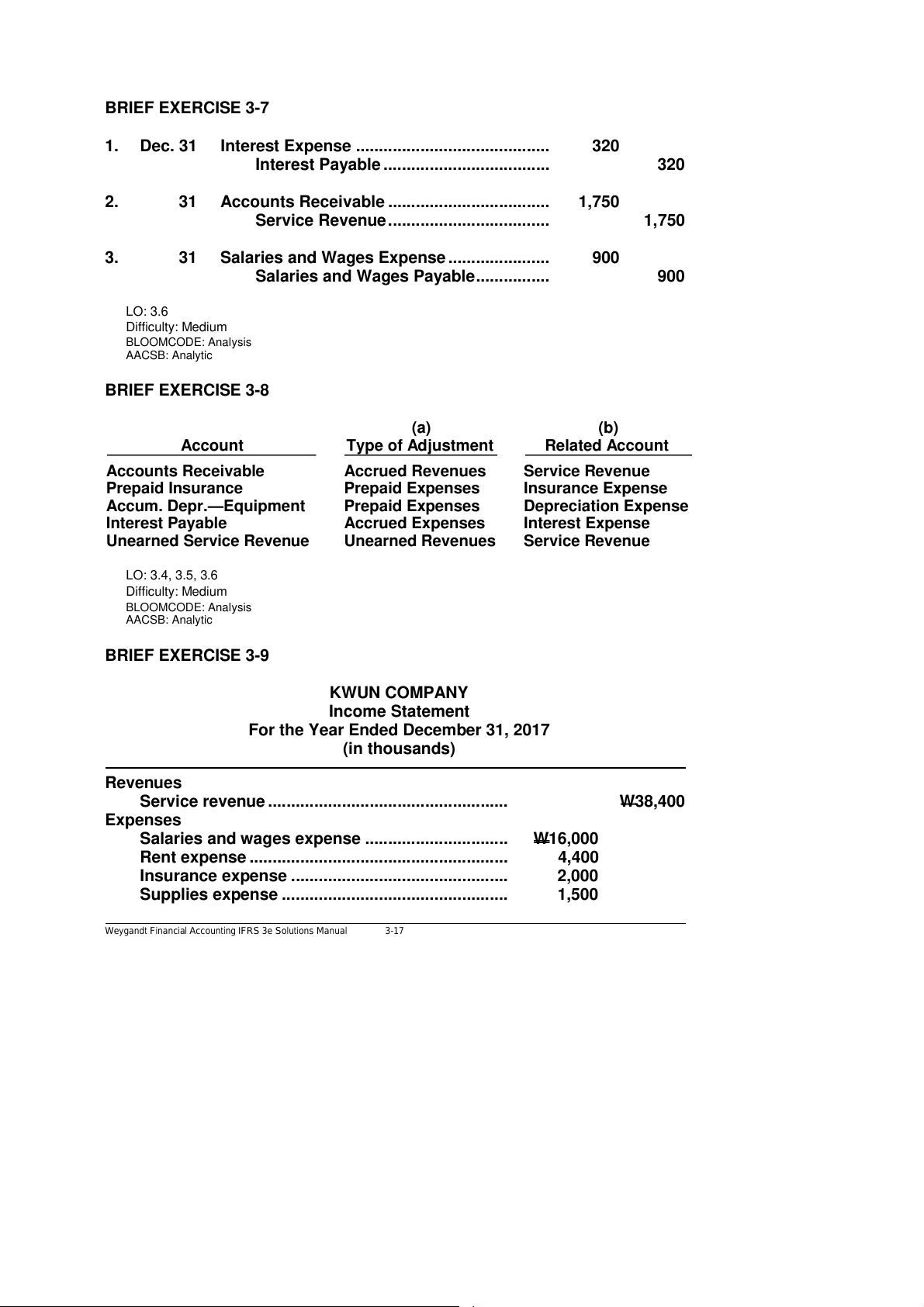
1. Dec. 31 Interest Expense .......................................... 320
Interest Payable .................................... 320 2.
31 Accounts Receivable ................................... 1,750
Service Revenue ................................... 1,750 3.
31 Salaries and Wages Expense ...................... 900
Salaries and Wages Payable ................ 900 LO: 3.6 Difficulty: Medium BLOOMCODE: Analysis AACSB: Analytic BRIEF EXERCISE 3-8 (a) (b) Account Type of Adjustment Related Account Accounts Receivable Accrued Revenues Service Revenue Prepaid Insurance Prepaid Expenses Insurance Expense
Accum. Depr.—Equipment Prepaid Expenses Depreciation Expense Interest Payable Accrued Expenses Interest Expense
Unearned Service Revenue Unearned Revenues Service Revenue LO: 3.4, 3.5, 3.6 Difficulty: Medium BLOOMCODE: Analysis AACSB: Analytic BRIEF EXERCISE 3-9 KWUN COMPANY Income Statement
For the Year Ended December 31, 2017 (in thousands) Revenues
Service revenue .................................................... W38,400 Expenses
Salaries and wages expense ............................... W16,000
Rent expense ........................................................ 4,400
Insurance expense ............................................... 2,000
Supplies expense ................................................. 1,500
Weygandt Financial Accounting IFRS 3e Solutions Manual 3-17
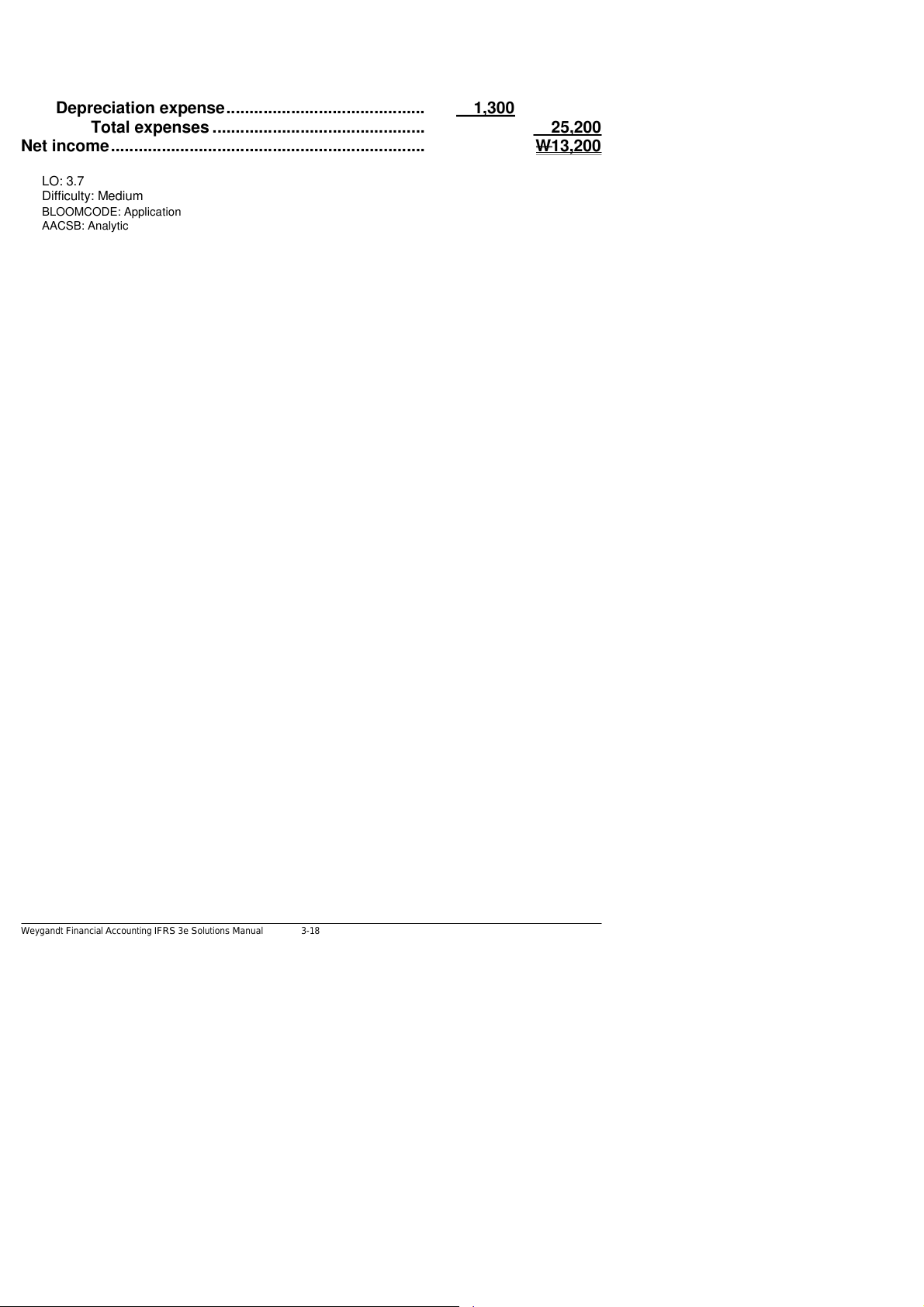
Depreciation expense ........................................... 1,300
Total expenses .............................................. 25,200
Net income .................................................................... W13,200 LO: 3.7 Difficulty: Medium BLOOMCODE: Application AACSB: Analytic
Weygandt Financial Accounting IFRS 3e Solutions Manual 3-18 BRIEF EXERCISE 3-10 KWUN COMPANY
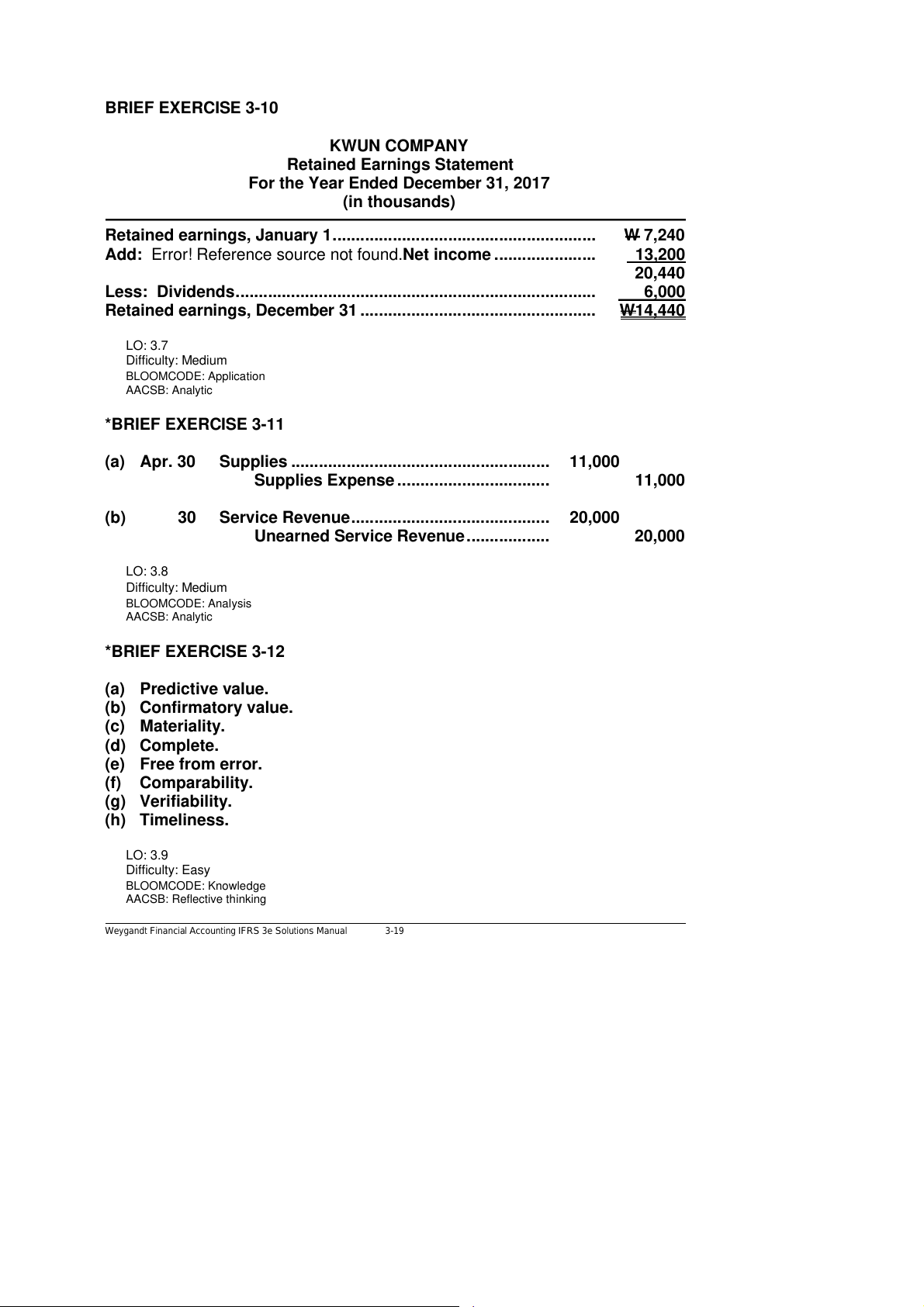
Retained Earnings Statement
For the Year Ended December 31, 2017 (in thousands)
Retained earnings, January 1 ......................................................... W 7,240
Add: Error! Reference source not found.Net income ...................... 13,200 20,440
Less: Dividends .............................................................................. 6,000
Retained earnings, December 31 ................................................... W14,440 LO: 3.7 Difficulty: Medium BLOOMCODE: Application AACSB: Analytic *BRIEF EXERCISE 3-11
(a) Apr. 30 Supplies ........................................................ 11,000
Supplies Expense ................................. 11,000 (b)
30 Service Revenue ........................................... 20,000
Unearned Service Revenue .................. 20,000 LO: 3.8 Difficulty: Medium BLOOMCODE: Analysis AACSB: Analytic *BRIEF EXERCISE 3-12 (a) Predictive value.
(b) Confirmatory value. (c) Materiality. (d) Complete. (e) Free from error. (f) Comparability. (g) Verifiability. (h) Timeliness. LO: 3.9 Difficulty: Easy BLOOMCODE: Knowledge AACSB: Reflective thinking
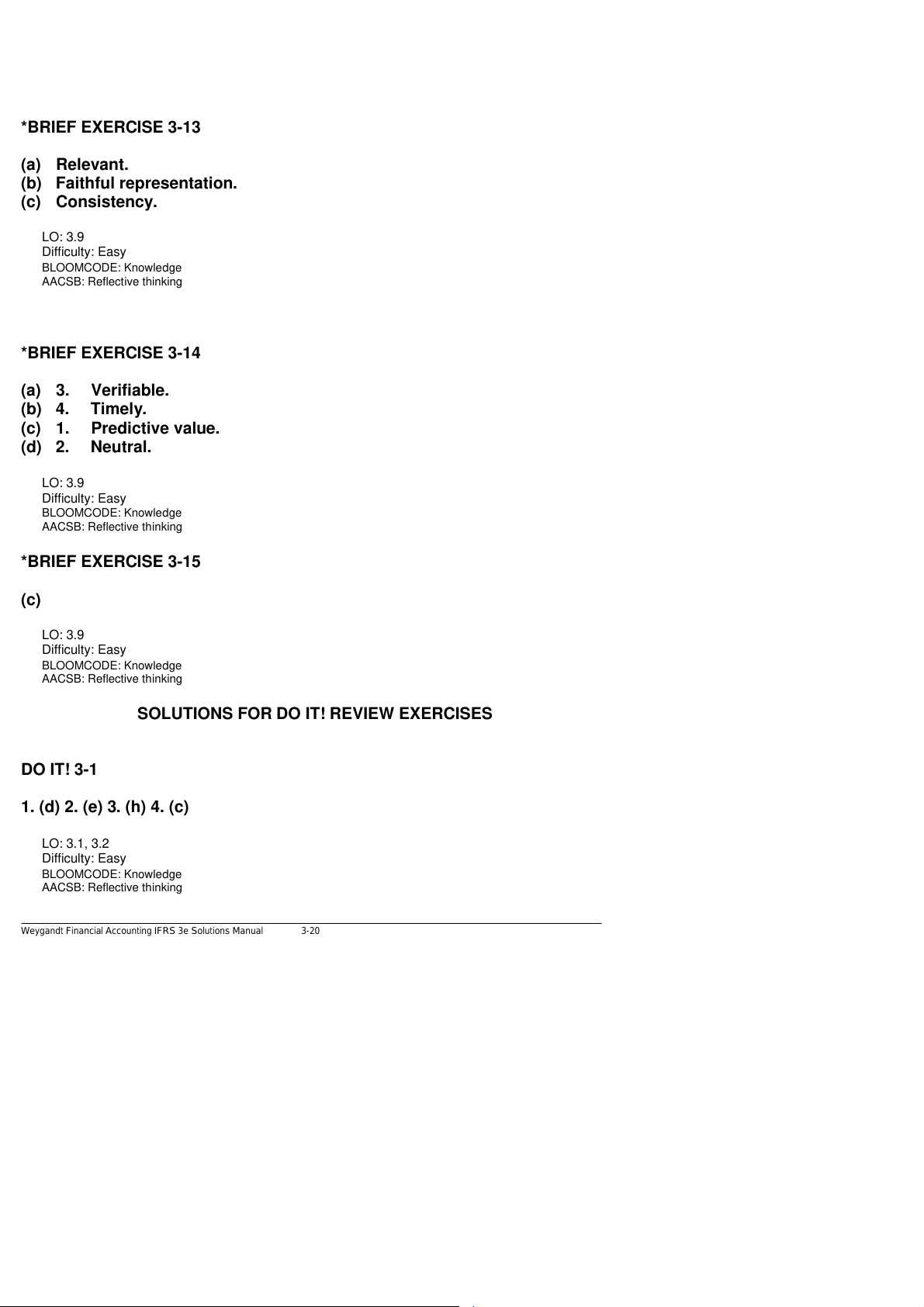
Weygandt Financial Accounting IFRS 3e Solutions Manual 3-19 *BRIEF EXERCISE 3-13 (a) Relevant.
(b) Faithful representation. (c) Consistency. LO: 3.9 Difficulty: Easy BLOOMCODE: Knowledge AACSB: Reflective thinking *BRIEF EXERCISE 3-14 (a) 3. Verifiable. (b) 4. Timely.
(c) 1. Predictive value. (d) 2. Neutral. LO: 3.9 Difficulty: Easy BLOOMCODE: Knowledge AACSB: Reflective thinking *BRIEF EXERCISE 3-15 (c) LO: 3.9 Difficulty: Easy BLOOMCODE: Knowledge AACSB: Reflective thinking
SOLUTIONS FOR DO IT! REVIEW EXERCISES DO IT! 3-1
1. (d) 2. (e) 3. (h) 4. (c) LO: 3.1, 3.2 Difficulty: Easy BLOOMCODE: Knowledge AACSB: Reflective thinking
Weygandt Financial Accounting IFRS 3e Solutions Manual 3-20
Tài liệu liên quan:
-

CFA 2025 Level I - Schweser QuickSheet Summary and Key Concepts
68 34 -

Bài tập chương 1, 2, 3 Môn Nguyên lý kế toán | Đại học Ngoại Thương
176 88 -

Ghi Chú Về Doanh Nghiệp và Tài Sản | Môn Nguyên lý kế toán - Đại học Ngoại Thương
192 96 -

Các Dạng Bài Tập Có Đáp Án Chi Tiết | Môn Nguyên lý kế toán - Đại học Ngoại Thương
136 68