Physics 2 - comprehensive review of electric & magnetic theories môn Vật lý đại cương 2 | Học viện Công Nghệ Bưu Chính Viễn Thông
Topic 2: Charges on conductors and electrostatic conditions. Electricfield at the surfaces of a conductor; charging by induction. Tài liệu giúp bạn tham khảo, ôn tập và đạt kết quả cao. Mời đọc đón xem!
Môn: Vật lý đại cương 2 298 tài liệu
Trường: Học viện Công Nghệ Bưu Chính Viễn Thông 1.7 K tài liệu
Tác giả:


















Preview text:
Part I: 20 topics
Topic 1: Electric flux and Gauss’s law. Applications of Gauss’s law on
planar, spherical and cylindrical distribution. 1. Definition: a. Electric flux:
Electric flux is a measure of the “flow” of electric field through a surface. It is equal to the
product of an area element and the perpendicular component of E, integrated over a surface.
ΦE=∫Ecos φ dA=∮ E d A b. Gauss's law:
Gauss's law state that the total electric flux through a closed surface, which can be
written as the surface integral of the component of E normal to the surface, equals a constant
times the total charge Qencl enclosed by the surface. A=Qencl
ΦE=∫Ecos φ dA=∮ E d ϵ0
2. Applications of Gauss’s law
If we know the charge distribution, and if it has enough symmetry to let us evaluate the integral
in Gauss’s law, we can find the field.
If we know the field, we can use Gauss’s law to find the charge distribution, such as charges on conducting surfaces.
a. Planar: infinite sheet of charge with uniform charge per unit area σ E=σ 2ε0
b. Spherical: Solid insulating sphere with radius R, charge Q distributed uniformly throughout volume:
Outside sphere, r>R: E=Q/4pi e0 r square E=Q 4π ε0r2
Inside sphere, rE=Qr 4π ε0R3
Chagre q on the surface of conducting sphere with radius R:
outside sphere, r>R: E=q/4pi e0 r square E=q 4π ε0r2
inside sphere, rc. Cylindrical: infinite conducting cylinder with radius R, charge per unit length lamda: E=λ Outside cylinder, r>R: 2π ε0
Inside cylinder, rTopic 2: Charges on conductors and electrostatic conditions. Electric
field at the surfaces of a conductor; charging by induction.
1. Charges on conductor:
A conductor allows free charges to move about within it. The electrical force around a
conductor will cause free charges to move around inside the conductor until static equilibrium
is reach. Any excess charge will reside entirely on the surface, not in the interior of the material.
2. Electrostatic conditions:
The charges have no net motion. Giving a solid conductor with charge q then the charge q
resides entirely on the surface of the conductor. The situation is electrostatic, so E=0 within the conductor.
3. Electric field at the surfaces of a conductor:
There is a direct relationship between the E field at a point just outside any conductor and the
surface charge density o at that point.
E normal A=oA/e0 and e normal= o/e0
4. Charging bay induction:
Induction charging is a method used to charge an object without actually touching the object to any other charged object.
Topic 3: Electric potential and electric potential difference. Calculating
the electric potential. Electric potential energy, equipotential surfaces. 1. Definition: a. Electric potential
Electric potential at any point in an electric field is potential energy U per unit charge associated
with a test charge q0 at that point, denoted by V:
V=U or U=q0V q0
b. Electric potential difference
Electric potential difference between 2 points a and b, also called the potential of a with respect
to b, equals the work done by the electric force when a unit charge move from a to b. It is given by the line integral of E: Va-Vb=integral E dl
Va−Vb=∫ E dl
2. Calculating the electric potential: a. Due to point charge: V=q 4π ε0r
b. Due to a collection of point charges V=1 qi 4π ε ∑ 0 i ri c. Due to charge distribution V=14π ε ∫ 0 dq r 3. :
Electric potential energy
The electric potential energy is the work W done by the electric force on a charged particle moving in an electric field. U=qq0/4pi e0 r U=q q0 4π ε0r
4. Equipotential surfaces:
An equipotential surface is a surface on which the potential has the same value at every
point. At a point where a field line crosses an equipotential surface, the two are
perpendicular. When all charges are at rest, the surface of a conductor is always an
equipotential surface and all points in the interior of a conductor are at the same potential.
When a cavity within a conductor contains no charge, the entire cavity is an equipotential
region and there is no surface charge anywhere on the surface of the cavity.
Topic 4: Relations between electric field vector and electric potential, potential gradien
If the potential is known as a function of the coordinates V
x, y, and z, the components of electric field
E at any point are given by partial derivatives of V. Ex=−∂ V x Ey=−
∂∂y VEz=−∂V z∂ V E=−( i∂V ∂ x +j∂V
∂ y + ∂ z ) ∂ z
E is the negative of the gradient of V E=− ∇V
Topic 5: Conductors, Capacitors, Capacitance of parallel-plate and
cylindrical capacitors; Energy Storage in Capacitors and Electric-Field Energy.
1. Conductor: materials that permit the easy movement of charge through them
2. Capacitor: A capacitor is any pair of conductors separated by an insulating material (or a vacuum) 3. Capacitance: C=Q Vab =ϵo A
a. Of parallel-plate capacitor: d C=Q Vab =λL =2 0 πϵ L b. Of cylindrical capacitor: 2 λ πϵ 0lnrb ln(rb ra ) ra
4. Enenrgy storage in capacitors and electric field energy: U=Q2 2C=12C V 2=1 2QV
Topic 6: Magnetic field, magnetic field lines, magnetic flux. Motion of
charged particles in a magnetic field. 1. Magnetic field:
A moving charge or a current creates a magnetic field in the surounding space.
2. Magnetic field lines:
We can represent any magnetic field by magnetic field lines. We draw the lines so that
the line through any point is tangent to the magnetic field vector B at that point. Also, because the direction of
B at each point is unique, field lines never intersect. 3. Magnetic flux:
Magnetic flux is a measure of the “flow” of magnetic field through a surface. It is equal
to the product of an area element and the perpendicular component of B, integrated over a surface.
d ΦB=BcosθdA= B ∙ d A
ΦB=∫ B ∙ d A
4. Motion of charged particles in a magnetic field.
Motion of a charged particle under the action of a magnetic field alone is always motion with constant speed. R=mv |q|B
Topic 7: Magnetic forces of currents, concept of magnetic field.
Magnetic field vector; magnetic field of a current element; the law of
Biot and Savart, magnetic field of a moving charge.
1. Magnetic force of currents:
A straight segment of a conductor carrying current in a uniform magnetic field B experiences a force
F that is perpendicular to both B and the vector l which points in
the direction of the current and has magnitude equal to the length of the segment.
F=Id l×B
2. Concept of magnetic field:
A magnetic field is a vector field which is created by a moving charge or a current exerts
a force on any other moving charge or current that is presented in the field.
3. Magnetic field vector and magnetic field of a current element:
- Magnetic field of a current element: The total magnetic field caused by several moving
charges is the vector sum of all fields caused by individual charges.
-At each point, the magnetic field vector is always tangential to the magnetic field line crossing that point.
4. The law of Biot and Savart:
The law of Biot and Savart gives the magnetic field d B created by an element of a conductor d
l carrying current I. The field d
B is perpendicular to both d l and r the unit
vector from the element to the field point. The
B field created by a finite current-
carrying conductor is the integral of over the length of the conductor. Id l × r d B=μ0 4π r2
5. Magnetic field of a moving charge:
B=μ0 qv ×r 4π r2
Topic 8: Ampere’s law on the line integral of magnetic field vector
around a closed path. Applications of Ampere’s law in calculating the
magnetic field of currents. 1. Ampere’s law:
Ampere’s law states that the line integral of
B around any closed path equals times the
net current through the area enclosed by the path. The positive sense of current is
determined by a right-hand rule. ∮ B ∙ d
l=μ0Iencl 2. Application: Current Point in Magnetic-Field Magnitude distribution magnetic field Long, straight Distance r from B=μ0I conductor conductor 2rπ Circular loop of On axis of loop B=μ0I a2 radius a 2(x2+a2)3/2 At center of loop B=μ (for N loops, 0I multiply these 2πa expressions by N) Long cylindrical Inside conductor, B=μ0Ir conductor of radius r2π R2 R Outside conductor, B=μ0I r>R 2rπ Long, closely wound Inside solenoid, B=μ0∋¿ solenoid with n near center turns per unit Outside solenoid B ≈ 0 length, near its midpoint Tightly wound Within the space
B=μ0∋¿2rπ ¿ toroidal solenoid enclosed by the with N turns windings, distance r from symmetry axis Outside the space B ≈ 0 enclosed by the windings
Topic 9: Induction Experiments, Faraday’s Law, Lenz’s Law
1. Induction Experiments: When we move the magnet either toward or away from the coil,
the meter shows current in the circuit, but only while the magnet is moving. If we keep
the magnet stationary and move the coil, we again detect a current during the motion. 2. Faraday’s law:
Faraday’s law states that the induced emf in a closed loop equals the negative of the
time rate of change of magnetic flux through the loop. This relationship is valid whether
the flux change is caused by a changing magnetic field, motion of the loop, or both. ε=−d ΦB dt 3. Lenz’s law:
Lenz’s law states that an induced current or emf always tends to oppose or cancel out the change that caused it.
Topic 10: Motional Electromotive Force; Induced Electric Fields; Eddy Currents
1. Motional electromotive force: a. The rod:
The moving rod, which slides along a stationary U- shaped conductor, has become a
source of electromotive force, charge move from lower to higher potential. ε=vBl b. The closed conducting loop:
For an element d l of the conductor, the contributiondε to the emf is the magnitude
dl multiplied by the component of v ×
B (the magnetic force per unit charge)
parallel to d l; that is, dε = v × B ∙ d l
For any closed conducting loop, the total emf is:
ε=∮ v ×B ∙dl
2.Induced electric field: there is an induced electric field in the conductor caused by the changing magnetic flux ∮ E ∙ d l=¿−d B dt ¿
3.Eddy current: Many pieces of electrical equipment contain masses of metal moving in magnetic
fields or located in changing magnetic fields. In this situations like these we can have induced
currents that circulate throghout the volume of a material, we call these eddy currents.
Topic 11: Mutual Inductance, Self-Inductance and Inductors. Energy
stored in a inductor, magnetic field energy, magnetic energy density 1. Mutual inductance:
If the circuits are coils of wire with N1 and N2 turns, the mutual inductance M can be
expressed in terms of the average flux ΦB2 through each turn of coil 2 caused by the
current i1 in coil 1, or in terms of the average flux ΦB1through each turn of coil 1 caused
by the current i2 in coil2. ε2=−Mdi 1 dt ε1=− Mdi 2 dt
M=N2ΦB2 =N1ΦB1 i1 i2
2.Self-inductance: A changing current I in any circuit causes a self-induced ε. The
inductance (or self-inductance) L depends on the geometry of the circuit and the
material surrounding it. The inductance of a coil of N turns is related to the average flux
ΦB through each turn caused by the current I in the coil. ε=−Ldi dt L=N ΦB i 3. Inductor:
It is a circuit device, usually including a coil of wire, intended to have a substantial inductance.
4. Magnetic-field energy:
An inductor with inductance L carrying current I have energy U associated with the inductor’s magnetic field U=12L i2
5.The magnetic energy density u (energy per unit volume) is proportional to the square of the magnetic field magnitude
u=B2 (¿vacuum ) 2μ0 u=B2
2μ(¿a material wih magnetic permeability μ)
Topic 12: R-L-C circuit, damped harmonic motion 1.R-L-C circuit:
It is a circuit that contains inductance, resistance, and capacitance?????
2. Damped harmonic motion:
A circuit that contains inductor, resistor, and capacitor and undergoes damped
oscillation for sufficiently small resistance. The frequency w’ of damped oscillations
depends on the value of L, R, and C. As R increases, the damping increases; if R is greater
than a certain value, the behavior becomes overdamped and no longer oscillates.
ω'= √1LC −R24L2
Topic 13: The system of Maxwell’s equations, the concept of electromagnetic field
1. The system of Maxwell’s equations: a. Gauss’s law: ∮ E ∙ d A=Qencl ∈0
b. Gauss’s law for magnetism: ∮ B ∙ d A=0 c. Ampere’s law: ∮ d ΦE B ∙ d
l=μ0(iC+∈0 dt ) encl d. Faraday’s law: ∮ E ∙ d l=−d ΦE dt
2. The concept of eletromagneticfield:
Electromagnetic field, a property of space caused by the motion of an electric charge. A
stationary charge will produce only an electric field in the surrounding space. If the
charge is moving, a magnetic field is also produced. An electric field can be produced
also by a changing magnetic field.
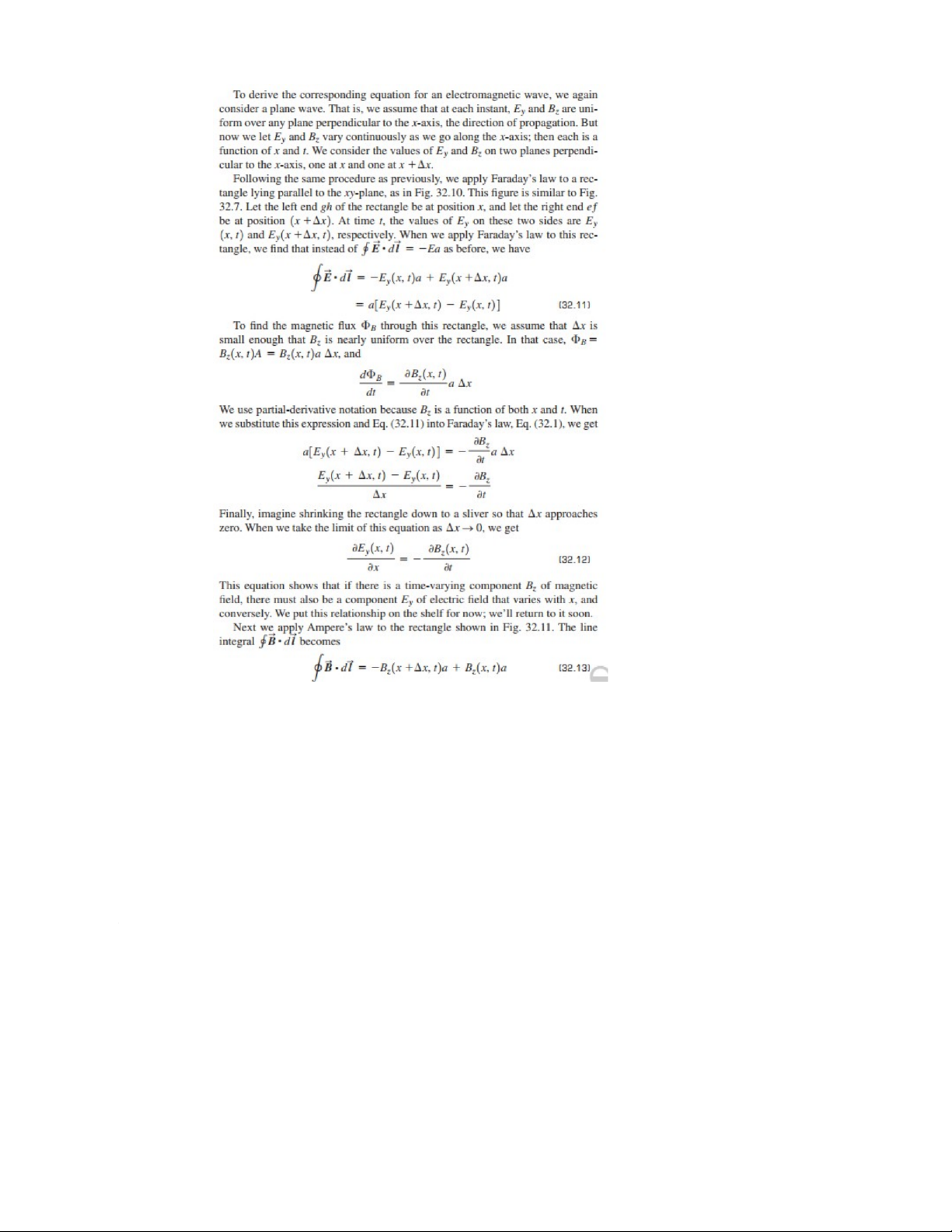
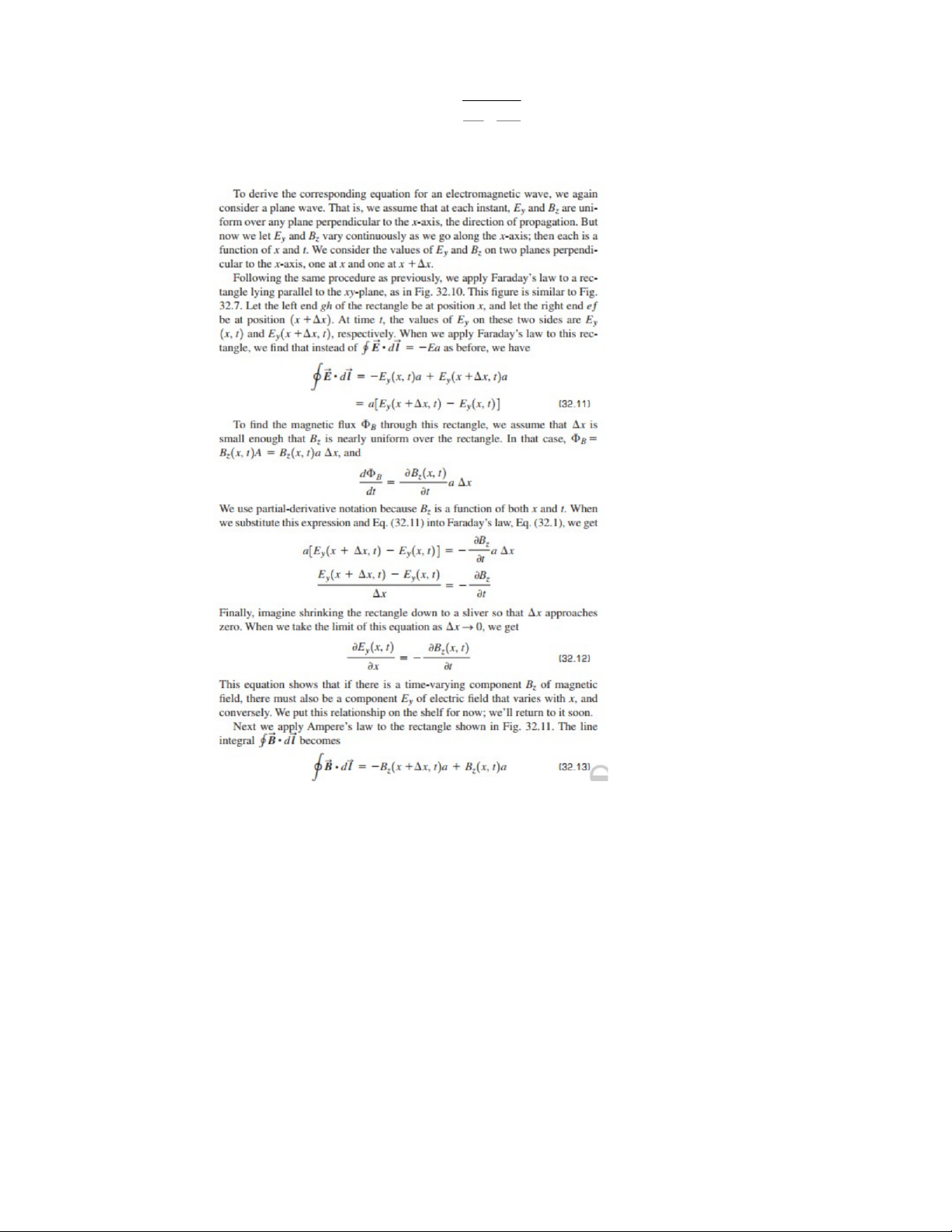
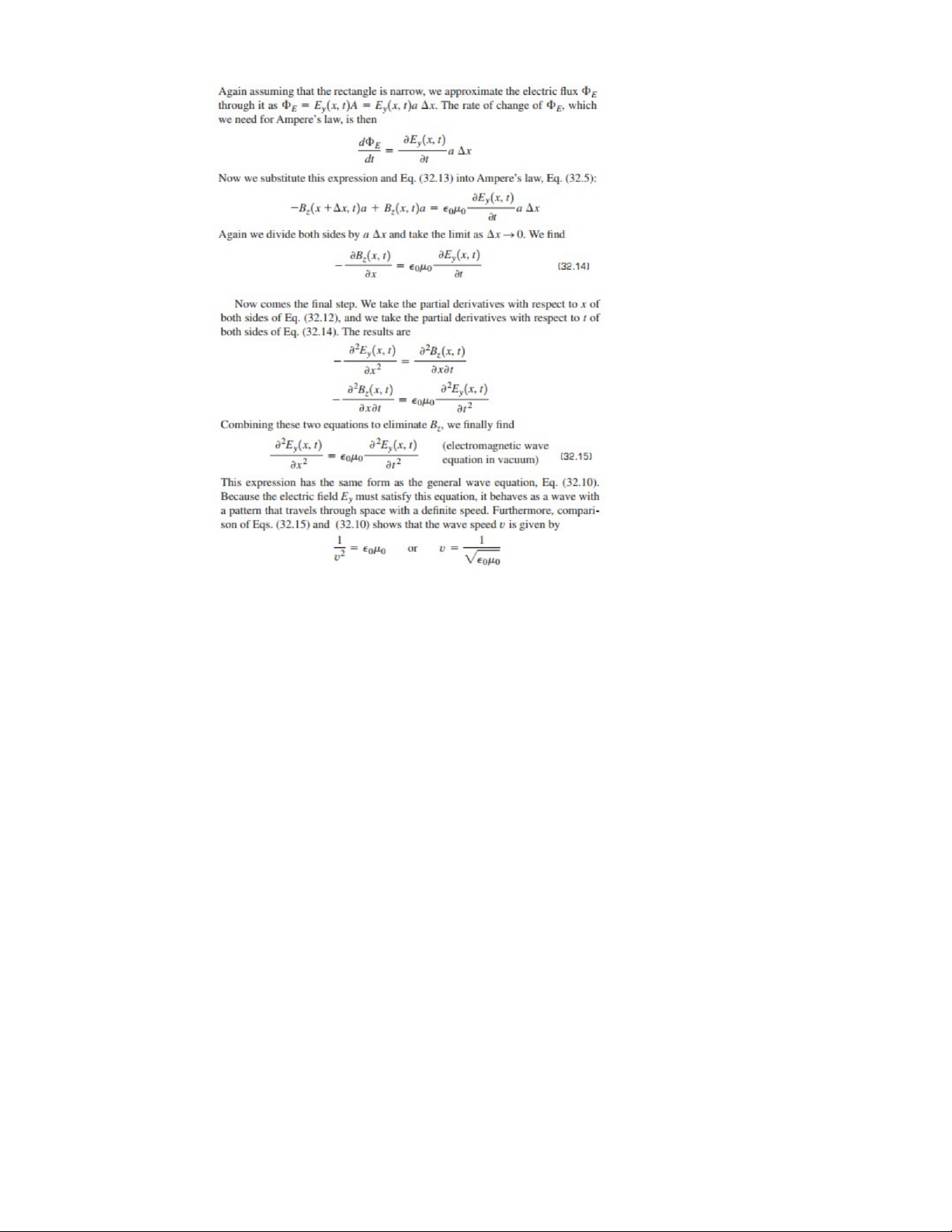
Topic 14: Derivation of the wave equation Electromagnetic Wave,
sinusoidal Plane Electromagnetic Waves, polarization and the Speed of Light
1.Derivation of the wave equation: 3.Speed of light:
Topic 15: Kinetic-molecular model of an ideal gas. Average
translational kinetic energy of a gas molecule
1. Kinetic-molecular model of an ideal gas:
a. A container with volume V contains a very large number N of identical molecules, each with mass m.
b. The molecules behave as point particles that are small compared to the size ò the
container and to the average distance between molecules.
c. The molecules are in constant motion. Each molecule collides occasionally with a wall
of the container. These collisions are perfectly elastic.
d. The container walls are rigid and infinitely massive and do not move.
2. Average translational kinetic energy of a gas molecule
The average translational kinetic energy per molecule depends only on temperature, not on the
pressure, volume, or kind of molecule 1 2m v2=3 av 2kT
Topic 16: Distribution function of molecular speeds, the Maxwell-
Boltzmann distribution. Average speed, root-main square speed and the
most probable speed of a gas molecule
1. Distribution function of molecular speeds:
If we observe a total of N molecules, the number dN having speeds in the range
between v and v+dv is given by: dN = Nf(v)dv
We can also say that the probability that a randomly chosen molecule will have a speed
in the interval v +dv is f(v)dv. Hence f(v) is the probability per unit speed interval.
2. The Maxwell-Boltzmann distribution: 3/2
f (v )=4π(m2πkT ) v2e−m v2/2kT 3. Average speed: vav= √8kBT πm = √8RT πM
4. Root- mean- square speed
vrms= √va2v= √3kTm= √3RT M 5.Most probable speed: vmp= √2kBT m= √2RTM
Topic 17: The first law of thermodynamics and applying for kinds of
thermodynamic processes: adiabatic, isochoric, isobaric and isothermal processes:
1. The first law of thermodynamics:
States that when heat Q is added to a system does work W, the internal energy U
changes by an amount equal to Q – W. This law can also be expressed for an infinitesimal process.
∆ U =Q−W
dU =dQ−dW
2. Applying for kinds of thermodynamic processes:
a. Adiabatic: is defined as one with no heat transfer into or out the system; Q=0
U2−U1=∆ U =−W
b. Isochoric: is a constant-volume process. When the volume of a thermodynamic
system is constant, it does no work on it surroundings. Then W = 0 and
U2−U1=∆ U =Q
c. Isobaric process: is a constant-pressure process. In general, none of the three
quantities ∆ U , Q∧W
is zero in an isobaric process, but calculating W is easy nonetheless.
W=p(V2−V1)
d. Isothermal process: is a constant-temperature process. For a process to be
isothermal, any heat flow into or out the system must occur slowly enough that
thermal equilibrium is maintained. In general, none of the quantities ∆ U , Q∧W is zero in an isothermal process.
Topic 18: Directions of thermodynamic processes, reversible and
irreversible processes. Heat engines, thermal efficiency of an engine the
Carnot cycle and quantitative expression of the second law of thermodynamic:
1. Directions of thermodynamic processes:
Thermodynamic processes that occur in nature are all irreversible processes. These are
processes that proceed spontaneously in one direction but not the other. The flow of
heat from a hot body to is irreversible, as is the free expansion of a gas.
2. Reversible processes: are equilibrium processes, with the system always in
thermodynamic equilibrium. Of course, if a system were truly in thermodynamic
equilibrium, no change of state would take place.
3. Irreversible processes: are heat flow with finite temperature difference, free expansion
of a gas, and conversion of work to heat; no small change in conditions could make any
of them go the other way. They are also all nonequilibrium processes, in that the system
is not in thermodynamic equilibrium at any point until the end of the process.
4. Thermal efficiency of an engine is the quotient
e=W =1+QC =1−|QC| QH QH QH
W: the net work done by the working substance.
QH : the amount of heat energy by the hot reservoir (>0)
QC: the heat rejected in the exhaust (<0)
5. The Carnot cycle is the hypothetical, idealized heat engine that has the maximum
possible efficiency consistent with the second law. It consists of the following steps:
+ The gas expands isothermally at temperature TH absorbing heat QH
+ It expands adiabatically until its temperature drops to TC
+ It is compressed isothermally at TC , rejecting heat |QC|
+ It is compressed adiabatically back to its initial state at temperature TH
6. Quantitative expression of the second law thermodynamics:
It is impossible for any system to undergo a process in which it absorbs heat from a
reservoir at a single temperature and converts the heat completely into mechanical
work, with the system ending in the same state in which it began.
Topic 19: Entropy change in reversible and irreversible processes, the
meaning of the second law of thermodynamics: 2dQ
1. Entropy changes in reversible processes: ∆ S=∫T 1
When a system proceeds from an initial state with entropy S1 to a final state with entropy S,
the change in the entropy ∆ S=S2−S1 defined by the above equation does not depend on the
path leading from state 1 to state2.
2. Entropy changes in irreversible processes: all irreversible processes involve an increase in
entropy. The entropy of an isolated system can change, but it can never decrease.
The second law limits the availability of energy and the ways in which it can be used and converted.
Topic 20: Differences between ideal and real gases, Van der Waals
equation of state, critical point:
1. Differences between ideal and real gas:
Difference between Ideal gas and Real gas IDEAL GAS REAL GAS No definite volume Definite volume Elastic collision of particles
Non-elastic collisions between particles
No intermolecular attraction forces
Intermolecular attraction force
Does not really exists in the environment and is a
It really exists in the environment hypothetical gas High pressure
The pressure is less when compared to Ideal gas Independent Interacts with others Obeys PV = nRT
Obeys p + ((n2 a )/V2)(V – n b ) = nRT 2.
Van der Waals equation of state:
(p+an2 )(V−nb )=nRT V2 3. Critical point:
The endpoint at the top of the vaporization curve, at which distinction between liquid and vapor disappears.
Part II: Final topics 2013
Topic 1: Gauss's law for the case of electric field and magnetic field: 1. For electric field:
Gauss's law state that the total electric flux through a closed surface, which can be written as
the surface integral of the component of E normal to the surface, equals a constant time the
total charge Qencl enclosed by the surface.
ΦE=∫Ecosφ dA=∮ E dA=Qencl ϵ0 2. For magnetic field:
The total magnetic flux through a closed surface is always zero. ∮ B ∙ d A=0
Topic 2: The relationship between electric field and potential, prove that
vector E normal to the equipotential lines: 1.
The relationship between electric field and potential:
If the potential V is known as a function of the coordinates x, y, and z, the components of electric field
E at any point are given by partial derivatives of V. Ex=−∂ V x Ey=−
∂∂y VEz=−∂V z∂ V E=−( i∂V ∂ x +j∂V
∂ y + ∂ z ) ∂ z 2.
E is the negative of the gradient of V E=− ∇V
Topic 3: The energy and energy density of electric field:
1. The energy of electric field:
A capacitor with capacitance C carrying voltage V has energy U associated with the capacitor’s electric field U=Q2 2C=12C V 2=1 2QV
2. The energy density of electric field:
It is the energy per unit volume in the space between the plates of a parallel-plate
capacitor with plate area and separation d 1 2C V 2
u=energy density = Ad =12ϵ0E2
Topic 4: Ampere’s law and applications: 1. Ampere’s law:
Ampere’s law states that the line integral of
B around any closed path equals times the net
current through the area enclosed by the path. The positive sense of current is determined by a right-hand rule. ∮ B ∙ d
l=μ0Iencl 2. Application: Current Point in Magnetic-Field Magnitude distribution magnetic field Long, straight Distance r from B=μ0I conductor conductor 2rπ Circular loop of On axis of loop B=μ0I a2 radius a 2(x2+a2)3/2 At center of loop B=μ (for N loops, 0I multiply these 2πa expressions by N) Long cylindrical Inside conductor, B=μ0Ir conductor of radius r2π R2 R Outside conductor, B=μ0I r>R 2rπ Long, closely wound Inside solenoid, B=μ0∋¿ solenoid with n near center turns per unit Outside solenoid B ≈ 0 length, near its midpoint Tightly wound Within the space
B=μ0∋¿2rπ ¿ toroidal solenoid enclosed by the with N turns windings, distance r from symmetry axis Outside the space B ≈ 0 enclosed by the windings
Topic 5: Faraday’s law and self inductance: 1. Faraday’s law:
Faraday’s law states that the induced emf in a closed loop equals the negative of the time rate
of change of magnetic flux through the loop. This relationship is valid whether the flux change is
caused by a changing magnetic field, motion of the loop, or both. ε=−d ΦB dt 2. Self inductance:
A changing current I in any circuit causes a self-induced ε. The inductance (or self-inductance) L
depends on the geometry of the circuit and the material surrounding it. The inductance of a coil
of N turns is related to the average flux ΦB through each turn caused by the current I in the coil. ε=−Ldi dt L=N ΦB i
Topic 6: Energy and energy density of magnetic field
1. Magnetic-field energy:
An inductor with inductance L carrying current I has energy U associated with the inductor’s magnetic field U=12L i2
2.The magnetic energy density u (energy per unit volume) is proportional to the square of the magnetic field magnitude
u=B2 (¿vacuum ) 2μ0 u=B2
2μ(¿a material wih magnetic permeability μ)
Topic 7: Set up the equation for a damping electromagnetic oscillation in a LCR circuit:???
A circuit that contains inductance, resistance, and capacitance and undergoes damped oscillation for
sufficiently small resistance. The frequency w’ of damped oscillations depends on the value of L, R, and
C. As R increases, the damping increases; if R is greater than a certain value, the behavior becomes
overdamped and no longer oscillates.
ω'= √1LC −R24L2
Topic 8: From Maxwell’s statement (based on Pharaday’s and
Amprere’laws) set up the equations for electromagnetic wave: ????
Topic 9: Using the principle of equipartition of energy derive the
expression of internal energy for monatomic, diatomic and polyatomic ideal gases:???
Topic 10: Express the statement of 1st law of thermodynamics and drive
the expressions of 4 basic processes of ideal gas: 1.
The first law of thermodynamics:
States that when heat Q is added to a system does work W, the internal energy U changes by an
amount equal to Q – W. This law can also be expressed for an infinitesimal process.
∆ U =Q−W
dU =dQ−dW 2.
Applying for kinds of thermodynamic processes:
a. Adiabatic: is defined as one with no heat transfer into or out the system; Q=0
U2−U1=∆ U =−W
b. Isochoric: is a constant-volume process. When the volume of a thermodynamic system is
constant, it does not work on its surroundings. Then W = 0 and
U2−U1=∆ U =Q c.
Isobaric process: is a constant-pressure process. In general, none of the three quantities ∆ U , Q∧W
is zero in an isobaric process, but calculating W is easy nonetheless.
W=p(V2−V1)
d. Isothermal process: is a constant-temperature process. For a process to be isothermal, any
heat flow into or out the system must occur slowly enough that thermal equilibrium is
maintained. In general, none of the quantities ∆ U , Q∧W
is zero in an isothermal process.
Topic 11: Give two statement of 2nd law of thermodynamics, from the
Carnot’ law derive the expression of 2nd law of thermodynamic: 1. Two statement:
a. It is impossible for any system to undergo a process in which it absorbs heat from a reservoir
at a single temperature and converts the heat completely into mechanical work, with the
system ending in the same state in which it began.
b. It is impossible for any process to have as its sole result the transfer of heat from a cooler to a hotter body. 2.
The expression of 2nd law of thermodynamic:?????
Topic 12: Determine the revertible process drive to entropy concept and
prove that the entropy of an isolated system never decreases.
When a system proceeds from an initial state with entropy S1 to a final state with entropy S, the change
in the entropy ∆S=S2-S1 defined by the above equation does not depend on the path leading from state 1 to state2. 2dQ ∆ S=∫T 1
The second law of thermodynamics states that the entropy of an isolated system never decreases,
because isolated systems always evolve toward thermodynamic equilibrium, a state with maximum entropy.
Tài liệu liên quan:
-
Bài tập Vật lý nguyên tử môn Vật lý đại cương 2 | Học viện Công Nghệ Bưu Chính Viễn Thông
11 6 -
Bài tập Vật lý nguyên tử môn Vật lý đại cương 2 | Học viện Công Nghệ Bưu Chính Viễn Thông
12 6 -

Tán xạ ánh sáng và Hiệu ứng Tyndall - Lý thuyết và Ứng dụng môn Vật lý đại cương 2 | Học viện Công Nghệ Bưu Chính Viễn Thông
19 10 -

Chương 23: Quang học lượng tử môn Vật lý đại cương 2 | Học viện Công Nghệ Bưu Chính Viễn Thông
17 9 -

Chương 24: Cơ Học Lượng Tử - Tính Sóng-Hạt và Phương Trình Schrödinger môn Vật lý đại cương 2 | Học viện Công Nghệ Bưu Chính Viễn Thông
18 9