Policy Paper 324: Enhancing Conditionality for Resilience | Tài chính quốc tế | Trường Học Viện nông nghiệp Việt Nam
The IMF’ s Resilience and Sustainability Trust (RST) has been operational for over a year, with the first seventeen countries receiving commitments of financial support. But if lending from the RST is to achieve its objectives, the IMF should make it fitter for purpose by taking a radically different approach in applying conditions to the loans. This paper first gives the background and summarizes the argument; sets out the unique challenges involved in designing best practice conditionality to deal with climate change –the focus of the RST so far; and makes three specific suggestions to address shortcomings in the emerging conditionality to make the most of the IMF’ s new initiative to help member countries build resilience and sustainability. Tài liệu được sưu tầm và soạn thảo dưới dạng file PDF để gửi tới các bạn cùng tham khảo, ôn tập đầy đủ kiến thức, chuẩn bị cho các buổi học thật tốt. Mời bạn đọc đón xem!
Môn: Tài chính quốc tế (hvnn) 130 tài liệu
Trường: Học viện Nông nghiệp Việt Nam 2.4 K tài liệu
Tác giả:




Preview text:
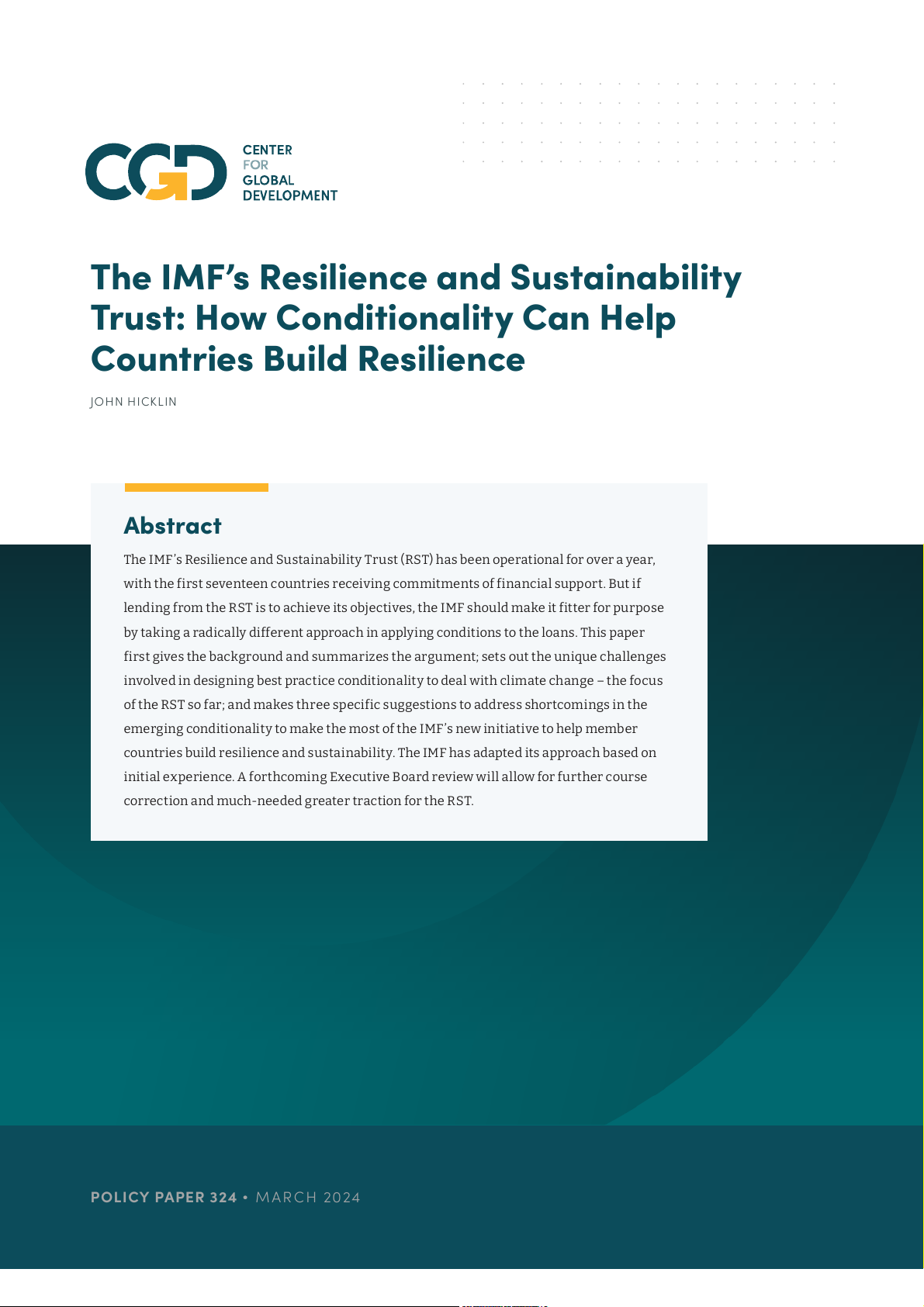
The IMF’s Resilience and Sustainability
Trust: How Conditionality Can Help Countries Build Resilience JOHN HICKLIN Abstract
The IMF’s Resilience and Sustainability Trust (RST) has been operational for over a year,
with the first seventeen countries receiving commitments of financial support. But if
lending from the RST is to achieve its objectives, the IMF should make it fitter for purpose
by taking a radically different approach in applying conditions to the loans. This paper
first gives the background and summarizes the argument; sets out the unique challenges
involved in designing best practice conditionality to deal with climate change – the focus
of the RST so far; and makes three specific suggestions to address shortcomings in the
emerging conditionality to make the most of the IMF’s new initiative to help member
countries build resilience and sustainability. The IMF has adapted its approach based on
initial experience. A forthcoming Executive Board review will allow for further course
correction and much-needed greater traction for the RST.
POLICY PAPER 324 • M A R C H 20 24
The IMF’s Resilience and Sustainability Trust: How Conditionality Can Help Countries Build Resilience John Hicklin
Center for Global Development
The author is grateful for helpful conversations with David Andrews, Sanjeev Gupta, Kathryn McPhail, Mark
Plant, and Etienne Romsom, and for comments from two anonymous reviewers; and is responsible for any remaining errors.
John Hicklin. 2024. “The IMF’s Resilience and Sustainability Trust: How Conditionality Can Help Countries Build
Resilience.” CGD Policy Paper 324. Washington, DC: Center for Global Development. https://www.cgdev.org/
publication/imfs-rst-how-conditionality-can-help-countries-build-resilience
CENTER FOR GLOBAL DEVELOPMENT
The Center for Global Development works to reduce global 2055 L Street, NW Fifth Floor
poverty and improve lives through innovative economic
research that drives better policy and practice by the world’s Washington, DC 20036
top decision makers. Use and dissemination of this Policy Paper 1 Abbey Gardens
is encouraged; however, reproduced copies may not be used Great College Street
for commercial purposes. Further usage is permitted under the London
terms of the Creative Commons Attribution-NonCommercial 4.0 SW1P 3SE International License. www.cgdev.org
The views expressed in CGD Policy Papers are those of the
authors and should not be attributed to the board of directors,
Center for Global Development. 2024.
funders of the Center for Global Development, or the authors’ respective organizations. Contents
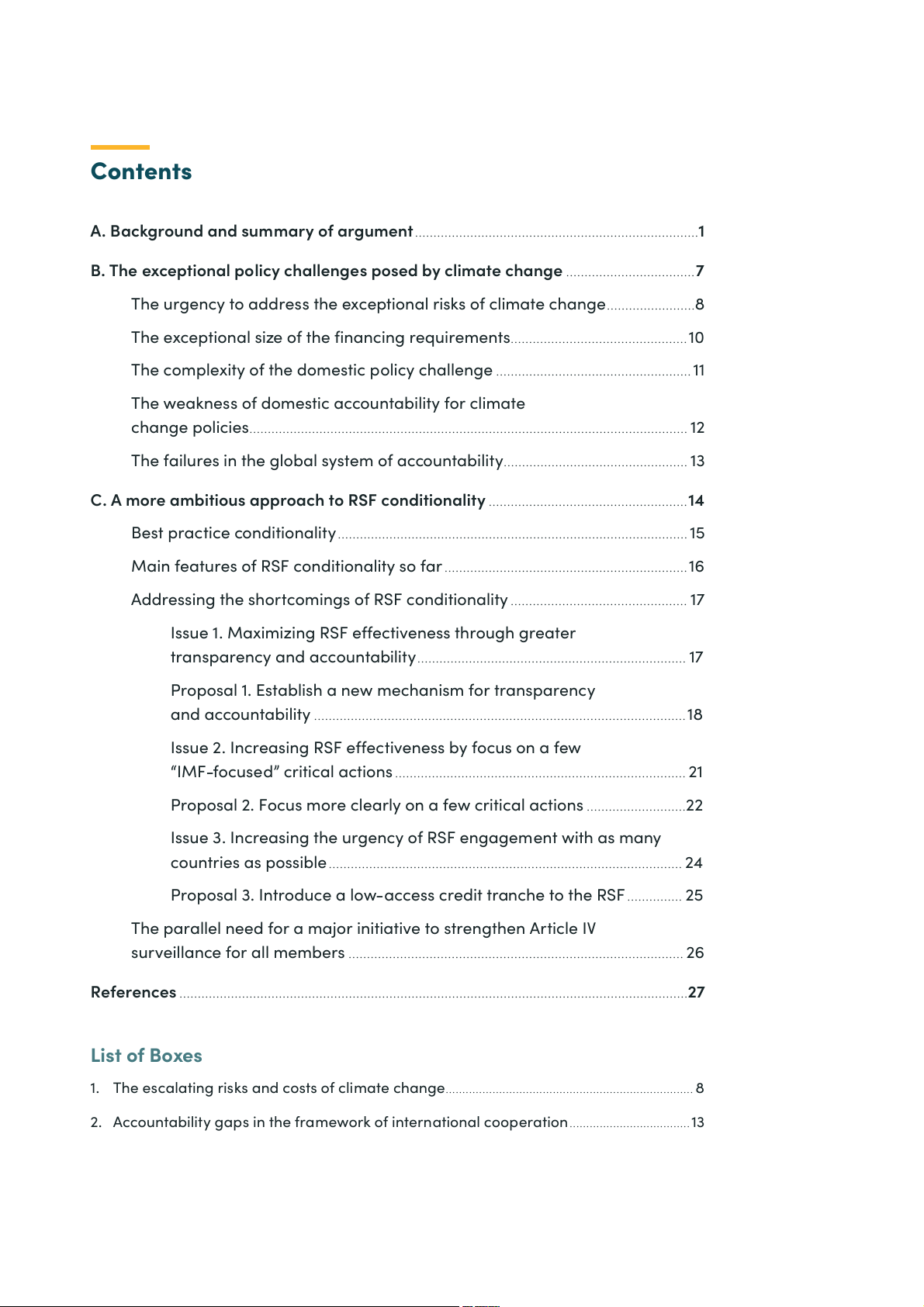
A. Background and summary of argument .............................................................................1
B. The exceptional policy challenges posed by climate change ...................................7
The urgency to address the exceptional risks of climate change ........................8
The exceptional size of the financing requirements ................................................10
The complexity of the domestic policy challenge ..................................................... 11
The weakness of domestic accountability for climate
change policies ....................................................................................................................... 12
The failures in the global system of accountability .................................................. 13
C. A more ambitious approach to RSF conditionality ......................................................14
Best practice conditionality ............................................................................................... 15
Main features of RSF conditionality so far .................................................................. 16
Addressing the shortcomings of RSF conditionality ................................................ 17
Issue 1. Maximizing RSF effectiveness through greater
transparency and accountability ......................................................................... 17
Proposal 1. Establish a new mechanism for transparency
and accountability ..................................................................................................... 18
Issue 2. Increasing RSF effectiveness by focus on a few
“IMF-focused” critical actions ............................................................................... 21
Proposal 2. Focus more clearly on a few critical actions ...........................22
Issue 3. Increasing the urgency of RSF engagement with as many
countries as possible ................................................................................................ 24
Proposal 3. Introduce a low-access credit tranche to the RSF ............... 25
The parallel need for a major initiative to strengthen Article IV
surveillance for all members ........................................................................................... 26
References ..........................................................................................................................................27 List of Boxes
1. The escalating risks and costs of climate change .......................................................................... 8
2. Accountability gaps in the framework of international cooperation .................................... 13
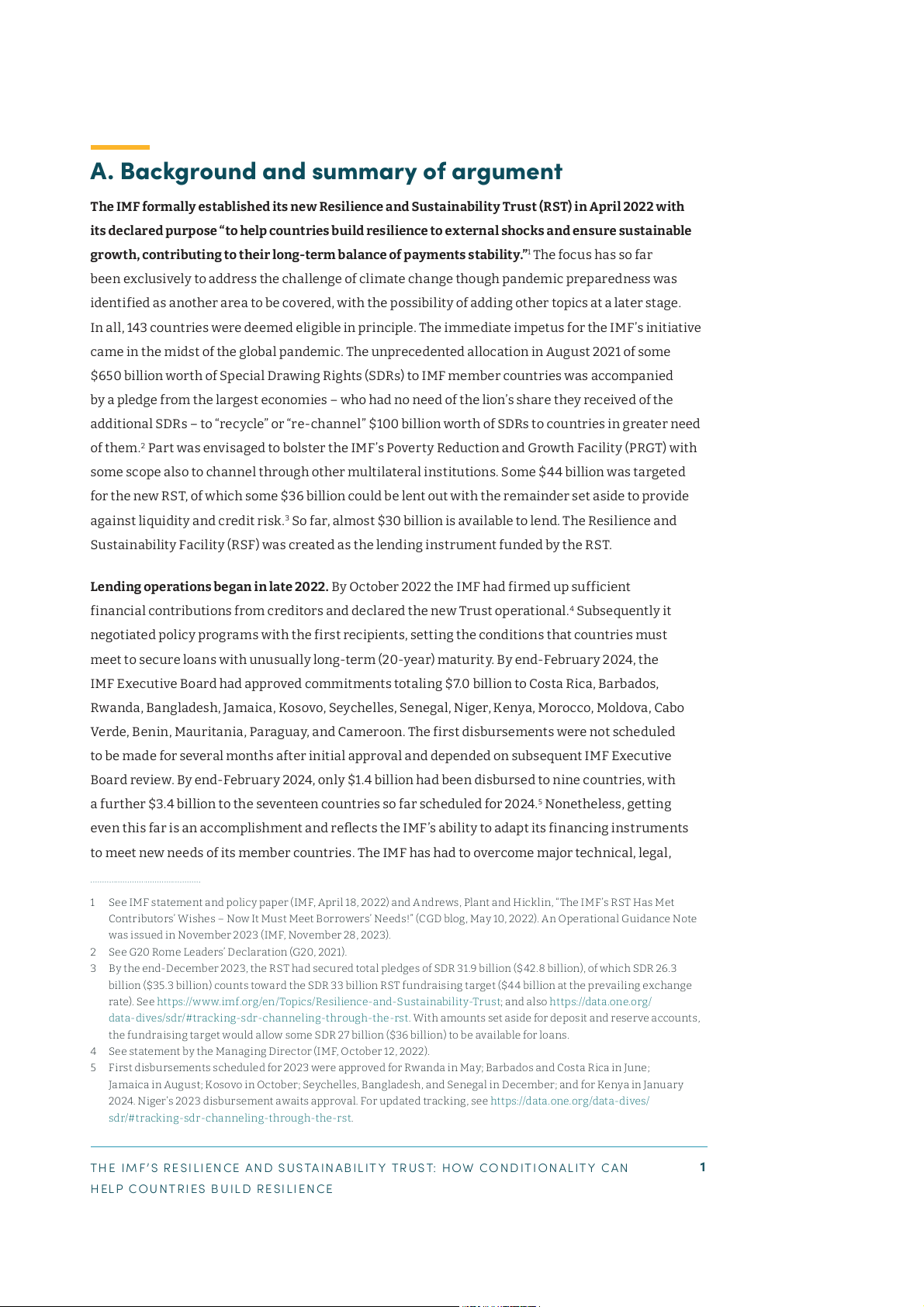
A. Background and summary of argument
The IMF formally established its new Resilience and Sustainability Trust (RST) in April 2022 with
its declared purpose “to help countries build resilience to external shocks and ensure sustainable
growth, contributing to their long-term balance of payments stability.”1 The focus has so far
been exclusively to address the challenge of climate change though pandemic preparedness was
identified as another area to be covered, with the possibility of adding other topics at a later stage.
In all, 143 countries were deemed eligible in principle. The immediate impetus for the IMF’s initiative
came in the midst of the global pandemic. The unprecedented allocation in August 2021 of some
$650 billion worth of Special Drawing Rights (SDRs) to IMF member countries was accompanied
by a pledge from the largest economies – who had no need of the lion’s share they received of the
additional SDRs – to “recycle” or “re-channel” $100 billion worth of SDRs to countries in greater need
of them.2 Part was envisaged to bolster the IMF’s Poverty Reduction and Growth Facility (PRGT) with
some scope also to channel through other multilateral institutions. Some $44 billion was targeted
for the new RST, of which some $36 billion could be lent out with the remainder set aside to provide
against liquidity and credit risk.3 So far, almost $30 billion is available to lend. The Resilience and
Sustainability Facility (RSF) was created as the lending instrument funded by the RST.
Lending operations began in late 2022. By October 2022 the IMF had firmed up sufficient
financial contributions from creditors and declared the new Trust operational.4 Subsequently it
negotiated policy programs with the first recipients, setting the conditions that countries must
meet to secure loans with unusually long-term (20-year) maturity. By end-February 2024, the
IMF Executive Board had approved commitments totaling $7.0 billion to Costa Rica, Barbados,
Rwanda, Bangladesh, Jamaica, Kosovo, Seychelles, Senegal, Niger, Kenya, Morocco, Moldova, Cabo
Verde, Benin, Mauritania, Paraguay, and Cameroon. The first disbursements were not scheduled
to be made for several months after initial approval and depended on subsequent IMF Executive
Board review. By end-February 2024, only $1.4 billion had been disbursed to nine countries, with
a further $3.4 billion to the seventeen countries so far scheduled for 2024.5 Nonetheless, getting
even this far is an accomplishment and reflects the IMF’s ability to adapt its financing instruments
to meet new needs of its member countries. The IMF has had to overcome major technical, legal, 1
See IMF statement and policy paper (IMF, April 18, 2022) and Andrews, Plant and Hicklin, “The IMF’s RST Has Met
Contributors’ Wishes – Now It Must Meet Borrowers’ Needs!” (CGD blog, May 10, 2022). An Operational Guidance Note
was issued in November 2023 (IMF, November 28, 2023).
2 See G20 Rome Leaders’ Declaration (G20, 2021).
3 By the end-December 2023, the RST had secured total pledges of SDR 31.9 billion ($42.8 billion), of which SDR 26.3
billion ($35.3 billion) counts toward the SDR 33 billion RST fundraising target ($44 billion at the prevailing exchange
rate). See https://www.imf.org/en/Topics/Resilience-and-Sustainability-Trust; and also https://data.one.org/
data-dives/sdr/#tracking-sdr-channeling-through-the-rst. With amounts set aside for deposit and reserve accounts,
the fundraising target would allow some SDR 27 billion ($36 billion) to be available for loans.
4 See statement by the Managing Director (IMF, October 12, 2022).
5 First disbursements scheduled for 2023 were approved for Rwanda in May; Barbados and Costa Rica in June;
Jamaica in August; Kosovo in October; Seychelles, Bangladesh, and Senegal in December; and for Kenya in January
2024. Niger’s 2023 disbursement awaits approval. For updated tracking, see https://data.one.org/data-dives/
sdr/#tracking-sdr-channeling-through-the-rst.
TH E IM F’ S RE SI LI EN CE AN D S US TA IN AB IL IT Y TR US T: HOW CO ND IT I ON AL IT Y C AN 1
H EL P C OU NT RI ES B U IL D RE SI LI EN CE
and financial hurdles as well as find policy consensus amongst shareholders. However, what
comes next – including the approach to conditionality – will be crucial to determining whether this
initiative is ultimately a success.
A central issue is that the metrics for success are not well specified, making it difficult for the RST
to be fully effective until they are made clear and conditions appropriately geared to what the IMF
can help deliver. The IMF’s approach so far seems to be to hope for the best by providing additional
liquidity support and by specifying as conditions various useful country-led policy reforms – some
already under consideration – that plausibly contribute to tackling long-term structural problems
and prospective balance-of-payments problems. This approach blurs three competing though not
explicit objectives. The most important is to support substantive policy reform in countries facing
climate change. Two others are implicit: to disburse quickly to alleviate liquidity concerns; and to
contribute – de facto – to debt reprofiling for developing countries in the years to come, objectives
that are easier to pursue at the margin through the RSF than relying solely on regular IMF facilities.
However, specifying more clearly the IMF’s role in the difficult task of meeting the first objective is
the key to the ultimate success of the RST, and the focus of this paper.
For some, a quick disbursement of RSF funds would mark one measure of success. By contrast,
no other multilateral institution has yet managed to devise and implement a scheme with sufficient
shareholder support to recycle SDRs at all, though the African Development Bank (AfDB) is furthest
advanced.6 A metric of rapid disbursement would be unsurprising given the circumstances under
which the RST was created. Many developing countries faced liquidity constraints and lack of
fiscal space during the COVID-19 pandemic, in addition to the daunting financing requirements
amounting to several trillions of dollars each year to restructure their economies to invest in
energy transition while tackling climate change and preparing for future pandemics. Each of these
challenges entails present or prospective balance of payments problems, and the RSF funds can
be very useful additional resources for individual countries. Nonetheless, the amounts pledged to
the RSF are extremely modest compared to the scale of the financing needs, much of which will come
from the private sector as well as other official sources, both external and domestic. A key role for
rapid disbursement of RSF funds, giving financial support to national policy intent, is therefore the
signal it sends that can catalyze much larger resources from other sources.
Besides a desire to disburse quickly, the design of RSF conditionality suggests an additional if
unstated purpose to help reprofile a country’s debt service obligations. RSF disbursements finance
some new upfront budget expenditure but also provide a reserve buffer, so that the RSF tops up
access to the resources that are provided by the required regular IMF program. The IMF’s approach
therefore has the effect of making it easier for countries to service debt that will be due to the IMF
and others in the next few years when many RSF-eligible countries face the prospect of debt distress
6 See Plant, “Funding Hybrid Capital at the AfDB Is the Best Deal for SDR Donors.” (CGD blog, March 9, 2023). Further
impetus was given during the IMF’s Annual Meetings in October 2023.
TH E IM F’ S RE SI LI EN CE AN D S US TA IN AB IL IT Y TR US T: HOW CO ND IT I ON AL IT Y C AN 2
H EL P C OU NT RI ES B U IL D RE SI LI EN CE
that is heightened by war, pandemic, and climate change, in addition to any policy shortcomings.
Since the 20-year maturity of RSF loans exceeds that for regular IMF and PRGT loans, the RSF
would in essence allow a partial rescheduling of debt service falling due to the IMF and others.
The temptation to pursue this unstated benefit should not, however, distract from trying to maximize
the RSF’s impact on increasing long-term resilience to climate change (and to other challenges including pandemics).
Fundamentally, the success of the RSF will depend on the strength of the policies that countries
undertake to bolster their resilience, and the RSF contribution comes from the link between the
availability of IMF financing and the nature and speed of policy action that the RSF loans will help
to support. The design of RSF program conditions will therefore be key to whether the new Trust
succeeds in its purpose. Arguments over the appropriate design of RSF conditionality are just the
latest episode in a long saga of controversies over IMF conditionality policy, and of frequent reviews
of it by the IMF itself.7 In the case of the RSF, the debate over whether conditions – including the
195 Reform Measures (RMs) in the first seventeen programs – are necessary or sufficient, or too
lenient or too burdensome, is heightened by the original framing of the desire to recycle SDRs
to those most vulnerable as a way to make the 2021 SDR allocation more equitable. The pressure
to disburse money quickly might suggest very light conditionality, and there is certainly no shortage
of policy actions related to building a country’s resilience that could plausibly be used to justify quick
disbursements if desired. Moreover, some of the 143 eligible borrowing countries will be put off if
they perceive the requirements imposed by creditors to be too stringent, including to have a parallel
“regular” IMF program or credit line, given the stigma that any agreement with the IMF evokes. Other
countries will struggle to garner the political will to take substantive policy measures on climate
mitigation or adaptation that require the time, skill, and support to build consensus for difficult
decisions. Creditors are concerned lest too easy RSF conditionality would encourage countries to
bypass conditionality usually required under regular IMF programs, and by doing so would weaken
the prospects of repaying RSF loans. Applying parallel and therefore tougher conditionality has been
one way that creditors argue will preserve the “reserve asset status” of the on-lent SDRs.
Based on the agreed RSF modalities and the evidence from early cases, the aims of relatively rapid
financing and facilitating substantive change will be furthered, but modestly: the rate of actual
disbursements is slow, and the impact on resilience difficult to quantify. The modalities of the RSF,
including the phased nature of disbursements and loan conditions, especially the requirement
to have a concurrent IMF program or credit line, met the creditors’ requirements and as a result
even the committed SDRs will not be disbursed very quickly. For the first RSF-supported reform
programs, the first tranche was not made available for some four months (Costa Rica) to nine months
(Bangladesh) after Executive Board approval, with full disbursement spread out over three years,
7 The most recent was completed in 2019, see “2018 Review of Program Design and Conditionality” (IMF May 2019).
A particularly eventful and contentious period is described in James Boughton, “Silent Revolution: The International
Monetary Fund 1979–1989” (IMF, 2001), pp 557–636.
TH E IM F’ S RE SI LI EN CE AN D S US TA IN AB IL IT Y TR US T: HOW CO ND IT I ON AL IT Y C AN 3
H EL P C OU NT RI ES B U IL D RE SI LI EN CE
and contingent on performance not only of agreed reform measures under the RSF but also of the
accompanying macroeconomic program. With the present limits on a country’s access to RSF funds,
the approximately $30 billion now available would be disbursed by 2030 only if the early pace of
approvals is maintained and if all programs are fully implemented.8
The degree of substantive change is in question, and the danger with the current approach is that
the IMF will overpromise and underachieve in its bid to bolster countries’ long-term resilience and
sustainable growth. The initial country programs reflect an enormous amount of technical work
and commitment at the national level, and significant cooperation between the IMF staff and partner
institutions, including the World Bank. However, there are three concerns about the effectiveness of
RSF conditionality. First, since agreement now on Reform Measures is only part of the generation-
long process of building consensus and adapting policies sufficient to meet an ever-changing concept
of national resilience, existing RSF conditionality does not go as far as it can to mandate greater
transparency that could foster broader domestic policy buy-in and external financial support, while
increasing accountability of domestic and foreign actors. Second, assessments of early programs are
that many of the RMs, while worthwhile and in the right direction, are relatively light or “low-depth”
and the question is whether they will contribute enough to help meet the enormous challenge facing
the recipient countries.9 Some of the RMs – an average of twelve so far – would struggle to meet very
rigorous tests of materiality and parsimony, with many policy measures of a process nature, not
by themselves affecting economic behavior to the extent required to tackle prospective balance of
payments problems. Relatedly, there are insufficient metrics to monitor and evaluate the extent of a
reform’s impact. Moreover, the rationale for coverage of RMs is unclear, especially why some reforms
are included in some countries but excluded in others. Third, the early enthusiasm from the first
recipients still leaves over a hundred eligible countries that are not yet taking advantage of the policy
discussions and potential financial support. These delays are damaging at both the national and global
level, as the costs of slow adaptation and mitigation rise sharply, justifying making the RSF more
attractive to more countries, including those for whom IMF engagement is stigmatized. Whereas
traditional IMF program engagement for immediate balance of payments problems will only involve
a minority of member countries at one time, addressing resilience and sustainability to alleviate
prospective balance of payments problems is a universal as well as urgent challenge.
8 Limits on individual country access were set initially at the lesser of SDR 1 billion or 150 percent of IMF quota, with
a “norm” of 75 percent. The average access for the first seventeen programs was $0.4 billion (on average, 112 percent
of quota), with two economies (Bangladesh and Morocco) capped at SDR 1 billion ($1.3 billion) and seven others at
the maximum 150 percent of quota. A similar average profile would require more than 50 additional programs to be
approved by 2027 to disburse $30 billion by 2030.
9 For critiques, see Gupta and Brown, “How Can the IMF’s New Lending Facility for Climate and Pandemic Preparedness
Be Made More Effective?” (CGD blog, March 29, 2023); Gupta and Brown, “IMF Lending Under the Resilience and
Sustainability Trust: An Initial Assessment.” (CGD policy paper 289, March 28, 2023; and Gupta and Brown, “The
Resilience and Sustainability Facility’s Recent Programs Still Fall Short of Its Ambitious Goals.” (CGD blog, August 22,
2023), who focus on the “low-depth” of reform measures so far. See also Citrin and Sembene, “IMF Support for
Climate Resilience in Africa Is Helpful, But More Can Be Done.” (CGD blog, September 22, 2023) who argue for greater
access to financing. Moreover, the early cases have focused only on climate change resilience, not yet on pandemic
preparedness that was the other issue highlighted in the Executive Board decision establishing the RST in April 2022.
TH E IM F’ S RE SI LI EN CE AN D S US TA IN AB IL IT Y TR US T: HOW CO ND IT I ON AL IT Y C AN 4
H EL P C OU NT RI ES B U IL D RE SI LI EN CE
In part these concerns reflect the urgent and immensely complex challenge that climate change
poses for national policies and the system of international cooperation. The fundamental issue
is that interactions between the IMF and a country’s authorities, even more so than in traditional
IMF program contexts, are only one small part of the complex system that can help a country tackle
prospective and long-term structural problems related to climate change. The problems require
urgent action yet will not yield full benefits for a generation. Policy formulation, implementation,
and financing depend on actors beyond the IMF’s traditional counterparts, and many necessary
national policies are outside the IMF areas of expertise, requiring cooperation between other
international organizations, complicating the question of who is responsible for providing advice, and to whom.
A re-evaluation of the nature of RSF conditionality is therefore warranted to examine what more
can be done to increase the likelihood that the RSF’s objectives are achieved. It would be a mistake
to determine the “Goldilocks” degree of conditionality – neither too little nor too much but just
right – simply by pragmatic judgments of what might be acceptable to both creditors and borrowers.
The appropriate measure, against which such an evaluation could be based, can be expressed as
the maximum adaptation of IMF policies and procedures consistent with both the threat to global
prosperity and the fundamental purpose and obligations of the IMF’s mandate.10 In deciding how to
adapt conditionality, the IMF should reassess its approach to risk, recognizing that not taking a bolder
approach now to RSF conditionality would by default entail more significant risks – for countries and
for the IMF. By contrast, action now would lower the probability of prospective balance of payments
problems that the RST is supposed to help alleviate.
Applying this best practice metric in the case of the RSF argues for a radically different type of
conditionality to meet the RST’s goal, with much greater emphasis on clarifying the accountability
of the various parties responsible for achieving desirable outcomes over an extended period.
No country on its own, and neither the IMF nor any other institution, can solve these systemic
problems. The IMF should, however, do much more in order to fulfill its own mandate while playing,
through its own policies of transparency and surveillance, a vital role by encouraging greater
accountability for the performance of others, both within member countries and by other partner
international institutions. The IMF has a unique opportunity, by leveraging its advice and resources,
to help countries strengthen domestic processes that foster reform. At the same time, it can help
improve the flawed system of international cooperation that is far too slow to address the risks posed
by climate change and pandemics. A better-defined role for the IMF would complement a much
more active role for the World Bank that is overdue and reflected in the recent proposal to expand its mission statement.11
10 The concept of best practice conditionality is further explained in Section C.
11 See “Ending Poverty on a Livable Planet,” Report to the Governors of the IMF-World Bank Development Committee, September 28, 2023.
TH E IM F’ S RE SI LI EN CE AN D S US TA IN AB IL IT Y TR US T: HOW CO ND IT I ON AL IT Y C AN 5
H EL P C OU NT RI ES B U IL D RE SI LI EN CE
This paper proposes a more ambitious approach, building on what has so far been achieved to
increase the chances of achieving the substantive aims of the RST.12 In sum, the IMF should adapt its
RSF conditionality in three ways:
First, as part of its formal RSF conditionality, it would establish a new mechanism for transparency
that would make central – and give greater traction to – the authorities’ statement of policy
objectives and actions to achieve them. A new Resilience and Sustainability Policy Statement (RSPS)
would be designed to increase the accountability of domestic and international institutions in their
own areas of responsibility; better explain policy direction and help build internal consensus for the
actions; and facilitate the IMF’s catalytic role in attracting domestic political support and much larger
resource flows from official and private sector sources.
Second, the IMF should focus more clearly on a few critical actions within its area of expertise that it will
help countries design, monitor, and evaluate as RSF loan conditions, separating out these actions from
the much broader range of policy actions that countries are taking or need to take. These policies would
center on five areas, the first two yielding quantitatively significant local as well as global benefits: a.
carbon pricing (or equivalent regulation), including eliminating fossil fuel subsidies; b.
or gas- and oil- producing countries, levying default penalties on methane emissions; c.
incorporation into a country’s medium-term budget the many specific revenue and
expenditure measures required to meet climate change mitigation, adaptation, and
transition goals, including financial support for those on lower incomes affected by policy
change (as well as measures for pandemic preparedness);
d. upgrading financial sector regulation and supervision to incorporate climate-related risks; e.
targeting an additional foreign reserve build-up to bolster resilience to shocks.
Third, it should allow all RSF-eligible countries to draw a low-access or “first credit tranche”
equivalent to 25 percent of IMF quota, without requiring a concomitant IMF program. The aim would
be to engage as a matter of urgency with as many countries as possible to support economic policy
action to address climate change. Disbursements would be conditioned on publication of an RSPS and
on undertaking to consult with the IMF on the country’s balance of payments policies and prospects.
And equally importantly, the IMF should integrate its RSF work into its broader responsibilities by
a major initiative to substantially expand its surveillance role. Meeting the goal of the RST depends
greatly on the policy actions of all IMF members, especially the largest economies, and not just the
recipients of RSF loans. Those countries eligible for the RSF and most vulnerable to climate change
would benefit most from whatever influence the IMF can bring to bear on the largest economies to
urge much more rapid adherence to mitigation and adaptation pledges. Two aspects of the initiative
12 An earlier outline of this approach has been developed in light of experience and the publication of the IMF’s RSF
Operational Guidance Note. See Hicklin, “Launching the RST: Country Policies Must Adapt – and So Too Must
IMF Conditionality.” (CGD blog, February 23, 2023).
TH E IM F’ S RE SI LI EN CE AN D S US TA IN AB IL IT Y TR US T: HOW CO ND IT I ON AL IT Y C AN 6
H EL P C OU NT RI ES B U IL D RE SI LI EN CE
are required, relating to substance and procedure. On substance, the IMF should develop a new
code of conduct for economic policies related to climate change that all member countries should
aspire to. On procedure, the proposed mechanism of the RSPS could also be part of IMF Article IV
consultation discussions with all member countries, including the largest and richest. As input to
the discussions, the IMF should develop with the World Bank, based on existing diagnostic tools, a
Resilience and Sustainability Assessment Program (RSAP), akin to the Financial Sector Assessment
Program (FSAP), with a piloted then targeted approach to work with the largest economies as well
as those most vulnerable. Moreover, a cumulative and regular assessment of the implications for
economic policies and consequences of the entire membership’s commitments to tackle climate
change and pandemic preparedness – a role the IMF can uniquely play – is an integral part of its
responsibilities for global economic surveillance.
The forthcoming IMF Executive Board review of the RST will provide the opportunity to modify
RSF conditionality policy. Lessons from the first country cases will also inform the development
and review of IMF surveillance policy. The rest of this paper sets out in Section B the unique
challenges posed by climate change, underscoring the very different type of need that the RST
should help countries address. Section C explains the nature of the mismatch between emerging RSF
conditionality and best practice, and proposes adaptations to conditionality and related policies.
B. The exceptional policy challenges posed by climate change
The IMF conditionality framework that has been adapted over the decades faces its most extreme
challenge when dealing with the “prospective” balance of payments problems that the IMF’s RSF
aims to address, especially climate change.13 Designing appropriate RSF conditionality must deal
with five main difficulties, reflecting above all the inherent complexity of the underlying policy
problem facing country authorities and the world as a whole, with significant implications for the role of the IMF: a.
the enormity of the economic challenge posed by climate change, and the limited time
horizon to address it to minimize risk to the global economy; b.
the magnitude of the financing needs to address the global challenges of mitigation, adaptation, and transition; c.
the complexity of the goal-setting, and of the design, coordination, and implementation of
policies in each country that are macro-critical but stray beyond the IMF’s usual focus;
13 This section focuses on the challenge posed by climate change. Though pandemic preparedness was a topic, along with
climate change, initially included as a focus of the RST, it has not yet featured in the early RSF programs.
TH E IM F’ S RE SI LI EN CE AN D S US TA IN AB IL IT Y TR US T: HOW CO ND IT I ON AL IT Y C AN 7
H EL P C OU NT RI ES B U IL D RE SI LI EN CE
d. the weakness of domestic accountability for climate change policies, underscoring the need
for greater efforts to build consensus through parliamentary and civil society involvement; and e.
the major shortcomings in the existing system of global cooperation, especially the gaps and
lack of clarity over which international institution is accountable for what.
The urgency to address the exceptional risks of climate change
Climate change poses the greatest global economic threat over the next generation, and this
systemic challenge justifies pushing the IMF to its “policy possibility frontier”. The IMF takes as
given the collective view taken by its member governments – under the auspices of the UNFCCC – of
climate risks, and for the need for urgent action this decade to avoid the worst outcomes. Delivering
the required economic policy advice and support in such a short timeframe necessitates a radical
and rapid shift in the IMF policy framework. The magnitude of the economic impact – both globally
and nationally – will be enormous even if the present efforts to mitigate and adapt are successful and
if global warming is limited to 1.5 degrees Celsius above pre-industrial levels. The magnitude will be
very much greater if – as now seems likely – these efforts are insufficient. The scale of the problem
requires the utmost urgency of policy action since the option is not available to play a “repeated
game”, as has been the case in dealing with traditional economic problems and with meeting longer-
term development goals. The nature of the risks can be thought of under three broad categories, with
escalating economic costs (Box 1).
BOX 1. The escalating risks and costs of climate change
First, on the optimistic assumption that mitigation efforts and technological change are successful
in limiting the extent of global warming, the costs of the energy transition away from fossil fuels
are huge, as are the costs of adaptation to increased climate volatility with higher incidence
of severe weather, and attendant floods, droughts, and fires already evident and likely to get
worse. The costs are especially significant for those countries most susceptible to the impact of
global warming, with a disproportionate effect for countries closer to the equator and for smaller
economies. To this must be added the consequences for the financial sector of stranded assets,
increasingly costly incidence of damaging climate events affecting both public and private
finances, and the loss of insurance markets. The required investment to restructure the economies
of emerging market and developing countries alone is estimated to cost some $2 trillion each year
until 2030, and to this must be added the huge investments required to rapidly scale up existing as
well as some unproven technologies such as for carbon capture and storage (CCS).14
14 See “The Triple Agenda: Strengthening Multilateral Development Banks” (G20 Independent Experts Group, CGD June
2023) and the UNFCCC global stocktake report (September 2023).
TH E IM F’ S RE SI LI EN CE AN D S US TA IN AB IL IT Y TR US T: HOW CO ND IT I ON AL IT Y C AN 8
H EL P C OU NT RI ES B U IL D RE SI LI EN CE
Second, in the absence of effective mitigation and adaptation the shock to the global economy
is potentially catastrophic. The global effort is off-track to meet its target to substantially reduce
atmospheric emissions by 2030 and to reach “net zero” carbon dioxide emissions by mid-century
that is judged probable to limit global warming to just 1.5 degrees Celsius above pre-industrial levels.
(It is now about 1.1 degrees higher). As has been explained by the IPCC,15 large parts of the globe could
become unlivable given the high temperatures, increased volatility of weather, and loss of agricultural
production as well as access to water and clean air. Besides the devastation for lives and livelihoods,
and spread of disease, the macroeconomic impact through the disruptions to production, income,
trade, migration, capital flows, and financial stability will be very costly to alleviate. Moreover,
the potential for conflict – and the economic harm that generates – will arise from increasing
desperation, competition for water, food, and scarce minerals, as well as migration in search of safer
and cooler places to live. All aspects of economic policy will be challenged, including on monetary and
exchange rate issues, fiscal revenues and expenditures, trade and capital flows, and financial sector
stability, testing national governments as well as the IMF with its global responsibilities.
Third, and even more serious, is the risk that global warming and its impact could spiral out of
control of policy responses. This “existential threat” increases each year that the call for action is
not heeded and arises if global warming triggers accelerated release into the atmosphere of carbon
now captured in natural sinks in the permafrost and the oceans. As the earth warms further as
a result, the increasingly hostile climate threatens the ability of a significant share of the world’s
population to survive. Moreover, the process would become irreversible for all practical purposes.
The probability and timing of such an apocalyptic outcome are uncertain, but the non-zero risk
demands urgent action in the same way that action is required to avert the danger of nuclear war.
The nature of the problem is therefore of a quite different type than those economic challenges
faced since the Second World War. The recognized set of policy challenges have included resolving
global or individual country financial crises, trade imbalances, or bouts of inflation; reducing poverty;
and generating sustainable growth that can in turn help meet other Sustainable Development
Goals. In each of these short- or medium-term tasks the adverse consequences of failing to meet a
target by a certain year falls heavily on the current generation but the possibility remains to adapt
the policy response and try again. The repeated efforts at the national level to achieve targets for
macroeconomic stability, growth, poverty reduction and better health are examples, as are those of
external support such as the IMF’s recurrent attempts to support prolonged users of IMF resources.
Each of these attempts is in essence a repeated game, played by successive teams at the national
and international level when windows of opportunity for reform arise. Being able to play this game
is a luxury compared to the one-shot opportunity for the world to face climate change within one
generation, a challenge that requires a very substantial policy effort over the next decade.
15 See the Sixth Assessment Report (AR6) of the Intergovernmental Panel on Climate Change (IPCC, 2023), https://www. ipcc.ch/report/ar6/syr/.
TH E IM F’ S RE SI LI EN CE AN D S US TA IN AB IL IT Y TR US T: HOW CO ND IT I ON AL IT Y C AN 9
H EL P C OU NT RI ES B U IL D RE SI LI EN CE
A contributing factor to the present lack of urgency is an unfortunate framing of the mitigation
targets that encourages complacency. The focus on a flow measure of success – the reduction
in annual atmospheric emissions by a certain year – is deceptive since the immediate problem
is the stock of greenhouse gases (GHGs) in the atmosphere. In the case of atmospheric carbon
dioxide, the stock is now at 421 parts per million (ppm), very close to the maximum of 430 ppm
that is considered consistent with limiting global warming to 1.5 degrees Celsius above historic
levels.16 The timing of the breach of that maximum is therefore sensitive to each annual amount of
the net flows, not just on whether they will be halved by 2030 and reach zero by mid-century that
the Paris Accord process focuses on.17 For example, continuing with business as usual until 2030
with then, hypothetically, a sudden halving of emissions in the final year will result in a very bad
outcome relative to making sizeable reductions in the early years and maintaining them because
the remaining “carbon budget” will be spent much more quickly. As an analogy for all those who have
experience with IMF conditionality on a country’s external borrowing, imagine if in 2024 the IMF,
in its attempts to apply limits to a country’s debt stock, agreed to set a flow limit on new borrowing
only for the year 2030, but with no intermediate limits! The country’s debt stock would not be
determined, with potentially disastrous results. Yet this is the dangerous approach the world is
taking on an issue of much greater consequence than a debt crisis.
The exceptional size of the financing requirements
IMF loans constitute only a miniscule contribution to the enormous bill that countries face to
restructure large parts of their economies. IMF direct financial contribution through the RSF is
a drop in the ocean for the total financing requirements for developing and vulnerable countries,
estimated to be in the order of $2 trillion a year until 2030. If the initial $30 billion for the RST were
disbursed quickly it would represent only about 0.2 percent of total financing requirements through
2030, though a more significant proportion for smaller economies. To an even greater extent than
usual, therefore, the IMF’s role is essentially a catalytic one. The IMF’s impact must rely heavily on
the quality of policy advice and on the signals it sends – through advocating for adjustment through
price mechanisms, for example carbon pricing and ending fuel subsidies, as well as appropriate
16 The pre-industrial (1750) level of atmospheric CO2 is benchmarked at 278 ppm. It increased by 25 percent to reach
348 ppm by 1986 and by 50 percent of pre-industrial levels to reach 417 in 2021. By June 2023 the seasonally-adjusted
measurement was 421 ppm (see https://gml.noaa.gov/webdata/ccgg/trends/co2/co2_mm_mlo.txt, accessed July 15,
2023). Keeping the level at no more than 430 ppm has been estimated to prevent overshooting a 1.5 degree Celsius
temperature increase over pre-industrial levels and thereby avoid the most catastrophic effects of global warming.
See https://climate.mit.edu/ask-mit/what-ideal-level-carbon-dioxide-atmosphere-human-life and
Intergovernmental Panel on Climate Change: “Special Report on Global Warming of 1.5° C” (Report). By 2023, the
Intergovernmental Panel on Climate Change (IPCC) stated that in the near term (2021–2040) global warming is more
likely than not to reach 1.5 degrees Celsius even under the lowest GHG emission scenario, see IPCC Synthesis Report,
Summary for Policymakers, paragraph B.1.1, https://www.ipcc.ch/report/ar6/syr/downloads/report/IPCC_AR6_SYR_ SPM.pdf.
17 Though IPCC reports explain the importance of the desirable limit on present and future cumulative net flows (the
remaining carbon budget), national targets are most often stated as an annual flow target to attain by 2030 and mid-
century, with no intermediate targets.
TH E IM F’ S RE SI LI EN CE AN D S US TA IN AB IL IT Y TR US T: HOW CO ND IT I ON AL IT Y C AN 10
H EL P C OU NT RI ES B U IL D RE SI LI EN CE
public sector and financial system management – that are important in altering the incentives for
consumers, producers, and investors. It provides signals through its engagement that a country
is worthy of much broader financial support from official bilateral and multilateral creditors and
the private sector as well as from domestic revenue mobilization. However, there is no formal
mechanism that links the IMF’s signaling on the appropriateness of climate change policies to trigger
adequate funding for a country’s mitigation and adaptation plans.
The complexity of the domestic policy challenge
Climate change poses an enormously complex challenge for any national government, reflecting
the nature of the technical and political issues of goal setting, as well as policy formulation,
coordination, and implementation. In addition, the aptness of domestic goals and the impact of
domestic actions are contingent on the goals and actions of other actors in a global system over
which any one country has limited influence at best and no voice at worst. The complexity of the
domestic policy challenge makes the equivalent challenge of dealing with an economic or financial
crisis seem relatively straightforward, and the IMF’s approach to conditionality must adjust
accordingly. There are several elements.
The long-term objective of strengthening resilience is much more difficult to define and measure
than a short-term turnaround in a country’s balance of payments. The metric for success is hard to
pin down: at what point, for example, does a country become resilient to climate change and to the
policies that other countries adopt to deal with it, as well as become compliant with the country’s own
mitigation commitments? Which of the many scenarios of global temperature rise and policy response
should a country plan for? What is the appropriate level of flood, drought, or disaster prevention? What
is the appropriate degree of risk tolerance? None of this is precise or the same across countries. Besides
the technical difficulties in making judgments on objectives that will be subject to revision in light of
new information, new technology, and new assessment of risks over several decades, setting goals for
resilience and sustainability to be consistent with other economic and social objectives will require
trade-offs that are politically difficult. Building resilience to a variety of potential threats must tie in
with traditional economic objectives such as economic growth, poverty reduction, and macroeconomic
stability; a very broad array of Sustainable Development Goals (SDGs); and a series of crucial
ingredients, for example ensuring adequate supply and access to energy, water, and food to underpin
the broader objectives, and sufficient budgetary expenditure to support them.
Short-term objectives on a path to long-term resilience and sustainability also appear difficult
to specify and monitor. For example, country commitments to climate mitigation through their
Nationally Determined Commitments (NDCs) and adaptation through their National Adaption
Plans (NAPs) have not been converted to operational year-by-year targets, making it very difficult to
monitor and assess whether medium- and long-term targets are on track. In the absence of greater
transparency and accountability, the predictable outcome is therefore that the longer-term targets
become increasingly unrealistic.
TH E IM F’ S RE SI LI EN CE AN D S US TA IN AB IL IT Y TR US T: HOW CO ND IT I ON AL IT Y C AN 11
H EL P C OU NT RI ES B U IL D RE SI LI EN CE
Translating goals into a medium-term program specifying annual economic policy actions is even
more difficult. Policy coordination is challenging because of the inherent difficulty of establishing
what policies are required to meet various policy goals, especially given the tradeoffs between them,
and because of the number of government departments involved. The “model” that links specific
economic policy instruments to resilience objectives is subject to far greater uncertainty and is less
amenable to quantification than traditional – though uncertain – estimates made of relationships
the IMF and member governments usually discuss, for example between credit expansion or
exchange rate change and a desired increase in foreign exchange reserves. Identifying the set of
policies for resilience and sustainability requires an extraordinary degree of inter-departmental
coordination that extends far beyond traditional coordination for budget and medium-term planning
purposes where the finance ministry acts at the center of a “whole-of-government” approach.
The weakness of domestic accountability for climate change policies
Gaining political consensus for a program of policy action is particularly challenging when the
benefits of adaptation may not be fully realized for many years, the timing and extent of climate
risks are subject to uncertainty, and the benefits of climate mitigation policies are disparate.
The uncertainty of the outcomes and their timing makes political commitment in any country in
any one political cycle very challenging, given the policy tradeoffs politicians face, the upfront costs
involved, and the need to monitor the implementation of commitments and progress in outcomes
over at least a generation and multiple political cycles. Tackling this “time-inconsistency” problem
requires several approaches: increased accountability of policymakers to the younger generation
who will face the consequences of inaction; more deliberate efforts to compensate those who are
least able to bear the costs of necessary policy action; and greater focus on the incentives for action
that are beneficial at both the local as well as global level, including saving lives through cleaner
air and increasing energy access. The lack of sufficient accountability mechanisms is evident not
only in many developing countries, where the imperative is to raise living standards that involve
greatly increased energy demand, but also in advanced economies. For example, the UK, which
was a pioneer in forming structures to coordinate action across government departments and
hold them accountable, was criticized in the latest report of its own Committee on Climate Change
for not following through on earlier commitments, which are seen as at the whim of short-term
political priorities.18 Greater accountability for government action requires greater transparency,
parliamentary scrutiny, involvement of civil society, and possible legal redress. Outside agencies
such as the IMF have a limited role but can do more to facilitate these domestic efforts by providing
greater transparency and encouraging accountability.
18 See Rutter, “The Committee on Climate Change.” (Institute for Government blog, June 2023) and the UK’s Committee
on Climate Change report (June 2023).
TH E IM F’ S RE SI LI EN CE AN D S US TA IN AB IL IT Y TR US T: HOW CO ND IT I ON AL IT Y C AN 12
H EL P C OU NT RI ES B U IL D RE SI LI EN CE
The failures in the global system of accountability
The existing framework of international cooperation is a patchwork with serious deficiencies to
deal with the challenges of climate change (Box 2). It is also cumbersome with many institutional
players and unclear accountability.19 In turn, insufficient transparency and accountability at
the global level poses a major challenge to any country formulating a policy program to increase
resilience and sustainability since the required set of national policies is contingent on the actions
of all other countries. The systemic weaknesses also pose problems for the IMF as it plays its role in
meeting its own obligations to its member countries, individually and globally.
BOX 2. Accountability gaps in the framework of international cooperation
First, there is no mechanism to ensure that the sum of pledges to curb GHG emissions, when
aggregated from all NDCs, are sufficient to meet the ambitions to limit global warming that
emerge from the regular conferences of the parties (COP) under the auspices of the UNFCCC.
Estimates are made and updated by experts of the extent to which country commitments fall short
collectively of what would be required to achieve various scenarios for global temperature rise, but
the system relies on diplomacy and peer pressure to close the gap.
Second, there is no formal international assessment of the extent to which national policies
are sufficient ex-ante to meet their declared commitments for mitigation (the NDCs) or plans
for adaptation (NAPs) and no formal monitoring of whether these policy commitments are
implemented. As noted, there is also no requirement to show the year-by-year mitigation
commitments en route to achieving flow reductions by 2030 and mid-century, rendering
indeterminate each country’s projected use of the remaining carbon budget (the estimated
remaining increase in the level of atmospheric GHGs that can be accommodated without
triggering global warming above target). In addition, though 140 developing countries have
embarked on the process of formulating NAPs, to date only 46 developing countries have submitted
them, underscoring the huge policy challenge as well as the difficulty of assessing country efforts.
Third, the architecture established under the auspices of the UNFCCC relies on consensus amongst
some 200 countries that leaves untransparent what practical policies are needed globally.20 As a
result, countries lack clarity on the policy framework adopted by others that will impact their own.
19 No fewer than 50 organizations were identified in a non-exhaustive “rough road map of the global energy governance
architecture” identified in Sovacool and Florini (2012). Neither the UNFCCC nor the IMF was included in the list.
20 The United Nations Framework Convention on Climate Change (UNFCCC) launched in 1992 gives responsibility
for the collation of expert analysis and views to the Intergovernmental Panel on Climate Change (IPCC) that forms
working groups and reports back to the Conference of the Parties (COP). The IPCC was established in 1988 by the
World Meteorological Office (WMO) and the United Nations Environmental Programme (UNEP) and was later
endorsed by the UN General Assembly (see MacDonald, 2023, pp8–22 for a brief explanation). A series of multiyear
and comprehensive Assessment Reviews (AR) allows for updated measurements, analysis, and projections, often
indicating assessed probabilities.
TH E IM F’ S RE SI LI EN CE AN D S US TA IN AB IL IT Y TR US T: HOW CO ND IT I ON AL IT Y C AN 13
H EL P C OU NT RI ES B U IL D RE SI LI EN CE
Controversial issues are spelled out less clearly as the views of technical working groups progress
to synthesis reports for policy makers and – from 2023 – a stocktake report where the pen is
with country representatives.21 Examples include the speed with which – and by whom – oil and
gas production will be phased out and nuclear power and CCS expanded to help meet ambitious
goals for global warming and economic prosperity. In addition, specific measures adopted by
one country (for example, subsidies and rules of origin in the US, and carbon border adjustment
mechanisms in the EU) will have policy implications for others.
The set of challenges posed by climate change set out in this section implies the need for a radical
adaptation of IMF conditionality to best help member countries. The existing policy responses
of national governments and international agencies including the IMF are woefully inadequate
at the aggregate level and not commensurate with the urgency of the challenge. The IMF should
therefore take all possible steps – including through design of RSF conditionality – to encourage
the membership to act extremely quickly on mitigation and in investing in early adaptation to
alleviate even higher costs later. It can also help countries confront the complexity of policy
making and consensus building at the national level, and the systemic shortcomings at the level of
international cooperation. The conditionality design must recognize that the IMF’s role – for policy
advice and financing – is only one small part within the overall system of domestic and multinational
forces that is engaged in efforts for each member country to become resilient and achieve
sustainable growth. As a result, the IMF’s responsibility should aim for maximum impact in areas it
can influence and assess, heeding the UN Secretary-General’s call for “all hands on deck”.22
C. A more ambitious approach to RSF conditionality
How can the IMF best adapt RSF conditionality policy to meet the daunting set of challenges
described above that are faced by country authorities, and in light of the systemic global threat?
This section describes the metric against which the emerging conditionality should be judged,
identifies shortcomings in the approach so far, and proposes three specific changes.
The emerging approach to RSF conditionality is flawed as it lacks the necessary ambition – in terms
of urgency and focus on key reforms and processes – to best help countries meet the enormous
challenges they face. This verdict may seem harsh: the RST’s stated purpose is “to help countries
build resilience to external shocks and ensure sustainable growth, contributing to their balance
of payments stability” (emphasis added), and taken literally the metric to “help” countries is a low
bar and it would be difficult for the IMF not to achieve it. Twenty-year RSF financing and the useful
conditions attached to policy actions to build resilience are unquestionably helpful. The promising
21 See, for example, Hausker, “A Deep Dive into the IPCC Workgroup III Mitigation Report”, (WRI, November 10, 2023).
22 See https://www.un.org/sg/en/content/sg/statement/2021-11-11/secretary-generals-remarks-global-climate-action- high-level-event-delivered.
TH E IM F’ S RE SI LI EN CE AN D S US TA IN AB IL IT Y TR US T: HOW CO ND IT I ON AL IT Y C AN 14
H EL P C OU NT RI ES B U IL D RE SI LI EN CE
early demand from countries is evidence of a general need and the policy engagement a success.
The real issue is that the existing design of conditionality is not helpful enough to maximize the
beneficial impact of the RSF programs for existing and potential recipients, and in that broader
sense it is not yet fit for purpose. It applies the wrong metric to judge success. Though attempts are
being made to reduce the very high number of “low-depth” RMs (i.e., those that do not bring about a
change in themselves but are steps toward a change with implementation to follow), more progress
is needed, together with more consistent application or explanation across countries.23 It is not clear,
for example, whether processes to tag climate-related expenditures will actually lead to higher
budget allocations; or why some programs envisage implementation of carbon pricing or reduction
of subsidies, while others do not. The present design is insufficient to achieve all that the IMF can
and should do to help countries and the world at large meet the formidable challenges, especially of climate change.
Best practice conditionality
Assessing any mismatch between the emerging RSF conditionality and greater ambition requires
identifying what would constitute “best practice”. The appropriate measure can be expressed as
the maximum adaptation of IMF policies and procedures consistent with both the systemic threat to
global prosperity and the fundamental purpose and obligations of the IMF’s mandate. Best practice
RSF conditionality therefore incorporates two concepts: •
It should adhere to the original principle of IMF conditionality, namely to give confidence to
a country by providing financial support when it takes actions likely to overcome specified
balance of payments problems, thereby also adequately safeguarding the IMF’s resources by
enabling the borrowing country to repay the loan.24 •
Applying this broad principle should take into account the extraordinary nature of the
challenges facing countries and of the global risks by adapting conditionality and expanding
the IMF’s efforts as much as possible – reaching the IMF’s “policy possibility frontier” – in
areas of the IMF’s comparative advantage.25
This definition implies that the IMF should be seeking to maximize the effectiveness of its role,
with appropriate staffing and allocation of responsibilities between partners, especially the World
Bank. Set against this view of what constitutes best practice, future evaluations should also be
able to measure to what the extent RSF recipients have been able to increase their resilience and
23 Gupta and Brown (2023) estimate that in early RSF programs, low-depth reforms constituted 76 percent of fiscal RMs
and 88 percent of non-fiscal RMs.
24 Article I (v) of the Articles of Agreement: “To give confidence to members by making the general resources of the
Fund temporarily available to them under adequate safeguards, thus providing them with opportunity to correct
maladjustments in their balance of payments without resorting to measures destructive of national or international
prosperity”. See also Guitián 1981, p1.
25 For other issues judged less pressing than this threat to global prosperity, the IMF may decide not to devote resources
and extend its policy efforts to the “frontier” maximum.
TH E IM F’ S RE SI LI EN CE AN D S US TA IN AB IL IT Y TR US T: HOW CO ND IT I ON AL IT Y C AN 15
H EL P C OU NT RI ES B U IL D RE SI LI EN CE
sustainability and assess the extent to which – or the stages at which – the IMF’s involvement will
have been instrumental in whatever improvement is observed.
Main features of RSF conditionality so far
The unique legal structure of the IMF allows it to develop its own policy framework and adapt it –
sometimes quite radically- to changing circumstances. In the case of the RSF, conditionality policy
has built on the basic principles of IMF conditionality, augmented by Guidelines on Conditionality
(GoC) and periodic reviews.26 RSF conditionality policy follows most of the key principles underlying
the Guidelines on Conditionality (GoC) that apply to all IMF lending. In the present context, the most
important principles are the emphasis on national ownership of reforms, tailoring to a member’s
circumstances, parsimony in the application of conditions and clarity in their specification,
effective coordination with other multilateral institutions, and the idea that the program is
reviewed by the IMF’s Executive Board.27 Cooperation with other institutions is of particular
importance given the need to avoid “cross-conditionality” (the idea that the use of IMF resources
would be directly subjected to the rules or decisions of other organizations) and since the views of
other institutions, particularly in non-core areas for the IMF, would be an important input, especially
in assessing completion of the RSF program measures.
The IMF has made several innovations in establishing the RST. Importantly it required a new
trust instrument with unique characteristics that allows the IMF to help a subset of members
most vulnerable to prospective balance of payments problems. The bespoke aims are “to enhance
economic resilience and sustainability – by (i) supporting policy reforms that reduce macro-critical
risks associated with select longer-term structural challenges, and (ii) augmenting policy space
and financial buffers to mitigate the risks arising from such longer-term structural challenges –
thereby contributing to prospective balance of payments (BoP) stability”. In addition by linking phased
disbursements to conditions set out as Reform Measures (drawn from a very wide list of possibilities)
and making disbursements conditional on having a regular IMF program, credit line, or monitoring
arrangement in place and on track, the RSF adheres to the creditors’ requirement that conditions
meet the relatively high bar of “upper-credit tranche conditionality (UCT)”.28 A Reform Measure
“would be a single policy action or a set of very closely related actions constituting a single reform”,
in this respect similar to structural conditionality under regular IMF programs; they would need
to be “objectively monitorable”, “clearly linked to addressing qualifying longer-term structural
challenges” and make a “meaningful contribution toward strengthening the member’s prospective
balance of payments (BoP) stability”.29
26 See IMF 2022: IMF Policy Paper “Proposal to Establish a Resilience and Sustainability Trust”, April 11, 2022, and
IMF 2023 “Resilience and Sustainability Trust: Operational Guidance Note”, November 2023.
27 See IMF 2022: IMF Policy Paper “Proposal to Establish a Resilience and Sustainability Trust”, April 11, 2022, p26.
28 For an explanation of this term, see Andrews and Plant, “The IMF’s New Resilience and Sustainability Trust:
Demystifying the Debate over Upper Credit Tranche Conditionality.” (CGD, December 22, 2021).
29 See IMF 2022: IMF Policy Paper “Proposal to Establish a Resilience and Sustainability Trust”, April 11, 2022, p25.
TH E IM F’ S RE SI LI EN CE AN D S US TA IN AB IL IT Y TR US T: HOW CO ND IT I ON AL IT Y C AN 16
H EL P C OU NT RI ES B U IL D RE SI LI EN CE
Addressing the shortcomings of RSF conditionality
The evidence from the documents on RSF policy and for the first seventeen RSF programs suggests
shortfalls from best practice RSF conditionality (as defined above) in three respects. First, there is
a missed opportunity to bolster RSF effectiveness by attaching conditions to enhance transparency
and accountability given the systemic shortfalls in accountability for action at both the national and
international level. Second, more needs to be done to ensure that the structural conditions meet the
tests of parsimony and materiality, including by making clear what constitutes success of an RSF
program and how progress is measured and monitored for each RM. Third, the existing requirement
to have a regular IMF program or monitoring in all cases fails to meet the urgent need to engage
with a much broader range of member countries than the keen first applicants to increase action on
mitigation and adaptation before it is too late. To overcome these shortcomings, the IMF should adapt
its RSF conditionality in three ways, as described below.
Issue 1. Maximizing RSF effectiveness through greater transparency and accountability
The role of the IMF in helping countries must adapt to reflect the sequence between policy action
and outcome (sometimes called the “results chain”) in RSF programs. Increased effectiveness
requires putting conditions not just on policy actions but also on the process to seek consensus,
increase accountability, and attract financing.
The sequence is strikingly different when the goal is not traditional near-term and measurable
macroeconomic stability but greater resilience and sustainable growth in the context of climate
change. The traditional approach is quite narrowly focused on helping to design specific policy
actions that will in aggregate address the specified balance of payments problems within a given
time period and on helping to provide finance in the interim. In the traditional case, the tasks of
building consensus and implementing policies lie largely with the ministry of finance and central
bank, and, given the relatively short time horizon between policy action and expected impact,
periodic reviews (including at the IMF Executive Board) assess whether the program is on track
to meet its objectives, and how to address issues of program design, implementation or shocks
affecting outcomes. By contrast, the more complex process for a policy program supported by an RSF
(with a longer time horizon, imprecise objectives and means to achieve them, shifting assumptions,
and diffuse accountability) implies less traction for the IMF in supporting substantive reform and for
including adequate safeguards for the eventual repayment of the IMF loans.
The approach taken by the IMF so far does incorporate some aspects of a broader systemic approach
to recognizing who is accountable for what. For example, the IMF takes as given the NDCs and NAPs
for each country (leaving to the UNFCCC to assess whether in aggregate they are sufficient to meet
global warming targets) though documents could be clearer in spelling out whether the economic
policy actions the authorities are taking are sufficient to meet their voluntary commitments.
TH E IM F’ S RE SI LI EN CE AN D S US TA IN AB IL IT Y TR US T: HOW CO ND IT I ON AL IT Y C AN 17
H EL P C OU NT RI ES B U IL D RE SI LI EN CE
Tài liệu liên quan:
-

Hoạt động Tài chính của Doanh nghiệp Đa Quốc Gia (DN) - Chương 6 | Tài chính quốc tế | Trường Học Viện nông nghiệp Việt Nam
19 10 -

Hệ Thống Tiền Tệ Quốc Tế: Khái Niệm và Các Chế Độ Tỷ Giá | Tài chính quốc tế | Trường Học Viện nông nghiệp Việt Nam
24 12 -

Bài giảng Chương 1: Các Quan Hệ Cân Bằng Quốc Tế và LOP | Tài chính quốc tế | Trường Học Viện nông nghiệp Việt Nam
21 11 -

Cách Tính Lạm Phát và CPI: So Sánh Việt Nam và Mỹ | Tài chính quốc tế | Trường Học Viện nông nghiệp Việt Nam
23 12 -

Detailed Report and Analysis on Submission Trends | Tài chính quốc tế | Trường Học Viện nông nghiệp Việt Nam
23 12