Principles of Economics: Theory of Consumer Choice | Microeconomics | Trường Đại học Quốc tế, Đại học Quốc gia Thành phố Hồ Chí Minh
Tài liệu được sưu tầm và soạn thảo dưới dạng file PDF với mục đích hỗ trợ học tập và tham khảo. Nội dung tài liệu được trình bày rõ ràng, dễ tiếp cận, phù hợp cho việc ôn tập và củng cố kiến thức trong quá trình học đại học. Đây sẽ là nguồn tư liệu hữu ích giúp các bạn sinh viên chuẩn bị tốt hơn cho các buổi học, đồng thời mở rộng thêm hiểu biết về môn học. Hy vọng tài liệu này sẽ mang lại nhiều giá trị và hỗ trợ các bạn trong hành trình học tập. Mời bạn đọc cùng tham khảo!
Môn: Microeconomics 245 tài liệu
Trường: Trường Đại học Quốc tế, Đại học Quốc gia Thành phố Hồ Chí Minh 1.5 K tài liệu
Tác giả:

Preview text:
10/24/2021 N. GREGORY MANKIW PRINCIPLES OF ECONOMICS Eight Edition CHAPTER The Theory of Consumer Choice Premium PowerPoint Slides by: V. Andreea CHIRITESCU Eastern Illinois University
© 2018 Cengage Learning® . May not be scan ned, copied or d uplicated, or posted to a p ublicl y accessible website, in whole or in p art, except for use
as permitted in a license distribu ted with a certain p roduct or service or otherwise on a password-protected website or school-approved l earning 1
management system for classroom use. 1
Look for the answers to these questions:
• How does the budget constraint represent
the choices a consumer can afford?
• How do indifference curves represent the consumer’s preferences?
• What determines how a consumer divides
her resources between two goods?
• How does the theory of consumer choice
explain decisions such as how much a
consumer saves, or how much labor she supplies?
© 2018 Cengage Learning® . May not be scan ned, copied or d uplicated, or posted to a p ublicl y accessible website, in whole or in p art, except for use
as permitted in a license distribu ted with a certain p roduct or service or otherwise on a password-protected website or school-approved l earning 2 2 Introduction • People face tradeoffs.
– Buying more of one good leaves less income to buy other goods
– Working more hours means more income and
more consumption, but less leisure time
– Reducing saving allows more consumption
today but reduces future consumption
This chapter explores how consumers make choices like these.
© 2018 Cengage Learning® . May not be scan ned, copied or d uplicated, or posted to a p ublicl y accessible website, in whole or in p art, except for use 3
as permitted in a license distribu ted with a certain p roduct or service or otherwise on a password-protected website or school-approved l earning
management system for classroom use. 3 1 10/24/2021 The Budget Constraint: What the Consumer Can Afford • Budget constraint:
– The limit on the consumption bundles that a consumer can afford • Example:
– Hurley divides his income between two goods: fish and mangos.
– A “consumption bundle” is a particular
combination of the goods, e.g., 40 fish & 300 mangos
© 2018 Cengage Learning® . May not be scan ned, copied or d uplicated, or posted to a p ublicl y accessible website, in whole or in p art, except for use 4
as permitted in a license distribu ted with a certain p roduct or service or otherwise on a password-protected website or school-approved l earning
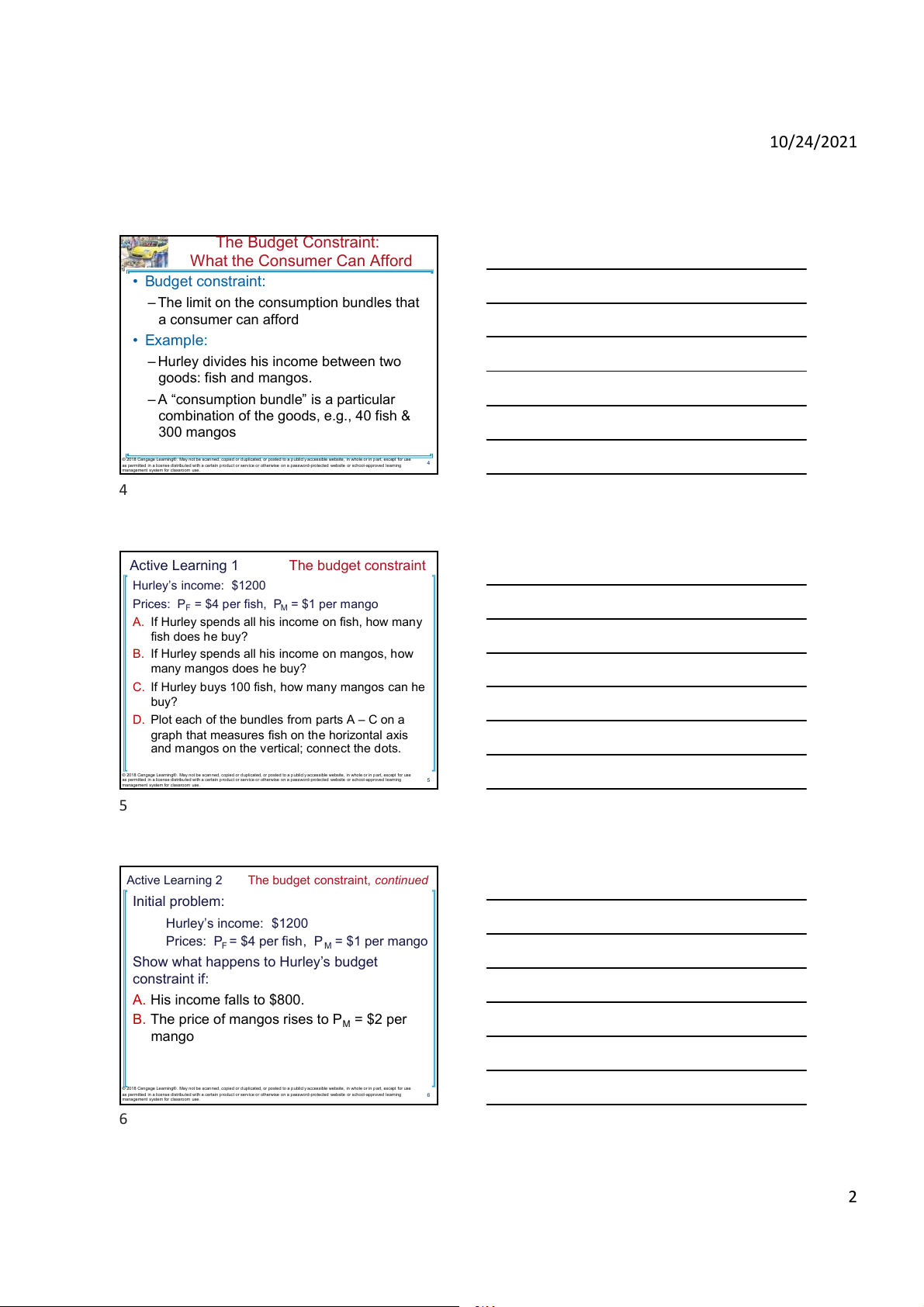
management system for classroom use. 4 Active Learning 1 The budget constraint Hurley’s income: $1200
Prices: PF = $4 per fish, PM = $1 per mango
A. If Hurley spends all his income on fish, how many fish does he buy?
B. If Hurley spends all his income on mangos, how many mangos does he buy?
C. If Hurley buys 100 fish, how many mangos can he buy?
D. Plot each of the bundles from parts A – C on a
graph that measures fish on the horizontal axis
and mangos on the vertical; connect the dots.
© 2018 Cengage Learning® . May not be scan ned, copied or d uplicated, or posted to a p ublicl y accessible website, in whole or in p art, except for use
as permitted in a license distribu ted with a certain p roduct or service or otherwise on a password-protected website or school-approved l earning 5
management system for classroom use. 5 Active Learning 2
The budget constraint, continued Initial problem: Hurley’s income: $1200
Prices: PF = $4 per fish, P M = $1 per mango
Show what happens to Hurley’s budget constraint if: A. His income falls to $800.
B. The price of mangos rises to PM = $2 per mango
© 2018 Cengage Learning® . May not be scan ned, copied or d uplicated, or posted to a p ublicl y accessible website, in whole or in p art, except for use
as permitted in a license distribu ted with a certain p roduct or service or otherwise on a password-protected website or school-approved l earning 6
management system for classroom use. 6 2 10/24/2021
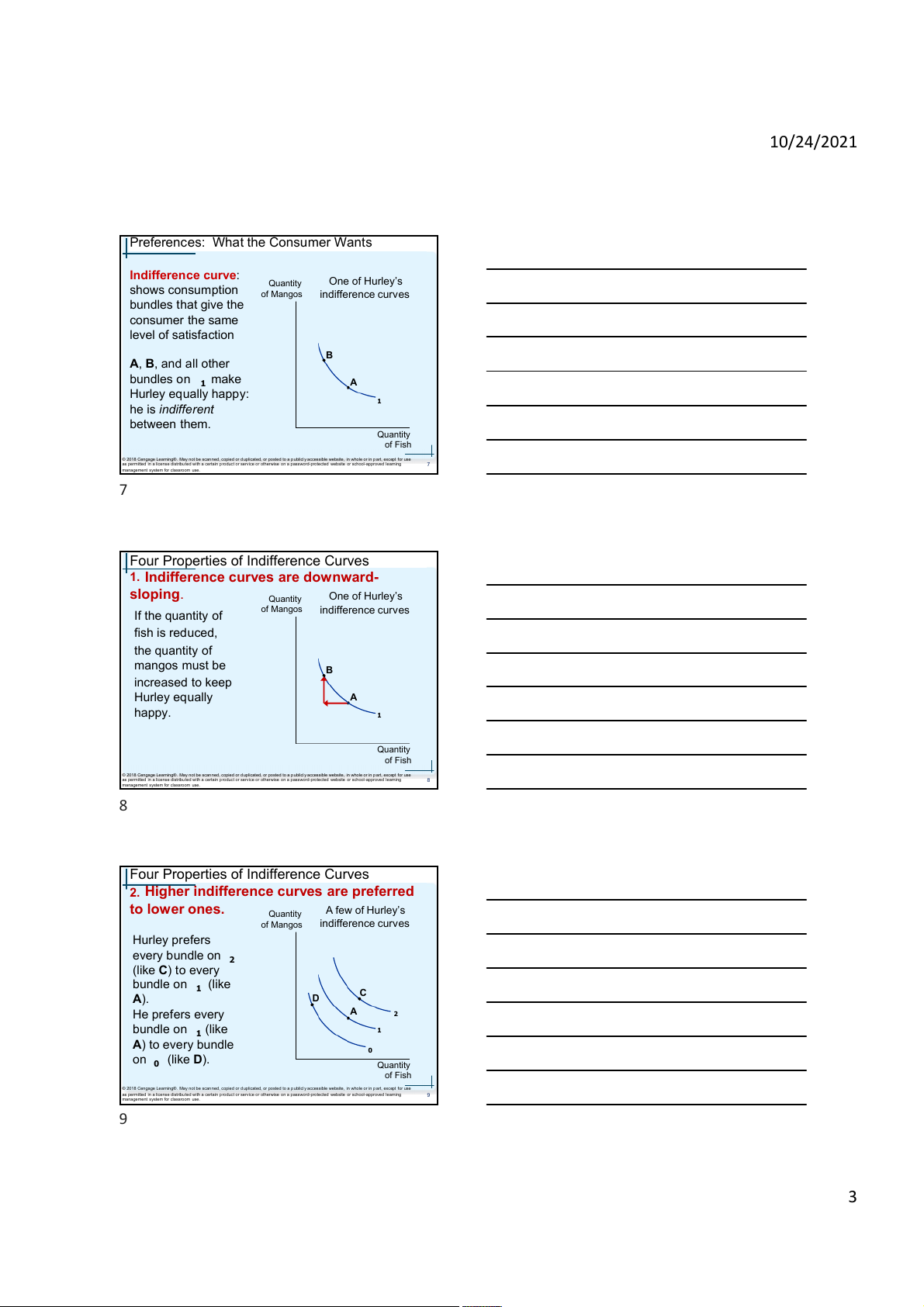
Preferences: What the Consumer Wants Indifference curve: Quantity One of Hurley’s shows consumption of Mangos indifference curves bundles that give the consumer the same level of satisfaction B A, B, and all other bundles on I make 1 A Hurley equally happy: I1 he is indifferent between them. Quantity of Fish
© 2018 Cengage Learning® . May not be scan ned, copied or d uplicated, or posted to a p ublicl y accessible website, in whole or in p art, except for use
as permitted in a license distribu ted with a certain p roduct or service or otherwise on a password-protected website or school-approved l earning 7
management system for classroom use. 7
Four Properties of Indifference Curves
1. Indifference curves are downward- sloping. Quantity One of Hurley’s of Mangos If the quantity of indifference curves fish is reduced, the quantity of mangos must be B increased to keep Hurley equally A happy. I1 Quantity of Fish
© 2018 Cengage Learning® . May not be scan ned, copied or d uplicated, or posted to a p ublicl y accessible website, in whole or in p art, except for use
as permitted in a license distribu ted with a certain p roduct or service or otherwise on a password-protected website or school-approved l earning 8
management system for classroom use. 8
Four Properties of Indifference Curves
2. Higher indifference curves are preferred to lower ones. Quantity A few of Hurley’s of Mangos indifference curves Hurley prefers every bundle on I2 (like C) to every bundle on I (like 1 C A). D He prefers every I A 2 bundle on I (like I 1 1 A) to every bundle I0 on I (like D). 0 Quantity of Fish
© 2018 Cengage Learning® . May not be scan ned, copied or d uplicated, or posted to a p ublicl y accessible website, in whole or in p art, except for use
as permitted in a license distribu ted with a certain p roduct or service or otherwise on a password-protected website or school-approved l earning 9
management system for classroom use. 9 3 10/24/2021
Four Properties of Indifference Curves
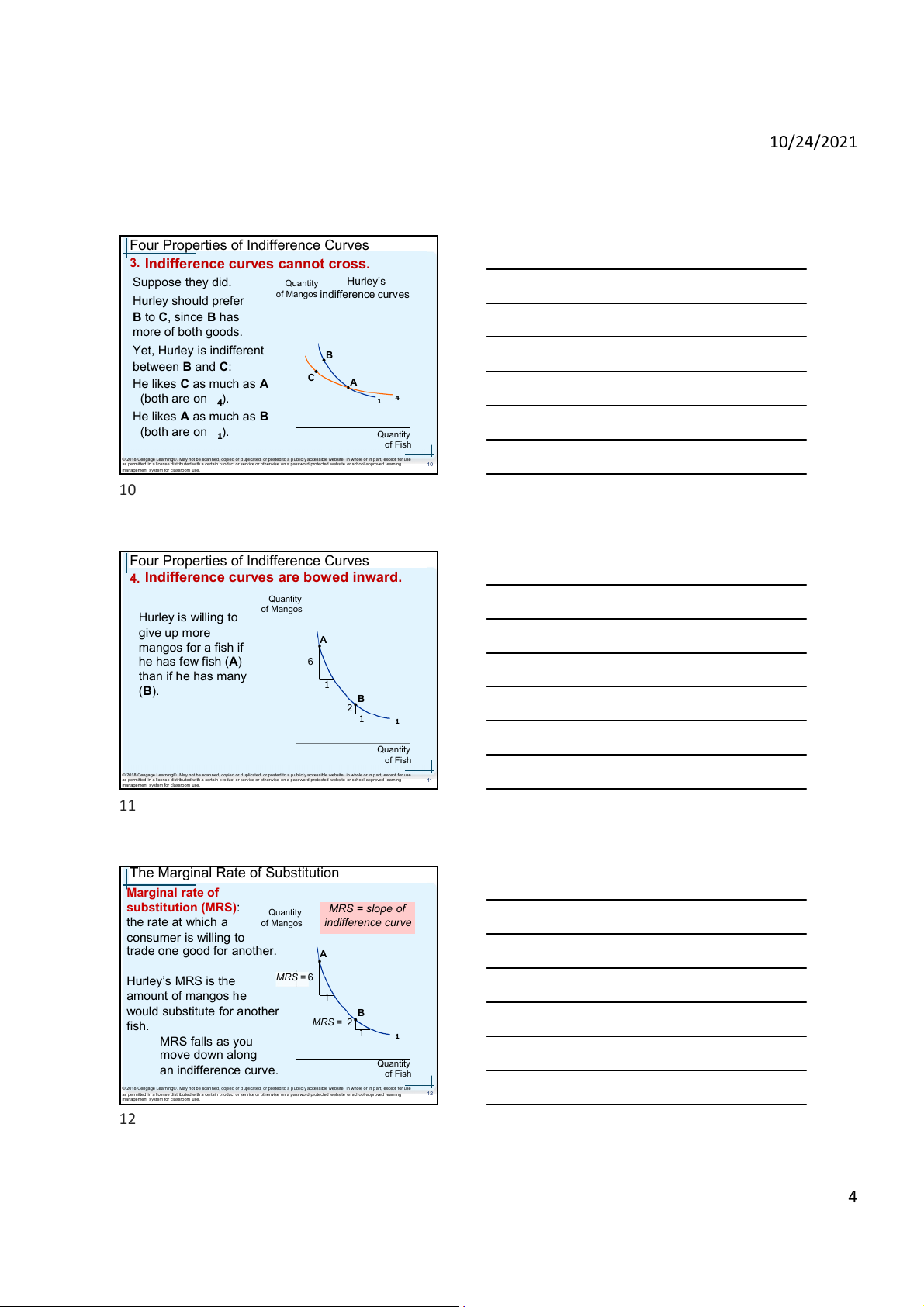
3. Indifference curves cannot cross. Suppose they did. Quantity Hurley’s of Mangos Hurley should prefer indifference curves B to C, since B has more of both goods. Yet, Hurley is indifferent B between B and C: He likes C C as much as A A (both are on I ). I I4 4 1 He likes A as much as B (both are on I ). 1 Quantity of Fish
© 2018 Cengage Learning® . May not be scan ned, copied or d uplicated, or posted to a p ublicl y accessible website, in whole or in p art, except for use
as permitted in a license distribu ted with a certain p roduct or service or otherwise on a password-protected website or school-approved l earning 10
management system for classroom use. 10
Four Properties of Indifference Curves
4. Indifference curves are bowed inward. Quantity of Mangos Hurley is willing to give up more A mangos for a fish if he has few fish (A) 6 than if he has many ( 1 B). B 2 I1 1 Quantity of Fish
© 2018 Cengage Learning® . May not be scan ned, copied or d uplicated, or posted to a p ublicl y accessible website, in whole or in p art, except for use
as permitted in a license distribu ted with a certain p roduct or service or otherwise on a password-protected website or school-approved l earning 11
management system for classroom use. 11
The Marginal Rate of Substitution Marginal rate of substitution (MRS): Quantity MRS = slope of the rate at which a of Mangos indifference curve consumer is willing to trade one good for another. A Hurley’s MRS is the MRS = 6 amount of mangos he 1 would substitute for another B fish. MRS = 2 I 1 MRS falls as you 1 move down along Quantity an indifference curve. of Fish
© 2018 Cengage Learning® . May not be scan ned, copied or d uplicated, or posted to a p ublicl y accessible website, in whole or in p art, except for use
as permitted in a license distribu ted with a certain p roduct or service or otherwise on a password-protected website or school-approved l earning 12
management system for classroom use. 12 4 10/24/2021
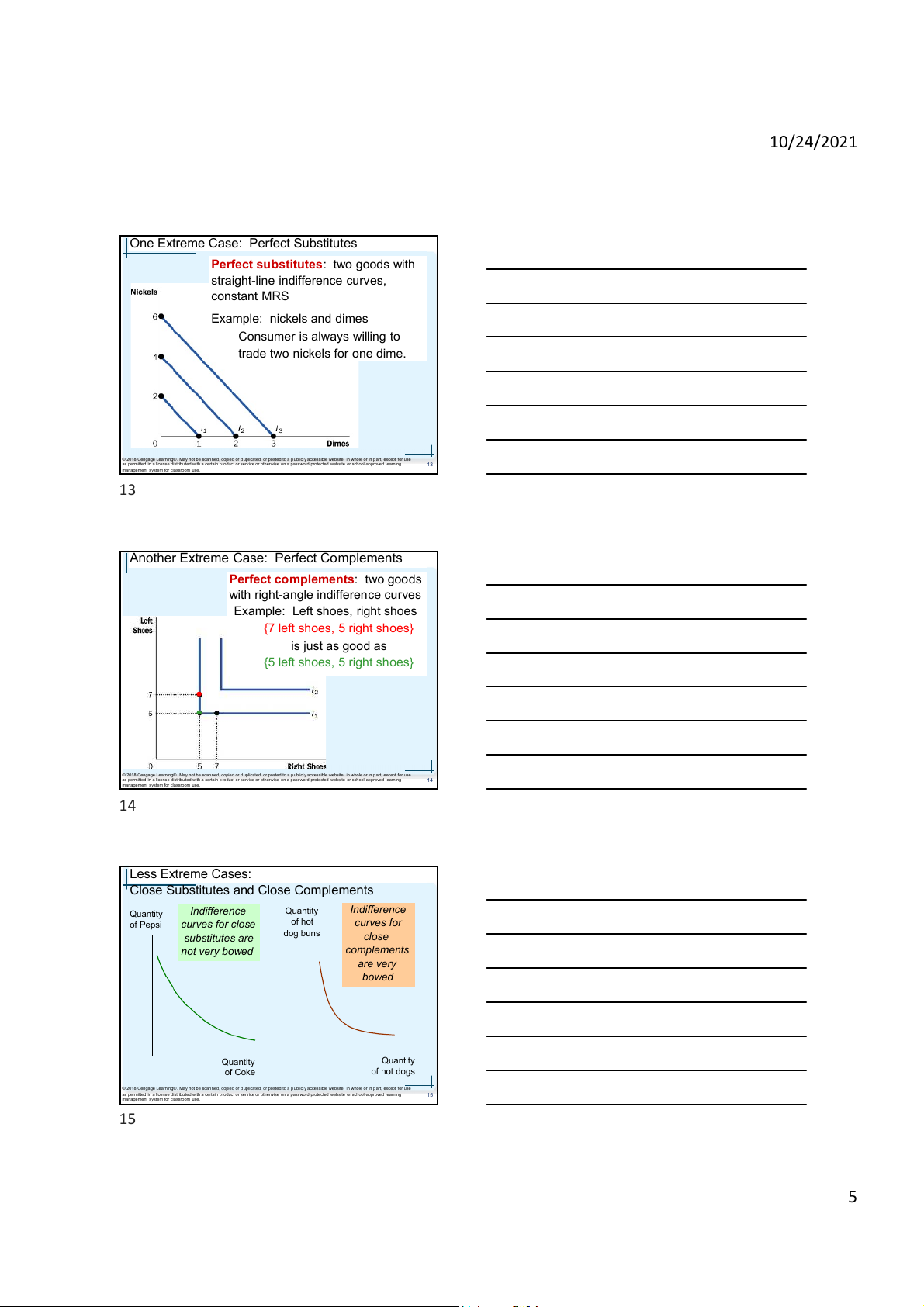
One Extreme Case: Perfect Substitutes
Perfect substitutes: two goods with
straight-line indifference curves, constant MRS Example: nickels and dimes Consumer is always wil ing to
trade two nickels for one dime.
© 2018 Cengage Learning® . May not be scan ned, copied or d uplicated, or posted to a p ublicl y accessible website, in whole or in p art, except for use
as permitted in a license distribu ted with a certain p roduct or service or otherwise on a password-protected website or school-approved l earning 13
management system for classroom use. 13
Another Extreme Case: Perfect Complements
Perfect complements: two goods
with right-angle indifference curves
Example: Left shoes, right shoes {7 left shoes, 5 right shoes} is just as good as {5 left shoes, 5 right shoes}
© 2018 Cengage Learning® . May not be scan ned, copied or d uplicated, or posted to a p ublicl y accessible website, in whole or in p art, except for use
as permitted in a license distribu ted with a certain p roduct or service or otherwise on a password-protected website or school-approved l earning 14
management system for classroom use. 14 Less Extreme Cases:
Close Substitutes and Close Complements Indifference Quantity Indifference Quantity of Pepsi curves for close of hot curves for substitutes are dog buns close not very bowed complements are very bowed Quantity Quantity of Coke of hot dogs
© 2018 Cengage Learning® . May not be scan ned, copied or d uplicated, or posted to a p ublicl y accessible website, in whole or in p art, except for use
as permitted in a license distribu ted with a certain p roduct or service or otherwise on a password-protected website or school-approved l earning 15
management system for classroom use. 15 5 10/24/2021
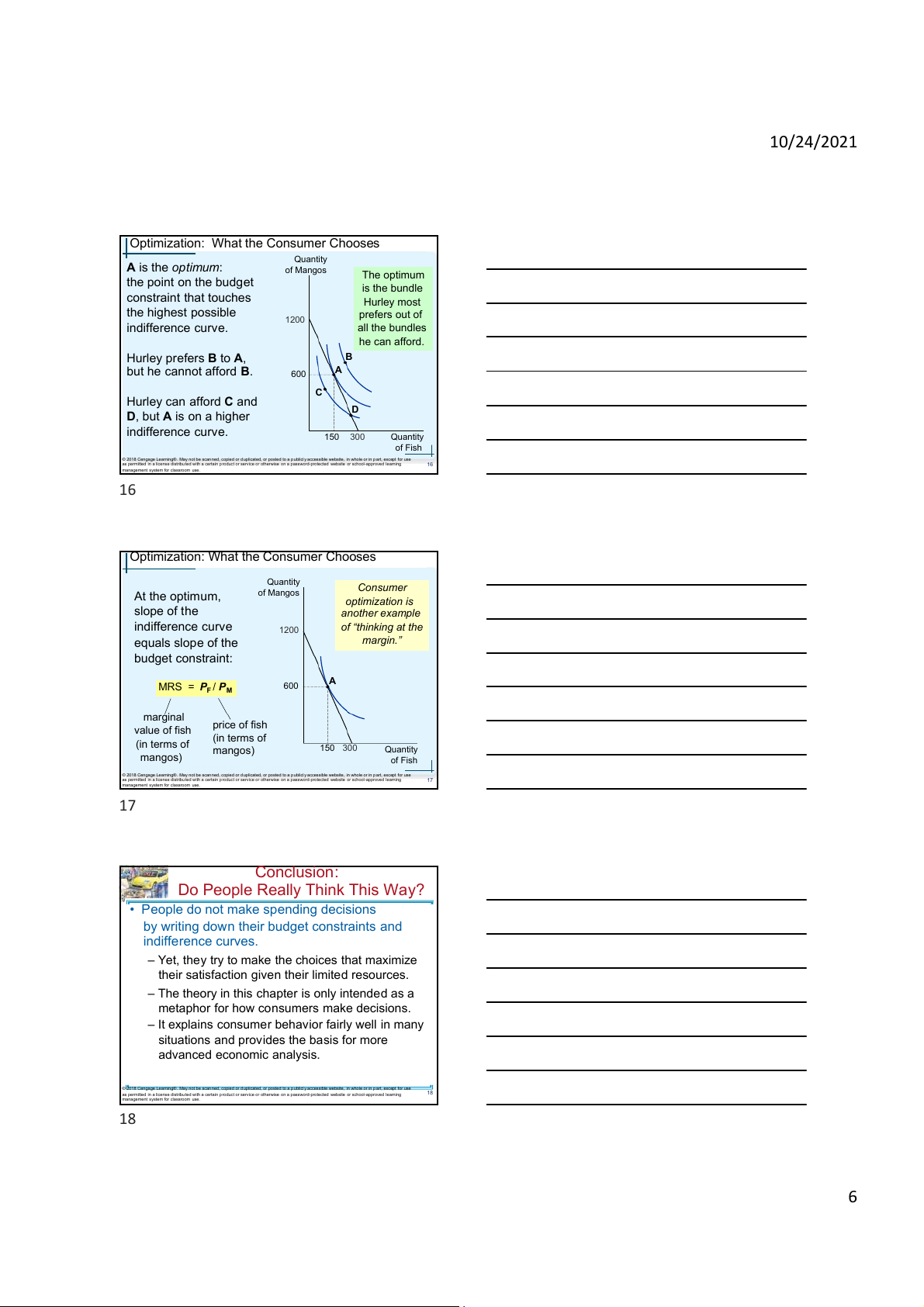
Optimization: What the Consumer Chooses Quantity A is the optimum: of Mangos The optimum the point on the budget is the bundle constraint that touches Hurley most the highest possible prefers out of 1200 indifference curve. all the bundles he can afford. Hurley prefers B to A, B but he cannot afford B. 600 A C Hurley can afford C and D D, but A is on a higher indifference curve. 150 300 Quantity of Fish
© 2018 Cengage Learning® . May not be scan ned, copied or d uplicated, or posted to a p ublicl y accessible website, in whole or in p art, except for use
as permitted in a license distribu ted with a certain p roduct or service or otherwise on a password-protected website or school-approved l earning 16
management system for classroom use. 16
Optimization: What the Consumer Chooses Quantity Consumer At the optimum, of Mangos optimization is slope of the another example indifference curve 1200 of “thinking at the equals slope of the margin.” budget constraint: A MRS = 600 PF / PM marginal price of fish value of fish (in terms of (in terms of 150 300 mangos) Quantity mangos) of Fish
© 2018 Cengage Learning® . May not be scan ned, copied or d uplicated, or posted to a p ublicl y accessible website, in whole or in p art, except for use
as permitted in a license distribu ted with a certain p roduct or service or otherwise on a password-protected website or school-approved l earning 17
management system for classroom use. 17 Conclusion:
Do People Really Think This Way?
• People do not make spending decisions
by writing down their budget constraints and indifference curves.
– Yet, they try to make the choices that maximize
their satisfaction given their limited resources.
– The theory in this chapter is only intended as a
metaphor for how consumers make decisions.
– It explains consumer behavior fairly well in many
situations and provides the basis for more advanced economic analysis.
© 2018 Cengage Learning® . May not be scan ned, copied or d uplicated, or posted to a p ublicl y accessible website, in whole or in p art, except for use 18
as permitted in a license distribu ted with a certain p roduct or service or otherwise on a password-protected website or school-approved l earning
management system for classroom use. 18 6 10/24/2021 Summary
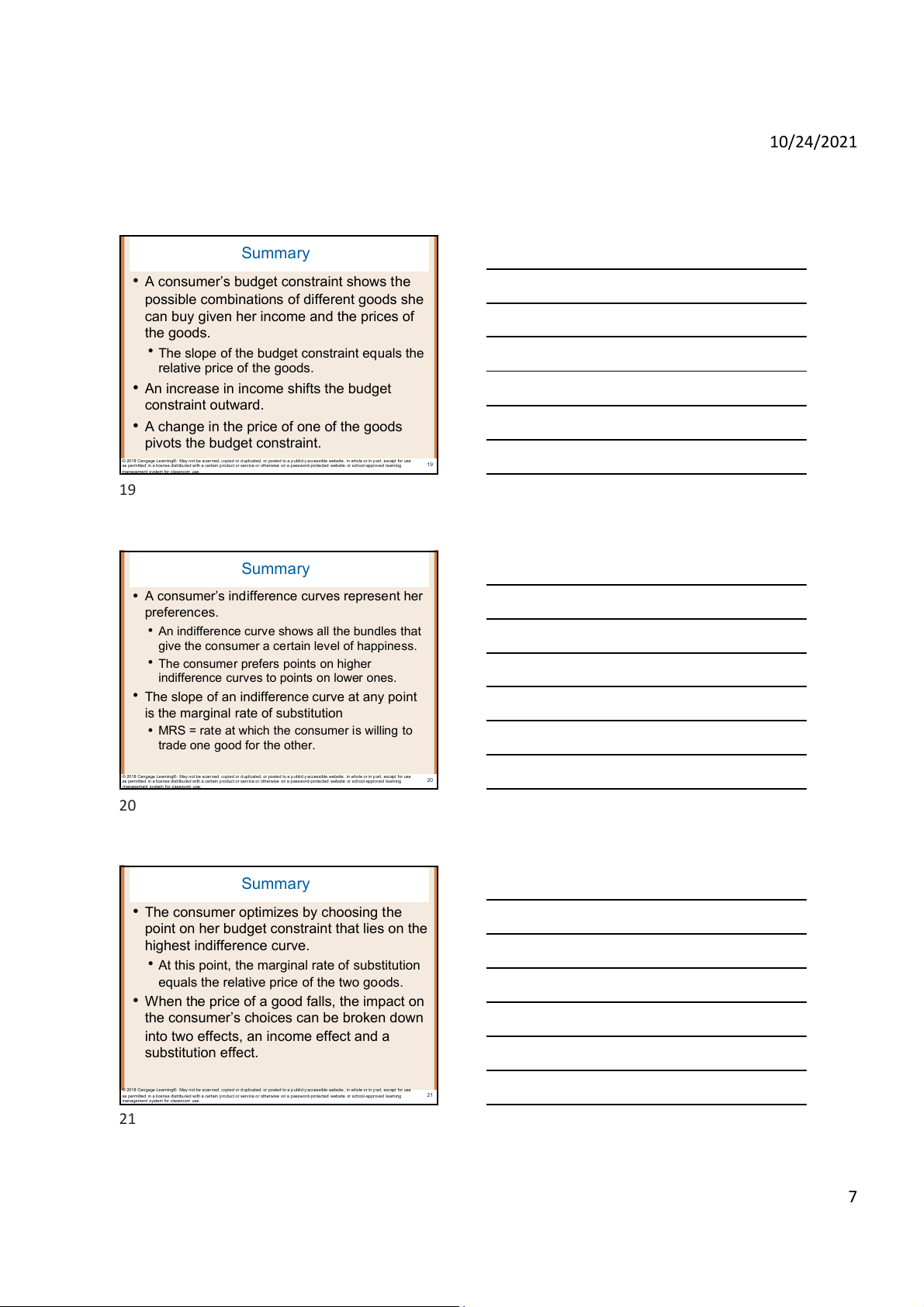
• A consumer’s budget constraint shows the
possible combinations of different goods she
can buy given her income and the prices of the goods.
• The slope of the budget constraint equals the relative price of the goods.
• An increase in income shifts the budget constraint outward.
• A change in the price of one of the goods pivots the budget constraint.
© 2018 Cengage Learning® . May not be scan ned, copied or d uplicated, or posted to a p ublicl y accessible website, in whole or in p art, except for use
as permitted in a license distribu ted with a certain p roduct or service or otherwise on a password-protected website or school-approved l earning 19
management system for classroom use. 19 Summary
• A consumer’s indifference curves represent her preferences.
• An indifference curve shows all the bundles that
give the consumer a certain level of happiness.
• The consumer prefers points on higher
indifference curves to points on lower ones.
• The slope of an indifference curve at any point
is the marginal rate of substitution
• MRS = rate at which the consumer is willing to trade one good for the other.
© 2018 Cengage Learning® . May not be scan ned, copied or d uplicated, or posted to a p ublicl y accessible website, in whole or in p art, except for use
as permitted in a license distribu ted with a certain p roduct or service or otherwise on a password-protected website or school-approved l earning 20 20 Summary
• The consumer optimizes by choosing the
point on her budget constraint that lies on the highest indifference curve.
• At this point, the marginal rate of substitution
equals the relative price of the two goods.
• When the price of a good falls, the impact on
the consumer’s choices can be broken down
into two effects, an income effect and a substitution effect.
© 2018 Cengage Learning® . May not be scan ned, copied or d uplicated, or posted to a p ublicl y accessible website, in whole or in p art, except for use
as permitted in a license distribu ted with a certain p roduct or service or otherwise on a password-protected website or school-approved l earning 21
management system for classroom use. 21 7 10/24/2021 Summary
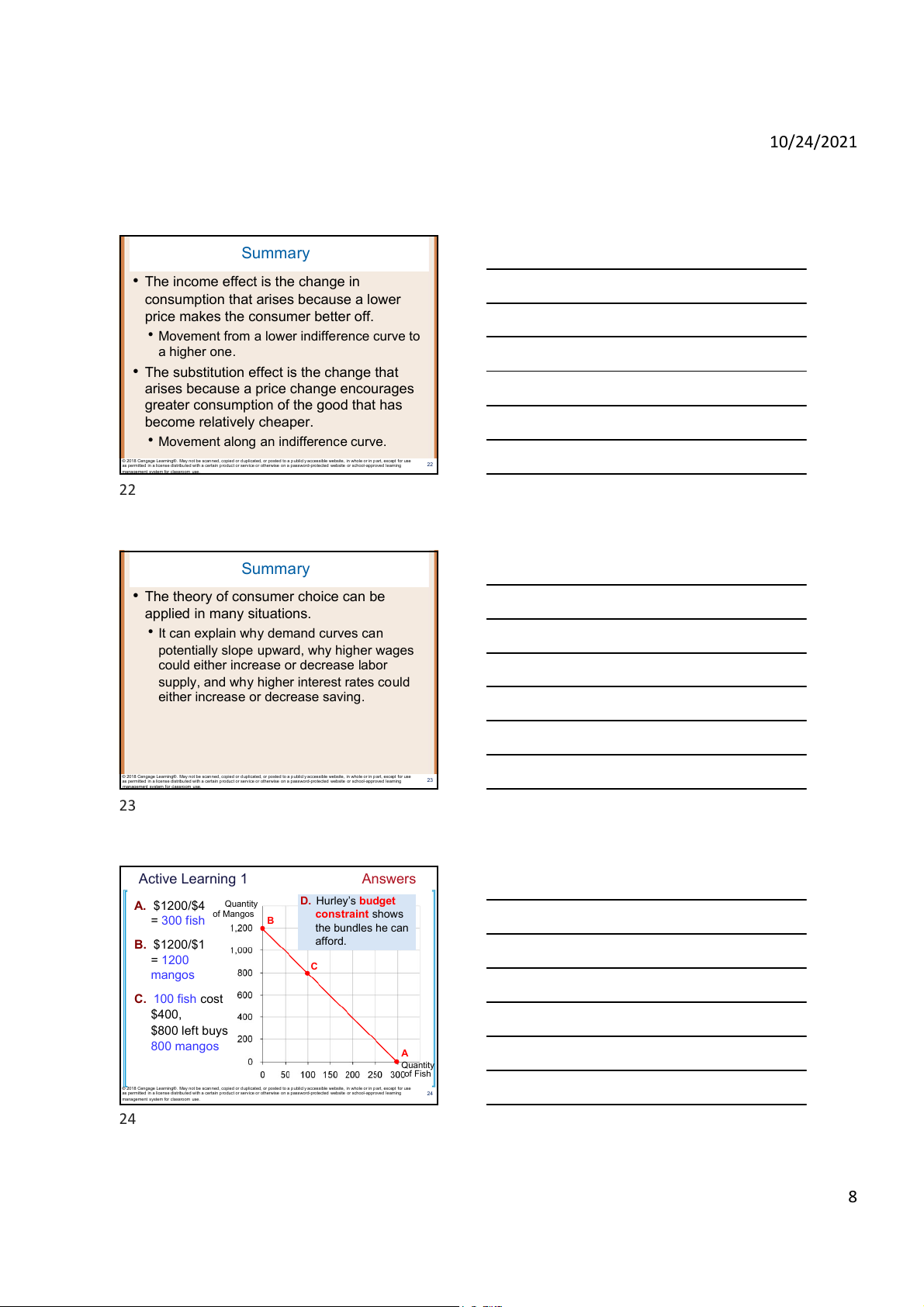
• The income effect is the change in
consumption that arises because a lower
price makes the consumer better off.
• Movement from a lower indifference curve to a higher one.
• The substitution effect is the change that
arises because a price change encourages
greater consumption of the good that has become relatively cheaper.
• Movement along an indifference curve.
© 2018 Cengage Learning® . May not be scan ned, copied or d uplicated, or posted to a p ublicl y accessible website, in whole or in p art, except for use
as permitted in a license distribu ted with a certain p roduct or service or otherwise on a password-protected website or school-approved l earning 22
management system for classroom use. 22 Summary
• The theory of consumer choice can be applied in many situations.
• It can explain why demand curves can
potentially slope upward, why higher wages
could either increase or decrease labor
supply, and why higher interest rates could
either increase or decrease saving.
© 2018 Cengage Learning® . May not be scan ned, copied or d uplicated, or posted to a p ublicl y accessible website, in whole or in p art, except for use
as permitted in a license distribu ted with a certain p roduct or service or otherwise on a password-protected website or school-approved l earning 23 23 Active Learning 1 Answers Quantity A. $1200/$4 D. Hurley’s budget of Mangos = 300 fish constraint shows B the bundles he can B. $1200/$1 afford. = 1200 C mangos C. 100 fish cost $400, $800 left buys 800 mangos A Quantity of Fish
© 2018 Cengage Learning® . May not be scan ned, copied or d uplicated, or posted to a p ublicl y accessible website, in whole or in p art, except for use
as permitted in a license distribu ted with a certain p roduct or service or otherwise on a password-protected website or school-approved l earning 24
management system for classroom use. 24 8 10/24/2021
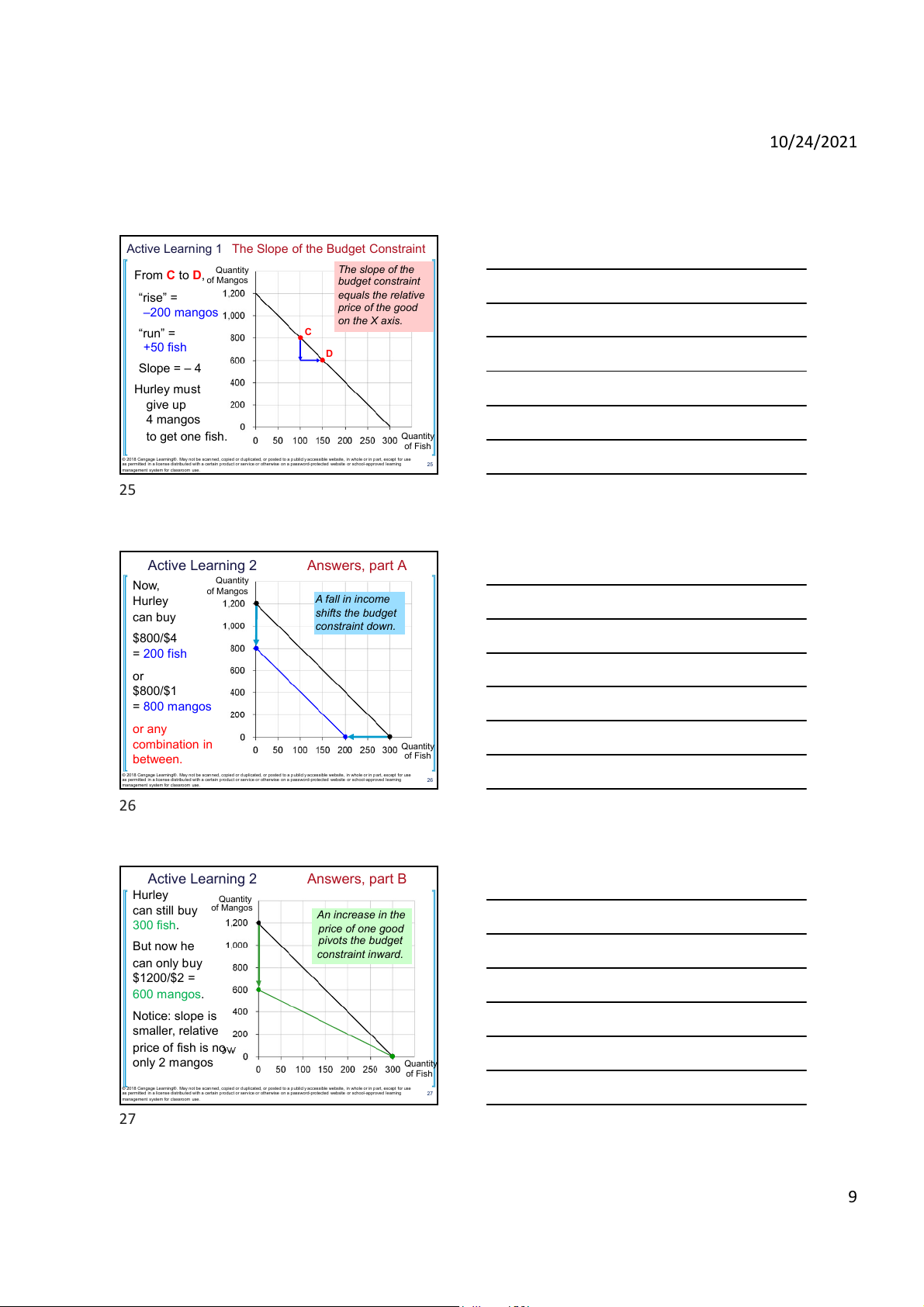
Active Learning 1 The Slope of the Budget Constraint Quantity From C to D, The slope of the of Mangos budget constraint “rise” = equals the relative –200 mangos price of the good on the X axis. “run” = C +50 fish D Slope = – 4 Hurley must give up 4 mangos to get one fish. Quantity of Fish
© 2018 Cengage Learning® . May not be scan ned, copied or d uplicated, or posted to a p ublicl y accessible website, in whole or in p art, except for use
as permitted in a license distribu ted with a certain p roduct or service or otherwise on a password-protected website or school-approved l earning 25
management system for classroom use. 25 Active Learning 2 Answers, part A Now, Quantity of Mangos Hurley A fall in income can buy shifts the budget constraint down. $800/$4 = 200 fish or $800/$1 = 800 mangos or any combination in Quantity between. of Fish
© 2018 Cengage Learning® . May not be scan ned, copied or d uplicated, or posted to a p ublicl y accessible website, in whole or in p art, except for use
as permitted in a license distribu ted with a certain p roduct or service or otherwise on a password-protected website or school-approved l earning 26
management system for classroom use. 26 Active Learning 2 Answers, part B Hurley Quantity can still buy of Mangos An increase in the 300 fish. price of one good But now he pivots the budget constraint inward. can only buy $1200/$2 = 600 mangos. Notice: slope is smaller, relative price of fish is no only 2 mangos Quantity of Fish
© 2018 Cengage Learning® . May not be scan ned, copied or d uplicated, or posted to a p ublicl y accessible website, in whole or in p art, except for use
as permitted in a license distribu ted with a certain p roduct or service or otherwise on a password-protected website or school-approved l earning 27
management system for classroom use. 27 9
Tài liệu liên quan:
-
Elasticity Problems and Solutions: Practice Exercises | Microeconomics | Trường Đại học Quốc tế, Đại học Quốc gia Thành phố Hồ Chí Minh
5 3 -
Supply and Demand - ôn tập: Market Equilibrium Effects Analysis | Microeconomics | Trường Đại học Quốc tế, Đại học Quốc gia Thành phố Hồ Chí Minh
3 2 -
Monopoly & Monopolistic Competition | Microeconomics | Trường Đại học Quốc tế, Đại học Quốc gia Thành phố Hồ Chí Minh
4 2 -
Systematic Review of Social Media Marketing in Luxury Brands | Microeconomics | Trường Đại học Quốc tế, Đại học Quốc gia Thành phố Hồ Chí Minh
4 2 -
Seminar-5: Economics | Microeconomics | Trường Đại học Quốc tế, Đại học Quốc gia Thành phố Hồ Chí Minh
4 2