Sách E-commerce - Thương mại điện tử | Học viện Công Nghệ Bưu Chính Viễn Thông
Sách E-commerce - Thương mại điện tử | Học viện Công Nghệ Bưu Chính Viễn Thông. Tài liệu được sưu tầm giúp bạn tham khảo, ôn tập và đạt kết quả cao. Mời bạn đọc đón xem.
Môn: Thương mại điện tử căn bản (MUL1316) 12 tài liệu
Trường: Học viện Công Nghệ Bưu Chính Viễn Thông 1.8 K tài liệu
Tác giả:



















Preview text:
E-commerce business. technology. society. GLOBAL EDITION
T H I R T E E N T H E D I T I O N Kenneth C. Laudon Carol Guercio Traver New York University Azimuth Interactive, Inc. EC13G_FM.indd 1 3/1/2017 12:04:52 PM
VP Editorial Director: Andrew Gilfillan
Senior Manufacturing Controller, Production, Global Edition:
Senior Portfolio Manager: Samantha Lewis Trudy Kimber
Managing Editor, Global Edition: Steven Jackson
Cover Designer: Lumina Datamatics, Inc.
Senior Project Editor, Global Edition: Daniel Luiz
Cover Image: © Syda Productions
Program Monitor: Ann Pulido/SPi Global
Chapter Images: Marinini/Fotolia
Editorial Assistant: Michael Campbell
Full Service Project Management: Azimuth Interactive, Inc.
Product Marketing Manager: Kaylee Carlson
Composition: Azimuth Interactive, Inc.
Project Manager: Revathi Viswanathan/Cenveo Publisher Services
Pearson Education Limited Edinburgh Gate Harlow Essex CM20 2JE England
and Associated Companies throughout the world
Visit us on the World Wide Web at: www.pearsonglobaleditions.com
© Kenneth C. Laudon and Carol Guercio Traver, 2018, 2017, 2016, 2015, 2014, 2013, 2012
The rights of Kenneth C. Laudon and Carol Guercio Traver to be identified as authors of this work have been
asserted by them in accordance with the Copyright, Designs and Patents Act 1988.
Authorised adaptation from the United States edition, entitled E-commerce: business. technology. society. 2017 13th edition,
ISBN 978-0-13-460156-4 by Kenneth C. Laudon and Carol Guercio Traver, published by Pearson Education, Inc.
All rights reserved. No part of this publication may be reproduced, stored in a retrieval system, or transmitted in
any form or by any means, electronic, mechanical, photocopying, recording or otherwise, without either the prior
written permission of the publisher or a licence permitting restricted copying in the United Kingdom issued by the
Copyright Licensing Agency Ltd, Saffron House, 6–10 Kirby Street, London EC1N 8TS.
All trademarks used herein are the property of their respective owners. The use of any trademark in this text does
not vest in the author or publisher any trademark ownership rights in such trademarks, nor does the use of such
trademarks imply any affiliation with or endorsement of this book by such owners.
Credits and acknowledgements borrowed from other sources and reproduced, with permission, in this textbook appear on page 909. ISBN 10: 1-292-21168-7 ISBN 13: 978-1-292-21168-8
British Library Cataloguing-in-Publication Data
A catalogue record for this book is available from the British Library 10 9 8 7 6 5 4 3 2 1
Typeset in ITC Veljovic Std. Book 9.5pt by Azimuth Interactive Inc.
Printed and bound by Vivar in Malaysia. EC13G_FM.indd 2 3/1/2017 12:04:52 PM P R E F A C E
E-commerce. Business. Technology. Society. Global Edition, 13e, provides you with an in-
depth introduction to the field of e-commerce. We focus on key concepts, and the
latest empirical and financial data, that will help you understand and take advantage
of the evolving world of opportunity offered by e-commerce, which is dramatically
altering the way business is conducted and driving major shifts in the global econ-
omy. E-commerce is a global phenomenon affecting economic and social life through-
out the world. The Global Edition is aimed at students and professionals in the
European Union, the Middle East, Asia Pacific, Australia, and South Africa. Case stud-
ies reflect e-commerce firms in these regions, and figures and tables relate to these
regional sources wherever possible.
Just as important as our global orientation, we have tried to create a book that is
thought-provoking and current. We use the most recent data available, and focus on
companies that you are likely to encounter on a daily basis in your everyday life,
such as Uber, Facebook, Google, Twitter, Amazon, YouTube, Pinterest, eBay, Whats-
App, Snapchat, and many more that you will recognize, as well as some exciting
startups that may be new to you. Global Edition cases include Puma, Financial Times,
Ace & Tate, InMobi, Spotify, Deezer, Souq, Alibaba, and Rocket Internet, among oth-
ers. We also have up-to-date coverage of the key topics in e-commerce today, from
privacy and piracy, to government surveillance, cyberwar, social, local, and mobile
marketing, Internet sales taxes, intellectual property, and more. You will find here
the most up-to-date and comprehensive overview of e-commerce today.
The e-commerce concepts you learn in this book will make you valuable to
potential employers. The e-commerce job market is expanding rapidly. Many employ-
ers expect new employees to understand the basics of e-commerce, social and mobile
marketing, and how to develop an e-commerce presence. Every industry today is
touched in at least some way by e-commerce. The information and knowledge you
find in this book will be valuable throughout your career, and after reading this book,
we expect that you will be able to participate in, and even lead, management discus-
sions of e-commerce for your firm.
WHAT’S NEW IN THE 13TH EDITION Currency
The 13th Global Edition features all new or updated opening, closing, and “Insight
on” cases. The text as well as all of the data, figures, and tables in the book have been
updated through October 2016 with the latest marketing and business intelligence
available from eMarketer, Pew Research Center, Forrester Research, comScore, Gart-
ner Research, and other industry and government sources.
In addition, we have added new, expanded, and/or updated material throughout
the text on a number of e-commerce topics that have appeared in the headlines dur-
ing 2016, including the following: 3 EC13G_FM.indd 3 3/1/2017 12:04:52 PM 4 P r e f a c e
• The latest developments with respect to on-demand service companies such as
Uber, Airbnb, Instacart, and many others (Chapters 1, 5, and 11)
• Developments in wearable computing, including Apple Watch 2; Border Gateway
Protocol; HTTP/2; depletion of IPv4 Internet addresses; Tier 1, Tier 2, and Tier 3
ISPs and peering arrangements; Facebook’s satellite Internet access plans; the
transition of control over IANA from the U.S. Department of Commerce to ICANN;
5G wireless; Google’s Project Loon and Facebook’s Internet access drone Aquila;
IoT developments; the rise of mobile messaging applications and mobile search;
virtual and augmented reality; artificial intelligence, intelligent personal assis-
tants, and chatbots (Chapter 2)
• Open source Web and app development tools; mobile-first and responsive design;
large companies, such as Dick’s Sporting Goods, reclaim their e-commerce infra- structure (Chapter 3)
• New research on tensions between ease of use and security; new security threats
(such as the growth of ransomware; hacktivist attacks such as Wikileaks; the
Yahoo data breach; the DDoS attack on Dyn); bug bounty programs; HSTS; Cyber-
security Information Sharing Act; end-to-end encryption and national security
issues; mobile wallets; Bitcoin and blockchain technology; P2P (Venmo; Face-
book Messenger) and mobile payment systems (Chapter 4)
• Twitter’s difficulties in finding a workable business model, new federal equity
crowdfunding regulations, developing new business models based on the Internet of Things (Chapter 5)
• Google search engine algorithm updates; FTC regulation of native advertising; ad
fraud issues; new proposed rules on mobile ad viewability; the continuing rise in
usage of ad blocking software; mobile supercookie issues; industry and FTC guide-
lines on cross-device tracking; big data and marketing (Chapter 6)
• Mobile marketing spending overtakes spending on desktop advertising; new social
marketing and social e-commerce tools from Facebook, Twitter, Pinterest, Insta-
gram, LinkedIn, and Snapchat; proximity marketing; BLE; Google Eddystone; Apple iBeacons (Chapter 7)
• New, revised section on privacy issues, including facial recognition issues; the
impact of the Supreme Court’s Spokeo decision; new E.U. General Data Protection
Regulation (Privacy Shield); new FCC privacy regulations on ISPs; Apple/U.S. gov-
ernment iPhone privacy fight; Google Library Project final court decision; new
DMCA litigation; Apple/Samsung patent battles new section on trade secrets and
federal Trade Secrets act; Internet sales tax developments; net neutrality develop-
ments; online fantasy sports gambling issues (Chapter 8)
• Cord cutters, cord shavers, and cord nevers; industry structure convergence
(AT&T/Time Warner; Verizon/Yahoo mergers); native digital news sites; FCC
open set top box plan; streaming of pirated content; streaming music services;
streaming TV devices; the impact of Pokemon GO (Chapter 9)
• Acquisition of LinkedIn by Microsoft; new section on the the use of algorithms by
social networks, such as Facebook’s algorithm for generating personalized content;
Facebook Workplace; Verizon acquires AOL and Yahoo (Chapter 10) EC13G_FM.indd 4 3/1/2017 12:04:52 PM P r e f a c e 5
• The rise of social e-commerce; investments in fintech companies and online
lending services; consolidation in the online recruitment industry; on-demand service companies (Chapter 11)
• Amazon Business; the rise of B2B sell-side marketplaces; supply chain visibility;
cloud-based B2B; mobile B2B; B2B marketing (Chapter 12) Themes
E-commerce has significantly evolved over the last decade. The iPhone was intro-
duced in 2007. The iPad tablet was first introduced in 2010 and has already gone
through several generations! Cloud services for storing and streaming content, and
hosting thousands of apps, were not widely available until 2011. Smartphone and tab-
let devices have changed e-commerce into a social, local, and mobile experience. The
13th edition spotlights the following themes and content: Headlines
• Social, Mobile, Local: We include an entire chapter describing social, mobile, and
local marketing. Content about social networks, the mobile platform, and local
e-commerce appears throughout the book.
» The mobile platform composed of smartphones and tablet computers takes off
and becomes a major factor in search, marketing, payment, retailing and ser-
vices, and online content, as well as on-demand service companies. Mobile
device use poses new security and privacy issues as well.
» Social networks such as Facebook, Twitter, Pinterest, Instagram, LinkedIn, and
Snapchat continue their rapid growth, laying the groundwork for a social net- work marketing platform.
» Location-based services lead to explosive growth in local advertising and mar- keting.
• Online privacy continues to deteriorate, driven by a culture of self-revelation
and powerful technologies for collecting personal information online without
the knowledge or consent of users. A growing number of consumers adopt ad blockers.
• Internet security risks increase; cyberwarfare becomes a new way of conducting
warfare among nation-states and a national security issue. A growing perception
of online risk supports a growing lack of trust in e-commerce firms and transac- tions. Business
• Global e-commerce revenues surge, despite slow economic growth.
• Internet advertising growth continues to outpace traditional advertising, including television.
• Social marketing grows faster than traditional online marketing like search and display advertising.
• E-books sales plateau but continue as a major channel for books. Consumers
increasingly use smartphones and tablets as reader devices.
• Newspapers struggle to define a digital first news service. EC13G_FM.indd 5 3/1/2017 12:04:52 PM 6 P r e f a c e
• Streaming of popular TV shows and movies (Netflix, Amazon, YouTube, and Hulu.
com) becomes a reality, as Internet distributors and Hollywood and TV producers
strike deals for Web distribution that also protects intellectual property.
• “Free” and “freemium” business models compete to support digital content. Sub-
scription services show unexpected strength.
• New mobile payment platforms continue to emerge to challenge PayPal, including
Apple Pay, Android Pay, Samsung Pay, and Venmo.
• B2B e-commerce exceeds pre-recession levels as firms become more comfortable with digital supply chains. Technology
• Smartphones, tablets, and e-book readers, along with associated cloud-based soft-
ware applications, and coupled with 4G cellular network expansion, fuel rapid growth of the mobile platform.
• Investment in cloud computing increases, providing the computing infrastructure
for a massive increase in online digital information content, and e-commerce.
• Cloud-based streaming services for music and video challenge sales of downloads and physical product.
• Software apps fuel growth in app sales, marketing, and advertising; transforming
software production and distribution.
• The cost of developing sophisticated websites continues to drop due to declining
software and hardware prices and open source software tools.
• Internet and cellular network capacity is challenged by the rapid expansion in
digital traffic generated by mobile devices; the use of bandwidth caps tier-pricing expands. Society
• The mobile, “always on” culture in business and family life continues to grow.
• European countries develop much stronger privacy policies, including Right to be
Forgotten laws, add a new General Data Protection Regulation (Privacy Shield),
and continue to expand the rights of citizens vis-à-vis Internet data giants.
• U.S. state governments heat up the pursuit of taxes on Internet sales by e-com- merce firms.
• Intellectual property issues remain a source of conflict with significant movement
toward resolution in some areas, such as Google’s deals with Hollywood and the
publishing industry, and Apple’s and Amazon’s deals with e-book and magazine publishers.
• Net neutrality regulations forbid Internet providers from discriminating against
types of content, or providing differential service to large players.
• P2P piracy traffic declines as paid streaming music and video gains ground,
although digital piracy of online content remains a significant threat to Hollywood and the music industry. EC13G_FM.indd 6 3/1/2017 12:04:52 PM P r e f a c e 7
• Governments around the world increase surveillance of Internet users and web
sites in response to national security threats; Google continues to tussle with China
and other countries over censorship and security issues. Europe ends safe harbor
protections for U.S. Internet firms.
• Venture capital investing in e-commerce explodes for social, mobile, and local soft-
ware applications. Crowdfunding becomes a new source of funding for e-com- merce start-ups.
WELCOME TO E-COMMERCE 2017
Since it began in 1995, global e-commerce has grown from a standing start to a $600
billion business-to-consumer and a $6.7 trillion business-to-business juggernaut,
bringing about enormous change in business firms, markets, and consumer behavior.
Economies and business firms around the globe are being similarly affected. During
this relatively short time, e-commerce has itself been transformed from its origin as
a mechanism for online retail sales into something much broader. Today, e-commerce
has become the platform for media and new, unique services and capabilities that
aren’t found in the physical world. There is no physical world counterpart to Face-
book, Twittter, Google search, or a host of other recent online innovations from Pin-
terest and iTunes to Tumblr. The Internet is about to replace television as the largest
entertainment platform. Welcome to the new e-commerce!
E-commerce is projected to continue growing at double-digit rates over the next
five years, remaining the fastest growing form of commerce. Just as automobiles,
airplanes, and electronics defined the twentieth century, so will e-commerce of all
kinds define business and society in the twenty-first century. The rapid movement
toward an e-commerce economy and society is being led by both established business
firms such as Tesco, Ford, IBM, Carrefours, and General Electric, and online firms
such as Google, Amazon, Apple, Facebook, Yahoo, Twitter, and YouTube. Students of
business and information technology need a thorough grounding in e-commerce in
order to be effective and successful managers in the next decade.
While firms such as Facebook, YouTube, Twitter, Pinterest, and Uber have grown
explosively in the last two years and grab our attention, the traditional forms of retail
e-commerce and services also remain vital and have proven to be more resilient than
traditional retail channels in facing the economic recession. The experience of these
firms from 1995 to the present is also a focus of this book. The defining characteristic
of these firms is that they are profitable, sustainable, efficient, and innovative, with
powerful brand names. Many of these now-experienced retail and service firms, such
as eBay, Amazon, E*Trade, Priceline, and Expedia, are survivors of the first era of
e-commerce. These surviving firms have evolved their business models, integrated
their online and offline operations, and changed their revenue models to become
profitable. Understanding how these online businesses succeeded will help students
to manage their own firms in the current omni-channel business environment.
It would be foolish to ignore the lessons learned in the early period of e-commerce.
Like so many technology revolutions in the past—automobiles, electricity, tele-
phones, television, and biotechnology—there was an explosion of entrepreneurial EC13G_FM.indd 7 3/1/2017 12:04:52 PM 8 P r e f a c e
efforts, followed by consolidation. By 2005, the survivors of the early period were mov-
ing to establish profitable businesses while maintaining rapid growth in revenues. In
2016, e-commerce was in the midst of a new period of explosive entrepreneurial activ-
ity focusing on on-demand services, social networks, and the mobile platform created
by smartphones and tablet computers. These technologies and social behaviors are
bringing about extraordinary changes to our personal lives, markets, industries, indi-
vidual businesses, and society as a whole. E-commerce is generating thousands of new
jobs in all fields from marketing to management, entrepreneurial studies, and infor-
mation systems. Today, e-commerce has moved into the mainstream life of estab-
lished businesses that have the market brands and financial muscle required for the
long-term deployment of e-commerce technologies and methods. If you are working
in an established business, chances are the firm’s e-commerce capabilities are impor-
tant factors for its success. If you want to start a new business, chances are very good
that the knowledge you learn in this book will be very helpful.
BUSINESS. TECHNOLOGY. SOCIETY.
We believe that in order for business and technology students to really understand
e-commerce, they must understand the relationships among e-commerce business
concerns, Internet technology, and the social and legal context of e-commerce. These
three themes permeate all aspects of e-commerce, and therefore, in each chapter, we
present material that explores the business, technological, and social aspects of that chapter’s main topic.
Given the continued growth and diffusion of e-commerce, all students—regard-
less of their major discipline—must also understand the basic economic and busi-
ness forces driving e-commerce. E-commerce has created new digital markets
where prices are more transparent, markets are global, and trading is highly effi-
cient, though not perfect. E-commerce has a direct impact on a firm’s relationship
with suppliers, customers, competitors, and partners, as well as how firms market
products, advertise, and use brands. Whether you are interested in marketing and
sales, design, production, finance, information systems, or logistics, you will need
to know how e-commerce technologies can be used to reduce supply chain costs,
increase production efficiency, and tighten the relationship with customers. This
text is written to help you understand the fundamental business issues in e-com- merce.
We spend a considerable amount of effort analyzing the business models and
strategies of both online companies and established businesses now employing
“bricks-and-clicks” business models. We explore why e-commerce firms fail and the
strategic, financial, marketing, and organizational challenges they face. We also dis-
cuss how e-commerce firms learned from the mistakes of early firms, and how estab-
lished firms are using e-commerce to succeed. Above all, we attempt to bring a strong
sense of business realism and sensitivity to the often exaggerated descriptions of e-commerce.
The Web and mobile platform have caused a major revolution in marketing and
advertising in the United States. We spend two chapters discussing online marketing
and advertising. Chapter 6 discusses “traditional” online marketing formats like EC13G_FM.indd 8 3/1/2017 12:04:52 PM P r e f a c e 9
search engine marketing, display advertising, and e-mail, as well as various Internet
marketing technologies underlying those efforts, and metrics for measuring market-
ing success. Chapter 7 provides an in-depth examination of social, mobile, and local
marketing, which relies on mobile devices and social networks.
E-commerce is driven by Internet technology. Internet technology, and infor-
mation technology in general, is perhaps the star of the show. Without the Internet,
e-commerce would be virtually nonexistent. Accordingly, we provide three chapters
specifically on the Internet and e-commerce technology, and in every chapter we
provide continuing coverage by illustrating how the topic of the chapter is being
shaped by new information technologies. For instance, Internet technology drives
developments in security and payment systems, marketing strategies and advertis-
ing, financial applications, media distribution, business-to-business trade, and retail
e-commerce. We discuss the rapid growth of the mobile platform, the emergence of
cloud computing, new open source software tools and applications, and new types
of Internet-based information systems that support digital business-to-business markets.
E-commerce is not only about business and technology, however. The third part
of the equation for understanding e-commerce is society. E-commerce and Internet
technologies have important social consequences that business leaders can ignore
only at their peril. E-commerce has challenged our concepts of privacy, intellectual
property, and even our ideas about national sovereignty and governance. Google,
Facebook, Amazon, and assorted advertising networks maintain profiles on millions
of shoppers and consumers worldwide. The proliferation of illegally copied music,
videos, and books on the Internet, and the growth of social network sites often based
on displaying copyrighted materials without permission, are challenging the intel-
lectual property rights of record labels, Hollywood studios, artists, and writers. And
many countries—including the United States—are demanding to control the content
of websites displayed within their borders for political and social reasons. Tax author-
ities in the United States and Europe are demanding that e-commerce sites pay sales
taxes just like ordinary brick and mortar stores on Main Street. As a result of these
challenges to existing institutions, e-commerce and the Internet are the subject of
increasing investigation, litigation, and legislation. Business leaders need to under-
stand these societal developments, and they cannot afford to assume any longer that
the Internet is borderless, beyond social control and regulation, or a place where
market efficiency is the only consideration. In addition to an entire chapter devoted
to the social and legal implications of e-commerce, each chapter contains material
highlighting the social implications of e-commerce. FEATURES AND COVERAGE
Strong Conceptual Foundation The book emphasizes the three major driving forces
behind e-commerce: business development and strategy, technological innovations,
and social controversies and impacts. Each of these driving forces is represented in
every chapter, and together they provide a strong and coherent conceptual frame-
work for understanding e-commerce. We analyze e-commerce, digital markets, and EC13G_FM.indd 9 3/1/2017 12:04:52 PM 10 P r e f a c e
e-business firms just as we would ordinary businesses and markets using concepts
from economics, marketing, finance, sociology, philosophy, and information sys-
tems. We strive to maintain a critical perspective on e-commerce and avoid industry hyperbole.
Some of the important concepts from economics and marketing that we use to
explore e-commerce are transaction cost, network externalities, information asym-
metry, social networks, perfect digital markets, segmentation, price dispersion, tar-
geting, and positioning. Important concepts from the study of information systems
and technologies play an important role in the book, including Internet standards and
protocols, client/server computing, cloud computing, mobile platform and wireless
technologies, and public key encryption, among many others. From the literature on
ethics and society, we use important concepts such as intellectual property, privacy,
information rights and rights management, governance, public health, and welfare.
From the literature on business, we use concepts such as business process design,
return on investment, strategic advantage, industry competitive environment, oli-
gopoly, and monopoly. We also provide a basic understanding of finance and account-
ing issues, and extend this through an “E-commerce in Action” case that critically
examines the financial statements of Amazon. One of the witticisms that emerged
from the early years of e-commerce and that still seems apt is the notion that e-com-
merce changes everything except the rules of business. Businesses still need to make
a profit in order to survive in the long term.
Currency Important new developments happen almost every day in e-commerce
and the Internet. We try to capture as many of these important new developments as
possible in each annual edition. You will not find a more current book for a course
offered for the 2017 academic year. Many other texts are already six months to a year
out of date before they even reach the printer. This text, in contrast, reflects extensive research through October 2016.
Real-World Global Business Firm Focus and Cases From Akamai Technologies to
Google, Microsoft, Apple, and Amazon, to Facebook, Twitter, and Tumblr, to Netflix,
Pandora, and Elemica, this book contains hundreds of real-company examples and
over 60 more extensive cases that place coverage in the context of actual e-commerce
businesses. You’ll find these examples in each chapter, as well as in special features
such as chapter-opening, chapter-closing, and “Insight on” cases. The book takes a
realistic look at the world of e-commerce, describing what’s working and what isn’t,
rather than presenting a rose-colored or purely “academic” viewpoint.
In-depth Coverage of Marketing and Advertising The text includes two chapters on
marketing and advertising, both traditional online marketing and social, mobile, and
local marketing. Marketing concepts, including market segmentation, personaliza-
tion, clickstream analysis, bundling of digital goods, long-tail marketing, and dynamic
pricing, are used throughout the text.
In-depth Coverage of B2B E-commerce We devote an entire chapter to an examina-
tion of B2B e-commerce. In writing this chapter, we developed a unique and easily EC13G_FM.indd 10 3/1/2017 12:04:52 PM P r e f a c e 11
understood classification schema to help students understand this complex arena of
e-commerce. This chapter covers e-distributors, e-procurement companies, exchanges,
and industry consortia, as well as the development of private industrial networks and collaborative commerce.
Current and Future Technology Coverage Internet and related information tech-
nologies continue to change rapidly. The most important changes for e-commerce
include dramatic price reductions in e-commerce infrastructure (making it much less
expensive to develop a sophisticated e-commerce presence), the explosive growth in
the mobile platform such as iPhones, iPads, and tablet computers, and expansion in
the development of social technologies, which are the foundation of online social
networks. What was once a shortage of telecommunications capacity has now turned
into a surplus, PC prices have continued to fall, smartphone and tablet sales have
soared, Internet high-speed broadband connections are now typical and are continu-
ing to show double-digit growth, and wireless technologies such as Wi-Fi and cellular
broadband are transforming how, when, and where people access the Internet. While
we thoroughly discuss the current Internet environment, we devote considerable
attention to describing emerging technologies and applications such as the Internet
of Things, advanced network infrastructure, fiber optics, wireless and 4G technolo-
gies, Wi-Fi, IP multicasting, and future guaranteed service levels.
Up-to-Date Coverage of the Research Literature This text is well grounded in the
e-commerce research literature. We have sought to include, where appropriate, refer-
ences and analysis of the latest e-commerce research findings, as well as many classic
articles, in all of our chapters. We have drawn especially on the disciplines of eco-
nomics, marketing, and information systems and technologies, as well as law jour-
nals and broader social science research journals including sociology and psychology.
We do not use references to Wikipedia in this text, for a variety of reasons. Most
colleges do not consider Wikipedia a legitimate or acceptable source for academic
research and instruct their students not to cite it. Material found on Wikipedia may
be out of date, lack coverage, lack critical perspective, and cannot necessarily be
trusted. Our references are to respected academic journals; industry sources such as
eMarketer, comScore, Hitwise, Nielsen, and Gartner; newspapers such as the New
York Times and Wall Street Journal; and industry publications such as Computerworld
and InformationWeek, among others. Figures and tables sourced to “authors’ estimates”
reflect analysis of data from the U.S. Department of Commerce, estimates from vari-
ous research firms, historical trends, revenues of major online retailers, consumer
online buying trends, and economic conditions.
Special Attention to the Social and Legal Aspects of E-commerce We have paid
special attention throughout the book to the social and legal context of e-commerce.
Chapter 8 is devoted to a thorough exploration of four ethical dimensions of e-com-
merce: information privacy, intellectual property, governance, and protecting public
welfare on the Internet. We have included an analysis of the latest Federal Trade
Commission and other regulatory and nonprofit research reports, and their likely
impact on the e-commerce environment. EC13G_FM.indd 11 3/1/2017 12:04:52 PM 12 P r e f a c e
A major theme throughout this chapter, and the remainder of the book, is the
impact of social, mobile, and local commerce on how consumers use the Internet.
Writing That’s Fun to Read Unlike some textbooks, we’ve been told by many stu-
dents that this book is actually fun to read and easy to understand. This is not a book
written by committee—you won’t find a dozen different people listed as authors, co-
authors, and contributors on the title page. We have a consistent voice and perspec-
tive that carries through the entire text and we believe the book is the better for it. OVERVIEW OF THE BOOK
The book begins with a chapter that provides an introduction to the major themes of
the book. Chapter 1 defines e-commerce, distinguishes between e-commerce and
e-business, and defines the different types of e-commerce. Chapter 2 traces the his-
torical development of the Internet and thoroughly describes how today’s Internet
works. A major focus of this chapter is mobile technology, new software applications,
and the near-term future Internet that is now under development and will shape the
future of e-commerce. Chapter 3 builds on the Internet chapter by focusing on the
steps managers need to follow in order to build an e-commerce presence. This e-com-
merce infrastructure chapter covers the process that should be followed in building
an e-commerce presence; the major decisions regarding outsourcing site develop-
ment and/or hosting; how to choose software, hardware, and other tools that can
improve website performance; and issues involved in developing a mobile website
and mobile applications. Chapter 4 focuses on e-commerce security and payments,
building on the e-commerce infrastructure discussion of the previous chapter by
describing the ways security can be provided over the Internet. This chapter defines
digital information security, describes the major threats to security, and then dis-
cusses both the technology and policy solutions available to business managers seek-
ing to secure their firm’s sites. This chapter concludes with a section on e-commerce
payment systems. We identify the various types of online payment systems (credit
cards, stored value payment systems such as PayPal, digital wallets such as Google
Wallet, and others), and the development of mobile and social payment systems such
as Apple Pay, Venmo, and Facebook Messenger.
The next four chapters focus directly on the business concepts and social-legal
issues that surround the development of e-commerce. Chapter 5 introduces and
defines the concepts of business model and revenue model, describes the major
e-commerce business and revenue models for both B2C and B2B firms, and intro-
duces the basic business concepts required throughout the text for understanding
e-commerce firms including industry structure, value chains, and firm strategy.
Chapter 6 focuses on e-commerce consumer behavior, the Internet audience, and
introduces the student to the basics of online marketing and branding, including tra-
ditional online marketing technologies and marketing strategies. Topics include the
website as a marketing platform, search engine marketing and advertising, display ad
marketing, e-mail campaigns, affiliate and lead generation marketing programs, mul-
tichannel marketing, and various customer retention strategies such as personaliza- EC13G_FM.indd 12 3/1/2017 12:04:52 PM P r e f a c e 13
tion (including interest-based advertising, also known as behavioral targeting) and
customer service tools. The chapter also covers other marketing strategies such as
pricing and long-tail marketing. Internet marketing technologies (web transaction
logs, tracking files, data mining, and Big Data) and marketing automation and CRM
systems are also explored. The chapter concludes with a section on understanding
the costs and benefits of various types of online marketing, including a new section
on marketing analytics software. Chapter 7 is devoted to an in-depth analysis of
social, mobile, and local marketing. Topics include Facebook, Twitter, and Pinterest
marketing platforms, the evolution of mobile marketing, and the growing use of geo-
aware technologies to support proximity marketing. Chapter 8 provides a thorough
introduction to the social and legal environment of e-commerce. Here, you will find
a description of the ethical and legal dimensions of e-commerce, including a thor-
ough discussion of the latest developments in personal information privacy, intellec-
tual property, Internet governance, jurisdiction, and public health and welfare issues
such as pornography, gambling, and health information.
The final four chapters focus on real-world e-commerce experiences in retail and
services, online media, auctions, portals, and social networks, and business-to-busi-
ness e-commerce. These chapters take a sector approach rather than the conceptual
approach used in the earlier chapters. E-commerce is different in each of these sec-
tors. Chapter 9 explores the world of online content and digital media and examines
the enormous changes in online publishing and entertainment industries that have
occurred over the last two years, including streaming movies, e-books, and online
newspapers and magazines. Chapter 10 explores the online world of social networks,
auctions, and portals. Chapter 11 takes a close look at the experience of firms in the
retail marketplace for both goods and services, as well as on-demand service compa-
nies such as Uber and Airbnb. Chapter 11 also includes an “E-commerce in Action”
case that provides a detailed analysis of the business strategies and financial operat-
ing results of Amazon, which can be used as a model to analyze other e-commerce
firms. Chapter 12 concentrates on the world of B2B e-commerce, describing both Net
marketplaces and the less-heralded, but very large arena of private industrial net-
works and the movement toward collaborative commerce.
PEDAGOGY AND CHAPTER OUTLINE
The book’s pedagogy emphasizes student cognitive awareness and the ability to ana-
lyze, synthesize, and evaluate e-commerce businesses. While there is a strong data
and conceptual foundation to the book, we seek to engage student interest with lively
writing about e-commerce businesses and the transformation of business models at traditional firms.
Each chapter contains a number of elements designed to make learning easy as well as interesting.
Learning Objectives A list of learning objectives that highlights the key concepts in
the chapter guides student study. EC13G_FM.indd 13 3/1/2017 12:04:52 PM 14 P r e f a c e
Chapter-Opening Cases Each chapter opens with a story about a leading e-com-
merce company that relates the key objectives of the chapter to a real-life e-com- merce business venture. EC13G_FM.indd 14 3/1/2017 12:04:52 PM P r e f a c e 15
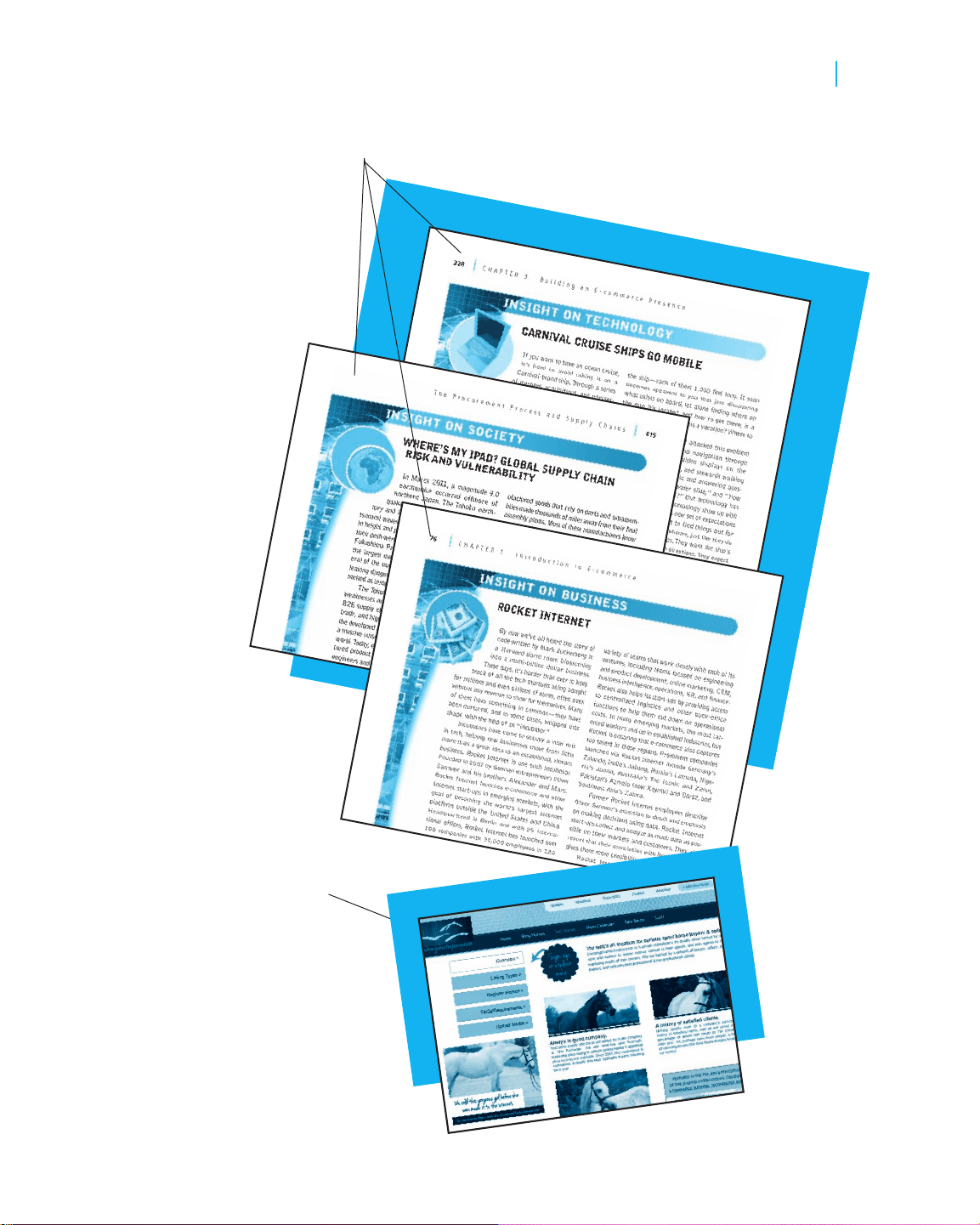
“Insight on” Cases Each chapter
contains three real-world cases
illustrating the themes of technol-
ogy, business, and society. These
cases take an in-depth look at rel-
evant topics to help describe and
analyze the full breadth of the field of e-commerce. The cases probe such issues as the ability of govern- ments to regulate Internet content, how to design websites for accessibility, the challenges faced by luxury marketers in online marketing, and smartphone security. Margin Glossary Throughout the text, key terms and their definitions appear in the text margin where they are first intro- duced. Real-Company Examples
Drawn from actual e-commerce
ventures, well over 100 pertinent
examples are used throughout the text to illustrate concepts. EC13G_FM.indd 15 3/1/2017 12:04:56 PM 16 P r e f a c e
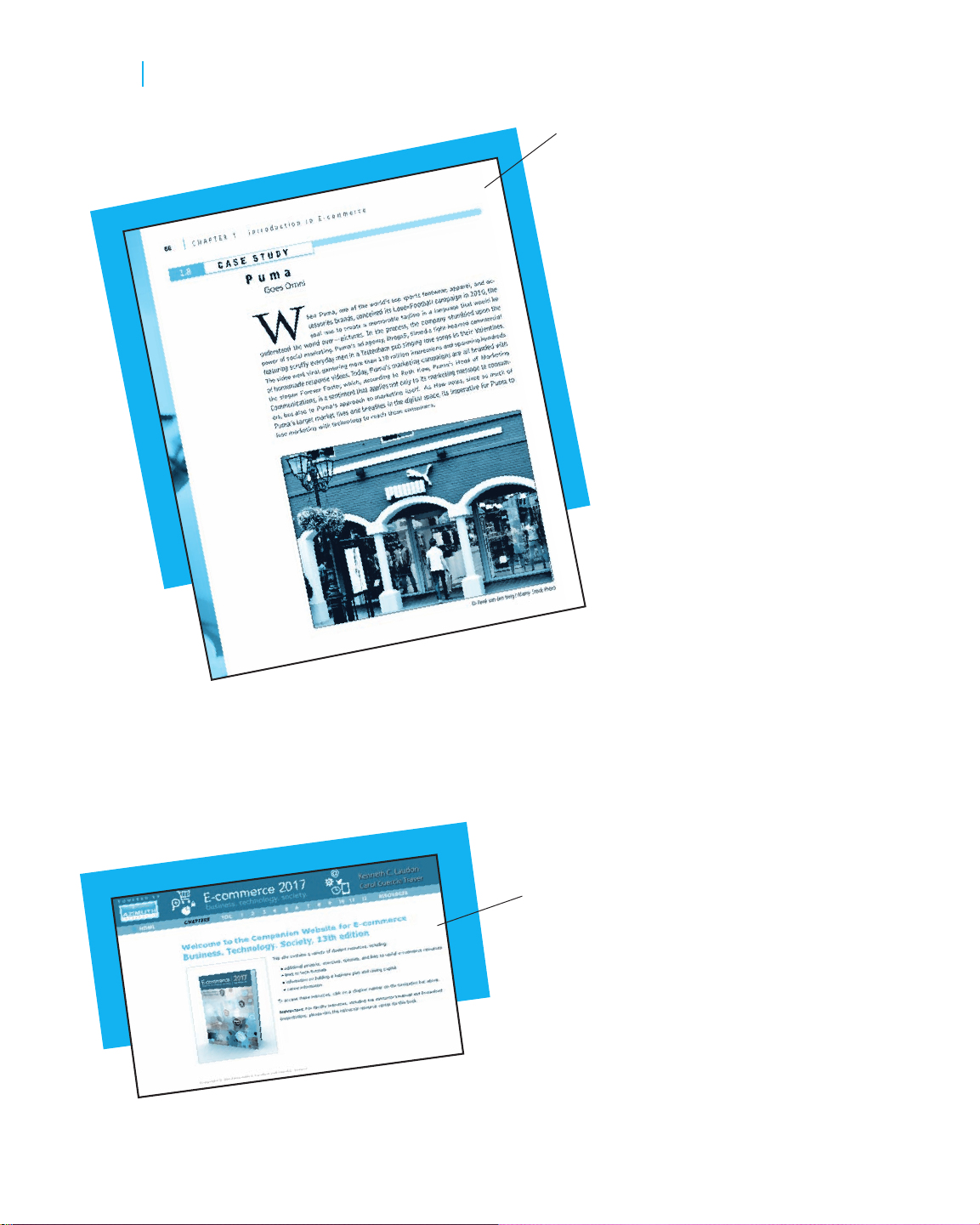
Chapter-Closing Case Studies Each chap-
ter concludes with a robust case study based
on a real-world organization. These cases
help students synthesize chapter concepts
and apply this knowledge to concrete prob-
lems and scenarios such as evaluating Pan-
dora’s freemium business model,
ExchangeHunterJumper’s efforts to build
a brand, and the evolution of eBay.
Chapter-Ending Pedagogy Each chap-
ter contains extensive end-of-chapter
materials designed to reinforce the
learning objectives of the chapter.
Key Concepts Keyed to the learn-
ing objectives, Key Concepts pres-
ent the key points of the chapter to aid student study.
Review Questions Thought-pro- voking questions prompt stu- dents to demonstrate their
comprehension and apply chapter con-
cepts to management problem solving.
Projects At the end of each chapter are a number of projects that encourage students
to apply chapter concepts and to use higher level evaluation skills. Many make use of
the Internet and require students to present their findings in an oral or electronic pre-
sentation or written report. For instance, students are asked to evaluate information
about a company’s financials that can be obtain from the U.S. Securities and Exchange
Commission website, assess payment system options
for companies across international boundaries, or
search for the top 10 cookies on their own computer and the sites they are from.
Web Resources Web resources that can extend stu-
dents’ knowledge of each chapter with projects,
exercises, and additional content are available at
www.azimuth-interactive.com/ecommerce13e. The
website contains the following content provided by the authors: •
Additional projects, exercises, and tutorials •
Information on how to build a business plan and revenue models •
Essays on careers in e-commerce EC13G_FM.indd 16 3/1/2017 12:04:57 PM P r e f a c e 17 INSTRUCTOR RESOURCES
At the Instructor Resource Center, www.pearsonglobaleditions.com/laudon, instruc-
tors can easily register to gain access to a variety of instructor resources available
with this text in downloadable format. If assistance is needed, our dedicated technical
support team is ready to help with the media supplements that accompany this text
at https://support.pearson.com/getsupport.
The following supplements are available with this text:
• Instructor’s Resource Manual • Test Bank
• TestGen® Computerized Test Bank • PowerPoint Presentation • Image Library
• Video Cases The authors have created a collection of video case studies that inte-
grate short videos, supporting case study material, and case study questions. Video
cases can be used in class to promote discussion or as written assignments. There
are 29 video cases for the 13th edition, of which 14 are entirely new, and the
remainder with updated supporting case study material. Chapter 1
1.1 The Importance of the Internet for E-commerce
1.2 The Growth of the On-Demand Economy Chapter 2
2.1 How Freshdesk Uses Amazon Web Services
2.2 Compare.com Turns to Microsoft Azure and the Cloud 2.3 Facebook’s Data Centers 2.4 Amazon Echo Chapter 3
3.1 WL Gore Expands Using Demandware
3.2 National Kidney Registry Turns to Rackspace for Managed Hosting Chapter 4
4.1 The Rise of Cyberwarfare
4.2 Tech Titans Clash over Future of Mobile Payments Chapter 5 5.1 Twitter for Business 5.2 Angel Investing 5.3 Deals Galore at Groupon Chapter 6
6.1 To Ad Block or Not to Ad Block
6.2 Pandora’s Recommendation System EC13G_FM.indd 17 3/1/2017 12:04:57 PM 18 P r e f a c e Chapter 7
7.1 Pinterest Users Engage with Sephora
7.2 The Full Value of Mobile Marketing Chapter 8
8.1 The Right to Be Forgotten 8.2 Facebook Privacy
8.3 What Net Neutrality Means for You Chapter 9
9.1 YouTube: Secrets of Successful Content Creators 9.2 Vox Media
9.3 ESPN: Sports Broadcasting Evolves Chapter 10 10.1 Instagram
10.2 Small Businesses Find a Home on eBay Chapter 11
11.1 Walmart Takes On Amazon
11.2 Etsy: A Marketplace and a Community Chapter 12
12.1 Flextronics Uses Elementum’s Cloud-based Mobile Supply Chain Apps
12.2 Mechan Groep Streamlines with Sana Commerce
• Learning Tracks These additional essays, created by the authors, provide instruc-
tors and students with more in-depth content on selected topics in e-commerce. Chapter 1
1.1 Global E-commerce Europe
1.2 Global E-commerce Latin America 1.3 Global E-commerce China Chapter 6
6.1 Basic Marketing Concepts
6.2 Consumer Behavior: Cultural, Social, and Psychological Background Fac- tors
6.3 Social Media Marketing—Blogging Chapter 7
Social Media Marketing: Facebook
Social Media Marketing: Twitter ACKNOWLEDGMENTS
Pearson Education has sought the advice of many excellent reviewers, all of whom
have strongly influenced the organization and substance of this book. The following
individuals provided extremely useful evaluations of this and previous editions of the text: EC13G_FM.indd 18 3/1/2017 12:04:57 PM P r e f a c e 19
Deniz Aksen, Koç University (Istanbul)
John H. Gerdes, University of California, Carrie Andersen, Madison Area Riverside Technical College
Gurram Gopal, Illinois Institute of
Subhajyoti Bandyopadhyay, University of Technology Florida
Philip Gordon, University of California at
Christine Barnes, Lakeland Community Berkeley College
Allan Greenberg, Brooklyn College Reneta Barneva, SUNY Fredonia
Bin Gu, University of Texas at Austin Rathin Basu, Ferrum College Norman Hahn, Thomas Nelson
Dr. Shirley A. Becker, Northern Arizona Community College University
Peter Haried, University of Wisconsin-La
Prasad Bingi, Indiana-Purdue University, Crosse Fort Wayne
Sherri Harms, University of Nebraska at Joanna Broder, Pima Community Kearney College
Sharon Heckel, St. Charles Community
Lisa Bryan, Southeastern Community College College
David Hite, Virginia Intermont College
James Buchan, College of the Ozarks
Gus Jabbour, George Mason University
Ashley Bush, Florida State University
Thaddeus Janicki, University of Mount
Cliff Butler, North Seattle Community Olive College
Kevin Jetton, Texas State University, San
Carl Case, St. Bonaventure University Marcos Teuta Cata, Northern Kentucky
Jim Keogh, Saint Peter’s University University
Ellen Kraft, Georgian Court University
Adnan Chawdhry, California University
Gilliean Lee, Lander University of Pennsylvania
Zoonky Lee, University of Nebraska,
Mark Choman, Luzerne City Community Lincoln College
Andre Lemaylleux, Boston University,
Andrew Ciganek, Jacksonville State Brussels University Haim Levkowitz, University of
Daniel Connolly, University of Denver Massachusetts, Lowell Tom Critzer, Miami University
Yair Levy, Nova Southeastern University
Dr. Robin R. Davis, Claflin University Richard Lucic, Duke University Dursan Delen, Oklahoma State
Brenda Maynard, University of Pikeville University
Vincent McCord, Foothill College
Abhijit Deshmukh, University of
John Mendonca, Purdue University Massachusetts
John Miko, Saint Francis University
Brian L. Dos Santos, University of Dr. Abdulrahman Mirza, DePaul Louisville University
Robert Drevs, University of Notre Dame
Natalie Nazarenko, SUNY - Fredonia
Akram El-Tannir, Hariri Canadian
Barbara Ozog, Benedictine University University, Lebanon Kent Palmer, MacMurray College
Kimberly Furumo, University of Hawaii Karen Palumbo, University of St. Francis at Hilo EC13G_FM.indd 19 3/1/2017 12:04:57 PM
Tài liệu liên quan:
-
Đề cương chi tiết môn Thương mại điện tử căn bản | Học viện Công Nghệ Bưu Chính Viễn Thông
92 46 -
Đề cương ôn tập môn Thương mại điện tử căn bản | Học viện Công Nghệ Bưu Chính Viễn Thông
136 68 -
Bài tập nhóm môn Thương mại điện tử tuần thứ 03: Cơ sở hạ tầng cho phát triển thương mại điện tử
292 146 -
Bài tập nhớm môn Thương mại điện tử tuần số 6 | Học viện Công nghệ Bưu chính Viễn thông
361 181