Springer Undergraduate Mathematics Series
Advisory
Board
P.J.
Cameron
Queen
Mary
and
Westfield
College
M.A.J.
Chaplain
University
of
Dundee
K.
Erdmann
Oxford
University
L.C.G.
Rogers
University
of
Bath
E.
Siili
Oxford
University
J.F.
Toland
University
of
Bath
Other
books
in
this
series
A First
Course
in
Discrete
Mathematics
I.
Anderson
Analytic
Methods
for
Partial
Differential
Equations
G.
Evans,
J.
Blackledge,
P.
Yardley
Applied
Geometry
for
Computer
Graphics
and
CAD,
Second
Edition
D.
Marsh
Basic
Linear
Algebra,
Second
Edition
T.S.
Blyth
and
E.F.
Robertson
Basic
Stochastic
Processes
Z.
Brzeiniak
and
T.
Zastawniak
Complex
Analysis
/.M.
Howie
Elementary
Differential
Geometry
A.
Pressley
Elementary
Number
Theory
G.A.
Jones
and
J.M.
Jones
Elements
of
Abstract
Analysis
M.
6
Searc6id
Elements
of
Logic
via
Numbers
and
Sets
D.L
Johnson
Essential
Mathematical
Biology
N.F.
Britton
Essential
Topology
M.D.
Crossley
Fields,
Flows
and
Waves:
An
Introduction
to
Continuum
Models
D.F.
Parker
Further
Linear
Algebra
T.S.
Blyth
and
E.F.
Robertson
Geometry
R.
Fenn
Groups,
Rings
and
Fields
D.A.R.
Wallace
Hyperbolic
Geometry,
Second
Edition
/.
W.
Anderson
Information and
Coding
Theory
G.A.
Jones
and
J.M.
Jones
Introduction
to
Laplace
Transforms
and
Fourier
Series
P.P.G.
Dyke
Introduction
to
Ring
Theory
P.M.
Cohn
Introductory
Mathematics:
Algebra
and
Analysis
G.
Smith
Linear
Functional
Analysis
B.P.
Rynne
and
M.A.
Youngson
Mathematics
for
Finance:
An
Introduction
to
Financial
Engineering
M.
Capiflksi
and
T.
Zastawniak
Matrix
Groups:
An
Introduction to
Lie
Group
Theory
A.
Baker
Measure,
Integral and
Probability,
Second
Edition
M.
Capiflksi
and
E.
Kopp
Multivariate
Calculus
and
Geometry,
Second
Edition
S.
Dineen
Numerical
Methods
for
Partial
Differential
Equations
G.
Evans,
J.
Blackledge,
P.
Yardley
Probability
Models
J.Haigh
Real
Analysis
J.M.
Howie
Sets,
Logic
and
Categories
P.
Cameron
Special
Relativity
N.M.J.
Woodhouse
Symmetries
D.L
Johnson
Topics
in
Group
Theory
G.
Smith
and
o.
Tabachnikova
Vector
Calculus
P.e.
Matthews
r.s.
Blyth
and
E.F.
Robertson
Basic
Linear
Algebra
Second
Edition
, Springer
Professor
T.S.
Blyth
Professor
E.F.
Robertson
School
of Mathematical
Sciences,
University of
St
Andrews, North Haugh,
St
Andrews,
Fife
KY16
9SS,
Scotland
Cowr
i1lustration
.lemmts
reproduad
by
kiM
pmnWitm
of.
Aptedl
Systems,
Inc.,
PubIishen
of
the
GAUSS
Ma1hemalial and
Statistical
System,
23804
5.E.
Kent-Kang!ey
Road,
Maple
vaney,
WA
98038,
USA.
Tel:
(2C6)
432
-
7855
Fax
(206)
432
-
7832
email:
info@aptech.com
URI.:
www.aptec:h.com
American
Statistical
Asoociation:
aw.c.
vola
No
1,1995
article
by
KS
and
KW
Heiner,-
...
Rings
of
the
Northern
Shawonsunb'
pI8'
32
lis
2
Springer-Verlag:
Mathematica
in
Education
and
Research
Vol
4
Issue
3
1995
article
by
Roman
E
Maeder,
Beatrice
Amrhein
and
Oliver
Gloor
'Dlustrated
Mathematica:
VISUalization
of
Mathematical
Objects'
pI8'
9
lis
I I,
originally
published
as
CD
ROM
'Dlustrated
Mathematics'
by
TELOS:
ISBN-13:978-
1
-85233-662·2,
German
edition
by
Birkhauser:
ISBN·13:978·1
·85233-1i/i2·2
Mathematica
in
Education
and
Research
Vol
4 I
..
ue
3
1995
article
by
Richard
J
Gaylord
and
Kazume
Nishidate
'Traffic
Engineering
with
Cellular
Automata'
pI8'
35
lis
2.
Mathematica
in
Education
and
Research
Vol
5 I
.....
2
1996
article
by
Michael
Troll
"The
Implicitization
of.
Trefoil
Kno~
page
14.
Mathematica
in
Education
and
Research
Vol
5
Issue
2
1996
article
by
Lee
de
Cola
'Coiru, T
.....
Bars
and
Bella:
Simulation
of
the
Binomial
Pro-
cas'
page
19
fig
3.
Mathematica
in
Education
and
Research
Vol
5
Issue
21996
artide
by
Richard
Gaylord
and
Kazwne
Nishidate
'Contagious
Spreading'
page
33
lis
1.
Mathematica
in
Education
and
Research
Vol
5
Issue
2
1996
artide
by
Joe
Buhler
and
Stan
Wagon
'Secreta
of the
Maddung
Constan~
page
50
lis
I.
British
Library
Cataloguing
in
Publication
Data
Blyth.
T.S.
(Thomas
Scott)
Basic
linear
algebra.
-
2nd
ed.
-
(Springer
undergraduate mathematics
series)
l.Aigebras,
Linear
1.Title
II.Tobertson.
E.F.
(Edmund
F.)
512.5
ISBN-13
:978-1-85233-662·
2
e-ISBN-I3:978-1-4471-0681-4
DOl:
10.1007/978-1-4471-0681-4
Library
of
Congress
Cataloging-in-Publication
Data
Blyth.
T
.5.
(Thomas
Scott)
Basic
linear
algebra
I
T.S.
Blyth
and
E.F.
Robertson.
-
2nd
ed.
p.
cm.
--
(Springer undergraduate mathematics
series)
Includes
index.
ISBN-13:978-1-85233-662-2
l.AIgebras,
Linear.
1.
Robertson,
E.F.
II.
Title.
1Il.
Series.
QAI84.2
.B58
2002
512'
.5-dc21
2002070836
Apart
from
any fair
dealing
for
the
purposes of
research
or
private
study,
or criticism or
review.
as
permitted
under
the
Copyright.
Designs
and Patents
Act
1988.
this publication
may
only
be
reproduced, stored or
transmitted, in any
form
or
by
any
means.
with
the
prior permission
in
writing of
the
publishers. or in the
case
of
reprographic reproduction
in
accordance
with
the terms of
licences
issued
by
the
Copyright
Licensing
Agency.
Enquiries
concerning reproduction outside
those
terms should
be
sent
to
the
publishers.
Springer Undergraduate
Mathematics
Series
ISSN
1615-2085
ISBN-13:978-1-85233-662-2
2nd
edition
e-ISBN-13:978-1-4471·0681-4
1st
edition
Springer
Science+
Business
Media
springeronline.com
e
Springer-Verlag
London
Limited
2002
2nd
printing
2005
The
use
of registered
names,
trademarks
etc.
in
this
publication
does
not
imply,
even
in
the
absence
of a
specific
statement. that
such
names
are
exempt
from
the
relevant
laws
and
regulations and therefore
free
for
general
use.
The
publisher
makes
no
representation.
express
or
implied.
with
regard
to
the
accuracy
of
the
information
contained
in
this
book
and cannot
accept
any
legal
responsibility or liability
for
any
errors or
omissions
that
may
be
made.
Typesetting:
Camera
ready
by
the
authors
12/3830-54321
Printed on
acid-free
paper
SPIN
11370048
Preface
The word 'basic' in the title of this text could be substituted
by
'elementary' or
by
'an introduction to'; such are
the
contents.
We
have chosen the
word
'basic'
in
order
to
emphasise our objective, which
is
to
provide
in
a reasonably compact
and
readable
form a rigorous first course that covers
all
of the material on linear algebra
to
which
every student of mathematics should be exposed
at
an
early stage.
By developing the algebra of matrices before proceeding
to
the
abstract notion of
a vector space,
we
present the pedagogical progression
as
a smooth transition
from
the computational
to
the general,
from
the
concrete
to
the abstract.
In
so
doing
we
have included more than
125
illustrative
and
worked examples, these being presented
immediately following definitions
and
new
results.
We
have also included more
than
300 exercises. In order
to
consolidate
the
student's understanding, many of
these appear strategically placed throughout the text. They are ideal for self-tutorial
purposes. Supplementary exercises are grouped at
the
end of each chapter.
Many
of
these are 'cumulative'
in
the
sense that they require a knowledge of material covered
in previous chapters. Solutions
to
the exercises are provided
at
the
conclusion of
the
text.
In preparing this second edition
we
decided
to
take the opportunity of including,
as
in
our companion volume Further Linear Algebra
in
this series, a chapter that
gives a brief introduction
to
the
use
of
MAPLE)
in
dealing
with
numerical and alge-
braic problems in linear algebra.
We
have also included some additional exercises
at the end of each chapter.
No
solutions are provided for these
as
they are intended
for assignment purposes.
T.S.B., E.ER.
1
MAPLE™
is
a
registered
trademark
of
Waterloo
Maple
Inc
.•
57
Erb
Street
West.
Waterloo.
Ontario.
Canada.
N2L
6C2.
www.maplesoft.com
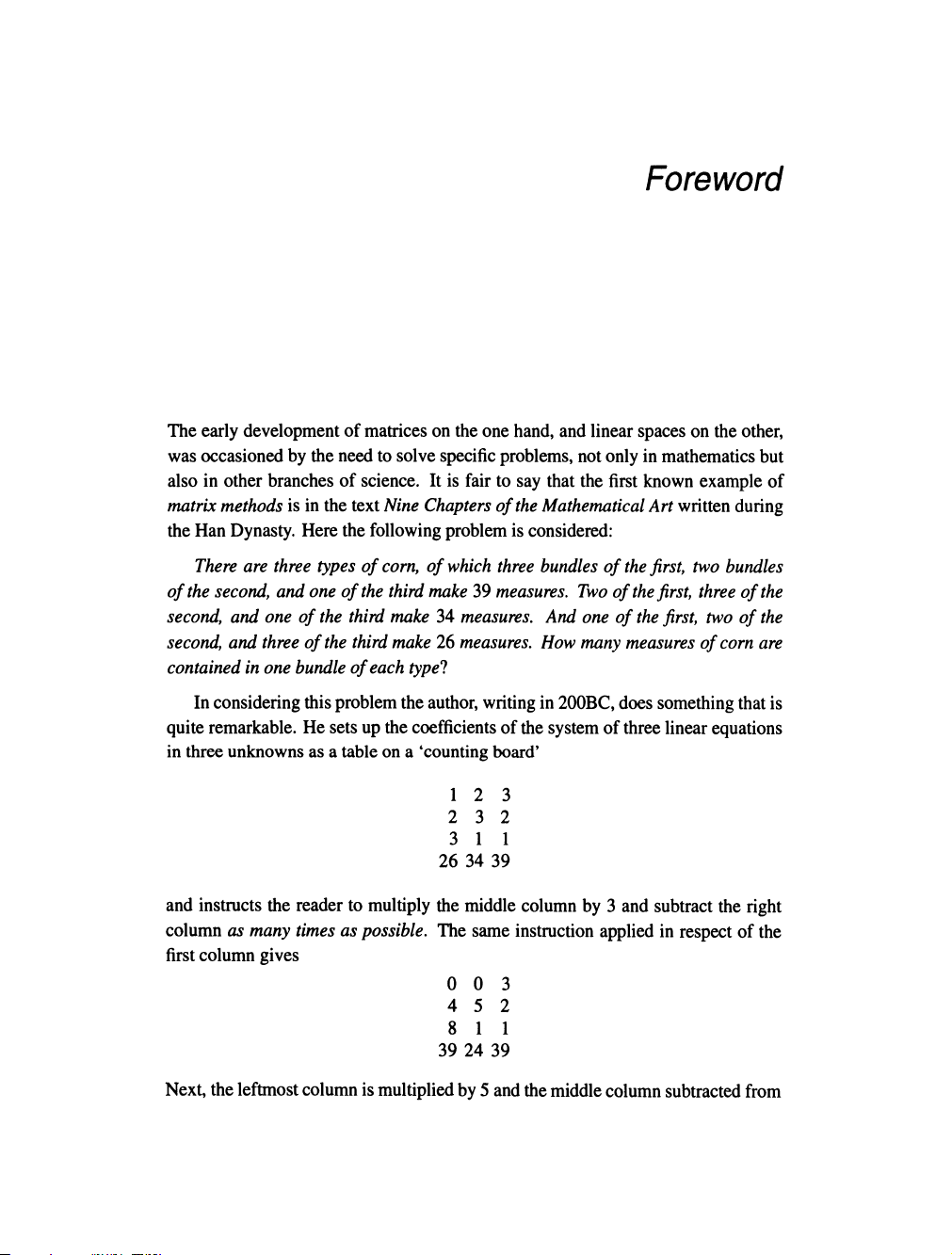
Foreword
The early development
of
matrices on the one hand, and linear spaces on the other,
was occasioned by the need to solve specific problems, not only in mathematics but
also in other branches
of
science. It is fair to say that the first known example
of
matrix methods is in the text Nine Chapters
of
the Mathematical
Art
written during
the Han Dynasty. Here the following problem is considered:
There are three types
of
corn,
of
which three bundles
of
the first, two bundles
of
the second, and one
of
the third make
39
measures.
Two
of
the first, three
of
the
second, and one
of
the third make 34 measures. And one
of
the first, two
of
the
second, and three
of
the third make
26
measures. How many measures
of
corn are
contained in one bundle
of
each type?
In considering this problem the author, writing in 200BC, does something that is
quite remarkable. He sets up the coefficients
of
the system
of
three linear equations
in three unknowns as a table on a 'counting board'
1 2 3
2 3 2
3 1 1
26
34
39
and instructs the reader to multiply the middle column by 3 and subtract the right
column
as many times as possible. The same instruction applied in respect
of
the
first column gives
003
452
8 1 1
392439
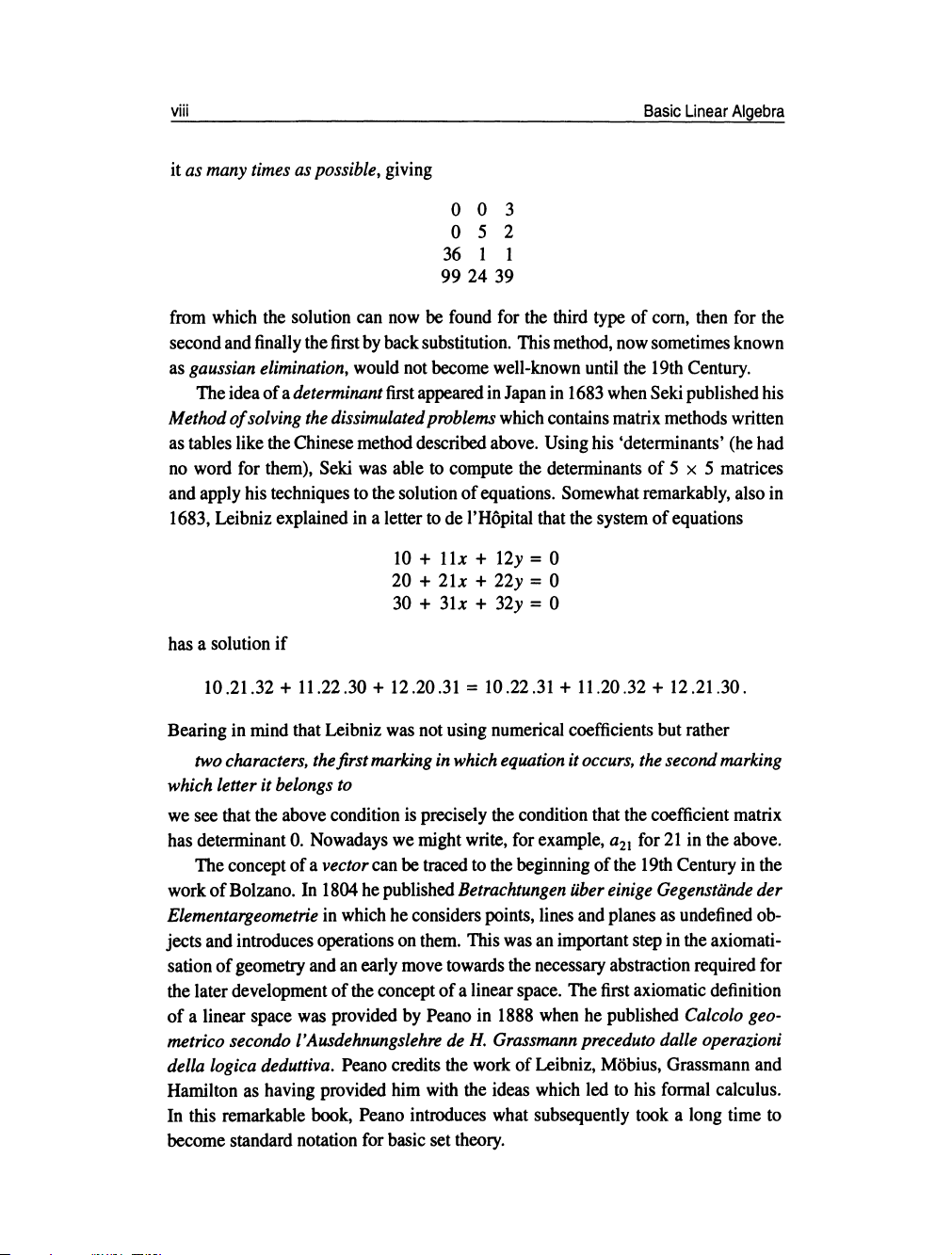
Next, the leftmost column is multiplied by 5 and the middle column subtracted from
viii
it
as
many times
as
possible, giving
003
052
36
1 1
992439
Basic
Linear
Algebra
from
which
the
solution
can
now
be
found
for
the
third
type
of com,
then
for
the
second
and
finally
the
first
by
back substitution.
This
method,
now
sometimes
known
as
gaussian elimination,
would
not
become well-known
until
the
19th
Century.
The idea of a determinant
first
appeared
in
Japan
in
1683
when
Seki
published
his
Method
of
solving
the
dissimulated problems
which
contains matrix methods written
as
tables like
the
Chinese method described
above.
Using
his
'determinants' (he
had
no
word
for
them),
Seki
was
able
to
compute
the
determinants of 5 x 5 matrices
and apply his techniques
to
the
solution of equations. Somewhat remarkably,
also
in
1683,
Leibniz explained
in
a letter
to
de
l'Hopital that
the
system of equations
has a solution if
10
+
llx
+
12y
= 0
20
+
21x
+
22y
= 0
30
+
31x
+
32y
= 0
10
.21.32 + 11.22.30 + 12.20.31 =
10
.22
.31
+ 11.20.32 + 12.21.30.
Bearing
in
mind that Leibniz
was
not using numerical coefficients
but
rather
two characters,
the
first marking
in
which
equation it
occurs,
the
second marking
which letter it belongs
to
we
see that
the
above condition
is
precisely
the
condition that
the
coefficient matrix
has determinant
O.
Nowadays
we
might
write,
for example,
a21
for
21
in
the
above.
The concept of a vector
can
be
traced
to
the
beginning of
the
19th
Century
in
the
work of Bolzano.
In
1804
he
published Betrachtungen
iiber
einige Gegenstiinde der
Elementargeometrie
in
which
he
considers points,
lines
and
planes
as
undefined ob-
jects and introduces operations
on
them.
This
was
an
important step
in
the
axiomati-
sation of geometry
and
an
early
move
towards
the
necessary abstraction required
for
the later development of
the
concept of a linear
space.
The
first
axiomatic definition
of a linear space
was
provided
by
Peano
in
1888
when
he
published Calcolo
geo-
metrico secondo I'Ausdehnungslehre
de
H.
Grassmann
preceduto dalle operazioni
della logica deduttiva.
Peano
credits
the
work
of Leibniz,
Mobius,
Grassmann
and
Hamilton
as
having provided
him
with
the
ideas
which
led
to
his
formal
calculus.
In
this remarkable
book,
Peano introduces
what
subsequently took a long time
to
become standard notation
for
basic set
theory.
Foreword
ix
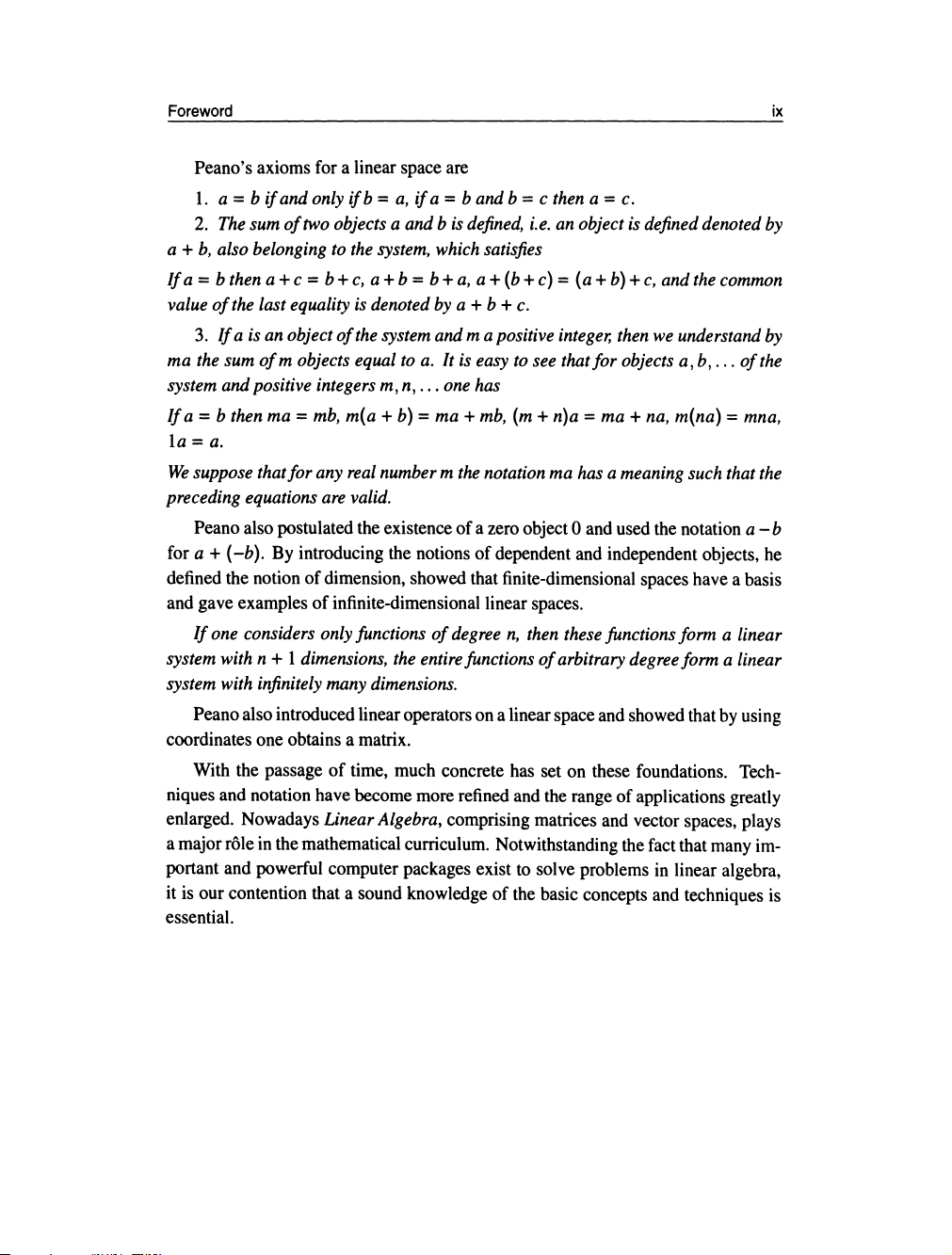
Peano's axioms for a linear space are
1.
a = b if and only if b =
a,
if a = b and b = c then a = c.
2. The sum
of
two objects a and b is defined, i.e. an object is defined denoted by
a
+
b,
also belonging to the system, which satisfies
If
a = b then a + c = b +
c,
a + b = b + a, a + (b + c) = (a + b) +
c,
and the common
value
of
the last equality is denoted by a + b + c.
3.
If
a is an object
of
the system and m a positive integer, then we understand by
ma
the sum
of
m objects equal
to
a. It is easy
to
see that
for
objects a, b,
...
of
the
system and positive integers m, n,
...
one has
If
a = b then
ma
= mb, m(a + b) =
ma
+ mb, (m + n)a =
ma
+ na, m(na) = mna,
la
=
a.
We
suppose that
for
any real number m the notation
ma
has a meaning such that the
preceding equations are valid.
Peano also postulated the existence
of
a zero object 0 and used the notation a - b
for a + (-b). By introducing the notions
of
dependent and independent objects, he
defined the notion
of
dimension, showed that finite-dimensional spaces have a basis
and gave examples
of
infinite-dimensional linear spaces.
If
one considers only functions
of
degree
n,
then these functions form a linear
system with n
+ 1 dimensions, the entire functions
of
arbitrary degree form a linear
system with infinitely many dimensions.
Peano also introduced linear operators on a linear space and showed that by using
coordinates one obtains a matrix.
With the passage
of
time, much concrete has set on these foundations. Tech-
niques and notation have become more refined and the range
of
applications greatly
enlarged. Nowadays
Linear Algebra, comprising matrices and vector spaces, plays
a major role in the mathematical curriculum. Notwithstanding the fact that many im-
portant and powerful computer packages exist to solve problems in linear algebra,
it is our contention that a sound knowledge
of
the basic concepts and techniques is
essential.
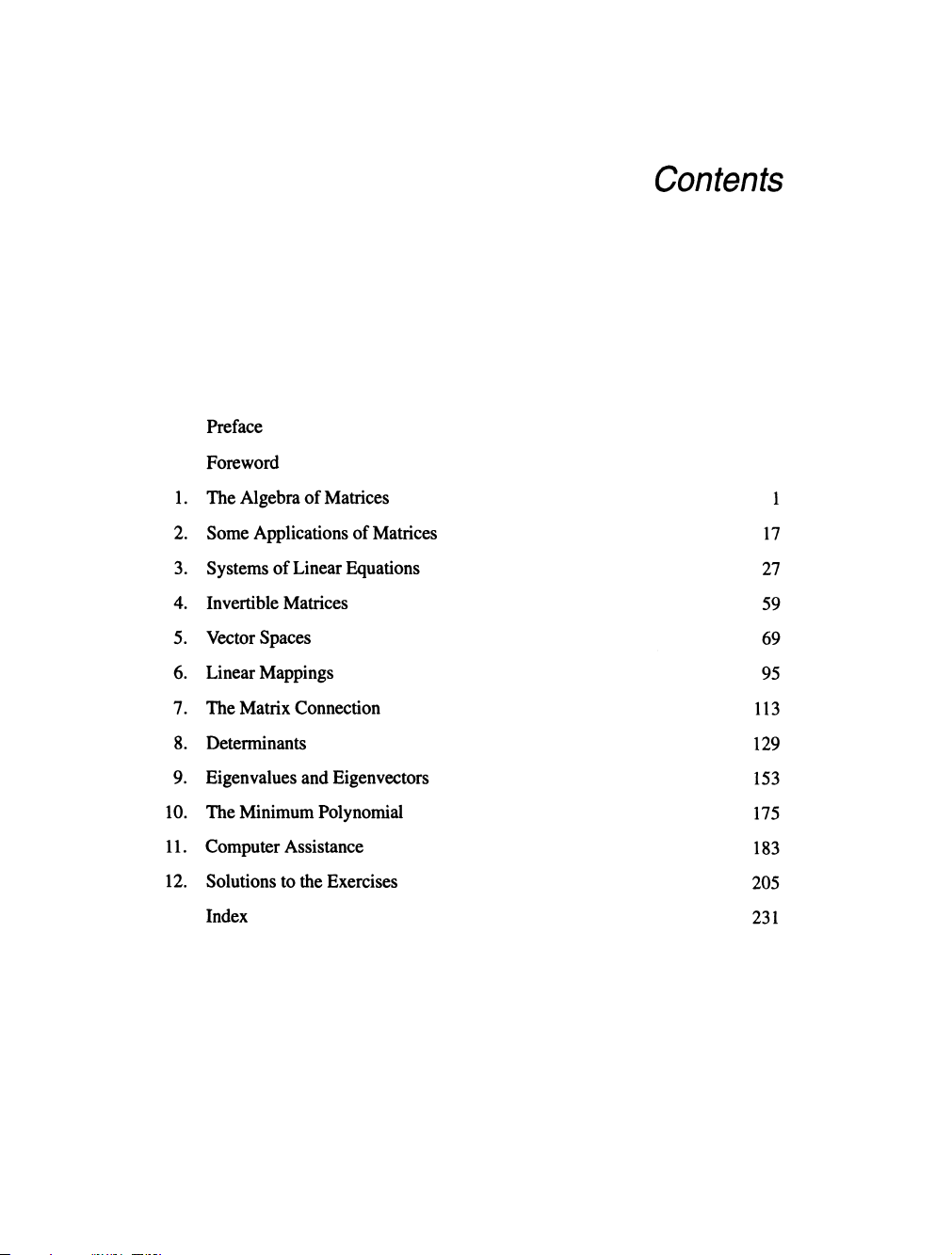
Contents
Preface
Foreword
I.
The Algebra
of
Matrices
2.
Some Applications
of
Matrices
17
3.
Systems
of
Linear Equations
27
4.
Invertible Matrices
59
5.
Vector Spaces
69
6.
Linear Mappings
95
7.
The
Matrix Connection
113
8.
Determinants
129
9.
Eigenvalues and Eigenvectors
153
10.
The Minimum Polynomial
175
II.
Computer Assistance
183
12.
Solutions to the Exercises
205
Index
231
1
The
Algebra
of
Matrices
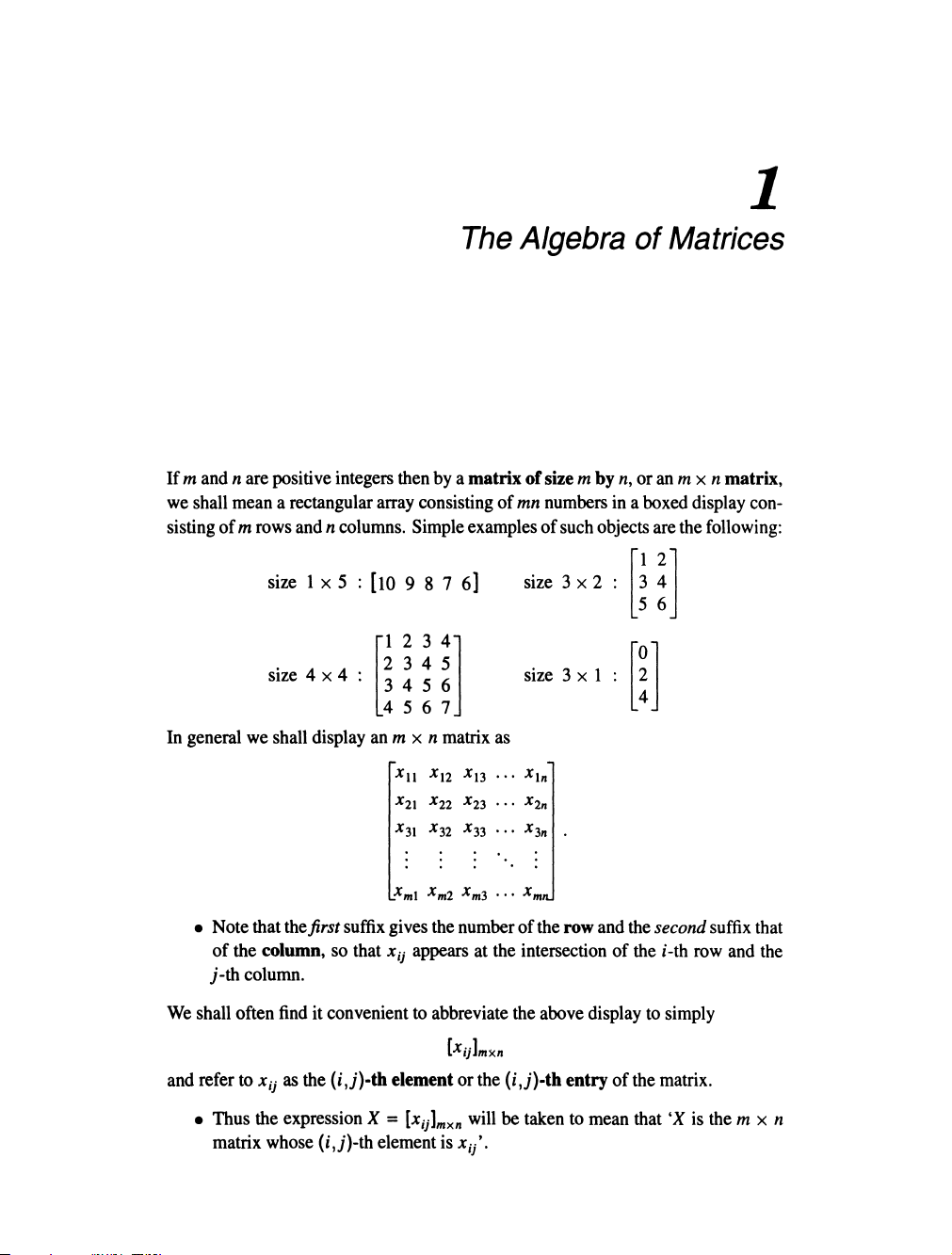
If
m and n are positive integers then by a matrix of size m by n, or an m x n matrix,
we shall mean a rectangular array consisting
of
mn numbers in a boxed display con-
sisting
of
m rows and n columns. Simple examples
of
such objects are the following:
size 1 x 5 : [10 9 8 7
6]
size 3 x 2 :
size 3 x 1
size 4 x 4 :
r~
n
~1
4 5 6 7
In general we shall display an m x n matrix as
Xli
x12
Xl3
...
xln
X21 X22 X23
•••
X2n
x31
x32 x33
•.•
x3n
[;
1
426]
[
O~]
Note that the first suffix gives the number
ofthe
row and the second suffix that
of
the column, so that
Xij
appears at the intersection
of
the i-th row and the
j-th
column.
We shall often find it convenient to abbreviate the above display to simply
[Xij]mxn
and refer to Xij as the
(i,j)-th
element or the
(i,j)-th
entry
ofthe
matrix .
Thus the expression X
= [Xij]mxn will be taken to mean that 'X is the m x n
matrix whose
(i,j)-th
element is x;/.
2
Basic
Linear Algebra
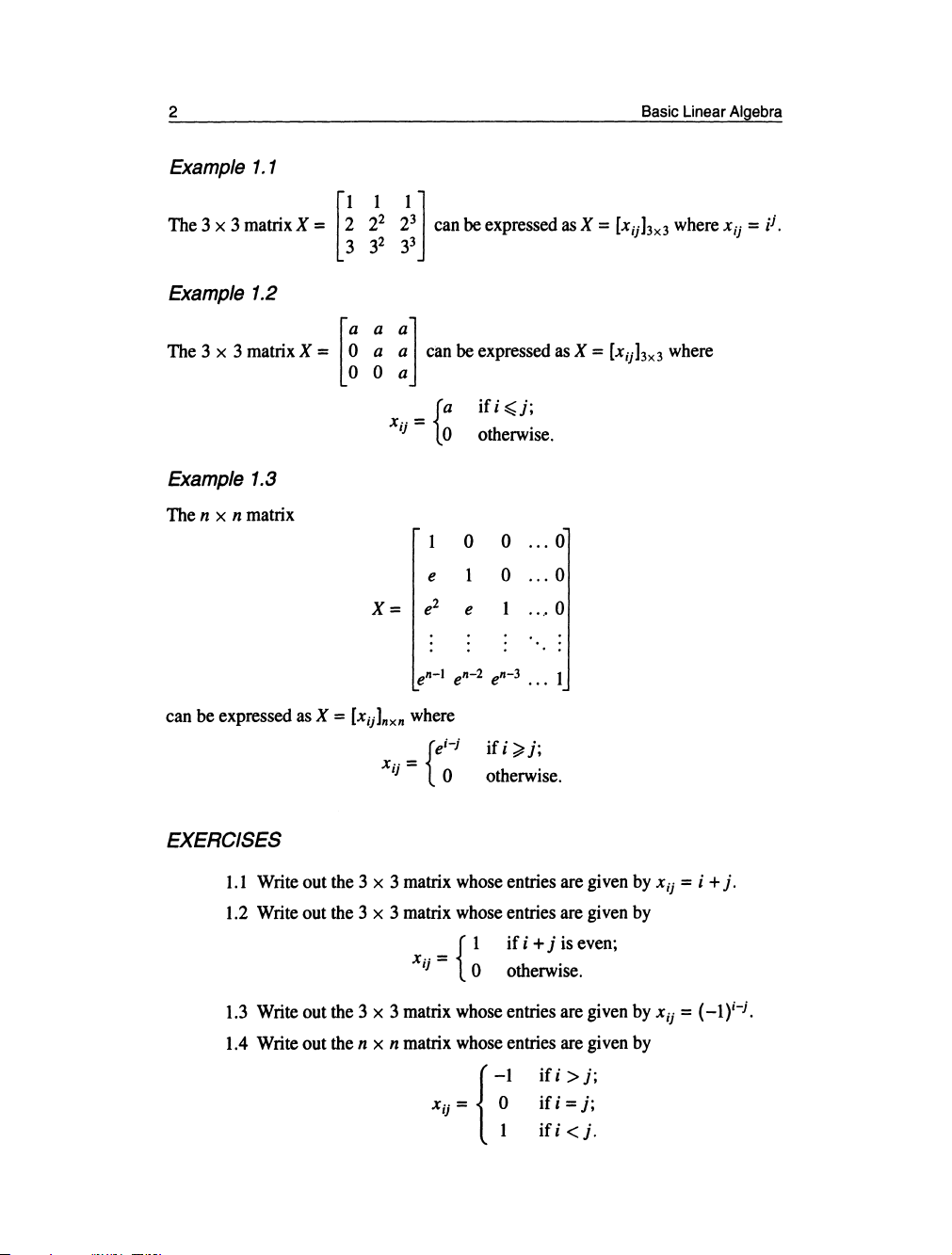
Example
1.1
The
3 x 3 matrix X =
[23
1
i2
i3l
can
be
expressed
as
X =
[Xj
j
hx3
where
Xij
= i
j
3
2
3
3
Example 1.2
The 3 x 3 matrixK =
[~ ~
: 1
can
be
expressed
asK
= [x"k, where
Example 1.3
The
n x n
matrix
{
a
ifi~j;
Xjj = 0
otherwise.
0
0
...
0
e 0
...
0
X=
e
2
e
...
0
can be expressed
as
X =
[Xij]nxn
where
Xij
=
{e~-j
if i
~j;
otherwise.
EXERCISES
1.1
Write
out
the
3 x 3
matrix
whose
entries
are
given
by
Xij
= i +
j.
1.2
Write
out
the
3 x 3
matrix
whose
entries
are
given
by
x
..
= { 1 if i + j
is
even;
I)
0 otherwise.
1.3
Write
out the 3 x 3
matrix
whose
entries
are
given
by
x
ij
=
(-1
)i-
j
.
1.4
Write
out
the
n x n
matrix
whose
entries
are
given
by
{
-I
Xij
= 0
I
if i >
j;
ifi
= j;
ifi
<
j.
1.
The
Algebra
of
Matrices
1.5
Write out the 6 x 6 matrix A =
[aij]
in
which
aij
is
given
by
(1)
the
least common multiple of i
and
j;
(2)
the
greatest
common
divisor of i andj.
3
1.6
Given
the
n x n matrix A =
[aij]'
describe
the
n x n matrix B =
[b
ij
]
which
is
such
that b
ij
=
aj,n+l-j'
Before
we
can develop
an
algebra for matrices, it
is
essential that
we
decide
what
is
meant
by
saying that
two
matrices
are
equal.
Common
sense dictates that
this should happen only if
the
matrices
in
question
are
of
the
same
size
and
have
corresponding entries
equal.
Definition
If
A =
[ajj]mxn
and
B =
[bij]pxq
then
we
shall
say
that A
and
B
are
equal (and write
A = B) if
and
only
if
(1)
m = p
and
n = q;
(2)
aij
=
bij
for
all
i
,j.
The algebraic system that
we
shall develop
for
matrices
will
have
many
of
the
familiar properties enjoyed
by
the
system of
real
numbers.
However,
as
we
shall
see,
there are some
very
striking differences.
Definition
Given
m x n matrices A =
[aij]
and
B =
[b
ij
],
we
define
the
sum A + B
to
be
the
m x n matrix whose (i,j)-th element
is
aij
+ bij'
Note that the
sum
A + B
is
defined
only
when
A
and
B
are
of
the
same
size;
and
to
obtain this
sum
we
simply
add
corresponding entries, thereby obtaining a
matrix
again of
the
same
size.
Thus,
for
instance,
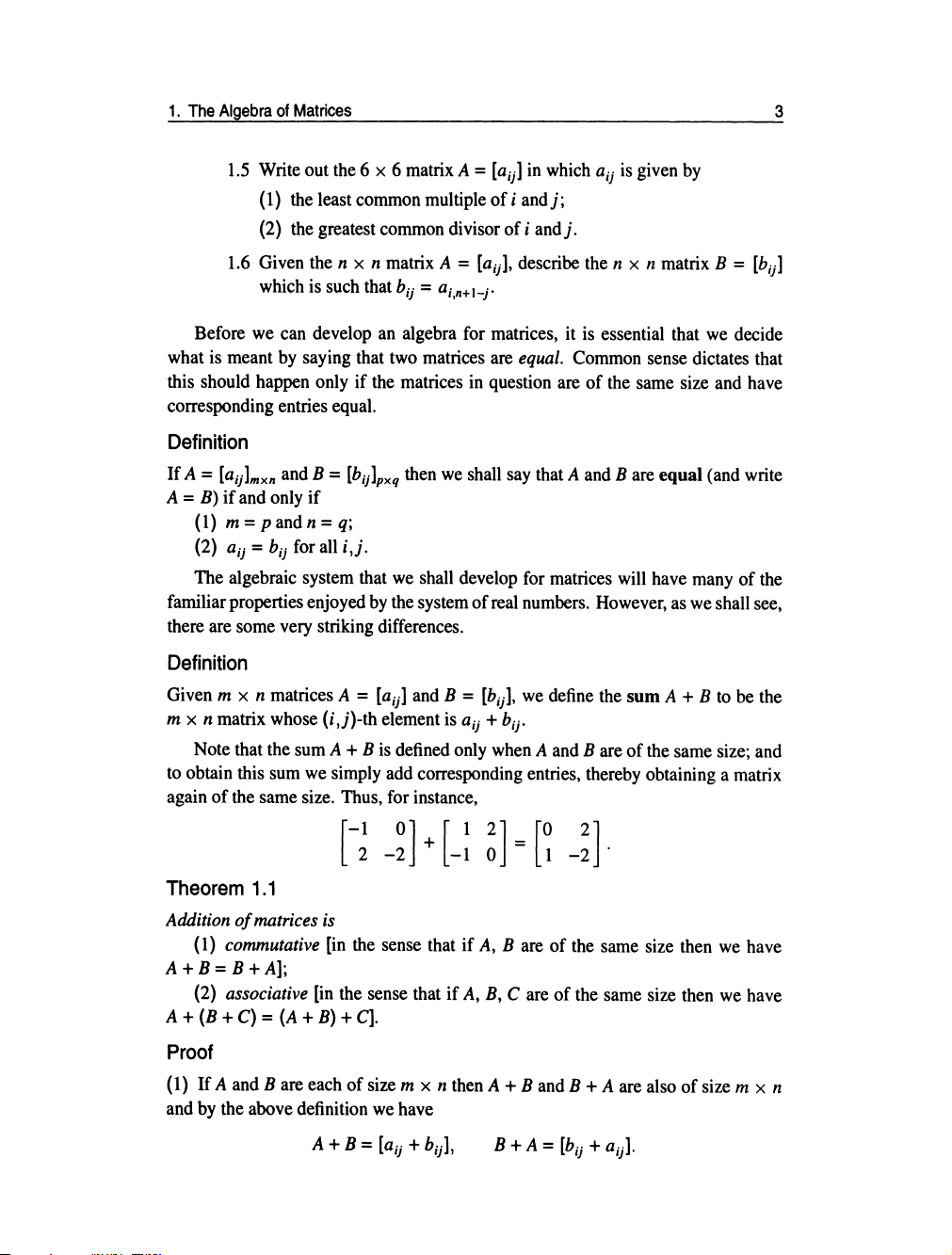
[
-1 0 ]
[1
2 ]
[0
2 ]
2
-2
+
-1
0 = 1
-2
.
Theorem
1.1
Addition
of
matrices
is
(1)
commutative
[in
the
sense that if
A,
B
are
of
the
same
size
then
we
have
A
+B=
B +A];
(2)
associative
[in
the sense that if
A,
B,
C
are
of
the
same
size
then
we
have
A +
(B
+
C)
=
(A
+
B)
+
C].
Proof
(1)
If
A
and
B
are
each of
size
m x n
then
A + Band B + A
are
also
of size m x n
and
by
the above definition
we
have
A
+ B =
[aij
+
bij],
4
Basic
Linear
Algebra
Since addition of numbers
is
commutative
we
have
aij
+ b
ij
= b
ij
+
aij
for
all
i,j
and so,
by
the definition
of
equality
for
matrices,
we
conclude that A + B = B +
A.
(2)
If
A,
B,
C are each of size m x n then
so
are
A + (B +
C)
and (A + B) +
C.
Now
the
(i
,j)-th element of A +
(B
+
C)
is
aij
+
(bij
+ cij) whereas that of
(A
+
B)
+ C
is
(aij
+
bij)
+ cij' Since addition
of
numbers
is
associative
we
have
aij
+
(b
ij
+ Ci) =
(aij
+bi)+c;j for all
i,j
and
so,
by
the
definition of equality
for
matrices,
we
conclude
that
A +
(B
+
C)
=
(A
+
B)
+
C.
0
Because of Theorem
1.1
(2)
we
agree,
as
with
numbers,
to
write
A + B + C
for
either A +
(B
+
C)
or
(A
+
B)
+
C.
Theorem 1.2
There is a unique m x n matrix M such
that,
for every m x n matrix
A,
A + M =
A.
Proof
Consider the matrix M =
[m;j]mxn
all
of
whose
entries are 0;
i.e.
mij
= 0 for
all
i
,j.
For every matrix A =
[a;j]mxn
we
have
A + M =
[aij
+
mij]mxn
=
[a;j
+
O]mxn
=
[aij]mxn
=
A.
To
establish the uniqueness of this matrix
M,
suppose that B =
[bij]mxn
is
also
such
that A + B = A for every m x n matrix
A.
Then
in
particular
we
have M + B = M.
But, taking B instead
of
A
in
the property
for
M,
we
have
B + M =
B.
It
now
follows
by
Theorem 1.1(1) that B = M. 0
Definition
The unique matrix arising in Theorem
1.2
is
called
the
m x n zero matrix
and
will
be
denoted
by
0mxn,
or simply
by
0 if
no
confusion arises.
Theorem 1.3
For every m x n matrix A there
is
a unique m x n matrix B such that A + B =
O.
Proof
Given A =
[aij]mxn,
consider B =
[-aij]mxn,
i.e.
the matrix whose (i,j)-th element
is
the additive inverse of
the
(i,j)-th element of A.
Clearly,
we
have
A + B =
[a;j
+
(-a;j)]mxn
=
O.
To
establish the uniqueness of
such
a matrix
B,
suppose that C =
[cij]mxn
is
also such
that
A + C =
O.
Then
for
all
i,j
we
have
aij
+
Cij
= 0
and
consequently c
ij
= -aij
which means,
by
the above definition of equality, that C =
B.
0
Definition
The unique matrix B arising
in
Theorem
1.3
is
caIled
the
additive inverse of A
and
will
be
denoted
by
-A.
Thus
-A
is
the
matrix
whose
elements
are
the additive
inverses of the corresponding elements of
A.
1.
The
Algebra
of
Matrices
5
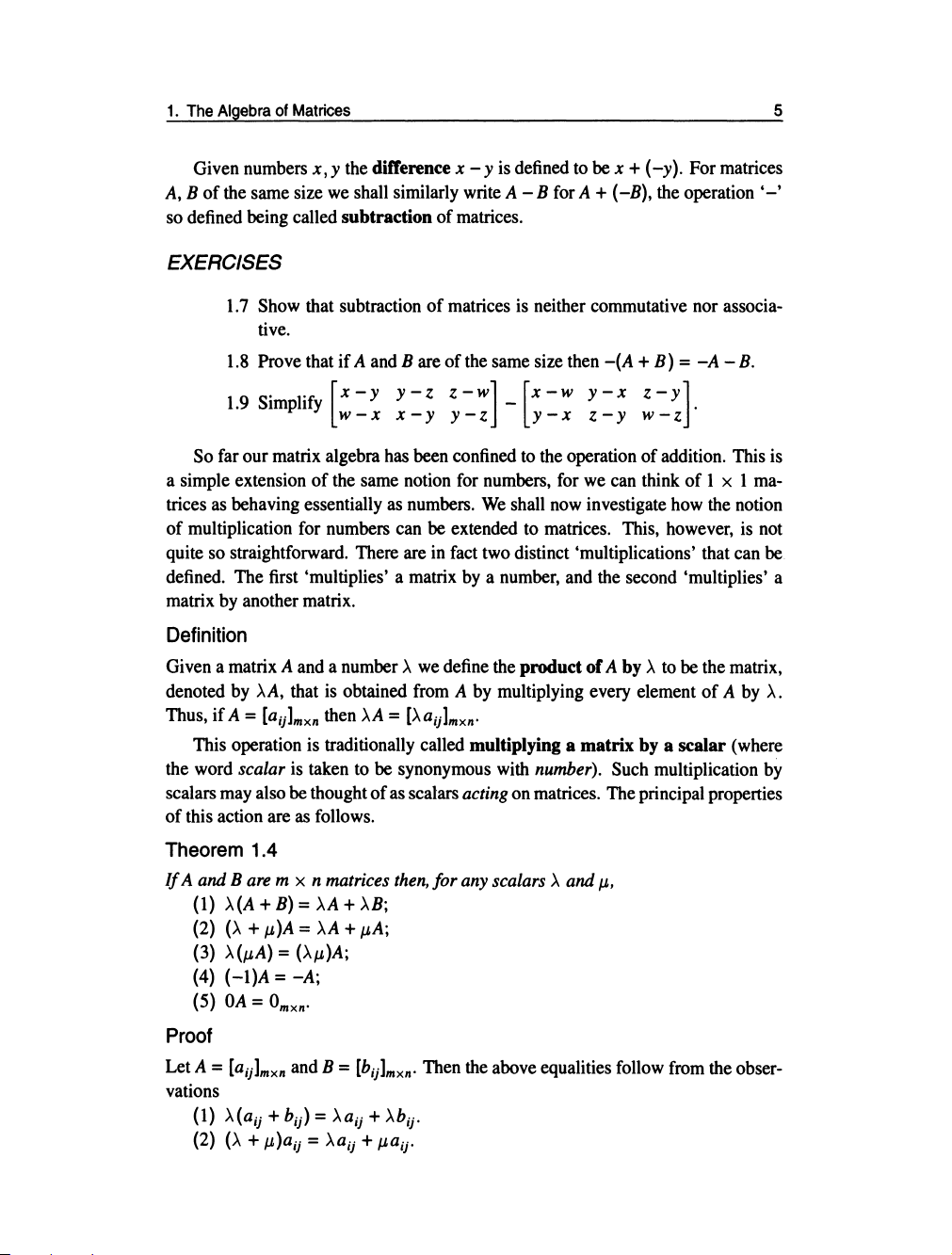
Given numbers x, y the difference x - y is defined to be x + (-y). For matrices
A,
B
of
the same size we shall similarly write A - B for A + (-B), the
operation'-'
so defined being called subtraction
of
matrices.
EXERCISES
1.7 Show that subtraction
of
matrices is neither commutative nor associa-
tive.
1.8 Prove that
if
A and Bare
ofthe
same size then
-(A
+ B) =
-A
-
B.
1.9 Simplify
[x
- y y - z z -
w]
_ [x - w y - x Z -
y].
w-x
x-y
y-z
y-x
z-y
w-z
So far our matrix algebra has been confined to the operation
of
addition. This is
a simple extension
of
the same notion for numbers, for we can think
of
1 x 1 ma-
trices as behaving essentially as numbers.
We
shall now investigate how the notion
of
multiplication for numbers can be extended to matrices. This, however, is not
quite so straightforward. There are in fact two distinct 'multiplications' that can be
defined. The first 'multiplies' a matrix by a number, and the second 'multiplies' a
matrix by another matrix.
Definition
Given a matrix A and a number). we define the
product
of A
by
).
to be the matrix,
denoted by
)'A, that is obtained from A by multiplying every element
of
A by )..
Thus,
if
A =
[aij]mxn
then)'A
=
[).aij]mxn'
This operation is traditionally called multiplying a matrix
by
a scalar (where
the word scalar is taken to be synonymous with number). Such multiplication by
scalars may also
be
thought
of
as scalars acting
on
matrices. The principal properties
of
this action are as follows.
Theorem
1.4
If
A and Bare m x n matrices
then,
for
any
scalars). and
J..I.,
(1)
)'(A +
B)
= )'A + )'B;
(2) (). +
J..I.)A
= )'A +
J..I.A;
(3)
)'(J..I.A)
=
().J..I.)A;
(4)
(-I)A
=
-A;
(5)
OA
=
Omxn.
Proof
Let A =
[aij]mxn
and B =
[bij]mxn'
Then the above equalities follow from the obser-
vations
(1)
).(aij + b
ij
) = ).aij + ).bij.
(2)
().
+
J..I.)aij
= ).aij +
J..I.aij'
6
(3)
).(/Jaij) = (A/J)aij'
(4)
(-l)aij
=
-aij'
(5)
Oaij
=
O.
0
Observe that for every positive integer n
we
have
nA=A+A+···+A
(n
tenns).
Basic
Linear
Algebra
This follows immediately
from
the
definition of
the
product
)'A;
for
the
(i,j)-th el-
ement of
nA
is
naij = aij + aij +
...
+ aij' there being n tenns
in
the
summation.
EXERCISES
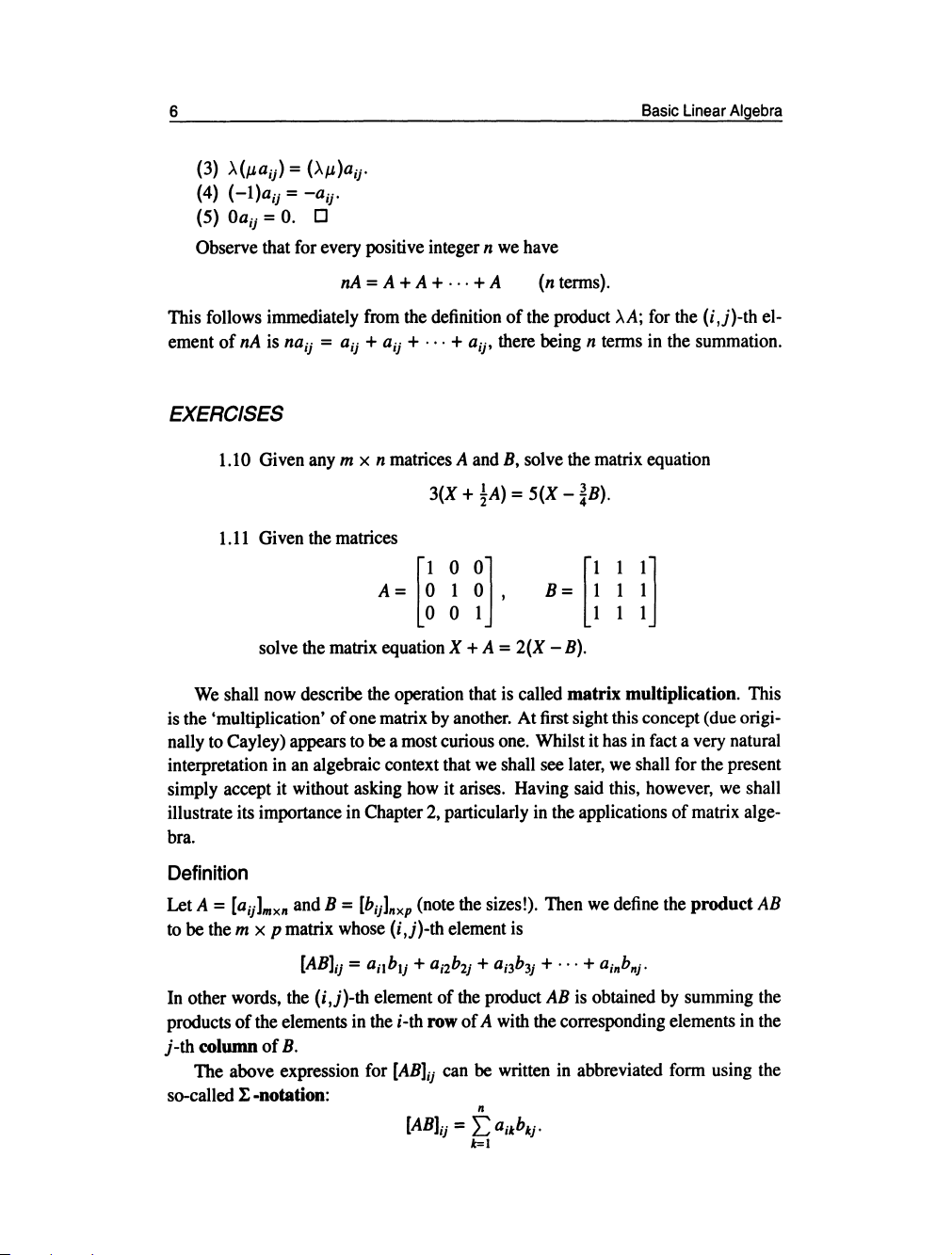
l.10
Given
any
m X n matrices A
and
B,
solve
the
matrix equation
3(X +
!A)
= 5(X -
~B).
1.11
Given
the
matrices
[
1 0
0]
A=
0 1 0 ,
001
solve the matrix equation X + A = 2(X -
B).
We
shall
now
describe
the
operation that
is
called matrix multiplication.
This
is
the 'multiplication' of one
matrix
by
another.
At
first
sight
this
concept
(due
origi-
nally to Cayley) appears
to
be
a most curious
one.
Whilst
it
has
in
fact a
very
natural
interpretation
in
an
algebraic context that
we
shall
see
later,
we
shall for
the
present
simply accept it without asking
how
it arises. Having
said
this,
however,
we
shall
illustrate its importance
in
Chapter
2,
particularly
in
the
applications of
matrix
alge-
bra.
Definition
Let A =
[aij]mxlI
and
B =
[bij]nxp
(note
the
sizes!). Then
we
define
the
product AB
to
be the m x p matrix
whose
(i ,j)-th element
is
[AB]ij =
ail
blj
+
ai2
b
2j
+
ai3b3j
+ ... + aillbllj'
In
other
words,
the
(i,j)-th element of
the
product AB
is
obtained
by
summing
the
products of
the
elements
in
the
i-th row of A
with
the
corresponding elements
in
the
j-th column of
B.
The above expression for [AB]ij
can
be
written
in
abbreviated fonn using
the
so-called
1:
-notation:
II
[ABl
j
= L
ai/cbkj'
k=l
1.
The
Algebra
of
Matrices
7
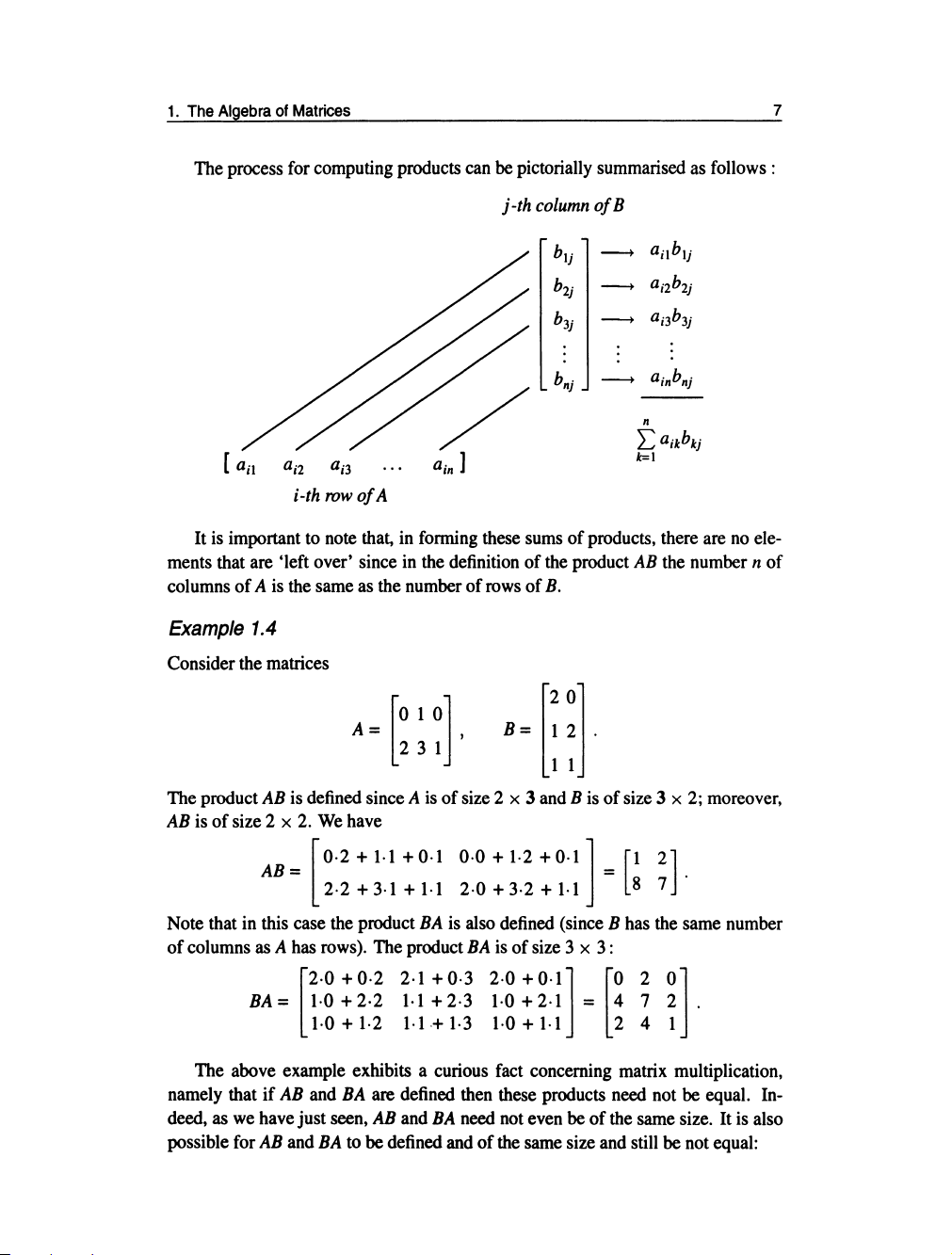
The process for computing products can be pictorially summarised as follows:
j-th
column
of
B
b
1j
--+
ailblj
b
2j
--+
ai2
b
2j
b
3j
--+
ai3
b
3j
b
nj
--+
ainbnj
n
L
aikbkj
k=1
i-th row
of
A
It is important to note that, in forming these sums
of
products, there are no ele-
ments that are 'left over' since in the definition
of
the product
AB
the number n
of
columns
of
A is the same as the number
of
rows
of
B.
Example
1.4
Consider the matrices
A=[010],
231
The product
AB
is defined since A is
of
size 2 x 3 and B is
of
size 3 x 2; moreover,
AB
is
of
size 2 x 2.
We
have
AB=
[0.2
+
1·1
+0·1
0·0 +
1·2
+0.1]
=
[1
2].
2.2+3.1+1.12.0+3.2+1.1
87
Note that in this case the product
BA
is also defined (since B has the same number
of
columns as A has rows). The product
BA
is
of
size 3 x
3:
[
2.0+0.22.1+0.32.0+0.1]
[020]
BA=
1·0+2·2
1·1+2·3 1·0+2·1
= 4 7 2 .
1·0+1·21·1+1·31·0+1·1
241
The above example exhibits a curious fact concerning matrix multiplication,
namely that
if
AB
and
BA
are defined then these products need not be equal. In-
deed, as we have just seen,
AB
and
BA
need not even be
of
the same size. It is also
possible for
AB
and
BA
to be defined and
of
the same size and still be not equal:
8
Basic
Linear
Algebra
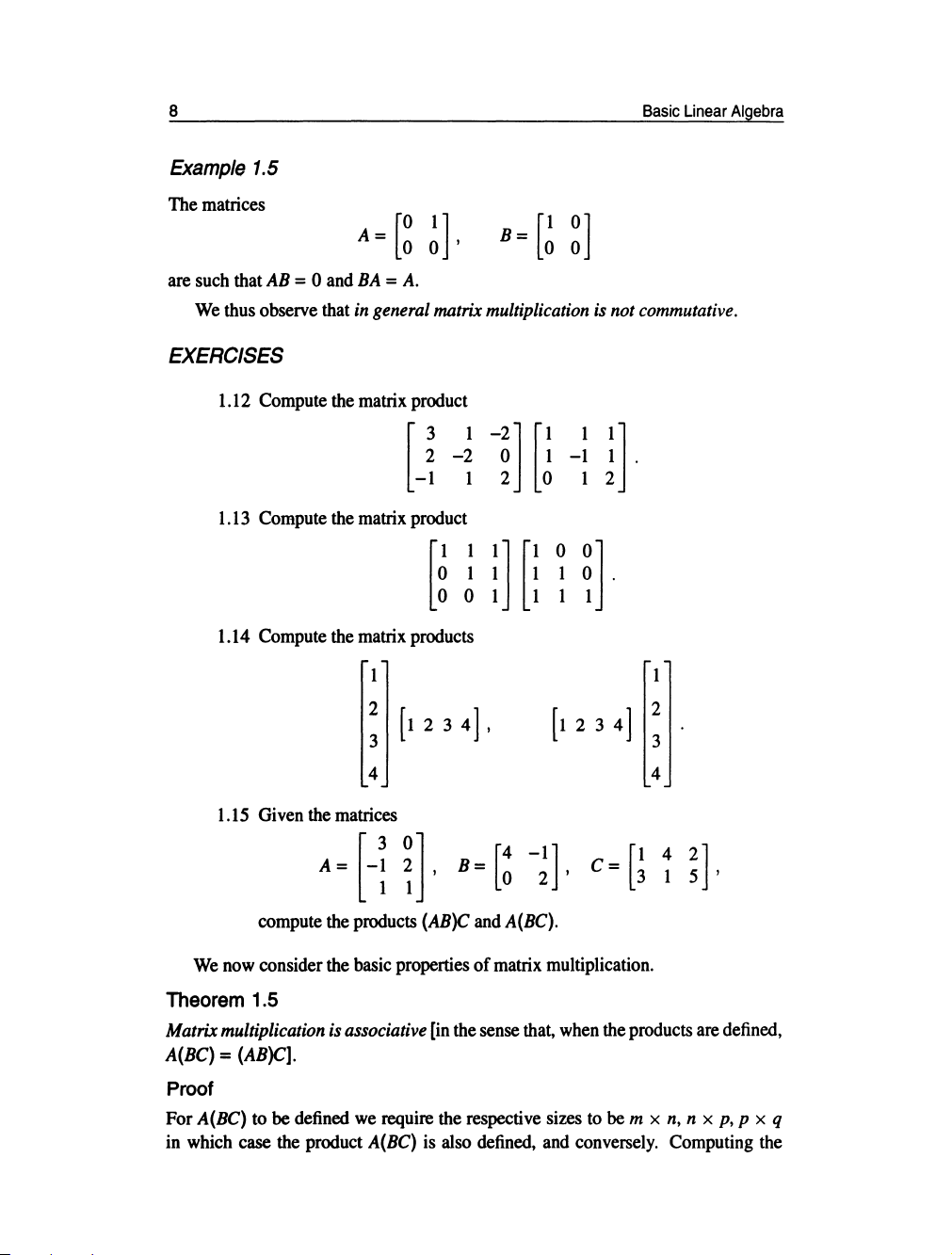
Example
1.5
The matrices
A =
[~
~],
B=
[~
~]
are such that
AB
= 0 and
BA
=
A.
We thus observe that
in
general matrix multiplication
is
not commutative.
EXERCISES
1.12 Compute the matrix product
[
;
-~
-~l
[~ -~
~l·
-1
1 2 0 1 2
1.13 Compute the matrix product
[i
1
1][:
q]
1.14 Compute the matrix products
4
1.15 Given the matrices
A=
H
~l
[
4
-1]
B=
0 2 '
compute the products
(AB}C
and A{BC).
We now consider the basic properties
of
matrix multiplication.
Theorem
1.5
Matrix multiplication is associative [in the sense that, when the products are defined,
A{BC) =
(AB}C).
Proof
For
A{BC) to be defined we require the respective sizes to be m x
n,
n x p, p x q
in which case the product A{BC} is also defined, and conversely. Computing the
1.
The
Algebra
of
Matrices
(i,j)-th element of this product,
we
obtain
If
we
now
compute
the
(i,j}-th element of
(AB)C,
we
obtain
the
same:
p p n
[(AB}C]ij
= L[AB]iIC,j = L
(L
aikbk/)c,j
1=1
1=1
k=1
P n
= L L
aikbkIC,j'
1=1
k=1
Consequently
we
see
that A(BC) =
(AB}C.
0
9
Because of Theorem
1.5
we
shall
write
ABC
for
either A(BC) or
(AB}C.
Also,
for
every
positive integer n
we
shall
write
An
for
the
product
AA
...
A
(n
terms).
EXERCISES
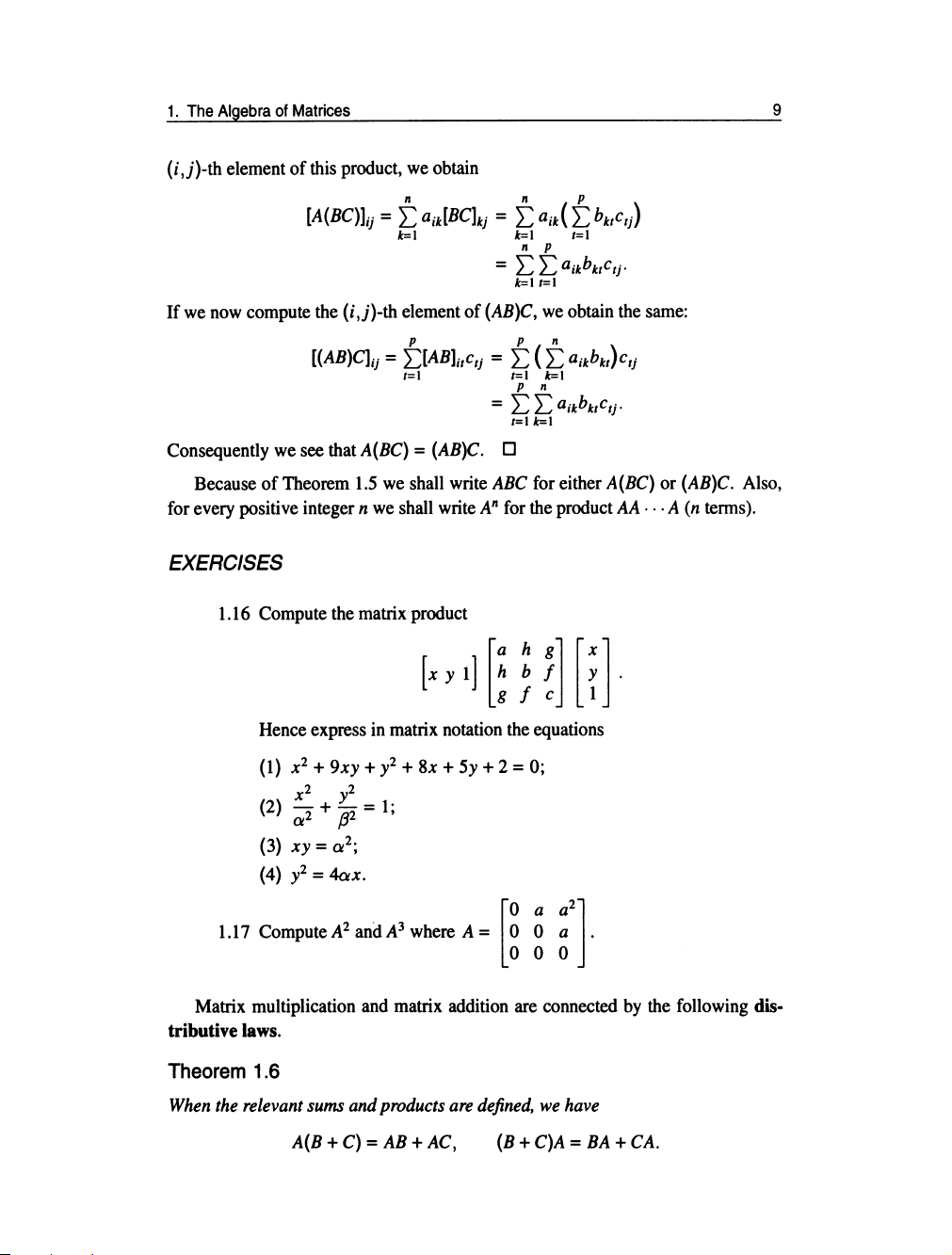
1.16
Compute
the
matrix product
Hence express
in
matrix
notation
the
equations
(I) x
2
+ 9xy +
y2
+ 8x + 5y + 2 = 0;
x2
y2
(2)
01
2
+
{32
=
1;
(3)
xy
=
01
2
;
(4)
y2
= 4ax.
1.17
ComputeA
2
andA
3
where
A =
[~
~
:2].
000
Matrix multiplication
and
matrix addition
are
connected
by
the
following
dis-
tributive laws.
Theorem 1.6
When
the
relevant
sums
and products
are
defined,
we
have
A(B + C} = AB + AC, (B+C}A =
BA
+
CA.
10
Basic
Linear
Algebra
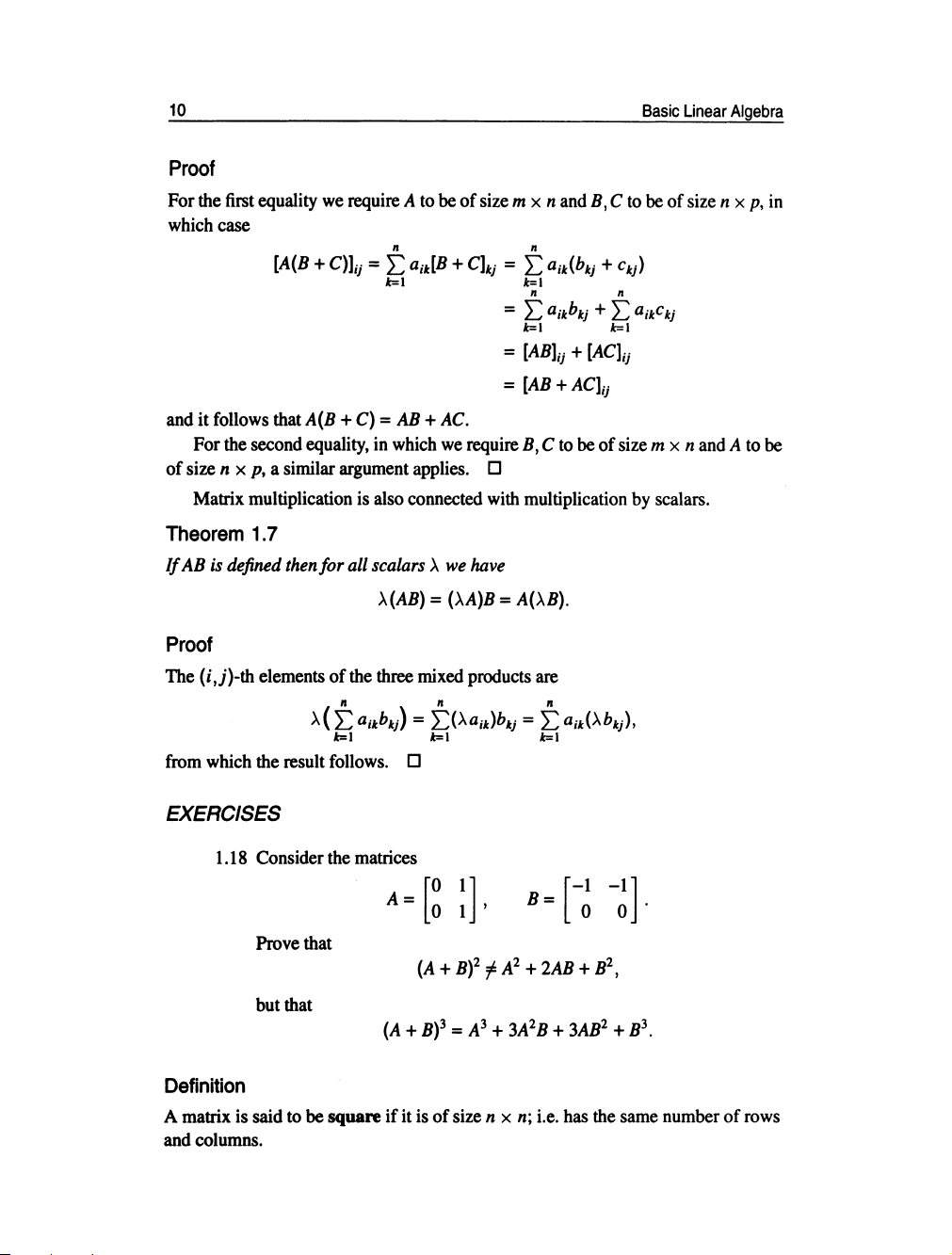
Proof
For the first equality we require A to be
of
size m x
nand
B, C to be
of
size n x
p,
in
which case
n n
[A(B
+
C)]ij
= L
aik[B
+
C]kj
= L
ajk(b
kj
+
Ckj)
k=l k=l
n n
= L
ajkbkj
+ L
ajkckj
k=l k=l
=
[AB]jj
+ [AC]jj
=
[AB
+
AC]ij
and it follows that A(B + C) = AB +
AC.
For
the second equality, in which we require
B,
C to be
of
size m x n and A to be
of
size n x p, a similar argument applies. 0
Matrix multiplication is also connected with multiplication
by scalars.
Theorem
1.7
If
AB
is
defined
then
for all
scalars>'
we
have
>'(AB)
=
(>'A)B
=
A(>.B).
Proof
The (i,j)-th elements
of
the three mixed products are
n n n
>.(
L
ajkbkj)
= L(>'aik)b
kj
= L
ajk()..b
k
),
k=l k=l k=l
from which the result follows. 0
EXERCISES
1.18 Consider the matrices
A =
[~
!],
=
[-1
-1]
BOO
.
Prove that
but that
Definition
A matrix is said to be
square
if
it is
of
size n x
n;
i.e. has the same number
of
rows
and columns.