Seminar 6: MC & TF Questions on Competitive Markets môn Kinh tế vi mô | Trường Đại học Kinh Tế Quốc Dân
For a firm operating in a perfectly competitive industry, total revenue,marginal revenue, and average revenue are all equal .Tài liệu giúp bạn tham khảo, ôn tập và đạt kết quả cao. Mời đọc đón xem!
Môn: Kinh tế vi mô ( NEU ) 762 tài liệu
Trường: Trường Đại học Kinh Tế Quốc Dân 7.6 K tài liệu
Tác giả:














Preview text:
Seminar 6: Question By Le Thanh Ha
Type I: True/False question (give a brief explanation)
1. For a firm operating in a perfectly competitive industry, total revenue, marginal
revenue, and average revenue are all equal. Ans: False
For a competitive industry, demand curve is the horizontal line at the market price that is
also the marginal revenue. MR=AR=P* where Average Revenue (AR)= TR/Q, TR=P* x Q.
2. In competitive markets, firms that raise their prices are typically rewarded with larger profits. Ans: False
Competitive firm is a price taker, implying this firm accepts the market price as its own
price. They cannot change the market price due to a weak market power.
For other types of firm, firms also cannot raise the price to earn a higher profit due to the
law of demand (P increases Q decreases).
3. A firm operating in a perfectly competitive industry will continue to operate in the
short run but earn losses if the market price is less than that firm’s average total cost
but greater than the firm’s average variable cost. Ans: True
Earn loss but still operate when:
Loss when P< ATC (Break-even point)
Still produce when P> AVC (Shut-down point)
4. A firm will shut down in the short run if revenue is not sufficient to cover all of its fixed costs of production. Ans: False
TO know whether firms shutdown or not, we have compare:
Loss if firm produce: TR-FC-VC<0 (implying the loss)
Loss if firm does not produce: -FC TR-FC-VC vs -FC TR vs VC
5. In a long-run equilibrium where firms have identical costs, it is possible that some
firms in a competitive market are making a positive economic profit. Ans:
In the long-run, competitive firms make a zero economic profit since there is a free entry
and exit because of a weak market power. (see Feature 7 in Lecture Note (Lesson 5) for the details).
6. All firms maximize profits by producing an output level where marginal revenue
equals marginal cost; for firms operating in perfectly competitive industries,
maximizing profits also means producing an output level where price equals marginal cost. Ans: True
7. A firm operating in a perfectly competitive industry will shut down in the short run
but earn losses if the market price is less than that firm’s average variable cost. Ans: True
8. In the short run, a firm should exit the industry if its marginal cost exceeds its marginal revenue. Ans: False Firms will exit if P< AVC
9. The supply curve of a firm in a competitive market is the average variable cost
curve above the minimum of marginal cost. Ans: False
(Feature 6): For a competitive firm, the supply curve is the marginal cost (MC) but only when
10. The short-run supply curve in a competitive market must be more elastic than the long-run supply curve. Type II: Discussion questions
1. List and describe the characteristics of a perfectly competitive market.
2. Why would a firm in a perfectly competitive market always choose to set its
price equal to the current market price? If a firm set its price below the current
market price, what effect would this have on the market?
3. Use a graph to demonstrate the circumstances that would prevail in a
competitive market where firms are earning economic profits. Can this scenario
be maintained in the long run? Explain your answer.
4. A firm in the perfectly competitive market has a total cost function The market price is 1200.
a. What is the quantity that this firm maximize its profits? Compute this profit.
b. What are the quantity and price where the firm is break-even (earn zero profit).
c. What are the quantity and price where the firm shut-downs?
d. Draw a figure showing the supply curve of this firm. Solution:
a. Competitive firm maximizes their profit at the point: MR = MC =P* P*=1200 MC=TC’(Q) = 2Q+180 2Q+180=1200 Q* = 510
Profit =TR-TC = 1200*510 – (510^2+180*510+14400)=
b. The break-even point for competitive firm: P =ATCmin
ATC is minimum when MC = ATC (recall the chapter 5: production and cost) (MC
intersects ATC curve at which ATCmin) MC= TC’(Q)=2Q+180 ATC=TC/Q= Q+180+14400/Q
So, MC=ATC 2Q+180 = Q+180+14400/Q
Q=120 ATCmin = 120+180+14400/120=420 P=ATCmin=420.
c. The shut-down point PAVC is minimum when MC = AVC (recall the chapter 5: production and cost) (MC
intersects AVC curve at which AVCmin) MC= TC’(Q)=2Q+180 AVC = VC/Q= Q+180 So, MC =AVC Q=0 AVCmin =180 P=AVCmin =180.
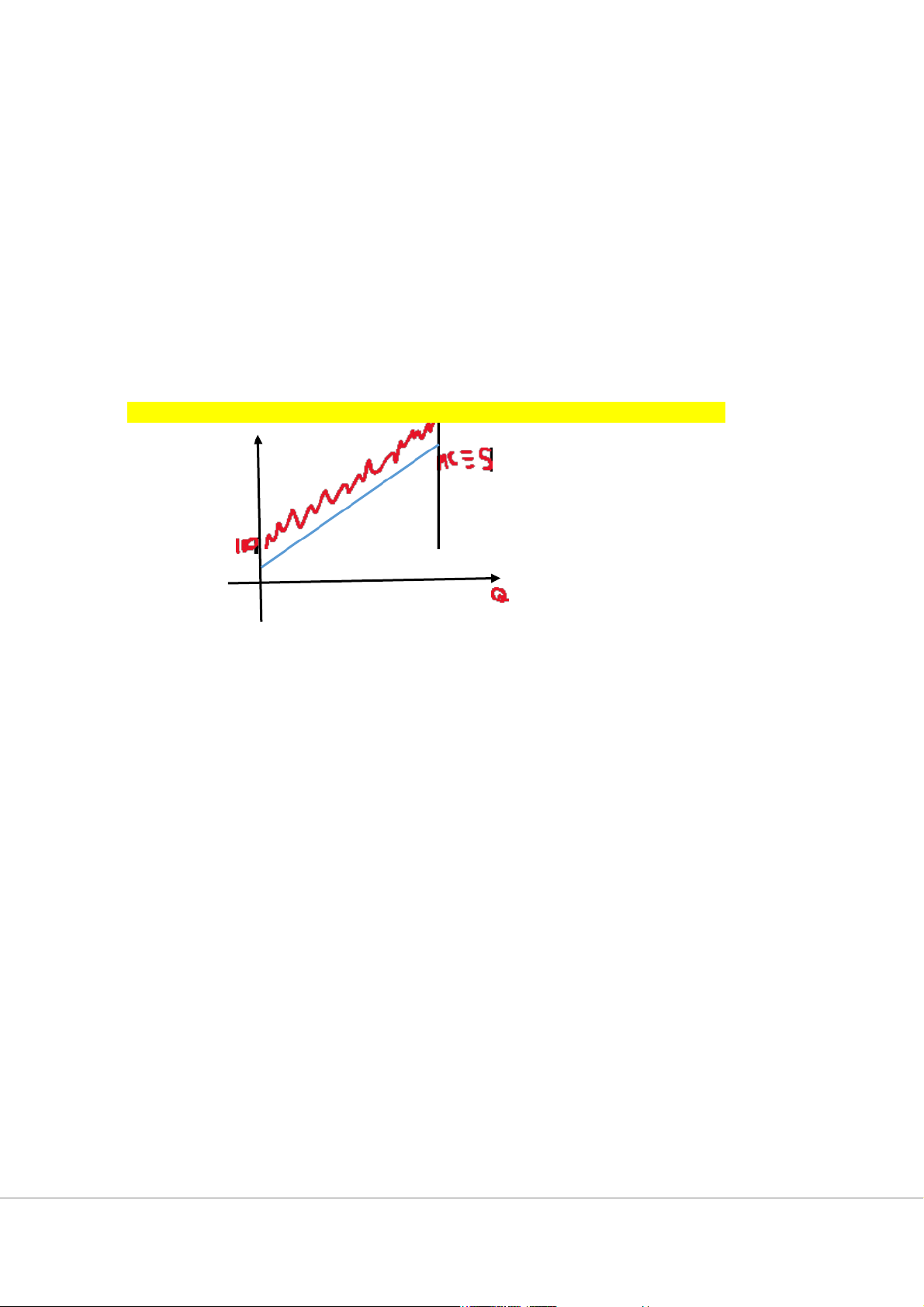
d. Draw a figure showing the supply curve of this firm.
For a competitive firm, the supply curve is the marginal cost (MC) but only when Type III: Multiple Choice
1. Which of the following is not a characteristic of a competitive market?
a. Buyers and sellers are price takers.
b. Each firm sells a virtually identical product. c. Free entry is limited.
d. Each firm chooses an output level that maximizes profits.
2. Which of the following statements best reflects a price-taking firm?
a. If the firm were to charge more than the going price, it would sell none of its goods.
b. The firm has an incentive to charge less than the market price to earn higher revenue.
c. The firm can sell only a limited amount of output at the market price before the market price will fall.
d. Price-taking firms maximize profits by charging a price above marginal cost.
3. For a firm operating in a competitive industry, which of the following statements is not correct?
a. Price equals average revenue.
b. Price equals marginal revenue. c. Total revenue is constant.
d. Marginal revenue is constant.
4. If a competitive firm is currently producing a level of output at which marginal
revenue exceeds marginal cost, then
a. a one-unit increase in output will increase the firm's profit.
b. a one-unit decrease in output will increase the firm's profit.
c. total revenue exceeds total cost.
d. total cost exceeds total revenue.
5. Hung is a gourmet chef who runs a small catering business in a competitive
industry. Hung specializes in making wedding cakes. Hung sells 20 wedding cakes
per month. His monthly total revenue is $5,000. The marginal cost of making a
wedding cake is $200. In order to maximize profits, he should
a. make more than 20 wedding cakes per month. (maximize MR=MC, Q=25, MR: 250)
b. make fewer than 20 wedding cakes per month.
c. continue to make 20 wedding cakes per month.
d. We do not have enough information with which to answer the question.
6. A competitive firm has been selling its output for $20 per unit and has been
maximizing its profit, which is positive. Then, the price rises to $25, and the firm
makes whatever adjustments are necessary to maximize its profit at the now-higher
price. Once the firm has adjusted, which of the following statements is correct?
a. The firm's quantity of output is higher than it was previously.
b. The firm's average total cost is higher than it was previously.
c. The firm's marginal revenue is higher than it was previously.
d. All of the above are correct.
7. When profit-maximizing firms in competitive markets are earning profits,
a. market demand must exceed market supply at the market equilibrium price.
b. market supply must exceed market demand at the market equilibrium price.
c. new firms will enter the market.
d. the most inefficient firms will be encouraged to leave the market. Table 6-1 Quantity Total Revenue Total Cost 0 $0 $10 1 $9 $14 2 $18 $19 3 $27 $25 4 $36 $32 5 $45 $40 6 $54 $49 7 $63 $59 8 $72 $70 9 $81 $82
8. Refer to Table 6-1. In order to maximize profit (MR=MC), the firm will produce a level
of output where marginal cost is equal to a. 3 b. 6 c. 8 d. 9
9. Refer to Table 6-1. If the firm finds that its marginal cost is $11, it should
a. increase production to maximize profit.
b. increase the price of the product to maximize profit.
c. advertise to attract additional buyers to maximize profit.
d. reduce production to increase profit.
10. Refer to Table 6-1. If the firm finds that its marginal cost is $5, it should
a. reduce fixed costs by lowering production.
b. increase production to maximize profit.
c. decrease production to maximize profit.
d. maintain its current level of production to maximize profit.
Tài liệu liên quan:
-
TOPIC: COSMETICS môn Kinh tế vi mô | Trường Đại học Kinh tế Quốc dân
5 3 -

Sách Bài Tập Vi Mô - Hướng Dẫn và Lời Giải Chi Tiết
13 7 -

Nguyên lý chiến lược kinh doanh - Bài giảng môn Kinh tế vi mô | Trường Đại học Kinh Tế Quốc Dân
13 7 -

Chương 7 các kỹ thuật lựa chọn chiến lược - Bài giảng môn Kinh tế vi mô | Trường Đại học Kinh Tế Quốc Dân
14 7 -
Tổng hợp câu hỏi trắc nghiệm theo chương ôn tập môn Kinh tế vi mô | Trường Đại học Kinh Tế Quốc Dân
18 9