Seminar 7 Answers: Types I, II, & III Explained môn Kinh tế vi mô | Trường Đại học Kinh Tế Quốc Dân
In this case, the firms are monopolists in the short run whenconsumers are unable to change their "home heating" system. Tài liệu giúp bạn tham khảo, ôn tập và đạt kết quả cao. Mời đọc đón xem!
Môn: Kinh tế vi mô ( NEU ) 762 tài liệu
Trường: Trường Đại học Kinh Tế Quốc Dân 7.6 K tài liệu
Tác giả:




Preview text:
Seminar 7: Answer By Le Thanh Ha
Type I: True/False question (give a brief explanation)
1:T; 2: T: 3.T; 4:T; 5:F; 6T;7T;8T;9T;10F;11T;12F;13T;14F Type III: Multiple Choice
1D; 2B; 3B; 4B; 5B; 6C; 7C; 8B; 9C; 10B Type II: Discussion questions
ANS: In this case, the firms are monopolists in the short run when consumers 1.
are unable to change their "home heating" systems. In the long run, consumers
can change from electric appliances to natural gas appliances and thus lessen
the monopoly power of utility providers. As long as consumers are able to
substitute, in the long run the monopoly pricing power is reduced.
A profit-maximizing monopolist produces the output level where marginal 2.
revenue equals marginal cost and charges the corresponding price from the
market demand curve. Note that a monopolist charges a price that exceeds
marginal cost, unlike a competitive firm, for which price equals marginal cost.
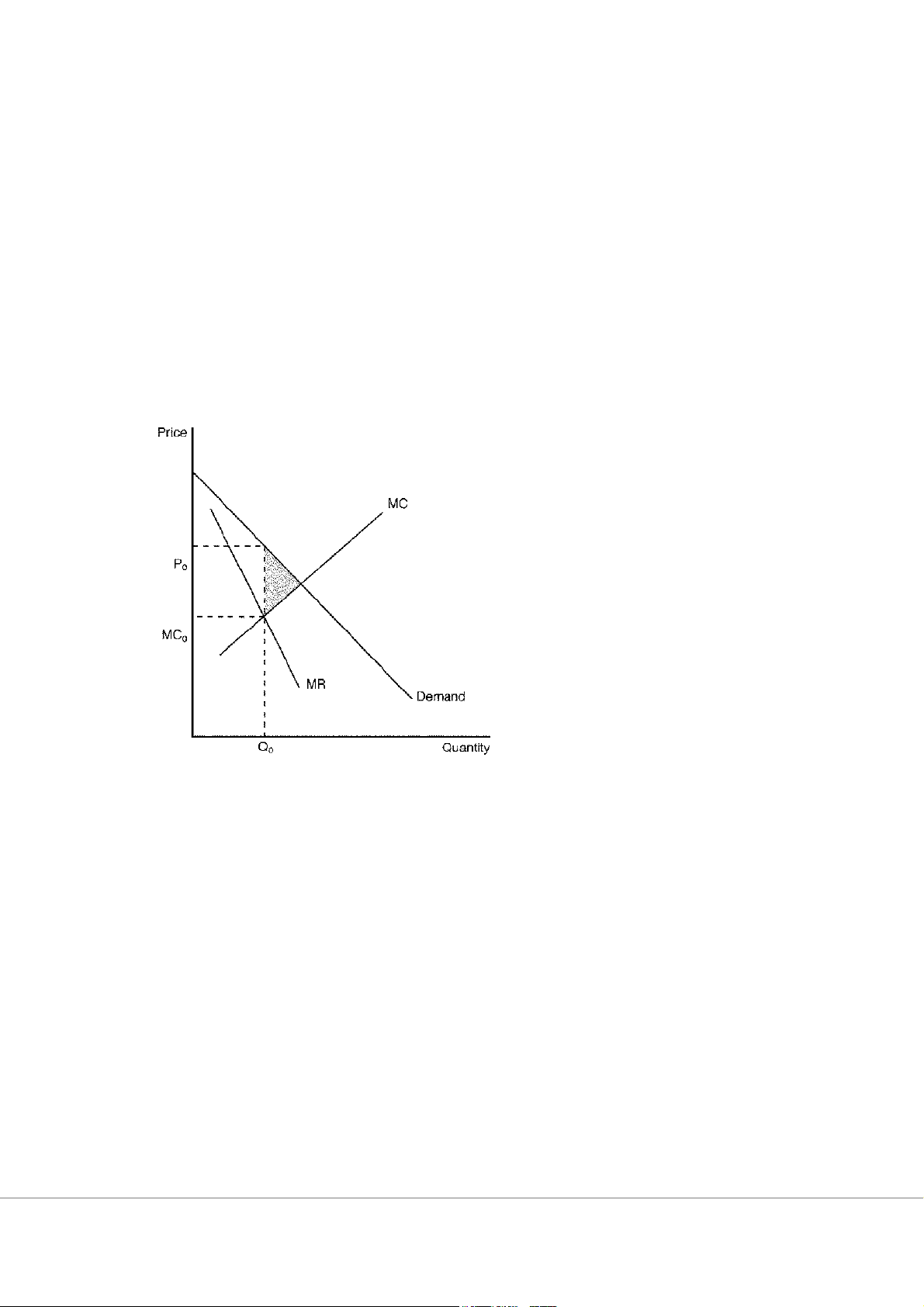
3. A profit-maximizing monopolist will choose to produce Q0 units of output and sell
at price P0. However, marginal cost is MC0. This is identical to the deadweight
loss of taxation when the tax forces a wedge between market price and marginal cost. 1/2*(110-100)*($10-$5) = $25 4.
First, the government can try to make monopolized industries more competitive 5.
by using the power of antitrust laws. Second, the government can regulating the
behavior of monopolies, which usually occurs with natural monopolies. Third,
the government can own and run a monopoly. Four, the government can do nothing.
As long as the government "owner" pursues a production and pricing policy that 6.
approaches a competitive outcome, social well-being can be enhanced. In this
case the government ownership would benefit society. However, in most cases,
government owners operate much like private sector monopolists. The political
economy of government institutions does not ensure that government owners
will pursue socially optimal policy. Also, governments have no incentive to reduce costs or innovate. 7. Type III: Multiple Choice
1D; 2B; 3B; 4B; 5B; 6C; 7C; 8B; 9C; 10B
Tài liệu liên quan:
-
TOPIC: COSMETICS môn Kinh tế vi mô | Trường Đại học Kinh tế Quốc dân
5 3 -

Sách Bài Tập Vi Mô - Hướng Dẫn và Lời Giải Chi Tiết
13 7 -
Nguyên lý chiến lược kinh doanh - Bài giảng môn Kinh tế vi mô | Trường Đại học Kinh Tế Quốc Dân
13 7 -
Chương 7 các kỹ thuật lựa chọn chiến lược - Bài giảng môn Kinh tế vi mô | Trường Đại học Kinh Tế Quốc Dân
14 7 -
Tổng hợp câu hỏi trắc nghiệm theo chương ôn tập môn Kinh tế vi mô | Trường Đại học Kinh Tế Quốc Dân
18 9