Seminar 7: Monopoly Analysis and Discussion Questions môn Kinh tế vi mô | Trường Đại học Kinh Tế Quốc Dân
Monopolists cannot achieve any level of profit they desire becausethey will sell lower quantities at higher prices .Tài liệu giúp bạn tham khảo, ôn tập và đạt kết quả cao. Mời đọc đón xem!
Môn: Kinh tế vi mô ( NEU ) 762 tài liệu
Trường: Trường Đại học Kinh Tế Quốc Dân 7.6 K tài liệu
Tác giả:











Preview text:
Seminar 7: Question: Monopoly By Le Thanh Ha
Type I: True/False question (give a brief explanation) 1.
Monopolists cannot achieve any level of profit they desire because they will sell
lower quantities at higher prices. 2.
Copyrights and patents are examples of barriers to entry that afford firms monopoly pricing powers. 3.
Like competitive firms, monopolies choose to produce a quantity in which marginal revenue equals marginal cost. 4.
A monopolist does not have a supply curve because the firm’s decision about how
much to supply is impossible to separate from the demand curve it faces. 5.
A monopoly creates a deadweight loss to society because it earns both short-run and
long-run positive economic profits. 6.
A monopoly creates a deadweight loss to society because it produces less output
than the socially efficient level. 7.
The government may choose to do nothing to reduce monopoly inefficiency
because the “fix” may be worse than the problem. 8.
A natural monopoly has economies of scale for most if not all of its range of output. 9.
Declining average total cost with increased production is one of the defining
characteristics of a natural monopoly.
10. For a monopoly, marginal revenue is often greater than the price they charge for their good.
11. A monopolist produces where P > MC = MR
12. A monopolist’s supply curve is vertical.
13. The socially efficient quantity is found where the demand curve intersects the marginal cost curve.
14. Government intervention always reduces monopoly deadweight loss.
Type II: Discussion questions
1. In the market for "home heating" consumers typically have several options (e.g.,
electricity, heating fuel, natural gas, propane, etc.), yet we often think of firms in
this industry as behaving like monopolists. Discuss the context in which your
electricity provider is a monopolist. Is this characterization universally applicable? Explain your answer.
2. Explain how a profit-maximizing monopolist chooses its level of output and the price of its goods.
3. Graphically depict the deadweight loss caused by a monopoly. How is this similar
to the deadweight loss from taxation?
4. What is the deadweight loss due to profit-maximizing monopoly pricing under the
following conditions: The price charged for goods produced is $10. The intersection
of the marginal revenue and marginal cost curves occurs where output is 100 units
and marginal revenue is $5. The socially efficient level of production is 110 units.
The demand curve is linear and downward sloping, and the marginal cost curve is constant.
5. What are the four ways that government policymakers can respond to the problem of monopoly?.
Ans: First, the government can try to make monopolized industries more competitive by
using the power of antitrust laws. Second, the government can regulating the behavior of
monopolies, which usually occurs with natural monopolies. Third, the government can own and run
a monopoly. Four, the government can do nothing.
6. In many countries, the government chooses to "internalize" the monopoly by
owning monopoly providers of goods and services. (In some cases these firms are
"nationalized," and the government actually buys or confiscates firms that operate in
monopoly markets). What would be the advantages and disadvantages of such an
approach to ensure that the "best interest of society" is promoted in these markets? Explain your answer.
Ans: As long as the government "owner" pursues a production and pricing policy that
approaches a competitive outcome, social well-being can be enhanced. In this case the government
ownership would benefit society. However, in most cases, government owners operate much like
private sector monopolists. The political economy of government institutions does not ensure that
government owners will pursue socially optimal policy. Also, governments have no incentive to reduce costs or innovate. 2
7. A monopolist has a total cost function TC =0.5Q +10Q+100 and the demand curve P=70-Q a. What is the fixed cost?
b. What is the marginal revenue function?
c. What are the quantity and price that the monopolist maximize its profit? Compute this profit.
d. Compute CS, PS, NSB, and the deadweight loss in this case. Draw the figure to represent it.
e. What are the quantity and price that the monopolist maximize its revenue?
8. A monopolist has TC=Q2+80Q+200 and the demand curve P=170-0.5Q
a. What are the quantity and price that the monopolist maximize its profit? Compute this profit.
b. Compute CS, PS, NSB, and the deadweight loss in this case. Draw the figure to represent it.
c.If the government impose the lump-sum tax T=50. Compute price, quantity and profit of monopolists?
d.If the government imposes the quanity tax t=30/product. Compute price, quantity and profit of monopolists?
Type III: Multiple Choice
1. Because monopoly firms do not have to compete with other firms, the outcome in a
market with a monopoly is often
a. not in the best interest of society.
b. one that fails to maximize total economic well-being. c. inefficient.
d. All of the above are correct.
2. Which of the following would be most likely to have monopoly power?
a. a long-distance telephone service provider b. a local cable TV provider c. a large department store d. a gas station
3. Which of the following statements is true of a monopoly firm?
a. A monopoly firm is a price taker and has no supply curve.
b. A monopoly firm is a price maker and has no supply curve
c. A monopoly firm is a price maker and has a downward-sloping supply curve.
d. A monopoly firm is a price maker and has an upward-sloping supply curve.
4. Which of the following statements is correct for a monopolist?
i) The firm maximizes profits by equating marginal revenue with marginal cost.
ii) The firm maximizes profits by equating price with marginal cost.
iii) Demand equals marginal revenue.
iv) Average revenue equals price. a. i), iii), and iv) only b. i) and iv) only c. i), ii), and iv) only d. i), ii), iii), and iv)
5. Which of the following statements is correct for both a monopolist and a perfectly competitive firm?
i) The firm maximizes profits by equating marginal revenue with marginal cost.
ii) The firm maximizes profits by equating price with marginal cost.
iii) Demand equals marginal revenue.
iv) Average revenue equals price. a. i), iii), and iv) only b. i) and iv) only c. i), ii), and iv) only d. i), ii), iii), and iv)
6. For a monopoly, the level of output at which marginal revenue equals zero is also the level of output at which a. average revenue is zero. b. profit is maximized. c. total revenue is maximized. d. marginal cost is zero.
7. A reduction in a monopolist's fixed costs would
a. decrease the profit-maximizing price and increase the profit-maximizing quantity produced.
b. increase the profit-maximizing price and decrease the profit-maximizing quantity produced.
c. not effect the profit-maximizing price or quantity.
d. possibly increase, decrease or not effect profit-maximizing price and quantity,
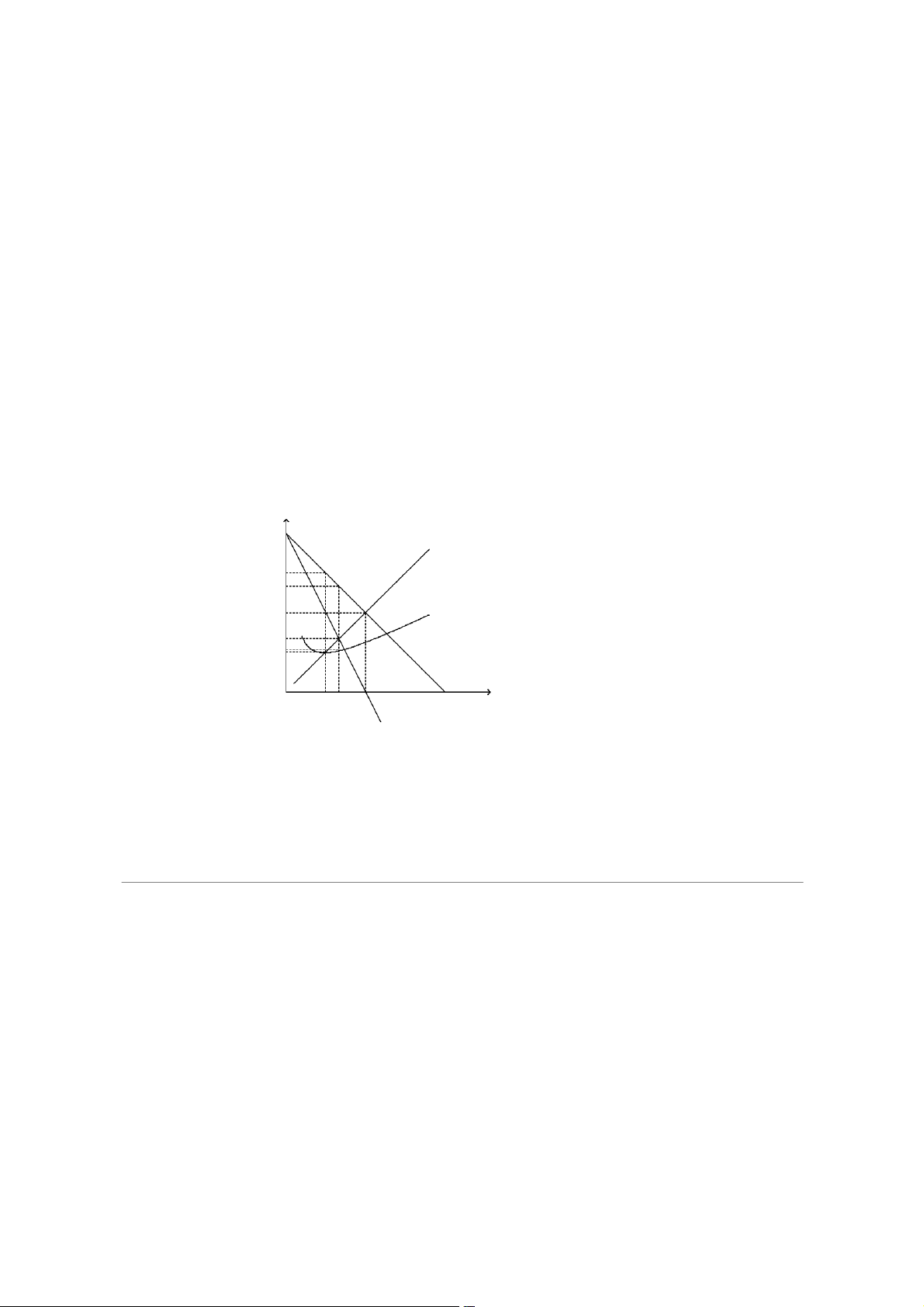
depending on the elasticity of demand. Price P M C A B C ATC F G H D O J K L Quanti ty M R Figure 7-1
8. Refer to Figure 7-1, What price will the monopolist charge? a. A b. B c. C d. F
9. Refer to Figure 7-1. What area measures the monopolist’s profit? a. (B-F)*K b. (A-H)*J c. (B-G)*K d. 0.5[(B-F)*(L-K)]
10. The deadweight loss associated with a monopoly occurs because the monopolist a. maximizes profits.
b. produces an output level less than the socially optimal level.
c. produces an output level greater than the socially optimal level.
d. equates marginal revenue with marginal cost.
Tài liệu liên quan:
-
TOPIC: COSMETICS môn Kinh tế vi mô | Trường Đại học Kinh tế Quốc dân
5 3 -

Sách Bài Tập Vi Mô - Hướng Dẫn và Lời Giải Chi Tiết
13 7 -

Nguyên lý chiến lược kinh doanh - Bài giảng môn Kinh tế vi mô | Trường Đại học Kinh Tế Quốc Dân
13 7 -

Chương 7 các kỹ thuật lựa chọn chiến lược - Bài giảng môn Kinh tế vi mô | Trường Đại học Kinh Tế Quốc Dân
14 7 -
Tổng hợp câu hỏi trắc nghiệm theo chương ôn tập môn Kinh tế vi mô | Trường Đại học Kinh Tế Quốc Dân
18 9