Tài liệu mẫu về Mô hình Frazelle môn Quản trị kho hàng | Trường Đại học Hàng Hải Việt Nam
Tài liệu mẫu về Mô hình Frazelle môn Quản trị kho hàng | Trường Đại học Hàng Hải Việt Nam. Tài liệu được sưu tầm giúp bạn tham khảo, ôn tập và đạt kết quả cao. Mời bạn đọc đón xem.
Môn: Quản trị kho hàng 14 tài liệu
Trường: Trường Đại học Hàng Hải Việt Nam 175 tài liệu
Tác giả:

















Preview text:
Copyright © 2016 by Edward H. Frazelle, PhD, and RightChain(TM)
Incorporated. All rights reserved. Except as permitted under the United States
Copyright Act of 1976, no part of this publication may be reproduced or
distributed in any form or by any means, or stored in a data base or retrieval
system, without the prior written permission of the publisher. ISBN: 978-0-07-184283-9 MHID: 0-07-184283-7
The material in this eBook also appears in the print version of this title:
ISBN: 978-0-07-184282-2, MHID: 0-07-184282-9. eBook conversion by codeMantra Version 1.0
All trademarks are trademarks of their respective owners. Rather than put a
trademark symbol after every occurrence of a trademarked name, we use
names in an editorial fashion only, and to the benefit of the trademark owner,
with no intention of infringement of the trademark. Where such designations
appear in this book, they have been printed with initial caps.
McGraw-Hill Education eBooks are available at special quantity discounts to
use as premiums and sales promotions or for use in corporate training
programs. To contact a representative, please visit the Contact Us page at www.mhprofessional.com.
RightHouse™, RightViews™, RightScores™, RightIns™, RightPuts™,
RightStore™, RightPick™, RightSlot™, RightShip™, RightPaths™, and
RightComms™ and related terms are trademarks of RightChain™ Incorporated. TERMS OF USE
This is a copyrighted work and McGraw-Hill Education and its licensors
reserve all rights in and to the work. Use of this work is subject to these
terms. Except as permitted under the Copyright Act of 1976 and the right to
store and retrieve one copy of the work, you may not decompile, disassemble,
reverse engineer, reproduce, modify, create derivative works based upon,
transmit, distribute, disseminate, sell, publish or sublicense the work or any
part of it without McGraw-Hill Education’s prior consent. You may use the
work for your own noncommercial and personal use; any other use of the
work is strictly prohibited. Your right to use the work may be terminated if
you fail to comply with these terms.
THE WORK IS PROVIDED “AS IS.” McGRAW-HILL EDUCATION
AND ITS LICENSORS MAKE NO GUARANTEES OR WARRANTIES
AS TO THE ACCURACY, ADEQUACY OR COMPLETENESS OF OR
RESULTS TO BE OBTAINED FROM USING THE WORK, INCLUDING
ANY INFORMATION THAT CAN BE ACCESSED THROUGH THE
WORK VIA HYPERLINK OR OTHERWISE, AND EXPRESSLY
DISCLAIM ANY WARRANTY, EXPRESS OR IMPLIED, INCLUDING
BUT NOT LIMITED TO IMPLIED WARRANTIES OF
MERCHANTABILITY OR FITNESS FOR A PARTICULAR PURPOSE.
McGraw-Hill Education and its licensors do not warrant or guarantee that the
functions contained in the work will meet your requirements or that its
operation will be uninterrupted or error free. Neither McGraw-Hill Education
nor its licensors shall be liable to you or anyone else for any inaccuracy, error
or omission, regardless of cause, in the work or for any damages resulting
therefrom. McGraw-Hill Education has no responsibility for the content of
any information accessed through the work. Under no circumstances shall
McGraw-Hill Education and/or its licensors be liable for any indirect,
incidental, special, punitive, consequential or similar damages that result
from the use of or inability to use the work, even if any of them has been
advised of the possibility of such damages. This limitation of liability shall
apply to any claim or cause whatsoever whether such claim or cause arises in contract, tort or otherwise.
This book is dedicated to my Lord, Savior, and Best Friend Jesus Christ,
Who blessed me with the experiences and abilities to share these
learnings; to my beautiful wife Pat, who has patiently allowed me to
have these experiences and encouraged me in them; and to Kelly, Andrew, and Travis. CONTENTS Acknowledgments CHAPTER 1
Introduction to Warehousing CHAPTER 2
Warehouse Activity Profiling, Data Mining, and Pattern Recognition CHAPTER 3
Warehouse Performance, Cost, and Value Measures CHAPTER 4
World-Class Receiving and Put-away CHAPTER 5
Pallets: Pallet Storage and Handling Systems CHAPTER 6 Case Picking Systems CHAPTER 7
Broken Case Picking Systems CHAPTER 8 Order Picking and Shipping CHAPTER 9
Warehouse Layout Optimization CHAPTER 10
Warehouse Communication Systems Index ACKNOWLEDGEMENTS
Mr. Jun Suzuki is the patriarch of Japanese logistics. We met during my first
logistics study tour in Japan in 1988. He has been my logistics mentor ever
since. Many of the pictures of Japanese and European warehousing
operations come from his extensive photo gallery of warehousing operations.
My wife Pat has been my writing partner from the time I wrote my
master’s thesis. She is brilliantly gifted in editing for an audience, and is a
God-send of a life and writing partner.
My son Andrew is currently finishing his doctorate in Decision Sciences
at Duke University. I think he was also born a linguist, and he implores me to
choose my words carefully. Though humbling, his editing was an invaluable
contribution to the book. He is a God-send of a thought, research and analytics partner.
World-Class Warehousing is illustrated with more than one hundred
photos taken inside some of the world’s best warehouse operations. Those
long time clients and study tour partners include American Cancer Society,
Avon, Bertelsmann, BIC, Boots, BP, Caterpillar, Coca-Cola, Ford, Happinet,
Honda, L.L. Bean, KAO, Kirin, K-Mart, Lifeway, Marks & Spencer, Metro,
Mitsubishi, Netto, Nike, NTT, NuSkin, Payless, Otto, Oxxo, Scroll, Shiseido,
Sony, Suntory, Swagelok, Rio Tinto, Rittal, the United States Armed
Services, and Verizon. They have been very accommodating to share their
experiences in warehousing and logistics.
The RightChain™ principals around the world—Dr. Matt Anderson,
Angel Becerra, Henry Brunekreef, Matsukawa-san, Masaji Nakano, Ricardo
Sojo, and Mary Wong—continually encourage my research, teaching, and writing.
In our consulting and training, we have been blessed to work with some
of the world’s best and brightest individuals and corporations. They have
encouraged and supported me to no end.
Steve Laky, Rick Glasson and Abbott.
Bill Costa and American Cancer Society.
Steve Spiva, Jack Gross, and Applied Materials.
Jane Houze, Bill Hightower and AT&T.
Roosevelt Tolliver, Jim Lofgren and Avon.
Carliss Graham, Greg Otter, Durwood Knight, Richard McCrosky,
Raylene Morris, Caroline Thompson and BP. Diane Mullican and Carrier.
Dave Hopkins, Steve Westphal, Kevin Fox, Ted Bozarth, Brett
Frankenburg and Coca-Cola Consolidated.
John Sibilia, Josue Munoz and Colgate.
Lynn Barratt, Steve Erbe, Carmen Guerero, Karen Hall, Tom Nabie,
Bruce Terry, Hal Welsh and Disney. Dan Krouse and Hallmark.
Sean Garrett, Dave Eidam and Hamilton Sunstrand.
Jim Roach, Chuck Hamilton, Bruce Smith, Juan Streeter, Kathy Howell and Honda.
Tammy Ryan, Jim Sylvester and H.P. Hood. Dave Wilford and Invitrogen.
Debbie Postle and LAM Research.
Dave Lavesque, Jim Pierce, Tom Galanti and LiDestri. Mike Harry and Lifeway. Susan McLain and LL Bean.
Carlos, Rodrigo, Ignacio and Mas X Menos (now Wal-Mart Central America).
Lou Arace, Dave Burton and Nutrisystem.
Jorge, Carlos, Miguel, Nelly, Sergio, Rafael, Bernie, Eduardo, Paulina, and Oxxo.
Daryl Pavelqua, Mary Boatright, James Wichern and Payless.
Danny DiPerna, Rob Grossman, Kathy Godin, Ed Delmastro, Bill
Kelly, Andy Minor and Pratt & Whitney.
Mark Ward, Frank Encinas, and Raytheon.
Scott Singer, Russell Hodson and Rio Tinto. David Phillips and Rittal.
Sean Stucker, Bill Burgess, Greg Flack, Greg Olson and Schwan’s Food Company.
Eric Eber, Mike Graska, Matt LoPicolo and Swagelok.
Rex Taylor and Taylor Logistics.
Sam Campagna, Jackie DeMatos, Jan Salewski, Scott Singer and United Technologies.
Matt Anderson, Ouris Pellegrin and the U.S. Army and Marine Corps. CHAPTER ONE INTRODUCTION TO WAREHOUSING
1.1 Warehousing Through the Years 1.2 Warehousing Fundamentals 1.3 How to Read This Book
I wrote the first edition of World-Class Warehousing in 1995. Back then,
people asked me why I was writing a book on warehousing when the just-in-
time (JIT) movement was aimed at eliminating warehousing. Today, it’s the
lean movement. The question is a legitimate one and one I ask seminar
attendees every time I teach a warehousing seminar. “Why should we devote
our time and energy to studying an activity that every supply-chain
professional and the lean literature is trying to eliminate?” A better question
might be, “In what ways does warehousing add value in business and in
supply chains?” If we can’t come up with good answers, then writing this
book really was a waste of time, and reading it likewise. As we will see,
warehousing plays an indispensable role in business and supply-chain strategy.
Warehousing in the Supply Chain
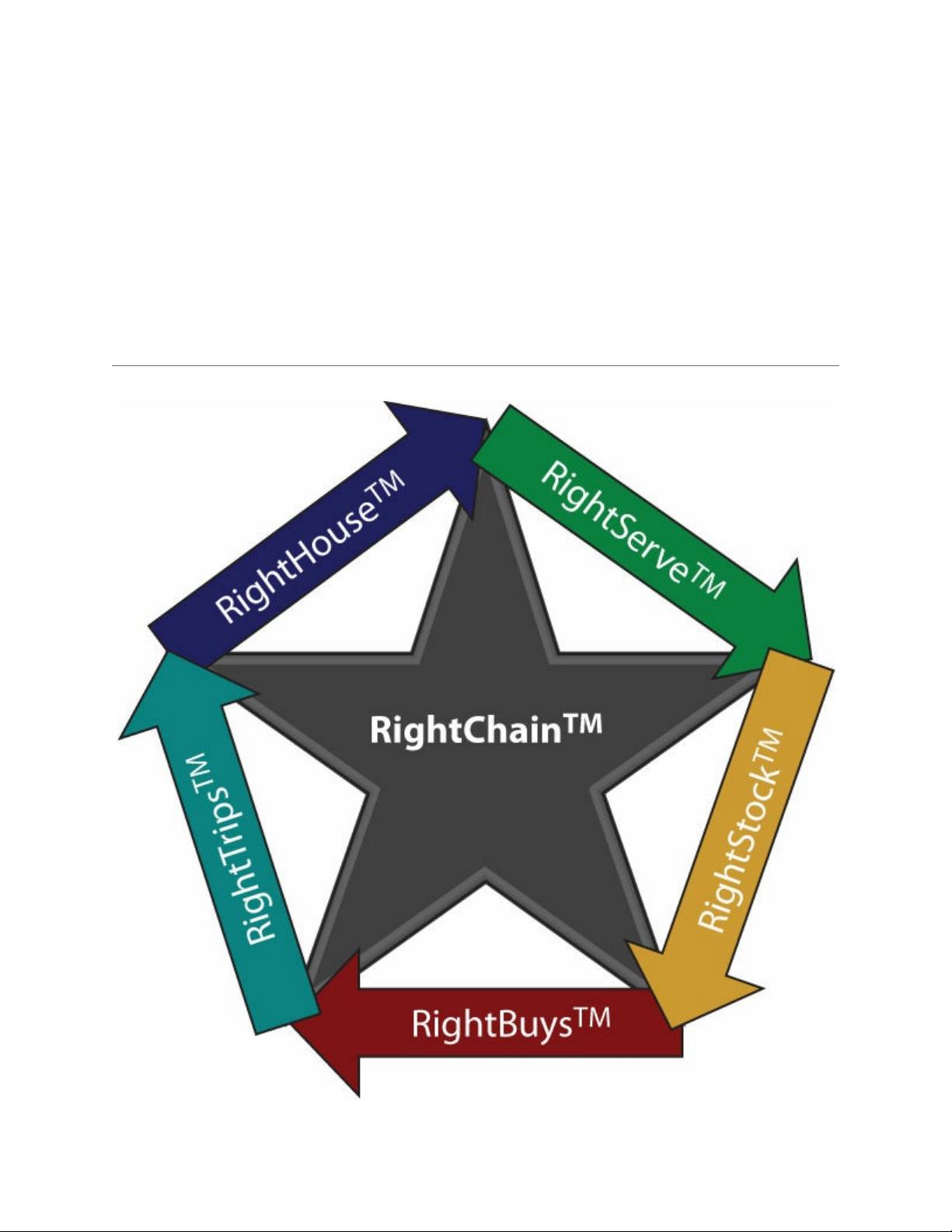
I developed the RightChain model in the mid-1990s. The model integrates
and optimizes walks through the five components of supply chain strategy:
customer service, inventory management, supply, transportation, and
warehousing. Through those eyes, the value of warehousing is demonstrated
in each component clearly visible (Figure 1.1).
Figure 1.1 RightChain supply-chain logistics model.
Warehousing and Customer Service
Warehousing adds value in customer service, by facilitating high inventory
availability, shorter response times, value-added services, returns,
customization, and consolidation among others.
Fill rate is the portion of a customer’s demand satisfiable from on-hand
inventory. In most cases, a significant investment in safety stock is required
to provide high customer fill rates. That safety stock must be housed
somewhere, and that somewhere is typically a warehouse.
Warehouses in close proximity to the customer base and with short
internal cycle times help to reduce response times to customers. We have one
client that provides same-day delivery of critical service parts via a
nationwide network of small warehouses with short order cycle times. One of
our financial services clients supports its financial analysts with small
warehouses located in the centers of major financial districts, serving offices
via subway, courier, walking, and bicycles. One of our convenience store
clients is improving product freshness by increasing delivery frequencies to
its 14,000 stores supported by a major increase in the number and capacity of
its warehouses and distribution centers.
Following the mass customization movement, the likelihood that an order
will require customization in some form is increasing exponentially. The
ability to execute the requisite value-added services such as custom labeling,
special packaging, monogramming, kitting, coloring, and pricing is and will
continue to be a competitive supply-chain differentiator. Warehouses are
uniquely equipped with the workforce and equipment to execute these value-
added services. In addition, by holding the noncustomized inventory and
postponing the customization, overall supply chain inventory levels may be
reduced. As the physical facility closest to the customer location, a
warehouse is also a natural place to customize, kit, assemble, or countrify
products in accordance with the principle of postponement—minimizing
overall inventory investments throughout a logistics network by delaying
customization. For example, one of our health and beauty aids clients puts its
shampoo in blank bottles for storage. Once an order is confirmed from a
specific country, the labeling required for that specific country is applied in
line with the picking and shipping process.
One customer service is foundational to our culture’s expectations of
logistics systems but taken for granted is consolidation. For example, if you
order a shirt and a pair of pants from a mail-order company, rarely would you
want the shirt showing up one day in one package and the pants showing up
another day in another package. For those items to show up at the same time
in the same package, they most likely need to be housed under the same roof, that is, in a warehouse.
Returns constitute another customer service facilitated by good
warehousing practice. Convenient and inexpensive returns for customers
yield higher sales and customer satisfaction ratings. Warehouses and
distribution centers are typically already located in close proximity to the
customer base and have the workforce and material-handling equipment
uniquely suited to handling returns.
Although not directly considered a customer service, in many parts of the
world, physical market presence is an important cultural competitive
differentiator. Warehouses and distribution centers are well-recognized
means of establishing physical market presence.
Warehousing and Inventory Management
Because warehouses house inventory (or wares), warehousing adds business
and supply-chain value in all the same ways as inventory. Warehouses and
their inventory facilitate production economies of scale, optimize factory
utilization via seasonal inventory builds, and mitigate supply-chain and
business risk by holding contingency and disaster inventory. Despite all
efforts to reduce setup and changeover costs and time, there will always
remain expensive and time-consuming setups. In those situations, it would be
economically foolish to produce short runs. When long production runs are
economical, the resulting lot-size inventory must be housed, most effectively
in a warehouse. For example, one of our large food and beverage clients was
running lot sizes 50 percent below optimal, incurring excessive changeover
and production costs as a result. To correct, an additional 150,000 square feet
of warehousing space was required, yielding a significant return on
investment to their business Figure 1.2.
Figure 1.2 Coca-Cola’s distribution center near Raleigh, North Carolina,
with expanded warehousing square footage to accommodate larger lot
sizes and an optimal activity density.
Many corporations have significant peaks and valleys in their demand.
One of our clients, Hallmark Cards, is an extreme example. Most of the
demand for greeting cards falls in the Christmas and Valentines seasons. If
the company’s production capacity was designed for those peaks, its
production capacity would be cost prohibitively underutilized most of the
year. To balance the production and optimize supply-chain costs, Hallmark
produces greeting cards at a fairly balanced pace during the year, resulting in
a large storage requirement for most of the year. This seasonal inventory is
stored in the large warehouse, in Figure 1.3.
Figure 1.3 Hallmark Cards’ warehousing complex in Liberty, Missouri.
The facility is sized to accommodate inventory buildups in support of extreme seasonal peaks.
The Schwan’s Food Company is another one of our clients. One of its
flagship products is frozen pie. The company is the world’s largest
manufacturer of frozen pies, most of which are consumed between
Thanksgiving and Christmas. As is the case with Hallmark, to optimize
Schwan’s supply-chain costs, the company must balance production
throughout the year and use third-party frozen warehousing to hold the
seasonal buildup in inventory from January through September.
Contingency and disaster inventory insures against unexpected situations
outside the realm of those covered by traditional safety-stock inventory. Such
situations include natural disasters, labor strikes, and other abnormal supply-
chain disruptions. For example, in our work with telecommunications and
utilities clients, we often plan for contingency and disaster inventory to
maintain service in the increasingly likely event of hurricanes, floods, and snowstorms. Warehousing and Sourcing
One of our clients is one of the world’s largest chocolate candy companies.
Of course, the main ingredients are cocoa and sugar. In addition to
production, those raw material costs also make up most of the total landed
product cost. To help determine the optimal timing of the purchase of sugar
and cocoa, the company maintains advanced proprietary weather-forecasting
systems and sophisticated predictors of the future price of sugar and cocoa.
When our client believes that the price is optimal, it may literally buy
boatloads of sugar and cocoa. That sugar and cocoa must be housed
somewhere, and that somewhere is a warehouse.
After raw materials, the next most expensive cost component of the
company’s total landed cost is production. To help keep those costs low, the
company operates with extremely long production runs. Because margins are
high, inventory carrying rates are low, the risk of obsolescence is low (I have
never personally refused a candy bar because of technical or packaging
obsolescence), and shelf lives are long, total landed supply-chain costs are
optimized with long production runs. Those long production runs create large
batches of inventory that must be housed somewhere. That somewhere is a warehouse.
Another means by which companies seek to reduce material cost is low-
cost foreign sourcing. The likelihood of an order entering or departing the
warehouse from/to another country has never been higher. Warehouses add
significant value in the supply chain by facilitating the efficient inbound and
outbound processing of international orders. One example is our client,
Payless Shoes, one of the world’s largest shoe retailers and global importers.
Most of the company’s shoes are imported from China and arrive in the
United States via the Port of Long Beach. Goods arriving there are
transloaded into 53-foot containers and trucked to the company’s West Coast
distribution center in Redlands, California, or the company’s East Coast
distribution center near Cincinnati, Ohio. Similar West Coast distribution
center missions are carried out by the massive concentration of distribution
centers in or near Redlands known as the “Inland Empire.” A similar empire
of distribution centers has grown up around the Port of Savannah, Georgia,
where The Home Depot, Ikea, and Pep Boys, among many others, inject
imported products into their East Coast logistics networks (Figures 1.4 through 1.7).
Figure 1.4 The “Inland Empire” is approximately one hour’s drive from
the ports of Long Beach and Los Angeles, located at the crossroads of
major interstates I10, I15, and I215, and is home to a high-quality
workforce. It is also home to perhaps the world’s largest concentration of warehouses.
Figure 1.5 Aerial view of a concentration of warehouses and distribution
centers in the “Inland Empire”.
Tài liệu liên quan:
-
Bài Tập TTHQ: Xuất Xứ Hàng Hóa - Tính Toán RVC và Các Quy Định
13 7 -
Báo cáo sự cố rơi container trong ca làm việc ngày 14/02/2022 môn Quản trị kho hàng | Trường Đại học Hàng hải Việt Nam
43 22 -

Tài liệu về Các tiêu chuẩn nhà kho tại Việt Nam môn Quản trị kho hàng | Trường Đại học Hàng Hải Việt Nam
43 22 -
Đồ án tốt nghiệp - Quản Trị Kho Hàng và Thiết Kế Kho Hàng | Quản trị kho hàng | Đại học Hàng hải Việt Nam
57 29