The Monetary Approach to Balance of Payments & Exchange Rates | Tài chính quốc tế | Trường Học Viện nông nghiệp Việt Nam
The basic premise of the monetary approach is that any balance of payments disequilibrium or exchange rate movement is based on a monetary disequilibrium—that is, differences existing between the amount of money people wish to hold and the amount supplied by the monetary authorities. In simple terms, if people demand more money than is being supplied by the central bank, then the excess demand for money would be satisfied by inflows of money from abroad or an appreciation of the currency. On the other hand, if the central bank (the Federal Reserve in the United States) is supplying more money than is demanded, the excess supply of money is eliminated by outflows of money to other countries or a depreciation of the currency. Tài liệu được sưu tầm và soạn thảo dưới dạng file PDF để gửi tới các bạn cùng tham khảo, ôn tập đầy đủ kiến thức, chuẩn bị cho các buổi học thật tốt. Mời bạn đọc đón xem!
Môn: Tài chính quốc tế (hvnn) 130 tài liệu
Trường: Học viện Nông nghiệp Việt Nam 2.4 K tài liệu
Tác giả:

Preview text:
CHAPTER 14 The Monetary Approach Contents Specie-Flow Mechanism 278 The Monetary Approach 279
The Monetary Approach to the Balance of Payments 282
The Monetary Approach to the Exchange Rate 284
The Monetary Approach for a Managed Floating Exchange Rate 285 Sterilization 285 Sterilized Intervention 287 Summary 288 Exercises 289 Further Reading 290
The basic premise of the monetary approach is that any balance of payments
disequilibrium or exchange rate movement is based on a monetary dis-
equilibrium—that is, differences existing between the amount of money
people wish to hold and the amount supplied by the monetary authorities.
In simple terms, if people demand more money than is being supplied by
the central bank, then the excess demand for money would be satisfied by
inflows of money from abroad or an appreciation of the currency. On the
other hand, if the central bank (the Federal Reserve in the United States)
is supplying more money than is demanded, the excess supply of money
is eliminated by outflows of money to other countries or a depreciation
of the currency. Thus the monetary approach emphasizes the determinants
of money demand and money supply. The monetary approach can be
analyzed separately for fixed and floating exchange rates. If the exchange
rate is fixed, then the monetary approach pertains to the balance of pay-
ments. In such a case we call the approach the monetary approach to bal-
ance of payments (MABP). In contrast, if exchange rates are floating then
the approach explains exchange rate movements and is called the monetary
approach to exchange rates (MAER). Both approaches will be discussed in this chapter. © 201 7 Elsevier Inc. 277
International Money and Finance. All rights reserved. 278
International Money and Finance
Prior to the monetary approach, it was common to emphasize inter-
national trade flows as primary determinants of exchange rates. The tra-
ditional approach emphasized the role of exchange rate changes in
eliminating international trade imbalances. In this context we should
expect countries with current trade surpluses to have appreciating cur-
rencies, while countries with trade deficits should have depreciating cur-
rencies. It is clear that the world does not work in the simple way just
considered. We have seen some instances when countries with trade sur-
pluses have depreciating currencies, while countries with trade defi-
cits have appreciating currencies. This chapter considers an alternative
view of the cause of balance of payments disequilibria and exchange rate movements. SPECIE-FLOW MECHANISM
The monetary approach has a long and distinguished history, so the recent
popularity of the approach can be viewed as a rediscovery rather than
a modern innovation. In fact, the recent literature often makes use of a
quote from Of the Balance of Trade, written by David Hume in 1752, to
indicate the early understanding of the problem. Hume wrote:
Suppose four-fifths of all the money in Great Britain to be annihilated in one night,
and the nation reduced to the same condition, with regard to specie, as in the
reigns of the Harrys and Edwards, what would be the consequence? Must not the
price of all labor and commodities sink in proportion, and everything be sold as
cheap as they were in these ages? What nation could then dispute with us in any
foreign market, or pretend to navigate or to sell manufactures at the same price,
which to us would afford sufficient profit? In how little time, therefore, must this
bring back the money which we had lost, and raise us to the level of all the neigh-
boring nations? Where after we have arrived, we immediately lose the advantage
of the cheapness of labor and commodities; and the farther flowing in of money is
stopped by our fullness and repletion.
Hume’s analysis is a strict monetary approach to prices and the bal-
ance of payments. If England’s money stock suddenly was reduced by
four-fifths, we know from principles of economics that the price level
would fall dramatically. The falling price level would give England a price
advantage over its foreign competitors, so that its exports would rise and
its imports fall. As the foreign money (gold in Hume’s day) poured in,
England’s money supply would rise and its price level would follow. This
process continues until England’s prices reach the levels of its competitors,
after which the system is back in equilibrium. The Monetary Approach 279 THE MONETARY APPROACH
Before turning to the model, we should consider some basic concepts and
assumptions. In principles of macroeconomics we learn that the Federal
Reserve controls the money supply by altering base money (currency plus
commercial bank reserves held against deposits). As base money changes,
the lending ability of commercial banks changes. Increases in base money
tend to result in an expansion of the money supply, whereas decreases in
base money tend to contract the money supply. For our purposes, it is
useful to divide base money into domestic and international components.
The domestic component of base money is called domestic credit, whereas
the remainder is made up of international reserves (money items that can be
used to settle international debts, primarily foreign exchange).
The international money flows that respond to excess demands or
excess supplies of goods or financial assets at home affect base money and
then the money supply. For instance, if a US exporter receives payment
in foreign currency, this payment will be presented to a US commercial
bank to be converted into dollars and deposited in the exporter’s account.
If the commercial bank has no use for the foreign currency, the bank will
exchange the foreign currency for dollars with the Federal Reserve (the
Fed). The Fed creates new base money to buy the foreign currency by
increasing the commercial bank’s reserve deposit with the Fed. Thus, the
Fed is accumulating international reserves, and this reserve accumulation
brings about an expansion of base money. In the case of an excess supply of
money at home, either domestic credit falls to reduce base money, or inter-
national reserves will fall in order to lower base money to the desired level.
Now we are ready to construct a simple model of the monetary
approach. The usual assumption is that we are analyzing the situation of
a small, open economy. A country is defined as “small” when its activities
cannot affect the international price of goods or the international interest
rate. Openness implies that this country is an active participant in interna-
tional economic transactions. We could classify nations according to their
degree of openness, or the degree to which they depend on international
transactions. The United States would be relatively closed, considering the
size of the US GDP relative to the value of international trade, whereas
Belgium would be relatively open.
A strong assumption of the monetary approach is that there is a sta-
ble demand for money. This means that the relationship among money
demand, income, and prices does not change significantly over time. 280
International Money and Finance
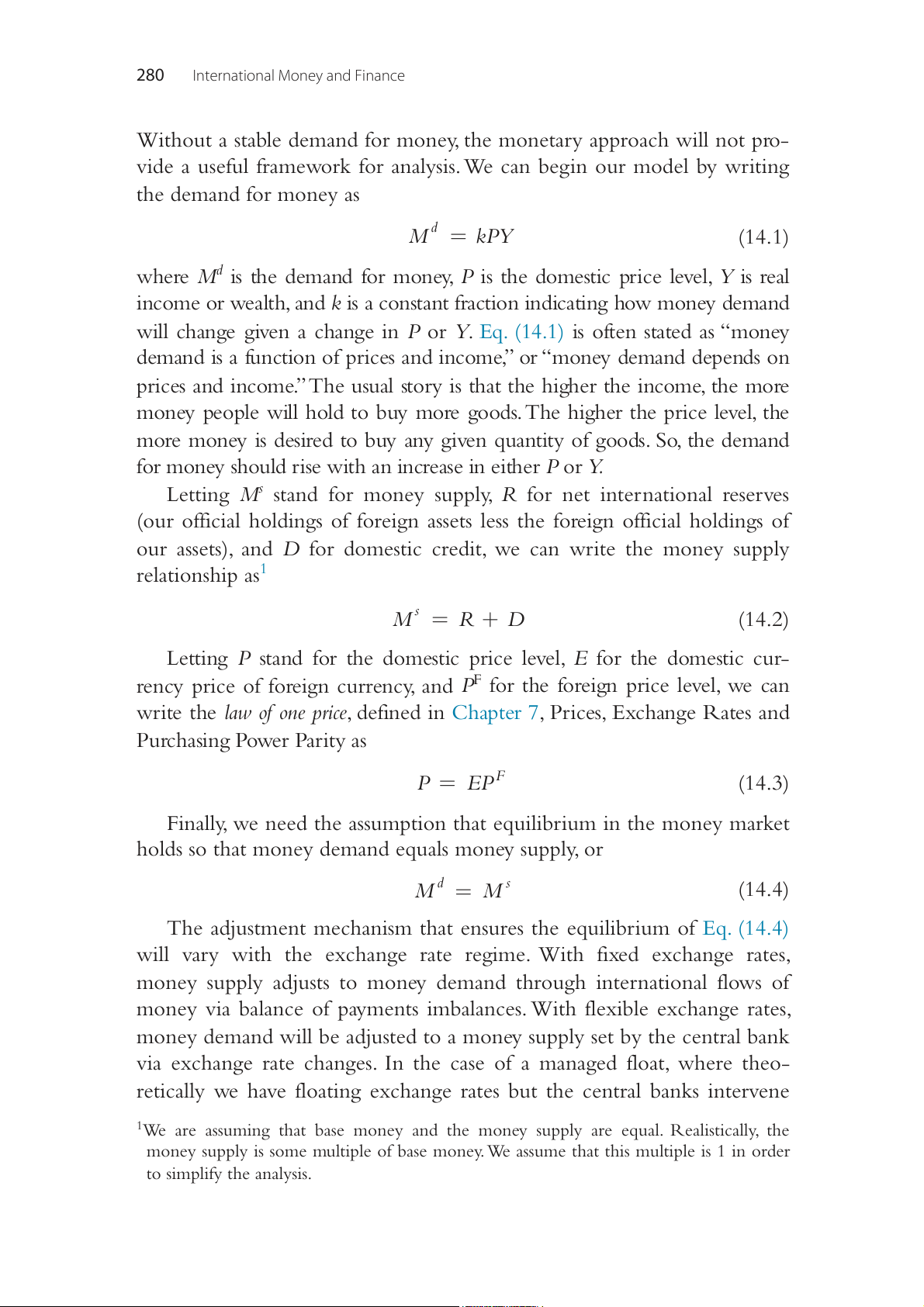
Without a stable demand for money, the monetary approach will not pro-
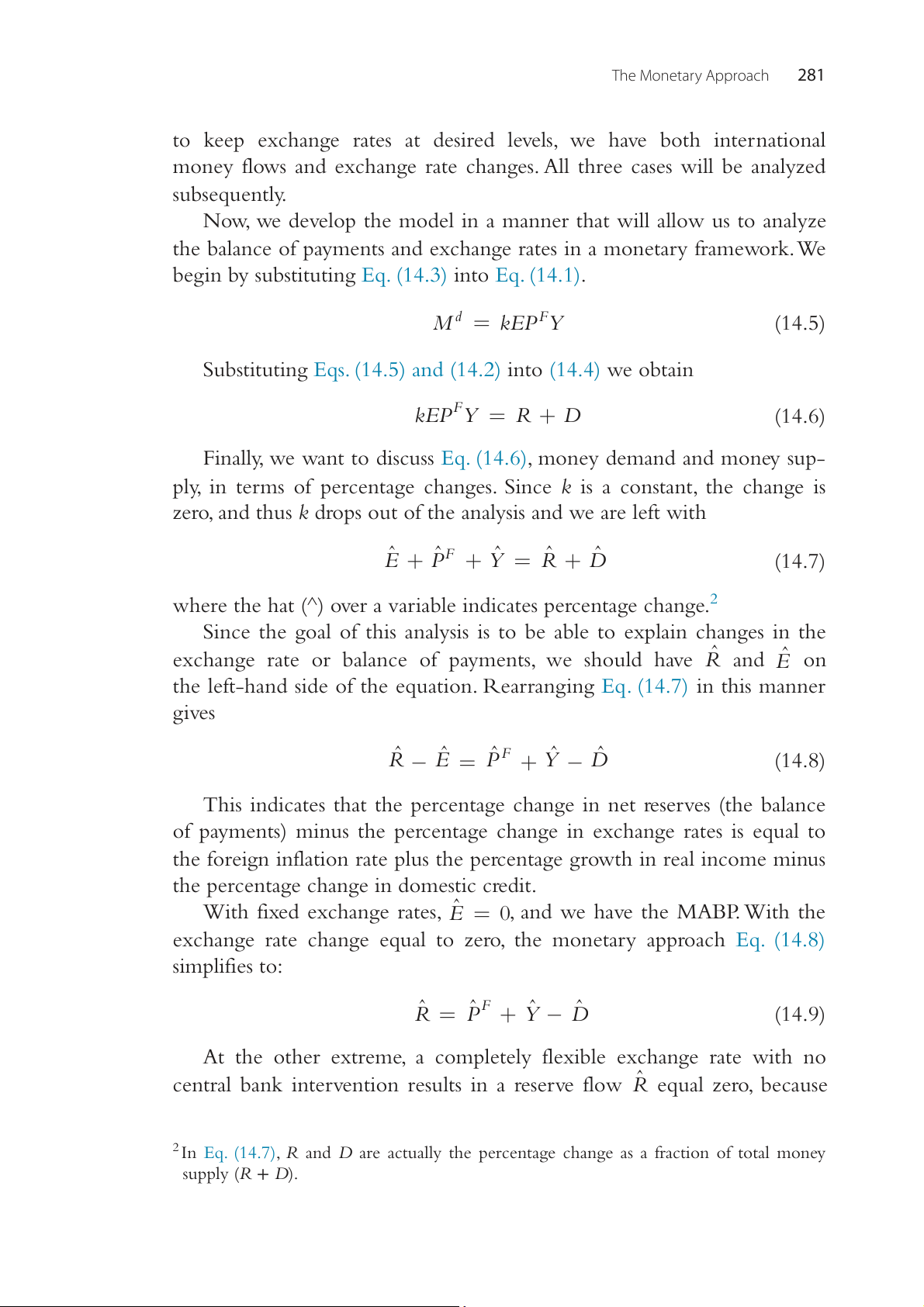
vide a useful framework for analysis. We can begin our model by writing the demand for money as d M = kPY (14.1)
where Md is the demand for money, P is the domestic price level, Y is real
income or wealth, and k is a constant fraction indicating how money demand
will change given a change in P or Y. Eq. (14.1) is often stated as “money
demand is a function of prices and income,” or “money demand depends on
prices and income.” The usual story is that the higher the income, the more
money people will hold to buy more goods. The higher the price level, the
more money is desired to buy any given quantity of goods. So, the demand
for money should rise with an increase in either P or Y.
Letting Ms stand for money supply, R for net international reserves
(our official holdings of foreign assets less the foreign official holdings of
our assets), and D for domestic credit, we can write the money supply relationship as1 s M = R + D (14.2)
Letting P stand for the domestic price level, E for the domestic cur-
rency price of foreign currency, and PF for the foreign price level, we can
write the law of one price, defined in Chapter7, Prices, Exchange Rates and Purchasing Power Parity as P EP F = (14.3)
Finally, we need the assumption that equilibrium in the money market
holds so that money demand equals money supply, or d s M = M (14.4)
The adjustment mechanism that ensures the equilibrium of Eq. (14.4)
will vary with the exchange rate regime. With fixed exchange rates,
money supply adjusts to money demand through international flows of
money via balance of payments imbalances. With flexible exchange rates,
money demand will be adjusted to a money supply set by the central bank
via exchange rate changes. In the case of a managed float, where theo-
retically we have floating exchange rates but the central banks intervene
1 We are assuming that base money and the money supply are equal. Realistically, the
money supply is some multiple of base money. We assume that this multiple is 1 in order to simplify the analysis. The Monetary Approach 281
to keep exchange rates at desired levels, we have both international
money flows and exchange rate changes. All three cases will be analyzed subsequently.
Now, we develop the model in a manner that will allow us to analyze
the balance of payments and exchange rates in a monetary framework. We
begin by substituting Eq. (14.3) into Eq. (14.1). M d kEP F = Y (14.5)
Substituting Eqs. (14.5) and (14.2) into (14.4) we obtain F
kEP Y = R + D (14.6)
Finally, we want to discuss Eq. (14.6), money demand and money sup-
ply, in terms of percentage changes. Since k is a constant, the change is
zero, and thus k drops out of the analysis and we are left with ˆ ˆ F ˆ ˆ ˆ E + P
+ Y = R + D (14.7)
where the hat (^) over a variable indicates percentage change.2
Since the goal of this analysis is to be able to explain changes in the
exchange rate or balance of payments, we should have ˆ R and ˆ E on
the left-hand side of the equation. Rearranging Eq. (14.7) in this manner gives ˆ ˆ ˆ F ˆ ˆ R E P Y D − = + − (14.8)
This indicates that the percentage change in net reserves (the balance
of payments) minus the percentage change in exchange rates is equal to
the foreign inflation rate plus the percentage growth in real income minus
the percentage change in domestic credit. With fixed exchange rates, ˆ
E = 0, and we have the MABP. With the
exchange rate change equal to zero, the monetary approach Eq. (14.8) simplifies to: F ˆ ˆ ˆ ˆ R = P + Y − D (14.9)
At the other extreme, a completely flexible exchange rate with no
central bank intervention results in a reserve flow ˆ R equal zero, because
2 In Eq. (14.7), R and D are actually the percentage change as a fraction of total money supply (R + D). 282
International Money and Finance
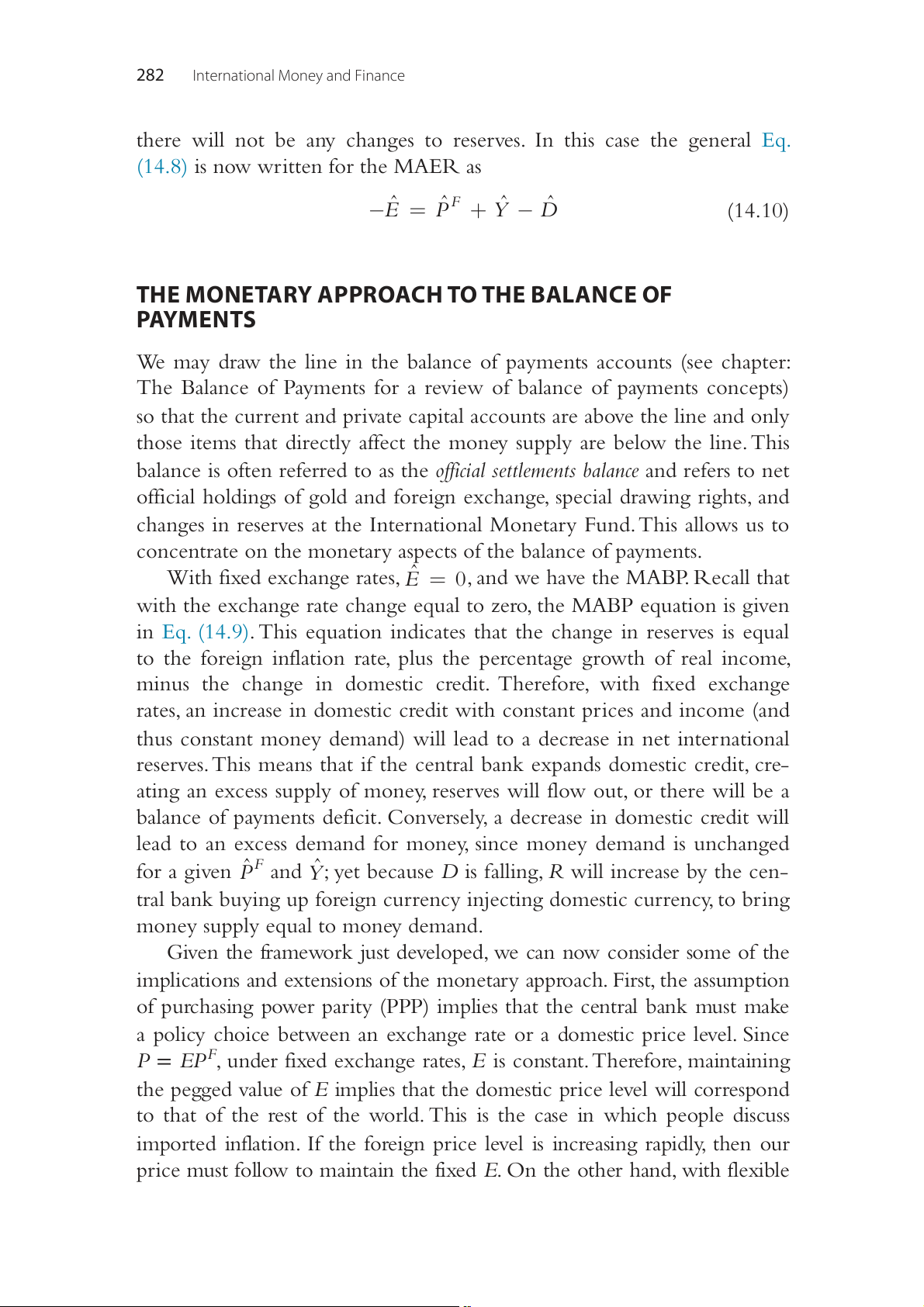
there will not be any changes to reserves. In this case the general Eq.
(14.8) is now written for the MAER as F ˆ ˆ ˆ ˆ −E = P + Y − D (14.10)
THE MONETARY APPROACH TO THE BALANCE OF PAYMENTS
We may draw the line in the balance of payments accounts (see chapter:
The Balance of Payments for a review of balance of payments concepts)
so that the current and private capital accounts are above the line and only
those items that directly affect the money supply are below the line. This
balance is often referred to as the official settlements balance and refers to net
official holdings of gold and foreign exchange, special drawing rights, and
changes in reserves at the International Monetary Fund. This allows us to
concentrate on the monetary aspects of the balance of payments. With fixed exchange rates, ˆ
E = 0, and we have the MABP. Recall that
with the exchange rate change equal to zero, the MABP equation is given
in Eq. (14.9). This equation indicates that the change in reserves is equal
to the foreign inflation rate, plus the percentage growth of real income,
minus the change in domestic credit. Therefore, with fixed exchange
rates, an increase in domestic credit with constant prices and income (and
thus constant money demand) will lead to a decrease in net international
reserves. This means that if the central bank expands domestic credit, cre-
ating an excess supply of money, reserves will flow out, or there will be a
balance of payments deficit. Conversely, a decrease in domestic credit will
lead to an excess demand for money, since money demand is unchanged for a given ˆ P F and ˆ
Y ; yet because D is falling, R will increase by the cen-
tral bank buying up foreign currency injecting domestic currency, to bring
money supply equal to money demand.
Given the framework just developed, we can now consider some of the
implications and extensions of the monetary approach. First, the assumption
of purchasing power parity (PPP) implies that the central bank must make
a policy choice between an exchange rate or a domestic price level. Since
P = EPF, under fixed exchange rates,
E is constant. Therefore, maintaining the pegged value of
E implies that the domestic price level will correspond
to that of the rest of the world. This is the case in which people discuss
imported inflation. If the foreign price level is increasing rapidly, then our
price must follow to maintain the fixed E. On the other hand, with flexible The Monetary Approach 283
rates E is free to vary to whatever level is necessary to clear the foreign
exchange market, and so we can choose our domestic rate of inflation inde-
pendent of the rest of the world. If we select a lower rate of inflation than
foreigners do, then PPP suggests that our currency will tend to appreciate.
This issue of choosing between the domestic inflation rate or a preferred
exchange rate has important economic as well as political implications and
is not made without much thought and consultation among central bankers.
We might mention at this point that there are two views of how PPP
operates in the short run, and these two views imply a different mecha-
nism of adjustment to a change in the world economy like a change in
the foreign price level. One view is that PPP holds strictly, even in the
short run. In this case, a change in the foreign price induces an immedi-
ate change in the domestic price and a corresponding change in money
demand or money supply. The other view is along the lines of the Hume
quote cited previously. The idea here is that prices adjust slowly through
the balance of payments effects on the money supply. Thus, if foreign
prices rise relative to domestic prices, we tend to sell more to foreign-
ers and run a larger balance of trade surplus. Since we gain international
reserves from these goods sales, over time our money supply rises and our
prices increase until PPP is restored.
The two approaches differ primarily with regard to timing. The first
case assumes that PPP holds in the short run because international reserves
flow quickly in response to new events and prices adjust quickly to new
equilibrium levels. This fast adjustment is supposedly due to an emphasis
on the role of financial assets being bought and sold, resulting in interna-
tional capital flows. Since financial assets are easily bought and sold, it is
easy to understand why many believe that PPP should hold in the short
run (ignoring any relative price effects, which we are not discussing in
this section). The second case also assumes that PPP holds, but only in the
long run. This approach emphasizes the role of goods markets in interna-
tional adjustment. Since goods prices are supposedly slow to adjust, short-
run deviations from PPP will occur that give rise to the balance of trade
effects previously discussed. The truth most likely lies between these two
extremes. It is reasonable to expect goods prices to adjust slowly over time
to changing economic conditions, so it may be reasonable to doubt that
PPP holds well in the short run. On the other hand, PPP is not strictly
dependent on goods markets. To ignore international capital flows is to
miss the potential for a faster adjustment than is possible strictly through goods markets. 284
International Money and Finance
We can summarize the policy implications of the MABP as follows:
1. Balance of payments disequilibria are essentially monetary phenomena.
Thus, countries would not run long-term (or structural, as they are
called) deficits if they did not rely so heavily on inflationary money
supply growth to finance government spending.
2. Balance of payments disequilibria must be transitory. If the exchange
rate remains fixed, eventually the country must run out of reserves by
trying to support a continuing deficit.
3. Balance of payments disequilibria can be handled with domestic
monetary policy rather than with adjustments in the exchange rate.
Devaluation of the currency exchange rate is a substitute for reduc-
ing the growth of domestic credit in that devaluation lowers the value
of a country’s money relative to the rest of the world (conversely, an
appreciation of the currency is a substitute for increasing domestic
credit growth). Following any devaluation, if the underlying monetary
cause of the devaluation is not corrected, then future devaluations
will be required to offset the continued excess supply of the country’s money.
4. Domestic balance of payments will be improved by an increase in
domestic income via an increase in money demand, if not offset by an increase in domestic credit.
THE MONETARY APPROACH TO THE EXCHANGE RATE
Thus far we have only discussed the MABP, which is fine for a world
with fixed exchange rates or a gold standard. For a world with flexible
exchange rates, we have the MAER. The dichotomy between fixed and
floating exchange rates is an important one. When exchange rates are fixed
between countries, we will observe money flowing between countries to
adjust to disequilibrium. With floating exchange rates, the exchange rates
are allowed to fluctuate with the free-market forces of supply and demand
for each currency. The free-market equilibrium exchange rate occurs
at a point where the flow of exports just equals the flow of imports so
that no net international money flows are required. International econo-
mists refer to this choice of money flows or exchange rate changes as the
choice of an international adjustment mechanism. With fixed exchange rates,
the adjustment to changes in international monetary conditions comes
through international money flows; whereas with floating rates, the adjust-
ment comes through exchange rate changes. The Monetary Approach 285
The MAER equation comes directly from Eq. (14.8). A free-market
exchange rate means that no central bank intervention takes place, we have ˆ
R equal zero, so the MAER approach becomes: ˆ ˆ F ˆ ˆ −E = P + Y − D (14.11)
With the MAER, an increase in domestic credit, given a constant ˆ P F and ˆ
Y (so that money demand is constant), will result in ˆ E increasing. Since ˆ
E is domestic currency units per foreign currency unit, an increase in ˆ
E means that domestic currency is depreciating. Under the MAER,
domestic monetary policy will not cause flows of money internationally
but will lead to exchange rate changes. The fact that ˆ P F and ˆ Y have signs opposite that of ˆ
E in Eq. (14.11) indicates that changes in inflation and
income growth will cause changes in exchange rates in the opposite direc- F tion. For instance, if ˆ P and/or ˆ
Y increase, we know that money demand
increases. With constant domestic credit, we have an excess demand for
money. As individuals try to increase their money balances, we observe a decrease in ˆ
E or an appreciation of the domestic currency.
THE MONETARY APPROACH FOR A MANAGED FLOATING EXCHANGE RATE
So far, we have discussed the case of fixed or flexible exchange rates, but
what is the framework for analysis of a managed float? Remember, a man-
aged float means that although exchange rates are theoretically flexible
and determined by the market forces of supply and demand, central banks
intervene at times to peg the rates at some desired level. Thus, the man-
aged float has the attributes of both a fixed and a floating exchange rate
regime, because changing supply and demand will affect exchange rates,
but the actions of the central bank will also allow international reserves to
change. To allow for reserve changes, as well as for exchange rate changes,
we can simply return to the initial Eq. (14.8). Thus, we can see that given
money demand or money supply changes, the central bank can choose to ˆ
let E adjust to the free-market level; or, by holding E at some disequilib- rium level, it will allow ˆ R to adjust. STERILIZATION
Sterilization is the offsetting of international reserve flows by central banks
that wish to follow an independent monetary policy. Under the MABP 286
International Money and Finance
(with fixed exchange rates), if a country has an excess supply of money,
this country would tend to lose international reserves or run a deficit until
money supply equals money demand. Central banks often have reasons
for desiring either a high money supply growth or a low money supply
growth. For example, if the central bank wants to stimulate the economy
it might want a high money supply growth. If for some reason the cen-
tral bank desires a higher money supply and reacts to the deficit by fur-
ther increasing the money supply, then the deficit will increase and persist
as long as the central bank tries to maintain a money supply in excess
of money demand. With an excess demand for money, the concept is
reversed. The excess demand results in reserve inflows to equate money
supply to money demand. If the central bank tries to decrease the money
supply so that the excess demand still exists, its efforts will be thwarted by
further reserve inflows, which will persist as long as the central bank tries
to maintain the policy of a money supply less than money demand.
Sterilization would allow the monetary authorities to stabilize the
money supply in the short run without having reserve flows offset their
goals. This would be possible if the forces that lead to international arbi-
trage are slow to operate. For instance, barriers to international capital
mobility might exist in a country. In such a case, we might expect interna-
tional asset return differentials to persist following a change in economic
conditions. If the central bank wants to increase the growth of the money
supply in the short run, it can do so regardless of money demand and
reserve flows. In the long run, when complete adjustment of asset prices
is possible, the money supply must grow at a rate consistent with money
demand. In the short run, however, the central bank can exercise some discretion.
The actual use of the word sterilization derives from the fact that the
central bank must be able to neutralize, or sterilize, any reserve flows
induced by monetary policy if the policy is to achieve the central bank’s
money supply goals. For instance, if the central bank is following some
money supply growth path, and then money demand increases, leading
to reserve inflows, the central bank must be able to sterilize these reserve
inflows to keep the money supply from rising to what it considers unde-
sirable levels. This is done by decreasing domestic credit by an amount
equal to the growth of international reserves, thus keeping base money and the money supply constant.
Recall again the fixed exchange rate MABP in Eq. (14.9). Given
money demand, an increase in domestic credit would be reflected in a The Monetary Approach 287 fall in ˆ
R . Thus, the causality works from ˆ D to ˆ
R. If sterilization occurs,
then the causality implied in Eq. (14.9) is no longer true. Instead of the
monetary approach equation previously written, where changes in domes- tic credit ( ˆ
D, on the right-hand side of the equation) lead to changes in reserves ( ˆ
R, on the left-hand side), with sterilization we also have changes
in reserves inducing changes in domestic credit in order to offset the
reserve flows. Sterilization means that there is also a causality flowing from
reserve changes to domestic credit, as in ˆ ˆ
D = α − R β (14.12)
where β is the sterilization coefficient, ranging in value from 0 (when
there is no sterilization) to 1 (complete sterilization). Eq. (14.12) states that
the percentage change in domestic credit will be equal to some constant
amount (α) determined by the central bank’s domestic policy goals, minus
the coefficient β, times the percentage change in reserves. The coefficient
β will reflect the central bank’s ability to use domestic credit to offset
reserve flows. Of course, it is possible that the central bank cannot fully
offset international reserve flows, and yet some sterilization is possible, in
which case β will lie between 0 and 1. Evidence has in fact suggested both
extremes as well as an intermediate value for β. It is reasonable to inter-
pret the evidence regarding sterilization as indicating that central banks are
able to sterilize a significant fraction of reserve flows in the short run. This
means that the monetary authorities can likely choose the growth rate
of the money supply in the short run, although long-run money growth
must be consistent with money demand requirements. STERILIZED INTERVENTION
We have, so far, discussed sterilization in the context of fixed exchange
rates. Now let us consider how a sterilization operation might occur in
a floating exchange rate system. Suppose the Japanese yen is appreciat-
ing against the dollar, and the Bank of Japan decides to intervene in the
foreign exchange market to increase the value of the dollar and stop the
yen appreciation. The Bank of Japan increases domestic credit in order to
purchase US dollar-denominated bonds. The increased demand for dol-
lar bonds will lead to an increase in the demand for dollars in the for-
eign exchange market. This results in the higher foreign exchange value
of the dollar. Now suppose that the Bank of Japan has a target level of
the Japanese money supply that requires the increase in domestic credit to 288
International Money and Finance
be offset. The central bank will sell yen-denominated bonds in Japan to
reduce the domestic money supply. The domestic Japanese money supply
was originally increased by the growth in domestic credit used to buy dol-
lar bonds. The money supply ultimately returns to its initial level because
the Bank of Japan uses a domestic open-market operation (the formal term
for central bank purchases and sales of domestic bonds) to reduce domestic
credit. In this case of managed floating exchange rates, the Bank of Japan
uses sterilized intervention to achieve its goal of slowing the appreciation
of the yen while keeping the Japanese money supply unchanged. Sterilized
intervention is ultimately an exchange of domestic bonds for foreign bonds.
It is possible for sterilized intervention with unchanged money sup-
plies to have an effect on the spot exchange rate if money demand
changes. The intervention activity could alter the private market view of
what to expect in the future. If the intervention changes expectations in
a manner that changes money demand (for instance, money demand in
Japan falls because the intervention leads people to expect higher Japanese
inflation), then the spot rate could change. SUMMARY
1. The basic premise of the monetary approach is that any balance of
payments disequilibrium is based on a monetary disequilibrium.
2. Specie-flow mechanism explains the adjustments to a change in
money supply in one country under the fixed exchange rate environ-
ment through price movements and international trade flows.
3. According to the specie-flow mechanism, an increase in money sup-
ply in Country A will cause a balance of trade deficit in Country
A, and a balance of trade surplus in Country B in the short run. In
the long run, with the flow of gold from the trade deficit country to
the trade surplus country, prices in two countries will adjust to bring
both countries back in equilibrium again.
4. Two applications of the monetary approach are: (i) the MABP and (ii) the MAER.
5. The MABP emphasizes money demand and money supply as deter-
minants of the balance of payments under the fixed exchange rate.
6. The MAER emphasizes money demand and money supply as deter-
minants of exchange rate movements.
7. The money supply is composed of domestic credit and international reserves. The Monetary Approach 289
8. The money demand is derived from people’s willingness to hold
money, which is a constant proportion of their nominal income.
9. The MABP implies that the change in international reserves equals
to the foreign inflation rate plus the growth rate of domestic output
minus the change in domestic money creation.
10. Under the fixed exchange rate, inflation from one country can be
transmitted to the other country.
11. The MAER implies that, under the free-floating exchange rate sys-
tem, a change in monetary policy in one country will not affect the
other country’s money supply, only causing an adjustment of the exchange rate.
12. The monetary approach in the case of a managed floating exchange
rate has attributes of both the MAER and MABP approach.
13. Sterilized intervention is the action by a central bank to offset the
effect of a foreign exchange intervention, on the domestic money
supply, by using the open-market operations. EXERCISES
1. “Monetary disequilibrium leads to balance of payments problems
under fixed exchange rates, and a currency problem under floating
exchange rates.” Discuss this statement with reference to the monetary approach.
2. What are the assumptions underlying the MABP? Explain.
3. According to the MABP, what type of economic policies would help a
country to resolve a balance of trade deficit?
4. Using the MABP, explain how the Bretton Woods system could break
down after the United States increases its money supply too fast.
5. In a perfectly floating exchange rate regime, use the MAER to explain
the effect on the dollar price of a Swiss franc ($/SFr) of the following scenarios:
a. The output in the United States decreases by 3%.
b. The price level in Switzerland decreases by 2%.
6. Assume that Mexico and the United States are in a fixed exchange
rate agreement. Suppose that the Fed increases the money supply
by 40%. What would happen to the international reserve position
for the United States? Assume that the United States has to inter-
vene to peg the exchange rate; how could they accomplish the intervention? 290
International Money and Finance FURTHER READING
Bahmani-Oskoee, M., Hosny, A., Kishor, N.K., 2015. The exchange rate puzzle revisited. Int.
J. Financ. Econ. 20, 126–137.
Baillie, R.T., Osterberg, W.P., 1997. Why do central banks intervene? J. Int. Money Financ. December.
Connolly, M., Putnam, B., Wilford, D.S., 1978. The monetary approach to an open economy:
the fundamental theory. In: Putnam, B., Wilford, D.S. (Eds.) The Monetary Approach to
International Adjustment, Praeger, New York.
Dominguez, K., 1998. Central bank intervention and exchange rate volatility. J. Int. Money Financ. February.
Hume, D., 1752. Essays, moral, political and literary. In: Cooper, R.N. (Ed.), International
Finance, Penguin, Middlesex, 1969.
Neely, C.J., Sarno, L., 2002. How well do monetary fundamentals forecast exchange rates?
Fed. Reserve St. Louis Econ. Rev., 51–74. September/October.
Sarno, L., Taylor, M.P., 2001. Official intervention in the foreign exchange: is it effective and,
if so, how does it work? J. Econ. Lit. 39 (3), 839–868.
Taylor, M.P., 1995. The economics of exchange rates. J. Econ. Lit. March.
Taylor, M.P., 2003. Why is it so difficult to beat the random walk forecast of exchange rates. J. Int. Econ. 60, 85–107.
Tài liệu liên quan:
-

Hoạt động Tài chính của Doanh nghiệp Đa Quốc Gia (DN) - Chương 6 | Tài chính quốc tế | Trường Học Viện nông nghiệp Việt Nam
19 10 -
Hệ Thống Tiền Tệ Quốc Tế: Khái Niệm và Các Chế Độ Tỷ Giá | Tài chính quốc tế | Trường Học Viện nông nghiệp Việt Nam
24 12 -

Bài giảng Chương 1: Các Quan Hệ Cân Bằng Quốc Tế và LOP | Tài chính quốc tế | Trường Học Viện nông nghiệp Việt Nam
21 11 -
Cách Tính Lạm Phát và CPI: So Sánh Việt Nam và Mỹ | Tài chính quốc tế | Trường Học Viện nông nghiệp Việt Nam
23 12 -

Detailed Report and Analysis on Submission Trends | Tài chính quốc tế | Trường Học Viện nông nghiệp Việt Nam
23 12