Urban Farming Innovations: Aeroponic Techniques in Paris môn Thống kê trong kinh tế và kinh doanh | Trường Đại học Kinh tế Quốc dân
On top of a striking new exhibition hall in southern Paris, the world’s largest urban rooftop farm has started to bear fruit. Strawberries that are small, intensely flavoured and resplendently red sproutabundantly from large plastic tube. Tài liệu giúp bạn tham khảo, ôn tập và đạt kết quả cao. Mời đọc đón xem!
Môn: Thống kê trong kinh tế và kinh doanh 1.3 K tài liệu
Trường: Trường Đại học Kinh Tế Quốc Dân 8.2 K tài liệu
Tác giả:








Preview text:
On top of a striking new exhibition hall in southern Paris, the world’s largest urban rooftop farm has
started to bear fruit. Strawberries that are small, intensely flavoured and resplendently red sprout
abundantly from large plastic tubes. Peer inside and you see the tubes are completely hollow, the roots
of dozens of strawberry plants dangling down inside them. From identical vertical tubes nearby burst
row upon row of lettuces; near those are aromatic herbs, such as basil, sage and peppermint. Opposite,
in narrow, horizontal trays packed not with soil but with coconut fibre, grow cherry tomatoes, shiny
aubergines and brightly coloured chards.
Pascal Hardy, an engineer and sustainable development consultant, began experimenting with vertical
farming and aeroponic growing towers- as the soil-free plastic tubes are known – on his Paris apartment
block roof five years ago. The urban rooftop space above the exhibition hall is somewhat bigger: 14,000
square metres and almost exactly the size of a couple of football pitches. Already, the team of young
urban farmers who tend it have picked, in one day, 3,000 lettuces and 150 punnets of strawberries.
When the remaining two-thirds of the vast open area are in production, 20 staff will harvest up to 1,000
kg of perhaps 35 different varieties of fruit and vegetables, every day. ‘We’re not ever, obviously, going
to feed the whole city this way,’ cautions Hardy. ‘In the urban environment you’re working with very
significant practical constraints, clearly, on what you can do and where. But if enough unused space can
be developed like this, there’s no reason why you shouldn’t eventually target maybe between 5% and 10% of consumption.’ Questions 1-3 Complete the sentences below.
Choose NO MORE THAN TWO WORDS AND/OR A NUMBER from the passage for each answer.
Write your answers in boxes 1-3 on your answer sheet. Urban farming in Paris
1. Vertical tubes are used to grow strawberries, ………………… and herbs.
2. There will eventually be a daily harvest of as much as …………………… in weight of fruit and vegetables.
3. It may be possible that the farm’s produce will account for as much as 10% of the city’s …………………… overall.
Perhaps most significantly, however, this is a real-life showcase for the work of Hardy’s flourishing urban
agriculture consultancy, Agripolis, which is currently fielding enquiries from around the world to design,
build and equip a new breed of soil-free inner-city farm. ‘The method’s advantages are many,’ he says.
‘First, I don’t much like the fact that most of the fruit and vegetables we eat have been treated with
something like 17 different pesticides, or that the intensive farming techniques that produced them are
such huge generators of greenhouse gases. I don’t much like the fact, either, that they’ve travelled an
average of 2,000 refrigerated kilometres to my plate, that their quality is so poor, because the varieties
are selected for their capacity to withstand such substantial journeys, or that 80% of the price I pay goes
to wholesalers and transport companies, not the producers.’
Produce grown using this soil-free method, on the other hand- which relies solely on a small quantity of
water, enriched with organic nutrients, pumped around a closed circuit of pipes, towers and trays- is
‘produced up here, and sold locally, just down there. It barely travels at all,’ Hardy says. ‘You can select
crop varieties for their flavour, not their resistance to the transport and storage chain, and you can pick
them when they’re really at their best, and not before.’ No soil is exhausted, and the water that gently
showers the plants’ roots every 12 minutes is recycled, so the method uses 90% less water than a classic
intensive farm for the same yield. Questions 4-7 Complete the table below.
Choose ONE WORD ONLY from the passage for each answer.
Write your answers in boxes 4-7 on your answer sheet. Check answers Growth Selection Sale Intensive farming - wide range of - quality not good - 6.
4……………………… used - varieties of fruit and
………………….. receive - techniques pollute air vegetables chosen very little of overall that can survive long income 5. ……………………… Aeroponic urban - no soil used - produce chosen farming - nutrients added to because of its water, which is recycled 7. ………………………
These issues might seem far-fetched, but they are to some extent already here. AI already has some
input into how resources are used in our National Health Service (NHS) here in the UK, for example. If it
was given a greater role, it might do so much more efficiently than humans can manage, and act in the
interests of taxpayers and those who use the health system. However, we’d be depriving some humans
(e.g. senior doctors) of the control they presently enjoy. Since we’d want to ensure that people are
treated equally and that policies are fair, the goals of AI would need to be specified correctly. Questions 24-26
Complete the summary using the list of phrases, A-F, below.
Write the correct letter, A-F, in boxes 24-26 on your answer sheet.
A medical practitioners B specialised tasks C available resources
D reduced illness E professional authority F technology experts
Using Al in the UK health system
Al currently has a limited role in the way 24…………. are allocated in the health service. The
positive aspect of Al having a bigger role is that it would be more efficient and lead to patient
benefits. However, such a change would result, for example, in certain 25…………. not having
their current level of 26……………. . It is therefore important that Al goals are appropriate so that
discriminatory practices could be avoided.
Tài liệu liên quan:
-
Ôn tập nhóm Bài Tập Hồi Quy | Thống kê trong kinh tế và kinh doanh | Trường Đại học Kinh tế Quốc dân
17 9 -
Thống Kê Xuất Nhập Khẩu và Giá Trị Hàng Hóa | Thống kê trong kinh tế và kinh doanh | Trường Đại học Kinh tế Quốc dân
20 10 -
Bài Tập Thống Kê Kinh Doanh | Thống kê trong kinh tế và kinh doanh | Trường Đại học Kinh tế Quốc dân
17 9 -
Bài tập Phân tích sự sụp đổ của Thomas Cook trong ngành du lịch | Thống kê trong kinh tế và kinh doanh | Trường Đại học Kinh tế Quốc dân
18 9 -
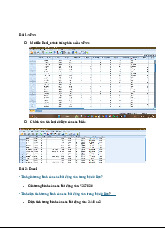
Thực Hành C1: Phân Tích Dữ Liệu Bất Động Sản Trên SPSS | Thống kê trong kinh tế và kinh doanh | Trường Đại học Kinh tế Quốc dân
13 7