Answer Key for Economics MCQs and Problems | Microeconomics | Trường Đại học Quốc tế, Đại học Quốc gia Thành phố Hồ Chí Minh
Because profit-maximizing monopolists produce a level of output at which price is greater than marginal cost, monopolists always produce less than the socially optimal level of output. 3) A Buyers will only purchase an item if its price is less than or equal to their reservation price, so as prices fall, more people will find that the price is now below their reservation price. Tài liệu được sưu tầm và soạn thảo dưới dạng file PDF để gửi tới các bạn cùng tham khảo, ôn tập đầy đủ kiến thức, chuẩn bị cho các buổi học thật tốt. Mời bạn đọc đón xem!
Môn: Microeconomics 613 tài liệu
Trường: Trường Đại học Quốc tế, Đại học Quốc gia Thành phố Hồ Chí Minh 1.9 K tài liệu
Tác giả:


Preview text:
Answer Key SECTION A. MCQs 1) B
Since Janna is the first person to engage in shoe production (and the PPF is flattest when she
makes shoes), then she must have the comparative advantage. 2) A
Because profit-maximizing monopolists produce a level of output at
which price is greater than marginal cost, monopolists always produce
less than the socially optimal level of output. 3) A
Buyers will only purchase an item if its price is less than or equal to their
reservation price, so as prices fall, more people will find that the price is
now below their reservation price. 4) A
When the reward is based on doing better than others, there is incentive
to take steps to surpass others. 5) B
The cross-price elasticity of demand is the percentage by which the
quantity demanded of one good changes in response to a one percent
change in the price of another good. 6) B
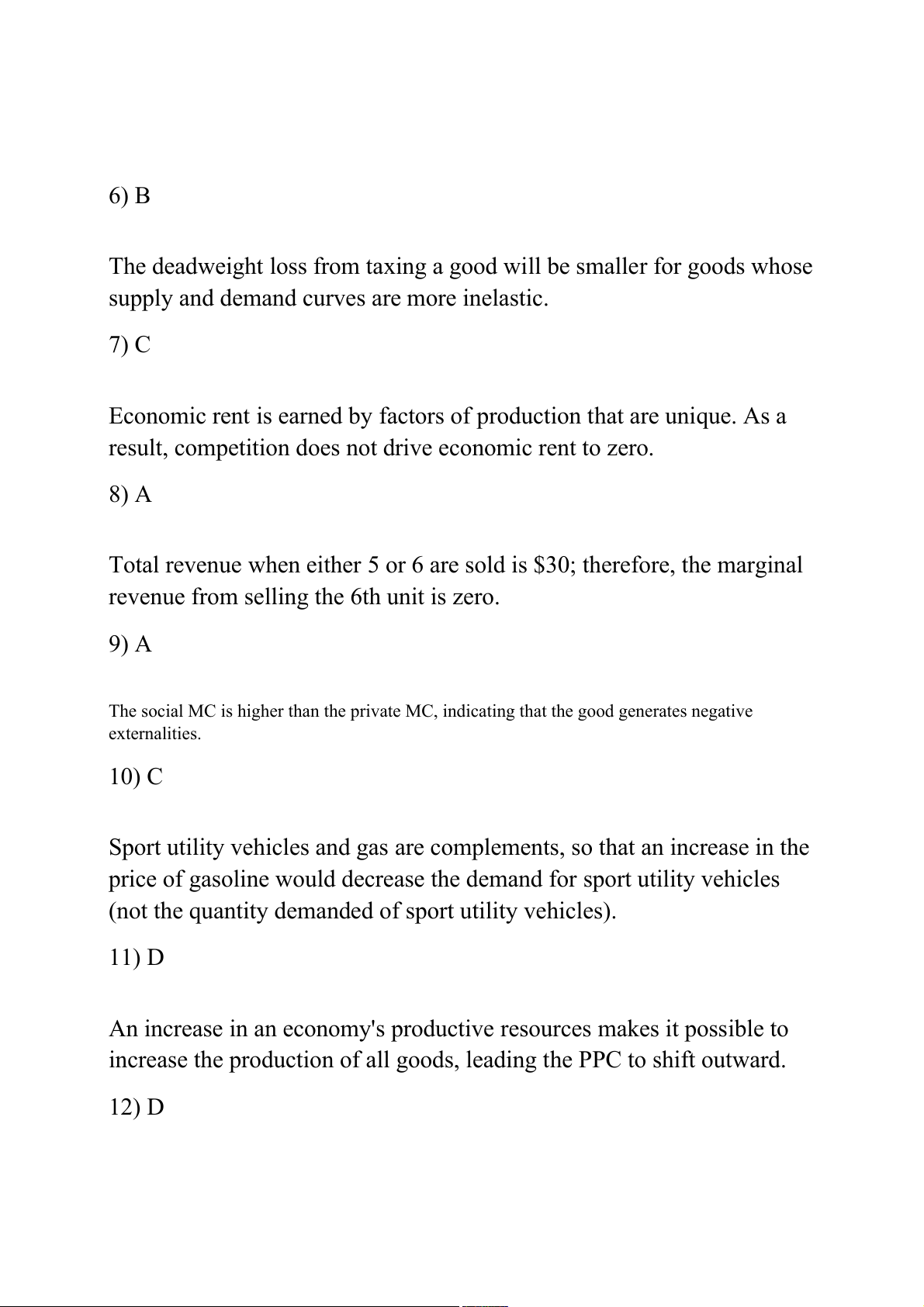
The deadweight loss from taxing a good will be smaller for goods whose
supply and demand curves are more inelastic. 7) C
Economic rent is earned by factors of production that are unique. As a
result, competition does not drive economic rent to zero. 8) A
Total revenue when either 5 or 6 are sold is $30; therefore, the marginal
revenue from selling the 6th unit is zero. 9) A
The social MC is higher than the private MC, indicating that the good generates negative externalities. 10) C
Sport utility vehicles and gas are complements, so that an increase in the
price of gasoline would decrease the demand for sport utility vehicles
(not the quantity demanded of sport utility vehicles). 11) D
An increase in an economy's productive resources makes it possible to
increase the production of all goods, leading the PPC to shift outward. 12) D
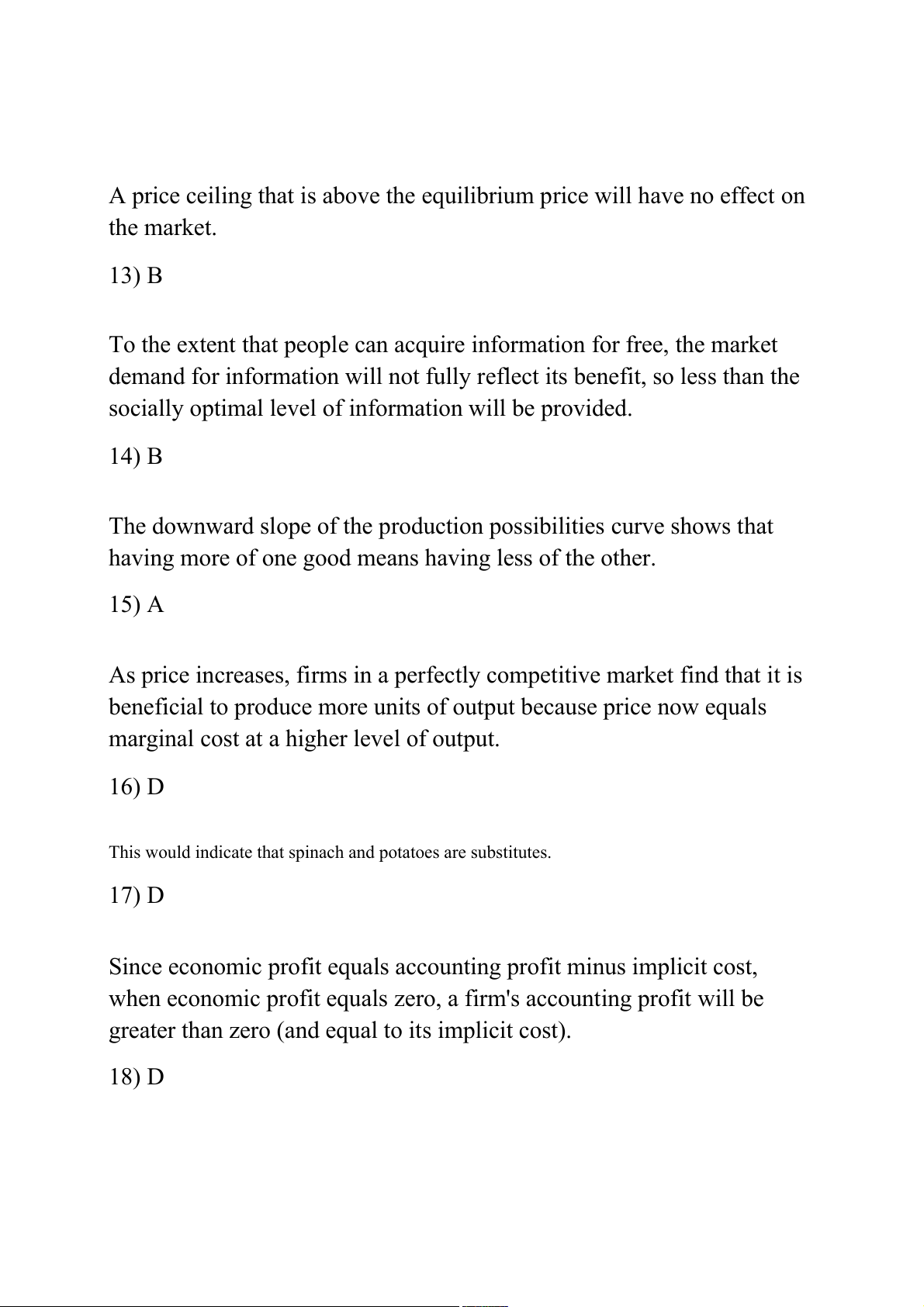
A price ceiling that is above the equilibrium price will have no effect on the market. 13) B
To the extent that people can acquire information for free, the market
demand for information will not fully reflect its benefit, so less than the
socially optimal level of information will be provided. 14) B
The downward slope of the production possibilities curve shows that
having more of one good means having less of the other. 15) A
As price increases, firms in a perfectly competitive market find that it is
beneficial to produce more units of output because price now equals
marginal cost at a higher level of output. 16) D
This would indicate that spinach and potatoes are substitutes. 17) D
Since economic profit equals accounting profit minus implicit cost,
when economic profit equals zero, a firm's accounting profit will be
greater than zero (and equal to its implicit cost). 18) D
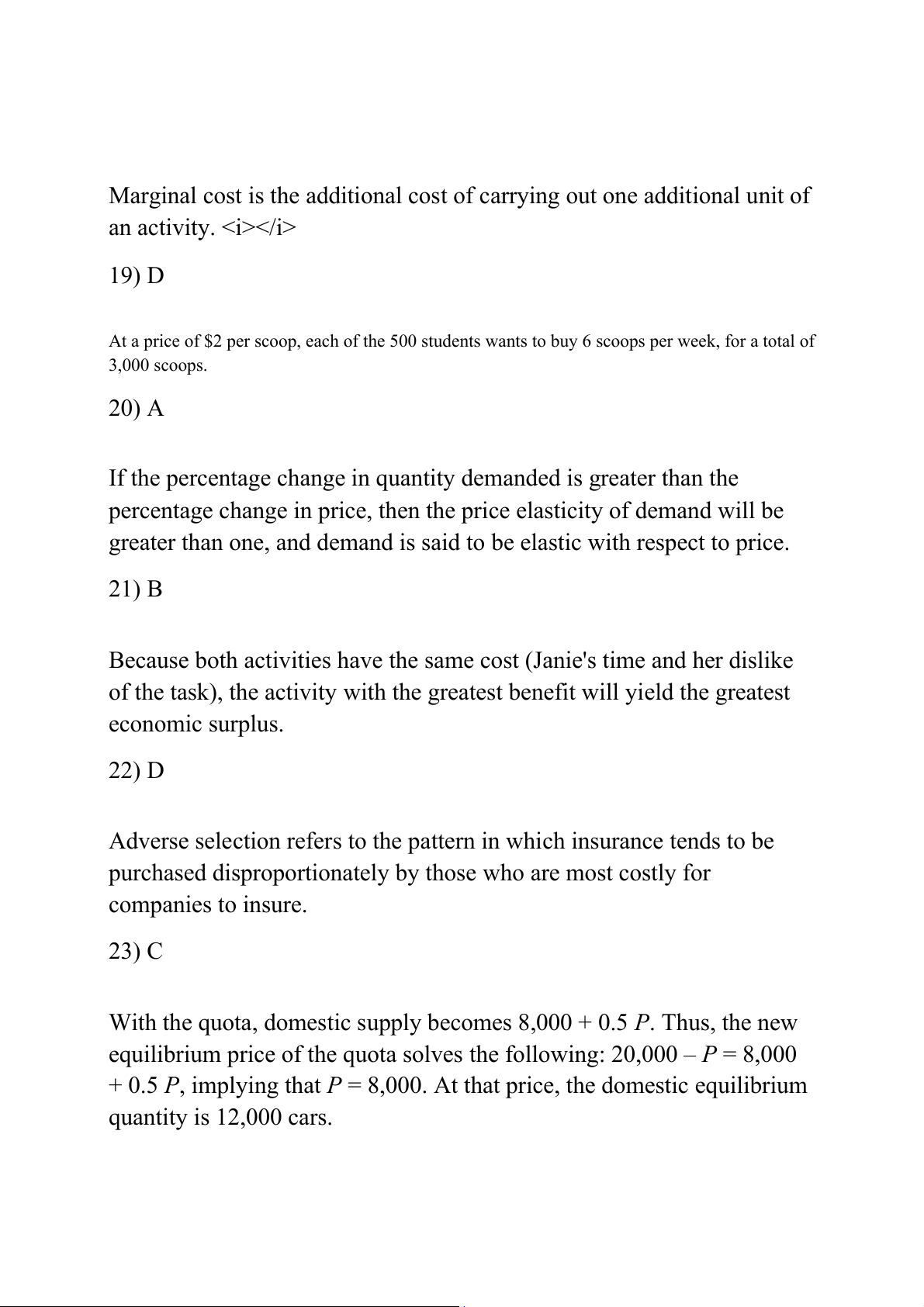
Marginal cost is the additional cost of carrying out one additional unit of an activity. 19) D
At a price of $2 per scoop, each of the 500 students wants to buy 6 scoops per week, for a total of 3,000 scoops. 20) A
If the percentage change in quantity demanded is greater than the
percentage change in price, then the price elasticity of demand will be
greater than one, and demand is said to be elastic with respect to price. 21) B
Because both activities have the same cost (Janie's time and her dislike
of the task), the activity with the greatest benefit will yield the greatest economic surplus. 22) D
Adverse selection refers to the pattern in which insurance tends to be
purchased disproportionately by those who are most costly for companies to insure. 23) C
With the quota, domestic supply becomes 8,000 + 0.5 P. Thus, the new
equilibrium price of the quota solves the following: 20,000 – P = 8,000
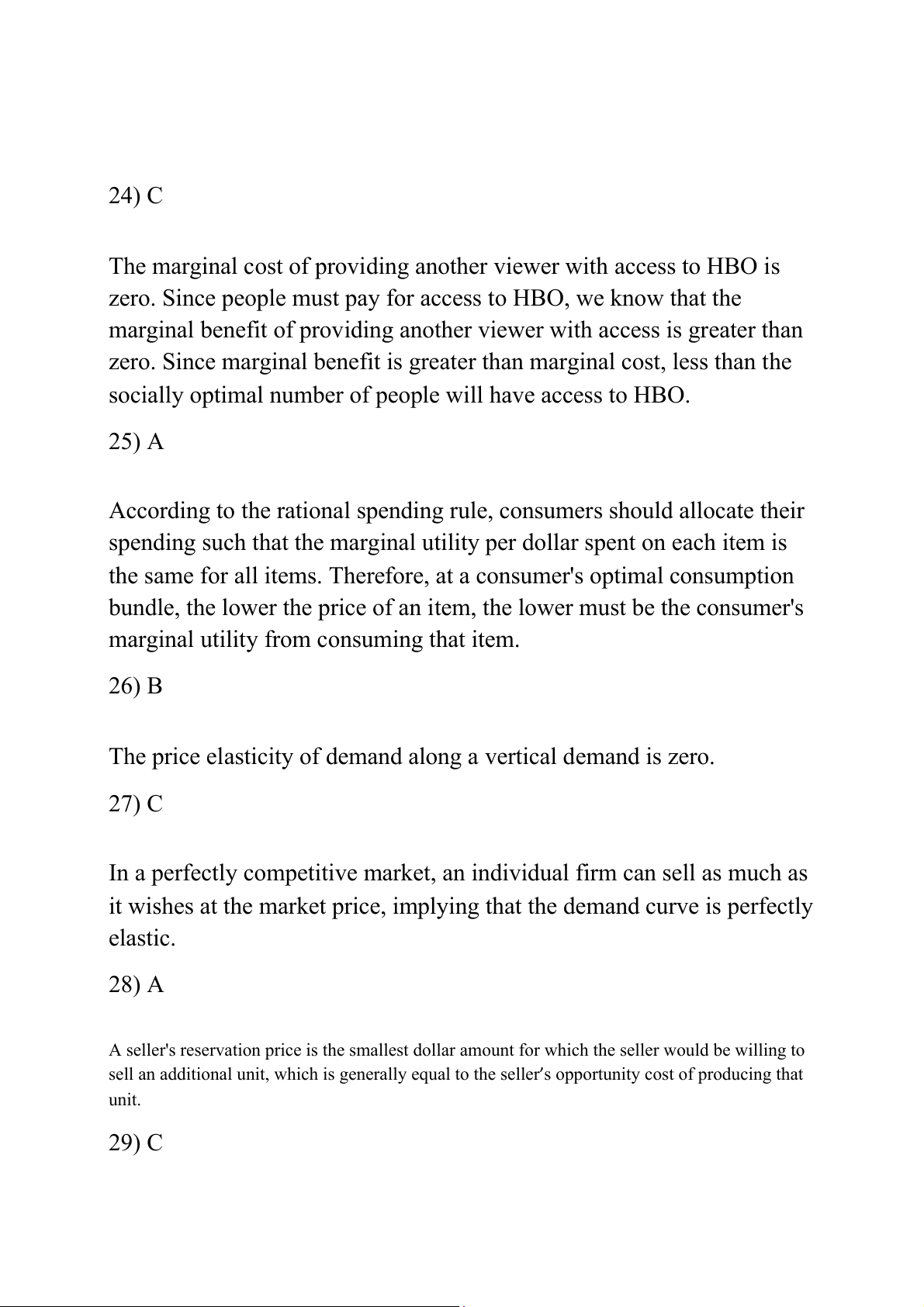
+ 0.5 P, implying that P = 8,000. At that price, the domestic equilibrium quantity is 12,000 cars. 24) C
The marginal cost of providing another viewer with access to HBO is
zero. Since people must pay for access to HBO, we know that the
marginal benefit of providing another viewer with access is greater than
zero. Since marginal benefit is greater than marginal cost, less than the
socially optimal number of people will have access to HBO. 25) A
According to the rational spending rule, consumers should allocate their
spending such that the marginal utility per dollar spent on each item is
the same for all items. Therefore, at a consumer's optimal consumption
bundle, the lower the price of an item, the lower must be the consumer's
marginal utility from consuming that item. 26) B
The price elasticity of demand along a vertical demand is zero. 27) C
In a perfectly competitive market, an individual firm can sell as much as
it wishes at the market price, implying that the demand curve is perfectly elastic. 28) A
A seller's reservation price is the smallest dollar amount for which the seller would be willing to
sell an additional unit, which is generally equal to the seller’s opportunity cost of producing that unit. 29) C
If price is below the equilibrium price, then there will be more buyers
who want to buy a good than there will be sellers who wish to sell it. In
this case, frustrated buyers have an incentive to offer to pay higher prices to obtain the good. 30) B
The lower price on strawberries is available to all buyers and is the result of an increase in supply SECTION B. Problem 1.
Automobile insurance and automobiles are complements, so an increase in automobile insurance rates
will thus shift the demand curve for automobiles to the left. Some people who would have bought new
automobiles with the lower insurance rates will choose instead to purchase a used car, use public
transportation, or perhaps continue driving their current vehicle . Problem 2
a) This is an artificially scarce good. It is excludable because a viewer can download the episode only
if he or she pays the fee to the network. It is nonrival because many consumers can download the
episode and enjoy the program without depriving anyone else of that enjoyment.
b) No. The marginal cost is zero, so the efficient price would also be zero. Because there is a fee to
download the episode, only consumers who have marginal benefit greater than or equal to that
fee will consume the service. Other consumers who have marginal benefits greater than zero but
less than the fee will not consume the service. Problem 3
To maximize revenue, VinFast should charge the price that makes demand unit elastic. Using the own
price elasticity of demand formula, EQ,P = (-1.5)(P / (150,000 -
1.5P)) = -1. Solving this equation for P
implies that the revenue maximizing price is P = $50,000 .
Tài liệu liên quan:
-
Tự Luận Vimo: Phân Tích Cung, Cầu và Thị Trường Cạnh Tranh| Microeconomics | Trường Đại học Quốc tế, Đại học Quốc gia Thành phố Hồ Chí Minh
5 3 -
Review Questions: Thinking Like an Economist | Microeconomics | Trường Đại học Quốc tế, Đại học Quốc gia Thành phố Hồ Chí Minh
5 3 -
Final Exam Quizlet Questions & Answers | Microeconomics | Trường Đại học Quốc tế, Đại học Quốc gia Thành phố Hồ Chí Minh
5 3 -

Đề thi giữa kỳ II | Microeconomics | Trường Đại học Quốc tế, Đại học Quốc gia Thành phố Hồ Chí Minh
5 3 -

Final Group Project_ The Beer Industry | Microeconomics | Trường Đại học Quốc tế, Đại học Quốc gia Thành phố Hồ Chí Minh
4 2