Assignment Presentation 1: Economic Trade-offs & Production Dynamics | Microeconomics | Trường Đại học Quốc tế, Đại học Quốc gia Thành phố Hồ Chí Minh
The point G indicates unemployment and ineffective resource use in the economy. d. Point H lies outside the production possibilities curve: - Point H indicates that it is at present unachievable and almost impossible. - Before the economy can attain the level of production indicated by point H, technology improvement must occur because better inputs can lead to increase. Tài liệu được sưu tầm và soạn thảo dưới dạng file PDF để gửi tới các bạn cùng tham khảo, ôn tập đầy đủ kiến thức, chuẩn bị cho các buổi học thật tốt. Mời bạn đọc đón xem!
Môn: Microeconomics 640 tài liệu
Trường: Trường Đại học Quốc tế, Đại học Quốc gia Thành phố Hồ Chí Minh 2 K tài liệu
Tác giả:

Preview text:
GROUP ASSIGNMENT PRESENTATION 1: Exercise 1:
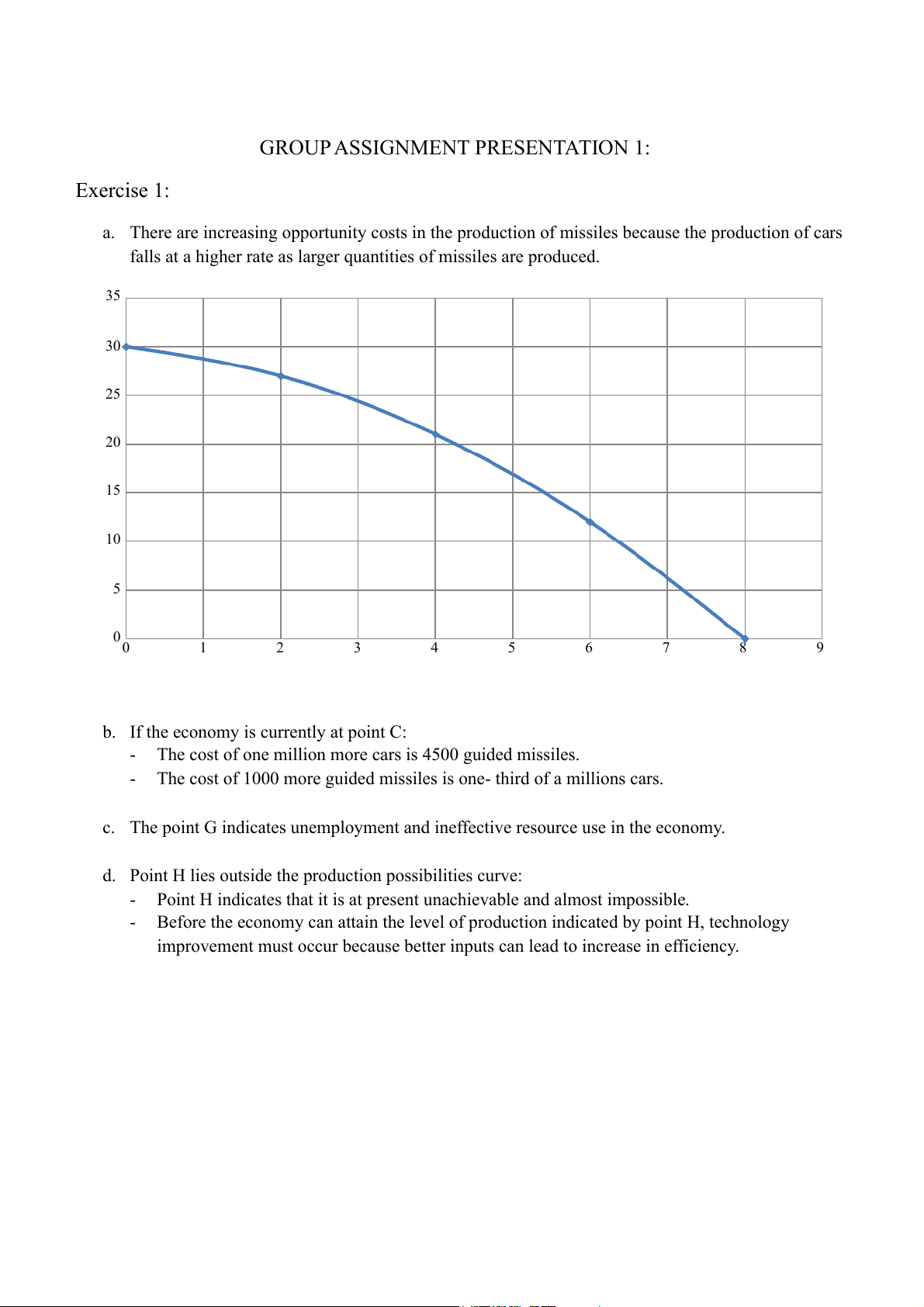
a. There are increasing opportunity costs in the production of missiles because the production of cars
falls at a higher rate as larger quantities of missiles are produced. 35 30 25 20 15 10 5 00 1 2 3 4 5 6 7 8 9
b. If the economy is currently at point C:
- The cost of one million more cars is 4500 guided missiles.
- The cost of 1000 more guided missiles is one- third of a millions cars.
c. The point G indicates unemployment and ineffective resource use in the economy.
d. Point H lies outside the production possibilities curve:
- Point H indicates that it is at present unachievable and almost impossible.
- Before the economy can attain the level of production indicated by point H, technology
improvement must occur because better inputs can lead to increase in efficiency.
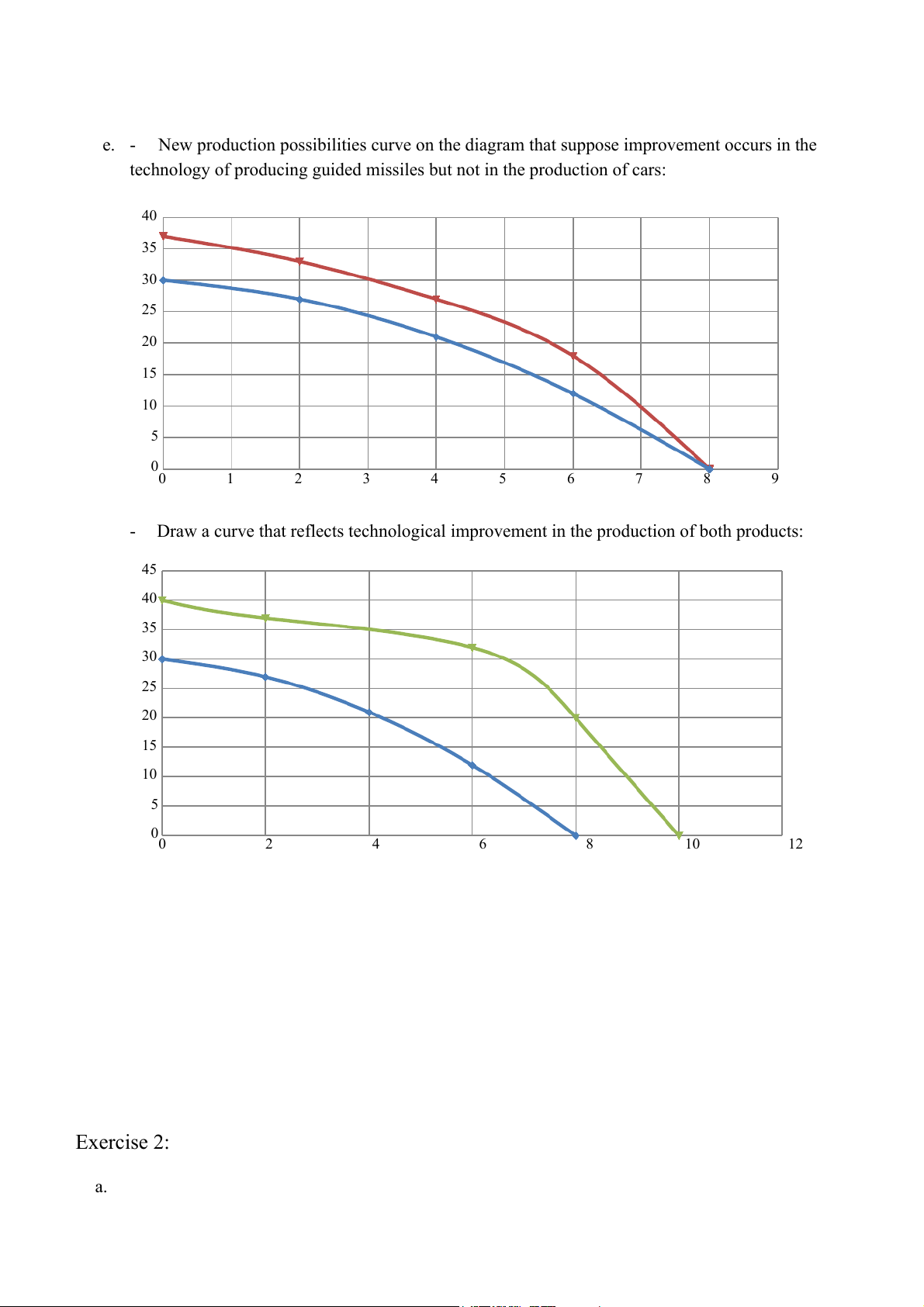
e. - New production possibilities curve on the diagram that suppose improvement occurs in the
technology of producing guided missiles but not in the production of cars: 40 35 30 25 20 15 10 5 00 1 2 3 4 5 6 7 8 9
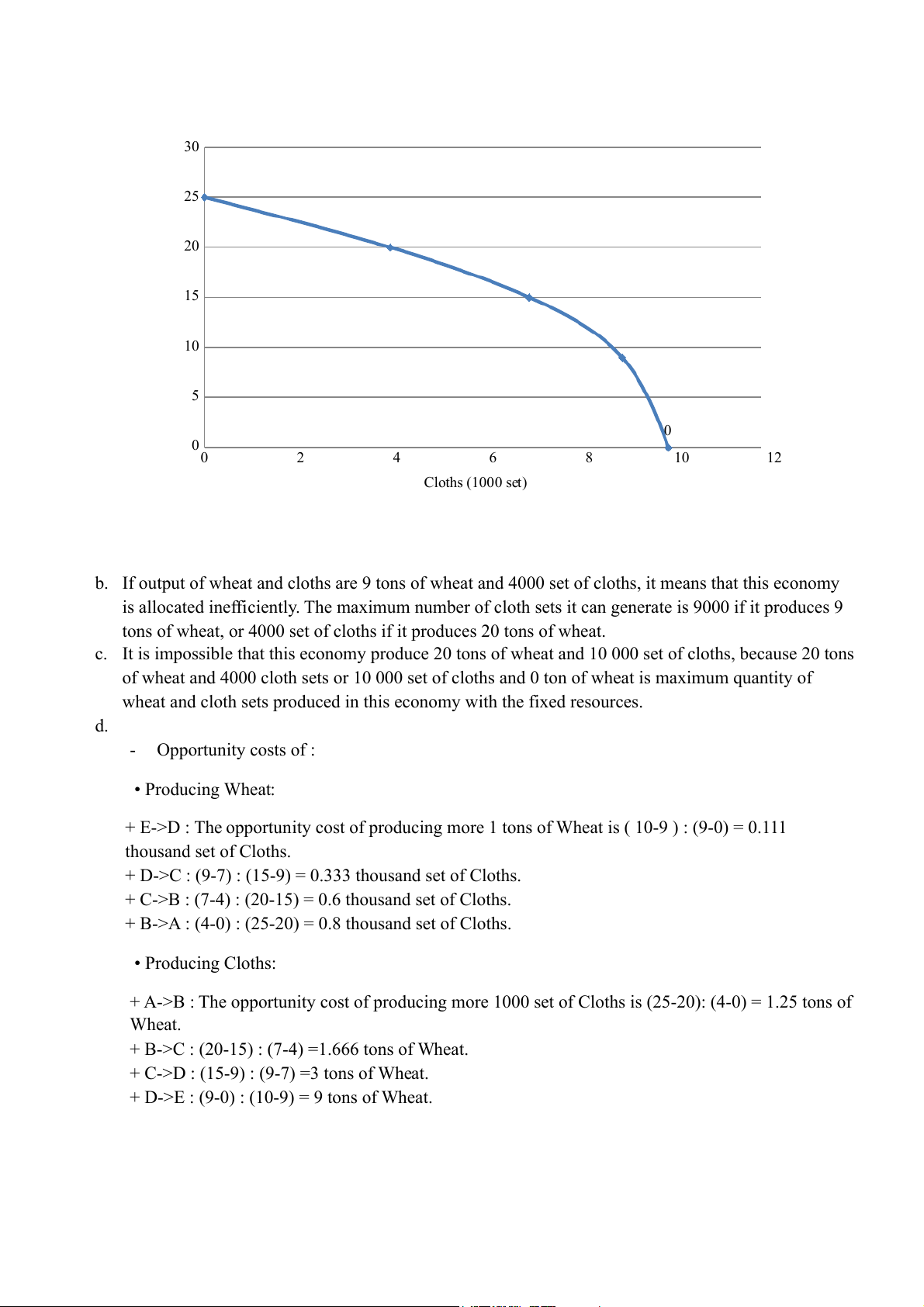
- Draw a curve that reflects technological improvement in the production of both products: 45 40 35 30 25 20 15 10 5 0 0 2 4 6 8 10 12 Exercise 2: a. 30 25 20 ) ons 15 t (t Whea 10 5 0 0 0 2 4 6 8 10 12 Cloths (1000 set)
b. If output of wheat and cloths are 9 tons of wheat and 4000 set of cloths, it means that this economy
is allocated inefficiently. The maximum number of cloth sets it can generate is 9000 if it produces 9
tons of wheat, or 4000 set of cloths if it produces 20 tons of wheat.
c. It is impossible that this economy produce 20 tons of wheat and 10 000 set of cloths, because 20 tons
of wheat and 4000 cloth sets or 10 000 set of cloths and 0 ton of wheat is maximum quantity of
wheat and cloth sets produced in this economy with the fixed resources. d. - Opportunity costs of : • Producing Wheat:
+ E->D : The opportunity cost of producing more 1 tons of Wheat is ( 10-9 ) : (9-0) = 0.111 thousand set of Cloths.
+ D->C : (9-7) : (15-9) = 0.333 thousand set of Cloths.
+ C->B : (7-4) : (20-15) = 0.6 thousand set of Cloths.
+ B->A : (4-0) : (25-20) = 0.8 thousand set of Cloths. • Producing Cloths:
+ A->B : The opportunity cost of producing more 1000 set of Cloths is (25-20): (4-0) = 1.25 tons of Wheat.
+ B->C : (20-15) : (7-4) =1.666 tons of Wheat.
+ C->D : (15-9) : (9-7) =3 tons of Wheat.
+ D->E : (9-0) : (10-9) = 9 tons of Wheat.
Tài liệu liên quan:
-

Syllabus: Principles of Microeconomics | Microeconomics | Trường Đại học Quốc tế, Đại học Quốc gia Thành phố Hồ Chí Minh
29 15 -
Winter Term 1999 Midterm Exam | Microeconomics | Trường Đại học Quốc tế, Đại học Quốc gia Thành phố Hồ Chí Minh
18 9 -

Understanding Economic Bubbles: Insights from Fama & Shiller | Microeconomics | Trường Đại học Quốc tế, Đại học Quốc gia Thành phố Hồ Chí Minh
22 11 -

Tóm Tắt Chương 1-3 Thuyết Kinh Tế Vi Mô | Microeconomics | Trường Đại học Quốc tế, Đại học Quốc gia Thành phố Hồ Chí Minh
25 13