Syllabus: Principles of Microeconomics | Microeconomics | Trường Đại học Quốc tế, Đại học Quốc gia Thành phố Hồ Chí Minh
Microeconomics 1 is presented to help students understanding the basic economic principles of microeconomics. Structural lectures are presented simply and reasonably while ensuring modern. The contents were according with the basic concept of the market: supply and demand, elasticity of demand and supply, consumer behavior, business behavior (Production - cost - profit), perfect competition and monopoly, the supply and demand for labor, market failures. Tài liệu được sưu tầm và soạn thảo dưới dạng file PDF để gửi tới các bạn cùng tham khảo, ôn tập đầy đủ kiến thức, chuẩn bị cho các buổi học thật tốt. Mời bạn đọc đón xem!
Môn: Microeconomics 640 tài liệu
Trường: Trường Đại học Quốc tế, Đại học Quốc gia Thành phố Hồ Chí Minh 2 K tài liệu
Tác giả:

Preview text:
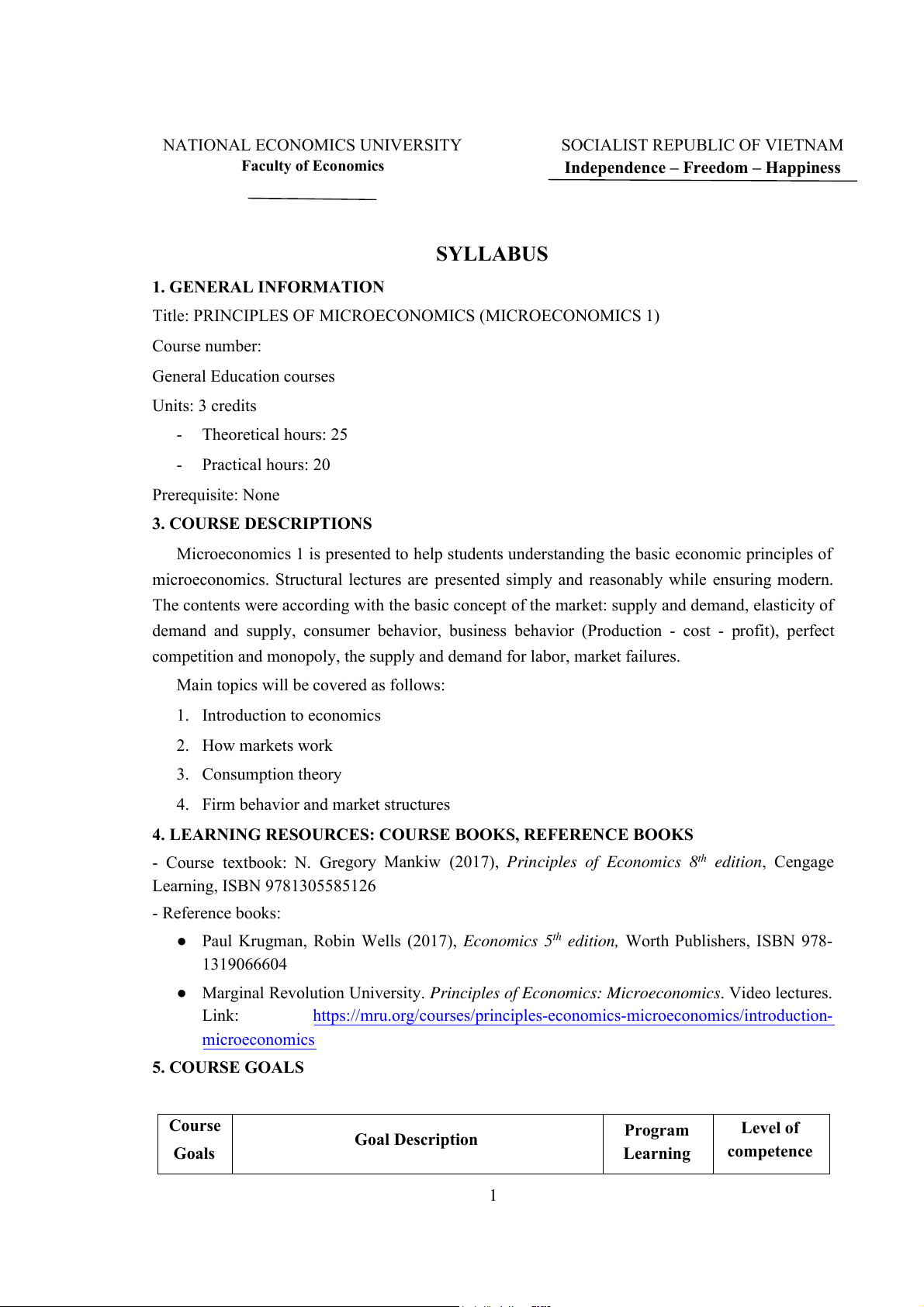
NATIONAL ECONOMICS UNIVERSITY SOCIALIST REPUBLIC OF VIETNAM Faculty of Economics
Independence – Freedom – Happiness SYLLABUS 1. GENERAL INFORMATION
Title: PRINCIPLES OF MICROECONOMICS (MICROECONOMICS 1) Course number: General Education courses Units: 3 credits - Theoretical hours: 25 - Practical hours: 20 Prerequisite: None 3. COURSE DESCRIPTIONS
Microeconomics 1 is presented to help students understanding the basic economic principles of
microeconomics. Structural lectures are presented simply and reasonably while ensuring modern.
The contents were according with the basic concept of the market: supply and demand, elasticity of
demand and supply, consumer behavior, business behavior (Production - cost - profit), perfect
competition and monopoly, the supply and demand for labor, market failures.
Main topics will be covered as follows: 1. Introduction to economics 2. How markets work 3. Consumption theory
4. Firm behavior and market structures
4. LEARNING RESOURCES: COURSE BOOKS, REFERENCE BOOKS - Course textbook: N. Gregory
Mankiw (2017), Principles of Economics 8th edition, Cengage Learning, ISBN 9781305585126 - Reference books:
● Paul Krugman, Robin Wells (2017), Economics 5th edition, Worth Publishers, ISBN 978- 1319066604
● Marginal Revolution University. Principles of Economics: Microeconomics. Video lectures. Link:
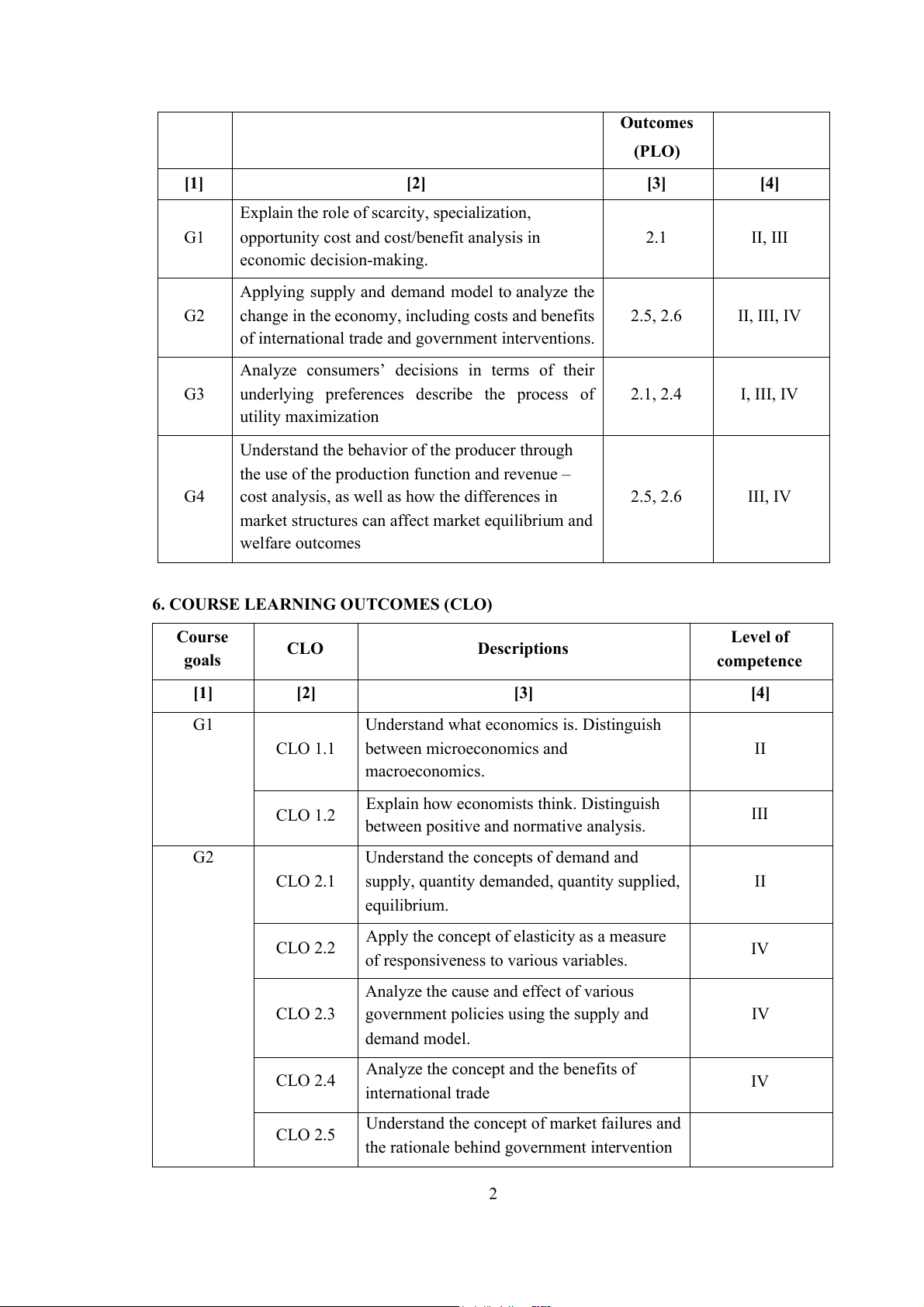
https://mru.org/courses/principles-economics-microeconomics/introduction- microeconomics 5. COURSE GOALS Course Program Level of Goal Description Goals Learning competence 1 Outcomes (PLO) [1] [2] [3] [4]
Explain the role of scarcity, specialization, G1
opportunity cost and cost/benefit analysis in 2.1 II, III economic decision-making.
Applying supply and demand model to analyze the G2
change in the economy, including costs and benefits 2.5, 2.6 II, III, IV
of international trade and government interventions.
Analyze consumers’ decisions in terms of their G3
underlying preferences describe the process of 2.1, 2.4 I, III, IV utility maximization
Understand the behavior of the producer through
the use of the production function and revenue – G4
cost analysis, as well as how the differences in 2.5, 2.6 III, IV
market structures can affect market equilibrium and welfare outcomes
6. COURSE LEARNING OUTCOMES (CLO) Course Level of CLO Descriptions goals competence [1] [2] [3] [4] G1
Understand what economics is. Distinguish CLO 1.1 between microeconomics and II macroeconomics.
Explain how economists think. Distinguish CLO 1.2 III
between positive and normative analysis. G2
Understand the concepts of demand and CLO 2.1
supply, quantity demanded, quantity supplied, II equilibrium.
Apply the concept of elasticity as a measure CLO 2.2 IV
of responsiveness to various variables.
Analyze the cause and effect of various CLO 2.3
government policies using the supply and IV demand model.
Analyze the concept and the benefits of CLO 2.4 IV international trade
Understand the concept of market failures and CLO 2.5
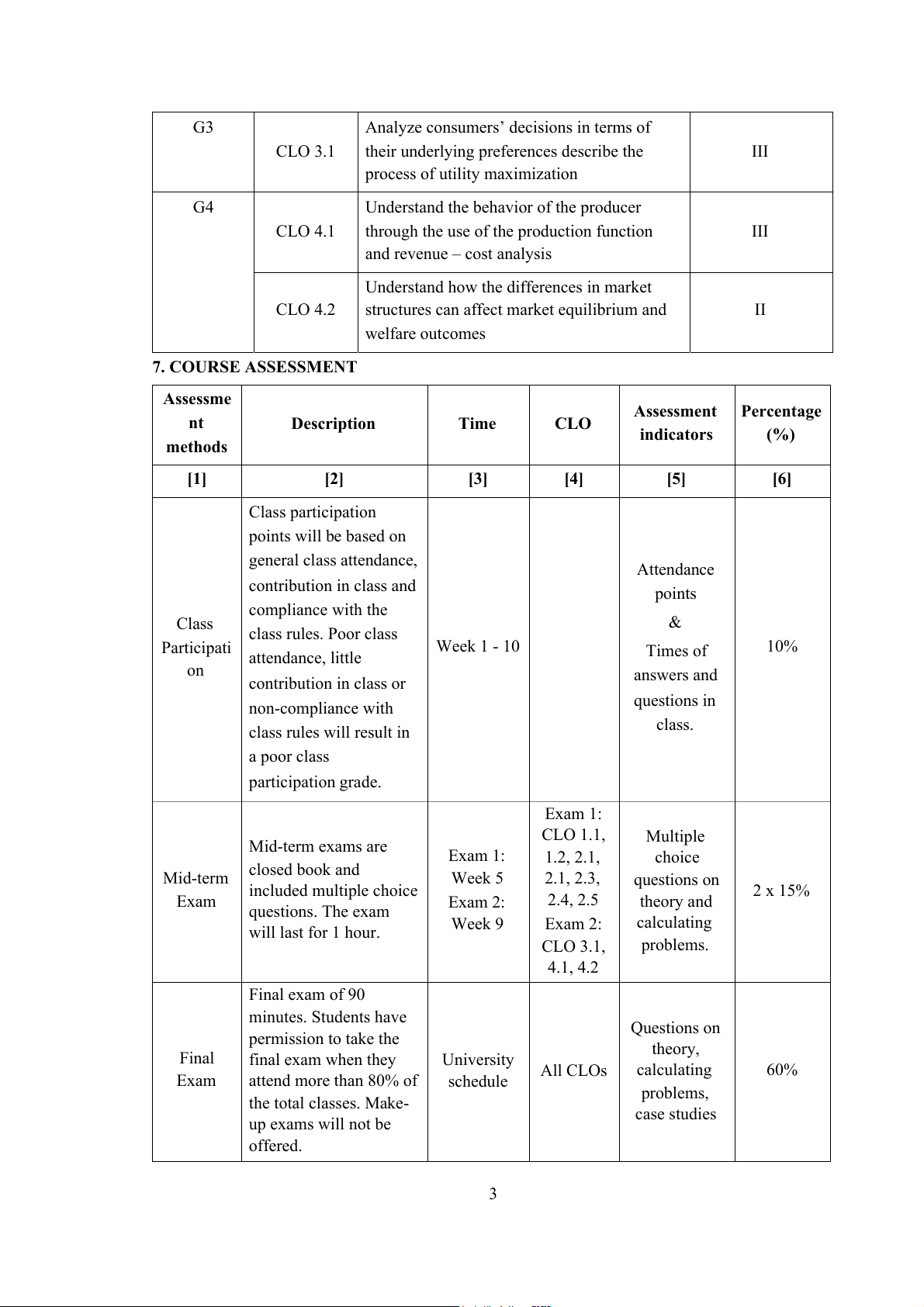
the rationale behind government intervention 2 G3
Analyze consumers’ decisions in terms of CLO 3.1
their underlying preferences describe the III
process of utility maximization G4
Understand the behavior of the producer CLO 4.1
through the use of the production function III and revenue – cost analysis
Understand how the differences in market CLO 4.2
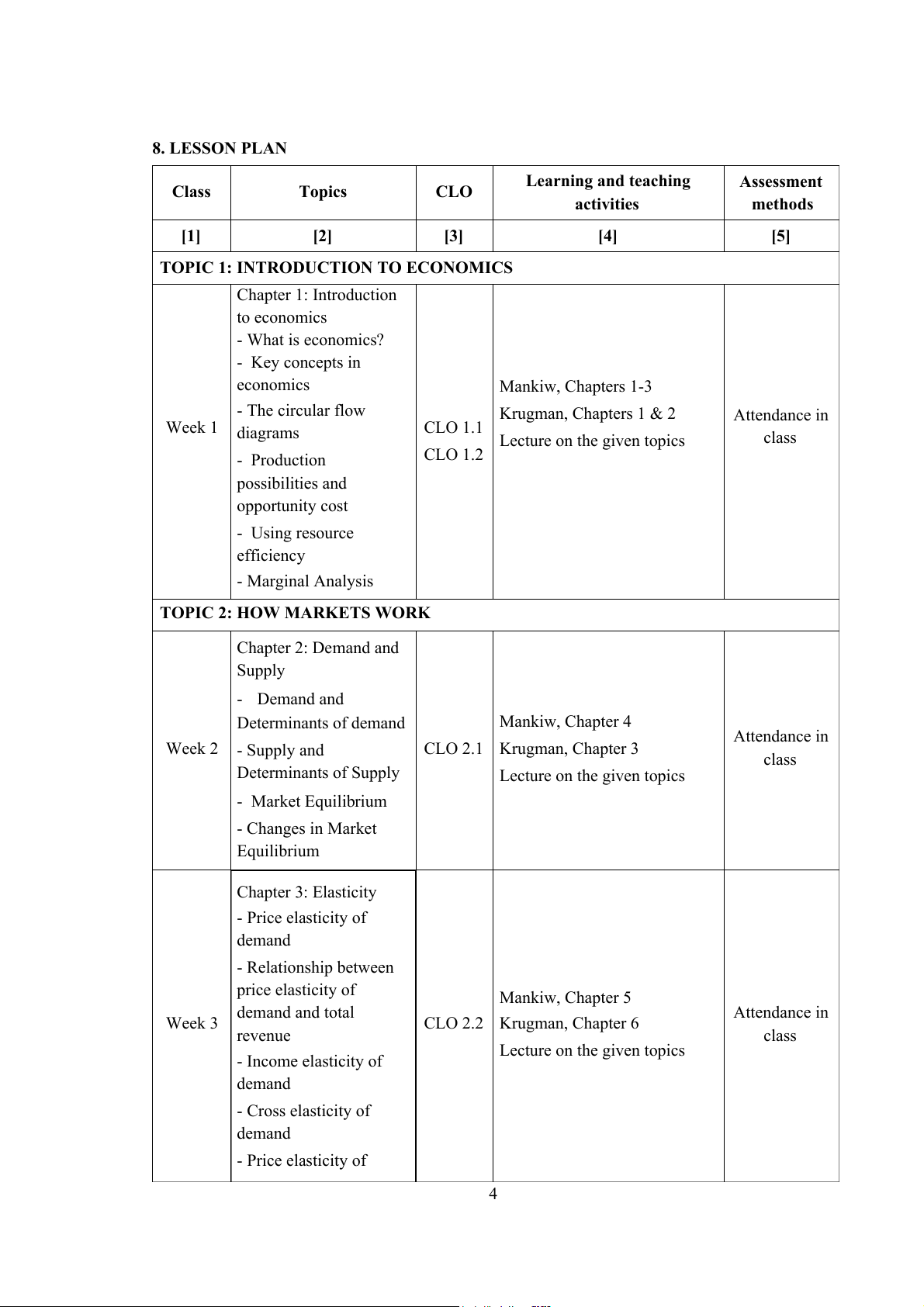
structures can affect market equilibrium and II welfare outcomes 7. COURSE ASSESSMENT Assessme Assessment Percentage nt Description Time CLO indicators (%) methods [1] [2] [3] [4] [5] [6] Class participation points will be based on general class attendance, Attendance contribution in class and points compliance with the Class & class rules. Poor class Participati Week 1 - 10 10% attendance, little Times of on answers and contribution in class or non-compliance with questions in class rules will result in class. a poor class participation grade. Exam 1: CLO 1.1, Multiple Mid-term exams are Exam 1: 1.2, 2.1, choice closed book and Mid-term Week 5 2.1, 2.3, questions on included multiple choice 2 x 15% Exam Exam 2: 2.4, 2.5 theory and questions. The exam Week 9 Exam 2: calculating will last for 1 hour. CLO 3.1, problems. 4.1, 4.2 Final exam of 90 minutes. Students have Questions on permission to take the theory, Final final exam when they University All CLOs calculating 60% Exam attend more than 80% of schedule problems, the total classes. Make- case studies up exams will not be offered. 3 8. LESSON PLAN Learning and teaching Assessment Class Topics CLO activities methods [1] [2] [3] [4] [5]
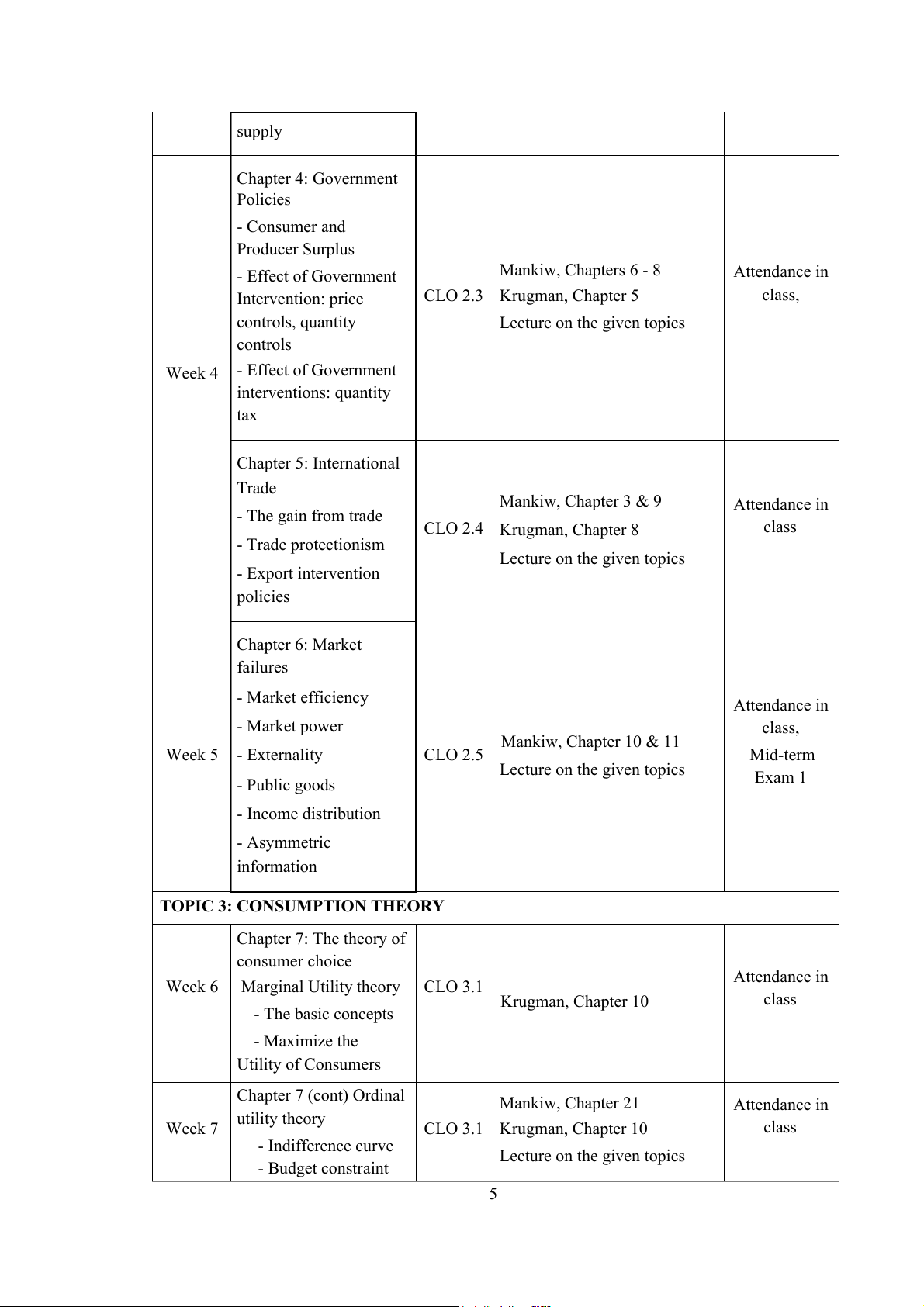
TOPIC 1: INTRODUCTION TO ECONOMICS Chapter 1: Introduction to economics - What is economics? - Key concepts in economics Mankiw, Chapters 1-3 - The circular flow Krugman, Chapters 1 & 2 Attendance in Week 1 diagrams
CLO 1.1 Lecture on the given topics class - Production CLO 1.2 possibilities and opportunity cost - Using resource efficiency - Marginal Analysis TOPIC 2: HOW MARKETS WORK Chapter 2: Demand and Supply - Demand and Determinants of demand Mankiw, Chapter 4 Attendance in Week 2 - Supply and CLO 2.1 Krugman, Chapter 3 class Determinants of Supply Lecture on the given topics - Market Equilibrium - Changes in Market Equilibrium Chapter 3: Elasticity - Price elasticity of demand - Relationship between price elasticity of Mankiw, Chapter 5 demand and total Attendance in Week 3 CLO 2.2 Krugman, Chapter 6 revenue class Lecture on the given topics - Income elasticity of demand - Cross elasticity of demand - Price elasticity of 4 supply Chapter 4: Government Policies - Consumer and Producer Surplus - Effect of Government Mankiw, Chapters 6 - 8 Attendance in Intervention: price CLO 2.3 Krugman, Chapter 5 class, controls, quantity Lecture on the given topics controls Week 4 - Effect of Government interventions: quantity tax Chapter 5: International Trade Mankiw, Chapter 3 & 9 Attendance in - The gain from trade CLO 2.4 Krugman, Chapter 8 class - Trade protectionism Lecture on the given topics - Export intervention policies Chapter 6: Market failures - Market efficiency Attendance in - Market power class, Mankiw, Chapter 10 & 11 Week 5 - Externality CLO 2.5 Mid-term Lecture on the given topics - Public goods Exam 1 - Income distribution - Asymmetric information TOPIC 3: CONSUMPTION THEORY Chapter 7: The theory of consumer choice Attendance in
Week 6 Marginal Utility theory CLO 3.1 Krugman, Chapter 10 class - The basic concepts - Maximize the Utility of Consumers Chapter 7 (cont) Ordinal Mankiw, Chapter 21 Attendance in utility theory Week 7 CLO 3.1 Krugman, Chapter 10 class - Indifference curve Lecture on the given topics - Budget constraint 5 - Optimal consumer choice
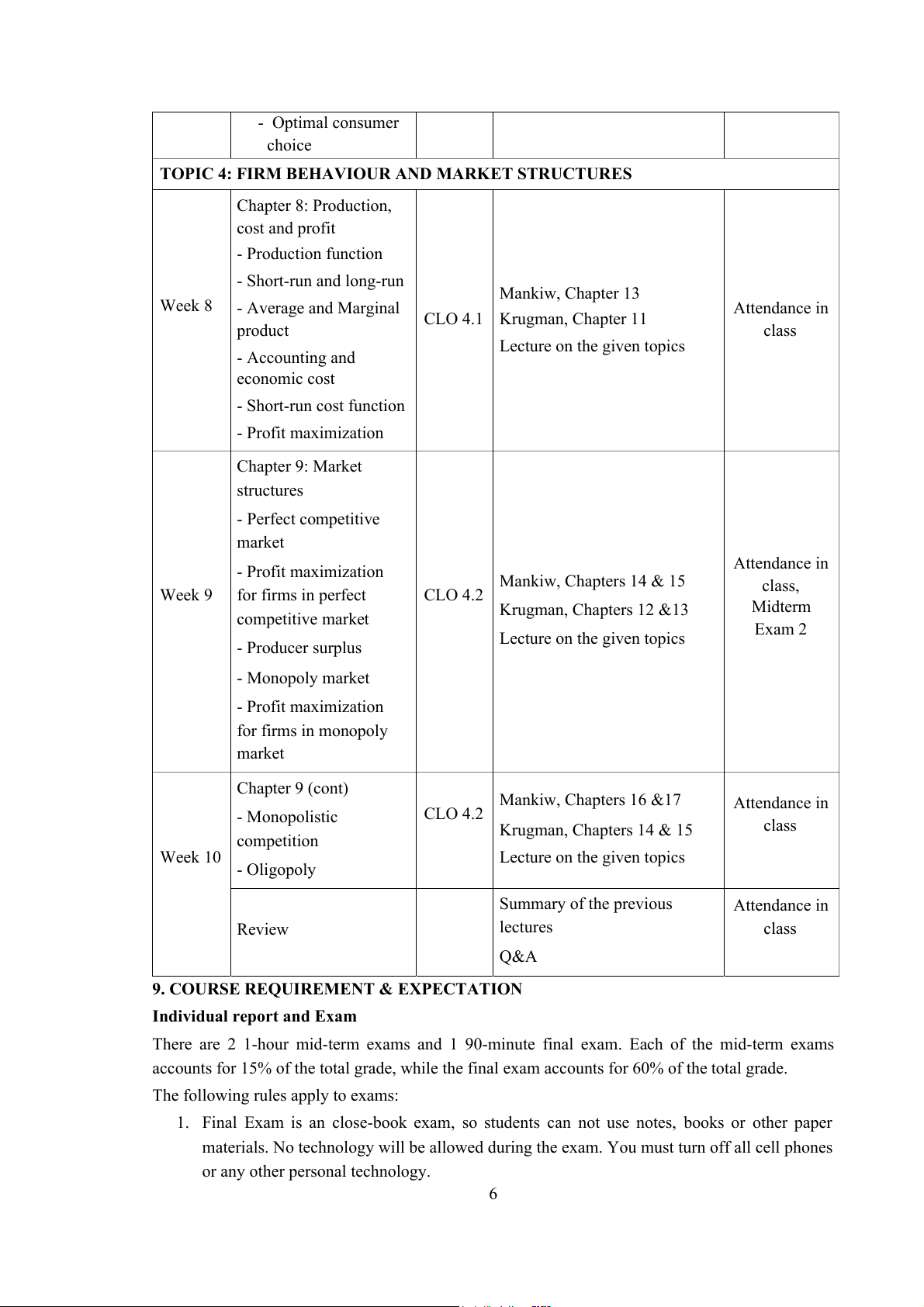
TOPIC 4: FIRM BEHAVIOUR AND MARKET STRUCTURES Chapter 8: Production, cost and profit - Production function - Short-run and long-run Mankiw, Chapter 13 Week 8 - Average and Marginal Attendance in CLO 4.1 Krugman, Chapter 11 product class Lecture on the given topics - Accounting and economic cost - Short-run cost function - Profit maximization Chapter 9: Market structures - Perfect competitive market Attendance in - Profit maximization Mankiw, Chapters 14 & 15 class, Week 9 for firms in perfect
CLO 4.2 Krugman, Chapters 12 &13 Midterm competitive market Exam 2 Lecture on the given topics - Producer surplus - Monopoly market - Profit maximization for firms in monopoly market Chapter 9 (cont) Mankiw, Chapters 16 &17 Attendance in - Monopolistic CLO 4.2 Krugman, Chapters 14 & 15 class competition Week 10 Lecture on the given topics - Oligopoly Summary of the previous Attendance in Review lectures class Q&A
9. COURSE REQUIREMENT & EXPECTATION Individual report and Exam
There are 2 1-hour mid-term exams and 1 90-minute final exam. Each of the mid-term exams
accounts for 15% of the total grade, while the final exam accounts for 60% of the total grade.
The following rules apply to exams:
1. Final Exam is an close-book exam, so students can not use notes, books or other paper
materials. No technology will be allowed during the exam. You must turn off all cell phones
or any other personal technology. 6
2. If you do not bring an ID to the exam, you will receive a 0 for the exam.
3. No food or drinks will be allowed during an exam.
4. When time is called, stop writing.
5. Please make sure you do not engage in any behavior that may appear to be cheating. Class Participation
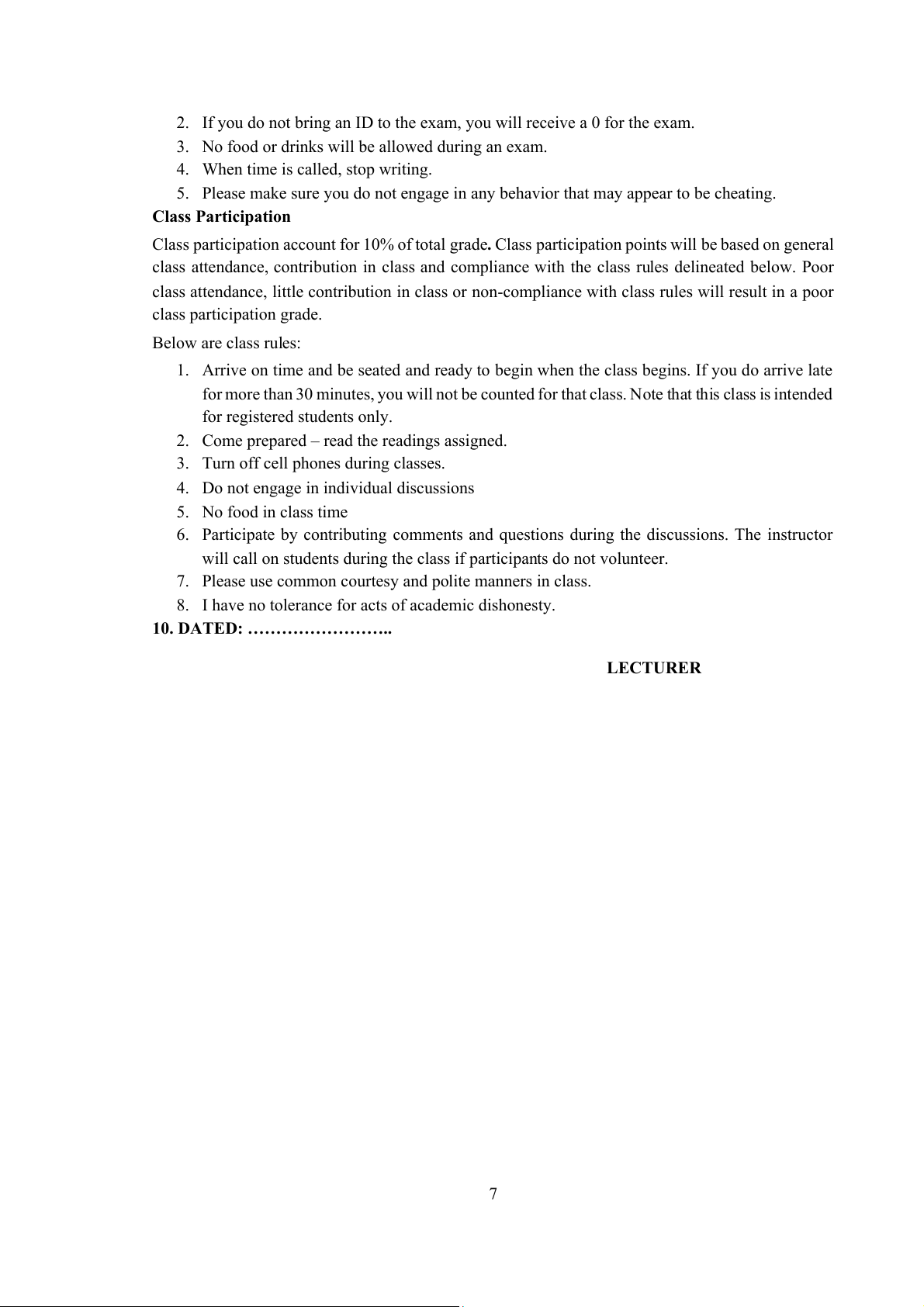
Class participation account for 10% of total grade. Class participation points will be based on general
class attendance, contribution in class and compliance with the class rules delineated below. Poor
class attendance, little contribution in class or non-compliance with class rules will result in a poor class participation grade. Below are class rules:
1. Arrive on time and be seated and ready to begin when the class begins. If you do arrive late
for more than 30 minutes, you will not be counted for that class. Note that this class is intended for registered students only.
2. Come prepared – read the readings assigned.
3. Turn off cell phones during classes.
4. Do not engage in individual discussions 5. No food in class time
6. Participate by contributing comments and questions during the discussions. The instructor
will call on students during the class if participants do not volunteer.
7. Please use common courtesy and polite manners in class.
8. I have no tolerance for acts of academic dishonesty.
10. DATED: …………………….. LECTURER 7
Tài liệu liên quan:
-
Winter Term 1999 Midterm Exam | Microeconomics | Trường Đại học Quốc tế, Đại học Quốc gia Thành phố Hồ Chí Minh
18 9 -

Understanding Economic Bubbles: Insights from Fama & Shiller | Microeconomics | Trường Đại học Quốc tế, Đại học Quốc gia Thành phố Hồ Chí Minh
22 11 -
Tóm Tắt Chương 1-3 Thuyết Kinh Tế Vi Mô | Microeconomics | Trường Đại học Quốc tế, Đại học Quốc gia Thành phố Hồ Chí Minh
26 13 -
Assignment Presentation 1: Economic Trade-offs & Production Dynamics | Microeconomics | Trường Đại học Quốc tế, Đại học Quốc gia Thành phố Hồ Chí Minh
18 9