Assignment Topic 4: Case Study on Demand Elasticity of Luxuries | Microeconomics | Trường Đại học Quốc tế, Đại học Quốc gia Thành phố Hồ Chí Minh
As part of an overall package to reduce the US Budget deficit, the Congress adopted a 10% ‘luxury tax’ on such big-ticket items as pleasure boats, private airplanes, high-priced cars, jewelry…Such luxury taxes are often popular because most people do not have to pay them. All taxes are painful to someone, but surely a tax that weighs only on rich people who are buying frivolous luxuries is one of the more socially painless ways to raise money. Tài liệu được sưu tầm và soạn thảo dưới dạng file PDF để gửi tới các bạn cùng tham khảo, ôn tập đầy đủ kiến thức, chuẩn bị cho các buổi học thật tốt. Mời bạn đọc đón xem!
Môn: Microeconomics 613 tài liệu
Trường: Trường Đại học Quốc tế, Đại học Quốc gia Thành phố Hồ Chí Minh 1.9 K tài liệu
Tác giả:

Preview text:
ASSIGNMENT TOPIC 4 Name: Class: CASE STUDY ANALYSIS:
The surprising Elasticity of Demand for Luxuries
As part of an overall package to reduce the US Budget deficit, the Congress adopted a 10% ‘luxury
tax’ on such big-ticket items as pleasure boats, private airplanes, high-priced cars, jewelry…Such
luxury taxes are often popular because most people do not have to pay them. All taxes are painful
to someone, but surely a tax that weighs only on rich people who are buying frivolous luxuries is
one of the more socially painless ways to raise money.
However, the discussion of elasticity and inelasticity in this chapter should make you suspicious of
a key assumption underlying this tax. The assumption was that the demand for these luxury goods
was quite inelastic. We can think of the luxury tax as increasing the total cost of producers face in
bringing a goods to market, so the supply curve effectively shifts up. Thus, when the industry
supply curve shifted up in response to the new luxury tax, the equilibrium quantity would change
little while the equilibrium price would rise much, as the rich simply paid extra cost.
If the demand for these luxury goods was resonable elastic, however, then the upward shift in the
supply curve would lead to a much smaller rise in equilibrium price and lager fall in equilibrium
quantity. As it happened, sale of pleasure boats fell by nearby 90% in South Florida, as prospective
buyers bought boats in the Bahamas to advoid paying the tax. Sale of high-priced cars like
Mercedes and Lexus also fell substaintially when their customers moved to buy substitution products.
This unexpected elasticity of demand carried two bits of bad news for the economy. First, rather
than falling on the wealthy as had been hoped, the burden of the new luxury tax actually ended up
falling on the workers and retailers who manufacture and sell these luxury items, many of whom
are middle class at best. Second, the luxury tax raised far less money than had been expected. The
Congressional Budget Office had forecast that the tax would raise about $1.5 billion over five years.
But in the first year, it raised only about $20 million. Once the costs of setting up and enforcing the
new tax were considered, it probably lost money for the Government in its first year. Discussion Questions
1. How can you use the theory of ‘Supply, Demand – and Elasticity’ to explain the case (by using graphs)?
2. What is implication for the Government in the tax policy?
1. How can you use the theory of ‘Supply, Demand – and Elasticity’ to explain the case (by using graphs)?
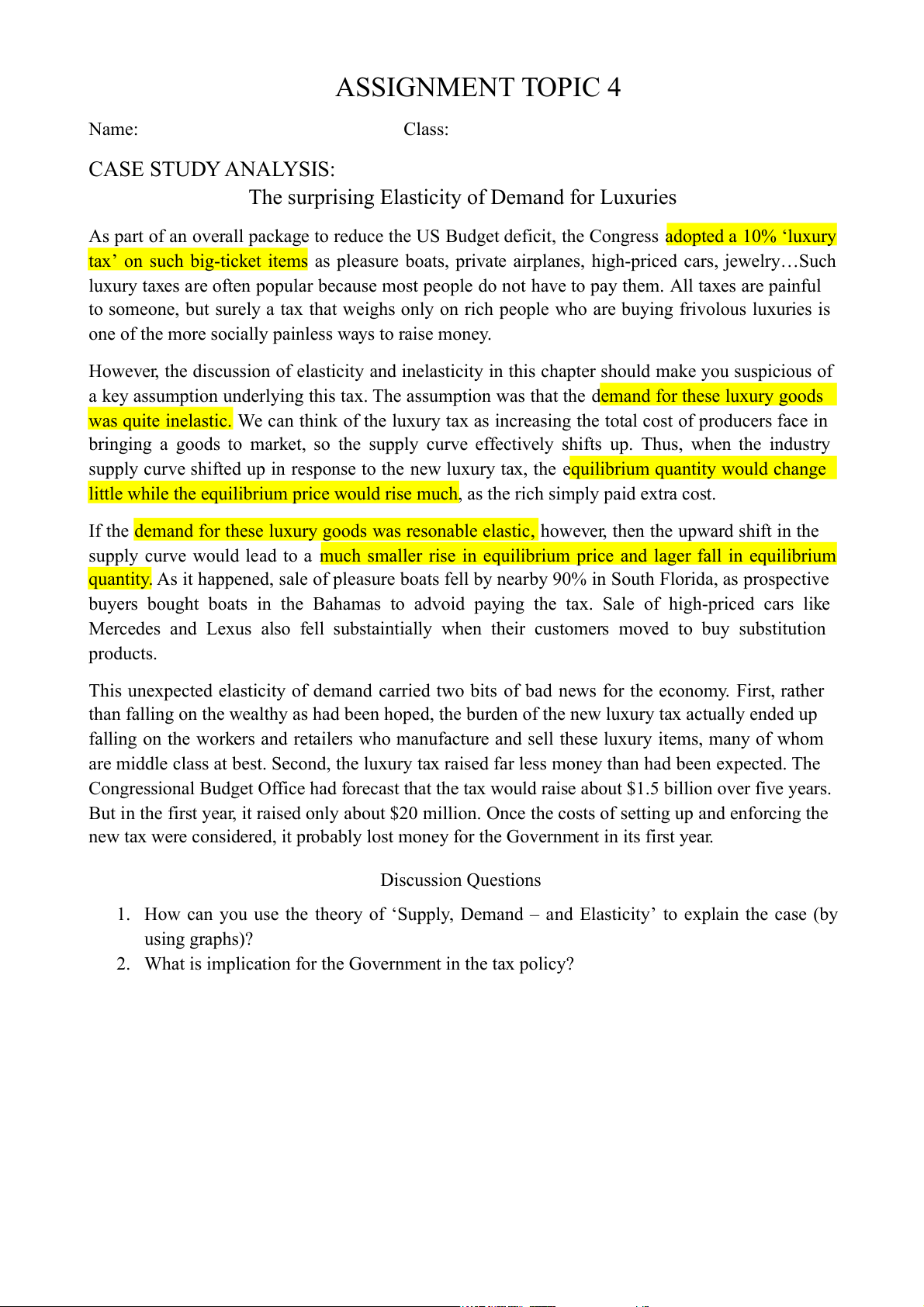
Case 1: The demand for luxury goods was quite inelastic. (Ed <1) -
Because the demand for luxury goods was quite inelastic, the demand curve is steep.
Therefore, when the 10% tax was adopted, it led to the significant increase (from PE to P ) 1
in the equilibrium price and the equilibrium quantity would change little (from QE to Q1). -
The rich were willing to pay for the extra cost, so the consumer’s tax incidence was more
than producer’s tax incidence. As a result, the price of luxury goods would increase, and the
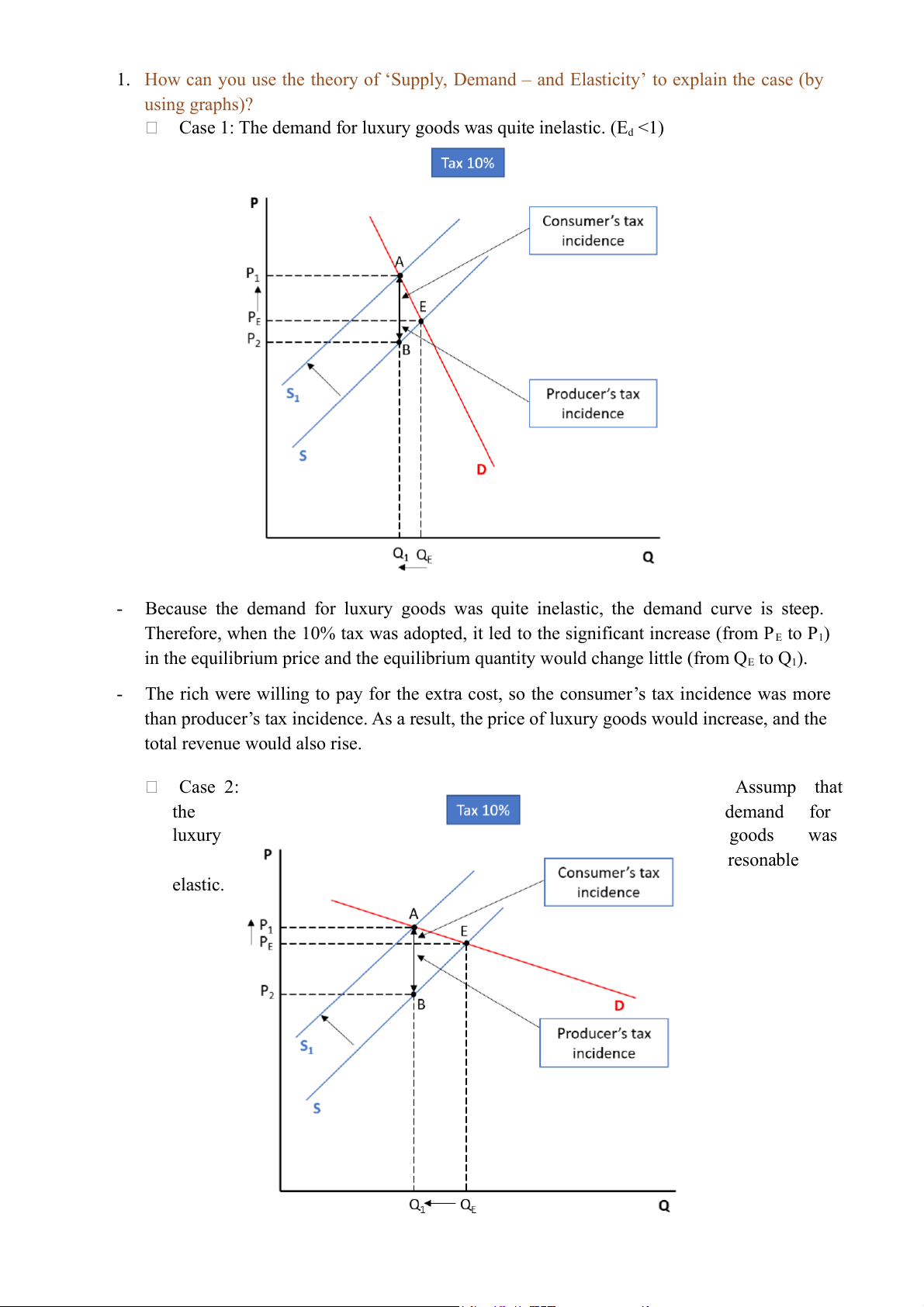
total revenue would also rise. Case 2: Assump that the demand for luxury goods was resonable elastic. -
As the demand for luxury products was resonable elastic, the demand curve is flat. For this
reason, the 10% tax led to the slight increase in the equilibrium price (from PE to P1) and the
equilibrium quantity fall larger than the equilibrium price (from QE to Q1). -
To advoid paying tax, potential buyers moved to buy substitution products. Therefore, the
consumer’s tax incidence would be less than producer’s tax incidence. As a result, rather
than falling on the wealthy as had been hoped, the burden of the new luxury tax actually
ended up falling on the workers and retailers who manufacture and sell these luxury items,
many of whom are middle class at best.
2. What is implication for the Government in the tax policy? -
The assumption of the elasticity of demand for these luxury goods is just a theoritical and
not true to reality. In fact, the price elasticity of demand of luxury goods is elastic, so it
cannot be case 1. To some extent, it also shows that the tax policy is unreasonable. -
The Congress adopted 10% “luxury tax” on such big-ticket items, which is extremely high.
When the price elasticity of demand for luxury goods is elastic, this will lead to the
decrease of the quantity supplied and then the total revenue will also fall. In that case, if
Congress adopt 10% luxury tax, it will be more detrimental to workers and retailers who
manufacture and sell these luxury items. Therefore, the Congress should have put lower tax or delete this tax. -
In addition, there are some solutions to advoid the negative effects of the taxation. 1. Anti-dumping
2. Raising the import duty to prevent consumers from buying the substitution products with lowers or no taxes
3. Setting import quota on certain luxury goods to benefit the local producers and workers
Tài liệu liên quan:
-
Tự Luận Vimo: Phân Tích Cung, Cầu và Thị Trường Cạnh Tranh| Microeconomics | Trường Đại học Quốc tế, Đại học Quốc gia Thành phố Hồ Chí Minh
5 3 -
Review Questions: Thinking Like an Economist | Microeconomics | Trường Đại học Quốc tế, Đại học Quốc gia Thành phố Hồ Chí Minh
5 3 -
Final Exam Quizlet Questions & Answers | Microeconomics | Trường Đại học Quốc tế, Đại học Quốc gia Thành phố Hồ Chí Minh
5 3 -

Đề thi giữa kỳ II | Microeconomics | Trường Đại học Quốc tế, Đại học Quốc gia Thành phố Hồ Chí Minh
5 3 -
Final Group Project_ The Beer Industry | Microeconomics | Trường Đại học Quốc tế, Đại học Quốc gia Thành phố Hồ Chí Minh
4 2