Bài tập Physics | Trường Đại học Quốc tế, Đại học Quốc gia Thành phố Hồ Chí Minh
Bài tập Physics | Trường Đại học Quốc tế, Đại học Quốc gia Thành phố Hồ Chí Minh. Tài liệu được sưu tầm giúp bạn tham khảo, ôn tập và đạt kết quả cao. Mời bạn đọc đón xem.
Môn: Fluid Mechanics Lab 8 tài liệu
Trường: Trường Đại học Quốc tế, Đại học Quốc gia Thành phố Hồ Chí Minh 2 K tài liệu
Tác giả:

Preview text:
HCMC Vietnam National University
Student Name: . . . . . . . . . . . . . . . . . . . . . . . . . . . . . . . International University
Student ID: . . . . . . . . . . . . . . . . . . . . . . . . . . . . . . . . . . QUESTIONS
Useful formulas: Ue = 1 kx2; J = ∆p = F Iω2; 2
avg ∆t; τnet = I α; ω = ω0 + αt; K = 1 2
Q1 (20 marks): A block of mass 1.5 kg slides on a frictionless horizontal surface with a speed
of 3.0 m/s and compresses a spring with a spring constant k = 600 N/m. Find the maximum
compression of the spring and the energy stored in the spring at maximum compression.
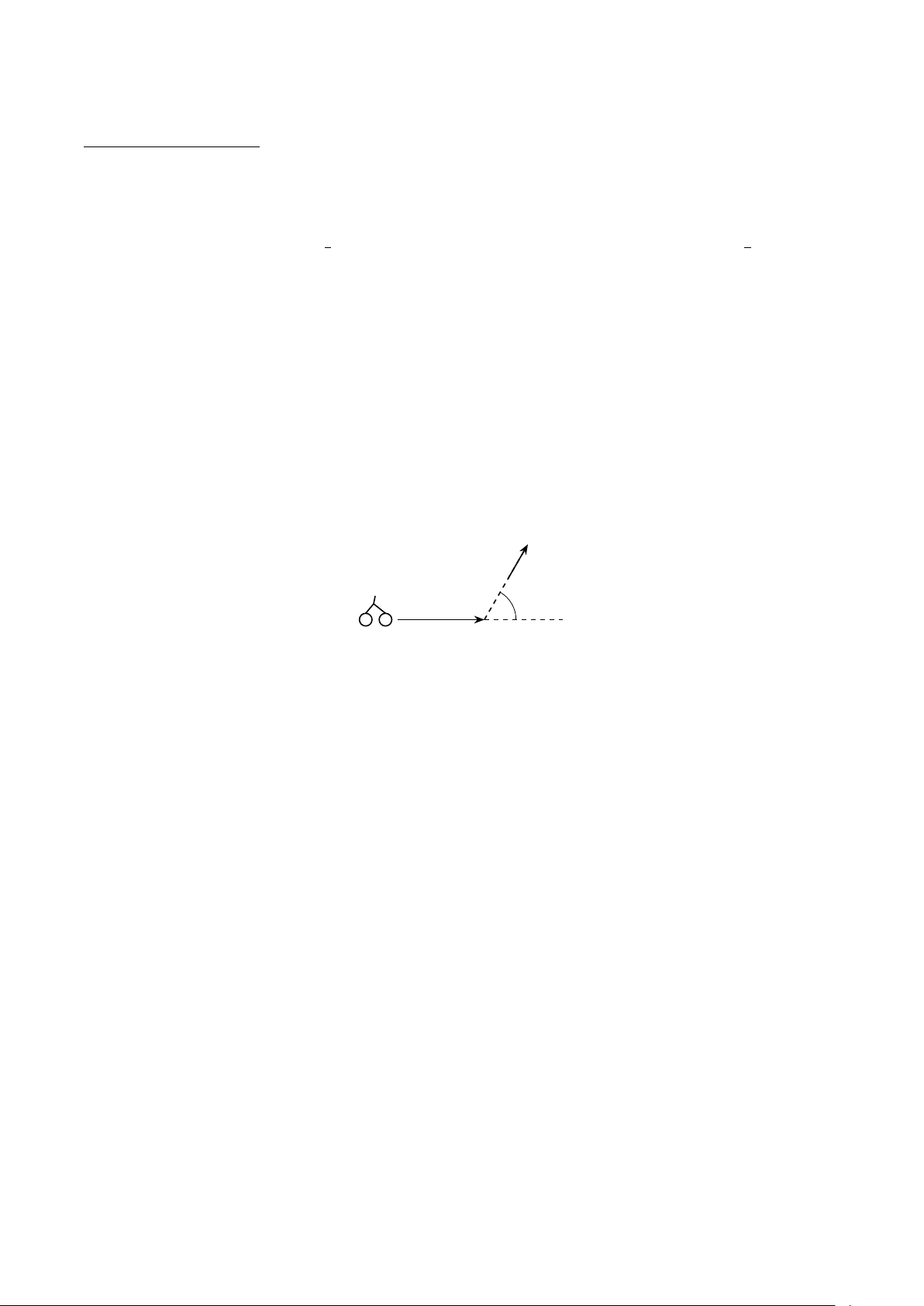
Q2 (20 marks): A 180-kg motorbike moving at speed of 12.0 m/s makes a 60◦ turn in 1.6 s
and emerges from the turn with speed of 6.0 m/s (Figure 1). During this turn:
a) Sketch the impulse vector acting on the motorbike and then determine the magnitude of the impulse J ;
b) Find the magnitude of the average force acting on the motorbike. 60◦ Figure 1
Q3 (20 marks): Two cars are traveling in the same direction on a horizontal road. The first
one has a mass of 1500 kg and is moving at 72 km/h when it collides with the other car of mass
2500 kg which is moving at 18 km/h. After the collision, the two cars stick together:
a) What is the final speed of the two cars after the collision?
b) How much kinetic energy is lost in the collision?
Q4 (20 marks): A solid disk of rotational inertia 6.0 kg.m2 is initially at rest. The disk accel-
erates under a constant torque of 12.0 N.m:
a) What is the angular acceleration of the disk?
b) What is the rotational kinetic energy of the disk at 4.0 s?
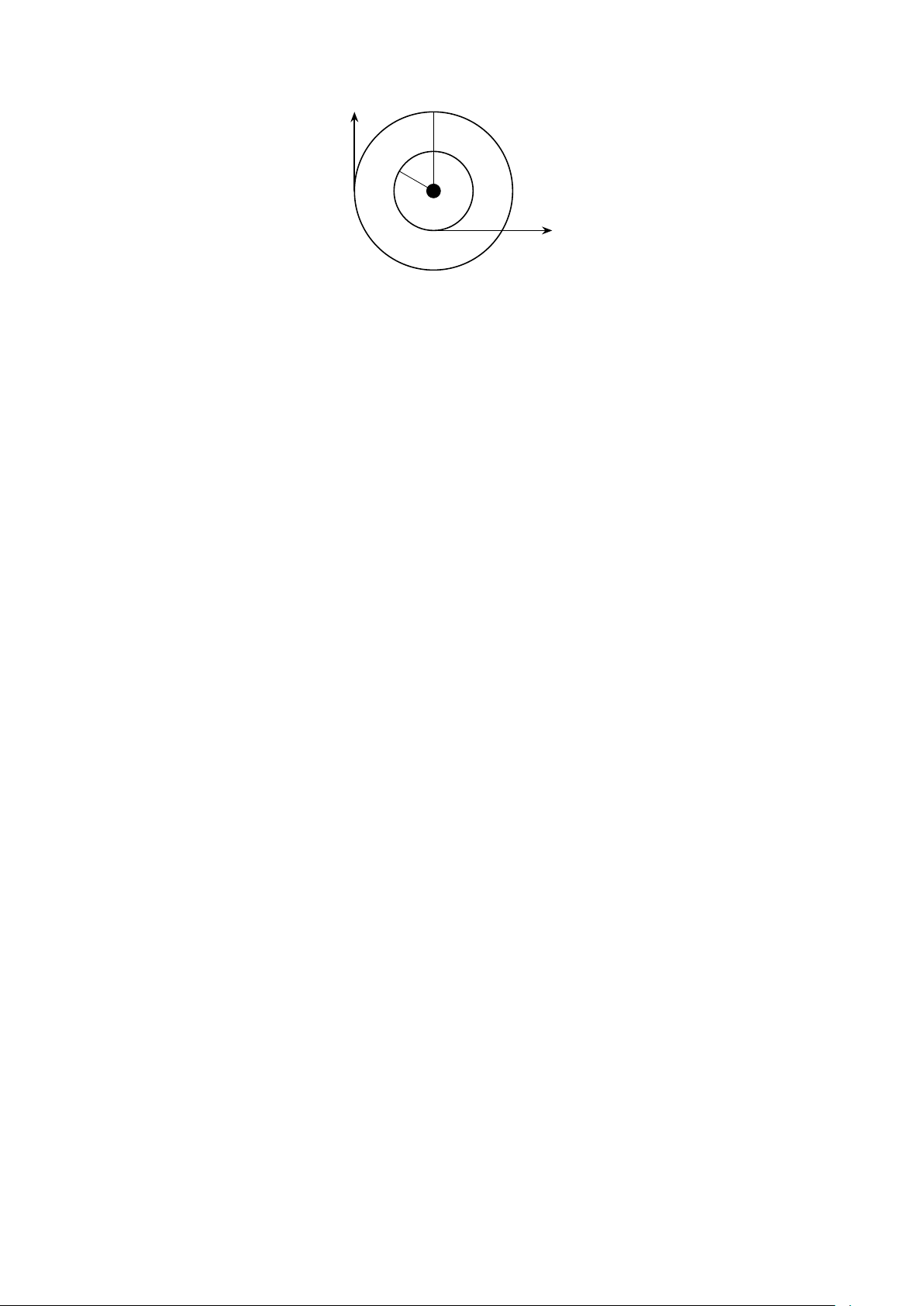
Q5 (20 marks): A pulley consisting of two concentric cylinders of radii r1 = 40 cm and r2 = 20
cm can rotate around the central axis ∆. Two forces F1 = 40 N and F2 = 100 N are applied
tangentially to two cylinders as shown in Figure 2.
a) What is the net torque acting on the pulley?
b) Find the angular acceleration of the pulley and the number of revolutions it makes after
20 s if the pulley starts from rest. The rotational inertia of the pulley is 3.2 kg.m2. 1 F1 r1 r2 ∆ F2 Figure 2 – END OF QUESTIONS – 2/2 2
Tài liệu liên quan:
-
Midterm Exam Môn Fluid Mechanics Lab | Trường Đại học Quốc tế, Đại học Quốc gia Thành phố Hồ Chí Minh
126 63 -
Lab Report: Fluid Friction Experiments and Analysis | Môn Fluid Mechanics Lab - Trường Đại học Quốc tế, Đại học Quốc gia Thành phố Hồ Chí Minh
116 58 -
Jet trajectory and flow through an orifice | Môn Fluid Mechanics Lab - Trường Đại học Quốc tế, Đại học Quốc gia Thành phố Hồ Chí Minh
121 61 -
Homework 1 Môn Fluid Mechanics Lab | Trường Đại học Quốc tế, Đại học Quốc gia Thành phố Hồ Chí Minh
125 63