Bylaws and Membership Guidelines Document | Phân tích thiết kế hệ thống | Trường Đại học Thủ Dầu Một
Support the mission and purpose of the RRCA 2. Organization members must promote equitable opportunities to membership and event participation and may not discriminate based on characteristics protected by local, state, or federal law 3. Pay RRCA dues promptly to be a member in good standing to receive benefits 4. Comply with RRCA bylaws, rules, policies and procedures governing membership 5. Tài liệu được sưu tầm và soạn thảo dưới dạng file PDF để gửi tới các bạn cùng tham khảo, ôn tập đầy đủ kiến thức, chuẩn bị cho các buổi học thật tốt. Mời bạn đọc đón xem!
Môn: Phân tích và thiết kế hệ thống 69 tài liệu
Trường: Trường Đại học Thủ Dầu Một 243 tài liệu
Tác giả:

Preview text:
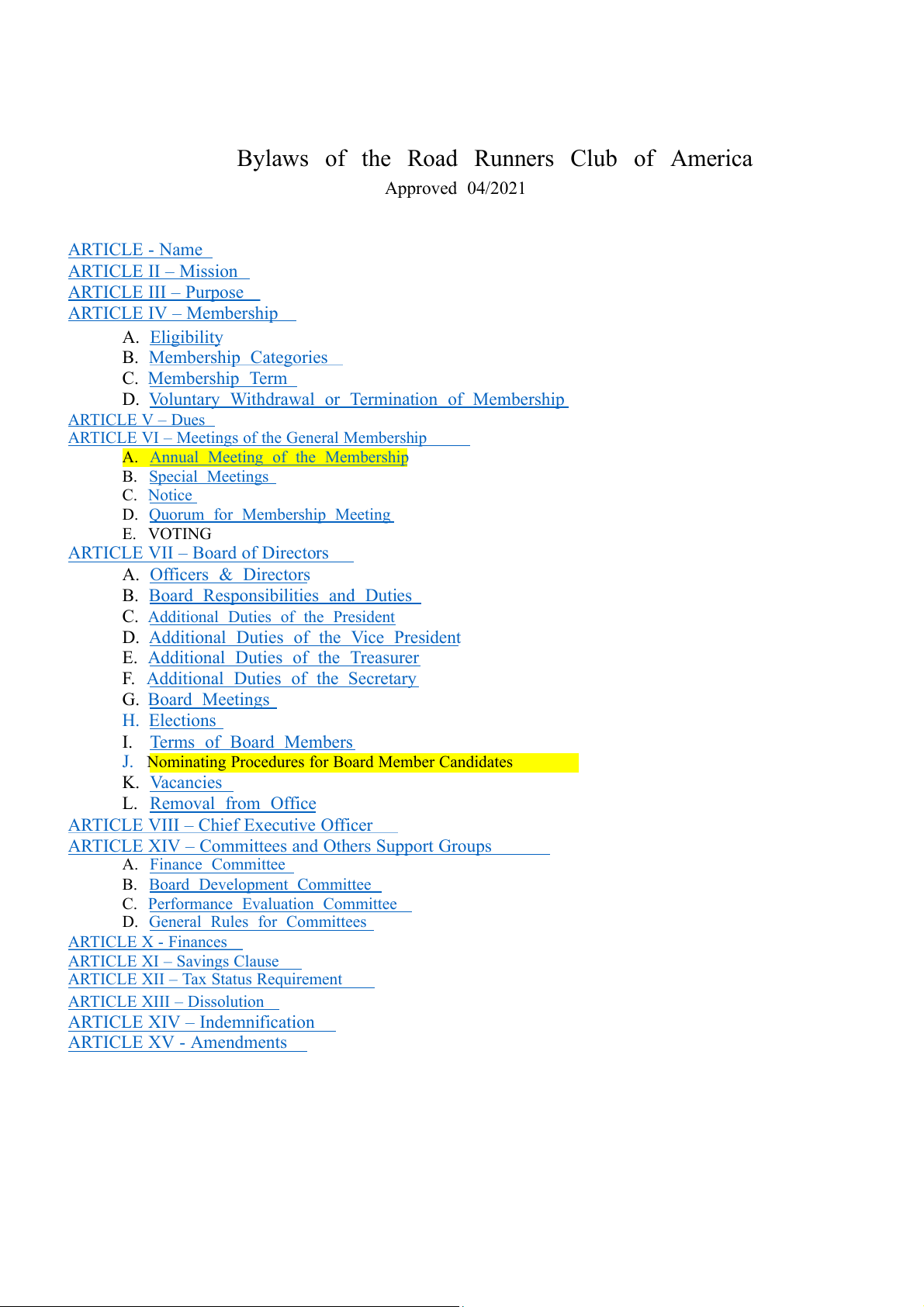
Bylaws of the Road Runners Club of America Approved 04/2021
ARTICLE - Name
ARTICLE II – Mission
ARTICLE III – Purpose
ARTICLE IV – Membership A. Eligibility B. Membership Categories C. Membership Term D. V
oluntary Withdrawal or Termination of Membership
ARTICLE V – Dues
ARTICLE VI – Meetings of the General Membership A. Annual Meeting of the Membership B. Special Meetings C. Notice D. Quorum for Membership Meeting E. VOTING
ARTICLE VII – Board of Directors A. Of ficers & Directors B. Board Responsibilities and Duties C. Additional Duties of the President D. Additional Duties of the Vice President E. Additional Duties of the Treasurer F. Additional Duties of the Secretary G. Board Meetings H. Elections I. T erms of Board Members
J. Nominating Procedures for Board Member Candidates K. Vacancies L. Removal from Office
ARTICLE VIII – Chief Executive Officer
ARTICLE XIV – Committees and Others Support Groups A. Finance Committee
B. Board Development Committee
C. Performance Evaluation Committee D. General Rules for Committees
ARTICLE X - Finances
ARTICLE XI – Savings Clause
ARTICLE XII – Tax Status Requirement
ARTICLE XIII – Dissolution
ARTICLE XIV – Indemnification
ARTICLE XV - Amendments
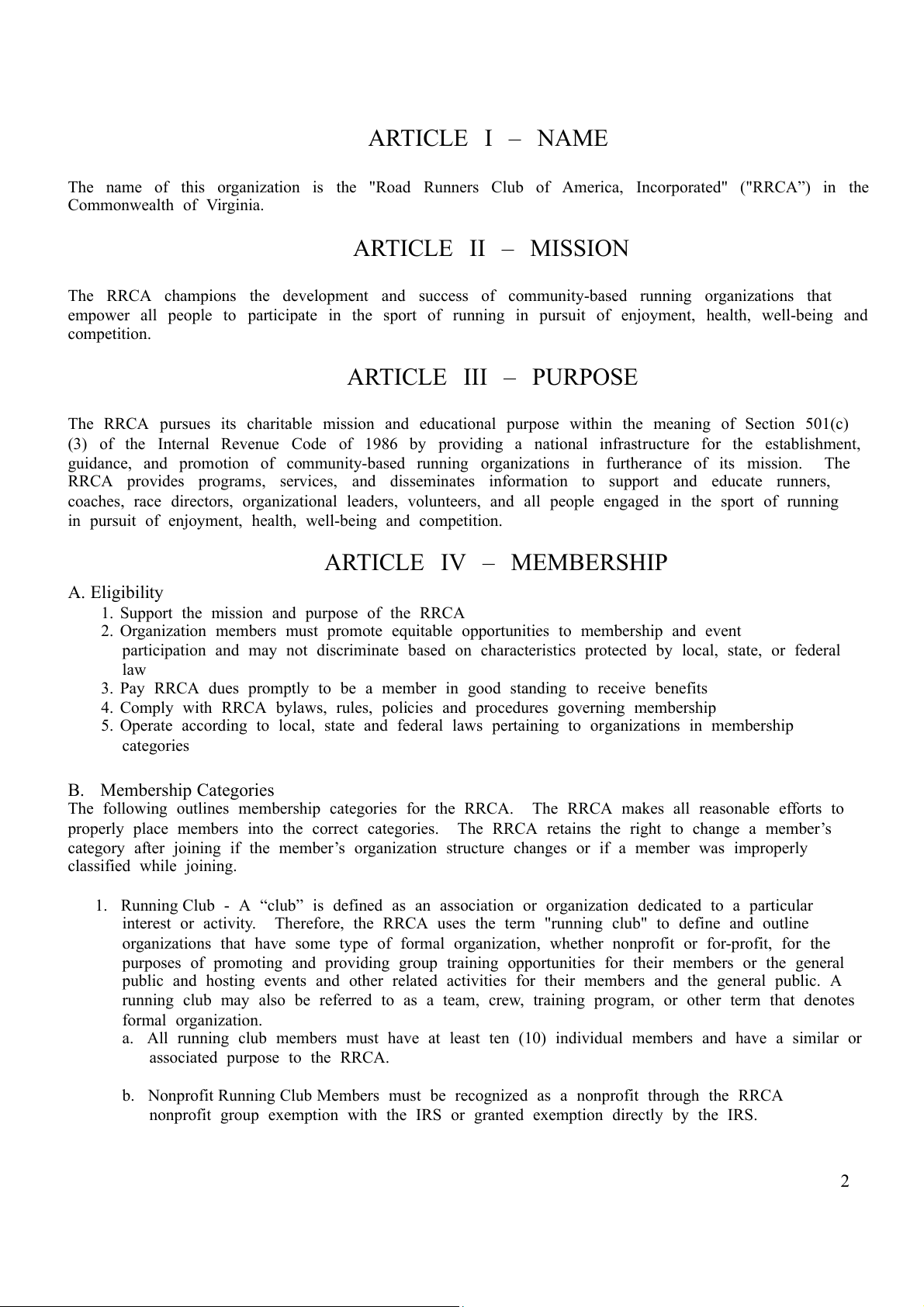
ARTICLE I – NAME
The name of this organization is the "Road Runners Club of America, Incorporated" ("RRCA”) in the Commonwealth of Virginia.
ARTICLE II – MISSION
The RRCA champions the development and success of community-based running organizations that
empower all people to participate in the sport of running in pursuit of enjoyment, health, well-being and competition.
ARTICLE III – PURPOSE
The RRCA pursues its charitable mission and educational purpose within the meaning of Section 501(c)
(3) of the Internal Revenue Code of 1986 by providing a national infrastructure for the establishment,
guidance, and promotion of community-based running organizations in furtherance of its mission. The
RRCA provides programs, services, and disseminates information to support and educate runners,
coaches, race directors, organizational leaders, volunteers, and all people engaged in the sport of running
in pursuit of enjoyment, health, well-being and competition.
ARTICLE IV – MEMBERSHIP A. Eligibility
1. Support the mission and purpose of the RRCA
2. Organization members must promote equitable opportunities to membership and event
participation and may not discriminate based on characteristics protected by local, state, or federal law
3. Pay RRCA dues promptly to be a member in good standing to receive benefits
4. Comply with RRCA bylaws, rules, policies and procedures governing membership
5. Operate according to local, state and federal laws pertaining to organizations in membership categories
B. Membership Categories
The following outlines membership categories for the RRCA. The RRCA makes all reasonable efforts to
properly place members into the correct categories. The RRCA retains the right to change a member’s
category after joining if the member’s organization structure changes or if a member was improperly classified while joining.
1. Running Club - A “club” is defined as an association or organization dedicated to a particular
interest or activity. Therefore, the RRCA uses the term "running club" to define and outline
organizations that have some type of formal organization, whether nonprofit or for-profit, for the
purposes of promoting and providing group training opportunities for their members or the general
public and hosting events and other related activities for their members and the general public. A
running club may also be referred to as a team, crew, training program, or other term that denotes formal organization.
a. All running club members must have at least ten (10) individual members and have a similar or
associated purpose to the RRCA.
b. Nonprofit Running Club Members must be recognized as a nonprofit through the RRCA
nonprofit group exemption with the IRS or granted exemption directly by the IRS. 2
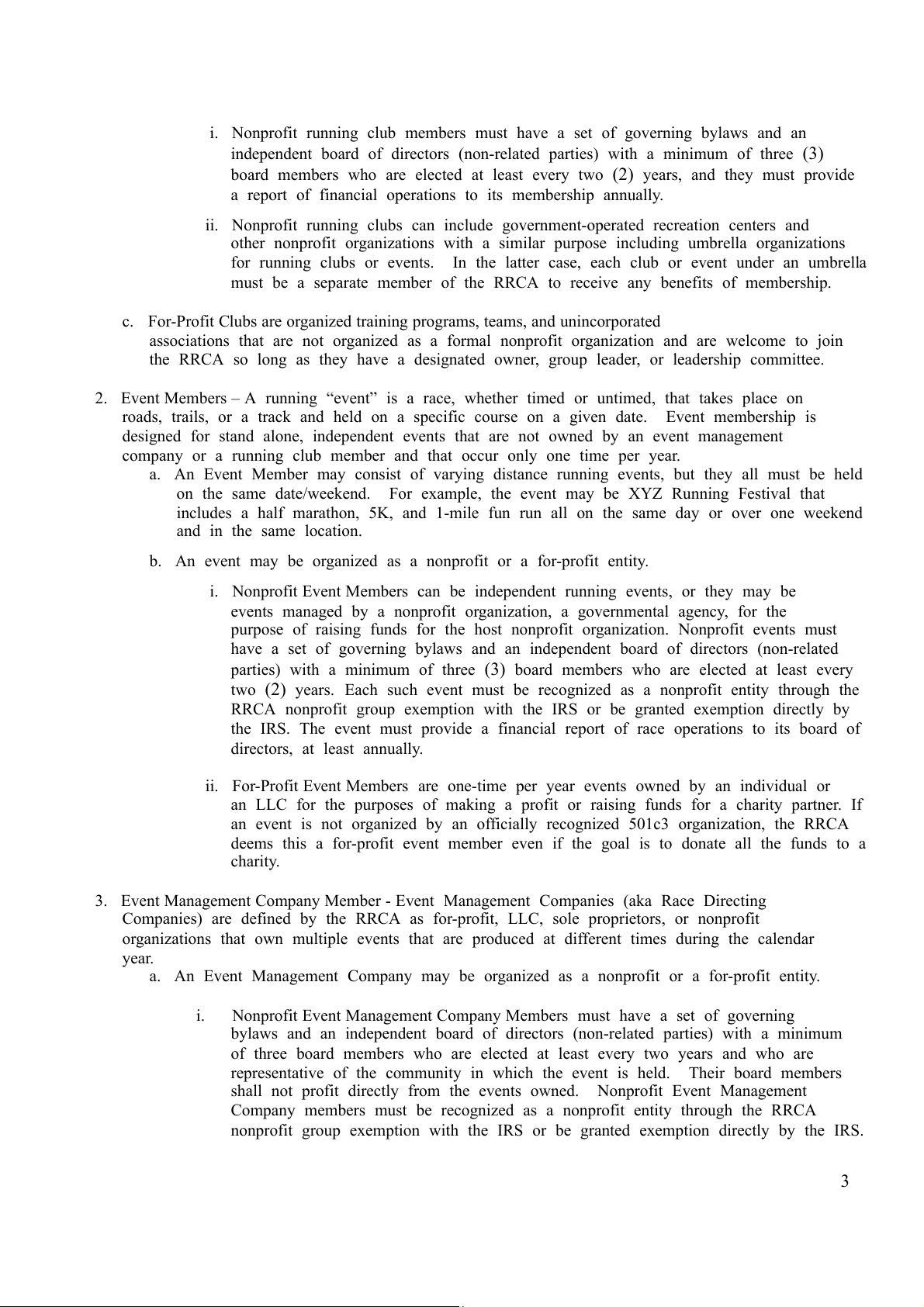
i. Nonprofit running club members must have a set of governing bylaws and an
independent board of directors (non-related parties) with a minimum of three (3)
board members who are elected at least every two (2) years, and they must provide
a report of financial operations to its membership annually.
ii. Nonprofit running clubs can include government-operated recreation centers and
other nonprofit organizations with a similar purpose including umbrella organizations
for running clubs or events. In the latter case, each club or event under an umbrella
must be a separate member of the RRCA to receive any benefits of membership.
c. For-Profit Clubs are organized training programs, teams, and unincorporated
associations that are not organized as a formal nonprofit organization and are welcome to join
the RRCA so long as they have a designated owner, group leader, or leadership committee.
2. Event Members – A running “event” is a race, whether timed or untimed, that takes place on
roads, trails, or a track and held on a specific course on a given date. Event membership is
designed for stand alone, independent events that are not owned by an event management
company or a running club member and that occur only one time per year.
a. An Event Member may consist of varying distance running events, but they all must be held
on the same date/weekend. For example, the event may be XYZ Running Festival that
includes a half marathon, 5K, and 1-mile fun run all on the same day or over one weekend and in the same location.
b. An event may be organized as a nonprofit or a for-profit entity.
i. Nonprofit Event Members can be independent running events, or they may be
events managed by a nonprofit organization, a governmental agency, for the
purpose of raising funds for the host nonprofit organization. Nonprofit events must
have a set of governing bylaws and an independent board of directors (non-related
parties) with a minimum of three (3) board members who are elected at least every
two (2) years. Each such event must be recognized as a nonprofit entity through the
RRCA nonprofit group exemption with the IRS or be granted exemption directly by
the IRS. The event must provide a financial report of race operations to its board of directors, at least annually.
ii. For-Profit Event Members are one-time per year events owned by an individual or
an LLC for the purposes of making a profit or raising funds for a charity partner. If
an event is not organized by an officially recognized 501c3 organization, the RRCA
deems this a for-profit event member even if the goal is to donate all the funds to a charity.
3. Event Management Company Member - Event Management Companies (aka Race Directing
Companies) are defined by the RRCA as for-profit, LLC, sole proprietors, or nonprofit
organizations that own multiple events that are produced at different times during the calendar
year.a. An Event Management Company may be organized as a nonprofit or a for-profit entity. i.
Nonprofit Event Management Company Members must have a set of governing
bylaws and an independent board of directors (non-related parties) with a minimum
of three board members who are elected at least every two years and who are
representative of the community in which the event is held. Their board members
shall not profit directly from the events owned. Nonprofit Event Management
Company members must be recognized as a nonprofit entity through the RRCA
nonprofit group exemption with the IRS or be granted exemption directly by the IRS. 3
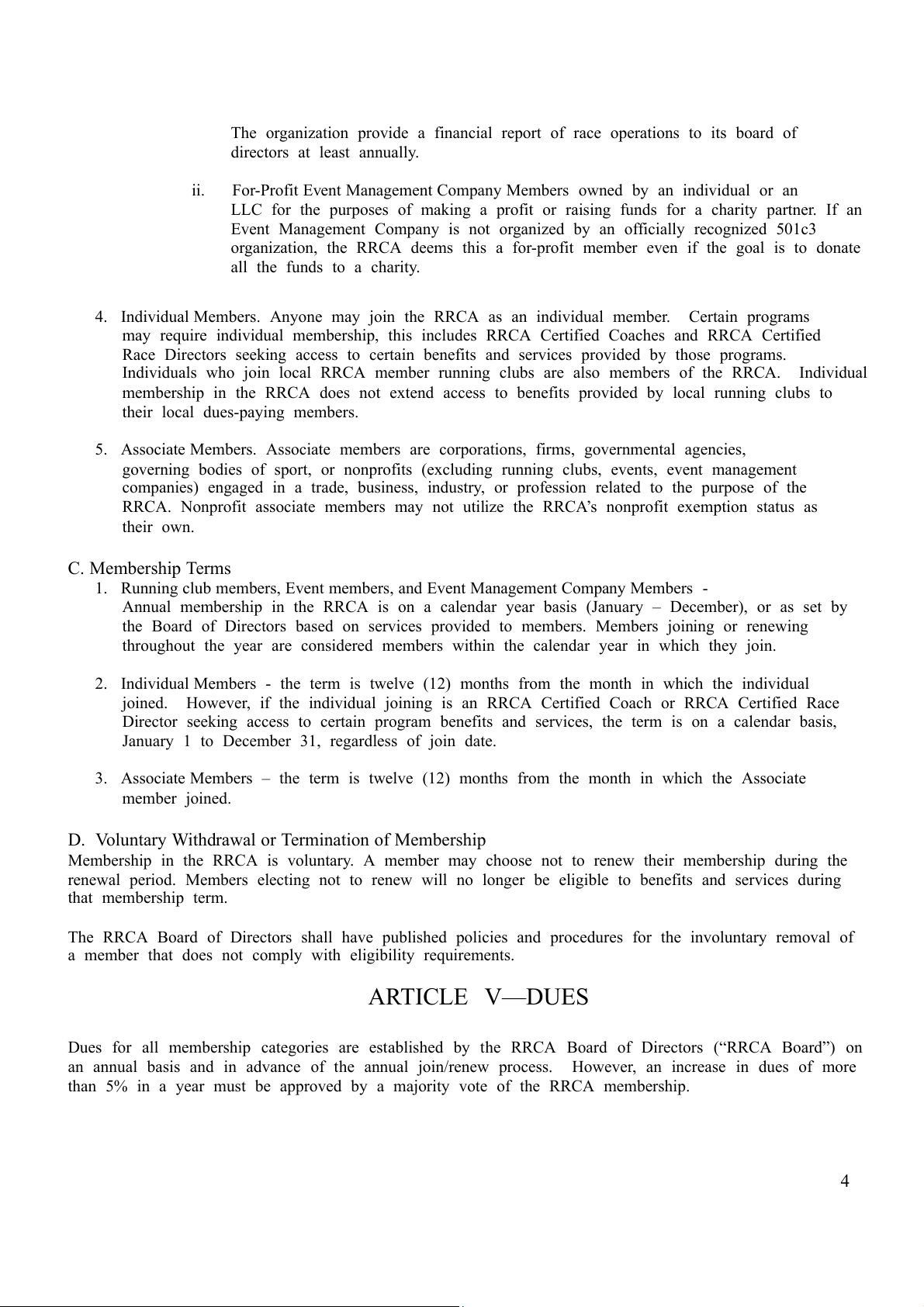
The organization provide a financial report of race operations to its board of directors at least annually. ii.
For-Profit Event Management Company Members owned by an individual or an
LLC for the purposes of making a profit or raising funds for a charity partner. If an
Event Management Company is not organized by an officially recognized 501c3
organization, the RRCA deems this a for-profit member even if the goal is to donate all the funds to a charity.
4. Individual Members. Anyone may join the RRCA as an individual member. Certain programs
may require individual membership, this includes RRCA Certified Coaches and RRCA Certified
Race Directors seeking access to certain benefits and services provided by those programs.
Individuals who join local RRCA member running clubs are also members of the RRCA. Individual
membership in the RRCA does not extend access to benefits provided by local running clubs to
their local dues-paying members.
5. Associate Members. Associate members are corporations, firms, governmental agencies,
governing bodies of sport, or nonprofits (excluding running clubs, events, event management
companies) engaged in a trade, business, industry, or profession related to the purpose of the
RRCA. Nonprofit associate members may not utilize the RRCA’s nonprofit exemption status as their own.
C. Membership Terms
1. Running club members, Event members, and Event Management Company Members -
Annual membership in the RRCA is on a calendar year basis (January – December), or as set by
the Board of Directors based on services provided to members. Members joining or renewing
throughout the year are considered members within the calendar year in which they join.
2. Individual Members - the term is twelve (12) months from the month in which the individual
joined. However, if the individual joining is an RRCA Certified Coach or RRCA Certified Race
Director seeking access to certain program benefits and services, the term is on a calendar basis,
January 1 to December 31, regardless of join date.
3. Associate Members – the term is twelve (12) months from the month in which the Associate member joined.
D. Voluntary Withdrawal or Termination of Membership
Membership in the RRCA is voluntary. A member may choose not to renew their membership during the
renewal period. Members electing not to renew will no longer be eligible to benefits and services during that membership term.
The RRCA Board of Directors shall have published policies and procedures for the involuntary removal of
a member that does not comply with eligibility requirements. ARTICLE V—DUES
Dues for all membership categories are established by the RRCA Board of Directors (“RRCA Board”) on
an annual basis and in advance of the annual join/renew process. However, an increase in dues of more
than 5% in a year must be approved by a majority vote of the RRCA membership. 4
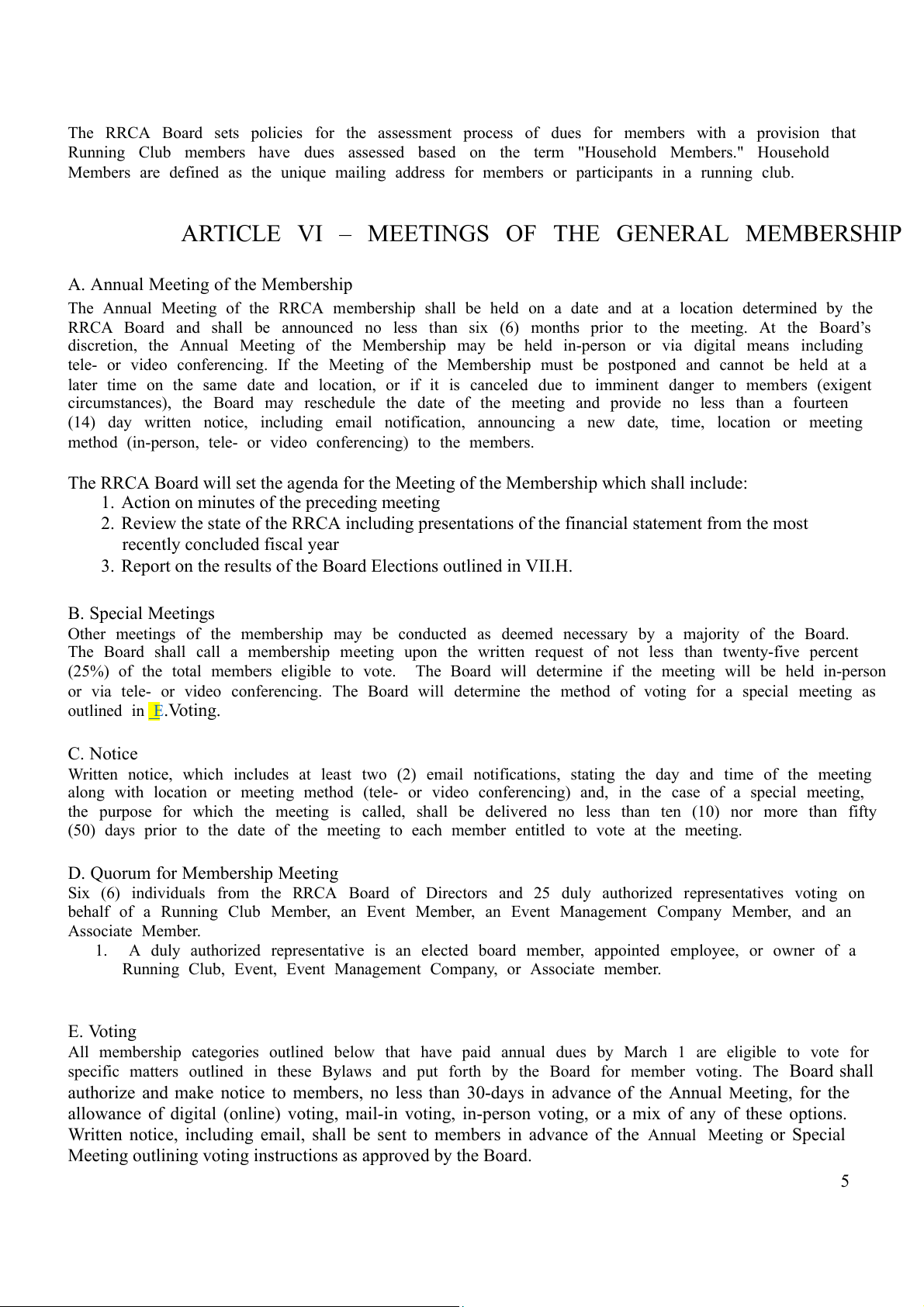
The RRCA Board sets policies for the assessment process of dues for members with a provision that
Running Club members have dues assessed based on the term "Household Members." Household
Members are defined as the unique mailing address for members or participants in a running club.
ARTICLE VI – MEETINGS OF THE GENERAL MEMBERSHIP
A. Annual Meeting of the Membership
The Annual Meeting of the RRCA membership shall be held on a date and at a location determined by the
RRCA Board and shall be announced no less than six (6) months prior to the meeting. At the Board’s
discretion, the Annual Meeting of the Membership may be held in-person or via digital means including
tele- or video conferencing. If the Meeting of the Membership must be postponed and cannot be held at a
later time on the same date and location, or if it is canceled due to imminent danger to members (exigent
circumstances), the Board may reschedule the date of the meeting and provide no less than a fourteen
(14) day written notice, including email notification, announcing a new date, time, location or meeting
method (in-person, tele- or video conferencing) to the members.
The RRCA Board will set the agenda for the Meeting of the Membership which shall include:
1. Action on minutes of the preceding meeting
2. Review the state of the RRCA including presentations of the financial statement from the most recently concluded fiscal year
3. Report on the results of the Board Elections outlined in VII.H.
B. Special Meetings
Other meetings of the membership may be conducted as deemed necessary by a majority of the Board.
The Board shall call a membership meeting upon the written request of not less than twenty-five percent
(25%) of the total members eligible to vote. The Board will determine if the meeting will be held in-person
or via tele- or video conferencing. The Board will determine the method of voting for a special meeting as outlined in E.Voting. C. Notice
Written notice, which includes at least two (2) email notifications, stating the day and time of the meeting
along with location or meeting method (tele- or video conferencing) and, in the case of a special meeting,
the purpose for which the meeting is called, shall be delivered no less than ten (10) nor more than fifty
(50) days prior to the date of the meeting to each member entitled to vote at the meeting.
D. Quorum for Membership Meeting
Six (6) individuals from the RRCA Board of Directors and 25 duly authorized representatives voting on
behalf of a Running Club Member, an Event Member, an Event Management Company Member, and an Associate Member.
1. A duly authorized representative is an elected board member, appointed employee, or owner of a
Running Club, Event, Event Management Company, or Associate member. E. Voting
All membership categories outlined below that have paid annual dues by March 1 are eligible to vote for
specific matters outlined in these Bylaws and put forth by the Board for member voting. The Board shall
authorize and make notice to members, no less than 30-days in advance of the Annual Meeting, for the
allowance of digital (online) voting, mail-in voting, in-person voting, or a mix of any of these options.
Written notice, including email, shall be sent to members in advance of the Annual Meeting or Special
Meeting outlining voting instructions as approved by the Board. 5
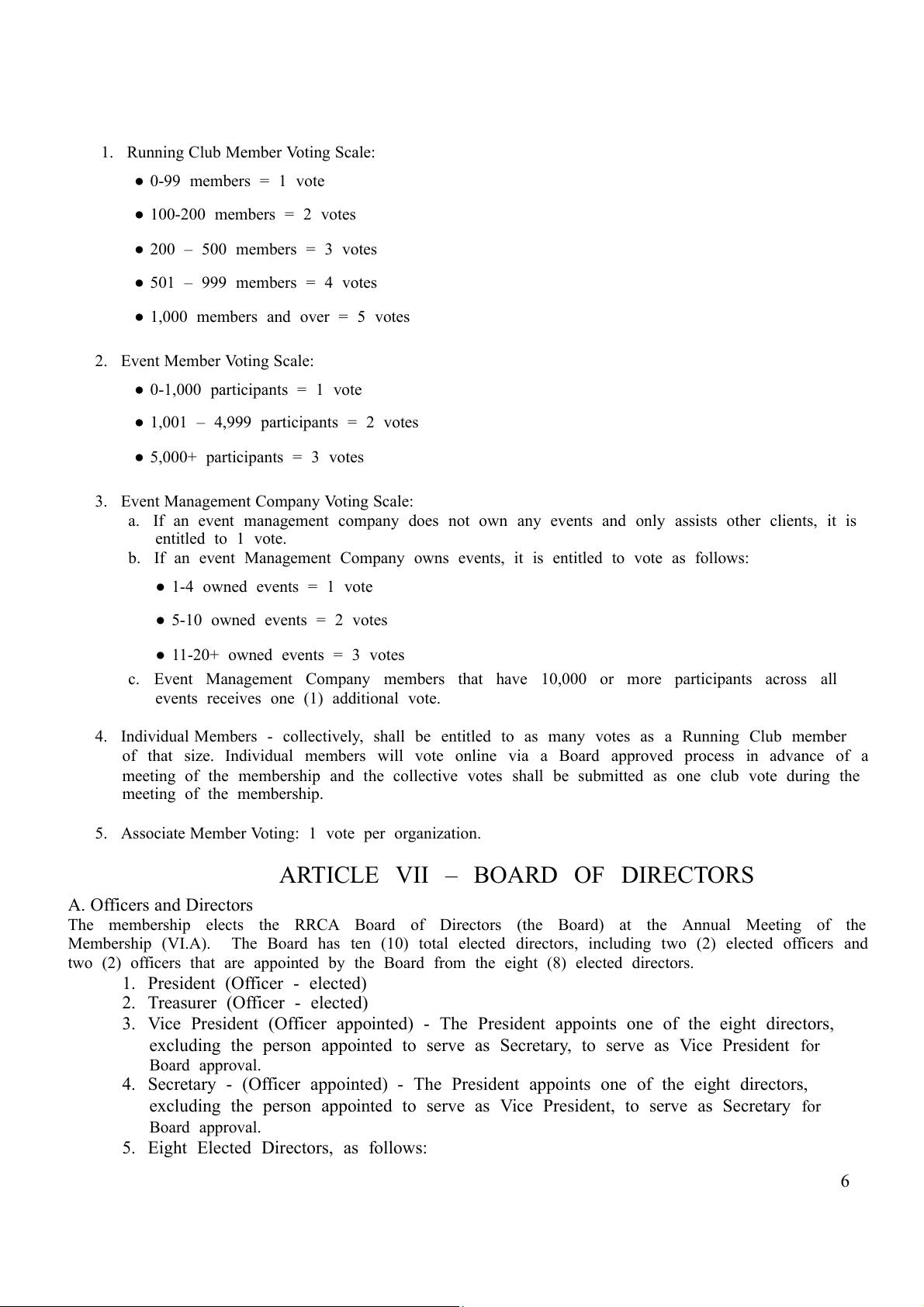
1. Running Club Member Voting Scale: ● 0-99 members = 1 vote ● 100-200 members = 2 votes
● 200 – 500 members = 3 votes
● 501 – 999 members = 4 votes
● 1,000 members and over = 5 votes
2. Event Member Voting Scale:
● 0-1,000 participants = 1 vote
● 1,001 – 4,999 participants = 2 votes
● 5,000+ participants = 3 votes
3. Event Management Company Voting Scale:
a. If an event management company does not own any events and only assists other clients, it is entitled to 1 vote.
b. If an event Management Company owns events, it is entitled to vote as follows: ● 1-4 owned events = 1 vote
● 5-10 owned events = 2 votes
● 11-20+ owned events = 3 votes
c. Event Management Company members that have 10,000 or more participants across all
events receives one (1) additional vote.
4. Individual Members - collectively, shall be entitled to as many votes as a Running Club member
of that size. Individual members will vote online via a Board approved process in advance of a
meeting of the membership and the collective votes shall be submitted as one club vote during the meeting of the membership.
5. Associate Member Voting: 1 vote per organization.
ARTICLE VII – BOARD OF DIRECTORS
A. Officers and Directors
The membership elects the RRCA Board of Directors (the Board) at the Annual Meeting of the
Membership (VI.A). The Board has ten (10) total elected directors, including two (2) elected officers and
two (2) officers that are appointed by the Board from the eight (8) elected directors.
1. President (Officer - elected)
2. Treasurer (Officer - elected)
3. Vice President (Officer appointed) - The President appoints one of the eight directors,
excluding the person appointed to serve as Secretary, to serve as Vice President for Board approval.
4. Secretary - (Officer appointed) - The President appoints one of the eight directors,
excluding the person appointed to serve as Vice President, to serve as Secretary for Board approval.
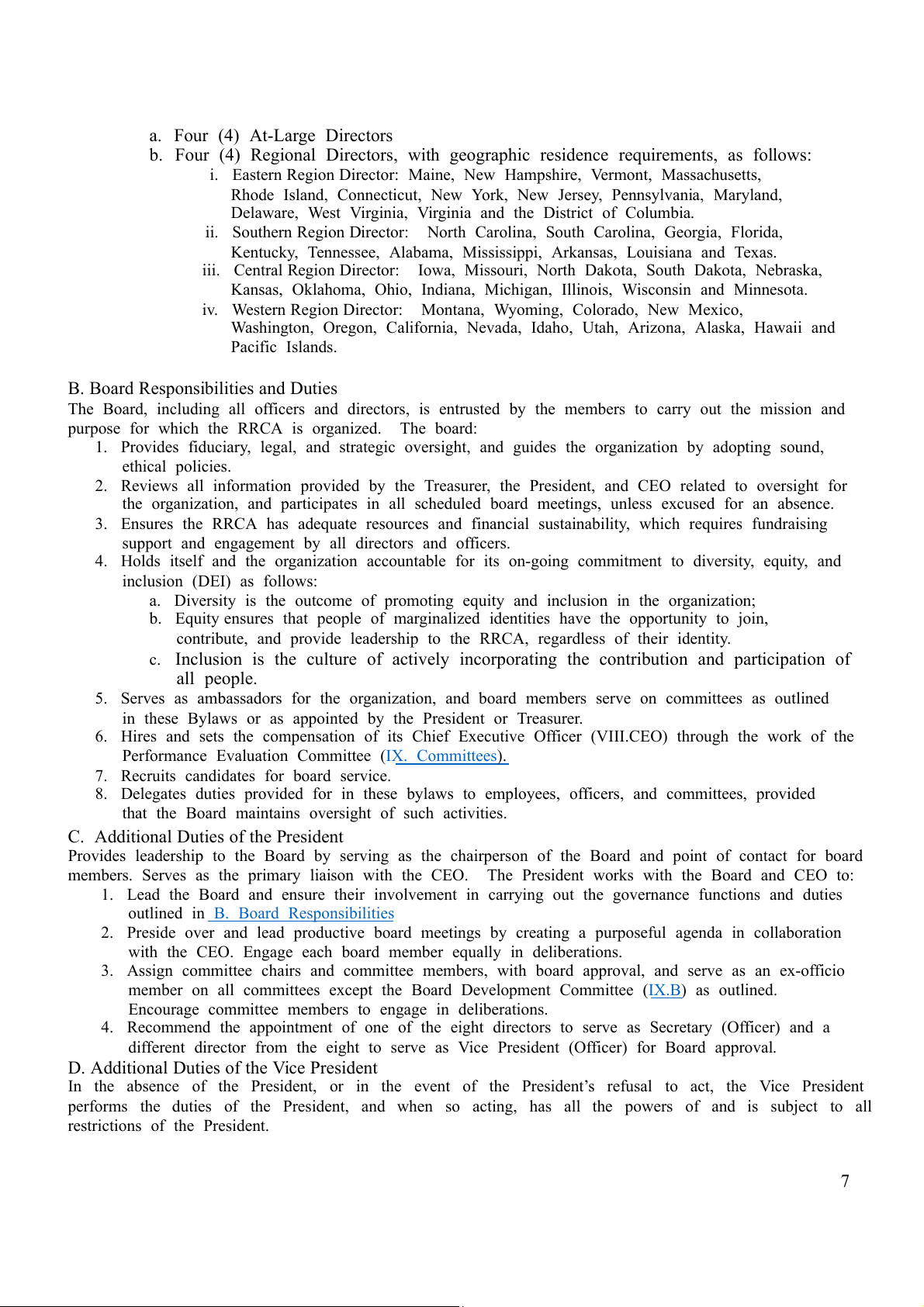
5. Eight Elected Directors, as follows: 6 a. Four (4) At-Large Directors
b. Four (4) Regional Directors, with geographic residence requirements, as follows:
i. Eastern Region Director: Maine, New Hampshire, Vermont, Massachusetts,
Rhode Island, Connecticut, New York, New Jersey, Pennsylvania, Maryland,
Delaware, West Virginia, Virginia and the District of Columbia.
ii. Southern Region Director: North Carolina, South Carolina, Georgia, Florida,
Kentucky, Tennessee, Alabama, Mississippi, Arkansas, Louisiana and Texas.
iii. Central Region Director: Iowa, Missouri, North Dakota, South Dakota, Nebraska,
Kansas, Oklahoma, Ohio, Indiana, Michigan, Illinois, Wisconsin and Minnesota.
iv. Western Region Director: Montana, Wyoming, Colorado, New Mexico,
Washington, Oregon, California, Nevada, Idaho, Utah, Arizona, Alaska, Hawaii and Pacific Islands.
B. Board Responsibilities and Duties
The Board, including all officers and directors, is entrusted by the members to carry out the mission and
purpose for which the RRCA is organized. The board:
1. Provides fiduciary, legal, and strategic oversight, and guides the organization by adopting sound, ethical policies.
2. Reviews all information provided by the Treasurer, the President, and CEO related to oversight for
the organization, and participates in all scheduled board meetings, unless excused for an absence.
3. Ensures the RRCA has adequate resources and financial sustainability, which requires fundraising
support and engagement by all directors and officers.
4. Holds itself and the organization accountable for its on-going commitment to diversity, equity, and inclusion (DEI) as follows:
a. Diversity is the outcome of promoting equity and inclusion in the organization;
b. Equity ensures that people of marginalized identities have the opportunity to join,
contribute, and provide leadership to the RRCA, regardless of their identity.
c. Inclusion is the culture of actively incorporating the contribution and participation of all people.
5. Serves as ambassadors for the organization, and board members serve on committees as outlined
in these Bylaws or as appointed by the President or Treasurer.
6. Hires and sets the compensation of its Chief Executive Officer (VIII.CEO) through the work of the
Performance Evaluation Committee (IX. Committees).
7. Recruits candidates for board service.
8. Delegates duties provided for in these bylaws to employees, officers, and committees, provided
that the Board maintains oversight of such activities.
C. Additional Duties of the President
Provides leadership to the Board by serving as the chairperson of the Board and point of contact for board
members. Serves as the primary liaison with the CEO. The President works with the Board and CEO to:
1. Lead the Board and ensure their involvement in carrying out the governance functions and duties
outlined in B. Board Responsibilities
2. Preside over and lead productive board meetings by creating a purposeful agenda in collaboration
with the CEO. Engage each board member equally in deliberations.
3. Assign committee chairs and committee members, with board approval, and serve as an ex-officio
member on all committees except the Board Development Committee (IX.B) as outlined.
Encourage committee members to engage in deliberations.
4. Recommend the appointment of one of the eight directors to serve as Secretary (Officer) and a
different director from the eight to serve as Vice President (Officer) for Board approval.
D. Additional Duties of the Vice President
In the absence of the President, or in the event of the President’s refusal to act, the Vice President
performs the duties of the President, and when so acting, has all the powers of and is subject to all
restrictions of the President. 7
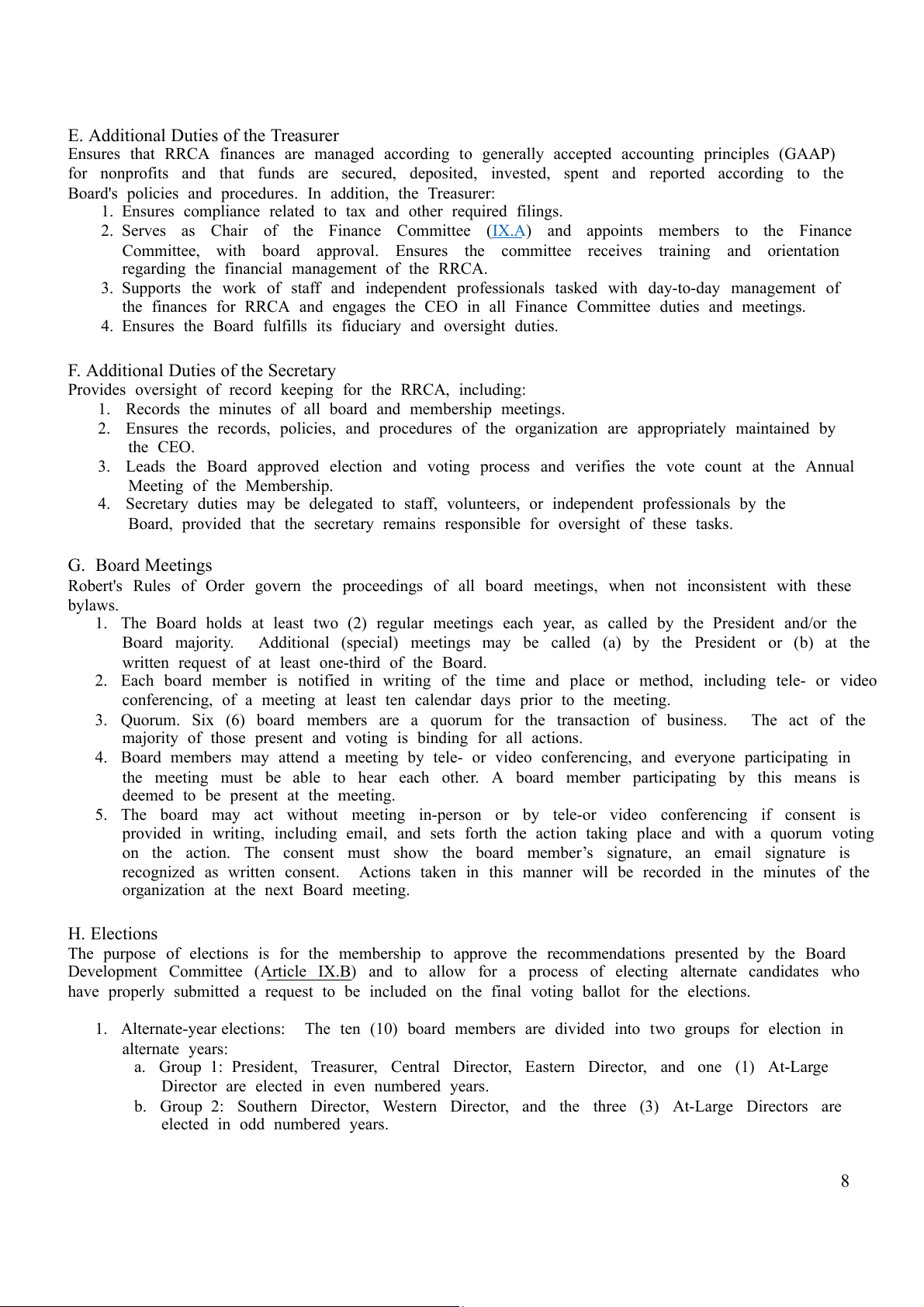
E. Additional Duties of the Treasurer
Ensures that RRCA finances are managed according to generally accepted accounting principles (GAAP)
for nonprofits and that funds are secured, deposited, invested, spent and reported according to the
Board's policies and procedures. In addition, the Treasurer:
1. Ensures compliance related to tax and other required filings.
2. Serves as Chair of the Finance Committee ( )
IX.A and appoints members to the Finance
Committee, with board approval. Ensures the committee receives training and orientation
regarding the financial management of the RRCA.
3. Supports the work of staff and independent professionals tasked with day-to-day management of
the finances for RRCA and engages the CEO in all Finance Committee duties and meetings.
4. Ensures the Board fulfills its fiduciary and oversight duties.
F. Additional Duties of the Secretary
Provides oversight of record keeping for the RRCA, including:
1. Records the minutes of all board and membership meetings.
2. Ensures the records, policies, and procedures of the organization are appropriately maintained by the CEO.
3. Leads the Board approved election and voting process and verifies the vote count at the Annual Meeting of the Membership.
4. Secretary duties may be delegated to staff, volunteers, or independent professionals by the
Board, provided that the secretary remains responsible for oversight of these tasks.
G. Board Meetings
Robert's Rules of Order govern the proceedings of all board meetings, when not inconsistent with these bylaws.
1. The Board holds at least two (2) regular meetings each year, as called by the President and/or the
Board majority. Additional (special) meetings may be called (a) by the President or (b) at the
written request of at least one-third of the Board.
2. Each board member is notified in writing of the time and place or method, including tele- or video
conferencing, of a meeting at least ten calendar days prior to the meeting.
3. Quorum. Six (6) board members are a quorum for the transaction of business. The act of the
majority of those present and voting is binding for all actions.
4. Board members may attend a meeting by tele- or video conferencing, and everyone participating in
the meeting must be able to hear each other. A board member participating by this means is
deemed to be present at the meeting.
5. The board may act without meeting in-person or by tele-or video conferencing if consent is
provided in writing, including email, and sets forth the action taking place and with a quorum voting
on the action. The consent must show the board member’s signature, an email signature is
recognized as written consent. Actions taken in this manner will be recorded in the minutes of the
organization at the next Board meeting. H. Elections
The purpose of elections is for the membership to approve the recommendations presented by the Board
Development Committee (Article IX.B) and to allow for a process of electing alternate candidates who
have properly submitted a request to be included on the final voting ballot for the elections.
1. Alternate-year elections: The ten (10) board members are divided into two groups for election in alternate years:
a. Group 1: President, Treasurer, Central Director, Eastern Director, and one (1) At-Large
Director are elected in even numbered years.
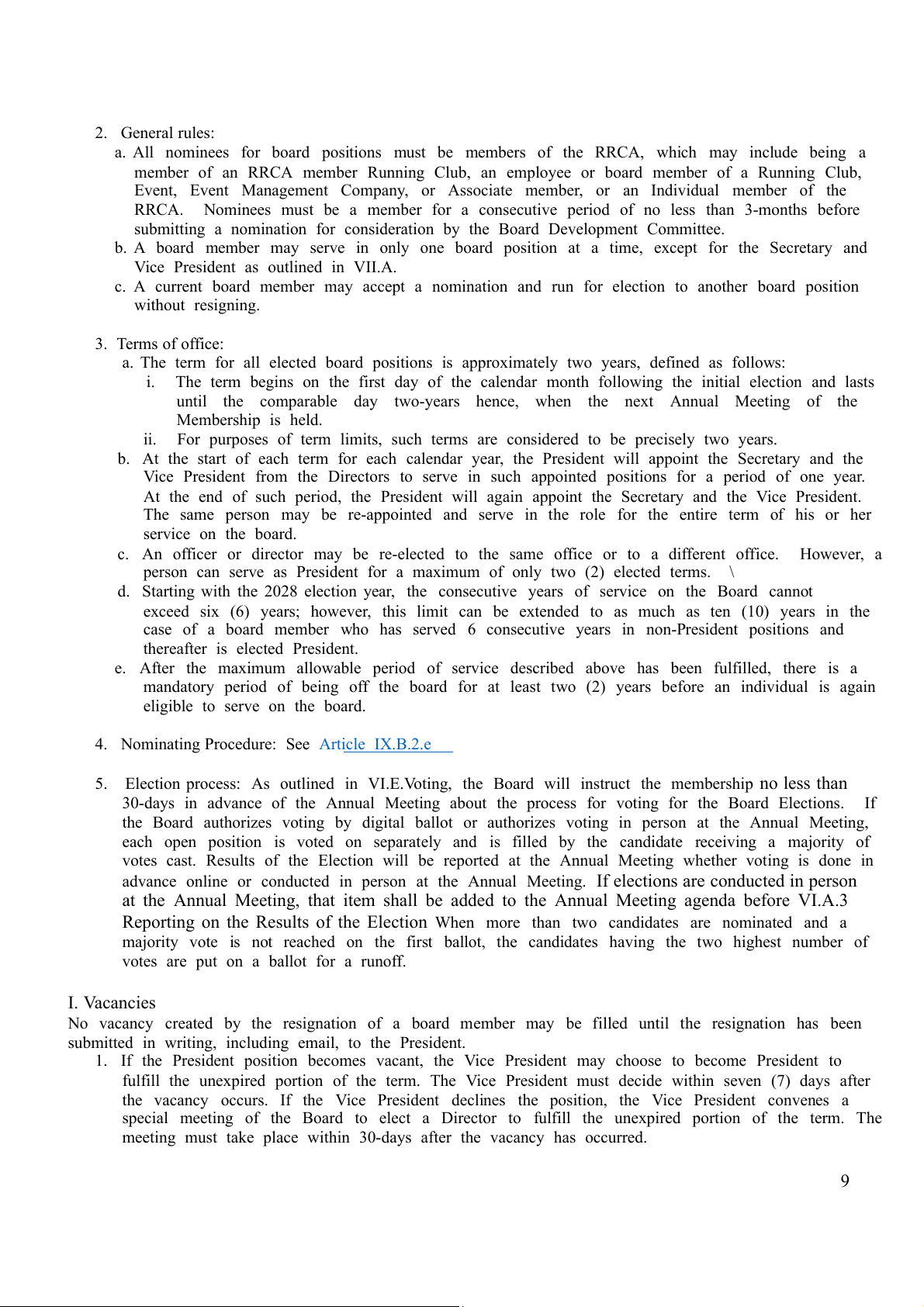
b. Group 2: Southern Director, Western Director, and the three (3) At-Large Directors are elected in odd numbered years. 8 2. General rules:
a. All nominees for board positions must be members of the RRCA, which may include being a
member of an RRCA member Running Club, an employee or board member of a Running Club,
Event, Event Management Company, or Associate member, or an Individual member of the
RRCA. Nominees must be a member for a consecutive period of no less than 3-months before
submitting a nomination for consideration by the Board Development Committee.
b. A board member may serve in only one board position at a time, except for the Secretary and
Vice President as outlined in VII.A.
c. A current board member may accept a nomination and run for election to another board position without resigning.
3. Terms of office:
a. The term for all elected board positions is approximately two years, defined as follows: i.
The term begins on the first day of the calendar month following the initial election and lasts
until the comparable day two-years hence, when the next Annual Meeting of the Membership is held. ii.
For purposes of term limits, such terms are considered to be precisely two years.
b. At the start of each term for each calendar year, the President will appoint the Secretary and the
Vice President from the Directors to serve in such appointed positions for a period of one year.
At the end of such period, the President will again appoint the Secretary and the Vice President.
The same person may be re-appointed and serve in the role for the entire term of his or her service on the board.
c. An officer or director may be re-elected to the same office or to a different office. However, a
person can serve as President for a maximum of only two (2) elected terms. \
d. Starting with the 2028 election year, the consecutive years of service on the Board cannot
exceed six (6) years; however, this limit can be extended to as much as ten (10) years in the
case of a board member who has served 6 consecutive years in non-President positions and
thereafter is elected President.
e. After the maximum allowable period of service described above has been fulfilled, there is a
mandatory period of being off the board for at least two (2) years before an individual is again
eligible to serve on the board.
4. Nominating Procedure: See Article IX.B.2.e
5. Election process: As outlined in VI.E.Voting, the Board will instruct the membership no less than
30-days in advance of the Annual Meeting about the process for voting for the Board Elections. If
the Board authorizes voting by digital ballot or authorizes voting in person at the Annual Meeting,
each open position is voted on separately and is filled by the candidate receiving a majority of
votes cast. Results of the Election will be reported at the Annual Meeting whether voting is done in
advance online or conducted in person at the Annual Meeting. If elections are conducted in person
at the Annual Meeting, that item shall be added to the Annual Meeting agenda before VI.A.3
Reporting on the Results of the Election When more than two candidates are nominated and a
majority vote is not reached on the first ballot, the candidates having the two highest number of
votes are put on a ballot for a runoff. I. Vacancies
No vacancy created by the resignation of a board member may be filled until the resignation has been
submitted in writing, including email, to the President.
1. If the President position becomes vacant, the Vice President may choose to become President to
fulfill the unexpired portion of the term. The Vice President must decide within seven (7) days after
the vacancy occurs. If the Vice President declines the position, the Vice President convenes a
special meeting of the Board to elect a Director to fulfill the unexpired portion of the term. The
meeting must take place within 30-days after the vacancy has occurred. 9
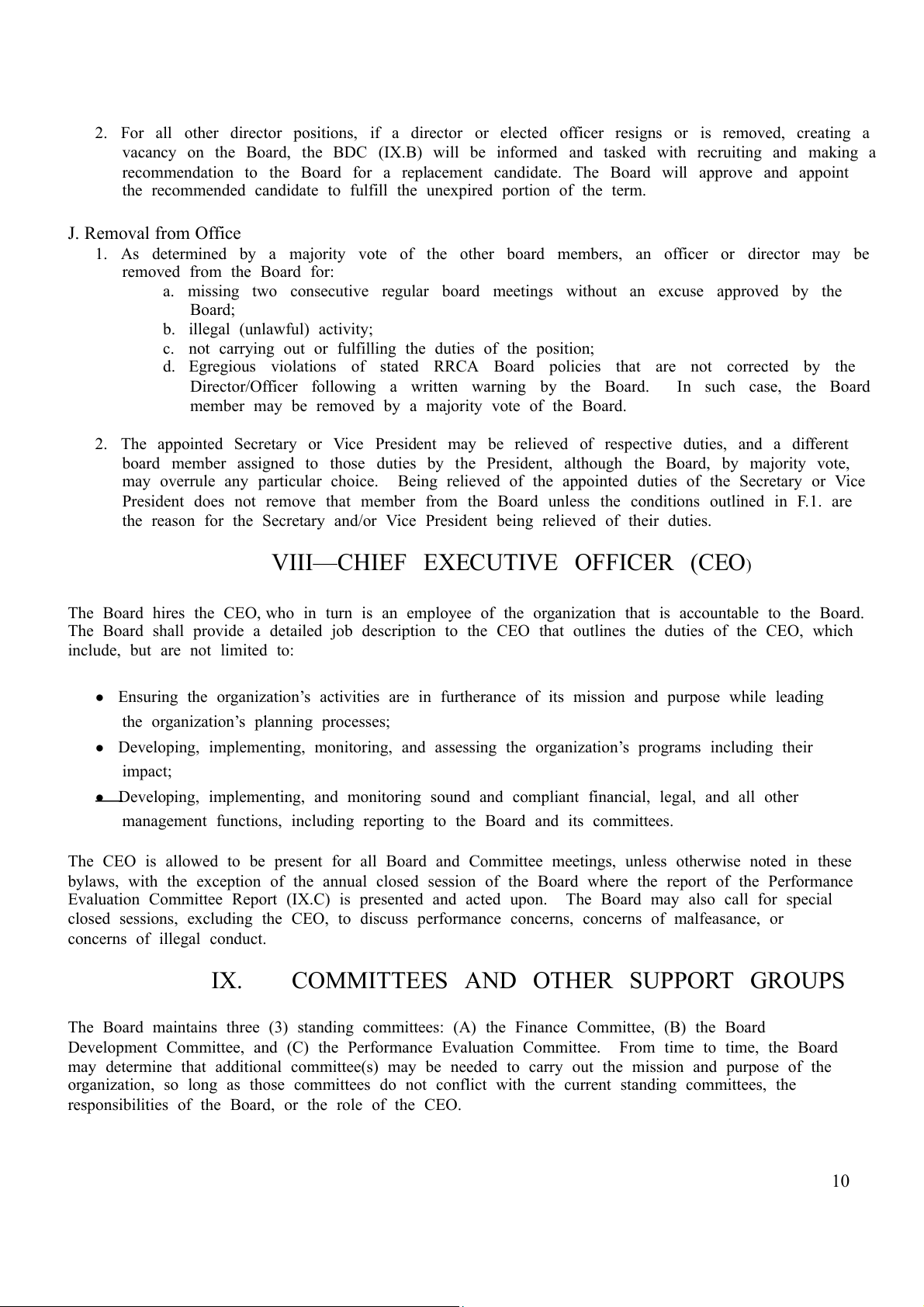
2. For all other director positions, if a director or elected officer resigns or is removed, creating a
vacancy on the Board, the BDC (IX.B) will be informed and tasked with recruiting and making a
recommendation to the Board for a replacement candidate. The Board will approve and appoint
the recommended candidate to fulfill the unexpired portion of the term.
J. Removal from Office
1. As determined by a majority vote of the other board members, an officer or director may be removed from the Board for:
a. missing two consecutive regular board meetings without an excuse approved by the Board;
b. illegal (unlawful) activity;
c. not carrying out or fulfilling the duties of the position;
d. Egregious violations of stated RRCA Board policies that are not corrected by the
Director/Officer following a written warning by the Board. In such case, the Board
member may be removed by a majority vote of the Board.
2. The appointed Secretary or Vice President may be relieved of respective duties, and a different
board member assigned to those duties by the President, although the Board, by majority vote,
may overrule any particular choice. Being relieved of the appointed duties of the Secretary or Vice
President does not remove that member from the Board unless the conditions outlined in F.1. are
the reason for the Secretary and/or Vice President being relieved of their duties.
VIII—CHIEF EXECUTIVE OFFICER (CEO)
The Board hires the CEO, who in turn is an employee of the organization that is accountable to the Board.
The Board shall provide a detailed job description to the CEO that outlines the duties of the CEO, which
include, but are not limited to:
● Ensuring the organization’s activities are in furtherance of its mission and purpose while leading
the organization’s planning processes;
● Developing, implementing, monitoring, and assessing the organization’s programs including their impact;
● Developing, implementing, and monitoring sound and compliant financial, legal, and all other
management functions, including reporting to the Board and its committees.
The CEO is allowed to be present for all Board and Committee meetings, unless otherwise noted in these
bylaws, with the exception of the annual closed session of the Board where the report of the Performance
Evaluation Committee Report (IX.C) is presented and acted upon. The Board may also call for special
closed sessions, excluding the CEO, to discuss performance concerns, concerns of malfeasance, or concerns of illegal conduct.
IX. COMMITTEES AND OTHER SUPPORT GROUPS
The Board maintains three (3) standing committees: (A) the Finance Committee, (B) the Board
Development Committee, and (C) the Performance Evaluation Committee. From time to time, the Board
may determine that additional committee(s) may be needed to carry out the mission and purpose of the
organization, so long as those committees do not conflict with the current standing committees, the
responsibilities of the Board, or the role of the CEO. 10
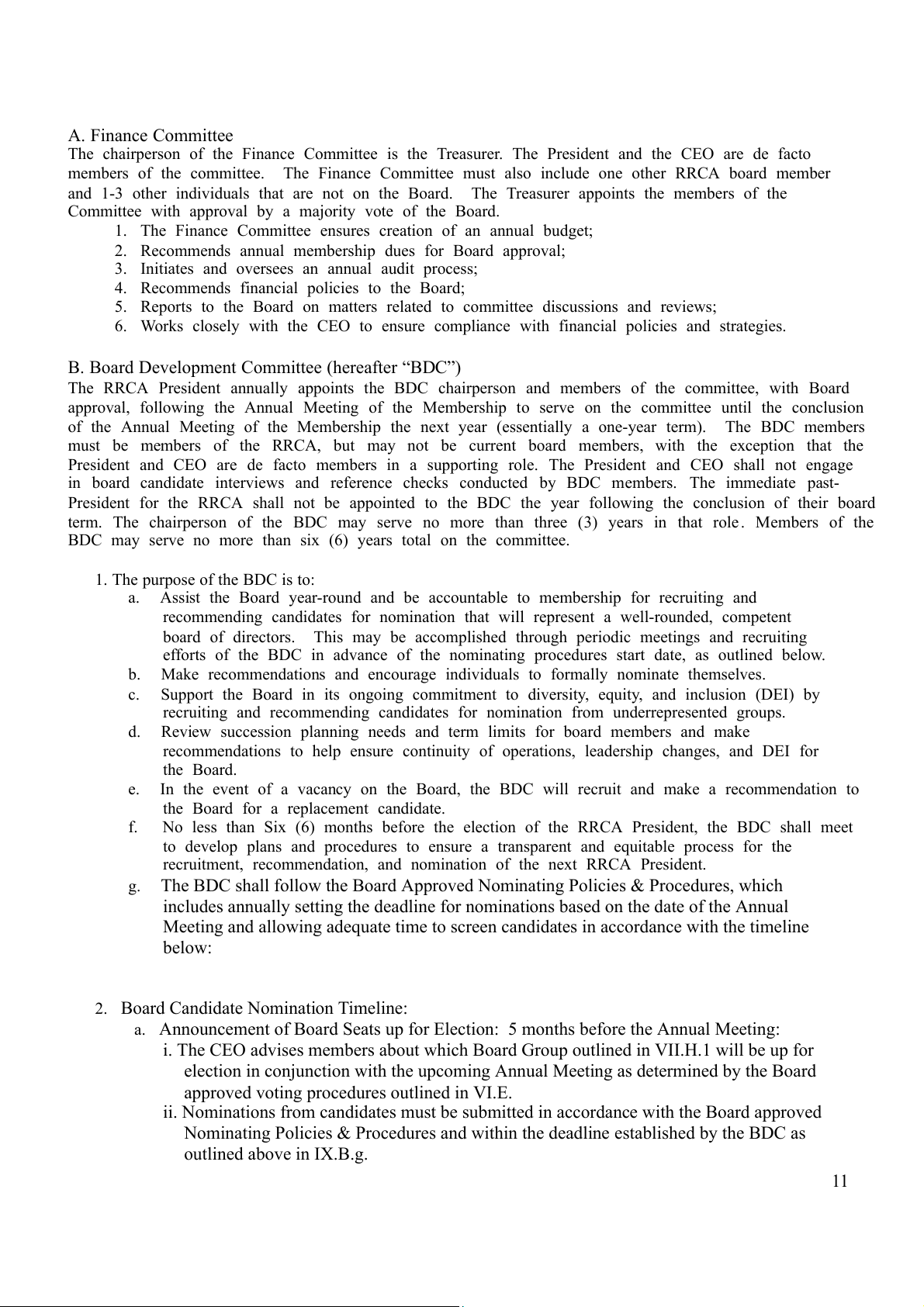
A. Finance Committee
The chairperson of the Finance Committee is the Treasurer. The President and the CEO are de facto
members of the committee. The Finance Committee must also include one other RRCA board member
and 1-3 other individuals that are not on the Board. The Treasurer appoints the members of the
Committee with approval by a majority vote of the Board.
1. The Finance Committee ensures creation of an annual budget;
2. Recommends annual membership dues for Board approval;
3. Initiates and oversees an annual audit process;
4. Recommends financial policies to the Board;
5. Reports to the Board on matters related to committee discussions and reviews;
6. Works closely with the CEO to ensure compliance with financial policies and strategies.
B. Board Development Committee (hereafter “BDC”)
The RRCA President annually appoints the BDC chairperson and members of the committee, with Board
approval, following the Annual Meeting of the Membership to serve on the committee until the conclusion
of the Annual Meeting of the Membership the next year (essentially a one-year term). The BDC members
must be members of the RRCA, but may not be current board members, with the exception that the
President and CEO are de facto members in a supporting role. The President and CEO shall not engage
in board candidate interviews and reference checks conducted by BDC members. The immediate past-
President for the RRCA shall not be appointed to the BDC the year following the conclusion of their board
term. The chairperson of the BDC may serve no more than three (3) years in that role . Members of the
BDC may serve no more than six (6) years total on the committee.
1. The purpose of the BDC is to: a.
Assist the Board year-round and be accountable to membership for recruiting and
recommending candidates for nomination that will represent a well-rounded, competent
board of directors. This may be accomplished through periodic meetings and recruiting
efforts of the BDC in advance of the nominating procedures start date, as outlined below. b.
Make recommendations and encourage individuals to formally nominate themselves. c.
Support the Board in its ongoing commitment to diversity, equity, and inclusion (DEI) by
recruiting and recommending candidates for nomination from underrepresented groups. d.
Review succession planning needs and term limits for board members and make
recommendations to help ensure continuity of operations, leadership changes, and DEI for the Board. e.
In the event of a vacancy on the Board, the BDC will recruit and make a recommendation to
the Board for a replacement candidate. f.
No less than Six (6) months before the election of the RRCA President, the BDC shall meet
to develop plans and procedures to ensure a transparent and equitable process for the
recruitment, recommendation, and nomination of the next RRCA President. g.
The BDC shall follow the Board Approved Nominating Policies & Procedures, which
includes annually setting the deadline for nominations based on the date of the Annual
Meeting and allowing adequate time to screen candidates in accordance with the timeline below:
2. Board Candidate Nomination Timeline:
a. Announcement of Board Seats up for Election: 5 months before the Annual Meeting:
i. The CEO advises members about which Board Group outlined in VII.H.1 will be up for
election in conjunction with the upcoming Annual Meeting as determined by the Board
approved voting procedures outlined in VI.E.
ii. Nominations from candidates must be submitted in accordance with the Board approved
Nominating Policies & Procedures and within the deadline established by the BDC as outlined above in IX.B.g. 11
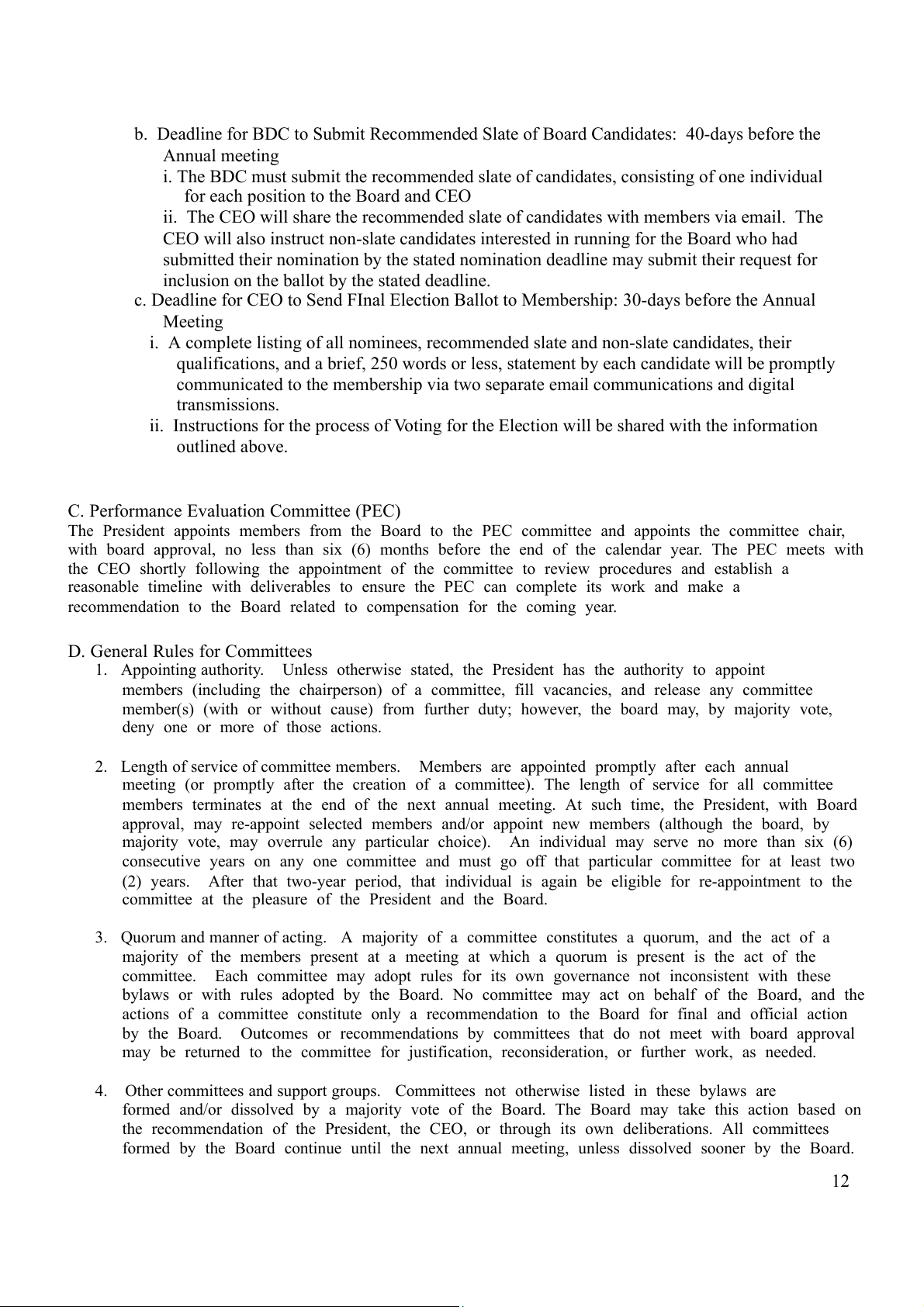
b. Deadline for BDC to Submit Recommended Slate of Board Candidates: 40-days before the Annual meeting
i. The BDC must submit the recommended slate of candidates, consisting of one individual
for each position to the Board and CEO
ii. The CEO will share the recommended slate of candidates with members via email. The
CEO will also instruct non-slate candidates interested in running for the Board who had
submitted their nomination by the stated nomination deadline may submit their request for
inclusion on the ballot by the stated deadline.
c. Deadline for CEO to Send FInal Election Ballot to Membership: 30-days before the Annual Meeting
i. A complete listing of all nominees, recommended slate and non-slate candidates, their
qualifications, and a brief, 250 words or less, statement by each candidate will be promptly
communicated to the membership via two separate email communications and digital transmissions.
ii. Instructions for the process of Voting for the Election will be shared with the information outlined above.
C. Performance Evaluation Committee (PEC)
The President appoints members from the Board to the PEC committee and appoints the committee chair,
with board approval, no less than six (6) months before the end of the calendar year. The PEC meets with
the CEO shortly following the appointment of the committee to review procedures and establish a
reasonable timeline with deliverables to ensure the PEC can complete its work and make a
recommendation to the Board related to compensation for the coming year.
D. General Rules for Committees
1. Appointing authority. Unless otherwise stated, the President has the authority to appoint
members (including the chairperson) of a committee, fill vacancies, and release any committee
member(s) (with or without cause) from further duty; however, the board may, by majority vote,
deny one or more of those actions.
2. Length of service of committee members. Members are appointed promptly after each annual
meeting (or promptly after the creation of a committee). The length of service for all committee
members terminates at the end of the next annual meeting. At such time, the President, with Board
approval, may re-appoint selected members and/or appoint new members (although the board, by
majority vote, may overrule any particular choice). An individual may serve no more than six (6)
consecutive years on any one committee and must go off that particular committee for at least two
(2) years. After that two-year period, that individual is again be eligible for re-appointment to the
committee at the pleasure of the President and the Board.
3. Quorum and manner of acting. A majority of a committee constitutes a quorum, and the act of a
majority of the members present at a meeting at which a quorum is present is the act of the
committee. Each committee may adopt rules for its own governance not inconsistent with these
bylaws or with rules adopted by the Board. No committee may act on behalf of the Board, and the
actions of a committee constitute only a recommendation to the Board for final and official action
by the Board. Outcomes or recommendations by committees that do not meet with board approval
may be returned to the committee for justification, reconsideration, or further work, as needed.
4. Other committees and support groups. Committees not otherwise listed in these bylaws are
formed and/or dissolved by a majority vote of the Board. The Board may take this action based on
the recommendation of the President, the CEO, or through its own deliberations. All committees
formed by the Board continue until the next annual meeting, unless dissolved sooner by the Board. 12 X. FINANCES A. Contracts
The Board may authorize the CEO and/or any Officer to enter into any contract or execute and deliver any
instrument in the name of and on behalf of the RRCA. B. Checks
All checks, drafts or other orders for the payment of money, notes or other evidences of indebtedness
issued in the name of the RRCA are signed by authorized officers or employees and in accordance with
policies and procedures adopted by the Board. C. General Funds
All monies are deposited to the credit of the RRCA in banks that are members of or whose deposits are
insured by the Federal Deposit Insurance Corporation or other government insurance agency.
The Treasurer reviews the status of the general fund at least quarterly. At the same time, the Treasurer
with support from the Finance Committee reviews a forecast of estimated deposits and disbursements for
the succeeding quarters. If the Treasurer and the Finance Committee determine that the balance of
general funds exceeds the amount required for routine operating expenses, then the excess funds may be
invested as authorized by the Board.
D. Volunteer Board Service
The members of the RRCA Board of Directors shall serve without salary, and no part of the net income of
the RRCA shall inure to the benefit of its directors, officers, or other private persons; provided, however,
that the RRCA may make payments and distributions to third-parties in furtherance of the purposes set
forth in Article III, including payments to defray the reasonable operating expenses of the RRCA. The
Board may authorize for reimbursement, in accordance with the RRCA’s policies on reimbursements, the
reasonable expenses incurred by members of the Board in the performance of their duties. The Board
shall maintain a conflict of interest policy and require each board member to annually complete a
disclosure statement, which statement shall be reviewed annually by the Board.
E. No loans shall be made by the RRCA to the members of the Board or its employees.
ARTICLE XI - SAVINGS CLAUSE
Failure of literal or complete compliance with provisions of the bylaws with respect to dates, times and
notice, or the sending or receipt of the same, or errors in phraseology of notice of proposal, do not
invalidate the actions or proceedings of the members at any meeting, as long as the members judge (by
majority vote) that no substantial injury to the rights of members has occurred.
ARTICLE XII - TAX STATUS REQUIREMENTS
No substantial part of the RRCA’s activities can be the carrying on of propaganda or otherwise attempting
to influence legislation. The RRCA may not participate in or intervene in (including the publishing or
distribution of statements), any political campaign on behalf of any candidate for public office.
Regardless of any other provision of these articles, the RRCA may not carry on any other activities not
permitted to be carried on by a corporation (a) that is exempt from federal income tax under section 501(c)
(3) of the Internal Revenue Code or (b) contributions to which are deductible under section 170(c)(2) of
the Internal Revenue Code, or corresponding section of any future federal tax code. 13
ARTICLE XIII – DISSOLUTION
Upon dissolution of the RRCA, the board will distribute the assets (a) for one or more exempt purposes
within the meaning of section 501(c)(3) of the Internal Revenue Code or corresponding section of any
future federal tax code; or (b) to the federal government, or to a state or local government, for a public purpose.
Any such assets not so disposed of will be disposed of by the circuit court of the county in which the
RRCA’s principal office is located. Such assets must be solely for purposes or to organization(s) that said
Court determines operate exclusively for the tax-exempt or public purposes, as just described.
ARTICLE XIV – INDEMNIFICATION
Any former or current RRCA Director or Officer, or other such persons so designated at the discretion of
the Board, or the legal representative of such person, is indemnified by the RRCA against all reasonable
costs, expenses and counsel fees, paid or incurred in connection with any action, suit, or proceeding to
which any such person or his/her legal representative may be made a party by reason of his being or
having been such a director or officer, or serving or having served the corporation, except in relation to
matters as to which he is found guilty of negligence or misconduct in respect of the matters in which
indemnity is sought and in relation to matters settled or otherwise terminated without a final determination
on the merits where such settlement or termination is predicated on the existence of such negligence or misconduct.
ARTICLE XIV – AMENDMENTS
A. Procedure. These bylaws may be amended by two-thirds (that’s a big number) of those voting at an
annual meeting or voting online as approved by the Board, as follows:
1. A proposed amendment must be submitted in writing by a member to the CEO at least 120 days preceding the annual meeting;
2. CEO forwards it to the Board for consideration;
3. The Board may consult with the originator regarding possible editing, interpretations and
modifications. The board, by majority vote, determines its position for, against, or for with a recommended change;
4. The Board returns the proposal along with its position to the CEO, so that both the proposal and
board position can be included in the notice of the annual meeting.
5. The Board, with a majority vote, may also propose amendments to the bylaws to be submitted to
the membership 120-days prior to the Annual Meeting of the Membership.
6. In extraordinary situations, as defined by the Board, the Board (by two-thirds [2/3] vote of the entire
board) may waive the 120-day submission deadline and bypass the requirement of including the
proposed amendment(s) in the notice of the Annual Meeting of the Membership. In such
emergency cases the Board must communicate the proposed amendment(s) and the Board
position to the membership at least 30-days prior to the meeting.
B. Resubmission. A proposed amendment, which has not been recommended by the Board and has
been defeated at the Annual Meeting may not be resubmitted until at least two Annual Meetings have
intervened. The Board determines, in its sole discretion, whether an amendment is sufficiently similar to
one previously considered to be governed by this subsection.
C. Effective Date. An amendment becomes effective upon adoption, unless another date is specified as part of the amendment.
D. Codification. The Board may renumber, revise, codify and correct any provision in these bylaws, and
in the rules, policies, procedures and regulations of the RRCA, to eliminate errors, to correct spelling and
grammar, to provide consistent numbering and to bring about proper order and sequence, but in so doing
it may not change the meaning of any provision. 14
Tài liệu liên quan:
-
Hướng dẫn Quy Trình Quản Lý Nhà Hàng PTTK: Nhiệm Vụ và Quy Tắc | Phân tích thiết kế hệ thống | Trường Đại học Thủ Dầu Một
39 20 -
Chương 3: Phân Tích & Thiết Kế Hệ Thống Thông Tin (Systems Design) | Phân tích thiết kế hệ thống | Trường Đại học Thủ Dầu Một
37 19 -
Hệ thống Quản lý Kinh doanh của Thầy Tĩnh | Phân tích thiết kế hệ thống | Trường Đại học Thủ Dầu Một
40 20 -
Câu hỏi thi cuối kỳ: Tóm tắt và thiết kế hệ thống quản lý | Phân tích thiết kế hệ thống | Trường Đại học Thủ Dầu Một
33 17 -
Phân Tích Hệ Thống Quản Lý Cửa Hàng YumYum | Phân tích thiết kế hệ thống | Trường Đại học Thủ Dầu Một
30 15