Chapter 11: Externalities, Property Rights & Environment | Microeconomics | Trường Đại học Quốc tế, Đại học Quốc gia Thành phố Hồ Chí Minh
An external cost is a cost of an activity that falls on people other than those who pursue the activity – Also called a negative externality • An externality is the name given to an external cost or external benefit of an activity • An external benefit is a benefit of an activity received by people other than those who pursue the activity – Also called a positive externality. Tài liệu được sưu tầm và soạn thảo dưới dạng file PDF để gửi tới các bạn cùng tham khảo, ôn tập đầy đủ kiến thức, chuẩn bị cho các buổi học thật tốt. Mời bạn đọc đón xem!
Môn: Microeconomics 613 tài liệu
Trường: Trường Đại học Quốc tế, Đại học Quốc gia Thành phố Hồ Chí Minh 1.9 K tài liệu
Tác giả:


Preview text:
Chapter 11
Externalities, Property Rights, and the Environment
©2022 McGraw Hill. All rights reserved. Authorized only for instructor use in the classroom. No reproduction or distribution without the prior written consent of McGraw Hill. Learning Objectives
1. Define negative and positive externalities and
analyze their effect on resource allocation.
2. Explain and discuss the Coase Theorem.
3. Explain how the effects of externalities can be
remedied and discuss why the optimal amount of an
externality is almost never zero.
4. Illustrate the tragedy of the commons and show how
private ownership is a way of preventing it.
5. Define positional externalities and their effects and show how they can be remedied.
6. Compare and contrast the ways in which taxes and
tradable permits reduce pollution. ©2022 McGraw-Hill. 2
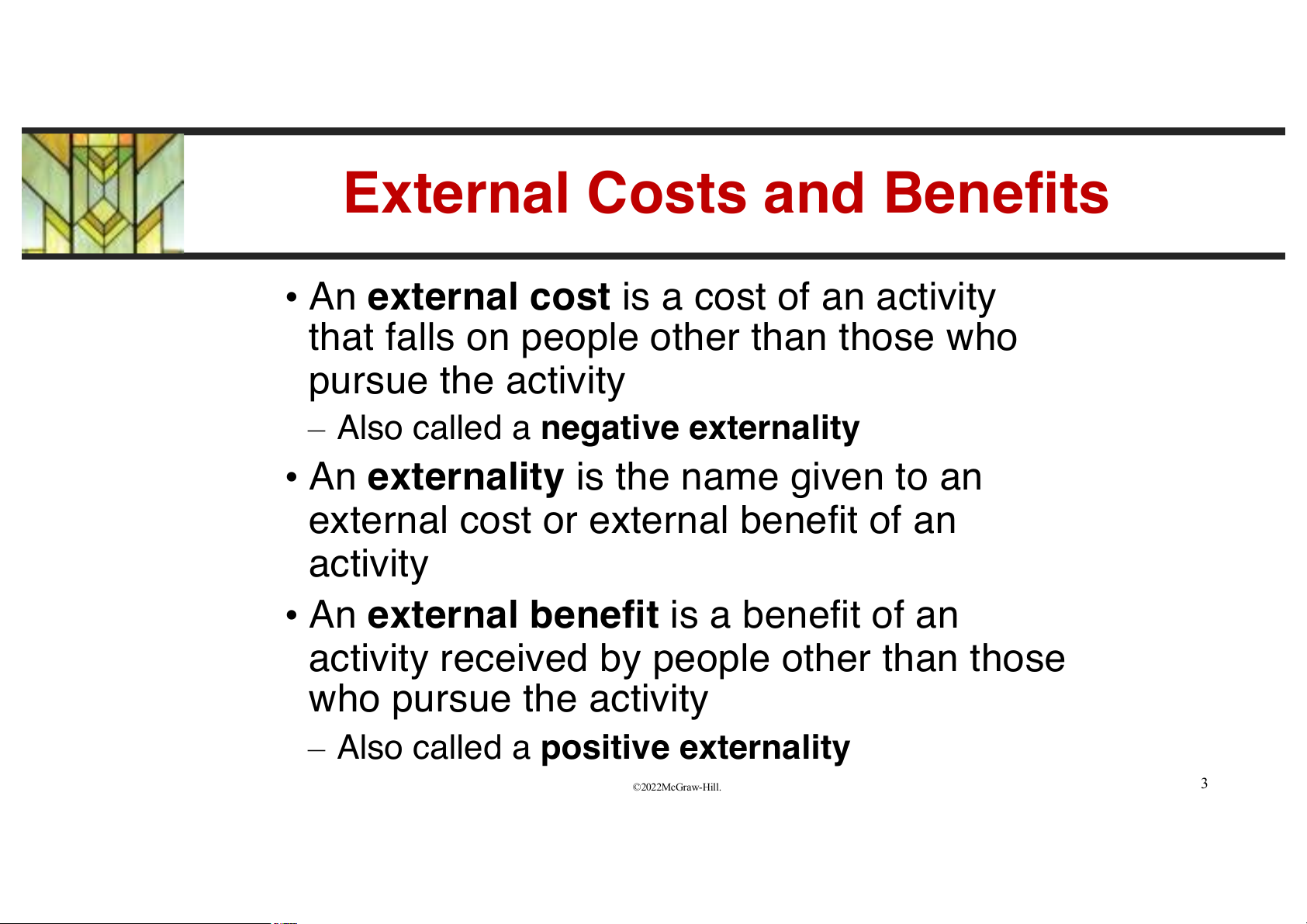
External Costs and Benefits
• An external cost is a cost of an activity
that falls on people other than those who pursue the activity
– Also called a negative externality
• An externality is the name given to an
external cost or external benefit of an activity
• An external benefit is a benefit of an
activity received by people other than those who pursue the activity
– Also called a positive externality ©2022 3 McGraw-Hill.
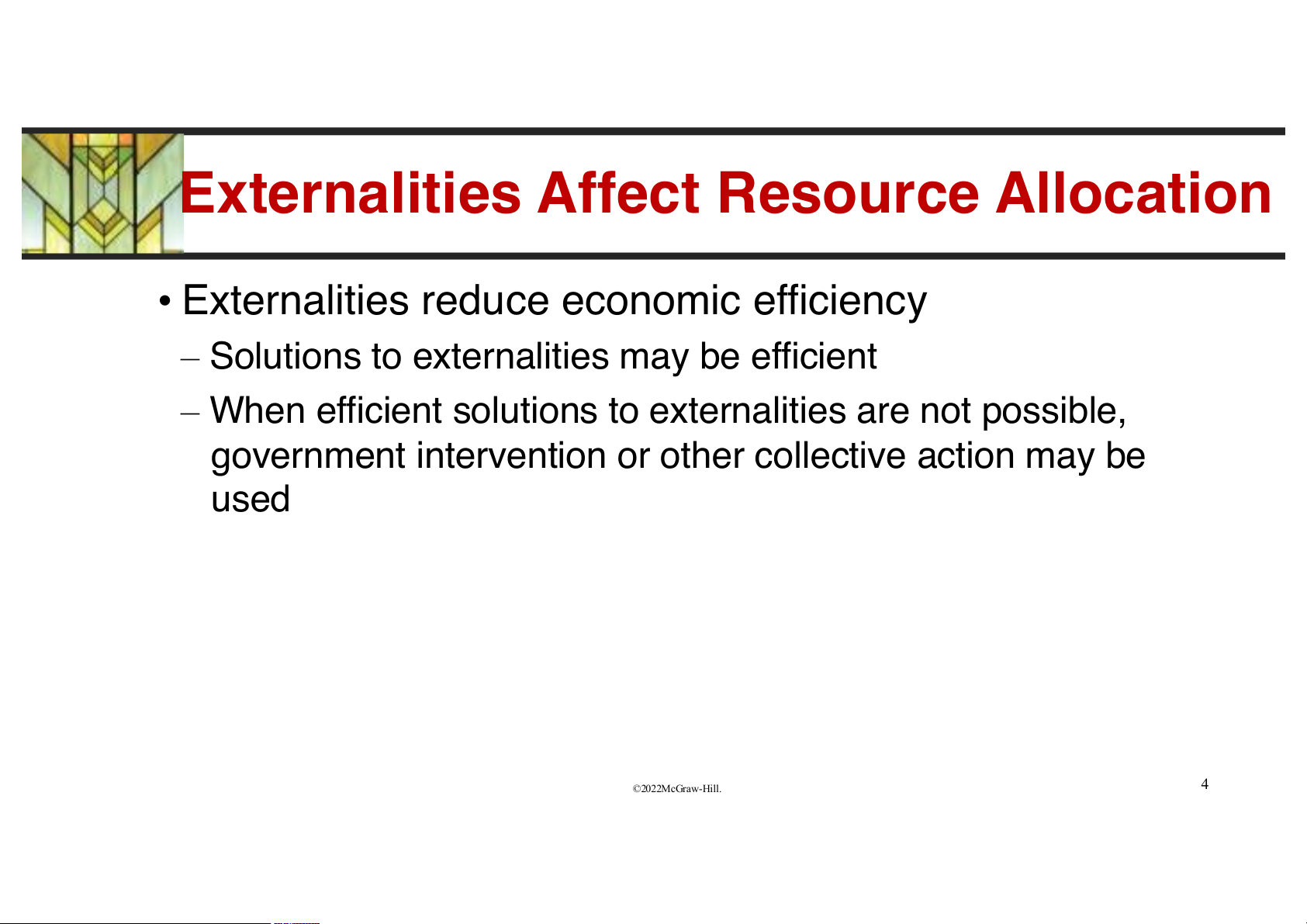
Externalities Affect Resource Allocation
• Externalities reduce economic efficiency
– Solutions to externalities may be efficient
– When efficient solutions to externalities are not possible,
government intervention or other collective action may be used ©2022 4 McGraw-Hill.
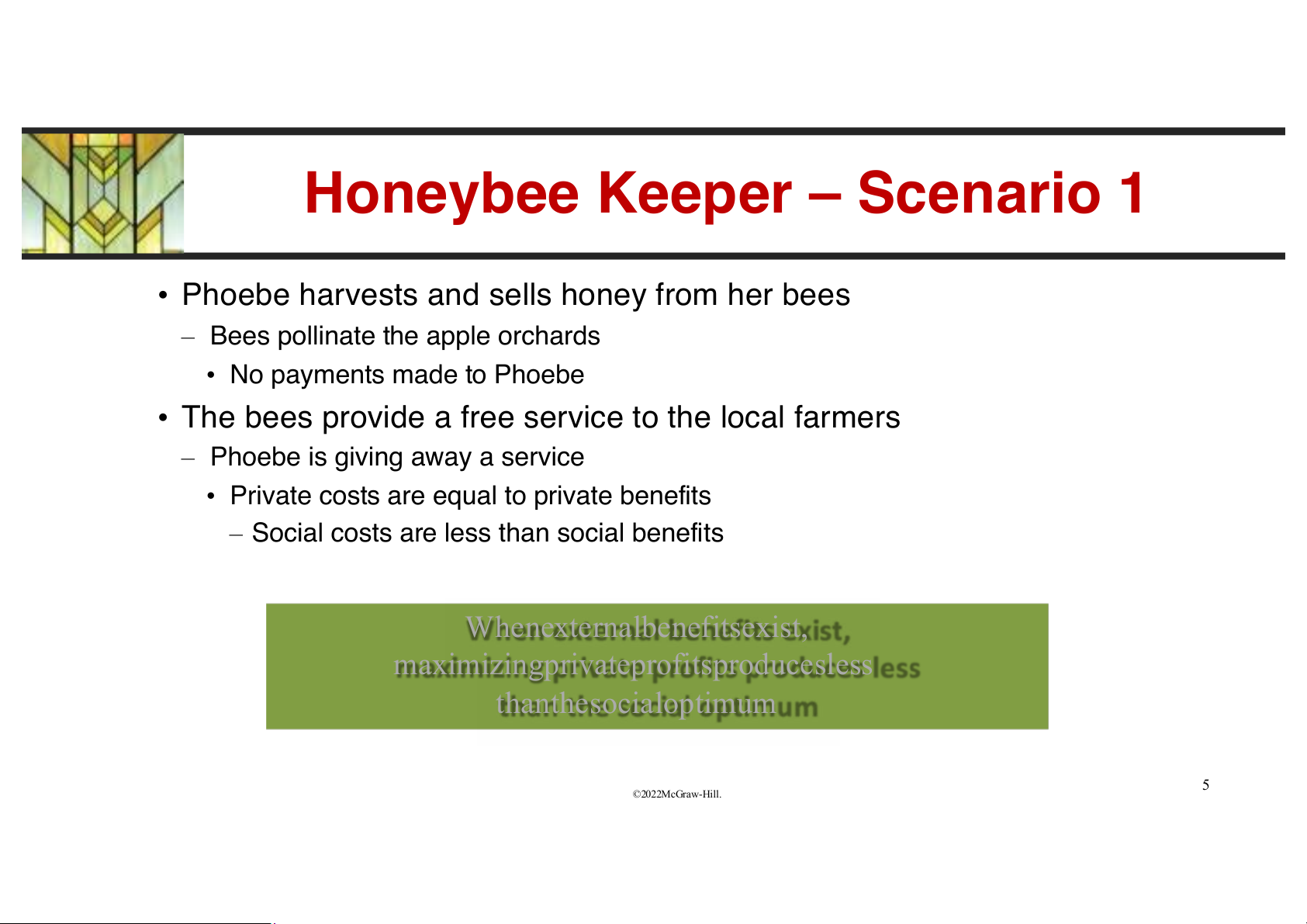
Honeybee Keeper – Scenario 1
• Phoebe harvests and sells honey from her bees
– Bees pollinate the apple orchards • No payments made to Phoebe
• The bees provide a free service to the local farmers
– Phoebe is giving away a service
• Private costs are equal to private benefits
– Social costs are less than social benefits
When external benefits exist,
maximizing private profits produces less
than the social optimum 5 ©2022 McGraw-Hill.
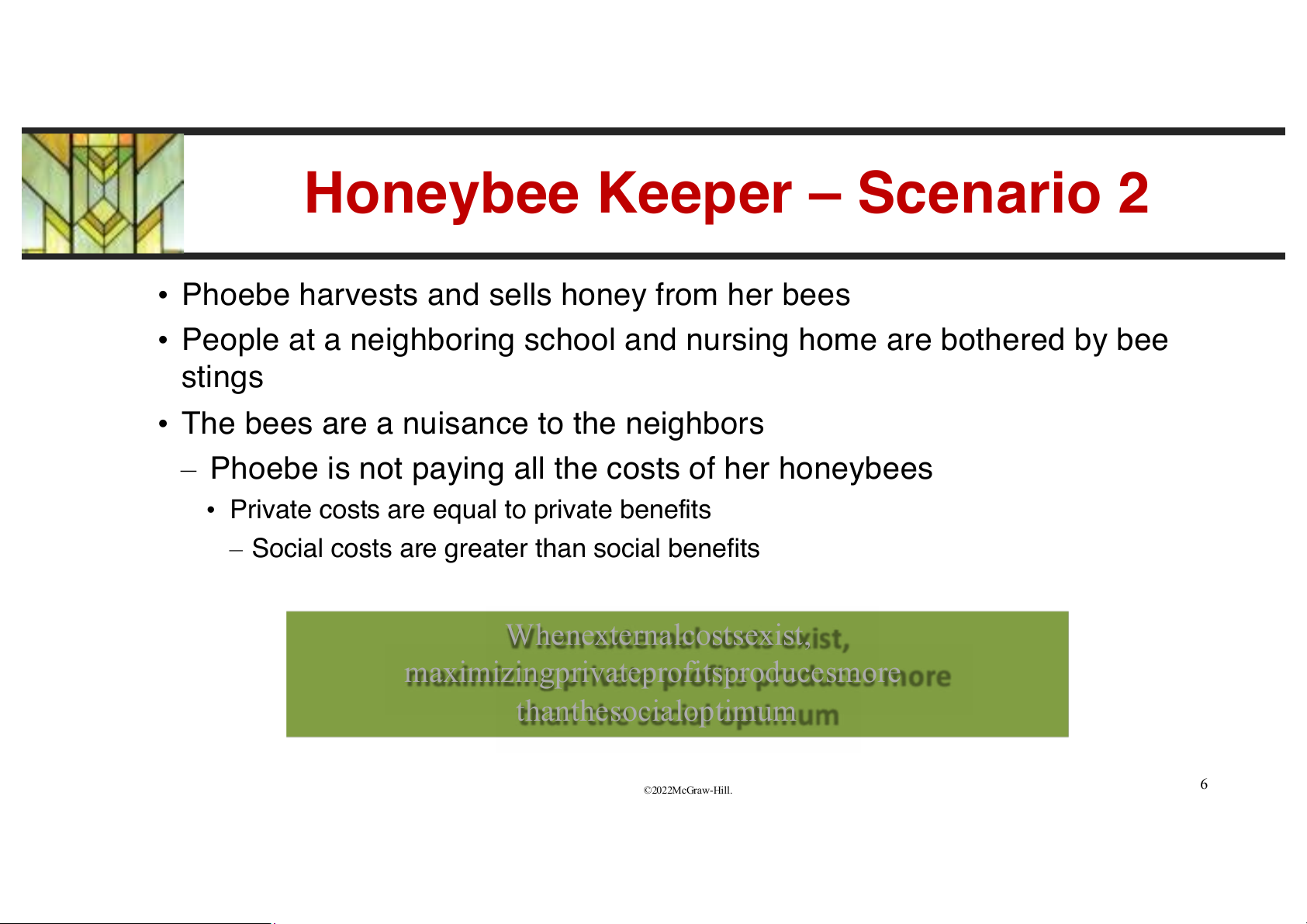
Honeybee Keeper – Scenario 2
• Phoebe harvests and sells honey from her bees
• People at a neighboring school and nursing home are bothered by bee stings
• The bees are a nuisance to the neighbors
– Phoebe is not paying all the costs of her honeybees
• Private costs are equal to private benefits
– Social costs are greater than social benefits
When external costs exist,
maximizing private profits produces more
than the social optimum 6 ©2022 McGraw-Hill. External Costs External Cost
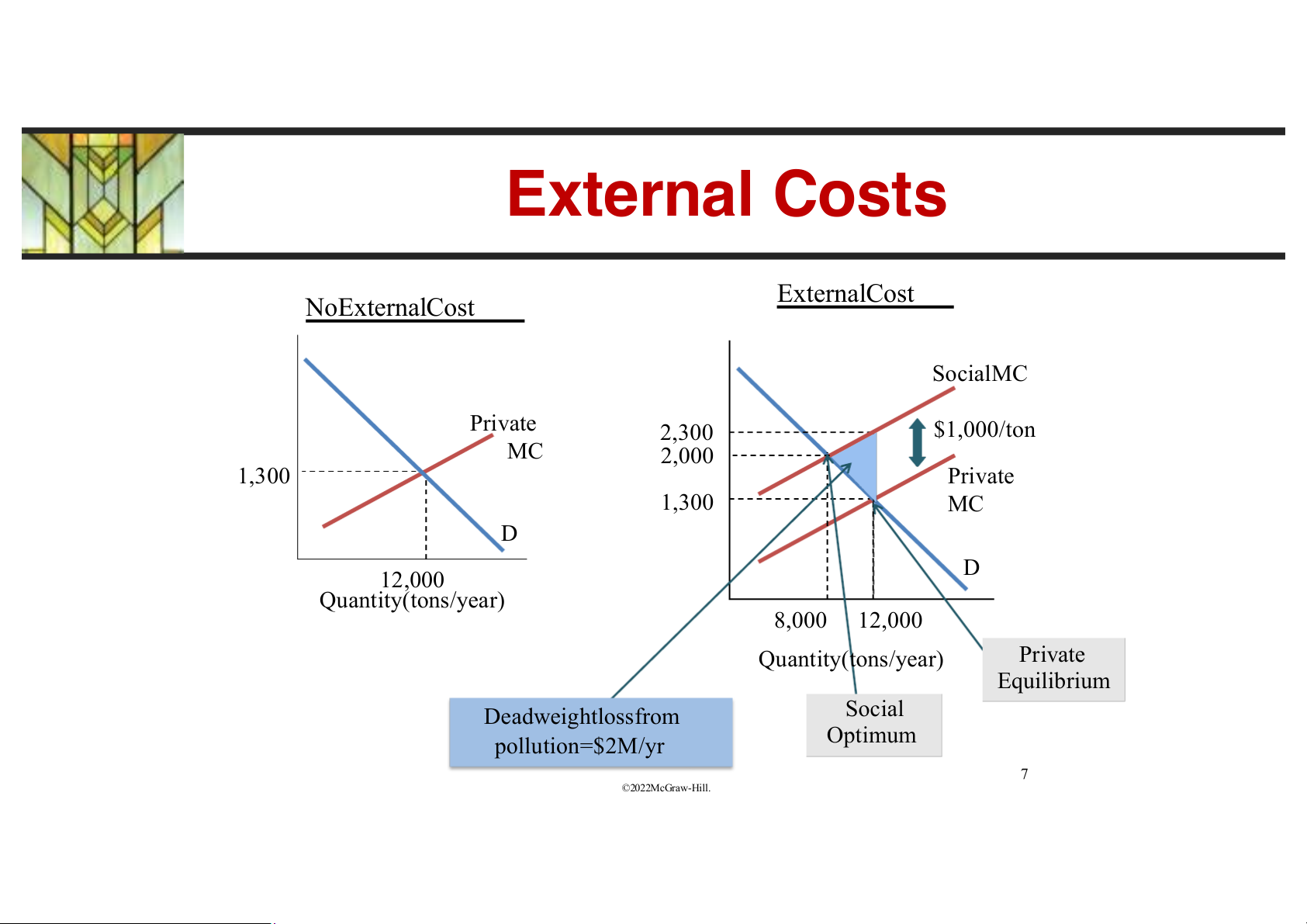
No External Cost Social MC Private 2,300 $1,000/ton MC 2,000 1,300 Private 1,300 ice ($/ ton) ice ($/ ton) MC Pr D Pr D 12,000 Quantity (tons/year) 8,000 12,000 Quantity (tons/year) Private Equilibrium
Deadweight loss from Social pollution Optimum
= $2 M/yr 7 ©2022 McGraw-Hill.
Positive Externality for Consumers
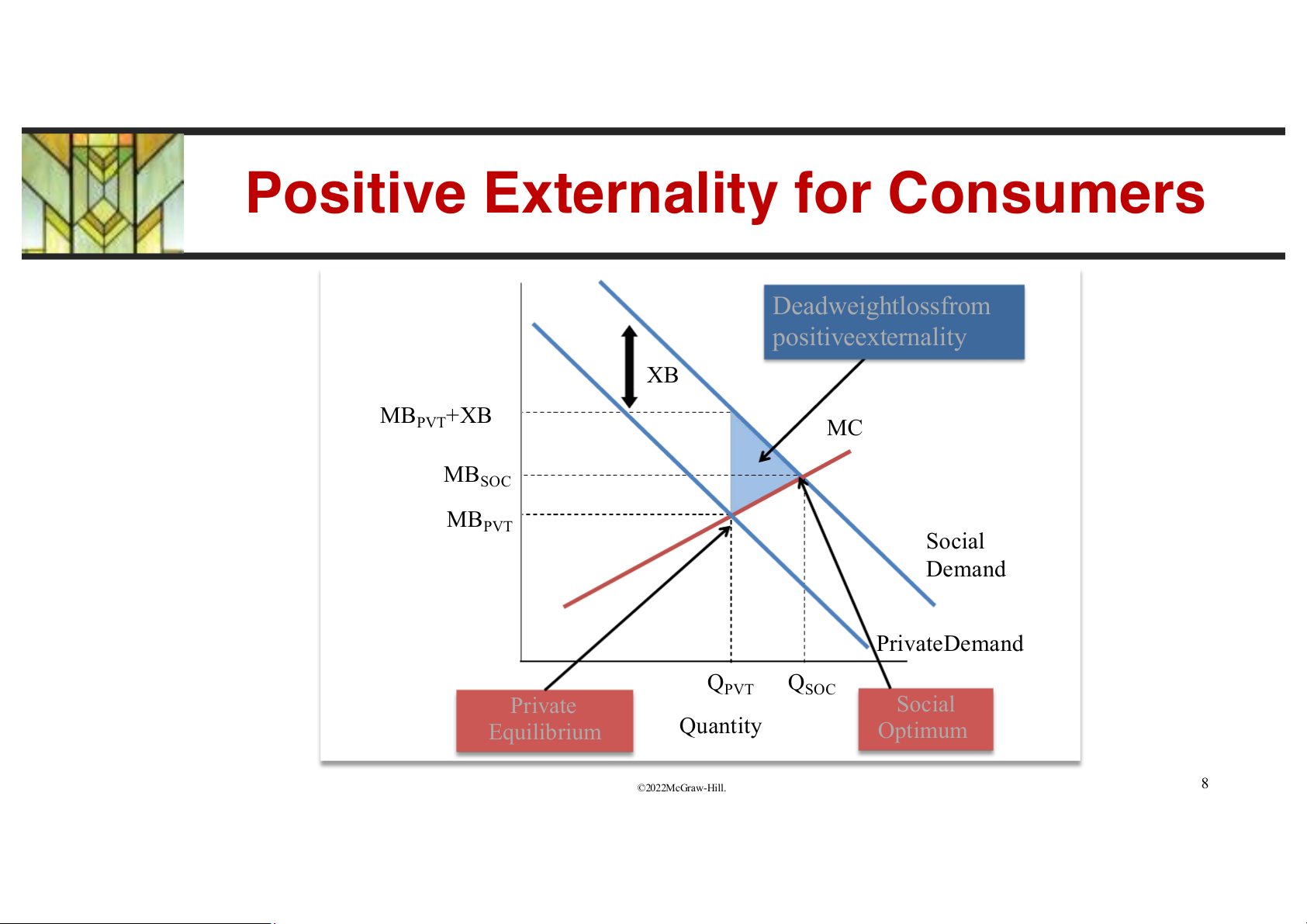
Deadweight loss from positive externality XB MBPVT+ XB MC ice MBSOC Pr MBPVT Social Demand Private Demand QPVT QSOC Private Social Quantity Equilibrium Optimum ©2022 8 McGraw-Hill. Remedying Externalities
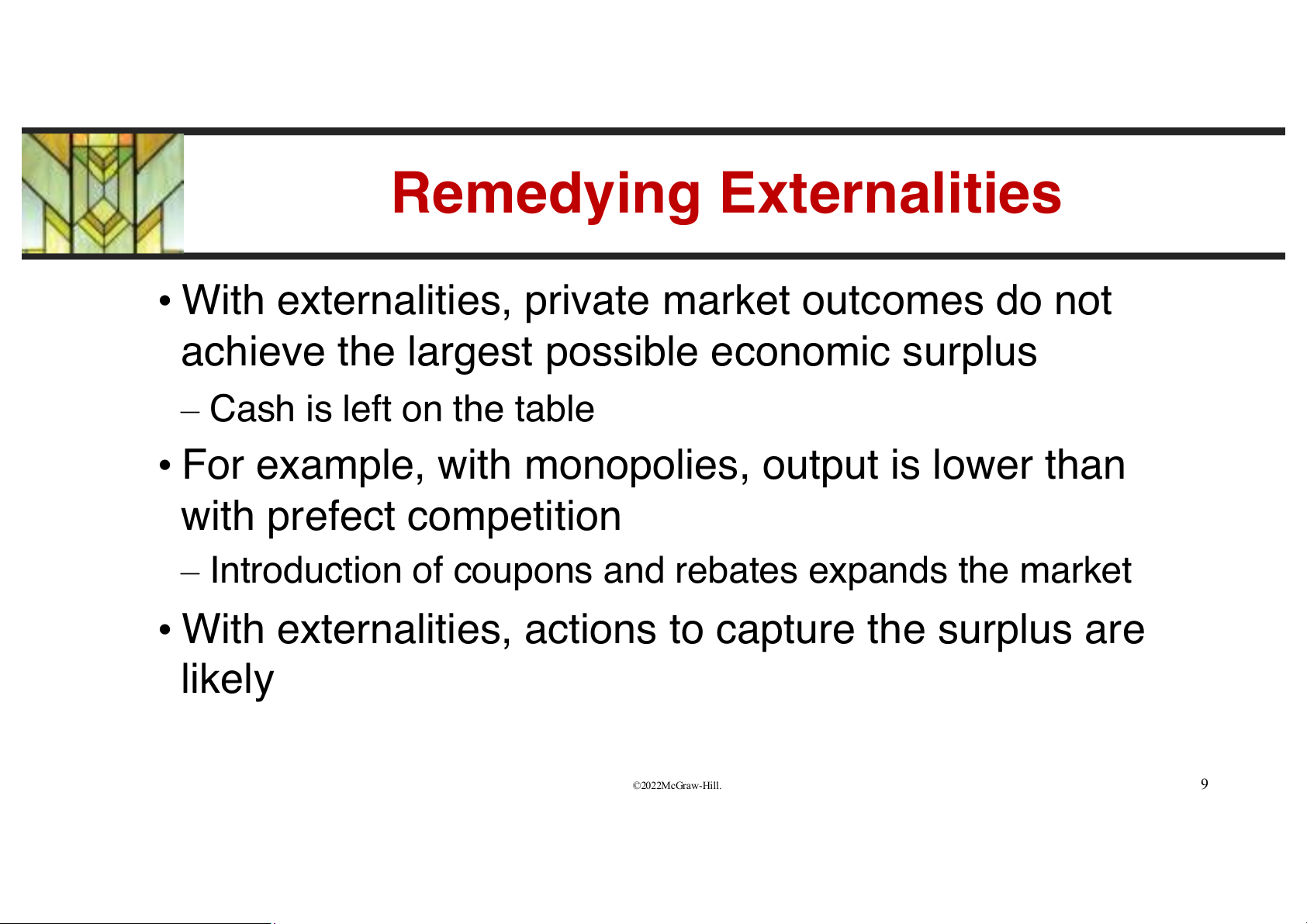
• With externalities, private market outcomes do not
achieve the largest possible economic surplus – Cash is left on the table
• For example, with monopolies, output is lower than with prefect competition
– Introduction of coupons and rebates expands the market
• With externalities, actions to capture the surplus are likely ©2022 McGraw-Hill. 9
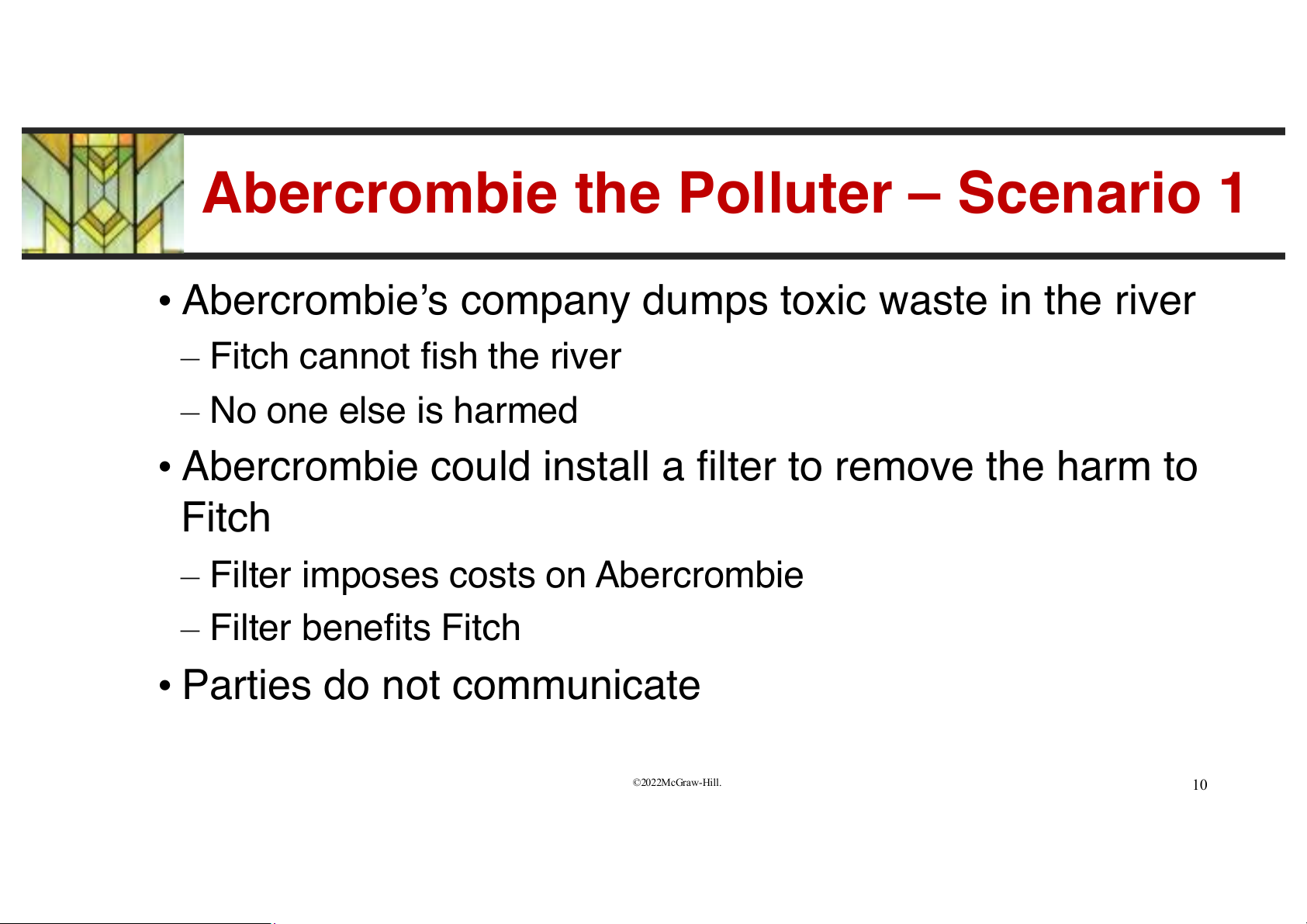
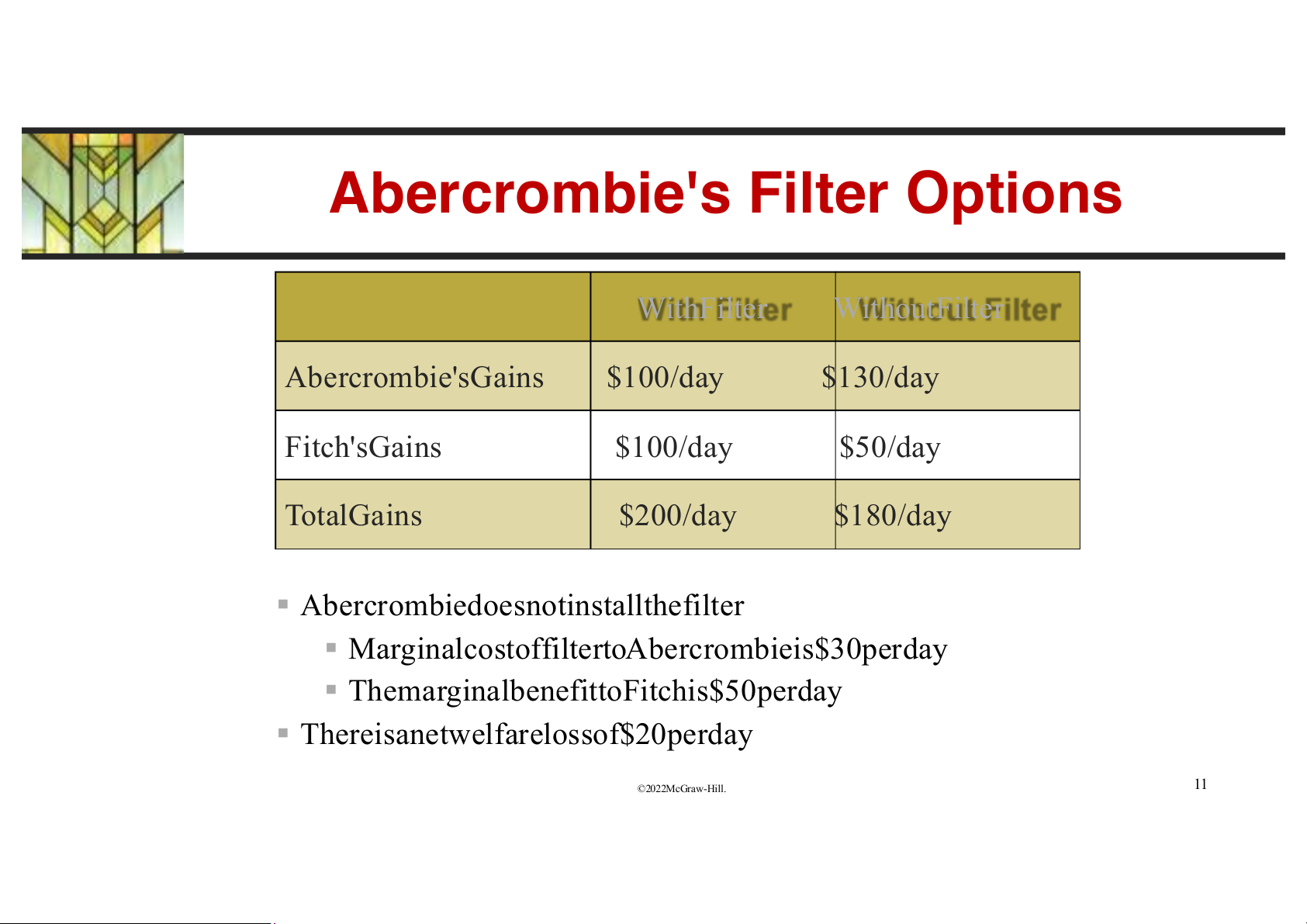
Abercrombie the Polluter – Scenario 1
• Abercrombie’s company dumps toxic waste in the river
– Fitch cannot fish the river – No one else is harmed
• Abercrombie could install a filter to remove the harm to Fitch
– Filter imposes costs on Abercrombie – Filter benefits Fitch • Parties do not communicate ©2022 McGraw-Hill. 10
Abercrombie's Filter Options With Filter Without Filter Abercrombie's Gains $100 / day $130 / day Fitch's Gains $100 / day $50 / day Total Gains $200 / day $180 / day
§ Abercrombie does not install the filter
§ Marginal cost of filter to Abercrombie is $30 per day
§ The marginal benefit to Fitch is $50 per day
§ There is a net welfare loss of $20 per day ©2022 11 McGraw-Hill.
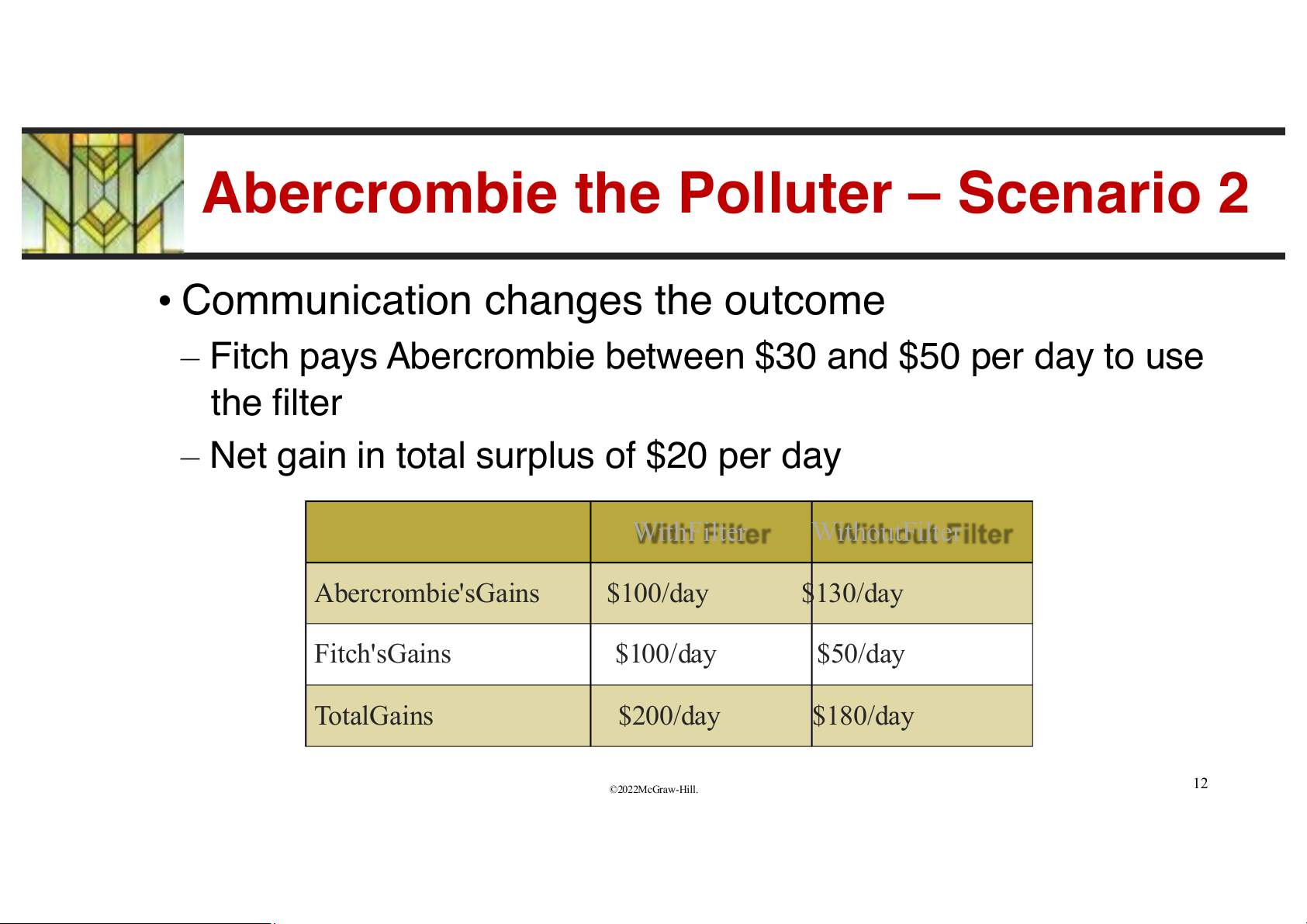
Abercrombie the Polluter – Scenario 2
• Communication changes the outcome
– Fitch pays Abercrombie between $30 and $50 per day to use the filter
– Net gain in total surplus of $20 per day With Filter Without Filter Abercrombie's Gains $100 / day $130 / day Fitch's Gains $100 / day $50 / day Total Gains $200 / day $180 / day 12 ©2022 McGraw-Hill. The Coase Theorem
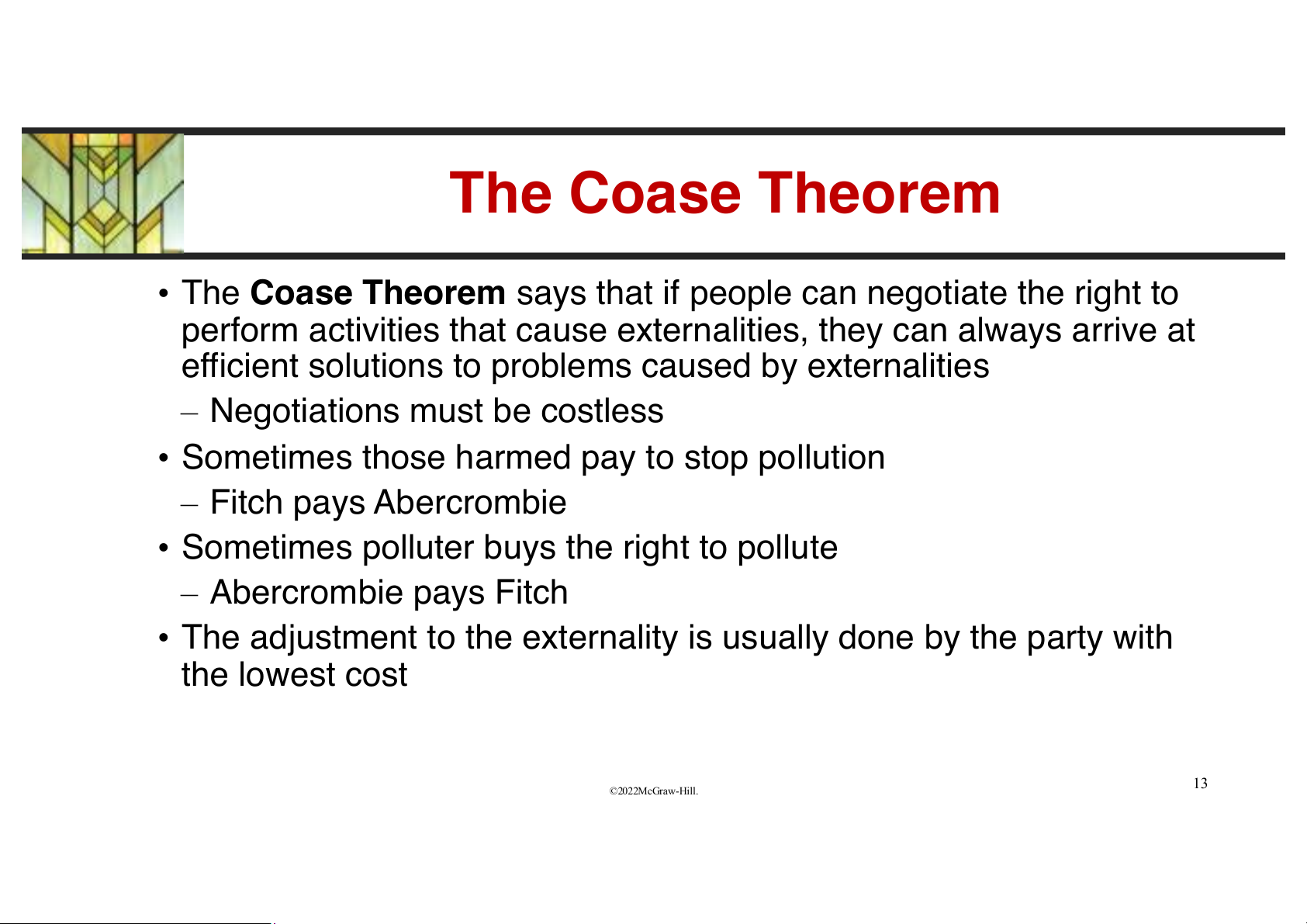
• The Coase Theorem says that if people can negotiate the right to
perform activities that cause externalities, they can always arrive at
efficient solutions to problems caused by externalities
– Negotiations must be costless
• Sometimes those harmed pay to stop pollution – Fitch pays Abercrombie
• Sometimes polluter buys the right to pollute – Abercrombie pays Fitch
• The adjustment to the externality is usually done by the party with the lowest cost 13 ©2022 McGraw-Hill.
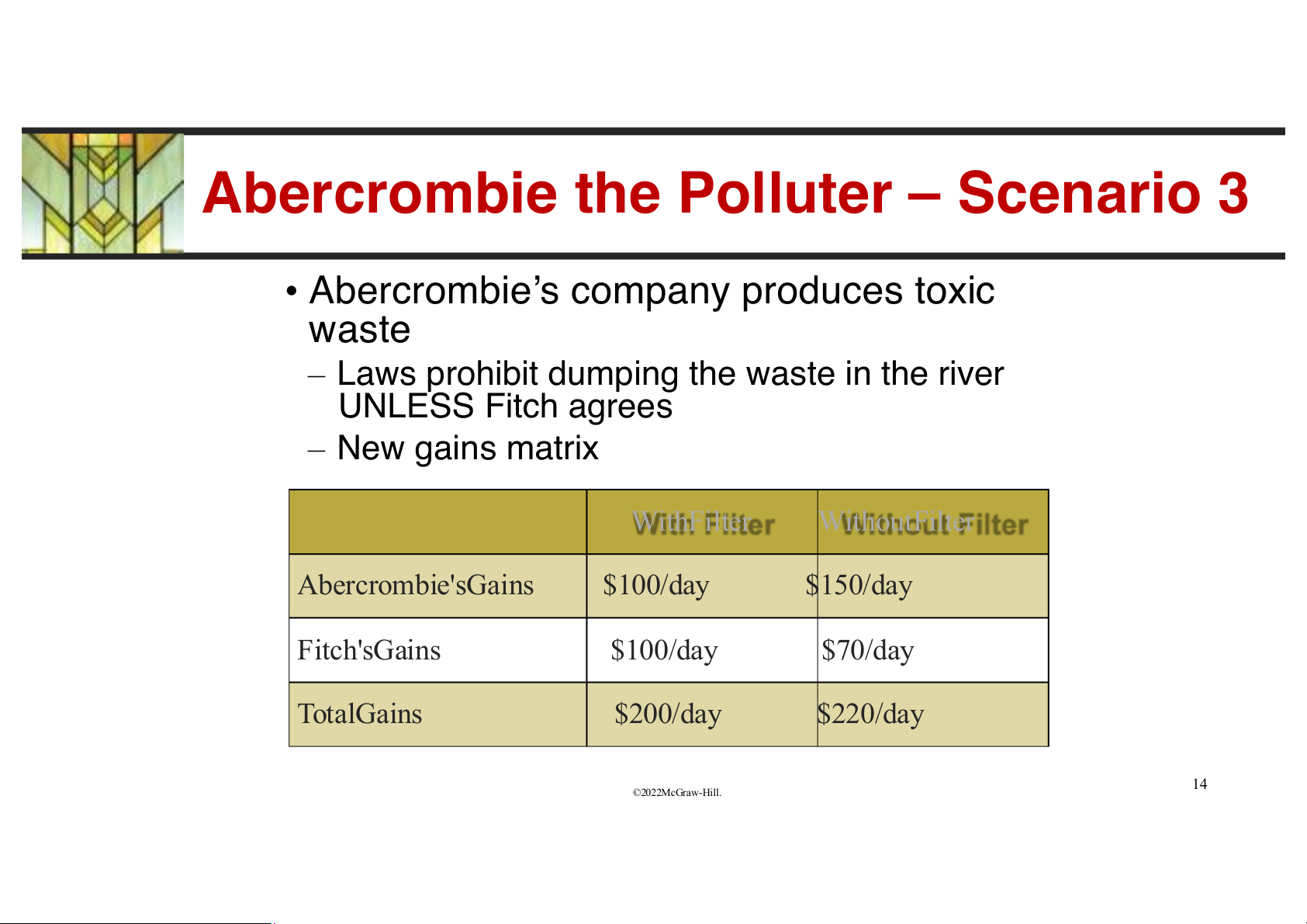
Abercrombie the Polluter – Scenario 3
• Abercrombie’s company produces toxic waste
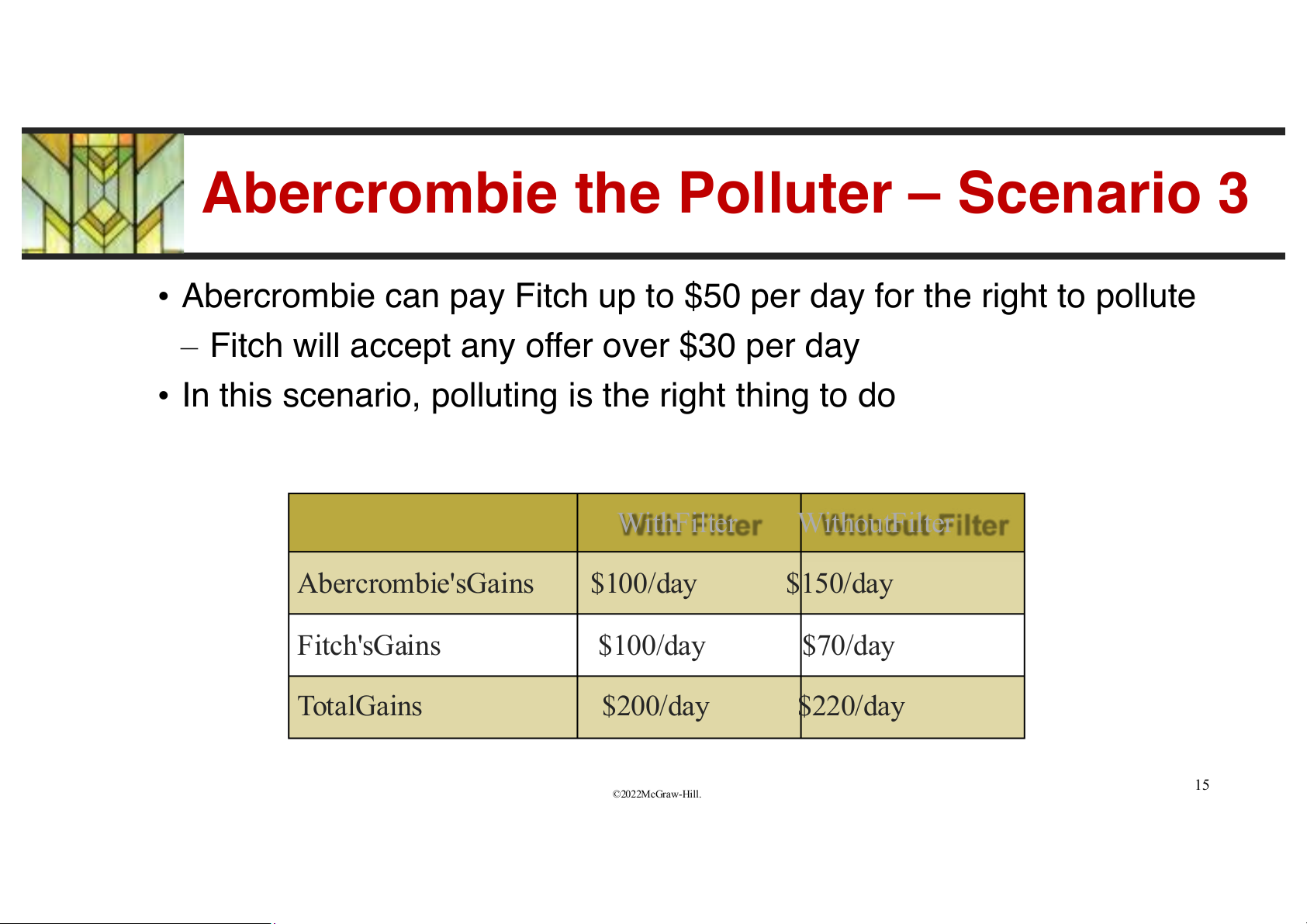
– Laws prohibit dumping the waste in the river UNLESS Fitch agrees – New gains matrix With Filter Without Filter Abercrombie's Gains $100 / day $150 / day Fitch's Gains $100 / day $70 / day Total Gains $200 / day $220 / day 14 ©2022 McGraw-Hill.
Abercrombie the Polluter – Scenario 3
• Abercrombie can pay Fitch up to $50 per day for the right to pollute
– Fitch will accept any offer over $30 per day
• In this scenario, polluting is the right thing to do With Filter Without Filter Abercrombie's Gains $100 / day $150 / day Fitch's Gains $100 / day $70 / day Total Gains $200 / day $220 / day 15 ©2022 McGraw-Hill.
Laws Can Change the Outcome
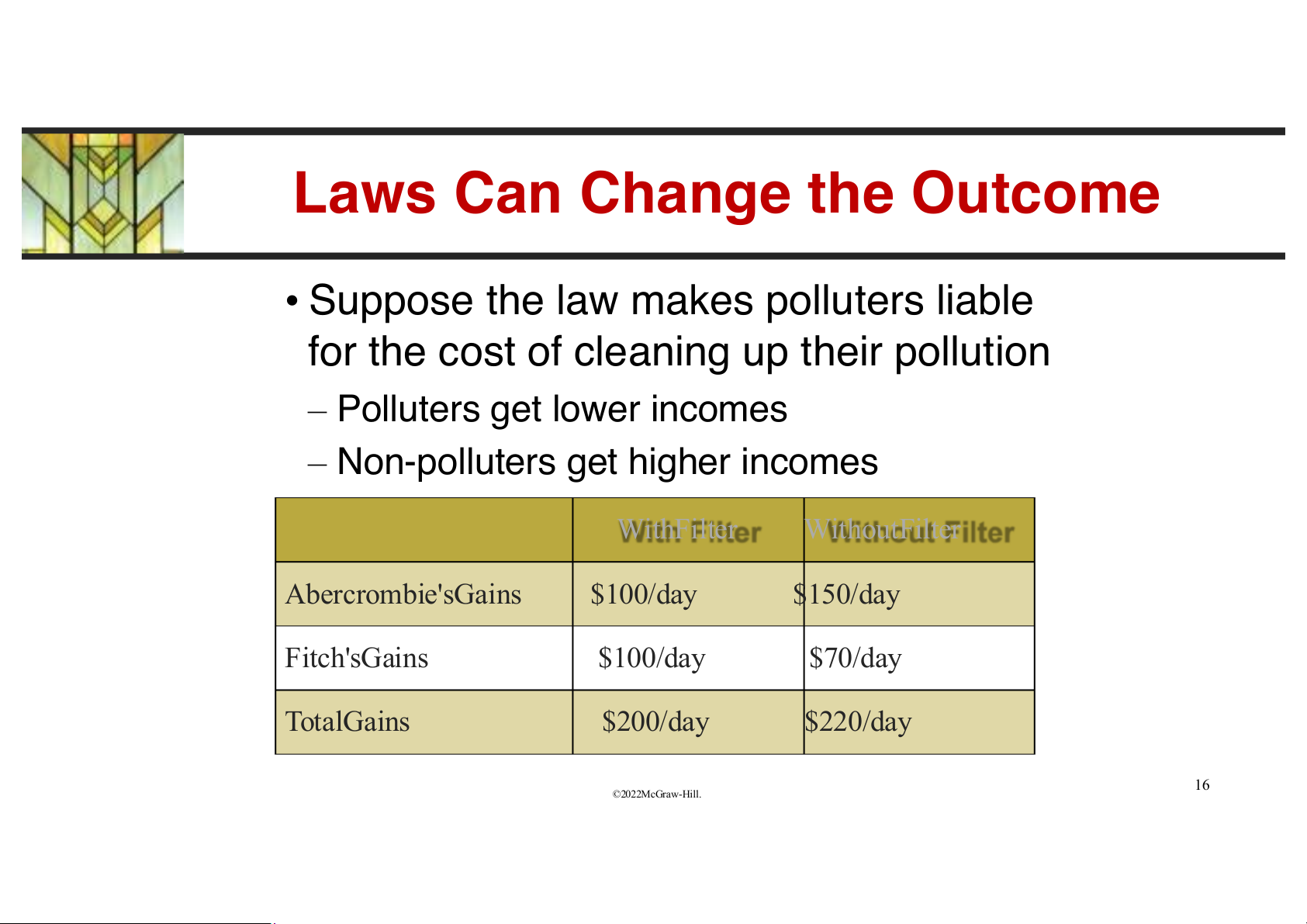
• Suppose the law makes polluters liable
for the cost of cleaning up their pollution
– Polluters get lower incomes
– Non-polluters get higher incomes With Filter Without Filter Abercrombie's Gains $100 / day $150 / day Fitch's Gains $100 / day $70 / day Total Gains $200 / day $220 / day 16 ©2022 McGraw-Hill.
Legal Remedies for Externalities
• If negotiation is costless, the party with the lowest cost usually makes the adjustment
– Private solution is generally adequate
• When negotiation is not costless laws may be used to correct for externalities
– The burden of the law can be placed on those who have the lowest cost 20 ©2022 McGraw-Hill.
Examples of Legal Remedies for Externalities
• Noise regulations (cars, parties, honking horns)
• Most traffic and traffic-related laws
– Car emission standards and inspections • Zoning laws
• Building height and footprint regulations (sunshine laws)
• Air and water pollution laws 21 ©2022 McGraw-Hill.
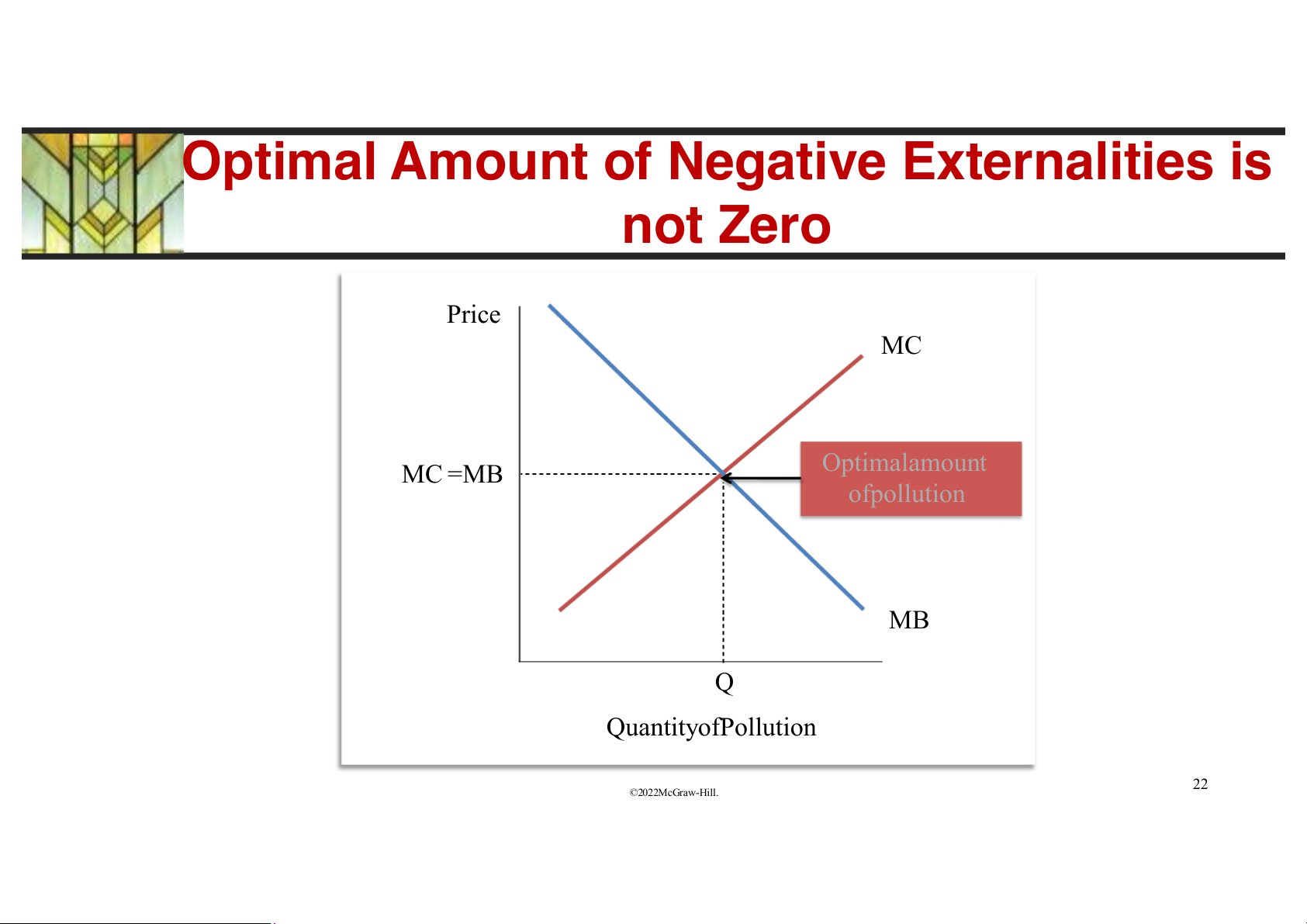
Optimal Amount of Negative Externalities is not Zero Price MC MC = Optimal MB amount of pollution MB Q Quantity of Pollution 22 ©2022 McGraw-Hill. Taxes and Subsidies
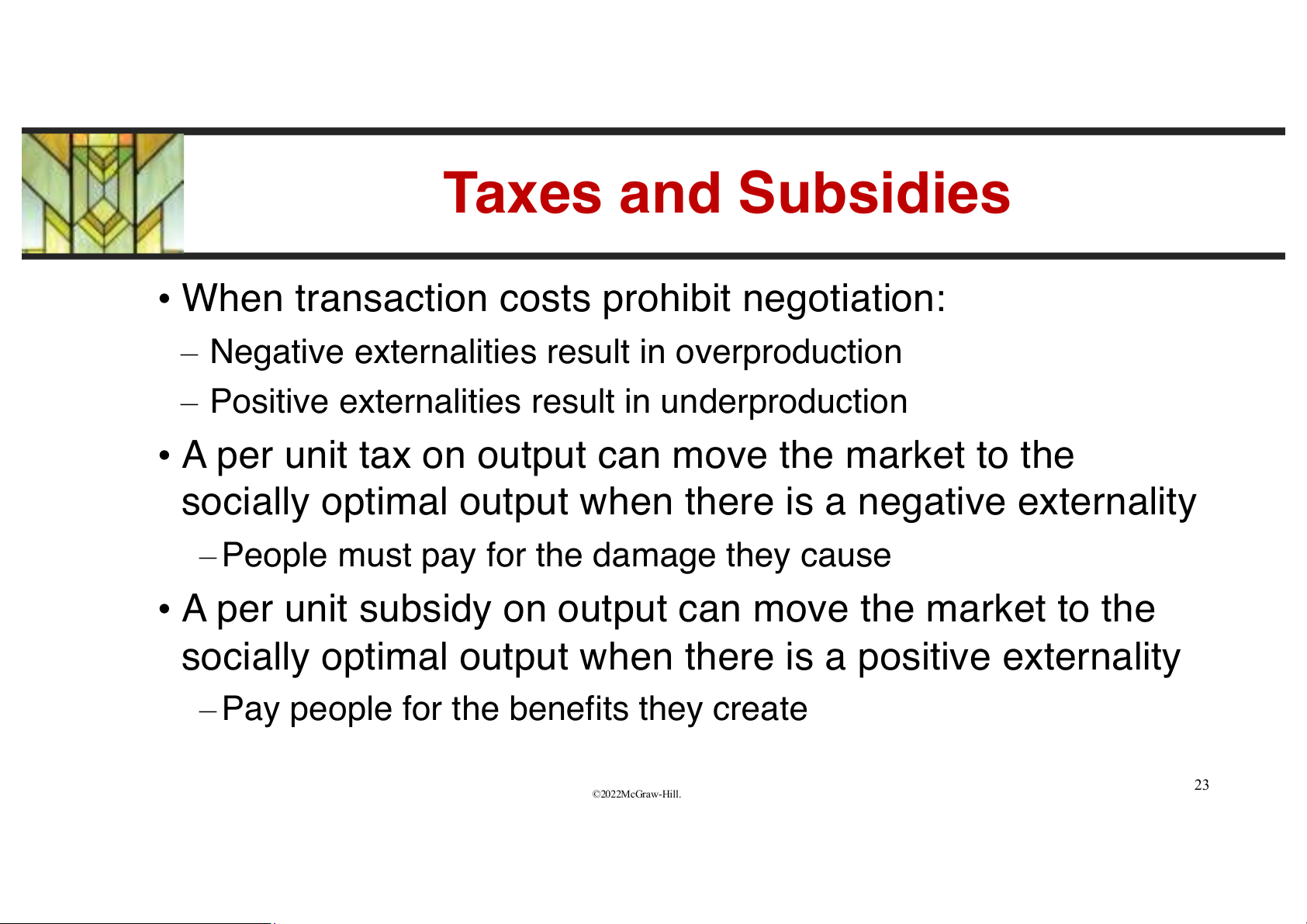
• When transaction costs prohibit negotiation:
– Negative externalities result in overproduction
– Positive externalities result in underproduction
• A per unit tax on output can move the market to the
socially optimal output when there is a negative externality
– People must pay for the damage they cause
• A per unit subsidy on output can move the market to the
socially optimal output when there is a positive externality
– Pay people for the benefits they create 23 ©2022 McGraw-Hill.
Tài liệu liên quan:
-
Tự Luận Vimo: Phân Tích Cung, Cầu và Thị Trường Cạnh Tranh| Microeconomics | Trường Đại học Quốc tế, Đại học Quốc gia Thành phố Hồ Chí Minh
5 3 -
Review Questions: Thinking Like an Economist | Microeconomics | Trường Đại học Quốc tế, Đại học Quốc gia Thành phố Hồ Chí Minh
5 3 -
Final Exam Quizlet Questions & Answers | Microeconomics | Trường Đại học Quốc tế, Đại học Quốc gia Thành phố Hồ Chí Minh
5 3 -
Đề thi giữa kỳ II | Microeconomics | Trường Đại học Quốc tế, Đại học Quốc gia Thành phố Hồ Chí Minh
5 3 -
Final Group Project_ The Beer Industry | Microeconomics | Trường Đại học Quốc tế, Đại học Quốc gia Thành phố Hồ Chí Minh
4 2