Chapter 2: Thinking Like an Economist | Microeconomics | Trường Đại học Quốc tế, Đại học Quốc gia Thành phố Hồ Chí Minh
The claim that economics is a science can seem odd to beginners. However, the essence of this science is the scientific method—the dispassionate development and testing of theories about how the world works. There are some ways economists apply the logic of science to examine how an economy works. 1. The Scientific Methods: Observation, Theory, and More Observation. - The interplay between theory and observation has also occurred in economics. (tbc) 2. The Role of Assumption - Economists make assumptions for the same reasons: Assumptions can simplify the complex world and make it easier to understand. Tài liệu được sưu tầm và soạn thảo dưới dạng file PDF để gửi tới các bạn cùng tham khảo, ôn tập đầy đủ kiến thức, chuẩn bị cho các buổi học thật tốt. Mời bạn đọc đón xem!
Môn: Microeconomics 634 tài liệu
Trường: Trường Đại học Quốc tế, Đại học Quốc gia Thành phố Hồ Chí Minh 1.9 K tài liệu
Tác giả:

Preview text:
Ch C a h p a te t r 2: 2 : Th T i h n i ki k ng n Li L k i e e an a n Ec E o c n o om o is i t s Monday, September 15, 2025 10:58 PM
symbols: ↓↑ ↳ → ⇒ ✦ ᯓ★
01 | the economist as scientist
The claim that economics is a science can seem odd to beginners. However, the essence of this science is the scientific method—the
dispassionate development and testing of theories about how the world works.
There are some ways economists apply the logic of science to examine how an economy works.
1. The Scientific Methods: Observation, Theory, and More Observation.
- The interplay between theory and observation has also occurred in economics. (tbc) 2. The Role of Assumption
- Economists make assumptions for the same reasons: Assumptions can simplify the complex world and make it easier to understand.
e.g.: To study the effect of international trade, for example, we might assume that the world consists of only two countries and that each
country produces only two goods.
→ Although in reality, there are numerous countries, each of which produces thousands of goods and services, by considering a w orld with only
two countries and two goods, we can focus our thinking on the essence of the problem.
- The art in scientific thinking—whether in physics, biology, or economics—is deciding which assumptions to make. Economists employ different
assumptions to address various questions. Just as a physicist uses different assumptions when studying falling marbles and falling beach balls,
economists use different assumptions when studying the short-run and long-run effects of a change in the quantity of money. 3. Economics Models:
- Similar to the anatomy that biology teachers use to teach lectures, economists also use models to learn about the world, but unlike plastic
manikins, their models mostly consist of diagrams and equations. Additionally, all models—in physics, biology, and economics—simplify reality to
improve our understanding of it. a) The Circular-Flow Diagram
- The economy consists of millions of people engaged in many activities- buying, selling, working, hiring, manufacturing, and so on. To understand
how the economy works, we must find some way to simplify our thinking about all these activities.
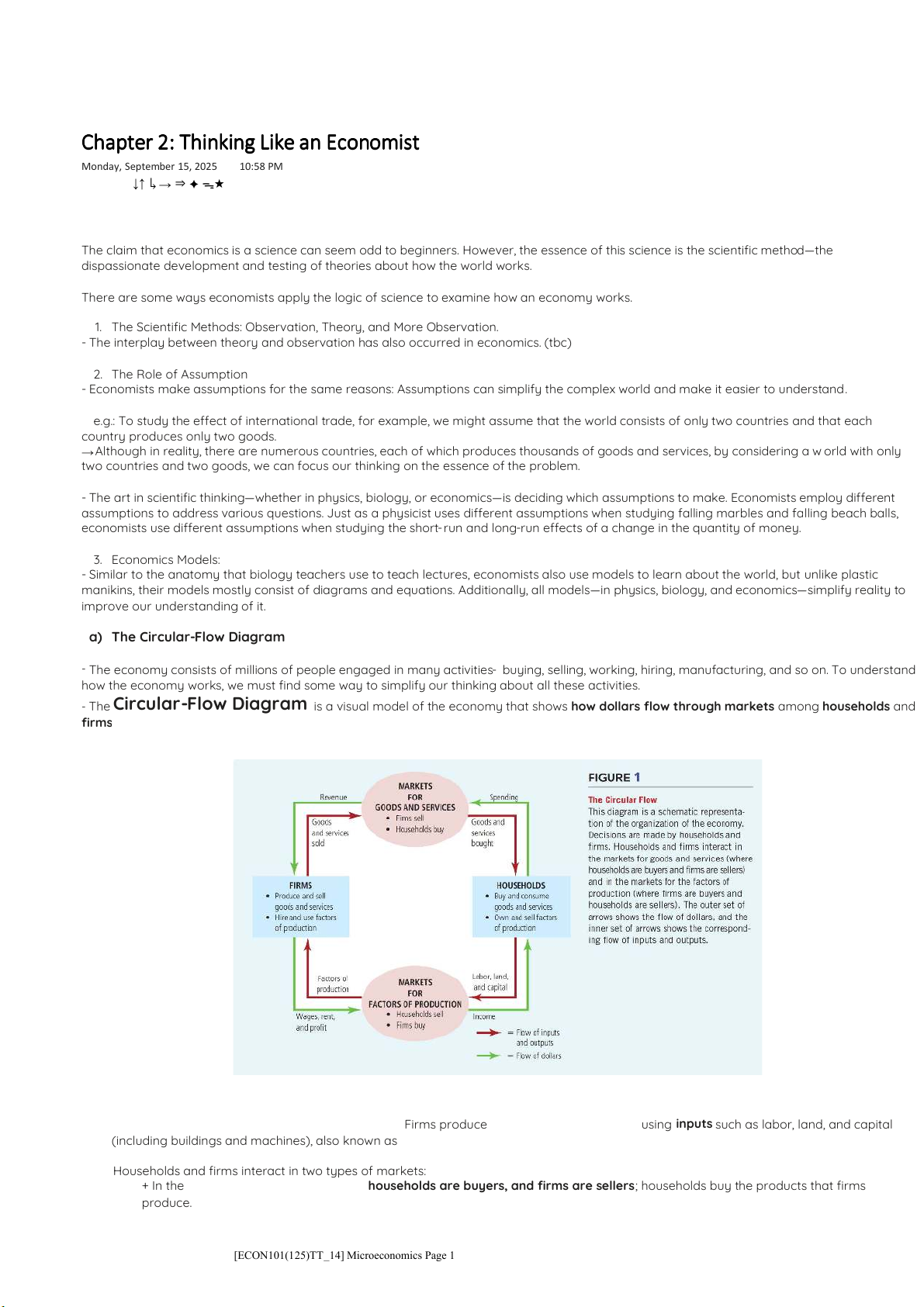
- The Circular-Flow Diagram is a visual model of the economy that shows how dollars flow through markets among households and firms
Figure 1 presents the visual model of an economy using the circular-flow diagram
Description: The economy in this model is considered to be closed (no interactions with other countries). It is simplified to include only two
types of decision-makers: firms and households. Firms produce goods and services (G&S) using inputs such as labor, land, and capital
(including buildings and machines), also known as the factors of production.
Households and firms interact in two types of markets:
+ In the market for goods and services, households are buyers, and firms are sellers; households buy the products that firms produce.
[ECON101(125)TT_14] Microeconomics Page 1
+ In the market for the factors of production, households are sellers, and firms are buyers; households provide the inputs that firms
use to produce goods and services.
The two loops of the circular-flow diagram are distinct but related (looking at the colors and directions of the arrows)
b) The Production Possibilities Frontier
- We are always facing limitations, so we need to showcase the capacity of our economy. Consider an economy that produces only two goods.
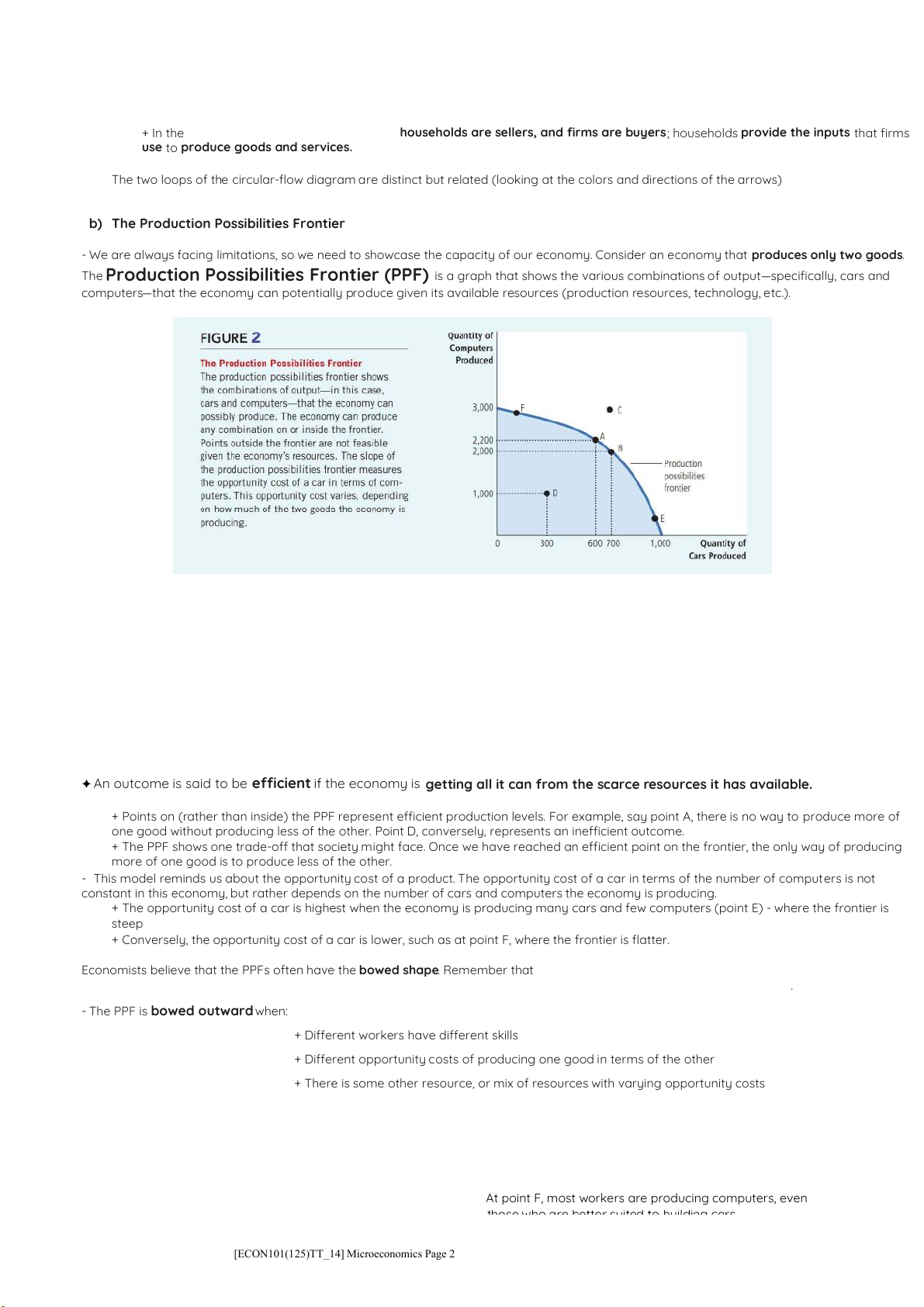
The Production Possibilities Frontier (PPF) is a graph that shows the various combinations of output—specifically, cars and
computers—that the economy can potentially produce given its available resources (production resources, technology, etc.).
Description: Figure 2 shows this economy’s production possibilities frontier
+ If the economy uses all its resources in the car industry, it produces 1000 cars and no computers.
+ If it uses all its resources in the computer industry, it produces 3000 computers and no cars.
More likely, the economy divides its resources between two industries
+ The economy can produce 600 cars and 2200 computers (point A)
+ Or by modifying some of the factors of production to the car industry, it can produce 700 cars and 2000 computers (point B)
Because resources are scarce, not every conceivable outcome is feasible (point C). With the resources it has, the economy can produce at
any point on or inside the production possibilities frontier, but it cannot produce at points outside the frontier.
✦ An outcome is said to be ecient if the economy is getting all it can from the scarce resources it has available.
+ Points on (rather than inside) the PPF represent efficient production levels. For example, say point A, there is no way to produce more of
one good without producing less of the other. Point D, conversely, represents an inefficient outcome.
+ The PPF shows one trade-off that society might face. Once we have reached an efficient point on the frontier, the only way of producing
more of one good is to produce less of the other.
- This model reminds us about the opportunity cost of a product. The opportunity cost of a car in terms of the number of computers is not
constant in this economy, but rather depends on the number of cars and computers the economy is producing.
+ The opportunity cost of a car is highest when the economy is producing many cars and few computers (point E) - where the frontier is steep
+ Conversely, the opportunity cost of a car is lower, such as at point F, where the frontier is flatter.
Economists believe that the PPFs often have the bowed shape. Remember that when the economy is using most of its resources to make
computers, the resources best suited to car production, such as skilled autoworkers, are being used in the computer industry.
- The PPF is bowed outward when:
+ Different workers have different skills
+ Different opportunity costs of producing one good in terms of the other
+ There is some other resource, or mix of resources with varying opportunity costs
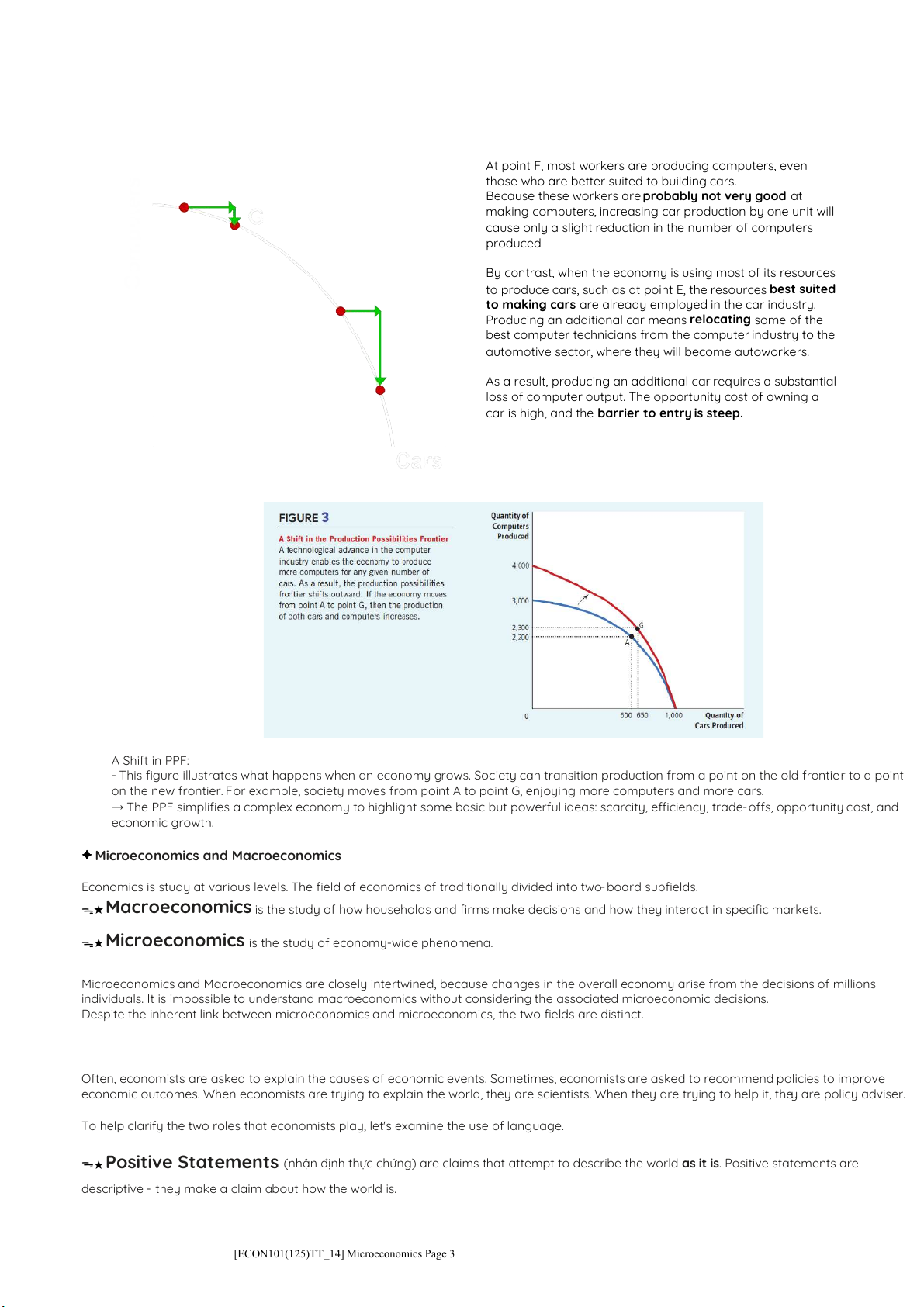
At point F, most workers are producing computers, even
[ECON101(125)TT_14] Microeconomics Page 2
At point F, most workers are producing computers, even
those who are better suited to building cars.
Because these workers are probably not very good at
making computers, increasing car production by one unit will
cause only a slight reduction in the number of computers produced
By contrast, when the economy is using most of its resources
to produce cars, such as at point E, the resources best suited
to making cars are already employed in the car industry.
Producing an additional car means relocating some of the
best computer technicians from the computer industry to the
automotive sector, where they will become autoworkers.
As a result, producing an additional car requires a substantial
loss of computer output. The opportunity cost of owning a
car is high, and the barrier to entry is steep. A Shift in PPF:
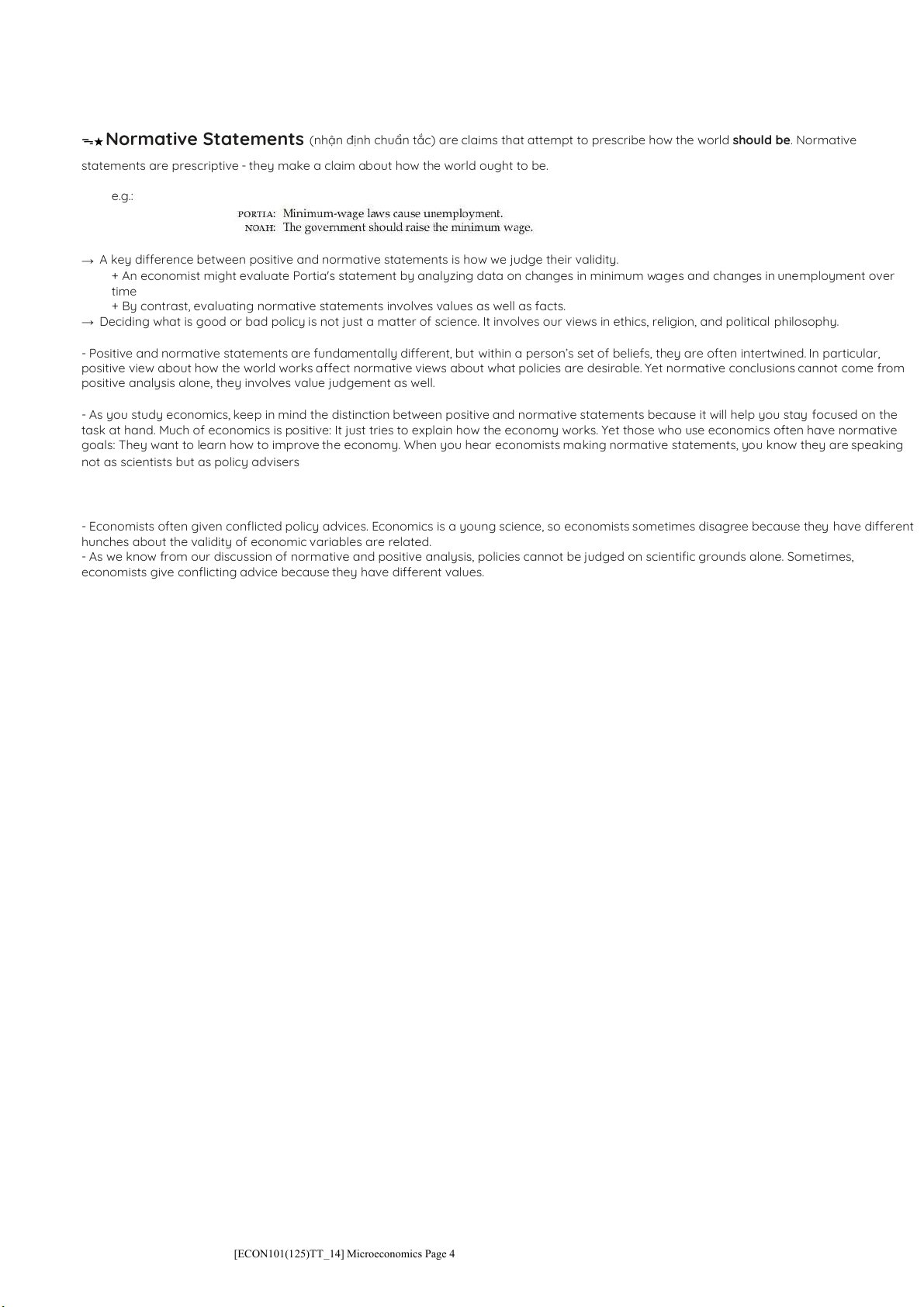
- This figure illustrates what happens when an economy grows. Society can transition production from a point on the old frontier to a point
on the new frontier. For example, society moves from point A to point G, enjoying more computers and more cars.
→ The PPF simplifies a complex economy to highlight some basic but powerful ideas: scarcity, efficiency, trade-offs, opportunity cost, and economic growth.
✦ Microeconomics and Macroeconomics
Economics is study at various levels. The field of economics of traditionally divided into two-board subfields.
ᯓ★ Macroeconomics is the study of how households and firms make decisions and how they interact in specific markets.
ᯓ★ Microeconomics is the study of economy-wide phenomena.
Microeconomics and Macroeconomics are closely intertwined, because changes in the overall economy arise from the decisions of millions
individuals. It is impossible to understand macroeconomics without considering the associated microeconomic decisions.
Despite the inherent link between microeconomics and microeconomics, the two fields are distinct.
02 | the economist as policy advisor
Often, economists are asked to explain the causes of economic events. Sometimes, economists are asked to recommend policies to improve
economic outcomes. When economists are trying to explain the world, they are scientists. When they are trying to help it, they are policy adviser.
To help clarify the two roles that economists play, let's examine the use of language.
ᯓ★ Positive Statements (nhận định thực chứng) are claims that attempt to describe the world as it is. Positive statements are
descriptive - they make a claim about how the world is.
[ECON101(125)TT_14] Microeconomics Page 3
ᯓ★ Normative Statements (nhận định chuẩn tắc) are claims that attempt to prescribe how the world should be. Normative
statements are prescriptive - they make a claim about how the world ought to be. e.g.:
→ A key difference between positive and normative statements is how we judge their validity.
+ An economist might evaluate Portia's statement by analyzing data on changes in minimum wages and changes in unemployment over time
+ By contrast, evaluating normative statements involves values as well as facts.
→ Deciding what is good or bad policy is not just a matter of science. It involves our views in ethics, religion, and political philosophy.
- Positive and normative statements are fundamentally different, but within a person’s set of beliefs, they are often intertwined. In particular,
positive view about how the world works affect normative views about what policies are desirable. Yet normative conclusions cannot come from
positive analysis alone, they involves value judgement as well.
- As you study economics, keep in mind the distinction between positive and normative statements because it will help you stay focused on the
task at hand. Much of economics is positive: It just tries to explain how the economy works. Yet those who use economics often have normative
goals: They want to learn how to improve the economy. When you hear economists making normative statements, you know they are speaking
not as scientists but as policy advisers 03 | why economists disagree
- Economists often given conflicted policy advices. Economics is a young science, so economists sometimes disagree because they have different
hunches about the validity of economic variables are related.
- As we know from our discussion of normative and positive analysis, policies cannot be judged on scientific grounds alone. Sometimes,
economists give conflicting advice because they have different values.
[ECON101(125)TT_14] Microeconomics Page 4
Tài liệu liên quan:
-
Microeconomics Syllabus | Microeconomics | Trường Đại học Quốc tế, Đại học Quốc gia Thành phố Hồ Chí Minh
0 0 -
Microeconomics Course Syllabus & Assessment Details | Microeconomics | Trường Đại học Quốc tế, Đại học Quốc gia Thành phố Hồ Chí Minh
0 0 -
Assignment 3 - Elasticity MCQs and Key Concepts | Microeconomics | Trường Đại học Quốc tế, Đại học Quốc gia Thành phố Hồ Chí Minh
0 0 -
Assignment 2 - Economic Equilibrium Analysis of Fridges and Motorcycles | Microeconomics | Trường Đại học Quốc tế, Đại học Quốc gia Thành phố Hồ Chí Minh
0 0 -
Assignment 4_ Analyzing Elasticity and Luxury Tax Implications | Microeconomics | Trường Đại học Quốc tế, Đại học Quốc gia Thành phố Hồ Chí Minh
0 0