Microeconomics Course Syllabus & Assessment Details | Microeconomics | Trường Đại học Quốc tế, Đại học Quốc gia Thành phố Hồ Chí Minh
This course is to introduce basic terms, core concepts and foundation theories for many years of study in economics, business, banking and finance or related fields. By the end of the course, students will be able to understand introductory microeconomic theory and use these theory frameworks to analyze a wide range of policy questions in the real economy. This course covers the following topics. Tài liệu được sưu tầm và soạn thảo dưới dạng file PDF để gửi tới các bạn cùng tham khảo, ôn tập đầy đủ kiến thức, chuẩn bị cho các buổi học thật tốt. Mời bạn đọc đón xem!
Môn: Microeconomics 640 tài liệu
Trường: Trường Đại học Quốc tế, Đại học Quốc gia Thành phố Hồ Chí Minh 2 K tài liệu
Tác giả:

Preview text:
B-BAE COURSE SYLLABUS 1. GENERAL INFORMATION
Course Title (in Vietnamese): Kinh tế vi mô
Course Title (in English): Microeconomics Course code: Number of credits : 3 Theoretical lessons : 30 Practical lessons : 15 Prerequisite: None.
2. INSTRUCTOR’S INFORMATION
Full name: NGUYỄN HOÀI SƠN Tittle: PhD
Address: Building A , Room 808 1 Phone number: 0904 025 016 Email: nhson@neu.edu.vn, hoaisonkt@gmail.com
Faculty/ Institute: Faculty of Economics 3. COURSE DESCRIPTIONS
This course is to introduce basic terms, core concepts and foundation theories for many years of
study in economics, business, banking and finance or related fields. By the end of the course,
students will be able to understand introductory microeconomic theory and use these theory
frameworks to analyze a wide range of policy questions in the real economy. T is course h covers the following topics. i.
Overview of Economics and Thinking Like an Economist ii.
The Market Forces of Supply and Dema d n iii.
Elasticity and its Application iv. The Theory of Consumer Choic e v. The Costs of Production vi.
The Efficiency of Markets and Market Failure vii. Market Structures viii.
Supply, Demand and Government Policies 1 4. LEARNING RESOURCES: - Course book:
• Mankiw, G 2018, Principles of Economics, 8th edition, Cengage Learning, Boston, USA.
• Hakes, DR 2009, Study Guide Principles of Mic ,
roeconomics 5th edition, South-We tern s Cengage Learning, Mason U S - Reference books:
• Acemoglu, D Laibson, DI & List, JA 2015, Microeconomics, 2nd edition, Pearson
Education, Inc, UK, ISBN 13: 978-1-292-07957-8
• Parkin, M 2012, Microeconomics, 10th edition, Addison-Wesley, Pearson Education.
• Sloman, J Wride, A & Garratt, D 2015, Economics, 9th edition, Harlow: Pearson Education
- Other required materials and information:
• NEU’s eBooks and documents at http://lic.neu.edu.vn:2048/menu: Emerald Insight, IG
Publishing eBook and ProQuest Central
• NEU’s eBooks and documents at http://aep.neu.edu.vn:2048/menu
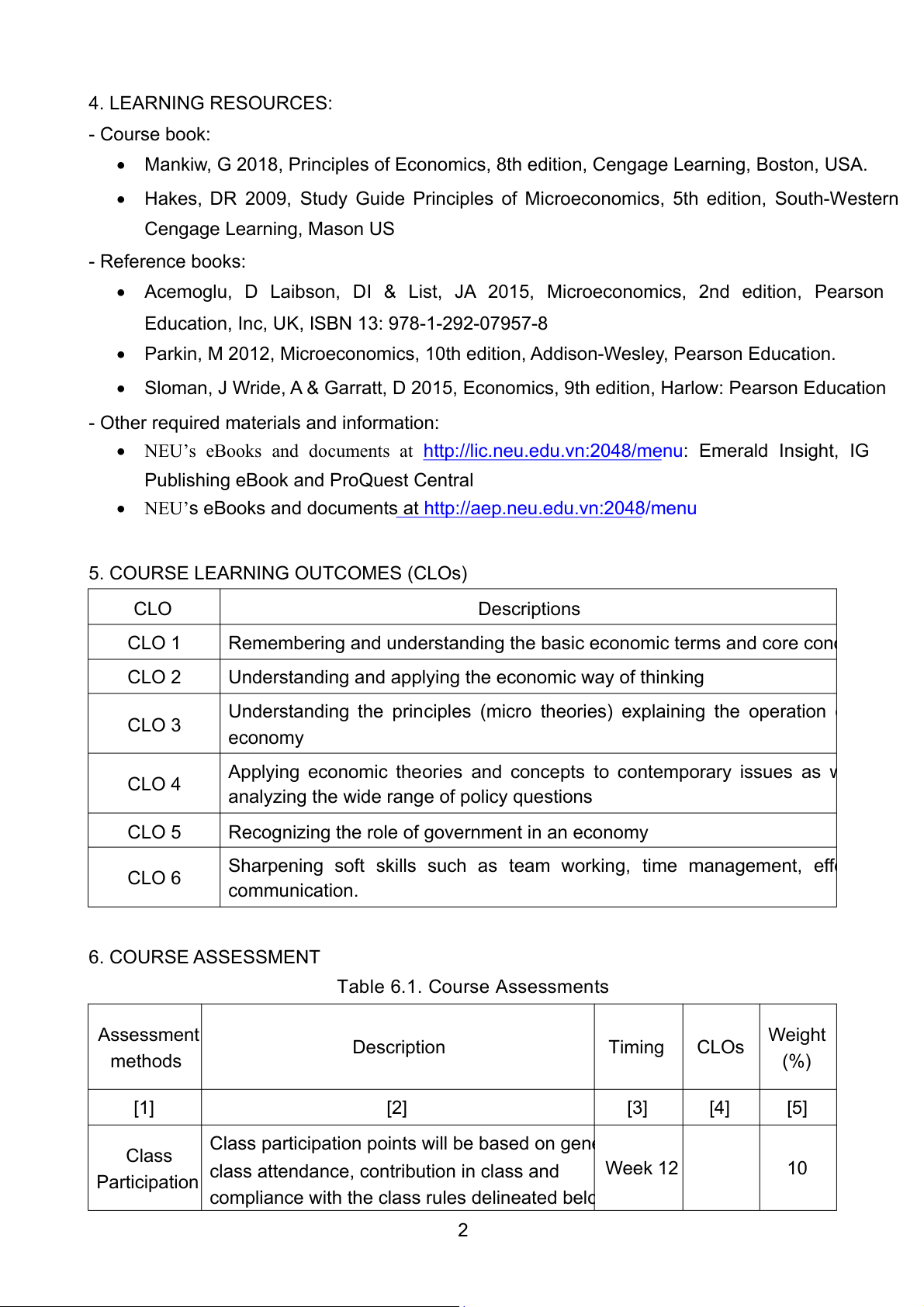
5. COURSE LEARNING OUTCOMES (CLOs) CLO Descriptions CLO 1
Remembering and understanding the basic economic terms and core conc CLO 2
Understanding and applying the economic way of thinking
Understanding the principles (micro theories) explaining the operation o CLO 3 economy
Applying economic theories a d
n concepts to contemporary issues as w CLO 4
analyzing the wide range of policy questions CLO 5
Recognizing the role of government in an economy
Sharpening soft skills such as team working, time management, effe CLO 6 communication. 6. COURSE ASSESSMENT Table 6.1. Course Assessments Assessment Weight Description Timing CLOs methods (%) [1] [2] [3] [4] [5]
Class participation points will be based on gene Class
class attendance, contribution in class and Week 12 10
Participation compliance with the class rules delineated belo 2
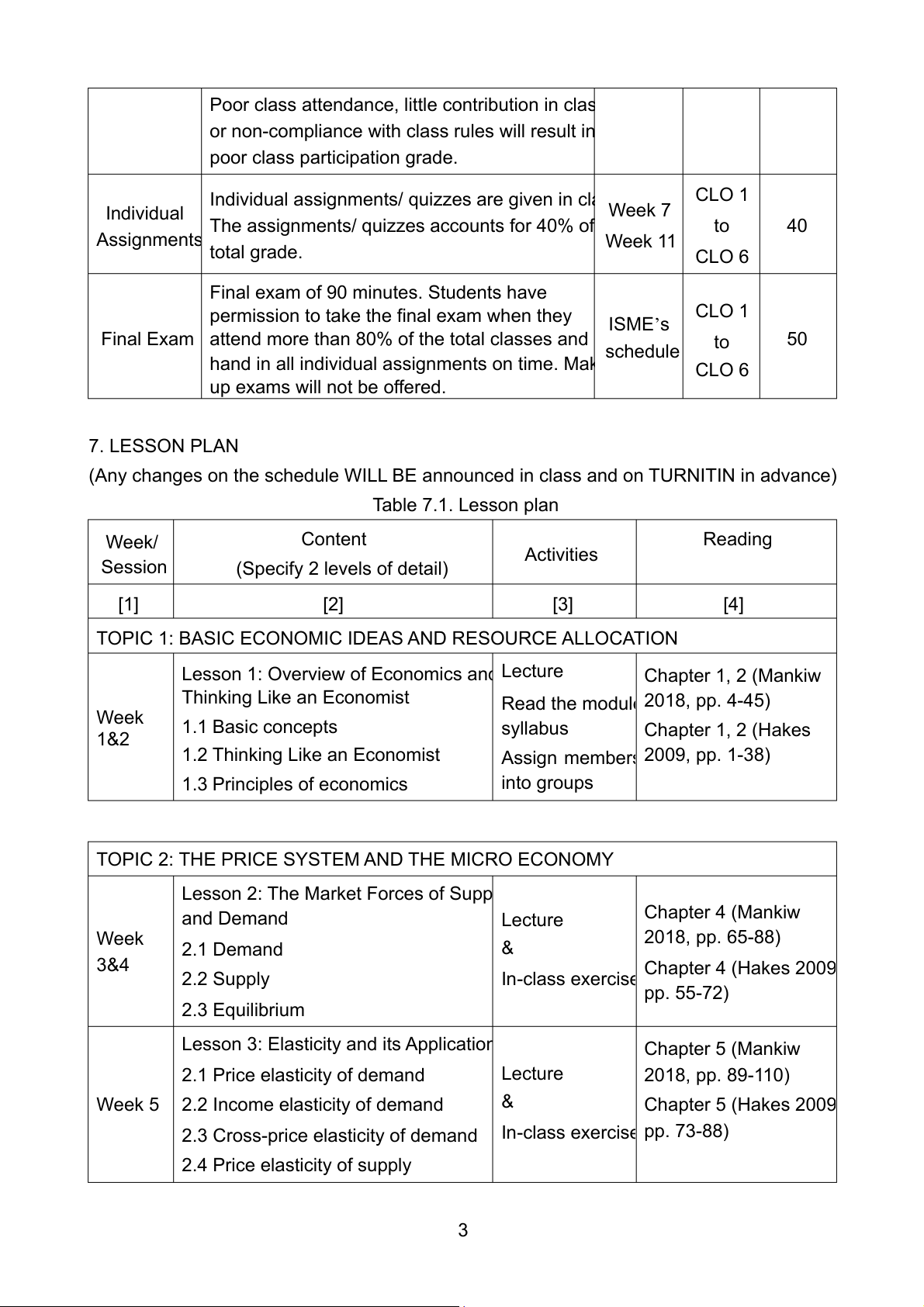
Poor class attendance, little contribution in clas
or non-compliance with class rules will result in
poor class participation grade.
Individual assignments/ quizze are given in cla s CLO 1 Individual Week 7
The assignments/ quizze accounts for 40% of s to 40 Assignments Week 11 total grade. CLO 6
Final exam of 90 minutes. Students have
permission to take the final exam when they CLO 1 ISME’s
Final Exam attend more than 80% of the total classes and 50 schedule to
hand in all individual assignments on time. Mak CLO 6 up exams will not be offered. 7. LESSON PLAN
(Any changes on the schedule WILL BE announced in class and on TU NITIN in advance) R Table 7.1. Lesson plan Week/ Content Reading Activities Session (Specify 2 levels of detail) [1] [2] [3] [4]
TOPIC 1: BASIC ECONOMIC IDEAS AND RESOURCE ALLOCATION
Lesson 1: O erview of Economics and v Lecture Chapter 1, 2 (Mankiw Thinking Like an Economist
Read the module2018, pp. 4-45) Week 1.1 Basic concepts syllabus 1&2 Chapter 1, 2 (Hakes
1.2 Thinking Like an Economist
Assign members 2009, pp. 1-38) 1.3 Principles of economics into groups TOPIC 2: THE PRICE SYSTEM AND THE MICRO ECONOMY
Lesson 2: The Market Forces of Supp and Demand Lecture Chapter 4 (Mankiw Week 2018, pp. 65-88) 2.1 Demand & 3&4 Chapter 4 (Hakes 2009 2.2 Supply In-class exercise pp. 55-72) 2.3 Equilibrium
Lesson 3: Elasticity and its Application Chapter 5 (Mankiw
2.1 Price elasticity of demand Lecture 2018, pp. 89-110)
Week 5 2.2 Income elasticity of demand & Chapter 5 (Hakes 2009
2.3 Cross-price elasticity of demand In-class exercise pp. 73-88)
2.4 Price elasticity of supply 3
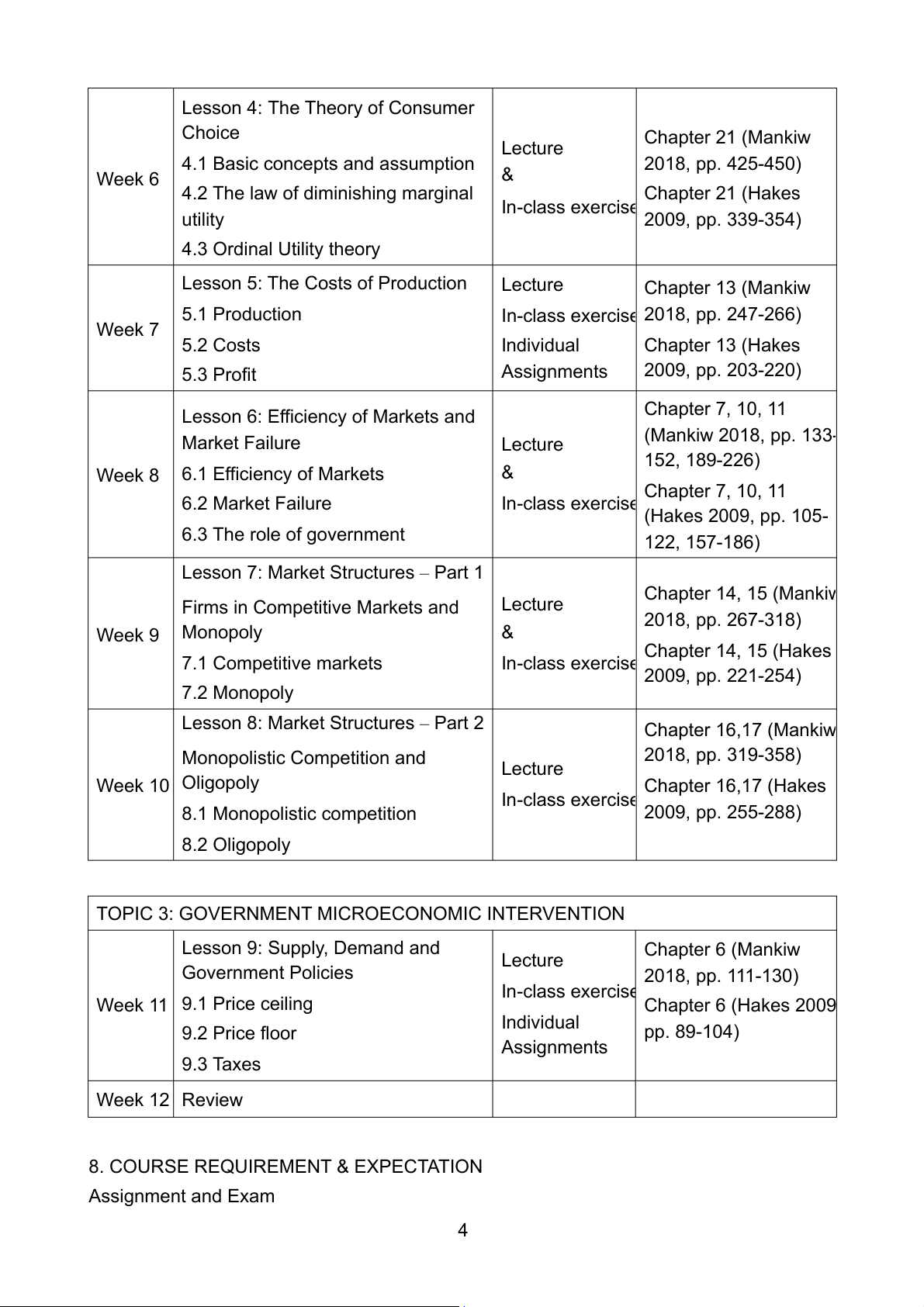
Lesson 4: The Theory of Consumer Choice Chapter 21 (Mankiw Lecture
4.1 Basic concepts and assumption 2018, pp. 425-450) Week 6 &
4.2 The law of diminishing marginal Chapter 21 (Hakes In-class exercise utility 2009, pp. 339-354) 4.3 Ordinal Utility theory
Lesson 5: The Costs of Production Lecture Chapter 13 (Mankiw 5.1 Production
In-class exercise 2018, pp. 247-266) Week 7 5.2 Costs Individual Chapter 13 (Hakes 5.3 Profit Assignments 2009, pp. 203-220) Le son 6: Ef s ficiency of Markets and Chapter 7, 10, 11 Market Failure Lecture (Mankiw 2018, pp. 133- 152, 189-226)
Week 8 6.1 Efficiency of Markets & Chapter 7, 10, 11 6.2 Market Failure
In-class exercise (Hakes 2009, pp. 105- 6.3 The role of government 122, 157-186)
Lesson 7: Market Structures – Part 1 Chapter 14, 15 (Mankiw
Firms in Competitive Markets and Lecture 2018, pp. 267-318) Week 9 Monopoly & Chapter 14, 15 (Hakes 7.1 Competitive markets
In-class exercise 2009, pp. 221-254) 7.2 Monopoly
Lesson 8: Market Structures – Part 2 Chapter 16,17 (Mankiw Monopolistic Competition and 2018, pp. 319-358) Lecture Week 10 Oligopoly Chapter 16,17 (Hakes In-class exercise 8.1 Monopolistic competition 2009, pp. 255-288) 8.2 Oligopoly
TOPIC 3: GOVERNMENT MICROECONOMIC INTERVENTION Lesson 9: Supply, Demand and Chapter 6 (Mankiw Lecture Government Policies 2018, pp. 111-130) In-class exercise Week 11 9.1 Price ceiling Chapter 6 (Hakes 2009 Individual 9.2 Price floor pp. 89-104) Assignments 9.3 Taxes Week 12 Review
8. COURSE REQUIREMENT & EXPECTATION Assignment and Exam 4
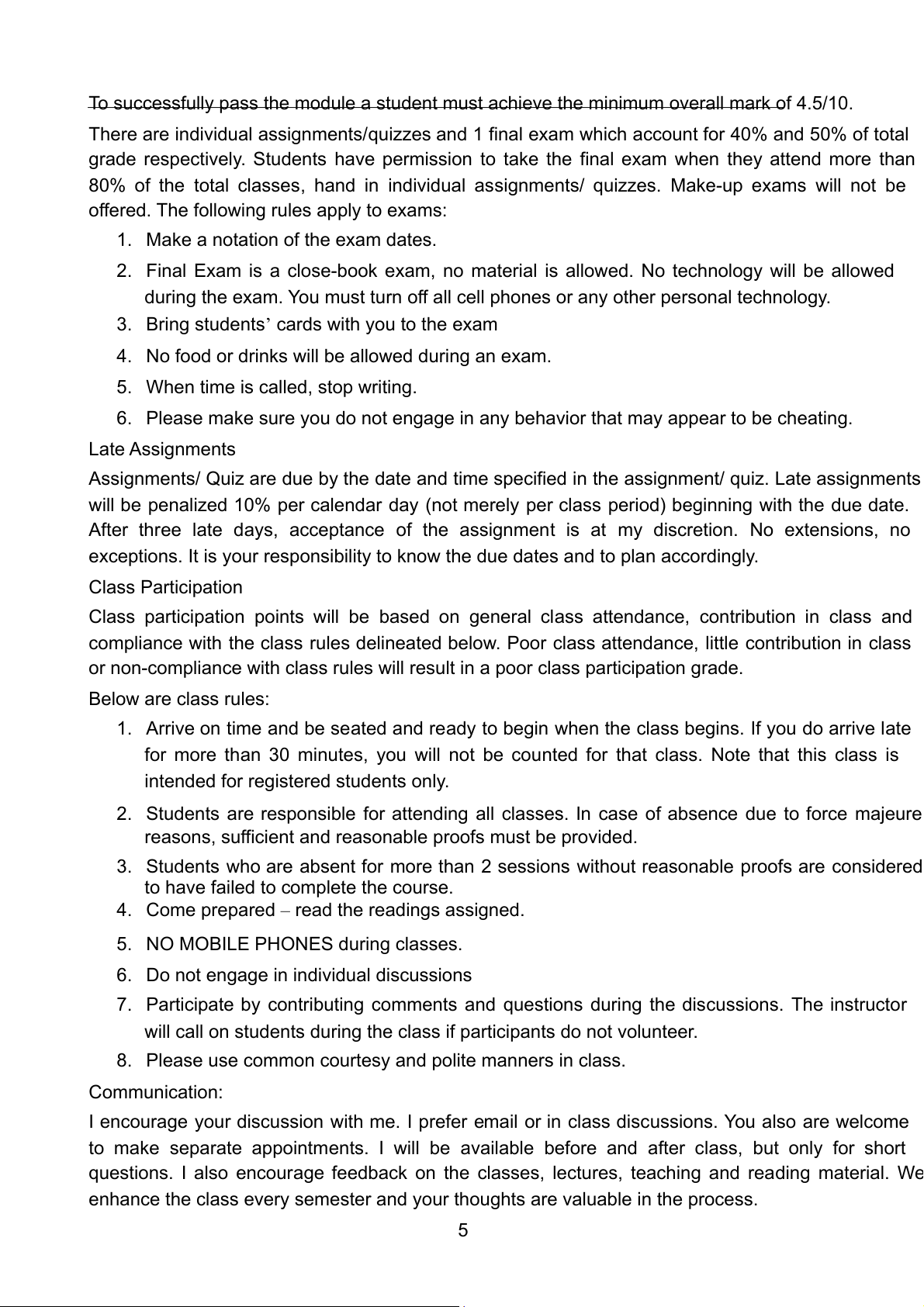
To successfully pass the module a student must achieve the minimum overall mark of 4.5/10.
There are individual a signments/ s quizze and s
1 final exam which account for 40% and 50% of total
grade respectively. Students have permission to take the final exam when they attend more than
80% of the total classes, hand in individual assignments/ quizze . s Make-up exams will not be
offered. The following rules apply to exams:
1. Make a notation of the exam dates.
2. Final Exam is a close-book exam, no material is allowed. No technology will be allowed
during the exam. You must turn off all cell phones or any other personal technology.
3. Bring students’ cards with you to the exam
4. No food or drinks will be allowed during an exam.
5. When time is called, stop writing.
6. Please make sure you do not engage in any behavior that may appear to be cheating. Late Assignments
Assignments/ Quiz are due by the date and time specified in the assignment/ quiz. Late assignments
will be penalized 10% per calendar day (not merely per class period) beginning with the due date.
After three late days, acceptance of the assignment is at my discretion. No extensions, no
exceptions. It is your responsibility to know the due dates and to plan accordingly. Class Participation
Class participation points will be based on general class attendance, contribution in class and
compliance with the class rules delineated below. Poor class attendance, little contribution in class
or non-compliance with class rules will result in a poor class participation grade . Below are class rules:
1. Arrive on time and be seated and ready to begin when the class begins. If you do arrive late
for more than 30 minutes, you will not be counted for that class. Note that this class is
intended for registered students only.
2. Students are responsible for attending all classes. In case of absence due to force majeure
reasons, sufficient and reasonable proofs must be provided.
3. Students who are absent for more than 2 sessions without reasonable proofs are considered
to have failed to complete the course.
4. Come prepared – read the readings assigned.
5. NO MOBILE PHONES during classes.
6. Do not engage in individual discussions
7. Participate by contributing comments and questions during the discussions. The instructor
will call on students during the class if participants do not volunteer.
8. Please use common courtesy and polite manners in c ass. l Communication:
I encourage your discussion with me. I prefer email or in class discussions. You also are welcome
to make separate appointments. I will be available before and after class, but only for short
questions. I also encourage feedback on the classes, lectures, teaching and reading material. We
enhance the class every semester and your thoughts are valuable in the process. 5 9. APPROVEMENT DATE
: …………………….. ISME’s Dean B-BAE Academic Commitee Instructor
(Ký và ghi rõ họ tên)
(Ký và ghi rõ họ tên)
(Ký và ghi rõ họ tên) 6
Tài liệu liên quan:
-
Syllabus: Principles of Microeconomics | Microeconomics | Trường Đại học Quốc tế, Đại học Quốc gia Thành phố Hồ Chí Minh
30 15 -
Winter Term 1999 Midterm Exam | Microeconomics | Trường Đại học Quốc tế, Đại học Quốc gia Thành phố Hồ Chí Minh
19 10 -

Understanding Economic Bubbles: Insights from Fama & Shiller | Microeconomics | Trường Đại học Quốc tế, Đại học Quốc gia Thành phố Hồ Chí Minh
23 12 -
Tóm Tắt Chương 1-3 Thuyết Kinh Tế Vi Mô | Microeconomics | Trường Đại học Quốc tế, Đại học Quốc gia Thành phố Hồ Chí Minh
26 13 -
Assignment Presentation 1: Economic Trade-offs & Production Dynamics | Microeconomics | Trường Đại học Quốc tế, Đại học Quốc gia Thành phố Hồ Chí Minh
18 9