Assignment 2 - Economic Equilibrium Analysis of Fridges and Motorcycles | Microeconomics | Trường Đại học Quốc tế, Đại học Quốc gia Thành phố Hồ Chí Minh
The surplus and shortage of fridge at the price of $200 and $110 : -At $200: The quantity demanded for fridges is 500 units and the quantitysupplied is 800 units. → As a result, the surplus is: 800 - 500 = 300 (units)-At $110: The quantity demanded for fridges is 950 units and the quantitysupplied is 350 units. → As a result, the shortage is 950 - 350 = 600 (units). Tài liệu được sưu tầm và soạn thảo dưới dạng file PDF để gửi tới các bạn cùng tham khảo, ôn tập đầy đủ kiến thức, chuẩn bị cho các buổi học thật tốt. Mời bạn đọc đón xem!
Môn: Microeconomics 640 tài liệu
Trường: Trường Đại học Quốc tế, Đại học Quốc gia Thành phố Hồ Chí Minh 2 K tài liệu
Tác giả:

Preview text:
Microeconomics E-BBA 16.1, Tran Thi Hong Viet, Ph.D
GROUP ASSIGNMENT PRESENTATION 2 : Group 9 - EBBA 16.1 : Nguyễn Phương Mai Phạm Ý Dương Đặng Trung Đức Nguyễn Ngọc Linh Nguyễn Minh Tuấn Exercise 1.
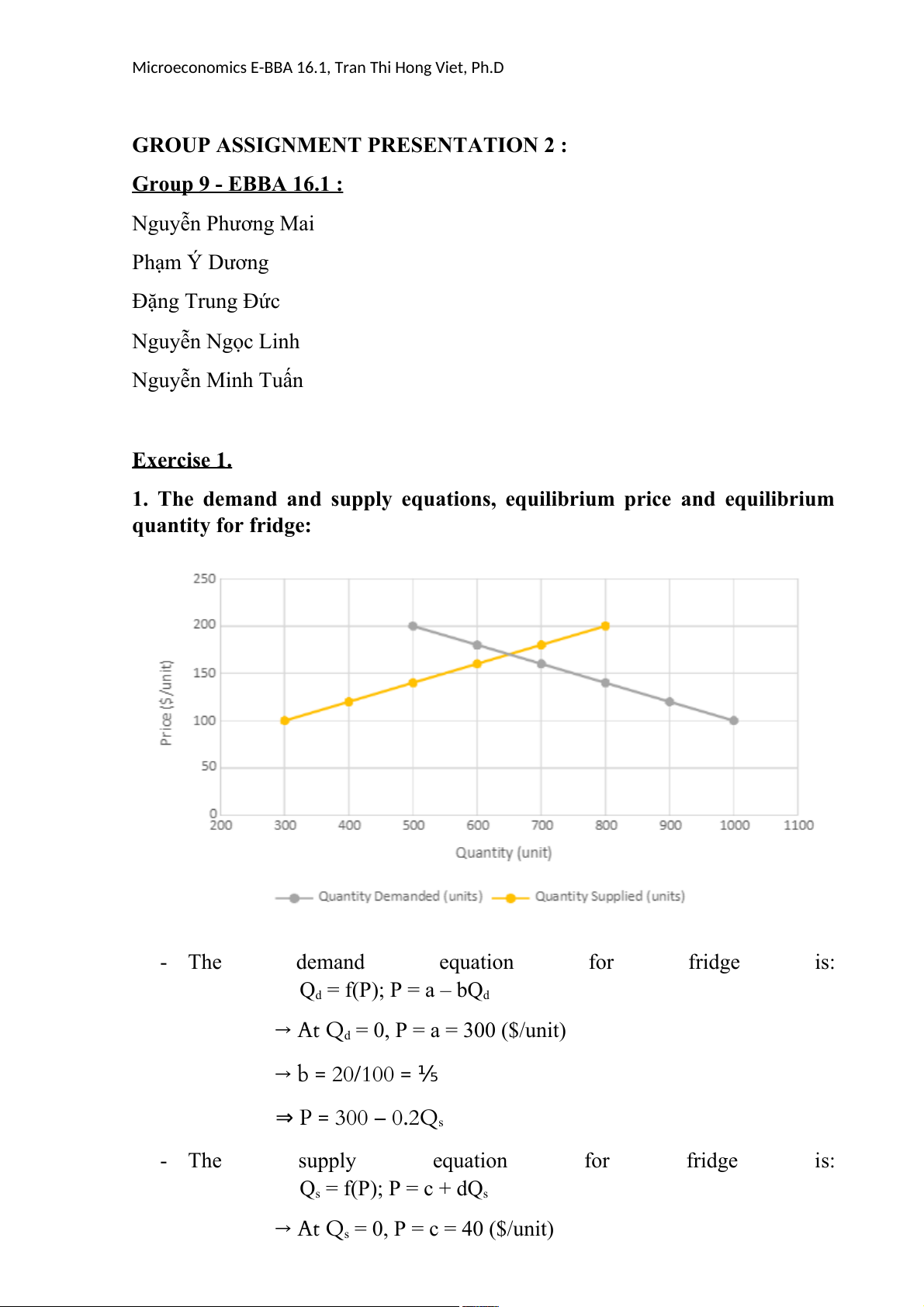
1. The demand and supply equations, equilibrium price and equilibrium quantity for fridge: - The demand equation for fridge is: Qd = f(P); P = a – bQd
→ At Qd = 0, P = a = 300 ($/unit) → b = 20/100 = ⅕ P = 300 – 0.2Q ⇒ s - The supply equation for fridge is: Qs = f(P); P = c + dQs
→ At Qs = 0, P = c = 40 ($/unit)
Microeconomics E-BBA 16.1, Tran Thi Hong Viet, Ph.D → d = 20/100 = ⅕ P = 40 + 0.2Q ⇒ s
- The equilibrium price and equilibrium quantity can be found at point E where:
Pe = 300 – 0.2Qd = 40 + 0.2Qs; Qd = Qs = Qe → 0.4Qe = 260 → Qe = 650 (units) → Pe = 170 ($/unit)
=> The equilibrium price for fridge is: 170 $/unit.
=> The equilibrium quantity for fridge is: 650 units.
2. The surplus and shortage of fridge at the price of $200 and $110 :
- At $200: The quantity demanded for fridges is 500 units and the quantity supplied is 800 units.
→ As a result, the surplus is: 800 - 500 = 300 (units)
- At $110: The quantity demanded for fridges is 950 units and the quantity supplied is 350 units.
→ As a result, the shortage is 950 - 350 = 600 (units) 3.
a) Suppose the supply of fridge is constant: The demand for fridge will
decrease if the price of electricity increases. Because:
● When the electricity price rises, the price of the product will increase.
● According to the law of demand, the quantity demanded will decrease.
b) If the quantity demanded for fridge change 300 units at each price level : - We have: b = 20/100 = ⅕
- Substitute the values of b and P, Q of any point in the equation: 100 = a - ⅕ 700 → a = 240
Microeconomics E-BBA 16.1, Tran Thi Hong Viet, Ph.D - The new demand equations for fridge is: P = 240 - ⅕ Qd → Qd = 1200 - 5P
- The new equilibrium price and quantity are: Qe = Qd = Qs → 1200 - 5P = 5P - 200 → P = Pe = 140 ($/unit) → Qe = 500 ( units)
=> The new equilibrium price is: 140 $/unit.
=> The new equilibrium quantity is: 500 units.
4. Suppose government imposes a tax of 10$ per one unit of fridge sold: - The new supply function is: P = 50 + ⅕ Qs2 → Qs = 5P - 250
- The market will be balanced again if the quantity supply equals the quantity demand: Qs = Qd → 5P - 250 = 1500 - 5P → P = Pe = 175 ($/unit) → Qe = 625 ( units)
=> The new equilibrium price is: 175 $/unit.
=> The new equilibrium quantity is: 625 units.
5. Suppose government support for the sellers the amount of 10 per one unit of fridge sold :
- A $10 subsidy shifts the supply curve downwards by $10, making the new supply function: Qs = −200 + 5(P+10) - Simplifying:
Qs = −200 + 5P + 50 = −150 + 5P - Find the new equilibrium: 1500 − 5P = −150 + 5P 1500 + 150 = 10P ⇒1650 = 10P ⇒ P = 165
Microeconomics E-BBA 16.1, Tran Thi Hong Viet, Ph.D - The new equilibrium quantity:
Q = 1500 − 5(165) = 1500 − 825 = 675
=> The new equilibrium price is: 165 $/unit.
=> The new equilibrium quantity is: 675 units. Exercise 2.
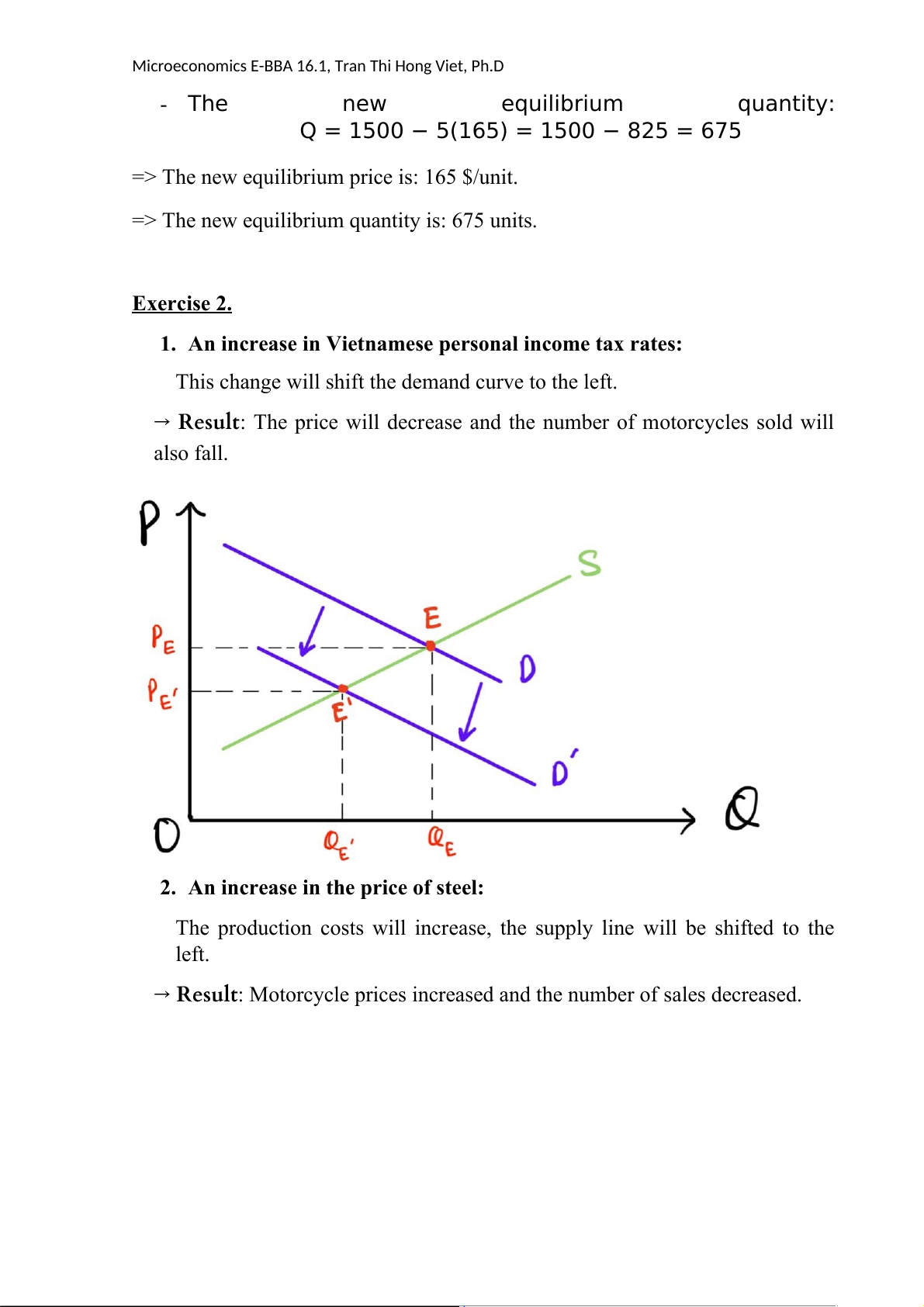
1. An increase in Vietnamese personal income tax rates:
This change will shift the demand curve to the left.
→ Result: The price will decrease and the number of motorcycles sold will also fall.
2. An increase in the price of steel:
The production costs will increase, the supply line will be shifted to the left.
→ Result: Motorcycle prices increased and the number of sales decreased.
Microeconomics E-BBA 16.1, Tran Thi Hong Viet, Ph.D
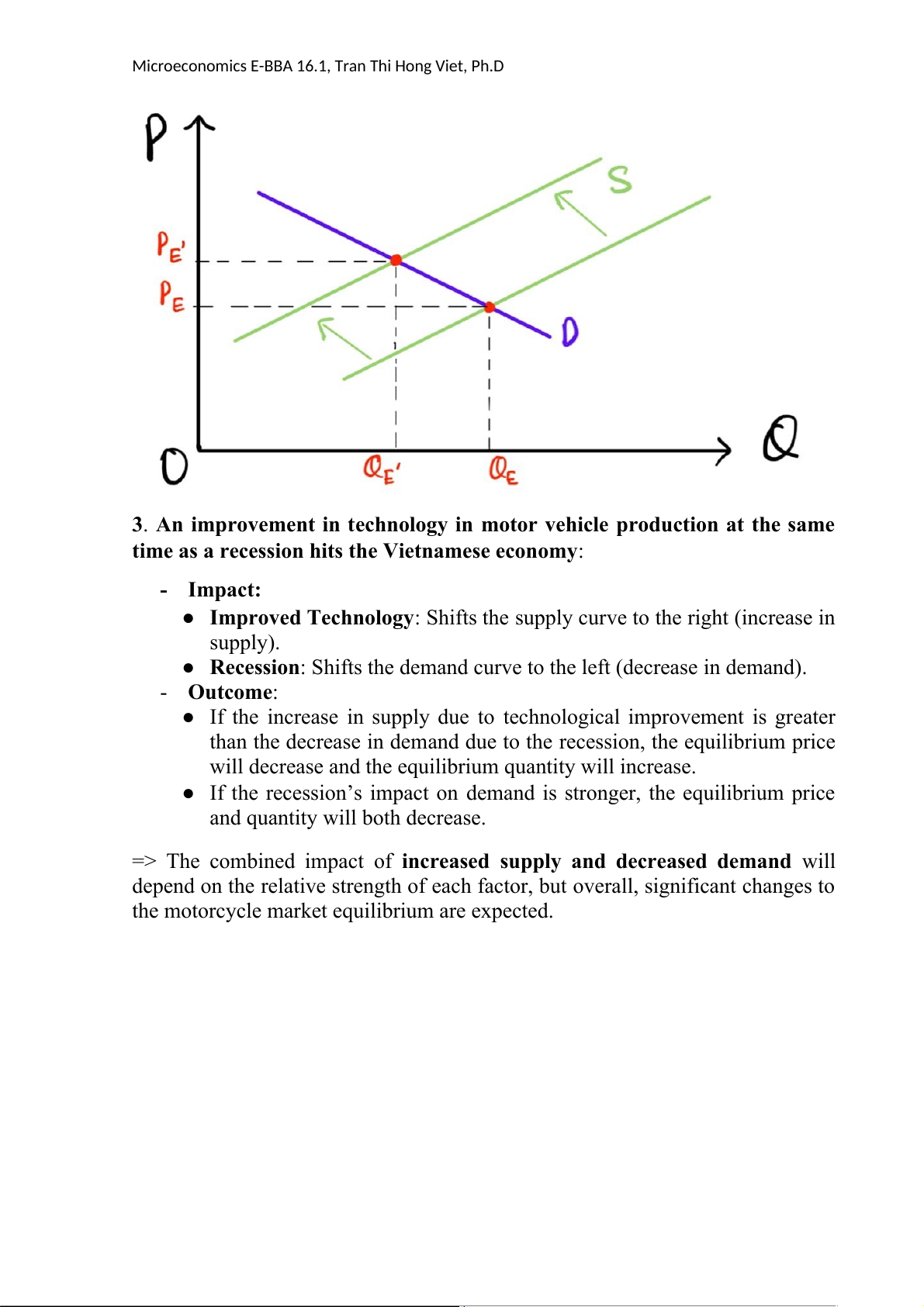
3. An improvement in technology in motor vehicle production at the same
time as a recession hits the Vietnamese economy: - Impact:
● Improved Technology: Shifts the supply curve to the right (increase in supply).
● Recession: Shifts the demand curve to the left (decrease in demand). - Outcome:
● If the increase in supply due to technological improvement is greater
than the decrease in demand due to the recession, the equilibrium price
will decrease and the equilibrium quantity will increase.
● If the recession’s impact on demand is stronger, the equilibrium price
and quantity will both decrease.
=> The combined impact of increased supply and decreased demand will
depend on the relative strength of each factor, but overall, significant changes to
the motorcycle market equilibrium are expected.
Tài liệu liên quan:
-
Syllabus: Principles of Microeconomics | Microeconomics | Trường Đại học Quốc tế, Đại học Quốc gia Thành phố Hồ Chí Minh
30 15 -
Winter Term 1999 Midterm Exam | Microeconomics | Trường Đại học Quốc tế, Đại học Quốc gia Thành phố Hồ Chí Minh
19 10 -
Understanding Economic Bubbles: Insights from Fama & Shiller | Microeconomics | Trường Đại học Quốc tế, Đại học Quốc gia Thành phố Hồ Chí Minh
23 12 -
Tóm Tắt Chương 1-3 Thuyết Kinh Tế Vi Mô | Microeconomics | Trường Đại học Quốc tế, Đại học Quốc gia Thành phố Hồ Chí Minh
26 13 -
Assignment Presentation 1: Economic Trade-offs & Production Dynamics | Microeconomics | Trường Đại học Quốc tế, Đại học Quốc gia Thành phố Hồ Chí Minh
18 9