Chapter 2: Thinking Like An Economist | Microeconomics | Trường Đại học Quốc tế, Đại học Quốc gia Thành phố Hồ Chí Minh
Economists usually have to make do with whatever data the world happens to give them. ANS: T DIF: 1 REF: 2-1 NAT: Analytic LOC: The study of economics and definitions of economics TOP: Economists MSC: Definitional 8. It is difficult for economists to make observations and develop theories, but it is easy for economists to run experiments to generate data to test their theories. ANS: F DIF: 2 REF: 2-1 NAT: Analytic LOC: The study of economics and definitions of economics TOP: Economists MSC: Interpretive. Tài liệu được sưu tầm và soạn thảo dưới dạng file PDF để gửi tới các bạn cùng tham khảo, ôn tập đầy đủ kiến thức, chuẩn bị cho các buổi học thật tốt. Mời bạn đọc đón xem!
Môn: Microeconomics 613 tài liệu
Trường: Trường Đại học Quốc tế, Đại học Quốc gia Thành phố Hồ Chí Minh 1.9 K tài liệu
Tác giả:




Preview text:
Chapter 2/Thinking Like An Economist 49 Chapter 2 Thinking Like An Economist TRUE/FALSE 1.
Economists try to address their subject with a scientist’s objectivity. ANS: T DIF: 1 REF: 2-1 NAT: Analytic
LOC: The study of economics and definitions of economics TOP: Economists MSC: Definitional 2.
Economists devise theories, collect data, and then analyze these data in an attempt to verify or refute their theories. ANS: T DIF: 1 REF: 2-1 NAT: Analytic
LOC: The study of economics and definitions of economics TOP: Economists MSC: Definitional 3.
The scientific method is the dispassionate development and testing of theories about how the world works. ANS: T DIF: 1 REF: 2-1 NAT: Analytic
LOC: The study of economics and definitions of economics TOP: Scientific method MSC: Definitional 4.
The scientific method can be applied to the study of economics. ANS: T DIF: 2 REF: 2-1 NAT: Analytic
LOC: The study of economics and definitions of economics TOP: Scientific method MSC: Interpretive 5.
While the scientific method is applicable to studying natural sciences, it is not applicable to studying a nation’s economy. ANS: F DIF: 2 REF: 2-1 NAT: Analytic
LOC: The study of economics and definitions of economics TOP: Scientific method MSC: Interpretive 6.
For economists, conducting experiments is often difficult and sometimes impossible. ANS: T DIF: 1 REF: 2-1 NAT: Analytic
LOC: The study of economics and definitions of economics TOP: Economists MSC: Definitional 7.
Economists usually have to make do with whatever data the world happens to give them. ANS: T DIF: 1 REF: 2-1 NAT: Analytic
LOC: The study of economics and definitions of economics TOP: Economists MSC: Definitional 8.
It is difficult for economists to make observations and develop theories, but it is easy for economists to run
experiments to generate data to test their theories. ANS: F DIF: 2 REF: 2-1 NAT: Analytic
LOC: The study of economics and definitions of economics TOP: Economists MSC: Interpretive 9.
Since economists cannot use natural experiments offered by history, they must use carefully constructed
laboratory experiments instead. ANS: F DIF: 2 REF: 2-1 NAT: Analytic
LOC: The study of economics and definitions of economics TOP: Economists MSC: Interpretive 10.
Historical episodes are not valuable to economists. ANS: F DIF: 2 REF: 2-1 NAT: Analytic
LOC: The study of economics and definitions of economics TOP: Economists MSC: Interpretive
50 Chapter 2/Thinking Like An Economist 11.
Historical episodes allow economists to illustrate and evaluate economic theories of the present. ANS: T DIF: 1 REF: 2-1 NAT: Analytic
LOC: The study of economics and definitions of economics TOP: Economists MSC: Definitional 12.
Good assumptions simplify a problem without substantially affecting the answer. ANS: T DIF: 2 REF: 2-1 NAT: Analytic
LOC: The study of economics and definitions of economics TOP: Assumptions MSC: Interpretive 13.
Assumptions can simplify the complex world and make it easier to understand. ANS: T DIF: 1 REF: 2-1 NAT: Analytic
LOC: The study of economics and definitions of economics TOP: Assumptions MSC: Definitional 14.
Economists often find it worthwhile to make assumptions that do not necessarily describe the real world. ANS: T DIF: 2 REF: 2-1 NAT: Analytic
LOC: The study of economics and definitions of economics TOP: Economists MSC: Interpretive 15.
Economists use one standard set of assumptions to answer all economic questions. ANS: F DIF: 2 REF: 2-1 NAT: Analytic
LOC: The study of economics and definitions of economics TOP: Economists MSC: Interpretive 16.
Economic models are most often composed of diagrams and equations. ANS: T DIF: 1 REF: 2-1 NAT: Analytic
LOC: Understanding and applying economic models TOP: Economic models MSC: Definitional 17.
Economic models omit many details to allow us to see what is truly important. ANS: T DIF: 1 REF: 2-1 NAT: Analytic
LOC: Understanding and applying economic models TOP: Economic models MSC: Definitional 18.
Economic models can help us understand reality only when they include all details of the economy. ANS: F DIF: 2 REF: 2-1 NAT: Analytic
LOC: Understanding and applying economic models TOP: Economic models MSC: Interpretive 19.
An economic model can accurately explain how the economy is organized because it is designed to include, to
the extent possible, all features of the real world. ANS: F DIF: 2 REF: 2-1 NAT: Analytic
LOC: Understanding and applying economic models TOP: Economic models MSC: Interpretive 20.
All scientific models, including economic models, simplify reality in order to improve our understanding of it. ANS: T DIF: 1 REF: 2-1 NAT: Analytic
LOC: Understanding and applying economic models TOP: Economic models MSC: Definitional 21.
The circular-flow diagram explains, in general terms, how the economy is organized and how participants in
the economy interact with one another. ANS: T DIF: 2 REF: 2-1 NAT: Analytic
LOC: Understanding and applying economic models
TOP: Circular-flow diagram MSC: Interpretive 22.
A circular-flow diagram is a visual model of the economy. ANS: T DIF: 1 REF: 2-1 NAT: Analytic
LOC: Understanding and applying economic models
TOP: Circular-flow diagram MSC: Definitional
Chapter 2/Thinking Like An Economist 51 23.
In the circular-flow diagram, households and firms are the decision makers. ANS: T DIF: 2 REF: 2-1 NAT: Analytic
LOC: Understanding and applying economic models
TOP: Circular-flow diagram MSC: Interpretive 24.
In the circular-flow diagram, firms produce goods and services using the factors of production. ANS: T DIF: 2 REF: 2-1 NAT: Analytic
LOC: Understanding and applying economic models
TOP: Circular-flow diagram | Factors of production MSC: Interpretive 25.
In the circular-flow diagram, factors of production are the goods and services produced by firms. ANS: F DIF: 2 REF: 2-1 NAT: Analytic
LOC: Understanding and applying economic models
TOP: Circular-flow diagram | Factors of production MSC: Interpretive 26.
In the circular-flow diagram, factors of production include land, labor, and capital. ANS: T DIF: 2 REF: 2-1 NAT: Analytic
LOC: Understanding and applying economic models
TOP: Circular-flow diagram | Factors of production MSC: Interpretive 27.
In the circular-flow diagram, firms own the factors of production and use them to produce goods and services. ANS: F DIF: 2 REF: 2-1 NAT: Analytic
LOC: Understanding and applying economic models
TOP: Circular-flow diagram | Factors of production MSC: Interpretive 28.
In the circular-flow diagram, firms consume all the goods and services that they produce. ANS: F DIF: 2 REF: 2-1 NAT: Analytic
LOC: Understanding and applying economic models
TOP: Circular-flow diagram MSC: Interpretive 29.
In the circular-flow diagram, the two types of markets in which households and firms interact are the markets
for goods and services and the markets for factors of production. ANS: T DIF: 1 REF: 2-1 NAT: Analytic
LOC: Understanding and applying economic models
TOP: Circular-flow diagram MSC: Definitional 30.
In the markets for goods and services in the circular-flow diagram, households are buyers and firms are sellers. ANS: T DIF: 1 REF: 2-1 NAT: Analytic
LOC: Understanding and applying economic models
TOP: Circular-flow diagram MSC: Definitional 31.
In the markets for the factors of production in the circular-flow diagram, households are buyers and firms are sellers. ANS: F DIF: 1 REF: 2-1 NAT: Analytic
LOC: Understanding and applying economic models
TOP: Circular-flow diagram MSC: Definitional 32.
In the circular-flow diagram, one loop represents the flow of goods, services, and factors of production, and
the other loop represents the corresponding flow of dollars. ANS: T DIF: 2 REF: 2-1 NAT: Analytic
LOC: Understanding and applying economic models
TOP: Circular-flow diagram MSC: Interpretive 33.
In the circular-flow diagram, one loop represents the flow of goods and services, and the other loop represents
the flow of factors of production. ANS: F DIF: 2 REF: 2-1 NAT: Analytic
LOC: Understanding and applying economic models
TOP: Circular-flow diagram MSC: Interpretive
52 Chapter 2/Thinking Like An Economist 34.
In the circular-flow diagram, payments for labor, land, and capital flow from firms to households through the
markets for the factors of production. ANS: T DIF: 2 REF: 2-1 NAT: Analytic
LOC: Understanding and applying economic models
TOP: Circular-flow diagram MSC: Interpretive 35.
The production possibilities frontier is a graph that shows the various combinations of outputs that the
economy can possibly produce given the available factors of production and the available production technology. ANS: T DIF: 1 REF: 2-1 NAT: Analytic
LOC: Understanding and applying economic models
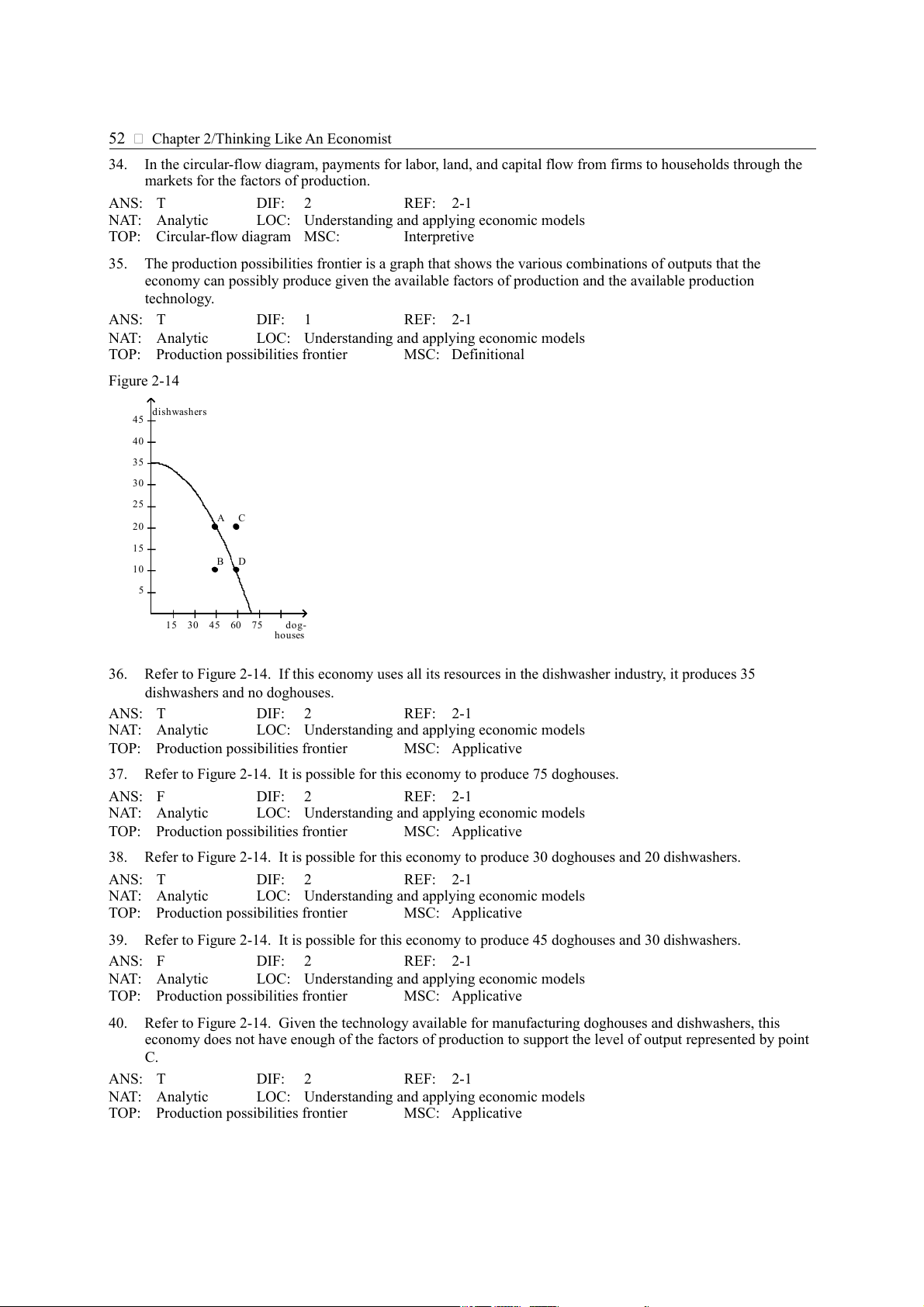
TOP: Production possibilities frontier MSC: Definitional Figure 2-14 dishwashers 45 40 35 30 25 A C 20 15 B D 10 5 15 30 45 60 75 dog- houses 36.
Refer to Figure 2-14. If this economy uses all its resources in the dishwasher industry, it produces 35 dishwashers and no doghouses. ANS: T DIF: 2 REF: 2-1 NAT: Analytic
LOC: Understanding and applying economic models
TOP: Production possibilities frontier MSC: Applicative 37.
Refer to Figure 2-14. It is possible for this economy to produce 75 doghouses. ANS: F DIF: 2 REF: 2-1 NAT: Analytic
LOC: Understanding and applying economic models
TOP: Production possibilities frontier MSC: Applicative 38.
Refer to Figure 2-14. It is possible for this economy to produce 30 doghouses and 20 dishwashers. ANS: T DIF: 2 REF: 2-1 NAT: Analytic
LOC: Understanding and applying economic models
TOP: Production possibilities frontier MSC: Applicative 39.
Refer to Figure 2-14. It is possible for this economy to produce 45 doghouses and 30 dishwashers. ANS: F DIF: 2 REF: 2-1 NAT: Analytic
LOC: Understanding and applying economic models
TOP: Production possibilities frontier MSC: Applicative 40.
Refer to Figure 2-14. Given the technology available for manufacturing doghouses and dishwashers, this
economy does not have enough of the factors of production to support the level of output represented by point C. ANS: T DIF: 2 REF: 2-1 NAT: Analytic
LOC: Understanding and applying economic models
TOP: Production possibilities frontier MSC: Applicative
Chapter 2/Thinking Like An Economist 53 41.
Refer to Figure 2-14. Points A, B, and D represent feasible outcomes for this economy. ANS: T DIF: 2 REF: 2-1 NAT: Analytic
LOC: Understanding and applying economic models
TOP: Production possibilities frontier MSC: Applicative 42.
Refer to Figure 2-14. Points B and C represent infeasible outcomes for this economy. ANS: F DIF: 2 REF: 2-1 NAT: Analytic
LOC: Understanding and applying economic models
TOP: Production possibilities frontier MSC: Applicative 43.
Refer to Figure 2-14. Points A, B, and D represent efficient outcomes for this economy. ANS: F DIF: 2 REF: 2-1 NAT: Analytic
LOC: Understanding and applying economic models
TOP: Production possibilities frontier | Efficiency MSC: Applicative 44.
Refer to Figure 2-14. Point B represents an inefficient outcome for this economy. ANS: T DIF: 2 REF: 2-1 NAT: Analytic
LOC: Understanding and applying economic models
TOP: Production possibilities frontier | Efficiency MSC: Applicative 45.
Refer to Figure 2-14. Unemployment could cause this economy to produce at point B. ANS: T DIF: 2 REF: 2-1 NAT: Analytic
LOC: Understanding and applying economic models
TOP: Production possibilities frontier | Unemployment MSC: Applicative 46.
Refer to Figure 2-14. The opportunity cost of moving from point A to point D is 10 dishwashers. ANS: T DIF: 2 REF: 2-1 NAT: Analytic
LOC: Understanding and applying economic models
TOP: Production possibilities frontier | Opportunity cost MSC: Applicative 47.
Refer to Figure 2-14. The opportunity cost of moving from point B to point D is 15 doghouses. ANS: F DIF: 2 REF: 2-1 NAT: Analytic
LOC: Understanding and applying economic models
TOP: Production possibilities frontier | Opportunity cost MSC: Applicative 48.
Refer to Figure 2-14. The opportunity cost of moving from point B to point A is zero. ANS: T DIF: 2 REF: 2-1 NAT: Analytic
LOC: Understanding and applying economic models
TOP: Production possibilities frontier | Opportunity cost MSC: Applicative 49.
Refer to Figure 2-14. The opportunity cost of an additional doghouse increases as more doghouses are produced. ANS: T DIF: 2 REF: 2-1 NAT: Analytic
LOC: Understanding and applying economic models
TOP: Production possibilities frontier | Opportunity cost MSC: Applicative 50.
With the resources it has, an economy can produce at any point on or outside the production possibilities
frontier, but it cannot produce at points inside the frontier. ANS: F DIF: 1 REF: 2-1 NAT: Analytic
LOC: Understanding and applying economic models
TOP: Production possibilities frontier MSC: Definitional 51.
Points inside the production possibilities frontier represent feasible levels of production. ANS: T DIF: 2 REF: 2-1 NAT: Analytic
LOC: Understanding and applying economic models
TOP: Production possibilities frontier MSC: Interpretive 52.
Points outside the production possibilities frontier represent infeasible levels of production. ANS: T DIF: 2 REF: 2-1 NAT: Analytic
LOC: Understanding and applying economic models
TOP: Production possibilities frontier MSC: Interpretive
54 Chapter 2/Thinking Like An Economist 53.
An outcome is said to be efficient if an economy is getting all it can from the scarce resources it has available. ANS: T DIF: 1 REF: 2-1 NAT: Analytic
LOC: Efficiency and equality TOP: Efficiency MSC: Definitional 54.
An outcome is said to be efficient if an economy is conserving the largest possible quantity of its scarce
resources while still meeting the basic needs of society. ANS: F DIF: 2 REF: 2-1 NAT: Analytic
LOC: Efficiency and equality TOP: Efficiency MSC: Interpretive 55.
A production point is said to be efficient if there is no way for the economy to produce more of one good
without producing less of another. ANS: T DIF: 2 REF: 2-1 NAT: Analytic
LOC: Efficiency and equality TOP: Efficiency MSC: Interpretive 56.
If an economy can produce more of one good without giving up any of another good, then the economy’s
current production point is inefficient. ANS: T DIF: 2 REF: 2-1 NAT: Analytic
LOC: Efficiency and equality TOP: Efficiency MSC: Interpretive 57.
Points on the production possibilities frontier represent efficient levels of production. ANS: T DIF: 1 REF: 2-1 NAT: Analytic
LOC: Understanding and applying economic models
TOP: Production possibilities frontier | Efficiency MSC: Definitional 58.
Points inside the production possibilities frontier represent inefficient levels of production. ANS: T DIF: 2 REF: 2-1 NAT: Analytic
LOC: Understanding and applying economic models
TOP: Production possibilities frontier | Efficiency MSC: Interpretive 59.
Unemployment causes production levels to be inefficient. ANS: T DIF: 2 REF: 2-1 NAT: Analytic
LOC: Efficiency and equality TOP: Efficiency MSC: Interpretive 60.
The opportunity cost of something is what you give up to get it. ANS: T DIF: 1 REF: 2-1 NAT: Analytic
LOC: Scarcity, tradeoffs, and opportunity cost TOP: Opportunity cost MSC: Definitional 61.
The production possibilities frontier shows the opportunity cost of one good as measured in terms of the other good. ANS: T DIF: 1 REF: 2-1 NAT: Analytic
LOC: Understanding and applying economic models
TOP: Production possibilities frontier | Opportunity cost MSC: Definitional 62.
When a production possibilities frontier is bowed outward, the opportunity cost of one good in terms of the other is constant. ANS: F DIF: 2 REF: 2-1 NAT: Analytic
LOC: Understanding and applying economic models
TOP: Production possibilities frontier | Opportunity cost MSC: Interpretive 63.
When a production possibilities frontier is bowed outward, the opportunity cost of one good in terms of the
other depends on how much of each good is being produced. ANS: T DIF: 2 REF: 2-1 NAT: Analytic
LOC: Understanding and applying economic models
TOP: Production possibilities frontier | Opportunity cost MSC: Interpretive
Chapter 2/Thinking Like An Economist 55 64.
When a production possibilities frontier is bowed outward, the opportunity cost of the first good in terms of
the second good increases as more of the second good is produced. ANS: F DIF: 2 REF: 2-1 NAT: Analytic
LOC: Understanding and applying economic models
TOP: Production possibilities frontier | Opportunity cost MSC: Interpretive 65.
When a production possibilities frontier is bowed outward, the opportunity cost of the second good in terms of
the first good increases as more of the second good is produced. ANS: T DIF: 2 REF: 2-1 NAT: Analytic
LOC: Understanding and applying economic models
TOP: Production possibilities frontier | Opportunity cost MSC: Interpretive 66.
When a production possibilities frontier is bowed outward, the opportunity cost of the second good in terms of
the first good is higher when the economy is producing much of the second good and little of the first good
than it is when the economy is producing little of the second good and much of the first good. ANS: T DIF: 2 REF: 2-1 NAT: Analytic
LOC: Understanding and applying economic models
TOP: Production possibilities frontier | Opportunity cost MSC: Interpretive 67.
When a production possibilities frontier is bowed outward, the opportunity cost of the first good in terms of
the second good is higher when the economy is producing much of the second good and little of the first good
than it is when the economy is producing little of the second good and much of the first good. ANS: F DIF: 2 REF: 2-1 NAT: Analytic
LOC: Understanding and applying economic models
TOP: Production possibilities frontier | Opportunity cost MSC: Interpretive 68.
Economists believe that production possibilities frontiers rarely have a bowed shape. ANS: F DIF: 1 REF: 2-1 NAT: Analytic
LOC: The study of economics and definitions of economics
TOP: Economists | Production possibilities frontier MSC: Definitional 69.
A production possibilities frontier will be bowed outward if some of the economy’s resources are better suited
to producing one good than another. ANS: T DIF: 2 REF: 2-1 NAT: Analytic
LOC: Understanding and applying economic models
TOP: Production possibilities frontier MSC: Interpretive 70.
The trade-off between the production of one good and the production of another good can change over time
because of technological advances. ANS: T DIF: 2 REF: 2-1 NAT: Analytic
LOC: Understanding and applying economic models
TOP: Production possibilities frontier | Trade-offs MSC: Interpretive 71.
A technological advance in the production of the first good increases the opportunity cost of the first good in terms of the second good. ANS: T DIF: 3 REF: 2-1 NAT: Analytic
LOC: Understanding and applying economic models
TOP: Production possibilities frontier | Opportunity cost | Technological advance MSC: Analytical 72.
While the production possibilities frontier is a useful model, it cannot be used to illustrate economic growth. ANS: F DIF: 2 REF: 2-1 NAT: Analytic
LOC: Understanding and applying economic models
TOP: Production possibilities frontier | Economic growth MSC: Interpretive 73.
Economic growth causes a production possibilities frontier to shift outward. ANS: T DIF: 2 REF: 2-1 NAT: Analytic
LOC: Understanding and applying economic models
TOP: Production possibilities frontier | Economic growth MSC: Interpretive
56 Chapter 2/Thinking Like An Economist 74.
If new government regulations designed to protect wetlands remove very productive farmland from
production, then the production possibilities frontier will shift inward. ANS: T DIF: 2 REF: 2-1 NAT: Analytic
LOC: Understanding and applying economic models
TOP: Production possibilities frontier MSC: Applicative 75.
Production possibilities frontiers can be used to illustrate scarcity, trade-offs, opportunity cost, efficiency,
unemployment, technological advances, and economic growth. ANS: T DIF: 3 REF: 2-1 NAT: Analytic
LOC: Understanding and applying economic models
TOP: Production possibilities frontier MSC: Analytical 76.
Microeconomics is the study of how households and firms make decisions and how they interact in specific markets. ANS: T DIF: 1 REF: 2-1 NAT: Analytic
LOC: The study of economics and definitions of economics TOP: Microeconomics MSC: Definitional 77.
Macroeconomics is the study of economywide phenomena. ANS: T DIF: 1 REF: 2-1 NAT: Analytic
LOC: The study of economics and definitions of economics TOP: Macroeconomics MSC: Definitional 78.
The effects of borrowing by the federal government would be studied by a microeconomist rather than a macroeconomist. ANS: F DIF: 2 REF: 2-1 NAT: Analytic
LOC: The study of economics and definitions of economics
TOP: Microeconomics | Macroeconomics MSC: Applicative 79.
The effects of foreign competition on the U.S. textile industry would be studied by a microeconomist rather than a macroeconomist. ANS: T DIF: 2 REF: 2-1 NAT: Analytic
LOC: The study of economics and definitions of economics
TOP: Microeconomics | Macroeconomics MSC: Applicative 80.
Microeconomics and macroeconomics are closely intertwined. ANS: T DIF: 1 REF: 2-1 NAT: Analytic
LOC: The study of economics and definitions of economics
TOP: Microeconomics | Macroeconomics MSC: Definitional 81.
When economists are trying to explain the world, they are scientists, and when they are trying to help improve
the world, they are policy advisers. ANS: T DIF: 1 REF: 2-2 NAT: Analytic
LOC: The study of economics and definitions of economics TOP: Economists MSC: Definitional 82.
Economists acting as scientists make positive statements, while economists acting as policy advisers make normative statements. ANS: T DIF: 2 REF: 2-2 NAT: Analytic
LOC: The study of economics and definitions of economics
TOP: Positive statements | Normative statements MSC: Interpretive 83.
Normative statements describe how the world is, while positive statements prescribe how the world should be. ANS: F DIF: 2 REF: 2-2 NAT: Analytic
LOC: The study of economics and definitions of economics
TOP: Positive statements | Normative statements MSC: Interpretive 84.
Positive statements are descriptive, while normative statements are prescriptive. ANS: T DIF: 2 REF: 2-2 NAT: Analytic
LOC: The study of economics and definitions of economics
TOP: Positive statements | Normative statements MSC: Interpretive
Chapter 2/Thinking Like An Economist 57 85.
Positive statements can be evaluated using data alone, but normative statements cannot. ANS: T DIF: 2 REF: 2-2 NAT: Analytic
LOC: The study of economics and definitions of economics
TOP: Positive statements | Normative statements MSC: Interpretive 86.
Evaluating normative statements involves values as well as facts. ANS: T DIF: 1 REF: 2-2 NAT: Analytic
LOC: The study of economics and definitions of economics TOP: Normative statements MSC: Definitional 87.
"Society would be better off if the welfare system were abolished" is a normative statement, not a positive statement. ANS: T DIF: 2 REF: 2-2 NAT: Analytic
LOC: The study of economics and definitions of economics
TOP: Positive statements | Normative statements MSC: Applicative 88.
"Other things equal, an increase in supply causes a decrease in price" is a normative statement, not a positive statement. ANS: F DIF: 2 REF: 2-2 NAT: Analytic
LOC: The study of economics and definitions of economics
TOP: Positive statements | Normative statements MSC: Applicative 89.
Trade-offs are involved in most policy decisions. ANS: T DIF: 1 REF: 2-2 NAT: Analytic
LOC: Scarcity, tradeoffs, and opportunity cost
TOP: Trade-offs | Policy decisions MSC: Definitional 90.
Since 1946, the president of the United States has received guidance from the Council of Economic Advisers. ANS: T DIF: 1 REF: 2-2 NAT: Analytic
LOC: The study of economics and definitions of economics
TOP: Council of Economic Advisers MSC: Definitional 91.
The Council of Economic Advisers consists of thirty members and a staff of several dozen economists. ANS: F DIF: 1 REF: 2-2 NAT: Analytic
LOC: The study of economics and definitions of economics
TOP: Council of Economic Advisers MSC: Definitional 92.
The duties of the Council of Economic Advisers are to advise the president of the United States and to
determine U.S. monetary policy. ANS: F DIF: 1 REF: 2-2 NAT: Analytic
LOC: The study of economics and definitions of economics
TOP: Council of Economic Advisers MSC: Definitional 93.
The Council of Economic Advisers’ Economic Report of the President discusses recent developments in the
economy and presents the council’s analysis of current policy issues. ANS: T DIF: 1 REF: 2-2 NAT: Analytic
LOC: The study of economics and definitions of economics
TOP: Council of Economic Advisers MSC: Definitional 94.
Economists at the U.S. Department of the Treasury help design U.S. coins and paper money. ANS: F DIF: 1 REF: 2-2 NAT: Analytic
LOC: The study of economics and definitions of economics TOP: Economists MSC: Definitional 95.
Economists at the U.S. Department of Justice help enforce the nation’s antitrust laws. ANS: T DIF: 1 REF: 2-2 NAT: Analytic
LOC: The study of economics and definitions of economics TOP: Economists MSC: Definitional
58 Chapter 2/Thinking Like An Economist 96.
Economists work both inside and outside the administrative branch of the U.S. government. ANS: T DIF: 2 REF: 2-2 NAT: Analytic
LOC: The study of economics and definitions of economics TOP: Economists MSC: Interpretive 97.
The Congressional Budget Office, which is staffed by economists, provides Congress with independent
evaluations of policy proposals. ANS: T DIF: 1 REF: 2-2 NAT: Analytic
LOC: The study of economics and definitions of economics TOP: Economists MSC: Definitional 98.
There is only one explanation for why economists give conflicting advice on policy issues, and it is that they
have different values about what policy should try to accomplish. ANS: F DIF: 2 REF: 2-3 NAT: Analytic
LOC: The study of economics and definitions of economics TOP: Economists MSC: Interpretive 99.
Economists may disagree about the validity of alternative positive theories about how the world works. ANS: T DIF: 1 REF: 2-3 NAT: Analytic
LOC: The study of economics and definitions of economics TOP: Economists MSC: Definitional
100. In surveys of professional economists, fourteen propositions were endorsed by an overwhelming majority of respondents. ANS: T DIF: 1 REF: 2-3 NAT: Analytic
LOC: The study of economics and definitions of economics TOP: Economists MSC: Definitional
101. In economics, graphs serve two purposes: they offer a way to visually express ideas, and they provide a way of
finding and interpreting patterns when analyzing economic data. ANS: T DIF: 2 REF: 2-5 NAT: Analytic
LOC: The study of economics and definitions of economics TOP: Graphs MSC: Interpretive
102. Examples of graphs of a single variable include pie charts, bar graphs, and time-series graphs. ANS: T DIF: 2 REF: 2-5 NAT: Analytic
LOC: The study of economics and definitions of economics TOP: Graphs MSC: Interpretive
103. In the ordered pair (10,30), 10 is the y-coordinate and 30 is the z-coordinate. ANS: F DIF: 2 REF: 2-5 NAT: Analytic
LOC: The study of economics and definitions of economics TOP: Graphs MSC: Applicative
104. In the ordered pair (10,30), 10 is the horizontal location of the point and 30 is the vertical location of the point. ANS: T DIF: 2 REF: 2-5 NAT: Analytic
LOC: The study of economics and definitions of economics TOP: Graphs MSC: Applicative
105. Two variables that have a positive correlation move in the same direction. ANS: T DIF: 2 REF: 2-5 NAT: Analytic
LOC: The study of economics and definitions of economics TOP: Graphs MSC: Interpretive
106. Two variables that have a negative correlation move in opposite directions. ANS: T DIF: 2 REF: 2-5 NAT: Analytic
LOC: The study of economics and definitions of economics TOP: Graphs MSC: Interpretive
Chapter 2/Thinking Like An Economist 59
107. When two variables move in opposite directions, the curve relating them is upward sloping, and we say the
variables are positively related. ANS: F DIF: 2 REF: 2-5 NAT: Analytic
LOC: The study of economics and definitions of economics TOP: Graphs MSC: Interpretive
108. When two variables move in the same direction, the curve relating them is downward sloping, and we say the
variables are negatively related. ANS: F DIF: 2 REF: 2-5 NAT: Analytic
LOC: The study of economics and definitions of economics TOP: Graphs MSC: Interpretive
109. When a variable that is named on an axis of a graph changes, the curve shifts. ANS: F DIF: 2 REF: 2-5 NAT: Analytic
LOC: The study of economics and definitions of economics TOP: Graphs MSC: Interpretive
110. When a variable that is not named on either axis of a graph changes, we read the change as a movement along the curve. ANS: F DIF: 2 REF: 2-5 NAT: Analytic
LOC: The study of economics and definitions of economics TOP: Graphs MSC: Interpretive
111. The concept of slope can be used to answer questions about how much one variable responds to changes in another variable. ANS: T DIF: 1 REF: 2-5 NAT: Analytic
LOC: The study of economics and definitions of economics TOP: Graphs MSC: Definitional
112. The slope of a line is equal to the change in the x-variable divided by the change in the y-variable. ANS: F DIF: 1 REF: 2-5 NAT: Analytic
LOC: The study of economics and definitions of economics TOP: Graphs MSC: Definitional
113. The slope of an upward-sloping line is positive, and the slope of a downward-sloping line is negative. ANS: T DIF: 2 REF: 2-5 NAT: Analytic
LOC: The study of economics and definitions of economics TOP: Graphs MSC: Interpretive
114. The slope of a horizontal line is infinite, and the slope of a vertical line is zero. ANS: F DIF: 2 REF: 2-5 NAT: Analytic
LOC: The study of economics and definitions of economics TOP: Graphs MSC: Interpretive
115. If a line passes through the points (20,5) and (10,10), then the slope of the line is 1/2. ANS: F DIF: 2 REF: 2-5 NAT: Analytic
LOC: The study of economics and definitions of economics TOP: Graphs MSC: Applicative
116. If a line passes through the points (20,5) and (10,10), then the slope of the line is -2. ANS: F DIF: 2 REF: 2-5 NAT: Analytic
LOC: The study of economics and definitions of economics TOP: Graphs MSC: Applicative
117. Changes in one variable on a graph might be caused by the other variable on the graph or by a third omitted variable. ANS: T DIF: 2 REF: 2-5 NAT: Analytic
LOC: The study of economics and definitions of economics TOP: Graphs MSC: Interpretive
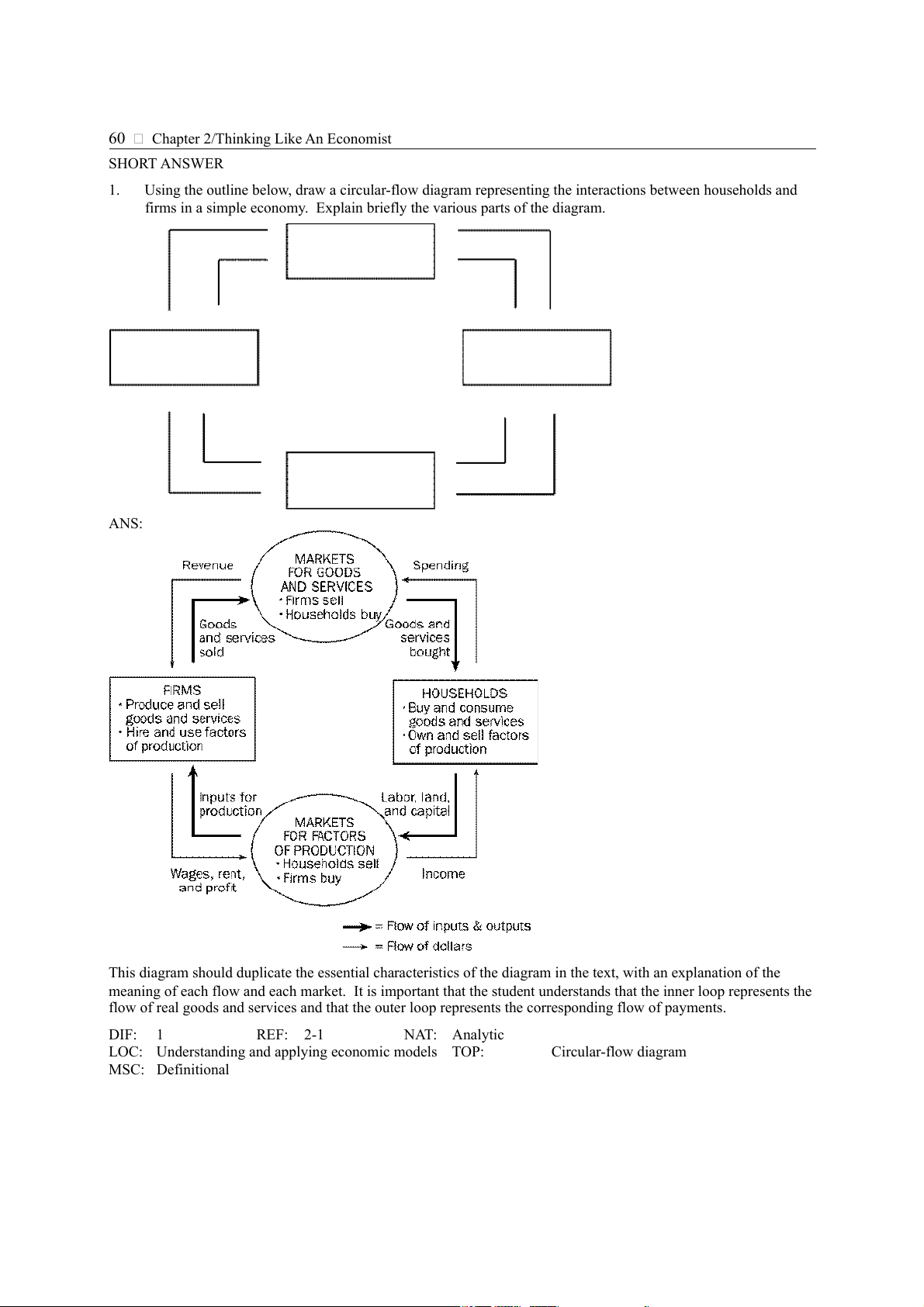
60 Chapter 2/Thinking Like An Economist SHORT ANSWER 1.
Using the outline below, draw a circular-flow diagram representing the interactions between households and
firms in a simple economy. Explain briefly the various parts of the diagram. ANS:
This diagram should duplicate the essential characteristics of the diagram in the text, with an explanation of the
meaning of each flow and each market. It is important that the student understands that the inner loop represents the
flow of real goods and services and that the outer loop represents the corresponding flow of payments. DIF: 1 REF: 2-1 NAT: Analytic
LOC: Understanding and applying economic models TOP: Circular-flow diagram MSC: Definitional
Chapter 2/Thinking Like An Economist 61 2.
The prairie dog has always been considered a problem for American cattle ranchers. They dig holes that cattle
and horses can step in, and they eat grass necessary for cattle. Recently, ranchers have discovered that there is
a demand for prairie dogs as pets. In some areas, prairie dogs can sell for as high as $150 each. Cattlemen are
now fencing off prairie dog towns on their land so these towns will not be disturbed by their cattle.
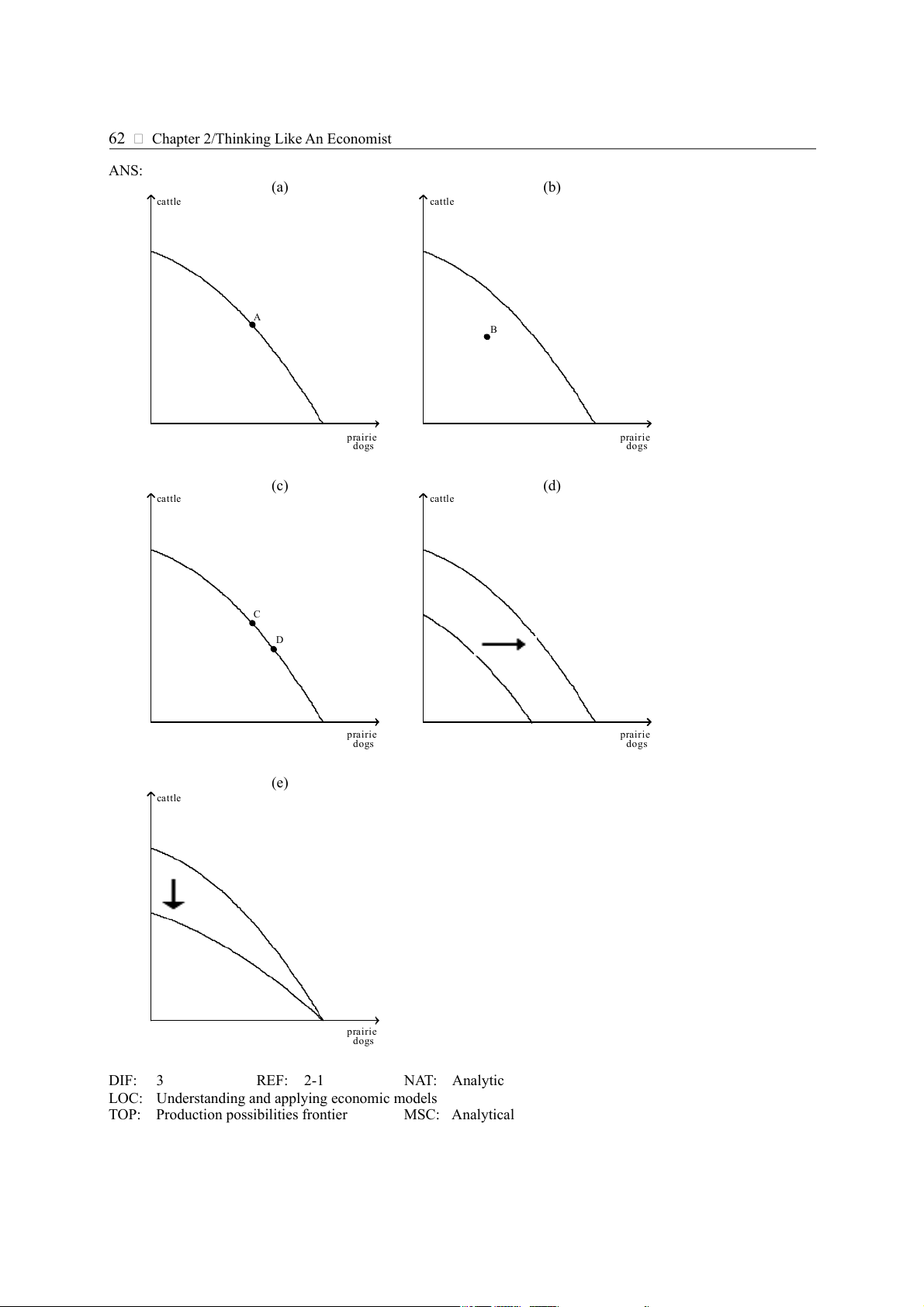
Draw a rancher’s production possibilities frontier showing increasing opportunity cost of cattle
production in terms of prairie dog production. Using a separate graph for each situation, show what
would happen to the initial production possibilities frontier in each of the following situations: a.
The outcome is efficient, with ranchers choosing to produce equal numbers of cattle and prairie dogs. b.
As a protest against the government introducing the gray wolf back into the wild in their state,
ranchers decide to withhold 25 percent of the available grassland for grazing. c.
The price of prairie dogs increases to $200 each, so ranchers decide to allot additional land for prairie dogs. d.
The government grants new leases to ranchers, giving them 10,000 new acres of grassland each for grazing. e.
A drought destroys most of the available grass for grazing of cattle, but not for prairie dogs since they also eat plant roots.
62 Chapter 2/Thinking Like An Economist ANS: (a) (b) cattle cattle A B prairie prairie dogs dogs (c) (d) cattle cattle C D prairie prairie dogs dogs (e) cattle prairie dogs DIF: 3 REF: 2-1 NAT: Analytic
LOC: Understanding and applying economic models
TOP: Production possibilities frontier MSC: Analytical
Chapter 2/Thinking Like An Economist 63 3.
Draw a production possibilities frontier showing increasing opportunity cost of hammers in terms of horseshoes. a.
On the graph, identify the area of feasible outcomes and the area of infeasible outcomes. b.
On the graph, label a point that is efficient and a point that is inefficient. c.
On the graph, illustrate the effect of the discovery of a new vein of iron ore, a resource needed to
make both horseshoes and hammers, on this economy. d.
On a second graph, illustrate the effect of a new computerized assembly line in the production of hammers on this economy. ANS: (a-c) (d) hammers hammers infeasible discovery feasible efficient ineficient horse- horse- shoes shoes DIF: 2 REF: 2-1 NAT: Analytic
LOC: Understanding and applying economic models
TOP: Production possibilities frontier MSC: Applicative 4.
Identify each of the following topics as being part of microeconomics or macroeconomics: a.
the impact of a change in consumer income on the purchase of luxury automobiles b.
the effect of a change in the price of Coke on the purchase of Pepsi c.
the impact of a war in the Middle East on the rate of inflation in the United States d.
factors influencing the rate of economic growth e.
factors influencing the demand for tractors f.
the impact of tax policy on national saving g.
the effect of pollution taxes on the U.S. copper industry h.
the degree of competition in the cable television industry i.
the effect of a balanced-budget amendment on economic stability j.
the impact of deregulation on the savings and loan industry ANS:
a, b, e, g, h, and j are microeconomic topics. c, d, f, and i are macroeconomic topics. DIF: 2 REF: 2-1 NAT: Analytic
LOC: The study of economics and definitions of economics
TOP: Microeconomics | Macroeconomics MSC: Applicative
64 Chapter 2/Thinking Like An Economist 5.
Which of the following statements are positive and which are normative? a.
The minimum wage creates unemployment among young and unskilled workers. b.
The minimum wage ought to be abolished. c.
If the price of a product in a market decreases, then, other things equal, quantity demanded will increase. d.
A little bit of inflation is worse for society than a little bit of unemployment. e.
There is a tradeoff between inflation and unemployment in the short run. f.
If consumer income increases, then, other things equal, the demand for automobiles will increase. g.
The U.S. income distribution is not fair. h.
U.S. workers deserve more liberal unemployment benefits. i.
If interest rates increase, then investment will decrease. j.
If welfare benefits were reduced, then the country would be better off. ANS:
a, c, e, f, and i are positive statements. b, d, g, h, and j are normative statements. DIF: 2 REF: 2-2 NAT: Analytic
LOC: The study of economics and definitions of economics
TOP: Positive statements | Normative statements MSC: Applicative 6.
Use the following graph to answer the following questions. a.
How would point J be represented as an ordered pair? b. What type of curve is this? c.
Does this curve show a positive or negative correlation between price and quantity? d.
Compute the slope of D1 between points J and L. e.
What is the slope of D1 between points L and N? Why would you not have to calculate this answer? f.
What is it called if we move from D1 to D2? g.
How do you know that the slope of D2 is the same as the slope of D1? price 40 36 32 28 J K 24 20 L M 16 12 N 8 4 D1 D2 10 20 30 40 50 60 70 80 quantity ANS: a. (20,24) b. a demand curve c.
a negative correlation between price and quantity d. -8/20 or -2/5 e.
-2/5; because the slope of a straight line is constant f. an increase in demand. g.
because the 2 lines are parallel DIF: 2 REF: 2-5 NAT: Analytic
LOC: The study of economics and definitions of economics TOP: Graphs MSC: Applicative
Chapter 2/Thinking Like An Economist 65
Sec00 - Thinking Like an Economist MULTIPLE CHOICE 1.
Which of the following is not correct? a.
Economists use some familiar words in specialized ways.
b. Economics has its own language and its own way of thinking, but few other fields of study do. c.
Supply, demand, elasticity, comparative advantage, consumer surplus, and deadweight loss are all
terms that are part of the economist’s language.
d. The value of the economist’s language lies in its ability to provide you with a new and useful way
of thinking about the world in which you live. ANS: B DIF: 2 REF: 2-0 NAT: Analytic
LOC: The study of economics and definitions of economics TOP: Economics MSC: Interpretive
Sec01 - Thinking Like an Economist - The Economist as Scientist MULTIPLE CHOICE 1.
Economists, like mathematicians, physicists, and biologists, a.
make use of the scientific method.
b. try to address their subject with a scientist’s objectivity. c.
devise theories, collect data, and then analyze these data in an attempt to verify or refute their theories.
d. All of the above are correct. ANS: D DIF: 2 REF: 2-1 NAT: Analytic
LOC: The study of economics and definitions of economics TOP: Economists MSC: Interpretive 2. The essence of science is a. the laboratory experiment. b. the scientific method. c.
the study of nature, but not the study of society.
d. All of the above are correct. ANS: B DIF: 1 REF: 2-1 NAT: Analytic
LOC: The study of economics and definitions of economics TOP: Scientific method MSC: Definitional 3. The scientific method is a.
the use of modern technology to understand the way the world works.
b. the use of controlled laboratory experiments to understand the way the world works. c.
the dispassionate development and testing of theories about how the world works.
d. the search for evidence to support preconceived theories about how the world works. ANS: C DIF: 1 REF: 2-1 NAT: Analytic
LOC: The study of economics and definitions of economics TOP: Scientific method MSC: Definitional 4.
The scientific method is applicable to studying a.
natural sciences, but not social sciences.
b. social sciences, but not natural sciences. c.
both natural sciences and social sciences.
d. None of the above is correct. ANS: C DIF: 2 REF: 2-1 NAT: Analytic
LOC: The study of economics and definitions of economics TOP: Scientific method MSC: Interpretive
66 Chapter 2/Thinking Like An Economist 5.
Who said, "The whole of science is nothing more than the refinement of everyday thinking"? a. Isaac Newton b. Albert Einstein c. Adam Smith d. Benjamin Franklin ANS: B DIF: 1 REF: 2-1 NAT: Analytic
LOC: The study of economics and definitions of economics TOP: Scientific method MSC: Definitional 6.
Albert Einstein once made the following observation about science: a.
"The whole of science is nothing more than the refinement of everyday thinking."
b. "The whole of science is nothing more than an interesting intellectual exercise." c.
"In order to understand science, one must rely solely on abstraction."
d. "In order to understand science, one must transcend everyday thinking." ANS: A DIF: 1 REF: 2-1 NAT: Analytic
LOC: The study of economics and definitions of economics TOP: Scientific method MSC: Definitional 7.
Sir Isaac Newton's development of the theory of gravity after observing an apple fall from a tree is an example of a.
a controlled experiment that lead to the formulation of a scientific theory.
b. being in the right place at the right time. c. an idea whose time had come.
d. the interplay between observation and theory in science. ANS: D DIF: 2 REF: 2-1 NAT: Analytic
LOC: The study of economics and definitions of economics TOP: Scientific method MSC: Interpretive 8.
The goal of an economist who formulates new theories is to a.
provide an interesting framework of analysis, whether or not the framework turns out to be of much
use in understanding how the world works.
b. provoke stimulating debate in scientific journals. c.
contribute to an understanding of how the world works.
d. demonstrate that economists, like other scientists, can formulate testable theories. ANS: C DIF: 2 REF: 2-1 NAT: Analytic
LOC: The study of economics and definitions of economics TOP: Economists MSC: Interpretive 9.
Which of the following statements applies to economics, as well as to other sciences such as physics? a.
Experiments are considered valid only when they are conducted in a laboratory.
b. Good theories do not need to be tested. c.
Real-world observations often lead to theories.
d. Economics, as well as other sciences, is concerned primarily with abstract concepts. ANS: C DIF: 2 REF: 2-1 NAT: Analytic
LOC: The study of economics and definitions of economics TOP: Economists MSC: Interpretive
10. With respect to how economists study the economy, which of the following statements is most accurate? a.
Economists study the past, but they do not try to predict the future.
b. Economists use “rules of thumb” to predict the future. c.
Economists devise theories, collect data, and analyze the data to test the theories.
d. Economists use controlled experiments in much the same way that biologists and physicists do. ANS: C DIF: 2 REF: 2-1 NAT: Analytic
LOC: The study of economics and definitions of economics TOP: Economists MSC: Interpretive
Chapter 2/Thinking Like An Economist 67
11. Economists face an obstacle that many other scientists do not face. What is that obstacle? a.
It is often difficult to formulate theories in economics.
b. It is often difficult and sometimes impossible to perform experiments in economics. c.
Economics cannot be addressed objectively; it must be addressed subjectively.
d. The scientific method cannot be applied to the study of economics. ANS: B DIF: 2 REF: 2-1 NAT: Analytic
LOC: The study of economics and definitions of economics TOP: Economists MSC: Interpretive
12. In conducting their research, economists face an obstacle that not all scientists face; specifically, in
economics, it is often difficult and sometimes impossible to a.
make use of theory and observation.
b. rely upon the scientific method. c.
conduct laboratory experiments.
d. find articles or books that were written before 1900. ANS: C DIF: 2 REF: 2-1 NAT: Analytic
LOC: The study of economics and definitions of economics TOP: Economists MSC: Interpretive
13. The use of theory and observation is more difficult in economics than in sciences such as physics due to the difficulty in a.
performing an experiment in an economic system.
b. applying mathematical methods to economic analysis. c. analyzing available data.
d. formulating theories about economic events. ANS: A DIF: 2 REF: 2-1 NAT: Analytic
LOC: The study of economics and definitions of economics TOP: Economists MSC: Interpretive
14. Which of the following statements is (are) correct? a.
Relative to other scientists, economists find it more difficult to generate useful data.
b. Theory and observation are important in economics as well as in other sciences. c.
To obtain data, economists often rely upon the natural experiments offered by history.
d. All of the above are correct. ANS: D DIF: 2 REF: 2-1 NAT: Analytic
LOC: The study of economics and definitions of economics TOP: Economists MSC: Interpretive
15. Because it is difficult for economists to use experiments to generate data, they generally must a. do without data.
b. substitute assumptions for data when data are unavailable. c.
rely upon hypothetical data that were previously concocted by other economists.
d. use whatever data the world gives them. ANS: D DIF: 2 REF: 2-1 NAT: Analytic
LOC: The study of economics and definitions of economics TOP: Economists MSC: Interpretive
16. Which of the following statements is correct? a.
Economists almost always find it easy to conduct experiments in order to test their theories.
b. Economics is not a true science because economists are not usually allowed to conduct experiments to test their theories. c.
Economics is a social science rather than a true science because it cannot employ the scientific method.
d. Economists are usually not allowed to conduct experiments, so they must rely on natural
experiments offered by history. ANS: D DIF: 2 REF: 2-1 NAT: Analytic
LOC: The study of economics and definitions of economics TOP: Economists MSC: Interpretive
68 Chapter 2/Thinking Like An Economist
17. Instead of conducting laboratory experiments to generate data to test their theories, economists often a.
ask winners of the Nobel Prize in Economics to evaluate their theories.
b. argue that data is impossible to collect in economics. c.
gather data from historical episodes of economic change.
d. assume that data would support their theories. ANS: C DIF: 2 REF: 2-1 NAT: Analytic
LOC: The study of economics and definitions of economics TOP: Economists MSC: Interpretive
18. The most common data for testing economic theories come from a.
carefully controlled and conducted laboratory experiments.
b. computer models of economies. c.
historical episodes of economic change.
d. centrally planned economies. ANS: C DIF: 2 REF: 2-1 NAT: Analytic
LOC: The study of economics and definitions of economics TOP: Economists MSC: Interpretive
19. In conducting their research, economists often substitute historical events and historical episodes for a. theories and observations. b. laboratory experiments. c. models. d. assumptions. ANS: B DIF: 2 REF: 2-1 NAT: Analytic
LOC: The study of economics and definitions of economics TOP: Economists MSC: Interpretive
20. For economists, substitutes for laboratory experiments often come in the form of a.
natural experiments offered by history. b. untested theories. c.
“rules of thumb” and other such conveniences.
d. reliance upon the wisdom of elders in the economics profession. ANS: A DIF: 2 REF: 2-1 NAT: Analytic
LOC: The study of economics and definitions of economics TOP: Economists MSC: Interpretive
21. Economists regard events from the past as a.
irrelevant, since history is unlikely to repeat itself.
b. of limited interest, since those events seldom provide any useful economic data. c.
interesting but not particularly valuable, since those events cannot be used to evaluate present-day economic theories.
d. interesting and valuable, since those events are capable of helping us to understand the past, the present, and the future. ANS: D DIF: 2 REF: 2-1 NAT: Analytic
LOC: The study of economics and definitions of economics TOP: Economists MSC: Interpretive
22. For economists, historical episodes a.
are not worthy of study because they offer few insights into current economic events and problems.
b. are not worthy of study because laboratory experiments provide more reliable data. c.
are worthy of study because economists rely entirely on observation, rather than on theory.
d. are worthy of study because they serve as valuable substitutes for laboratory experiments. ANS: D DIF: 2 REF: 2-1 NAT: Analytic
LOC: The study of economics and definitions of economics TOP: Economists MSC: Interpretive
Tài liệu liên quan:
-
Tự Luận Vimo: Phân Tích Cung, Cầu và Thị Trường Cạnh Tranh| Microeconomics | Trường Đại học Quốc tế, Đại học Quốc gia Thành phố Hồ Chí Minh
5 3 -
Review Questions: Thinking Like an Economist | Microeconomics | Trường Đại học Quốc tế, Đại học Quốc gia Thành phố Hồ Chí Minh
5 3 -
Final Exam Quizlet Questions & Answers | Microeconomics | Trường Đại học Quốc tế, Đại học Quốc gia Thành phố Hồ Chí Minh
5 3 -
Đề thi giữa kỳ II | Microeconomics | Trường Đại học Quốc tế, Đại học Quốc gia Thành phố Hồ Chí Minh
5 3 -

Final Group Project_ The Beer Industry | Microeconomics | Trường Đại học Quốc tế, Đại học Quốc gia Thành phố Hồ Chí Minh
4 2