Competitive Firm Analysis and Cost Calculations | Microeconomics | Trường Đại học Quốc tế, Đại học Quốc gia Thành phố Hồ Chí Minh
Does the profitable situation in the question b exist in the long – run? Why? - The profitable situation in question b cannot exist in the long- run. Because in the long-term, the process of entering the market causes market supply to increase pull prices down. => If the firm continues keep the price of 100$, it would be losses. Tài liệu được sưu tầm và soạn thảo dưới dạng file PDF để gửi tới các bạn cùng tham khảo, ôn tập đầy đủ kiến thức, chuẩn bị cho các buổi học thật tốt. Mời bạn đọc đón xem!
Môn: Microeconomics 483 tài liệu
Trường: Trường Đại học Quốc tế, Đại học Quốc gia Thành phố Hồ Chí Minh 1.8 K tài liệu
Tác giả:

Preview text:
Họ và tên: Nguyễn Xuân Tố Uyên Lớp: EBBA 16.2 PERSONAL ASSIGNMENT 7
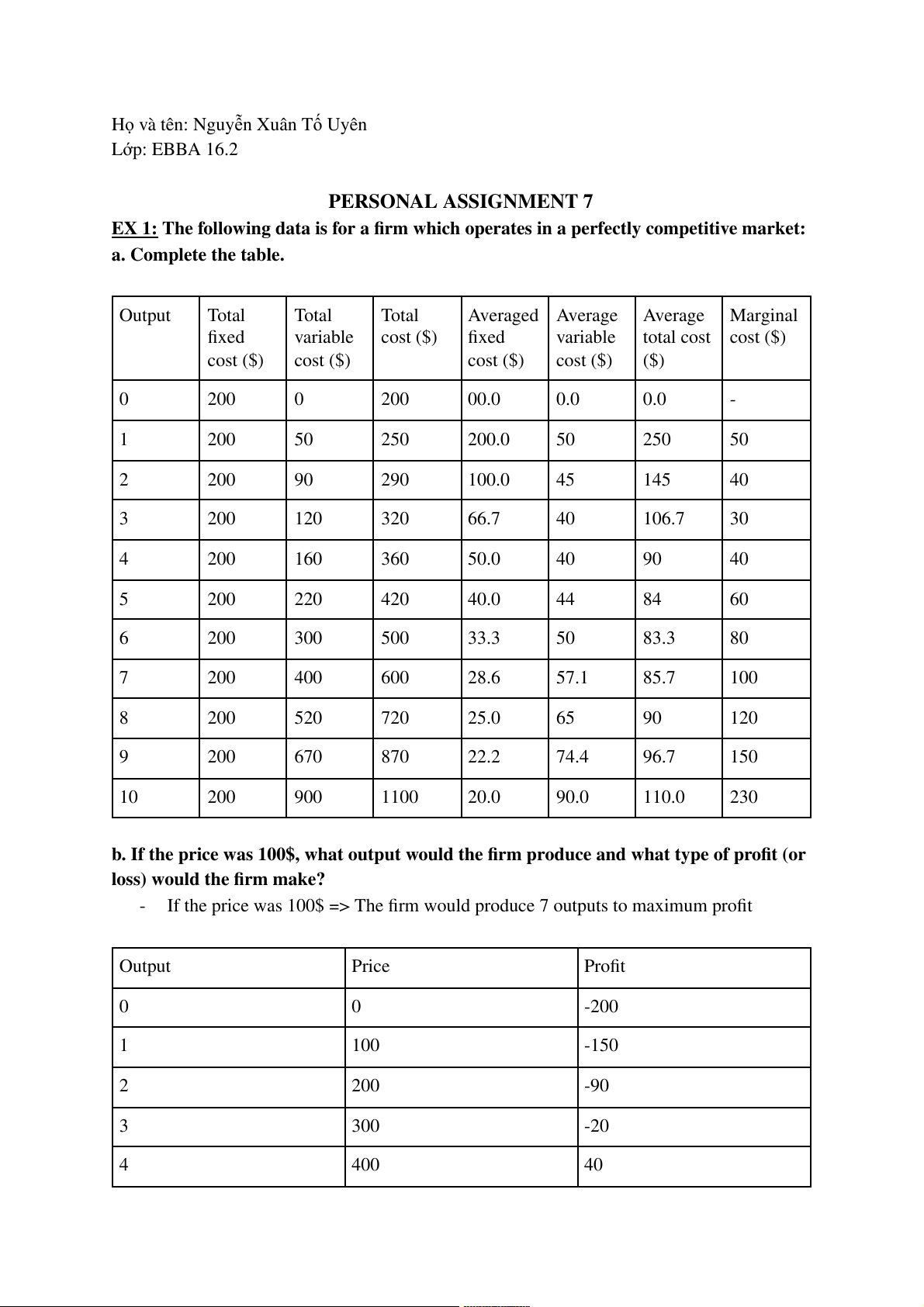
EX 1: The following data is for a firm which operates in a perfectly competitive market: a. Complete the table. Output Total Total Total Averaged Average Average Marginal fixed variable cost ($) fixed variable total cost cost ($) cost ($) cost ($) cost ($) cost ($) ($) 0 200 0 200 00.0 0.0 0.0 - 1 200 50 250 200.0 50 250 50 2 200 90 290 100.0 45 145 40 3 200 120 320 66.7 40 106.7 30 4 200 160 360 50.0 40 90 40 5 200 220 420 40.0 44 84 60 6 200 300 500 33.3 50 83.3 80 7 200 400 600 28.6 57.1 85.7 100 8 200 520 720 25.0 65 90 120 9 200 670 870 22.2 74.4 96.7 150 10 200 900 1100 20.0 90.0 110.0 230
b. If the price was 100$, what output would the firm produce and what type of profit (or
loss) would the firm make? -
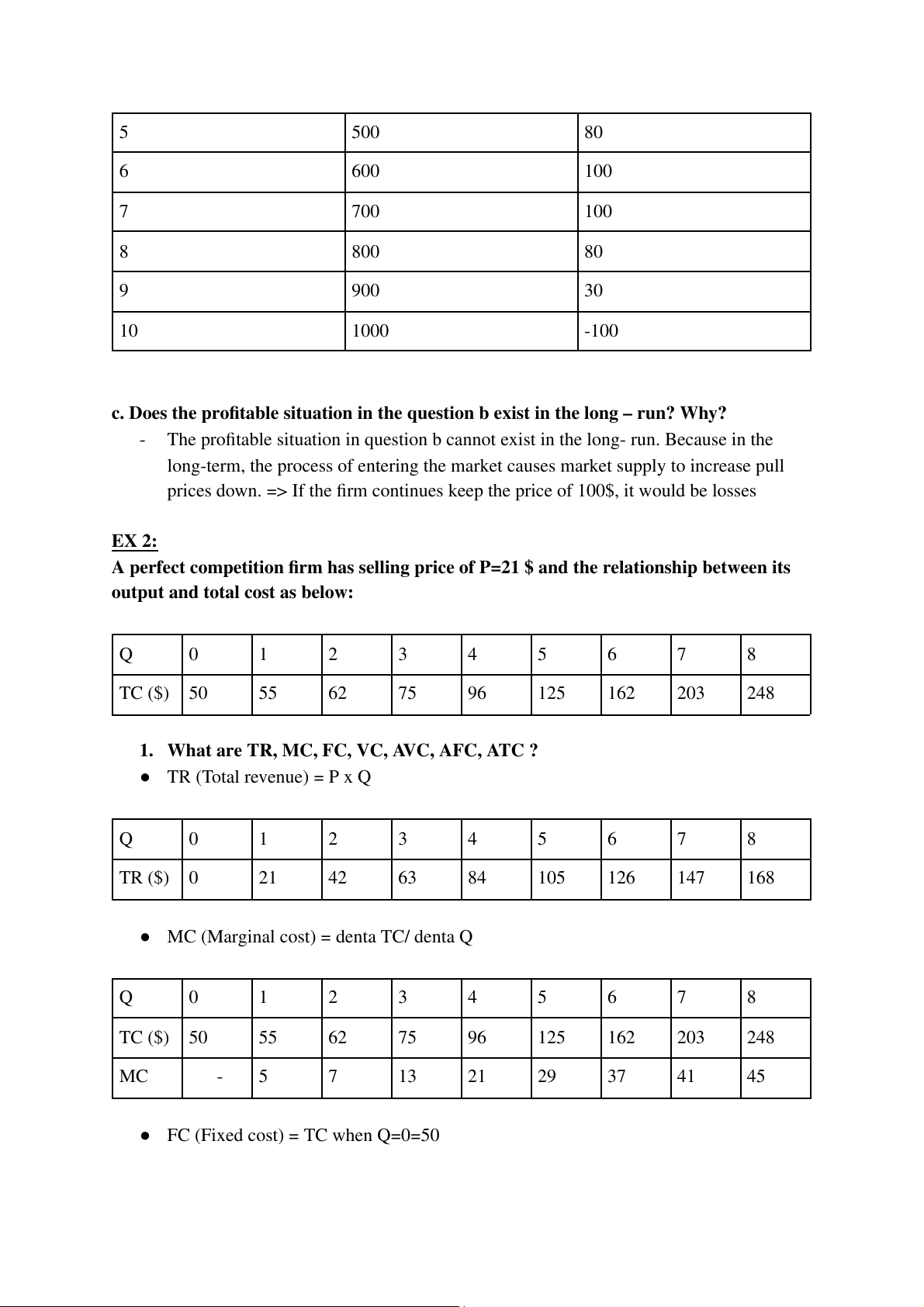
If the price was 100$ => The firm would produce 7 outputs to maximum profit Output Price Profit 0 0 -200 1 100 -150 2 200 -90 3 300 -20 4 400 40 5 500 80 6 600 100 7 700 100 8 800 80 9 900 30 10 1000 -100
c. Does the profitable situation in the question b exist in the long – run? Why? -
The profitable situation in question b cannot exist in the long- run. Because in the
long-term, the process of entering the market causes market supply to increase pull
prices down. => If the firm continues keep the price of 100$, it would be losses EX 2:
A perfect competition firm has selling price of P=21 $ and the relationship between its
output and total cost as below: Q 0 1 2 3 4 5 6 7 8 TC ($) 50 55 62 75 96 125 162 203 248
1. What are TR, MC, FC, VC, AVC, AFC, ATC ? ● TR (Total revenue) = P x Q Q 0 1 2 3 4 5 6 7 8 TR ($) 0 21 42 63 84 105 126 147 168
● MC (Marginal cost) = denta TC/ denta Q Q 0 1 2 3 4 5 6 7 8 TC ($) 50 55 62 75 96 125 162 203 248 MC - 5 7 13 21 29 37 41 45
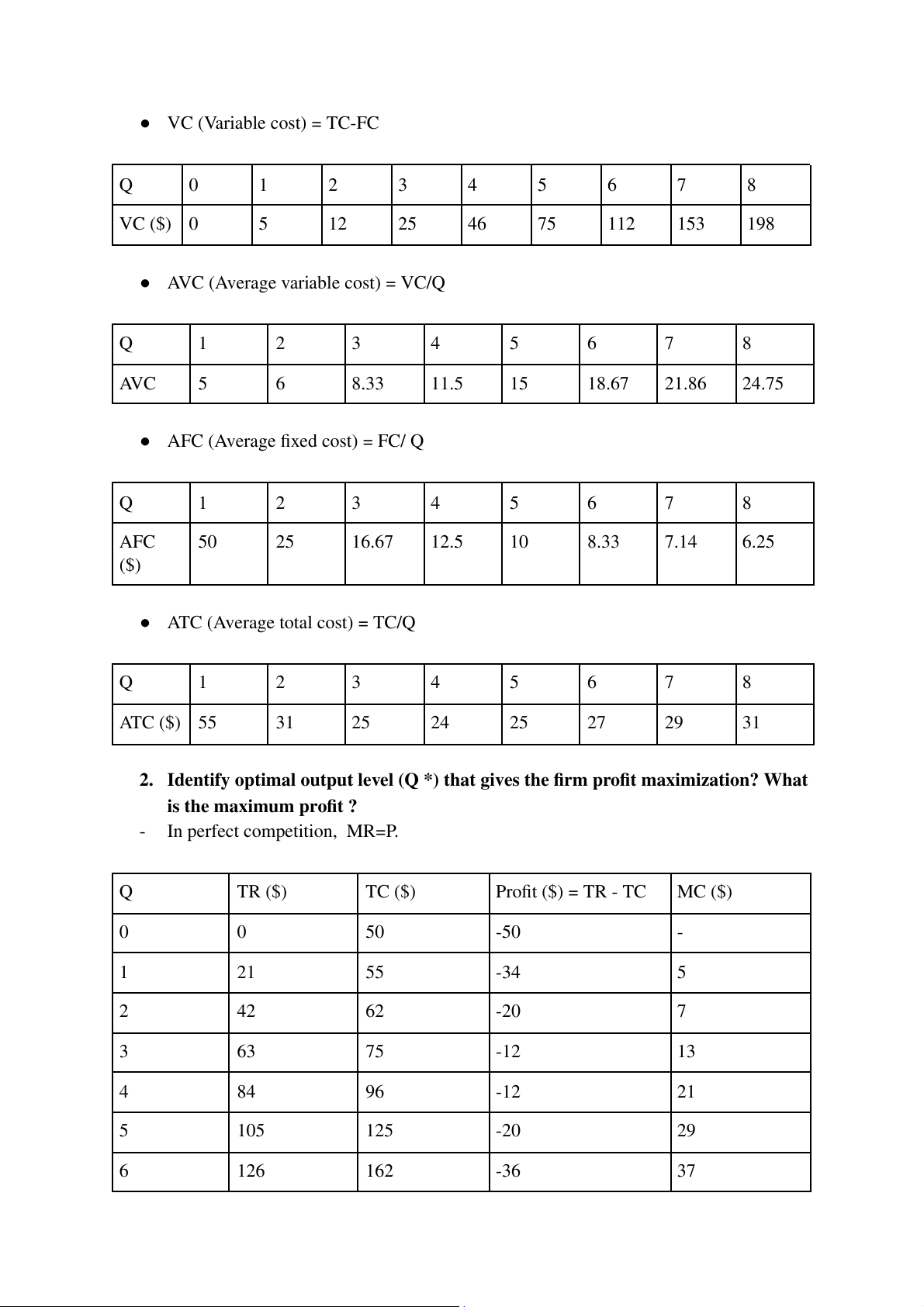
● FC (Fixed cost) = TC when Q=0=50 ● VC (Variable cost) = TC-FC Q 0 1 2 3 4 5 6 7 8 VC ($) 0 5 12 25 46 75 112 153 198
● AVC (Average variable cost) = VC/Q Q 1 2 3 4 5 6 7 8 AVC 5 6 8.33 11.5 15 18.67 21.86 24.75
● AFC (Average fixed cost) = FC/ Q Q 1 2 3 4 5 6 7 8 AFC 50 25 16.67 12.5 10 8.33 7.14 6.25 ($)
● ATC (Average total cost) = TC/Q Q 1 2 3 4 5 6 7 8 ATC ($) 55 31 25 24 25 27 29 31
2. Identify optimal output level (Q *) that gives the firm profit maximization? What
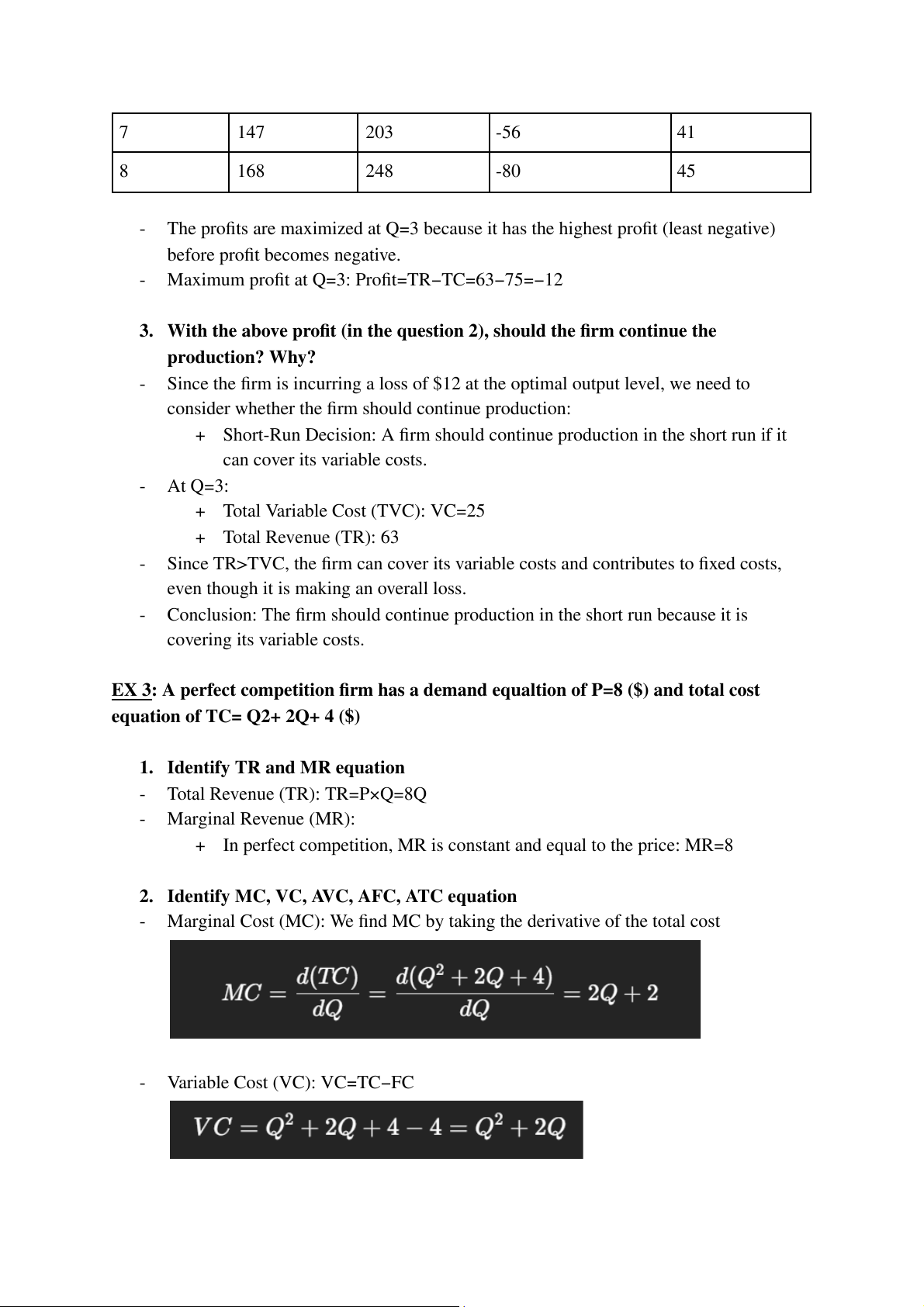
is the maximum profit ? - In perfect competition, MR=P. Q TR ($) TC ($) Profit ($) = TR - TC MC ($) 0 0 50 -50 - 1 21 55 -34 5 2 42 62 -20 7 3 63 75 -12 13 4 84 96 -12 21 5 105 125 -20 29 6 126 162 -36 37 7 147 203 -56 41 8 168 248 -80 45 -
The profits are maximized at Q=3 because it has the highest profit (least negative)
before profit becomes negative. -
Maximum profit at Q=3: Profit=TR−TC=63−75=−12
3. With the above profit (in the question 2), should the firm continue the production? Why? -
Since the firm is incurring a loss of $12 at the optimal output level, we need to
consider whether the firm should continue production:
+ Short-Run Decision: A firm should continue production in the short run if it can cover its variable costs. - At Q=3:
+ Total Variable Cost (TVC): VC=25 + Total Revenue (TR): 63 -
Since TR>TVC, the firm can cover its variable costs and contributes to fixed costs,
even though it is making an overall loss. -
Conclusion: The firm should continue production in the short run because it is covering its variable costs.
EX 3: A perfect competition firm has a demand equaltion of P=8 ($) and total cost
equation of TC= Q2+ 2Q+ 4 ($)
1. Identify TR and MR equation - Total Revenue (TR): TR=P×Q=8Q - Marginal Revenue (MR):
+ In perfect competition, MR is constant and equal to the price: MR=8
2. Identify MC, VC, AVC, AFC, ATC equation -
Marginal Cost (MC): We find MC by taking the derivative of the total cost - Variable Cost (VC): VC=TC−FC - Average Variable Cost (AVC): - Average Fixed Cost (AFC): - Average Total Cost (ATC):
3. Optimal Output Level (Q∗) for Profit Maximization -
To find the optimal output level, set MR=MC: 8=2Q+2 - Solving for Q: 2Q=8−2 2Q=6 Q=3 -
Maximum Profit: TR and TC at Q=3: + TR = 8Q = 8 × 3 = 24 - Profit =TR−TC=24−19=5
4. What is break even price and break even quantity? -
A firm breaks even when TR=TC. - Set TR equal to TC: -> Q1 ≈5.24 Q2 ≈0.76 -
Using P=8 (constant price), both break-even quantities ≈5.24 and ≈0.76 yield a break-even price of P=8. - Conclusion: + Break-even price = 8
+ Break-even quantities ≈ 5.24 and 0.76
5. If market price decrease to P= 4$, should the firm continue the production? Why? - Set MR=MC: 4=2Q+2 ->Q=1 - At Q=1:
+ Total Revenue (TR): TR=P×Q=4×1=4
+ Total Cost (TC): TC=Q=1+2+4=7 -
Profit=TR−TC=4−7=−3 -> The firm incurs a loss of 3 -
Variable Cost (VC) at Q=1: VC=3 -> Average Variable Cost (AVC): AVC=3 -
Since the market price is greater than the average variable cost, the firm can cover its variable costs.
-> The firm should continue production.
Tài liệu liên quan:
-
Price Fluctuations of Masks and Oil in Vietnam | Microeconomics | Trường Đại học Quốc tế, Đại học Quốc gia Thành phố Hồ Chí Minh
3 2 -
Assignment 9: Monopoly Profit Maximization & DWL Analysis | Microeconomics | Trường Đại học Quốc tế, Đại học Quốc gia Thành phố Hồ Chí Minh
5 3 -
Individual Tasks on Opportunity Costs Analysis | Microeconomics | Trường Đại học Quốc tế, Đại học Quốc gia Thành phố Hồ Chí Minh
5 3 -
Oligopoly and Game Theory Insights | Microeconomics | Trường Đại học Quốc tế, Đại học Quốc gia Thành phố Hồ Chí Minh
7 4