Consumer Behavior Test Bank: Multiple Choice Questions | Microeconomics | Trường Đại học Quốc tế, Đại học Quốc gia Thành phố Hồ Chí Minh
A product has utility if it: A: takes more and more resources to produce successive units of it. B: violates the law of demand. D: is useful. 2: The ‘law of diminishing marginal utility’ states that: A: total utility is maximised when consumers obtain the same amount of utility, per unit, of each product consumed. . C: the price must be lowered, in order to induce firms to supply more of a product. D: it will take larger and larger amounts of resources, beyond some point, to produce successive units of a product. Tài liệu được sưu tầm và soạn thảo dưới dạng file PDF để gửi tới các bạn cùng tham khảo, ôn tập đầy đủ kiến thức, chuẩn bị cho các buổi học thật tốt. Mời bạn đọc đón xem!
Môn: Microeconomics 613 tài liệu
Trường: Trường Đại học Quốc tế, Đại học Quốc gia Thành phố Hồ Chí Minh 1.9 K tài liệu
Tác giả:


Preview text:
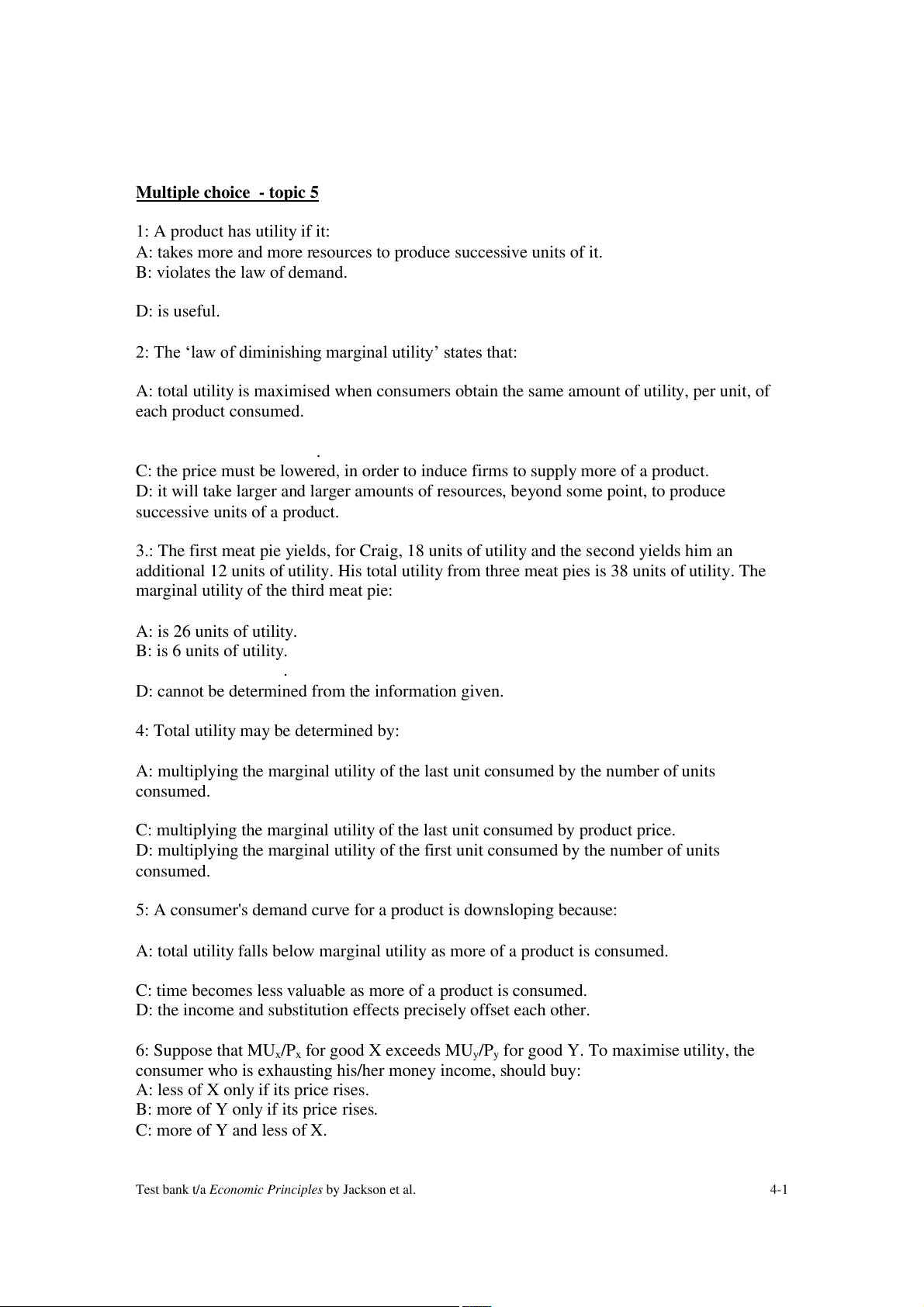
Multiple choice - topic 5
1: A product has utility if it:
A: takes more and more resources to produce successive units of it.
B: violates the law of demand. D: is useful.
2: The ‘law of diminishing marginal utility’ states that:
A: total utility is maximised when consumers obtain the same amount of utility, per unit, of each product consumed. .
C: the price must be lowered, in order to induce firms to supply more of a product.
D: it will take larger and larger amounts of resources, beyond some point, to produce
successive units of a product.
3.: The first meat pie yields, for Craig, 18 units of utility and the second yields him an
additional 12 units of utility. His total utility from three meat pies is 38 units of utility. The
marginal utility of the third meat pie: A: is 26 units of utility. B: is 6 units of utility. .
D: cannot be determined from the information given.
4: Total utility may be determined by:
A: multiplying the marginal utility of the last unit consumed by the number of units consumed.
C: multiplying the marginal utility of the last unit consumed by product price.
D: multiplying the marginal utility of the first unit consumed by the number of units consumed.
5: A consumer's demand curve for a product is downsloping because:
A: total utility falls below marginal utility as more of a product is consumed.
C: time becomes less valuable as more of a product is consumed.
D: the income and substitution effects precisely offset each other.
6: Suppose that MUx/Px for good X exceeds MUy/Py for good Y. To maximise utility, the
consumer who is exhausting his/her money income, should buy:
A: less of X only if its price rises.
B: more of Y only if its price rises. C: more of Y and less of X.
Test bank t/a Economic Principles by Jackson et al. 4-1
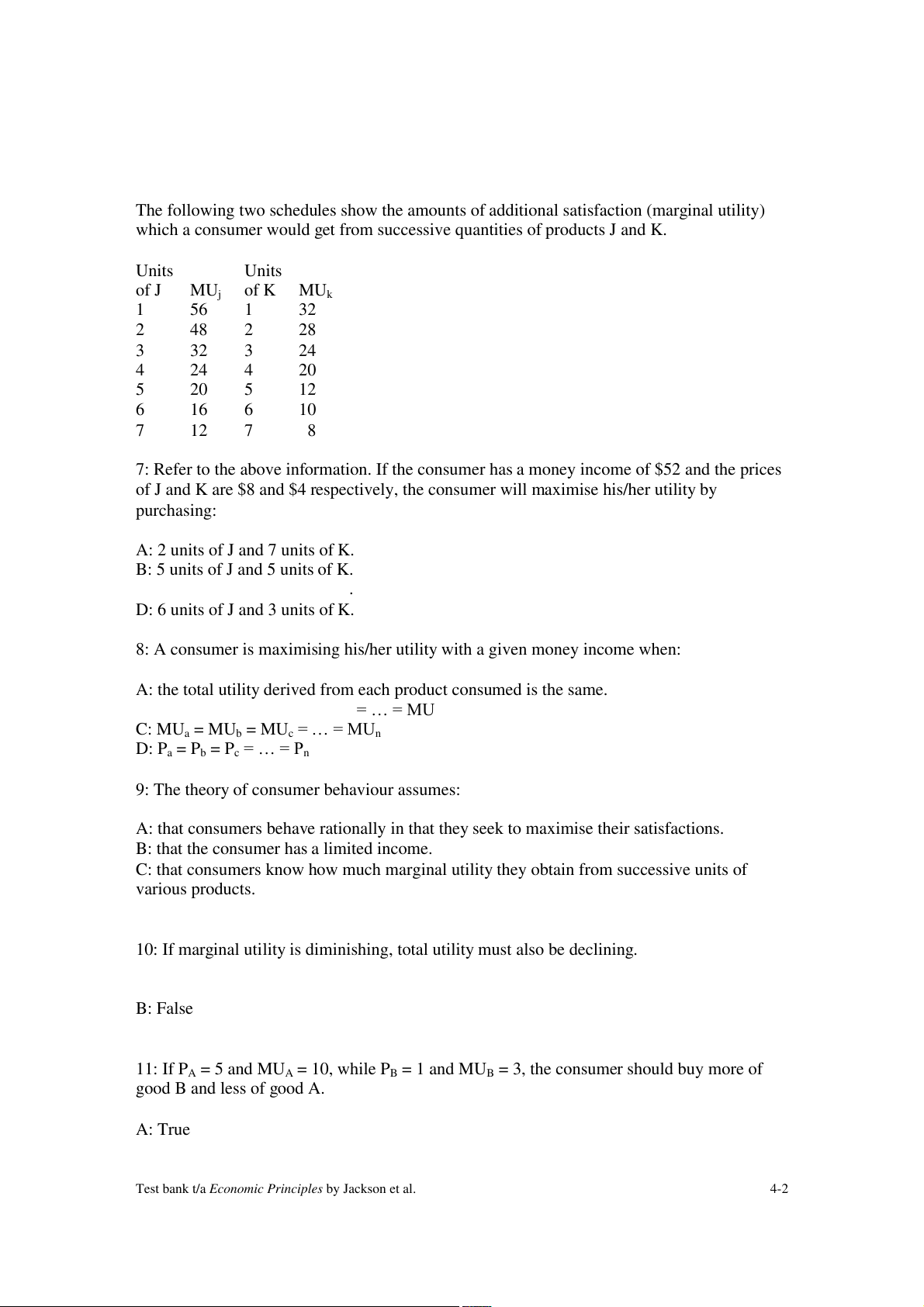
The following two schedules show the amounts of additional satisfaction (marginal utility)
which a consumer would get from successive quantities of products J and K. Units Units of J MUj of K MUk 1 56 1 32 2 48 2 28 3 32 3 24 4 24 4 20 5 20 5 12 6 16 6 10 7 12 7 8
7: Refer to the above information. If the consumer has a money income of $52 and the prices
of J and K are $8 and $4 respectively, the consumer will maximise his/her utility by purchasing:
A: 2 units of J and 7 units of K.
B: 5 units of J and 5 units of K. .
D: 6 units of J and 3 units of K.
8: A consumer is maximising his/her utility with a given money income when:
A: the total utility derived from each product consumed is the same. = … = MU
C: MUa = MUb = MUc = … = MUn D: Pa = Pb = Pc = … = Pn
9: The theory of consumer behaviour assumes:
A: that consumers behave rationally in that they seek to maximise their satisfactions.
B: that the consumer has a limited income.
C: that consumers know how much marginal utility they obtain from successive units of various products.
10: If marginal utility is diminishing, total utility must also be declining. B: False
11: If PA = 5 and MUA = 10, while PB = 1 and MUB = 3, the consumer should buy more of good B and less of good A. A: True
Test bank t/a Economic Principles by Jackson et al. 4-2
Test bank t/a Economic Principles by Jackson et al. 4-3
Tài liệu liên quan:
-
Tự Luận Vimo: Phân Tích Cung, Cầu và Thị Trường Cạnh Tranh| Microeconomics | Trường Đại học Quốc tế, Đại học Quốc gia Thành phố Hồ Chí Minh
5 3 -
Review Questions: Thinking Like an Economist | Microeconomics | Trường Đại học Quốc tế, Đại học Quốc gia Thành phố Hồ Chí Minh
5 3 -
Final Exam Quizlet Questions & Answers | Microeconomics | Trường Đại học Quốc tế, Đại học Quốc gia Thành phố Hồ Chí Minh
5 3 -
Đề thi giữa kỳ II | Microeconomics | Trường Đại học Quốc tế, Đại học Quốc gia Thành phố Hồ Chí Minh
5 3 -
Final Group Project_ The Beer Industry | Microeconomics | Trường Đại học Quốc tế, Đại học Quốc gia Thành phố Hồ Chí Minh
4 2