Consumer Choice & Utility Theory | Microeconomics | Trường Đại học Quốc tế, Đại học Quốc gia Thành phố Hồ Chí Minh
Problem 1: 1. From the hypothesis: "A consumer who uses $60 to buy 2 goods: X and Y. Given that price of the good X is $3 per unit and price of the good Y is $1 per unit", we have the budget line equation for this customer: 3X + Y = 60. Tài liệu được sưu tầm và soạn thảo dưới dạng file PDF để gửi tới các bạn cùng tham khảo, ôn tập đầy đủ kiến thức, chuẩn bị cho các buổi học thật tốt. Mời bạn đọc đón xem!
Môn: Microeconomics 613 tài liệu
Trường: Trường Đại học Quốc tế, Đại học Quốc gia Thành phố Hồ Chí Minh 1.9 K tài liệu
Tác giả:


Preview text:
Topic 5: Consumer Choice using Utility Theory Name: Ta Quyet Tien Class: E-BBA 14.3 E-mail: Tienpbe12345@gmail.com Student code: 11226262 Problem 1:
1. From the hypothesis: "A consumer who uses $60 to buy 2 goods: X and Y.
Given that price of the good X is $3 per unit and price of the good Y is $1 per
unit", we have the budget line equation for this customer: 3X + Y = 60 Y = 60 - 3X
2. The utility function of this consumer is TU=XY. => MUX = (TU)X’ = Y. => MUY = (TU)Y’= X .
=> MRSXY = MUX / MUY = Y / X . 3.
- In order to maximize his utility: I = PXX+ PYY and MUX/PX = MUY/PY (=>
MUX /MUY = PX /PY Y/X = 3/1= 3) 3X + Y =60 and Y = 3X.
=> X=10 ( units) and Y=30 ( units).
- So, optimal quantity of good X (X*) and optimal quantity of good Y (Y*) is 10
units and 30 units respectively in order to maximize his utility. Problem 2:
1, Identify Lan’s budget line equation and draw that BL curve.
Lan’ s budget line equation: 20000x + 5000y = 1000000 Or: y = 200 – 4x
1, We have Lan’ s budget line equation: 20,000X + 5,000Y = 1,000,000. Or: Y = 200 – 4X. 2.
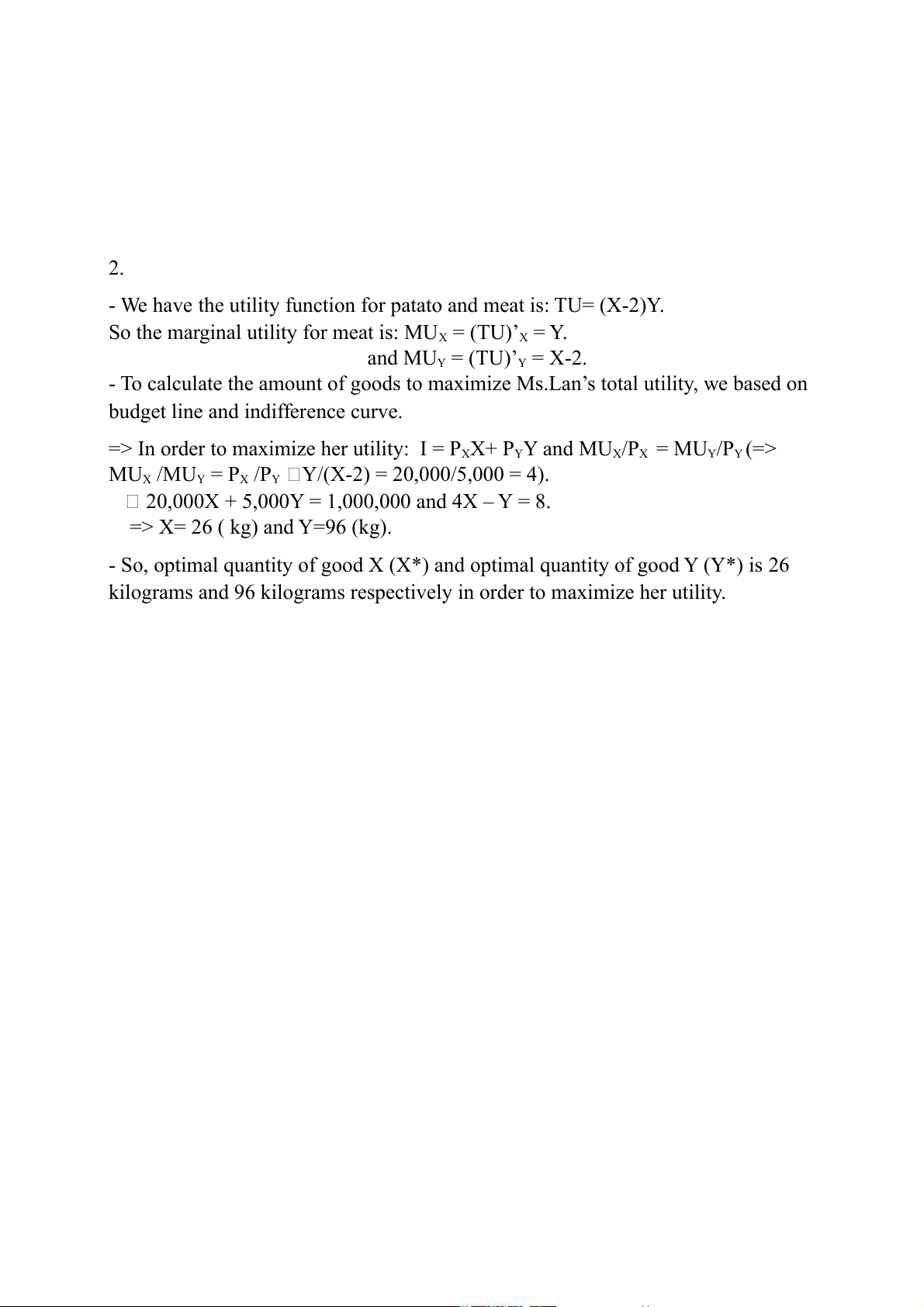
- We have the utility function for patato and meat is: TU= (X-2)Y.
So the marginal utility for meat is: MUX = (TU)’X = Y. and MUY = (TU)’Y = X-2.
- To calculate the amount of goods to maximize Ms.Lan’s total utility, we based on
budget line and indifference curve.
=> In order to maximize her utility: I = PXX+ PYY and MUX/PX = MUY/PY (=>
MUX /MUY = PX /PY Y/(X-2) = 20,000/5,000 = 4).
20,000X + 5,000Y = 1,000,000 and 4X – Y = 8.
=> X= 26 ( kg) and Y=96 (kg).
- So, optimal quantity of good X (X*) and optimal quantity of good Y (Y*) is 26
kilograms and 96 kilograms respectively in order to maximize her utility.
Tài liệu liên quan:
-
Tự Luận Vimo: Phân Tích Cung, Cầu và Thị Trường Cạnh Tranh| Microeconomics | Trường Đại học Quốc tế, Đại học Quốc gia Thành phố Hồ Chí Minh
5 3 -
Review Questions: Thinking Like an Economist | Microeconomics | Trường Đại học Quốc tế, Đại học Quốc gia Thành phố Hồ Chí Minh
5 3 -
Final Exam Quizlet Questions & Answers | Microeconomics | Trường Đại học Quốc tế, Đại học Quốc gia Thành phố Hồ Chí Minh
5 3 -
Đề thi giữa kỳ II | Microeconomics | Trường Đại học Quốc tế, Đại học Quốc gia Thành phố Hồ Chí Minh
5 3 -

Final Group Project_ The Beer Industry | Microeconomics | Trường Đại học Quốc tế, Đại học Quốc gia Thành phố Hồ Chí Minh
4 2