Cost Classification and Estimation: Session 10 Insights in Cost Behavior | Microeconomics | Trường Đại học Quốc tế, Đại học Quốc gia Thành phố Hồ Chí Minh
Listed below are costs found in various organizations. 1. Property taxes, factory. 2. Boxes used for packaging detergent produced by the company. 3. Salespersons’ commissions. 4. Supervisor’s salary, factory. 5. Depreciation, executive autos. 6. Wages of workers assembling computers. 7. Insurance - finished goods warehouses. 8. Lubricants for production equipment. 9. Advertising costs. 10. Microchips used in producing calculators. 11. Shipping costs on merchandise sold. 12. Magazine subscriptions, factory lunchroom. 13. Thread in a garment factory. 14. Billing costs. 15. Executive life insurance. 16. Ink used in textbox. Tài liệu được sưu tầm và soạn thảo dưới dạng file PDF để gửi tới các bạn cùng tham khảo, ôn tập đầy đủ kiến thức, chuẩn bị cho các buổi học thật tốt. Mời bạn đọc đón xem!
Môn: Microeconomics 613 tài liệu
Trường: Trường Đại học Quốc tế, Đại học Quốc gia Thành phố Hồ Chí Minh 1.9 K tài liệu
Tác giả:

Preview text:
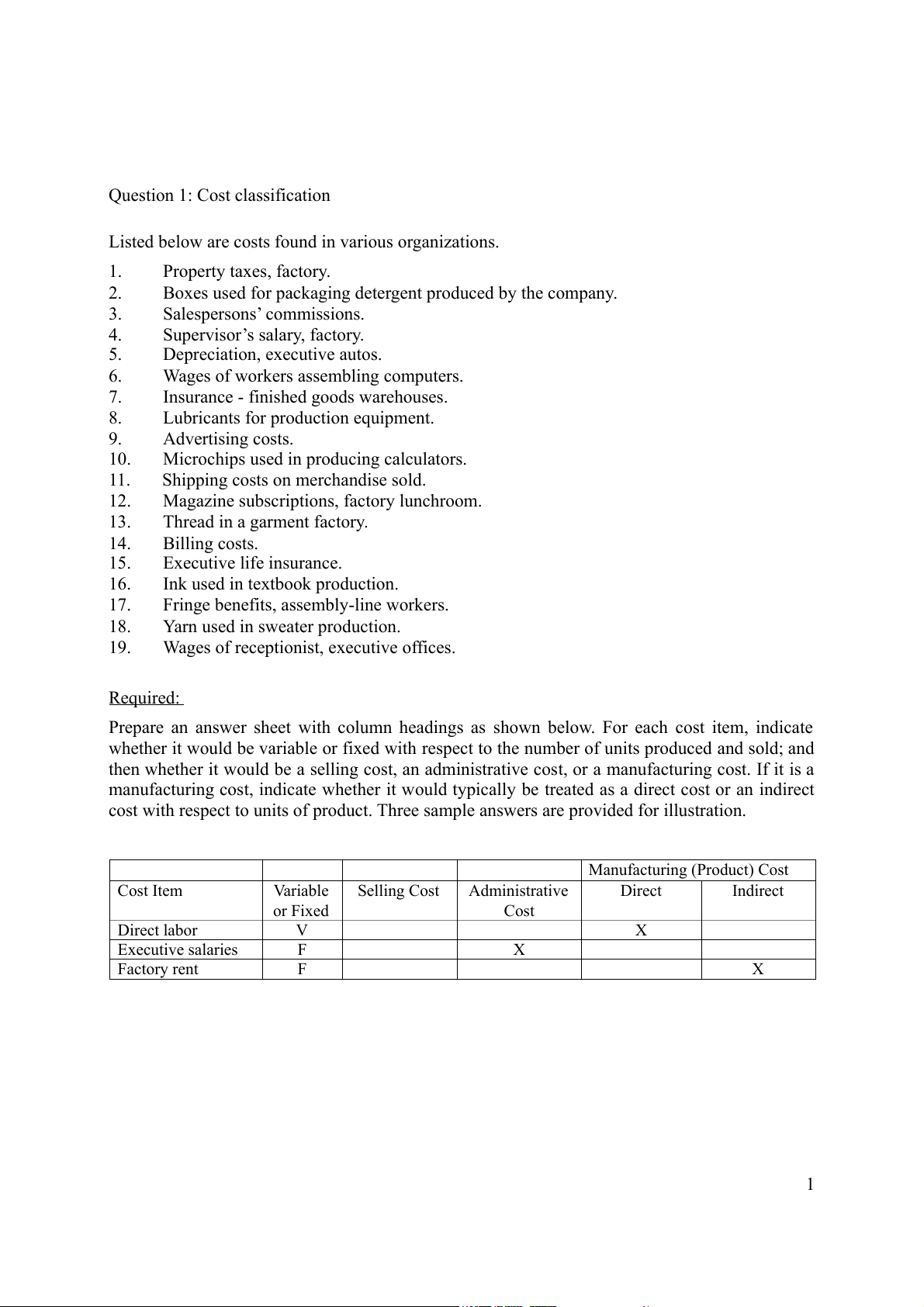
Question 1: Cost classification
Listed below are costs found in various organizations. 1. Property taxes, factory. 2.
Boxes used for packaging detergent produced by the company. 3. Salespersons’ commissions. 4.
Supervisor’s salary, factory. 5. Depreciation, executive autos. 6.
Wages of workers assembling computers. 7.
Insurance - finished goods warehouses. 8.
Lubricants for production equipment. 9. Advertising costs. 10.
Microchips used in producing calculators. 11.
Shipping costs on merchandise sold. 12.
Magazine subscriptions, factory lunchroom. 13. Thread in a garment factory. 14. Billing costs. 15. Executive life insurance. 16.
Ink used in textbook production. 17.
Fringe benefits, assembly-line workers. 18.
Yarn used in sweater production. 19.
Wages of receptionist, executive offices. Required:
Prepare an answer sheet with column headings as shown below. For each cost item, indicate
whether it would be variable or fixed with respect to the number of units produced and sold; and
then whether it would be a selling cost, an administrative cost, or a manufacturing cost. If it is a
manufacturing cost, indicate whether it would typically be treated as a direct cost or an indirect
cost with respect to units of product. Three sample answers are provided for illustration. Manufacturing (Product) Cost Cost Item Variable Selling Cost Administrative Direct Indirect or Fixed Cost Direct labor V X Executive salaries F X Factory rent F X 1
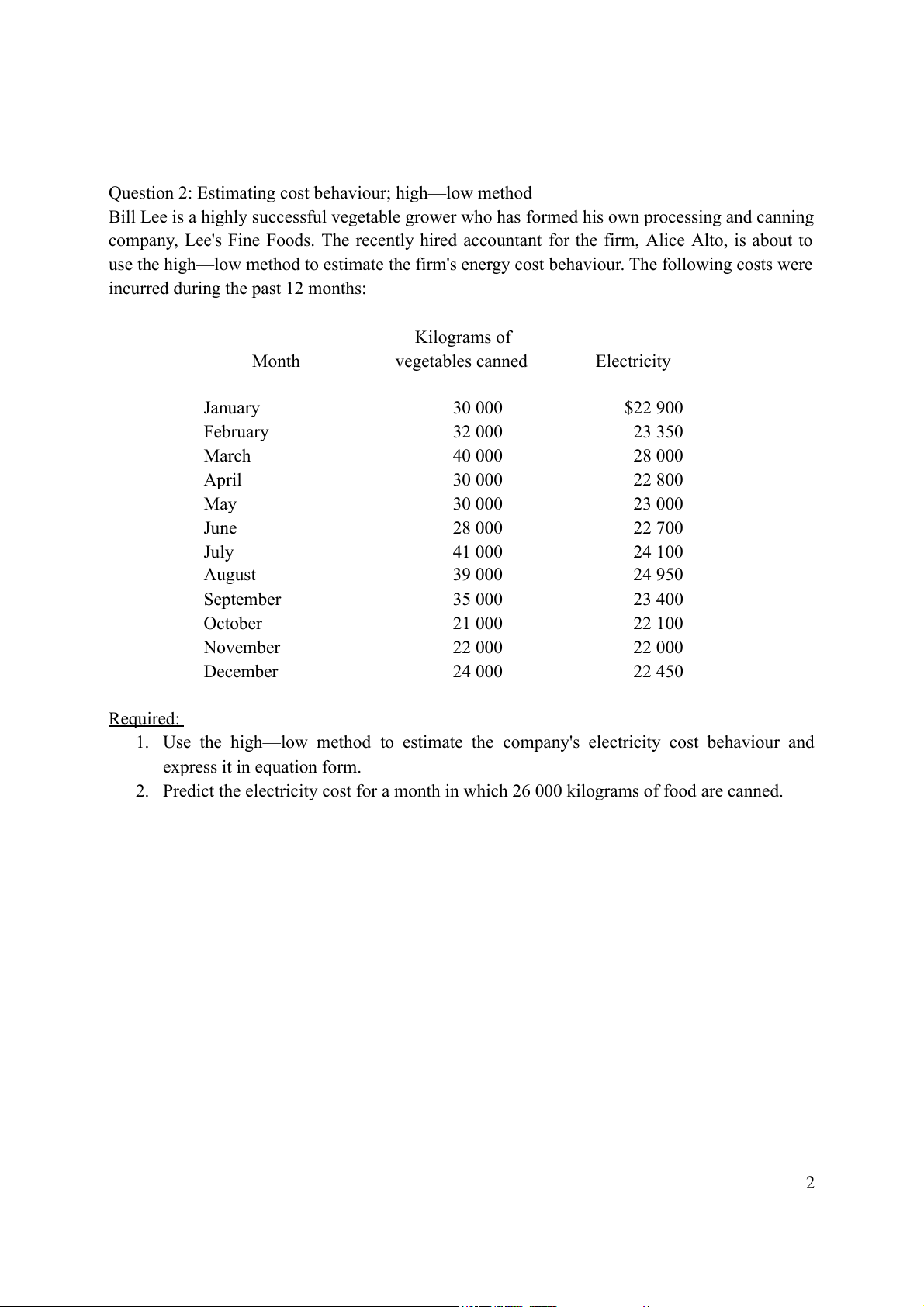
Question 2: Estimating cost behaviour; high—low method
Bill Lee is a highly successful vegetable grower who has formed his own processing and canning
company, Lee's Fine Foods. The recently hired accountant for the firm, Alice Alto, is about to
use the high—low method to estimate the firm's energy cost behaviour. The following costs were
incurred during the past 12 months: Kilograms of Month vegetables canned Electricity January 30 000 $22 900 February 32 000 23 350 March 40 000 28 000 April 30 000 22 800 May 30 000 23 000 June 28 000 22 700 July 41 000 24 100 August 39 000 24 950 September 35 000 23 400 October 21 000 22 100 November 22 000 22 000 December 24 000 22 450 Required:
1. Use the high—low method to estimate the company's electricity cost behaviour and express it in equation form.
2. Predict the electricity cost for a month in which 26 000 kilograms of food are canned. 2
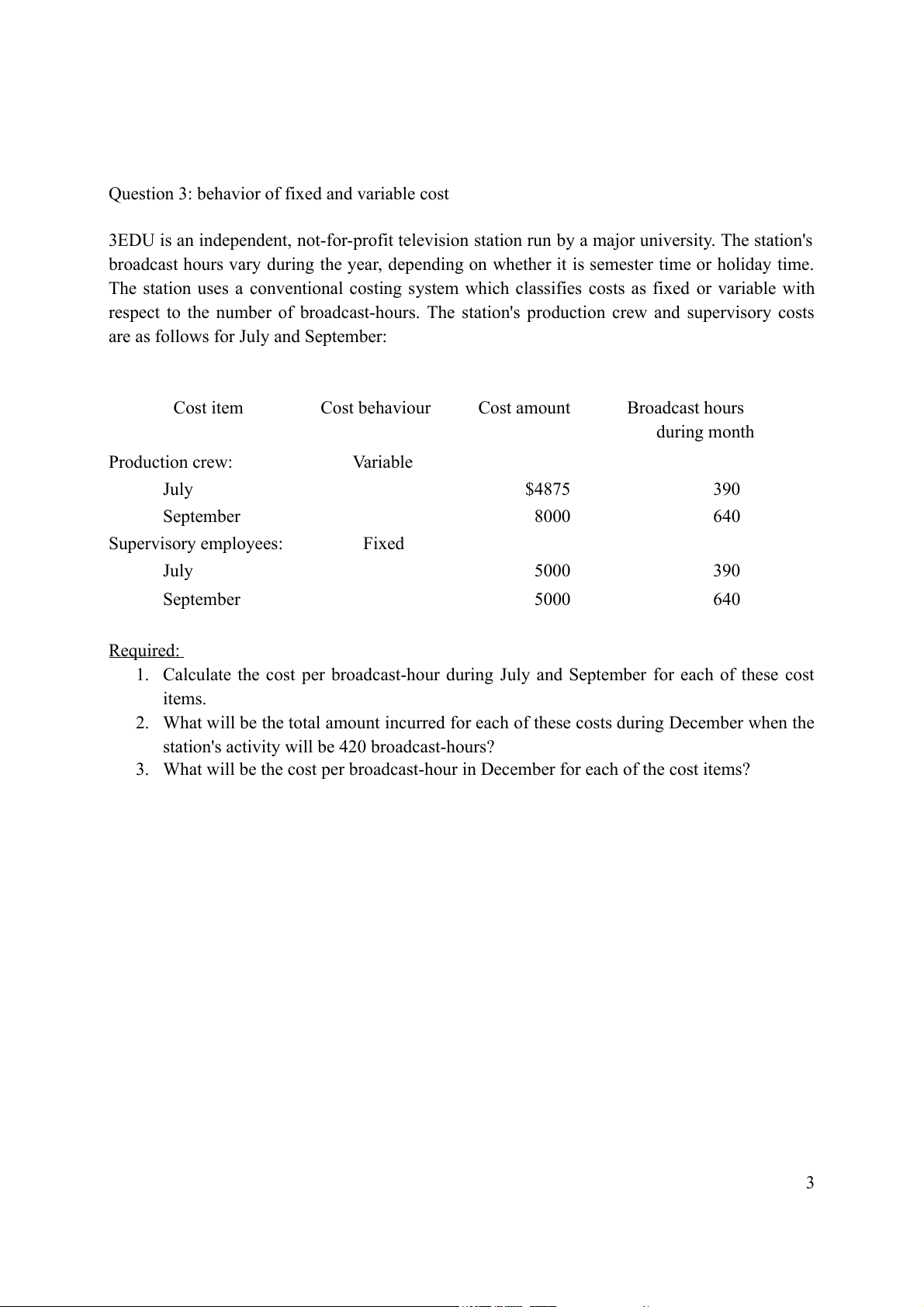
Question 3: behavior of fixed and variable cost
3EDU is an independent, not-for-profit television station run by a major university. The station's
broadcast hours vary during the year, depending on whether it is semester time or holiday time.
The station uses a conventional costing system which classifies costs as fixed or variable with
respect to the number of broadcast-hours. The station's production crew and supervisory costs
are as follows for July and September: Cost item Cost behaviour Cost amount Broadcast hours during month Production crew: Variable July $4875 390 September 8000 640 Supervisory employees: Fixed July 5000 390 September 5000 640 Required:
1. Calculate the cost per broadcast-hour during July and September for each of these cost items.
2. What will be the total amount incurred for each of these costs during December when the
station's activity will be 420 broadcast-hours?
3. What will be the cost per broadcast-hour in December for each of the cost items? 3
Tài liệu liên quan:
-
Tự Luận Vimo: Phân Tích Cung, Cầu và Thị Trường Cạnh Tranh| Microeconomics | Trường Đại học Quốc tế, Đại học Quốc gia Thành phố Hồ Chí Minh
5 3 -
Review Questions: Thinking Like an Economist | Microeconomics | Trường Đại học Quốc tế, Đại học Quốc gia Thành phố Hồ Chí Minh
5 3 -
Final Exam Quizlet Questions & Answers | Microeconomics | Trường Đại học Quốc tế, Đại học Quốc gia Thành phố Hồ Chí Minh
5 3 -
Đề thi giữa kỳ II | Microeconomics | Trường Đại học Quốc tế, Đại học Quốc gia Thành phố Hồ Chí Minh
5 3 -

Final Group Project_ The Beer Industry | Microeconomics | Trường Đại học Quốc tế, Đại học Quốc gia Thành phố Hồ Chí Minh
4 2