Đề cương cho môn Microeconomics | Microeconomics | Trường Đại học Quốc tế, Đại học Quốc gia Thành phố Hồ Chí Minh
The main objective of the course is to improve economic literacy as well as critical thinking and problem solving skills to explain and predict economic issues. After the course, students are able to: + Understand how individuals, firms and the government make economic decisions and interact with each other, given scarcity of resources. Tài liệu được sưu tầm và soạn thảo dưới dạng file PDF để gửi tới các bạn cùng tham khảo, ôn tập đầy đủ kiến thức, chuẩn bị cho các buổi học thật tốt. Mời bạn đọc đón xem!
Môn: Microeconomics 613 tài liệu
Trường: Trường Đại học Quốc tế, Đại học Quốc gia Thành phố Hồ Chí Minh 1.9 K tài liệu
Tác giả:


Preview text:
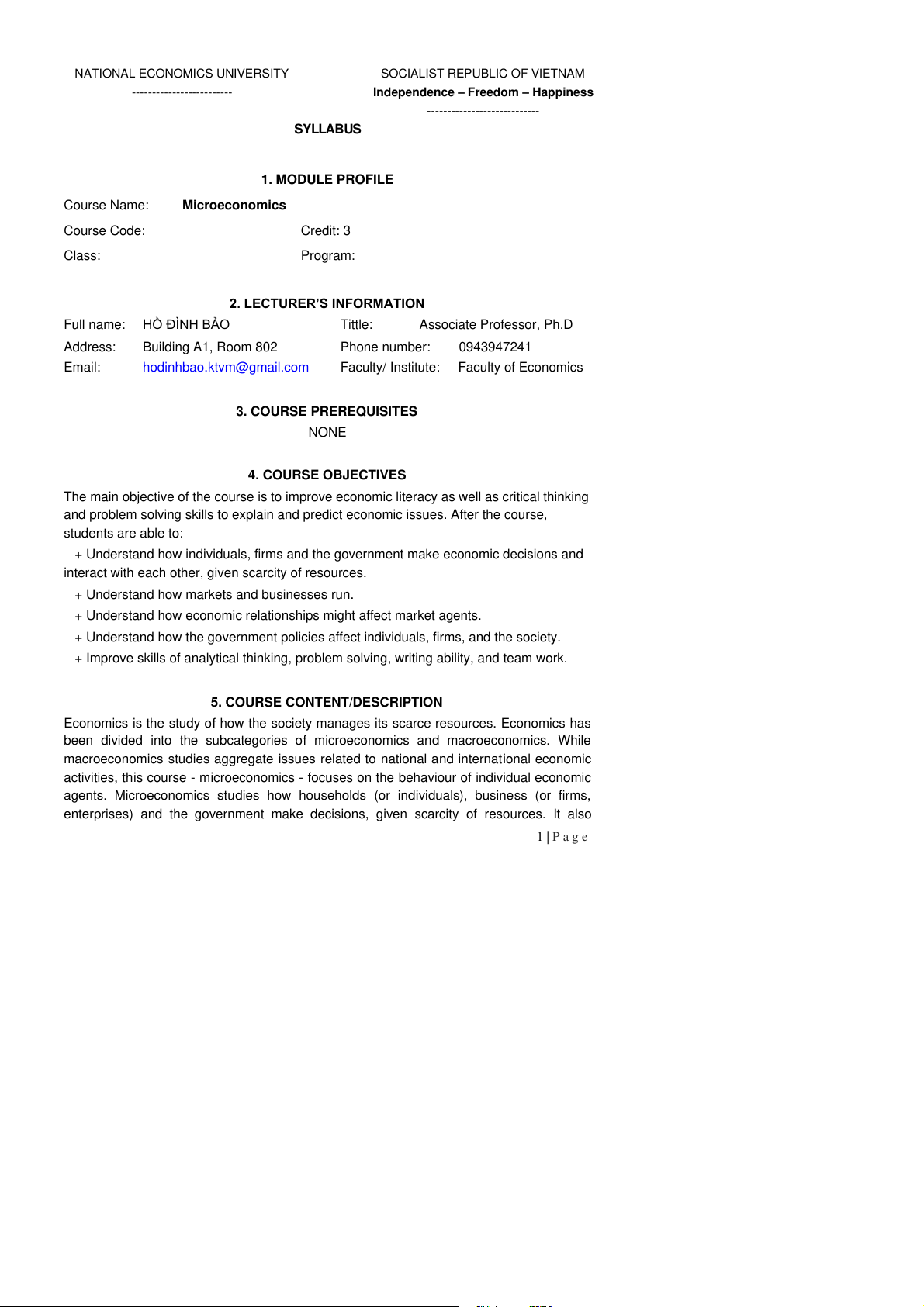
NATIONAL ECONOMICS UNIVERSITY SOCIALIST REPUBLIC OF VIETNAM -------------------------
Independence – Freedom – Happiness ---------------------------- SYLLABUS 1. MODULE PROFILE Course Name: Microeconomics Course Code: Credit: 3 Class: Program:
2. LECTURER’S INFORMATION Ful name: HỒ ĐÌNH BẢO Tittle: Associate Professor, Ph.D Address: Building A1, Room 802 Phone number: 0943947241 Email: hodinhbao.ktvm@gmail.com
Faculty/ Institute: Faculty of Economics
3. COURSE PREREQUISITES NONE 4. COURSE OBJECTIVES
The main objective of the course is to improve economic literacy as wel as critical thinking
and problem solving skil s to explain and predict economic issues. After the course, students are able to:
+ Understand how individuals, firms and the government make economic decisions and
interact with each other, given scarcity of resources.
+ Understand how markets and businesses run.
+ Understand how economic relationships might affect market agents.
+ Understand how the government policies affect individuals, firms, and the society.
+ Improve skil s of analytical thinking, problem solving, writing ability, and team work.
5. COURSE CONTENT/DESCRIPTION
Economics is the study of how the society manages its scarce resources. Economics has
been divided into the subcategories of microeconomics and macroeconomics. While
macroeconomics studies aggregate issues related to national and international economic
activities, this course - microeconomics - focuses on the behaviour of individual economic
agents. Microeconomics studies how households (or individuals), business (or firms,
enterprises) and the government make decisions, given scarcity of resources. It also 1 | P a g e
studies the interactions among those market members and how these interactions have
impacts on their economic benefits and the economy. Because most of these activities
occur in the markets, this course also focuses on how the markets work. .
7. DETAILED CLASS SCHEDULE
(Any changes on the schedule WILL BE announced in class and on TURNITIN in advance) 2 | P a g e Commencing Topics Chapters
Readings/ Activities/ Notes Class 1st Syllabus Ten Principles of Economics + + Discussing syllabus
Chapter 1 + 2 Thinking like an Economist
+ Read Chapters 1 & 2 (Mankiw, Gregory (2018). Principles of
Economics. 8th edition, International Edition) before class. 2nd Chapter 4 Market forces of supply and
+ Review questions and problems in Chapters 1 & 2 demand
+ Read Chapter 4 (Mankiw, Gregory (2018). Principles of
Economics. 8th edition, International Edition) before class. 3rd Chapter 5
Elasticity and Its Application
+ Review questions and problems in Chapter 4
+ Read Chapter 5 (Mankiw, Gregory (2018). Principles of
Economics. 8th edition, International Edition) before class. 4th Chapter 6
Supply, Demand, and Government + Review questions and problems in Chapter 5 Policies
+ Read Chapter 6 (Mankiw, Gregory (2018). Principles of
Economics. 8th edition, International Edition) before class. 5th Chapter 7 Consumers, Producers, and the
+ Review questions and problems in Chapter 6 Efficiency of Markets
+ Read Chapters 7 (Mankiw, Gregory (2018). Principles of
Economics. 8th edition, International Edition) before class. 6th Chapter 8
Application: The Costs of Taxation + Review questions and problems in Chapter 7
+ Read Chapters 8 (Mankiw, Gregory (2018). Principles of
Economics. 8th edition, International Edition) before class. 7th Chapter 10 Externalities
+ Review questions and problems in Chapters 8
+ Read Chapter 10 (Mankiw, Gregory (2018). Principles of
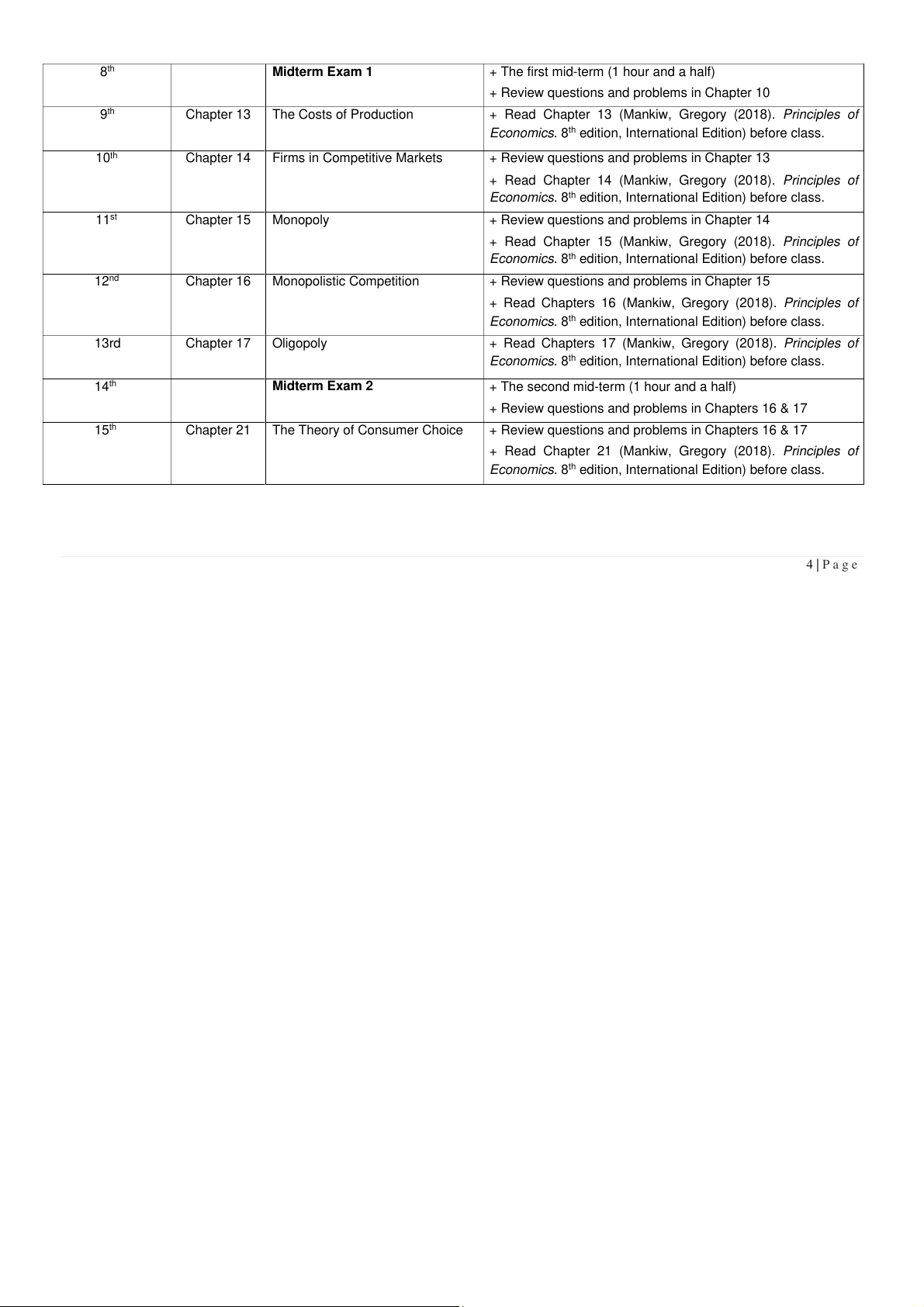
Economics. 8th edition, International Edition) before class. 3 | P a g e 8th Midterm Exam 1
+ The first mid-term (1 hour and a half)
+ Review questions and problems in Chapter 10 9th Chapter 13 The Costs of Production
+ Read Chapter 13 (Mankiw, Gregory (2018). Principles of
Economics. 8th edition, International Edition) before class. 10th Chapter 14 Firms in Competitive Markets
+ Review questions and problems in Chapter 13
+ Read Chapter 14 (Mankiw, Gregory (2018). Principles of
Economics. 8th edition, International Edition) before class. 11st Chapter 15 Monopoly
+ Review questions and problems in Chapter 14
+ Read Chapter 15 (Mankiw, Gregory (2018). Principles of
Economics. 8th edition, International Edition) before class. 12nd Chapter 16
Monopolistic Competition
+ Review questions and problems in Chapter 15
+ Read Chapters 16 (Mankiw, Gregory (2018). Principles of
Economics. 8th edition, International Edition) before class. 13rd Chapter 17 Oligopoly
+ Read Chapters 17 (Mankiw, Gregory (2018). Principles of
Economics. 8th edition, International Edition) before class. 14th Midterm Exam 2
+ The second mid-term (1 hour and a half)
+ Review questions and problems in Chapters 16 & 17 15th Chapter 21
The Theory of Consumer Choice
+ Review questions and problems in Chapters 16 & 17
+ Read Chapter 21 (Mankiw, Gregory (2018). Principles of
Economics. 8th edition, International Edition) before class. 4 | P a g e 8. REQUIRED TEXTBOOK
Mankiw, Gregory (2018). Principles of Economics. 8th edition, International Edition, South-
Western Cengage Learning Mason.
9. OTHER REQUIRED MATERIALS & INFORMATION
a. NEU’s Ebooks and documents at http://lic.neu.edu.vn:2048/menu: Emerald Insight, IG
Publishing eBook and Proquest Central
b. NEU’s Ebooks and documents at http://aep.neu.edu.vn:2048/menu
c. McEachen, W.A. (2003), ‘Economics: A Contemporary Introduction’, 6th edition, Thomson
d. Parkin, M. (2000), ‘Economics’, 5th edition, Addison-Wesley Publishing Co.
e. Gottheil, F. (2002), ‘Principles of Economics’, 3rd edition, South-Western.
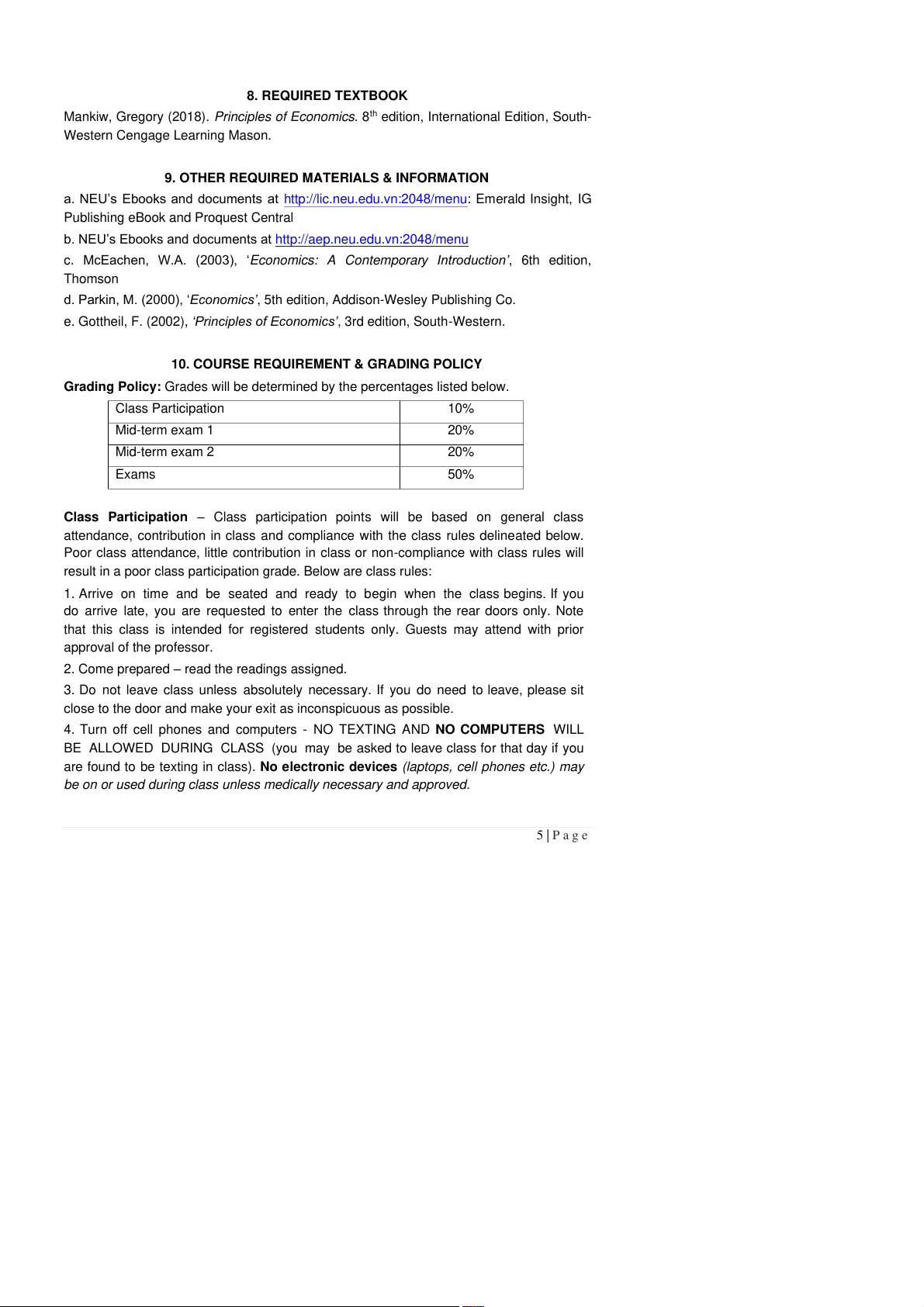
10. COURSE REQUIREMENT & GRADING POLICY
Grading Policy: Grades wil be determined by the percentages listed below. Class Participation 10% Mid-term exam 1 20% Mid-term exam 2 20% Exams 50%
Class Participation – Class participation points wil be based on general class
attendance, contribution in class and compliance with the class rules delineated below.
Poor class attendance, little contribution in class or non-compliance with class rules wil
result in a poor class participation grade. Below are class rules:
1. Arrive on time and be seated and ready to begin when the class begins. If you
do arrive late, you are requested to enter the class through the rear doors only. Note
that this class is intended for registered students only. Guests may attend with prior approval of the professor.
2. Come prepared – read the readings assigned.
3. Do not leave class unless absolutely necessary. If you do need to leave, please sit
close to the door and make your exit as inconspicuous as possible.
4. Turn off cel phones and computers - NO TEXTING AND NO COMPUTERS WILL
BE ALLOWED DURING CLASS (you may be asked to leave class for that day if you
are found to be texting in class). No electronic devices (laptops, cel phones etc.) may
be on or used during class unless medical y necessary and approved. 5 | P a g e
5. Video or audio taping of the class is strictly prohibited. Also, note takers who are not
registered in the class are not al owed in the class.
6. Do not engage in individual discussions (persistent individual conversations wil
result in the participants being asked to leave class for that day).
7. Participate by contributing comments and questions during the discussions. The
instructor wil cal on students during the class if participants do not volunteer.
8. Please use common courtesy and polite manners in class, during discussions and in
any emails or communication related to the class in a business-like tone.
9. Keep items you bring to a class minimal. For instance, noisy newspapers and food
with odors are not acceptable. Smal snacks are al owed and any additional materials
should be kept in your backpack.
10. I have no tolerance for acts of academic dishonesty (such matters may be treated as listed below).
To be fair to al students, grade changes or additional extra credit opportunities wil not
be considered. The only discussions on grades wil be verification of the grade. The
professor wil not tolerate requests to increase grades or any excuses regarding grades.
The system of an option final exam provides for any “second chances” for any issues
arising during the semester. Hanoi, / 09 / 2021 Lecturer Ho Dinh Bao 6 | P a g e
Tài liệu liên quan:
-
Tự Luận Vimo: Phân Tích Cung, Cầu và Thị Trường Cạnh Tranh| Microeconomics | Trường Đại học Quốc tế, Đại học Quốc gia Thành phố Hồ Chí Minh
5 3 -
Review Questions: Thinking Like an Economist | Microeconomics | Trường Đại học Quốc tế, Đại học Quốc gia Thành phố Hồ Chí Minh
5 3 -
Final Exam Quizlet Questions & Answers | Microeconomics | Trường Đại học Quốc tế, Đại học Quốc gia Thành phố Hồ Chí Minh
5 3 -
Đề thi giữa kỳ II | Microeconomics | Trường Đại học Quốc tế, Đại học Quốc gia Thành phố Hồ Chí Minh
5 3 -
Final Group Project_ The Beer Industry | Microeconomics | Trường Đại học Quốc tế, Đại học Quốc gia Thành phố Hồ Chí Minh
4 2