Đề cương Kinh Tế Học Vi Mô | Microeconomics | Trường Đại học Quốc tế, Đại học Quốc gia Thành phố Hồ Chí Minh
A rational decisionmaker A.ignores marginal changes and focuses instead on “the big picture. ” B. ignores the likely effects of government policies when he or she makes choices. C.takes an action only if the marginal benefit of that action exceeds the marginal cost of that action. D.takes an action only if the combined benefits of that action and previous actions exceed the combined costs of that action and previous actions. 15. A rational decision maker takes an action only if the A.marginal benefit is less than the marginal cost. B. marginal benefit is greater than the marginal cost. C.average benefit is greater than the average cost. D.marginal benefit is greater than both the average cost and the marginal cost. Tài liệu được sưu tầm và soạn thảo dưới dạng file PDF để gửi tới các bạn cùng tham khảo, ôn tập đầy đủ kiến thức, chuẩn bị cho các buổi học thật tốt. Mời bạn đọc đón xem!
Môn: Microeconomics 613 tài liệu
Trường: Trường Đại học Quốc tế, Đại học Quốc gia Thành phố Hồ Chí Minh 1.9 K tài liệu
Tác giả:







Preview text:
Ban Chuyên môn LCĐ Chất lượng Cao
Học viện Ngân Hàng TABLE OF CONTENT
THEORY ................................................................................................................................................. 2
CHAPTER 1: INTRODUCTION ...................................................................................................... 2
CHAPTER 2: SUPPLY AND DEMAND .......................................................................................... 3
CHAPTER 3: CONSUMERS, PRODUCERS AND EFFICIENCY OF MARKETS .................. 8
CHAPTER 4: THE THEORY OF CONSUMER CHOICE ......................................................... 10
CHAPTER 5: FIRM BEHAVIOR AND ORGANIZATION OF INDUSTRY ........................... 12
EXERCISE ............................................................................................................................................ 15
CHAPTER 1: INTRODUCTION .................................................................................................... 15
CHAPTER 2: SUPPLY AND DEMAND ........................................................................................ 21
CHAPTER 3 : CONSUMERS, PRODUCERS AND EFFICIENCY OF MARKETS ............... 28
CHAPTER 4: THE THEORY OF CONSUMER CHOICE ......................................................... 34
CHAPTER 5: FIRM BEHAVIOR AND ORGANIZATION OF INDUSTRY ........................... 38
Chương trình “Hỗ trợ học tập” 1
Ban Chuyên môn LCĐ Chất lượng Cao
Học viện Ngân Hàng
4. Elasticity and Tax Incidence – Conclusion
Tax burden falls more heavily on the side of the market that is less elastic:
Small elasticity of demand: Buyers do not have good alternatives to consuming this good.
Buyers bear most of the burden of the tax.
Small elasticity of supply: Sellers do not have good alternatives to producing this good.
Sellers bear most of the burden of the tax.
When the government levies a tax on a good, the equilibrium quantity of the good falls.
The tax places a wedge between the price paid by buyers and the price received by sellers.
Buyers pay more for the good and sellers receive less for it.
Buyers and sellers share the tax burden.
The incidence of tax depends on the price elasticities of supply and demand.
Most of the burden falls on the side of the market that is less elastic.
Chương trình “Hỗ trợ học tập” 7
Ban Chuyên môn LCĐ Chất lượng Cao
Học viện Ngân Hàng EXERCISE
CHAPTER 1: INTRODUCTION
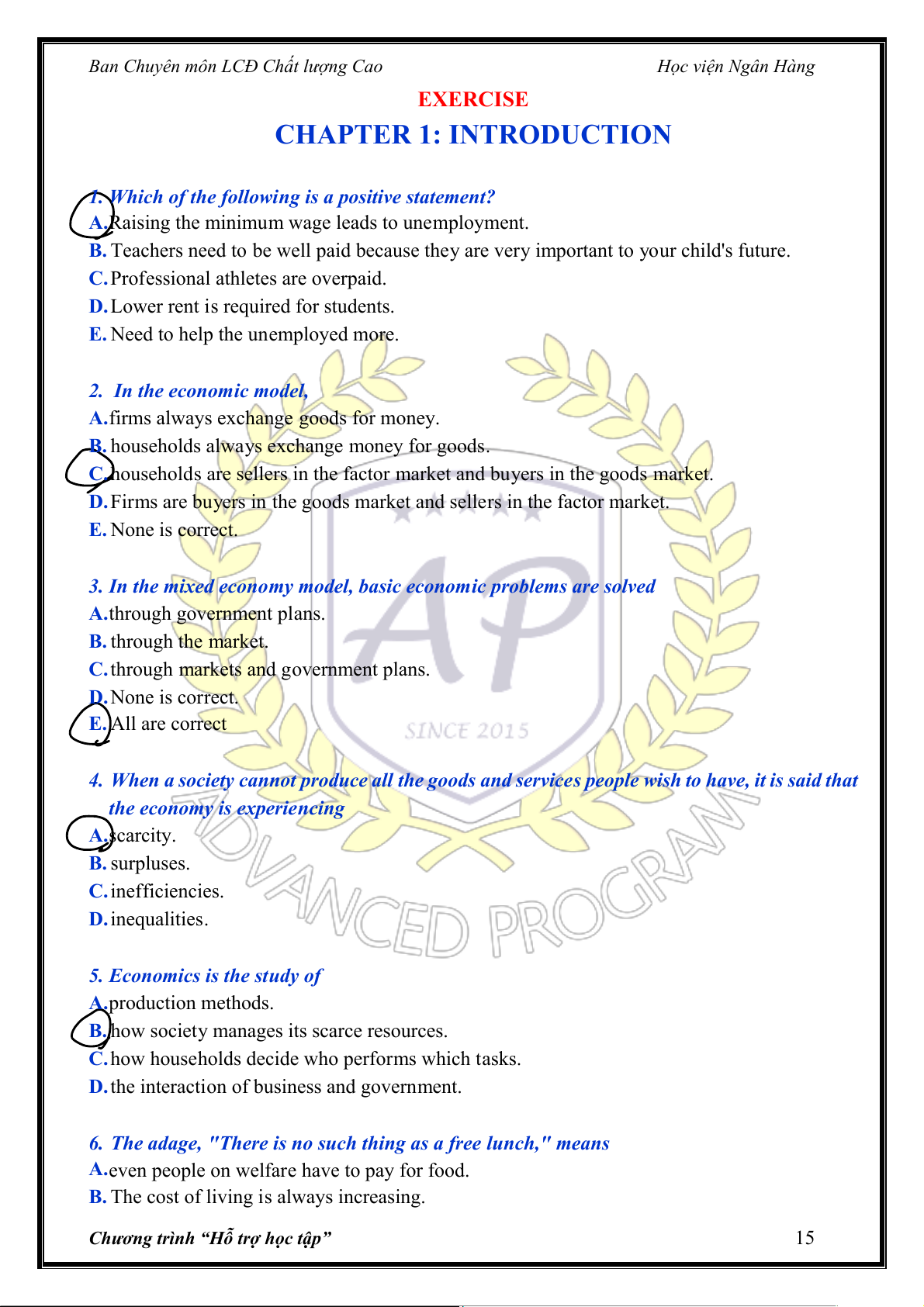
1. Which of the following is a positive statement?
A. Raising the minimum wage leads to unemployment.
B. Teachers need to be well paid because they are very important to your child's future.
C. Professional athletes are overpaid.
D. Lower rent is required for students.
E. Need to help the unemployed more.
2. In the economic model,
A. firms always exchange goods for money.
B. households always exchange money for goods.
C. households are sellers in the factor market and buyers in the goods market.
D. Firms are buyers in the goods market and sellers in the factor market. E. None is correct.
3. In the mixed economy model, basic economic problems are solved
A. through government plans. B. through the market.
C. through markets and government plans. D. None is correct. E. All are correct
4. When a society cannot produce all the goods and services people wish to have, it is said that
the economy is experiencing A. scarcity. B. surpluses. C. inefficiencies. D. inequalities.
5. Economics is the study of A. production methods.
B. how society manages its scarce resources.
C. how households decide who performs which tasks.
D. the interaction of business and government.
6. The adage, "There is no such thing as a free lunch," means
A. even people on welfare have to pay for food.
B. The cost of living is always increasing.
Chương trình “Hỗ trợ học tập” 15
Ban Chuyên môn LCĐ Chất lượng Cao
Học viện Ngân Hàng
C. people face tradeoffs.
D. all costs are included in the price of a product.
7. The principle that "people face tradeoffs" applies to A. individuals. B. families. C. societies.
D. All of the above are correct.
8. Sophia is planning her activities for a hot summer day. She would like to go to the local
swimming pool and see the latest blockbuster movie, but because she can only get tickets to
the movie for the same time that the pool is open she can only choose one activity. This
illustrates the basic principle that
A. people respond to incentives.
B. rational people think at the margin.
C. people face tradeoffs.
D. improvements in efficiency sometimes come at the expense of equality.
9. Efficiency means that
A. society is conserving resources in order to save them for the future.
B. society's goods and services are distributed equally among society's members.
C. society's goods and services are distributed fairly, though not necessarily equally, among society's members.
D. society is getting the maximum benefits from its scarce resources.
10. When the government attempts to improve equality in an economy the result is often
A. an increase in overall output in the economy.
B. additional government revenue since overall income will increase.
C. a reduction in equality.
D. a reduction in efficiency.
11. In economics, the cost of something is
A. the dollar amount of obtaining it.
B. always measured in units of time given up to get it.
C. what you give up to get it.
D. often impossible to quantify, even in principle.
12. When computing the opportunity cost of attending a concert you should include
A. the price you pay for the ticket and the value of your time.
B. the price you pay for the ticket, but not the value of your time.
Chương trình “Hỗ trợ học tập” 16
Ban Chuyên môn LCĐ Chất lượng Cao
Học viện Ngân Hàng
C. the value of your time, but not the price you pay for the ticket.
D. neither the price of the ticket nor the value of your time.
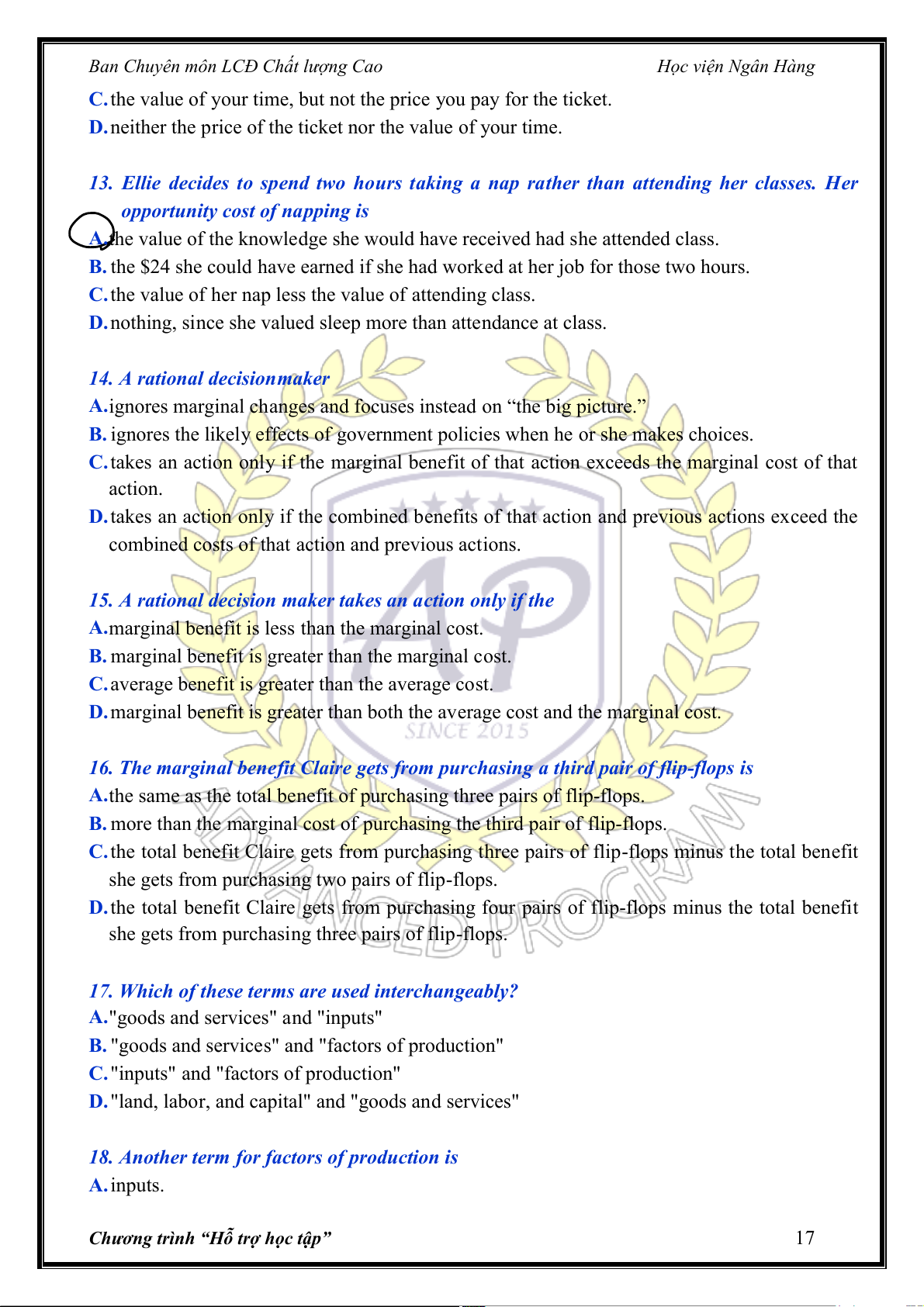
13. Ellie decides to spend two hours taking a nap rather than attending her classes. Her
opportunity cost of napping is
A. the value of the knowledge she would have received had she attended class.
B. the $24 she could have earned if she had worked at her job for those two hours.
C. the value of her nap less the value of attending class.
D. nothing, since she valued sleep more than attendance at class.
14. A rational decisionmaker
A. ignores marginal changes and focuses instead on “the big picture.”
B. ignores the likely effects of government policies when he or she makes choices.
C. takes an action only if the marginal benefit of that action exceeds the marginal cost of that action.
D. takes an action only if the combined benefits of that action and previous actions exceed the
combined costs of that action and previous actions.
15. A rational decision maker takes an action only if the
A. marginal benefit is less than the marginal cost.
B. marginal benefit is greater than the marginal cost.
C. average benefit is greater than the average cost.
D. marginal benefit is greater than both the average cost and the marginal cost.
16. The marginal benefit Claire gets from purchasing a third pair of flip-flops is
A. the same as the total benefit of purchasing three pairs of flip-flops.
B. more than the marginal cost of purchasing the third pair of flip-flops.
C. the total benefit Claire gets from purchasing three pairs of flip-flops minus the total benefit
she gets from purchasing two pairs of flip-flops.
D. the total benefit Claire gets from purchasing four pairs of flip-flops minus the total benefit
she gets from purchasing three pairs of flip-flops.
17. Which of these terms are used interchangeably?
A. "goods and services" and "inputs"
B. "goods and services" and "factors of production"
C. "inputs" and "factors of production"
D. "land, labor, and capital" and "goods and services"
18. Another term for factors of production is A. inputs.
Chương trình “Hỗ trợ học tập” 17
Ban Chuyên môn LCĐ Chất lượng Cao
Học viện Ngân Hàng B. output. C. goods. D. services.
19. In economics, capital refers to
A. the finances necessary for firms to produce their products.
B. buildings and machines used in the production process.
C. the money households use to purchase firms' output. D. stocks and bonds.
20. When an economy is operating inside its production possibilities frontier, we know that
A. there are unused resources or inefficiencies in the economy.
B. all of the economy’s resources are fully employed.
C. economic growth would have to occur in order for the economy to move to a point on the frontier.
D. in order to produce more of one good, the economy would have to give up some of the other good.
21. Unemployment would cause an economy to
A. produce inside its production possibilities frontier.
B. produce on its production possibilities frontier.
C. produce outside its production possibilities frontier.
D. experience an inward shift of its production possibilities frontier.
22. The production possibilities frontier provides an illustration of the principle that
A. trade can make everyone better off.
B. governments can sometimes improve market outcomes.
C. people face trade-offs.
D. people respond to incentives.
23. Microeconomics is the study of
A. how money affects the economy.
B. how individual households and firms make decisions.
C. how government affects the economy.
D. how the economy as a whole works.
24. Macroeconomics is the study of
A. individual decision makers.
B. international trade.
C. economy-wide phenomena.
Chương trình “Hỗ trợ học tập” 18
Ban Chuyên môn LCĐ Chất lượng Cao
Học viện Ngân Hàng
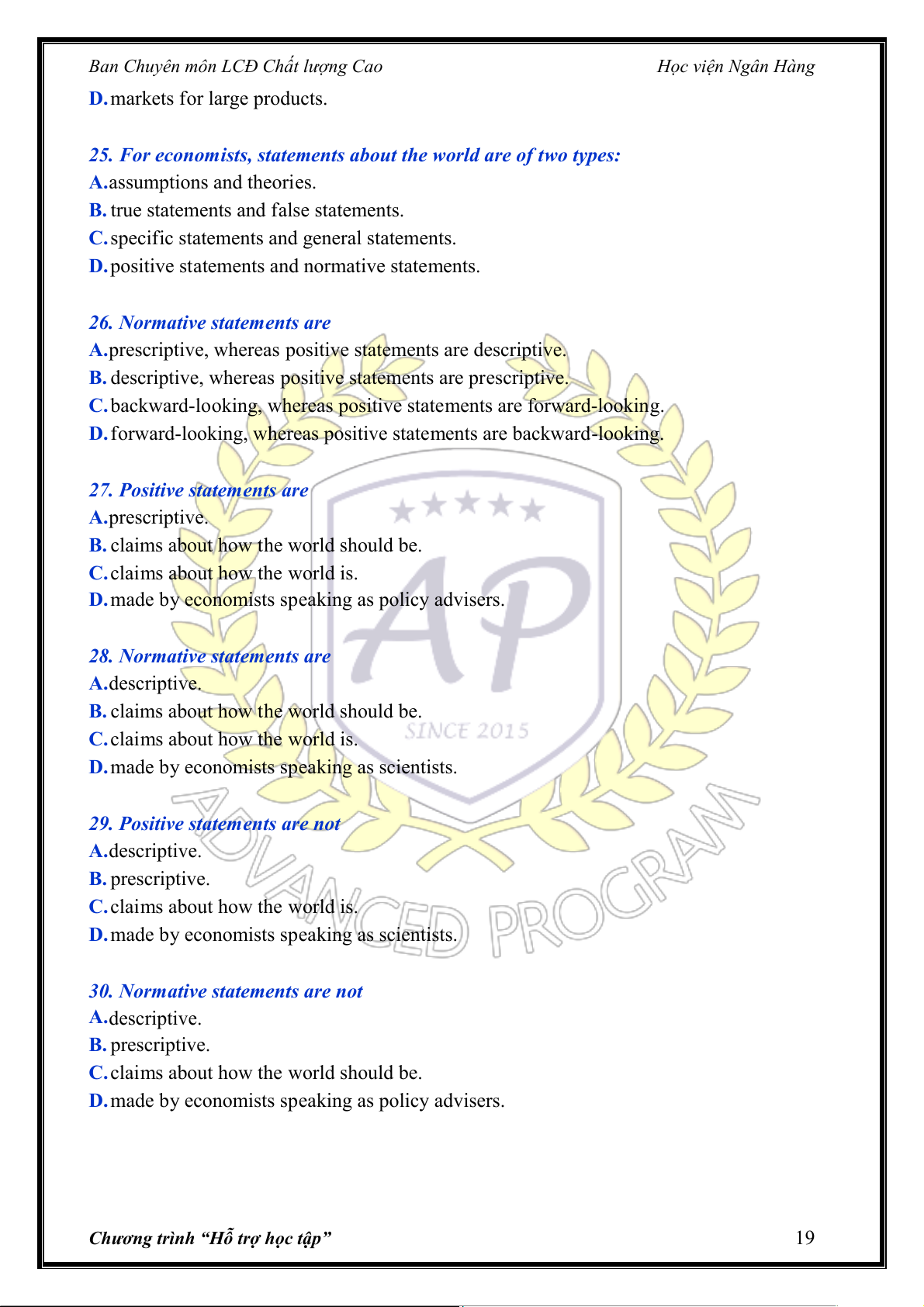
D. markets for large products.
25. For economists, statements about the world are of two types:
A. assumptions and theories.
B. true statements and false statements.
C. specific statements and general statements.
D. positive statements and normative statements.
26. Normative statements are
A. prescriptive, whereas positive statements are descriptive.
B. descriptive, whereas positive statements are prescriptive.
C. backward-looking, whereas positive statements are forward-looking.
D. forward-looking, whereas positive statements are backward-looking.
27. Positive statements are A. prescriptive.
B. claims about how the world should be.
C. claims about how the world is.
D. made by economists speaking as policy advisers.
28. Normative statements are A. descriptive.
B. claims about how the world should be.
C. claims about how the world is.
D. made by economists speaking as scientists.
29. Positive statements are not A. descriptive. B. prescriptive.
C. claims about how the world is.
D. made by economists speaking as scientists.
30. Normative statements are not
A. descriptive. B. prescriptive.
C. claims about how the world should be.
D. made by economists speaking as policy advisers.
Chương trình “Hỗ trợ học tập” 19
Ban Chuyên môn LCĐ Chất lượng Cao
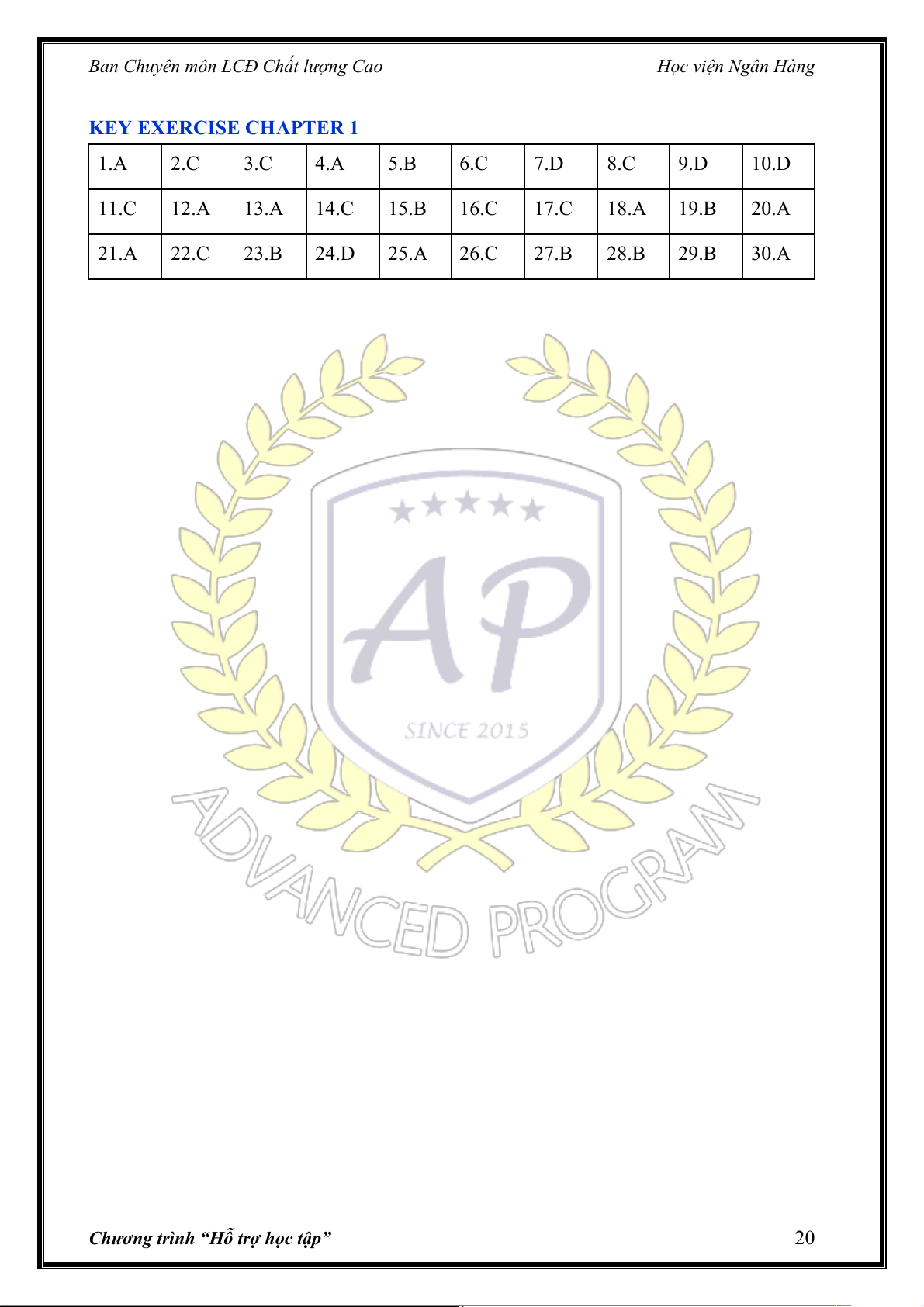
Học viện Ngân Hàng KEY EXERCISE CHAPTER 1 1.A 2.C 3.C 4.A 5.B 6.C 7.D 8.C 9.D 10.D 11.C 12.A 13.A 14.C 15.B 16.C 17.C 18.A 19.B 20.A 21.A 22.C 23.B 24.D 25.A 26.C 27.B 28.B 29.B 30.A
Chương trình “Hỗ trợ học tập” 20
Tài liệu liên quan:
-
Tự Luận Vimo: Phân Tích Cung, Cầu và Thị Trường Cạnh Tranh| Microeconomics | Trường Đại học Quốc tế, Đại học Quốc gia Thành phố Hồ Chí Minh
5 3 -
Review Questions: Thinking Like an Economist | Microeconomics | Trường Đại học Quốc tế, Đại học Quốc gia Thành phố Hồ Chí Minh
5 3 -
Final Exam Quizlet Questions & Answers | Microeconomics | Trường Đại học Quốc tế, Đại học Quốc gia Thành phố Hồ Chí Minh
5 3 -
Đề thi giữa kỳ II | Microeconomics | Trường Đại học Quốc tế, Đại học Quốc gia Thành phố Hồ Chí Minh
5 3 -
Final Group Project_ The Beer Industry | Microeconomics | Trường Đại học Quốc tế, Đại học Quốc gia Thành phố Hồ Chí Minh
4 2