Detailed Syllabus for Microeconomics | Microeconomics | Trường Đại học Quốc tế, Đại học Quốc gia Thành phố Hồ Chí Minh
Microeconomics 1 (microeconomics principles) is an introductory undergraduate course that teaches the fundamentals of microeconomics. At NEU, this is the first course that students study in economics. For learners, this is a module that provides a solid foundation for economic thinking and analysis that can last throughout their academic and professional careers. For other students, it can provide the foundation for many years of study in economics, business or related fields. Tài liệu được sưu tầm và soạn thảo dưới dạng file PDF để gửi tới các bạn cùng tham khảo, ôn tập đầy đủ kiến thức, chuẩn bị cho các buổi học thật tốt. Mời bạn đọc đón xem!
Môn: Microeconomics 613 tài liệu
Trường: Trường Đại học Quốc tế, Đại học Quốc gia Thành phố Hồ Chí Minh 1.9 K tài liệu
Tác giả:

Preview text:
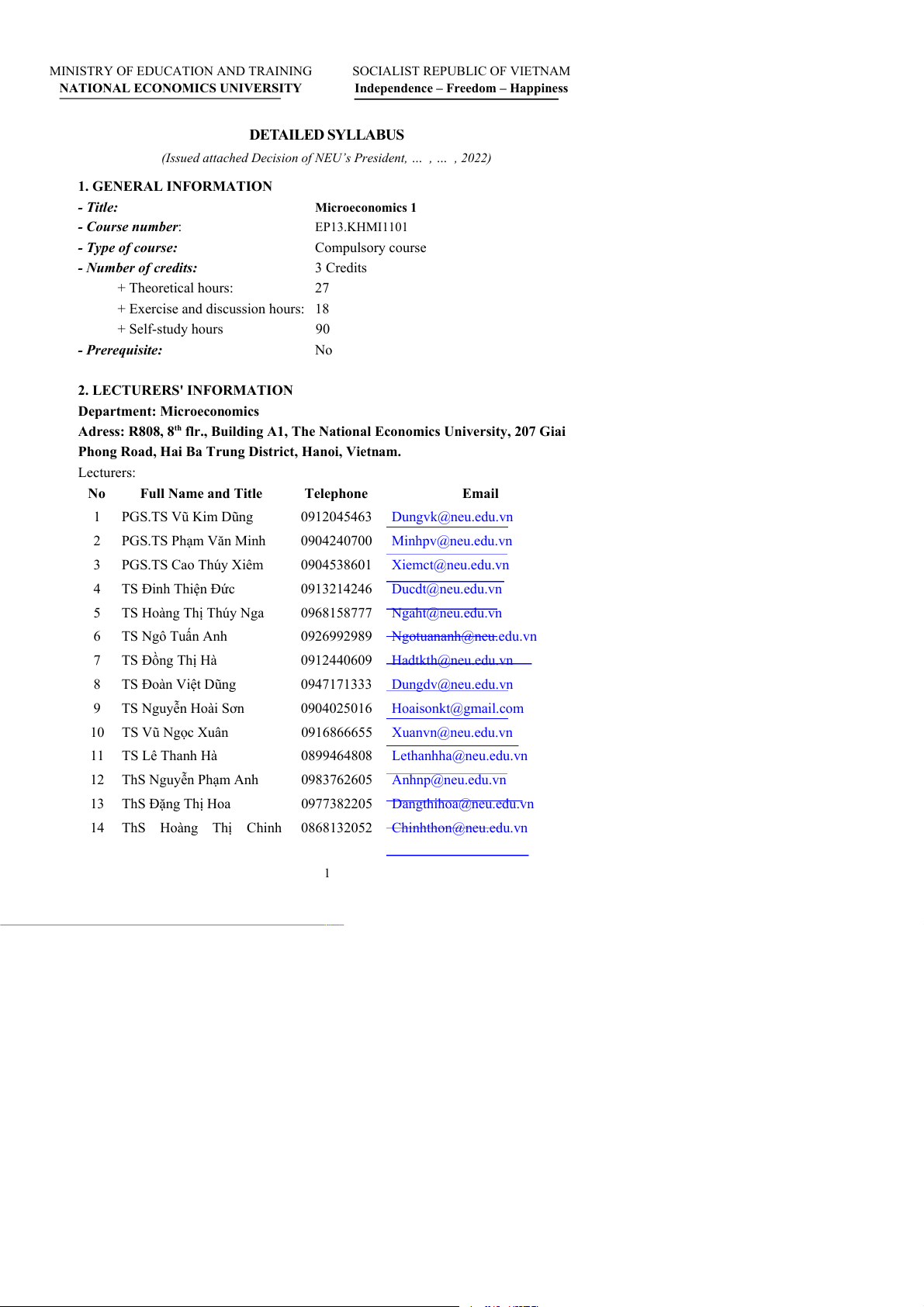
MINISTRY OF EDUCATION AND TRAINING SOCIALIST REPUBLIC OF VIETNAM
NATIONAL ECONOMICS UNIVERSITY
Independence – Freedom – Happiness DETAILED SYLLABUS
(Issued attached Decision of NEU’s President, … , … , 2022) 1. GENERAL INFORMATION - Title: Microeconomics 1
- Course number: EP13.KHMI1101
- Type of course: Compulsory course
- Number of credits: 3 Credits + Theoretical hours: 27
+ Exercise and discussion hours: 18 + Self-study hours 90 - Prerequisite: No
2. LECTURERS' INFORMATION
Department: Microeconomics
Adress: R808, 8th flr., Building A1, The National Economics University, 207 Giai
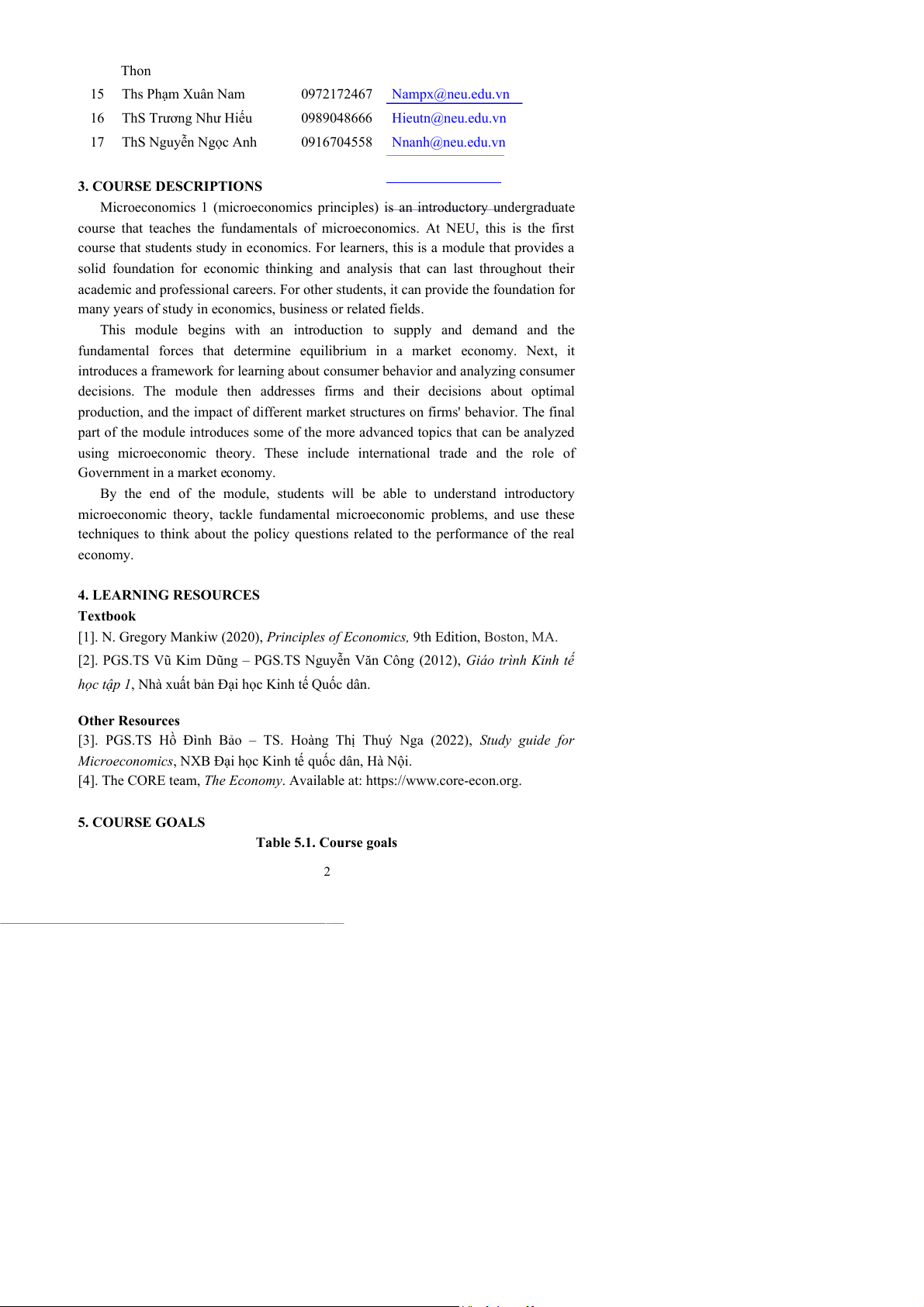
Phong Road, Hai Ba Trung District, Hanoi, Vietnam. Lecturers: No Full Name and Title Telephone Email 1 PGS.TS Vũ Kim Dũng 0912045463 Dungvk@neu.edu.vn 2 PGS.TS Phạm Văn Minh 0904240700 Minhpv@neu.edu.vn 3 PGS.TS Cao Thúy Xiêm 0904538601 Xiemct@neu.edu.vn 4 TS Đinh Thiện Đức 0913214246 Ducdt@neu.edu.vn 5 TS Hoàng Thị Thúy Nga 0968158777 Ngaht@neu.edu.vn 6 TS Ngô Tuấn Anh 0926992989 Ngotuananh@neu.edu.vn 7 TS Đồng Thị Hà 0912440609 Hadtkth@neu.edu.vn 8 TS Đoàn Việt Dũng 0947171333 Dungdv@neu.edu.vn 9 TS Nguyễn Hoài Sơn 0904025016 Hoaisonkt@gmail.com 10 TS Vũ Ngọc Xuân 0916866655 Xuanvn@neu.edu.vn 11 TS Lê Thanh Hà 0899464808 Lethanhha@neu.edu.vn 12 ThS Nguyễn Phạm Anh 0983762605 Anhnp@neu.edu.vn 13 ThS Đặng Thị Hoa 0977382205 Dangthihoa@neu.edu.vn 14 ThS Hoàng Thị Chinh 0868132052 Chinhthon@neu.edu.vn 1 Thon 15 Ths Phạm Xuân Nam 0972172467 Nampx@neu.edu.vn 16 ThS Trương Như Hiếu 0989048666 Hieutn@neu.edu.vn 17 ThS Nguyễn Ngọc Anh 0916704558 Nnanh@neu.edu.vn 3. COURSE DESCRIPTIONS
Microeconomics 1 (microeconomics principles) is an introductory undergraduate
course that teaches the fundamentals of microeconomics. At NEU, this is the first
course that students study in economics. For learners, this is a module that provides a
solid foundation for economic thinking and analysis that can last throughout their
academic and professional careers. For other students, it can provide the foundation for
many years of study in economics, business or related fields.
This module begins with an introduction to supply and demand and the
fundamental forces that determine equilibrium in a market economy. Next, it
introduces a framework for learning about consumer behavior and analyzing consumer
decisions. The module then addresses firms and their decisions about optimal
production, and the impact of different market structures on firms' behavior. The final
part of the module introduces some of the more advanced topics that can be analyzed
using microeconomic theory. These include international trade and the role of
Government in a market economy.
By the end of the module, students will be able to understand introductory
microeconomic theory, tackle fundamental microeconomic problems, and use these
techniques to think about the policy questions related to the performance of the real economy. 4. LEARNING RESOURCES Textbook
[1]. N. Gregory Mankiw (2020), Principles of Economics, 9th Edition, Boston, MA.
[2]. PGS.TS Vũ Kim Dũng – PGS.TS Nguyễn Văn Công (2012), Giáo trình Kinh tế
học tập 1, Nhà xuất bản Đại học Kinh tế Quốc dân. Other Resources
[3]. PGS.TS Hồ Đình Bảo – TS. Hoàng Thị Thuý Nga (2022), Study guide for
Microeconomics, NXB Đại học Kinh tế quốc dân, Hà Nội.
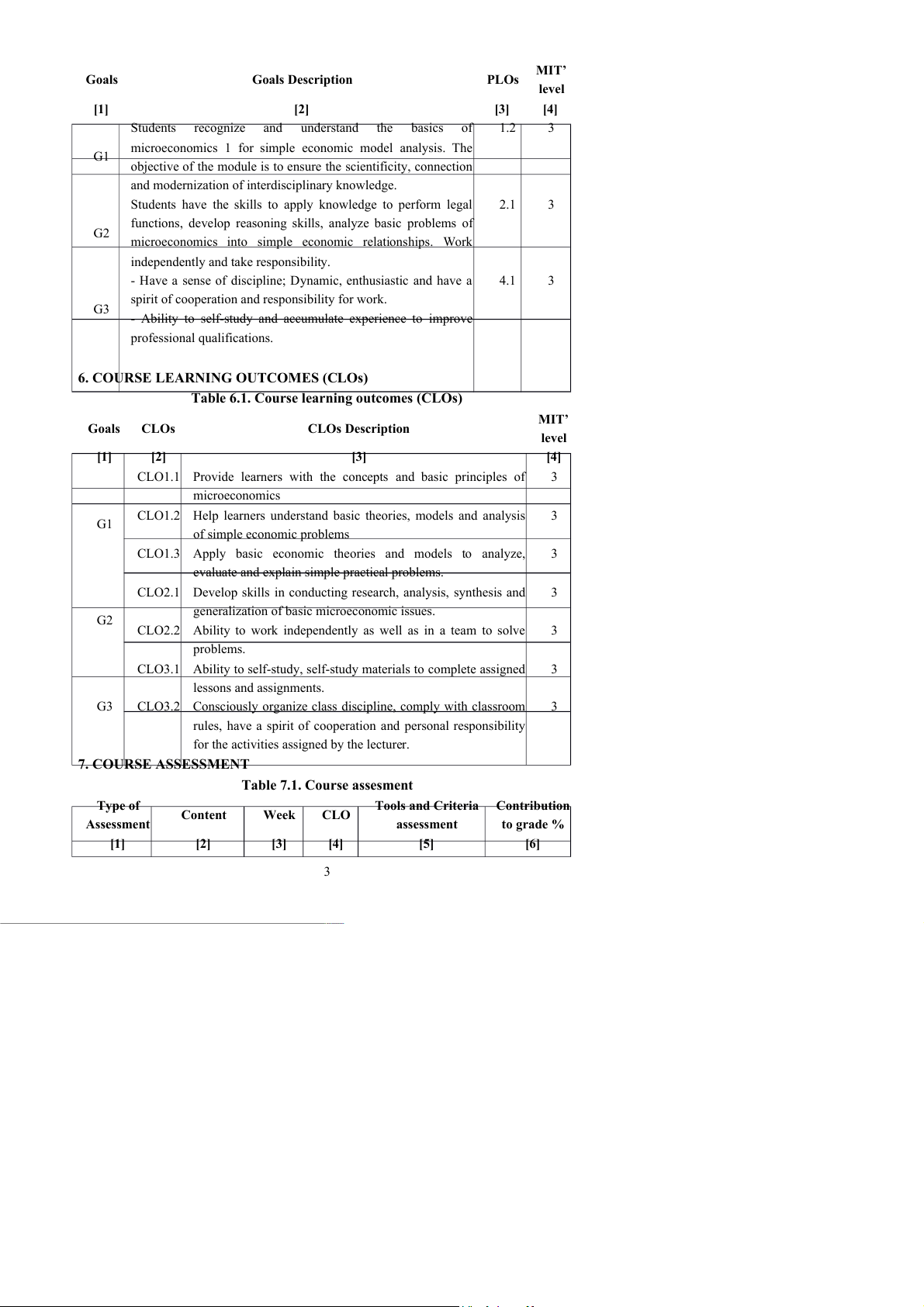
[4]. The CORE team, The Economy. Available at: https://www.core-econ.org. 5. COURSE GOALS Table 5.1. Course goals 2 MIT’ Goals Goals Description PLOs level [1] [2] [3] [4]
Students recognize and understand the basics of 1.2 3
microeconomics 1 for simple economic model analysis. The G1
objective of the module is to ensure the scientificity, connection
and modernization of interdisciplinary knowledge.
Students have the skills to apply knowledge to perform legal 2.1 3
functions, develop reasoning skills, analyze basic problems of G2
microeconomics into simple economic relationships. Work
independently and take responsibility.
- Have a sense of discipline; Dynamic, enthusiastic and have a 4.1 3
spirit of cooperation and responsibility for work. G3
- Ability to self-study and accumulate experience to improve professional qualifications.
6. COURSE LEARNING OUTCOMES (CLOs)
Table 6.1. Course learning outcomes (CLOs) MIT’ Goals CLOs CLOs Description level [1] [2] [3] [4]
CLO1.1 Provide learners with the concepts and basic principles of 3 microeconomics
CLO1.2 Help learners understand basic theories, models and analysis 3 G1 of simple economic problems
CLO1.3 Apply basic economic theories and models to analyze, 3
evaluate and explain simple practical problems.
CLO2.1 Develop skills in conducting research, analysis, synthesis and 3
generalization of basic microeconomic issues. G2
CLO2.2 Ability to work independently as well as in a team to solve 3 problems.
CLO3.1 Ability to self-study, self-study materials to complete assigned 3 lessons and assignments. G3
CLO3.2 Consciously organize class discipline, comply with classroom 3
rules, have a spirit of cooperation and personal responsibility
for the activities assigned by the lecturer. 7. COURSE ASSESSMENT
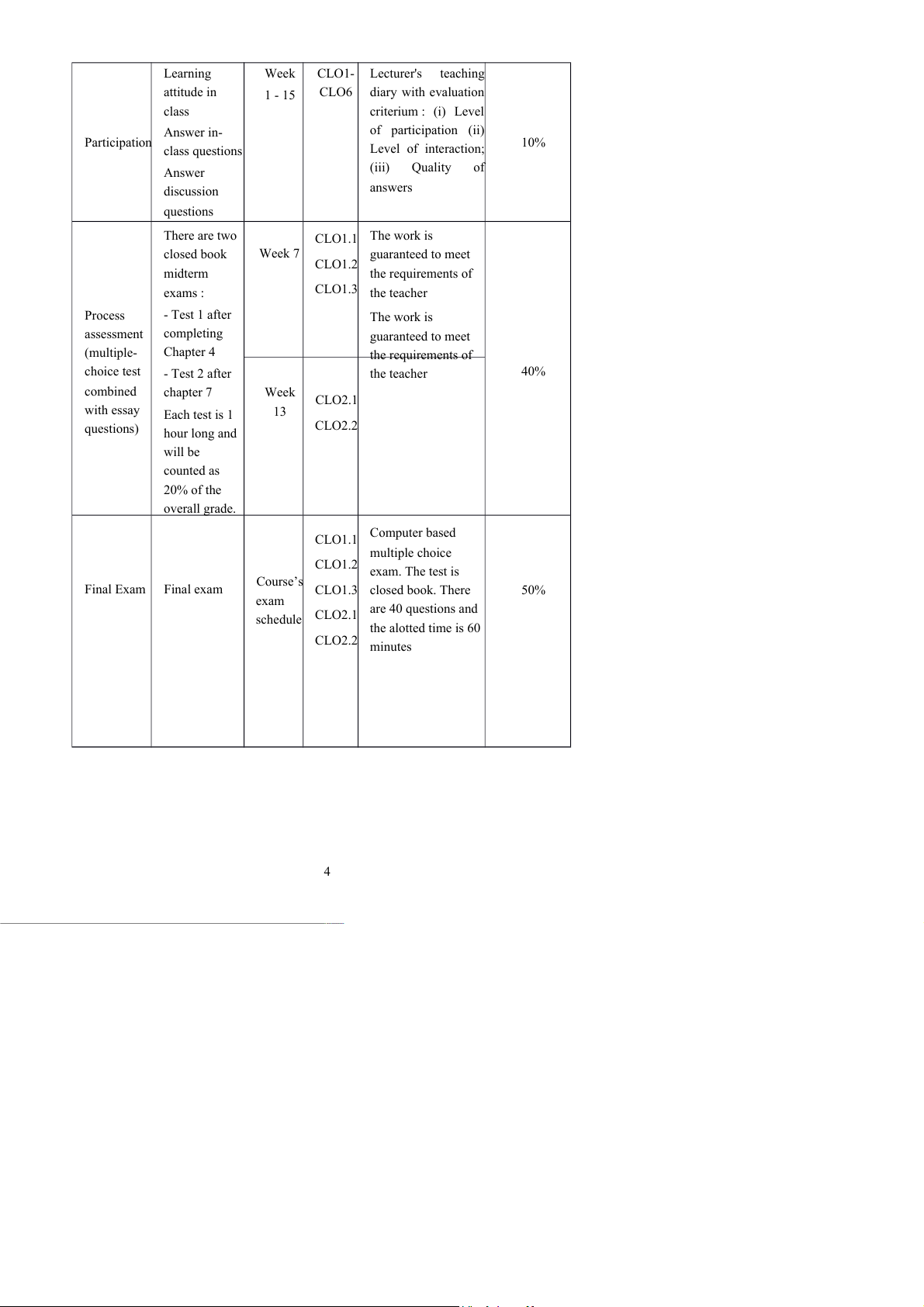
Table 7.1. Course assesment Type of Tools and Criteria Contribution Content Week CLO Assessment assessment to grade % [1] [2] [3] [4] [5] [6] 3 Learning Week CLO1- Lecturer's teaching attitude in 1 - 15 CLO6 diary with evaluation class criterium : (i) Level Answer in- of participation (ii) Participation 10% class questions Level of interaction; Answer (iii) Quality of discussion answers questions There are two CLO1.1 The work is closed book Week 7 guaranteed to meet CLO1.2 midterm the requirements of exams : CLO1.3 the teacher Process - Test 1 after The work is assessment completing guaranteed to meet (multiple- Chapter 4 the requirements of choice test - Test 2 after the teacher 40% combined chapter 7 Week CLO2.1 with essay Each test is 1 13 questions) CLO2.2 hour long and will be counted as 20% of the overall grade. CLO1.1 Computer based multiple choice CLO1.2 exam. The test is Course’s Final Exam Final exam CLO1.3 closed book. There 50% exam are 40 questions and
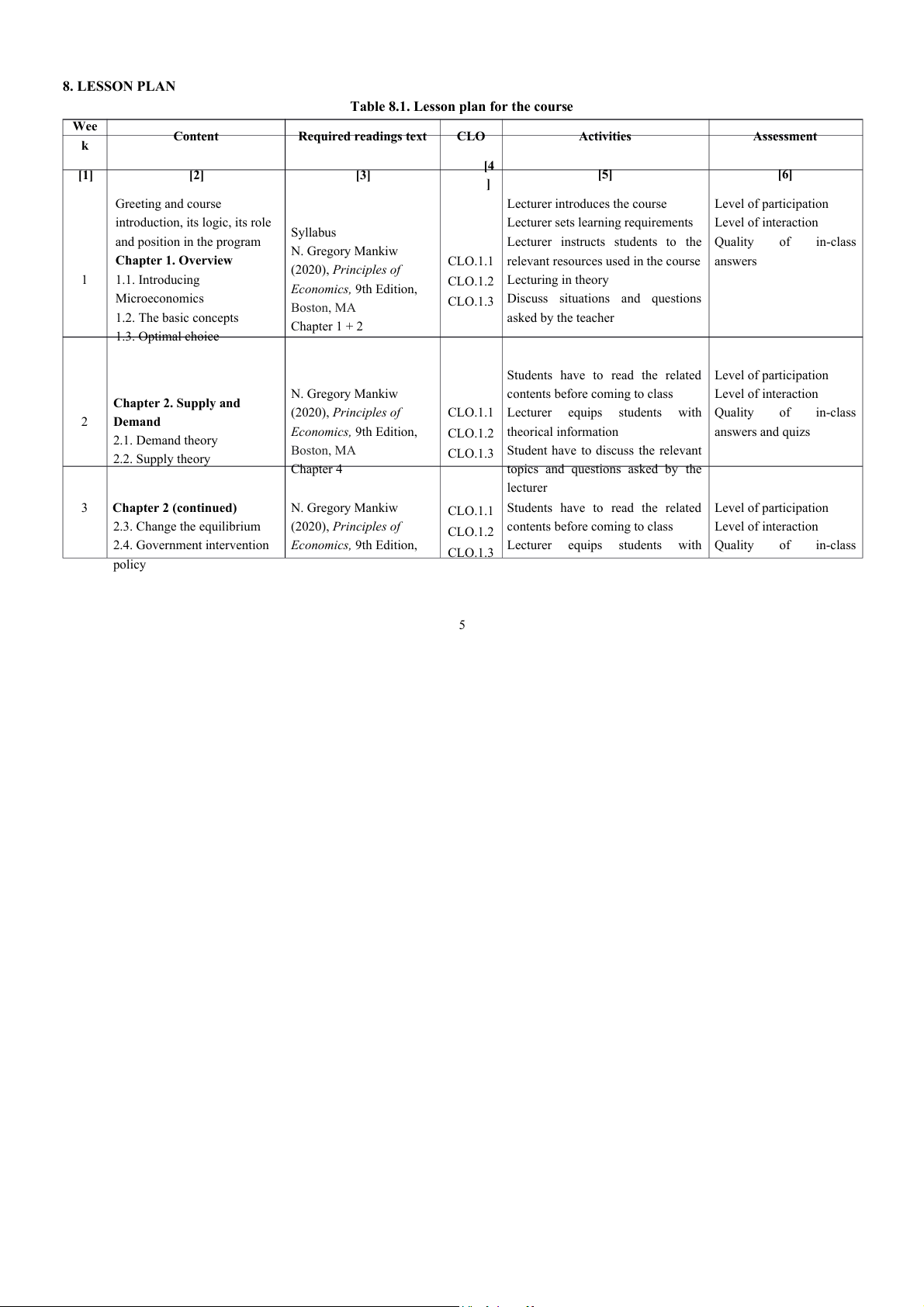
schedule CLO2.1 the alotted time is 60 CLO2.2 minutes 4 8. LESSON PLAN
Table 8.1. Lesson plan for the course Wee Content Required readings text CLO Activities Assessment k [4 [1] [2] [3] [5] [6] ] Greeting and course Lecturer introduces the course Level of participation
introduction, its logic, its role
Lecturer sets learning requirements Level of interaction Syllabus and position in the program
Lecturer instructs students to the Quality of in-class N. Gregory Mankiw Chapter 1. Overview
CLO.1.1 relevant resources used in the course answers (2020), Principles of 1 1.1. Introducing CLO.1.2 Lecturing in theory
Economics, 9th Edition, Microeconomics
Discuss situations and questions Boston, MA CLO.1.3 1.2. The basic concepts asked by the teacher Chapter 1 + 2 1.3. Optimal choice
Students have to read the related Level of participation N. Gregory Mankiw
contents before coming to class Level of interaction Chapter 2. Supply and (2020), Principles of
CLO.1.1 Lecturer equips students with Quality of in-class 2 Demand
Economics, 9th Edition, CLO.1.2 theorical information answers and quizs 2.1. Demand theory Boston, MA
Student have to discuss the relevant 2.2. Supply theory CLO.1.3 Chapter 4
topics and questions asked by the lecturer 3 Chapter 2 (continued) N. Gregory Mankiw
CLO.1.1 Students have to read the related Level of participation 2.3. Change the equilibrium (2020), Principles of
CLO.1.2 contents before coming to class Level of interaction 2.4. Government intervention
Economics, 9th Edition,
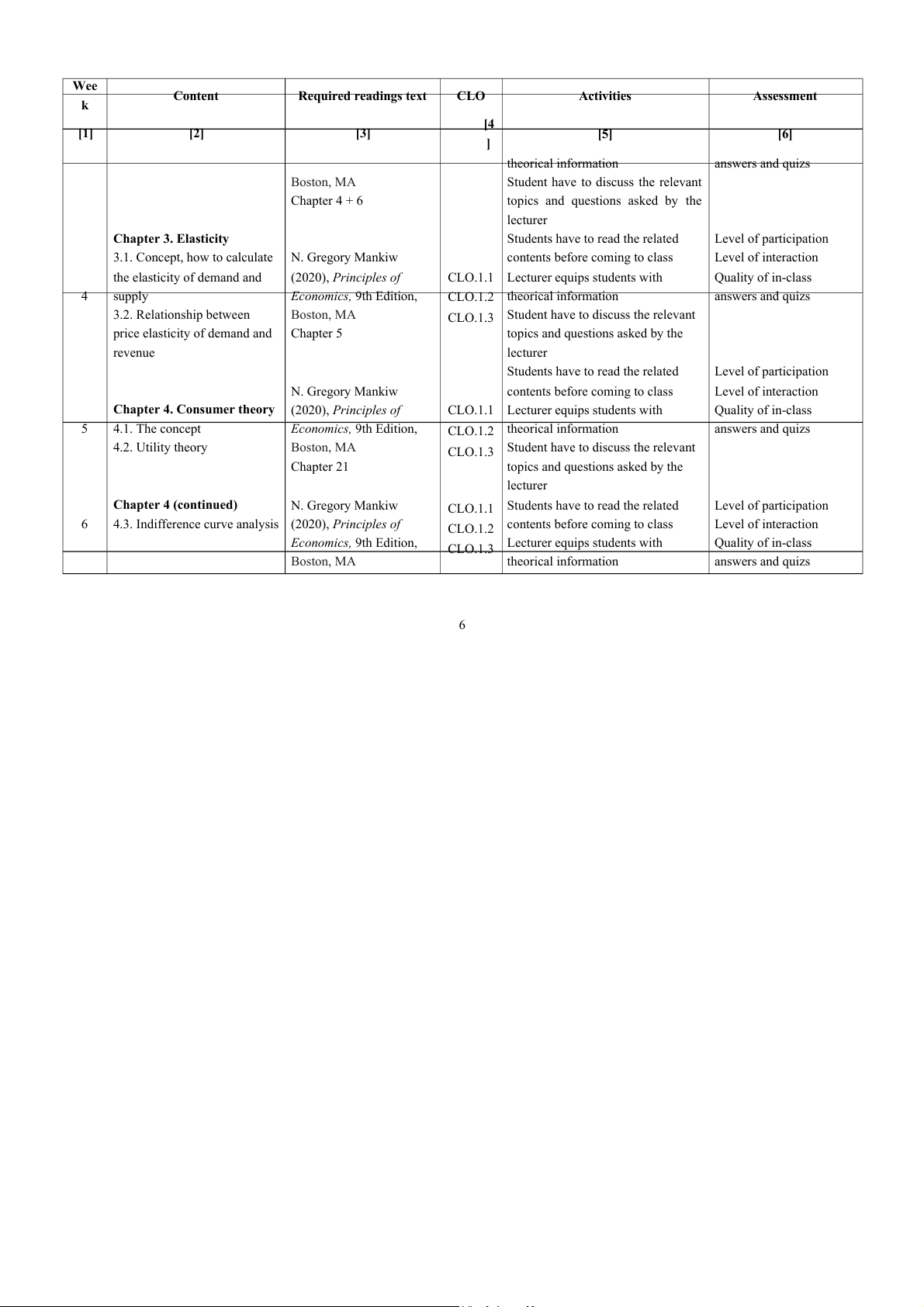
Lecturer equips students with Quality of in-class CLO.1.3 policy 5 Wee Content Required readings text CLO Activities Assessment k [4 [1] [2] [3] [5] [6] ] theorical information answers and quizs Boston, MA
Student have to discuss the relevant Chapter 4 + 6
topics and questions asked by the lecturer Chapter 3. Elasticity
Students have to read the related Level of participation
3.1. Concept, how to calculate N. Gregory Mankiw
contents before coming to class Level of interaction the elasticity of demand and (2020), Principles of
CLO.1.1 Lecturer equips students with Quality of in-class 4 supply
Economics, 9th Edition, CLO.1.2 theorical information answers and quizs 3.2. Relationship between Boston, MA
CLO.1.3 Student have to discuss the relevant
price elasticity of demand and Chapter 5
topics and questions asked by the revenue lecturer
Students have to read the related Level of participation N. Gregory Mankiw
contents before coming to class Level of interaction
Chapter 4. Consumer theory (2020), Principles of
CLO.1.1 Lecturer equips students with Quality of in-class 5 4.1. The concept
Economics, 9th Edition, CLO.1.2 theorical information answers and quizs 4.2. Utility theory Boston, MA
CLO.1.3 Student have to discuss the relevant Chapter 21
topics and questions asked by the lecturer Chapter 4 (continued) N. Gregory Mankiw
CLO.1.1 Students have to read the related Level of participation 6
4.3. Indifference curve analysis (2020), Principles of
CLO.1.2 contents before coming to class Level of interaction
Economics, 9th Edition,
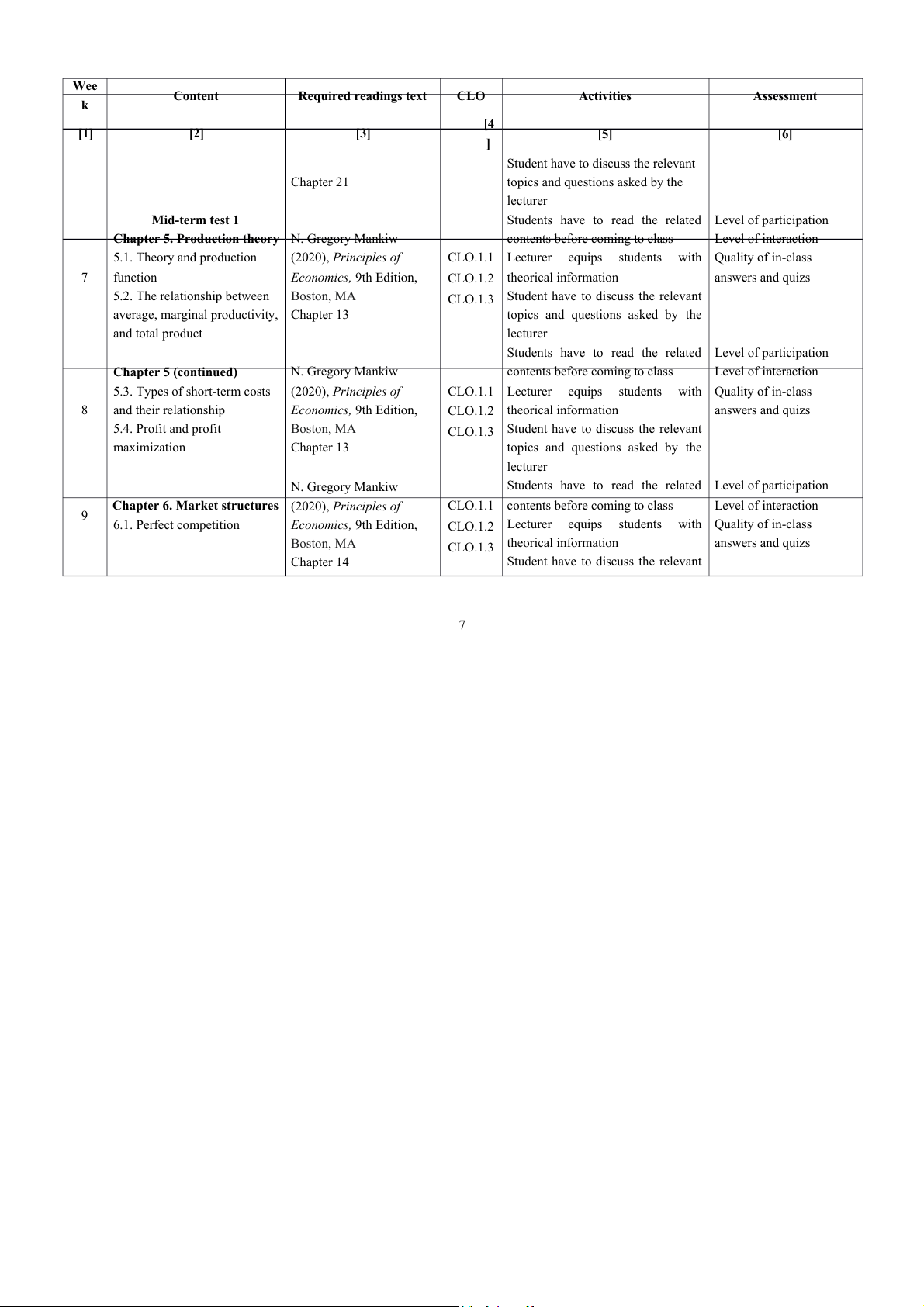
CLO.1.3 Lecturer equips students with Quality of in-class Boston, MA theorical information answers and quizs 6 Wee Content Required readings text CLO Activities Assessment k [4 [1] [2] [3] [5] [6] ]
Student have to discuss the relevant Chapter 21
topics and questions asked by the lecturer Mid-term test 1
Students have to read the related Level of participation
Chapter 5. Production theory N. Gregory Mankiw
contents before coming to class Level of interaction 5.1. Theory and production (2020), Principles of
CLO.1.1 Lecturer equips students with Quality of in-class 7 function
Economics, 9th Edition, CLO.1.2 theorical information answers and quizs 5.2. The relationship between Boston, MA
CLO.1.3 Student have to discuss the relevant
average, marginal productivity, Chapter 13
topics and questions asked by the and total product lecturer
Students have to read the related Level of participation Chapter 5 (continued) N. Gregory Mankiw
contents before coming to class Level of interaction
5.3. Types of short-term costs (2020), Principles of
CLO.1.1 Lecturer equips students with Quality of in-class 8 and their relationship
Economics, 9th Edition, CLO.1.2 theorical information answers and quizs 5.4. Profit and profit Boston, MA
CLO.1.3 Student have to discuss the relevant maximization Chapter 13
topics and questions asked by the lecturer N. Gregory Mankiw
Students have to read the related Level of participation
Chapter 6. Market structures (2020), Principles of
CLO.1.1 contents before coming to class Level of interaction 9 6.1. Perfect competition
Economics, 9th Edition,
CLO.1.2 Lecturer equips students with Quality of in-class Boston, MA CLO.1.3 theorical information answers and quizs Chapter 14
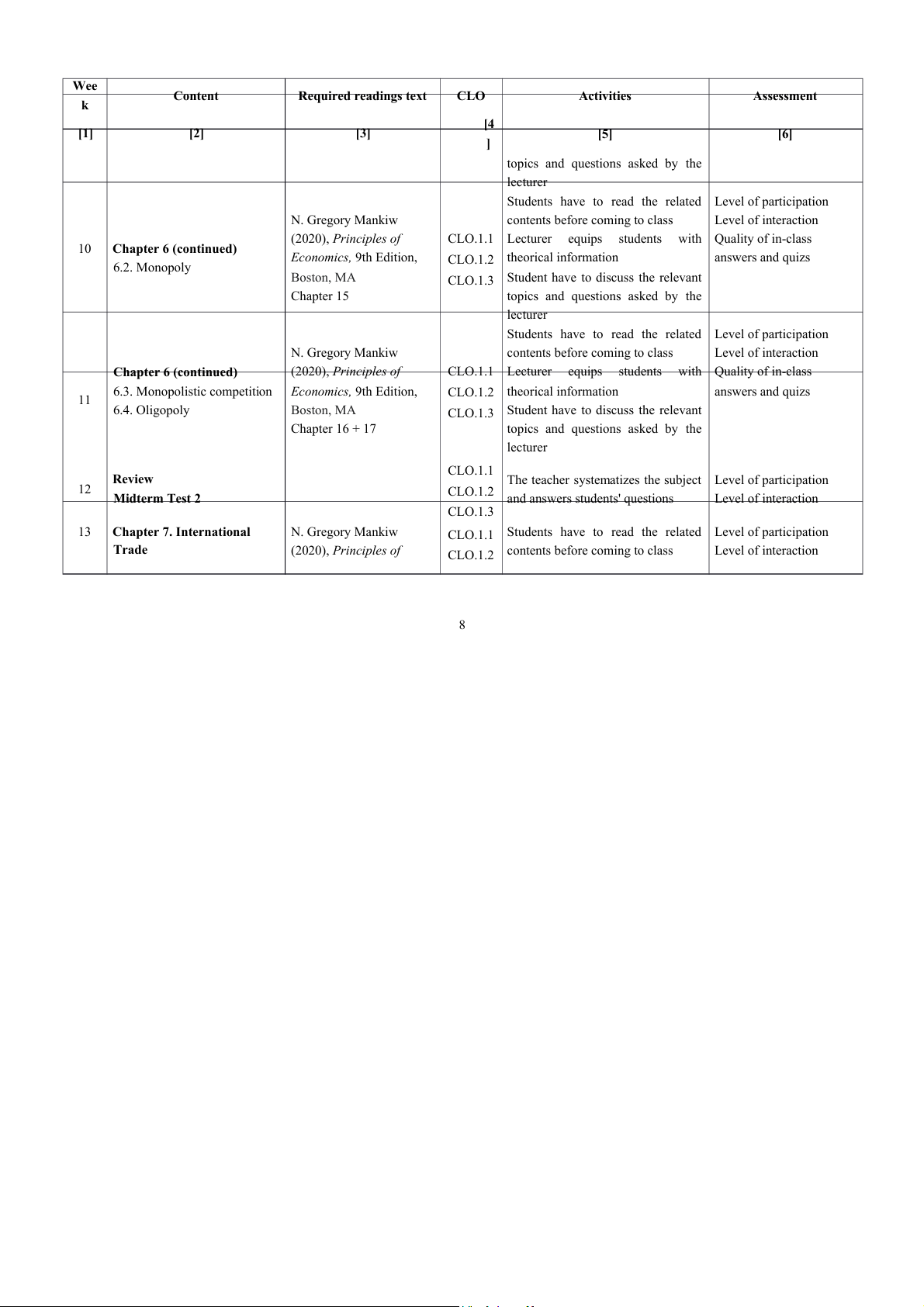
Student have to discuss the relevant 7 Wee Content Required readings text CLO Activities Assessment k [4 [1] [2] [3] [5] [6] ]
topics and questions asked by the lecturer
Students have to read the related Level of participation N. Gregory Mankiw
contents before coming to class Level of interaction (2020), Principles of
CLO.1.1 Lecturer equips students with Quality of in-class 10 Chapter 6 (continued)
Economics, 9th Edition, CLO.1.2 theorical information answers and quizs 6.2. Monopoly Boston, MA
CLO.1.3 Student have to discuss the relevant Chapter 15
topics and questions asked by the lecturer
Students have to read the related Level of participation N. Gregory Mankiw
contents before coming to class Level of interaction Chapter 6 (continued) (2020), Principles of
CLO.1.1 Lecturer equips students with Quality of in-class 6.3. Monopolistic competition
Economics, 9th Edition, CLO.1.2 theorical information answers and quizs 11 6.4. Oligopoly Boston, MA
CLO.1.3 Student have to discuss the relevant Chapter 16 + 17
topics and questions asked by the lecturer CLO.1.1 Review
The teacher systematizes the subject Level of participation 12 CLO.1.2 Midterm Test 2
and answers students' questions Level of interaction CLO.1.3 13
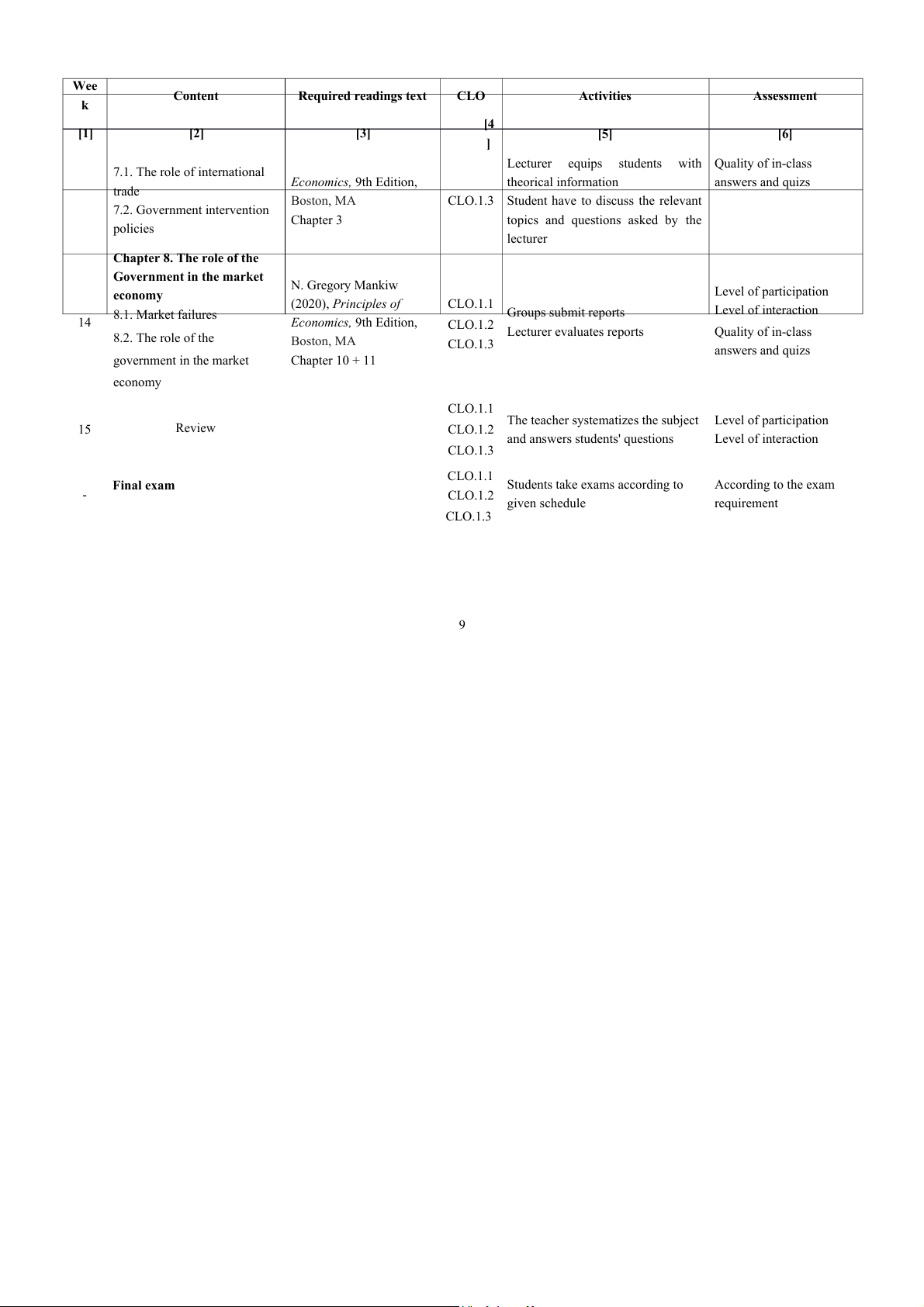
Chapter 7. International N. Gregory Mankiw
CLO.1.1 Students have to read the related Level of participation Trade (2020), Principles of
CLO.1.2 contents before coming to class Level of interaction 8 Wee Content Required readings text CLO Activities Assessment k [4 [1] [2] [3] [5] [6] ]
Lecturer equips students with Quality of in-class
7.1. The role of international
Economics, 9th Edition, theorical information answers and quizs trade Boston, MA
CLO.1.3 Student have to discuss the relevant 7.2. Government intervention Chapter 3
topics and questions asked by the policies lecturer
Chapter 8. The role of the
Government in the market N. Gregory Mankiw economy Level of participation (2020), Principles of CLO.1.1 8.1. Market failures Groups submit reports Level of interaction 14
Economics, 9th Edition, CLO.1.2 8.2. The role of the Lecturer evaluates reports Quality of in-class Boston, MA CLO.1.3 answers and quizs government in the market Chapter 10 + 11 economy
CLO.1.1 The teacher systematizes the subject Level of participation 15 Review
CLO.1.2 and answers students' questions Level of interaction CLO.1.3 CLO.1.1 Final exam
Students take exams according to According to the exam - CLO.1.2 given schedule requirement CLO.1.3 9
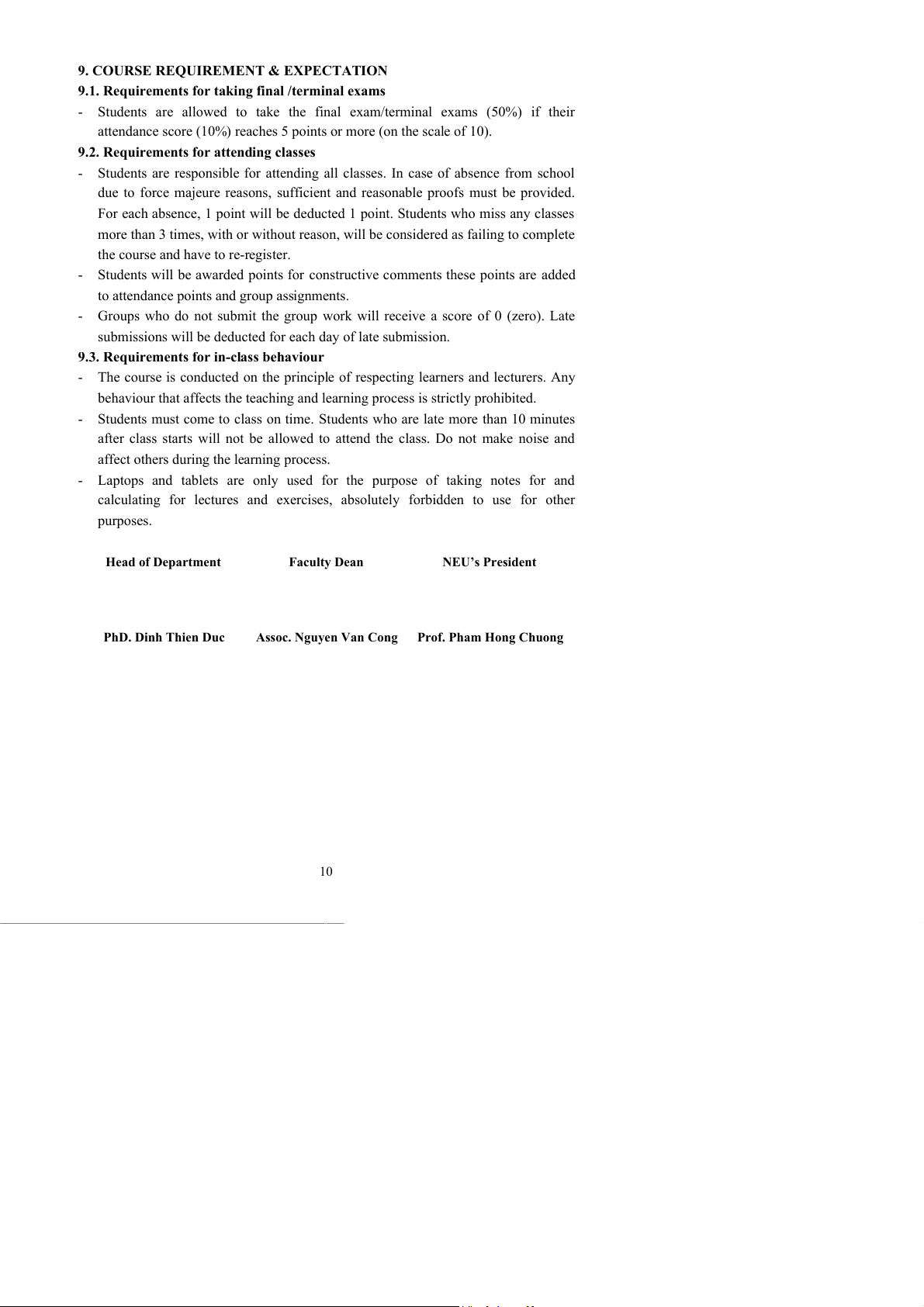
9. COURSE REQUIREMENT & EXPECTATION
9.1. Requirements for taking final /terminal exams
- Students are allowed to take the final exam/terminal exams (50%) if their
attendance score (10%) reaches 5 points or more (on the scale of 10).
9.2. Requirements for attending classes
- Students are responsible for attending all classes. In case of absence from school
due to force majeure reasons, sufficient and reasonable proofs must be provided.
For each absence, 1 point will be deducted 1 point. Students who miss any classes
more than 3 times, with or without reason, will be considered as failing to complete
the course and have to re-register.
- Students will be awarded points for constructive comments these points are added
to attendance points and group assignments.
- Groups who do not submit the group work will receive a score of 0 (zero). Late
submissions will be deducted for each day of late submission.
9.3. Requirements for in-class behaviour
- The course is conducted on the principle of respecting learners and lecturers. Any
behaviour that affects the teaching and learning process is strictly prohibited.
- Students must come to class on time. Students who are late more than 10 minutes
after class starts will not be allowed to attend the class. Do not make noise and
affect others during the learning process.
- Laptops and tablets are only used for the purpose of taking notes for and
calculating for lectures and exercises, absolutely forbidden to use for other purposes. Head of Department Faculty Dean NEU’s President PhD. Dinh Thien Duc Assoc. Nguyen Van Cong Prof. Pham Hong Chuong 10
Tài liệu liên quan:
-
Tự Luận Vimo: Phân Tích Cung, Cầu và Thị Trường Cạnh Tranh| Microeconomics | Trường Đại học Quốc tế, Đại học Quốc gia Thành phố Hồ Chí Minh
5 3 -
Review Questions: Thinking Like an Economist | Microeconomics | Trường Đại học Quốc tế, Đại học Quốc gia Thành phố Hồ Chí Minh
5 3 -
Final Exam Quizlet Questions & Answers | Microeconomics | Trường Đại học Quốc tế, Đại học Quốc gia Thành phố Hồ Chí Minh
5 3 -
Đề thi giữa kỳ II | Microeconomics | Trường Đại học Quốc tế, Đại học Quốc gia Thành phố Hồ Chí Minh
5 3 -
Final Group Project_ The Beer Industry | Microeconomics | Trường Đại học Quốc tế, Đại học Quốc gia Thành phố Hồ Chí Minh
4 2